Cambridge A Level History 9489 — 2024 Oct/Nov Paper 1 · Variant 2
9489/12/O/N/24 · 40 marks · ≈45 min
The question paper and its mark scheme, free to read here and free to download. This is Cambridge’s own paper, exactly as it was sat.
Question paper8 pages

Mark scheme14 pages
Answers below. Sit the paper first if you are practising.
Paper as text
Question paper, page 1
This document has 8 pages. Any blank pages are indicated. [Turn over Cambridge International AS & A Level DC (CE/CT) 337252/3 © UCLES 2024 * 4 0 7 8 0 4 3 1 8 7 * HISTORY 9489/12 Paper 1 Document Question October/November 2024 1 hour 15 minutes You must answer on the enclosed answer booklet. You will need: Answer booklet (enclosed) INSTRUCTIONS ● Answer one question from one section only. Section A: European option Section B: American option Section C: International option ● Follow the instructions on the front cover of the answer booklet. If you need additional answer paper, ask the invigilator for a continuation booklet. INFORMATION ● The total mark for this paper is 40. ● The number of marks for each question or part question is shown in brackets [ ].
Question paper, page 2
2 9489/12/O/N/24 © UCLES 2024 Answer one question from one section only. Section A: European option The Industrial Revolution in Britain, 1750–1850 1 Read the sources and then answer both parts of the question. Source A We demand universal suffrage because it is our right, because we believe it will bring freedom to our country, happiness to our homes. We believe it will give us bread, beef and beer. We are for peace, law and order, but we must have justice. We must have our rights speedily; peaceably if we can, forcibly if we must. The lack of universal suffrage has enabled our oppressors so long to ride rough-shod over us. Until I have the right to vote, I consider myself a slave. I have not the power to vote for the men who make laws, who press me into the military and make the laws by which food is taxed. And so long as they possess the power to make these laws without my consent, I shall consider myself a political slave. I mean to tell the government and the aristocracy that they should not amass fortunes out of the sweat and blood of the poor – that the poor should no longer be starved to supply their luxuries. From a speech made at a Chartist meeting, reported in the ‘Northern Star’, a Chartist newspaper, February 1839. Source B Unhappily, the conflicting opinions of some of the working classes regarding the means of accomplishing the Chartists’ aims have greatly held back the movement. However, we trust that experience has led them to understand that no other means will be so effective as a peaceful combination of the millions, founding their hopes on the power and influence of intellectual and moral progress. Being in favour of such a peaceful organisation, I will set forth the advantages it would possess. First, using moral force will cause great numbers to join us who are currently politically indifferent or have the wrong ideas about the intentions of the Chartists. Disagreement and foolishness have unhappily prevailed. However, Chartism has already been led by knowledge beyond the damaging influence of irresponsible and vindictive physical force supporters. Although prejudice and faction may be an issue for a short time, Chartism is destined to become a great and efficient instrument of moral and intellectual improvement. From an article by William Lovett, a leading Chartist, published in 1840.
Question paper, page 3
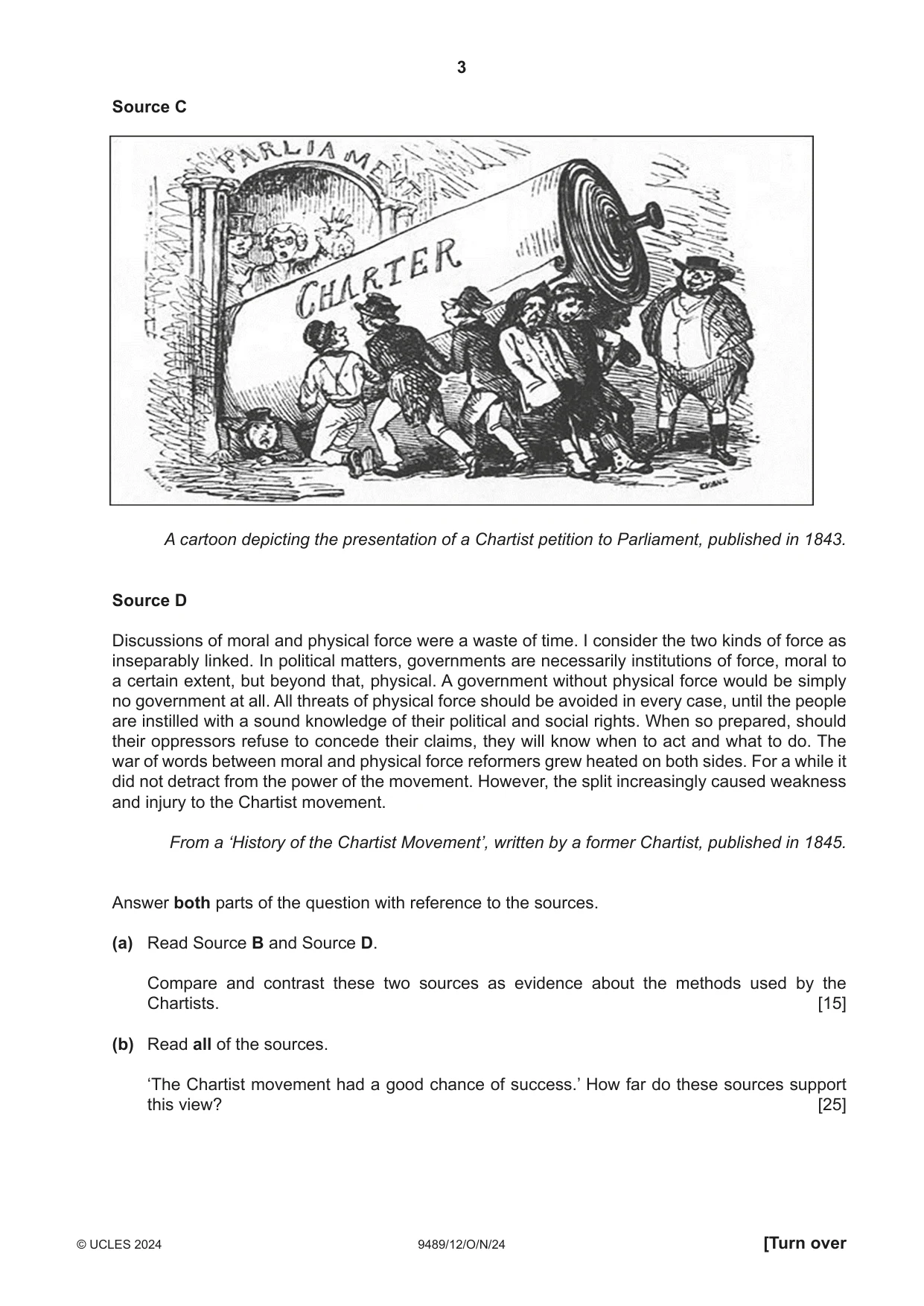
3 9489/12/O/N/24 © UCLES 2024 [Turn over Source C A cartoon depicting the presentation of a Chartist petition to Parliament, published in 1843. Source D Discussions of moral and physical force were a waste of time. I consider the two kinds of force as inseparably linked. In political matters, governments are necessarily institutions of force, moral to a certain extent, but beyond that, physical. A government without physical force would be simply no government at all. All threats of physical force should be avoided in every case, until the people are instilled with a sound knowledge of their political and social rights. When so prepared, should their oppressors refuse to concede their claims, they will know when to act and what to do. The war of words between moral and physical force reformers grew heated on both sides. For a while it did not detract from the power of the movement. However, the split increasingly caused weakness and injury to the Chartist movement. From a ‘History of the Chartist Movement’, written by a former Chartist, published in 1845. Answer both parts of the question with reference to the sources. (a) Read Source B and Source D. Compare and contrast these two sources as evidence about the methods used by the Chartists. [15] (b) Read all of the sources. ‘The Chartist movement had a good chance of success.’ How far do these sources support this view? [25]
Question paper, page 4
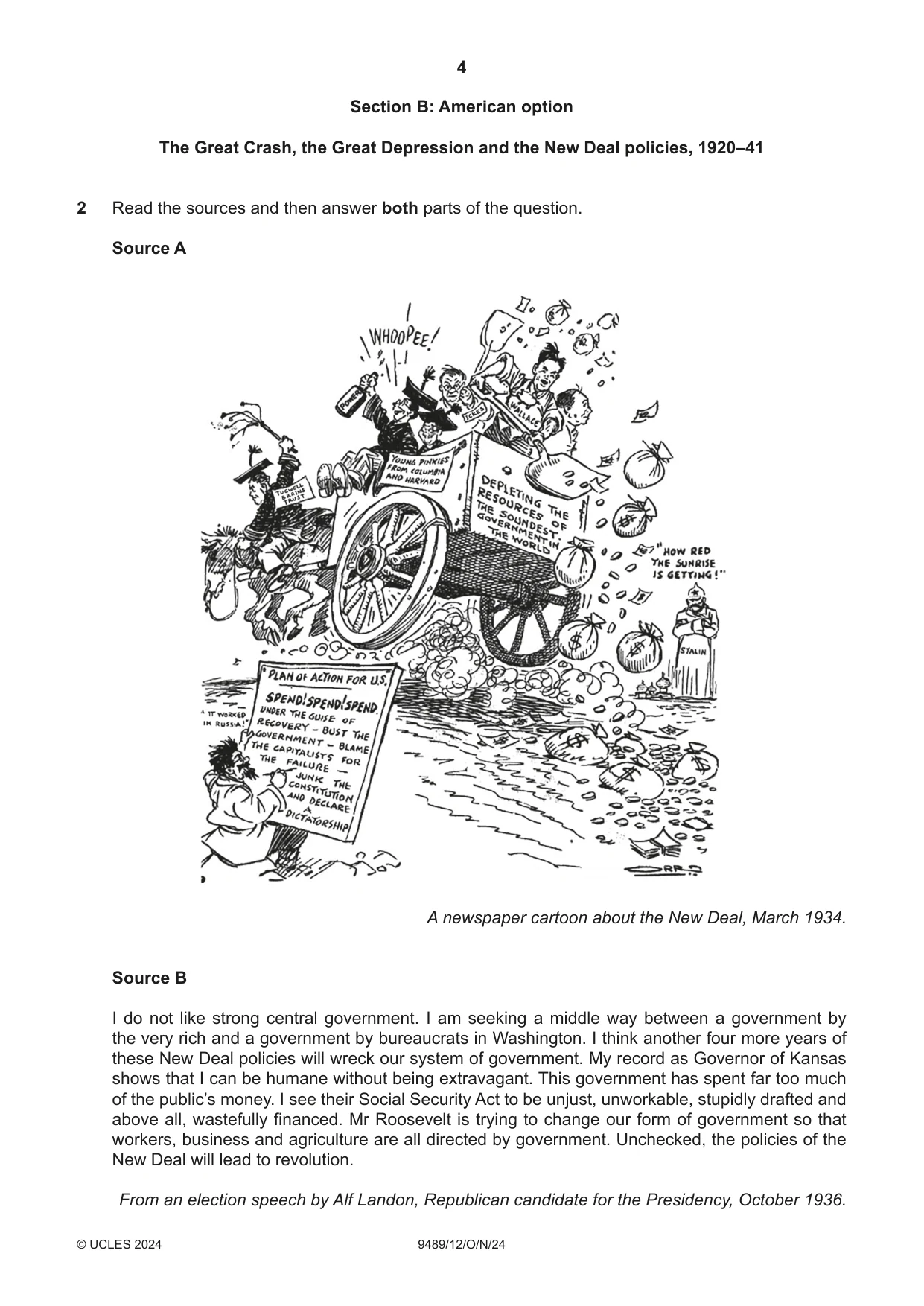
4 9489/12/O/N/24 © UCLES 2024 Section B: American option The Great Crash, the Great Depression and the New Deal policies, 1920–41 2 Read the sources and then answer both parts of the question. Source A A newspaper cartoon about the New Deal, March 1934. Source B I do not like strong central government. I am seeking a middle way between a government by the very rich and a government by bureaucrats in Washington. I think another four more years of these New Deal policies will wreck our system of government. My record as Governor of Kansas shows that I can be humane without being extravagant. This government has spent far too much of the public’s money. I see their Social Security Act to be unjust, unworkable, stupidly drafted and above all, wastefully financed. Mr Roosevelt is trying to change our form of government so that workers, business and agriculture are all directed by government. Unchecked, the policies of the New Deal will lead to revolution. From an election speech by Alf Landon, Republican candidate for the Presidency, October 1936.
Question paper, page 5
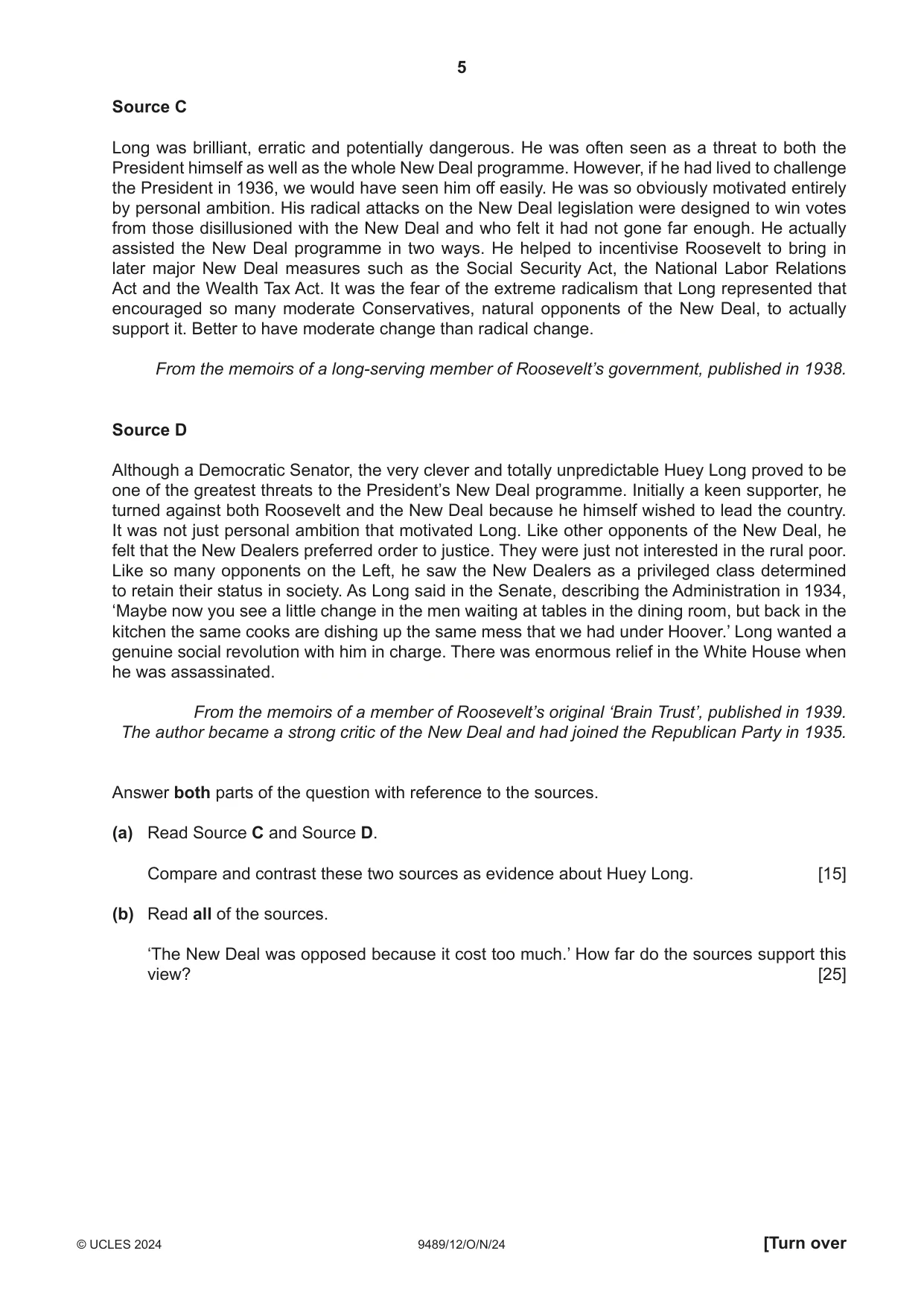
5 9489/12/O/N/24 © UCLES 2024 [Turn over Source C Long was brilliant, erratic and potentially dangerous. He was often seen as a threat to both the President himself as well as the whole New Deal programme. However, if he had lived to challenge the President in 1936, we would have seen him off easily. He was so obviously motivated entirely by personal ambition. His radical attacks on the New Deal legislation were designed to win votes from those disillusioned with the New Deal and who felt it had not gone far enough. He actually assisted the New Deal programme in two ways. He helped to incentivise Roosevelt to bring in later major New Deal measures such as the Social Security Act, the National Labor Relations Act and the Wealth Tax Act. It was the fear of the extreme radicalism that Long represented that encouraged so many moderate Conservatives, natural opponents of the New Deal, to actually support it. Better to have moderate change than radical change. From the memoirs of a long-serving member of Roosevelt’s government, published in 1938. Source D Although a Democratic Senator, the very clever and totally unpredictable Huey Long proved to be one of the greatest threats to the President’s New Deal programme. Initially a keen supporter, he turned against both Roosevelt and the New Deal because he himself wished to lead the country. It was not just personal ambition that motivated Long. Like other opponents of the New Deal, he felt that the New Dealers preferred order to justice. They were just not interested in the rural poor. Like so many opponents on the Left, he saw the New Dealers as a privileged class determined to retain their status in society. As Long said in the Senate, describing the Administration in 1934, ‘Maybe now you see a little change in the men waiting at tables in the dining room, but back in the kitchen the same cooks are dishing up the same mess that we had under Hoover.’ Long wanted a genuine social revolution with him in charge. There was enormous relief in the White House when he was assassinated. From the memoirs of a member of Roosevelt’s original ‘Brain Trust’, published in 1939. The author became a strong critic of the New Deal and had joined the Republican Party in 1935. Answer both parts of the question with reference to the sources. (a) Read Source C and Source D. Compare and contrast these two sources as evidence about Huey Long. [15] (b) Read all of the sources. ‘The New Deal was opposed because it cost too much.’ How far do the sources support this view? [25]
Question paper, page 6
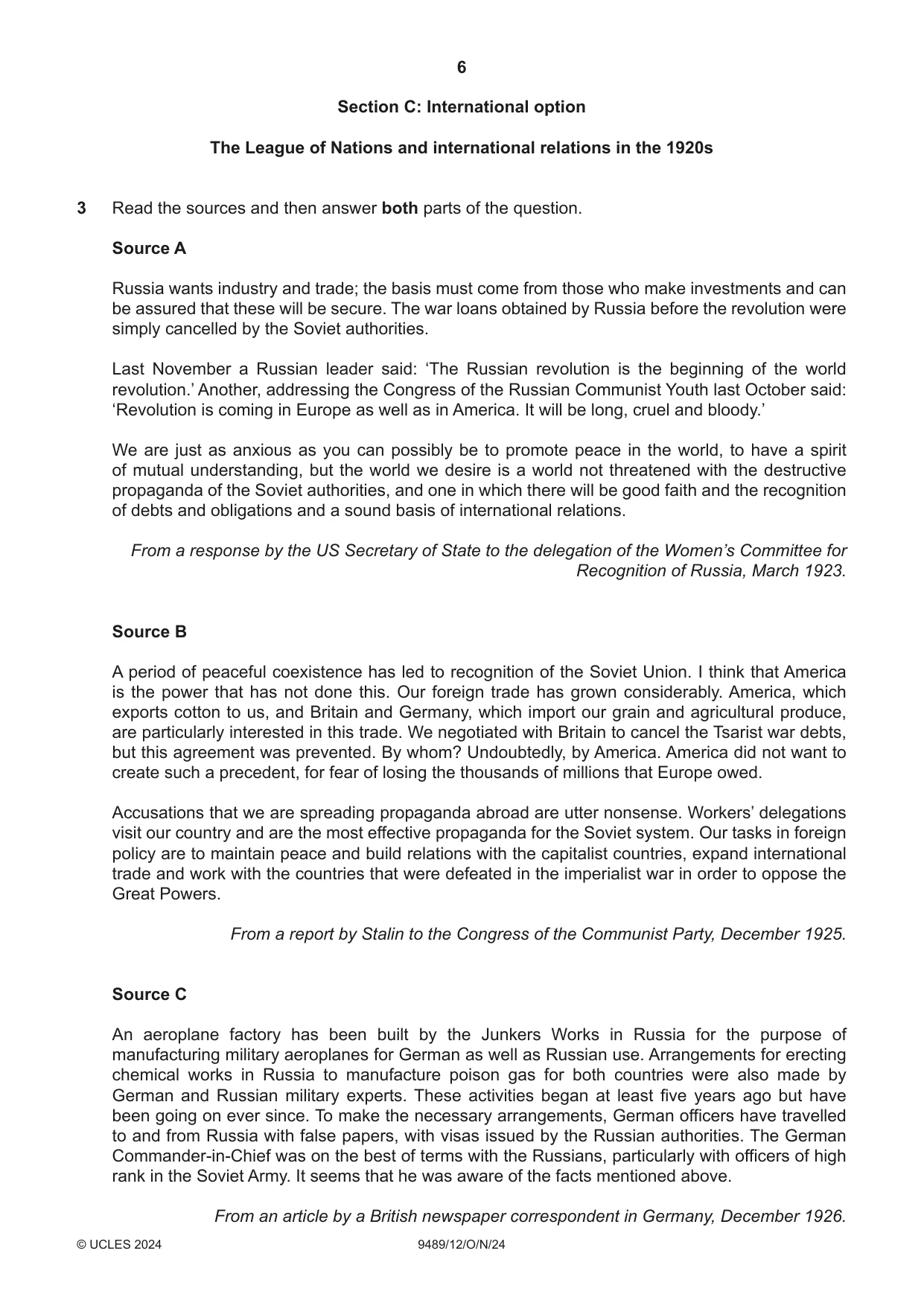
6 9489/12/O/N/24 © UCLES 2024 Section C: International option The League of Nations and international relations in the 1920s 3 Read the sources and then answer both parts of the question. Source A Russia wants industry and trade; the basis must come from those who make investments and can be assured that these will be secure. The war loans obtained by Russia before the revolution were simply cancelled by the Soviet authorities. Last November a Russian leader said: ‘The Russian revolution is the beginning of the world revolution.’ Another, addressing the Congress of the Russian Communist Youth last October said: ‘Revolution is coming in Europe as well as in America. It will be long, cruel and bloody.’ We are just as anxious as you can possibly be to promote peace in the world, to have a spirit of mutual understanding, but the world we desire is a world not threatened with the destructive propaganda of the Soviet authorities, and one in which there will be good faith and the recognition of debts and obligations and a sound basis of international relations. From a response by the US Secretary of State to the delegation of the Women’s Committee for Recognition of Russia, March 1923. Source B A period of peaceful coexistence has led to recognition of the Soviet Union. I think that America is the power that has not done this. Our foreign trade has grown considerably. America, which exports cotton to us, and Britain and Germany, which import our grain and agricultural produce, are particularly interested in this trade. We negotiated with Britain to cancel the Tsarist war debts, but this agreement was prevented. By whom? Undoubtedly, by America. America did not want to create such a precedent, for fear of losing the thousands of millions that Europe owed. Accusations that we are spreading propaganda abroad are utter nonsense. Workers’ delegations visit our country and are the most effective propaganda for the Soviet system. Our tasks in foreign policy are to maintain peace and build relations with the capitalist countries, expand international trade and work with the countries that were defeated in the imperialist war in order to oppose the Great Powers. From a report by Stalin to the Congress of the Communist Party, December 1925. Source C An aeroplane factory has been built by the Junkers Works in Russia for the purpose of manufacturing military aeroplanes for German as well as Russian use. Arrangements for erecting chemical works in Russia to manufacture poison gas for both countries were also made by German and Russian military experts. These activities began at least five years ago but have been going on ever since. To make the necessary arrangements, German officers have travelled to and from Russia with false papers, with visas issued by the Russian authorities. The German Commander-in-Chief was on the best of terms with the Russians, particularly with officers of high rank in the Soviet Army. It seems that he was aware of the facts mentioned above. From an article by a British newspaper correspondent in Germany, December 1926.
Question paper, page 7
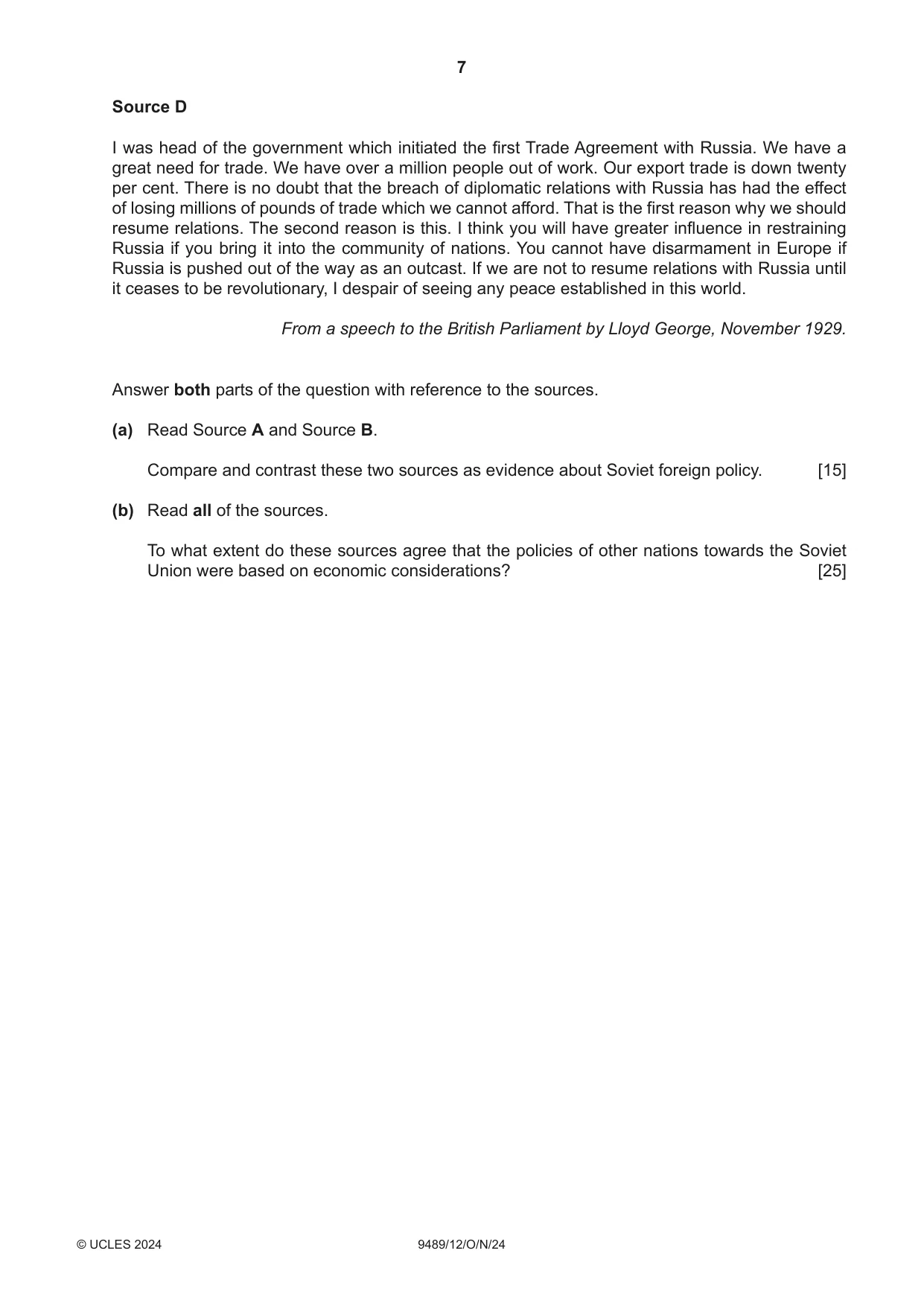
7 9489/12/O/N/24 © UCLES 2024 Source D I was head of the government which initiated the first Trade Agreement with Russia. We have a great need for trade. We have over a million people out of work. Our export trade is down twenty per cent. There is no doubt that the breach of diplomatic relations with Russia has had the effect of losing millions of pounds of trade which we cannot afford. That is the first reason why we should resume relations. The second reason is this. I think you will have greater influence in restraining Russia if you bring it into the community of nations. You cannot have disarmament in Europe if Russia is pushed out of the way as an outcast. If we are not to resume relations with Russia until it ceases to be revolutionary, I despair of seeing any peace established in this world. From a speech to the British Parliament by Lloyd George, November 1929. Answer both parts of the question with reference to the sources. (a) Read Source A and Source B. Compare and contrast these two sources as evidence about Soviet foreign policy. [15] (b) Read all of the sources. To what extent do these sources agree that the policies of other nations towards the Soviet Union were based on economic considerations? [25]
Question paper, page 8
8 9489/12/O/N/24 © UCLES 2024 Permission to reproduce items where third-party owned material protected by copyright is included has been sought and cleared where possible. Every reasonable effort has been made by the publisher (UCLES) to trace copyright holders, but if any items requiring clearance have unwittingly been included, the publisher will be pleased to make amends at the earliest possible opportunity. To avoid the issue of disclosure of answer-related information to candidates, all copyright acknowledgements are reproduced online in the Cambridge Assessment International Education Copyright Acknowledgements Booklet. This is produced for each series of examinations and is freely available to download at www.cambridgeinternational.org after the live examination series. Cambridge Assessment International Education is part of Cambridge Assessment. Cambridge Assessment is the brand name of the University of Cambridge Local Examinations Syndicate (UCLES), which is a department of the University of Cambridge. BLANK PAGE
Mark scheme, page 1
This document consists of 14 printed pages. © Cambridge University Press & Assessment 2024 [Turn over Cambridge International AS & A Level HISTORY 9489/12 Paper 1 Document Question October/November 2024 MARK SCHEME Maximum Mark: 40 Published This mark scheme is published as an aid to teachers and candidates, to indicate the requirements of the examination. It shows the basis on which Examiners were instructed to award marks. It does not indicate the details of the discussions that took place at an Examiners’ meeting before marking began, which would have considered the acceptability of alternative answers. Mark schemes should be read in conjunction with the question paper and the Principal Examiner Report for Teachers. Cambridge International will not enter into discussions about these mark schemes. Cambridge International is publishing the mark schemes for the October/November 2024 series for most Cambridge IGCSE, Cambridge International A and AS Level components, and some Cambridge O Level components.
Mark scheme, page 2
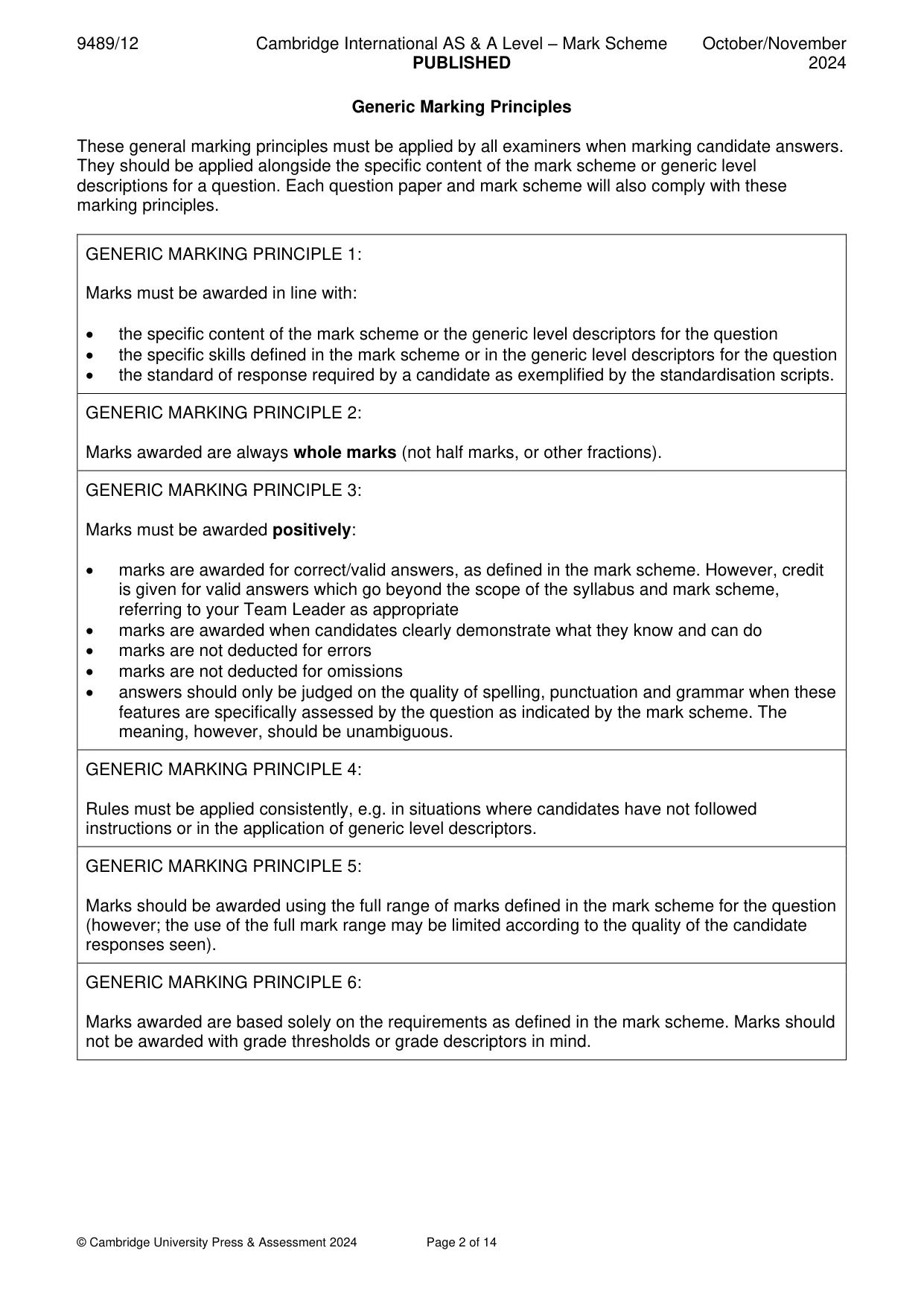
9489/12 Cambridge International AS & A Level – Mark Scheme PUBLISHED October/November 2024 © Cambridge University Press & Assessment 2024 Page 2 of 14 Generic Marking Principles These general marking principles must be applied by all examiners when marking candidate answers. They should be applied alongside the specific content of the mark scheme or generic level descriptions for a question. Each question paper and mark scheme will also comply with these marking principles. GENERIC MARKING PRINCIPLE 1: Marks must be awarded in line with: • the specific content of the mark scheme or the generic level descriptors for the question • the specific skills defined in the mark scheme or in the generic level descriptors for the question • the standard of response required by a candidate as exemplified by the standardisation scripts. GENERIC MARKING PRINCIPLE 2: Marks awarded are always whole marks (not half marks, or other fractions). GENERIC MARKING PRINCIPLE 3: Marks must be awarded positively: • marks are awarded for correct/valid answers, as defined in the mark scheme. However, credit is given for valid answers which go beyond the scope of the syllabus and mark scheme, referring to your Team Leader as appropriate • marks are awarded when candidates clearly demonstrate what they know and can do • marks are not deducted for errors • marks are not deducted for omissions • answers should only be judged on the quality of spelling, punctuation and grammar when these features are specifically assessed by the question as indicated by the mark scheme. The meaning, however, should be unambiguous. GENERIC MARKING PRINCIPLE 4: Rules must be applied consistently, e.g. in situations where candidates have not followed instructions or in the application of generic level descriptors. GENERIC MARKING PRINCIPLE 5: Marks should be awarded using the full range of marks defined in the mark scheme for the question (however; the use of the full mark range may be limited according to the quality of the candidate responses seen). GENERIC MARKING PRINCIPLE 6: Marks awarded are based solely on the requirements as defined in the mark scheme. Marks should not be awarded with grade thresholds or grade descriptors in mind.
Mark scheme, page 3
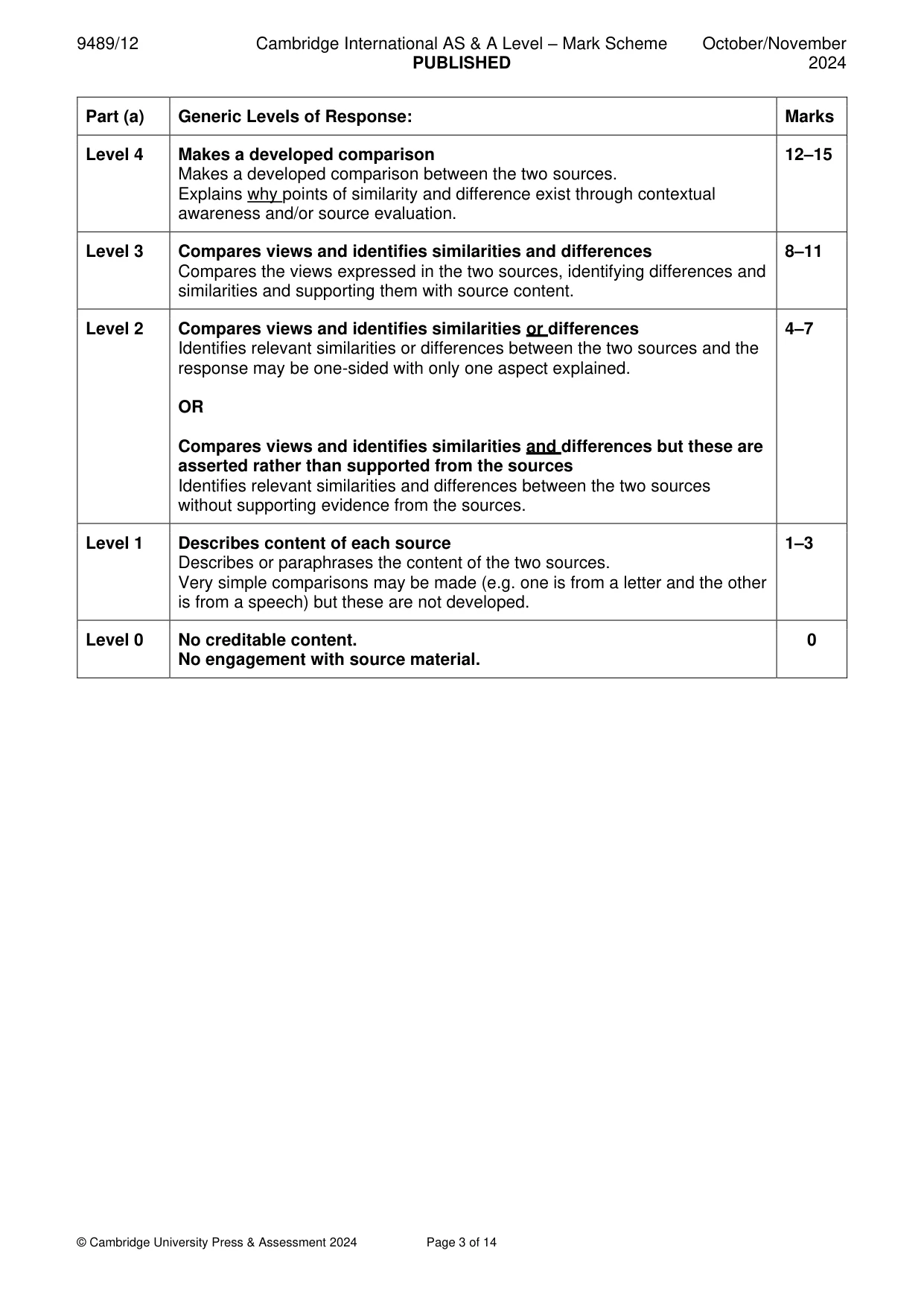
9489/12 Cambridge International AS & A Level – Mark Scheme PUBLISHED October/November 2024 © Cambridge University Press & Assessment 2024 Page 3 of 14 Part (a) Generic Levels of Response: Marks Level 4 Makes a developed comparison Makes a developed comparison between the two sources. Explains why points of similarity and difference exist through contextual awareness and/or source evaluation. 12–15 Level 3 Compares views and identifies similarities and differences Compares the views expressed in the two sources, identifying differences and similarities and supporting them with source content. 8–11 Level 2 Compares views and identifies similarities or differences Identifies relevant similarities or differences between the two sources and the response may be one-sided with only one aspect explained. OR Compares views and identifies similarities and differences but these are asserted rather than supported from the sources Identifies relevant similarities and differences between the two sources without supporting evidence from the sources. 4–7 Level 1 Describes content of each source Describes or paraphrases the content of the two sources. Very simple comparisons may be made (e.g. one is from a letter and the other is from a speech) but these are not developed. 1–3 Level 0 No creditable content. No engagement with source material. 0
Mark scheme, page 4
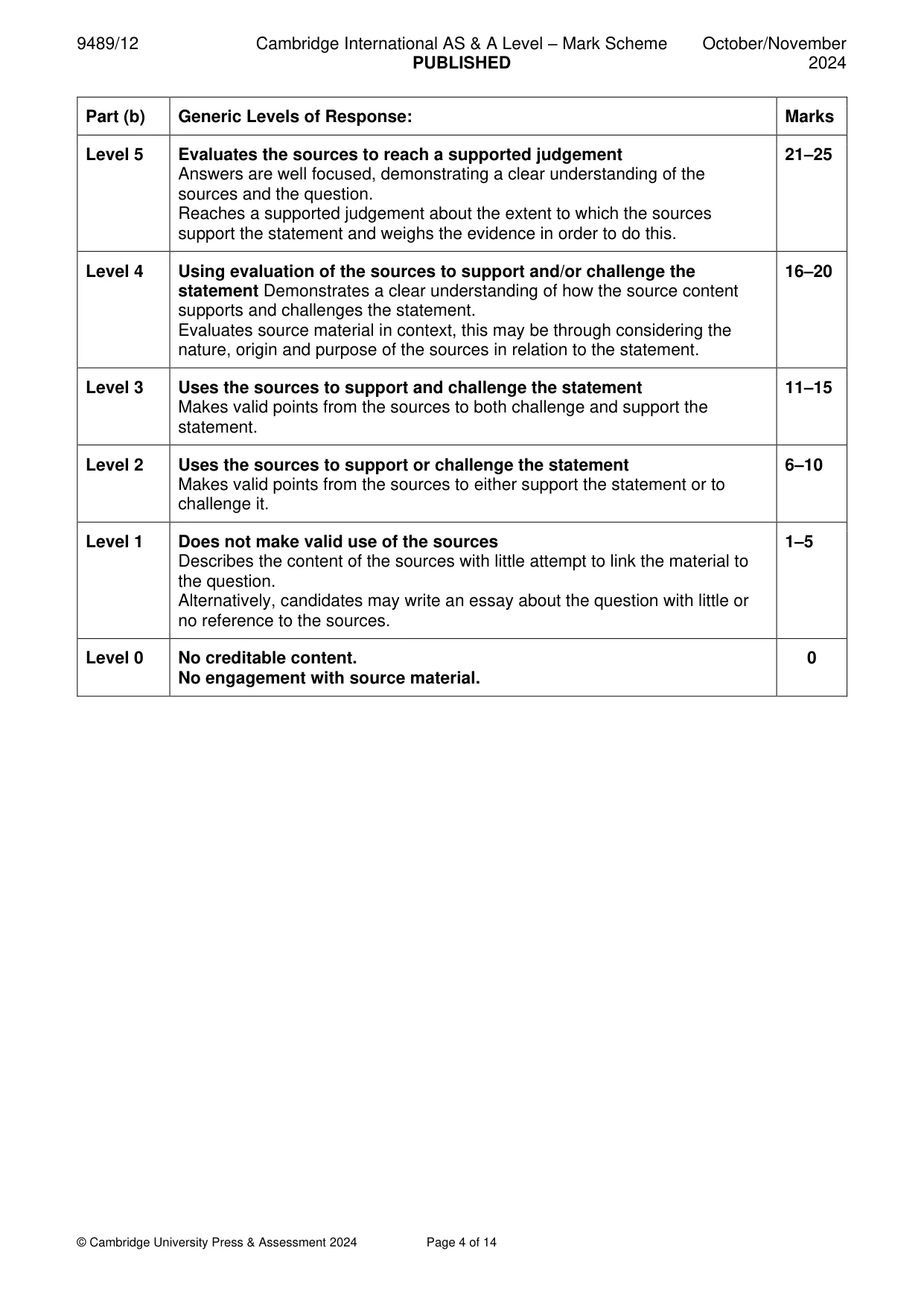
9489/12 Cambridge International AS & A Level – Mark Scheme PUBLISHED October/November 2024 © Cambridge University Press & Assessment 2024 Page 4 of 14 Part (b) Generic Levels of Response: Marks Level 5 Evaluates the sources to reach a supported judgement Answers are well focused, demonstrating a clear understanding of the sources and the question. Reaches a supported judgement about the extent to which the sources support the statement and weighs the evidence in order to do this. 21–25 Level 4 Using evaluation of the sources to support and/or challenge the statement Demonstrates a clear understanding of how the source content supports and challenges the statement. Evaluates source material in context, this may be through considering the nature, origin and purpose of the sources in relation to the statement. 16–20 Level 3 Uses the sources to support and challenge the statement Makes valid points from the sources to both challenge and support the statement. 11–15 Level 2 Uses the sources to support or challenge the statement Makes valid points from the sources to either support the statement or to challenge it. 6–10 Level 1 Does not make valid use of the sources Describes the content of the sources with little attempt to link the material to the question. Alternatively, candidates may write an essay about the question with little or no reference to the sources. 1–5 Level 0 No creditable content. No engagement with source material. 0
Mark scheme, page 5
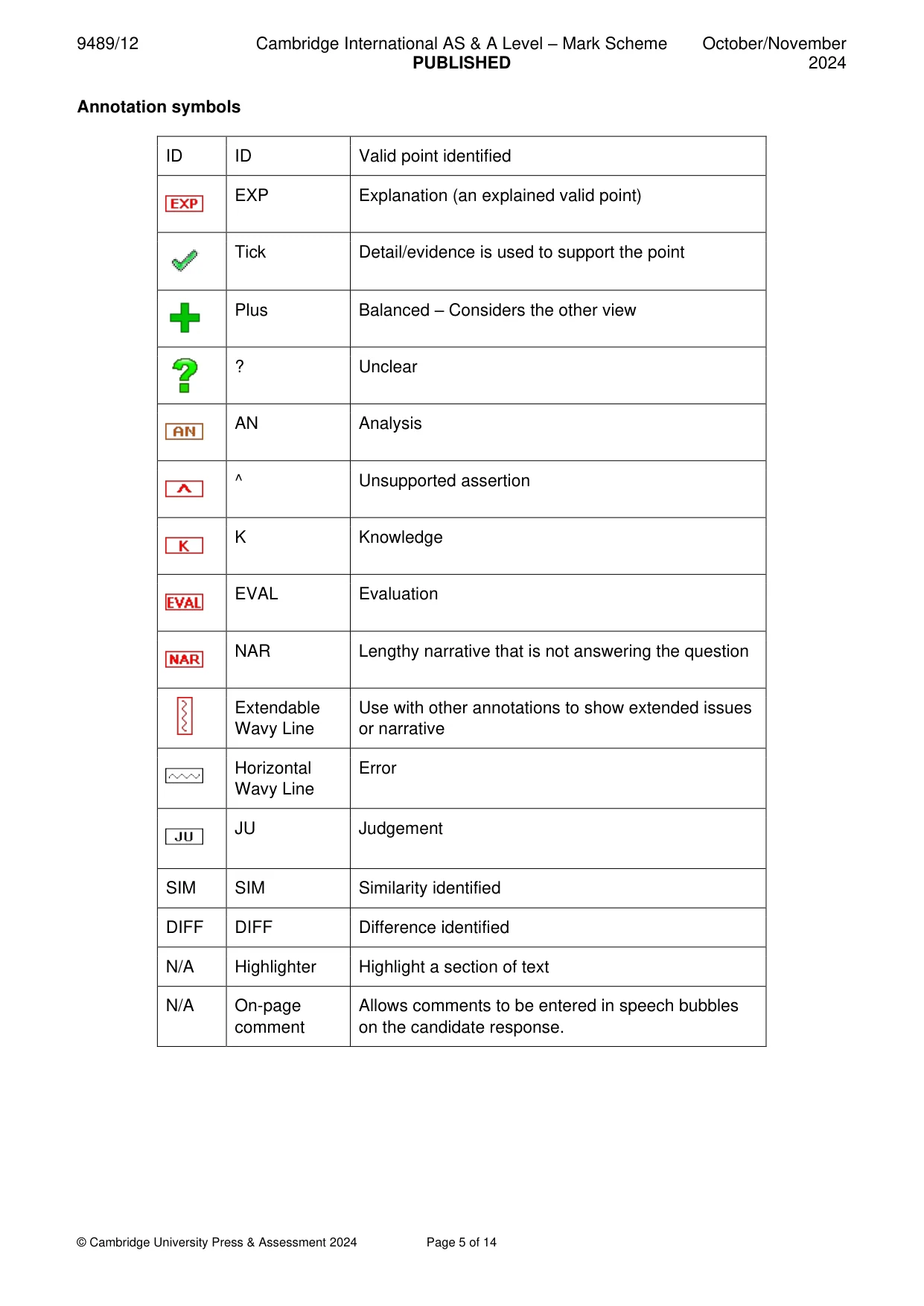
9489/12 Cambridge International AS & A Level – Mark Scheme PUBLISHED October/November 2024 © Cambridge University Press & Assessment 2024 Page 5 of 14 Annotation symbols ID ID Valid point identified EXP Explanation (an explained valid point) Tick Detail/evidence is used to support the point Plus Balanced – Considers the other view ? Unclear AN Analysis ^ Unsupported assertion K Knowledge EVAL Evaluation NAR Lengthy narrative that is not answering the question Extendable Wavy Line Use with other annotations to show extended issues or narrative Horizontal Wavy Line Error JU Judgement SIM SIM Similarity identified DIFF DIFF Difference identified N/A Highlighter Highlight a section of text N/A On-page comment Allows comments to be entered in speech bubbles on the candidate response.
Mark scheme, page 6
9489/12 Cambridge International AS & A Level – Mark Scheme PUBLISHED October/November 2024 © Cambridge University Press & Assessment 2024 Page 6 of 14 Using the annotations • Annotate using the symbols above as you read through the script. • At the end of each question write a short on-page comment: – be positive – say what the candidate has done, rather than what they have not – reference the attributes of the level descriptor you are awarding (i.e. make sure your comment matches the mark you have given) – be careful with your spelling (there is no spell check)
Mark scheme, page 7
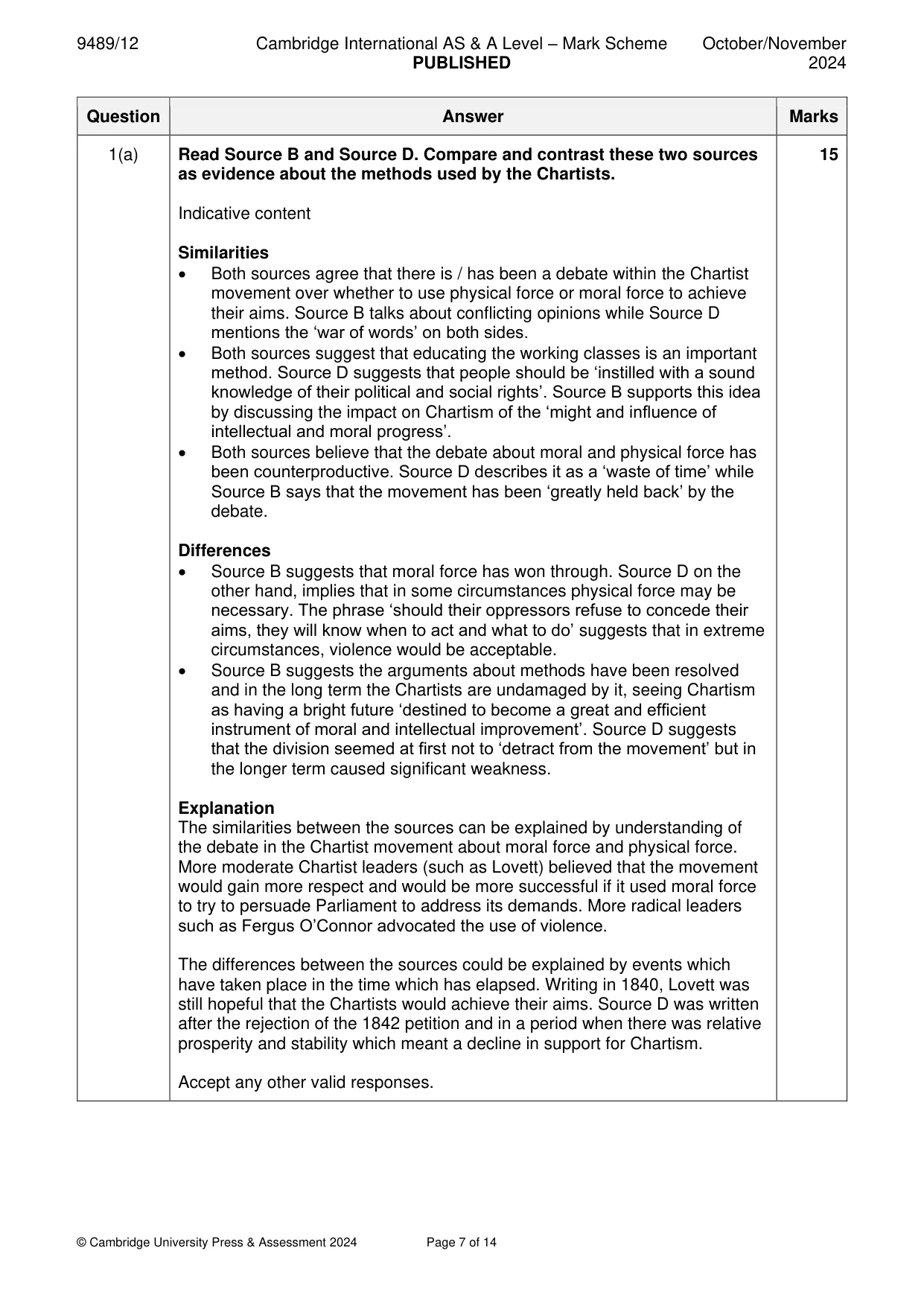
9489/12 Cambridge International AS & A Level – Mark Scheme PUBLISHED October/November 2024 © Cambridge University Press & Assessment 2024 Page 7 of 14 Question Answer Marks 1(a) Read Source B and Source D. Compare and contrast these two sources as evidence about the methods used by the Chartists. Indicative content Similarities • Both sources agree that there is / has been a debate within the Chartist movement over whether to use physical force or moral force to achieve their aims. Source B talks about conflicting opinions while Source D mentions the ‘war of words’ on both sides. • Both sources suggest that educating the working classes is an important method. Source D suggests that people should be ‘instilled with a sound knowledge of their political and social rights’. Source B supports this idea by discussing the impact on Chartism of the ‘might and influence of intellectual and moral progress’. • Both sources believe that the debate about moral and physical force has been counterproductive. Source D describes it as a ‘waste of time’ while Source B says that the movement has been ‘greatly held back’ by the debate. Differences • Source B suggests that moral force has won through. Source D on the other hand, implies that in some circumstances physical force may be necessary. The phrase ‘should their oppressors refuse to concede their aims, they will know when to act and what to do’ suggests that in extreme circumstances, violence would be acceptable. • Source B suggests the arguments about methods have been resolved and in the long term the Chartists are undamaged by it, seeing Chartism as having a bright future ‘destined to become a great and efficient instrument of moral and intellectual improvement’. Source D suggests that the division seemed at first not to ‘detract from the movement’ but in the longer term caused significant weakness. Explanation The similarities between the sources can be explained by understanding of the debate in the Chartist movement about moral force and physical force. More moderate Chartist leaders (such as Lovett) believed that the movement would gain more respect and would be more successful if it used moral force to try to persuade Parliament to address its demands. More radical leaders such as Fergus O’Connor advocated the use of violence. The differences between the sources could be explained by events which have taken place in the time which has elapsed. Writing in 1840, Lovett was still hopeful that the Chartists would achieve their aims. Source D was written after the rejection of the 1842 petition and in a period when there was relative prosperity and stability which meant a decline in support for Chartism. Accept any other valid responses. 15
Mark scheme, page 8
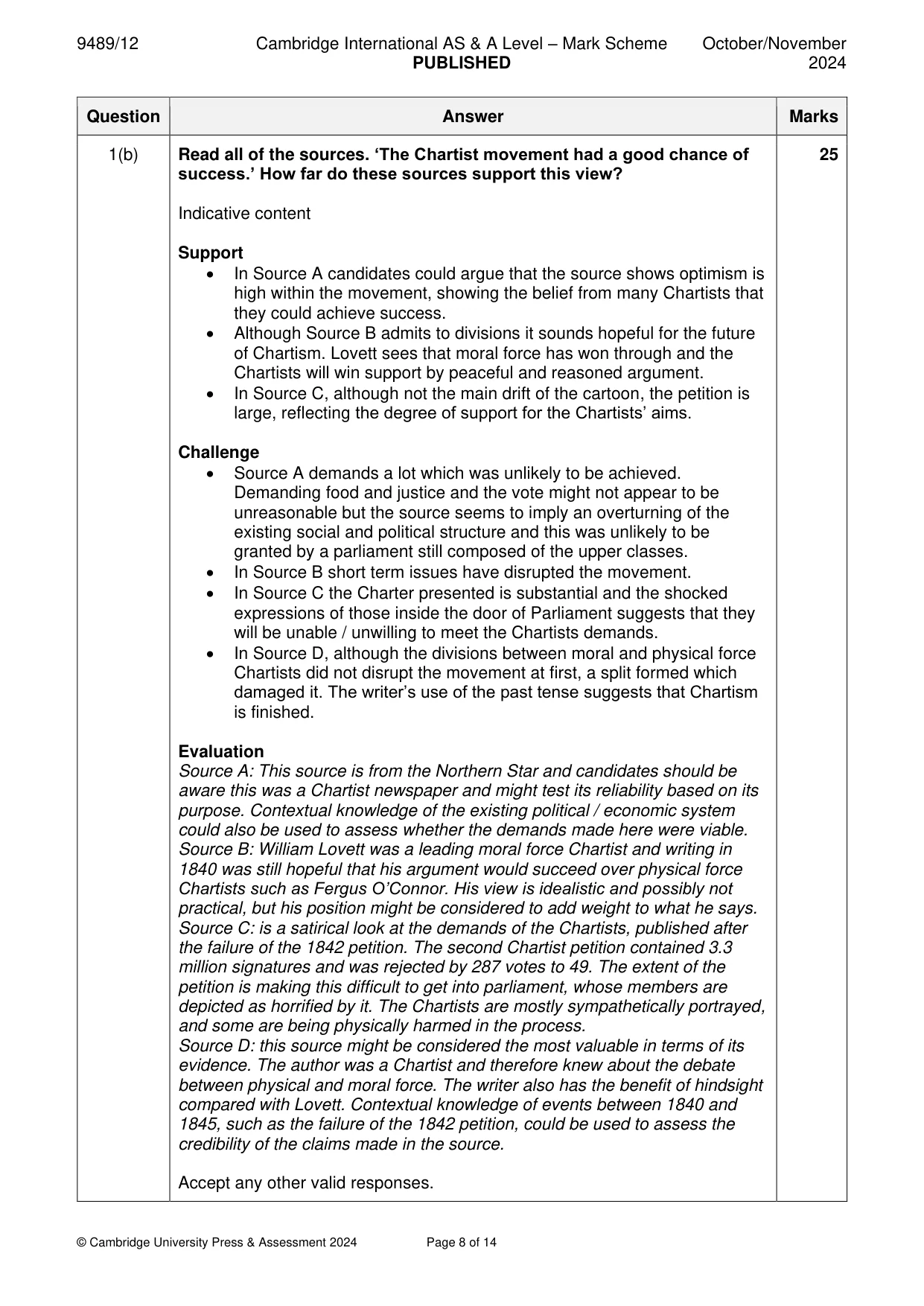
9489/12 Cambridge International AS & A Level – Mark Scheme PUBLISHED October/November 2024 © Cambridge University Press & Assessment 2024 Page 8 of 14 Question Answer Marks 1(b) Read all of the sources. ‘The Chartist movement had a good chance of success.’ How far do these sources support this view? Indicative content Support • In Source A candidates could argue that the source shows optimism is high within the movement, showing the belief from many Chartists that they could achieve success. • Although Source B admits to divisions it sounds hopeful for the future of Chartism. Lovett sees that moral force has won through and the Chartists will win support by peaceful and reasoned argument. • In Source C, although not the main drift of the cartoon, the petition is large, reflecting the degree of support for the Chartists’ aims. Challenge • Source A demands a lot which was unlikely to be achieved. Demanding food and justice and the vote might not appear to be unreasonable but the source seems to imply an overturning of the existing social and political structure and this was unlikely to be granted by a parliament still composed of the upper classes. • In Source B short term issues have disrupted the movement. • In Source C the Charter presented is substantial and the shocked expressions of those inside the door of Parliament suggests that they will be unable / unwilling to meet the Chartists demands. • In Source D, although the divisions between moral and physical force Chartists did not disrupt the movement at first, a split formed which damaged it. The writer’s use of the past tense suggests that Chartism is finished. Evaluation Source A: This source is from the Northern Star and candidates should be aware this was a Chartist newspaper and might test its reliability based on its purpose. Contextual knowledge of the existing political / economic system could also be used to assess whether the demands made here were viable. Source B: William Lovett was a leading moral force Chartist and writing in 1840 was still hopeful that his argument would succeed over physical force Chartists such as Fergus O’Connor. His view is idealistic and possibly not practical, but his position might be considered to add weight to what he says. Source C: is a satirical look at the demands of the Chartists, published after the failure of the 1842 petition. The second Chartist petition contained 3.3 million signatures and was rejected by 287 votes to 49. The extent of the petition is making this difficult to get into parliament, whose members are depicted as horrified by it. The Chartists are mostly sympathetically portrayed, and some are being physically harmed in the process. Source D: this source might be considered the most valuable in terms of its evidence. The author was a Chartist and therefore knew about the debate between physical and moral force. The writer also has the benefit of hindsight compared with Lovett. Contextual knowledge of events between 1840 and 1845, such as the failure of the 1842 petition, could be used to assess the credibility of the claims made in the source. Accept any other valid responses. 25
Mark scheme, page 9
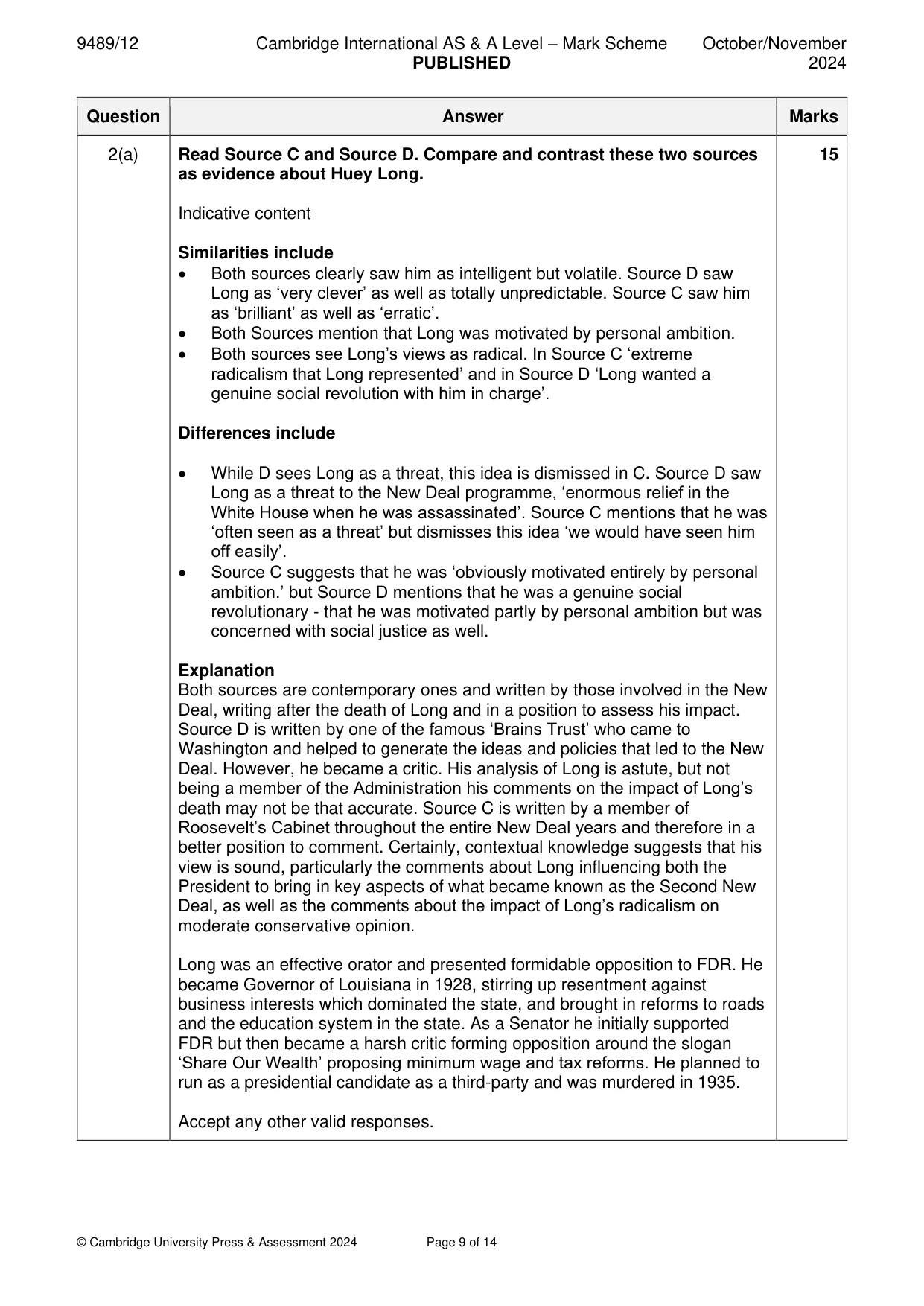
9489/12 Cambridge International AS & A Level – Mark Scheme PUBLISHED October/November 2024 © Cambridge University Press & Assessment 2024 Page 9 of 14 Question Answer Marks 2(a) Read Source C and Source D. Compare and contrast these two sources as evidence about Huey Long. Indicative content Similarities include • Both sources clearly saw him as intelligent but volatile. Source D saw Long as ‘very clever’ as well as totally unpredictable. Source C saw him as ‘brilliant’ as well as ‘erratic’. • Both Sources mention that Long was motivated by personal ambition. • Both sources see Long’s views as radical. In Source C ‘extreme radicalism that Long represented’ and in Source D ‘Long wanted a genuine social revolution with him in charge’. Differences include • While D sees Long as a threat, this idea is dismissed in C. Source D saw Long as a threat to the New Deal programme, ‘enormous relief in the White House when he was assassinated’. Source C mentions that he was ‘often seen as a threat’ but dismisses this idea ‘we would have seen him off easily’. • Source C suggests that he was ‘obviously motivated entirely by personal ambition.’ but Source D mentions that he was a genuine social revolutionary - that he was motivated partly by personal ambition but was concerned with social justice as well. Explanation Both sources are contemporary ones and written by those involved in the New Deal, writing after the death of Long and in a position to assess his impact. Source D is written by one of the famous ‘Brains Trust’ who came to Washington and helped to generate the ideas and policies that led to the New Deal. However, he became a critic. His analysis of Long is astute, but not being a member of the Administration his comments on the impact of Long’s death may not be that accurate. Source C is written by a member of Roosevelt’s Cabinet throughout the entire New Deal years and therefore in a better position to comment. Certainly, contextual knowledge suggests that his view is sound, particularly the comments about Long influencing both the President to bring in key aspects of what became known as the Second New Deal, as well as the comments about the impact of Long’s radicalism on moderate conservative opinion. Long was an effective orator and presented formidable opposition to FDR. He became Governor of Louisiana in 1928, stirring up resentment against business interests which dominated the state, and brought in reforms to roads and the education system in the state. As a Senator he initially supported FDR but then became a harsh critic forming opposition around the slogan ‘Share Our Wealth’ proposing minimum wage and tax reforms. He planned to run as a presidential candidate as a third-party and was murdered in 1935. Accept any other valid responses. 15
Mark scheme, page 10
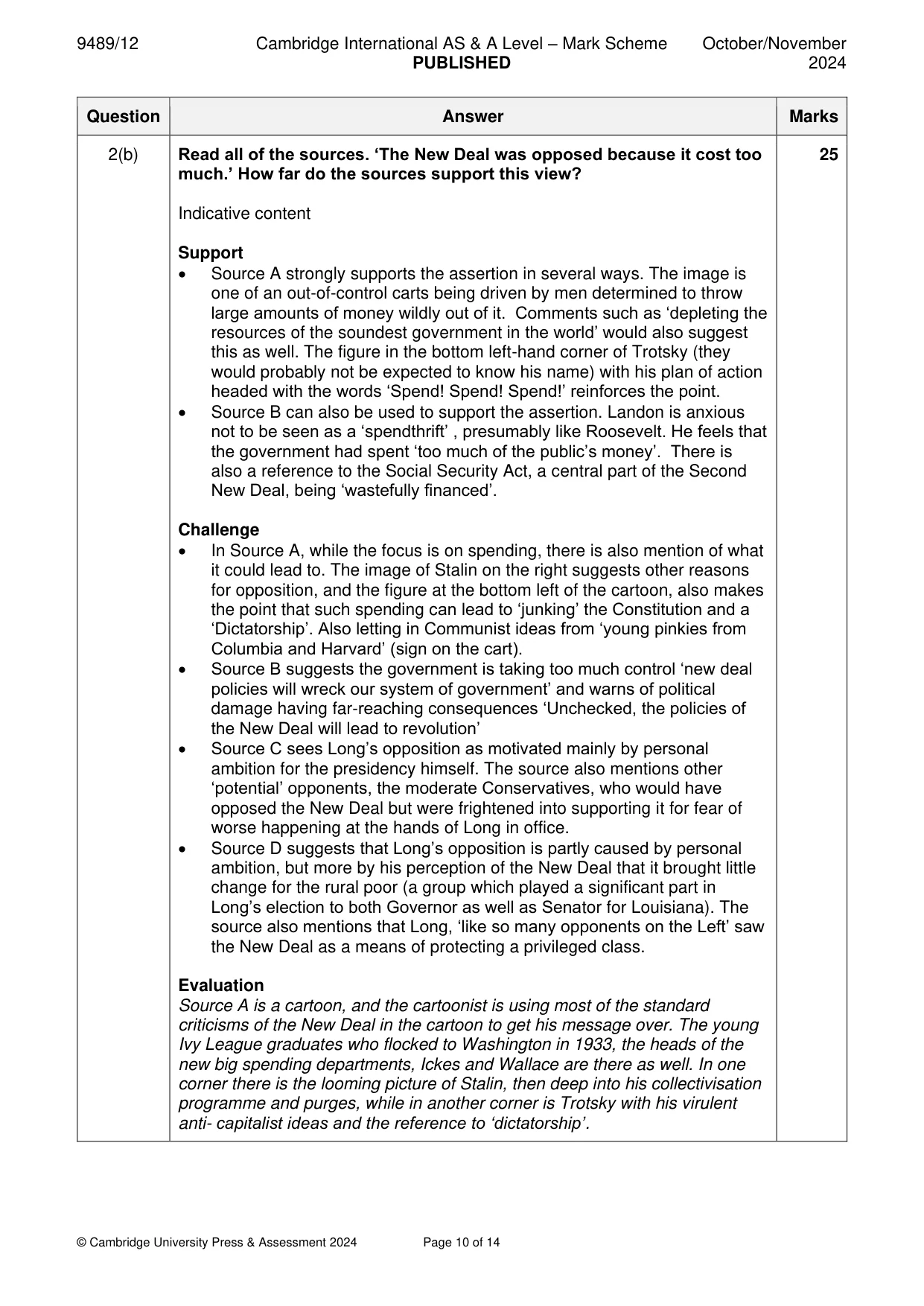
9489/12 Cambridge International AS & A Level – Mark Scheme PUBLISHED October/November 2024 © Cambridge University Press & Assessment 2024 Page 10 of 14 Question Answer Marks 2(b) Read all of the sources. ‘The New Deal was opposed because it cost too much.’ How far do the sources support this view? Indicative content Support • Source A strongly supports the assertion in several ways. The image is one of an out-of-control carts being driven by men determined to throw large amounts of money wildly out of it. Comments such as ‘depleting the resources of the soundest government in the world’ would also suggest this as well. The figure in the bottom left-hand corner of Trotsky (they would probably not be expected to know his name) with his plan of action headed with the words ‘Spend! Spend! Spend!’ reinforces the point. • Source B can also be used to support the assertion. Landon is anxious not to be seen as a ‘spendthrift’ , presumably like Roosevelt. He feels that the government had spent ‘too much of the public’s money’. There is also a reference to the Social Security Act, a central part of the Second New Deal, being ‘wastefully financed’. Challenge • In Source A, while the focus is on spending, there is also mention of what it could lead to. The image of Stalin on the right suggests other reasons for opposition, and the figure at the bottom left of the cartoon, also makes the point that such spending can lead to ‘junking’ the Constitution and a ‘Dictatorship’. Also letting in Communist ideas from ‘young pinkies from Columbia and Harvard’ (sign on the cart). • Source B suggests the government is taking too much control ‘new deal policies will wreck our system of government’ and warns of political damage having far-reaching consequences ‘Unchecked, the policies of the New Deal will lead to revolution’ • Source C sees Long’s opposition as motivated mainly by personal ambition for the presidency himself. The source also mentions other ‘potential’ opponents, the moderate Conservatives, who would have opposed the New Deal but were frightened into supporting it for fear of worse happening at the hands of Long in office. • Source D suggests that Long’s opposition is partly caused by personal ambition, but more by his perception of the New Deal that it brought little change for the rural poor (a group which played a significant part in Long’s election to both Governor as well as Senator for Louisiana). The source also mentions that Long, ‘like so many opponents on the Left’ saw the New Deal as a means of protecting a privileged class. Evaluation Source A is a cartoon, and the cartoonist is using most of the standard criticisms of the New Deal in the cartoon to get his message over. The young Ivy League graduates who flocked to Washington in 1933, the heads of the new big spending departments, Ickes and Wallace are there as well. In one corner there is the looming picture of Stalin, then deep into his collectivisation programme and purges, while in another corner is Trotsky with his virulent anti- capitalist ideas and the reference to ‘dictatorship’. 25
Mark scheme, page 11
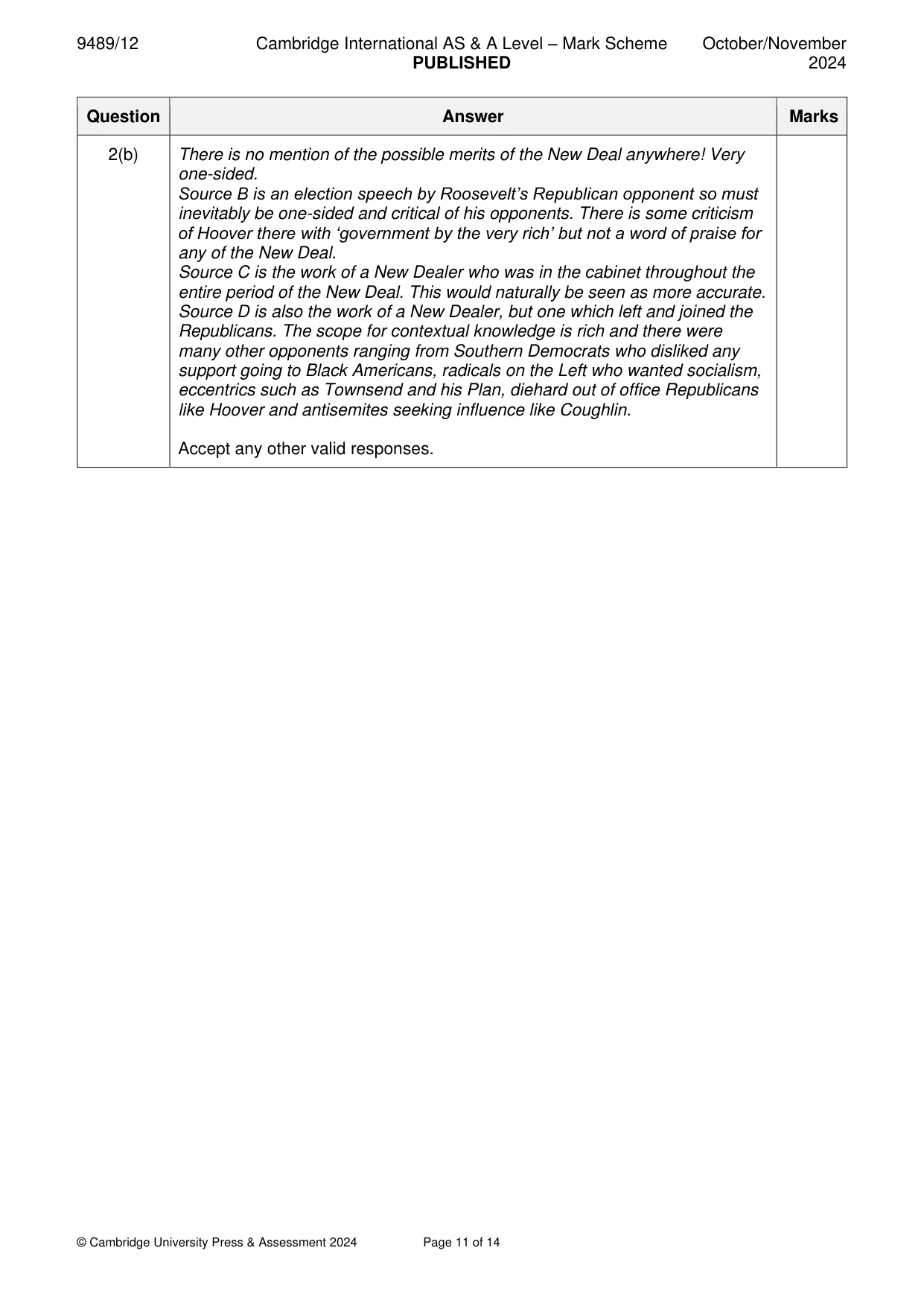
9489/12 Cambridge International AS & A Level – Mark Scheme PUBLISHED October/November 2024 © Cambridge University Press & Assessment 2024 Page 11 of 14 Question Answer Marks 2(b) There is no mention of the possible merits of the New Deal anywhere! Very one-sided. Source B is an election speech by Roosevelt’s Republican opponent so must inevitably be one-sided and critical of his opponents. There is some criticism of Hoover there with ‘government by the very rich’ but not a word of praise for any of the New Deal. Source C is the work of a New Dealer who was in the cabinet throughout the entire period of the New Deal. This would naturally be seen as more accurate. Source D is also the work of a New Dealer, but one which left and joined the Republicans. The scope for contextual knowledge is rich and there were many other opponents ranging from Southern Democrats who disliked any support going to Black Americans, radicals on the Left who wanted socialism, eccentrics such as Townsend and his Plan, diehard out of office Republicans like Hoover and antisemites seeking influence like Coughlin. Accept any other valid responses.
Mark scheme, page 12
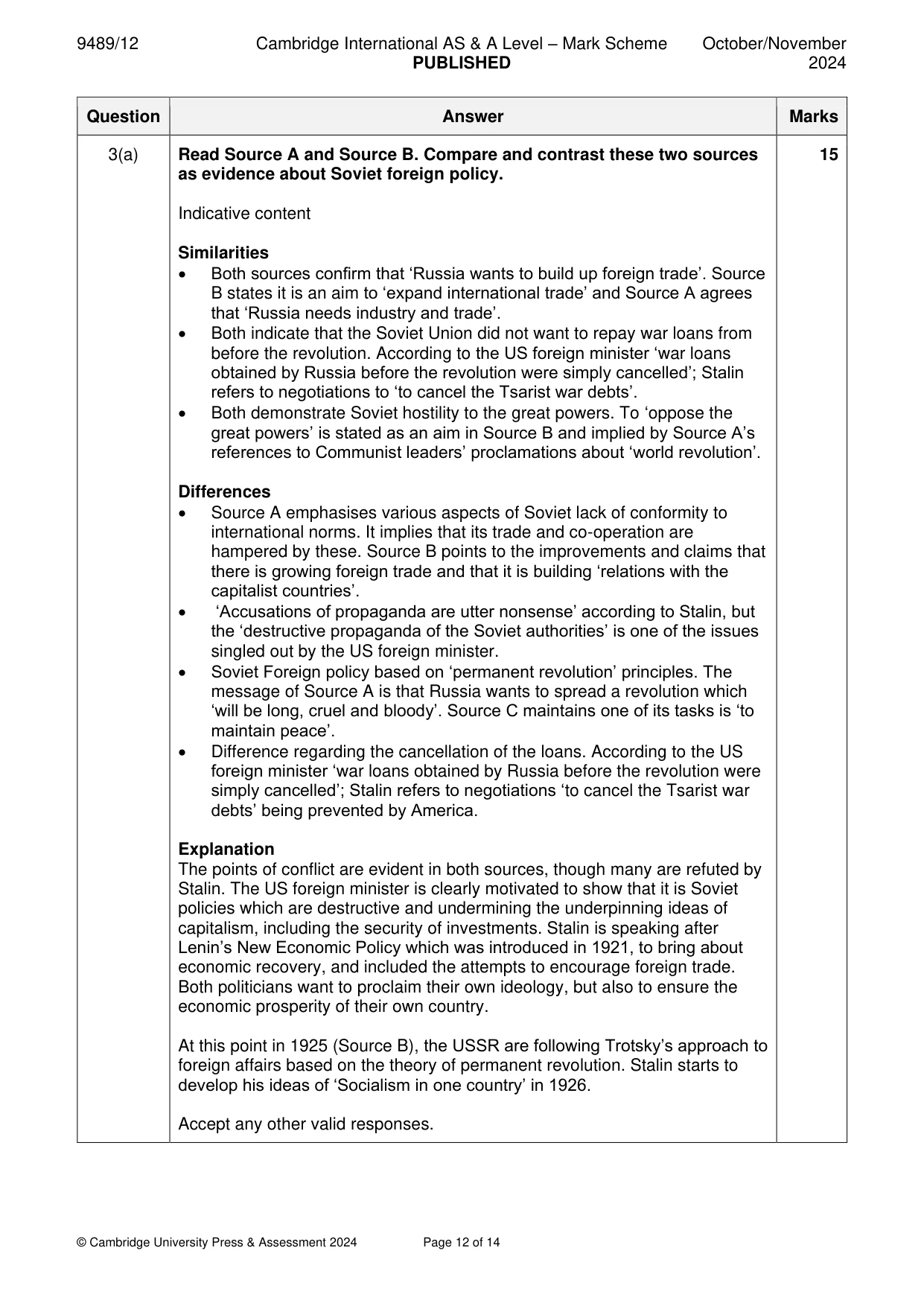
9489/12 Cambridge International AS & A Level – Mark Scheme PUBLISHED October/November 2024 © Cambridge University Press & Assessment 2024 Page 12 of 14 Question Answer Marks 3(a) Read Source A and Source B. Compare and contrast these two sources as evidence about Soviet foreign policy. Indicative content Similarities • Both sources confirm that ‘Russia wants to build up foreign trade’. Source B states it is an aim to ‘expand international trade’ and Source A agrees that ‘Russia needs industry and trade’. • Both indicate that the Soviet Union did not want to repay war loans from before the revolution. According to the US foreign minister ‘war loans obtained by Russia before the revolution were simply cancelled’; Stalin refers to negotiations to ‘to cancel the Tsarist war debts’. • Both demonstrate Soviet hostility to the great powers. To ‘oppose the great powers’ is stated as an aim in Source B and implied by Source A’s references to Communist leaders’ proclamations about ‘world revolution’. Differences • Source A emphasises various aspects of Soviet lack of conformity to international norms. It implies that its trade and co-operation are hampered by these. Source B points to the improvements and claims that there is growing foreign trade and that it is building ‘relations with the capitalist countries’. • ‘Accusations of propaganda are utter nonsense’ according to Stalin, but the ‘destructive propaganda of the Soviet authorities’ is one of the issues singled out by the US foreign minister. • Soviet Foreign policy based on ‘permanent revolution’ principles. The message of Source A is that Russia wants to spread a revolution which ‘will be long, cruel and bloody’. Source C maintains one of its tasks is ‘to maintain peace’. • Difference regarding the cancellation of the loans. According to the US foreign minister ‘war loans obtained by Russia before the revolution were simply cancelled’; Stalin refers to negotiations ‘to cancel the Tsarist war debts’ being prevented by America. Explanation The points of conflict are evident in both sources, though many are refuted by Stalin. The US foreign minister is clearly motivated to show that it is Soviet policies which are destructive and undermining the underpinning ideas of capitalism, including the security of investments. Stalin is speaking after Lenin’s New Economic Policy which was introduced in 1921, to bring about economic recovery, and included the attempts to encourage foreign trade. Both politicians want to proclaim their own ideology, but also to ensure the economic prosperity of their own country. At this point in 1925 (Source B), the USSR are following Trotsky’s approach to foreign affairs based on the theory of permanent revolution. Stalin starts to develop his ideas of ‘Socialism in one country’ in 1926. Accept any other valid responses. 15
Mark scheme, page 13
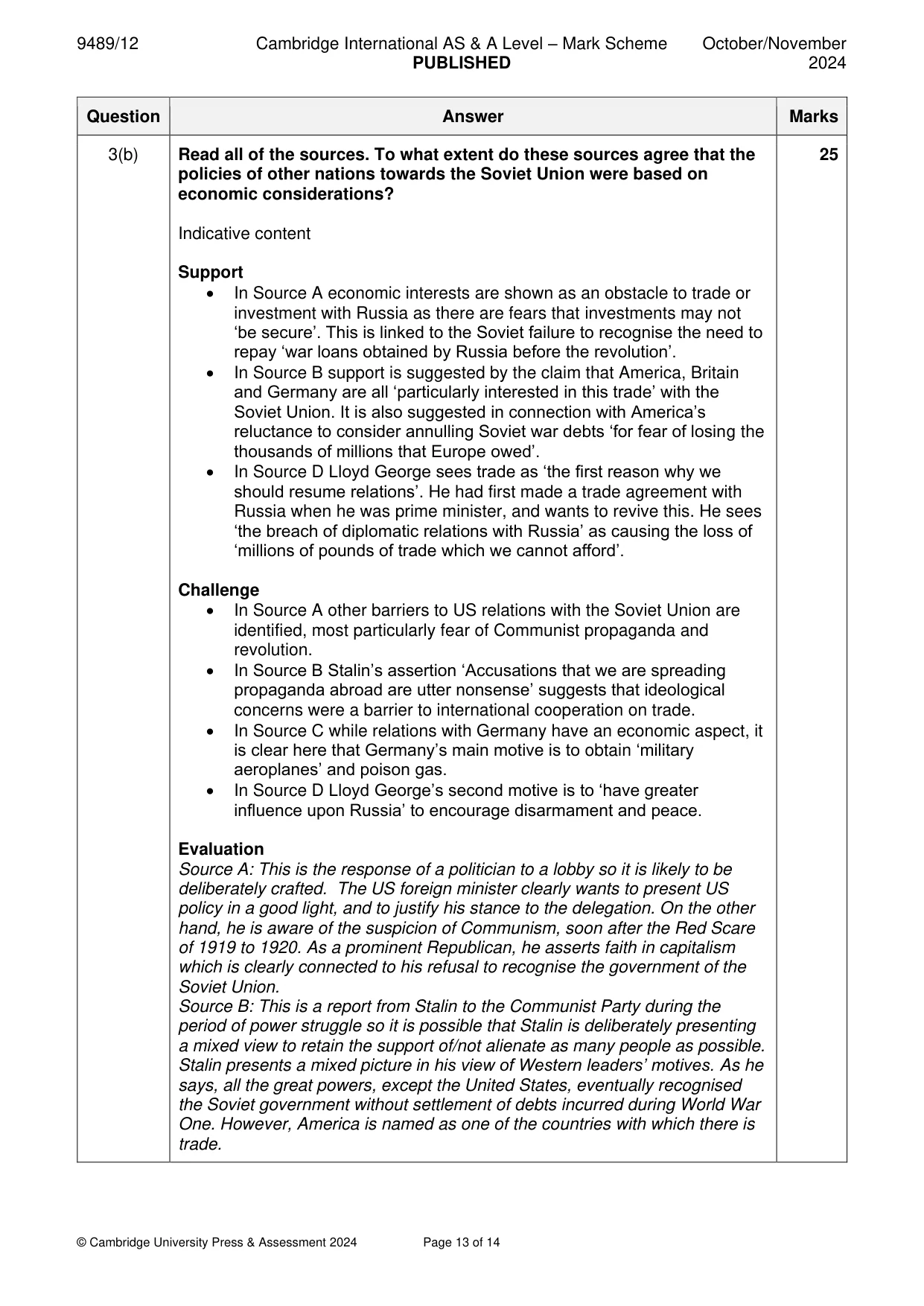
9489/12 Cambridge International AS & A Level – Mark Scheme PUBLISHED October/November 2024 © Cambridge University Press & Assessment 2024 Page 13 of 14 Question Answer Marks 3(b) Read all of the sources. To what extent do these sources agree that the policies of other nations towards the Soviet Union were based on economic considerations? Indicative content Support • In Source A economic interests are shown as an obstacle to trade or investment with Russia as there are fears that investments may not ‘be secure’. This is linked to the Soviet failure to recognise the need to repay ‘war loans obtained by Russia before the revolution’. • In Source B support is suggested by the claim that America, Britain and Germany are all ‘particularly interested in this trade’ with the Soviet Union. It is also suggested in connection with America’s reluctance to consider annulling Soviet war debts ‘for fear of losing the thousands of millions that Europe owed’. • In Source D Lloyd George sees trade as ‘the first reason why we should resume relations’. He had first made a trade agreement with Russia when he was prime minister, and wants to revive this. He sees ‘the breach of diplomatic relations with Russia’ as causing the loss of ‘millions of pounds of trade which we cannot afford’. Challenge • In Source A other barriers to US relations with the Soviet Union are identified, most particularly fear of Communist propaganda and revolution. • In Source B Stalin’s assertion ‘Accusations that we are spreading propaganda abroad are utter nonsense’ suggests that ideological concerns were a barrier to international cooperation on trade. • In Source C while relations with Germany have an economic aspect, it is clear here that Germany’s main motive is to obtain ‘military aeroplanes’ and poison gas. • In Source D Lloyd George’s second motive is to ‘have greater influence upon Russia’ to encourage disarmament and peace. Evaluation Source A: This is the response of a politician to a lobby so it is likely to be deliberately crafted. The US foreign minister clearly wants to present US policy in a good light, and to justify his stance to the delegation. On the other hand, he is aware of the suspicion of Communism, soon after the Red Scare of 1919 to 1920. As a prominent Republican, he asserts faith in capitalism which is clearly connected to his refusal to recognise the government of the Soviet Union. Source B: This is a report from Stalin to the Communist Party during the period of power struggle so it is possible that Stalin is deliberately presenting a mixed view to retain the support of/not alienate as many people as possible. Stalin presents a mixed picture in his view of Western leaders’ motives. As he says, all the great powers, except the United States, eventually recognised the Soviet government without settlement of debts incurred during World War One. However, America is named as one of the countries with which there is trade. 25
Mark scheme, page 14
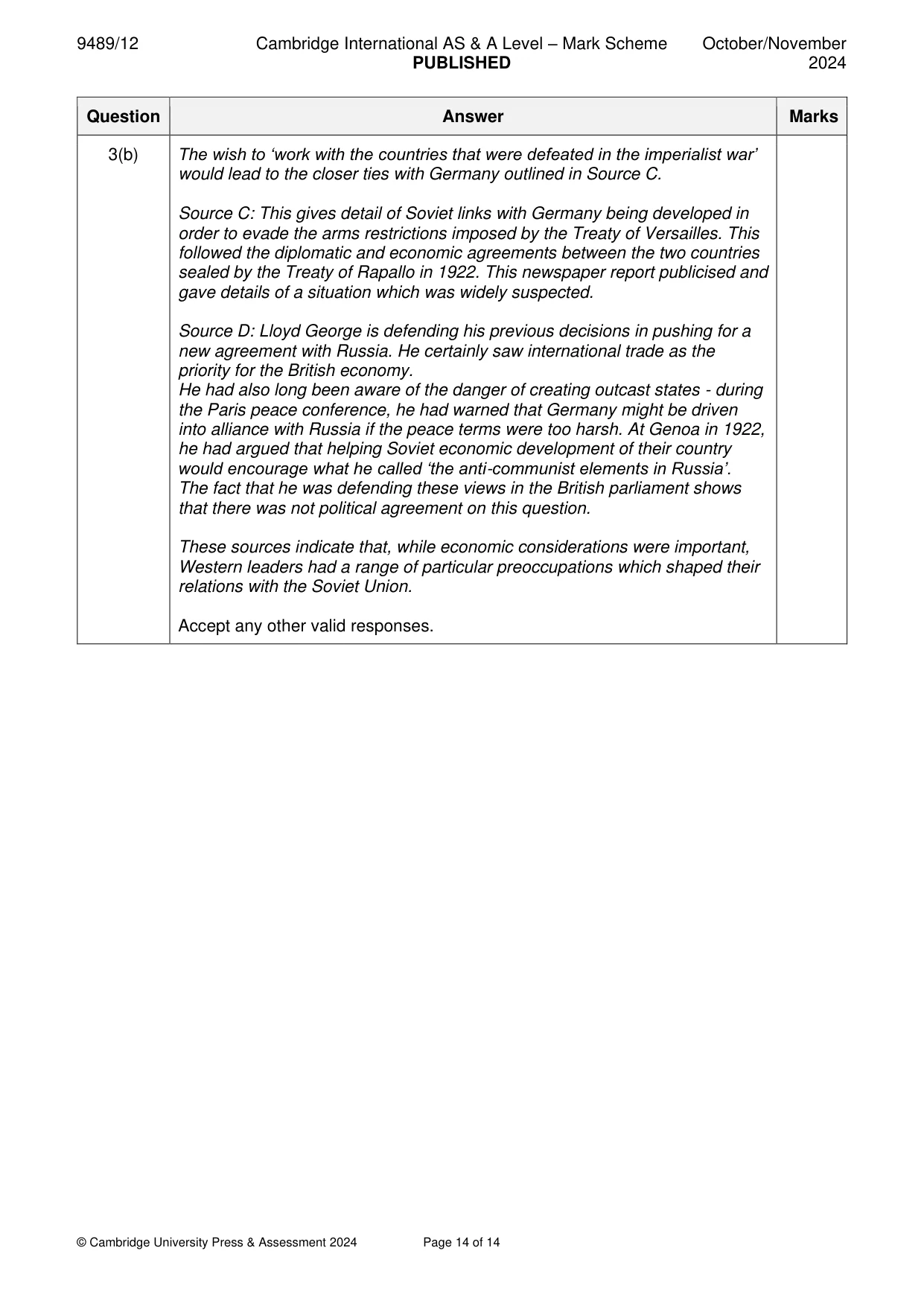
9489/12 Cambridge International AS & A Level – Mark Scheme PUBLISHED October/November 2024 © Cambridge University Press & Assessment 2024 Page 14 of 14 Question Answer Marks 3(b) The wish to ‘work with the countries that were defeated in the imperialist war’ would lead to the closer ties with Germany outlined in Source C. Source C: This gives detail of Soviet links with Germany being developed in order to evade the arms restrictions imposed by the Treaty of Versailles. This followed the diplomatic and economic agreements between the two countries sealed by the Treaty of Rapallo in 1922. This newspaper report publicised and gave details of a situation which was widely suspected. Source D: Lloyd George is defending his previous decisions in pushing for a new agreement with Russia. He certainly saw international trade as the priority for the British economy. He had also long been aware of the danger of creating outcast states - during the Paris peace conference, he had warned that Germany might be driven into alliance with Russia if the peace terms were too harsh. At Genoa in 1922, he had argued that helping Soviet economic development of their country would encourage what he called ‘the anti-communist elements in Russia’. The fact that he was defending these views in the British parliament shows that there was not political agreement on this question. These sources indicate that, while economic considerations were important, Western leaders had a range of particular preoccupations which shaped their relations with the Soviet Union. Accept any other valid responses.
What you needed in this session
Cambridge’s own grade thresholds for 2024 Oct/Nov, Paper 1 · Variant 2. A higher threshold means an easier paper — the bar moves with how the cohort did.