Cambridge A Level History 9489 — 2024 Oct/Nov Paper 1 · Variant 1
9489/11/O/N/24 · 40 marks · ≈45 min
The question paper and its mark scheme, free to read here and free to download. This is Cambridge’s own paper, exactly as it was sat.
Question paper8 pages
Mark scheme15 pages
Answers below. Sit the paper first if you are practising.
Paper as text
Question paper, page 1
This document has 8 pages. Any blank pages are indicated. [Turn over * 6 9 4 1 4 9 1 9 1 0 * Cambridge International AS & A Level HISTORY 9489/11 Paper 1 Document Question October/November 2024 1 hour 15 minutes You must answer on the enclosed answer booklet. You will need: Answer booklet (enclosed) INSTRUCTIONS ● Answer one question from one section only. Section A: European option Section B: American option Section C: International option ● Follow the instructions on the front cover of the answer booklet. If you need additional answer paper, ask the invigilator for a continuation booklet. INFORMATION ● The total mark for this paper is 40. ● The number of marks for each question or part question is shown in brackets [ ]. DC (DE/FC) 337457/3 © UCLES 2024
Question paper, page 2
2 9489/11/O/N/24 © UCLES 2024 Answer one question from one section only. Section A: European option The Industrial Revolution in Britain, 1750–1850 1 Read the sources and then answer both parts of the question. Source A The informer said he had to take an oath and the Luddites explained to him that his duty as a secret committee man would be to attend all meetings when called upon. He was also told that it was the business of the committee to bring in new members. He reports that a very great number of Luddites are local militia men. The Luddites have in view ultimately to overturn the system of government by revolutionising the country. Certain delegates at Ashton-under-Lyne, on 4 August last year, told the informant that the first measures adopted would be to send people to the homes of Members of Parliament and destroy them. Then the Luddites in London would overthrow the government. From a report of the evidence of a government informer who attended a Luddite meeting held in the north of England in 1812. Source B That morning we set off to the loom-breaking. We saw soldiers on horses coming along the road towards us. We came to a stop. The soldiers came forward, their drawn swords glittering in the air. The people let the soldiers through. Some of us threw our pikes over the hedge and some didn’t. When the soldiers came into the midst of the people, the officers called out ‘Halt!’. All expected that the soldiers were going to charge, but the officers made a speech and told us what the consequences would be if we persisted in what we were going to do. Some of the old fellows spoke. They said, ‘What are we to do? We’re starving. Are we to starve to death?’. The soldiers were fully equipped with canvas bags and they emptied their sandwiches among the crowd. Then the soldiers left and there was another meeting. Were the power looms to be broken or not? Yes, it was decided they must be broken at all costs. From the memoirs of one of the handloom weavers involved in the riots at Haslingden in April 1826.
Question paper, page 3
3 9489/11/O/N/24 © UCLES 2024 [Turn over Source C At Haslingden yesterday, despite a troop of cavalry being in the area, a mill was attacked and the machinery destroyed. This morning, as early as seven o’clock, almost 3000 people destroyed the power looms of three mills. The troops were placed in position to defend a mill at Chatterton. They were immediately attacked with a volley of stones which made it necessary for the colonel to order them to fire. Several of the mob were killed and it is to be feared from the incessant firing, which was kept up for more than quarter of an hour, that a considerable number must have been wounded. The mob dispersed gradually but with the intention of returning in greater numbers. They were equipped mostly with clubs and pikes but no firearms were observed. The desperation and determination of the rioters was most extraordinary, and such as I could not have believed had I not witnessed it myself. From a report for the Home Secretary written by an army officer who was present at Haslingden, April 1826. Source D A: But what is the reason for farm workers not being better off? B: The rents are not the cause so much as the taxes. One of the shopkeepers told me the price of his sugar and tea was half tax. A: What, then, becomes of all this money they collect in taxes? B: It is given to people who give nothing in exchange, some fine ladies and gentlemen who live without working. So long as they make the working class pay the present amount of taxes there will be no better times. The new government is going to make an alteration. If it does its duty and does not deceive us, we should have better times again. A: And do you think so? B: Yes, I do. It would put a stop to all that rick burning and mobbing that is going on at present. Extracts from a poster which was displayed in farming areas in the south of England in 1830. It relates a supposed conversation between two farm workers about their conditions. Answer both parts of the question with reference to the sources. (a) Read Source B and Source C. Compare and contrast these two sources as evidence about events in Haslingden in April 1826. [15] (b) Read all of the sources. How far do these sources show that working-class protest was a reaction against mechanisation? [25]
Question paper, page 4
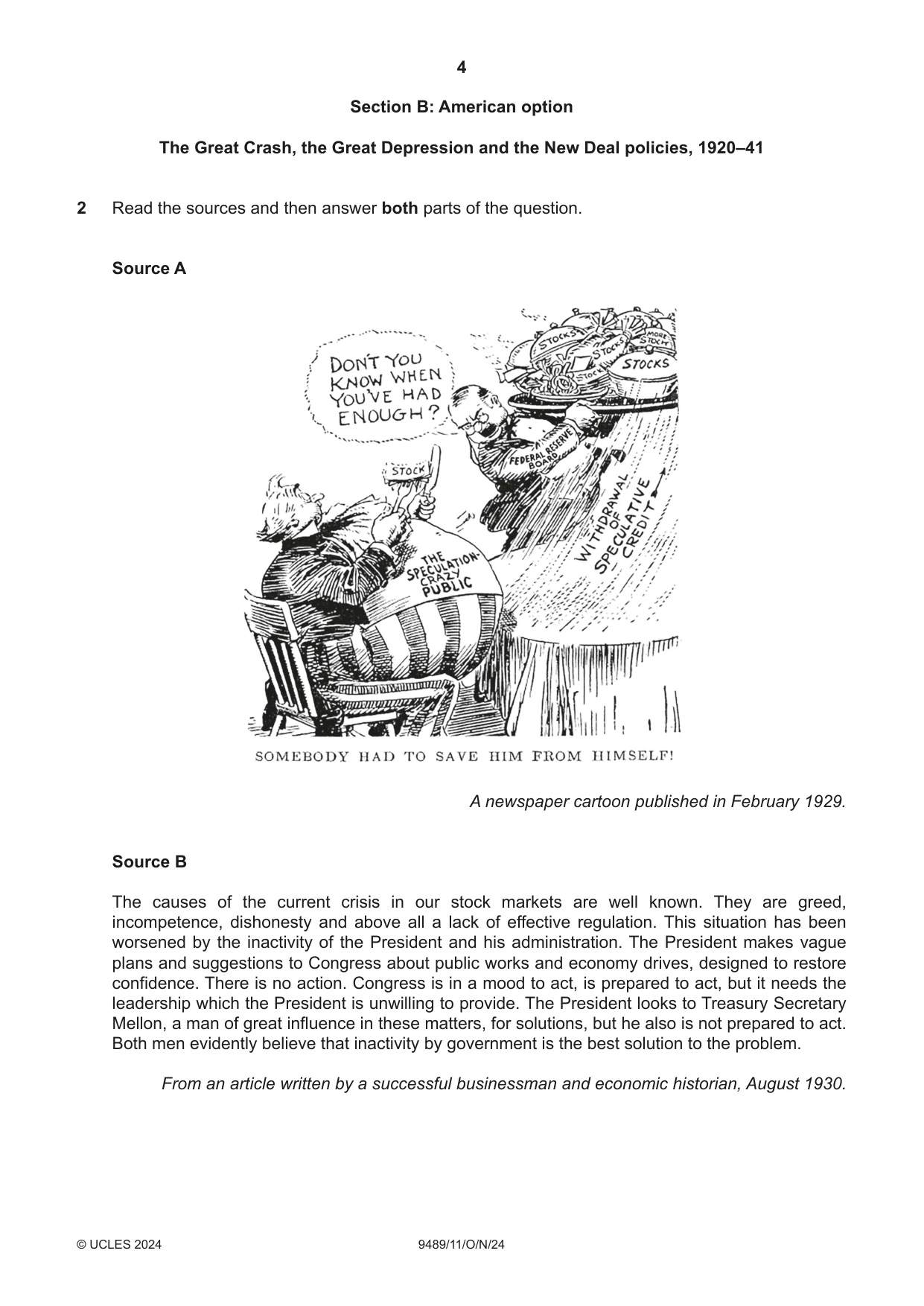
4 9489/11/O/N/24 © UCLES 2024 Section B: American option The Great Crash, the Great Depression and the New Deal policies, 1920–41 2 Read the sources and then answer both parts of the question. Source A A newspaper cartoon published in February 1929. Source B The causes of the current crisis in our stock markets are well known. They are greed, incompetence, dishonesty and above all a lack of effective regulation. This situation has been worsened by the inactivity of the President and his administration. The President makes vague plans and suggestions to Congress about public works and economy drives, designed to restore confidence. There is no action. Congress is in a mood to act, is prepared to act, but it needs the leadership which the President is unwilling to provide. The President looks to Treasury Secretary Mellon, a man of great influence in these matters, for solutions, but he also is not prepared to act. Both men evidently believe that inactivity by government is the best solution to the problem. From an article written by a successful businessman and economic historian, August 1930.
Question paper, page 5
5 9489/11/O/N/24 © UCLES 2024 [Turn over Source C In 1927, the Governors of the Banks of England, France and Germany put enormous pressure on the US Federal Reserve Board to cut its interest rates and lend more money. The Board gave in to this foreign pressure. This was one of the most costly errors made by any banking system in the past seventy-five years. This meant millions of dollars were made available to help finance the purchase of millions of shares in the United States. Provided with this cheap money, Americans rushed wildly into their stock markets. From that date the situation got totally out of control and led to the crisis of 1929. Evidence given by a member of the Federal Reserve Board to a Senate Committee investigating the 1929 crisis, March 1933. Source D Our banks were the weakest link in our whole economic system. We were slow to recognise the many dangers present in them before 1929. They included a weak and badly organised system of deposits and a willingness to lend money to anyone. There were no safety or security measures, and, above all, a lack of honesty amongst some of the leading bankers. I had regularly urged Congress to reform banking to make it safe for savers, but it would not act. After the crisis of 1929, I recommended co-operation between business and States to prevent speculation. I suggested increased public works and greater economy by government departments to help restore confidence. I urged Treasury Secretary Mellon to do all he could to restore stability and confidence to our banking system, but he had limited powers in that respect. Only Congress had the power to act, and it was reluctant to do so in spite of my requests. From ‘The Memoirs of Herbert Hoover’ published in 1952. Answer both parts of the question with reference to the sources. (a) Read Source B and Source D. To what extent do these two sources agree about the government’s management of the stock market crisis of 1929? [15] (b) Read all of the sources. ‘Speculation on the stock market caused the Wall Street Crash of 1929.’ How far do the sources support this view? [25]
Question paper, page 6
6 9489/11/O/N/24 © UCLES 2024 Section C: International option The League of Nations and international relations in the 1920s 3 Read the sources and then answer both parts of the question. Source A Chamberlain felt that Kellogg’s proposals marked the increased participation by the United States in the question of world peace. The force of the Pact lay in the attitude of the United States towards any nation breaking it. If, Chamberlain said, the words of American leaders and press should indicate that this would be condemned as merely ‘naughty’ and the United States continued to export material to the country breaking the Pact, its effect would be small. On the other hand, if the American attitude were to condemn completely a nation which broke the Pact, then the potential of its force was very great. My reply was that this was an election year in the United States; both the Republican and Democratic parties pledged to outlaw war in their platforms and many prominent people had enthusiastically endorsed the attitude of the Secretary of State. From a conversation in London between a US diplomat and the British foreign minister, Austen Chamberlain, as reported to the US foreign ministry, July 1928. Source B The original proposition of Secretary Kellogg was an unconditional rejection of war. The Pact, with all the French and British reservations, is not a rejection but a justification for all wars mentioned in the exceptions and qualifications. These include wars of self-defence, as well as wars under the League Covenant or the Locarno Treaties. If self-defence could be defined as ‘to defend its territory from attack or invasion’, as suggested by Kellogg, it would be of some value, but no specific definition of self-defence is necessarily accepted, each country being free to make its own interpretation. This cannot be blamed on Secretary Kellogg, whose intentions were of the best, but is a result of the reservations insisted upon by European powers, which, it is still to be feared, understand peace as a condition of affairs achieved through war or the threat of war. From a lecture by a professor of law at the University of Chicago, August 1928. Source C The United States is taking a worldwide responsibility which it shunned during the last ten years. The League Covenant is confirmed and strengthened by the Kellogg–Briand Pact, and the US government becomes the moral guardian of the Versailles Treaty and subsequent treaties. Briand was very skilful in bringing the United States to recognise all existing treaties. We should not belittle the risks which may result from this new burden nor underestimate the responsibilities and duties which will fall on the United States. The citizens of that country should especially avoid the illusion that war can be eliminated by pacifist ideals. We must indeed be optimistic not to see real possibilities of war in different parts of Europe. As the Bolsheviks work constantly to create conflicts, we can see what a grave thing, but what a magnificent thing, the United States has undertaken in seeking to prevent another war in Europe. From an article by a French journalist in ‘The New York Times’, December 1928.
Question paper, page 7
7 9489/11/O/N/24 © UCLES 2024 Source D Warned by the disaster of the last great war, statesmen of all nations have been taking measures to prevent the return of another such calamity. These measures may not be an absolute guarantee of peace, but they constitute the greatest preventive measures ever adopted. The League of Nations has helped to solve international problems, and progress has been made towards the reduction of armaments. Our Pact was a sacred promise between all nations and to all peoples not to go to war for the settlement of their differences. It aimed to ‘outlaw’ war so that any nations which violated it would be condemned by the public opinion of the world. I regret very much to hear so many people, many of my own countrymen, predicting war, stating that Europe is preparing and arming for conflict. I share the opinion of those of broader vision who see hope for peace. From Kellogg’s acceptance speech for the Nobel Peace Prize, December 1930. Answer both parts of the question with reference to the sources. (a) Read Source A and Source C. Compare and contrast these two sources as evidence about the role of the United States in maintaining peace. [15] (b) Read all of the sources. ‘The Kellogg–Briand Pact would prevent a future war.’ How far do the sources support this view? [25]
Question paper, page 8
8 9489/11/O/N/24 © UCLES 2024 Permission to reproduce items where third-party owned material protected by copyright is included has been sought and cleared where possible. Every reasonable effort has been made by the publisher (UCLES) to trace copyright holders, but if any items requiring clearance have unwittingly been included, the publisher will be pleased to make amends at the earliest possible opportunity. To avoid the issue of disclosure of answer-related information to candidates, all copyright acknowledgements are reproduced online in the Cambridge Assessment International Education Copyright Acknowledgements Booklet. This is produced for each series of examinations and is freely available to download at www.cambridgeinternational.org after the live examination series. Cambridge Assessment International Education is part of Cambridge Assessment. Cambridge Assessment is the brand name of the University of Cambridge Local Examinations Syndicate (UCLES), which is a department of the University of Cambridge. BLANK PAGE
Mark scheme, page 1
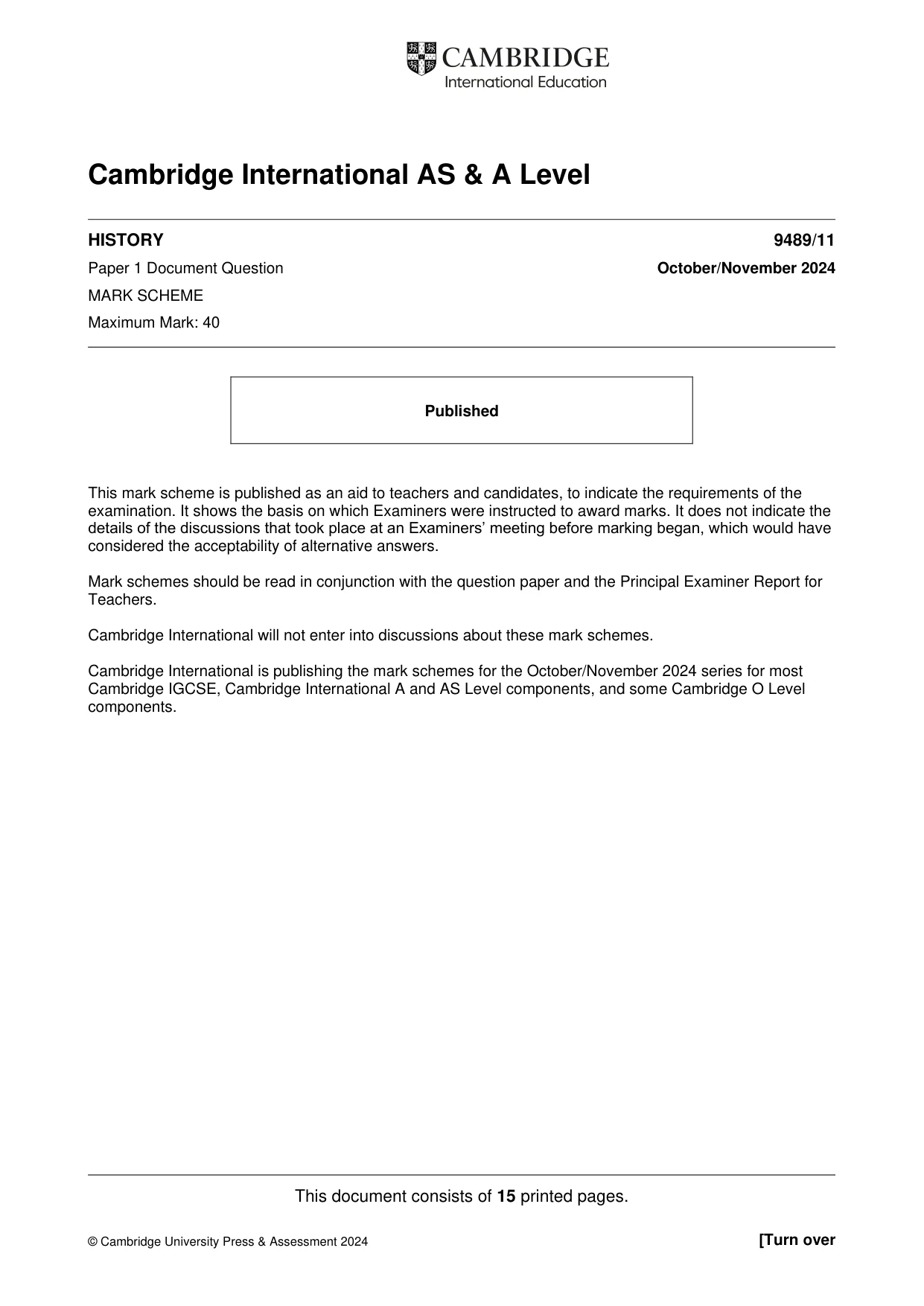
This document consists of 15 printed pages. © Cambridge University Press & Assessment 2024 [Turn over Cambridge International AS & A Level HISTORY 9489/11 Paper 1 Document Question October/November 2024 MARK SCHEME Maximum Mark: 40 Published This mark scheme is published as an aid to teachers and candidates, to indicate the requirements of the examination. It shows the basis on which Examiners were instructed to award marks. It does not indicate the details of the discussions that took place at an Examiners’ meeting before marking began, which would have considered the acceptability of alternative answers. Mark schemes should be read in conjunction with the question paper and the Principal Examiner Report for Teachers. Cambridge International will not enter into discussions about these mark schemes. Cambridge International is publishing the mark schemes for the October/November 2024 series for most Cambridge IGCSE, Cambridge International A and AS Level components, and some Cambridge O Level components.
Mark scheme, page 2
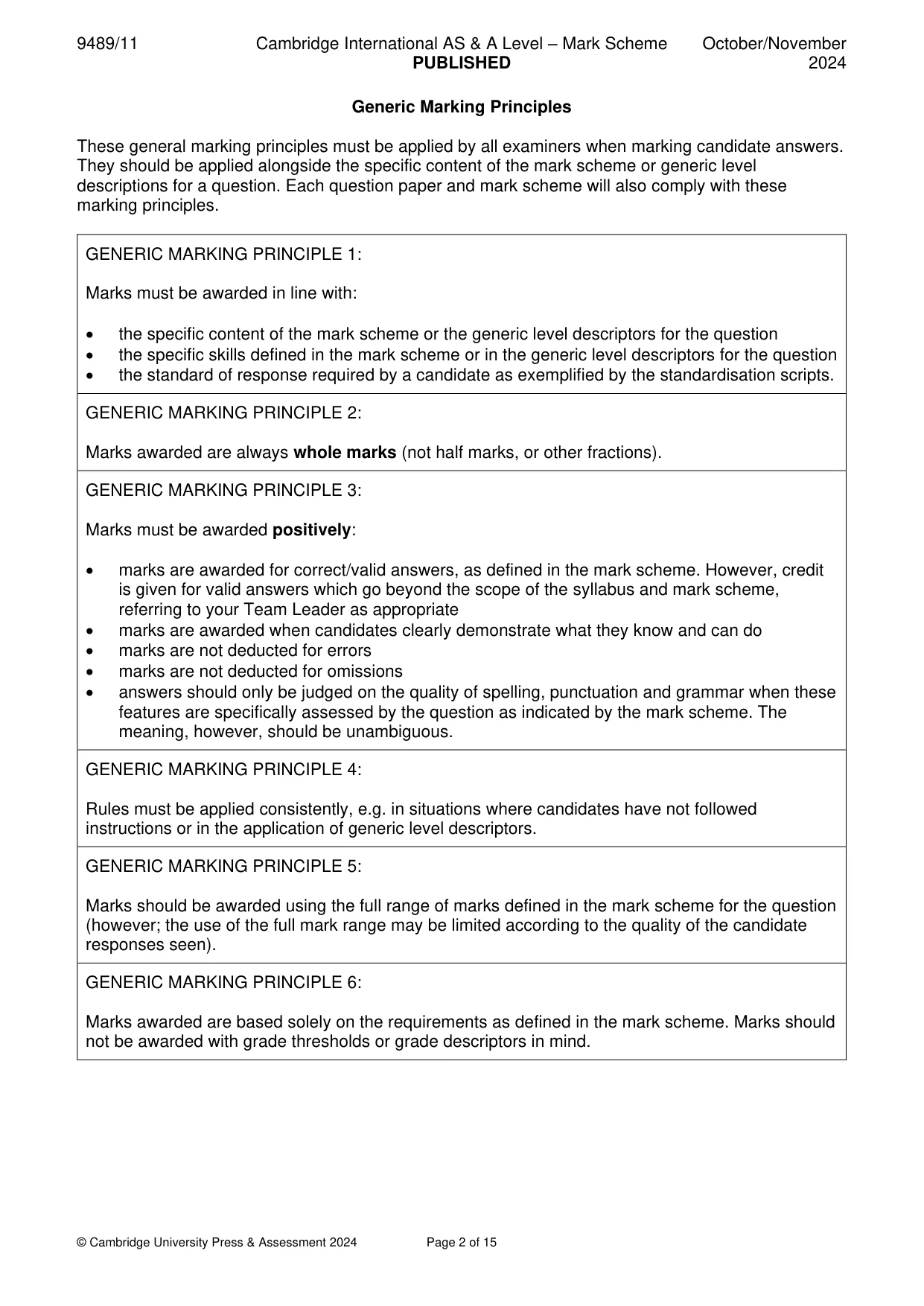
9489/11 Cambridge International AS & A Level – Mark Scheme PUBLISHED October/November 2024 © Cambridge University Press & Assessment 2024 Page 2 of 15 Generic Marking Principles These general marking principles must be applied by all examiners when marking candidate answers. They should be applied alongside the specific content of the mark scheme or generic level descriptions for a question. Each question paper and mark scheme will also comply with these marking principles. GENERIC MARKING PRINCIPLE 1: Marks must be awarded in line with: • the specific content of the mark scheme or the generic level descriptors for the question • the specific skills defined in the mark scheme or in the generic level descriptors for the question • the standard of response required by a candidate as exemplified by the standardisation scripts. GENERIC MARKING PRINCIPLE 2: Marks awarded are always whole marks (not half marks, or other fractions). GENERIC MARKING PRINCIPLE 3: Marks must be awarded positively: • marks are awarded for correct/valid answers, as defined in the mark scheme. However, credit is given for valid answers which go beyond the scope of the syllabus and mark scheme, referring to your Team Leader as appropriate • marks are awarded when candidates clearly demonstrate what they know and can do • marks are not deducted for errors • marks are not deducted for omissions • answers should only be judged on the quality of spelling, punctuation and grammar when these features are specifically assessed by the question as indicated by the mark scheme. The meaning, however, should be unambiguous. GENERIC MARKING PRINCIPLE 4: Rules must be applied consistently, e.g. in situations where candidates have not followed instructions or in the application of generic level descriptors. GENERIC MARKING PRINCIPLE 5: Marks should be awarded using the full range of marks defined in the mark scheme for the question (however; the use of the full mark range may be limited according to the quality of the candidate responses seen). GENERIC MARKING PRINCIPLE 6: Marks awarded are based solely on the requirements as defined in the mark scheme. Marks should not be awarded with grade thresholds or grade descriptors in mind.
Mark scheme, page 3
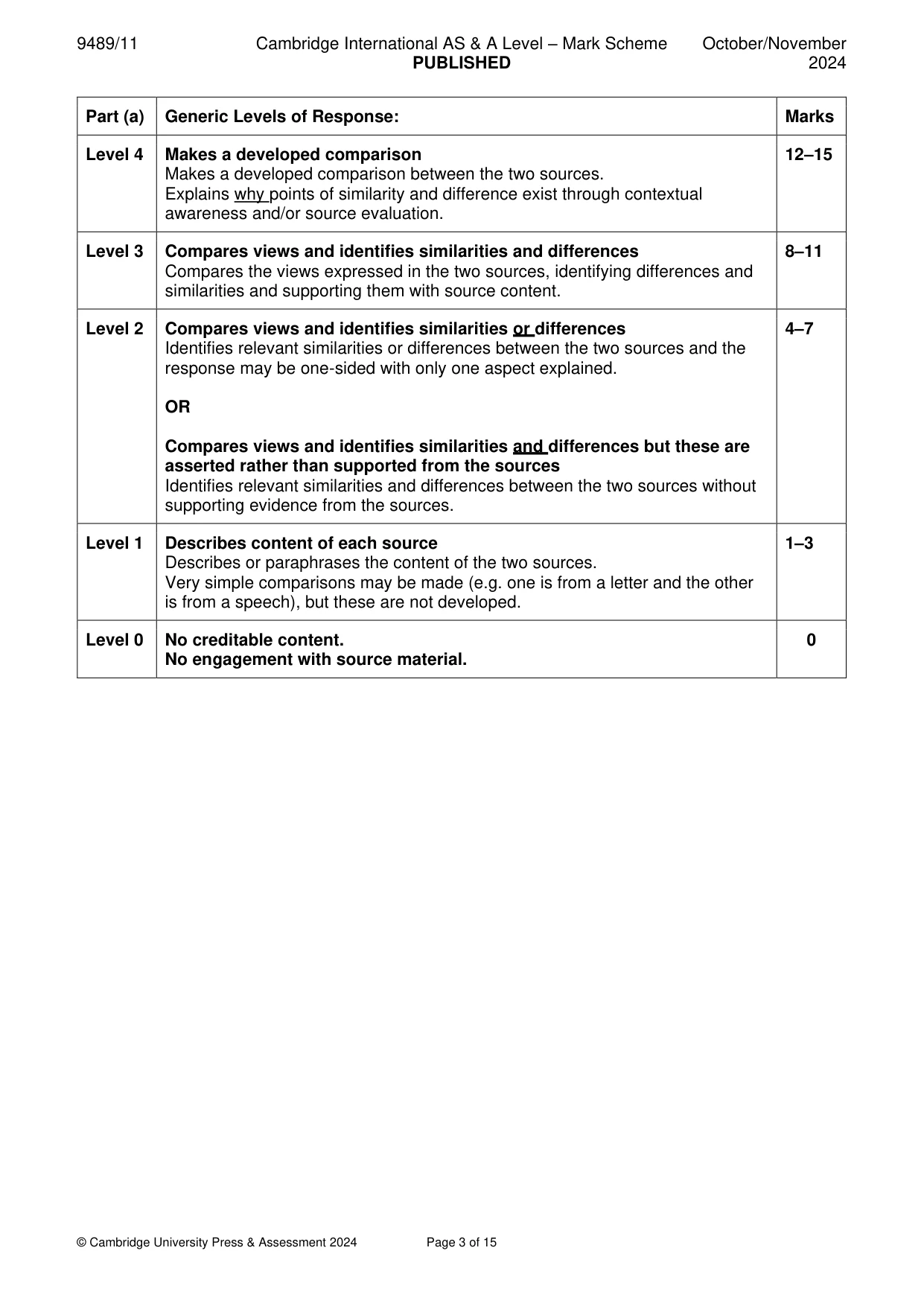
9489/11 Cambridge International AS & A Level – Mark Scheme PUBLISHED October/November 2024 © Cambridge University Press & Assessment 2024 Page 3 of 15 Part (a) Generic Levels of Response: Marks Level 4 Makes a developed comparison Makes a developed comparison between the two sources. Explains why points of similarity and difference exist through contextual awareness and/or source evaluation. 12–15 Level 3 Compares views and identifies similarities and differences Compares the views expressed in the two sources, identifying differences and similarities and supporting them with source content. 8–11 Level 2 Compares views and identifies similarities or differences Identifies relevant similarities or differences between the two sources and the response may be one-sided with only one aspect explained. OR Compares views and identifies similarities and differences but these are asserted rather than supported from the sources Identifies relevant similarities and differences between the two sources without supporting evidence from the sources. 4–7 Level 1 Describes content of each source Describes or paraphrases the content of the two sources. Very simple comparisons may be made (e.g. one is from a letter and the other is from a speech), but these are not developed. 1–3 Level 0 No creditable content. No engagement with source material. 0
Mark scheme, page 4
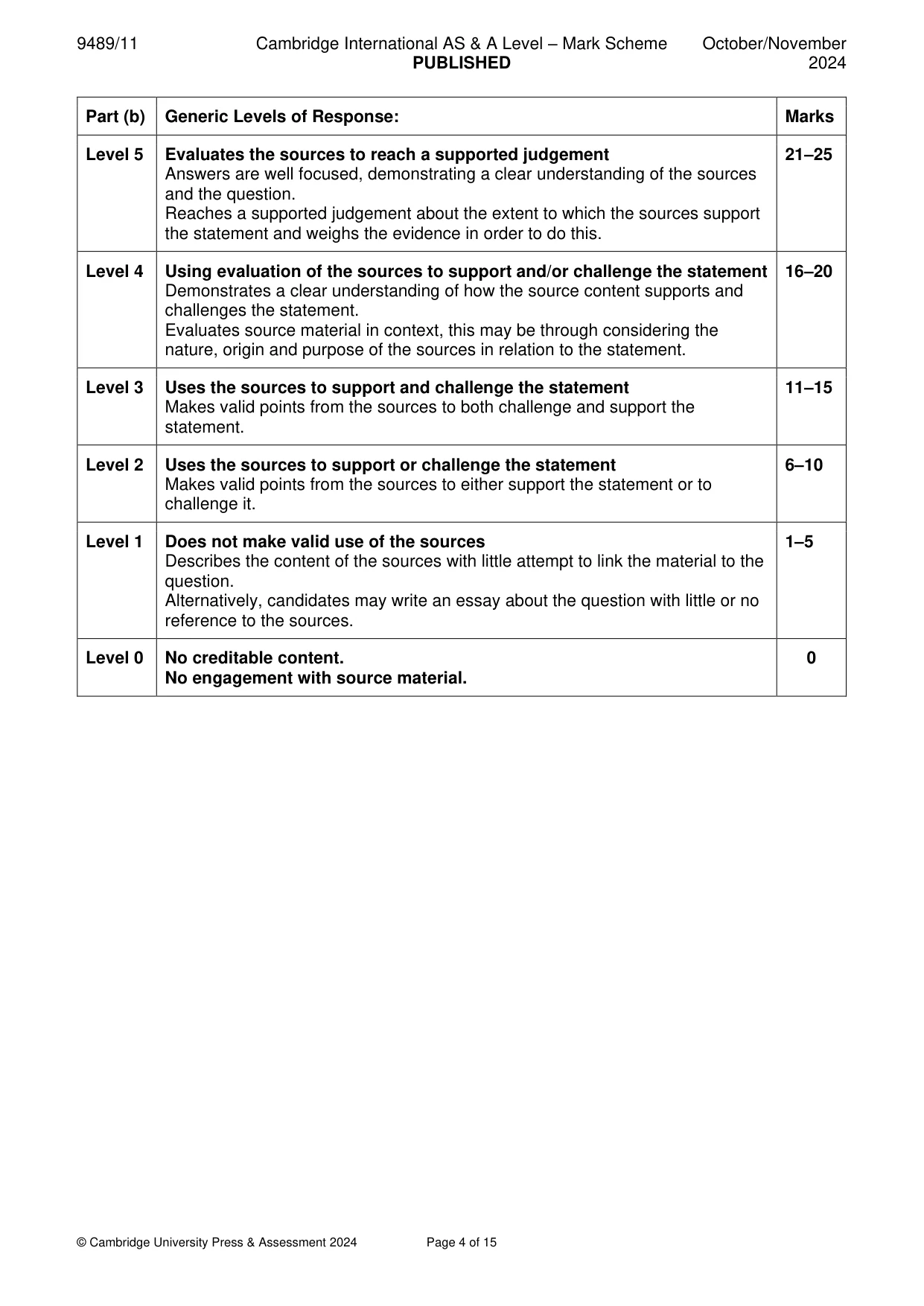
9489/11 Cambridge International AS & A Level – Mark Scheme PUBLISHED October/November 2024 © Cambridge University Press & Assessment 2024 Page 4 of 15 Part (b) Generic Levels of Response: Marks Level 5 Evaluates the sources to reach a supported judgement Answers are well focused, demonstrating a clear understanding of the sources and the question. Reaches a supported judgement about the extent to which the sources support the statement and weighs the evidence in order to do this. 21–25 Level 4 Using evaluation of the sources to support and/or challenge the statement Demonstrates a clear understanding of how the source content supports and challenges the statement. Evaluates source material in context, this may be through considering the nature, origin and purpose of the sources in relation to the statement. 16–20 Level 3 Uses the sources to support and challenge the statement Makes valid points from the sources to both challenge and support the statement. 11–15 Level 2 Uses the sources to support or challenge the statement Makes valid points from the sources to either support the statement or to challenge it. 6–10 Level 1 Does not make valid use of the sources Describes the content of the sources with little attempt to link the material to the question. Alternatively, candidates may write an essay about the question with little or no reference to the sources. 1–5 Level 0 No creditable content. No engagement with source material. 0
Mark scheme, page 5
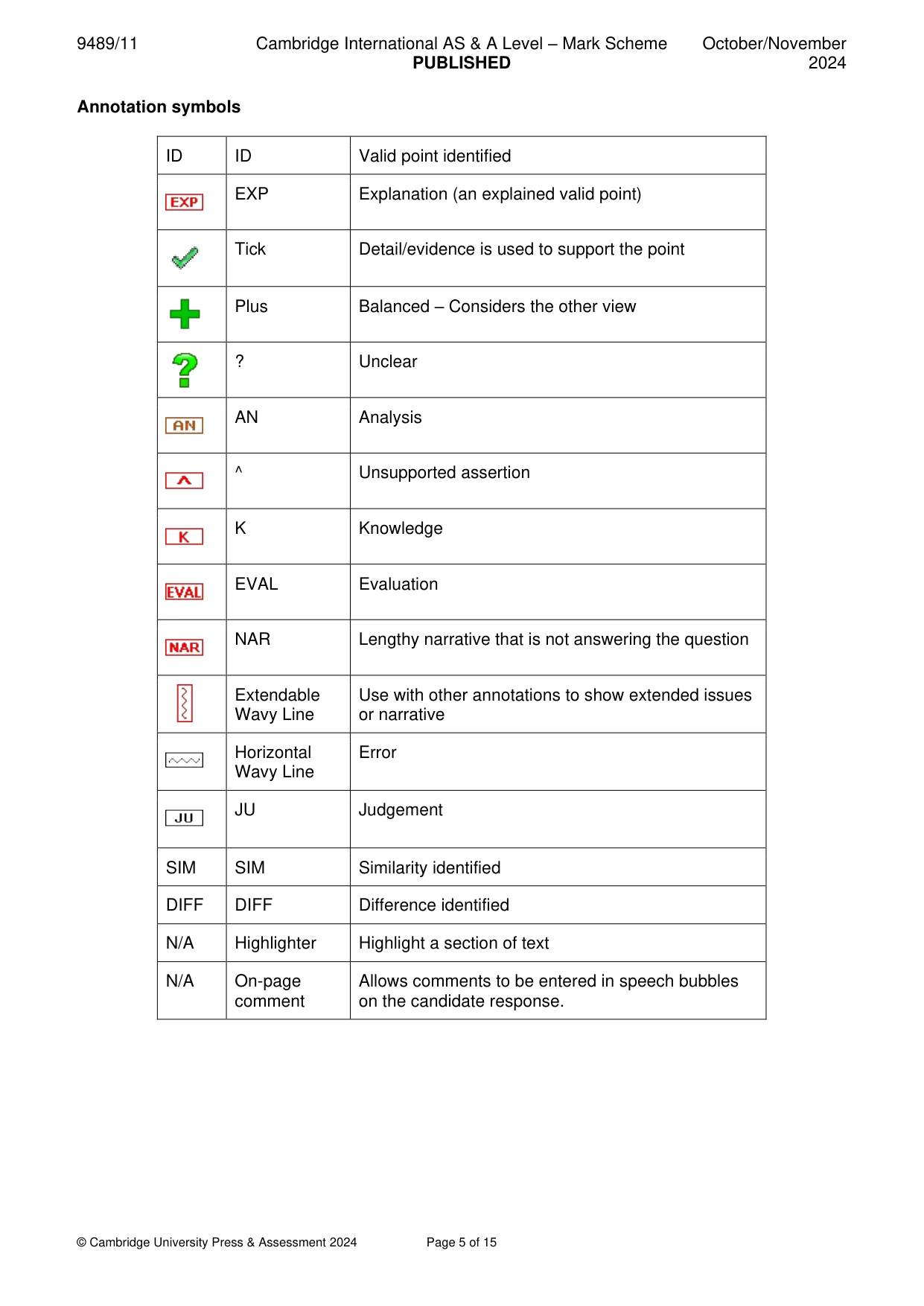
9489/11 Cambridge International AS & A Level – Mark Scheme PUBLISHED October/November 2024 © Cambridge University Press & Assessment 2024 Page 5 of 15 Annotation symbols ID ID Valid point identified EXP Explanation (an explained valid point) Tick Detail/evidence is used to support the point Plus Balanced – Considers the other view ? Unclear AN Analysis ^ Unsupported assertion K Knowledge EVAL Evaluation NAR Lengthy narrative that is not answering the question Extendable Wavy Line Use with other annotations to show extended issues or narrative Horizontal Wavy Line Error JU Judgement SIM SIM Similarity identified DIFF DIFF Difference identified N/A Highlighter Highlight a section of text N/A On-page comment Allows comments to be entered in speech bubbles on the candidate response.
Mark scheme, page 6
9489/11 Cambridge International AS & A Level – Mark Scheme PUBLISHED October/November 2024 © Cambridge University Press & Assessment 2024 Page 6 of 15 Using the annotations • Annotate using the symbols above as you read through the script. • At the end of each question write a short on-page comment: – be positive – say what the candidate has done, rather than what they have not – reference the attributes of the level descriptor you are awarding (i.e. make sure your comment matches the mark you have given) – be careful with your spelling
Mark scheme, page 7
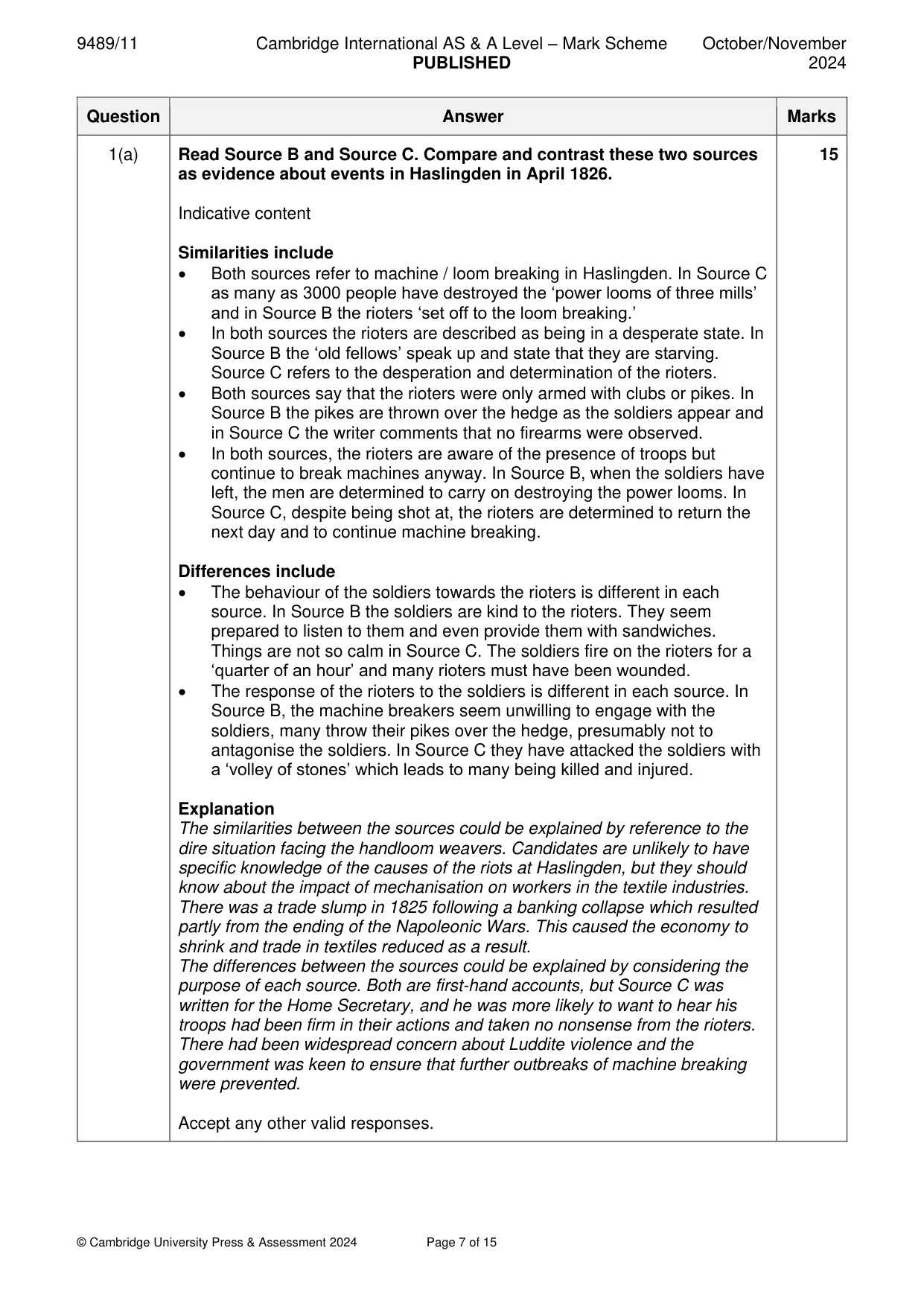
9489/11 Cambridge International AS & A Level – Mark Scheme PUBLISHED October/November 2024 © Cambridge University Press & Assessment 2024 Page 7 of 15 Question Answer Marks 1(a) Read Source B and Source C. Compare and contrast these two sources as evidence about events in Haslingden in April 1826. Indicative content Similarities include • Both sources refer to machine / loom breaking in Haslingden. In Source C as many as 3000 people have destroyed the ‘power looms of three mills’ and in Source B the rioters ‘set off to the loom breaking.’ • In both sources the rioters are described as being in a desperate state. In Source B the ‘old fellows’ speak up and state that they are starving. Source C refers to the desperation and determination of the rioters. • Both sources say that the rioters were only armed with clubs or pikes. In Source B the pikes are thrown over the hedge as the soldiers appear and in Source C the writer comments that no firearms were observed. • In both sources, the rioters are aware of the presence of troops but continue to break machines anyway. In Source B, when the soldiers have left, the men are determined to carry on destroying the power looms. In Source C, despite being shot at, the rioters are determined to return the next day and to continue machine breaking. Differences include • The behaviour of the soldiers towards the rioters is different in each source. In Source B the soldiers are kind to the rioters. They seem prepared to listen to them and even provide them with sandwiches. Things are not so calm in Source C. The soldiers fire on the rioters for a ‘quarter of an hour’ and many rioters must have been wounded. • The response of the rioters to the soldiers is different in each source. In Source B, the machine breakers seem unwilling to engage with the soldiers, many throw their pikes over the hedge, presumably not to antagonise the soldiers. In Source C they have attacked the soldiers with a ‘volley of stones’ which leads to many being killed and injured. Explanation The similarities between the sources could be explained by reference to the dire situation facing the handloom weavers. Candidates are unlikely to have specific knowledge of the causes of the riots at Haslingden, but they should know about the impact of mechanisation on workers in the textile industries. There was a trade slump in 1825 following a banking collapse which resulted partly from the ending of the Napoleonic Wars. This caused the economy to shrink and trade in textiles reduced as a result. The differences between the sources could be explained by considering the purpose of each source. Both are first-hand accounts, but Source C was written for the Home Secretary, and he was more likely to want to hear his troops had been firm in their actions and taken no nonsense from the rioters. There had been widespread concern about Luddite violence and the government was keen to ensure that further outbreaks of machine breaking were prevented. Accept any other valid responses. 15
Mark scheme, page 8
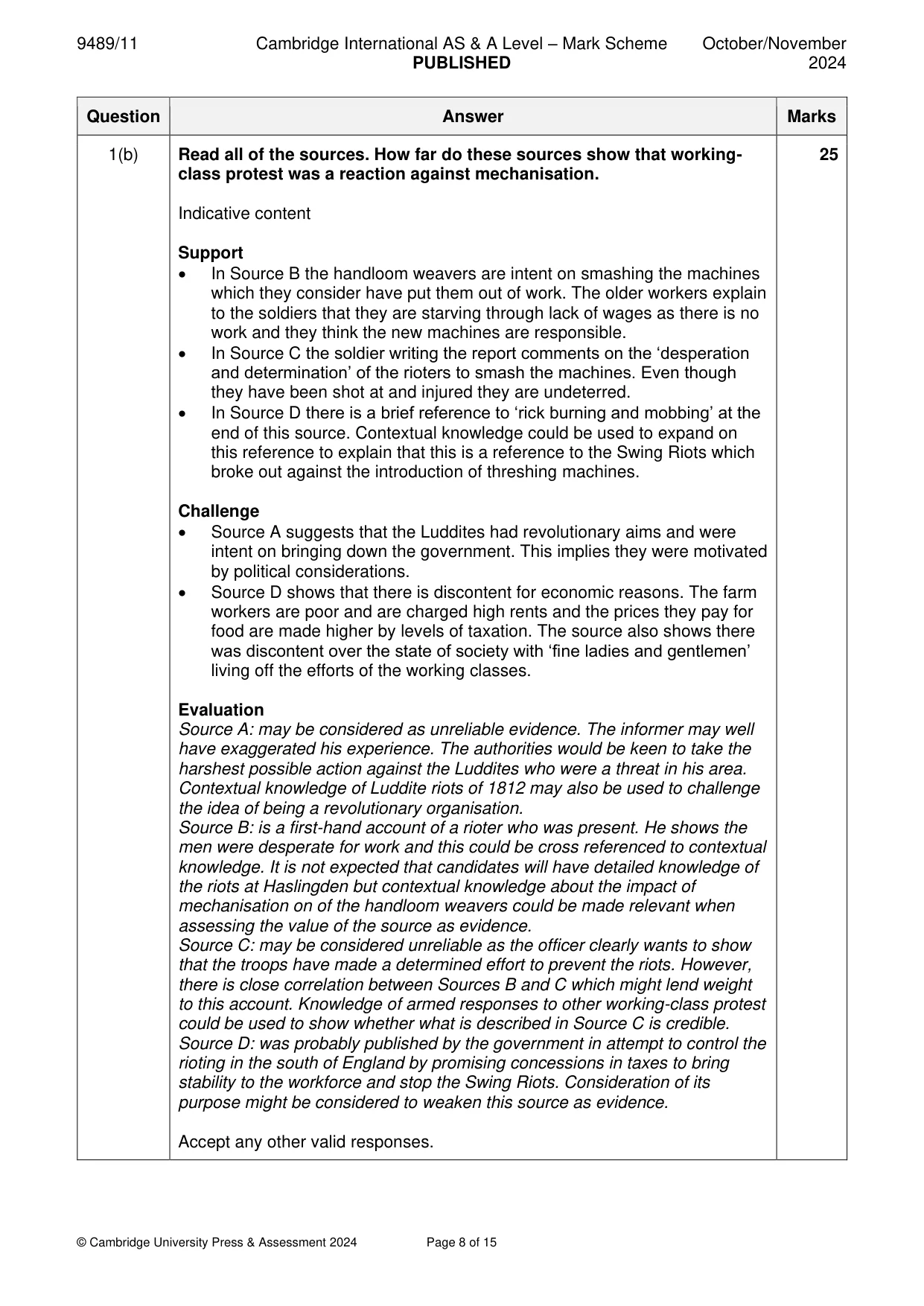
9489/11 Cambridge International AS & A Level – Mark Scheme PUBLISHED October/November 2024 © Cambridge University Press & Assessment 2024 Page 8 of 15 Question Answer Marks 1(b) Read all of the sources. How far do these sources show that working- class protest was a reaction against mechanisation. Indicative content Support • In Source B the handloom weavers are intent on smashing the machines which they consider have put them out of work. The older workers explain to the soldiers that they are starving through lack of wages as there is no work and they think the new machines are responsible. • In Source C the soldier writing the report comments on the ‘desperation and determination’ of the rioters to smash the machines. Even though they have been shot at and injured they are undeterred. • In Source D there is a brief reference to ‘rick burning and mobbing’ at the end of this source. Contextual knowledge could be used to expand on this reference to explain that this is a reference to the Swing Riots which broke out against the introduction of threshing machines. Challenge • Source A suggests that the Luddites had revolutionary aims and were intent on bringing down the government. This implies they were motivated by political considerations. • Source D shows that there is discontent for economic reasons. The farm workers are poor and are charged high rents and the prices they pay for food are made higher by levels of taxation. The source also shows there was discontent over the state of society with ‘fine ladies and gentlemen’ living off the efforts of the working classes. Evaluation Source A: may be considered as unreliable evidence. The informer may well have exaggerated his experience. The authorities would be keen to take the harshest possible action against the Luddites who were a threat in his area. Contextual knowledge of Luddite riots of 1812 may also be used to challenge the idea of being a revolutionary organisation. Source B: is a first-hand account of a rioter who was present. He shows the men were desperate for work and this could be cross referenced to contextual knowledge. It is not expected that candidates will have detailed knowledge of the riots at Haslingden but contextual knowledge about the impact of mechanisation on of the handloom weavers could be made relevant when assessing the value of the source as evidence. Source C: may be considered unreliable as the officer clearly wants to show that the troops have made a determined effort to prevent the riots. However, there is close correlation between Sources B and C which might lend weight to this account. Knowledge of armed responses to other working-class protest could be used to show whether what is described in Source C is credible. Source D: was probably published by the government in attempt to control the rioting in the south of England by promising concessions in taxes to bring stability to the workforce and stop the Swing Riots. Consideration of its purpose might be considered to weaken this source as evidence. Accept any other valid responses. 25
Mark scheme, page 9
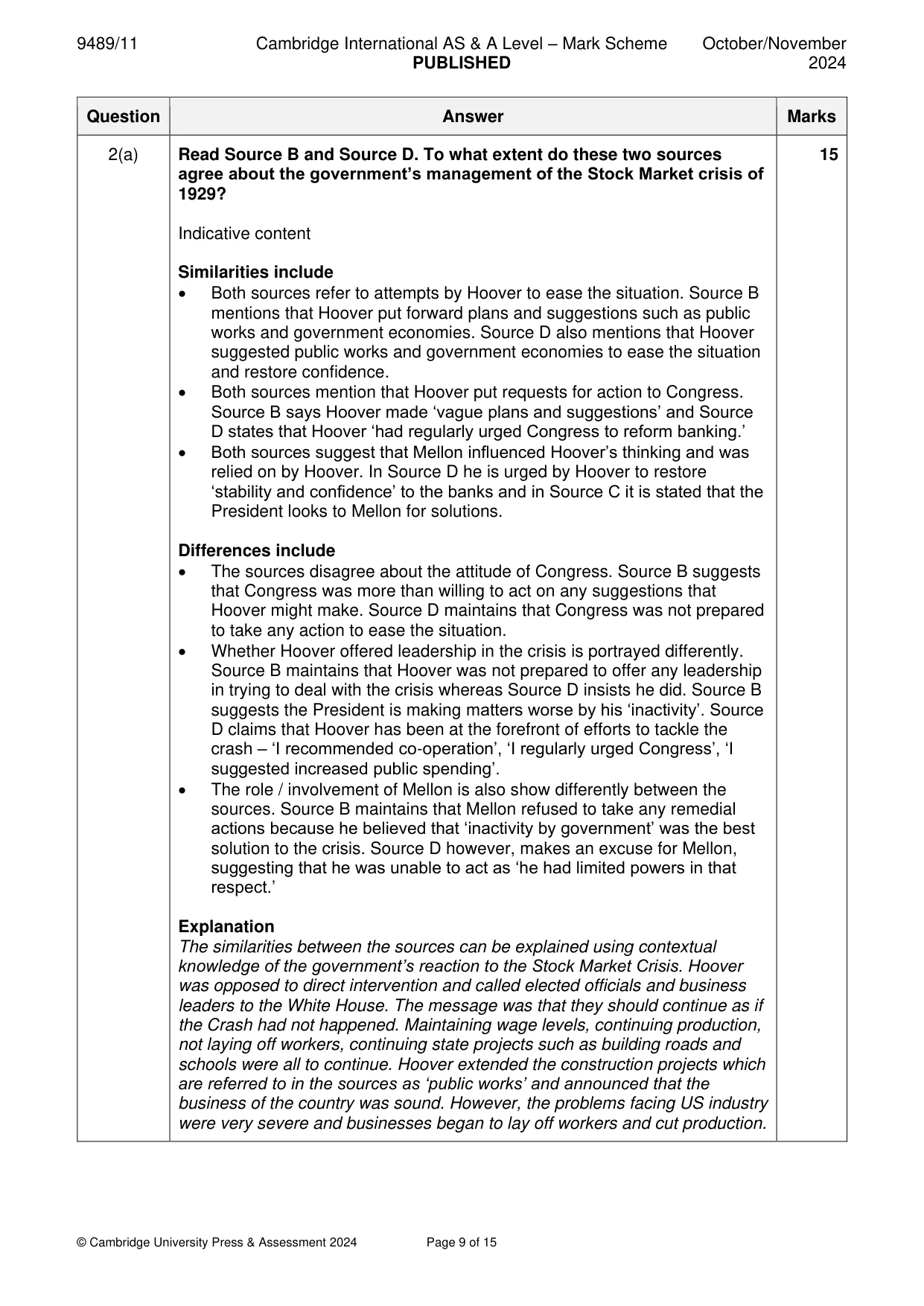
9489/11 Cambridge International AS & A Level – Mark Scheme PUBLISHED October/November 2024 © Cambridge University Press & Assessment 2024 Page 9 of 15 Question Answer Marks 2(a) Read Source B and Source D. To what extent do these two sources agree about the government’s management of the Stock Market crisis of 1929? Indicative content Similarities include • Both sources refer to attempts by Hoover to ease the situation. Source B mentions that Hoover put forward plans and suggestions such as public works and government economies. Source D also mentions that Hoover suggested public works and government economies to ease the situation and restore confidence. • Both sources mention that Hoover put requests for action to Congress. Source B says Hoover made ‘vague plans and suggestions’ and Source D states that Hoover ‘had regularly urged Congress to reform banking.’ • Both sources suggest that Mellon influenced Hoover’s thinking and was relied on by Hoover. In Source D he is urged by Hoover to restore ‘stability and confidence’ to the banks and in Source C it is stated that the President looks to Mellon for solutions. Differences include • The sources disagree about the attitude of Congress. Source B suggests that Congress was more than willing to act on any suggestions that Hoover might make. Source D maintains that Congress was not prepared to take any action to ease the situation. • Whether Hoover offered leadership in the crisis is portrayed differently. Source B maintains that Hoover was not prepared to offer any leadership in trying to deal with the crisis whereas Source D insists he did. Source B suggests the President is making matters worse by his ‘inactivity’. Source D claims that Hoover has been at the forefront of efforts to tackle the crash – ‘I recommended co-operation’, ‘I regularly urged Congress’, ‘I suggested increased public spending’. • The role / involvement of Mellon is also show differently between the sources. Source B maintains that Mellon refused to take any remedial actions because he believed that ‘inactivity by government’ was the best solution to the crisis. Source D however, makes an excuse for Mellon, suggesting that he was unable to act as ‘he had limited powers in that respect.’ Explanation The similarities between the sources can be explained using contextual knowledge of the government’s reaction to the Stock Market Crisis. Hoover was opposed to direct intervention and called elected officials and business leaders to the White House. The message was that they should continue as if the Crash had not happened. Maintaining wage levels, continuing production, not laying off workers, continuing state projects such as building roads and schools were all to continue. Hoover extended the construction projects which are referred to in the sources as ‘public works’ and announced that the business of the country was sound. However, the problems facing US industry were very severe and businesses began to lay off workers and cut production. 15
Mark scheme, page 10
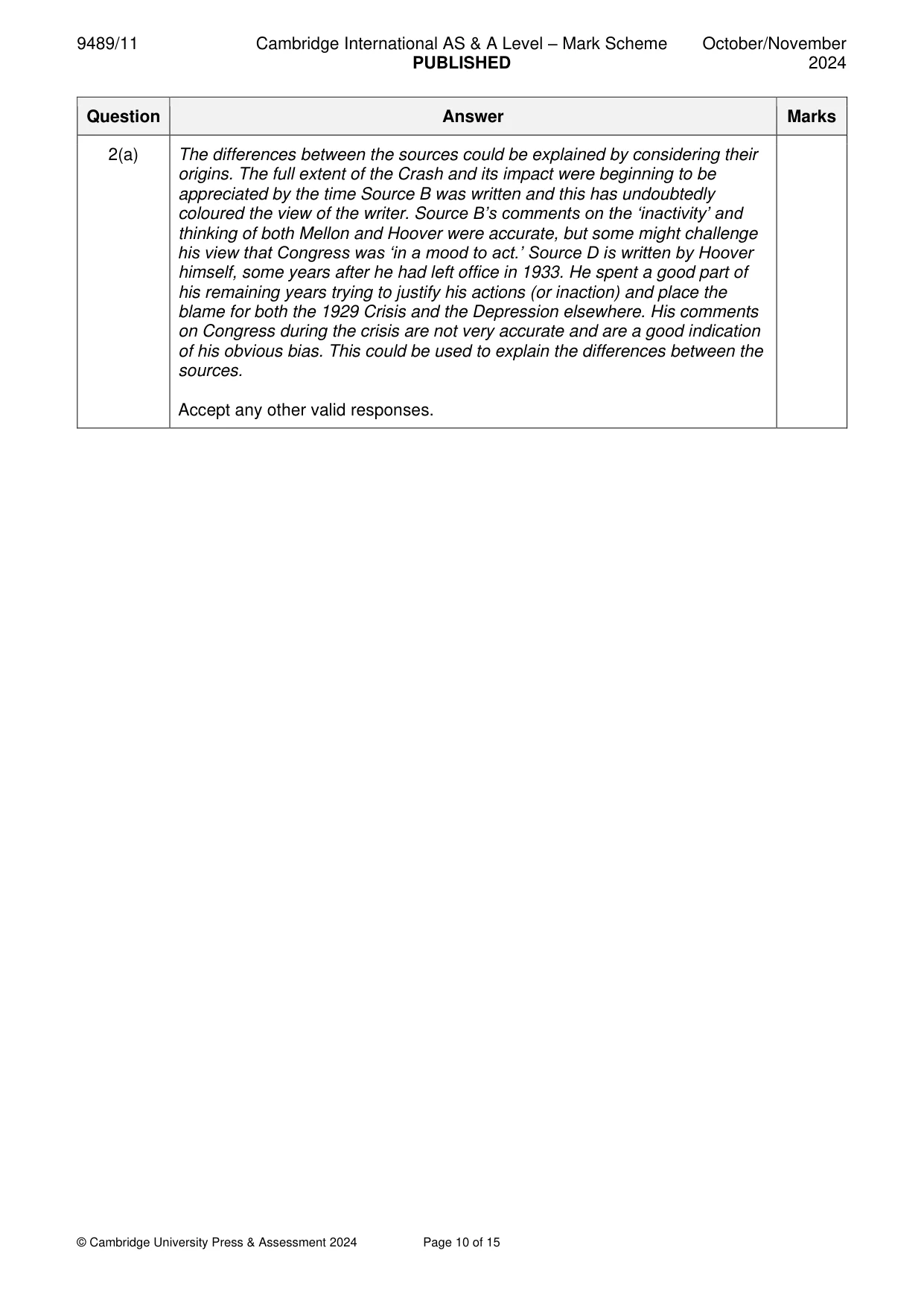
9489/11 Cambridge International AS & A Level – Mark Scheme PUBLISHED October/November 2024 © Cambridge University Press & Assessment 2024 Page 10 of 15 Question Answer Marks 2(a) The differences between the sources could be explained by considering their origins. The full extent of the Crash and its impact were beginning to be appreciated by the time Source B was written and this has undoubtedly coloured the view of the writer. Source B’s comments on the ‘inactivity’ and thinking of both Mellon and Hoover were accurate, but some might challenge his view that Congress was ‘in a mood to act.’ Source D is written by Hoover himself, some years after he had left office in 1933. He spent a good part of his remaining years trying to justify his actions (or inaction) and place the blame for both the 1929 Crisis and the Depression elsewhere. His comments on Congress during the crisis are not very accurate and are a good indication of his obvious bias. This could be used to explain the differences between the sources. Accept any other valid responses.
Mark scheme, page 11
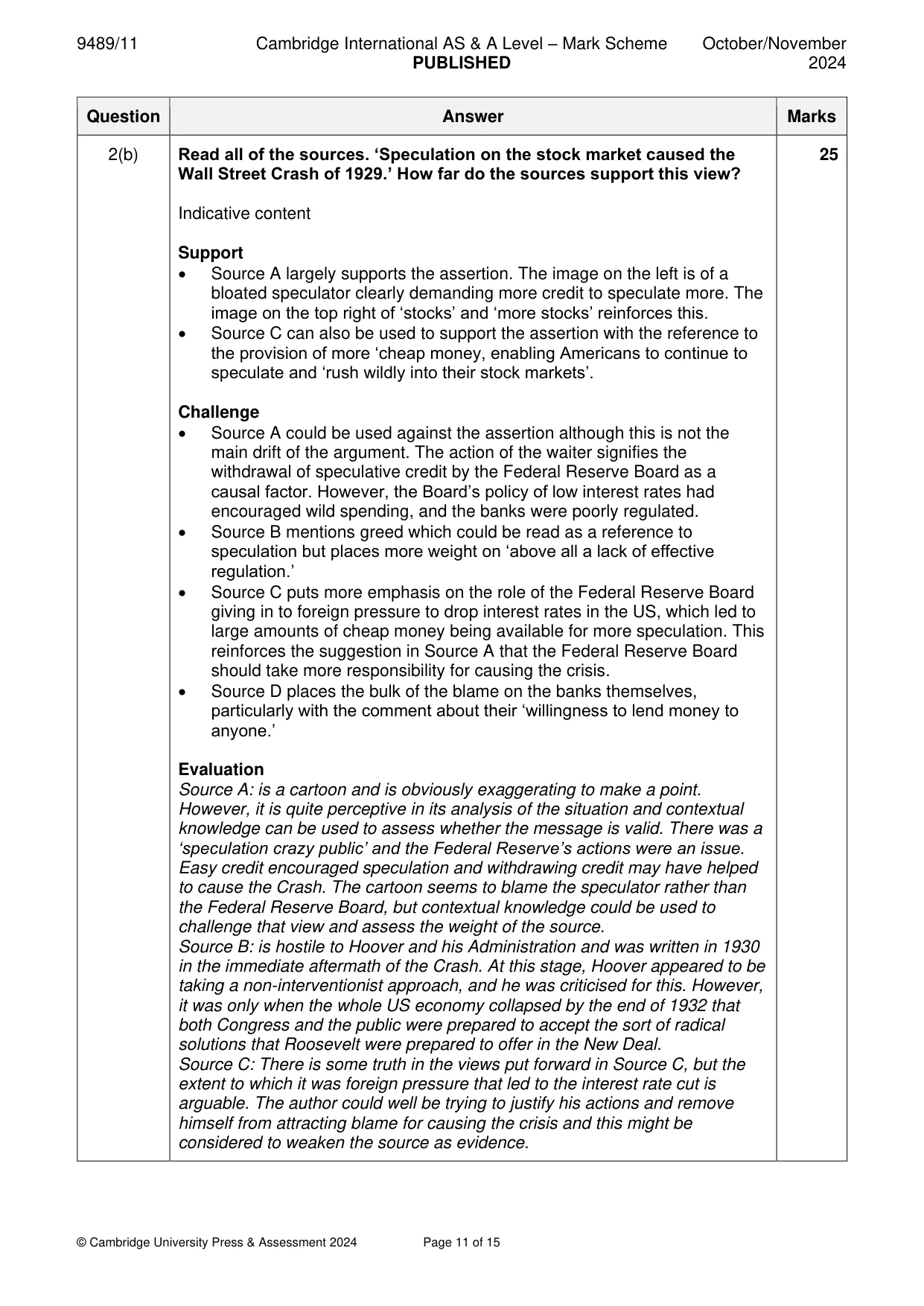
9489/11 Cambridge International AS & A Level – Mark Scheme PUBLISHED October/November 2024 © Cambridge University Press & Assessment 2024 Page 11 of 15 Question Answer Marks 2(b) Read all of the sources. ‘Speculation on the stock market caused the Wall Street Crash of 1929.’ How far do the sources support this view? Indicative content Support • Source A largely supports the assertion. The image on the left is of a bloated speculator clearly demanding more credit to speculate more. The image on the top right of ‘stocks’ and ‘more stocks’ reinforces this. • Source C can also be used to support the assertion with the reference to the provision of more ‘cheap money, enabling Americans to continue to speculate and ‘rush wildly into their stock markets’. Challenge • Source A could be used against the assertion although this is not the main drift of the argument. The action of the waiter signifies the withdrawal of speculative credit by the Federal Reserve Board as a causal factor. However, the Board’s policy of low interest rates had encouraged wild spending, and the banks were poorly regulated. • Source B mentions greed which could be read as a reference to speculation but places more weight on ‘above all a lack of effective regulation.’ • Source C puts more emphasis on the role of the Federal Reserve Board giving in to foreign pressure to drop interest rates in the US, which led to large amounts of cheap money being available for more speculation. This reinforces the suggestion in Source A that the Federal Reserve Board should take more responsibility for causing the crisis. • Source D places the bulk of the blame on the banks themselves, particularly with the comment about their ‘willingness to lend money to anyone.’ Evaluation Source A: is a cartoon and is obviously exaggerating to make a point. However, it is quite perceptive in its analysis of the situation and contextual knowledge can be used to assess whether the message is valid. There was a ‘speculation crazy public’ and the Federal Reserve’s actions were an issue. Easy credit encouraged speculation and withdrawing credit may have helped to cause the Crash. The cartoon seems to blame the speculator rather than the Federal Reserve Board, but contextual knowledge could be used to challenge that view and assess the weight of the source. Source B: is hostile to Hoover and his Administration and was written in 1930 in the immediate aftermath of the Crash. At this stage, Hoover appeared to be taking a non-interventionist approach, and he was criticised for this. However, it was only when the whole US economy collapsed by the end of 1932 that both Congress and the public were prepared to accept the sort of radical solutions that Roosevelt were prepared to offer in the New Deal. Source C: There is some truth in the views put forward in Source C, but the extent to which it was foreign pressure that led to the interest rate cut is arguable. The author could well be trying to justify his actions and remove himself from attracting blame for causing the crisis and this might be considered to weaken the source as evidence. 25
Mark scheme, page 12
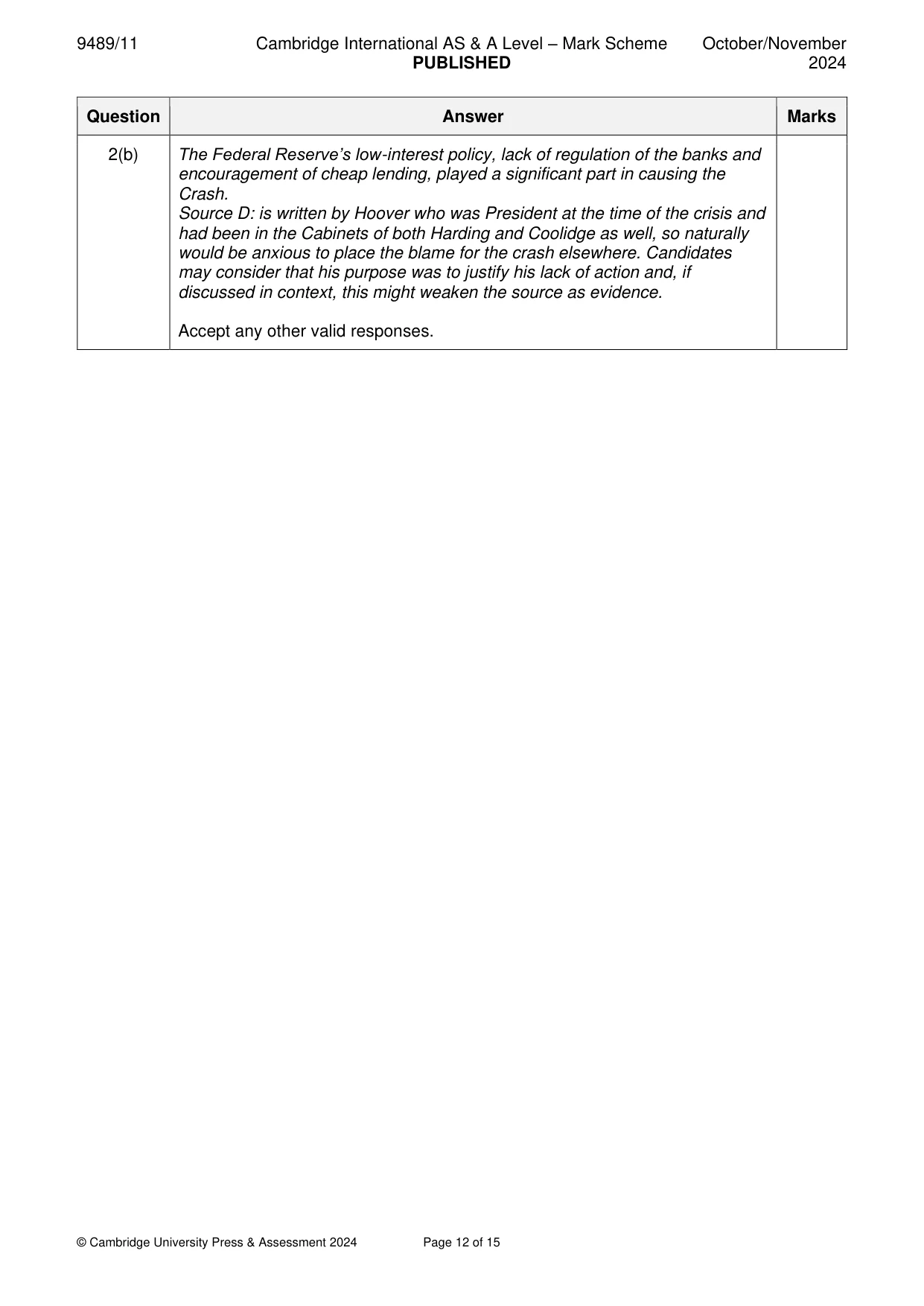
9489/11 Cambridge International AS & A Level – Mark Scheme PUBLISHED October/November 2024 © Cambridge University Press & Assessment 2024 Page 12 of 15 Question Answer Marks 2(b) The Federal Reserve’s low-interest policy, lack of regulation of the banks and encouragement of cheap lending, played a significant part in causing the Crash. Source D: is written by Hoover who was President at the time of the crisis and had been in the Cabinets of both Harding and Coolidge as well, so naturally would be anxious to place the blame for the crash elsewhere. Candidates may consider that his purpose was to justify his lack of action and, if discussed in context, this might weaken the source as evidence. Accept any other valid responses.
Mark scheme, page 13
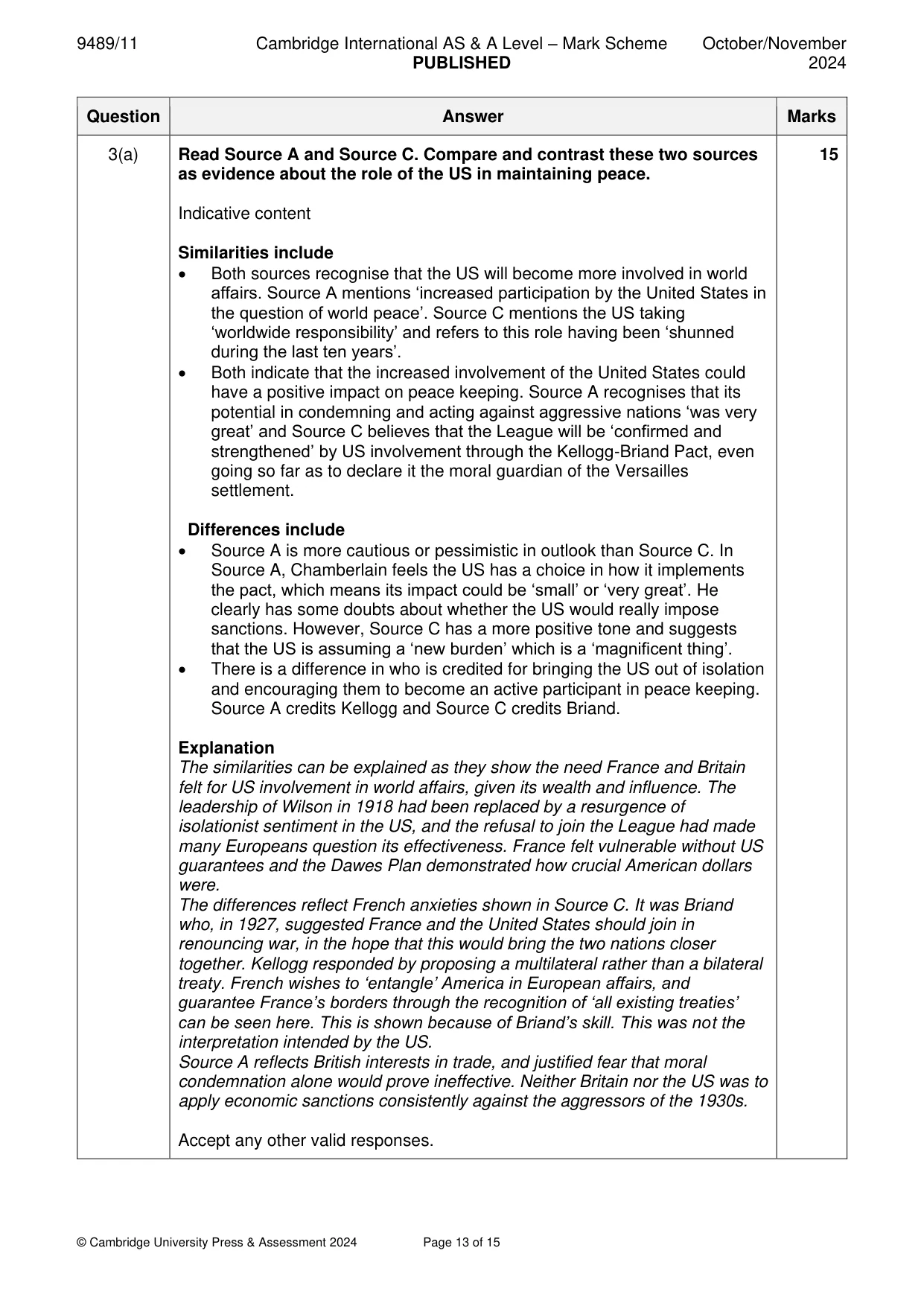
9489/11 Cambridge International AS & A Level – Mark Scheme PUBLISHED October/November 2024 © Cambridge University Press & Assessment 2024 Page 13 of 15 Question Answer Marks 3(a) Read Source A and Source C. Compare and contrast these two sources as evidence about the role of the US in maintaining peace. Indicative content Similarities include • Both sources recognise that the US will become more involved in world affairs. Source A mentions ‘increased participation by the United States in the question of world peace’. Source C mentions the US taking ‘worldwide responsibility’ and refers to this role having been ‘shunned during the last ten years’. • Both indicate that the increased involvement of the United States could have a positive impact on peace keeping. Source A recognises that its potential in condemning and acting against aggressive nations ‘was very great’ and Source C believes that the League will be ‘confirmed and strengthened’ by US involvement through the Kellogg-Briand Pact, even going so far as to declare it the moral guardian of the Versailles settlement. Differences include • Source A is more cautious or pessimistic in outlook than Source C. In Source A, Chamberlain feels the US has a choice in how it implements the pact, which means its impact could be ‘small’ or ‘very great’. He clearly has some doubts about whether the US would really impose sanctions. However, Source C has a more positive tone and suggests that the US is assuming a ‘new burden’ which is a ‘magnificent thing’. • There is a difference in who is credited for bringing the US out of isolation and encouraging them to become an active participant in peace keeping. Source A credits Kellogg and Source C credits Briand. Explanation The similarities can be explained as they show the need France and Britain felt for US involvement in world affairs, given its wealth and influence. The leadership of Wilson in 1918 had been replaced by a resurgence of isolationist sentiment in the US, and the refusal to join the League had made many Europeans question its effectiveness. France felt vulnerable without US guarantees and the Dawes Plan demonstrated how crucial American dollars were. The differences reflect French anxieties shown in Source C. It was Briand who, in 1927, suggested France and the United States should join in renouncing war, in the hope that this would bring the two nations closer together. Kellogg responded by proposing a multilateral rather than a bilateral treaty. French wishes to ‘entangle’ America in European affairs, and guarantee France’s borders through the recognition of ‘all existing treaties’ can be seen here. This is shown because of Briand’s skill. This was not the interpretation intended by the US. Source A reflects British interests in trade, and justified fear that moral condemnation alone would prove ineffective. Neither Britain nor the US was to apply economic sanctions consistently against the aggressors of the 1930s. Accept any other valid responses. 15
Mark scheme, page 14
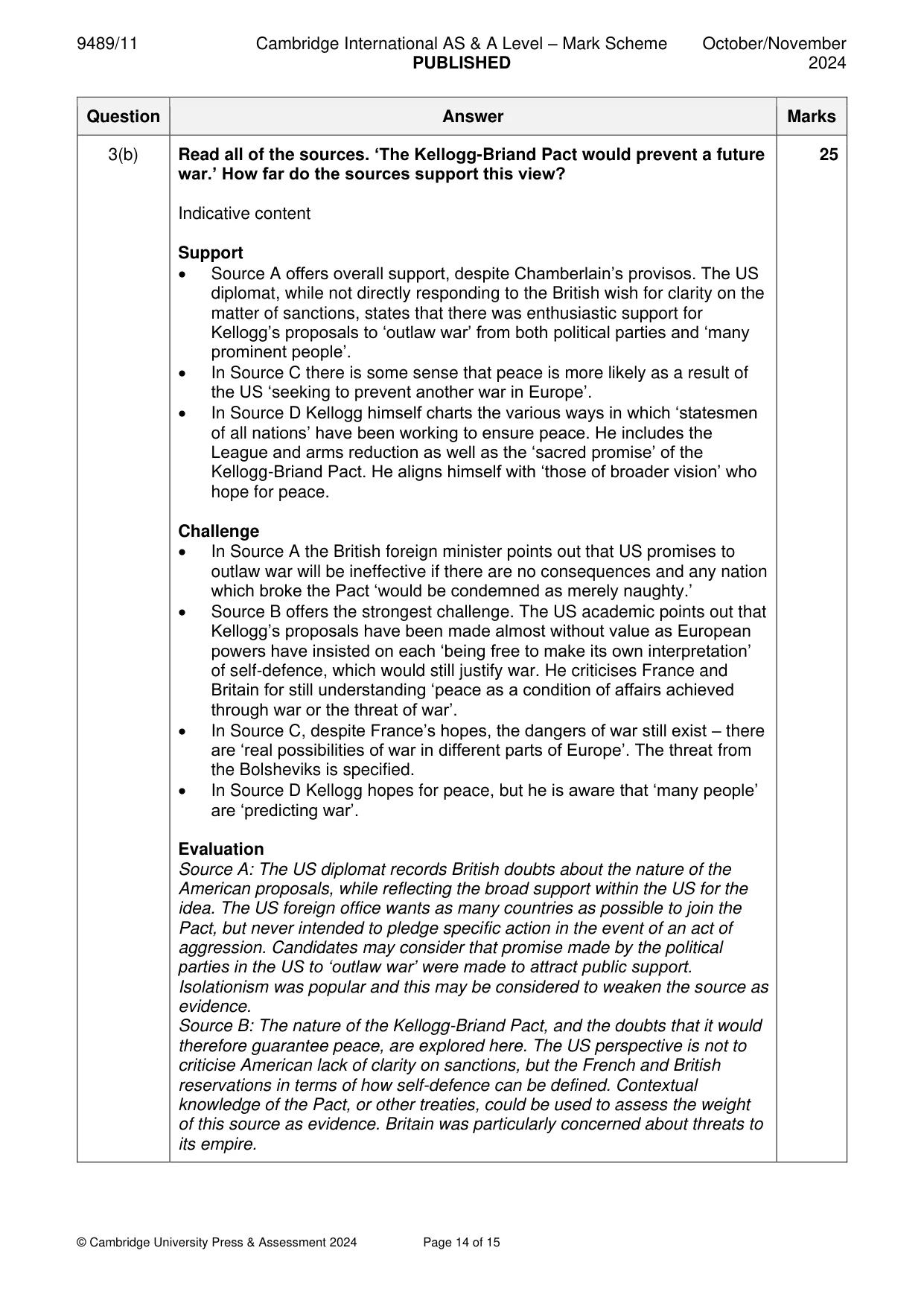
9489/11 Cambridge International AS & A Level – Mark Scheme PUBLISHED October/November 2024 © Cambridge University Press & Assessment 2024 Page 14 of 15 Question Answer Marks 3(b) Read all of the sources. ‘The Kellogg-Briand Pact would prevent a future war.’ How far do the sources support this view? Indicative content Support • Source A offers overall support, despite Chamberlain’s provisos. The US diplomat, while not directly responding to the British wish for clarity on the matter of sanctions, states that there was enthusiastic support for Kellogg’s proposals to ‘outlaw war’ from both political parties and ‘many prominent people’. • In Source C there is some sense that peace is more likely as a result of the US ‘seeking to prevent another war in Europe’. • In Source D Kellogg himself charts the various ways in which ‘statesmen of all nations’ have been working to ensure peace. He includes the League and arms reduction as well as the ‘sacred promise’ of the Kellogg-Briand Pact. He aligns himself with ‘those of broader vision’ who hope for peace. Challenge • In Source A the British foreign minister points out that US promises to outlaw war will be ineffective if there are no consequences and any nation which broke the Pact ‘would be condemned as merely naughty.’ • Source B offers the strongest challenge. The US academic points out that Kellogg’s proposals have been made almost without value as European powers have insisted on each ‘being free to make its own interpretation’ of self-defence, which would still justify war. He criticises France and Britain for still understanding ‘peace as a condition of affairs achieved through war or the threat of war’. • In Source C, despite France’s hopes, the dangers of war still exist – there are ‘real possibilities of war in different parts of Europe’. The threat from the Bolsheviks is specified. • In Source D Kellogg hopes for peace, but he is aware that ‘many people’ are ‘predicting war’. Evaluation Source A: The US diplomat records British doubts about the nature of the American proposals, while reflecting the broad support within the US for the idea. The US foreign office wants as many countries as possible to join the Pact, but never intended to pledge specific action in the event of an act of aggression. Candidates may consider that promise made by the political parties in the US to ‘outlaw war’ were made to attract public support. Isolationism was popular and this may be considered to weaken the source as evidence. Source B: The nature of the Kellogg-Briand Pact, and the doubts that it would therefore guarantee peace, are explored here. The US perspective is not to criticise American lack of clarity on sanctions, but the French and British reservations in terms of how self-defence can be defined. Contextual knowledge of the Pact, or other treaties, could be used to assess the weight of this source as evidence. Britain was particularly concerned about threats to its empire. 25
Mark scheme, page 15
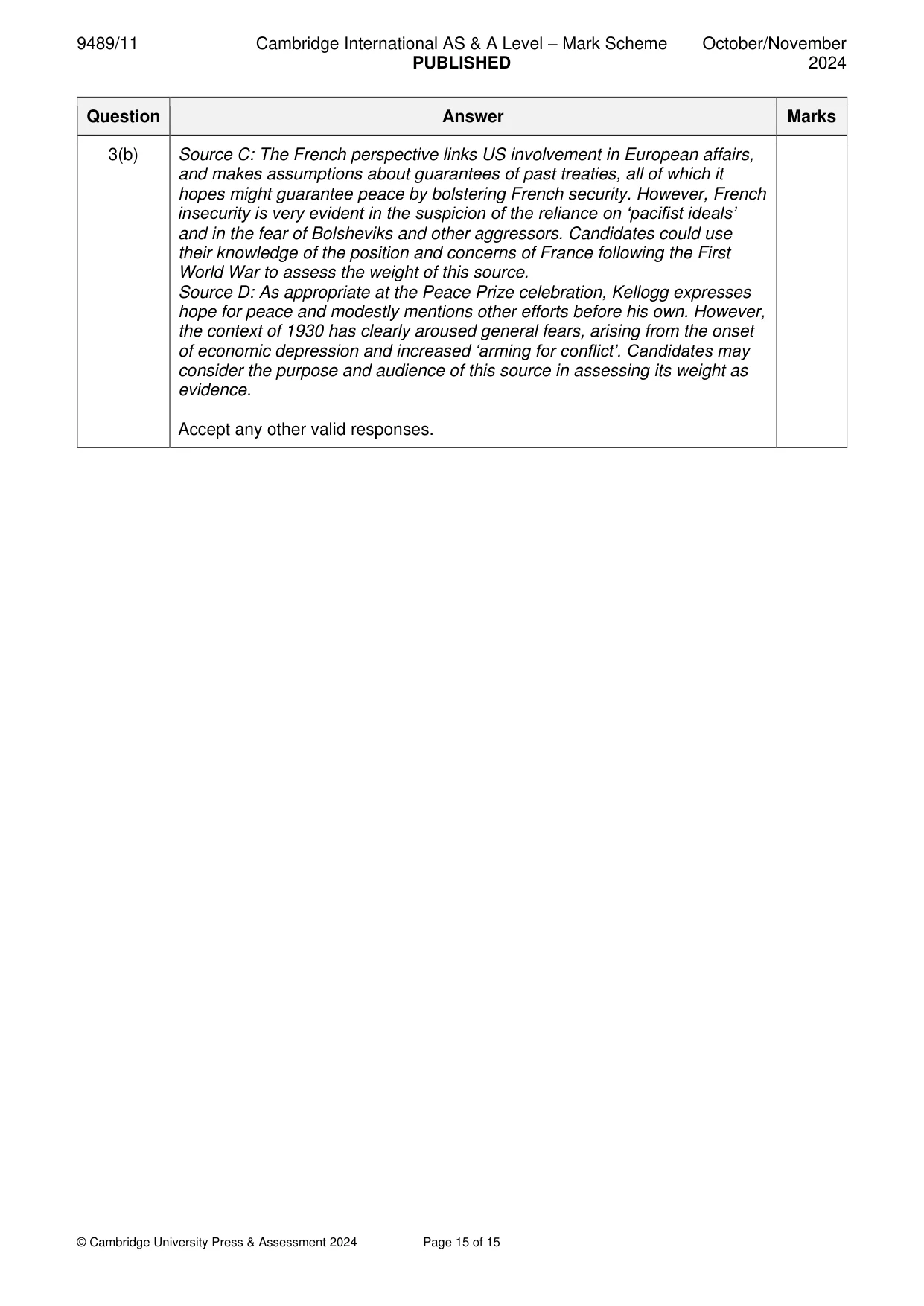
9489/11 Cambridge International AS & A Level – Mark Scheme PUBLISHED October/November 2024 © Cambridge University Press & Assessment 2024 Page 15 of 15 Question Answer Marks 3(b) Source C: The French perspective links US involvement in European affairs, and makes assumptions about guarantees of past treaties, all of which it hopes might guarantee peace by bolstering French security. However, French insecurity is very evident in the suspicion of the reliance on ‘pacifist ideals’ and in the fear of Bolsheviks and other aggressors. Candidates could use their knowledge of the position and concerns of France following the First World War to assess the weight of this source. Source D: As appropriate at the Peace Prize celebration, Kellogg expresses hope for peace and modestly mentions other efforts before his own. However, the context of 1930 has clearly aroused general fears, arising from the onset of economic depression and increased ‘arming for conflict’. Candidates may consider the purpose and audience of this source in assessing its weight as evidence. Accept any other valid responses.
What you needed in this session
Cambridge’s own grade thresholds for 2024 Oct/Nov, Paper 1 · Variant 1. A higher threshold means an easier paper — the bar moves with how the cohort did.