Cambridge A Level History 9489 — 2023 Oct/Nov Paper 1 · Variant 1
9489/11/O/N/23 · 40 marks · ≈45 min
The question paper and its mark scheme, free to read here and free to download. This is Cambridge’s own paper, exactly as it was sat.
Question paper8 pages
Mark scheme14 pages
Answers below. Sit the paper first if you are practising.
Paper as text
Question paper, page 1
This document has 8 pages. [Turn over Cambridge International AS & A Level HISTORY 9489/11 Paper 1 Document Question October/November 2023 1 hour 15 minutes You must answer on the enclosed answer booklet. You will need: Answer booklet (enclosed) INSTRUCTIONS ● Answer one question from one section only. Section A: European option Section B: American option Section C: International option ● Follow the instructions on the front cover of the answer booklet. If you need additional answer paper, ask the invigilator for a continuation booklet. INFORMATION ● The total mark for this paper is 40. ● The number of marks for each question or part question is shown in brackets [ ]. * 1 5 6 0 2 7 3 3 8 0 * DC (CE/CT) 311591/3 © UCLES 2023
Question paper, page 2
2 9489/11/O/N/23 © UCLES 2023 Answer one question from one section only. Section A: European option France, 1774–1814 1 Read the sources and then answer both parts of the question. Source A Provocative writings inciting violence against me and my family were published and remained unpunished. I therefore wished to leave Paris. Since I could not do this openly, I decided to leave by night. I had no intention of leaving the kingdom. I had no agreement to that end, either with foreign powers, my own relatives or any of the French subjects who have previously left the kingdom. The passport I carried was necessary for the journey. It was drawn up for a foreign country because they are not issued for the interior of the kingdom. From the views which I gathered along my route, I realised the public supported the Constitution. As soon as I realised the general will I acted without hesitation, just as I have never hesitated to make a personal sacrifice for the good of my people. I shall happily forget all the troubles which I may have suffered, to assure the peace and happiness of the nation. From a statement by Louis XVI, made to a special committee of the National Constituent Assembly, after his failed Flight to Varennes, June 1791. Source B The premier public servant abandons his post. He arms himself with a false passport. When writing to the foreign powers he says that his most dangerous enemies are those who spread doubts about the monarch’s intentions. He leaves the French a declaration which, if not criminal, is at the least contrary to the principles of our liberty. He must be aware that his flight exposed the nation to the dangers of civil war. And finally, of the claim that he wished only to go to Montmédy, I say this: if he wanted to content himself with making peaceful observations to the National Assembly about its decrees, in that case, it was useless to flee. If he wanted to support his claims with arms, in that case it was a conspiracy against liberty. From a speech made in the National Constituent Assembly by a republican clergyman, June 1791.
Question paper, page 3
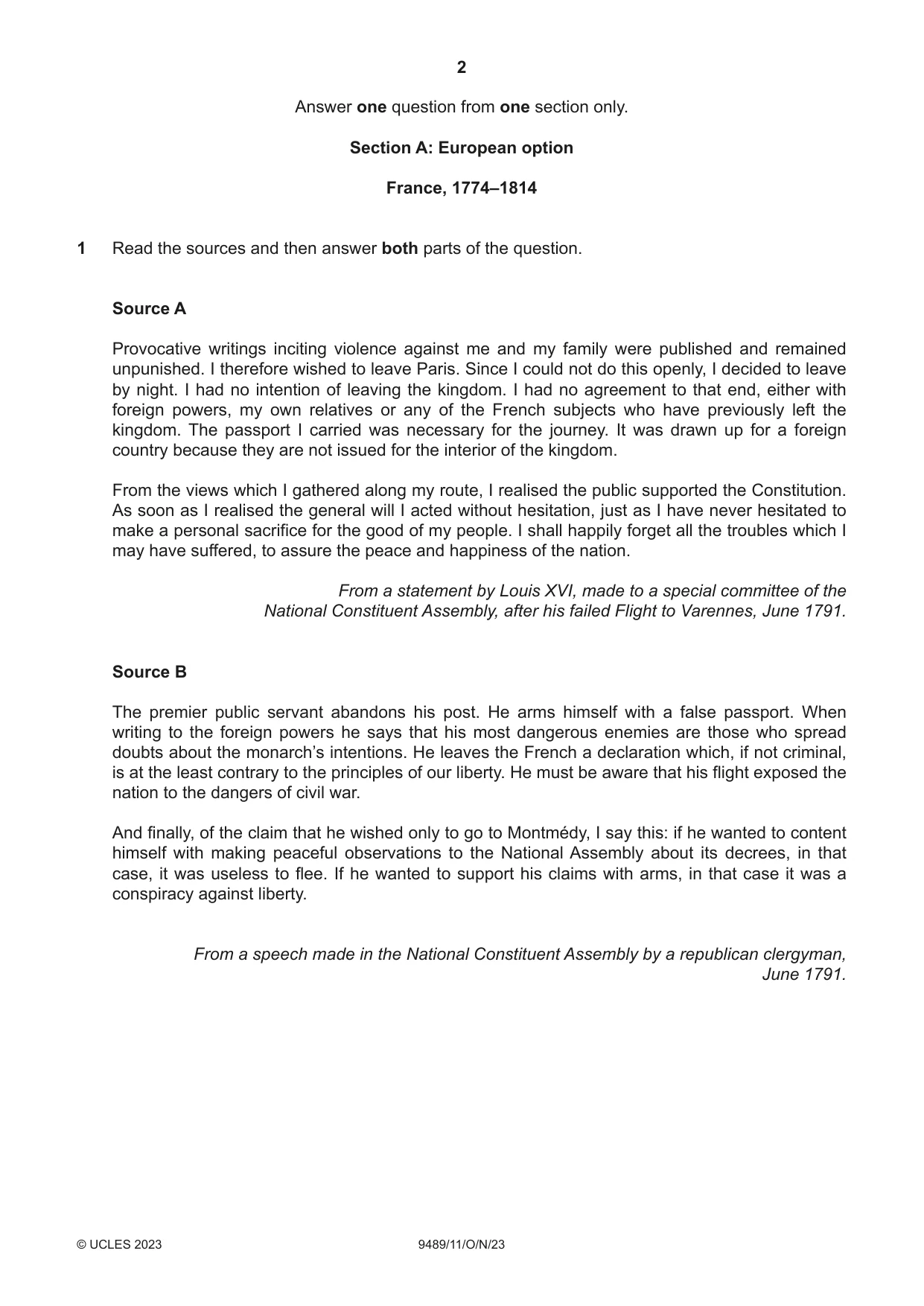
3 9489/11/O/N/23 © UCLES 2023 [Turn over Source C An anonymous cartoon of Louis XVI published in July 1791. Louis is shown as a two-faced king who takes an oath to the representatives of the Nation, ‘I will support the Constitution’, but at the same time says to the representatives of the royalist clergy, ‘I will destroy the Constitution’. Source D The condition of France is such that it may end up in total chaos. The solution is to end the partisan divisions and restore the authority of the government. There are only two ways to accomplish this: force or reconciliation. Force can only be used by foreign armies and this means resorting to war. Can a king contemplate all these misfortunes calmly and bring them down upon his people? One can never govern a people against its will. Right now the will of this nation is for the Rights of Man, senseless though they be. I believe then that I should join my will to the principles of the Constitution. I realise how difficult it will be to govern a large nation this way, I may say it will be impossible. But the obstacles that I would have put in the way [by refusing to accept the Constitution] would have brought about the war I sought to avoid. I prefer to proceed towards a better situation than that which would result from my refusal. From a secret letter written by Louis XVI to his brothers, 25 September 1791. Answer both parts of the question with reference to the sources. (a) Read Sources A and B. How far do these sources agree about the King’s Flight to Varennes? [15] (b) Read all of the sources. ‘Louis XVI supported the Constitution.’ How far do these sources support this view? [25]
Question paper, page 4
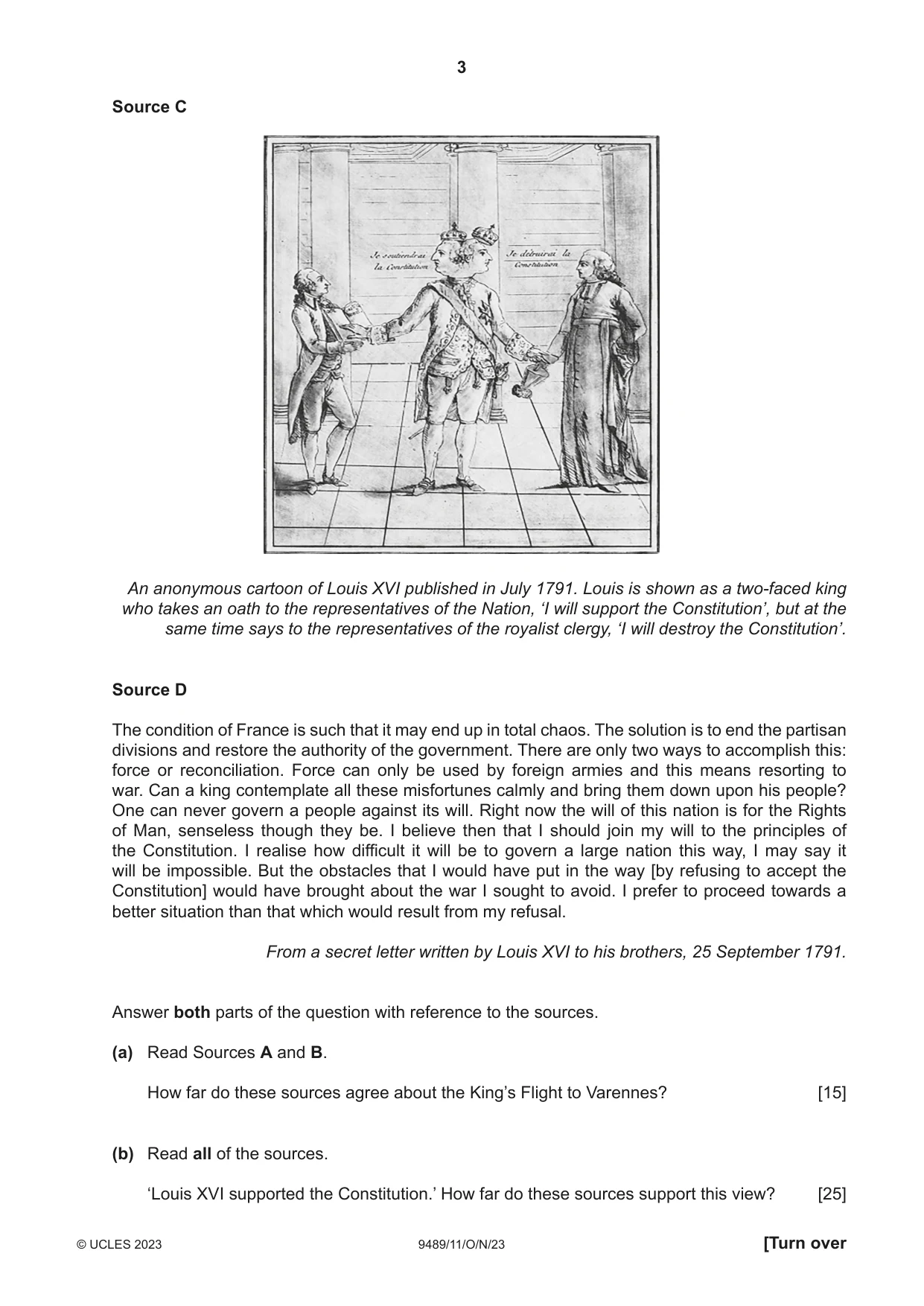
4 9489/11/O/N/23 © UCLES 2023 Section B: American option The Gilded Age and Progressive Era, 1870s to 1920 2 Read the sources and then answer both parts of the question. Source A A cartoon commenting on the impact of President Wilson’s economic policies, published in a Washington newspaper, 1913.
Question paper, page 5
5 9489/11/O/N/23 © UCLES 2023 [Turn over Source B The Clayton Anti-Trust Act will make the small businessman as free to succeed as the big businessman. It will kill monopoly from the outset. Our purpose is to destroy monopoly and maintain real competition as the only way to ensure liberty for the businessman. We have shown no party-political bias or favour to labour unions. We have achieved a new peace in our economic affairs. The new freedom I promised has now been achieved. We have discovered the way to attain a lasting method of cooperation between democracy and capitalism. There is now an effective method of enforcing this law, which was always a major failing of the Sherman Anti-Trust Act. It is clear what is legal and what is not. Morgan and his fellow monopolists have surrendered unconditionally. I see this legislation, together with our work on currency, banking and tariffs, as a major step forward. These laws will ensure not only future prosperity for all Americans, but an end to such crises that caused so much harm to so many in 1893 and 1907. A letter from President Wilson to a member of the House of Representatives, October 1914. Source C While there is much to praise in the Clayton Anti-Trust Act to further regulate trusts, it is not without its flaws. Effective enforcement is intended, but it is unlikely that this will be achieved. There is greater clarity about what is permitted and what is not. The president did not give in to the excessive demands of the labour unions which would have caused much harm to business. While Wilson was prepared to listen and talk to members of our party, he made unnecessary and potentially damaging concessions to pacify radicals and improve his party’s electoral standing in major cities in the North. There is more scope for competition and some of the worst practices of the monopolistic holding companies are outlawed. However, together with the legislation of last year, many see this as another major attack on wealth. Investment is falling as a result. Share prices and farm prices are down and there is a growing level of unemployment in both our cities and on our farms. A speech in the Senate by a Republican senator, October 1914. Source D The Manufacturers’ Association have just presented a petition to the president requesting that there is a complete halt to his anti-trust programme. They argue that the uncertainty in manufacturing that has already arisen as a result of the Democratic Party’s legislation over tariffs and currency will only be worsened if the Clayton Anti-Trust Act is enforced. The president is always sure that he is right, but when he argues that the present poor economic conditions are ‘merely psychological’, any businessman, well-informed financier or student of economic conditions will tell you that our troubles are caused by Washington. While the war in Europe is a factor in the current economic downturn, a much more profound cause is the determination showed by this administration that it knows what is best for business. It does not, and the medicine that it is determined to administer will worsen and not cure the situation. From an article in the ‘New York Times’, October 1914.
Question paper, page 6
6 9489/11/O/N/23 © UCLES 2023 Answer both parts of the question with reference to the sources. (a) Read Sources A and D. Compare and contrast the views in these two sources as evidence about President Wilson. [15] (b) Read all of the sources. How far do these sources agree that anti-trust legislation would benefit the US economy? [25]
Question paper, page 7
7 9489/11/O/N/23 © UCLES 2023 Section C: International option Empire and the emergence of world powers, 1870–1919 3 Read the sources and then answer both parts of the question. Source A Boxers were stirring up trouble and soldiers were sent to suppress the rioting. The rioters did not disperse, the soldiers opened fire and killed over thirty rioters. Some of the local people were wounded by mistake. I informed the Throne and arrested the officer in charge. The Boxers were then met by the Christians, who opened fire and tried to capture them. The Boxers returned the attack and burned a missionary chapel. Later, on account of this affair, the Boxers again assembled. Two of the leading rioters were arrested. There are soldiers patrolling with strict orders to arrest rioters. The attacks on missionaries are numerous. When they are brought to my attention, immediate action is always taken. Whether by day or night every effort has been made. I beg you not to listen to the one-sided statements of missionaries, but to instruct them to keep the Chinese Christian converts in order. From a telegram to the US ambassador in China from the governor of Shantung, Yu Hsien, December 1899. Source B This afternoon I had an interview with Prince Qing and other ministers. They expressed much regret at the murder of the British missionaries. I pointed out that there was no indication that the Chinese Government intended to deal severely with the Boxer disturbances. No attempt was made to defend the government, nor to deny what I had said. Prince Qing admitted that the government was reluctant to act as the anti-foreign character of the Boxers was popular. He stated that 6000 soldiers were being sent to protect the railway, but he doubted whether they would be authorised to fire on the Boxers, except in defence of government property; or if authorised that they would obey. It was clear that he wished me to understand that the situation was most serious, and that, owing to the influence of ignorant advisors with the Empress, they were powerless to remedy it. From a report to the British Foreign Office from its representative in Beijing, June 1900. [Turn over
Question paper, page 8
8 9489/11/O/N/23 © UCLES 2023 Source C The wicked, cruel Yu Hsien, hater of foreigners, was the newly appointed Governor of Shanxi. He had previously promoted the Boxer movement in Shantung and persuaded the Empress Dowager that the Boxers had supernatural powers and were true patriots. He scattered proclamations stating that the foreign religions overthrew morality and inflamed men to do evil, so Heaven’s armies had been sent to exterminate the foreign devils. The Boxers were faithful to their sovereign, loyal to their country and determined to wipe out the foreign religion. He also offered a reward of either titles or office or money to all who killed foreigners. When the highest official in the province supported the Boxers, what could inferior officials do? All who enlisted as Boxers were in high favour. It was a time of anarchy, when not only Christians were killed, but hundreds of others against whom individual Boxers had a grudge. From an account by a Chinese Christian who escaped from the Boxers, 1900. Source D This disaster was caused by disputes between Boxers and Chinese Christian converts. Ignorant people claim we encouraged and protected bandits. They did not know that the court issued many decrees calling for the extermination of the Boxers and the protection of Christian converts. Foreigners had been preaching Christianity in China for a long time. In dealing with disputes between the churches and local people, the local magistrates did not always act fairly. The Boxers took advantage to rebel, so we dispatched an army. But the army was undisciplined, harming the common people who followed the Boxer devils. Tens of thousands of rebels roamed the capital, burned and looted churches and attacked foreign embassies. The reason why worse disasters were prevented was because the Imperial Court intervened with full force, even sending fruits and drinks to the foreigners. All you foreigners need to understand is that the Empress Dowager has a kind heart. From the Imperial Decree on events leading to the signing of the Boxer Protocol, ordered by the Empress Dowager Cixi, February 1901. Answer both parts of the question with reference to the sources. (a) Read Sources A and D. Compare and contrast these two sources as evidence about the disorder during the Boxer Rebellion. [15] (b) Read all of the sources. How far do the sources support the view that the Chinese authorities sympathised with the Boxers? [25] To avoid the issue of disclosure of answer-related information to candidates, all copyright acknowledgements are reproduced online in the Cambridge Assessment International Education Copyright Acknowledgements Booklet. This is produced for each series of examinations and is freely available to download at www.cambridgeinternational.org after the live examination series.
Mark scheme, page 1
This document consists of 14 printed pages. © UCLES 2023 [Turn over Cambridge International AS & A Level HISTORY 9489/11 Paper 1 Document Question October/November 2023 MARK SCHEME Maximum Mark: 40 Published This mark scheme is published as an aid to teachers and candidates, to indicate the requirements of the examination. It shows the basis on which Examiners were instructed to award marks. It does not indicate the details of the discussions that took place at an Examiners’ meeting before marking began, which would have considered the acceptability of alternative answers. Mark schemes should be read in conjunction with the question paper and the Principal Examiner Report for Teachers. Cambridge International will not enter into discussions about these mark schemes. Cambridge International is publishing the mark schemes for the October/November 2023 series for most Cambridge IGCSE, Cambridge International A and AS Level components, and some Cambridge O Level components.
Mark scheme, page 2
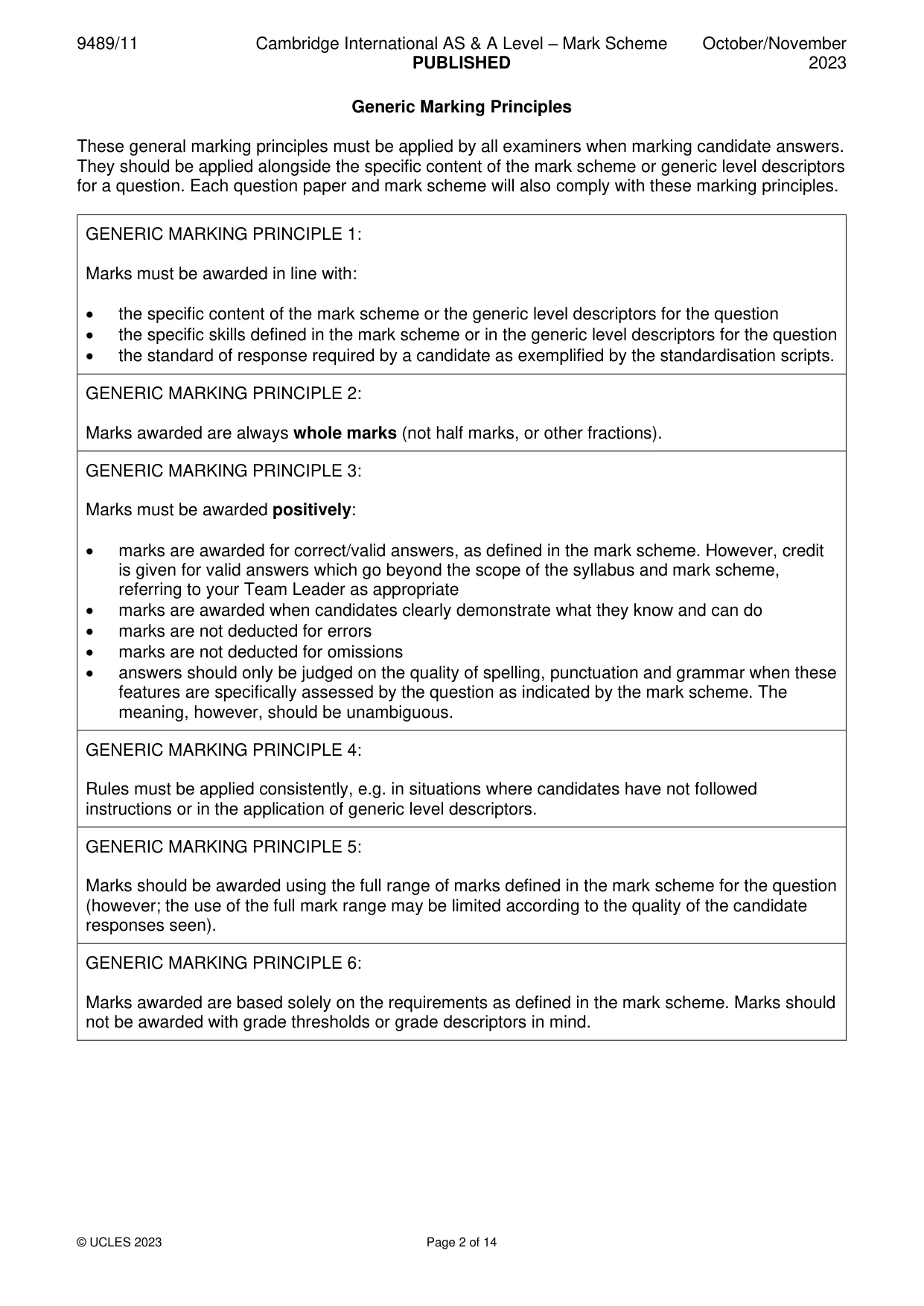
9489/11 Cambridge International AS & A Level – Mark Scheme PUBLISHED October/November 2023 © UCLES 2023 Page 2 of 14 Generic Marking Principles These general marking principles must be applied by all examiners when marking candidate answers. They should be applied alongside the specific content of the mark scheme or generic level descriptors for a question. Each question paper and mark scheme will also comply with these marking principles. GENERIC MARKING PRINCIPLE 1: Marks must be awarded in line with: • the specific content of the mark scheme or the generic level descriptors for the question • the specific skills defined in the mark scheme or in the generic level descriptors for the question • the standard of response required by a candidate as exemplified by the standardisation scripts. GENERIC MARKING PRINCIPLE 2: Marks awarded are always whole marks (not half marks, or other fractions). GENERIC MARKING PRINCIPLE 3: Marks must be awarded positively: • marks are awarded for correct/valid answers, as defined in the mark scheme. However, credit is given for valid answers which go beyond the scope of the syllabus and mark scheme, referring to your Team Leader as appropriate • marks are awarded when candidates clearly demonstrate what they know and can do • marks are not deducted for errors • marks are not deducted for omissions • answers should only be judged on the quality of spelling, punctuation and grammar when these features are specifically assessed by the question as indicated by the mark scheme. The meaning, however, should be unambiguous. GENERIC MARKING PRINCIPLE 4: Rules must be applied consistently, e.g. in situations where candidates have not followed instructions or in the application of generic level descriptors. GENERIC MARKING PRINCIPLE 5: Marks should be awarded using the full range of marks defined in the mark scheme for the question (however; the use of the full mark range may be limited according to the quality of the candidate responses seen). GENERIC MARKING PRINCIPLE 6: Marks awarded are based solely on the requirements as defined in the mark scheme. Marks should not be awarded with grade thresholds or grade descriptors in mind.
Mark scheme, page 3
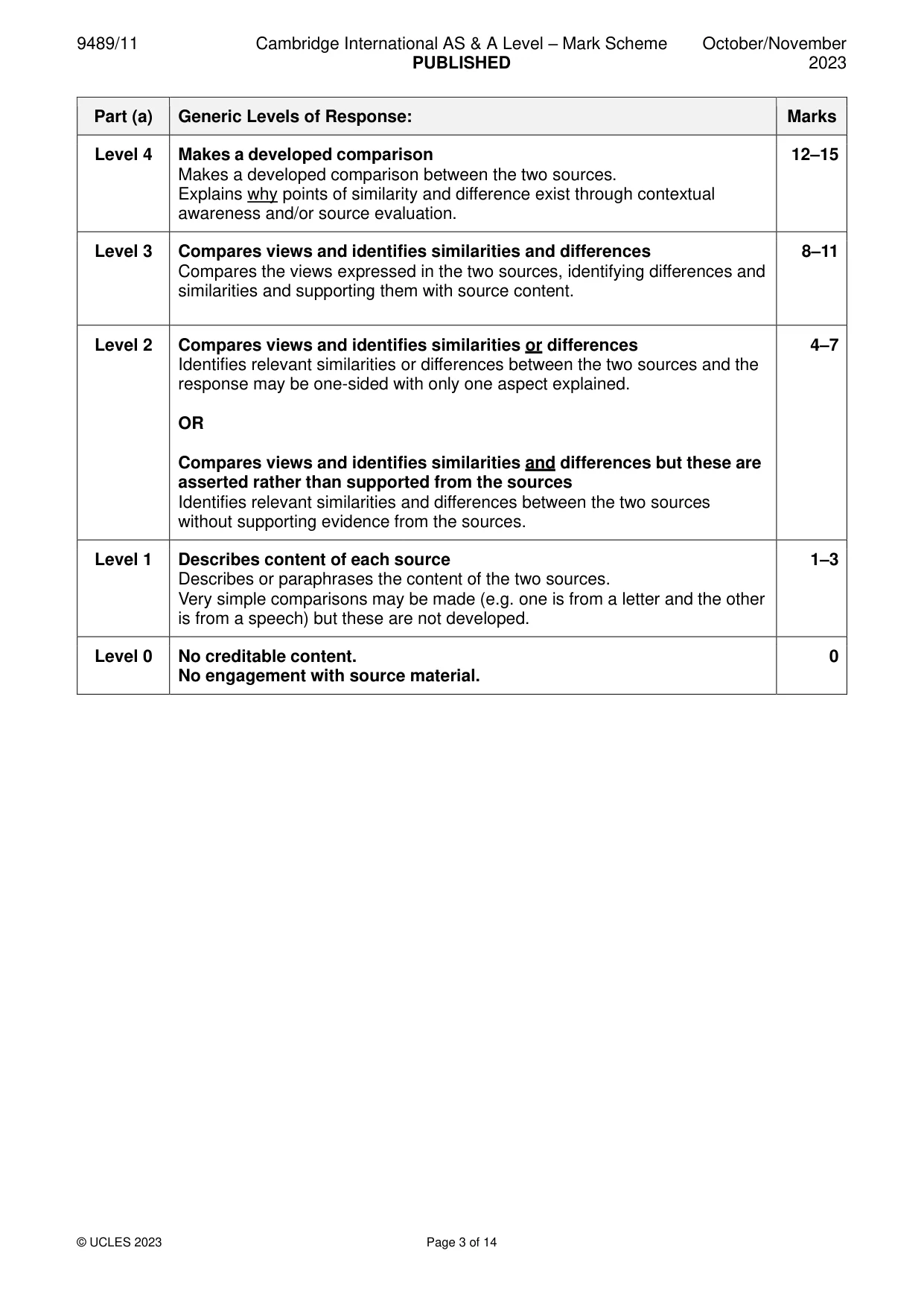
9489/11 Cambridge International AS & A Level – Mark Scheme PUBLISHED October/November 2023 © UCLES 2023 Page 3 of 14 Part (a) Generic Levels of Response: Marks Level 4 Makes a developed comparison Makes a developed comparison between the two sources. Explains why points of similarity and difference exist through contextual awareness and/or source evaluation. 12–15 Level 3 Compares views and identifies similarities and differences Compares the views expressed in the two sources, identifying differences and similarities and supporting them with source content. 8–11 Level 2 Compares views and identifies similarities or differences Identifies relevant similarities or differences between the two sources and the response may be one-sided with only one aspect explained. OR Compares views and identifies similarities and differences but these are asserted rather than supported from the sources Identifies relevant similarities and differences between the two sources without supporting evidence from the sources. 4–7 Level 1 Describes content of each source Describes or paraphrases the content of the two sources. Very simple comparisons may be made (e.g. one is from a letter and the other is from a speech) but these are not developed. 1–3 Level 0 No creditable content. No engagement with source material. 0
Mark scheme, page 4
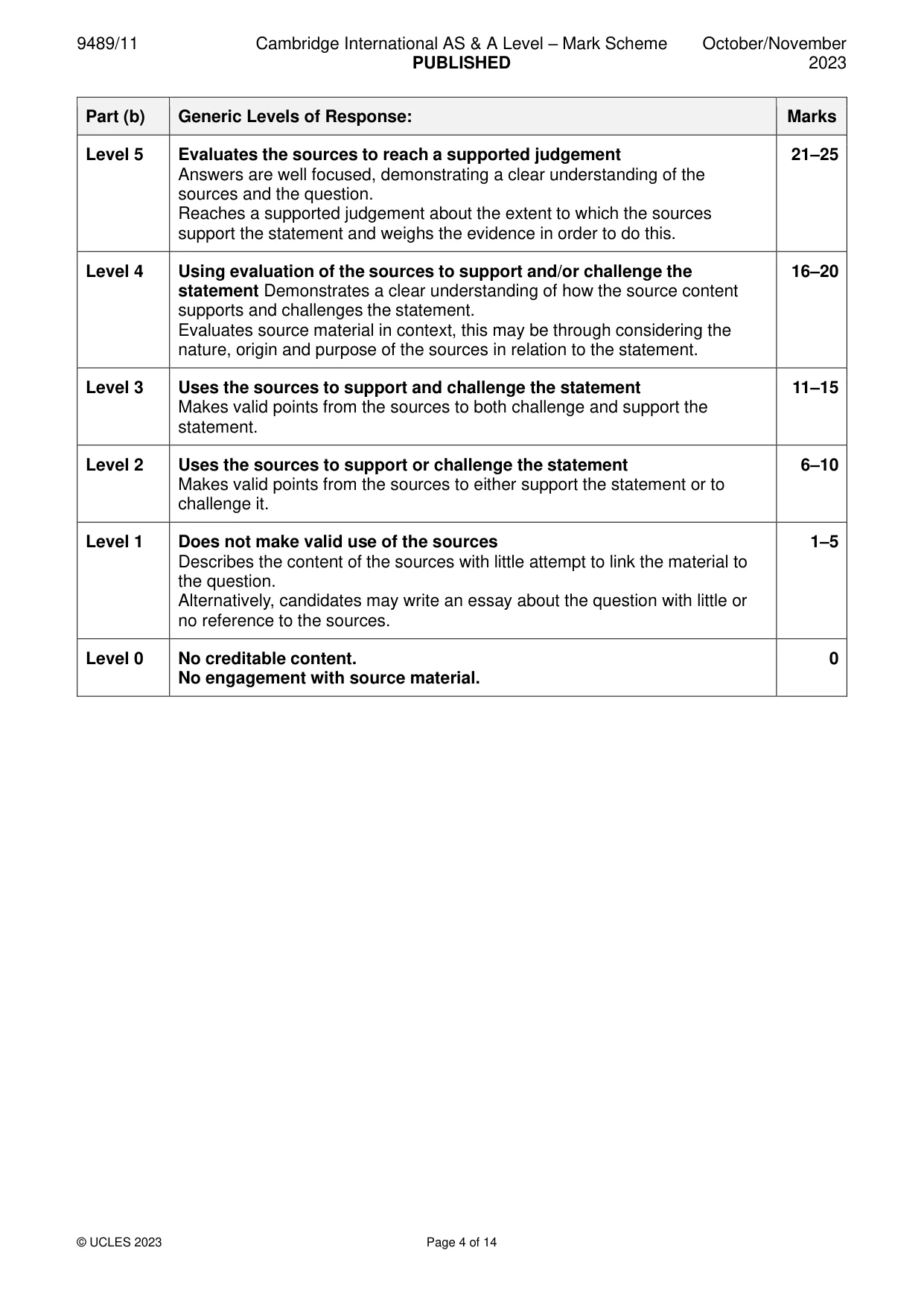
9489/11 Cambridge International AS & A Level – Mark Scheme PUBLISHED October/November 2023 © UCLES 2023 Page 4 of 14 Part (b) Generic Levels of Response: Marks Level 5 Evaluates the sources to reach a supported judgement Answers are well focused, demonstrating a clear understanding of the sources and the question. Reaches a supported judgement about the extent to which the sources support the statement and weighs the evidence in order to do this. 21–25 Level 4 Using evaluation of the sources to support and/or challenge the statement Demonstrates a clear understanding of how the source content supports and challenges the statement. Evaluates source material in context, this may be through considering the nature, origin and purpose of the sources in relation to the statement. 16–20 Level 3 Uses the sources to support and challenge the statement Makes valid points from the sources to both challenge and support the statement. 11–15 Level 2 Uses the sources to support or challenge the statement Makes valid points from the sources to either support the statement or to challenge it. 6–10 Level 1 Does not make valid use of the sources Describes the content of the sources with little attempt to link the material to the question. Alternatively, candidates may write an essay about the question with little or no reference to the sources. 1–5 Level 0 No creditable content. No engagement with source material. 0
Mark scheme, page 5
9489/11 Cambridge International AS & A Level – Mark Scheme PUBLISHED October/November 2023 © UCLES 2023 Page 5 of 14 Annotation symbols ID ID Valid point identified EXP Explanation (an explained valid point) Tick Detail/evidence is used to support the point Plus Balanced – Considers the other view ? Unclear AN Analysis ^ Unsupported assertion K Knowledge EVAL Evaluation NAR Lengthy narrative that is not answering the question Extendable Wavy Line Use with other annotations to show extended issues or narrative N/A Highlighter Highlight a section of text N/A On-page comment Allows comments to be entered in speech bubbles on the candidate response. Using the annotations • Annotate using the symbols above as you read through the script. • At the end of each question write a short on-page comment: – be positive – say what the candidate has done, rather than what they have not – reference the attributes of the level descriptor you are awarding (i.e. make sure your comment matches the mark you have given)
Mark scheme, page 6
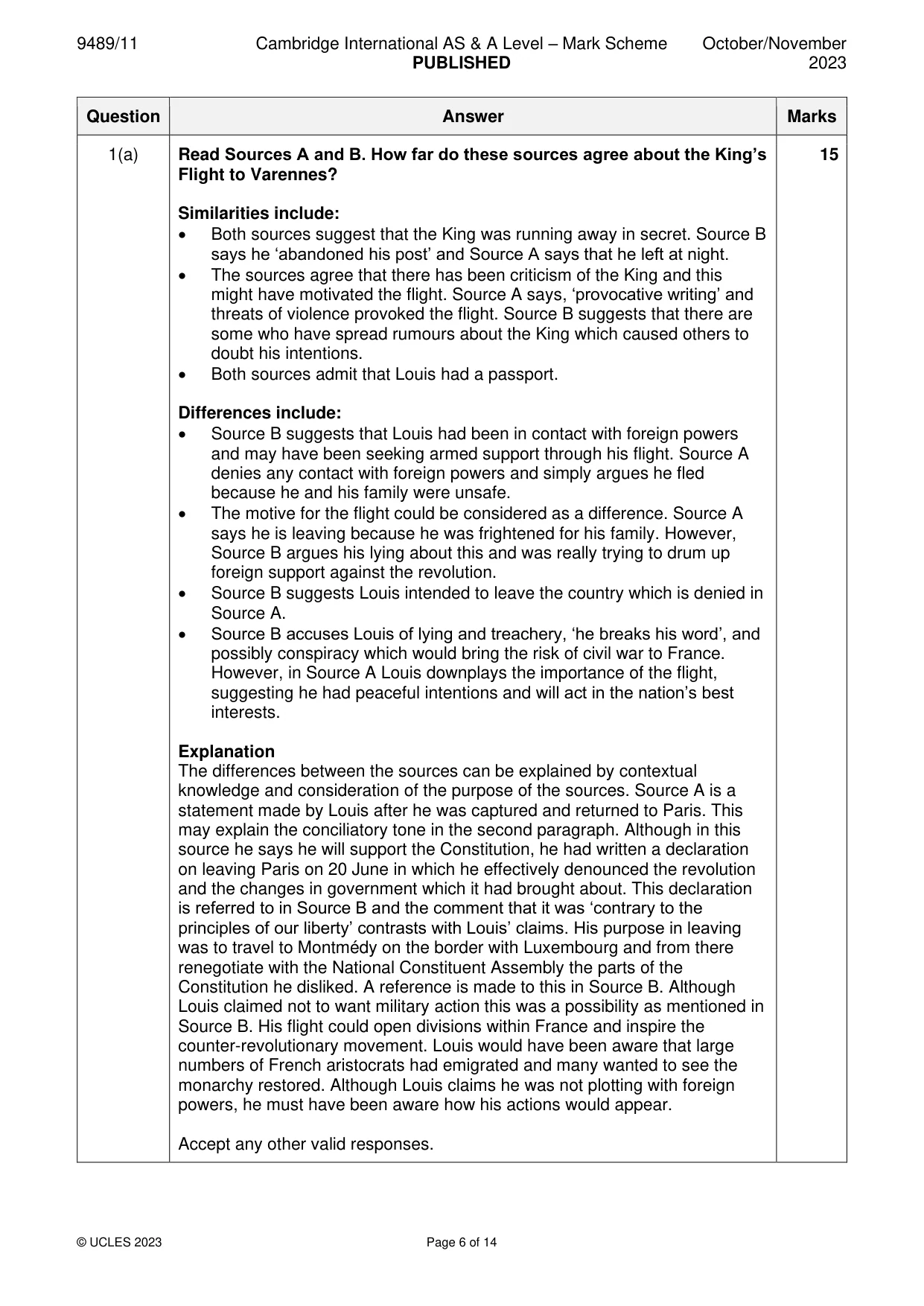
9489/11 Cambridge International AS & A Level – Mark Scheme PUBLISHED October/November 2023 © UCLES 2023 Page 6 of 14 Question Answer Marks 1(a) Read Sources A and B. How far do these sources agree about the King’s Flight to Varennes? Similarities include: • Both sources suggest that the King was running away in secret. Source B says he ‘abandoned his post’ and Source A says that he left at night. • The sources agree that there has been criticism of the King and this might have motivated the flight. Source A says, ‘provocative writing’ and threats of violence provoked the flight. Source B suggests that there are some who have spread rumours about the King which caused others to doubt his intentions. • Both sources admit that Louis had a passport. Differences include: • Source B suggests that Louis had been in contact with foreign powers and may have been seeking armed support through his flight. Source A denies any contact with foreign powers and simply argues he fled because he and his family were unsafe. • The motive for the flight could be considered as a difference. Source A says he is leaving because he was frightened for his family. However, Source B argues his lying about this and was really trying to drum up foreign support against the revolution. • Source B suggests Louis intended to leave the country which is denied in Source A. • Source B accuses Louis of lying and treachery, ‘he breaks his word’, and possibly conspiracy which would bring the risk of civil war to France. However, in Source A Louis downplays the importance of the flight, suggesting he had peaceful intentions and will act in the nation’s best interests. Explanation The differences between the sources can be explained by contextual knowledge and consideration of the purpose of the sources. Source A is a statement made by Louis after he was captured and returned to Paris. This may explain the conciliatory tone in the second paragraph. Although in this source he says he will support the Constitution, he had written a declaration on leaving Paris on 20 June in which he effectively denounced the revolution and the changes in government which it had brought about. This declaration is referred to in Source B and the comment that it was ‘contrary to the principles of our liberty’ contrasts with Louis’ claims. His purpose in leaving was to travel to Montmédy on the border with Luxembourg and from there renegotiate with the National Constituent Assembly the parts of the Constitution he disliked. A reference is made to this in Source B. Although Louis claimed not to want military action this was a possibility as mentioned in Source B. His flight could open divisions within France and inspire the counter-revolutionary movement. Louis would have been aware that large numbers of French aristocrats had emigrated and many wanted to see the monarchy restored. Although Louis claims he was not plotting with foreign powers, he must have been aware how his actions would appear. Accept any other valid responses. 15
Mark scheme, page 7
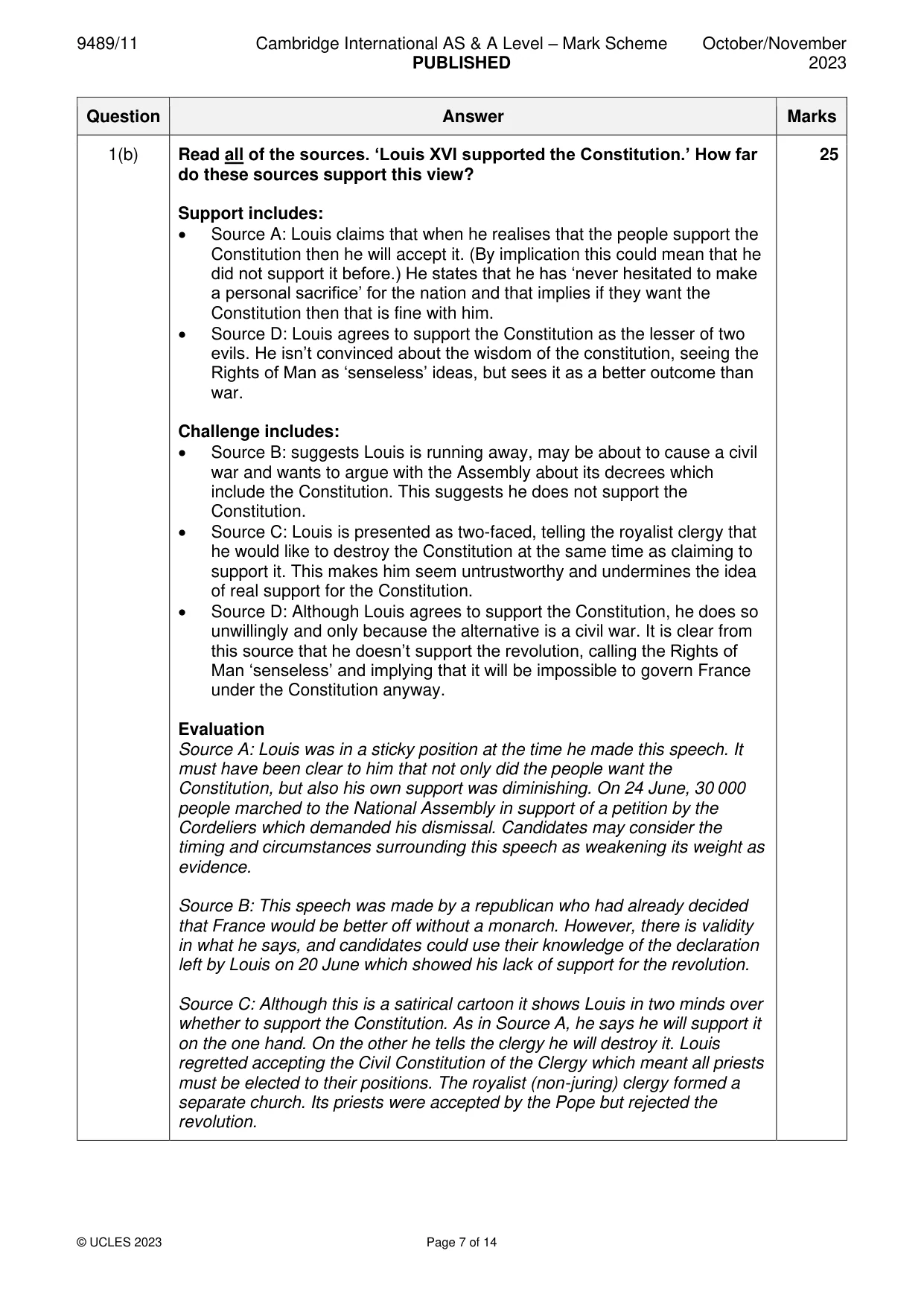
9489/11 Cambridge International AS & A Level – Mark Scheme PUBLISHED October/November 2023 © UCLES 2023 Page 7 of 14 Question Answer Marks 1(b) Read all of the sources. ‘Louis XVI supported the Constitution.’ How far do these sources support this view? Support includes: • Source A: Louis claims that when he realises that the people support the Constitution then he will accept it. (By implication this could mean that he did not support it before.) He states that he has ‘never hesitated to make a personal sacrifice’ for the nation and that implies if they want the Constitution then that is fine with him. • Source D: Louis agrees to support the Constitution as the lesser of two evils. He isn’t convinced about the wisdom of the constitution, seeing the Rights of Man as ‘senseless’ ideas, but sees it as a better outcome than war. Challenge includes: • Source B: suggests Louis is running away, may be about to cause a civil war and wants to argue with the Assembly about its decrees which include the Constitution. This suggests he does not support the Constitution. • Source C: Louis is presented as two-faced, telling the royalist clergy that he would like to destroy the Constitution at the same time as claiming to support it. This makes him seem untrustworthy and undermines the idea of real support for the Constitution. • Source D: Although Louis agrees to support the Constitution, he does so unwillingly and only because the alternative is a civil war. It is clear from this source that he doesn’t support the revolution, calling the Rights of Man ‘senseless’ and implying that it will be impossible to govern France under the Constitution anyway. Evaluation Source A: Louis was in a sticky position at the time he made this speech. It must have been clear to him that not only did the people want the Constitution, but also his own support was diminishing. On 24 June, 30 000 people marched to the National Assembly in support of a petition by the Cordeliers which demanded his dismissal. Candidates may consider the timing and circumstances surrounding this speech as weakening its weight as evidence. Source B: This speech was made by a republican who had already decided that France would be better off without a monarch. However, there is validity in what he says, and candidates could use their knowledge of the declaration left by Louis on 20 June which showed his lack of support for the revolution. Source C: Although this is a satirical cartoon it shows Louis in two minds over whether to support the Constitution. As in Source A, he says he will support it on the one hand. On the other he tells the clergy he will destroy it. Louis regretted accepting the Civil Constitution of the Clergy which meant all priests must be elected to their positions. The royalist (non-juring) clergy formed a separate church. Its priests were accepted by the Pope but rejected the revolution. 25
Mark scheme, page 8
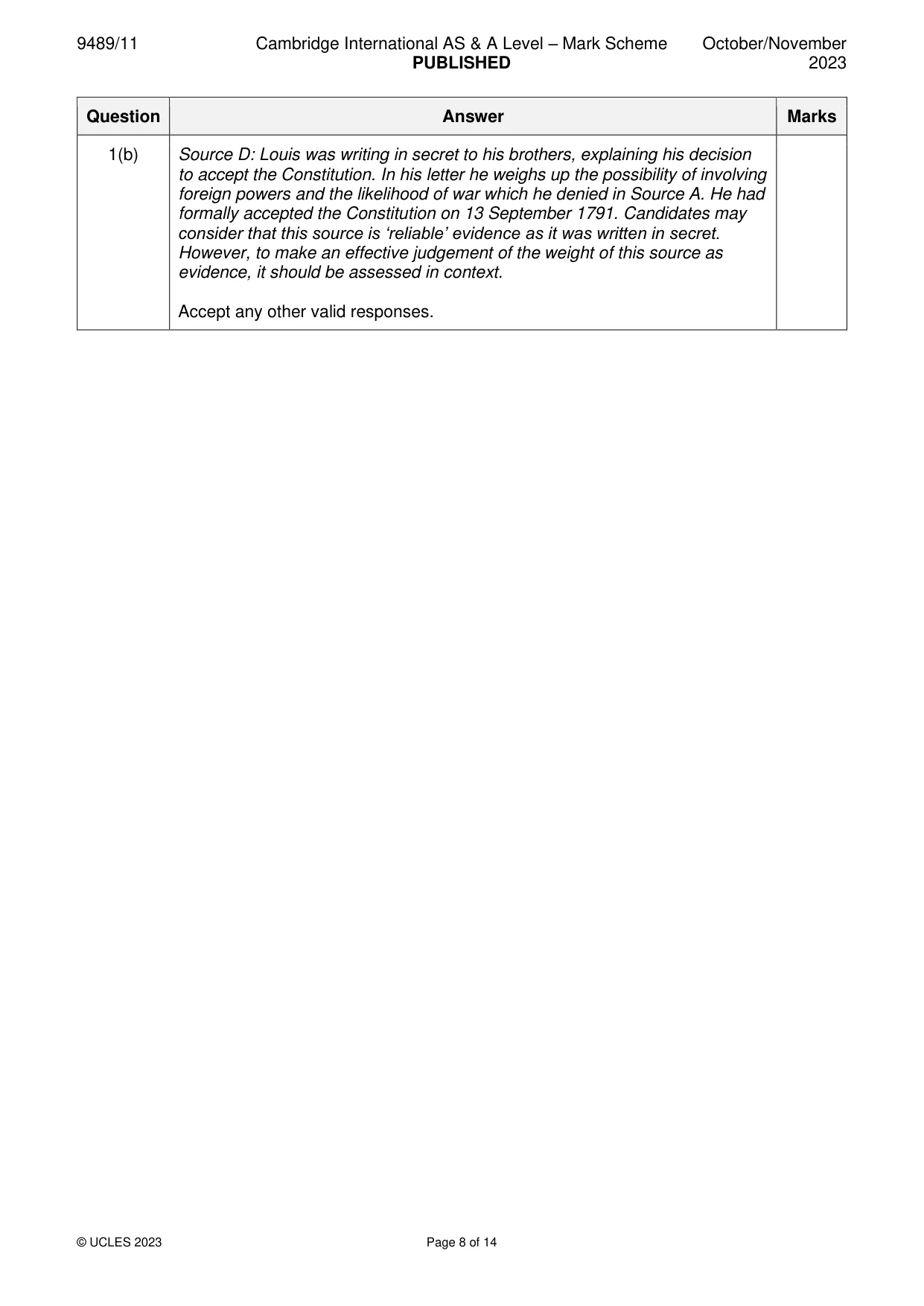
9489/11 Cambridge International AS & A Level – Mark Scheme PUBLISHED October/November 2023 © UCLES 2023 Page 8 of 14 Question Answer Marks 1(b) Source D: Louis was writing in secret to his brothers, explaining his decision to accept the Constitution. In his letter he weighs up the possibility of involving foreign powers and the likelihood of war which he denied in Source A. He had formally accepted the Constitution on 13 September 1791. Candidates may consider that this source is ‘reliable’ evidence as it was written in secret. However, to make an effective judgement of the weight of this source as evidence, it should be assessed in context. Accept any other valid responses.
Mark scheme, page 9
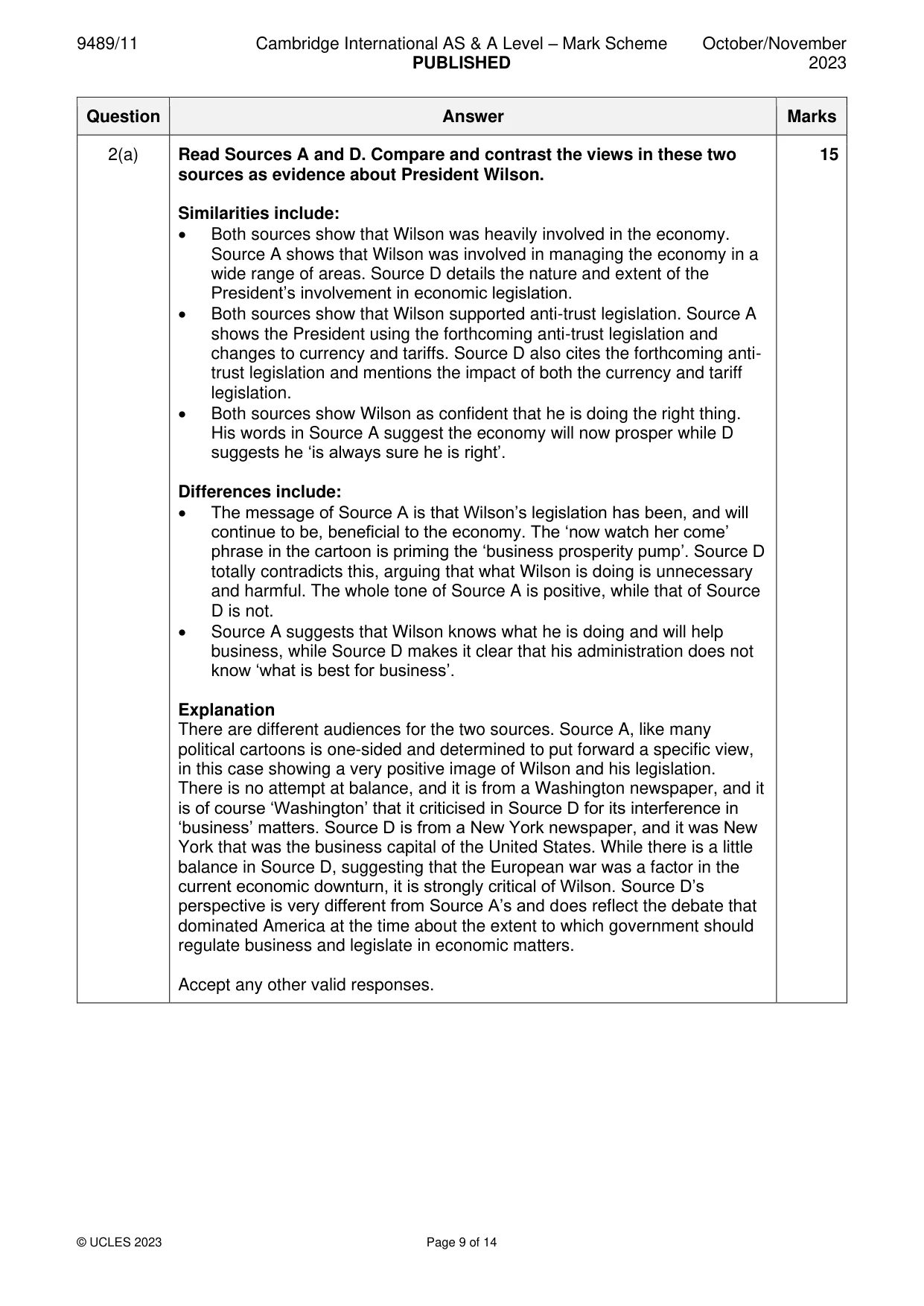
9489/11 Cambridge International AS & A Level – Mark Scheme PUBLISHED October/November 2023 © UCLES 2023 Page 9 of 14 Question Answer Marks 2(a) Read Sources A and D. Compare and contrast the views in these two sources as evidence about President Wilson. Similarities include: • Both sources show that Wilson was heavily involved in the economy. Source A shows that Wilson was involved in managing the economy in a wide range of areas. Source D details the nature and extent of the President’s involvement in economic legislation. • Both sources show that Wilson supported anti-trust legislation. Source A shows the President using the forthcoming anti-trust legislation and changes to currency and tariffs. Source D also cites the forthcoming anti- trust legislation and mentions the impact of both the currency and tariff legislation. • Both sources show Wilson as confident that he is doing the right thing. His words in Source A suggest the economy will now prosper while D suggests he ‘is always sure he is right’. Differences include: • The message of Source A is that Wilson’s legislation has been, and will continue to be, beneficial to the economy. The ‘now watch her come’ phrase in the cartoon is priming the ‘business prosperity pump’. Source D totally contradicts this, arguing that what Wilson is doing is unnecessary and harmful. The whole tone of Source A is positive, while that of Source D is not. • Source A suggests that Wilson knows what he is doing and will help business, while Source D makes it clear that his administration does not know ‘what is best for business’. Explanation There are different audiences for the two sources. Source A, like many political cartoons is one-sided and determined to put forward a specific view, in this case showing a very positive image of Wilson and his legislation. There is no attempt at balance, and it is from a Washington newspaper, and it is of course ‘Washington’ that it criticised in Source D for its interference in ‘business’ matters. Source D is from a New York newspaper, and it was New York that was the business capital of the United States. While there is a little balance in Source D, suggesting that the European war was a factor in the current economic downturn, it is strongly critical of Wilson. Source D’s perspective is very different from Source A’s and does reflect the debate that dominated America at the time about the extent to which government should regulate business and legislate in economic matters. Accept any other valid responses. 15
Mark scheme, page 10
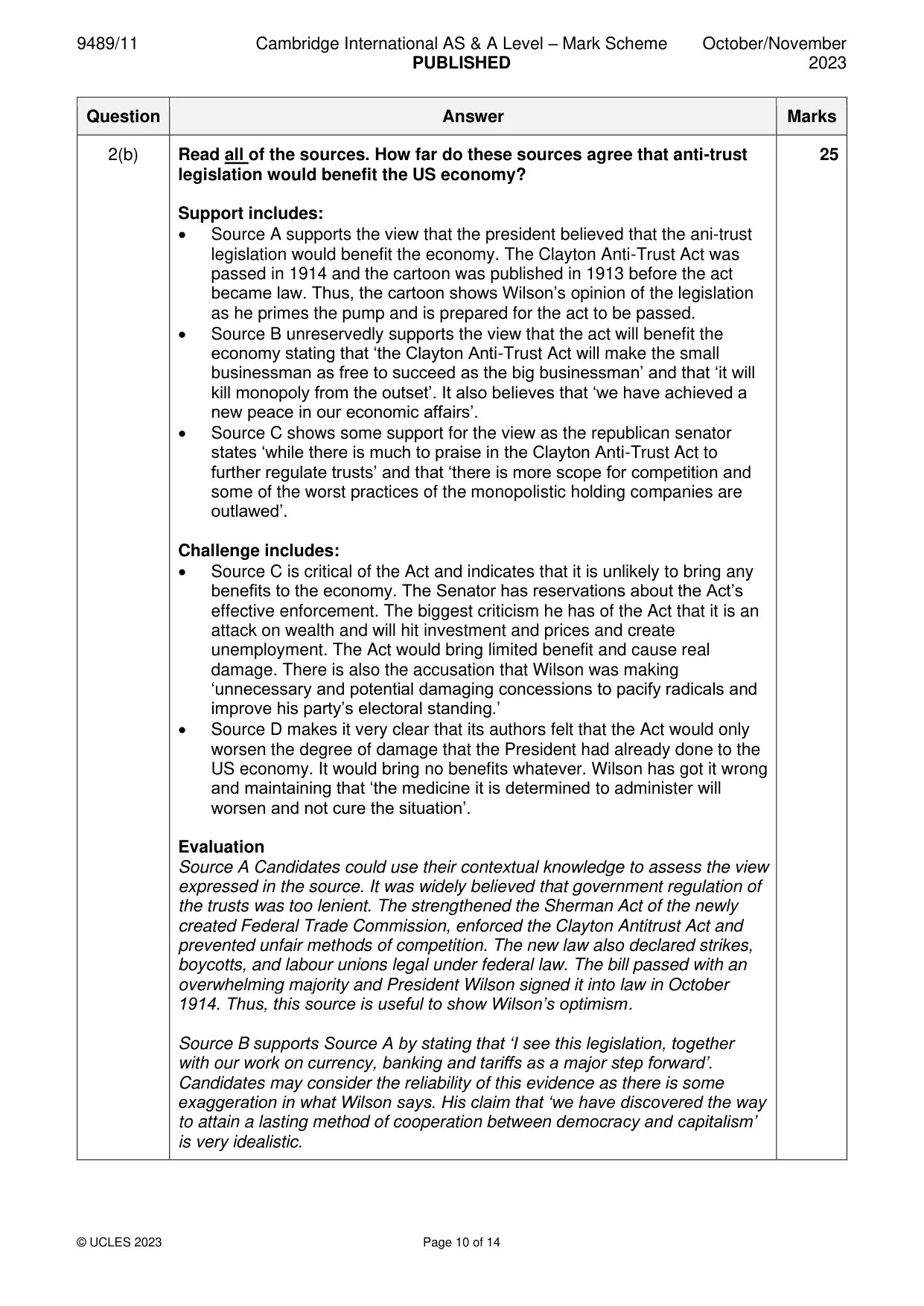
9489/11 Cambridge International AS & A Level – Mark Scheme PUBLISHED October/November 2023 © UCLES 2023 Page 10 of 14 Question Answer Marks 2(b) Read all of the sources. How far do these sources agree that anti-trust legislation would benefit the US economy? Support includes: • Source A supports the view that the president believed that the ani-trust legislation would benefit the economy. The Clayton Anti-Trust Act was passed in 1914 and the cartoon was published in 1913 before the act became law. Thus, the cartoon shows Wilson’s opinion of the legislation as he primes the pump and is prepared for the act to be passed. • Source B unreservedly supports the view that the act will benefit the economy stating that ‘the Clayton Anti-Trust Act will make the small businessman as free to succeed as the big businessman’ and that ‘it will kill monopoly from the outset’. It also believes that ‘we have achieved a new peace in our economic affairs’. • Source C shows some support for the view as the republican senator states ‘while there is much to praise in the Clayton Anti-Trust Act to further regulate trusts’ and that ‘there is more scope for competition and some of the worst practices of the monopolistic holding companies are outlawed’. Challenge includes: • Source C is critical of the Act and indicates that it is unlikely to bring any benefits to the economy. The Senator has reservations about the Act’s effective enforcement. The biggest criticism he has of the Act that it is an attack on wealth and will hit investment and prices and create unemployment. The Act would bring limited benefit and cause real damage. There is also the accusation that Wilson was making ‘unnecessary and potential damaging concessions to pacify radicals and improve his party’s electoral standing.’ • Source D makes it very clear that its authors felt that the Act would only worsen the degree of damage that the President had already done to the US economy. It would bring no benefits whatever. Wilson has got it wrong and maintaining that ‘the medicine it is determined to administer will worsen and not cure the situation’. Evaluation Source A Candidates could use their contextual knowledge to assess the view expressed in the source. It was widely believed that government regulation of the trusts was too lenient. The strengthened the Sherman Act of the newly created Federal Trade Commission, enforced the Clayton Antitrust Act and prevented unfair methods of competition. The new law also declared strikes, boycotts, and labour unions legal under federal law. The bill passed with an overwhelming majority and President Wilson signed it into law in October 1914. Thus, this source is useful to show Wilson’s optimism. Source B supports Source A by stating that ‘I see this legislation, together with our work on currency, banking and tariffs as a major step forward’. Candidates may consider the reliability of this evidence as there is some exaggeration in what Wilson says. His claim that ‘we have discovered the way to attain a lasting method of cooperation between democracy and capitalism’ is very idealistic. 25
Mark scheme, page 11
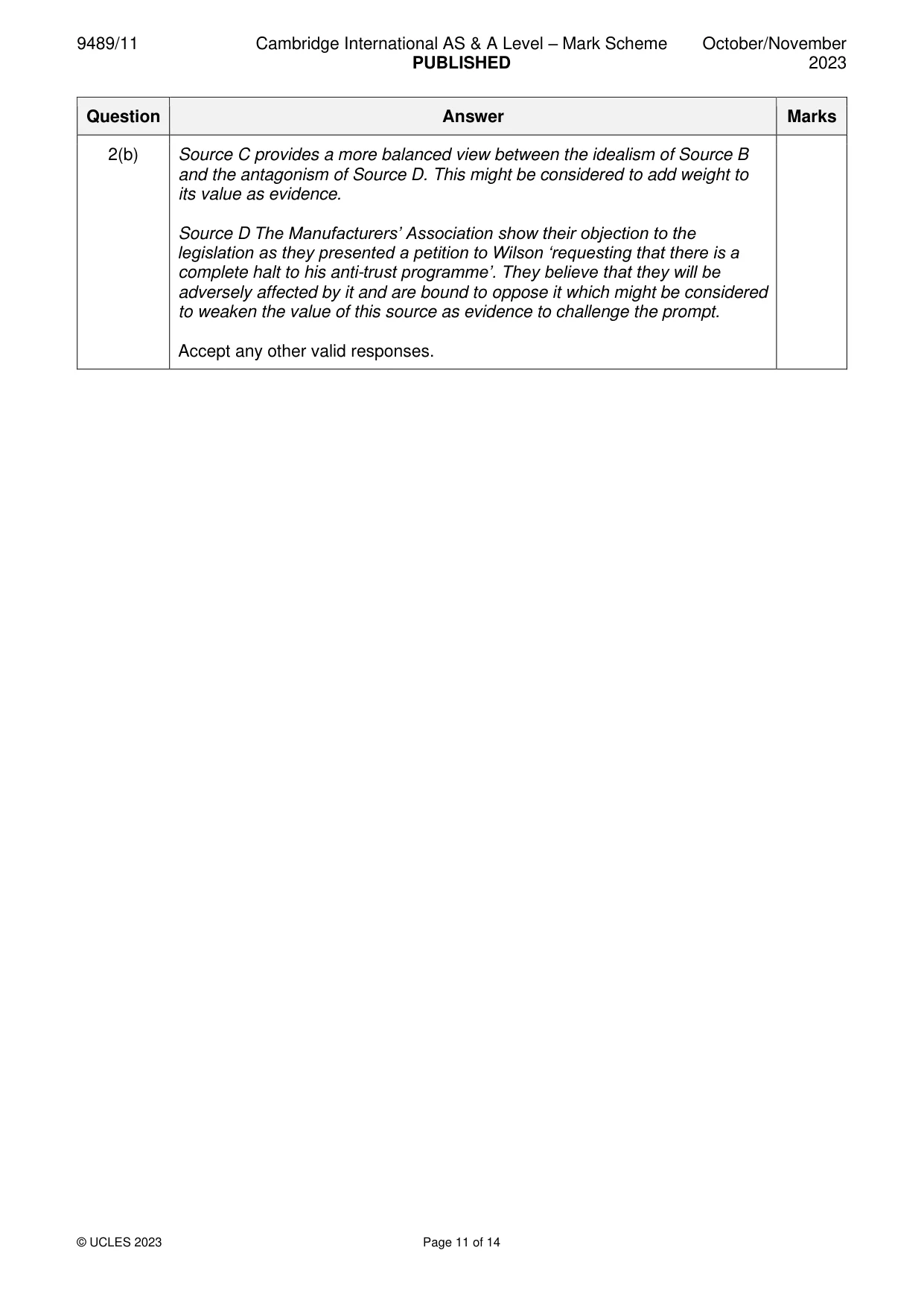
9489/11 Cambridge International AS & A Level – Mark Scheme PUBLISHED October/November 2023 © UCLES 2023 Page 11 of 14 Question Answer Marks 2(b) Source C provides a more balanced view between the idealism of Source B and the antagonism of Source D. This might be considered to add weight to its value as evidence. Source D The Manufacturers’ Association show their objection to the legislation as they presented a petition to Wilson ‘requesting that there is a complete halt to his anti-trust programme’. They believe that they will be adversely affected by it and are bound to oppose it which might be considered to weaken the value of this source as evidence to challenge the prompt. Accept any other valid responses.
Mark scheme, page 12
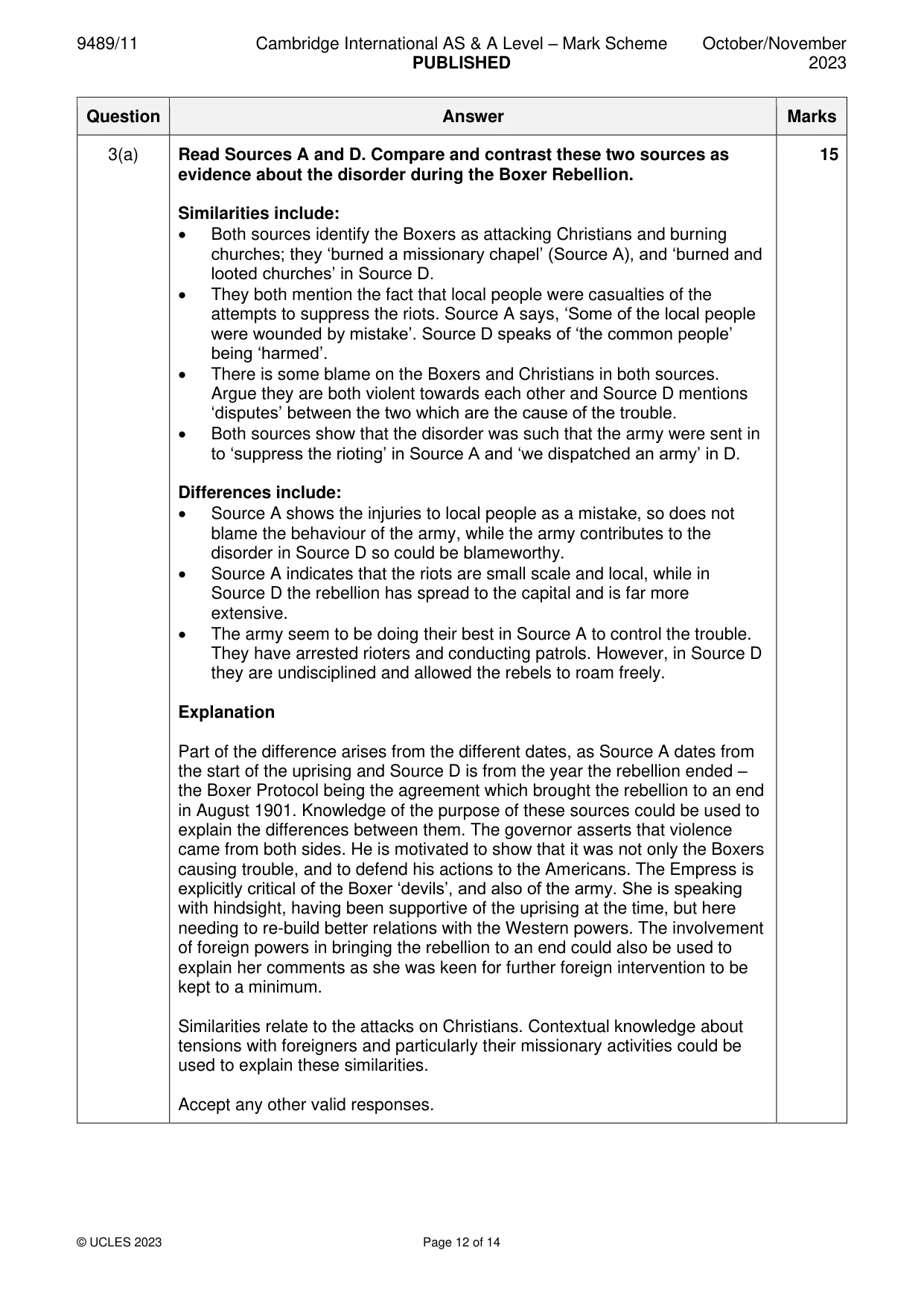
9489/11 Cambridge International AS & A Level – Mark Scheme PUBLISHED October/November 2023 © UCLES 2023 Page 12 of 14 Question Answer Marks 3(a) Read Sources A and D. Compare and contrast these two sources as evidence about the disorder during the Boxer Rebellion. Similarities include: • Both sources identify the Boxers as attacking Christians and burning churches; they ‘burned a missionary chapel’ (Source A), and ‘burned and looted churches’ in Source D. • They both mention the fact that local people were casualties of the attempts to suppress the riots. Source A says, ‘Some of the local people were wounded by mistake’. Source D speaks of ‘the common people’ being ‘harmed’. • There is some blame on the Boxers and Christians in both sources. Argue they are both violent towards each other and Source D mentions ‘disputes’ between the two which are the cause of the trouble. • Both sources show that the disorder was such that the army were sent in to ‘suppress the rioting’ in Source A and ‘we dispatched an army’ in D. Differences include: • Source A shows the injuries to local people as a mistake, so does not blame the behaviour of the army, while the army contributes to the disorder in Source D so could be blameworthy. • Source A indicates that the riots are small scale and local, while in Source D the rebellion has spread to the capital and is far more extensive. • The army seem to be doing their best in Source A to control the trouble. They have arrested rioters and conducting patrols. However, in Source D they are undisciplined and allowed the rebels to roam freely. Explanation Part of the difference arises from the different dates, as Source A dates from the start of the uprising and Source D is from the year the rebellion ended – the Boxer Protocol being the agreement which brought the rebellion to an end in August 1901. Knowledge of the purpose of these sources could be used to explain the differences between them. The governor asserts that violence came from both sides. He is motivated to show that it was not only the Boxers causing trouble, and to defend his actions to the Americans. The Empress is explicitly critical of the Boxer ‘devils’, and also of the army. She is speaking with hindsight, having been supportive of the uprising at the time, but here needing to re-build better relations with the Western powers. The involvement of foreign powers in bringing the rebellion to an end could also be used to explain her comments as she was keen for further foreign intervention to be kept to a minimum. Similarities relate to the attacks on Christians. Contextual knowledge about tensions with foreigners and particularly their missionary activities could be used to explain these similarities. Accept any other valid responses. 15
Mark scheme, page 13
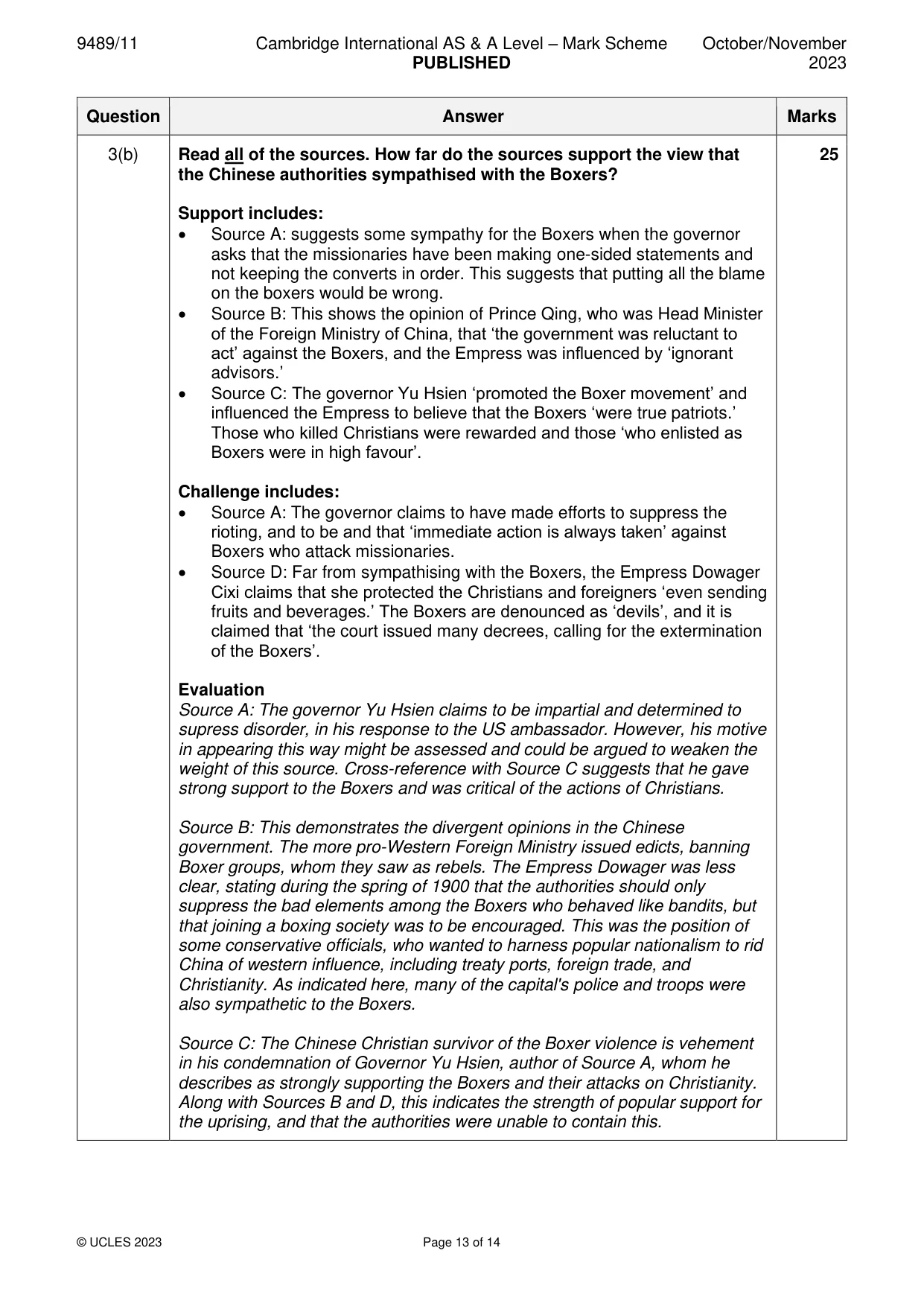
9489/11 Cambridge International AS & A Level – Mark Scheme PUBLISHED October/November 2023 © UCLES 2023 Page 13 of 14 Question Answer Marks 3(b) Read all of the sources. How far do the sources support the view that the Chinese authorities sympathised with the Boxers? Support includes: • Source A: suggests some sympathy for the Boxers when the governor asks that the missionaries have been making one-sided statements and not keeping the converts in order. This suggests that putting all the blame on the boxers would be wrong. • Source B: This shows the opinion of Prince Qing, who was Head Minister of the Foreign Ministry of China, that ‘the government was reluctant to act’ against the Boxers, and the Empress was influenced by ‘ignorant advisors.’ • Source C: The governor Yu Hsien ‘promoted the Boxer movement’ and influenced the Empress to believe that the Boxers ‘were true patriots.’ Those who killed Christians were rewarded and those ‘who enlisted as Boxers were in high favour’. Challenge includes: • Source A: The governor claims to have made efforts to suppress the rioting, and to be and that ‘immediate action is always taken’ against Boxers who attack missionaries. • Source D: Far from sympathising with the Boxers, the Empress Dowager Cixi claims that she protected the Christians and foreigners ‘even sending fruits and beverages.’ The Boxers are denounced as ‘devils’, and it is claimed that ‘the court issued many decrees, calling for the extermination of the Boxers’. Evaluation Source A: The governor Yu Hsien claims to be impartial and determined to supress disorder, in his response to the US ambassador. However, his motive in appearing this way might be assessed and could be argued to weaken the weight of this source. Cross-reference with Source C suggests that he gave strong support to the Boxers and was critical of the actions of Christians. Source B: This demonstrates the divergent opinions in the Chinese government. The more pro-Western Foreign Ministry issued edicts, banning Boxer groups, whom they saw as rebels. The Empress Dowager was less clear, stating during the spring of 1900 that the authorities should only suppress the bad elements among the Boxers who behaved like bandits, but that joining a boxing society was to be encouraged. This was the position of some conservative officials, who wanted to harness popular nationalism to rid China of western influence, including treaty ports, foreign trade, and Christianity. As indicated here, many of the capital's police and troops were also sympathetic to the Boxers. Source C: The Chinese Christian survivor of the Boxer violence is vehement in his condemnation of Governor Yu Hsien, author of Source A, whom he describes as strongly supporting the Boxers and their attacks on Christianity. Along with Sources B and D, this indicates the strength of popular support for the uprising, and that the authorities were unable to contain this. 25
Mark scheme, page 14
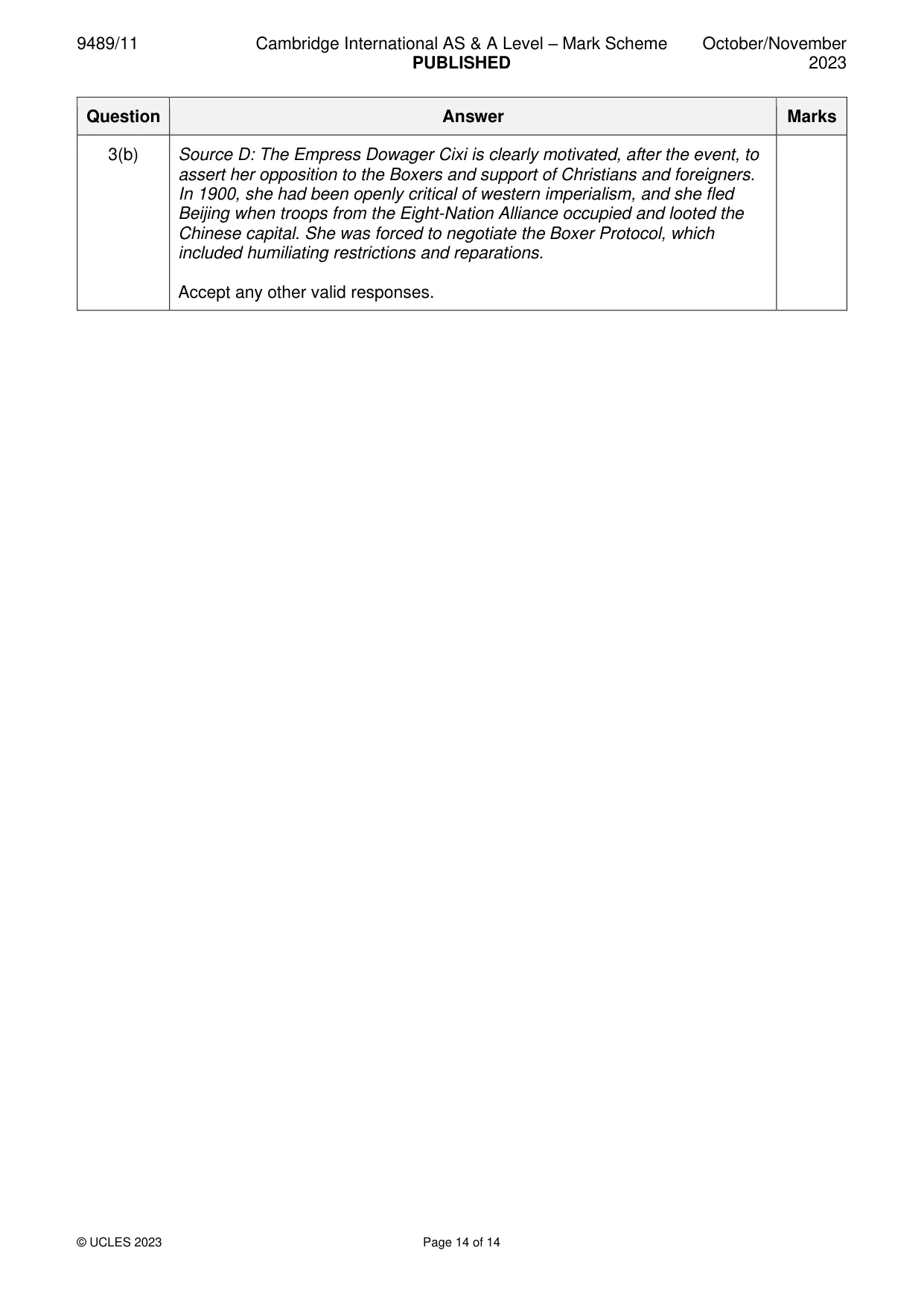
9489/11 Cambridge International AS & A Level – Mark Scheme PUBLISHED October/November 2023 © UCLES 2023 Page 14 of 14 Question Answer Marks 3(b) Source D: The Empress Dowager Cixi is clearly motivated, after the event, to assert her opposition to the Boxers and support of Christians and foreigners. In 1900, she had been openly critical of western imperialism, and she fled Beijing when troops from the Eight-Nation Alliance occupied and looted the Chinese capital. She was forced to negotiate the Boxer Protocol, which included humiliating restrictions and reparations. Accept any other valid responses.
What you needed in this session
Cambridge’s own grade thresholds for 2023 Oct/Nov, Paper 1 · Variant 1. A higher threshold means an easier paper — the bar moves with how the cohort did.