Cambridge A Level History 9489 — 2023 Oct/Nov Paper 1 · Variant 2
9489/12/O/N/23 · 40 marks · ≈45 min
The question paper and its mark scheme, free to read here and free to download. This is Cambridge’s own paper, exactly as it was sat.
Question paper8 pages

Mark scheme15 pages
Answers below. Sit the paper first if you are practising.
Paper as text
Question paper, page 1
This document has 8 pages. Any blank pages are indicated. [Turn over Cambridge International AS & A Level * 4 3 2 9 7 0 0 4 9 9 * DC (EF/FC) 312520/2 © UCLES 2023 HISTORY 9489/12 Paper 1 Document Question October/November 2023 1 hour 15 minutes You must answer on the enclosed answer booklet. You will need: Answer booklet (enclosed) INSTRUCTIONS ● Answer one question from one section only. Section A: European option Section B: American option Section C: International option ● Follow the instructions on the front cover of the answer booklet. If you need additional answer paper, ask the invigilator for a continuation booklet. INFORMATION ● The total mark for this paper is 40. ● The number of marks for each question or part question is shown in brackets [ ].
Question paper, page 2
2 9489/12/O/N/23 © UCLES 2023 Answer one question from one section only. Section A: European option France, 1774 –1814 1 Read the sources and then answer both parts of the question. Source A There is only one means of defence for you. That which I have recommended so many times: a general uprising and executions. Begin then by making sure of the king and the royal family: put them under a strong guard and let their heads answer for events. Follow this up by cutting off, without hesitation, the generals’ heads, and those of the counter‑revolutionary ministers and ex‑ministers; those of the mayor and the anti‑revolutionary municipal councillors. Then, put all the counter‑revolutionaries in the National Assembly, all the known supporters of despotism, on the edge of the sword. I tell you again, this is the only way for you to save the country. Six months ago, five or six hundred heads would have been enough. Today, because you have stupidly let your enemies conspire among themselves and gather strength, perhaps we will have to cut off five or six thousand. But even if it needs twenty thousand, there is no time for hesitation. From an article written by Marat in December 1790. Source B You are no longer my king, no longer my king! You are nothing but a cowardly deserter. A king should be the father of the people, not its executioner. Now that the nation has resumed its rights it will not be so stupid as to take back a coward like you. You, king? You are not even a citizen. You will be lucky to avoid leaving your head on a scaffold for having sought the slaughter of so many men. I don’t doubt that once again you are going to pretend to be honest and that, supported by those scoundrels on the constitutional committee, you are going to promise miracles. They would be prepared to stick the crown on the head of a monkey. But no, that will not happen! There is an outcry against you, ‘No more kings!’ This is what every citizen is shouting, and, besides, even if the Assembly want to pardon you all your crimes, what trust could now be placed in you? From an article in the radical journal ‘Le Père Duchesne’ published in Paris, June 1791. This was after the King’s failed Flight to Varennes.
Question paper, page 3
3 9489/12/O/N/23 © UCLES 2023 [Turn over Source C A French cartoon published in June 1791. The caption read, ‘The family of pigs being brought back to the farmyard’. Source D The Society of Friends of the Rights of Man considers that a nation must do everything, either by itself or through removable officers chosen by it. The Society considers that no single individual in the state should possess enough wealth and power to be able to corrupt the agents of the political administration. It believes that there should be no employment in the state that is not accessible to all the members of that state. Convinced of the greatness of these principles, it can no longer close its eyes to the fact that monarchy, above all hereditary monarchy, is incompatible with liberty. We anticipate that such a proposition will give rise to a host of opponents. Nevertheless, this issue deserves serious debate by the legislators. They have already messed up the revolution once because of lingering regard for the illusion of monarchy. Let us, therefore, act without fear and without terror, and try not to bring it back to life. From a petition by the Cordeliers Club, July 1791. Answer both parts of the question with reference to the sources. (a) Read Sources A and D. Compare and contrast these two sources as evidence of the aims of the revolutionaries. [15] (b) Read all of the sources. ‘It was the Flight to Varennes that destroyed faith in the monarchy.’ How far do these sources support this view? [25]
Question paper, page 4
4 9489/12/O/N/23 © UCLES 2023 Section B: American option The Gilded Age and Progressive Era, 1870s to 1920 2 Read the sources and then answer both parts of the question. Source A The Act of 1882 has been a success. Chinese immigration has declined and the ruling against Chinese becoming citizens has been enforced. We see that no harm has been done to our relationship with China’s government and people. While there were initially some complaints from employers that good labour was in short supply, this is no longer the case. Tragically, the disorder following the introduction of the Act did last for some years. Our Constitution is clear that we have a right to decide who can, and who cannot, come into America. There has been no violation of the principles on which this country is based. There is no place in America for people from such an alien culture. While there may have been a case for permitting immigration after the dreadful losses in the war against slavery, there must now be effective limitations on immigration. We are becoming the dumping ground for the unemployable, the undesirable, the dangerous radical, the old and sick. Those we admit must be those who we need and who will conform in every way to our values. From a speech in the House of Representatives on a Bill to extend the Chinese Exclusion Act of 1882 for a further ten years, April 1892. Source B A cartoon published in 1903.
Question paper, page 5
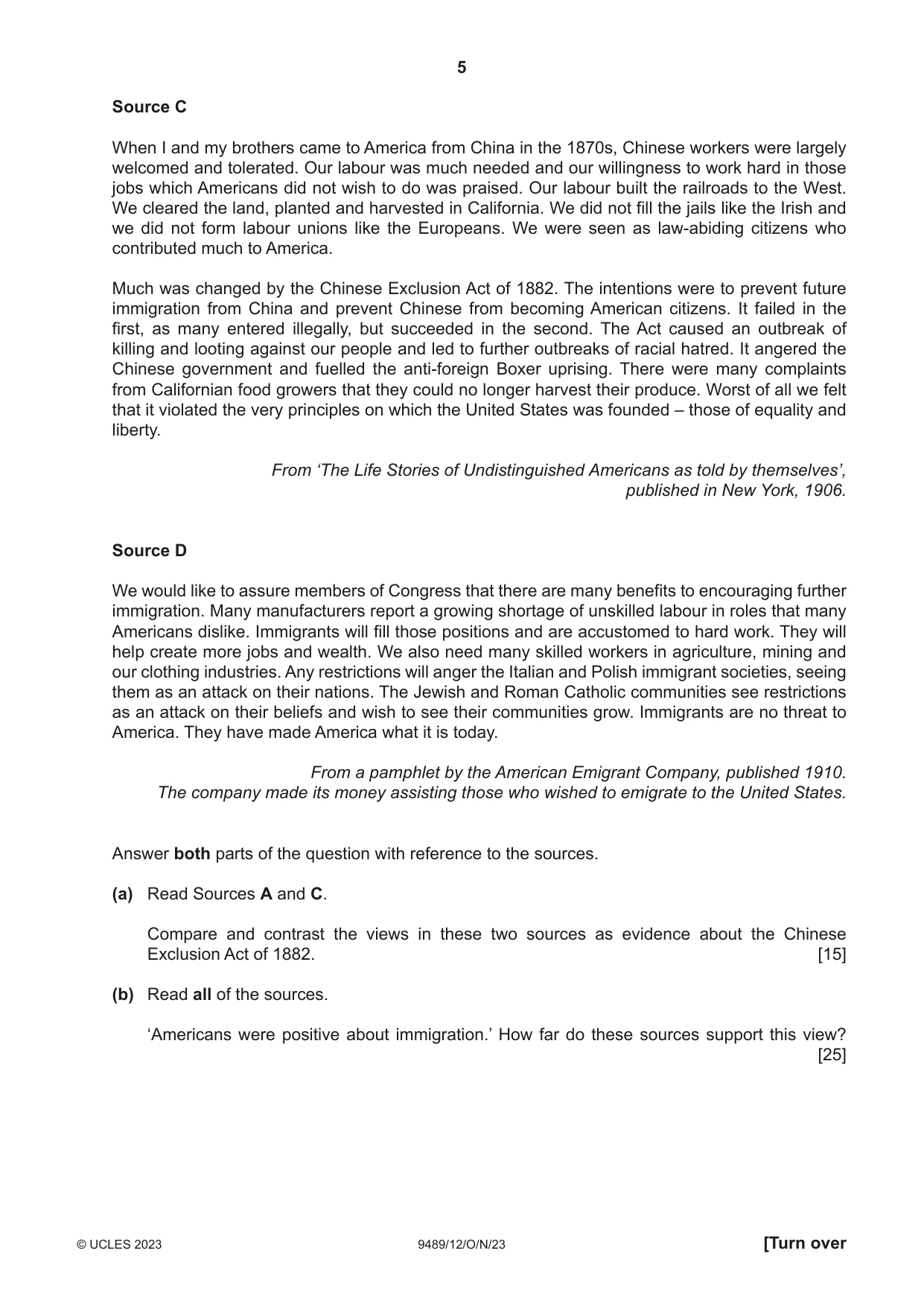
5 9489/12/O/N/23 © UCLES 2023 [Turn over Source C When I and my brothers came to America from China in the 1870s, Chinese workers were largely welcomed and tolerated. Our labour was much needed and our willingness to work hard in those jobs which Americans did not wish to do was praised. Our labour built the railroads to the West. We cleared the land, planted and harvested in California. We did not fill the jails like the Irish and we did not form labour unions like the Europeans. We were seen as law‑abiding citizens who contributed much to America. Much was changed by the Chinese Exclusion Act of 1882. The intentions were to prevent future immigration from China and prevent Chinese from becoming American citizens. It failed in the first, as many entered illegally, but succeeded in the second. The Act caused an outbreak of killing and looting against our people and led to further outbreaks of racial hatred. It angered the Chinese government and fuelled the anti‑foreign Boxer uprising. There were many complaints from Californian food growers that they could no longer harvest their produce. Worst of all we felt that it violated the very principles on which the United States was founded – those of equality and liberty. From ‘The Life Stories of Undistinguished Americans as told by themselves’, published in New York, 1906. Source D We would like to assure members of Congress that there are many benefits to encouraging further immigration. Many manufacturers report a growing shortage of unskilled labour in roles that many Americans dislike. Immigrants will fill those positions and are accustomed to hard work. They will help create more jobs and wealth. We also need many skilled workers in agriculture, mining and our clothing industries. Any restrictions will anger the Italian and Polish immigrant societies, seeing them as an attack on their nations. The Jewish and Roman Catholic communities see restrictions as an attack on their beliefs and wish to see their communities grow. Immigrants are no threat to America. They have made America what it is today. From a pamphlet by the American Emigrant Company, published 1910. The company made its money assisting those who wished to emigrate to the United States. Answer both parts of the question with reference to the sources. (a) Read Sources A and C. Compare and contrast the views in these two sources as evidence about the Chinese Exclusion Act of 1882. [15] (b) Read all of the sources. ‘Americans were positive about immigration.’ How far do these sources support this view? [25]
Question paper, page 6
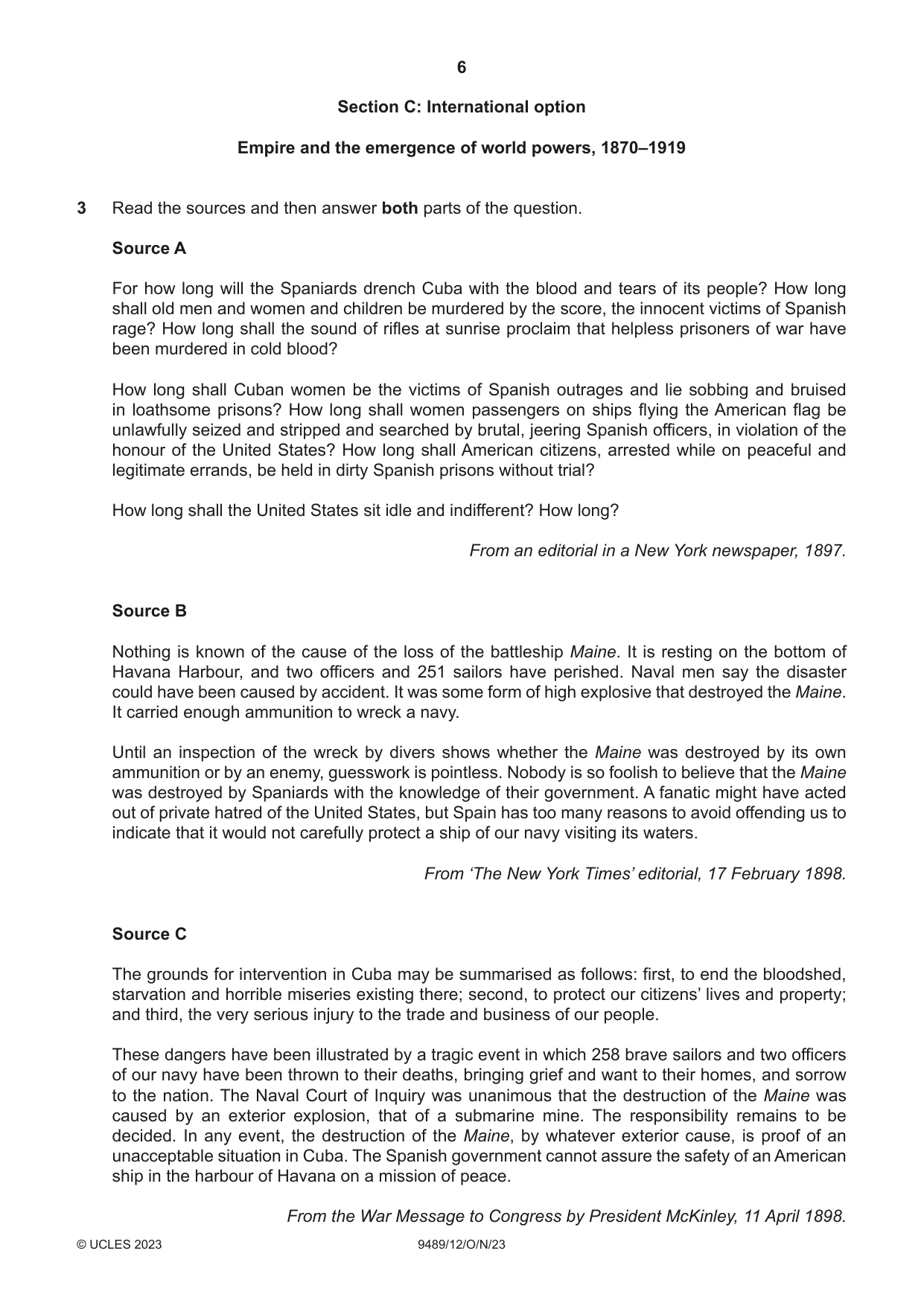
6 9489/12/O/N/23 © UCLES 2023 Section C: International option Empire and the emergence of world powers, 1870–1919 3 Read the sources and then answer both parts of the question. Source A For how long will the Spaniards drench Cuba with the blood and tears of its people? How long shall old men and women and children be murdered by the score, the innocent victims of Spanish rage? How long shall the sound of rifles at sunrise proclaim that helpless prisoners of war have been murdered in cold blood? How long shall Cuban women be the victims of Spanish outrages and lie sobbing and bruised in loathsome prisons? How long shall women passengers on ships flying the American flag be unlawfully seized and stripped and searched by brutal, jeering Spanish officers, in violation of the honour of the United States? How long shall American citizens, arrested while on peaceful and legitimate errands, be held in dirty Spanish prisons without trial? How long shall the United States sit idle and indifferent? How long? From an editorial in a New York newspaper, 1897. Source B Nothing is known of the cause of the loss of the battleship Maine. It is resting on the bottom of Havana Harbour, and two officers and 251 sailors have perished. Naval men say the disaster could have been caused by accident. It was some form of high explosive that destroyed the Maine. It carried enough ammunition to wreck a navy. Until an inspection of the wreck by divers shows whether the Maine was destroyed by its own ammunition or by an enemy, guesswork is pointless. Nobody is so foolish to believe that the Maine was destroyed by Spaniards with the knowledge of their government. A fanatic might have acted out of private hatred of the United States, but Spain has too many reasons to avoid offending us to indicate that it would not carefully protect a ship of our navy visiting its waters. From ‘The New York Times’ editorial, 17 February 1898. Source C The grounds for intervention in Cuba may be summarised as follows: first, to end the bloodshed, starvation and horrible miseries existing there; second, to protect our citizens’ lives and property; and third, the very serious injury to the trade and business of our people. These dangers have been illustrated by a tragic event in which 258 brave sailors and two officers of our navy have been thrown to their deaths, bringing grief and want to their homes, and sorrow to the nation. The Naval Court of Inquiry was unanimous that the destruction of the Maine was caused by an exterior explosion, that of a submarine mine. The responsibility remains to be decided. In any event, the destruction of the Maine, by whatever exterior cause, is proof of an unacceptable situation in Cuba. The Spanish government cannot assure the safety of an American ship in the harbour of Havana on a mission of peace. From the War Message to Congress by President McKinley, 11 April 1898.
Question paper, page 7
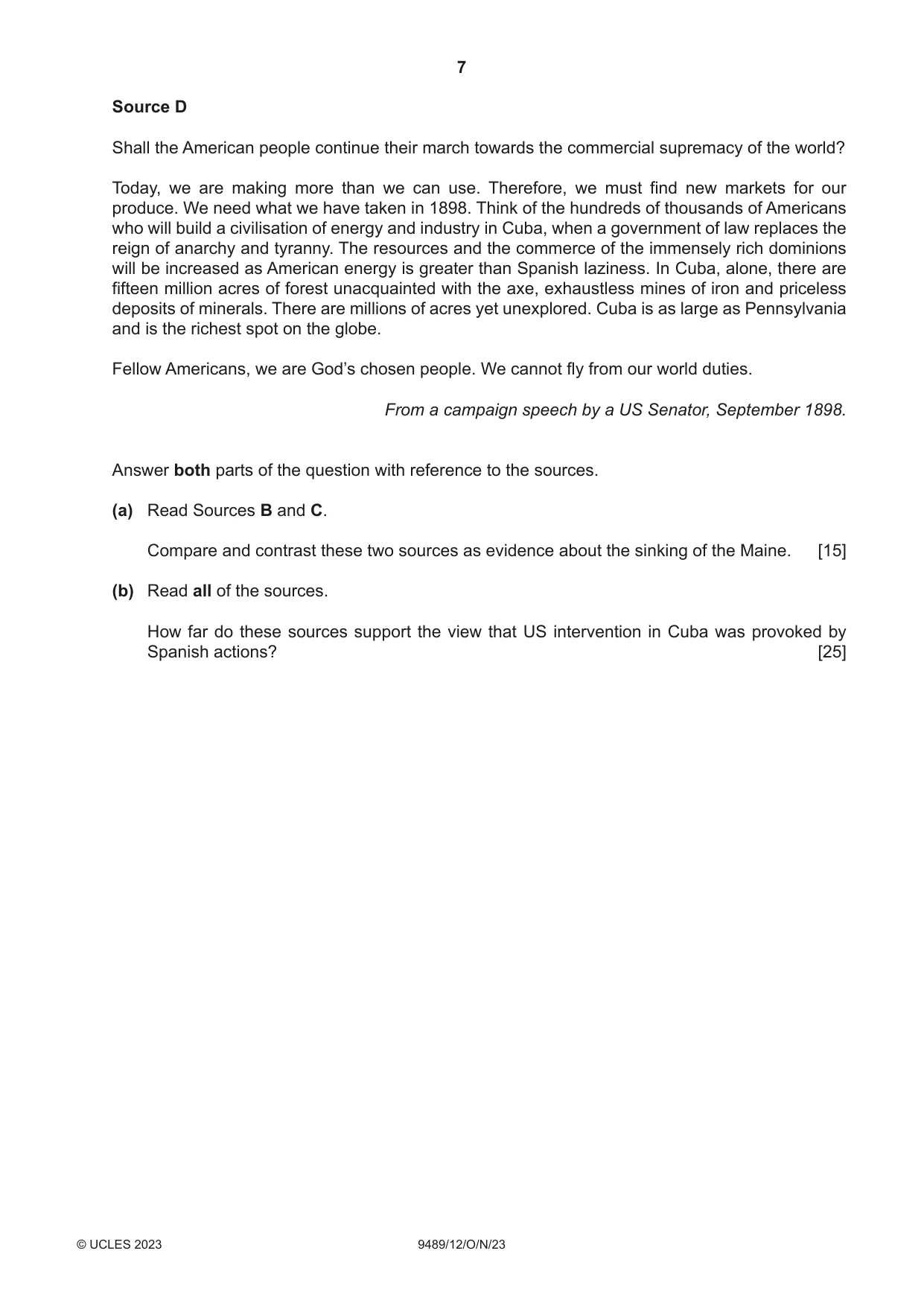
7 9489/12/O/N/23 © UCLES 2023 Source D Shall the American people continue their march towards the commercial supremacy of the world? Today, we are making more than we can use. Therefore, we must find new markets for our produce. We need what we have taken in 1898. Think of the hundreds of thousands of Americans who will build a civilisation of energy and industry in Cuba, when a government of law replaces the reign of anarchy and tyranny. The resources and the commerce of the immensely rich dominions will be increased as American energy is greater than Spanish laziness. In Cuba, alone, there are fifteen million acres of forest unacquainted with the axe, exhaustless mines of iron and priceless deposits of minerals. There are millions of acres yet unexplored. Cuba is as large as Pennsylvania and is the richest spot on the globe. Fellow Americans, we are God’s chosen people. We cannot fly from our world duties. From a campaign speech by a US Senator, September 1898. Answer both parts of the question with reference to the sources. (a) Read Sources B and C. Compare and contrast these two sources as evidence about the sinking of the Maine. [15] (b) Read all of the sources. How far do these sources support the view that US intervention in Cuba was provoked by Spanish actions? [25]
Question paper, page 8
8 9489/12/O/N/23 © UCLES 2023 Permission to reproduce items where third‑party owned material protected by copyright is included has been sought and cleared where possible. Every reasonable effort has been made by the publisher (UCLES) to trace copyright holders, but if any items requiring clearance have unwittingly been included, the publisher will be pleased to make amends at the earliest possible opportunity. To avoid the issue of disclosure of answer‑related information to candidates, all copyright acknowledgements are reproduced online in the Cambridge Assessment International Education Copyright Acknowledgements Booklet. This is produced for each series of examinations and is freely available to download at www.cambridgeinternational.org after the live examination series. Cambridge Assessment International Education is part of Cambridge Assessment. Cambridge Assessment is the brand name of the University of Cambridge Local Examinations Syndicate (UCLES), which is a department of the University of Cambridge. BLANK PAGE
Mark scheme, page 1
This document consists of 15 printed pages. © UCLES 2023 [Turn over Cambridge International AS & A Level HISTORY 9489/12 Paper 1 Document Question October/November 2023 MARK SCHEME Maximum Mark: 40 Published This mark scheme is published as an aid to teachers and candidates, to indicate the requirements of the examination. It shows the basis on which Examiners were instructed to award marks. It does not indicate the details of the discussions that took place at an Examiners’ meeting before marking began, which would have considered the acceptability of alternative answers. Mark schemes should be read in conjunction with the question paper and the Principal Examiner Report for Teachers. Cambridge International will not enter into discussions about these mark schemes. Cambridge International is publishing the mark schemes for the October/November 2023 series for most Cambridge IGCSE, Cambridge International A and AS Level components, and some Cambridge O Level components.
Mark scheme, page 2
9489/12 Cambridge International AS & A Level – Mark Scheme PUBLISHED October/November 2023 © UCLES 2023 Page 2 of 15 Generic Marking Principles These general marking principles must be applied by all examiners when marking candidate answers. They should be applied alongside the specific content of the mark scheme or generic level descriptors for a question. Each question paper and mark scheme will also comply with these marking principles. GENERIC MARKING PRINCIPLE 1: Marks must be awarded in line with: • the specific content of the mark scheme or the generic level descriptors for the question • the specific skills defined in the mark scheme or in the generic level descriptors for the question • the standard of response required by a candidate as exemplified by the standardisation scripts. GENERIC MARKING PRINCIPLE 2: Marks awarded are always whole marks (not half marks, or other fractions). GENERIC MARKING PRINCIPLE 3: Marks must be awarded positively: • marks are awarded for correct/valid answers, as defined in the mark scheme. However, credit is given for valid answers which go beyond the scope of the syllabus and mark scheme, referring to your Team Leader as appropriate • marks are awarded when candidates clearly demonstrate what they know and can do • marks are not deducted for errors • marks are not deducted for omissions • answers should only be judged on the quality of spelling, punctuation and grammar when these features are specifically assessed by the question as indicated by the mark scheme. The meaning, however, should be unambiguous. GENERIC MARKING PRINCIPLE 4: Rules must be applied consistently, e.g. in situations where candidates have not followed instructions or in the application of generic level descriptors. GENERIC MARKING PRINCIPLE 5: Marks should be awarded using the full range of marks defined in the mark scheme for the question (however; the use of the full mark range may be limited according to the quality of the candidate responses seen). GENERIC MARKING PRINCIPLE 6: Marks awarded are based solely on the requirements as defined in the mark scheme. Marks should not be awarded with grade thresholds or grade descriptors in mind.
Mark scheme, page 3
9489/12 Cambridge International AS & A Level – Mark Scheme PUBLISHED October/November 2023 © UCLES 2023 Page 3 of 15 General levels of response Process for awarding marks: • Markers review the answer against the AO4 marking criteria, and award a mark according to these criteria. • Generally, the subsequent mark awarded for AO1 will be the same level. In exceptional cases, markers could award marks in different levels for the two AOs. This is because the ability to recall, select and deploy relevant historical material will be central to any effective analysis and evaluation of the interpretation. • Responses that focus on contextual knowledge without reference to the interpretation cannot be rewarded. Underlining is used in this mark scheme to indicate the main interpretation of the extracts.
Mark scheme, page 4
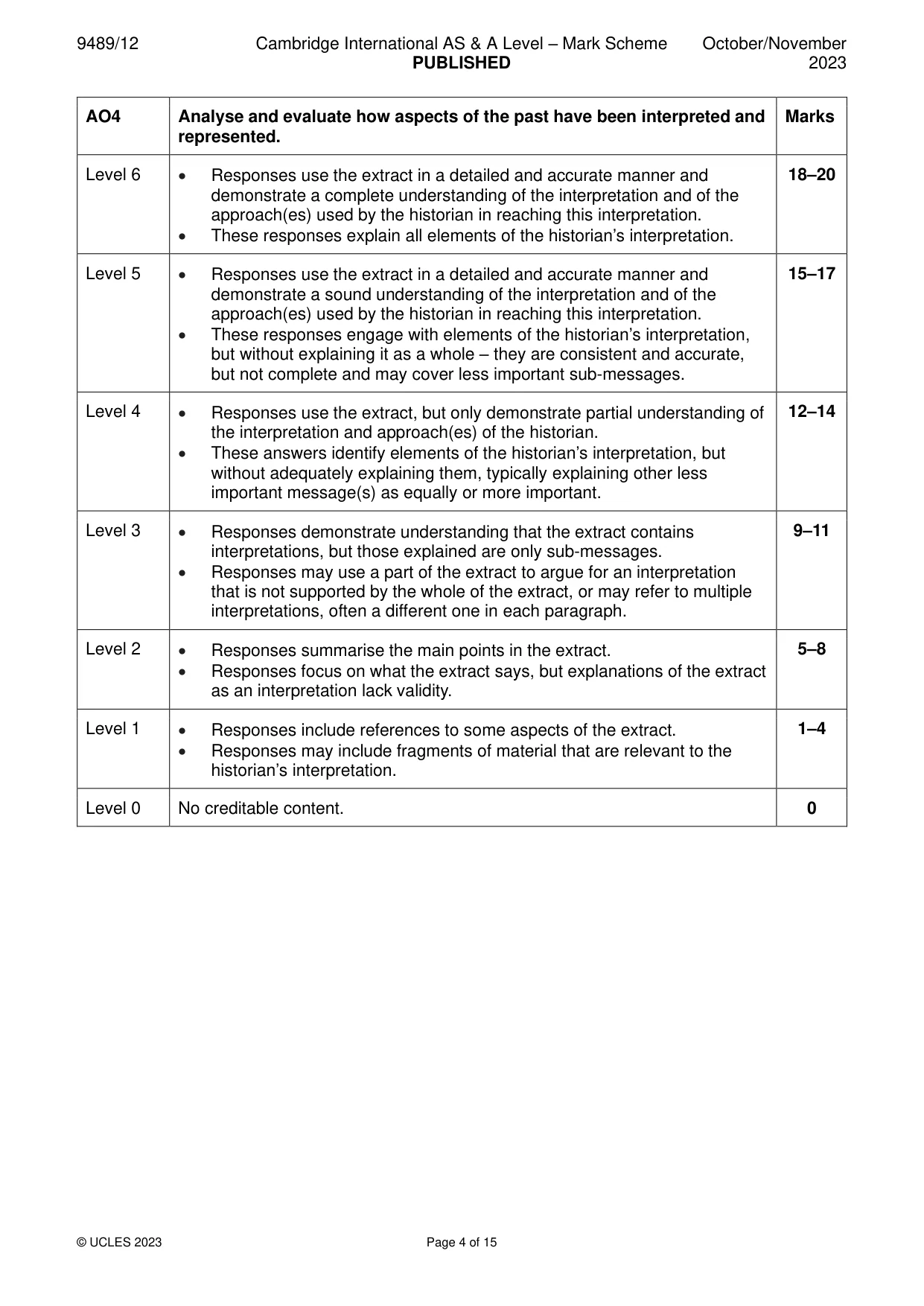
9489/12 Cambridge International AS & A Level – Mark Scheme PUBLISHED October/November 2023 © UCLES 2023 Page 4 of 15 AO4 Analyse and evaluate how aspects of the past have been interpreted and represented. Marks Level 6 • Responses use the extract in a detailed and accurate manner and demonstrate a complete understanding of the interpretation and of the approach(es) used by the historian in reaching this interpretation. • These responses explain all elements of the historian’s interpretation. 18–20 Level 5 • Responses use the extract in a detailed and accurate manner and demonstrate a sound understanding of the interpretation and of the approach(es) used by the historian in reaching this interpretation. • These responses engage with elements of the historian’s interpretation, but without explaining it as a whole – they are consistent and accurate, but not complete and may cover less important sub-messages. 15–17 Level 4 • Responses use the extract, but only demonstrate partial understanding of the interpretation and approach(es) of the historian. • These answers identify elements of the historian’s interpretation, but without adequately explaining them, typically explaining other less important message(s) as equally or more important. 12–14 Level 3 • Responses demonstrate understanding that the extract contains interpretations, but those explained are only sub-messages. • Responses may use a part of the extract to argue for an interpretation that is not supported by the whole of the extract, or may refer to multiple interpretations, often a different one in each paragraph. 9–11 Level 2 • Responses summarise the main points in the extract. • Responses focus on what the extract says, but explanations of the extract as an interpretation lack validity. 5–8 Level 1 • Responses include references to some aspects of the extract. • Responses may include fragments of material that are relevant to the historian’s interpretation. 1–4 Level 0 No creditable content. 0
Mark scheme, page 5
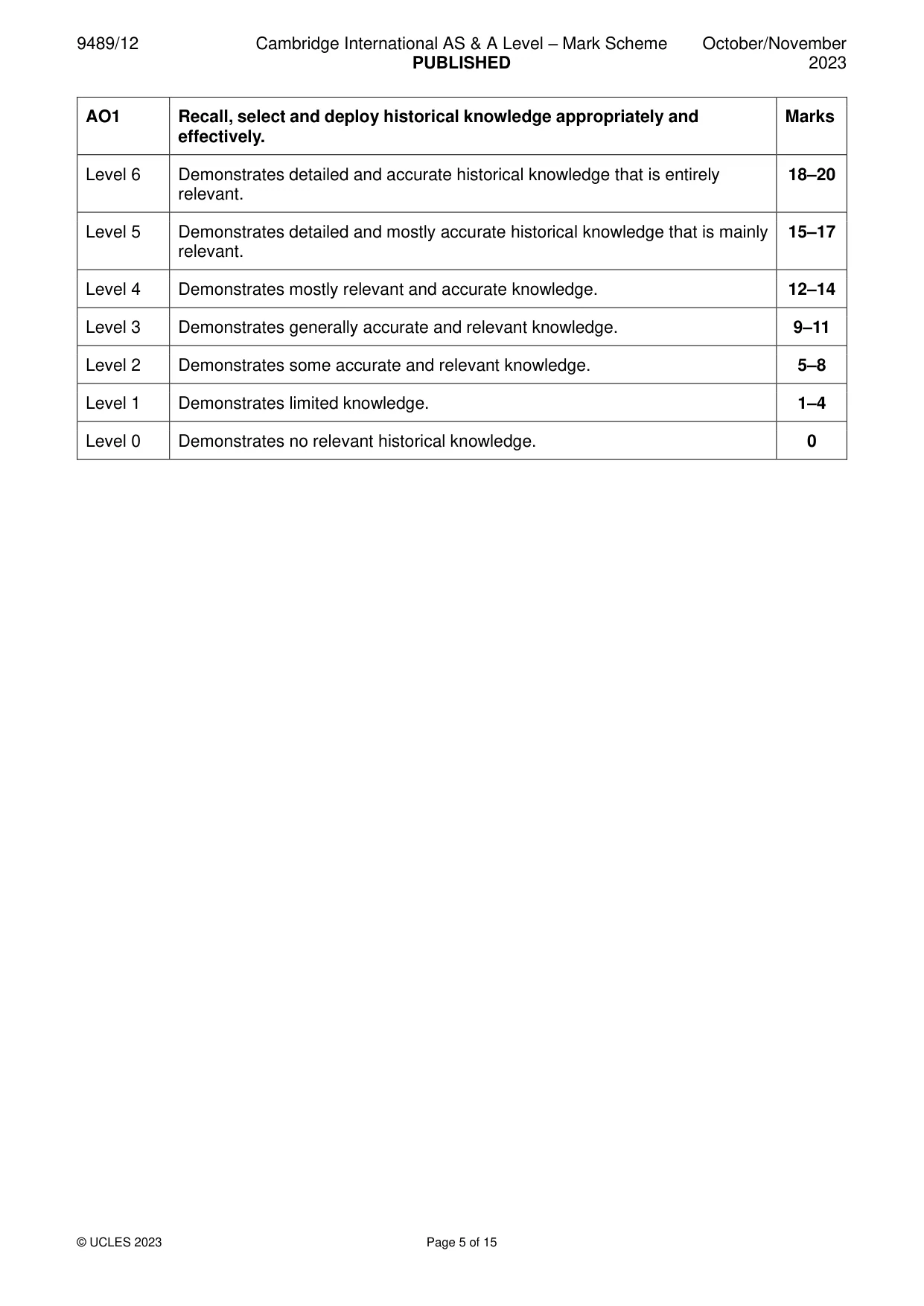
9489/12 Cambridge International AS & A Level – Mark Scheme PUBLISHED October/November 2023 © UCLES 2023 Page 5 of 15 AO1 Recall, select and deploy historical knowledge appropriately and effectively. Marks Level 6 Demonstrates detailed and accurate historical knowledge that is entirely relevant. 18–20 Level 5 Demonstrates detailed and mostly accurate historical knowledge that is mainly relevant. 15–17 Level 4 Demonstrates mostly relevant and accurate knowledge. 12–14 Level 3 Demonstrates generally accurate and relevant knowledge. 9–11 Level 2 Demonstrates some accurate and relevant knowledge. 5–8 Level 1 Demonstrates limited knowledge. 1–4 Level 0 Demonstrates no relevant historical knowledge. 0
Mark scheme, page 6
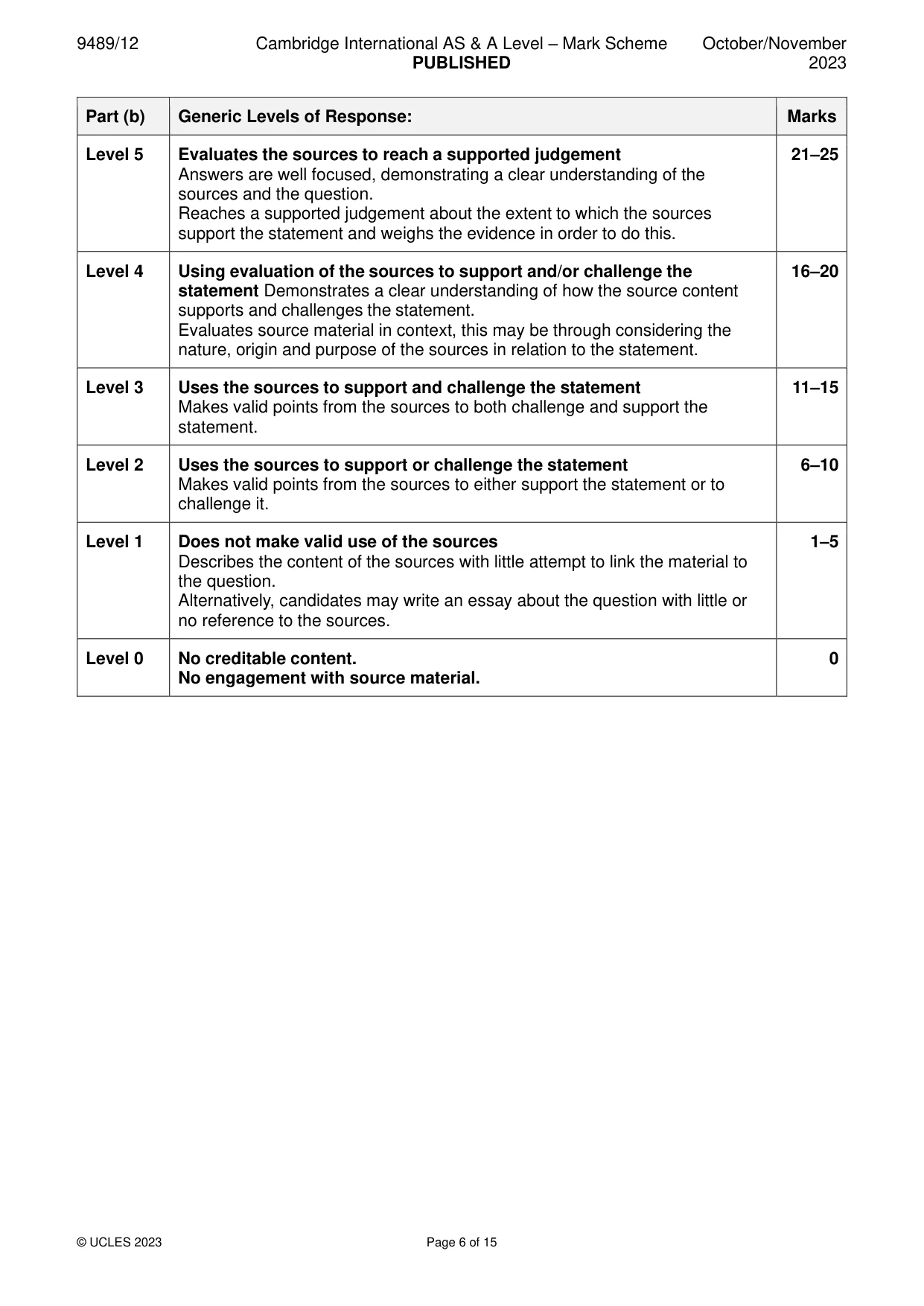
9489/12 Cambridge International AS & A Level – Mark Scheme PUBLISHED October/November 2023 © UCLES 2023 Page 6 of 15 Part (b) Generic Levels of Response: Marks Level 5 Evaluates the sources to reach a supported judgement Answers are well focused, demonstrating a clear understanding of the sources and the question. Reaches a supported judgement about the extent to which the sources support the statement and weighs the evidence in order to do this. 21–25 Level 4 Using evaluation of the sources to support and/or challenge the statement Demonstrates a clear understanding of how the source content supports and challenges the statement. Evaluates source material in context, this may be through considering the nature, origin and purpose of the sources in relation to the statement. 16–20 Level 3 Uses the sources to support and challenge the statement Makes valid points from the sources to both challenge and support the statement. 11–15 Level 2 Uses the sources to support or challenge the statement Makes valid points from the sources to either support the statement or to challenge it. 6–10 Level 1 Does not make valid use of the sources Describes the content of the sources with little attempt to link the material to the question. Alternatively, candidates may write an essay about the question with little or no reference to the sources. 1–5 Level 0 No creditable content. No engagement with source material. 0
Mark scheme, page 7
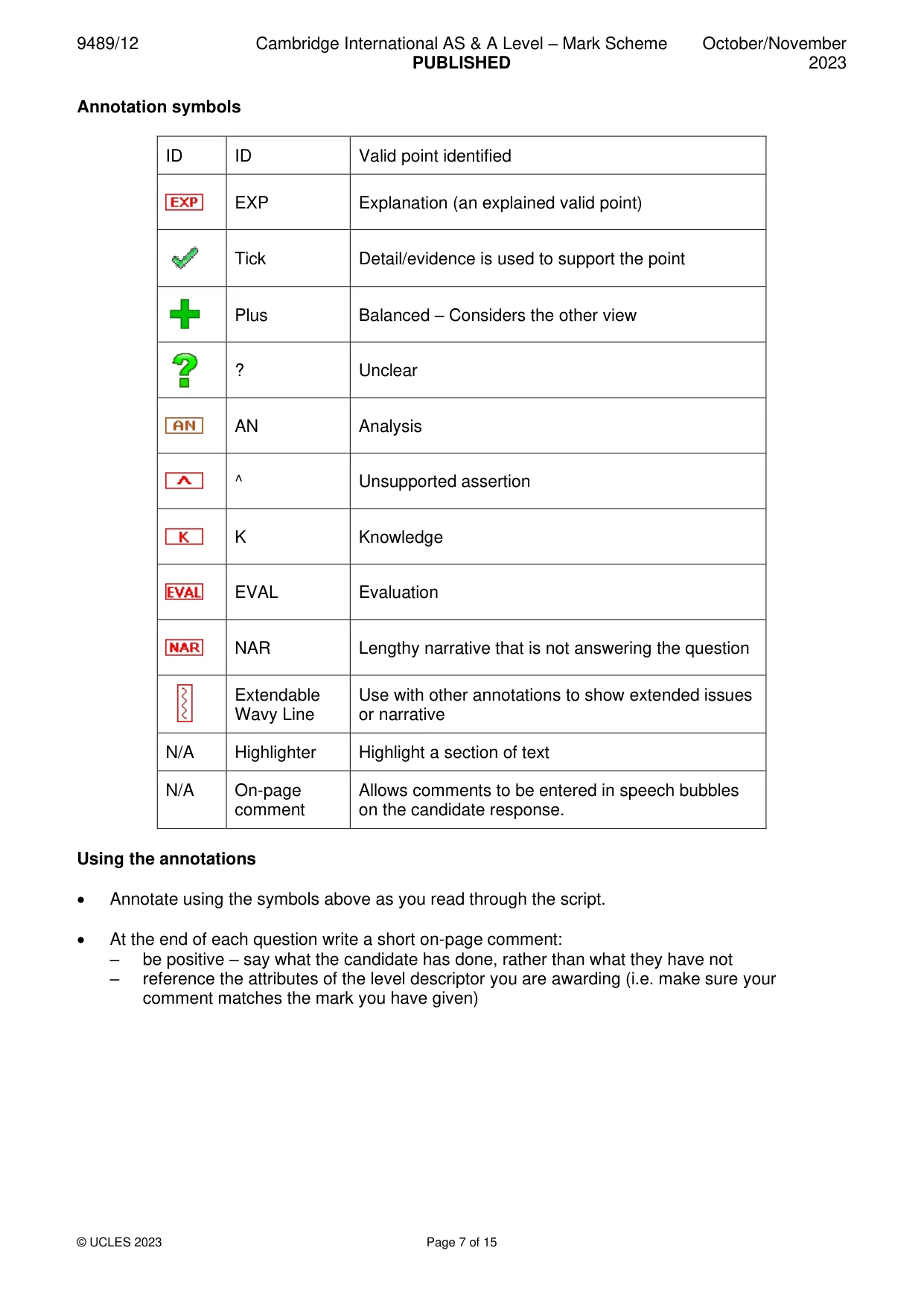
9489/12 Cambridge International AS & A Level – Mark Scheme PUBLISHED October/November 2023 © UCLES 2023 Page 7 of 15 Annotation symbols ID ID Valid point identified EXP Explanation (an explained valid point) Tick Detail/evidence is used to support the point Plus Balanced – Considers the other view ? Unclear AN Analysis ^ Unsupported assertion K Knowledge EVAL Evaluation NAR Lengthy narrative that is not answering the question Extendable Wavy Line Use with other annotations to show extended issues or narrative N/A Highlighter Highlight a section of text N/A On-page comment Allows comments to be entered in speech bubbles on the candidate response. Using the annotations • Annotate using the symbols above as you read through the script. • At the end of each question write a short on-page comment: – be positive – say what the candidate has done, rather than what they have not – reference the attributes of the level descriptor you are awarding (i.e. make sure your comment matches the mark you have given)
Mark scheme, page 8
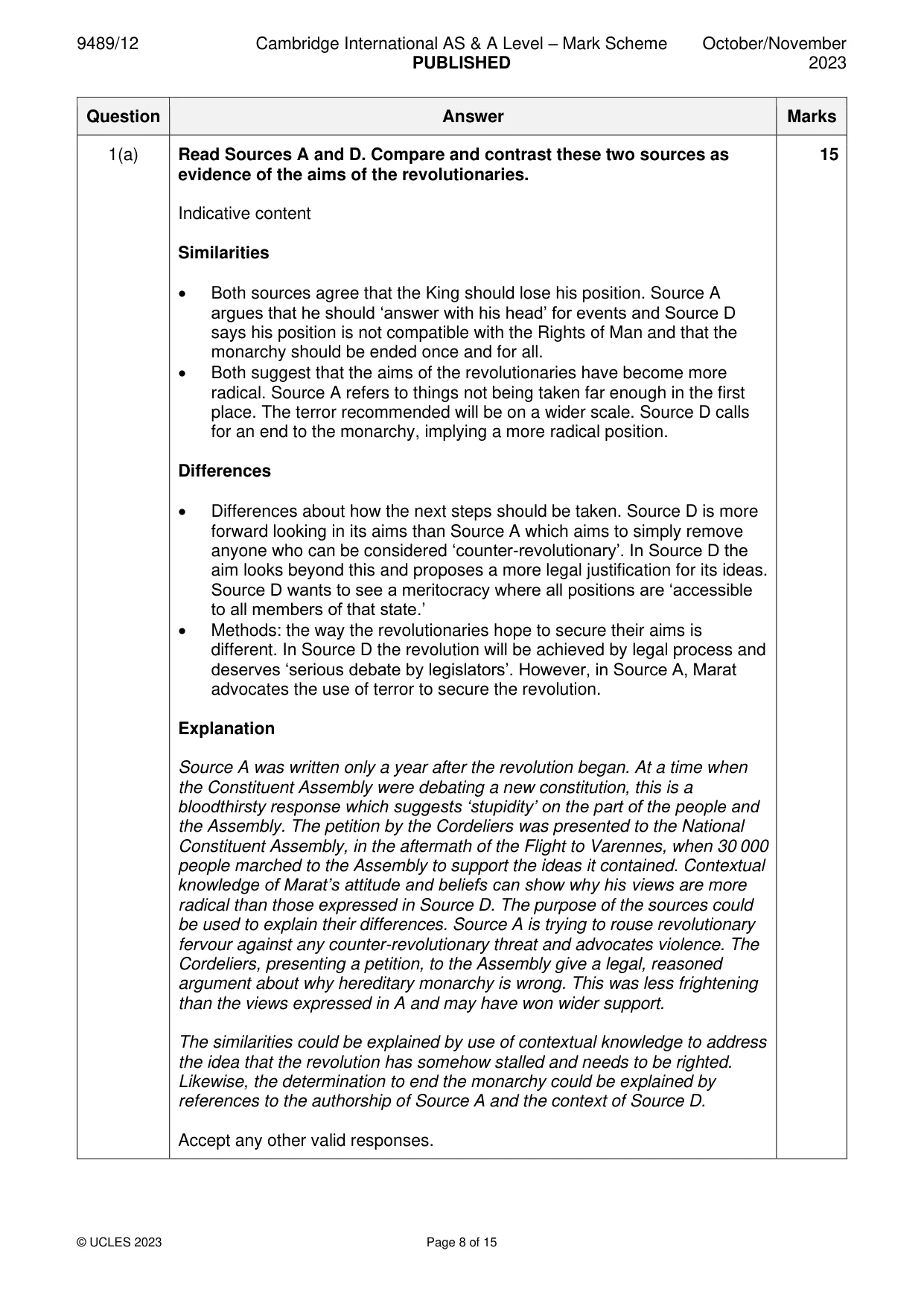
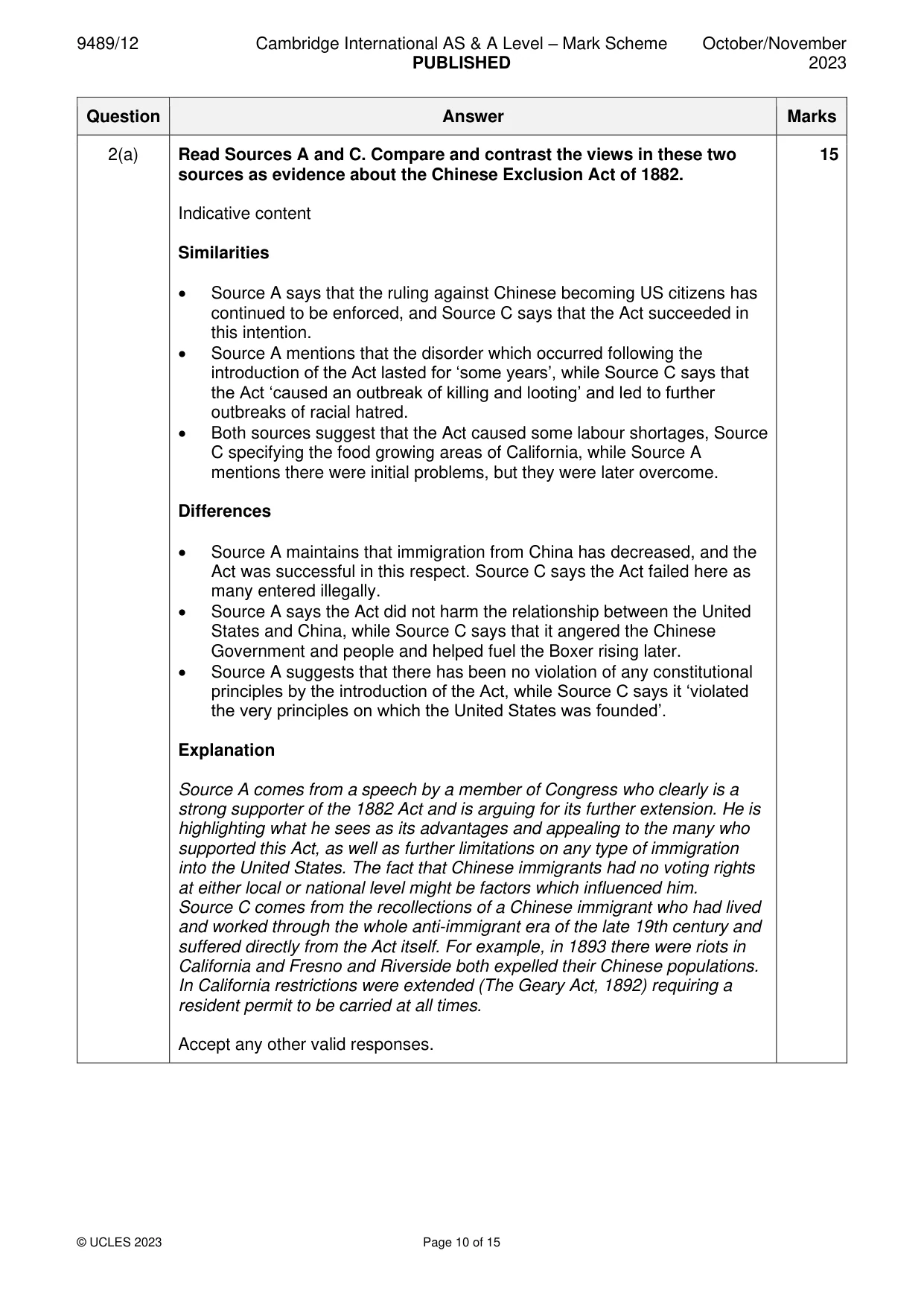
9489/12 Cambridge International AS & A Level – Mark Scheme PUBLISHED October/November 2023 © UCLES 2023 Page 8 of 15 Question Answer Marks 1(a) Read Sources A and D. Compare and contrast these two sources as evidence of the aims of the revolutionaries. Indicative content Similarities • Both sources agree that the King should lose his position. Source A argues that he should ‘answer with his head’ for events and Source D says his position is not compatible with the Rights of Man and that the monarchy should be ended once and for all. • Both suggest that the aims of the revolutionaries have become more radical. Source A refers to things not being taken far enough in the first place. The terror recommended will be on a wider scale. Source D calls for an end to the monarchy, implying a more radical position. Differences • Differences about how the next steps should be taken. Source D is more forward looking in its aims than Source A which aims to simply remove anyone who can be considered ‘counter-revolutionary’. In Source D the aim looks beyond this and proposes a more legal justification for its ideas. Source D wants to see a meritocracy where all positions are ‘accessible to all members of that state.’ • Methods: the way the revolutionaries hope to secure their aims is different. In Source D the revolution will be achieved by legal process and deserves ‘serious debate by legislators’. However, in Source A, Marat advocates the use of terror to secure the revolution. Explanation Source A was written only a year after the revolution began. At a time when the Constituent Assembly were debating a new constitution, this is a bloodthirsty response which suggests ‘stupidity’ on the part of the people and the Assembly. The petition by the Cordeliers was presented to the National Constituent Assembly, in the aftermath of the Flight to Varennes, when 30 000 people marched to the Assembly to support the ideas it contained. Contextual knowledge of Marat’s attitude and beliefs can show why his views are more radical than those expressed in Source D. The purpose of the sources could be used to explain their differences. Source A is trying to rouse revolutionary fervour against any counter-revolutionary threat and advocates violence. The Cordeliers, presenting a petition, to the Assembly give a legal, reasoned argument about why hereditary monarchy is wrong. This was less frightening than the views expressed in A and may have won wider support. The similarities could be explained by use of contextual knowledge to address the idea that the revolution has somehow stalled and needs to be righted. Likewise, the determination to end the monarchy could be explained by references to the authorship of Source A and the context of Source D. Accept any other valid responses. 15
Mark scheme, page 9
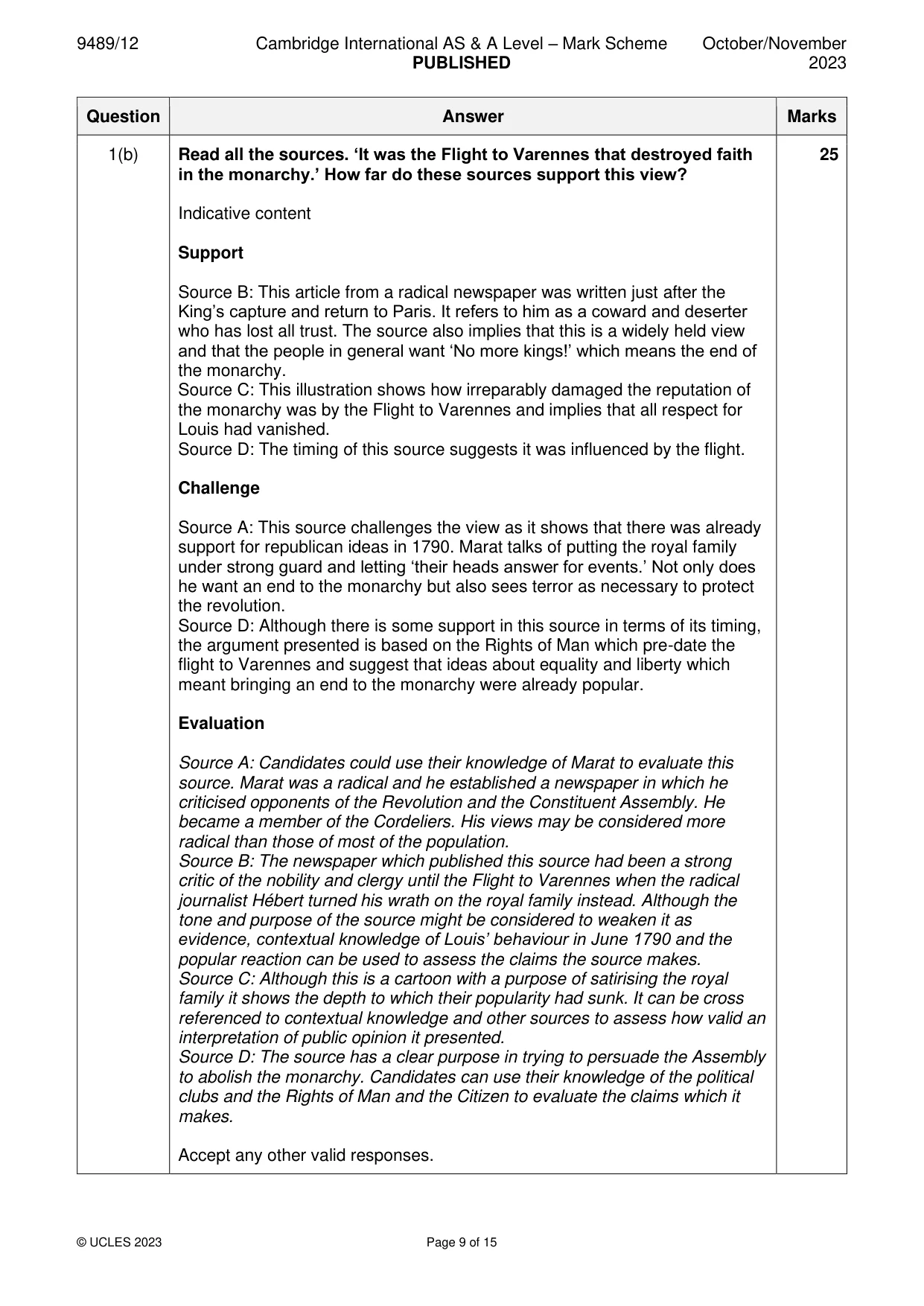
9489/12 Cambridge International AS & A Level – Mark Scheme PUBLISHED October/November 2023 © UCLES 2023 Page 9 of 15 Question Answer Marks 1(b) Read all the sources. ‘It was the Flight to Varennes that destroyed faith in the monarchy.’ How far do these sources support this view? Indicative content Support Source B: This article from a radical newspaper was written just after the King’s capture and return to Paris. It refers to him as a coward and deserter who has lost all trust. The source also implies that this is a widely held view and that the people in general want ‘No more kings!’ which means the end of the monarchy. Source C: This illustration shows how irreparably damaged the reputation of the monarchy was by the Flight to Varennes and implies that all respect for Louis had vanished. Source D: The timing of this source suggests it was influenced by the flight. Challenge Source A: This source challenges the view as it shows that there was already support for republican ideas in 1790. Marat talks of putting the royal family under strong guard and letting ‘their heads answer for events.’ Not only does he want an end to the monarchy but also sees terror as necessary to protect the revolution. Source D: Although there is some support in this source in terms of its timing, the argument presented is based on the Rights of Man which pre-date the flight to Varennes and suggest that ideas about equality and liberty which meant bringing an end to the monarchy were already popular. Evaluation Source A: Candidates could use their knowledge of Marat to evaluate this source. Marat was a radical and he established a newspaper in which he criticised opponents of the Revolution and the Constituent Assembly. He became a member of the Cordeliers. His views may be considered more radical than those of most of the population. Source B: The newspaper which published this source had been a strong critic of the nobility and clergy until the Flight to Varennes when the radical journalist Hébert turned his wrath on the royal family instead. Although the tone and purpose of the source might be considered to weaken it as evidence, contextual knowledge of Louis’ behaviour in June 1790 and the popular reaction can be used to assess the claims the source makes. Source C: Although this is a cartoon with a purpose of satirising the royal family it shows the depth to which their popularity had sunk. It can be cross referenced to contextual knowledge and other sources to assess how valid an interpretation of public opinion it presented. Source D: The source has a clear purpose in trying to persuade the Assembly to abolish the monarchy. Candidates can use their knowledge of the political clubs and the Rights of Man and the Citizen to evaluate the claims which it makes. Accept any other valid responses. 25
Mark scheme, page 10
9489/12 Cambridge International AS & A Level – Mark Scheme PUBLISHED October/November 2023 © UCLES 2023 Page 10 of 15 Question Answer Marks 2(a) Read Sources A and C. Compare and contrast the views in these two sources as evidence about the Chinese Exclusion Act of 1882. Indicative content Similarities • Source A says that the ruling against Chinese becoming US citizens has continued to be enforced, and Source C says that the Act succeeded in this intention. • Source A mentions that the disorder which occurred following the introduction of the Act lasted for ‘some years’, while Source C says that the Act ‘caused an outbreak of killing and looting’ and led to further outbreaks of racial hatred. • Both sources suggest that the Act caused some labour shortages, Source C specifying the food growing areas of California, while Source A mentions there were initial problems, but they were later overcome. Differences • Source A maintains that immigration from China has decreased, and the Act was successful in this respect. Source C says the Act failed here as many entered illegally. • Source A says the Act did not harm the relationship between the United States and China, while Source C says that it angered the Chinese Government and people and helped fuel the Boxer rising later. • Source A suggests that there has been no violation of any constitutional principles by the introduction of the Act, while Source C says it ‘violated the very principles on which the United States was founded’. Explanation Source A comes from a speech by a member of Congress who clearly is a strong supporter of the 1882 Act and is arguing for its further extension. He is highlighting what he sees as its advantages and appealing to the many who supported this Act, as well as further limitations on any type of immigration into the United States. The fact that Chinese immigrants had no voting rights at either local or national level might be factors which influenced him. Source C comes from the recollections of a Chinese immigrant who had lived and worked through the whole anti-immigrant era of the late 19th century and suffered directly from the Act itself. For example, in 1893 there were riots in California and Fresno and Riverside both expelled their Chinese populations. In California restrictions were extended (The Geary Act, 1892) requiring a resident permit to be carried at all times. Accept any other valid responses. 15
Mark scheme, page 11
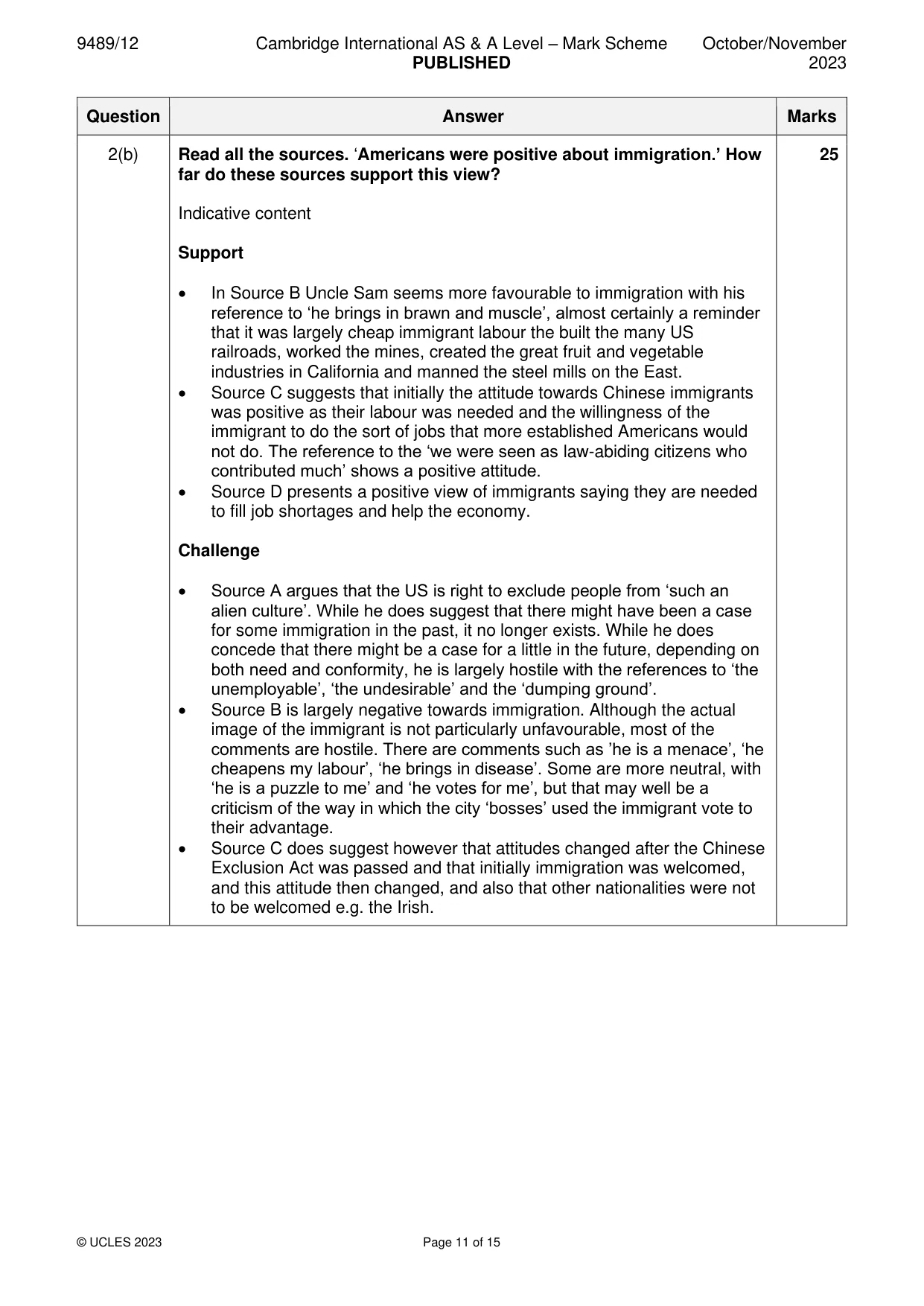
9489/12 Cambridge International AS & A Level – Mark Scheme PUBLISHED October/November 2023 © UCLES 2023 Page 11 of 15 Question Answer Marks 2(b) Read all the sources. ‘Americans were positive about immigration.’ How far do these sources support this view? Indicative content Support • In Source B Uncle Sam seems more favourable to immigration with his reference to ‘he brings in brawn and muscle’, almost certainly a reminder that it was largely cheap immigrant labour the built the many US railroads, worked the mines, created the great fruit and vegetable industries in California and manned the steel mills on the East. • Source C suggests that initially the attitude towards Chinese immigrants was positive as their labour was needed and the willingness of the immigrant to do the sort of jobs that more established Americans would not do. The reference to the ‘we were seen as law-abiding citizens who contributed much’ shows a positive attitude. • Source D presents a positive view of immigrants saying they are needed to fill job shortages and help the economy. Challenge • Source A argues that the US is right to exclude people from ‘such an alien culture’. While he does suggest that there might have been a case for some immigration in the past, it no longer exists. While he does concede that there might be a case for a little in the future, depending on both need and conformity, he is largely hostile with the references to ‘the unemployable’, ‘the undesirable’ and the ‘dumping ground’. • Source B is largely negative towards immigration. Although the actual image of the immigrant is not particularly unfavourable, most of the comments are hostile. There are comments such as ’he is a menace’, ‘he cheapens my labour’, ‘he brings in disease’. Some are more neutral, with ‘he is a puzzle to me’ and ‘he votes for me’, but that may well be a criticism of the way in which the city ‘bosses’ used the immigrant vote to their advantage. • Source C does suggest however that attitudes changed after the Chinese Exclusion Act was passed and that initially immigration was welcomed, and this attitude then changed, and also that other nationalities were not to be welcomed e.g. the Irish. 25
Mark scheme, page 12
9489/12 Cambridge International AS & A Level – Mark Scheme PUBLISHED October/November 2023 © UCLES 2023 Page 12 of 15 Question Answer Marks 2(b) Evaluation Source A is clearly arguing a case and is likely to have been a congressman from an area which was not dominated by recent immigrants. Source B: Compared with some cartoons, this is less hostile than many, but it does reflect many of the concerns that were raised throughout America by the anti-immigrant forces in the latter part of the 19th and early 20th century. Source C: Contextual knowledge would indicate that this is a reliable source which accurately portrays what happened to immigrants, and the Chinese in particular, in the later years of the 19th and the earlier part of the 20th centuries. Source D: There was not the shortage of labour by the time this pamphlet was written. There had been in the past. The point about skilled workers is a valid one, but not in all the industries that the writer suggests. Accept any other valid responses.
Mark scheme, page 13
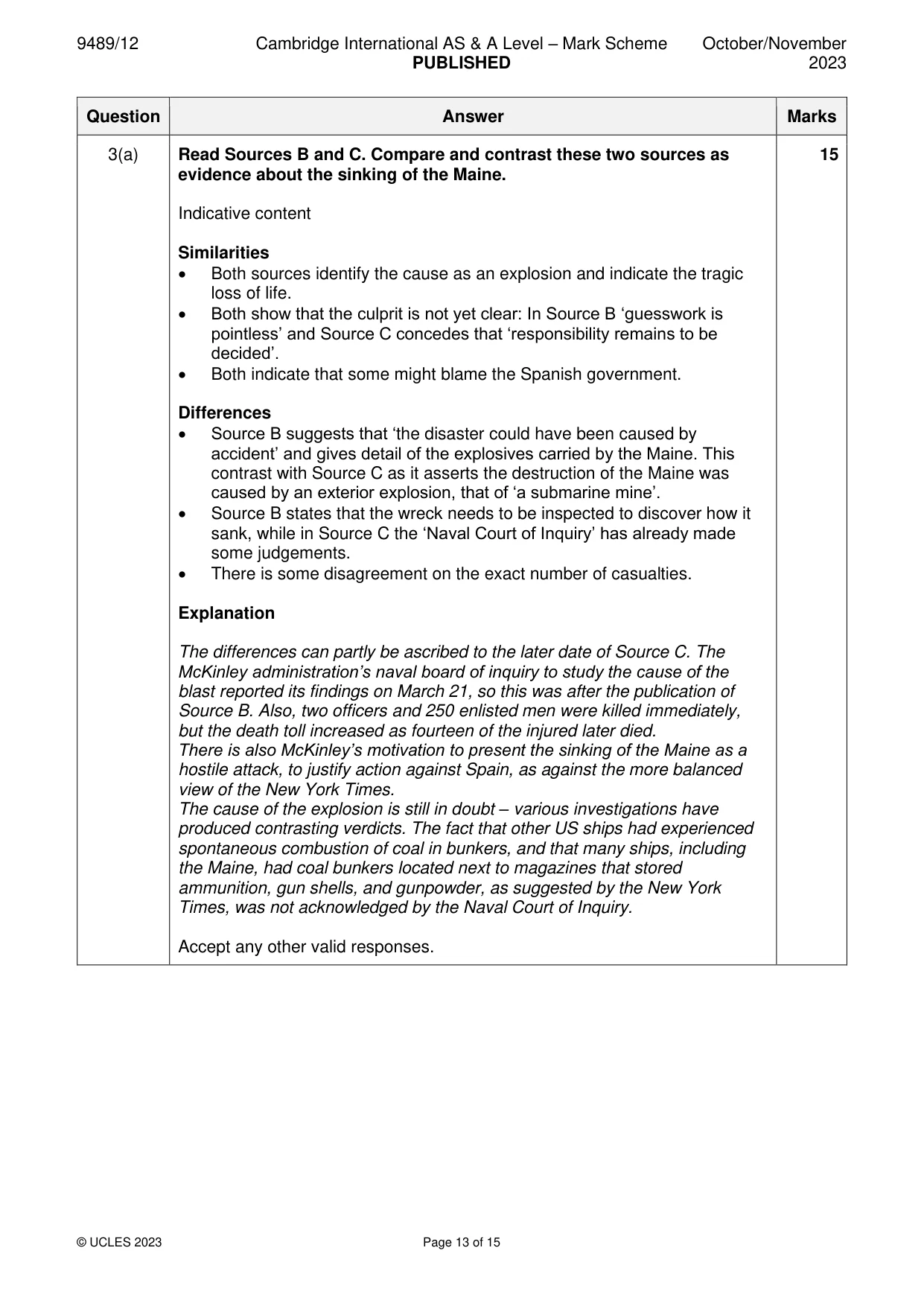
9489/12 Cambridge International AS & A Level – Mark Scheme PUBLISHED October/November 2023 © UCLES 2023 Page 13 of 15 Question Answer Marks 3(a) Read Sources B and C. Compare and contrast these two sources as evidence about the sinking of the Maine. Indicative content Similarities • Both sources identify the cause as an explosion and indicate the tragic loss of life. • Both show that the culprit is not yet clear: In Source B ‘guesswork is pointless’ and Source C concedes that ‘responsibility remains to be decided’. • Both indicate that some might blame the Spanish government. Differences • Source B suggests that ‘the disaster could have been caused by accident’ and gives detail of the explosives carried by the Maine. This contrast with Source C as it asserts the destruction of the Maine was caused by an exterior explosion, that of ‘a submarine mine’. • Source B states that the wreck needs to be inspected to discover how it sank, while in Source C the ‘Naval Court of Inquiry’ has already made some judgements. • There is some disagreement on the exact number of casualties. Explanation The differences can partly be ascribed to the later date of Source C. The McKinley administration’s naval board of inquiry to study the cause of the blast reported its findings on March 21, so this was after the publication of Source B. Also, two officers and 250 enlisted men were killed immediately, but the death toll increased as fourteen of the injured later died. There is also McKinley’s motivation to present the sinking of the Maine as a hostile attack, to justify action against Spain, as against the more balanced view of the New York Times. The cause of the explosion is still in doubt – various investigations have produced contrasting verdicts. The fact that other US ships had experienced spontaneous combustion of coal in bunkers, and that many ships, including the Maine, had coal bunkers located next to magazines that stored ammunition, gun shells, and gunpowder, as suggested by the New York Times, was not acknowledged by the Naval Court of Inquiry. Accept any other valid responses. 15
Mark scheme, page 14
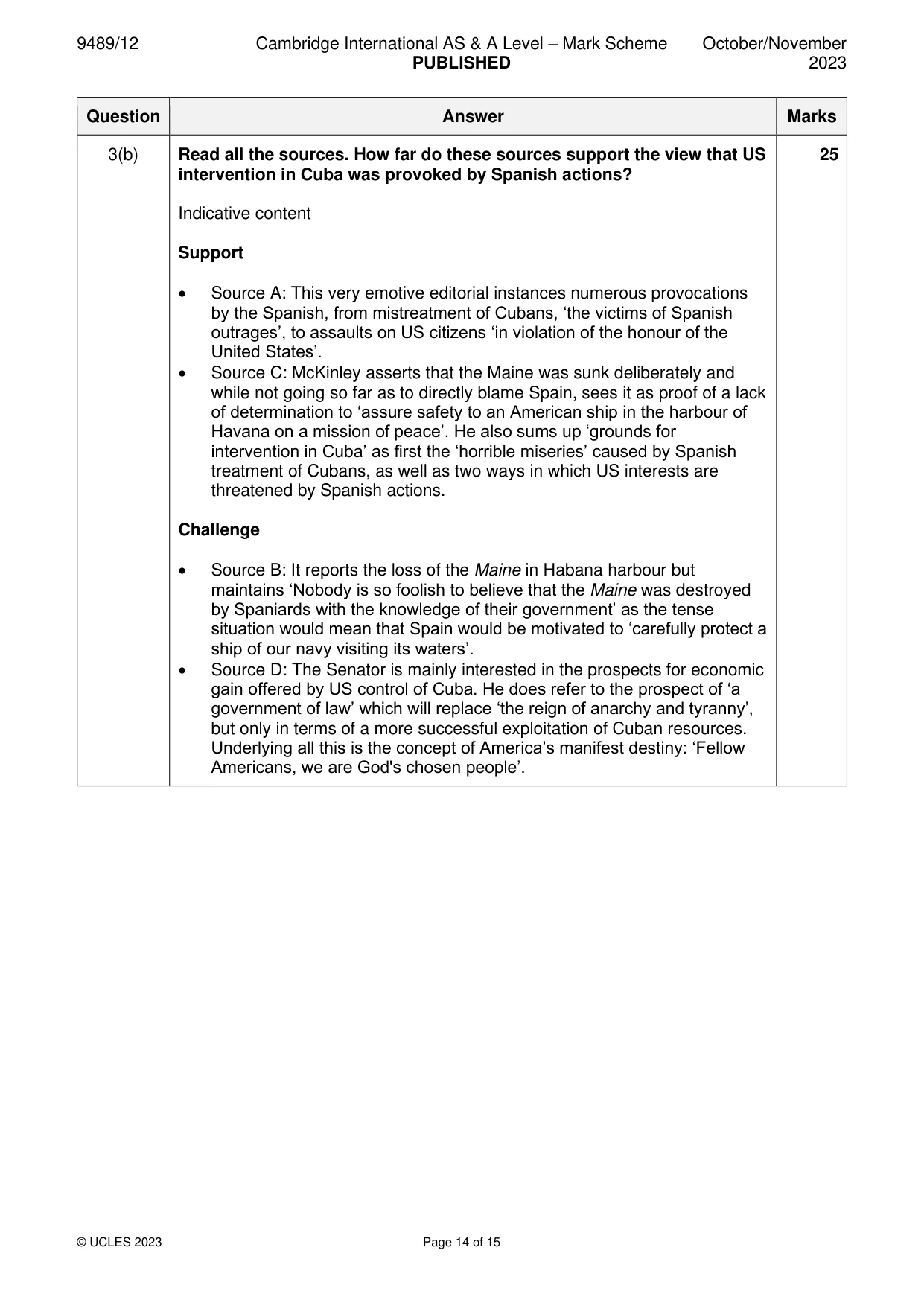
9489/12 Cambridge International AS & A Level – Mark Scheme PUBLISHED October/November 2023 © UCLES 2023 Page 14 of 15 Question Answer Marks 3(b) Read all the sources. How far do these sources support the view that US intervention in Cuba was provoked by Spanish actions? Indicative content Support • Source A: This very emotive editorial instances numerous provocations by the Spanish, from mistreatment of Cubans, ‘the victims of Spanish outrages’, to assaults on US citizens ‘in violation of the honour of the United States’. • Source C: McKinley asserts that the Maine was sunk deliberately and while not going so far as to directly blame Spain, sees it as proof of a lack of determination to ‘assure safety to an American ship in the harbour of Havana on a mission of peace’. He also sums up ‘grounds for intervention in Cuba’ as first the ‘horrible miseries’ caused by Spanish treatment of Cubans, as well as two ways in which US interests are threatened by Spanish actions. Challenge • Source B: It reports the loss of the Maine in Habana harbour but maintains ‘Nobody is so foolish to believe that the Maine was destroyed by Spaniards with the knowledge of their government’ as the tense situation would mean that Spain would be motivated to ‘carefully protect a ship of our navy visiting its waters’. • Source D: The Senator is mainly interested in the prospects for economic gain offered by US control of Cuba. He does refer to the prospect of ‘a government of law’ which will replace ‘the reign of anarchy and tyranny’, but only in terms of a more successful exploitation of Cuban resources. Underlying all this is the concept of America’s manifest destiny: ‘Fellow Americans, we are God's chosen people’. 25
Mark scheme, page 15
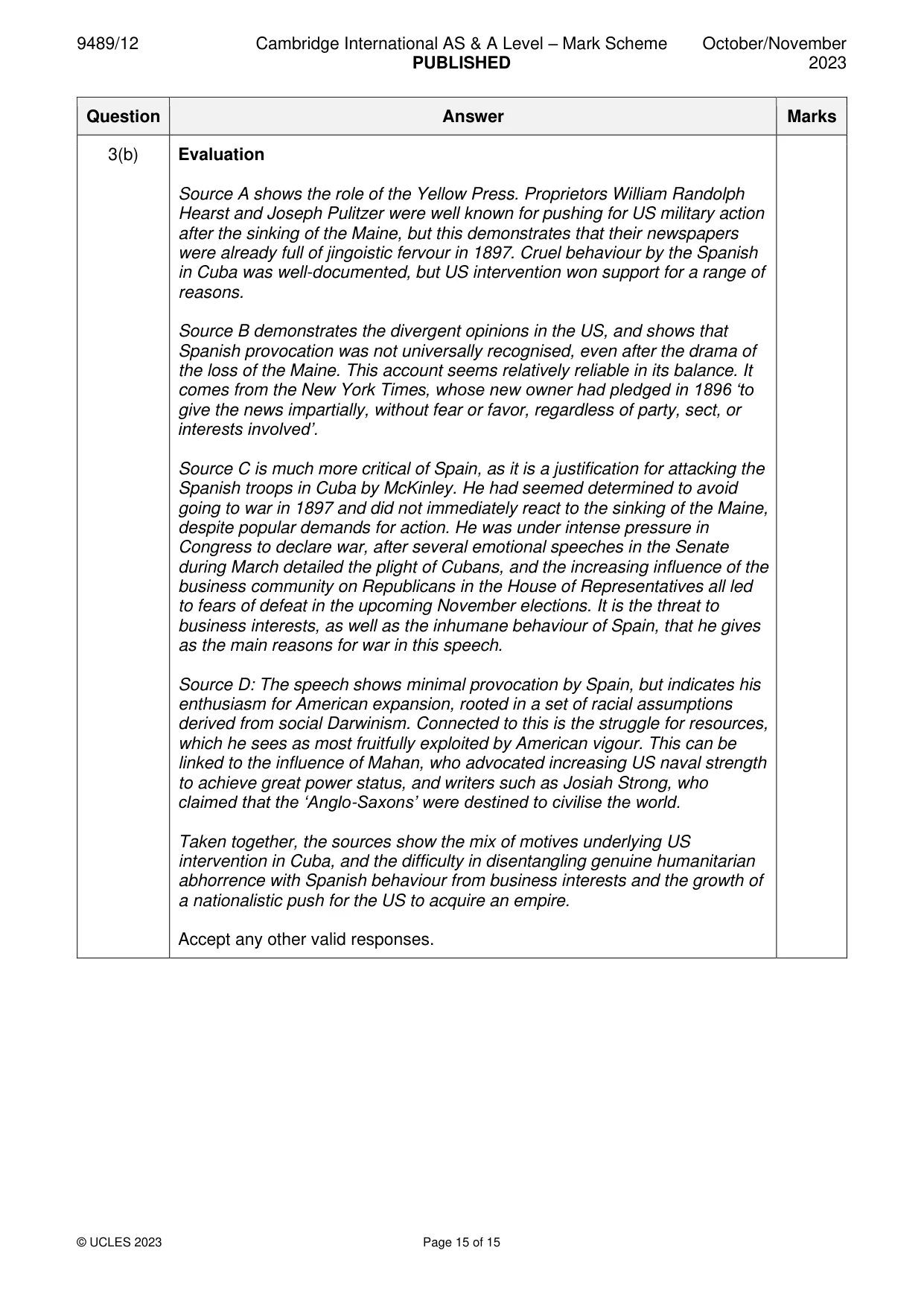
9489/12 Cambridge International AS & A Level – Mark Scheme PUBLISHED October/November 2023 © UCLES 2023 Page 15 of 15 Question Answer Marks 3(b) Evaluation Source A shows the role of the Yellow Press. Proprietors William Randolph Hearst and Joseph Pulitzer were well known for pushing for US military action after the sinking of the Maine, but this demonstrates that their newspapers were already full of jingoistic fervour in 1897. Cruel behaviour by the Spanish in Cuba was well-documented, but US intervention won support for a range of reasons. Source B demonstrates the divergent opinions in the US, and shows that Spanish provocation was not universally recognised, even after the drama of the loss of the Maine. This account seems relatively reliable in its balance. It comes from the New York Times, whose new owner had pledged in 1896 ‘to give the news impartially, without fear or favor, regardless of party, sect, or interests involved’. Source C is much more critical of Spain, as it is a justification for attacking the Spanish troops in Cuba by McKinley. He had seemed determined to avoid going to war in 1897 and did not immediately react to the sinking of the Maine, despite popular demands for action. He was under intense pressure in Congress to declare war, after several emotional speeches in the Senate during March detailed the plight of Cubans, and the increasing influence of the business community on Republicans in the House of Representatives all led to fears of defeat in the upcoming November elections. It is the threat to business interests, as well as the inhumane behaviour of Spain, that he gives as the main reasons for war in this speech. Source D: The speech shows minimal provocation by Spain, but indicates his enthusiasm for American expansion, rooted in a set of racial assumptions derived from social Darwinism. Connected to this is the struggle for resources, which he sees as most fruitfully exploited by American vigour. This can be linked to the influence of Mahan, who advocated increasing US naval strength to achieve great power status, and writers such as Josiah Strong, who claimed that the ‘Anglo-Saxons’ were destined to civilise the world. Taken together, the sources show the mix of motives underlying US intervention in Cuba, and the difficulty in disentangling genuine humanitarian abhorrence with Spanish behaviour from business interests and the growth of a nationalistic push for the US to acquire an empire. Accept any other valid responses.
What you needed in this session
Cambridge’s own grade thresholds for 2023 Oct/Nov, Paper 1 · Variant 2. A higher threshold means an easier paper — the bar moves with how the cohort did.