Cambridge A Level History 9489 — 2024 Feb/March Paper 3 · Variant 2
9489/32/F/M/24 · 3 questions · 40 marks · ≈45 min
The question paper and its mark scheme, free to read here and free to download. This is Cambridge’s own paper, exactly as it was sat.
Question paper4 pages
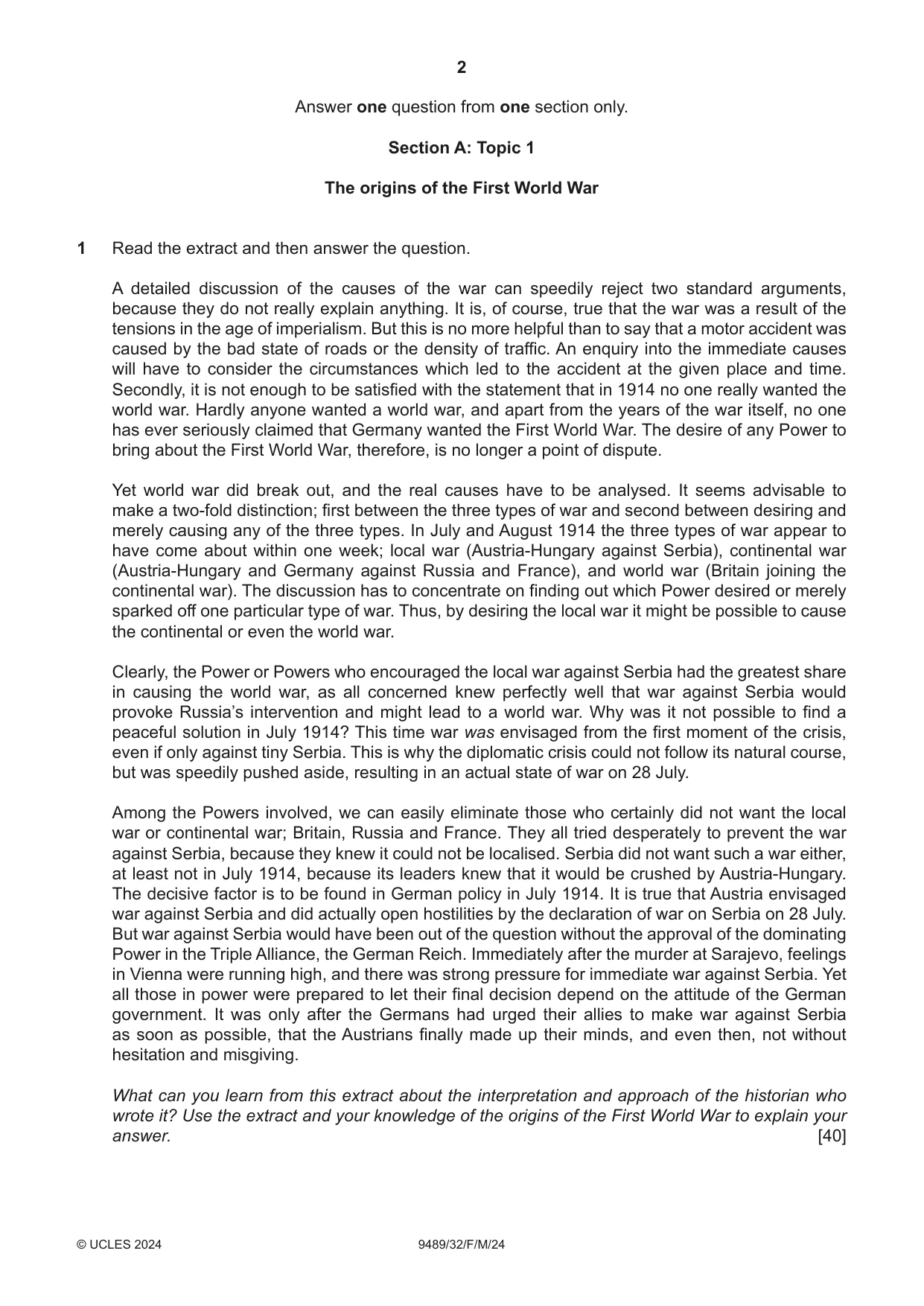
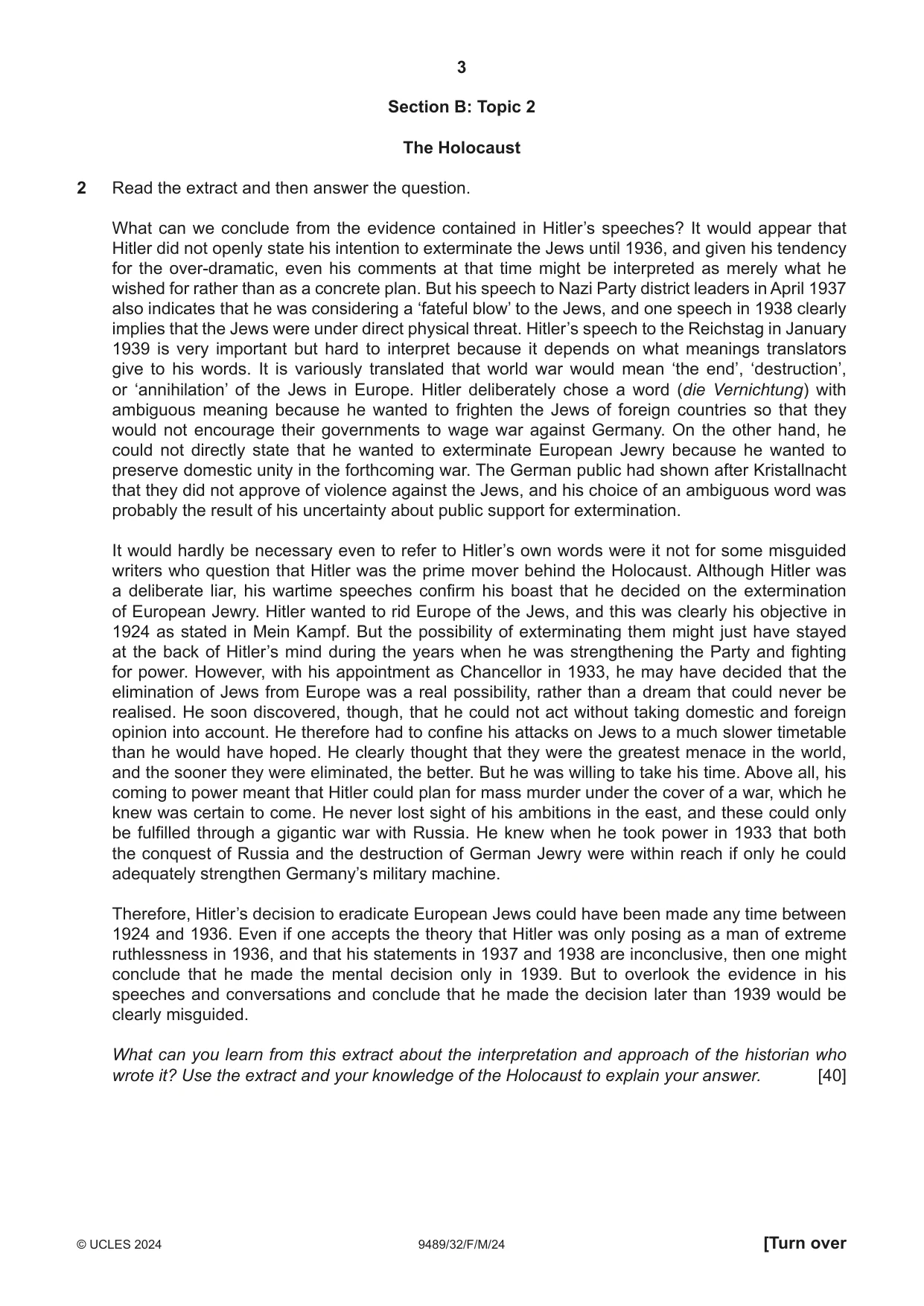
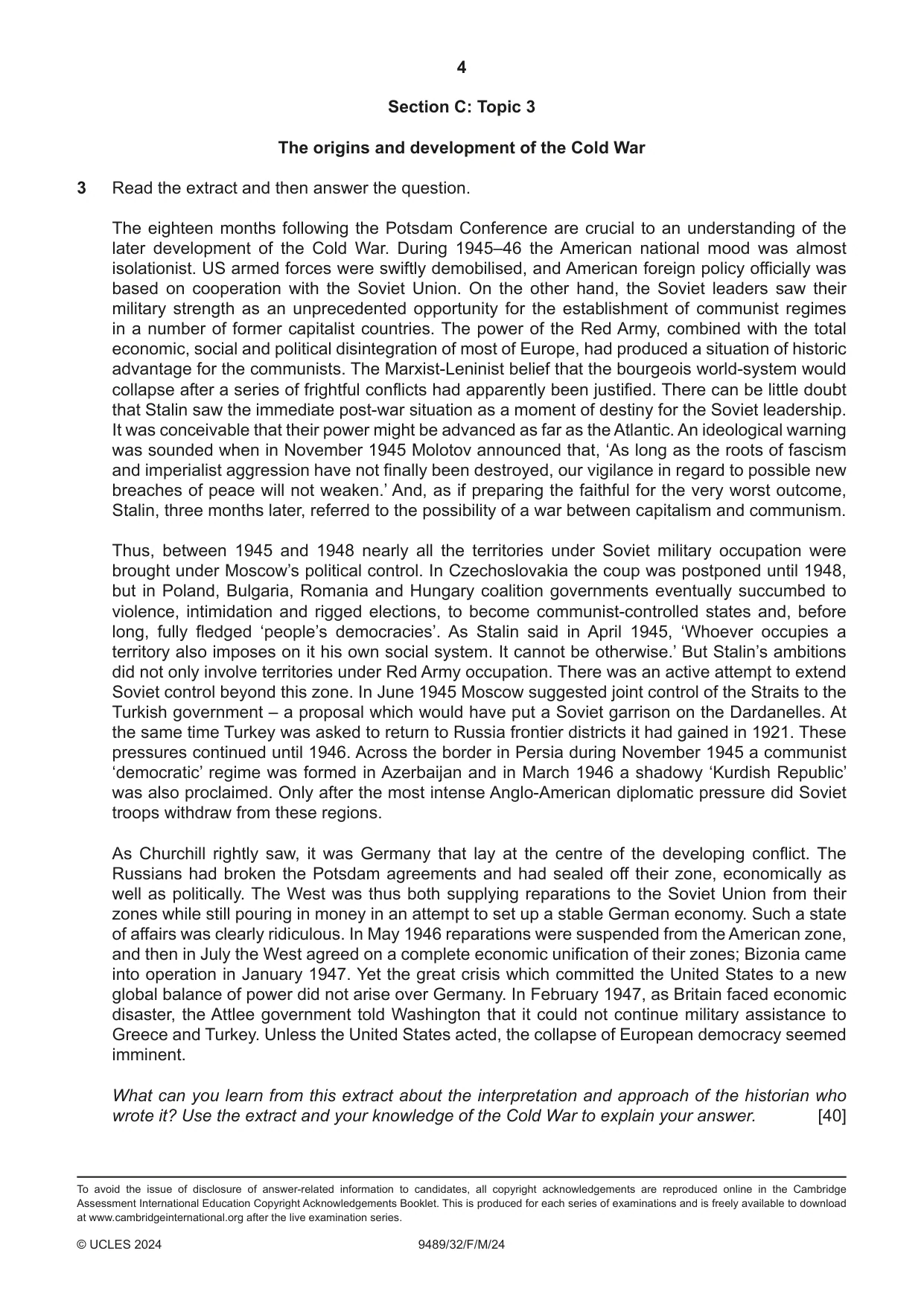
Mark scheme7 pages
Answers below. Sit the paper first if you are practising.
Questions as text
Q1 · Read the extract and then answer the question
1 Read the extract and then answer the question. A detailed discussion of the causes of the war can speedily reject two standard arguments, because they do not really explain anything. It is, of course, true that the war was a result of the tensions in the age of imperialism. But this is no more helpful than to say that a motor accident was caused by the bad state of roads or the density of traffic. An enquiry into the immediate causes will have to consider the circumstances which led to the accident at the given place and time. Secondly, it is not enough to be satisfied with the statement that in 1914 no one really wanted the world war. Hardly anyone wanted a world war, and apart from the years of the war itself, no one has ever seriously claimed that Germany wanted the First World War. The desire of any Power to bring about the First World War, therefore, is no longer a point of dispute. Yet world war did break out, and the real causes have to be analysed. It seems advisable to make a two-fold distinction; first between the three types of war and second between desiring and merely causing any of the three types. In July and August 1914 the three types of war appear to have come about within one week; local war (Austria-Hungary against Serbia), continental war (Austria-Hungary and Germany against Russia and France), and world war (Britain joining the continental war). The discussion has to concentrate on finding out which Power desired or merely sparked off one particular type of war. Thus, by desiring the local war it might be possible to cause the continental or even the world war. Clearly, the Power or Powers who encouraged the local war against Serbia had the greatest share in causing the world war, as all concerned knew perfectly well that war against Serbia would provoke Russia’s intervention and might lead to a world war. Why was it not possible to find a peaceful solution in July 1914? This time war was envisaged from the first moment of the crisis, even if only against tiny Serbia. This is why the diplomatic crisis could not follow its natural course, but was speedily pushed aside, resulting in an actual state of war on 28 July. Among the Powers involved, we can easily eliminate those who certainly did not want the local war or continental war; Britain, Russia and France. They all tried desperately to prevent the war against Serbia, because they knew it could not be localised. Serbia did not want such a war either, at least not in July 1914, because its leaders knew that it would be crushed by Austria-Hungary. The decisive factor is to be found in German policy in July 1914. It is true that Austria envisaged war against Serbia and did actually open hostilities by the declaration of war on Serbia on 28 July. But war against Serbia would have been out of the question without the approval of the dominating Power in the Triple Alliance, the German Reich. Immediately after the murder at Sarajevo, feelings in Vienna were running high, and there was strong pressure for immediate war against Serbia. Yet all those in power were prepared to let their final decision depend on the attitude of the German government. It was only after the Germans had urged their allies to make war against Serbia as soon as possible, that the Austrians finally made up their minds, and even then, not without hesitation and misgiving. What can you learn from this extract about the interpretation and approach of the historian who wrote it? Use the extract and your knowledge of the origins of the First World War to explain your answer. [40]
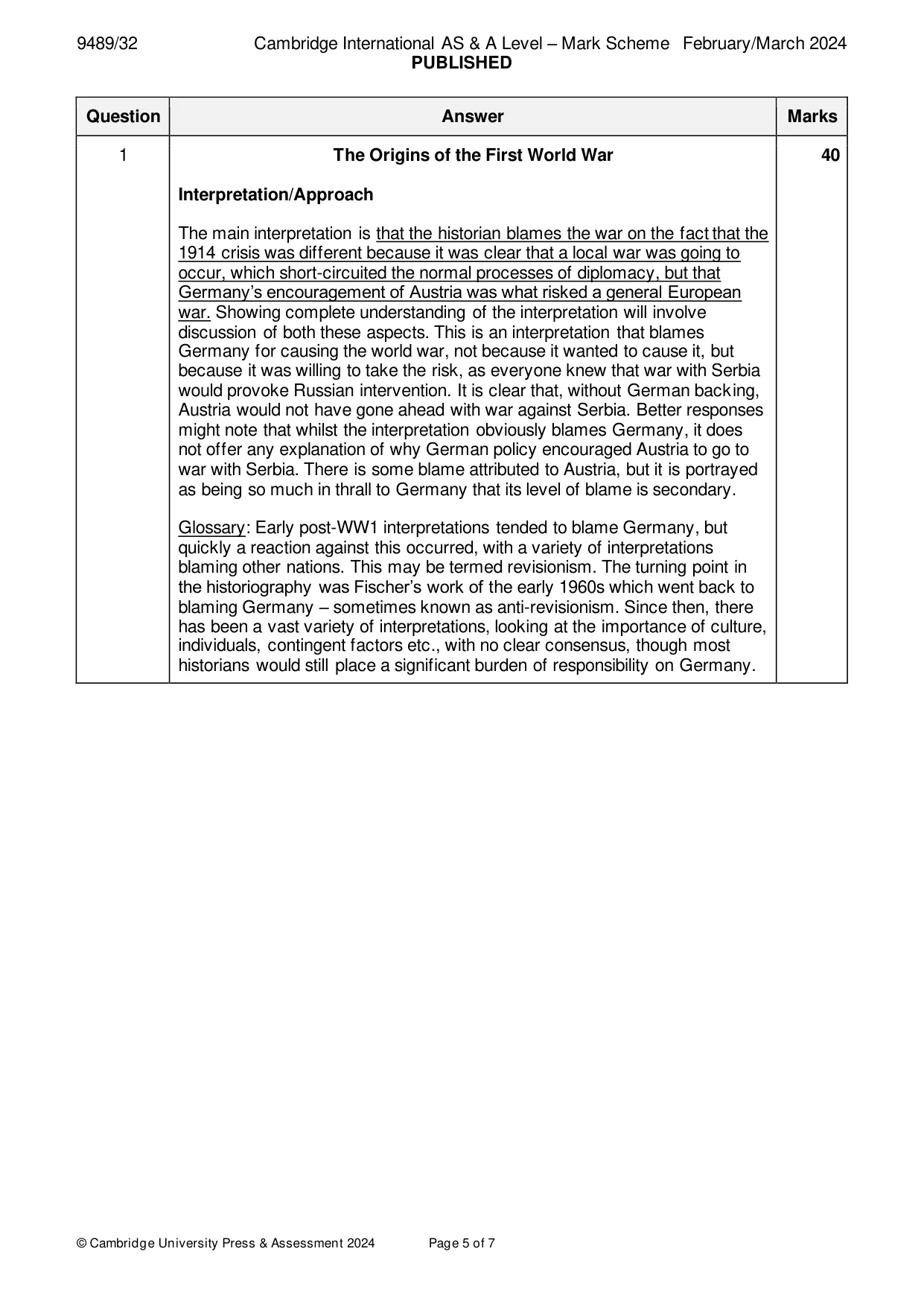
Mark scheme: Question Answer Marks 1 The Origins of the First World War 40 Interpretation/Approach The main interpretation is that the historian blames the war on the fact that the 1914 crisis was different because it was clear that a local war was going to occur, which short-circuited the normal processes of diplomacy, but that Germany’s encouragement of Austria was what risked a general European war. Showing complete understanding of the interpretation will involve discussion of both these aspects. This is an interpretation that blames Germany for causing the world war, not because it wanted to cause it, but because it was willing to take the risk, as everyone knew that war with Serbia would provoke Russian intervention. It is clear that, without German backing, Austria would not have gone ahead with war against Serbia. Better responses might note that whilst the interpretation obviously blames Germany, it does not offer any explanation of why German policy encouraged Austria to go to war with Serbia. There is some blame attributed to Austria, but it is portrayed as being so much in thrall to Germany that its level of blame is secondary. Glossary: Early post-WW1 interpretations tended to blame Germany, but quickly a reaction against this occurred, with a variety of interpretations blaming other nations. This may be termed revisionism. The turning point in the historiography was Fischer’s work of the early 1960s which went back to blaming Germany – sometimes known as anti-revisionism. Since then, there has been a vast variety of interpretations, looking at the importance of culture, individuals, contingent factors etc., with no clear consensus, though most historians would still place a significant burden of responsibility on Germany.
Q2 · Read the extract and then answer the question
2 Read the extract and then answer the question. What can we conclude from the evidence contained in Hitler’s speeches? It would appear that Hitler did not openly state his intention to exterminate the Jews until 1936, and given his tendency for the over-dramatic, even his comments at that time might be interpreted as merely what he wished for rather than as a concrete plan. But his speech to Nazi Party district leaders in April 1937 also indicates that he was considering a ‘fateful blow’ to the Jews, and one speech in 1938 clearly implies that the Jews were under direct physical threat. Hitler’s speech to the Reichstag in January 1939 is very important but hard to interpret because it depends on what meanings translators give to his words. It is variously translated that world war would mean ‘the end’, ‘destruction’, or ‘annihilation’ of the Jews in Europe. Hitler deliberately chose a word (die Vernichtung) with ambiguous meaning because he wanted to frighten the Jews of foreign countries so that they would not encourage their governments to wage war against Germany. On the other hand, he could not directly state that he wanted to exterminate European Jewry because he wanted to preserve domestic unity in the forthcoming war. The German public had shown after Kristallnacht that they did not approve of violence against the Jews, and his choice of an ambiguous word was probably the result of his uncertainty about public support for extermination. It would hardly be necessary even to refer to Hitler’s own words were it not for some misguided writers who question that Hitler was the prime mover behind the Holocaust. Although Hitler was a deliberate liar, his wartime speeches confirm his boast that he decided on the extermination of European Jewry. Hitler wanted to rid Europe of the Jews, and this was clearly his objective in 1924 as stated in Mein Kampf. But the possibility of exterminating them might just have stayed at the back of Hitler’s mind during the years when he was strengthening the Party and fighting for power. However, with his appointment as Chancellor in 1933, he may have decided that the elimination of Jews from Europe was a real possibility, rather than a dream that could never be realised. He soon discovered, though, that he could not act without taking domestic and foreign opinion into account. He therefore had to confine his attacks on Jews to a much slower timetable than he would have hoped. He clearly thought that they were the greatest menace in the world, and the sooner they were eliminated, the better. But he was willing to take his time. Above all, his coming to power meant that Hitler could plan for mass murder under the cover of a war, which he knew was certain to come. He never lost sight of his ambitions in the east, and these could only be fulfilled through a gigantic war with Russia. He knew when he took power in 1933 that both the conquest of Russia and the destruction of German Jewry were within reach if only he could adequately strengthen Germany’s military machine. Therefore, Hitler’s decision to eradicate European Jews could have been made any time between 1924 and 1936. Even if one accepts the theory that Hitler was only posing as a man of extreme ruthlessness in 1936, and that his statements in 1937 and 1938 are inconclusive, then one might conclude that he made the mental decision only in 1939. But to overlook the evidence in his speeches and conversations and conclude that he made the decision later than 1939 would be clearly misguided. What can you learn from this extract about the interpretation and approach of the historian who wrote it? Use the extract and your knowledge of the Holocaust to explain your answer. [40] Section C: Topic 3 The origins and development of the Cold War
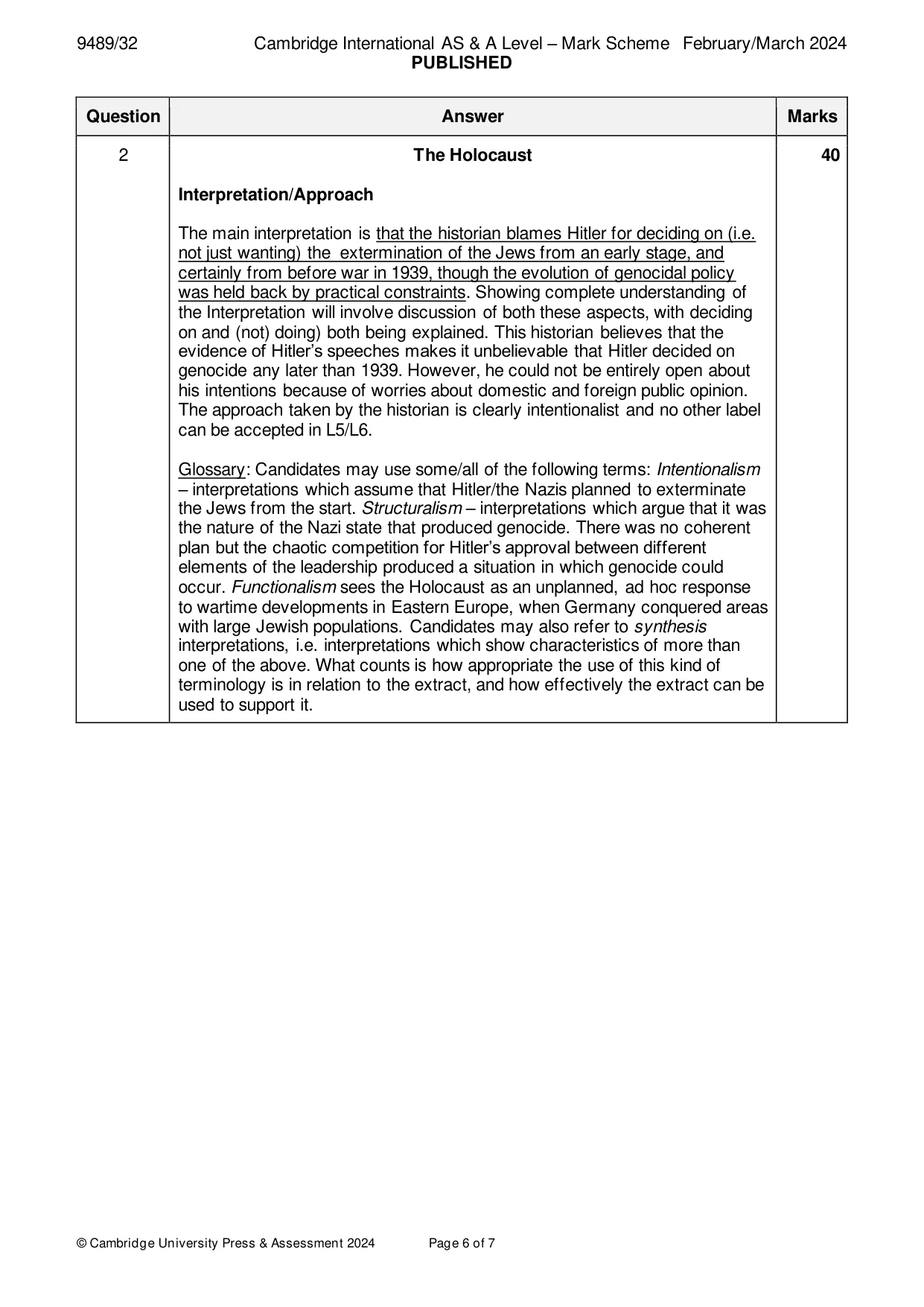
Mark scheme: 2 The Holocaust 40 Interpretation/Approach The main interpretation is that the historian blames Hitler for deciding on (i.e. not just wanting) the extermination of the Jews from an early stage, and certainly from before war in 1939, though the evolution of genocidal policy was held back by practical constraints. Showing complete understanding of the Interpretation will involve discussion of both these aspects, with deciding on and (not) doing) both being explained. This historian believes that the evidence of Hitler’s speeches makes it unbelievable that Hitler decided on genocide any later than 1939. However, he could not be entirely open about his intentions because of worries about domestic and foreign public opinion. The approach taken by the historian is clearly intentionalist and no other label can be accepted in L5/L6. Glossary: Candidates may use some/all of the following terms: Intentionalism – interpretations which assume that Hitler/the Nazis planned to exterminate the Jews from the start. Structuralism – interpretations which argue that it was the nature of the Nazi state that produced genocide. There was no coherent plan but the chaotic competition for Hitler’s approval between different elements of the leadership produced a situation in which genocide could occur. Functionalism sees the Holocaust as an unplanned, ad hoc response to wartime developments in Eastern Europe, when Germany conquered areas with large Jewish populations. Candidates may also refer to synthesis interpretations, i.e. interpretations which show characteristics of more than one of the above. What counts is how appropriate the use of this kind of terminology is in relation to the extract, and how effectively the extract can be used to support it.
Q3 · Read the extract and then answer the question
3 Read the extract and then answer the question. The eighteen months following the Potsdam Conference are crucial to an understanding of the later development of the Cold War. During 1945–46 the American national mood was almost isolationist. US armed forces were swiftly demobilised, and American foreign policy officially was based on cooperation with the Soviet Union. On the other hand, the Soviet leaders saw their military strength as an unprecedented opportunity for the establishment of communist regimes in a number of former capitalist countries. The power of the Red Army, combined with the total economic, social and political disintegration of most of Europe, had produced a situation of historic advantage for the communists. The Marxist-Leninist belief that the bourgeois world-system would collapse after a series of frightful conflicts had apparently been justified. There can be little doubt that Stalin saw the immediate post-war situation as a moment of destiny for the Soviet leadership. It was conceivable that their power might be advanced as far as the Atlantic. An ideological warning was sounded when in November 1945 Molotov announced that, ‘As long as the roots of fascism and imperialist aggression have not finally been destroyed, our vigilance in regard to possible new breaches of peace will not weaken.’ And, as if preparing the faithful for the very worst outcome, Stalin, three months later, referred to the possibility of a war between capitalism and communism. Thus, between 1945 and 1948 nearly all the territories under Soviet military occupation were brought under Moscow’s political control. In Czechoslovakia the coup was postponed until 1948, but in Poland, Bulgaria, Romania and Hungary coalition governments eventually succumbed to violence, intimidation and rigged elections, to become communist-controlled states and, before long, fully fledged ‘people’s democracies’. As Stalin said in April 1945, ‘Whoever occupies a territory also imposes on it his own social system. It cannot be otherwise.’ But Stalin’s ambitions did not only involve territories under Red Army occupation. There was an active attempt to extend Soviet control beyond this zone. In June 1945 Moscow suggested joint control of the Straits to the Turkish government – a proposal which would have put a Soviet garrison on the Dardanelles. At the same time Turkey was asked to return to Russia frontier districts it had gained in 1921. These pressures continued until 1946. Across the border in Persia during November 1945 a communist ‘democratic’ regime was formed in Azerbaijan and in March 1946 a shadowy ‘Kurdish Republic’ was also proclaimed. Only after the most intense Anglo-American diplomatic pressure did Soviet troops withdraw from these regions. As Churchill rightly saw, it was Germany that lay at the centre of the developing conflict. The Russians had broken the Potsdam agreements and had sealed off their zone, economically as well as politically. The West was thus both supplying reparations to the Soviet Union from their zones while still pouring in money in an attempt to set up a stable German economy. Such a state of affairs was clearly ridiculous. In May 1946 reparations were suspended from the American zone, and then in July the West agreed on a complete economic unification of their zones; Bizonia came into operation in January 1947. Yet the great crisis which committed the United States to a new global balance of power did not arise over Germany. In February 1947, as Britain faced economic disaster, the Attlee government told Washington that it could not continue military assistance to Greece and Turkey. Unless the United States acted, the collapse of European democracy seemed imminent. What can you learn from this extract about the interpretation and approach of the historian who wrote it? Use the extract and your knowledge of the Cold War to explain your answer. [40]
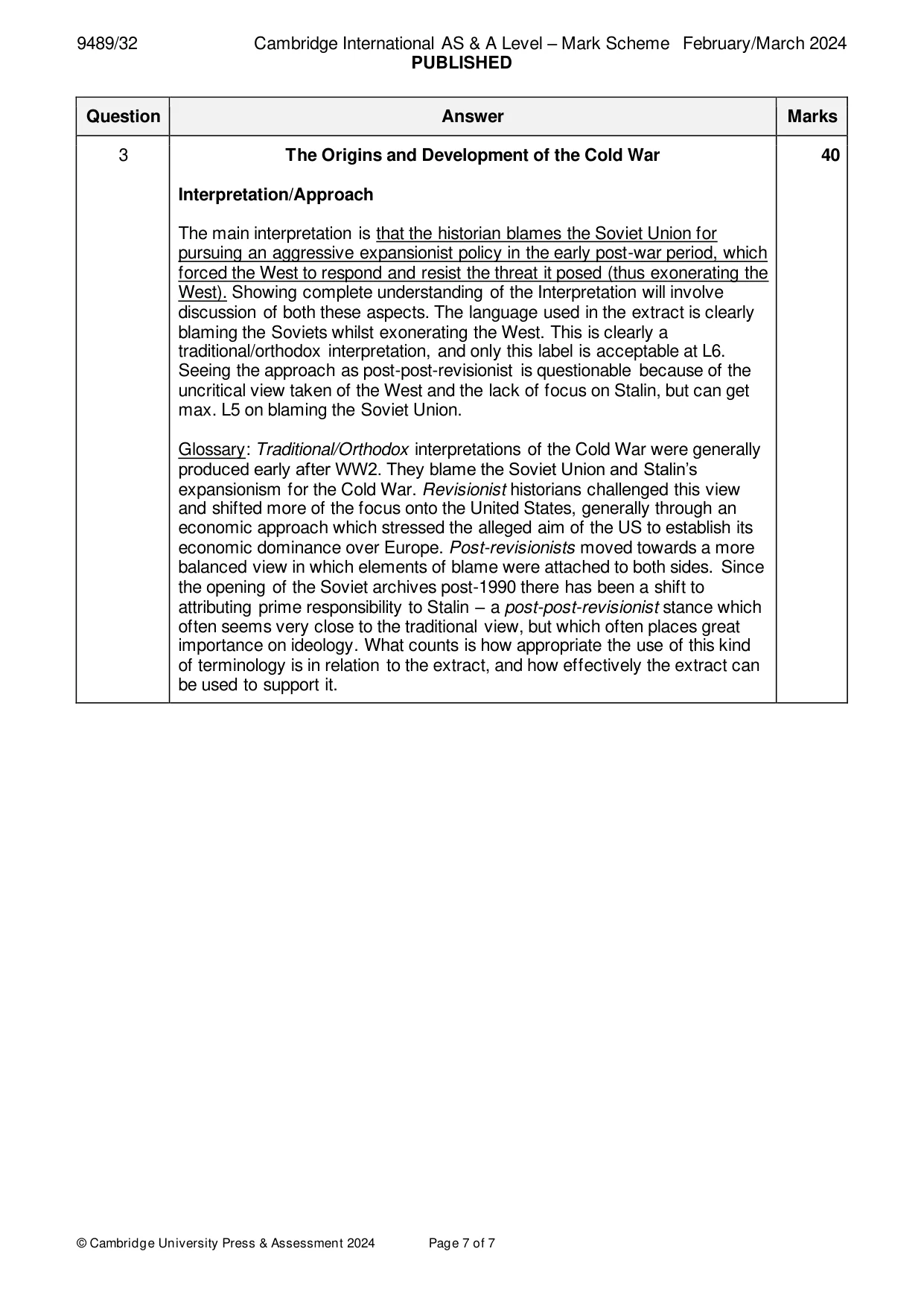
Mark scheme: 3 The Origins and Development of the Cold War 40 Interpretation/Approach The main interpretation is that the historian blames the Soviet Union for pursuing an aggressive expansionist policy in the early post-war period, which forced the West to respond and resist the threat it posed (thus exonerating the West). Showing complete understanding of the Interpretation will involve discussion of both these aspects. The language used in the extract is clearly blaming the Soviets whilst exonerating the West. This is clearly a traditional/orthodox interpretation, and only this label is acceptable at L6. Seeing the approach as post-post-revisionist is questionable because of the uncritical view taken of the West and the lack of focus on Stalin, but can get max. L5 on blaming the Soviet Union. Glossary: Traditional/Orthodox interpretations of the Cold War were generally produced early after WW2. They blame the Soviet Union and Stalin’s expansionism for the Cold War. Revisionist historians challenged this view and shifted more of the focus onto the United States, generally through an economic approach which stressed the alleged aim of the US to establish its economic dominance over Europe. Post-revisionists moved towards a more balanced view in which elements of blame were attached to both sides. Since the opening of the Soviet archives post-1990 there has been a shift to attributing prime responsibility to Stalin – a post-post-revisionist stance which often seems very close to the traditional view, but which often places great importance on ideology. What counts is how appropriate the use of this kind of terminology is in relation to the extract, and how effectively the extract can be used to support it.
What was in this paper
The subtopics covered by these 3 questions, and how many questions each got. Open one in a new tab to see every Cambridge question on it.
What you needed in this session
Cambridge’s own grade thresholds for 2024 Feb/March, Paper 3 · Variant 2. A higher threshold means an easier paper — the bar moves with how the cohort did.