Cambridge A Level History 9489 — 2021 May/June Paper 3 · Variant 3
9489/33/M/J/21 · 3 questions · 40 marks · ≈45 min
The question paper and its mark scheme, free to read here and free to download. This is Cambridge’s own paper, exactly as it was sat.
Question paper4 pages
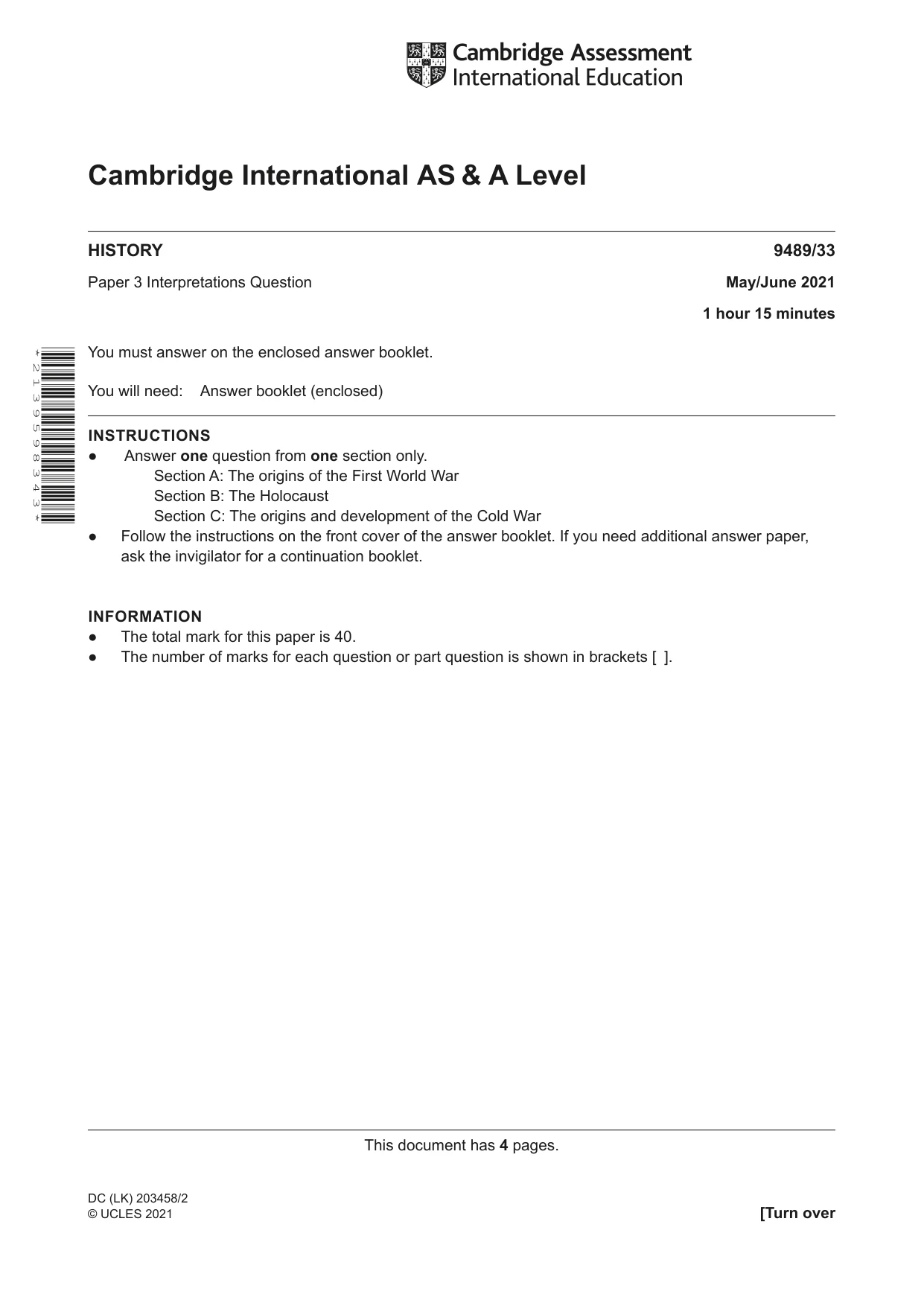
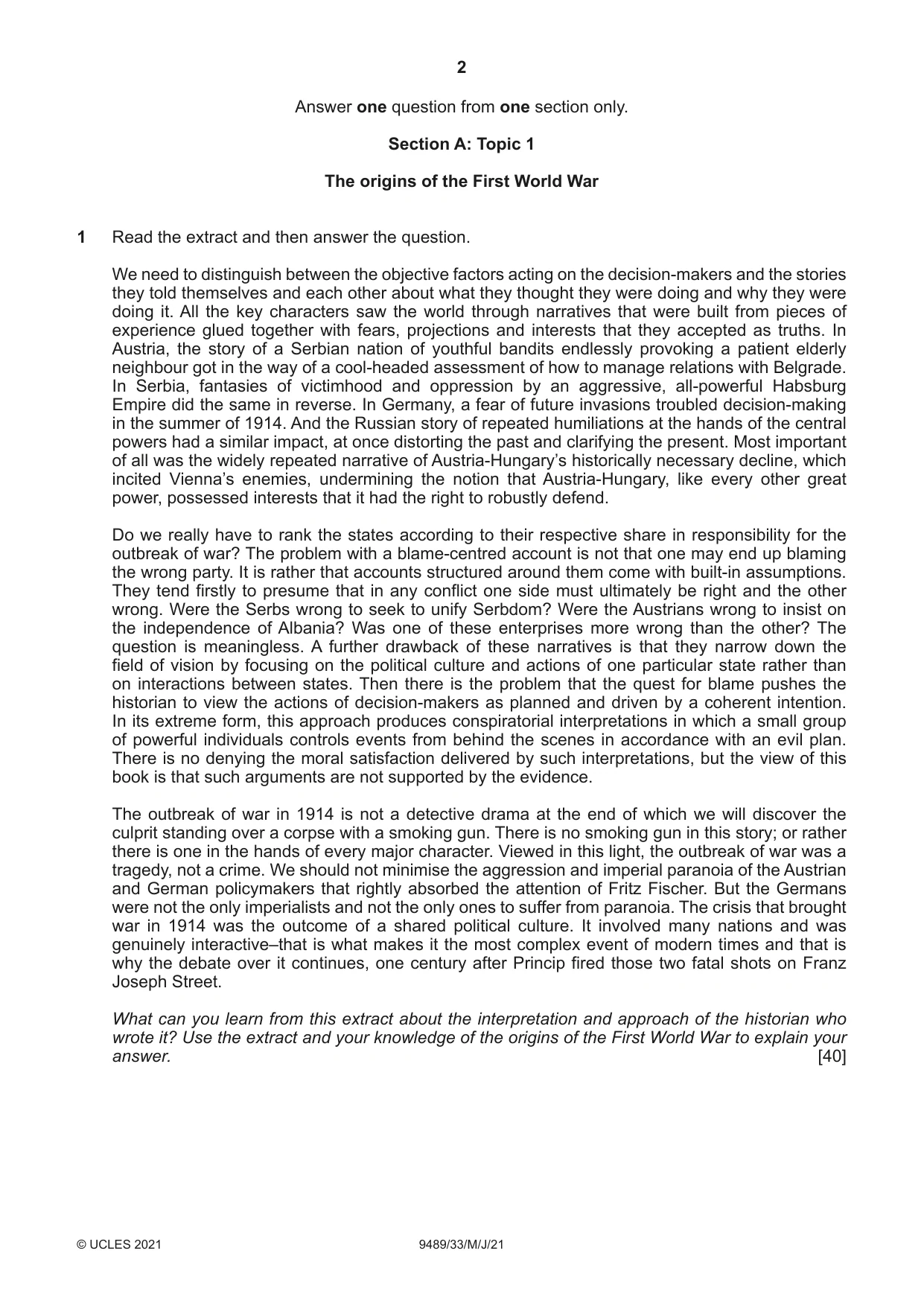
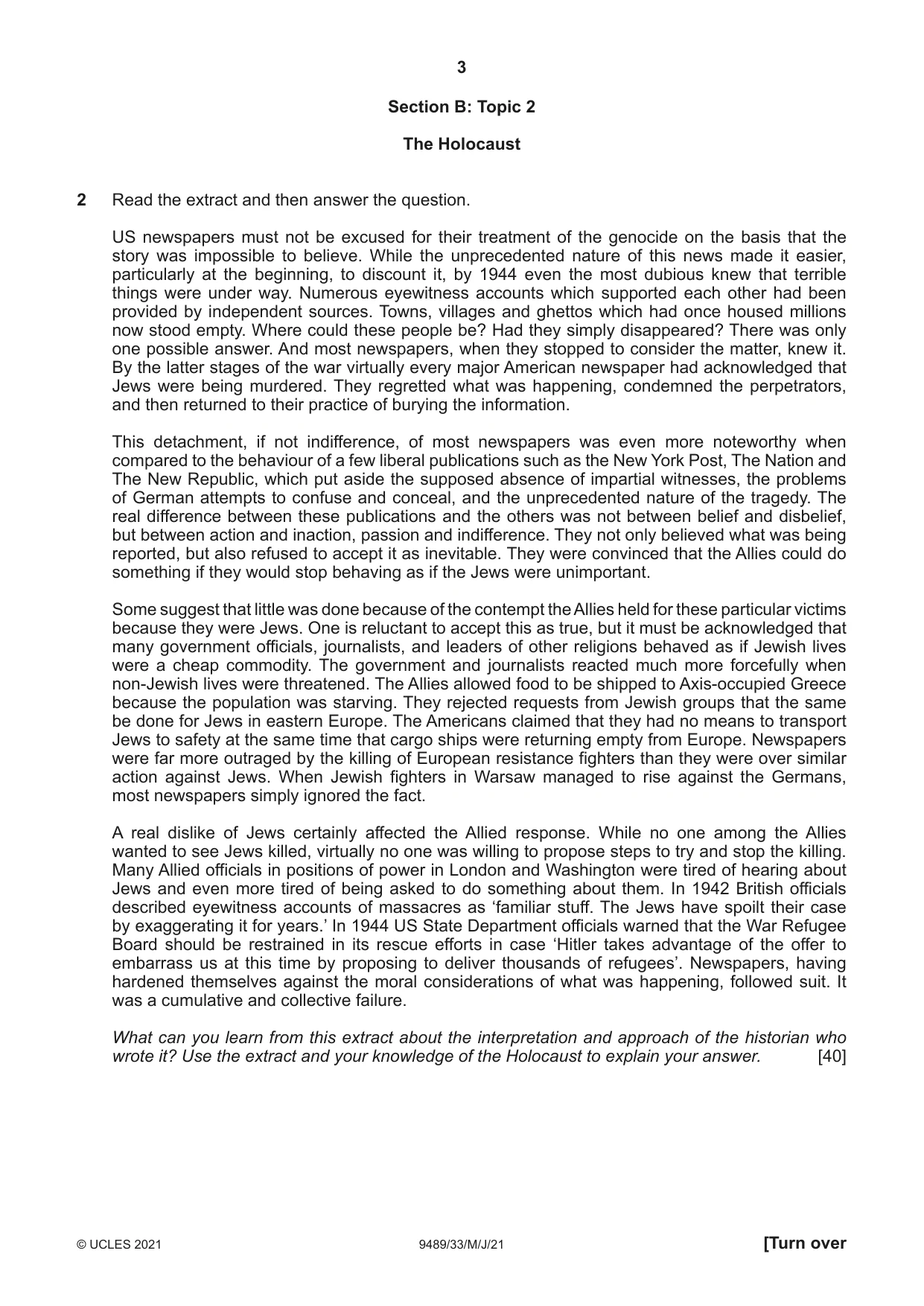
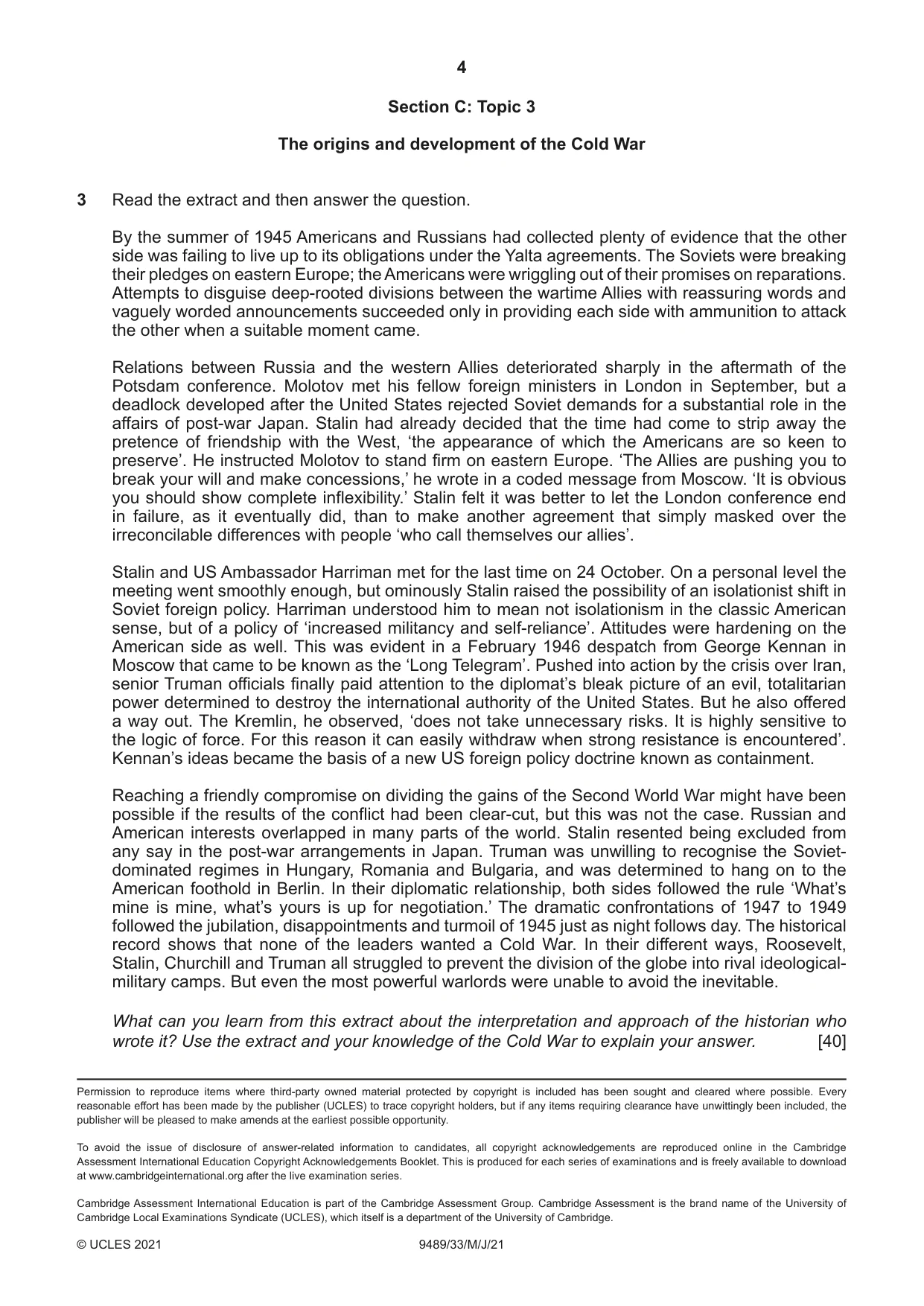
Mark scheme7 pages
Answers below. Sit the paper first if you are practising.
Questions as text
Q1 · Read the extract and then answer the question
1 Read the extract and then answer the question. We need to distinguish between the objective factors acting on the decision-makers and the stories they told themselves and each other about what they thought they were doing and why they were doing it. All the key characters saw the world through narratives that were built from pieces of experience glued together with fears, projections and interests that they accepted as truths. In Austria, the story of a Serbian nation of youthful bandits endlessly provoking a patient elderly neighbour got in the way of a cool-headed assessment of how to manage relations with Belgrade. In Serbia, fantasies of victimhood and oppression by an aggressive, all-powerful Habsburg Empire did the same in reverse. In Germany, a fear of future invasions troubled decision-making in the summer of 1914. And the Russian story of repeated humiliations at the hands of the central powers had a similar impact, at once distorting the past and clarifying the present. Most important of all was the widely repeated narrative of Austria-Hungary’s historically necessary decline, which incited Vienna’s enemies, undermining the notion that Austria-Hungary, like every other great power, possessed interests that it had the right to robustly defend. Do we really have to rank the states according to their respective share in responsibility for the outbreak of war? The problem with a blame-centred account is not that one may end up blaming the wrong party. It is rather that accounts structured around them come with built-in assumptions. They tend firstly to presume that in any conflict one side must ultimately be right and the other wrong. Were the Serbs wrong to seek to unify Serbdom? Were the Austrians wrong to insist on the independence of Albania? Was one of these enterprises more wrong than the other? The question is meaningless. A further drawback of these narratives is that they narrow down the field of vision by focusing on the political culture and actions of one particular state rather than on interactions between states. Then there is the problem that the quest for blame pushes the historian to view the actions of decision-makers as planned and driven by a coherent intention. In its extreme form, this approach produces conspiratorial interpretations in which a small group of powerful individuals controls events from behind the scenes in accordance with an evil plan. There is no denying the moral satisfaction delivered by such interpretations, but the view of this book is that such arguments are not supported by the evidence. The outbreak of war in 1914 is not a detective drama at the end of which we will discover the culprit standing over a corpse with a smoking gun. There is no smoking gun in this story; or rather there is one in the hands of every major character. Viewed in this light, the outbreak of war was a tragedy, not a crime. We should not minimise the aggression and imperial paranoia of the Austrian and German policymakers that rightly absorbed the attention of Fritz Fischer. But the Germans were not the only imperialists and not the only ones to suffer from paranoia. The crisis that brought war in 1914 was the outcome of a shared political culture. It involved many nations and was genuinely interactive–that is what makes it the most complex event of modern times and that is why the debate over it continues, one century after Princip fired those two fatal shots on Franz Joseph Street. What can you learn from this extract about the interpretation and approach of the historian who wrote it? Use the extract and your knowledge of the origins of the First World War to explain your answer. [40]
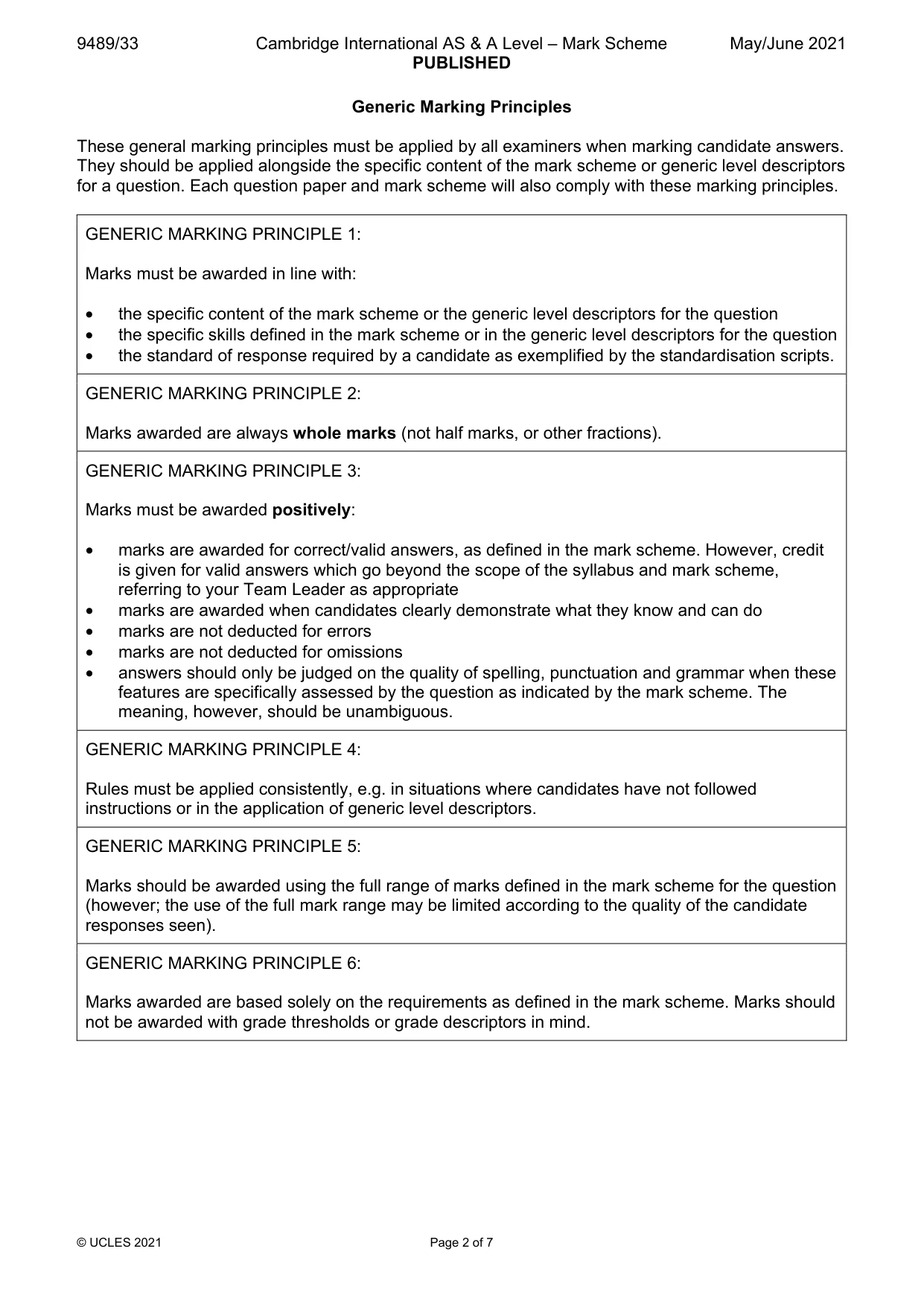
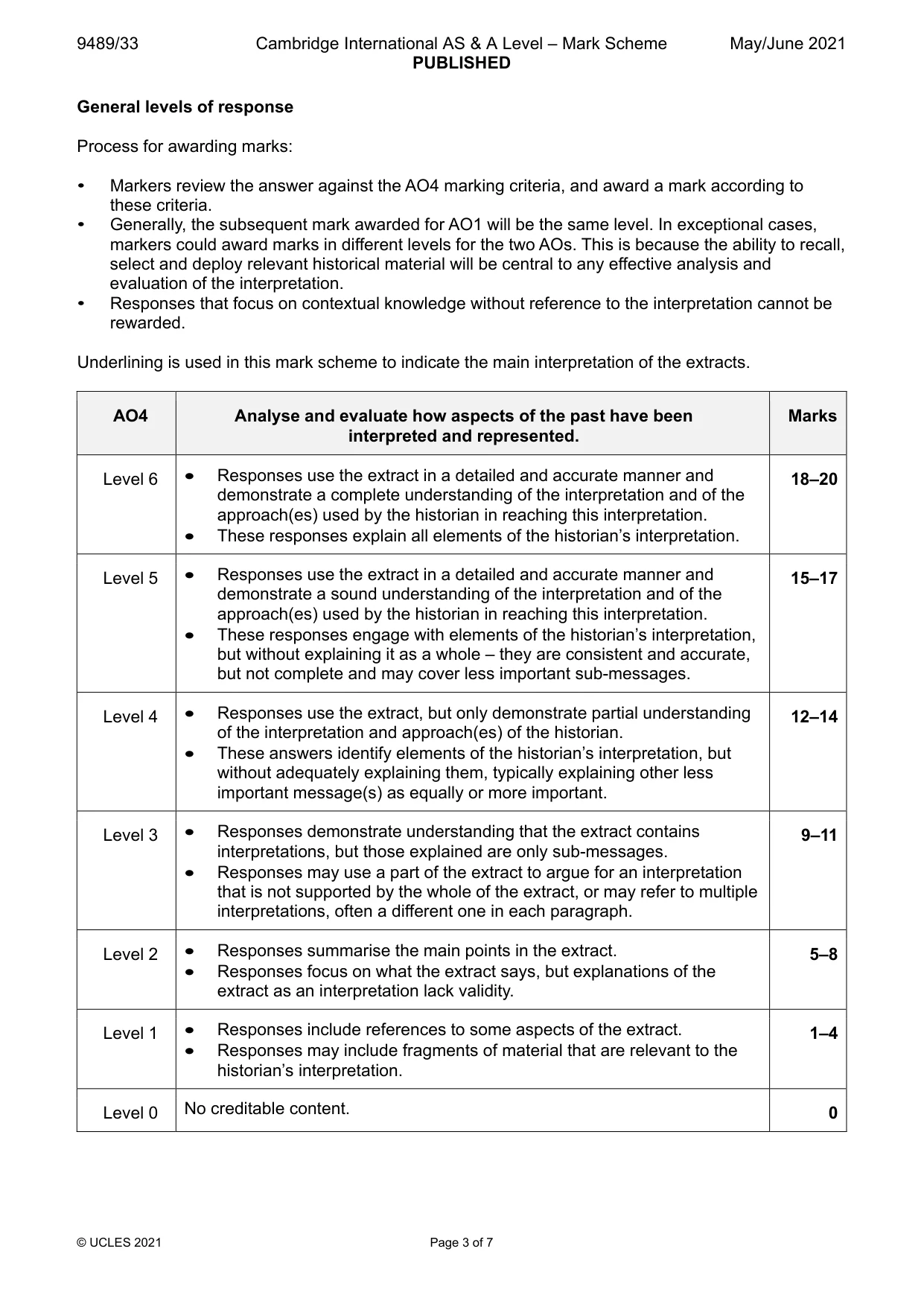
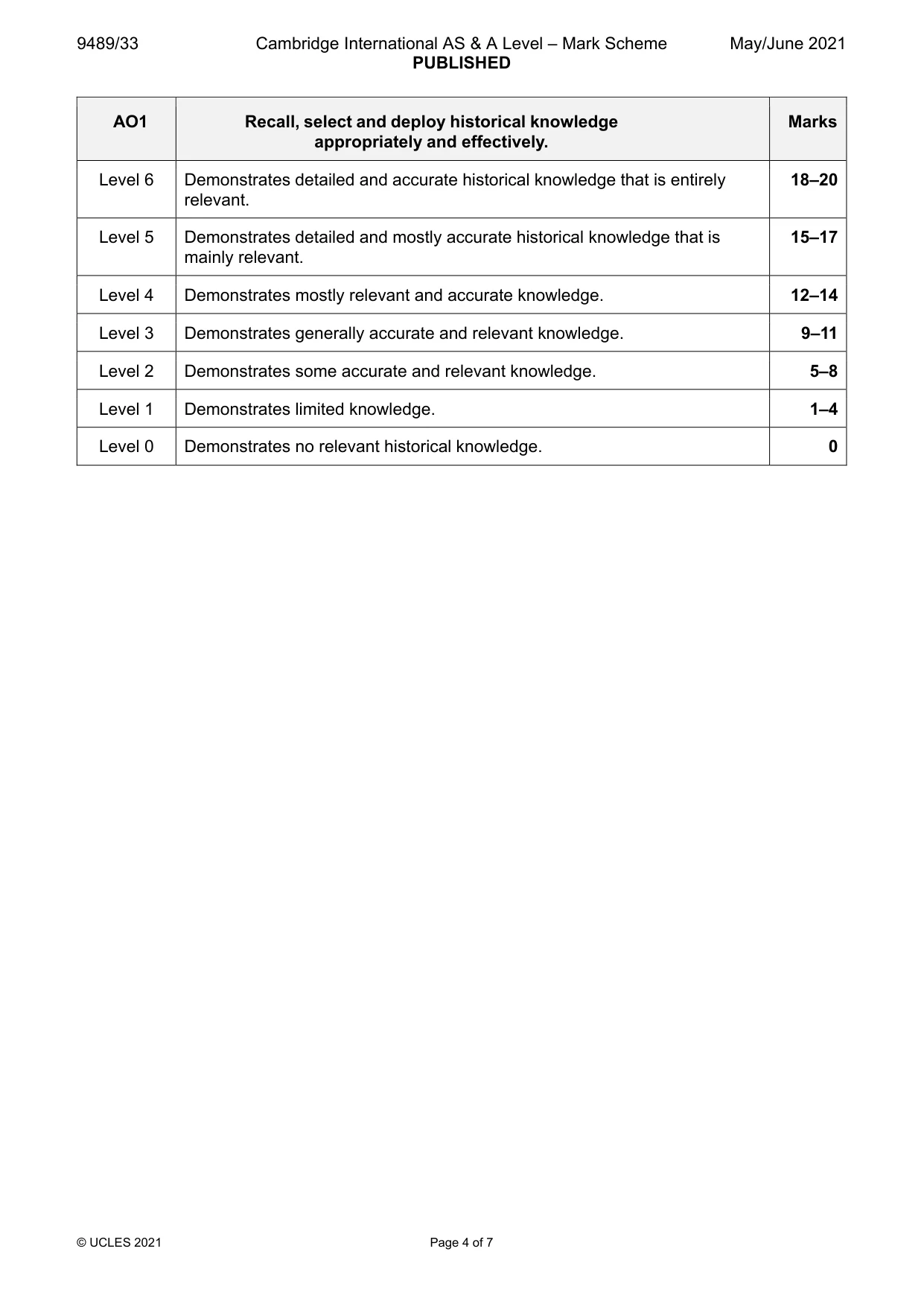
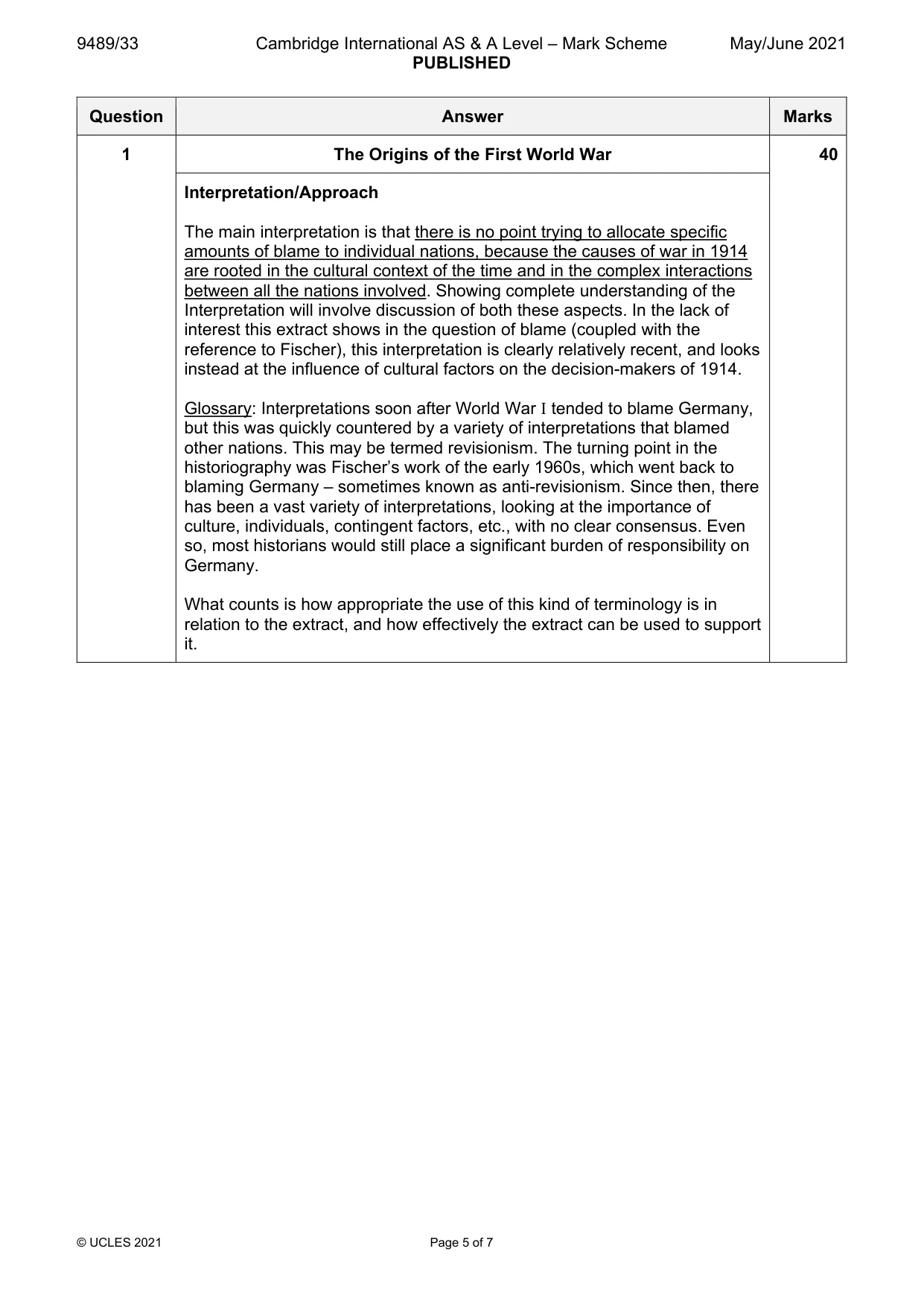
Mark scheme: Question Answer Marks 1 The Origins of the First World War 40 Interpretation/Approach The main interpretation is that there is no point trying to allocate specific amounts of blame to individual nations, because the causes of war in 1914 are rooted in the cultural context of the time and in the complex interactions between all the nations involved. Showing complete understanding of the Interpretation will involve discussion of both these aspects. In the lack of interest this extract shows in the question of blame (coupled with the reference to Fischer), this interpretation is clearly relatively recent, and looks instead at the influence of cultural factors on the decision-makers of 1914. Glossary: Interpretations soon after World War Ⅰ tended to blame Germany, but this was quickly countered by a variety of interpretations that blamed other nations. This may be termed revisionism. The turning point in the historiography was Fischer’s work of the early 1960s, which went back to blaming Germany – sometimes known as anti-revisionism. Since then, there has been a vast variety of interpretations, looking at the importance of culture, individuals, contingent factors, etc., with no clear consensus. Even so, most historians would still place a significant burden of responsibility on Germany. What counts is how appropriate the use of this kind of terminology is in relation to the extract, and how effectively the extract can be used to support it.
Q2 · Read the extract and then answer the question
2 Read the extract and then answer the question. US newspapers must not be excused for their treatment of the genocide on the basis that the story was impossible to believe. While the unprecedented nature of this news made it easier, particularly at the beginning, to discount it, by 1944 even the most dubious knew that terrible things were under way. Numerous eyewitness accounts which supported each other had been provided by independent sources. Towns, villages and ghettos which had once housed millions now stood empty. Where could these people be? Had they simply disappeared? There was only one possible answer. And most newspapers, when they stopped to consider the matter, knew it. By the latter stages of the war virtually every major American newspaper had acknowledged that Jews were being murdered. They regretted what was happening, condemned the perpetrators, and then returned to their practice of burying the information. This detachment, if not indifference, of most newspapers was even more noteworthy when compared to the behaviour of a few liberal publications such as the New York Post, The Nation and The New Republic, which put aside the supposed absence of impartial witnesses, the problems of German attempts to confuse and conceal, and the unprecedented nature of the tragedy. The real difference between these publications and the others was not between belief and disbelief, but between action and inaction, passion and indifference. They not only believed what was being reported, but also refused to accept it as inevitable. They were convinced that the Allies could do something if they would stop behaving as if the Jews were unimportant. Some suggest that little was done because of the contempt the Allies held for these particular victims because they were Jews. One is reluctant to accept this as true, but it must be acknowledged that many government officials, journalists, and leaders of other religions behaved as if Jewish lives were a cheap commodity. The government and journalists reacted much more forcefully when non-Jewish lives were threatened. The Allies allowed food to be shipped to Axis-occupied Greece because the population was starving. They rejected requests from Jewish groups that the same be done for Jews in eastern Europe. The Americans claimed that they had no means to transport Jews to safety at the same time that cargo ships were returning empty from Europe. Newspapers were far more outraged by the killing of European resistance fighters than they were over similar action against Jews. When Jewish fighters in Warsaw managed to rise against the Germans, most newspapers simply ignored the fact. A real dislike of Jews certainly affected the Allied response. While no one among the Allies wanted to see Jews killed, virtually no one was willing to propose steps to try and stop the killing. Many Allied officials in positions of power in London and Washington were tired of hearing about Jews and even more tired of being asked to do something about them. In 1942 British officials described eyewitness accounts of massacres as ‘familiar stuff. The Jews have spoilt their case by exaggerating it for years.’ In 1944 US State Department officials warned that the War Refugee Board should be restrained in its rescue efforts in case ‘Hitler takes advantage of the offer to embarrass us at this time by proposing to deliver thousands of refugees’. Newspapers, having hardened themselves against the moral considerations of what was happening, followed suit. It was a cumulative and collective failure. What can you learn from this extract about the interpretation and approach of the historian who wrote it? Use the extract and your knowledge of the Holocaust to explain your answer. [40] Section C: Topic 3 The origins and development of the Cold War
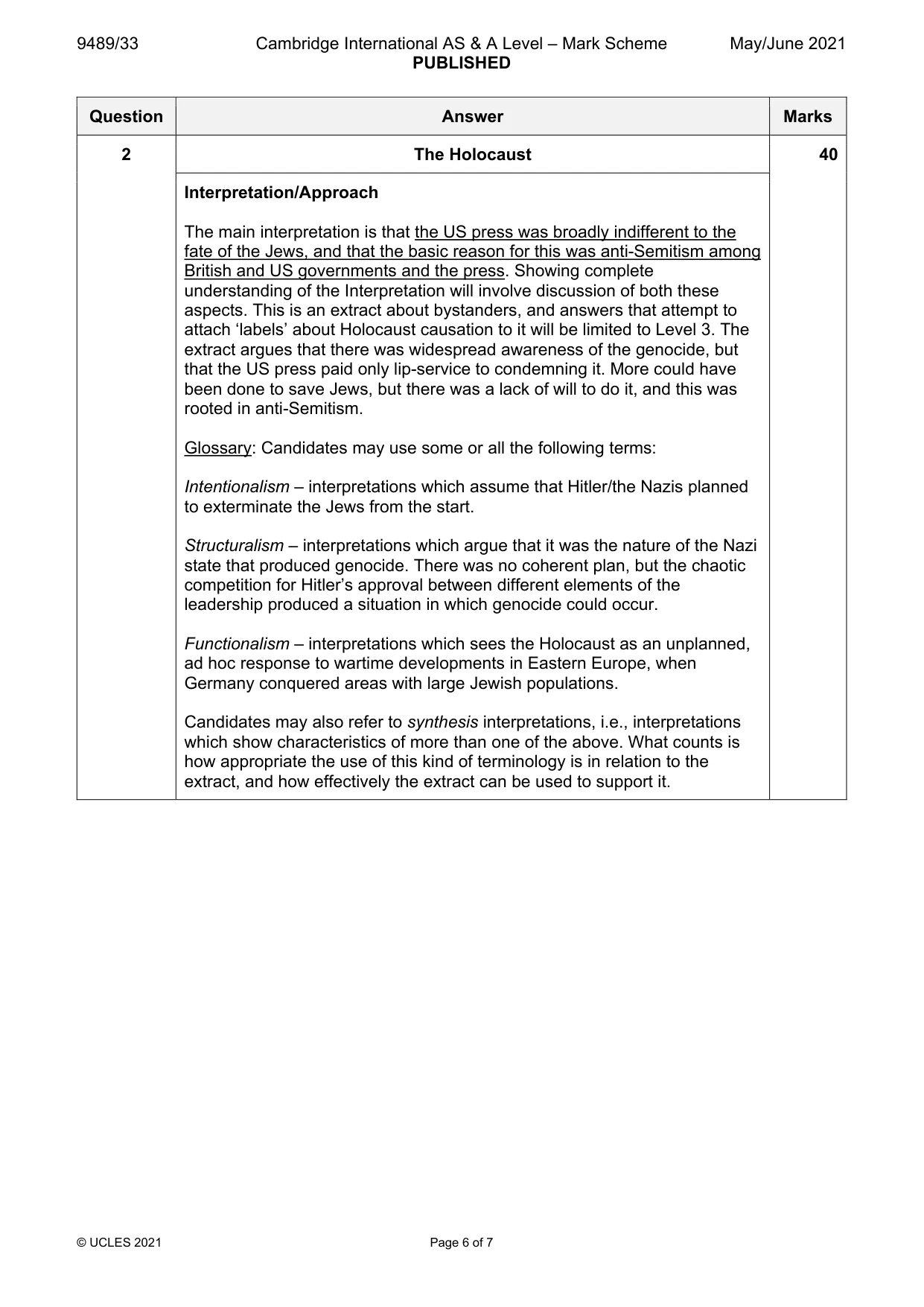
Mark scheme: 2 The Holocaust 40 Interpretation/Approach The main interpretation is that the US press was broadly indifferent to the fate of the Jews, and that the basic reason for this was anti-Semitism among British and US governments and the press. Showing complete understanding of the Interpretation will involve discussion of both these aspects. This is an extract about bystanders, and answers that attempt to attach ‘labels’ about Holocaust causation to it will be limited to Level 3. The extract argues that there was widespread awareness of the genocide, but that the US press paid only lip-service to condemning it. More could have been done to save Jews, but there was a lack of will to do it, and this was rooted in anti-Semitism. Glossary: Candidates may use some or all the following terms: Intentionalism – interpretations which assume that Hitler/the Nazis planned to exterminate the Jews from the start. Structuralism – interpretations which argue that it was the nature of the Nazi state that produced genocide. There was no coherent plan, but the chaotic competition for Hitler’s approval between different elements of the leadership produced a situation in which genocide could occur. Functionalism – interpretations which sees the Holocaust as an unplanned, ad hoc response to wartime developments in Eastern Europe, when Germany conquered areas with large Jewish populations. Candidates may also refer to synthesis interpretations, i.e., interpretations which show characteristics of more than one of the above. What counts is how appropriate the use of this kind of terminology is in relation to the extract, and how effectively the extract can be used to support it.
Q3 · Read the extract and then answer the question
3 Read the extract and then answer the question. By the summer of 1945 Americans and Russians had collected plenty of evidence that the other side was failing to live up to its obligations under the Yalta agreements. The Soviets were breaking their pledges on eastern Europe; the Americans were wriggling out of their promises on reparations. Attempts to disguise deep-rooted divisions between the wartime Allies with reassuring words and vaguely worded announcements succeeded only in providing each side with ammunition to attack the other when a suitable moment came. Relations between Russia and the western Allies deteriorated sharply in the aftermath of the Potsdam conference. Molotov met his fellow foreign ministers in London in September, but a deadlock developed after the United States rejected Soviet demands for a substantial role in the affairs of post-war Japan. Stalin had already decided that the time had come to strip away the pretence of friendship with the West, ‘the appearance of which the Americans are so keen to preserve’. He instructed Molotov to stand firm on eastern Europe. ‘The Allies are pushing you to break your will and make concessions,’ he wrote in a coded message from Moscow. ‘It is obvious you should show complete inflexibility.’ Stalin felt it was better to let the London conference end in failure, as it eventually did, than to make another agreement that simply masked over the irreconcilable differences with people ‘who call themselves our allies’. Stalin and US Ambassador Harriman met for the last time on 24 October. On a personal level the meeting went smoothly enough, but ominously Stalin raised the possibility of an isolationist shift in Soviet foreign policy. Harriman understood him to mean not isolationism in the classic American sense, but of a policy of ‘increased militancy and self-reliance’. Attitudes were hardening on the American side as well. This was evident in a February 1946 despatch from George Kennan in Moscow that came to be known as the ‘Long Telegram’. Pushed into action by the crisis over Iran, senior Truman officials finally paid attention to the diplomat’s bleak picture of an evil, totalitarian power determined to destroy the international authority of the United States. But he also offered a way out. The Kremlin, he observed, ‘does not take unnecessary risks. It is highly sensitive to the logic of force. For this reason it can easily withdraw when strong resistance is encountered’. Kennan’s ideas became the basis of a new US foreign policy doctrine known as containment. Reaching a friendly compromise on dividing the gains of the Second World War might have been possible if the results of the conflict had been clear-cut, but this was not the case. Russian and American interests overlapped in many parts of the world. Stalin resented being excluded from any say in the post-war arrangements in Japan. Truman was unwilling to recognise the Soviet- dominated regimes in Hungary, Romania and Bulgaria, and was determined to hang on to the American foothold in Berlin. In their diplomatic relationship, both sides followed the rule ‘What’s mine is mine, what’s yours is up for negotiation.’ The dramatic confrontations of 1947 to 1949 followed the jubilation, disappointments and turmoil of 1945 just as night follows day. The historical record shows that none of the leaders wanted a Cold War. In their different ways, Roosevelt, Stalin, Churchill and Truman all struggled to prevent the division of the globe into rival ideological- military camps. But even the most powerful warlords were unable to avoid the inevitable. What can you learn from this extract about the interpretation and approach of the historian who wrote it? Use the extract and your knowledge of the Cold War to explain your answer. [40]
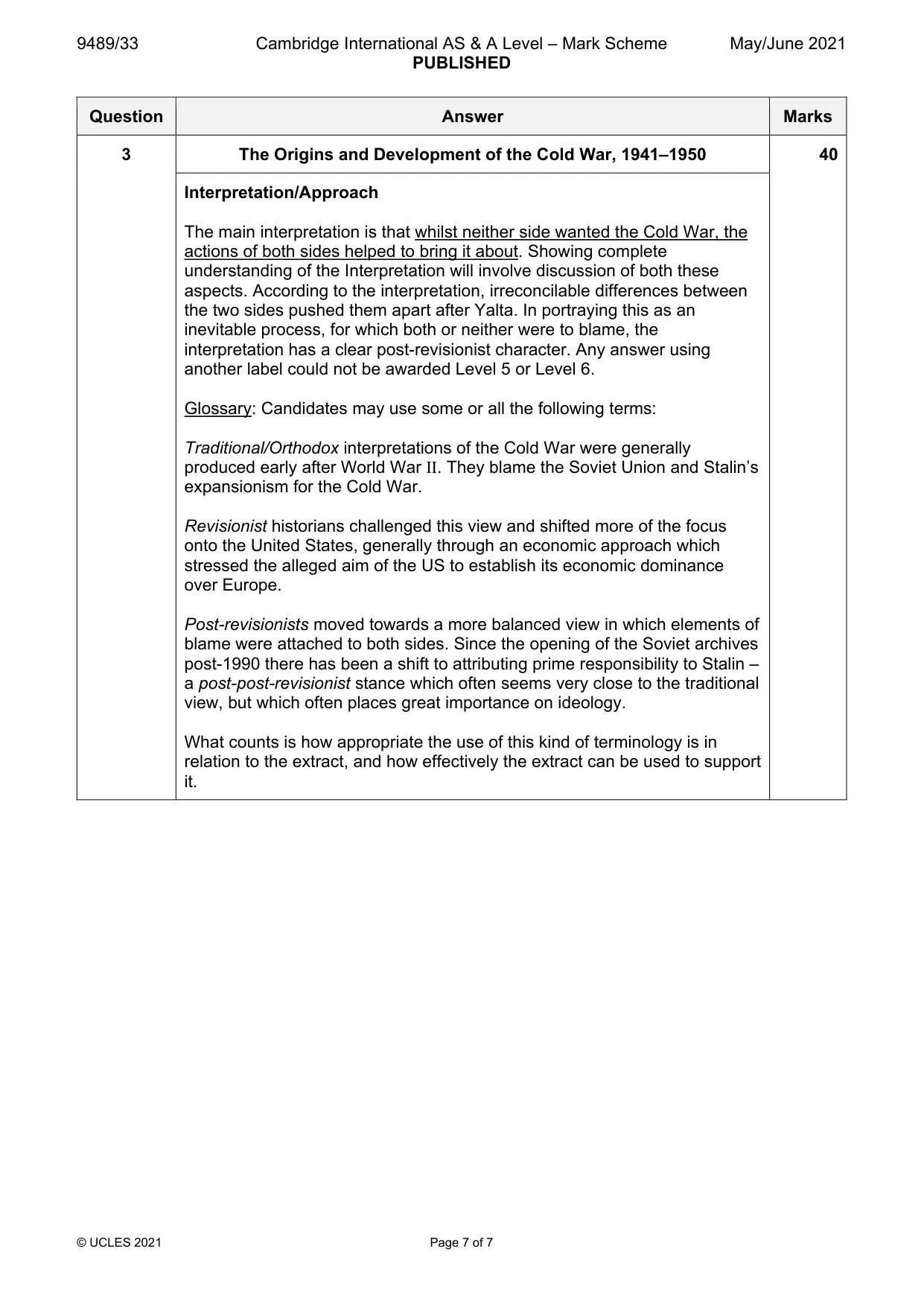
Mark scheme: 3 The Origins and Development of the Cold War, 1941–1950 40 Interpretation/Approach The main interpretation is that whilst neither side wanted the Cold War, the actions of both sides helped to bring it about. Showing complete understanding of the Interpretation will involve discussion of both these aspects. According to the interpretation, irreconcilable differences between the two sides pushed them apart after Yalta. In portraying this as an inevitable process, for which both or neither were to blame, the interpretation has a clear post-revisionist character. Any answer using another label could not be awarded Level 5 or Level 6. Glossary: Candidates may use some or all the following terms: Traditional/Orthodox interpretations of the Cold War were generally produced early after World War Ⅱ. They blame the Soviet Union and Stalin’s expansionism for the Cold War. Revisionist historians challenged this view and shifted more of the focus onto the United States, generally through an economic approach which stressed the alleged aim of the US to establish its economic dominance over Europe. Post-revisionists moved towards a more balanced view in which elements of blame were attached to both sides. Since the opening of the Soviet archives post-1990 there has been a shift to attributing prime responsibility to Stalin – a post-post-revisionist stance which often seems very close to the traditional view, but which often places great importance on ideology. What counts is how appropriate the use of this kind of terminology is in relation to the extract, and how effectively the extract can be used to support it.
What was in this paper
The subtopics covered by these 3 questions, and how many questions each got. Open one in a new tab to see every Cambridge question on it.
What you needed in this session
Cambridge’s own grade thresholds for 2021 May/June, Paper 3 · Variant 3. A higher threshold means an easier paper — the bar moves with how the cohort did.