Cambridge A Level History 9389 — 2021 Oct/Nov Paper 4 · Variant 1
9389/41/O/N/21 · 20 questions · 60 marks · ≈68 min
The question paper and its mark scheme, free to read here and free to download. This is Cambridge’s own paper, exactly as it was sat.
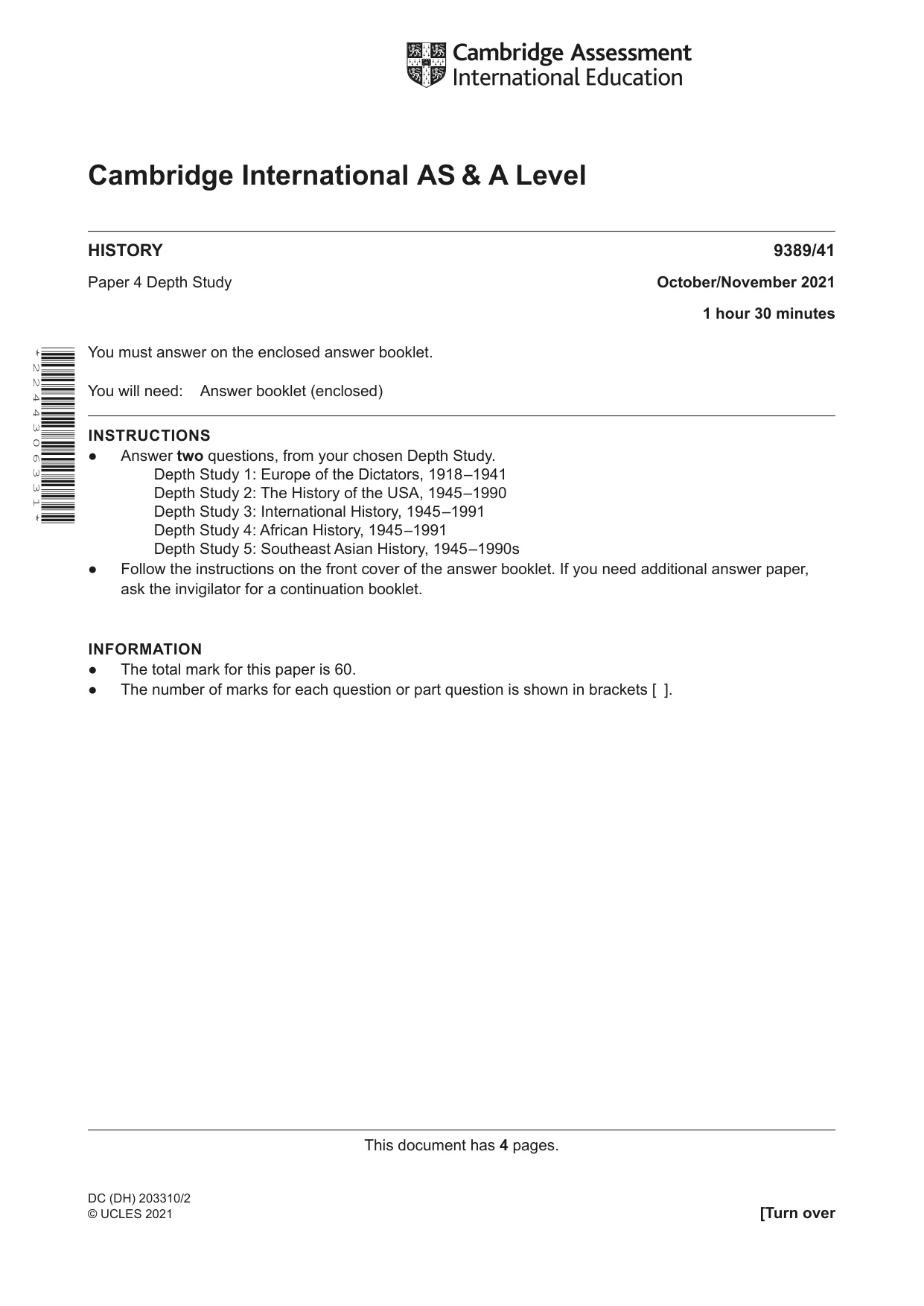
Question paper4 pages
Mark scheme24 pages
Answers below. Sit the paper first if you are practising.

Questions as text
Q1 · ‘Offering popular policies was the main reason for the Bolshevik retention of power…
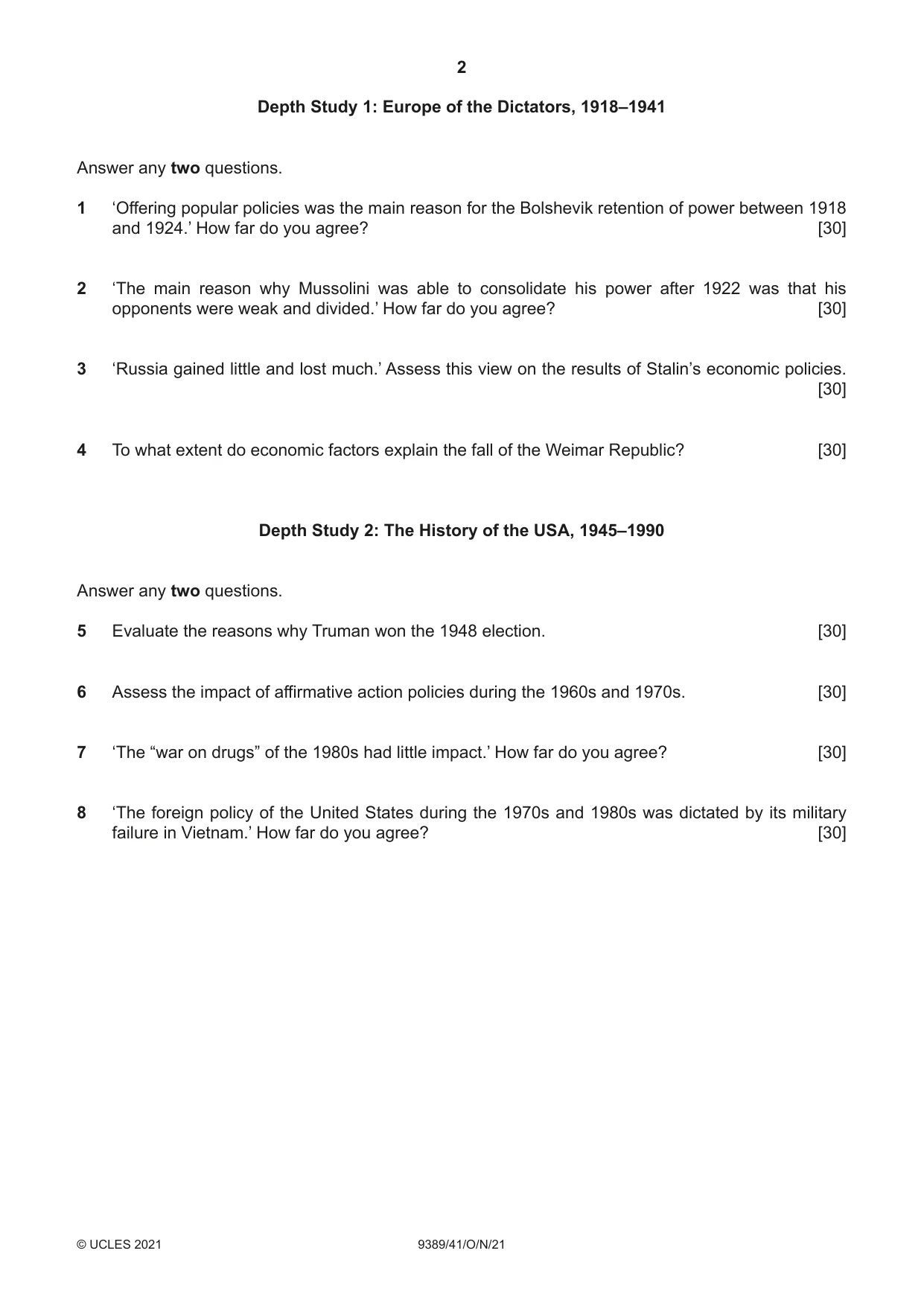
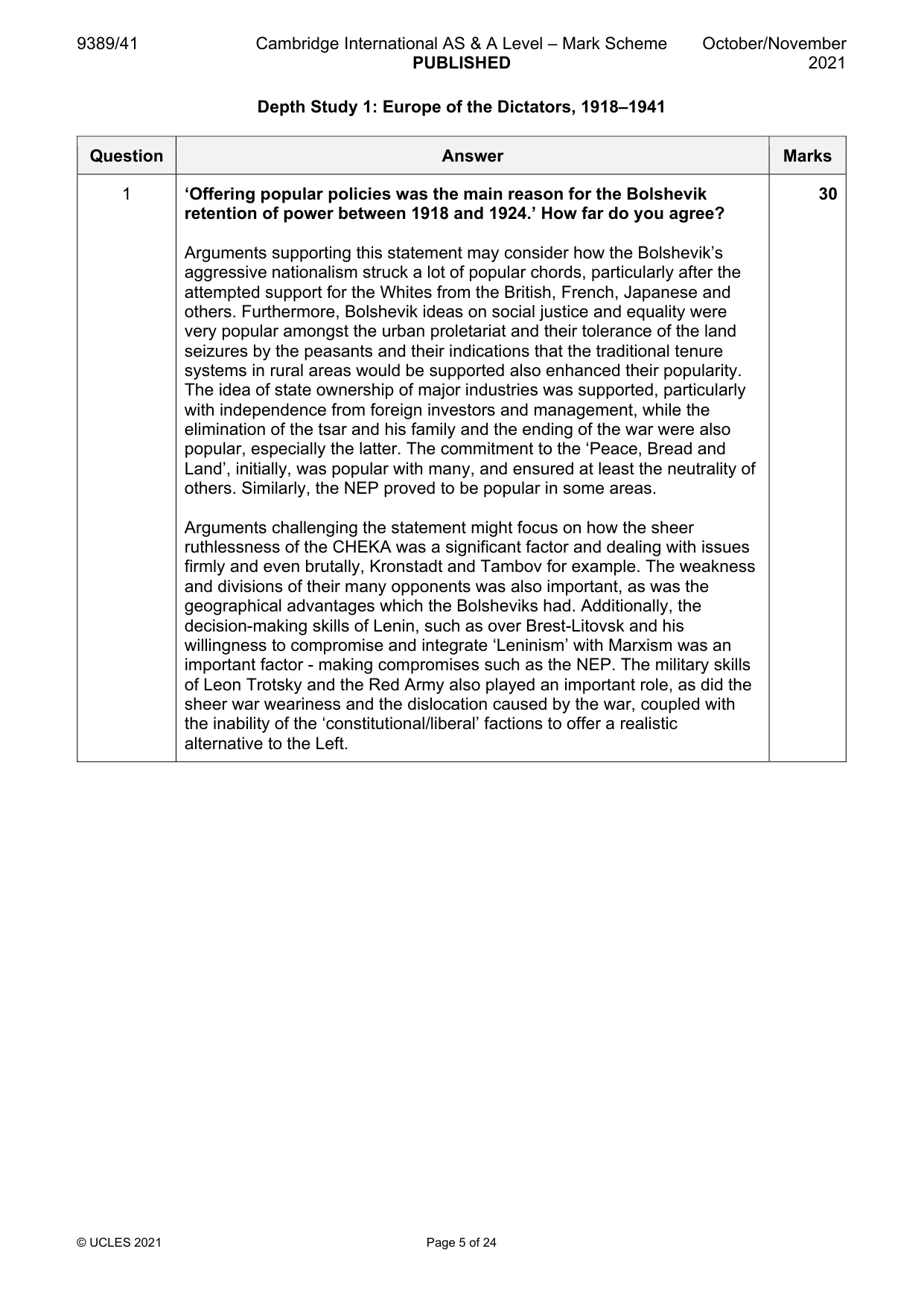
1 ‘Offering popular policies was the main reason for the Bolshevik retention of power between 1918 and 1924.’ How far do you agree? [30]
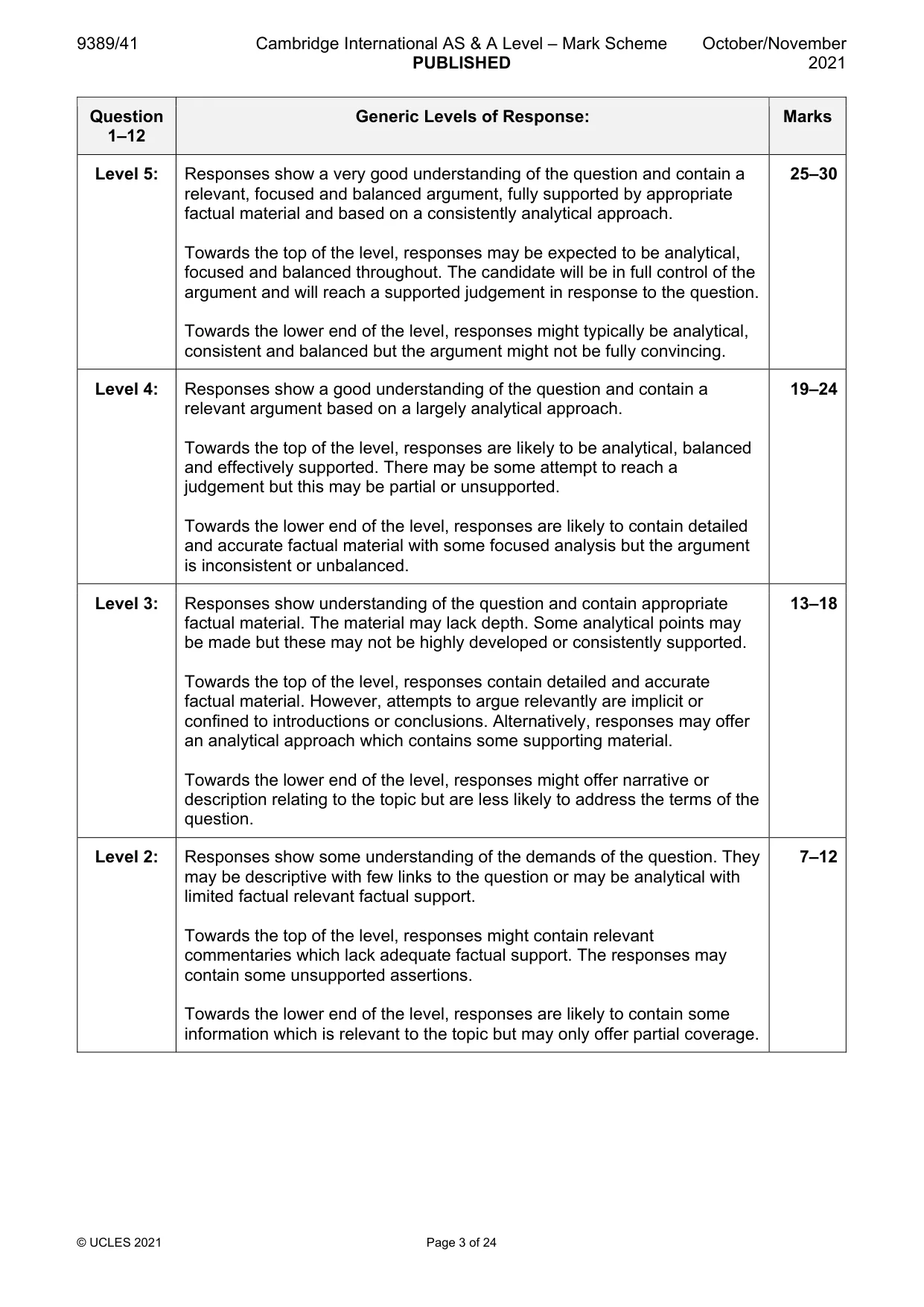
Mark scheme: Question Answer Marks 1 ‘Offering popular policies was the main reason for the Bolshevik 30 retention of power between 1918 and 1924.’ How far do you agree? Arguments supporting this statement may consider how the Bolshevik’s aggressive nationalism struck a lot of popular chords, particularly after the attempted support for the Whites from the British, French, Japanese and others. Furthermore, Bolshevik ideas on social justice and equality were very popular amongst the urban proletariat and their tolerance of the land seizures by the peasants and their indications that the traditional tenure systems in rural areas would be supported also enhanced their popularity. The idea of state ownership of major industries was supported, particularly with independence from foreign investors and management, while the elimination of the tsar and his family and the ending of the war were also popular, especially the latter. The commitment to the ‘Peace, Bread and Land’, initially, was popular with many, and ensured at least the neutrality of others. Similarly, the NEP proved to be popular in some areas. Arguments challenging the statement might focus on how the sheer ruthlessness of the CHEKA was a significant factor and dealing with issues firmly and even brutally, Kronstadt and Tambov for example. The weakness and divisions of their many opponents was also important, as was the geographical advantages which the Bolsheviks had. Additionally, the decision-making skills of Lenin, such as over Brest-Litovsk and his willingness to compromise and integrate ‘Leninism’ with Marxism was an important factor - making compromises such as the NEP. The military skills of Leon Trotsky and the Red Army also played an important role, as did the sheer war weariness and the dislocation caused by the war, coupled with the inability of the ‘constitutional/liberal’ factions to offer a realistic alternative to the Left.
Q2 · ‘The main reason why Mussolini was able to consolidate his power after 1922 was that his…
2 ‘The main reason why Mussolini was able to consolidate his power after 1922 was that his opponents were weak and divided.’ How far do you agree? [30]
Mark scheme: 2 ‘The main reason why Mussolini was able to consolidate his power 30 after 1922 was that his opponents were weak and divided.’ How far do you agree? Arguments challenging this statement may consider how there was a deep- rooted lack of faith in the democratic process in Italy which went back to 1871. There was also clear support from a range of both social and economic elites. Initially there was a degree of neutrality from the highly influential Roman Catholic Church, but later real support after the Concordat. Mussolini’s willingness to compromise over issues such as control of education and divorce/abortion etc. was important here. Additionally, his appointment by the King gave him not only the appearance of respectability but also real legitimacy. He was not seen as a radical revolutionary. His consistent anti-communist stance also made him very popular on the Right and with conservatives, while his ideological flexibility was vital. He only made a few vague commitments and then simply dumped them if needed. Clever use of the Acerbo Law also gave him a real electoral advantage in the early stages of his tenure when he was establishing his power, and his clever propaganda and ability to manipulate and influence the Press also gave him greater control. Furthermore, his foreign policy had real appeal, over Corfu and Locarno for example, and he did much to try and eliminate the feeling of humiliation which many Italians felt after the War and the Peace. His promise of another ‘Roman Empire’ also encouraged support. Arguments supporting the statement might consider how there was a substantial degree of disunity within all the major groups. The Liberals were bitterly divided over responsibility for the Peace and how to manage the failing economy and industrial unrest. There was also no chance of any unity between the Left and the Right. The Socialists and the Communists detested each other, and both had internal splits as well, particularly over the use of the strike weapon and the use of violence. All the major possible alternatives to Mussolini had different types of economic and above all, regional, support.
Q3 · ‘Russia gained little and lost much.’ Assess this view on the results of Stalin’s…
3 ‘Russia gained little and lost much.’ Assess this view on the results of Stalin’s economic policies. [30]
Mark scheme: 3 ‘Russia gained little and lost much.’ Assess this comment on the 30 results of Stalin’s economic policies. The focus should be on all aspects of Stalin’s economic policies, and not just on one of industrialisation and collectivisation. Arguments supporting the idea of gains might consider how there was a total modernisation of the Russian economy. It started to realise its vast potential. The Five Year Plans demonstrated real vision and showed what might be attainable by central planning using the full resources of the nation for the benefit of all. The nature and extent of industrialisation was profound – Russia attained in less than a decade what other nations had taken fifty years or more. The policies also created a major war machine which enabled it to stand up to the Nazis - with some success. They also created full employment and there were real benefits in terms of health provision and education. Management and leadership were open to all classes and not just a privileged elite. Careers were open to talent – in theory, and there was much more scope for careers for women. Resources could be used to benefit the people and not just overseas investors. Whole new industries were created, and agriculture could move from its subsistence approach to feeding an urban population and gaining foreign currency from exports. Arguments challenging the idea of gains may consider that while plausible in theory, many of the policies did not work in practice, especially collectivisation. There was also limited focus on consumer goods or housing and the standard of living of a very large number of Russians was appalling. There was also a human cost. Vast numbers of ‘kulaks’ died, and the use of slave labour was highly inefficient and wasteful. There were prestige projects which were disasters, like the White Sea Canal while people who knew nothing about agriculture took dreadful decisions about agriculture. The Lysenko affair is an excellent example of this. The focus was so often on quantity and not quality and the policies created one of the largest man- made famines in human history. The quality of management was often low and there was little effective co -ordination or forethought. The great Stalingrad tractor factory never got around to providing spares, and they were often delivered to areas which had no supplies of fuel for them.
Q4 · To what extent do economic factors explain the fall of the Weimar Republic?
4 To what extent do economic factors explain the fall of the Weimar Republic? [30] Depth Study 2: The History of the USA, 1945–1990 Answer any two questions.
Mark scheme: 4 To what extent do economic factors explain the fall of the Weimar 30 Republic? Arguments supporting the idea economic factors played a major part might include discussion about how there were many deep and lasting memories of the hyper-inflation of the early 1920s which hit the middle class so hard. There was also mass unemployment – over 6 million were unemployed and there was serious underemployment. There was additionally a failure by government to grasp the issue. Schacht had produced radical and realistic plans to deal with the problems (later largely adopted by Hitler) but there was not the political will to deal with them after the death of Stresemann. The impact of deflation may also be considered. It was seen by economists as having a more damaging effect on morale nationally than inflation, as well as a major effect on the economy. Governments seemed unable to simply manage the economy, which was also over dependent on US loans, as both the Dawes and the Young Plans revealed. Arguments discussing other factors may consider how governments simply failed to implement Schacht’s plans. There was a focus on political gain and not on national need. There was also a real lack of support for the Weimar system from so many of the elites, ranging from the Churches to the Army, the Judiciary to the business cartels. Stresemann’s’ death meant there was no leader who could command wide respect. The skills of the Nazi propaganda and electoral machine may also be discussed, as might the growing use of violence by the Nazis and the fear engendered in the minds of many by the growth of the Communist Party. The failure of political groups of all types to unite to save the system and defeat Nazism may also be explored. Depth Study 2: The History of the USA, 1945–1990
Q5 · Evaluate the reasons why Truman won the 1948 election
5 Evaluate the reasons why Truman won the 1948 election. [30]
Mark scheme: 5 Evaluate the reasons why Truman won the 1948 election. 30 On Election Day, Truman won 28 of the 48 states and 303 out of 531 electoral votes which came as a surprise to many in the United States who had expected his rival Thomas Dewey to win. At the time the Democratic party was split three ways, between more left-wing progressives, led by Henry Wallace, mainstream New Dealers, led by Truman, and Strom Thurmond’s Dixiecrats. By contrast, the Republicans were fairly united. Since 1947, they had also controlled both houses of Congress, the first time this had happened since 1930. The left-wing progressive threat was seen as a serious one to Truman. Led by Henry Wallace, who had been Vice President under FDR, it constantly accused Truman of being too hard on Communists and the Soviet Union. However, when the results came in they showed that Wallace had only delivered three states to Dewey and indeed his portrayal of Truman as staunchly anti-Communist had actually helped seal the Truman vote with some groups. This combined with Truman’s vigorous election campaign in the autumn of 1948, with the motto: ‘Give them hell, Harry’. In addition, his domestic policies appealed to key electoral groups, e.g. labour unions, commercial farmers, African Americans. The above points focus on the election campaign itself. Also important was the context of the time. The Soviet danger was at its greatest in 1948, e.g. the Berlin Blockade. Truman’s foreign policy of containment was more realistic than that of any of his rivals. The state of the economy was robust and was delivering prosperity for most groups. Also, the surprise of Truman’s victory was more a reflection on opinion polls, then in their infancy, and their likely inaccuracy.
Q6 · Assess the impact of affirmative action policies during the 1960s and 1970s
6 Assess the impact of affirmative action policies during the 1960s and 1970s. [30]
Mark scheme: 6 Assess the impact of affirmative action policies during the 1960s and 30 1970s. The concept of affirmative action arose from the premise that if racist barriers preventing African Americans from getting good jobs and attending good schools could be eliminated, they could reasonably be expected to succeed at the same rate as whites. In 1961, President Kennedy signed Executive Order 10925 requiring government contractors to take action to ensure applicants and employees are treated ‘without regard to their race, creed, colour, or national origin’. Title VII of the 1964 Civil Rights Act confirmed this. In the mid-1960s both private and public institutions began implementing policies that gave preference to minorities in the workplace. The first federal policy of race-conscious affirmative action was the Philadelphia Order 1969 requiring government contractors to set ‘goals and timetables’ for integrating and diversifying their workforce. Similar policies began to emerge in employment and education. By the early 1970s, 57% of African American male college graduates and 72% of female college graduates were employed in government positions. By the 1990s, statistics showed that 30% of men and nearly 60% of women of African American descent held white-collar jobs. The percentage of physicians increased from 2.2% to 4.5%. The number of African American college and university professors more than doubled between 1970 and 1990; the number of engineers almost quadrupled; and the number of attorneys increased more than six-fold. Secretary of State Colin Powell believed he benefited from it. However, there was push back towards the policies of affirmative action. People began to speak about reverse discrimination. Professional schools changed their admissions criteria for African American applicants; this was regarded as having double-standards. In 1971, the Supreme Court ruled that children were to be bussed to schools to achieve racial balance. The Griggs v. Duke Power Company Supreme Court decision ordered that all employers had to consider race when making hiring decisions. In the late 1970s, the courts began to strike down affirmative action programs that were designed to give minorities an opportunity to compete for federal contracts, by challenging programs that utilized ‘quotas’. The limitations imposed by the US Supreme Court is an important moment – in the Bakke case 1978 the Court decided against quotas for minorities but accepted ethnic background could be a factor in recruiting students. It may also be said that any improvement in minorities’ position is the result of other factors, e.g. the state of the economy, the quality of the education they received.
Q7 · ‘The “war on drugs” of the 1980s had little impact.’ How far do you agree?
7 ‘The “war on drugs” of the 1980s had little impact.’ How far do you agree? [30]
Mark scheme: 7 ‘The “war on drugs” of the 1980s had little impact.’ How far do you 30 agree? Instead of solely focusing on international drug trafficking and diplomacy, the Reagan Administration decided the main focus should be at home. Reagan succeeded in gaining the nation’s support for his plans for a drug- free America. He revealed his plan for the War on Drugs in 1982 and declared that illegal drugs were a threat to national security. A five-pronged approach to the problem of illegal drug use was established: international efforts, domestic enforcement, education and prevention, treatment, and using foreign governments in the fight against drug trafficking. Carlton E. Turner was the main policy maker for the War on Drugs. He condemned the use of both hard and soft drugs. He wanted to do everything to get people to see drug users as a menace to society. The government, therefore, increased spending on law enforcement while reducing federal spending on drug treatment programmes by 75%. The Anti-Drug Abuse Act of 1986 allocated $1.7 billion to fight the drug war and minimum penalties for drug offenses; a zero-tolerance approach. The Anti-Drug Abuse1988 focused on the demand for drugs denying drug users certain Federal benefits like student loans and public housing leases were terminated if tenants were caught taking illegal drugs. Nancy Reagan was very active in the area of drug treatment and prevention. Her "Just Say No" anti-drug campaign focused on white, middle-class children and was funded by corporate and private donations. In terms of evaluating the statement, possible successes include research conducted by the Institute for Social Research in Michigan found that there were less young people using illegal drugs in the 1980s than in the 1970s. Towards the end of Reagan’s second term the government changed focus to include treatment programmes and educational programmes along with prevention. President Bush also created the Office of National Drug Control Policy. Limitations might involve the fact that critics argued that Reagan’s drug policy was unsuccessful as the entire policy allowed for the government to be mostly crime fighting. The focus was not on attacking the general social issues present in the country that seemed to be the cause of the drug problem. People were afraid of drug related crime and towards the end of Reagan’s presidency; there was a sudden increase in drug-related illnesses which included death by drug overdose and AIDS. Media perceptions also influenced the policy, particularly how the media portrayed African American citizens involved in drug scenes. These images led to preconceived notions that drug use was mainly common among African American groups in society and not amongst the white people in the community. It has been claimed that the US government and CIA specifically targeted the African American community by introducing the drug into the market in ghettos to establish social control. Reagan’s policies did not stop the flow of drugs and the drug market.
Q8 · ‘The foreign policy of the United States during the 1970s and 1980s was dictated by its…
8 ‘The foreign policy of the United States during the 1970s and 1980s was dictated by its military failure in Vietnam.’ How far do you agree? [30] Depth Study 3: International History, 1945–1991 Answer any two questions.
Mark scheme: 8 ‘The foreign policy of the United States during the 1970s and 1980s 30 was dictated by its military failure in Vietnam.’ How far do you agree? American participation in the Vietnam war had resulted in a defeat for the USA which many saw as humiliating: the world superpower being defeated by a smaller state – albeit with the help of the USA’s superpower rival and in the 1970s there was a direct reaction to this. In 1975–79 the focus was on improving relations with the USSR and China and therefore the further development of détente with these nations was a considerable focus. Détente had begun in the Nixon era, but Ford and Carter took it much further. In 1975 the Helsinki Agreements were signed with the USSR, which established various mechanisms for ensuring peace in Eastern Europe, while formal diplomatic recognition of China was given in 1979. The SALT 2 nuclear disarmament treaty was also agreed in 1979. In the 1980s US policy focussed on different issues. Between 1979 and 1985 the focus was on fighting what some called ‘the Second Cold War’ and in Afghanistan CIA-led secret support of Mujahedeen in their struggle against military occupation by the USSR. In Central America, the USA backed Contras against Sandinista government in Nicaragua. The so-called Reagan Doctrine, which maintained support, often covert, for those resisting communism in the Third World avoided direct military intervention. Hence the Iran-Contra Affair of 1985. Depth Study 3: International History, 1945–1991
Q9 · Assess the importance of the Vietnam War in bringing about improved relations between the…
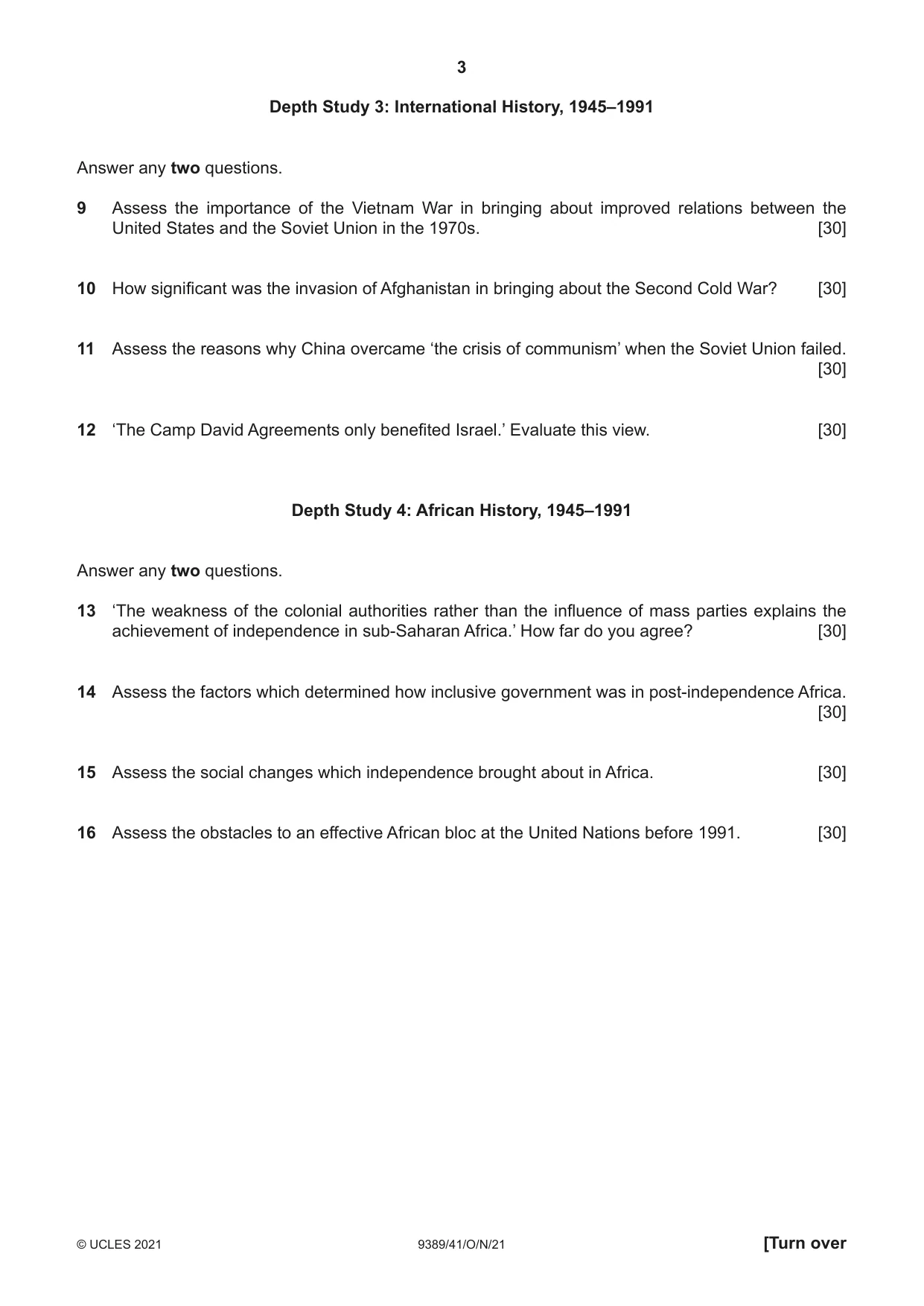
9 Assess the importance of the Vietnam War in bringing about improved relations between the United States and the Soviet Union in the 1970s. [30]
Mark scheme: 9 Assess the importance of the Vietnam War in bringing about improved 30 relations between the United States and the Soviet Union in the 1970s. Arguments may focus on how relations were poor at the height of the Vietnam war, but by the 1970s these relations had improved. For example, the SALT I nuclear agreement is signed in 1972, the Helsinki Accords in 1975 and the SALT II agreement in 1979. The US policy of détente which was first begun under Kennedy and Johnson but was extended by Nixon and Carter may also be considered. Arguments may also discuss the idea that the Soviet Union felt threatened by China and the US policy of improving relations with China under Nixon put pressure on the Soviet Union to set about improving their own diplomatic relationship with the US, leading to Nixon visiting both China and the Soviet Union. Challenges facing the Soviet economy may also be considered as influential factors encouraging better relations – in 1972 the Soviet Union signed a three-year agreement with the US to buy grain. Arguments may also consider how failure in Vietnam made the USA less combative and more amenable to improving relations with the Soviet Union and accepting more coexistence rather than pursuing the more traditional policy of containment. Relations only really began to improve in the 1970s, although it could be argued that in the 1960s relations improved but because of Cuba and not Vietnam.
Q10 · How significant was the invasion of Afghanistan in bringing about the Second Cold War?
10 How significant was the invasion of Afghanistan in bringing about the Second Cold War? [30]
Mark scheme: 10 How significant was the invasion of Afghanistan in bringing about the 30 Second Cold War? Arguments may discuss the impact of the Soviet invasion of Afghanistan and how this helped to end Carter’s policy of detente and indeed his presidency. In evaluating the importance of the invasion, responses may identify how the invasion was a direct attempt to further Soviet interests using physical force, an action that contravened earlier agreements between the two nations. Arguments challenging the importance of the Russian invasion of Afghanistan in causing the Second Cold War may also consider the rise of the Neo-Conservatives and the election of Ronald Reagan in 1980 and the conviction amongst that group that the USA could and would win the Cold War. They might also discuss events such as the Moscow Olympics boycott in 1980, the shooting down of Korean Airlines flight 007, Operation Able Archer in 1983, Star Wars (SDI), and the Los Angeles Olympics boycott which all enhanced the declining relationship between the US and USSR.
Q11 · Assess the reasons why China overcame ‘the crisis of communism’ when the Soviet Union…
11 Assess the reasons why China overcame ‘the crisis of communism’ when the Soviet Union failed. [30]
Mark scheme: 11 Assess the reasons why China overcame ‘the crisis of communism’ 30 when the Soviet Union failed. One important factor was the different approaches adopted by the two leaders, Deng Xiaoping and Mikhail Gorbachev. The Chinese government was very proactive on economic reform beginning in 1978 when China began to lift millions of rural households out of poverty with the introduction of the household responsibility system in agriculture and gave back land rights to households. Deng also opened up China to trade with the world believing that economic reforms would enhance the standing of the CCP. Thus, economic reform was well under way by the mid-1980s. However, while Deng was willing to loosen state control of economics, he was not willing to relinquish any political control. This was demonstrated when he dealt with the student protests in 1989 using the army to maintain control. He made it clear that there would be no deviation from political conservatism. On the other hand, Mikhail Gorbachev came to power in the Soviet Union in 1985 during a period of economic stagnation. The Soviets had invaded Afghanistan in1979 breaking détente with the United States. Poor relations with Ronald Reagan had led to an arms race and Gorbachev recognised the inefficiency of the communist system. He wanted moderate change with perestroika and glasnost. The idea was that these would help to restore the legitimacy of the Communist Party but, instead, the public became aware of the inefficient economic planning. In addition, the Soviet Union was also losing its grip on its satellite states and ethnic groups took the opportunity to free themselves from Soviet control. Gorbachev had failed to realise that communism would be destroyed once factors like nationalism took hold. He ended up setting loose uncontrollable forces that brought down the Soviet empire. Unlike China, the Soviet Union did not have a sense of national identity.
Q12 · ‘The Camp David Agreements only benefited Israel.’ Evaluate this view
12 ‘The Camp David Agreements only benefited Israel.’ Evaluate this view. [30] Depth Study 4: African History, 1945–1991 Answer any two questions.
Mark scheme: 12 ‘The Camp David Agreements only benefited Israel.’ Evaluate this 30 view. The Camp David Agreements were produced as a result of the diplomatic efforts of Egypt, Israel, and the United States. It was intended that disputes between Israel and the Arab countries would be resolved but the outcome led to a bilateral treaty between Israel and Egypt. ‘A Framework for the Conclusion of a Peace Treaty between Egypt and Israel ’resulted in the Peace of Washington signed by Sadat and Begin in March 1979. The Israelis managed to ensure Egypt’s neutrality increasing their security. Israel had agreed to lose land in return for peace, but it was land that the country was prepared to give up. Normal diplomatic relations would be established between the two countries. Israel would also be guaranteed freedom of passage through the Suez Canal and the Straits of Tiran, and a demilitarised area along the Israeli border. The second framework agreement, ‘The Framework for Peace in the Middle East’, never became a reality. Included in the framework was that Egypt, Israel and Jordan should agree methods of establishing an elected self-governing authority in the West Bank and Gaza and, together with the representatives of the Palestinian people, should negotiate on resolving the Palestinian problem. The UN General Assembly rejected it; it had been concluded without the participation of the UN and PLO. Menachem Begin’s Likud Party won the 1977 election and President Carter had agreed with Begin’s belief that the West Bank and Gaza were integral parts of Israel. Many Arabs saw no hope in this framework; the Egyptians had made peace without obtaining any guarantee for Palestinian self-determination which had always been an important goal. However, it could be argued that Egypt also benefited from the treaty. Egypt needed peace for its economy to recover. Israel agreed to withdraw its armed forces from the Sinai, evacuate its civilian inhabitants, and restore it to Egypt. Israel also agreed to guarantee free passage between Egypt and Jordan. With the withdrawal, Israel returned Egypt's oil fields in Western Sinai. The agreement also resulted in the United States committing to several billion dollars’ worth of annual subsidies to the governments of both Israel and Egypt. The normalisation of relations between Israel and Egypt went into effect in January 1980. While peace between Israel and Egypt was mutually beneficial, Egypt’s standing in the Arab world received a huge blow. Egypt had been regarded as a leader in the Arab world who promoted Arab interests. However, the Arab Summit held in Baghdad in1978 condemned Egypt and the Camp David Agreements; warned Egypt that it would be subject to an economic and political boycott if it concluded a separate peace with Israel, and transferred the Arab League headquarters from Cairo to Tunis. In 1979 as a result of the treaty the country was suspended from the Arab League, a suspension which lasted until 1989. There was no longer a united Arab front opposed to Israel and many Arab nations blamed Egypt for not putting enough pressure on Israel to reach a satisfactory conclusion to the Palestinian problem. President Sadat's signing of the Camp David Agreements led to his assassination on 6 October 1981 by members of the Egyptian Islamic Jihad. Depth Study 4: African History, 1945–1991
Q13 · ‘The weakness of the colonial authorities rather than the influence of mass parties…
13 ‘The weakness of the colonial authorities rather than the influence of mass parties explains the achievement of independence in sub-Saharan Africa.’ How far do you agree? [30]
Mark scheme: 13 ‘The weakness of the colonial authorities rather than the influence of 30 mass parties explains the achievement of independence in sub- Saharan Africa.’ How far do you agree? Both the attitude of colonial authorities and pressure from mass parties are important factors, but their significance varied from state to state. Candidates should use detailed knowledge of at least 2 examples to argue the question. Britain and France were weakened economically and politically by the Second World War. After 1945, the United Nations and the 2 super- powers, USA and USSR, were all opposed to colonialism. India gained independence in 1947. Britain accepted that her African colonies would eventually become independent. West Africa was more developed with an educated elite. Britain expected this elite would gradually take over in the Legislative Assemblies. The emergence of mass political parties like Nkrumahs’s Convention Peoples’ Party in Ghana by-passed the old elite and speeded up events, so Ghana became the first independent, African state in 1957. Members of the elite, such as Azikiwe in Nigeria, formed mass parties and the federation of Nigeria was formed in 1961. East and Central Africa were colonised later and were less developed. There were growing populations of white settlers, who expected Britain to protect their interests. Britain did not think these colonies would be ready for independence for at least another 20 years. Mass parties with charismatic leaders had emerged, but it was the cost of sending troops to fight the Mau- Mau uprising in Kenya that changed British attitudes. This suggests economic weakness was important. By 1964 Tanganyika, Uganda, Kenya, Malawi and Zambia were independent. Southern Rhodesia had been self-governing since 1923. Here the settlers declared UDI in 1965, resulting in a guerrilla war. Independent Zimbabwe was only achieved in 1980 as a result of protracted violence, organised by mass parties. French policy was different. De Gaulle broke up the loose federations of French West Africa and French Equatorial Africa and created the Franco-African community. In the referendum of 1959, only Guinea voted for complete independence. By 1960, French colonies were nominally independent, but remained closely tied to France and received a wide range of financial and technical assistance. Leaders like Senghor and Houphouet-Boigny were part of the elite and had served in the French Assembly. Portugal regarded her colonies as an integral part of Portugal. Under the dictatorship of Salazar, there was no question of political change. Costly guerrilla wars were fought in both Mozambique and Angola by mass parties. In 1974 the dictatorship was overthrown by a revolution in Portugal and the colonies achieved immediate independence.
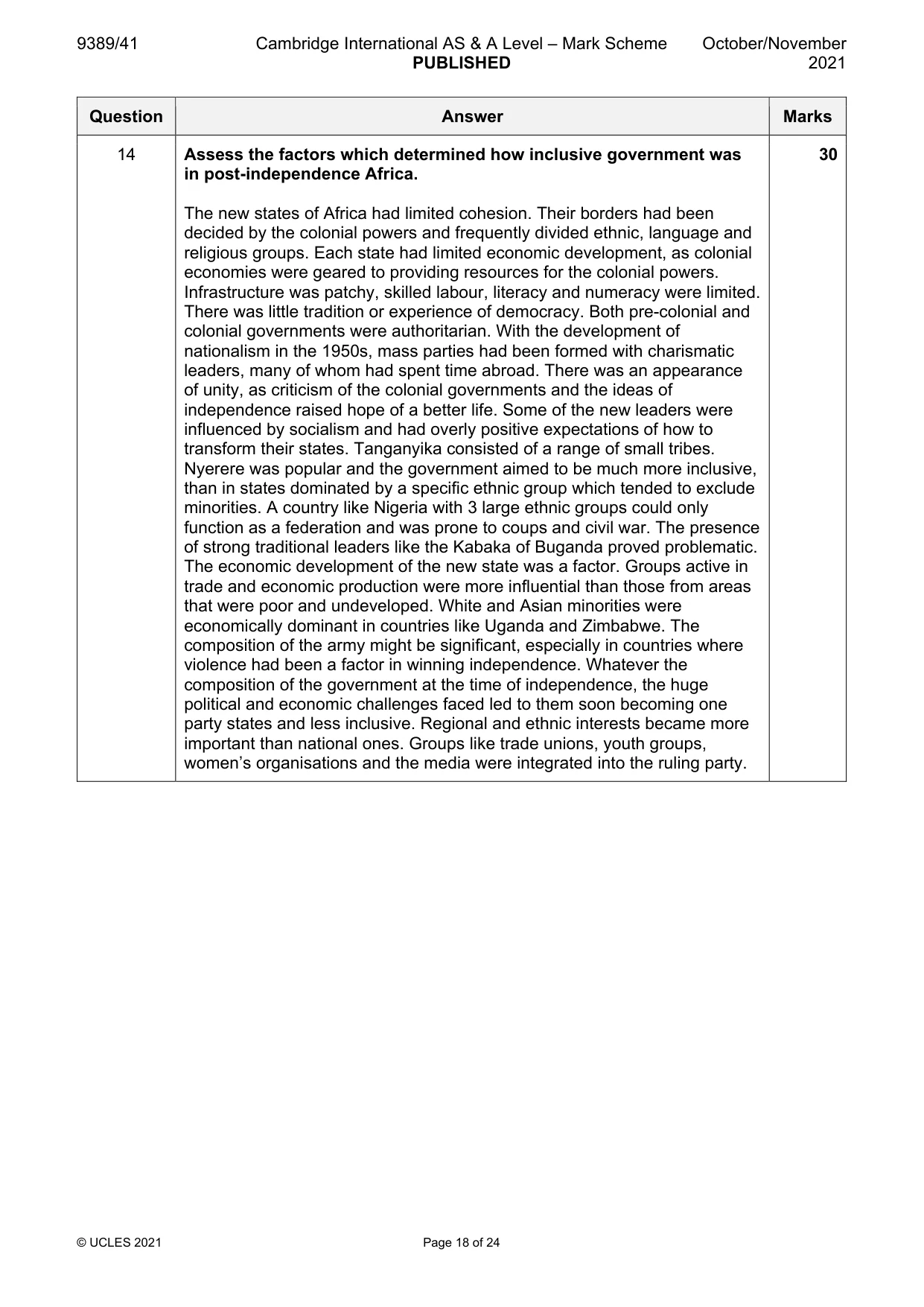
Q14 · Assess the factors which determined how inclusive government was in post-independence…
14 Assess the factors which determined how inclusive government was in post-independence Africa. [30]
Mark scheme: 14 Assess the factors which determined how inclusive government was 30 in post-independence Africa. The new states of Africa had limited cohesion. Their borders had been decided by the colonial powers and frequently divided ethnic, language and religious groups. Each state had limited economic development, as colonial economies were geared to providing resources for the colonial powers. Infrastructure was patchy, skilled labour, literacy and numeracy were limited. There was little tradition or experience of democracy. Both pre-colonial and colonial governments were authoritarian. With the development of nationalism in the 1950s, mass parties had been formed with charismatic leaders, many of whom had spent time abroad. There was an appearance of unity, as criticism of the colonial governments and the ideas of independence raised hope of a better life. Some of the new leaders were influenced by socialism and had overly positive expectations of how to transform their states. Tanganyika consisted of a range of small tribes. Nyerere was popular and the government aimed to be much more inclusive, than in states dominated by a specific ethnic group which tended to exclude minorities. A country like Nigeria with 3 large ethnic groups could only function as a federation and was prone to coups and civil war. The presence of strong traditional leaders like the Kabaka of Buganda proved problematic. The economic development of the new state was a factor. Groups active in trade and economic production were more influential than those from areas that were poor and undeveloped. White and Asian minorities were economically dominant in countries like Uganda and Zimbabwe. The composition of the army might be significant, especially in countries where violence had been a factor in winning independence. Whatever the composition of the government at the time of independence, the huge political and economic challenges faced led to them soon becoming one party states and less inclusive. Regional and ethnic interests became more important than national ones. Groups like trade unions, youth groups, women’s organisations and the media were integrated into the ruling party.
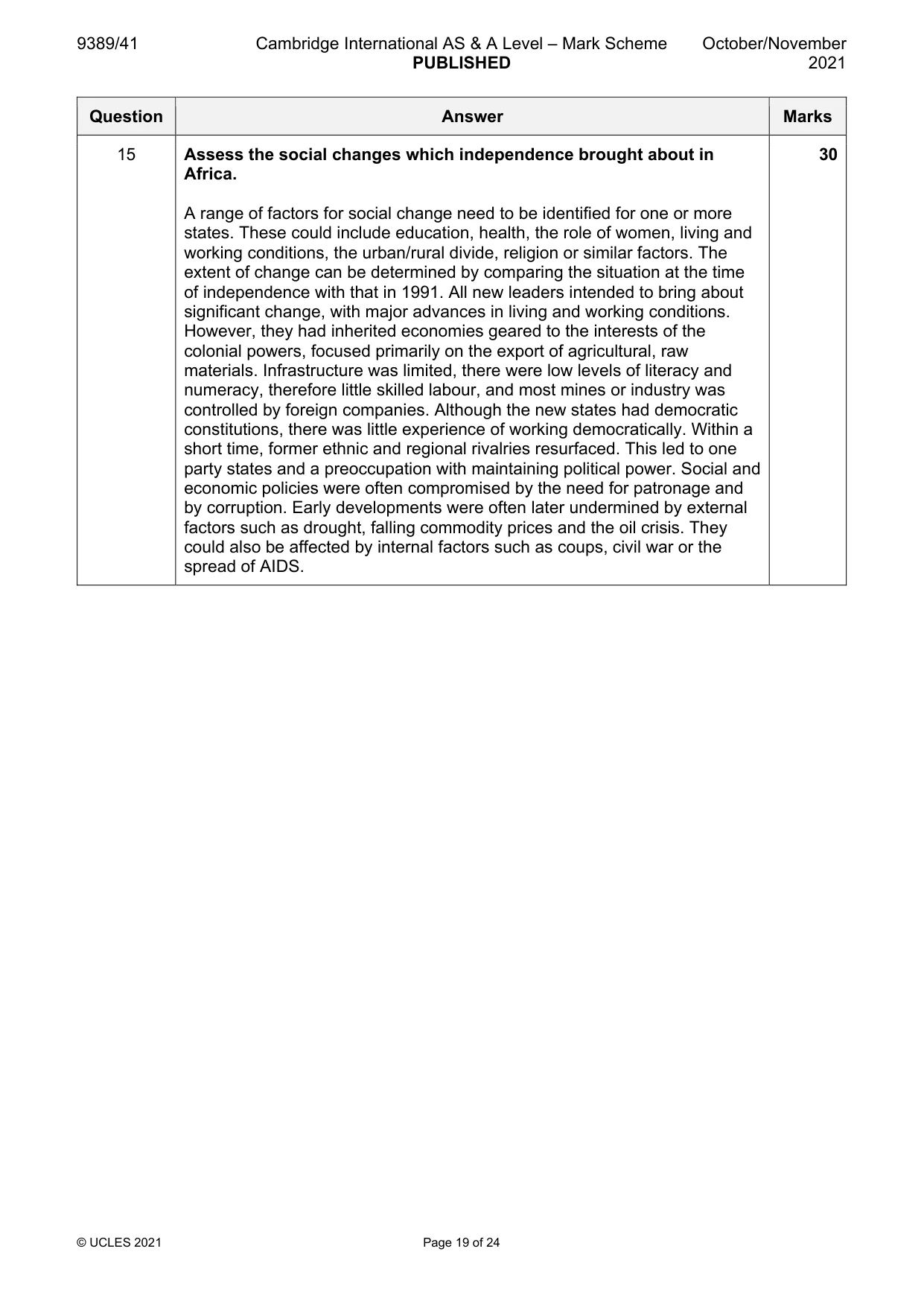
Q15 · Assess the social changes which independence brought about in Africa
15 Assess the social changes which independence brought about in Africa. [30]
Mark scheme: 15 Assess the social changes which independence brought about in 30 Africa. A range of factors for social change need to be identified for one or more states. These could include education, health, the role of women, living and working conditions, the urban/rural divide, religion or similar factors. The extent of change can be determined by comparing the situation at the time of independence with that in 1991. All new leaders intended to bring about significant change, with major advances in living and working conditions. However, they had inherited economies geared to the interests of the colonial powers, focused primarily on the export of agricultural, raw materials. Infrastructure was limited, there were low levels of literacy and numeracy, therefore little skilled labour, and most mines or industry was controlled by foreign companies. Although the new states had democratic constitutions, there was little experience of working democratically. Within a short time, former ethnic and regional rivalries resurfaced. This led to one party states and a preoccupation with maintaining political power. Social and economic policies were often compromised by the need for patronage and by corruption. Early developments were often later undermined by external factors such as drought, falling commodity prices and the oil crisis. They could also be affected by internal factors such as coups, civil war or the spread of AIDS.
Q16 · Depth Study 5: Southeast Asian History, 1945–1990s Answer any two questions
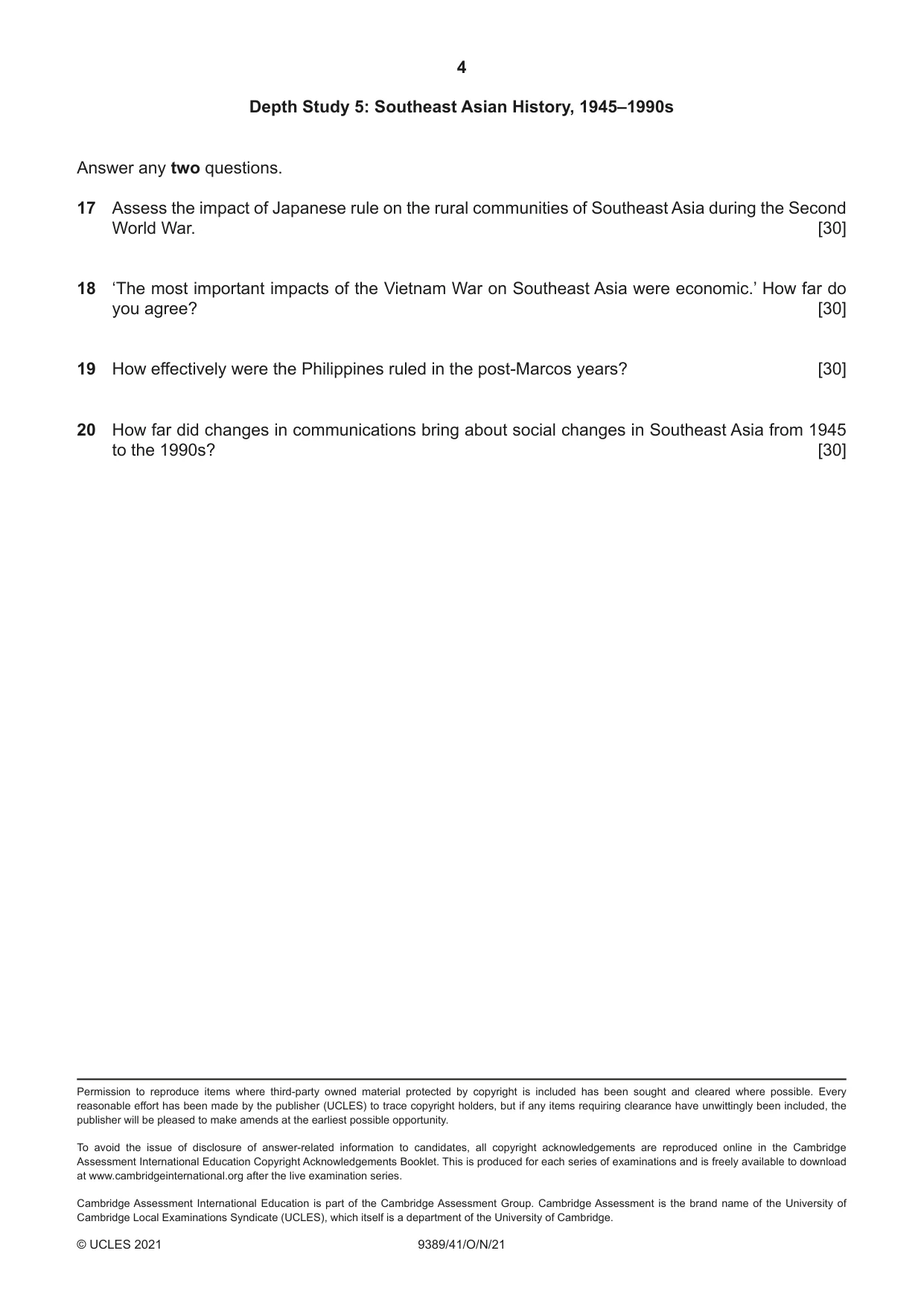
Depth Study 5: Southeast Asian History, 1945–1990s Answer any two questions.
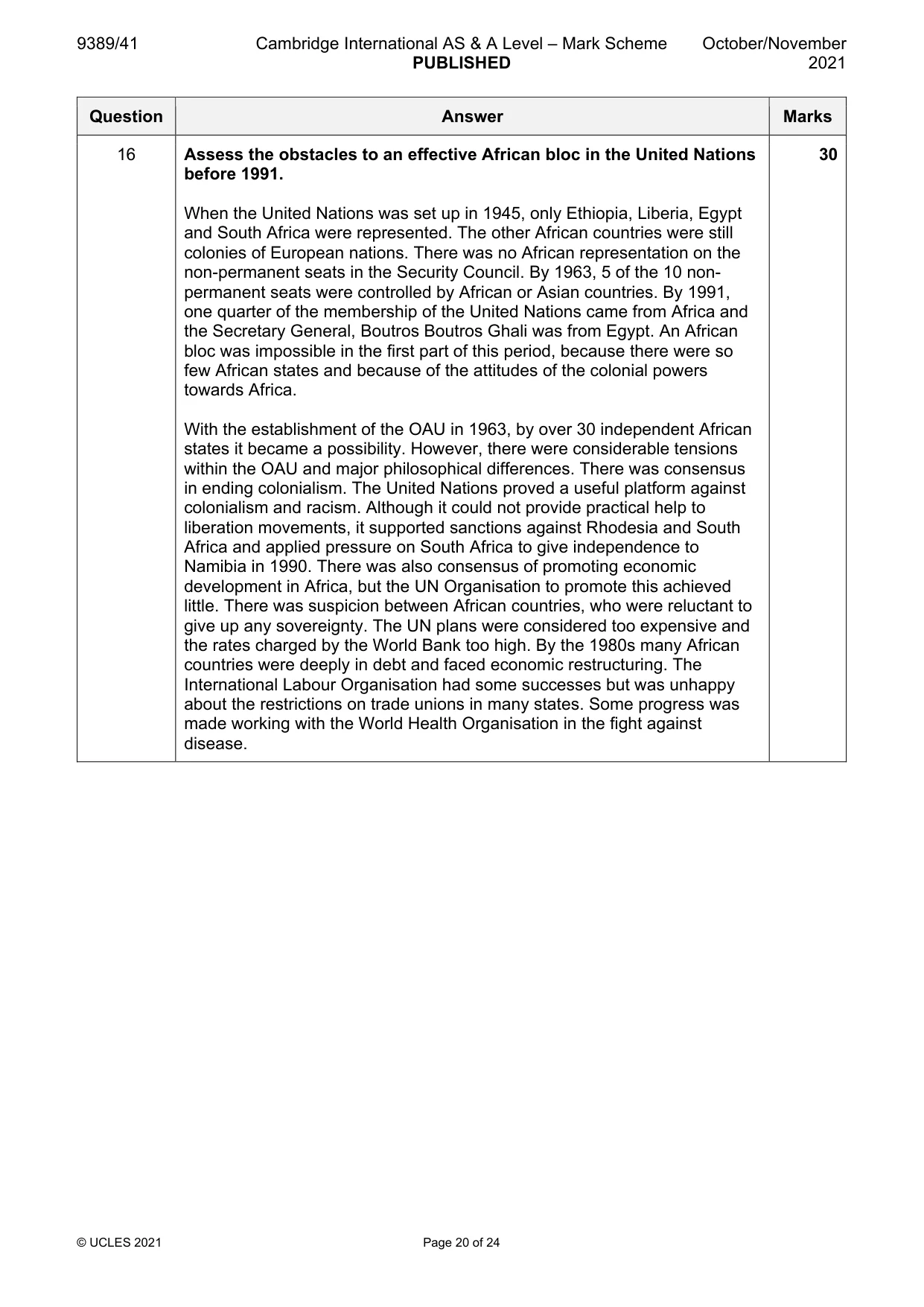
Mark scheme: 16 Assess the obstacles to an effective African bloc in the United Nations 30 before 1991. When the United Nations was set up in 1945, only Ethiopia, Liberia, Egypt and South Africa were represented. The other African countries were still colonies of European nations. There was no African representation on the non-permanent seats in the Security Council. By 1963, 5 of the 10 non- permanent seats were controlled by African or Asian countries. By 1991, one quarter of the membership of the United Nations came from Africa and the Secretary General, Boutros Boutros Ghali was from Egypt. An African bloc was impossible in the first part of this period, because there were so few African states and because of the attitudes of the colonial powers towards Africa. With the establishment of the OAU in 1963, by over 30 independent African states it became a possibility. However, there were considerable tensions within the OAU and major philosophical differences. There was consensus in ending colonialism. The United Nations proved a useful platform against colonialism and racism. Although it could not provide practical help to liberation movements, it supported sanctions against Rhodesia and South Africa and applied pressure on South Africa to give independence to Namibia in 1990. There was also consensus of promoting economic development in Africa, but the UN Organisation to promote this achieved little. There was suspicion between African countries, who were reluctant to give up any sovereignty. The UN plans were considered too expensive and the rates charged by the World Bank too high. By the 1980s many African countries were deeply in debt and faced economic restructuring. The International Labour Organisation had some successes but was unhappy about the restrictions on trade unions in many states. Some progress was made working with the World Health Organisation in the fight against disease. Depth Study 5: Southeast Asian History, 1945–1990s
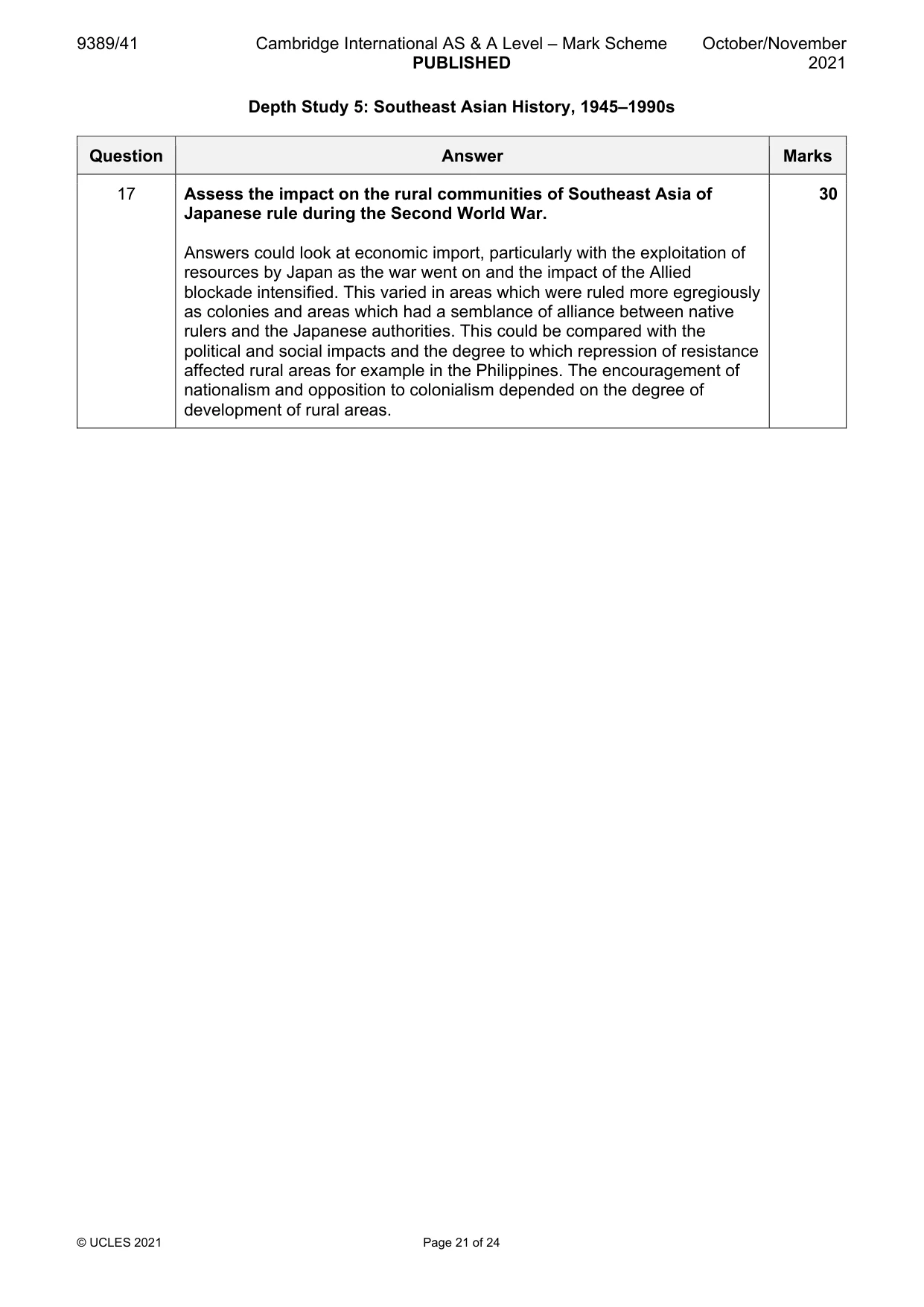
Q17 · Assess the impact of Japanese rule on the rural communities of Southeast Asia during the…
17 Assess the impact of Japanese rule on the rural communities of Southeast Asia during the Second World War. [30]
Mark scheme: 17 Assess the impact on the rural communities of Southeast Asia of 30 Japanese rule during the Second World War. Answers could look at economic import, particularly with the exploitation of resources by Japan as the war went on and the impact of the Allied blockade intensified. This varied in areas which were ruled more egregiously as colonies and areas which had a semblance of alliance between native rulers and the Japanese authorities. This could be compared with the political and social impacts and the degree to which repression of resistance affected rural areas for example in the Philippines. The encouragement of nationalism and opposition to colonialism depended on the degree of development of rural areas.
Q18 · ‘The most important impacts of the Vietnam War on Southeast Asia were economic.’ How far…
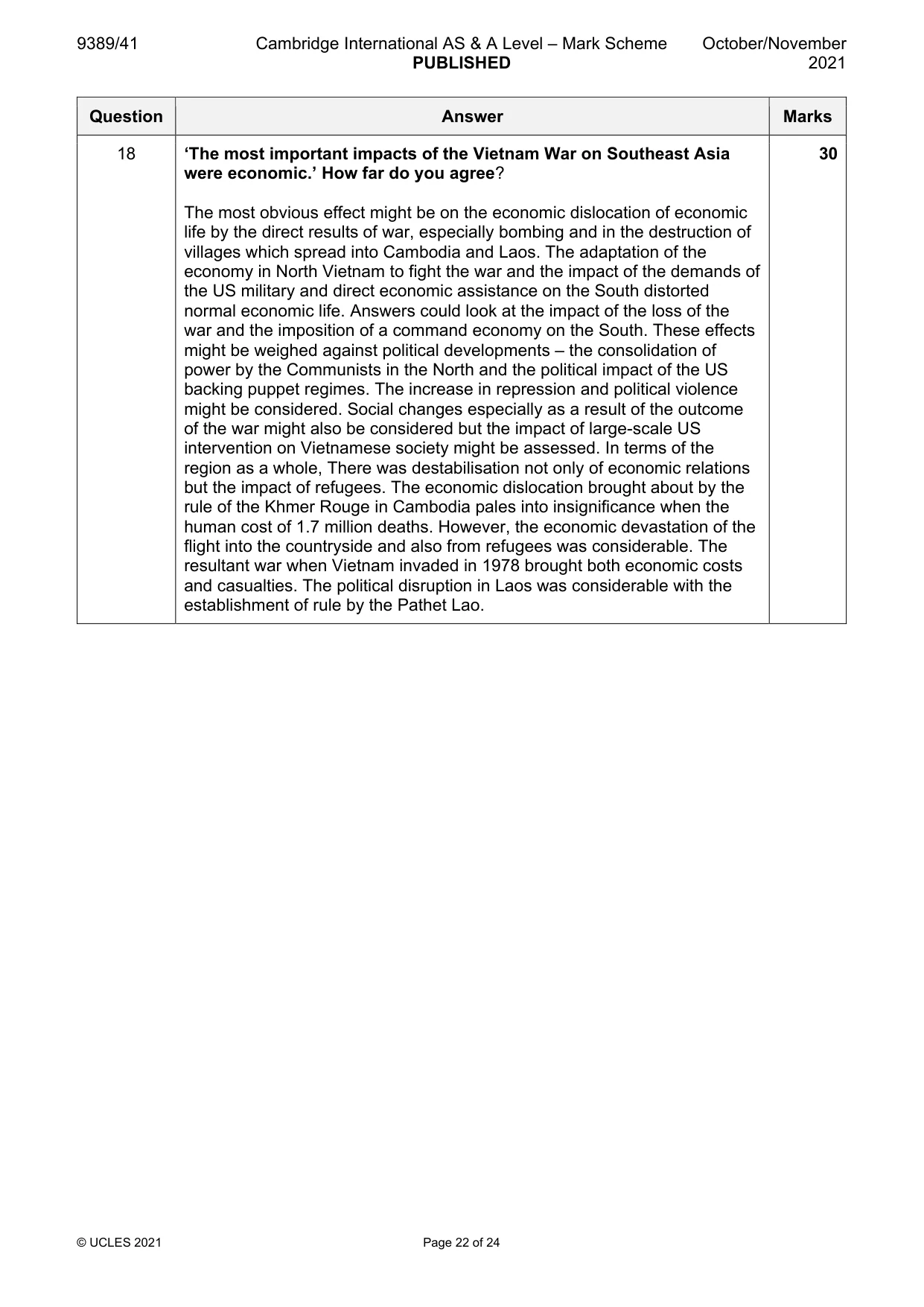
18 ‘The most important impacts of the Vietnam War on Southeast Asia were economic.’ How far do you agree? [30]
Mark scheme: 18 ‘The most important impacts of the Vietnam War on Southeast Asia 30 were economic.’ How far do you agree? The most obvious effect might be on the economic dislocation of economic life by the direct results of war, especially bombing and in the destruction of villages which spread into Cambodia and Laos. The adaptation of the economy in North Vietnam to fight the war and the impact of the demands of the US military and direct economic assistance on the South distorted normal economic life. Answers could look at the impact of the loss of the war and the imposition of a command economy on the South. These effects might be weighed against political developments – the consolidation of power by the Communists in the North and the political impact of the US backing puppet regimes. The increase in repression and political violence might be considered. Social changes especially as a result of the outcome of the war might also be considered but the impact of large-scale US intervention on Vietnamese society might be assessed. In terms of the region as a whole, There was destabilisation not only of economic relations but the impact of refugees. The economic dislocation brought about by the rule of the Khmer Rouge in Cambodia pales into insignificance when the human cost of 1.7 million deaths. However, the economic devastation of the flight into the countryside and also from refugees was considerable. The resultant war when Vietnam invaded in 1978 brought both economic costs and casualties. The political disruption in Laos was considerable with the establishment of rule by the Pathet Lao.
Q19 · How effectively were the Philippines ruled in the post-Marcos years?
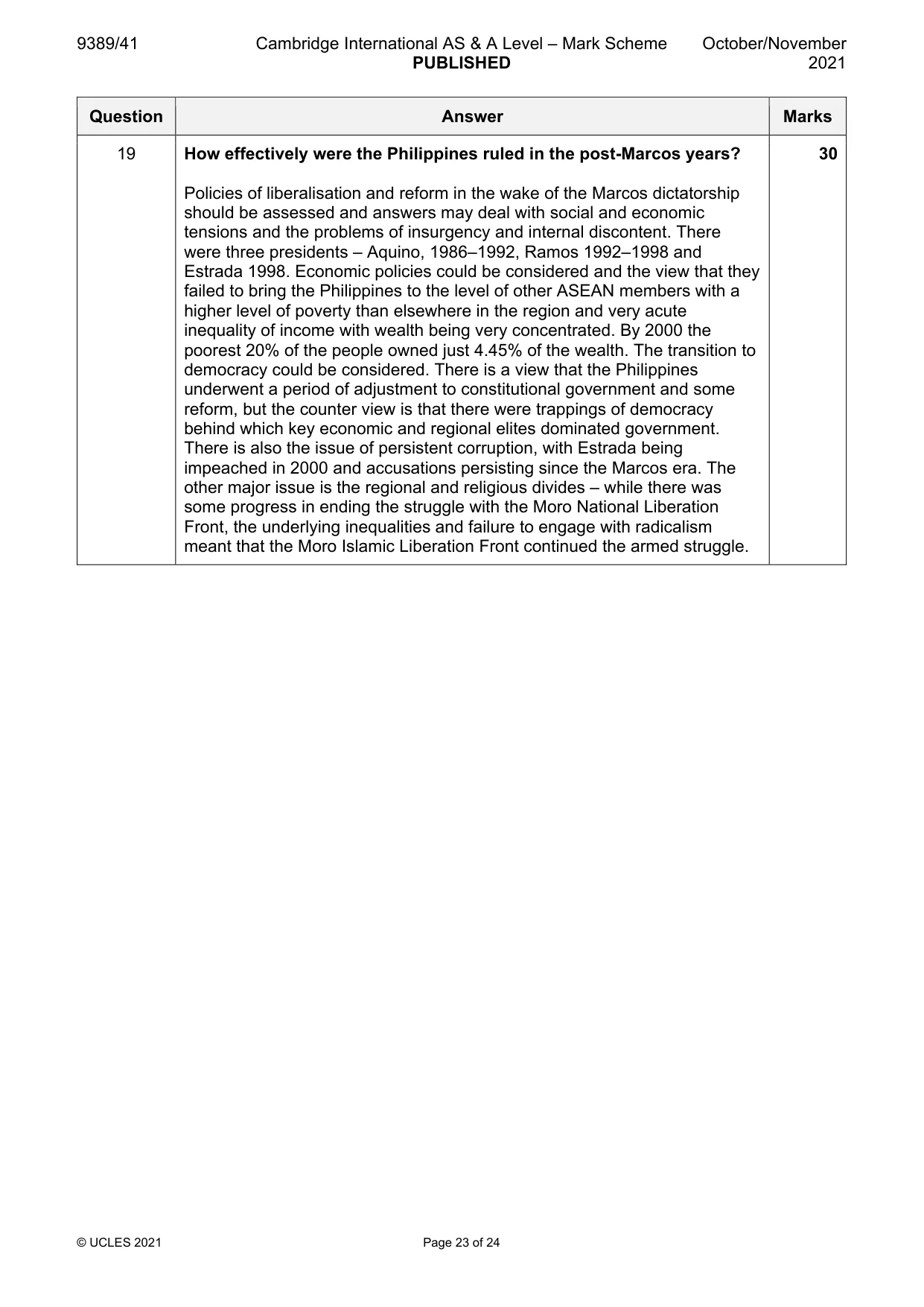
19 How effectively were the Philippines ruled in the post-Marcos years? [30]
Mark scheme: 19 How effectively were the Philippines ruled in the post-Marcos years? 30 Policies of liberalisation and reform in the wake of the Marcos dictatorship should be assessed and answers may deal with social and economic tensions and the problems of insurgency and internal discontent. There were three presidents – Aquino, 1986–1992, Ramos 1992–1998 and Estrada 1998. Economic policies could be considered and the view that they failed to bring the Philippines to the level of other ASEAN members with a higher level of poverty than elsewhere in the region and very acute inequality of income with wealth being very concentrated. By 2000 the poorest 20% of the people owned just 4.45% of the wealth. The transition to democracy could be considered. There is a view that the Philippines underwent a period of adjustment to constitutional government and some reform, but the counter view is that there were trappings of democracy behind which key economic and regional elites dominated government. There is also the issue of persistent corruption, with Estrada being impeached in 2000 and accusations persisting since the Marcos era. The other major issue is the regional and religious divides – while there was some progress in ending the struggle with the Moro National Liberation Front, the underlying inequalities and failure to engage with radicalism meant that the Moro Islamic Liberation Front continued the armed struggle.
Q20 · How far did changes in communications bring about social changes in Southeast Asia from…
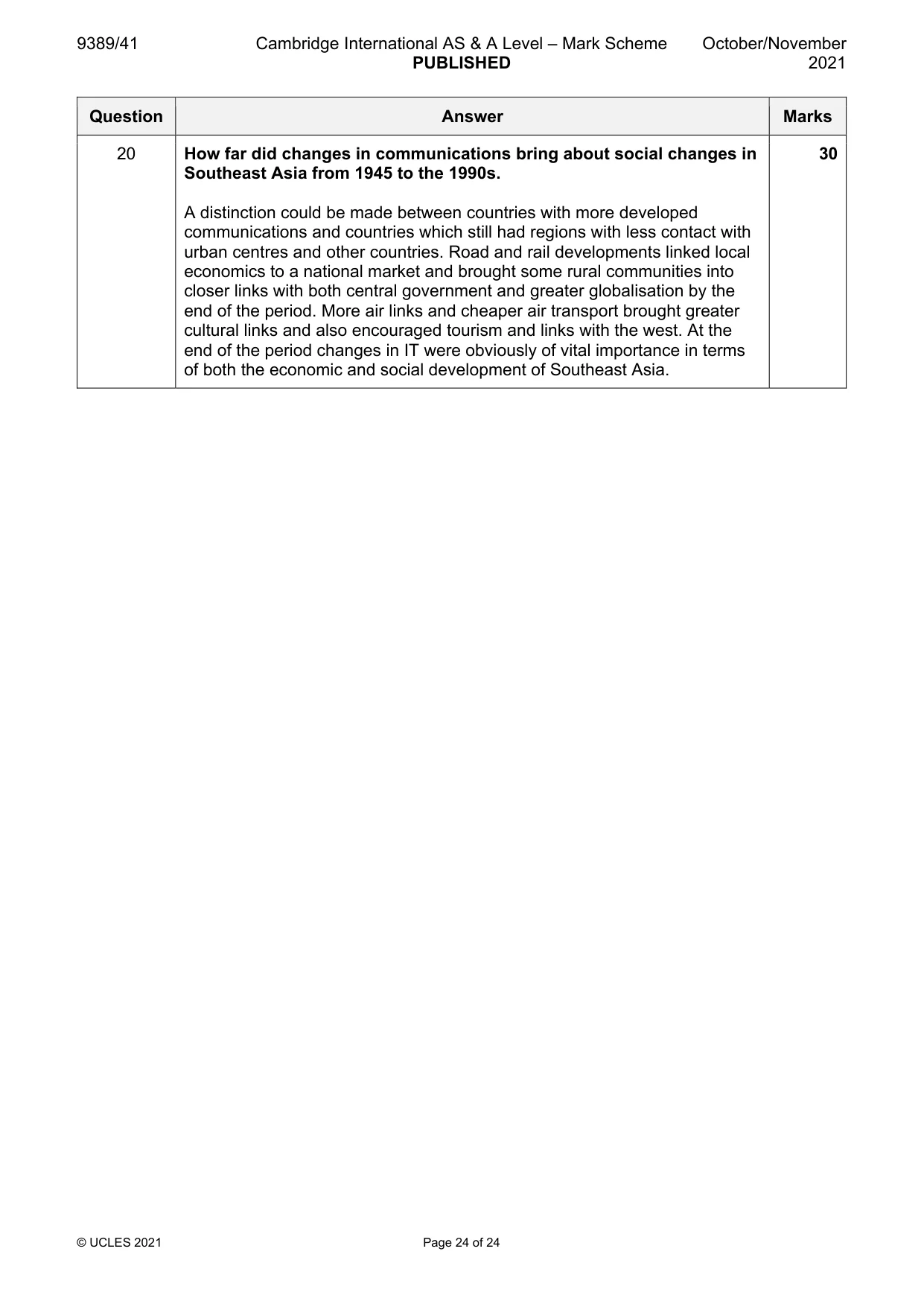
20 How far did changes in communications bring about social changes in Southeast Asia from 1945 to the 1990s? [30]
Mark scheme: 20 How far did changes in communications bring about social changes in 30 Southeast Asia from 1945 to the 1990s. A distinction could be made between countries with more developed communications and countries which still had regions with less contact with urban centres and other countries. Road and rail developments linked local economics to a national market and brought some rural communities into closer links with both central government and greater globalisation by the end of the period. More air links and cheaper air transport brought greater cultural links and also encouraged tourism and links with the west. At the end of the period changes in IT were obviously of vital importance in terms of both the economic and social development of Southeast Asia.
What you needed in this session
Cambridge’s own grade thresholds for 2021 Oct/Nov, Paper 4 · Variant 1. A higher threshold means an easier paper — the bar moves with how the cohort did.