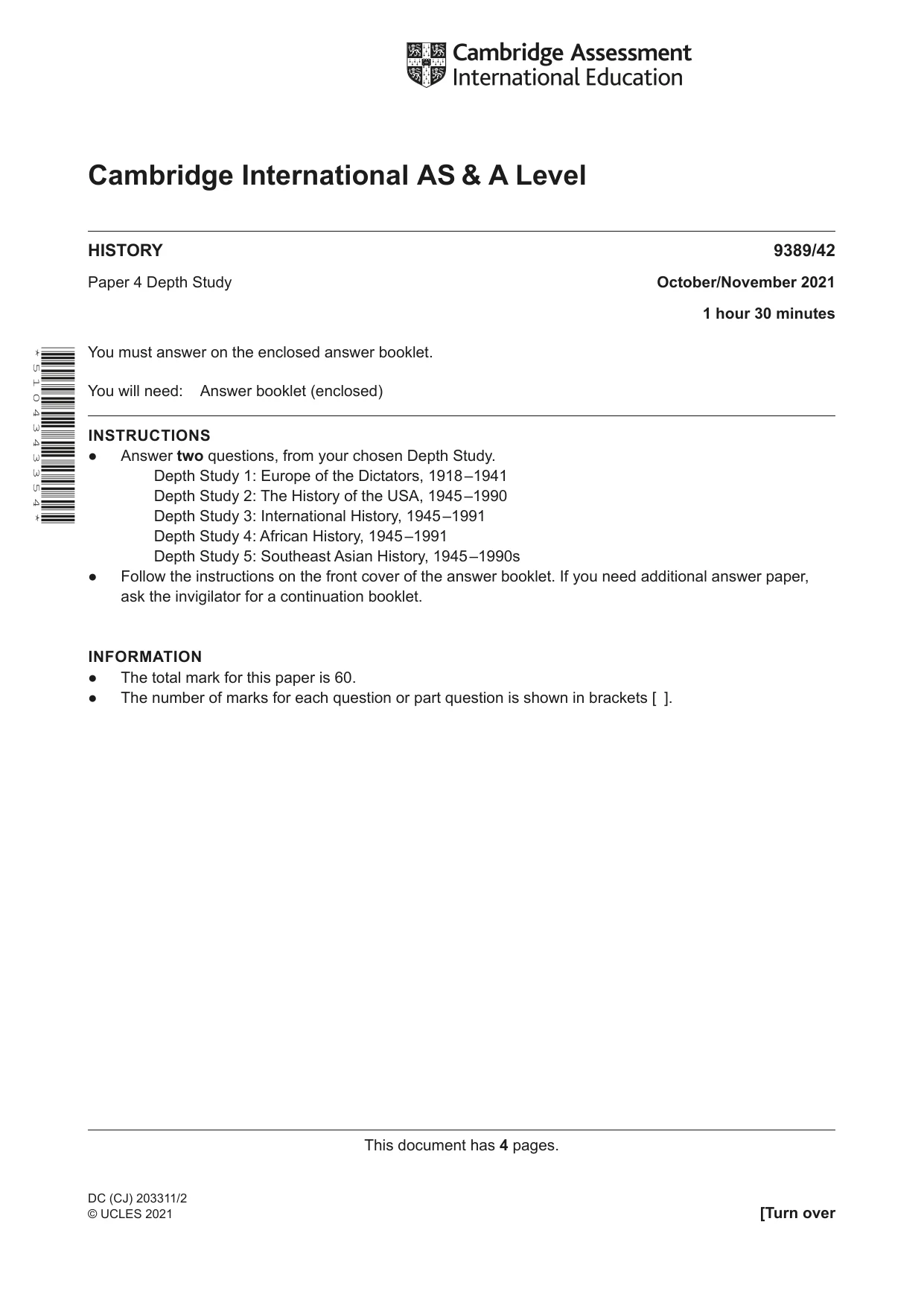
Cambridge A Level History 9389 — 2021 Oct/Nov Paper 4 · Variant 2
9389/42/O/N/21 · 20 questions · 60 marks · ≈68 min
The question paper and its mark scheme, free to read here and free to download. This is Cambridge’s own paper, exactly as it was sat.
Question paper4 pages
Mark scheme24 pages
Answers below. Sit the paper first if you are practising.

Questions as text
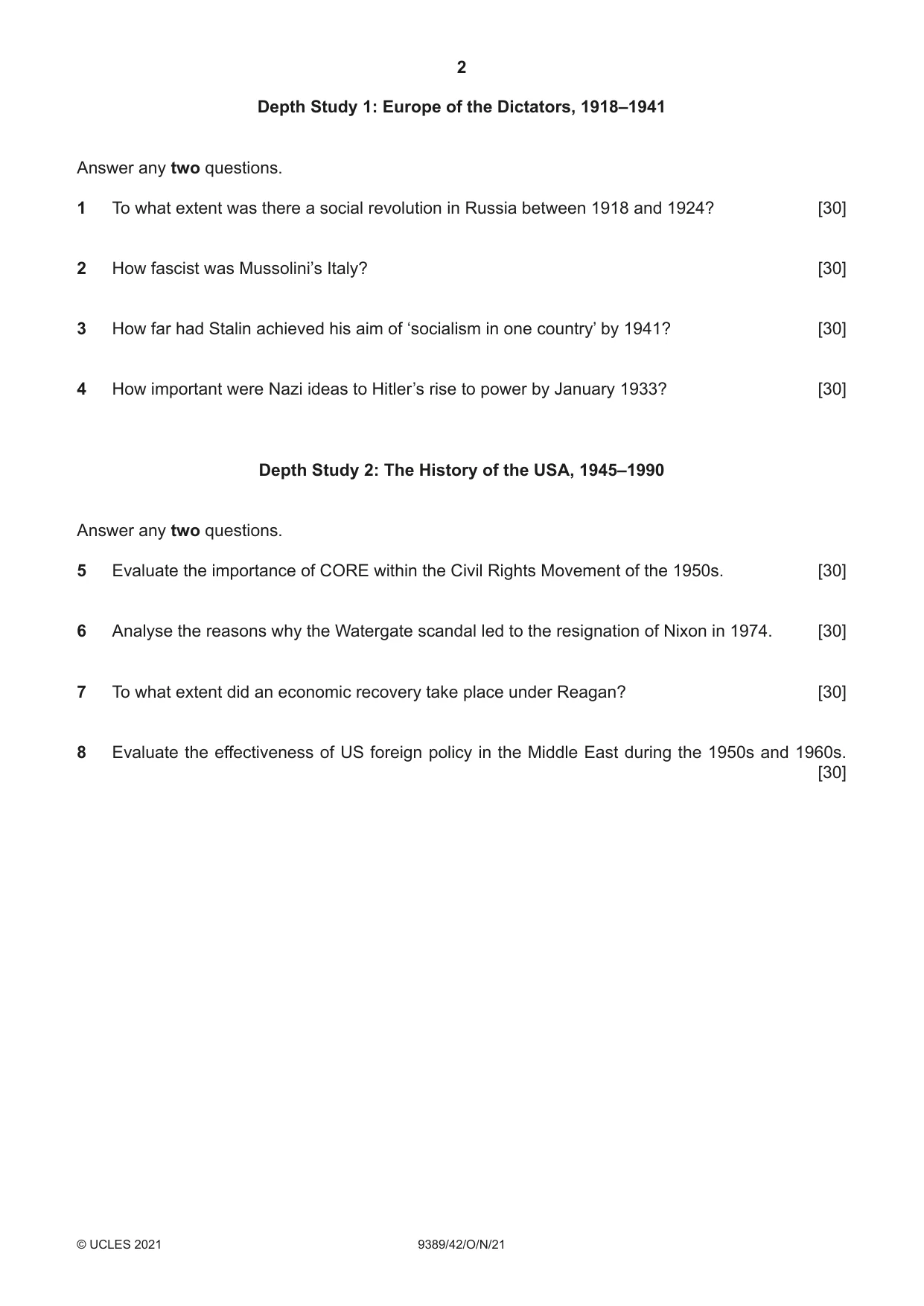
Q1 · To what extent was there a social revolution in Russia between 1918 and 1924?
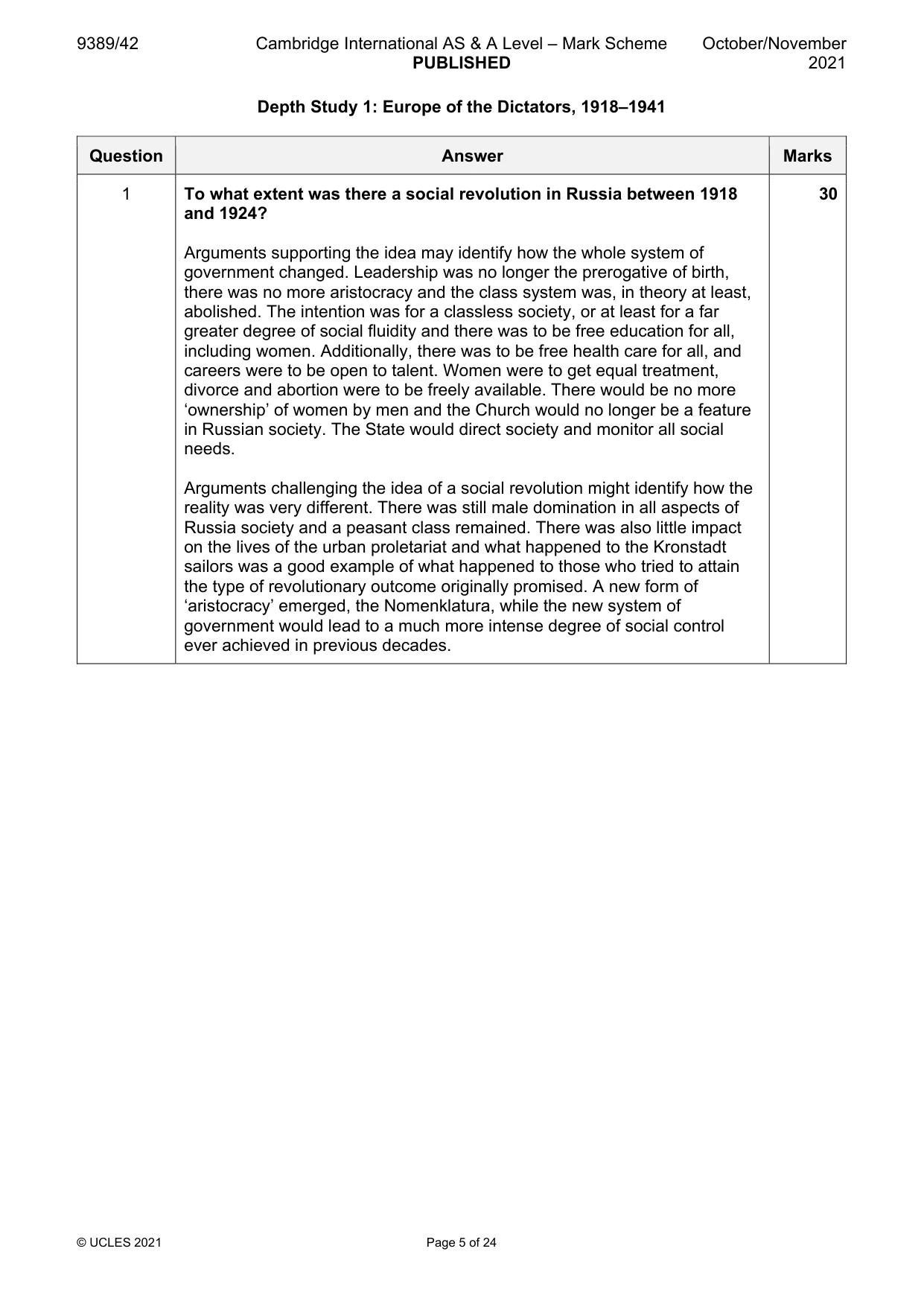
1 To what extent was there a social revolution in Russia between 1918 and 1924? [30]
Mark scheme: Question Answer Marks 1 To what extent was there a social revolution in Russia between 1918 30 and 1924? Arguments supporting the idea may identify how the whole system of government changed. Leadership was no longer the prerogative of birth, there was no more aristocracy and the class system was, in theory at least, abolished. The intention was for a classless society, or at least for a far greater degree of social fluidity and there was to be free education for all, including women. Additionally, there was to be free health care for all, and careers were to be open to talent. Women were to get equal treatment, divorce and abortion were to be freely available. There would be no more ‘ownership’ of women by men and the Church would no longer be a feature in Russian society. The State would direct society and monitor all social needs. Arguments challenging the idea of a social revolution might identify how the reality was very different. There was still male domination in all aspects of Russia society and a peasant class remained. There was also little impact on the lives of the urban proletariat and what happened to the Kronstadt sailors was a good example of what happened to those who tried to attain the type of revolutionary outcome originally promised. A new form of ‘aristocracy’ emerged, the Nomenklatura, while the new system of government would lead to a much more intense degree of social control ever achieved in previous decades.
Q2 · How fascist was Mussolini’s Italy?
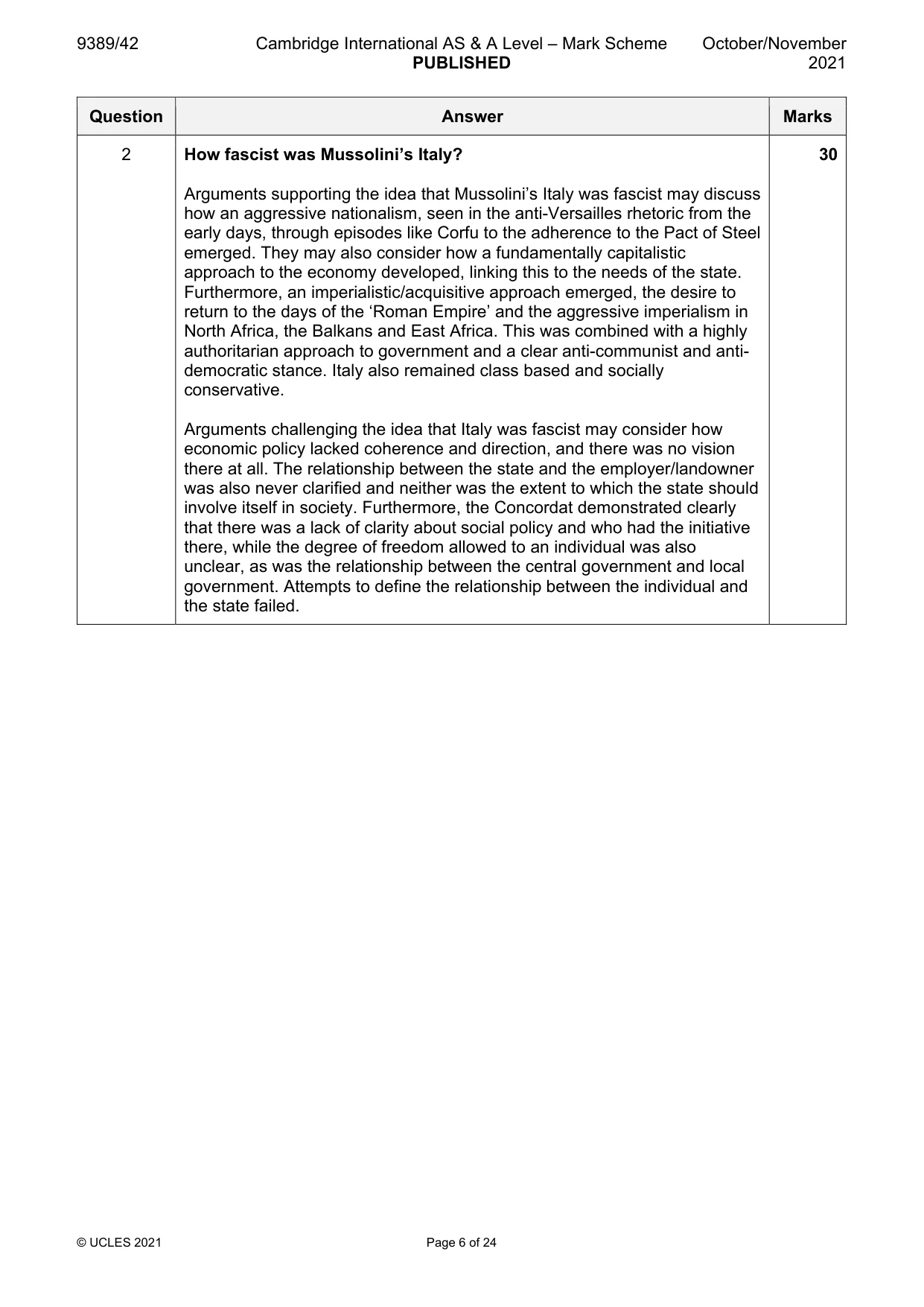
2 How fascist was Mussolini’s Italy? [30]
Mark scheme: 2 How fascist was Mussolini’s Italy? 30 Arguments supporting the idea that Mussolini’s Italy was fascist may discuss how an aggressive nationalism, seen in the anti-Versailles rhetoric from the early days, through episodes like Corfu to the adherence to the Pact of Steel emerged. They may also consider how a fundamentally capitalistic approach to the economy developed, linking this to the needs of the state. Furthermore, an imperialistic/acquisitive approach emerged, the desire to return to the days of the ‘Roman Empire’ and the aggressive imperialism in North Africa, the Balkans and East Africa. This was combined with a highly authoritarian approach to government and a clear anti-communist and anti- democratic stance. Italy also remained class based and socially conservative. Arguments challenging the idea that Italy was fascist may consider how economic policy lacked coherence and direction, and there was no vision there at all. The relationship between the state and the employer/landowner was also never clarified and neither was the extent to which the state should involve itself in society. Furthermore, the Concordat demonstrated clearly that there was a lack of clarity about social policy and who had the initiative there, while the degree of freedom allowed to an individual was also unclear, as was the relationship between the central government and local government. Attempts to define the relationship between the individual and the state failed.
Q3 · How far had Stalin achieved his aim of ‘socialism in one country’ by 1941?
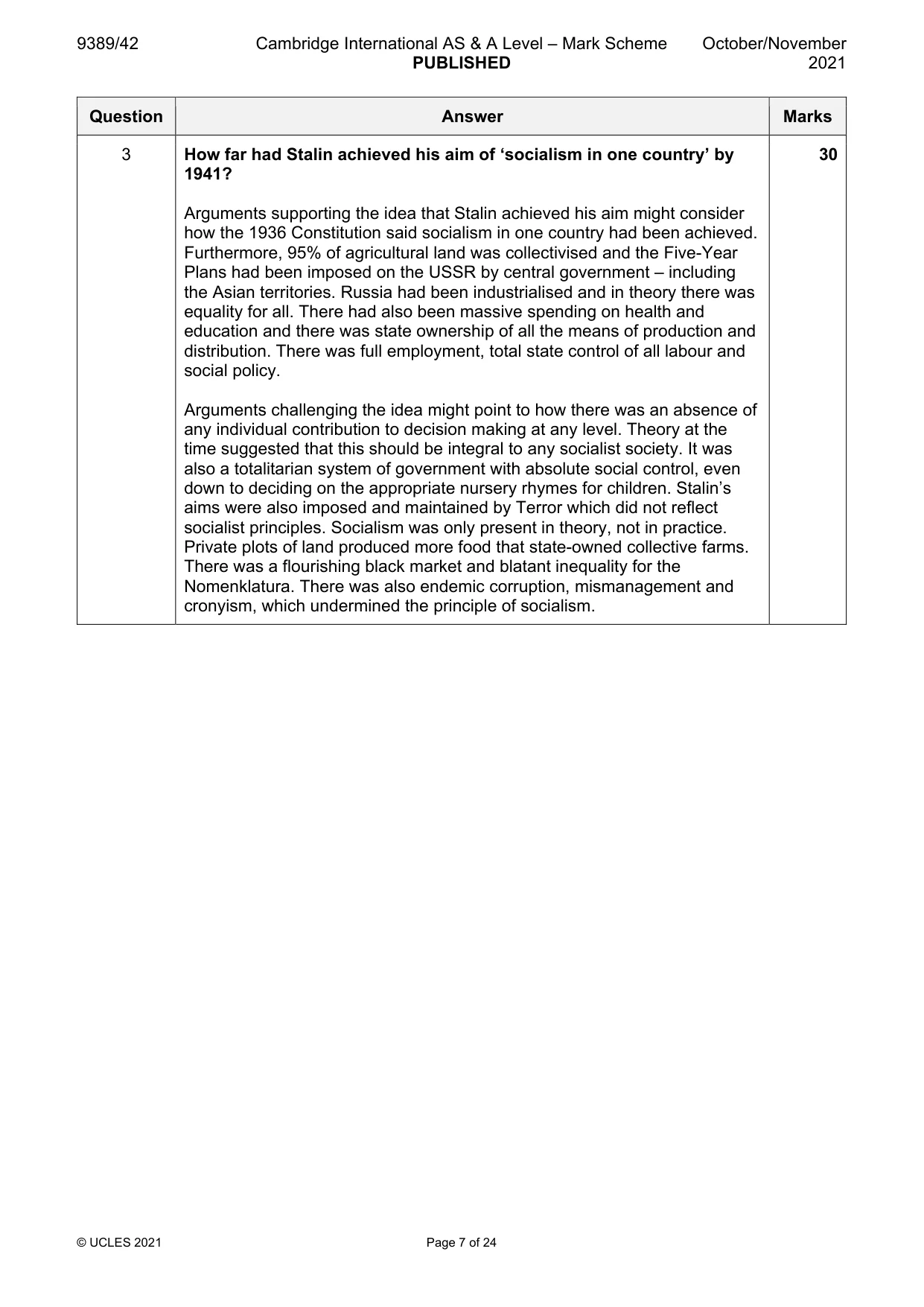
3 How far had Stalin achieved his aim of ‘socialism in one country’ by 1941? [30]
Mark scheme: 3 How far had Stalin achieved his aim of ‘socialism in one country’ by 30 1941? Arguments supporting the idea that Stalin achieved his aim might consider how the 1936 Constitution said socialism in one country had been achieved. Furthermore, 95% of agricultural land was collectivised and the Five-Year Plans had been imposed on the USSR by central government – including the Asian territories. Russia had been industrialised and in theory there was equality for all. There had also been massive spending on health and education and there was state ownership of all the means of production and distribution. There was full employment, total state control of all labour and social policy. Arguments challenging the idea might point to how there was an absence of any individual contribution to decision making at any level. Theory at the time suggested that this should be integral to any socialist society. It was also a totalitarian system of government with absolute social control, even down to deciding on the appropriate nursery rhymes for children. Stalin’s aims were also imposed and maintained by Terror which did not reflect socialist principles. Socialism was only present in theory, not in practice. Private plots of land produced more food that state-owned collective farms. There was a flourishing black market and blatant inequality for the Nomenklatura. There was also endemic corruption, mismanagement and cronyism, which undermined the principle of socialism.
Q4 · How important were Nazi ideas to Hitler’s rise to power by January 1933?
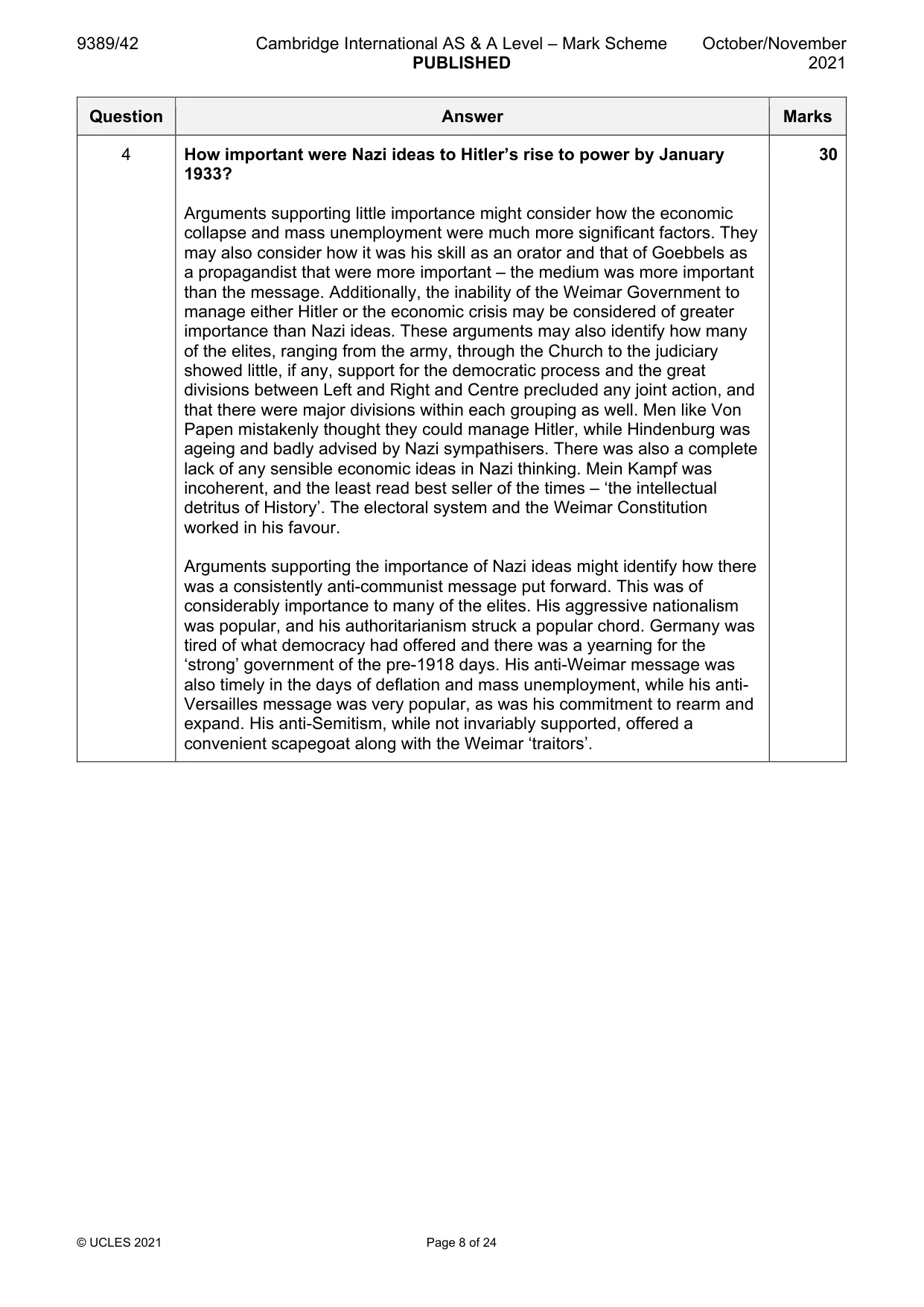
4 How important were Nazi ideas to Hitler’s rise to power by January 1933? [30] Depth Study 2: The History of the USA, 1945–1990 Answer any two questions.
Mark scheme: 4 How important were Nazi ideas to Hitler’s rise to power by January 30 1933? Arguments supporting little importance might consider how the economic collapse and mass unemployment were much more significant factors. They may also consider how it was his skill as an orator and that of Goebbels as a propagandist that were more important – the medium was more important than the message. Additionally, the inability of the Weimar Government to manage either Hitler or the economic crisis may be considered of greater importance than Nazi ideas. These arguments may also identify how many of the elites, ranging from the army, through the Church to the judiciary showed little, if any, support for the democratic process and the great divisions between Left and Right and Centre precluded any joint action, and that there were major divisions within each grouping as well. Men like Von Papen mistakenly thought they could manage Hitler, while Hindenburg was ageing and badly advised by Nazi sympathisers. There was also a complete lack of any sensible economic ideas in Nazi thinking. Mein Kampf was incoherent, and the least read best seller of the times – ‘the intellectual detritus of History’. The electoral system and the Weimar Constitution worked in his favour. Arguments supporting the importance of Nazi ideas might identify how there was a consistently anti-communist message put forward. This was of considerably importance to many of the elites. His aggressive nationalism was popular, and his authoritarianism struck a popular chord. Germany was tired of what democracy had offered and there was a yearning for the ‘strong’ government of the pre-1918 days. His anti-Weimar message was also timely in the days of deflation and mass unemployment, while his anti- Versailles message was very popular, as was his commitment to rearm and expand. His anti-Semitism, while not invariably supported, offered a convenient scapegoat along with the Weimar ‘traitors’. Depth Study 2: The History of the USA, 1945–1990
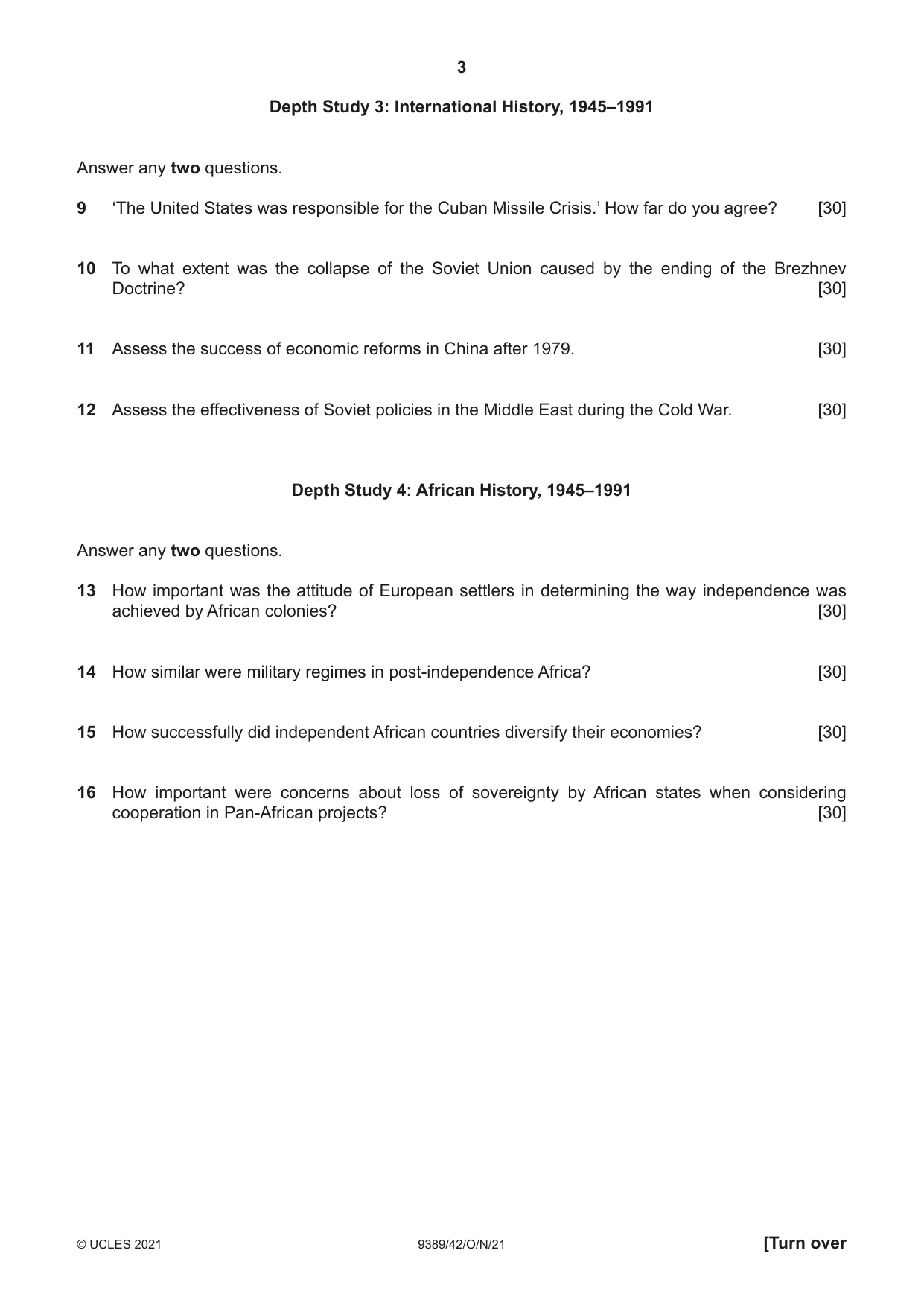
Q5 · Evaluate the importance of CORE within the Civil Rights Movement of the 1950s
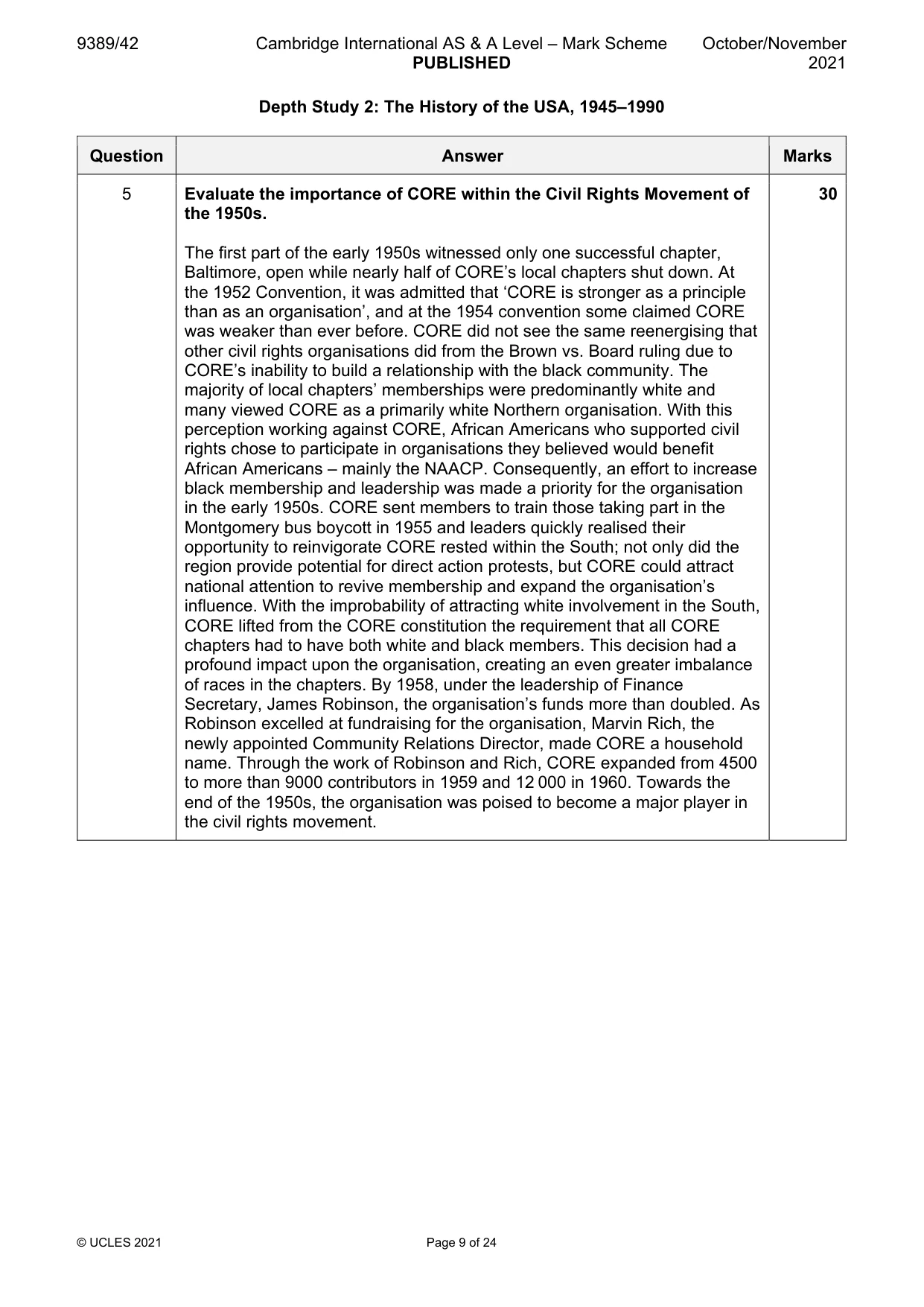
5 Evaluate the importance of CORE within the Civil Rights Movement of the 1950s. [30]
Mark scheme: 5 Evaluate the importance of CORE within the Civil Rights Movement of 30 the 1950s. The first part of the early 1950s witnessed only one successful chapter, Baltimore, open while nearly half of CORE’s local chapters shut down. At the 1952 Convention, it was admitted that ‘CORE is stronger as a principle than as an organisation’, and at the 1954 convention some claimed CORE was weaker than ever before. CORE did not see the same reenergising that other civil rights organisations did from the Brown vs. Board ruling due to CORE’s inability to build a relationship with the black community. The majority of local chapters’ memberships were predominantly white and many viewed CORE as a primarily white Northern organisation. With this perception working against CORE, African Americans who supported civil rights chose to participate in organisations they believed would benefit African Americans – mainly the NAACP. Consequently, an effort to increase black membership and leadership was made a priority for the organisation in the early 1950s. CORE sent members to train those taking part in the Montgomery bus boycott in 1955 and leaders quickly realised their opportunity to reinvigorate CORE rested within the South; not only did the region provide potential for direct action protests, but CORE could attract national attention to revive membership and expand the organisation’s influence. With the improbability of attracting white involvement in the South, CORE lifted from the CORE constitution the requirement that all CORE chapters had to have both white and black members. This decision had a profound impact upon the organisation, creating an even greater imbalance of races in the chapters. By 1958, under the leadership of Finance Secretary, James Robinson, the organisation’s funds more than doubled. As Robinson excelled at fundraising for the organisation, Marvin Rich, the newly appointed Community Relations Director, made CORE a household name. Through the work of Robinson and Rich, CORE expanded from 4500 to more than 9000 contributors in 1959 and 12 000 in 1960. Towards the end of the 1950s, the organisation was poised to become a major player in the civil rights movement.
Q6 · Analyse the reasons why the Watergate scandal led to the resignation of Nixon in 1974
6 Analyse the reasons why the Watergate scandal led to the resignation of Nixon in 1974. [30]
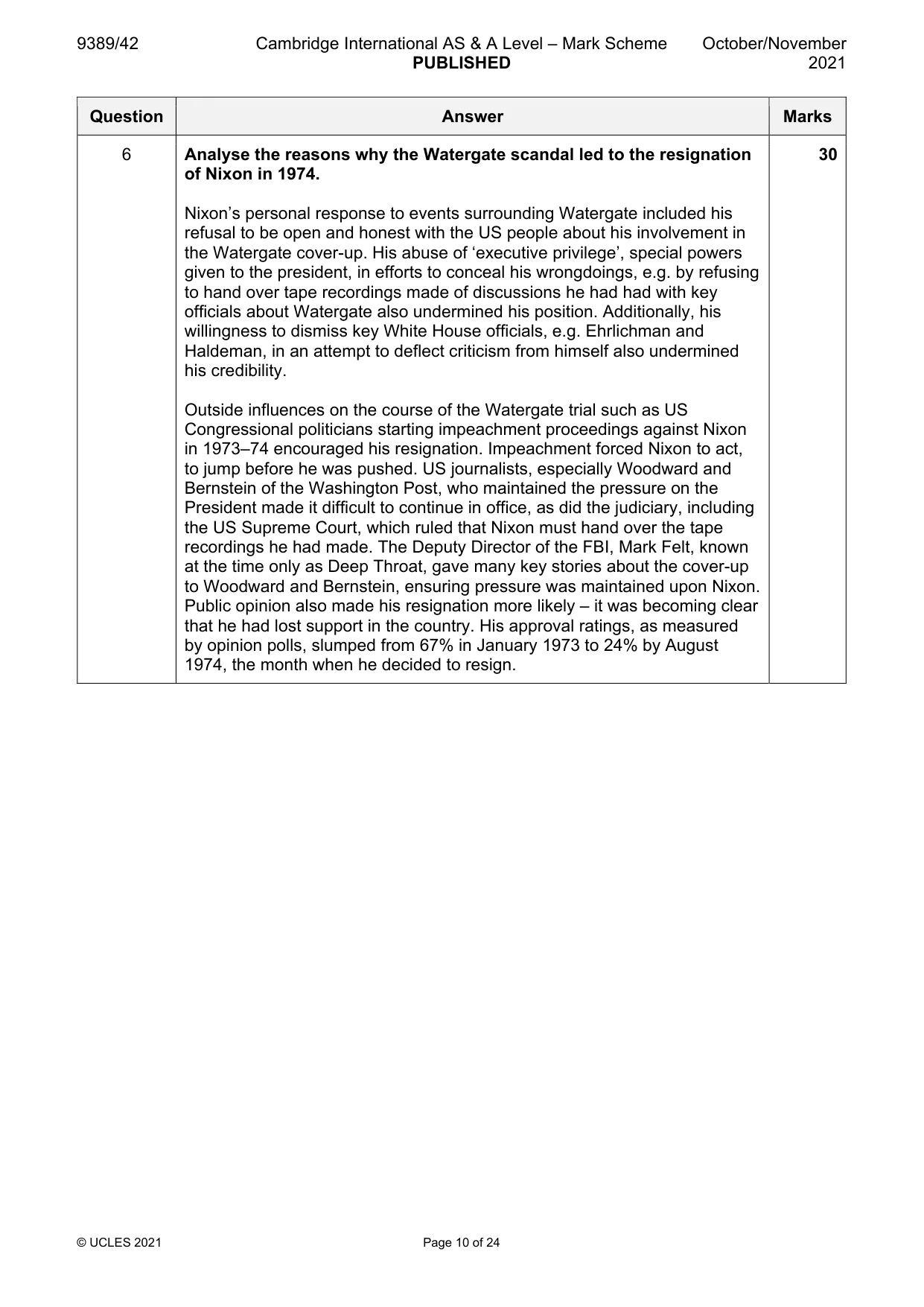
Mark scheme: 6 Analyse the reasons why the Watergate scandal led to the resignation 30 of Nixon in 1974. Nixon’s personal response to events surrounding Watergate included his refusal to be open and honest with the US people about his involvement in the Watergate cover-up. His abuse of ‘executive privilege’, special powers given to the president, in efforts to conceal his wrongdoings, e.g. by refusing to hand over tape recordings made of discussions he had had with key officials about Watergate also undermined his position. Additionally, his willingness to dismiss key White House officials, e.g. Ehrlichman and Haldeman, in an attempt to deflect criticism from himself also undermined his credibility. Outside influences on the course of the Watergate trial such as US Congressional politicians starting impeachment proceedings against Nixon in 1973–74 encouraged his resignation. Impeachment forced Nixon to act, to jump before he was pushed. US journalists, especially Woodward and Bernstein of the Washington Post, who maintained the pressure on the President made it difficult to continue in office, as did the judiciary, including the US Supreme Court, which ruled that Nixon must hand over the tape recordings he had made. The Deputy Director of the FBI, Mark Felt, known at the time only as Deep Throat, gave many key stories about the cover-up to Woodward and Bernstein, ensuring pressure was maintained upon Nixon. Public opinion also made his resignation more likely – it was becoming clear that he had lost support in the country. His approval ratings, as measured by opinion polls, slumped from 67% in January 1973 to 24% by August 1974, the month when he decided to resign.
Q7 · To what extent did an economic recovery take place under Reagan?
7 To what extent did an economic recovery take place under Reagan? [30]
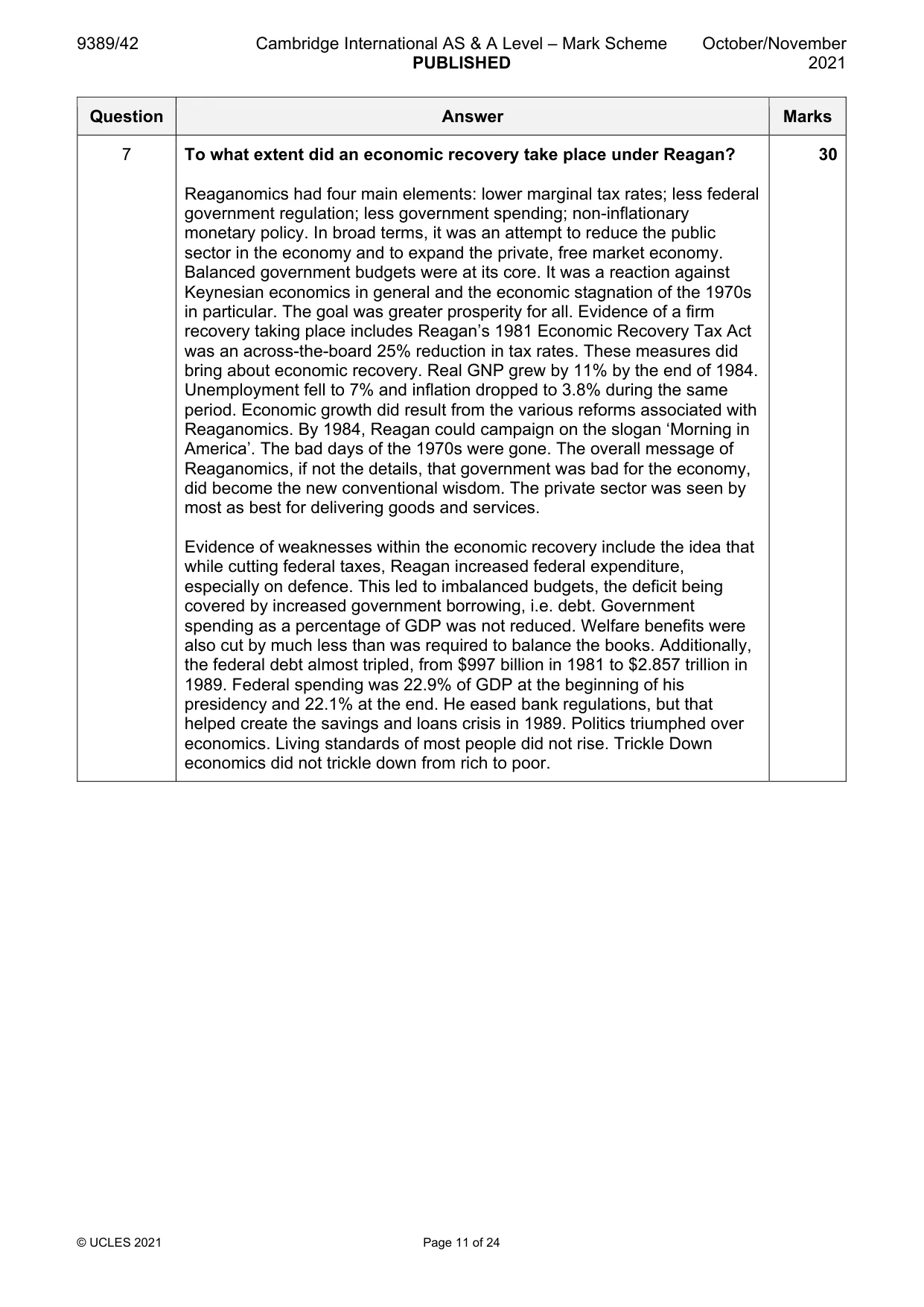
Mark scheme: 7 To what extent did an economic recovery take place under Reagan? 30 Reaganomics had four main elements: lower marginal tax rates; less federal government regulation; less government spending; non-inflationary monetary policy. In broad terms, it was an attempt to reduce the public sector in the economy and to expand the private, free market economy. Balanced government budgets were at its core. It was a reaction against Keynesian economics in general and the economic stagnation of the 1970s in particular. The goal was greater prosperity for all. Evidence of a firm recovery taking place includes Reagan’s 1981 Economic Recovery Tax Act was an across-the-board 25% reduction in tax rates. These measures did bring about economic recovery. Real GNP grew by 11% by the end of 1984. Unemployment fell to 7% and inflation dropped to 3.8% during the same period. Economic growth did result from the various reforms associated with Reaganomics. By 1984, Reagan could campaign on the slogan ‘Morning in America’. The bad days of the 1970s were gone. The overall message of Reaganomics, if not the details, that government was bad for the economy, did become the new conventional wisdom. The private sector was seen by most as best for delivering goods and services. Evidence of weaknesses within the economic recovery include the idea that while cutting federal taxes, Reagan increased federal expenditure, especially on defence. This led to imbalanced budgets, the deficit being covered by increased government borrowing, i.e. debt. Government spending as a percentage of GDP was not reduced. Welfare benefits were also cut by much less than was required to balance the books. Additionally, the federal debt almost tripled, from $997 billion in 1981 to $2.857 trillion in 1989. Federal spending was 22.9% of GDP at the beginning of his presidency and 22.1% at the end. He eased bank regulations, but that helped create the savings and loans crisis in 1989. Politics triumphed over economics. Living standards of most people did not rise. Trickle Down economics did not trickle down from rich to poor.
Q8 · Evaluate the effectiveness of US foreign policy in the Middle East during the 1950s and…
8 Evaluate the effectiveness of US foreign policy in the Middle East during the 1950s and 1960s. [30] Depth Study 3: International History, 1945–1991 Answer any two questions.
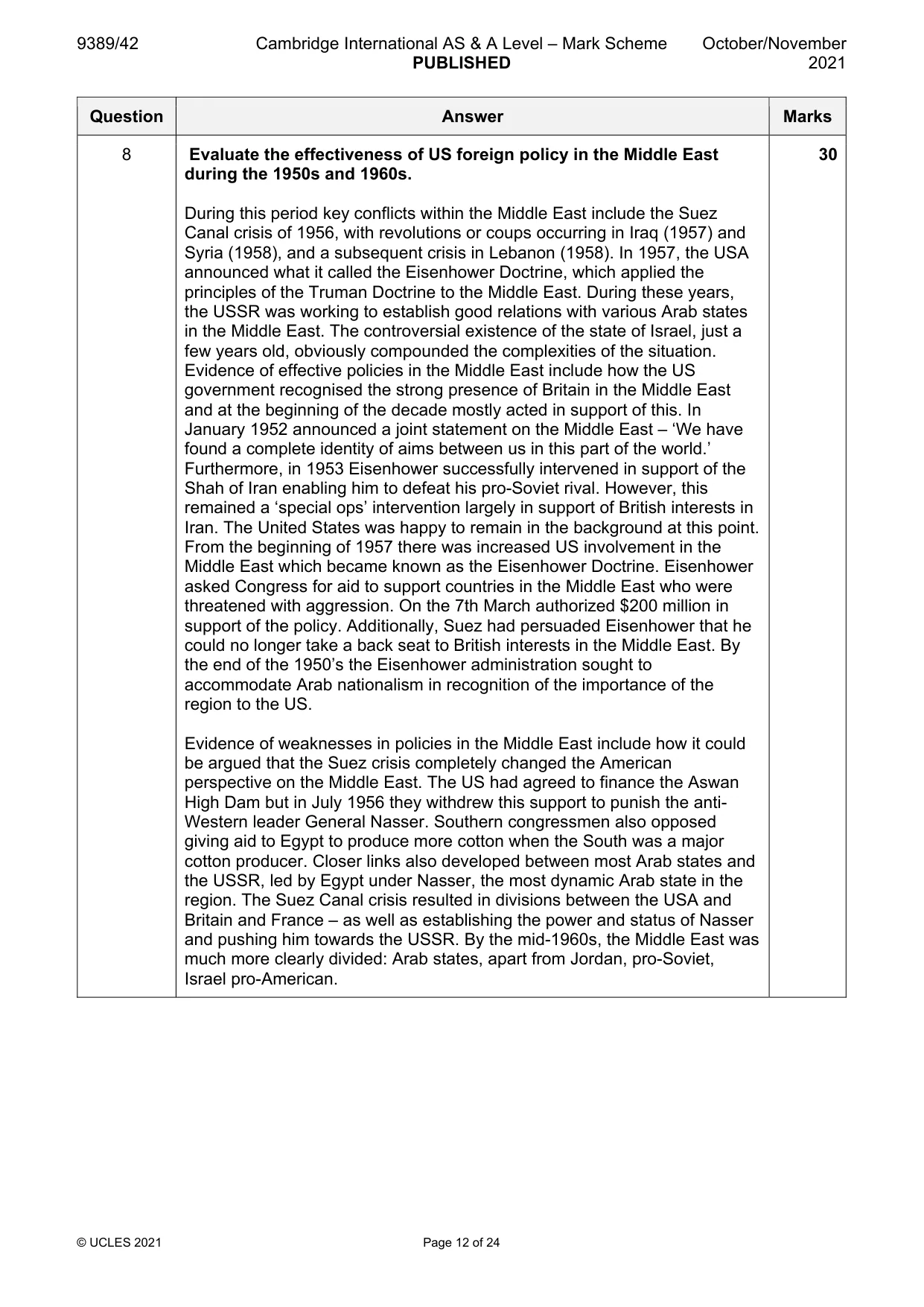
Mark scheme: 8 Evaluate the effectiveness of US foreign policy in the Middle East 30 during the 1950s and 1960s. During this period key conflicts within the Middle East include the Suez Canal crisis of 1956, with revolutions or coups occurring in Iraq (1957) and Syria (1958), and a subsequent crisis in Lebanon (1958). In 1957, the USA announced what it called the Eisenhower Doctrine, which applied the principles of the Truman Doctrine to the Middle East. During these years, the USSR was working to establish good relations with various Arab states in the Middle East. The controversial existence of the state of Israel, just a few years old, obviously compounded the complexities of the situation. Evidence of effective policies in the Middle East include how the US government recognised the strong presence of Britain in the Middle East and at the beginning of the decade mostly acted in support of this. In January 1952 announced a joint statement on the Middle East – ‘We have found a complete identity of aims between us in this part of the world.’ Furthermore, in 1953 Eisenhower successfully intervened in support of the Shah of Iran enabling him to defeat his pro-Soviet rival. However, this remained a ‘special ops’ intervention largely in support of British interests in Iran. The United States was happy to remain in the background at this point. From the beginning of 1957 there was increased US involvement in the Middle East which became known as the Eisenhower Doctrine. Eisenhower asked Congress for aid to support countries in the Middle East who were threatened with aggression. On the 7th March authorized $200 million in support of the policy. Additionally, Suez had persuaded Eisenhower that he could no longer take a back seat to British interests in the Middle East. By the end of the 1950’s the Eisenhower administration sought to accommodate Arab nationalism in recognition of the importance of the region to the US. Evidence of weaknesses in policies in the Middle East include how it could be argued that the Suez crisis completely changed the American perspective on the Middle East. The US had agreed to finance the Aswan High Dam but in July 1956 they withdrew this support to punish the anti- Western leader General Nasser. Southern congressmen also opposed giving aid to Egypt to produce more cotton when the South was a major cotton producer. Closer links also developed between most Arab states and the USSR, led by Egypt under Nasser, the most dynamic Arab state in the region. The Suez Canal crisis resulted in divisions between the USA and Britain and France – as well as establishing the power and status of Nasser and pushing him towards the USSR. By the mid-1960s, the Middle East was much more clearly divided: Arab states, apart from Jordan, pro-Soviet, Israel pro-American. Depth Study 3: International History, 1945–1991
Q9 · ‘The United States was responsible for the Cuban Missile Crisis.’ How far do you agree?
9 ‘The United States was responsible for the Cuban Missile Crisis.’ How far do you agree? [30]
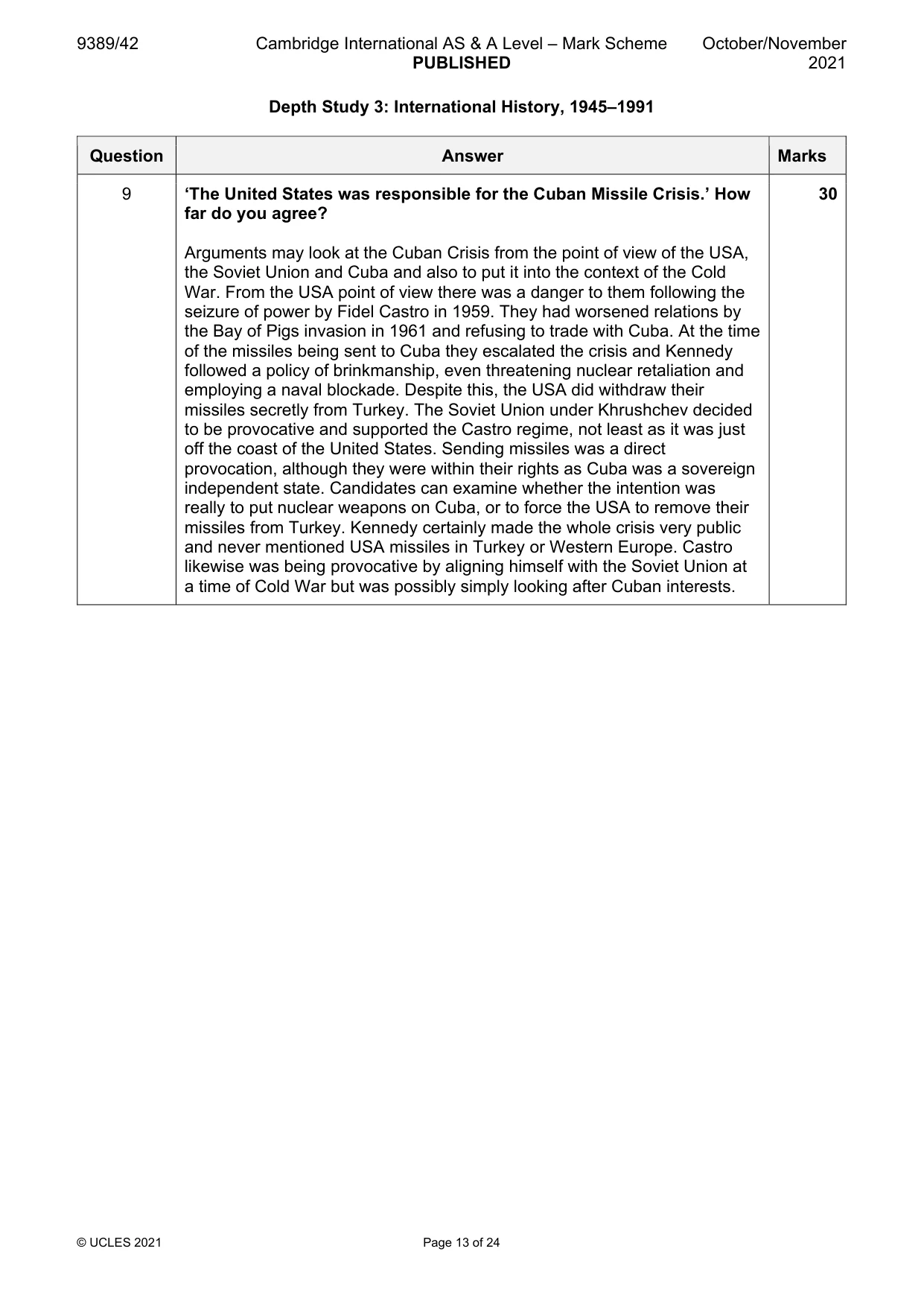
Mark scheme: 9 ‘The United States was responsible for the Cuban Missile Crisis.’ How 30 far do you agree? Arguments may look at the Cuban Crisis from the point of view of the USA, the Soviet Union and Cuba and also to put it into the context of the Cold War. From the USA point of view there was a danger to them following the seizure of power by Fidel Castro in 1959. They had worsened relations by the Bay of Pigs invasion in 1961 and refusing to trade with Cuba. At the time of the missiles being sent to Cuba they escalated the crisis and Kennedy followed a policy of brinkmanship, even threatening nuclear retaliation and employing a naval blockade. Despite this, the USA did withdraw their missiles secretly from Turkey. The Soviet Union under Khrushchev decided to be provocative and supported the Castro regime, not least as it was just off the coast of the United States. Sending missiles was a direct provocation, although they were within their rights as Cuba was a sovereign independent state. Candidates can examine whether the intention was really to put nuclear weapons on Cuba, or to force the USA to remove their missiles from Turkey. Kennedy certainly made the whole crisis very public and never mentioned USA missiles in Turkey or Western Europe. Castro likewise was being provocative by aligning himself with the Soviet Union at a time of Cold War but was possibly simply looking after Cuban interests.
Q10 · To what extent was the collapse of the Soviet Union caused by the ending of the Brezhnev…
10 To what extent was the collapse of the Soviet Union caused by the ending of the Brezhnev Doctrine? [30]
Mark scheme: 10 To what extent was the collapse of the Soviet Union caused by the 30 ending of the Brezhnev Doctrine? The Brezhnev Doctrine’s replacement with the Sinatra Doctrine was vital to the spread of nationalism in Eastern Europe and the collapse of the Warsaw Pact. This in turn led to nationalist demands growing within the Baltic States and finally within the Soviet Union itself. Ultimately even Russia left the Soviet Union. Arguments may also look at the policies of Perestroika that culminated in Catastroika, Glasnost and the failure of the relationship between Gorbachev and Yeltsin as contributory factors in the collapse of the Soviet Union. To this could be added the previous structural problems of the Soviet Union, economic decline, the pressure applied by the West in the Second Cold War. The policies and their failure of Gorbachev do need close examination and also an evaluation of the view that a totalitarian regime cannot ever successfully reform itself.
Q11 · Assess the success of economic reforms in China after 1979
11 Assess the success of economic reforms in China after 1979. [30]
Mark scheme: 11 Assess the success of economic reform in China after 1979. 30 Deng instigated the four modernisations programme involving national defence; agriculture; industry; and science and technology. He opened up China to foreign trade and restored the market economy. In the countryside the commune was abandoned, and a household responsibility system was introduced whereby individual families would contribute a share of their output to the government. He stressed individual responsibility in the making of economic decisions. Deng’s liberalisation of the economy led to China becoming wealthier. Chinese exports increased by over 500% between 1981 and 1991. Deng also conducted internal reform within the CCP designed to strengthen the party. The Third Plenum of the 11th Central Committee of the PRC in December 1978 resolved to restore party democracy. Those who had been wrongly condemned during the 1960s and 1970s were to be rehabilitated. Deng wanted to remove aspects of Maoism that had prevented progress; he supported the criticism of the Gang of Four who were put on trial in 1980. In 1981 Deng announced that Mao was 70% right and 30% wrong. He changed the structure of the CCP; he encouraged younger members into positions of authority, in a bid to modernise China. This again raised people’s hopes of further political reform. While Deng’s economic reforms ultimately contributed to China’s increased wealth and growing economy, there was a downside to modernisation with an increase in prices for consumer goods, overcrowding as a result of urbanisation and inflation which reduced wages. However. Deng’s determination meant that the communists retained control. Deng’s four cardinal principles consisted of keeping to the socialist road; remaining a dictatorship of the proletariat; upholding the leadership of the Communist Party and the supremacy of Marxist-Leninism and Mao Zedong Thought. He wanted China to be protected from western political ideas and was not prepared to tolerate political freedom. The treatment of Wei Jingsheng was a warning of this. Wei published the ‘Fifth Modernisation’ pamphlet which advocated democracy. He criticised Deng and was arrested in March 1979. In 1980 Article 45 was deleted from the Chinese Constitution. The article stated that citizens had the right to speak out freely, air their views fully, hold debates and write big-character posters. There were disturbances in 1986 in universities in Hefei, Wuhan and Shanghai. A professor at Hefei called for open government and democracy which prompted Deng to condemn bourgeois liberalisation. He confirmed that there could be no genuine democracy in China, the country could not depart from socialism and the leadership of the CCP was necessary for this. Deng’s political intransigence combined with economic liberalisation ultimately ensured the survival of communism in China.
Q12 · Assess the effectiveness of Soviet policies in the Middle East during the Cold War
12 Assess the effectiveness of Soviet policies in the Middle East during the Cold War. [30] Depth Study 4: African History, 1945–1991 Answer any two questions.
Mark scheme: 12 Assess the effectiveness of Soviet policies in the Middle East during 30 the Cold War. Soviet policies were designed to ensure that they could achieve parity with the United States by establishing naval and military bases throughout the Middle East. The Soviet Union also wanted to encourage local communist movements as well as support regional conflict providing it with a pretext for intervention while avoiding war with the United States. America sought to deny the Soviets access to Middle Eastern territory and, through the policy of containment, inhibit the expansion of the Soviet sphere of influence. The Soviet Union exploited Arab nationalism in both Egypt and Syria as well as the Arab-Israel enmity. In 1955 it supplied arms to both Egypt and Syria and supported Nasser’s stance in the Suez crisis. This was a positive move for the Soviet Union as it led to Soviet acquisition of naval and air facilities. Its main objective was to ensure that the United States did not have an advantage in the area. Its acquisition of bases in Syria and Egypt enabled it to rival the United States and, with access to bases within range of America’s European allies, the Soviet nuclear deterrent capability was much enhanced. The Soviets also acquired the use of Alexandria, Port Said and Latakia providing them with access to the Mediterranean and enabling them to begin a naval build-up in the area and to limit the influence of the United States. The Soviet Union therefore made use of anti-American and anti- Israeli sentiment for its own ends. Until 1973 the Soviets were quite successful in supplying arms and aid to gain influence by assisting Arab states in the Arab-Israeli conflict. In 1967, the year of the Six-Day war with Israel, Nasser accepted the presence of Soviet forces in the Mediterranean. After the Arab defeat the Soviets supplied the Egyptians with more arms and based about 20 000 air and naval personnel in Egypt. Limited progress was made in areas where there was little anti-American sentiment such as in Iran under the Shah. The Soviets were also unable to spread their communist ideology and were unable to produce a communist revolutionary movement in the Middle East. In 1972 at the Moscow Summit, the Soviets had the dilemma of opposing war and supporting détente or continuing their arms commitment to the Arabs. President Sadat was determined to secure a victory against the Israelis and when the Soviets refused him arms, he expelled their military advisers from Egypt. However, they did agree to support him in the Yom Kippur War of 1973, but both the Soviets and the United States demanded a ceasefire which was supported by the UN. It was Henry Kissinger of the United States who secured a series of agreements in 1974–5. Israel agreed to withdraw forces from the Suez Canal area and part of the Golan Heights. Egypt was able to reopen the canal in 1975. Sadat was keen for there to be a Middle East Treaty and it was President Carter who negotiated the Camp David Agreements of 1978 leading to a bilateral treaty between Egypt and Israel in 1979. Depth Study 4: African History, 1945–1991
Q13 · How important was the attitude of European settlers in determining the way independence…
13 How important was the attitude of European settlers in determining the way independence was achieved by African colonies? [30]
Mark scheme: 13 How important was the attitude of European settlers in determining the 30 way independence was achieved by African colonies? Only some colonies had significant numbers of white settlers. Although many European administrators, missionaries and merchants worked in West Africa, few settled permanently. They were not a factor in the achievement of independence in this region. However, in east and central Africa in the British colonies of Kenya, and Northern and Southern Rhodesia their attitude was important. White settlers were attracted to these colonies by fertile land, mineral wealth and a favourable climate. After 1945 Britain had encouraged emigration to Africa and the settlers expected her to protect their interests. Although, Britain’s attitude to independence in West Africa changed after World War II, she did not expect independence to become an issue in other colonies for a long time because these colonies had limited development. However, nationalism was a growing force and mass parties with new leaders were formed. In Kenya the rapid increase in white settlers in the fertile land of the White highlands, where the Kikuyu people lived, was a cause of increased anger and frustration. This led to the Mau Mau uprising (1952–1960) which had to be suppressed by British troops at great expense. This changed the attitude of the British government, showing that the demands of the white settlers counted for little in the long run. Tanganyika, Uganda and Kenya (east Africa) and Malawi and Zambia (central Africa) were all independent by 1964. The exception was Southern Rhodesia, which had been self-governing since 1923. In 1965, the settlers declared themselves independent of Britain. Zimbabwe was only created in 1980 after a protracted guerrilla war with nationalist armies, backed by Russia and China. The example of Algeria might be identified. Here France fought a war against the National Liberation Front between 1954 and 1962. Portugal considered Mozambique and Angola to be an integral part of Portugal. Political activity was banned by the dictatorship of Salazar. Costly guerrilla wars led by nationalists in Africa, backed by Russia and China, helped create a revolution in Portugal in 1974. Independence was immediately given to the colonies, showing it was the Portuguese government rather than the settlers that had most influence.
Q14 · How similar were military regimes in post-independence Africa?
14 How similar were military regimes in post-independence Africa? [30]
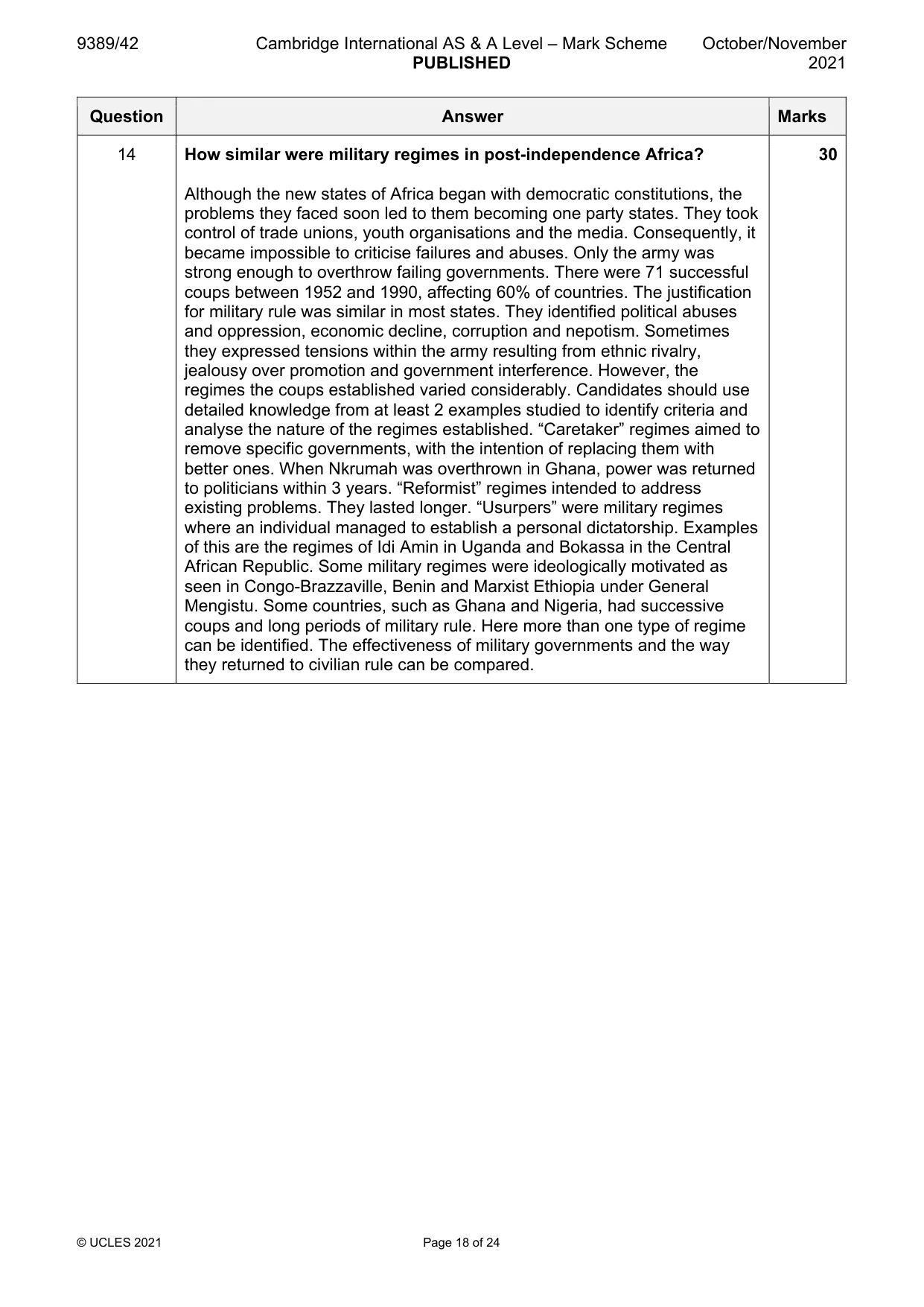
Mark scheme: 14 How similar were military regimes in post-independence Africa? 30 Although the new states of Africa began with democratic constitutions, the problems they faced soon led to them becoming one party states. They took control of trade unions, youth organisations and the media. Consequently, it became impossible to criticise failures and abuses. Only the army was strong enough to overthrow failing governments. There were 71 successful coups between 1952 and 1990, affecting 60% of countries. The justification for military rule was similar in most states. They identified political abuses and oppression, economic decline, corruption and nepotism. Sometimes they expressed tensions within the army resulting from ethnic rivalry, jealousy over promotion and government interference. However, the regimes the coups established varied considerably. Candidates should use detailed knowledge from at least 2 examples studied to identify criteria and analyse the nature of the regimes established. “Caretaker” regimes aimed to remove specific governments, with the intention of replacing them with better ones. When Nkrumah was overthrown in Ghana, power was returned to politicians within 3 years. “Reformist” regimes intended to address existing problems. They lasted longer. “Usurpers” were military regimes where an individual managed to establish a personal dictatorship. Examples of this are the regimes of Idi Amin in Uganda and Bokassa in the Central African Republic. Some military regimes were ideologically motivated as seen in Congo-Brazzaville, Benin and Marxist Ethiopia under General Mengistu. Some countries, such as Ghana and Nigeria, had successive coups and long periods of military rule. Here more than one type of regime can be identified. The effectiveness of military governments and the way they returned to civilian rule can be compared.
Q15 · How successfully did independent African countries diversify their economies?
15 How successfully did independent African countries diversify their economies? [30]
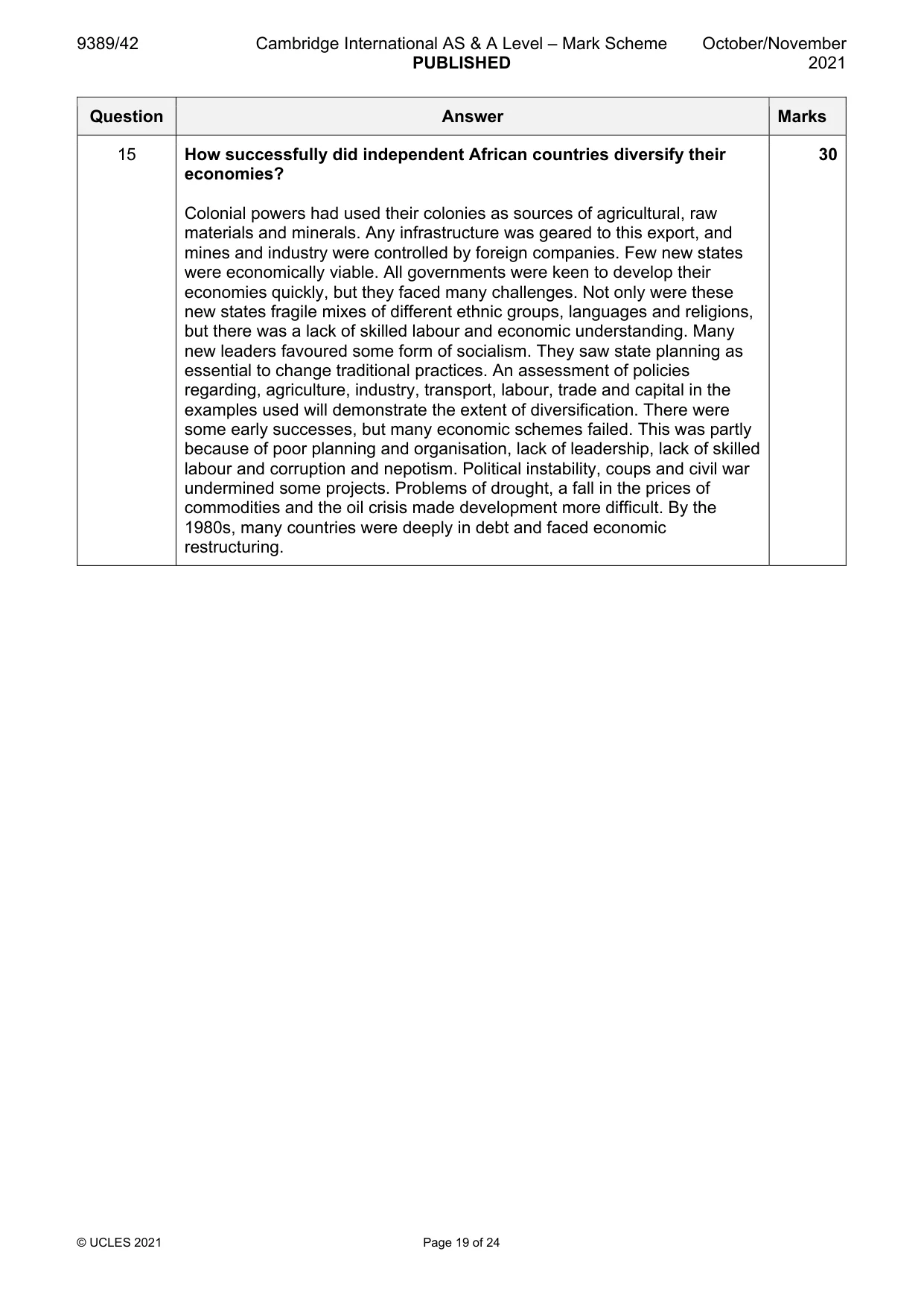
Mark scheme: 15 How successfully did independent African countries diversify their 30 economies? Colonial powers had used their colonies as sources of agricultural, raw materials and minerals. Any infrastructure was geared to this export, and mines and industry were controlled by foreign companies. Few new states were economically viable. All governments were keen to develop their economies quickly, but they faced many challenges. Not only were these new states fragile mixes of different ethnic groups, languages and religions, but there was a lack of skilled labour and economic understanding. Many new leaders favoured some form of socialism. They saw state planning as essential to change traditional practices. An assessment of policies regarding, agriculture, industry, transport, labour, trade and capital in the examples used will demonstrate the extent of diversification. There were some early successes, but many economic schemes failed. This was partly because of poor planning and organisation, lack of leadership, lack of skilled labour and corruption and nepotism. Political instability, coups and civil war undermined some projects. Problems of drought, a fall in the prices of commodities and the oil crisis made development more difficult. By the 1980s, many countries were deeply in debt and faced economic restructuring.
Q16 · How important were concerns about loss of sovereignty by African states when considering…
16 How important were concerns about loss of sovereignty by African states when considering cooperation in Pan-African projects? [30] Depth Study 5: Southeast Asian History, 1945–1990s Answer any two questions.
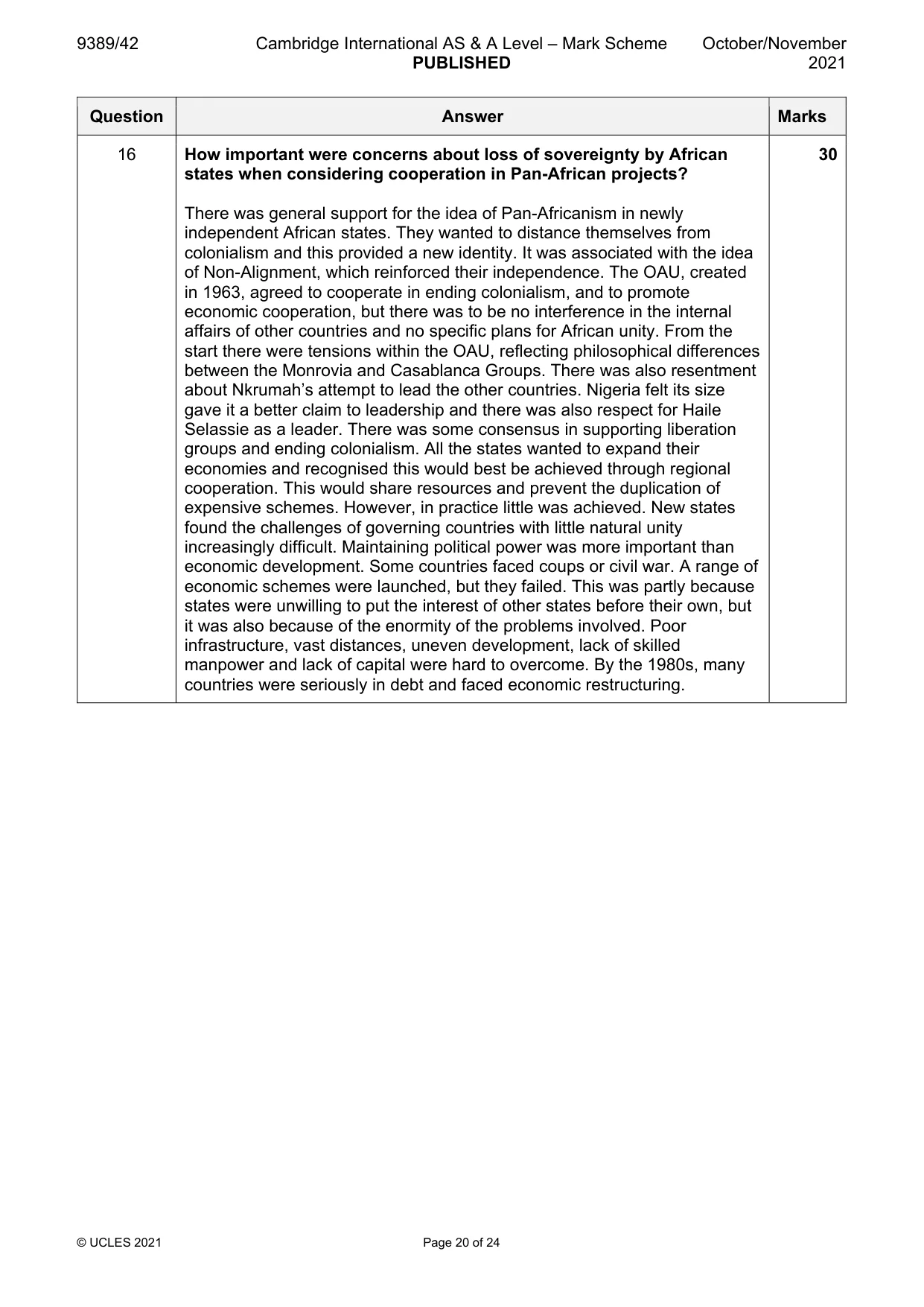
Mark scheme: 16 How important were concerns about loss of sovereignty by African 30 states when considering cooperation in Pan-African projects? There was general support for the idea of Pan-Africanism in newly independent African states. They wanted to distance themselves from colonialism and this provided a new identity. It was associated with the idea of Non-Alignment, which reinforced their independence. The OAU, created in 1963, agreed to cooperate in ending colonialism, and to promote economic cooperation, but there was to be no interference in the internal affairs of other countries and no specific plans for African unity. From the start there were tensions within the OAU, reflecting philosophical differences between the Monrovia and Casablanca Groups. There was also resentment about Nkrumah’s attempt to lead the other countries. Nigeria felt its size gave it a better claim to leadership and there was also respect for Haile Selassie as a leader. There was some consensus in supporting liberation groups and ending colonialism. All the states wanted to expand their economies and recognised this would best be achieved through regional cooperation. This would share resources and prevent the duplication of expensive schemes. However, in practice little was achieved. New states found the challenges of governing countries with little natural unity increasingly difficult. Maintaining political power was more important than economic development. Some countries faced coups or civil war. A range of economic schemes were launched, but they failed. This was partly because states were unwilling to put the interest of other states before their own, but it was also because of the enormity of the problems involved. Poor infrastructure, vast distances, uneven development, lack of skilled manpower and lack of capital were hard to overcome. By the 1980s, many countries were seriously in debt and faced economic restructuring. Depth Study 5: Southeast Asian History, 1945–1990s
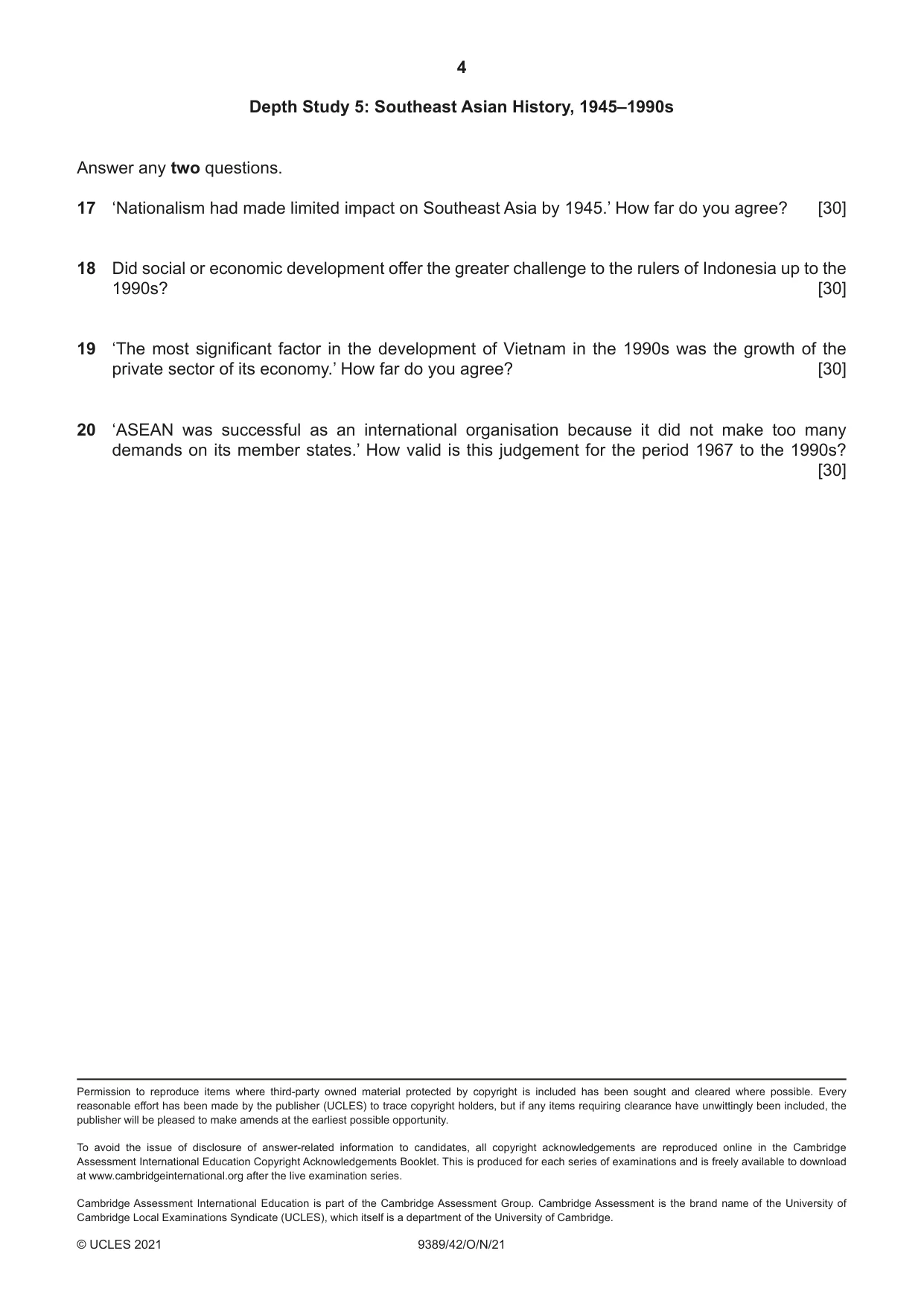
Q17 · ‘Nationalism had made limited impact on Southeast Asia by 1945.’ How far do you agree?
17 ‘Nationalism had made limited impact on Southeast Asia by 1945.’ How far do you agree? [30]
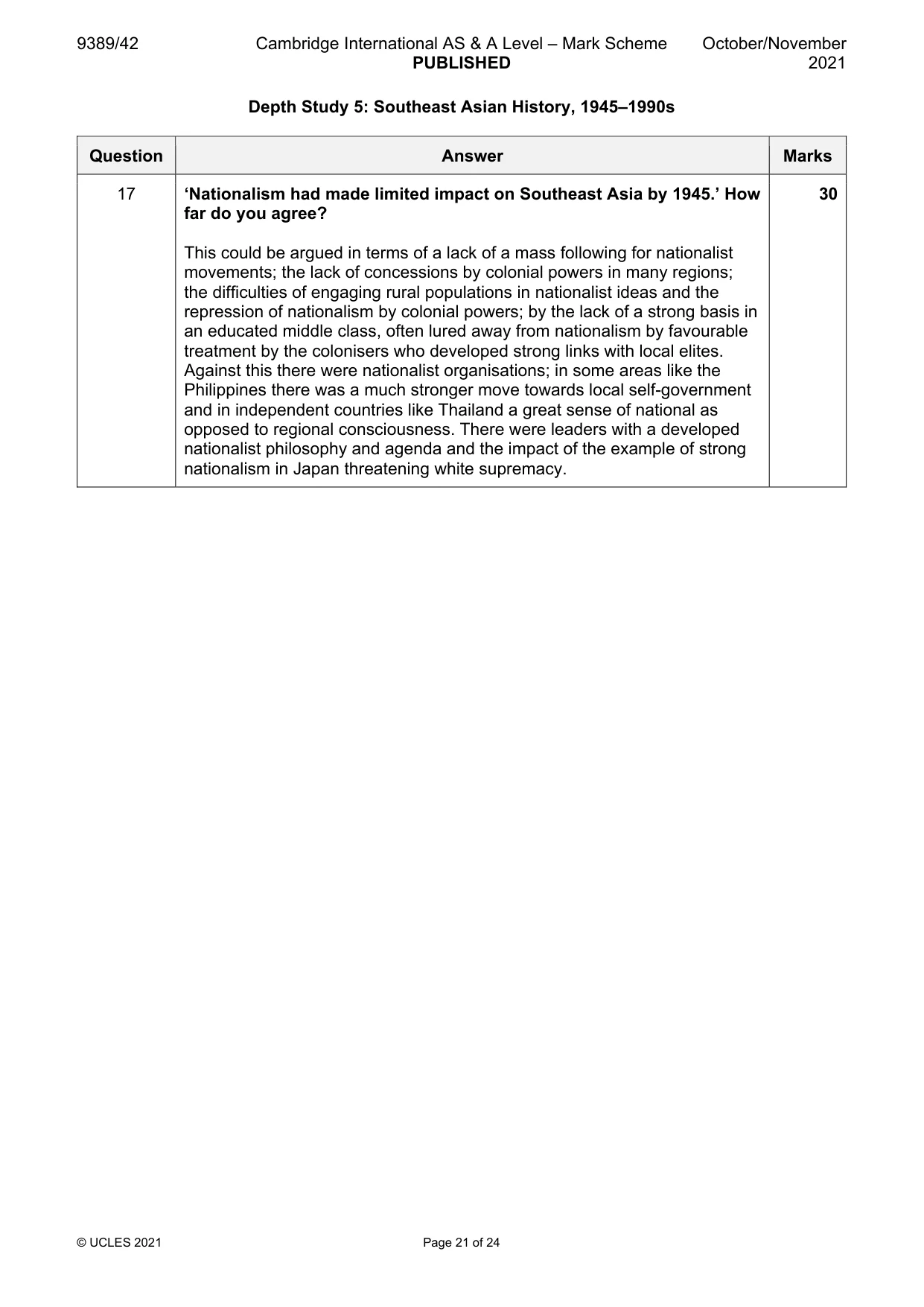
Mark scheme: 17 ‘Nationalism had made limited impact on Southeast Asia by 1945.’ How 30 far do you agree? This could be argued in terms of a lack of a mass following for nationalist movements; the lack of concessions by colonial powers in many regions; the difficulties of engaging rural populations in nationalist ideas and the repression of nationalism by colonial powers; by the lack of a strong basis in an educated middle class, often lured away from nationalism by favourable treatment by the colonisers who developed strong links with local elites. Against this there were nationalist organisations; in some areas like the Philippines there was a much stronger move towards local self-government and in independent countries like Thailand a great sense of national as opposed to regional consciousness. There were leaders with a developed nationalist philosophy and agenda and the impact of the example of strong nationalism in Japan threatening white supremacy.
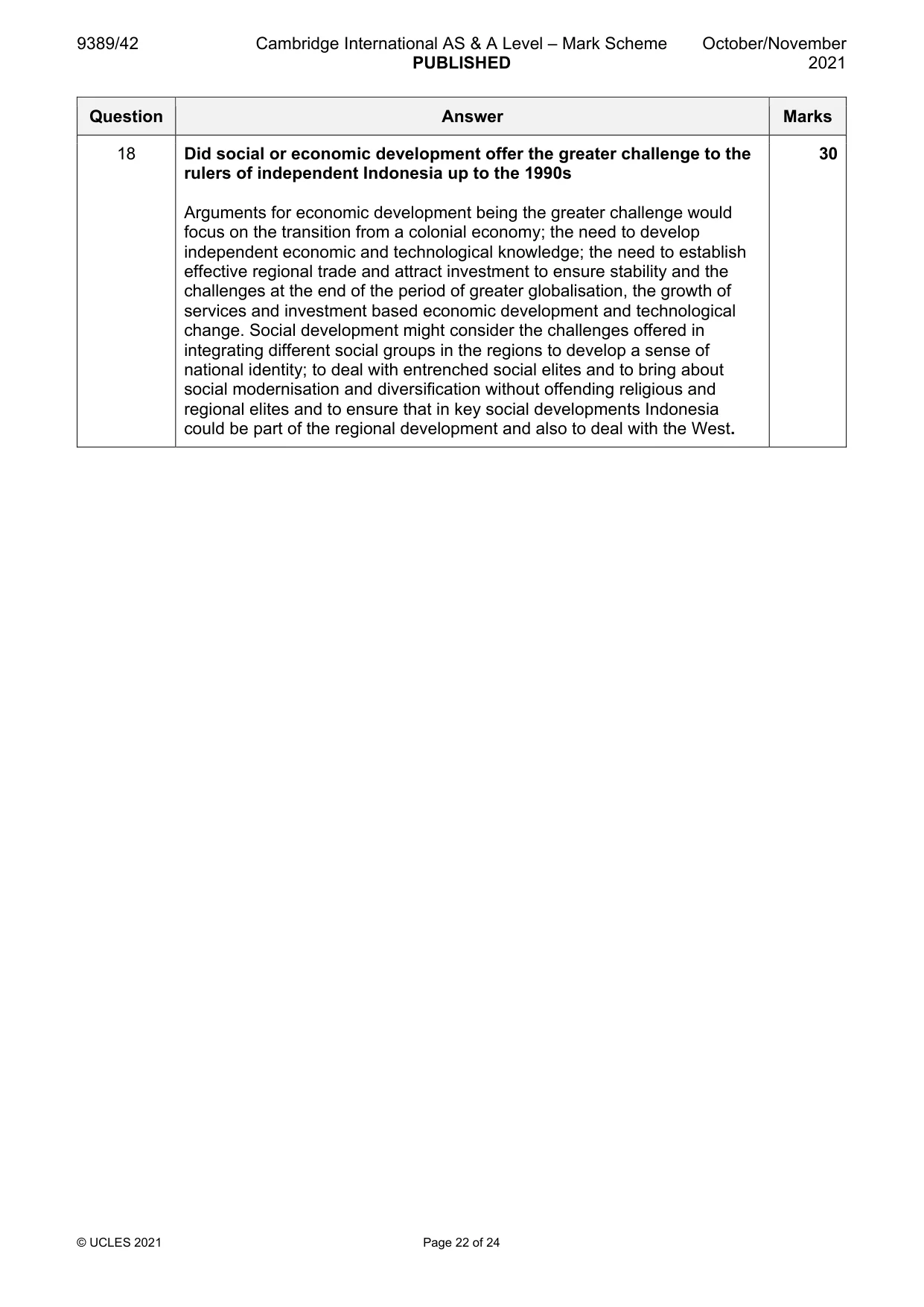
Q18 · Did social or economic development offer the greater challenge to the rulers of Indonesia…
18 Did social or economic development offer the greater challenge to the rulers of Indonesia up to the 1990s? [30]
Mark scheme: 18 Did social or economic development offer the greater challenge to the 30 rulers of independent Indonesia up to the 1990s Arguments for economic development being the greater challenge would focus on the transition from a colonial economy; the need to develop independent economic and technological knowledge; the need to establish effective regional trade and attract investment to ensure stability and the challenges at the end of the period of greater globalisation, the growth of services and investment based economic development and technological change. Social development might consider the challenges offered in integrating different social groups in the regions to develop a sense of national identity; to deal with entrenched social elites and to bring about social modernisation and diversification without offending religious and regional elites and to ensure that in key social developments Indonesia could be part of the regional development and also to deal with the West.
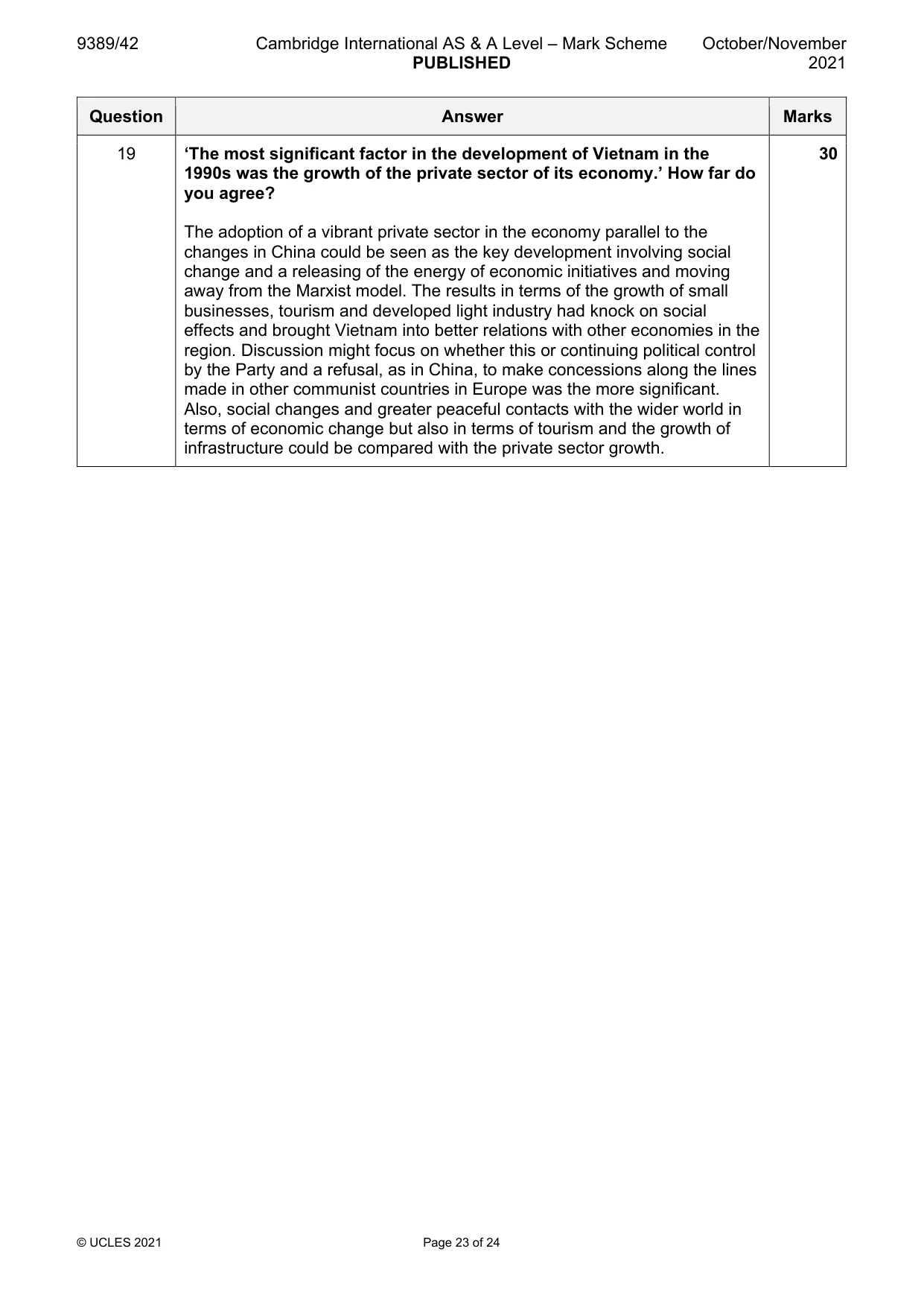
Q19 · ‘The most significant factor in the development of Vietnam in the 1990s was the growth of…
19 ‘The most significant factor in the development of Vietnam in the 1990s was the growth of the private sector of its economy.’ How far do you agree? [30]
Mark scheme: 19 ‘The most significant factor in the development of Vietnam in the 30 1990s was the growth of the private sector of its economy.’ How far do you agree? The adoption of a vibrant private sector in the economy parallel to the changes in China could be seen as the key development involving social change and a releasing of the energy of economic initiatives and moving away from the Marxist model. The results in terms of the growth of small businesses, tourism and developed light industry had knock on social effects and brought Vietnam into better relations with other economies in the region. Discussion might focus on whether this or continuing political control by the Party and a refusal, as in China, to make concessions along the lines made in other communist countries in Europe was the more significant. Also, social changes and greater peaceful contacts with the wider world in terms of economic change but also in terms of tourism and the growth of infrastructure could be compared with the private sector growth.
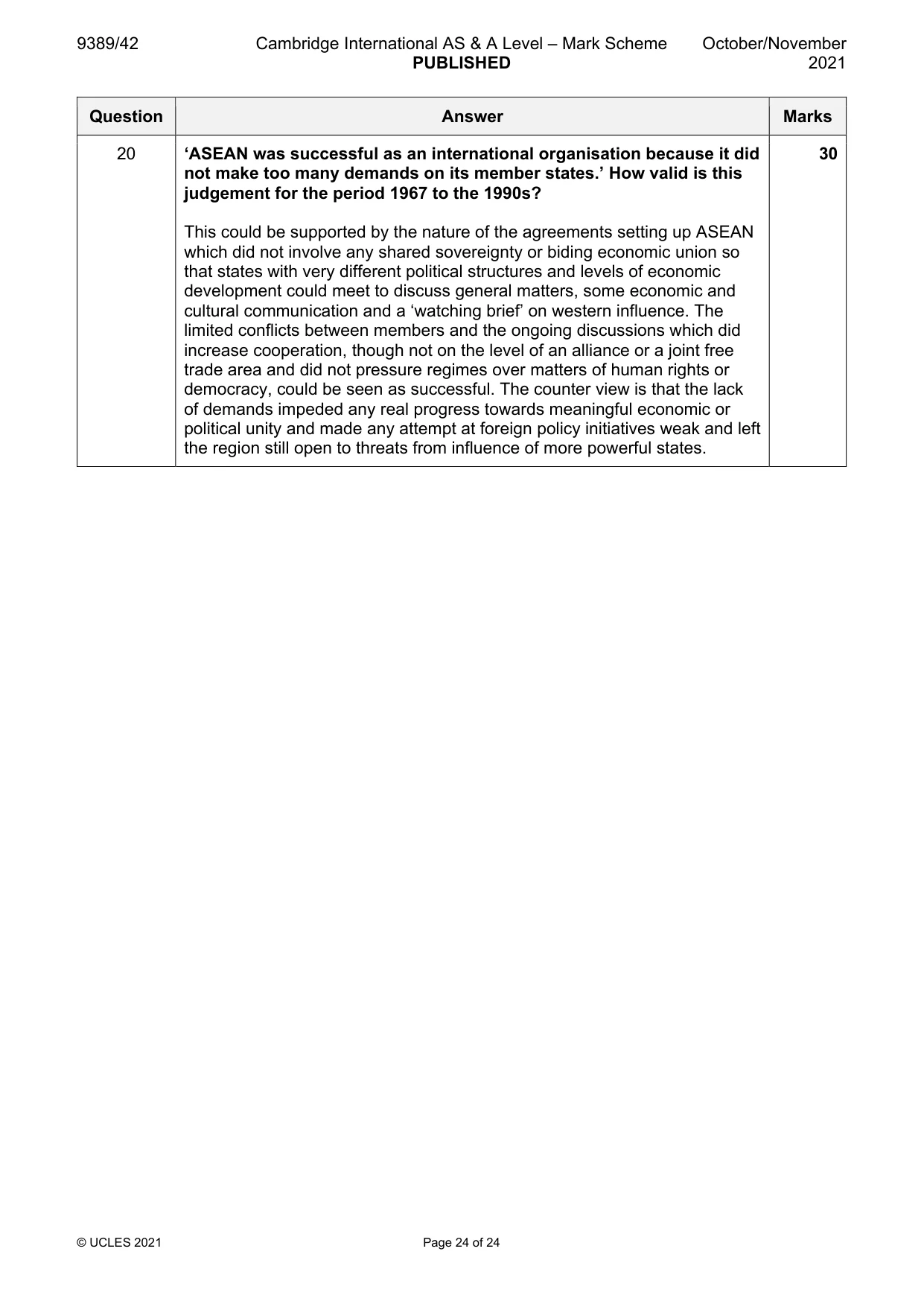
Q20 · ‘ASEAN was successful as an international organisation because it did not make too many…
20 ‘ASEAN was successful as an international organisation because it did not make too many demands on its member states.’ How valid is this judgement for the period 1967 to the 1990s? [30]
Mark scheme: 20 ‘ASEAN was successful as an international organisation because it did 30 not make too many demands on its member states.’ How valid is this judgement for the period 1967 to the 1990s? This could be supported by the nature of the agreements setting up ASEAN which did not involve any shared sovereignty or biding economic union so that states with very different political structures and levels of economic development could meet to discuss general matters, some economic and cultural communication and a ‘watching brief’ on western influence. The limited conflicts between members and the ongoing discussions which did increase cooperation, though not on the level of an alliance or a joint free trade area and did not pressure regimes over matters of human rights or democracy, could be seen as successful. The counter view is that the lack of demands impeded any real progress towards meaningful economic or political unity and made any attempt at foreign policy initiatives weak and left the region still open to threats from influence of more powerful states.
What you needed in this session
Cambridge’s own grade thresholds for 2021 Oct/Nov, Paper 4 · Variant 2. A higher threshold means an easier paper — the bar moves with how the cohort did.