Cambridge A Level History 9389 — 2019 Oct/Nov Paper 4 · Variant 2
9389/42/O/N/19 · 19 questions · 60 marks · ≈68 min
The question paper and its mark scheme, free to read here and free to download. This is Cambridge’s own paper, exactly as it was sat.
Question paper4 pages
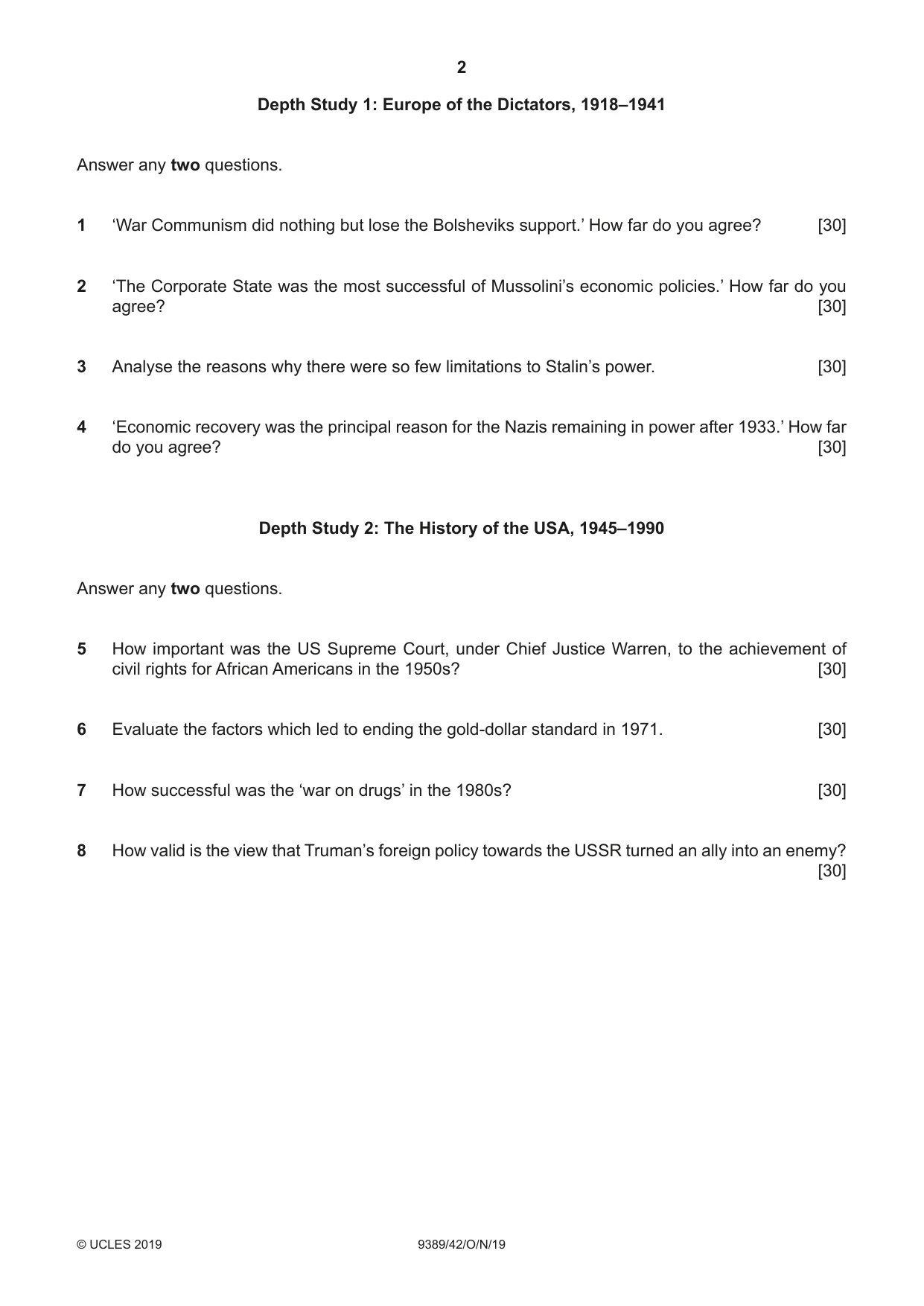
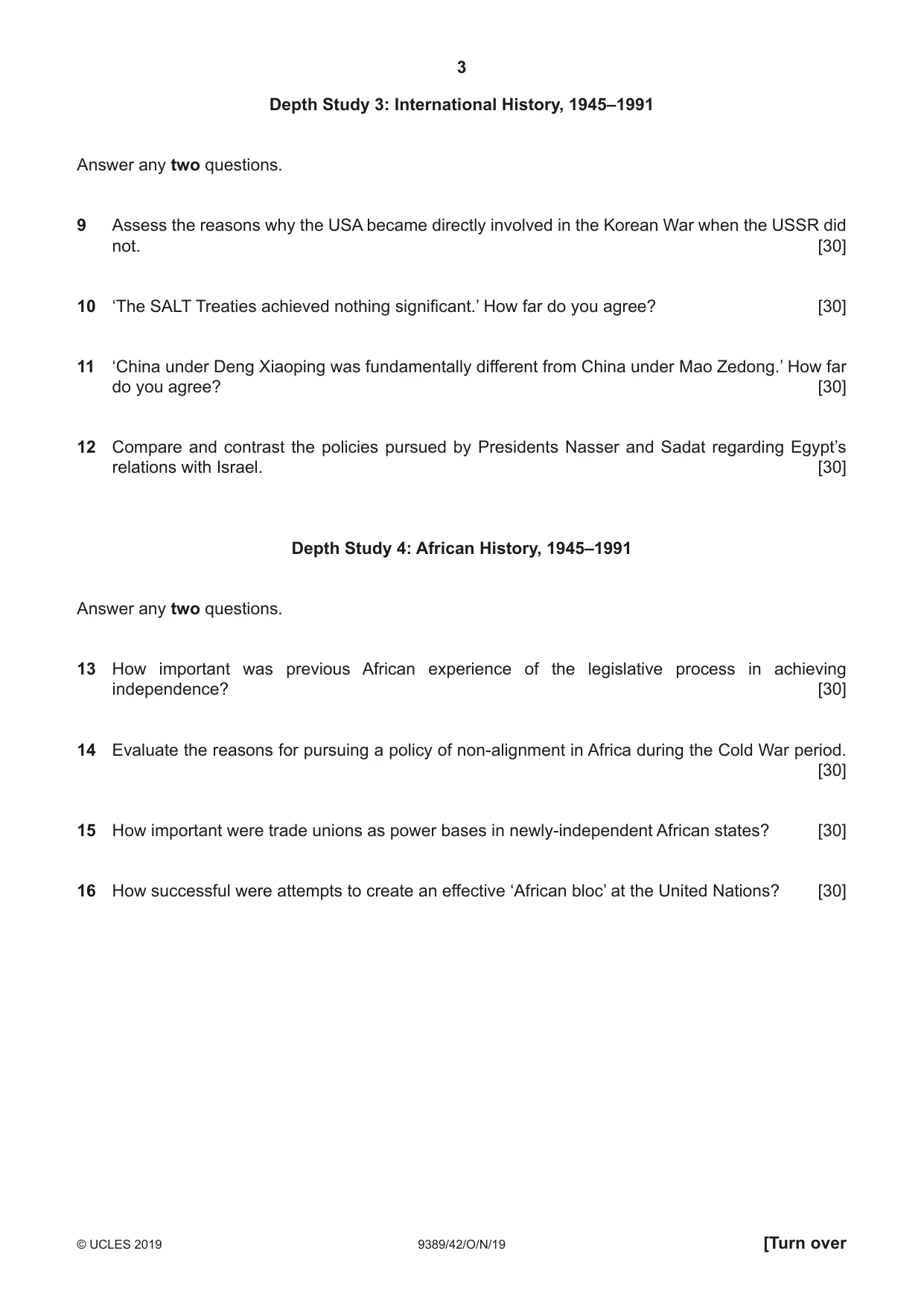
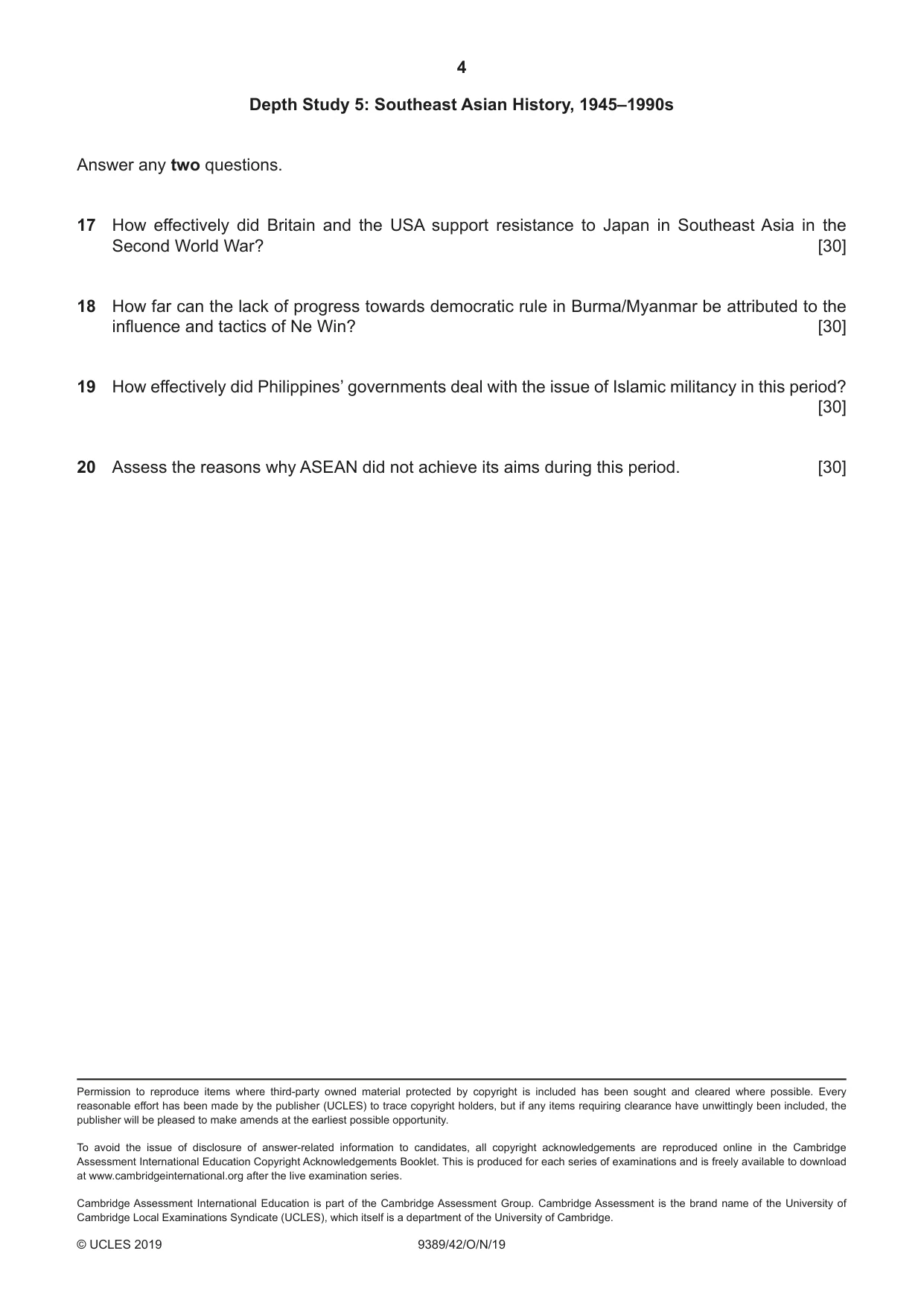
Mark scheme23 pages
Answers below. Sit the paper first if you are practising.

Questions as text
Q1 · ‘War Communism did nothing but lose the Bolsheviks support.’ How far do you agree?
1 ‘War Communism did nothing but lose the Bolsheviks support.’ How far do you agree? [30]
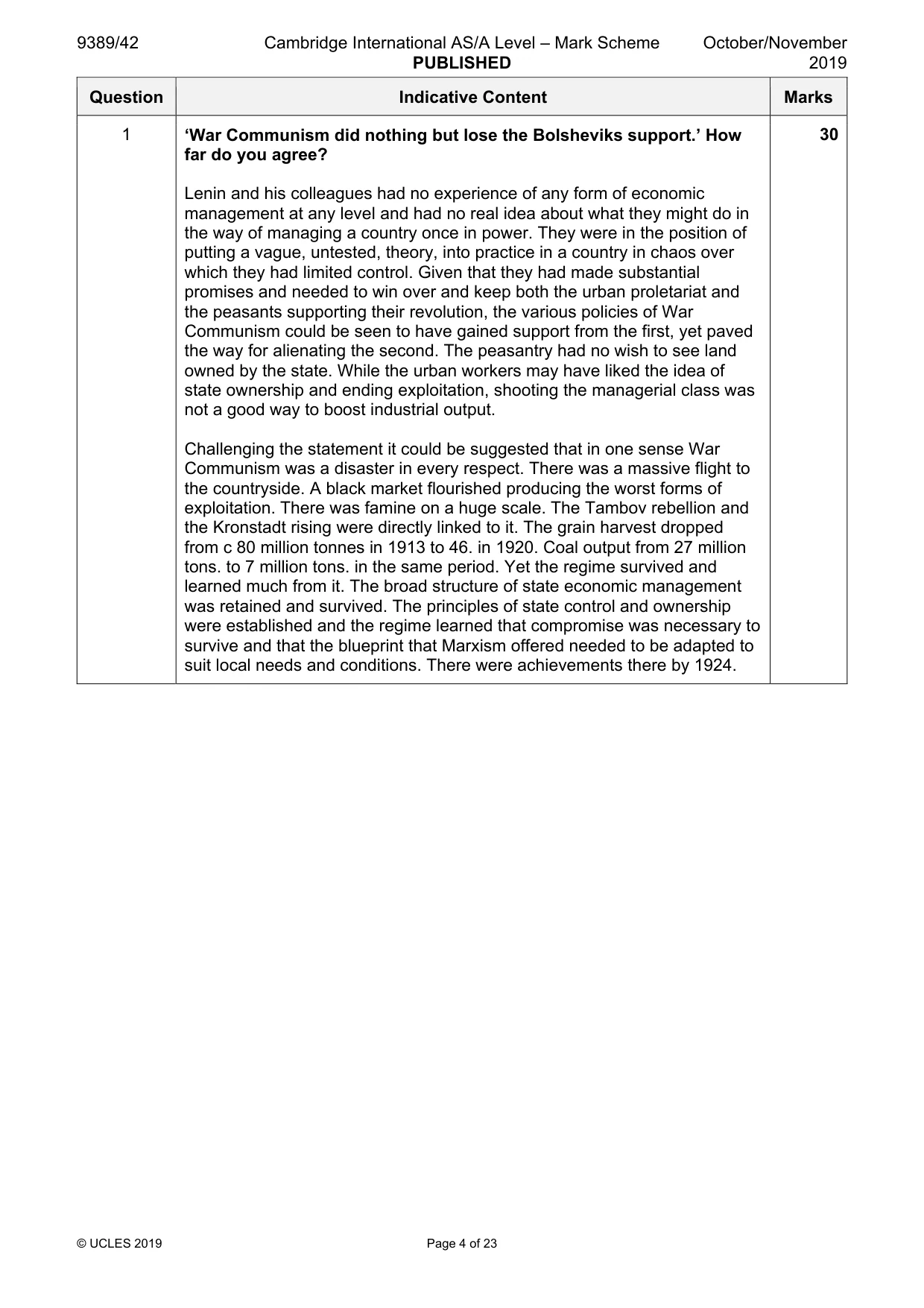
Mark scheme: Question Indicative Content Marks 1 ‘War Communism did nothing but lose the Bolsheviks support.’ How 30 far do you agree? Lenin and his colleagues had no experience of any form of economic management at any level and had no real idea about what they might do in the way of managing a country once in power. They were in the position of putting a vague, untested, theory, into practice in a country in chaos over which they had limited control. Given that they had made substantial promises and needed to win over and keep both the urban proletariat and the peasants supporting their revolution, the various policies of War Communism could be seen to have gained support from the first, yet paved the way for alienating the second. The peasantry had no wish to see land owned by the state. While the urban workers may have liked the idea of state ownership and ending exploitation, shooting the managerial class was not a good way to boost industrial output. Challenging the statement it could be suggested that in one sense War Communism was a disaster in every respect. There was a massive flight to the countryside. A black market flourished producing the worst forms of exploitation. There was famine on a huge scale. The Tambov rebellion and the Kronstadt rising were directly linked to it. The grain harvest dropped from c 80 million tonnes in 1913 to 46. in 1920. Coal output from 27 million tons. to 7 million tons. in the same period. Yet the regime survived and learned much from it. The broad structure of state economic management was retained and survived. The principles of state control and ownership were established and the regime learned that compromise was necessary to survive and that the blueprint that Marxism offered needed to be adapted to suit local needs and conditions. There were achievements there by 1924.
Q2 · ‘The Corporate State was the most successful of Mussolini’s economic policies.’ How far…
2 ‘The Corporate State was the most successful of Mussolini’s economic policies.’ How far do you agree? [30]
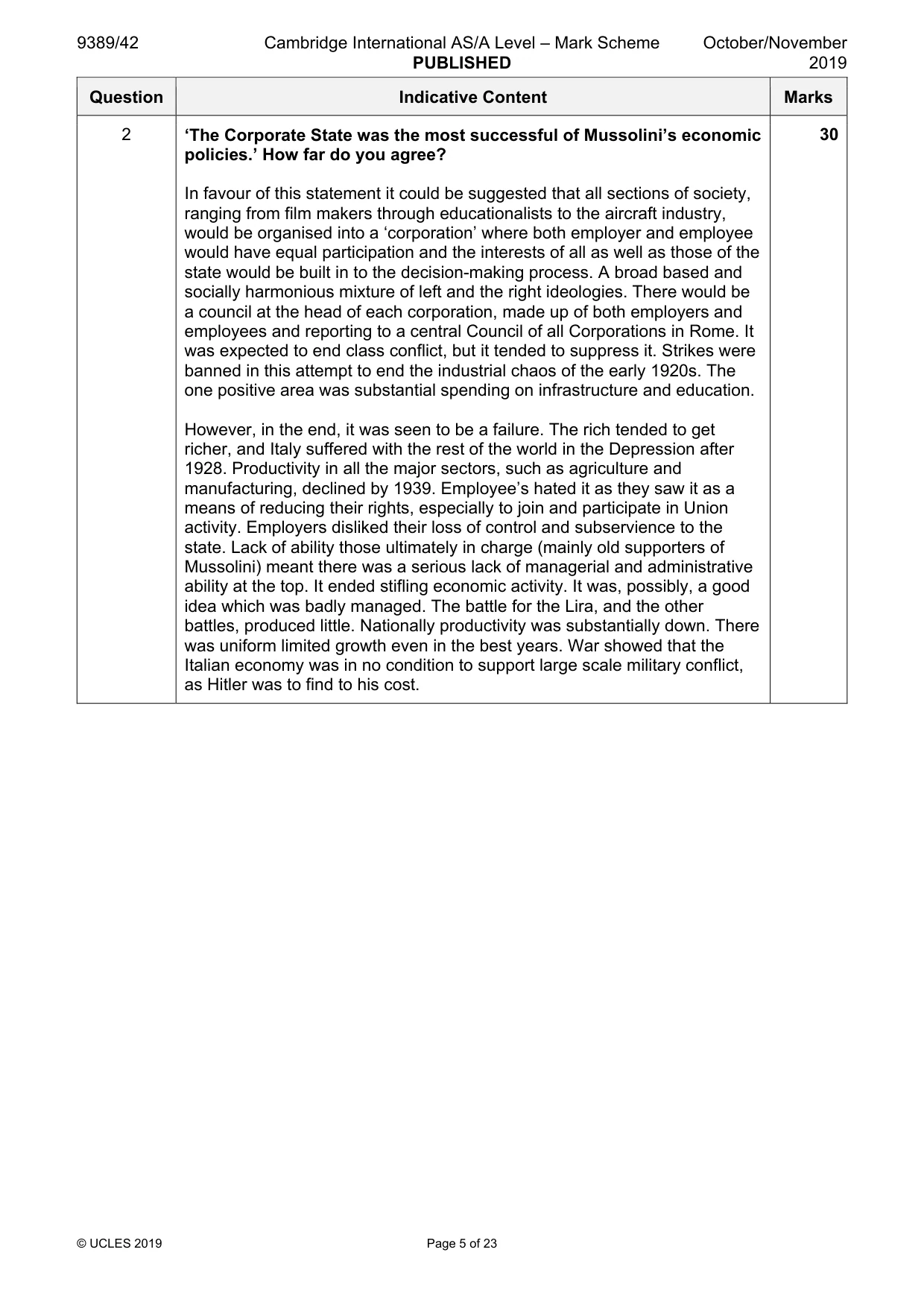
Mark scheme: 2 ‘The Corporate State was the most successful of Mussolini’s economic 30 policies.’ How far do you agree? In favour of this statement it could be suggested that all sections of society, ranging from film makers through educationalists to the aircraft industry, would be organised into a ‘corporation’ where both employer and employee would have equal participation and the interests of all as well as those of the state would be built in to the decision-making process. A broad based and socially harmonious mixture of left and the right ideologies. There would be a council at the head of each corporation, made up of both employers and employees and reporting to a central Council of all Corporations in Rome. It was expected to end class conflict, but it tended to suppress it. Strikes were banned in this attempt to end the industrial chaos of the early 1920s. The one positive area was substantial spending on infrastructure and education. However, in the end, it was seen to be a failure. The rich tended to get richer, and Italy suffered with the rest of the world in the Depression after 1928. Productivity in all the major sectors, such as agriculture and manufacturing, declined by 1939. Employee’s hated it as they saw it as a means of reducing their rights, especially to join and participate in Union activity. Employers disliked their loss of control and subservience to the state. Lack of ability those ultimately in charge (mainly old supporters of Mussolini) meant there was a serious lack of managerial and administrative ability at the top. It ended stifling economic activity. It was, possibly, a good idea which was badly managed. The battle for the Lira, and the other battles, produced little. Nationally productivity was substantially down. There was uniform limited growth even in the best years. War showed that the Italian economy was in no condition to support large scale military conflict, as Hitler was to find to his cost.
Q3 · Analyse the reasons why there were so few limitations to Stalin’s power
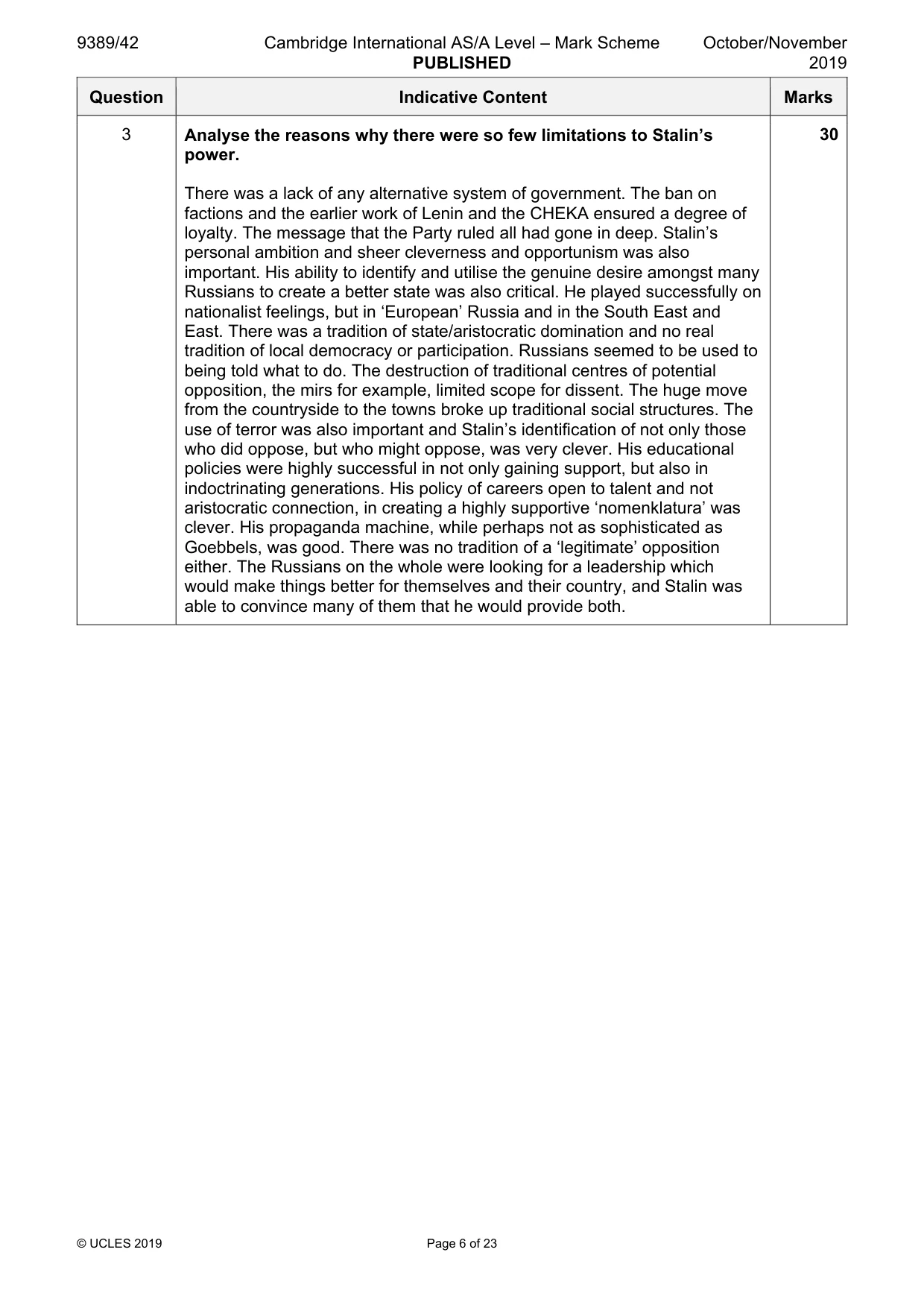
3 Analyse the reasons why there were so few limitations to Stalin’s power. [30]
Mark scheme: 3 Analyse the reasons why there were so few limitations to Stalin’s 30 power. There was a lack of any alternative system of government. The ban on factions and the earlier work of Lenin and the CHEKA ensured a degree of loyalty. The message that the Party ruled all had gone in deep. Stalin’s personal ambition and sheer cleverness and opportunism was also important. His ability to identify and utilise the genuine desire amongst many Russians to create a better state was also critical. He played successfully on nationalist feelings, but in ‘European’ Russia and in the South East and East. There was a tradition of state/aristocratic domination and no real tradition of local democracy or participation. Russians seemed to be used to being told what to do. The destruction of traditional centres of potential opposition, the mirs for example, limited scope for dissent. The huge move from the countryside to the towns broke up traditional social structures. The use of terror was also important and Stalin’s identification of not only those who did oppose, but who might oppose, was very clever. His educational policies were highly successful in not only gaining support, but also in indoctrinating generations. His policy of careers open to talent and not aristocratic connection, in creating a highly supportive ‘nomenklatura’ was clever. His propaganda machine, while perhaps not as sophisticated as Goebbels, was good. There was no tradition of a ‘legitimate’ opposition either. The Russians on the whole were looking for a leadership which would make things better for themselves and their country, and Stalin was able to convince many of them that he would provide both.
Q4 · ‘Economic recovery was the principal reason for the Nazis remaining in power after 1933.’…
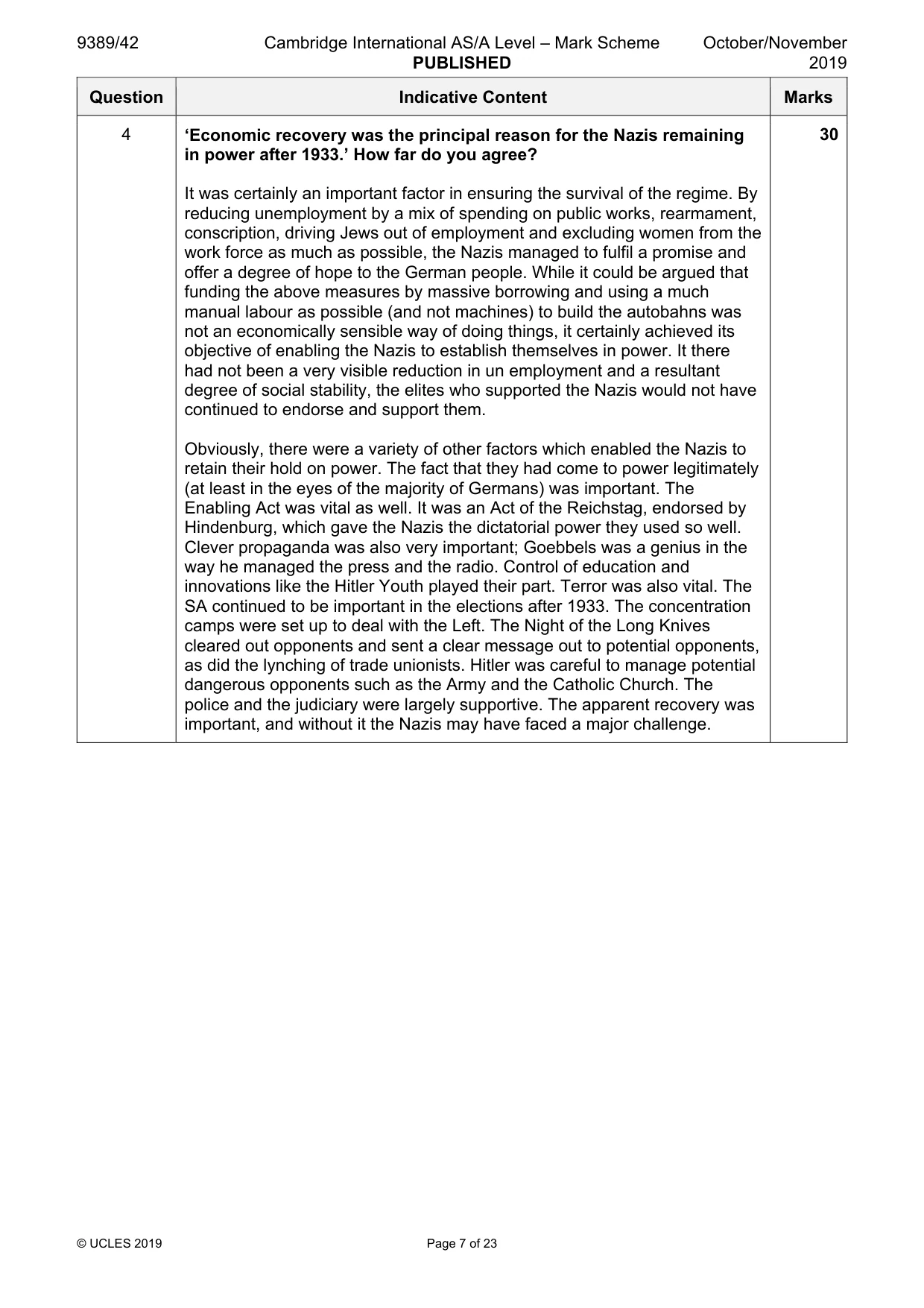
4 ‘Economic recovery was the principal reason for the Nazis remaining in power after 1933.’ How far do you agree? [30] Depth Study 2: The History of the USA, 1945–1990 Answer any two questions.
Mark scheme: 4 ‘Economic recovery was the principal reason for the Nazis remaining 30 in power after 1933.’ How far do you agree? It was certainly an important factor in ensuring the survival of the regime. By reducing unemployment by a mix of spending on public works, rearmament, conscription, driving Jews out of employment and excluding women from the work force as much as possible, the Nazis managed to fulfil a promise and offer a degree of hope to the German people. While it could be argued that funding the above measures by massive borrowing and using a much manual labour as possible (and not machines) to build the autobahns was not an economically sensible way of doing things, it certainly achieved its objective of enabling the Nazis to establish themselves in power. It there had not been a very visible reduction in un employment and a resultant degree of social stability, the elites who supported the Nazis would not have continued to endorse and support them. Obviously, there were a variety of other factors which enabled the Nazis to retain their hold on power. The fact that they had come to power legitimately (at least in the eyes of the majority of Germans) was important. The Enabling Act was vital as well. It was an Act of the Reichstag, endorsed by Hindenburg, which gave the Nazis the dictatorial power they used so well. Clever propaganda was also very important; Goebbels was a genius in the way he managed the press and the radio. Control of education and innovations like the Hitler Youth played their part. Terror was also vital. The SA continued to be important in the elections after 1933. The concentration camps were set up to deal with the Left. The Night of the Long Knives cleared out opponents and sent a clear message out to potential opponents, as did the lynching of trade unionists. Hitler was careful to manage potential dangerous opponents such as the Army and the Catholic Church. The police and the judiciary were largely supportive. The apparent recovery was important, and without it the Nazis may have faced a major challenge.
Q5 · How important was the US Supreme Court, under Chief Justice Warren, to the achievement of…
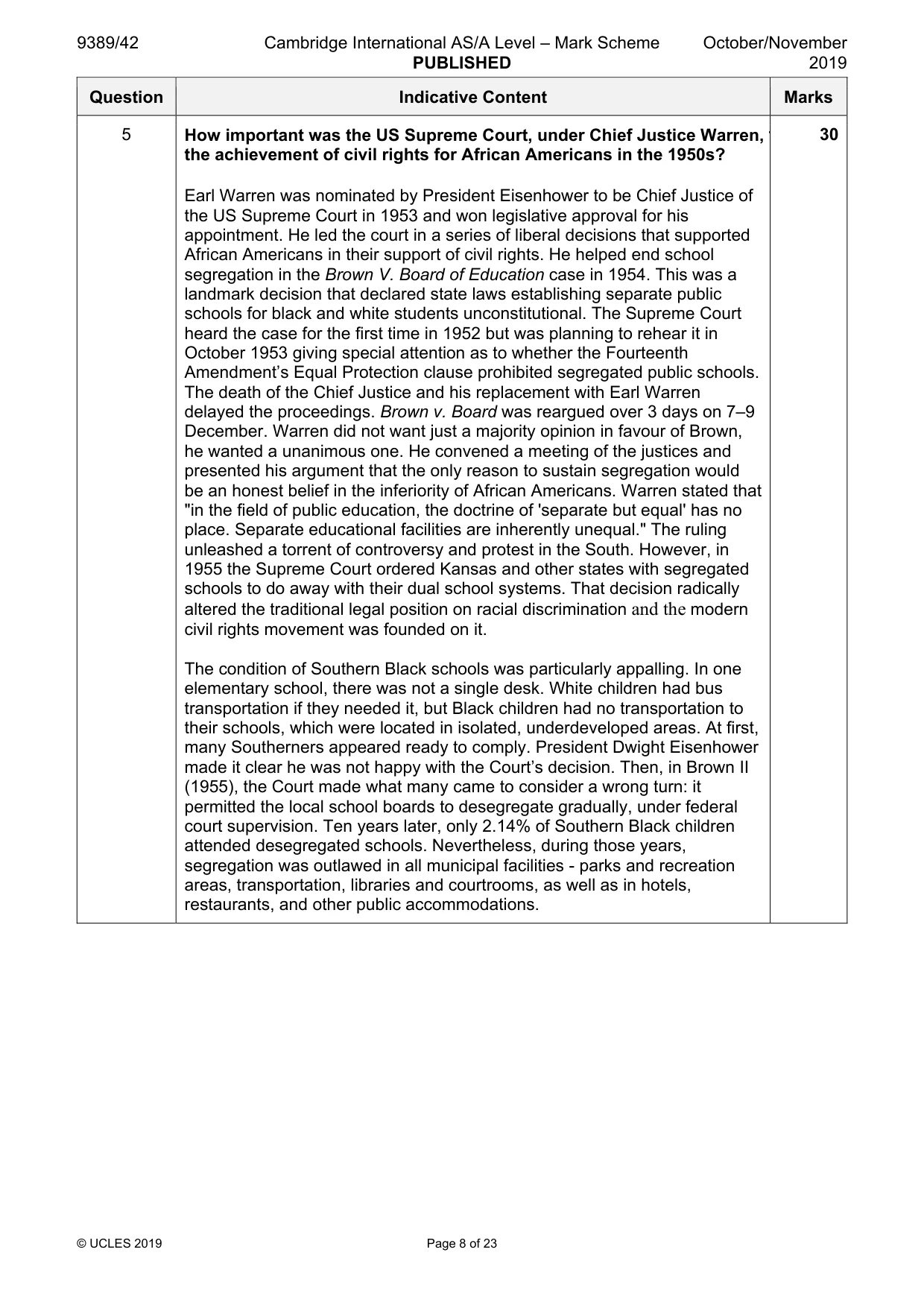
5 How important was the US Supreme Court, under Chief Justice Warren, to the achievement of civil rights for African Americans in the 1950s? [30]
Mark scheme: 5 How important was the US Supreme Court, under Chief Justice Warren, t 30 the achievement of civil rights for African Americans in the 1950s? Earl Warren was nominated by President Eisenhower to be Chief Justice of the US Supreme Court in 1953 and won legislative approval for his appointment. He led the court in a series of liberal decisions that supported African Americans in their support of civil rights. He helped end school segregation in the Brown V. Board of Education case in 1954. This was a landmark decision that declared state laws establishing separate public schools for black and white students unconstitutional. The Supreme Court heard the case for the first time in 1952 but was planning to rehear it in October 1953 giving special attention as to whether the Fourteenth Amendment’s Equal Protection clause prohibited segregated public schools. The death of the Chief Justice and his replacement with Earl Warren delayed the proceedings. Brown v. Board was reargued over 3 days on 7–9 December. Warren did not want just a majority opinion in favour of Brown, he wanted a unanimous one. He convened a meeting of the justices and presented his argument that the only reason to sustain segregation would be an honest belief in the inferiority of African Americans. Warren stated that "in the field of public education, the doctrine of 'separate but equal' has no place. Separate educational facilities are inherently unequal." The ruling unleashed a torrent of controversy and protest in the South. However, in 1955 the Supreme Court ordered Kansas and other states with segregated schools to do away with their dual school systems. That decision radically altered the traditional legal position on racial discrimination and the modern civil rights movement was founded on it. The condition of Southern Black schools was particularly appalling. In one elementary school, there was not a single desk. White children had bus transportation if they needed it, but Black children had no transportation to their schools, which were located in isolated, underdeveloped areas. At first, many Southerners appeared ready to comply. President Dwight Eisenhower made it clear he was not happy with the Court’s decision. Then, in Brown II (1955), the Court made what many came to consider a wrong turn: it permitted the local school boards to desegregate gradually, under federal court supervision. Ten years later, only 2.14% of Southern Black children attended desegregated schools. Nevertheless, during those years, segregation was outlawed in all municipal facilities - parks and recreation areas, transportation, libraries and courtrooms, as well as in hotels, restaurants, and other public accommodations.
Q6 · Evaluate the factors which led to ending the gold‑dollar standard in 1971
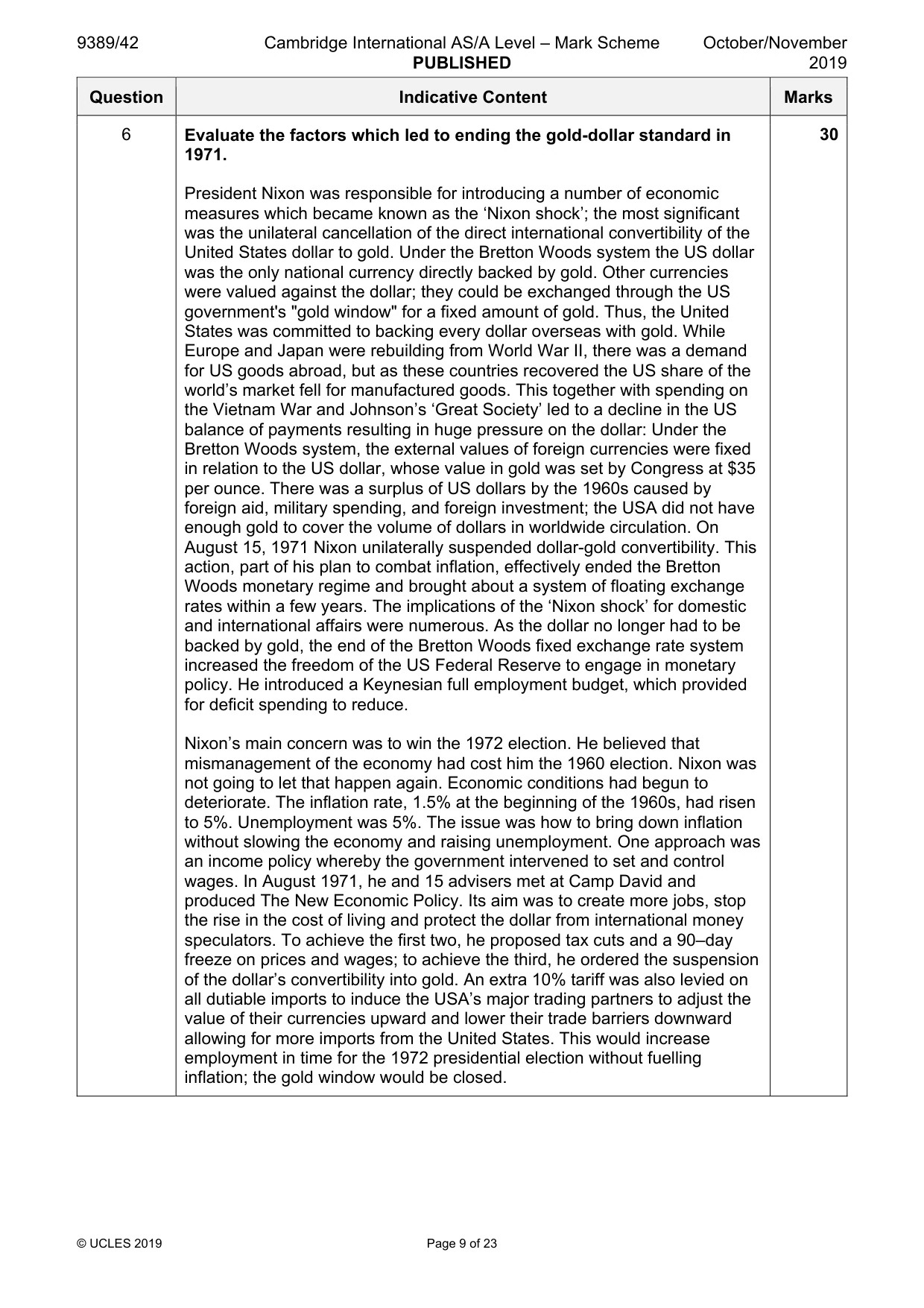
6 Evaluate the factors which led to ending the gold‑dollar standard in 1971. [30]
Mark scheme: 6 Evaluate the factors which led to ending the gold-dollar standard in 30 1971. President Nixon was responsible for introducing a number of economic measures which became known as the ‘Nixon shock’; the most significant was the unilateral cancellation of the direct international convertibility of the United States dollar to gold. Under the Bretton Woods system the US dollar was the only national currency directly backed by gold. Other currencies were valued against the dollar; they could be exchanged through the US government's "gold window" for a fixed amount of gold. Thus, the United States was committed to backing every dollar overseas with gold. While Europe and Japan were rebuilding from World War II, there was a demand for US goods abroad, but as these countries recovered the US share of the world’s market fell for manufactured goods. This together with spending on the Vietnam War and Johnson’s ‘Great Society’ led to a decline in the US balance of payments resulting in huge pressure on the dollar: Under the Bretton Woods system, the external values of foreign currencies were fixed in relation to the US dollar, whose value in gold was set by Congress at $35 per ounce. There was a surplus of US dollars by the 1960s caused by foreign aid, military spending, and foreign investment; the USA did not have enough gold to cover the volume of dollars in worldwide circulation. On August 15, 1971 Nixon unilaterally suspended dollar-gold convertibility. This action, part of his plan to combat inflation, effectively ended the Bretton Woods monetary regime and brought about a system of floating exchange rates within a few years. The implications of the ‘Nixon shock’ for domestic and international affairs were numerous. As the dollar no longer had to be backed by gold, the end of the Bretton Woods fixed exchange rate system increased the freedom of the US Federal Reserve to engage in monetary policy. He introduced a Keynesian full employment budget, which provided for deficit spending to reduce. Nixon’s main concern was to win the 1972 election. He believed that mismanagement of the economy had cost him the 1960 election. Nixon was not going to let that happen again. Economic conditions had begun to deteriorate. The inflation rate, 1.5% at the beginning of the 1960s, had risen to 5%. Unemployment was 5%. The issue was how to bring down inflation without slowing the economy and raising unemployment. One approach was an income policy whereby the government intervened to set and control wages. In August 1971, he and 15 advisers met at Camp David and produced The New Economic Policy. Its aim was to create more jobs, stop the rise in the cost of living and protect the dollar from international money speculators. To achieve the first two, he proposed tax cuts and a 90–day freeze on prices and wages; to achieve the third, he ordered the suspension of the dollar’s convertibility into gold. An extra 10% tariff was also levied on all dutiable imports to induce the USA’s major trading partners to adjust the value of their currencies upward and lower their trade barriers downward allowing for more imports from the United States. This would increase employment in time for the 1972 presidential election without fuelling inflation; the gold window would be closed.
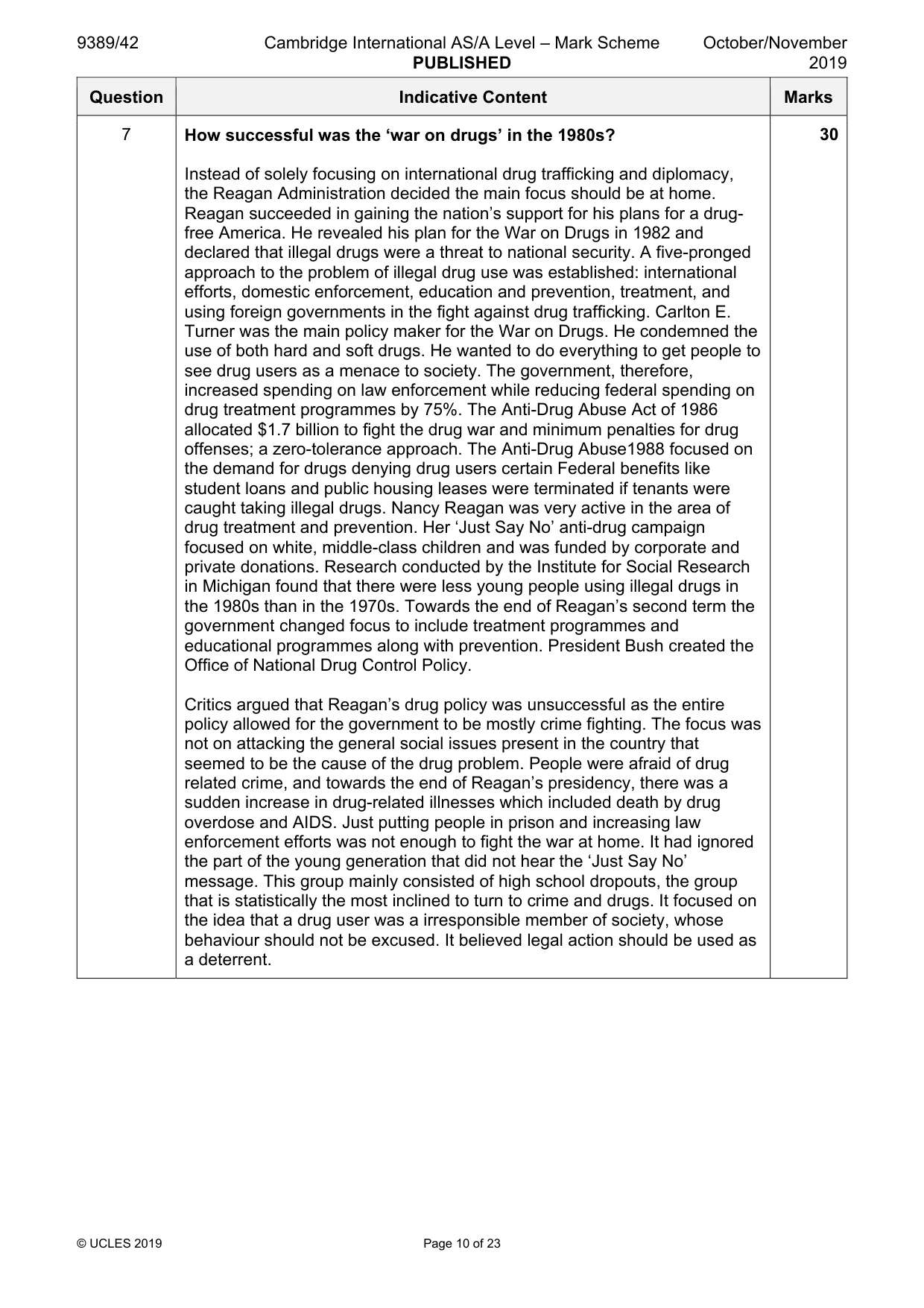
Q7 · How successful was the ‘war on drugs’ in the 1980s?
7 How successful was the ‘war on drugs’ in the 1980s? [30]
Mark scheme: 7 How successful was the ‘war on drugs’ in the 1980s? 30 Instead of solely focusing on international drug trafficking and diplomacy, the Reagan Administration decided the main focus should be at home. Reagan succeeded in gaining the nation’s support for his plans for a drug- free America. He revealed his plan for the War on Drugs in 1982 and declared that illegal drugs were a threat to national security. A five-pronged approach to the problem of illegal drug use was established: international efforts, domestic enforcement, education and prevention, treatment, and using foreign governments in the fight against drug trafficking. Carlton E. Turner was the main policy maker for the War on Drugs. He condemned the use of both hard and soft drugs. He wanted to do everything to get people to see drug users as a menace to society. The government, therefore, increased spending on law enforcement while reducing federal spending on drug treatment programmes by 75%. The Anti-Drug Abuse Act of 1986 allocated $1.7 billion to fight the drug war and minimum penalties for drug offenses; a zero-tolerance approach. The Anti-Drug Abuse1988 focused on the demand for drugs denying drug users certain Federal benefits like student loans and public housing leases were terminated if tenants were caught taking illegal drugs. Nancy Reagan was very active in the area of drug treatment and prevention. Her ‘Just Say No’ anti-drug campaign focused on white, middle-class children and was funded by corporate and private donations. Research conducted by the Institute for Social Research in Michigan found that there were less young people using illegal drugs in the 1980s than in the 1970s. Towards the end of Reagan’s second term the government changed focus to include treatment programmes and educational programmes along with prevention. President Bush created the Office of National Drug Control Policy. Critics argued that Reagan’s drug policy was unsuccessful as the entire policy allowed for the government to be mostly crime fighting. The focus was not on attacking the general social issues present in the country that seemed to be the cause of the drug problem. People were afraid of drug related crime, and towards the end of Reagan’s presidency, there was a sudden increase in drug-related illnesses which included death by drug overdose and AIDS. Just putting people in prison and increasing law enforcement efforts was not enough to fight the war at home. It had ignored the part of the young generation that did not hear the ‘Just Say No’ message. This group mainly consisted of high school dropouts, the group that is statistically the most inclined to turn to crime and drugs. It focused on the idea that a drug user was a irresponsible member of society, whose behaviour should not be excused. It believed legal action should be used as a deterrent.
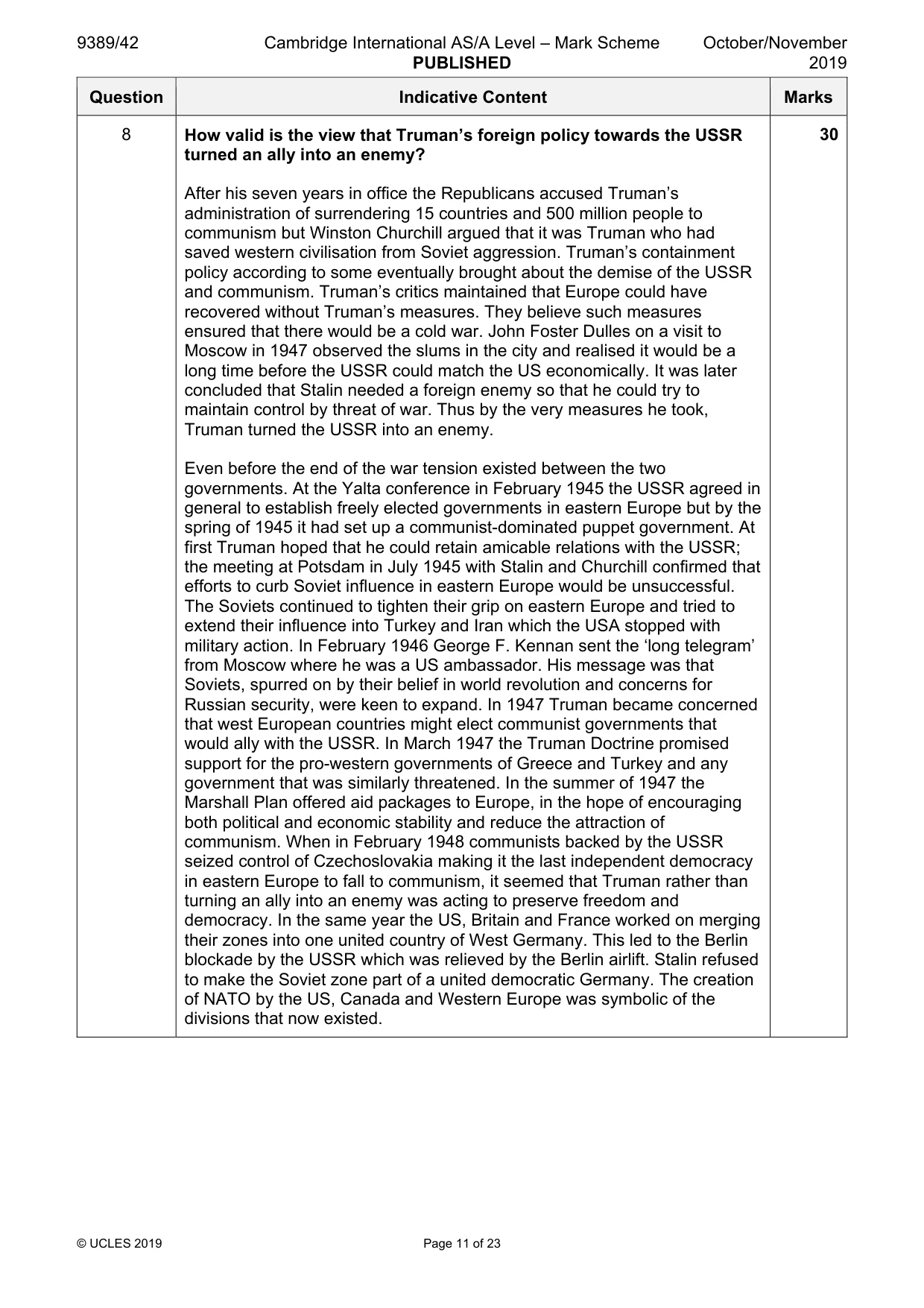
Q8 · How valid is the view that Truman’s foreign policy towards the USSR turned an ally into…
8 How valid is the view that Truman’s foreign policy towards the USSR turned an ally into an enemy? [30] Depth Study 3: International History, 1945–1991 Answer any two questions.
Mark scheme: 8 How valid is the view that Truman’s foreign policy towards the USSR 30 turned an ally into an enemy? After his seven years in office the Republicans accused Truman’s administration of surrendering 15 countries and 500 million people to communism but Winston Churchill argued that it was Truman who had saved western civilisation from Soviet aggression. Truman’s containment policy according to some eventually brought about the demise of the USSR and communism. Truman’s critics maintained that Europe could have recovered without Truman’s measures. They believe such measures ensured that there would be a cold war. John Foster Dulles on a visit to Moscow in 1947 observed the slums in the city and realised it would be a long time before the USSR could match the US economically. It was later concluded that Stalin needed a foreign enemy so that he could try to maintain control by threat of war. Thus by the very measures he took, Truman turned the USSR into an enemy. Even before the end of the war tension existed between the two governments. At the Yalta conference in February 1945 the USSR agreed in general to establish freely elected governments in eastern Europe but by the spring of 1945 it had set up a communist-dominated puppet government. At first Truman hoped that he could retain amicable relations with the USSR; the meeting at Potsdam in July 1945 with Stalin and Churchill confirmed that efforts to curb Soviet influence in eastern Europe would be unsuccessful. The Soviets continued to tighten their grip on eastern Europe and tried to extend their influence into Turkey and Iran which the USA stopped with military action. In February 1946 George F. Kennan sent the ‘long telegram’ from Moscow where he was a US ambassador. His message was that Soviets, spurred on by their belief in world revolution and concerns for Russian security, were keen to expand. In 1947 Truman became concerned that west European countries might elect communist governments that would ally with the USSR. In March 1947 the Truman Doctrine promised support for the pro-western governments of Greece and Turkey and any government that was similarly threatened. In the summer of 1947 the Marshall Plan offered aid packages to Europe, in the hope of encouraging both political and economic stability and reduce the attraction of communism. When in February 1948 communists backed by the USSR seized control of Czechoslovakia making it the last independent democracy in eastern Europe to fall to communism, it seemed that Truman rather than turning an ally into an enemy was acting to preserve freedom and democracy. In the same year the US, Britain and France worked on merging their zones into one united country of West Germany. This led to the Berlin blockade by the USSR which was relieved by the Berlin airlift. Stalin refused to make the Soviet zone part of a united democratic Germany. The creation of NATO by the US, Canada and Western Europe was symbolic of the divisions that now existed.
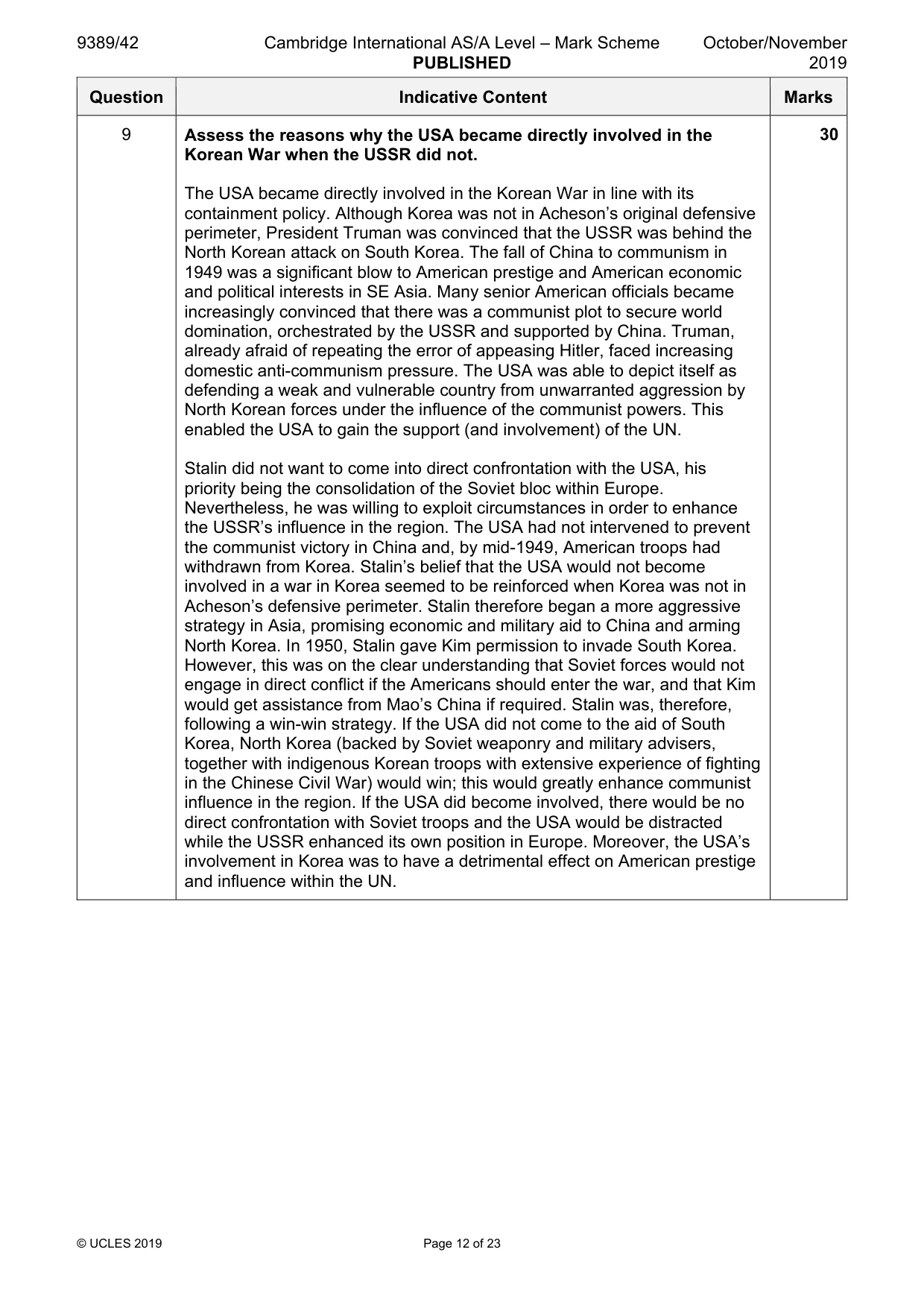
Q9 · Assess the reasons why the USA became directly involved in the Korean War when the USSR…
9 Assess the reasons why the USA became directly involved in the Korean War when the USSR did not. [30]
Mark scheme: 9 Assess the reasons why the USA became directly involved in the 30 Korean War when the USSR did not. The USA became directly involved in the Korean War in line with its containment policy. Although Korea was not in Acheson’s original defensive perimeter, President Truman was convinced that the USSR was behind the North Korean attack on South Korea. The fall of China to communism in 1949 was a significant blow to American prestige and American economic and political interests in SE Asia. Many senior American officials became increasingly convinced that there was a communist plot to secure world domination, orchestrated by the USSR and supported by China. Truman, already afraid of repeating the error of appeasing Hitler, faced increasing domestic anti-communism pressure. The USA was able to depict itself as defending a weak and vulnerable country from unwarranted aggression by North Korean forces under the influence of the communist powers. This enabled the USA to gain the support (and involvement) of the UN. Stalin did not want to come into direct confrontation with the USA, his priority being the consolidation of the Soviet bloc within Europe. Nevertheless, he was willing to exploit circumstances in order to enhance the USSR’s influence in the region. The USA had not intervened to prevent the communist victory in China and, by mid-1949, American troops had withdrawn from Korea. Stalin’s belief that the USA would not become involved in a war in Korea seemed to be reinforced when Korea was not in Acheson’s defensive perimeter. Stalin therefore began a more aggressive strategy in Asia, promising economic and military aid to China and arming North Korea. In 1950, Stalin gave Kim permission to invade South Korea. However, this was on the clear understanding that Soviet forces would not engage in direct conflict if the Americans should enter the war, and that Kim would get assistance from Mao’s China if required. Stalin was, therefore, following a win-win strategy. If the USA did not come to the aid of South Korea, North Korea (backed by Soviet weaponry and military advisers, together with indigenous Korean troops with extensive experience of fighting in the Chinese Civil War) would win; this would greatly enhance communist influence in the region. If the USA did become involved, there would be no direct confrontation with Soviet troops and the USA would be distracted while the USSR enhanced its own position in Europe. Moreover, the USA’s involvement in Korea was to have a detrimental effect on American prestige and influence within the UN.
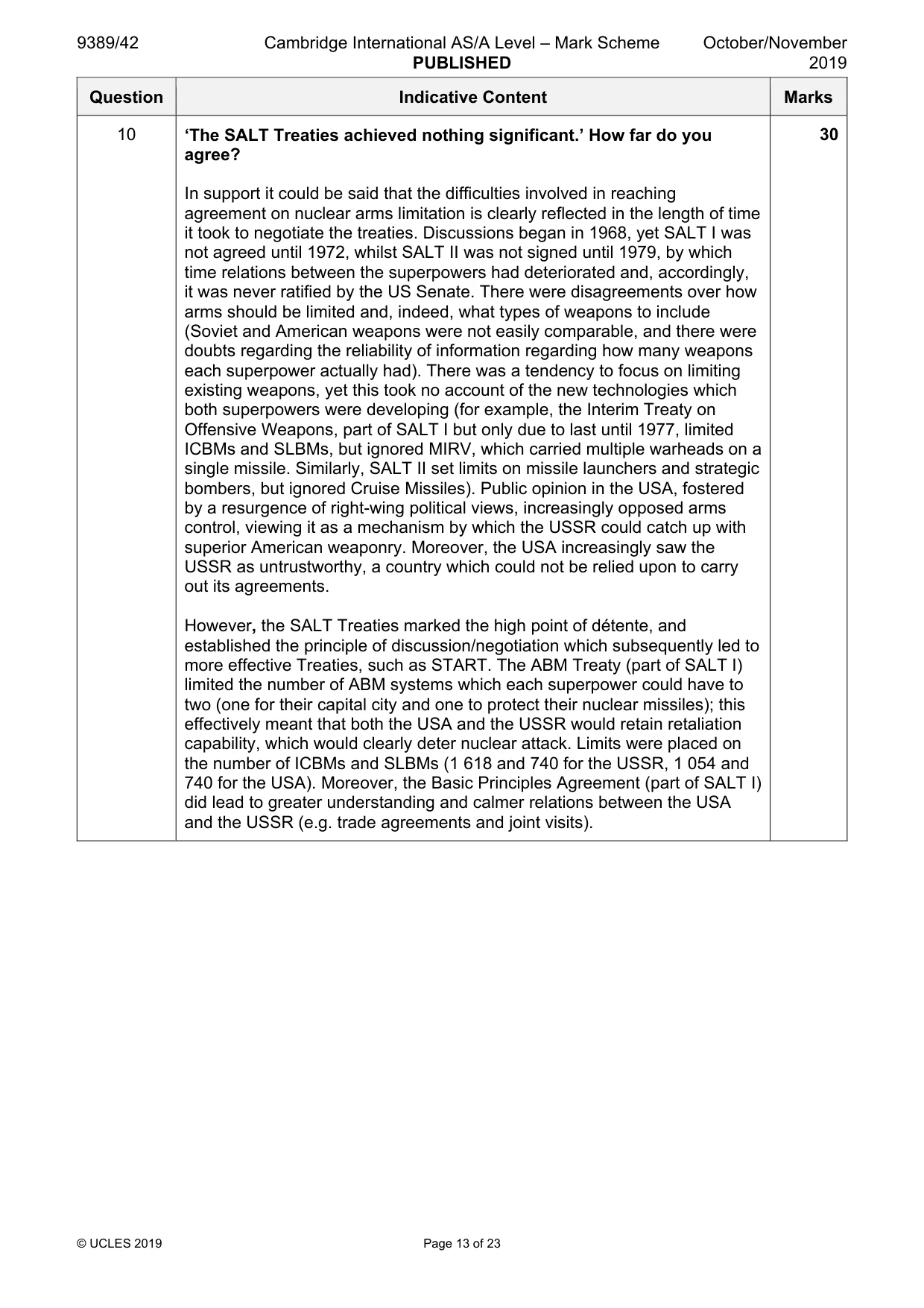
Q10 · ‘The SALT Treaties achieved nothing significant.’ How far do you agree?
10 ‘The SALT Treaties achieved nothing significant.’ How far do you agree? [30]
Mark scheme: 10 ‘The SALT Treaties achieved nothing significant.’ How far do you 30 agree? In support it could be said that the difficulties involved in reaching agreement on nuclear arms limitation is clearly reflected in the length of time it took to negotiate the treaties. Discussions began in 1968, yet SALT I was not agreed until 1972, whilst SALT II was not signed until 1979, by which time relations between the superpowers had deteriorated and, accordingly, it was never ratified by the US Senate. There were disagreements over how arms should be limited and, indeed, what types of weapons to include (Soviet and American weapons were not easily comparable, and there were doubts regarding the reliability of information regarding how many weapons each superpower actually had). There was a tendency to focus on limiting existing weapons, yet this took no account of the new technologies which both superpowers were developing (for example, the Interim Treaty on Offensive Weapons, part of SALT I but only due to last until 1977, limited ICBMs and SLBMs, but ignored MIRV, which carried multiple warheads on a single missile. Similarly, SALT II set limits on missile launchers and strategic bombers, but ignored Cruise Missiles). Public opinion in the USA, fostered by a resurgence of right-wing political views, increasingly opposed arms control, viewing it as a mechanism by which the USSR could catch up with superior American weaponry. Moreover, the USA increasingly saw the USSR as untrustworthy, a country which could not be relied upon to carry out its agreements. However, the SALT Treaties marked the high point of détente, and established the principle of discussion/negotiation which subsequently led to more effective Treaties, such as START. The ABM Treaty (part of SALT I) limited the number of ABM systems which each superpower could have to two (one for their capital city and one to protect their nuclear missiles); this effectively meant that both the USA and the USSR would retain retaliation capability, which would clearly deter nuclear attack. Limits were placed on the number of ICBMs and SLBMs (1 618 and 740 for the USSR, 1 054 and 740 for the USA). Moreover, the Basic Principles Agreement (part of SALT I) did lead to greater understanding and calmer relations between the USA and the USSR (e.g. trade agreements and joint visits).
Q11 · ‘China under Deng Xiaoping was fundamentally different from China under Mao Zedong.’ How…
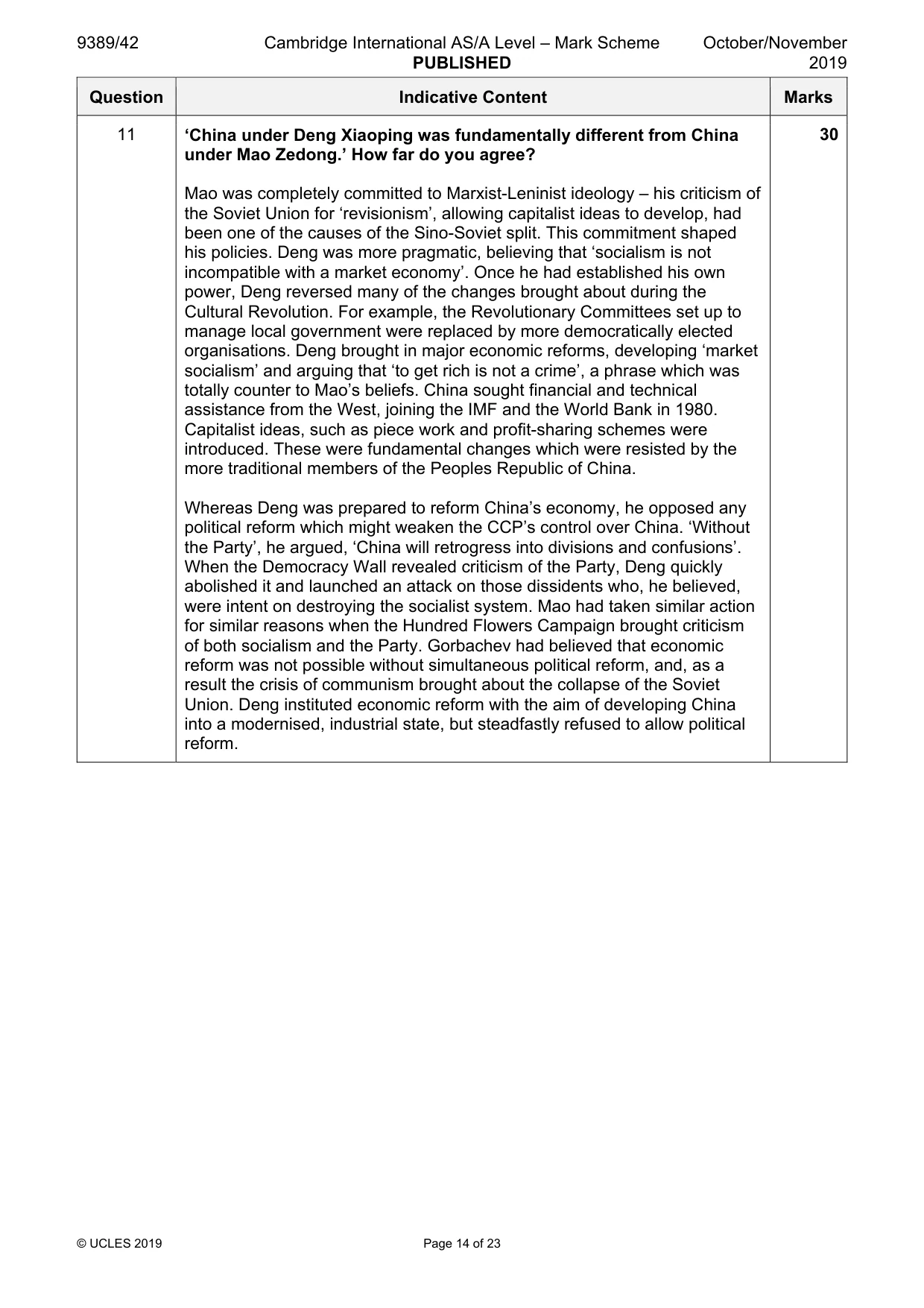
11 ‘China under Deng Xiaoping was fundamentally different from China under Mao Zedong.’ How far do you agree? [30]
Mark scheme: 11 ‘China under Deng Xiaoping was fundamentally different from China 30 under Mao Zedong.’ How far do you agree? Mao was completely committed to Marxist-Leninist ideology – his criticism of the Soviet Union for ‘revisionism’, allowing capitalist ideas to develop, had been one of the causes of the Sino-Soviet split. This commitment shaped his policies. Deng was more pragmatic, believing that ‘socialism is not incompatible with a market economy’. Once he had established his own power, Deng reversed many of the changes brought about during the Cultural Revolution. For example, the Revolutionary Committees set up to manage local government were replaced by more democratically elected organisations. Deng brought in major economic reforms, developing ‘market socialism’ and arguing that ‘to get rich is not a crime’, a phrase which was totally counter to Mao’s beliefs. China sought financial and technical assistance from the West, joining the IMF and the World Bank in 1980. Capitalist ideas, such as piece work and profit-sharing schemes were introduced. These were fundamental changes which were resisted by the more traditional members of the Peoples Republic of China. Whereas Deng was prepared to reform China’s economy, he opposed any political reform which might weaken the CCP’s control over China. ‘Without the Party’, he argued, ‘China will retrogress into divisions and confusions’. When the Democracy Wall revealed criticism of the Party, Deng quickly abolished it and launched an attack on those dissidents who, he believed, were intent on destroying the socialist system. Mao had taken similar action for similar reasons when the Hundred Flowers Campaign brought criticism of both socialism and the Party. Gorbachev had believed that economic reform was not possible without simultaneous political reform, and, as a result the crisis of communism brought about the collapse of the Soviet Union. Deng instituted economic reform with the aim of developing China into a modernised, industrial state, but steadfastly refused to allow political reform.
Q12 · Compare and contrast the policies pursued by Presidents Nasser and Sadat regarding…
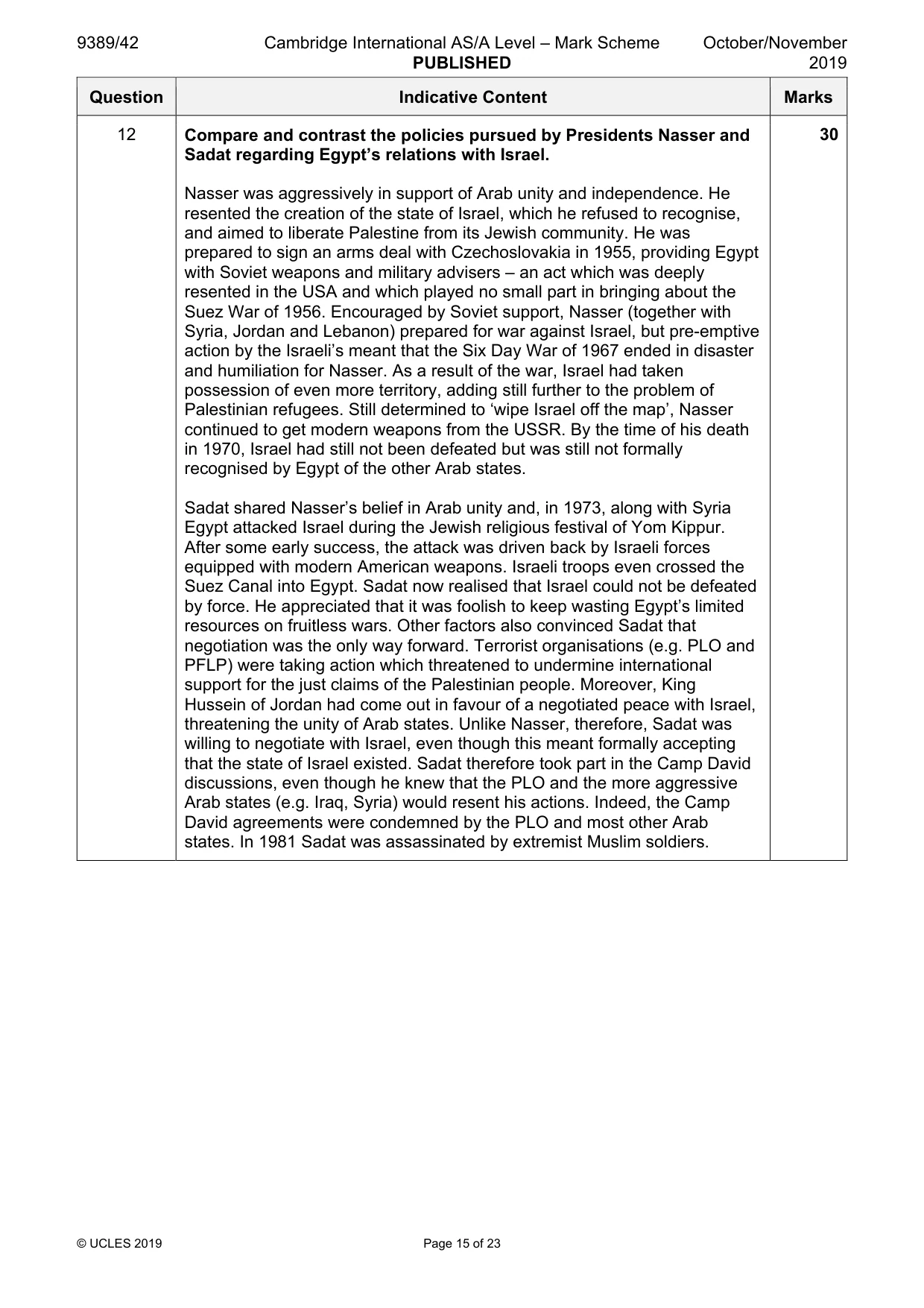
12 Compare and contrast the policies pursued by Presidents Nasser and Sadat regarding Egypt’s relations with Israel. [30] Depth Study 4: African History, 1945–1991 Answer any two questions.
Mark scheme: 12 Compare and contrast the policies pursued by Presidents Nasser and 30 Sadat regarding Egypt’s relations with Israel. Nasser was aggressively in support of Arab unity and independence. He resented the creation of the state of Israel, which he refused to recognise, and aimed to liberate Palestine from its Jewish community. He was prepared to sign an arms deal with Czechoslovakia in 1955, providing Egypt with Soviet weapons and military advisers – an act which was deeply resented in the USA and which played no small part in bringing about the Suez War of 1956. Encouraged by Soviet support, Nasser (together with Syria, Jordan and Lebanon) prepared for war against Israel, but pre-emptive action by the Israeli’s meant that the Six Day War of 1967 ended in disaster and humiliation for Nasser. As a result of the war, Israel had taken possession of even more territory, adding still further to the problem of Palestinian refugees. Still determined to ‘wipe Israel off the map’, Nasser continued to get modern weapons from the USSR. By the time of his death in 1970, Israel had still not been defeated but was still not formally recognised by Egypt of the other Arab states. Sadat shared Nasser’s belief in Arab unity and, in 1973, along with Syria Egypt attacked Israel during the Jewish religious festival of Yom Kippur. After some early success, the attack was driven back by Israeli forces equipped with modern American weapons. Israeli troops even crossed the Suez Canal into Egypt. Sadat now realised that Israel could not be defeated by force. He appreciated that it was foolish to keep wasting Egypt’s limited resources on fruitless wars. Other factors also convinced Sadat that negotiation was the only way forward. Terrorist organisations (e.g. PLO and PFLP) were taking action which threatened to undermine international support for the just claims of the Palestinian people. Moreover, King Hussein of Jordan had come out in favour of a negotiated peace with Israel, threatening the unity of Arab states. Unlike Nasser, therefore, Sadat was willing to negotiate with Israel, even though this meant formally accepting that the state of Israel existed. Sadat therefore took part in the Camp David discussions, even though he knew that the PLO and the more aggressive Arab states (e.g. Iraq, Syria) would resent his actions. Indeed, the Camp David agreements were condemned by the PLO and most other Arab states. In 1981 Sadat was assassinated by extremist Muslim soldiers.
Q13 · How important was previous African experience of the legislative process in achieving…
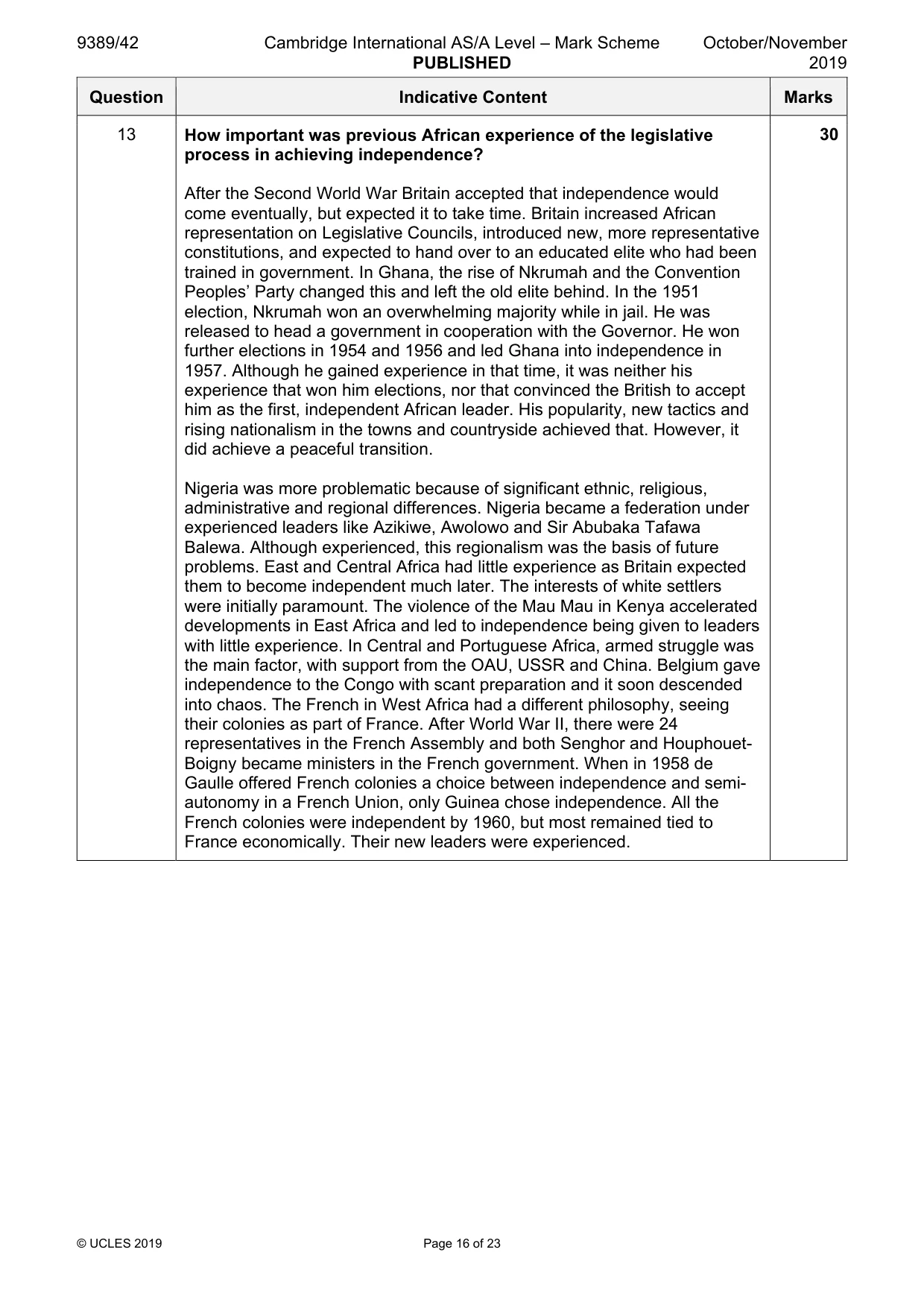
13 How important was previous African experience of the legislative process in achieving independence? [30]
Mark scheme: 13 How important was previous African experience of the legislative 30 process in achieving independence? After the Second World War Britain accepted that independence would come eventually, but expected it to take time. Britain increased African representation on Legislative Councils, introduced new, more representative constitutions, and expected to hand over to an educated elite who had been trained in government. In Ghana, the rise of Nkrumah and the Convention Peoples’ Party changed this and left the old elite behind. In the 1951 election, Nkrumah won an overwhelming majority while in jail. He was released to head a government in cooperation with the Governor. He won further elections in 1954 and 1956 and led Ghana into independence in 1957. Although he gained experience in that time, it was neither his experience that won him elections, nor that convinced the British to accept him as the first, independent African leader. His popularity, new tactics and rising nationalism in the towns and countryside achieved that. However, it did achieve a peaceful transition. Nigeria was more problematic because of significant ethnic, religious, administrative and regional differences. Nigeria became a federation under experienced leaders like Azikiwe, Awolowo and Sir Abubaka Tafawa Balewa. Although experienced, this regionalism was the basis of future problems. East and Central Africa had little experience as Britain expected them to become independent much later. The interests of white settlers were initially paramount. The violence of the Mau Mau in Kenya accelerated developments in East Africa and led to independence being given to leaders with little experience. In Central and Portuguese Africa, armed struggle was the main factor, with support from the OAU, USSR and China. Belgium gave independence to the Congo with scant preparation and it soon descended into chaos. The French in West Africa had a different philosophy, seeing their colonies as part of France. After World War II, there were 24 representatives in the French Assembly and both Senghor and Houphouet- Boigny became ministers in the French government. When in 1958 de Gaulle offered French colonies a choice between independence and semi- autonomy in a French Union, only Guinea chose independence. All the French colonies were independent by 1960, but most remained tied to France economically. Their new leaders were experienced.
Q14 · Evaluate the reasons for pursuing a policy of non‑alignment in Africa during the Cold War…
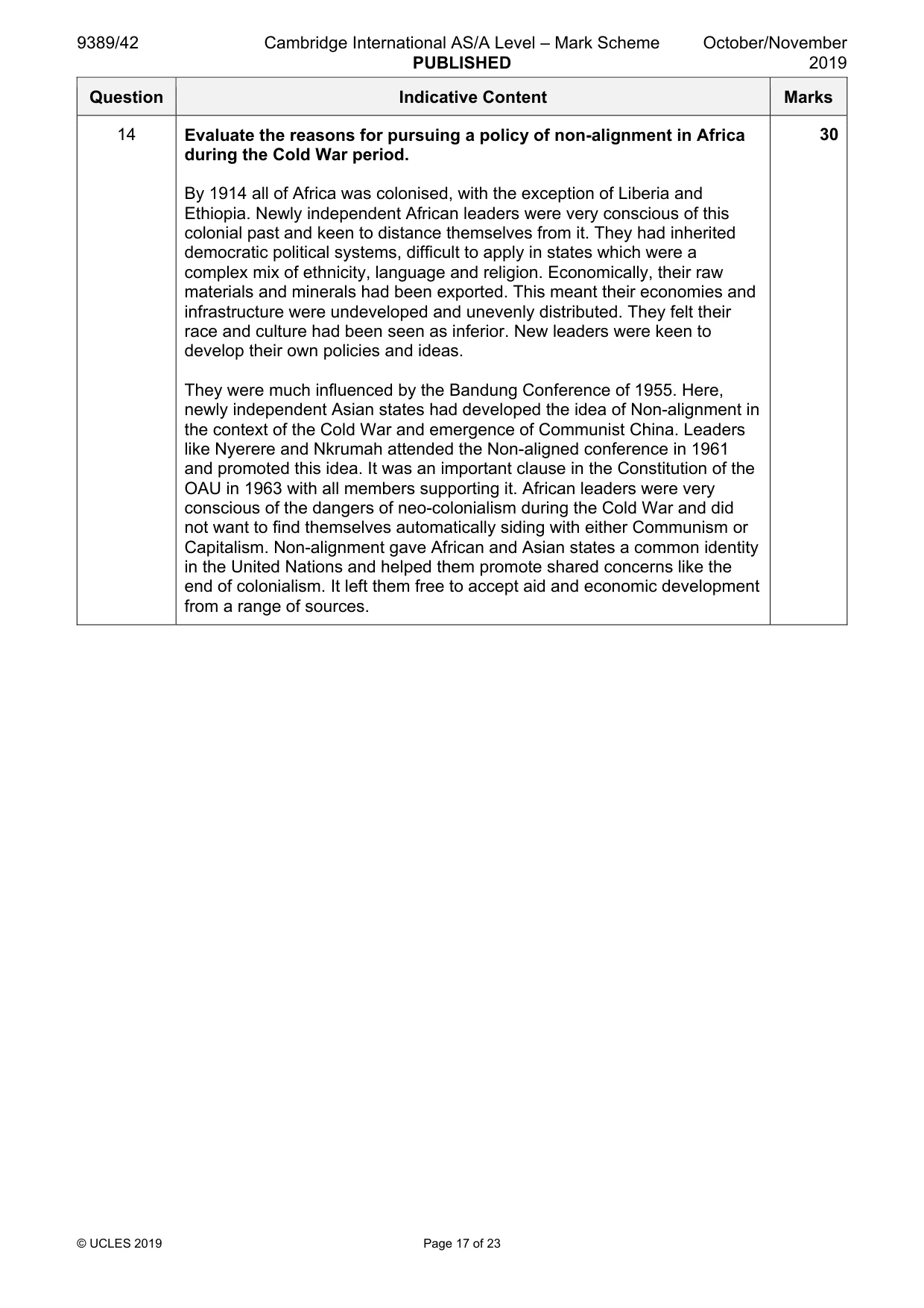
14 Evaluate the reasons for pursuing a policy of non‑alignment in Africa during the Cold War period. [30]
Mark scheme: 14 Evaluate the reasons for pursuing a policy of non-alignment in Africa 30 during the Cold War period. By 1914 all of Africa was colonised, with the exception of Liberia and Ethiopia. Newly independent African leaders were very conscious of this colonial past and keen to distance themselves from it. They had inherited democratic political systems, difficult to apply in states which were a complex mix of ethnicity, language and religion. Economically, their raw materials and minerals had been exported. This meant their economies and infrastructure were undeveloped and unevenly distributed. They felt their race and culture had been seen as inferior. New leaders were keen to develop their own policies and ideas. They were much influenced by the Bandung Conference of 1955. Here, newly independent Asian states had developed the idea of Non-alignment in the context of the Cold War and emergence of Communist China. Leaders like Nyerere and Nkrumah attended the Non-aligned conference in 1961 and promoted this idea. It was an important clause in the Constitution of the OAU in 1963 with all members supporting it. African leaders were very conscious of the dangers of neo-colonialism during the Cold War and did not want to find themselves automatically siding with either Communism or Capitalism. Non-alignment gave African and Asian states a common identity in the United Nations and helped them promote shared concerns like the end of colonialism. It left them free to accept aid and economic development from a range of sources.
Q15 · How important were trade unions as power bases in newly‑independent African states?
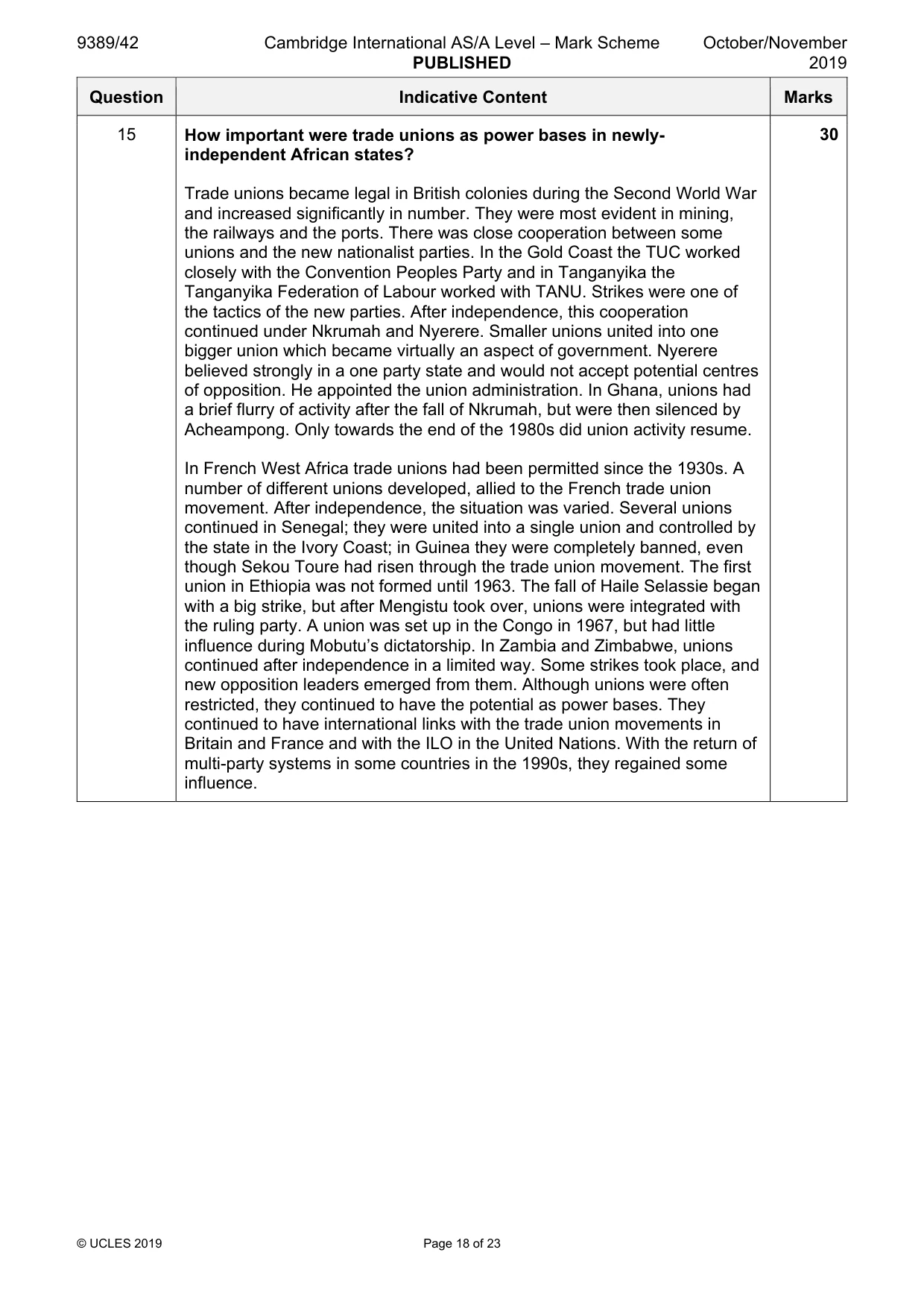
15 How important were trade unions as power bases in newly‑independent African states? [30]
Mark scheme: 15 How important were trade unions as power bases in newly- 30 independent African states? Trade unions became legal in British colonies during the Second World War and increased significantly in number. They were most evident in mining, the railways and the ports. There was close cooperation between some unions and the new nationalist parties. In the Gold Coast the TUC worked closely with the Convention Peoples Party and in Tanganyika the Tanganyika Federation of Labour worked with TANU. Strikes were one of the tactics of the new parties. After independence, this cooperation continued under Nkrumah and Nyerere. Smaller unions united into one bigger union which became virtually an aspect of government. Nyerere believed strongly in a one party state and would not accept potential centres of opposition. He appointed the union administration. In Ghana, unions had a brief flurry of activity after the fall of Nkrumah, but were then silenced by Acheampong. Only towards the end of the 1980s did union activity resume. In French West Africa trade unions had been permitted since the 1930s. A number of different unions developed, allied to the French trade union movement. After independence, the situation was varied. Several unions continued in Senegal; they were united into a single union and controlled by the state in the Ivory Coast; in Guinea they were completely banned, even though Sekou Toure had risen through the trade union movement. The first union in Ethiopia was not formed until 1963. The fall of Haile Selassie began with a big strike, but after Mengistu took over, unions were integrated with the ruling party. A union was set up in the Congo in 1967, but had little influence during Mobutu’s dictatorship. In Zambia and Zimbabwe, unions continued after independence in a limited way. Some strikes took place, and new opposition leaders emerged from them. Although unions were often restricted, they continued to have the potential as power bases. They continued to have international links with the trade union movements in Britain and France and with the ILO in the United Nations. With the return of multi-party systems in some countries in the 1990s, they regained some influence.
Q16 · Depth Study 5: Southeast Asian History, 1945–1990s Answer any two questions
Depth Study 5: Southeast Asian History, 1945–1990s Answer any two questions.
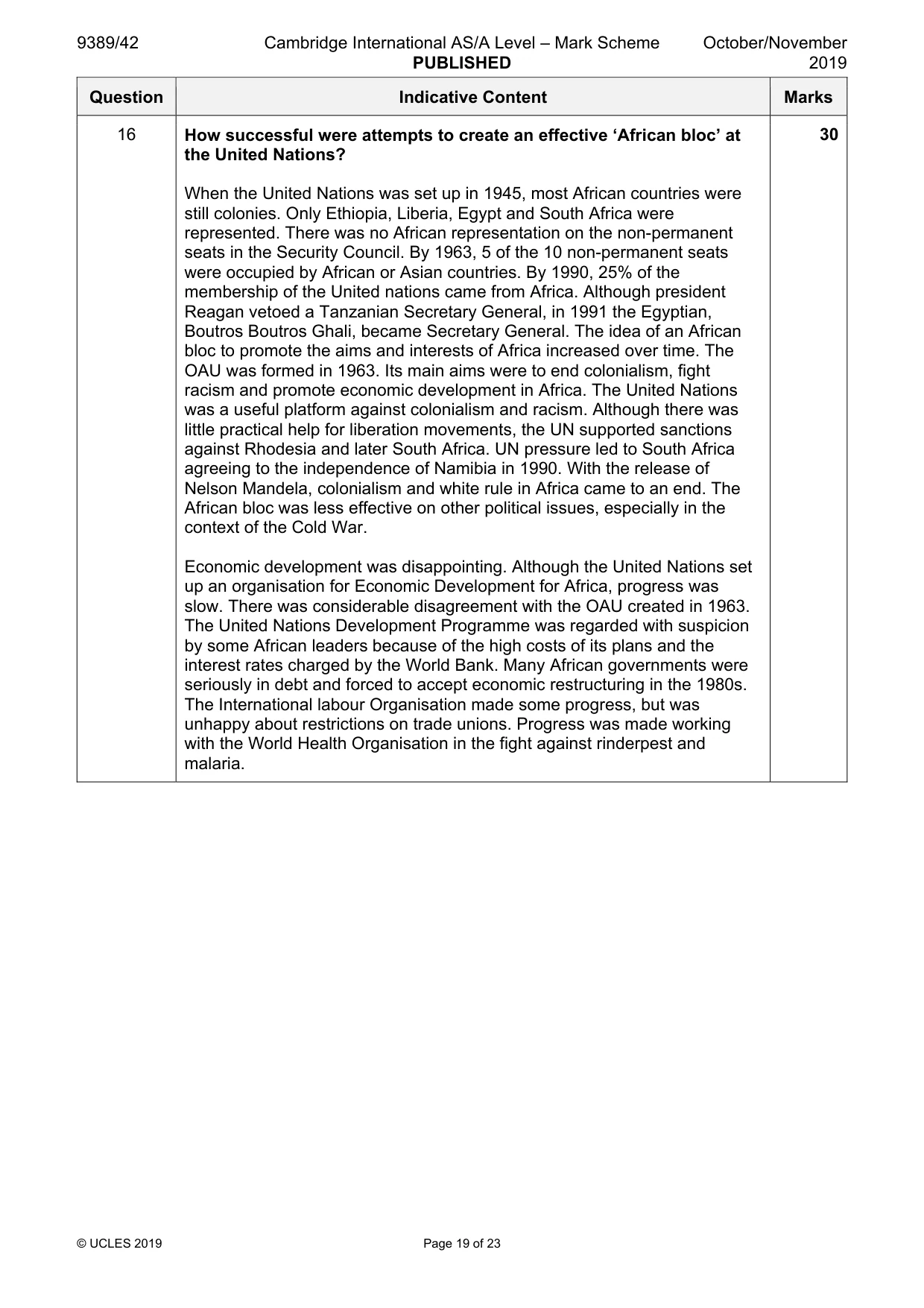
Mark scheme: 16 How successful were attempts to create an effective ‘African bloc’ at 30 the United Nations? When the United Nations was set up in 1945, most African countries were still colonies. Only Ethiopia, Liberia, Egypt and South Africa were represented. There was no African representation on the non-permanent seats in the Security Council. By 1963, 5 of the 10 non-permanent seats were occupied by African or Asian countries. By 1990, 25% of the membership of the United nations came from Africa. Although president Reagan vetoed a Tanzanian Secretary General, in 1991 the Egyptian, Boutros Boutros Ghali, became Secretary General. The idea of an African bloc to promote the aims and interests of Africa increased over time. The OAU was formed in 1963. Its main aims were to end colonialism, fight racism and promote economic development in Africa. The United Nations was a useful platform against colonialism and racism. Although there was little practical help for liberation movements, the UN supported sanctions against Rhodesia and later South Africa. UN pressure led to South Africa agreeing to the independence of Namibia in 1990. With the release of Nelson Mandela, colonialism and white rule in Africa came to an end. The African bloc was less effective on other political issues, especially in the context of the Cold War. Economic development was disappointing. Although the United Nations set up an organisation for Economic Development for Africa, progress was slow. There was considerable disagreement with the OAU created in 1963. The United Nations Development Programme was regarded with suspicion by some African leaders because of the high costs of its plans and the interest rates charged by the World Bank. Many African governments were seriously in debt and forced to accept economic restructuring in the 1980s. The International labour Organisation made some progress, but was unhappy about restrictions on trade unions. Progress was made working with the World Health Organisation in the fight against rinderpest and malaria.
Q17 · How effectively did Britain and the USA support resistance to Japan in Southeast Asia in…
17 How effectively did Britain and the USA support resistance to Japan in Southeast Asia in the Second World War? [30]
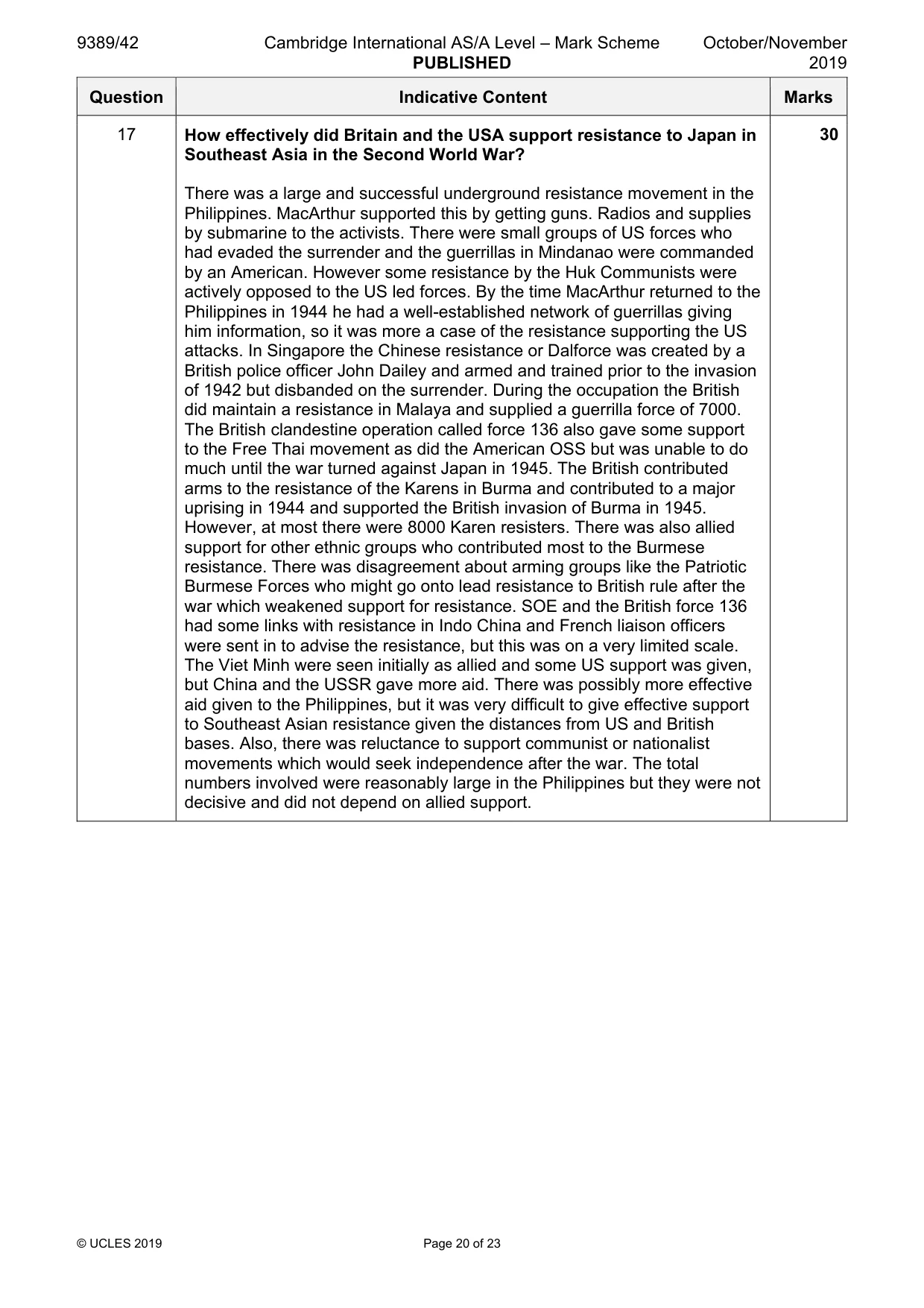
Mark scheme: 17 How effectively did Britain and the USA support resistance to Japan in 30 Southeast Asia in the Second World War? There was a large and successful underground resistance movement in the Philippines. MacArthur supported this by getting guns. Radios and supplies by submarine to the activists. There were small groups of US forces who had evaded the surrender and the guerrillas in Mindanao were commanded by an American. However some resistance by the Huk Communists were actively opposed to the US led forces. By the time MacArthur returned to the Philippines in 1944 he had a well-established network of guerrillas giving him information, so it was more a case of the resistance supporting the US attacks. In Singapore the Chinese resistance or Dalforce was created by a British police officer John Dailey and armed and trained prior to the invasion of 1942 but disbanded on the surrender. During the occupation the British did maintain a resistance in Malaya and supplied a guerrilla force of 7000. The British clandestine operation called force 136 also gave some support to the Free Thai movement as did the American OSS but was unable to do much until the war turned against Japan in 1945. The British contributed arms to the resistance of the Karens in Burma and contributed to a major uprising in 1944 and supported the British invasion of Burma in 1945. However, at most there were 8000 Karen resisters. There was also allied support for other ethnic groups who contributed most to the Burmese resistance. There was disagreement about arming groups like the Patriotic Burmese Forces who might go onto lead resistance to British rule after the war which weakened support for resistance. SOE and the British force 136 had some links with resistance in Indo China and French liaison officers were sent in to advise the resistance, but this was on a very limited scale. The Viet Minh were seen initially as allied and some US support was given, but China and the USSR gave more aid. There was possibly more effective aid given to the Philippines, but it was very difficult to give effective support to Southeast Asian resistance given the distances from US and British bases. Also, there was reluctance to support communist or nationalist movements which would seek independence after the war. The total numbers involved were reasonably large in the Philippines but they were not decisive and did not depend on allied support.
Q18 · How far can the lack of progress towards democratic rule in Burma/Myanmar be attributed…
18 How far can the lack of progress towards democratic rule in Burma/Myanmar be attributed to the influence and tactics of Ne Win? [30]
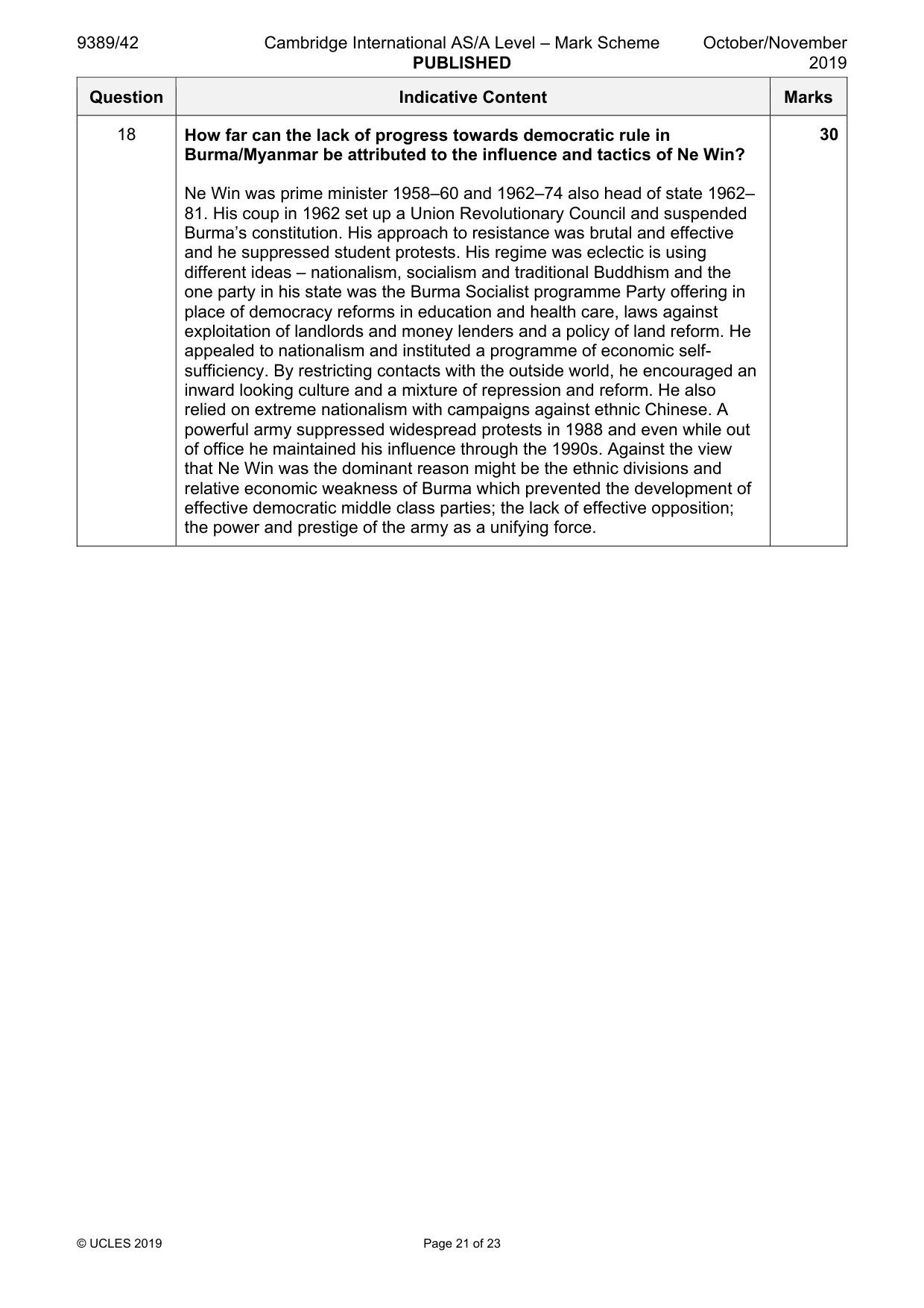
Mark scheme: 18 How far can the lack of progress towards democratic rule in 30 Burma/Myanmar be attributed to the influence and tactics of Ne Win? Ne Win was prime minister 1958–60 and 1962–74 also head of state 1962– 81. His coup in 1962 set up a Union Revolutionary Council and suspended Burma’s constitution. His approach to resistance was brutal and effective and he suppressed student protests. His regime was eclectic is using different ideas – nationalism, socialism and traditional Buddhism and the one party in his state was the Burma Socialist programme Party offering in place of democracy reforms in education and health care, laws against exploitation of landlords and money lenders and a policy of land reform. He appealed to nationalism and instituted a programme of economic self- sufficiency. By restricting contacts with the outside world, he encouraged an inward looking culture and a mixture of repression and reform. He also relied on extreme nationalism with campaigns against ethnic Chinese. A powerful army suppressed widespread protests in 1988 and even while out of office he maintained his influence through the 1990s. Against the view that Ne Win was the dominant reason might be the ethnic divisions and relative economic weakness of Burma which prevented the development of effective democratic middle class parties; the lack of effective opposition; the power and prestige of the army as a unifying force.
Q19 · How effectively did Philippines’ governments deal with the issue of Islamic militancy in…
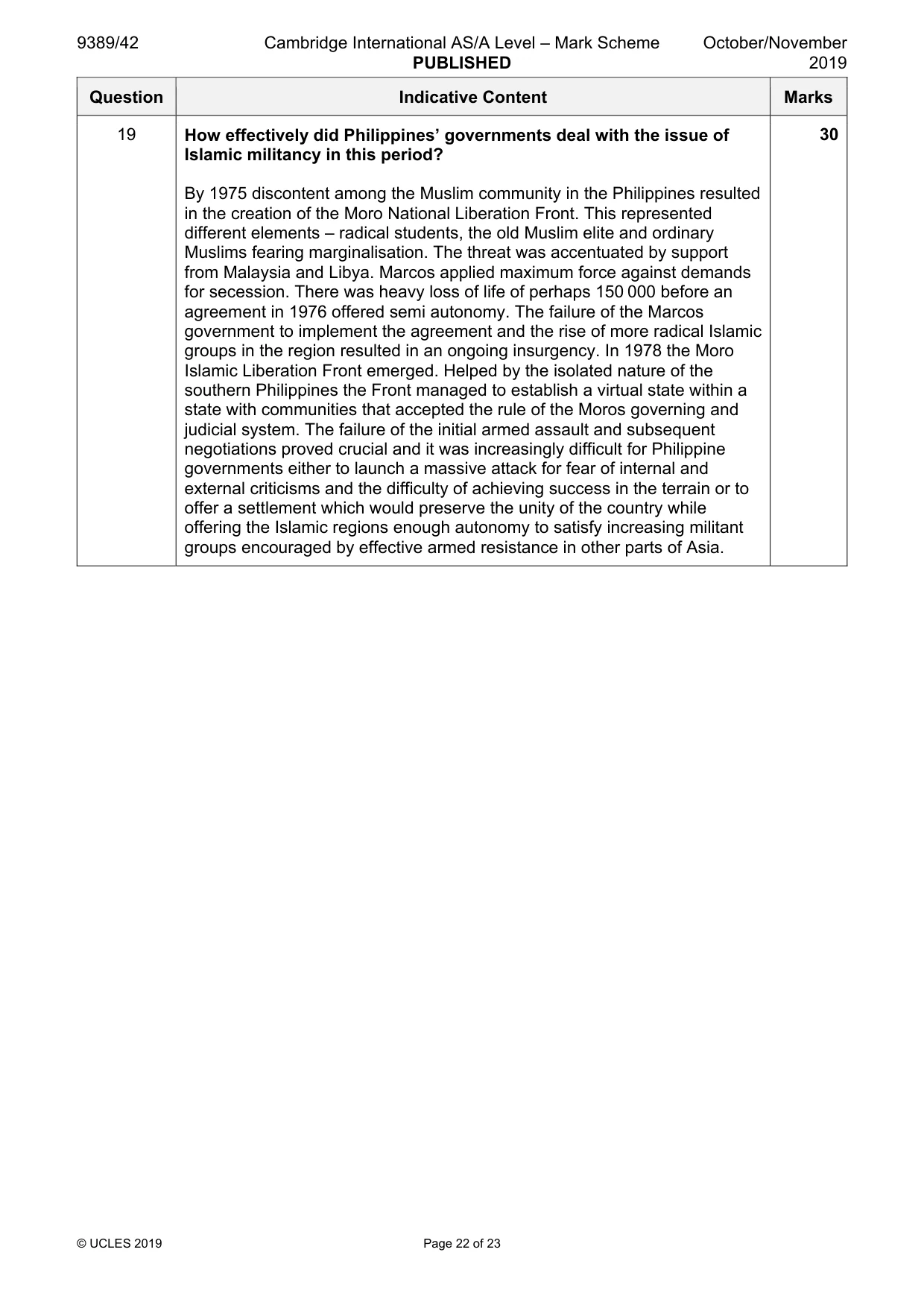
19 How effectively did Philippines’ governments deal with the issue of Islamic militancy in this period? [30]
Mark scheme: 19 How effectively did Philippines’ governments deal with the issue of 30 Islamic militancy in this period? By 1975 discontent among the Muslim community in the Philippines resulted in the creation of the Moro National Liberation Front. This represented different elements – radical students, the old Muslim elite and ordinary Muslims fearing marginalisation. The threat was accentuated by support from Malaysia and Libya. Marcos applied maximum force against demands for secession. There was heavy loss of life of perhaps 150 000 before an agreement in 1976 offered semi autonomy. The failure of the Marcos government to implement the agreement and the rise of more radical Islamic groups in the region resulted in an ongoing insurgency. In 1978 the Moro Islamic Liberation Front emerged. Helped by the isolated nature of the southern Philippines the Front managed to establish a virtual state within a state with communities that accepted the rule of the Moros governing and judicial system. The failure of the initial armed assault and subsequent negotiations proved crucial and it was increasingly difficult for Philippine governments either to launch a massive attack for fear of internal and external criticisms and the difficulty of achieving success in the terrain or to offer a settlement which would preserve the unity of the country while offering the Islamic regions enough autonomy to satisfy increasing militant groups encouraged by effective armed resistance in other parts of Asia.
What you needed in this session
Cambridge’s own grade thresholds for 2019 Oct/Nov, Paper 4 · Variant 2. A higher threshold means an easier paper — the bar moves with how the cohort did.