Cambridge A Level History 9389 — 2018 May/June Paper 4 · Variant 2
9389/42/M/J/18 · 11 questions · 60 marks · ≈68 min
The question paper and its mark scheme, free to read here and free to download. This is Cambridge’s own paper, exactly as it was sat.
Question paper4 pages
Mark scheme18 pages
Answers below. Sit the paper first if you are practising.
Questions as text
Q1 · ‘Nothing but a brutal dictatorship.’ How far do you agree with this view of Lenin’s…
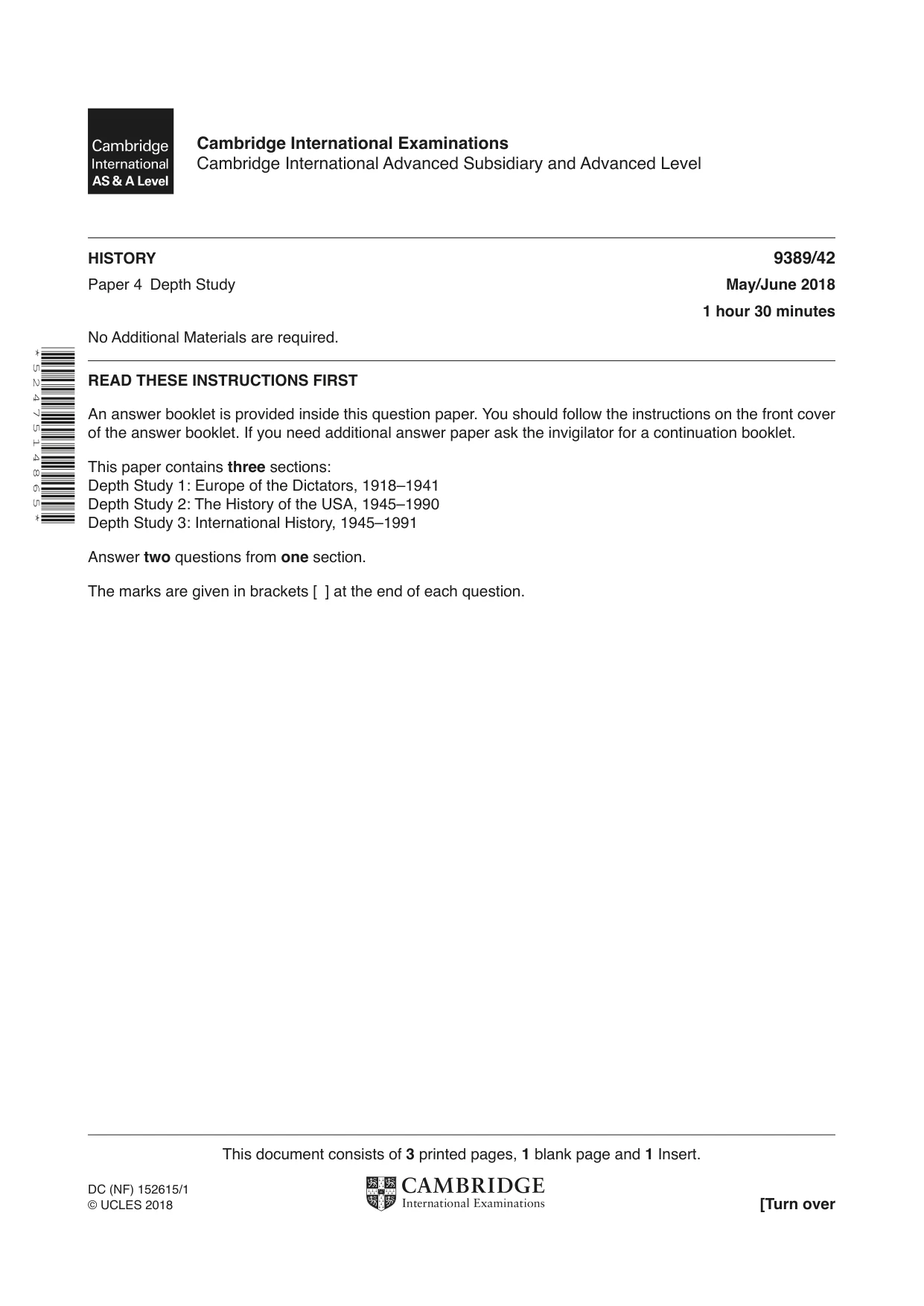
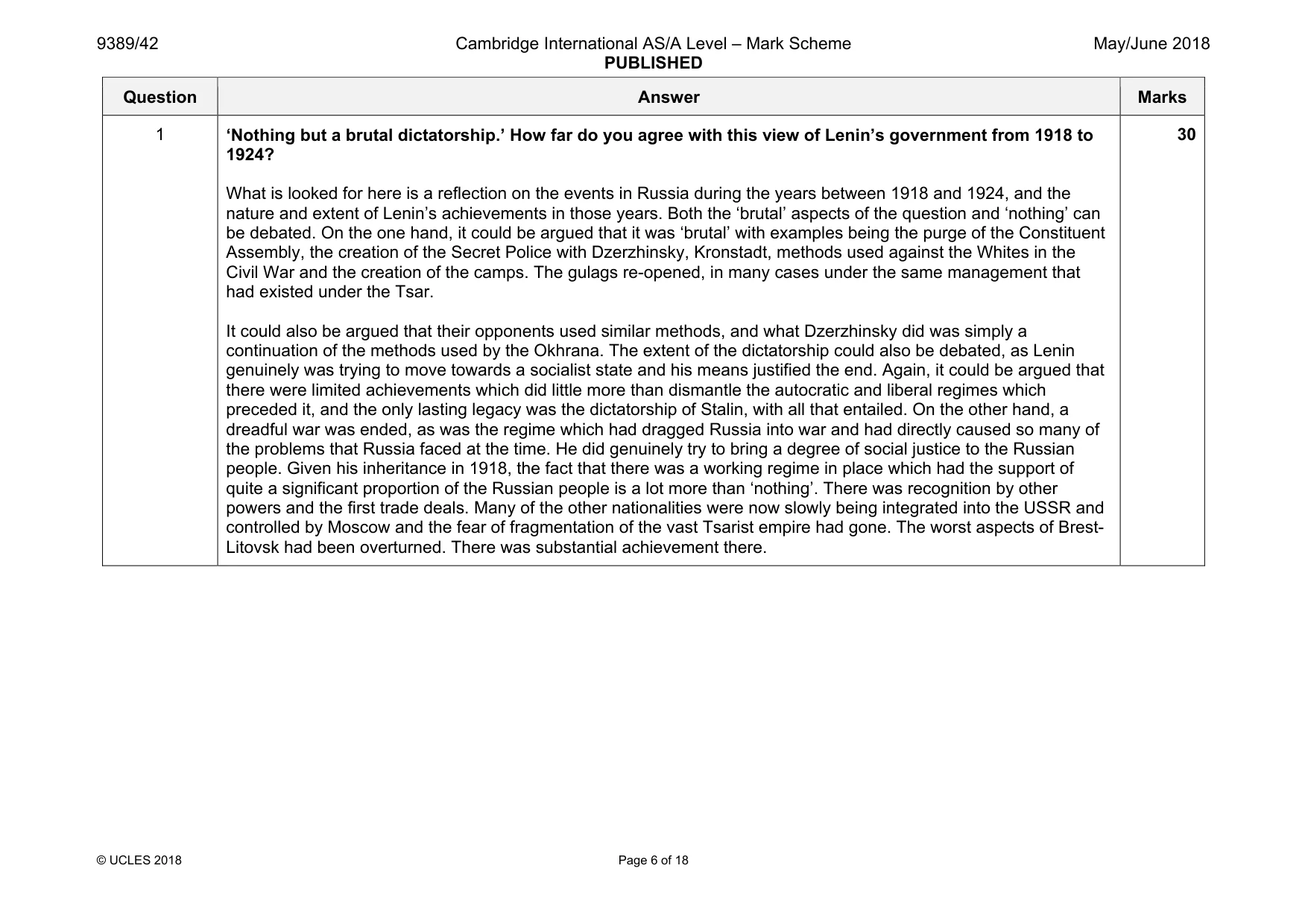
1 ‘Nothing but a brutal dictatorship.’ How far do you agree with this view of Lenin’s government from 1918 to 1924? [30]
Mark scheme: 1 ‘Nothing but a brutal dictatorship.’ How far do you agree with this view of Lenin’s government from 1918 to 1924? What is looked for here is a reflection on the events in Russia during the years between 1918 and 1924, and the nature and extent of Lenin’s achievements in those years. Both the ‘brutal’ aspects of the question and ‘nothing’ can be debated. On the one hand, it could be argued that it was ‘brutal’ with examples being the purge of the Constituent Assembly, the creation of the Secret Police with Dzerzhinsky, Kronstadt, methods used against the Whites in the Civil War and the creation of the camps. The gulags re-opened, in many cases under the same management that had existed under the Tsar. It could also be argued that their opponents used similar methods, and what Dzerzhinsky did was simply a continuation of the methods used by the Okhrana. The extent of the dictatorship could also be debated, as Lenin genuinely was trying to move towards a socialist state and his means justified the end. Again, it could be argued that there were limited achievements which did little more than dismantle the autocratic and liberal regimes which preceded it, and the only lasting legacy was the dictatorship of Stalin, with all that entailed. On the other hand, a dreadful war was ended, as was the regime which had dragged Russia into war and had directly caused so many of the problems that Russia faced at the time. He did genuinely try to bring a degree of social justice to the Russian people. Given his inheritance in 1918, the fact that there was a working regime in place which had the support of quite a significant proportion of the Russian people is a lot more than ‘nothing’. There was recognition by other powers and the first trade deals. Many of the other nationalities were now slowly being integrated into the USSR and controlled by Moscow and the fear of fragmentation of the vast Tsarist empire had gone. The worst aspects of Brest- Litovsk had been overturned. There was substantial achievement there. 30
Q2 · Assess the strengths and weaknesses of Mussolini as a national leader
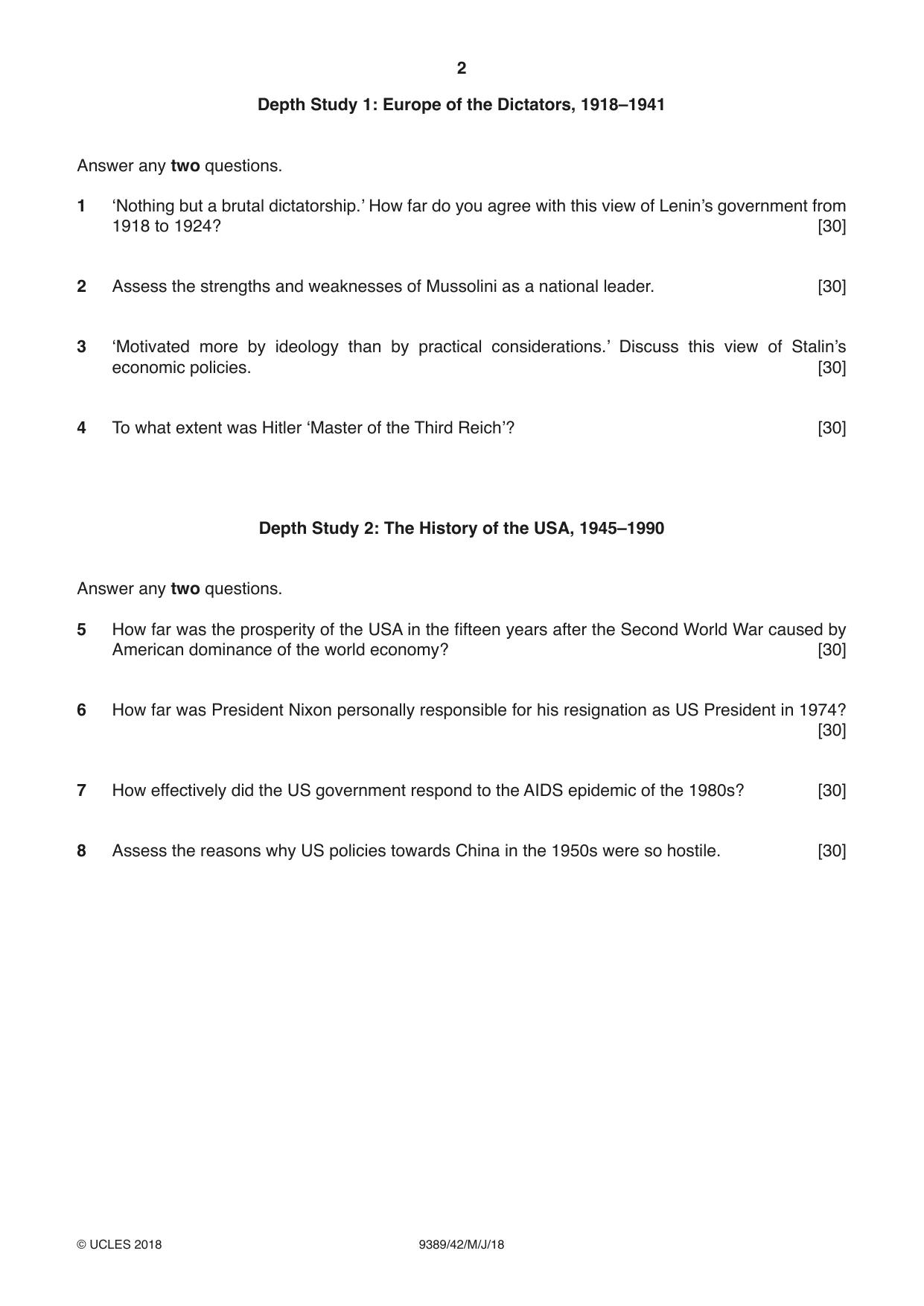
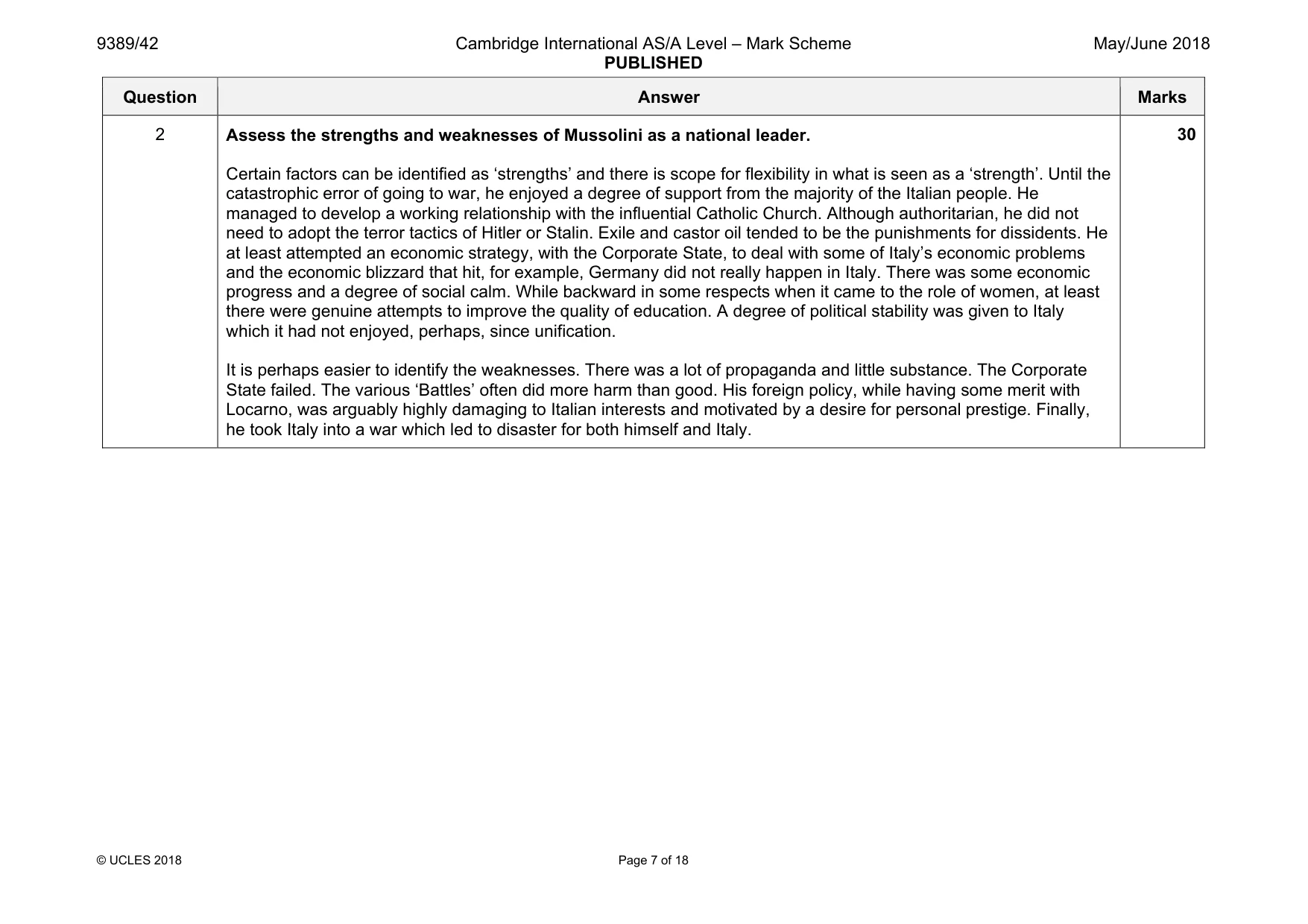
2 Assess the strengths and weaknesses of Mussolini as a national leader. [30]
Mark scheme: 2 Assess the strengths and weaknesses of Mussolini as a national leader. Certain factors can be identified as ‘strengths’ and there is scope for flexibility in what is seen as a ‘strength’. Until the catastrophic error of going to war, he enjoyed a degree of support from the majority of the Italian people. He managed to develop a working relationship with the influential Catholic Church. Although authoritarian, he did not need to adopt the terror tactics of Hitler or Stalin. Exile and castor oil tended to be the punishments for dissidents. He at least attempted an economic strategy, with the Corporate State, to deal with some of Italy’s economic problems and the economic blizzard that hit, for example, Germany did not really happen in Italy. There was some economic progress and a degree of social calm. While backward in some respects when it came to the role of women, at least there were genuine attempts to improve the quality of education. A degree of political stability was given to Italy which it had not enjoyed, perhaps, since unification. It is perhaps easier to identify the weaknesses. There was a lot of propaganda and little substance. The Corporate State failed. The various ‘Battles’ often did more harm than good. His foreign policy, while having some merit with Locarno, was arguably highly damaging to Italian interests and motivated by a desire for personal prestige. Finally, he took Italy into a war which led to disaster for both himself and Italy. 30
Q3 · ‘Motivated more by ideology than by practical considerations.’ Discuss this view of…
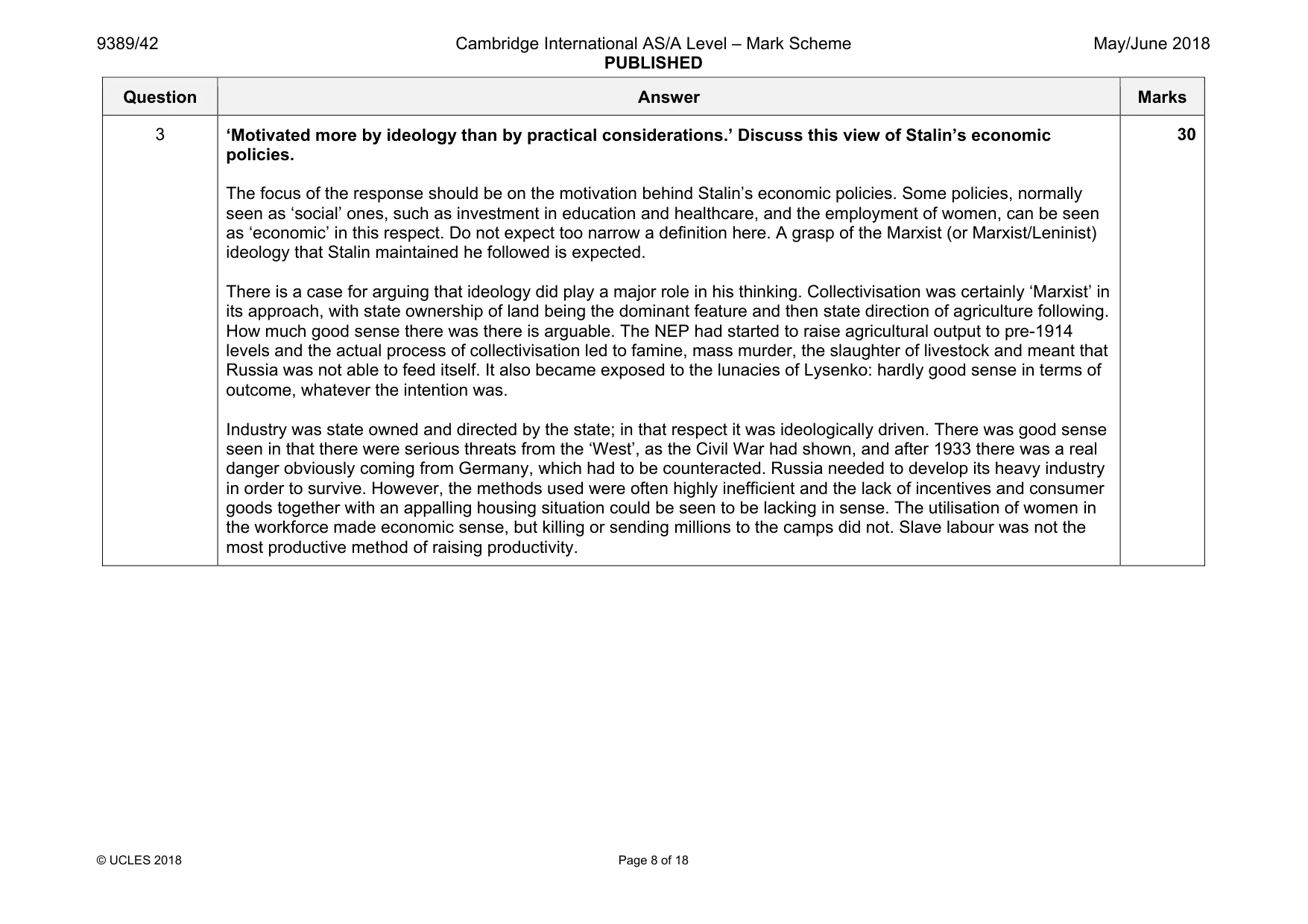
3 ‘Motivated more by ideology than by practical considerations.’ Discuss this view of Stalin’s economic policies. [30]
Mark scheme: 3 ‘Motivated more by ideology than by practical considerations.’ Discuss this view of Stalin’s economic policies. The focus of the response should be on the motivation behind Stalin’s economic policies. Some policies, normally seen as ‘social’ ones, such as investment in education and healthcare, and the employment of women, can be seen as ‘economic’ in this respect. Do not expect too narrow a definition here. A grasp of the Marxist (or Marxist/Leninist) ideology that Stalin maintained he followed is expected. There is a case for arguing that ideology did play a major role in his thinking. Collectivisation was certainly ‘Marxist’ in its approach, with state ownership of land being the dominant feature and then state direction of agriculture following. How much good sense there was there is arguable. The NEP had started to raise agricultural output to pre-1914 levels and the actual process of collectivisation led to famine, mass murder, the slaughter of livestock and meant that Russia was not able to feed itself. It also became exposed to the lunacies of Lysenko: hardly good sense in terms of outcome, whatever the intention was. Industry was state owned and directed by the state; in that respect it was ideologically driven. There was good sense seen in that there were serious threats from the ‘West’, as the Civil War had shown, and after 1933 there was a real danger obviously coming from Germany, which had to be counteracted. Russia needed to develop its heavy industry in order to survive. However, the methods used were often highly inefficient and the lack of incentives and consumer goods together with an appalling housing situation could be seen to be lacking in sense. The utilisation of women in the workforce made economic sense, but killing or sending millions to the camps did not. Slave labour was not the most productive method of raising productivity. 30
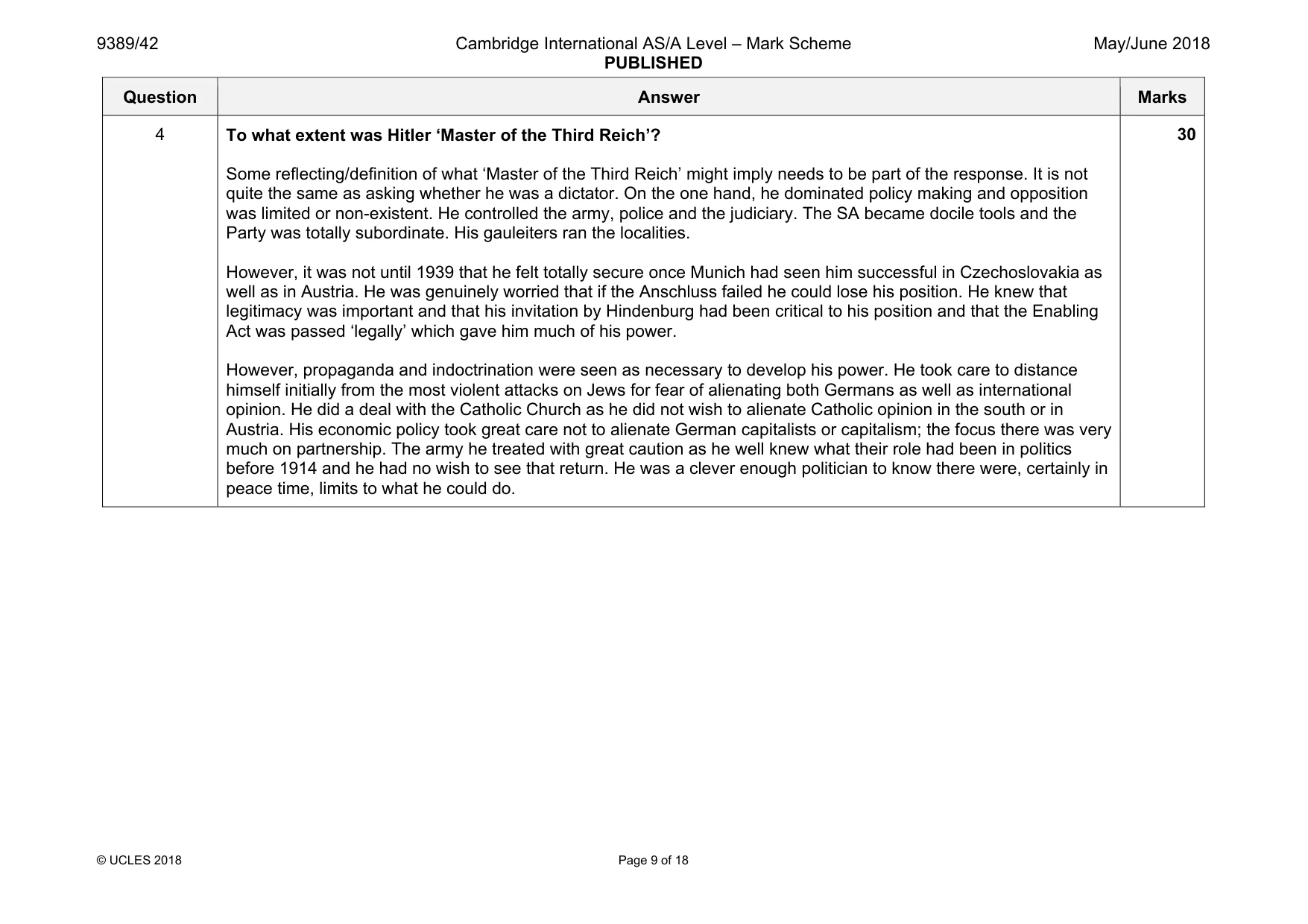
Q4 · To what extent was Hitler ‘Master of the Third Reich’?
4 To what extent was Hitler ‘Master of the Third Reich’? [30] Depth Study 2: The History of the USA, 1945–1990 Answer any two questions.
Mark scheme: 4 To what extent was Hitler ‘Master of the Third Reich’? Some reflecting/definition of what ‘Master of the Third Reich’ might imply needs to be part of the response. It is not quite the same as asking whether he was a dictator. On the one hand, he dominated policy making and opposition was limited or non-existent. He controlled the army, police and the judiciary. The SA became docile tools and the Party was totally subordinate. His gauleiters ran the localities. However, it was not until 1939 that he felt totally secure once Munich had seen him successful in Czechoslovakia as well as in Austria. He was genuinely worried that if the Anschluss failed he could lose his position. He knew that legitimacy was important and that his invitation by Hindenburg had been critical to his position and that the Enabling Act was passed ‘legally’ which gave him much of his power. However, propaganda and indoctrination were seen as necessary to develop his power. He took care to distance himself initially from the most violent attacks on Jews for fear of alienating both Germans as well as international opinion. He did a deal with the Catholic Church as he did not wish to alienate Catholic opinion in the south or in Austria. His economic policy took great care not to alienate German capitalists or capitalism; the focus there was very much on partnership. The army he treated with great caution as he well knew what their role had been in politics before 1914 and he had no wish to see that return. He was a clever enough politician to know there were, certainly in peace time, limits to what he could do. 30
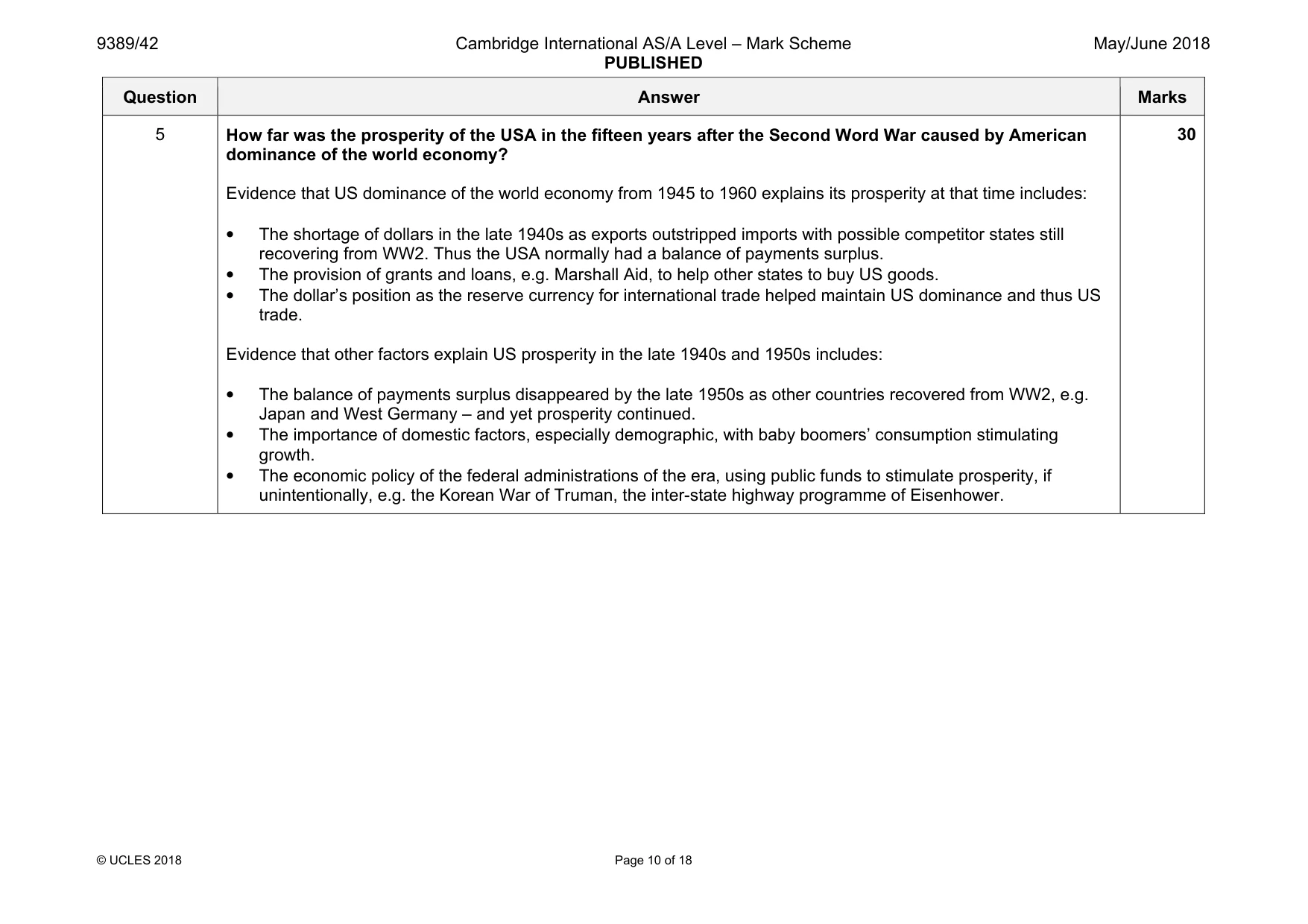
Q5 · How far was the prosperity of the USA in the fifteen years after the Second World War…
5 How far was the prosperity of the USA in the fifteen years after the Second World War caused by American dominance of the world economy? [30]
Mark scheme: 5 How far was the prosperity of the USA in the fifteen years after the Second Word War caused by American dominance of the world economy? Evidence that US dominance of the world economy from 1945 to 1960 explains its prosperity at that time includes: • The shortage of dollars in the late 1940s as exports outstripped imports with possible competitor states still recovering from WW2. Thus the USA normally had a balance of payments surplus. • The provision of grants and loans, e.g. Marshall Aid, to help other states to buy US goods. • The dollar’s position as the reserve currency for international trade helped maintain US dominance and thus US trade. Evidence that other factors explain US prosperity in the late 1940s and 1950s includes: • The balance of payments surplus disappeared by the late 1950s as other countries recovered from WW2, e.g. Japan and West Germany – and yet prosperity continued. • The importance of domestic factors, especially demographic, with baby boomers’ consumption stimulating growth. • The economic policy of the federal administrations of the era, using public funds to stimulate prosperity, if unintentionally, e.g. the Korean War of Truman, the inter-state highway programme of Eisenhower. 30
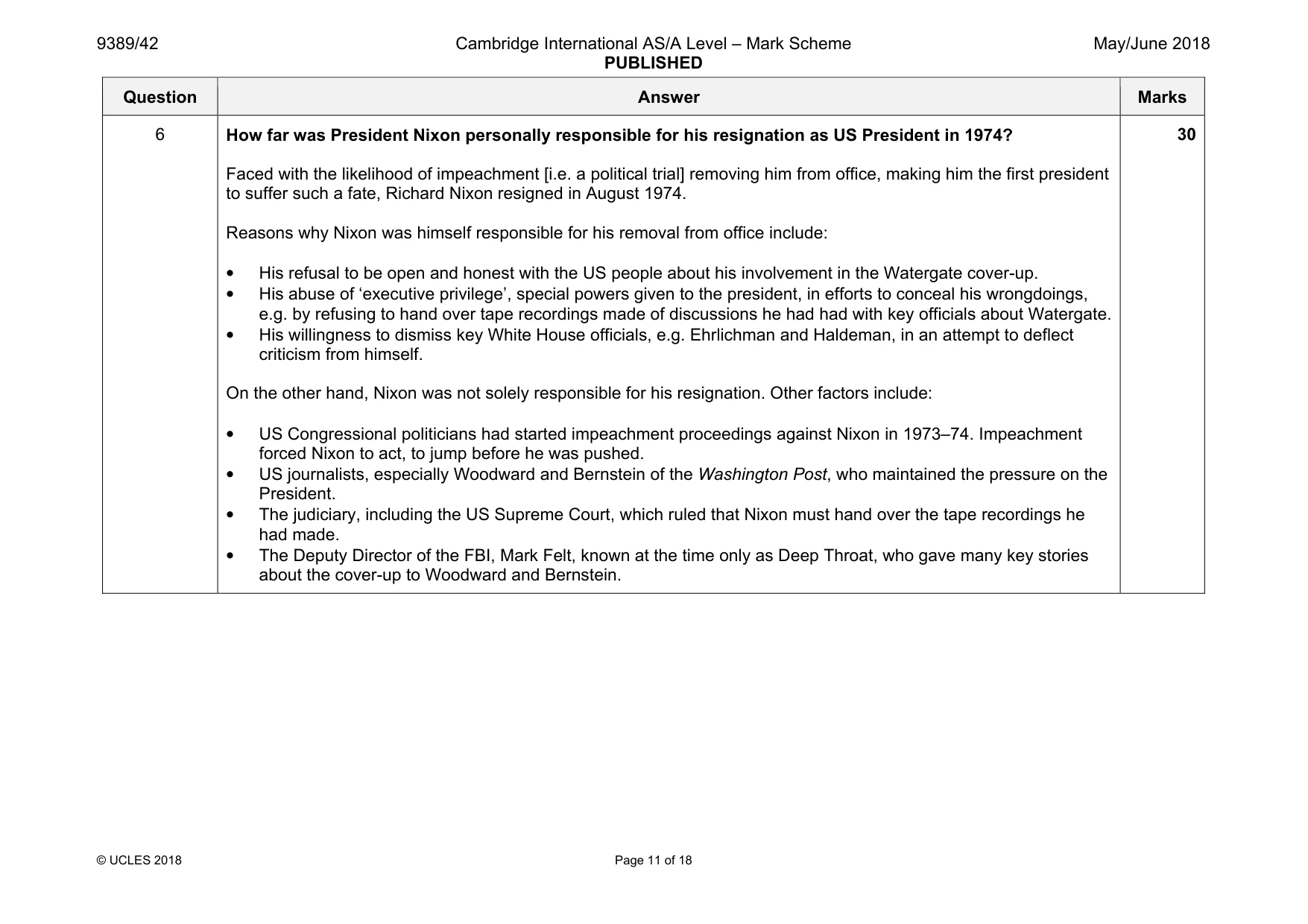
Q6 · How far was President Nixon personally responsible for his resignation as US President in…
6 How far was President Nixon personally responsible for his resignation as US President in 1974? [30]
Mark scheme: 6 How far was President Nixon personally responsible for his resignation as US President in 1974? Faced with the likelihood of impeachment [i.e. a political trial] removing him from office, making him the first president to suffer such a fate, Richard Nixon resigned in August 1974. Reasons why Nixon was himself responsible for his removal from office include: • His refusal to be open and honest with the US people about his involvement in the Watergate cover-up. • His abuse of ‘executive privilege’, special powers given to the president, in efforts to conceal his wrongdoings, e.g. by refusing to hand over tape recordings made of discussions he had had with key officials about Watergate. • His willingness to dismiss key White House officials, e.g. Ehrlichman and Haldeman, in an attempt to deflect criticism from himself. On the other hand, Nixon was not solely responsible for his resignation. Other factors include: • US Congressional politicians had started impeachment proceedings against Nixon in 1973–74. Impeachment forced Nixon to act, to jump before he was pushed. • US journalists, especially Woodward and Bernstein of the Washington Post, who maintained the pressure on the President. • The judiciary, including the US Supreme Court, which ruled that Nixon must hand over the tape recordings he had made. • The Deputy Director of the FBI, Mark Felt, known at the time only as Deep Throat, who gave many key stories about the cover-up to Woodward and Bernstein. 30
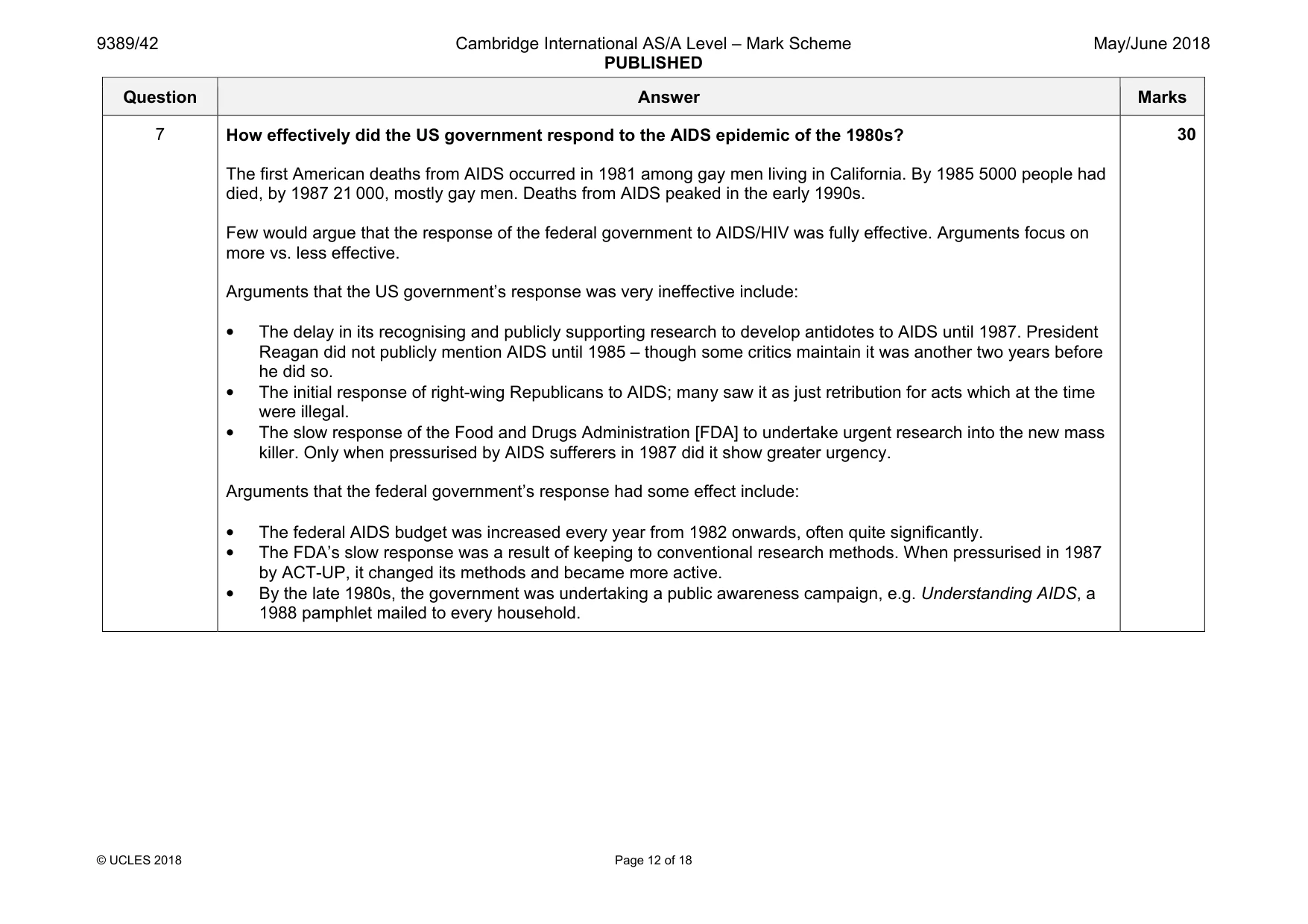
Q7 · How effectively did the US government respond to the AIDS epidemic of the 1980s?
7 How effectively did the US government respond to the AIDS epidemic of the 1980s? [30]
Mark scheme: 7 How effectively did the US government respond to the AIDS epidemic of the 1980s? The first American deaths from AIDS occurred in 1981 among gay men living in California. By 1985 5000 people had died, by 1987 21 000, mostly gay men. Deaths from AIDS peaked in the early 1990s. Few would argue that the response of the federal government to AIDS/HIV was fully effective. Arguments focus on more vs. less effective. Arguments that the US government’s response was very ineffective include: • The delay in its recognising and publicly supporting research to develop antidotes to AIDS until 1987. President Reagan did not publicly mention AIDS until 1985 – though some critics maintain it was another two years before he did so. • The initial response of right-wing Republicans to AIDS; many saw it as just retribution for acts which at the time were illegal. • The slow response of the Food and Drugs Administration [FDA] to undertake urgent research into the new mass killer. Only when pressurised by AIDS sufferers in 1987 did it show greater urgency. Arguments that the federal government’s response had some effect include: • The federal AIDS budget was increased every year from 1982 onwards, often quite significantly. • The FDA’s slow response was a result of keeping to conventional research methods. When pressurised in 1987 by ACT-UP, it changed its methods and became more active. • By the late 1980s, the government was undertaking a public awareness campaign, e.g. Understanding AIDS, a 1988 pamphlet mailed to every household. 30
Q8 · Depth Study 3: International History, 1945–1991 Answer any two questions
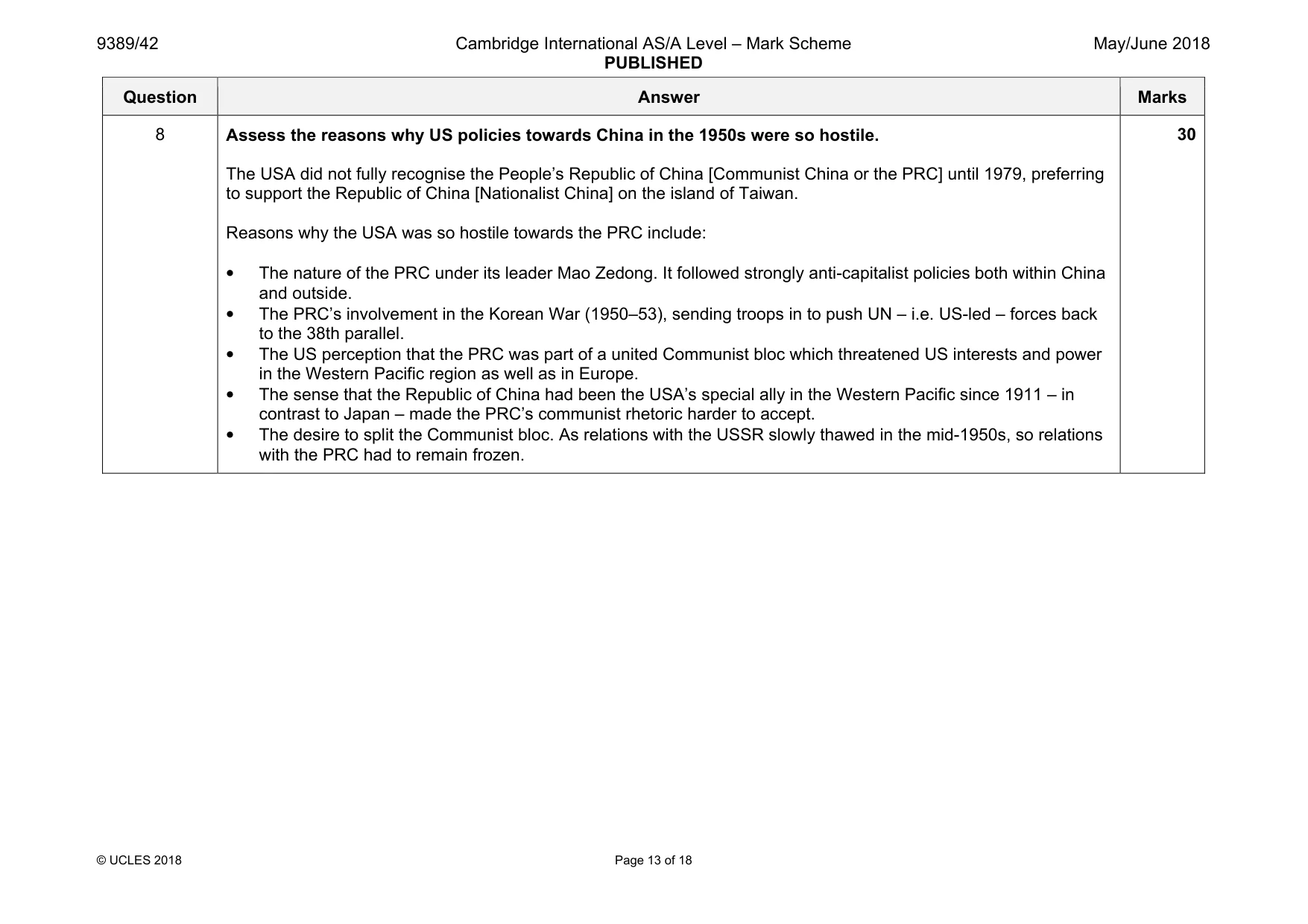
Depth Study 3: International History, 1945–1991 Answer any two questions.
Mark scheme: 8 Assess the reasons why US policies towards China in the 1950s were so hostile. The USA did not fully recognise the People’s Republic of China [Communist China or the PRC] until 1979, preferring to support the Republic of China [Nationalist China] on the island of Taiwan. Reasons why the USA was so hostile towards the PRC include: • The nature of the PRC under its leader Mao Zedong. It followed strongly anti-capitalist policies both within China and outside. • The PRC’s involvement in the Korean War (1950–53), sending troops in to push UN – i.e. US-led – forces back to the 38th parallel. • The US perception that the PRC was part of a united Communist bloc which threatened US interests and power in the Western Pacific region as well as in Europe. • The sense that the Republic of China had been the USA’s special ally in the Western Pacific since 1911 – in contrast to Japan – made the PRC’s communist rhetoric harder to accept. • The desire to split the Communist bloc. As relations with the USSR slowly thawed in the mid-1950s, so relations with the PRC had to remain frozen. 30
Q9 · To what extent was the USA’s defeat in the Vietnam War responsible for the development of…
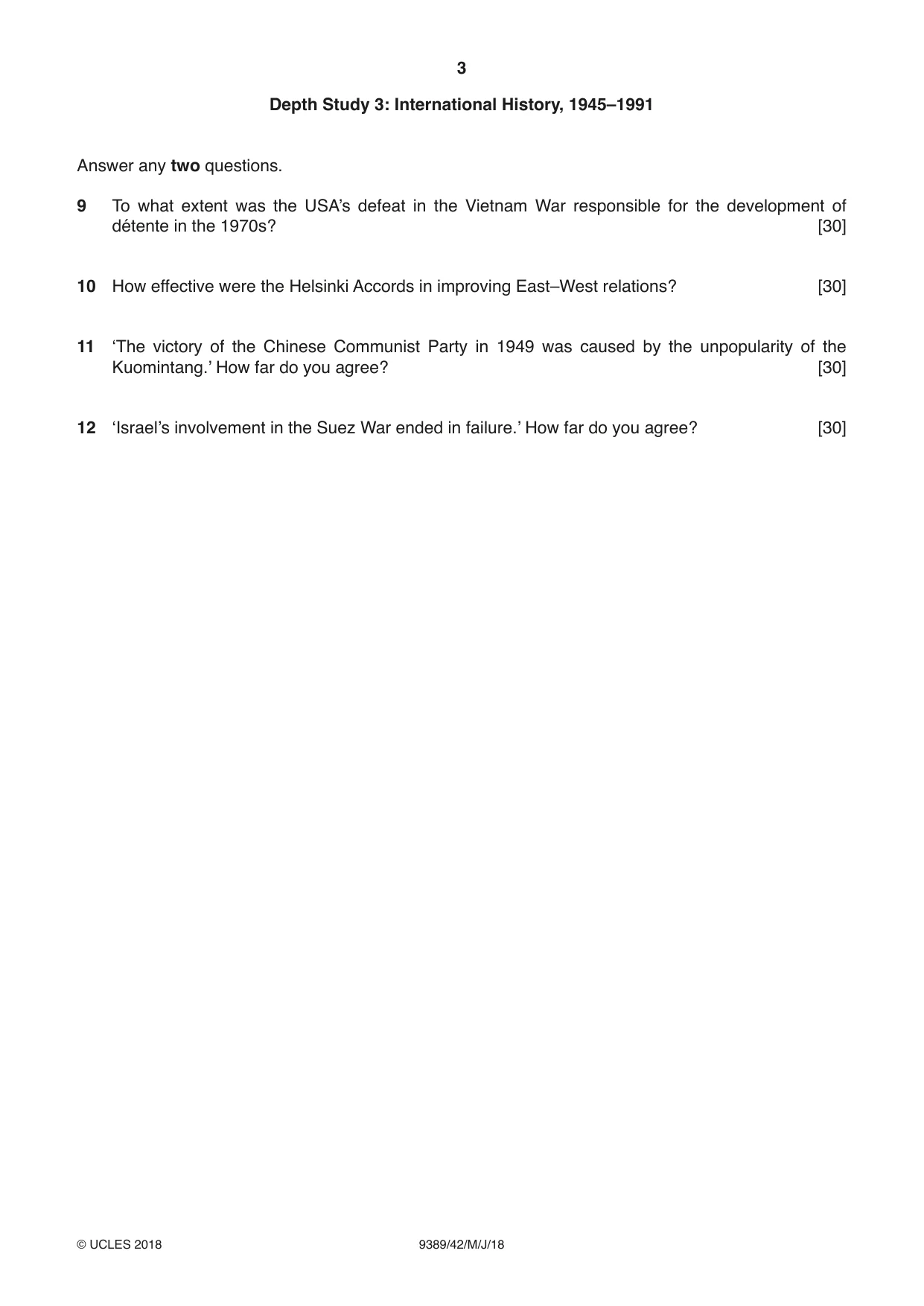
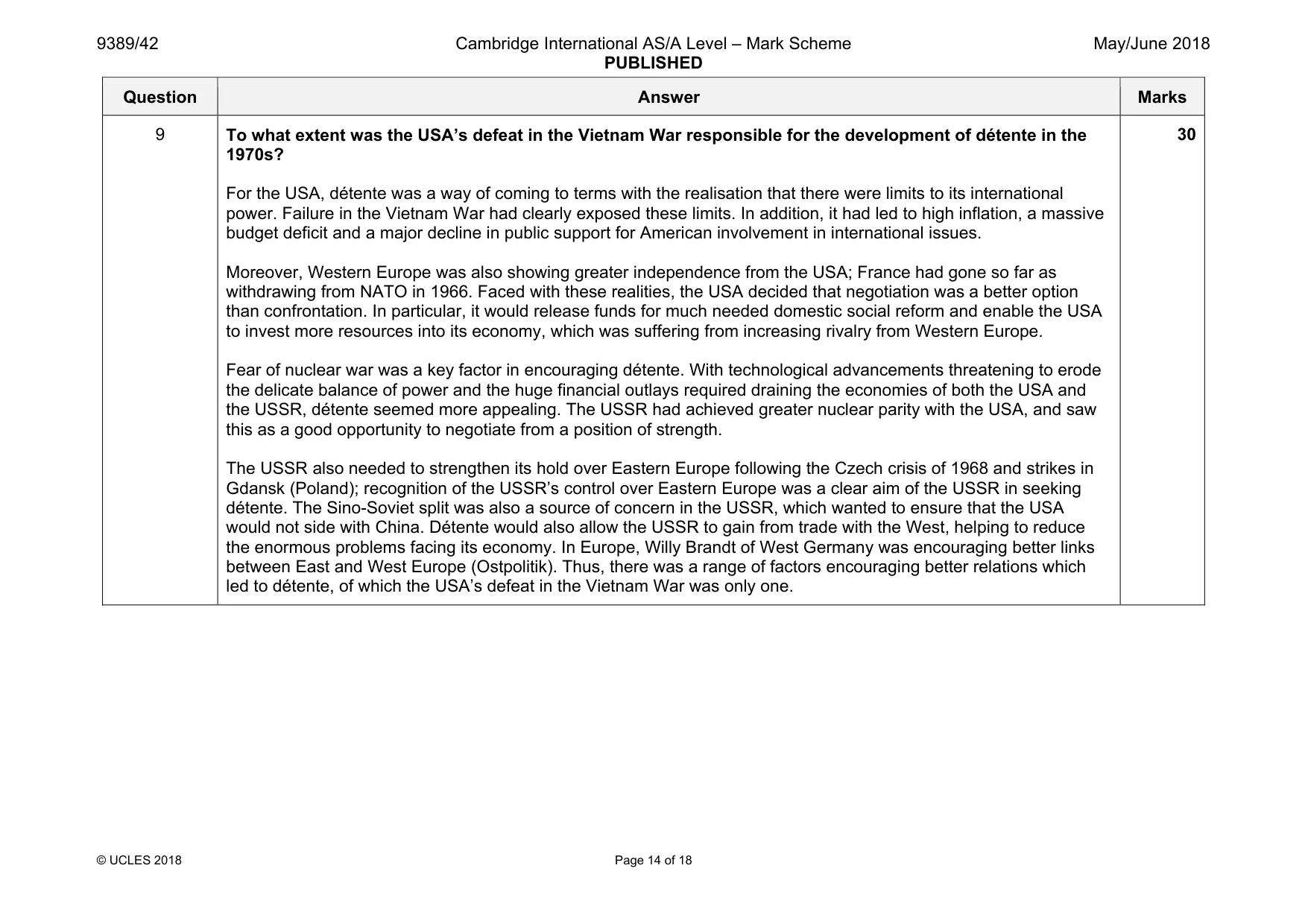
9 To what extent was the USA’s defeat in the Vietnam War responsible for the development of détente in the 1970s? [30]
Mark scheme: 9 To what extent was the USA’s defeat in the Vietnam War responsible for the development of détente in the 1970s? For the USA, détente was a way of coming to terms with the realisation that there were limits to its international power. Failure in the Vietnam War had clearly exposed these limits. In addition, it had led to high inflation, a massive budget deficit and a major decline in public support for American involvement in international issues. Moreover, Western Europe was also showing greater independence from the USA; France had gone so far as withdrawing from NATO in 1966. Faced with these realities, the USA decided that negotiation was a better option than confrontation. In particular, it would release funds for much needed domestic social reform and enable the USA to invest more resources into its economy, which was suffering from increasing rivalry from Western Europe. Fear of nuclear war was a key factor in encouraging détente. With technological advancements threatening to erode the delicate balance of power and the huge financial outlays required draining the economies of both the USA and the USSR, détente seemed more appealing. The USSR had achieved greater nuclear parity with the USA, and saw this as a good opportunity to negotiate from a position of strength. The USSR also needed to strengthen its hold over Eastern Europe following the Czech crisis of 1968 and strikes in Gdansk (Poland); recognition of the USSR’s control over Eastern Europe was a clear aim of the USSR in seeking détente. The Sino-Soviet split was also a source of concern in the USSR, which wanted to ensure that the USA would not side with China. Détente would also allow the USSR to gain from trade with the West, helping to reduce the enormous problems facing its economy. In Europe, Willy Brandt of West Germany was encouraging better links between East and West Europe (Ostpolitik). Thus, there was a range of factors encouraging better relations which led to détente, of which the USA’s defeat in the Vietnam War was only one. 30
Q10 · How effective were the Helsinki Accords in improving East–West relations?
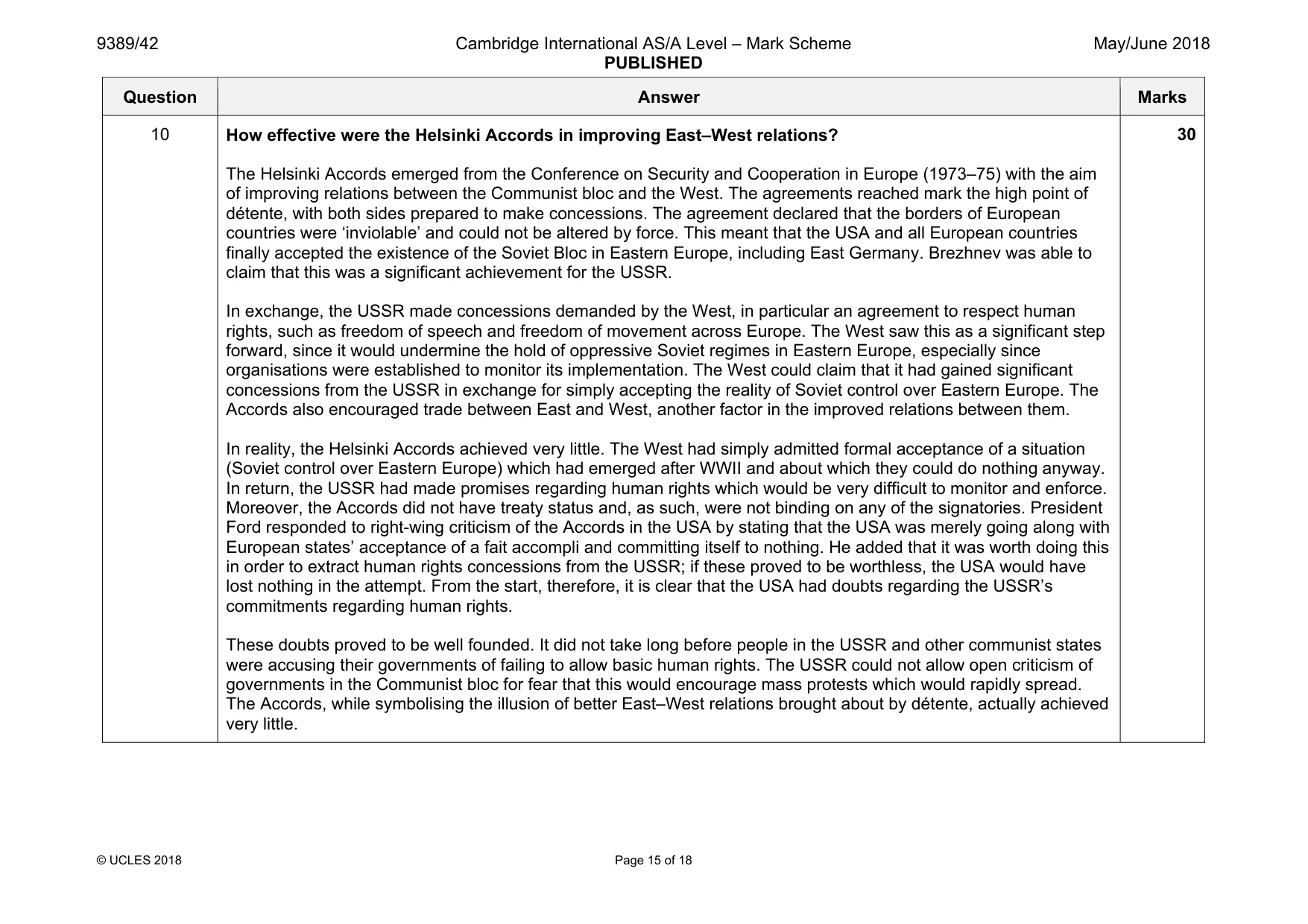
10 How effective were the Helsinki Accords in improving East–West relations? [30]
Mark scheme: 10 How effective were the Helsinki Accords in improving East–West relations? The Helsinki Accords emerged from the Conference on Security and Cooperation in Europe (1973–75) with the aim of improving relations between the Communist bloc and the West. The agreements reached mark the high point of détente, with both sides prepared to make concessions. The agreement declared that the borders of European countries were ‘inviolable’ and could not be altered by force. This meant that the USA and all European countries finally accepted the existence of the Soviet Bloc in Eastern Europe, including East Germany. Brezhnev was able to claim that this was a significant achievement for the USSR. In exchange, the USSR made concessions demanded by the West, in particular an agreement to respect human rights, such as freedom of speech and freedom of movement across Europe. The West saw this as a significant step forward, since it would undermine the hold of oppressive Soviet regimes in Eastern Europe, especially since organisations were established to monitor its implementation. The West could claim that it had gained significant concessions from the USSR in exchange for simply accepting the reality of Soviet control over Eastern Europe. The Accords also encouraged trade between East and West, another factor in the improved relations between them. In reality, the Helsinki Accords achieved very little. The West had simply admitted formal acceptance of a situation (Soviet control over Eastern Europe) which had emerged after WWII and about which they could do nothing anyway. In return, the USSR had made promises regarding human rights which would be very difficult to monitor and enforce. Moreover, the Accords did not have treaty status and, as such, were not binding on any of the signatories. President Ford responded to right-wing criticism of the Accords in the USA by stating that the USA was merely going along with European states’ acceptance of a fait accompli and committing itself to nothing. He added that it was worth doing this in order to extract human rights concessions from the USSR; if these proved to be worthless, the USA would have lost nothing in the attempt. From the start, therefore, it is clear that the USA had doubts regarding the USSR’s commitments regarding human rights. These doubts proved to be well founded. It did not take long before people in the USSR and other communist states were accusing their governments of failing to allow basic human rights. The USSR could not allow open criticism of governments in the Communist bloc for fear that this would encourage mass protests which would rapidly spread. The Accords, while symbolising the illusion of better East–West relations brought about by détente, actually achieved very little. 30
Q11 · ‘The victory of the Chinese Communist Party in 1949 was caused by the unpopularity of the…
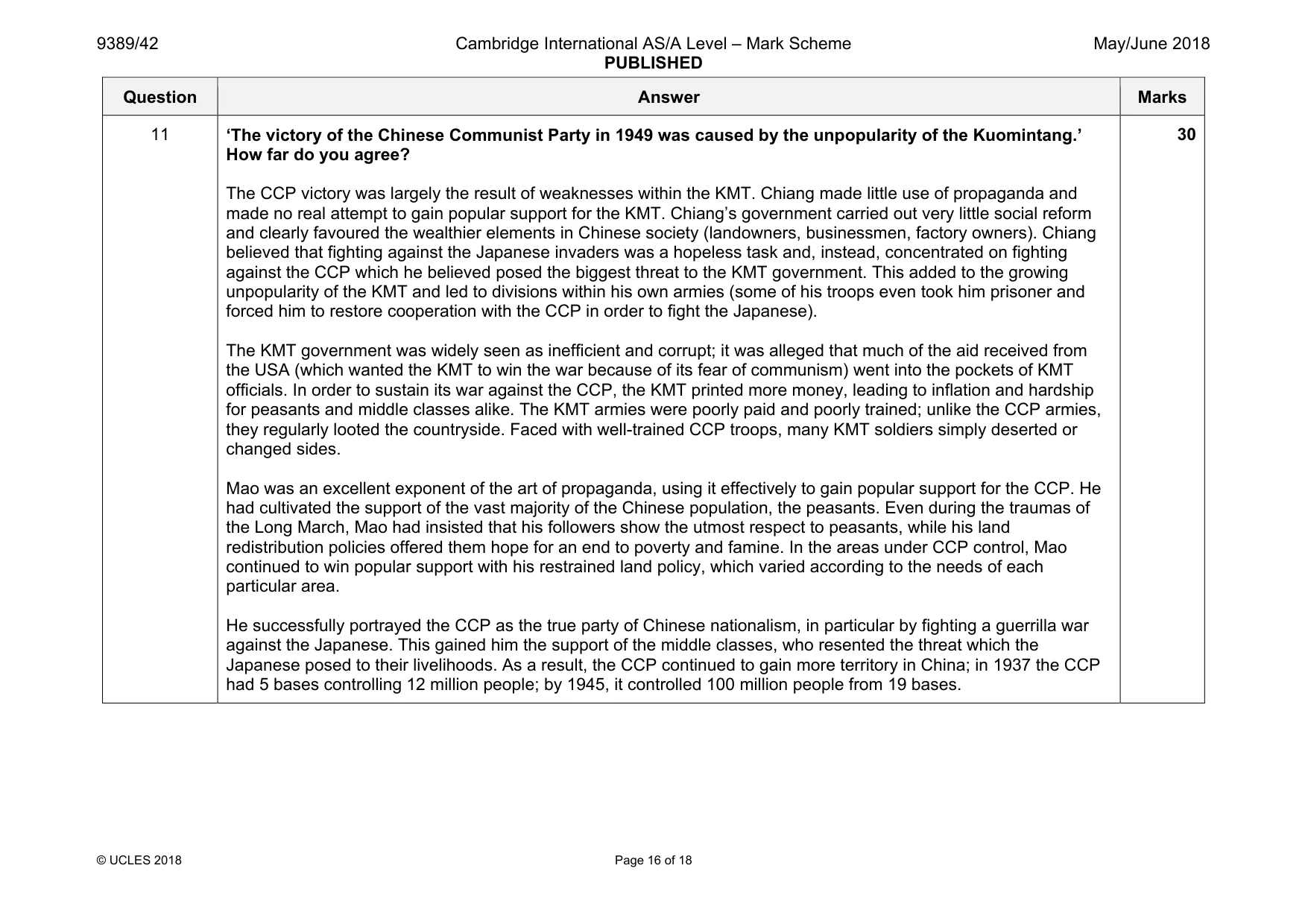
11 ‘The victory of the Chinese Communist Party in 1949 was caused by the unpopularity of the Kuomintang.’ How far do you agree? [30]
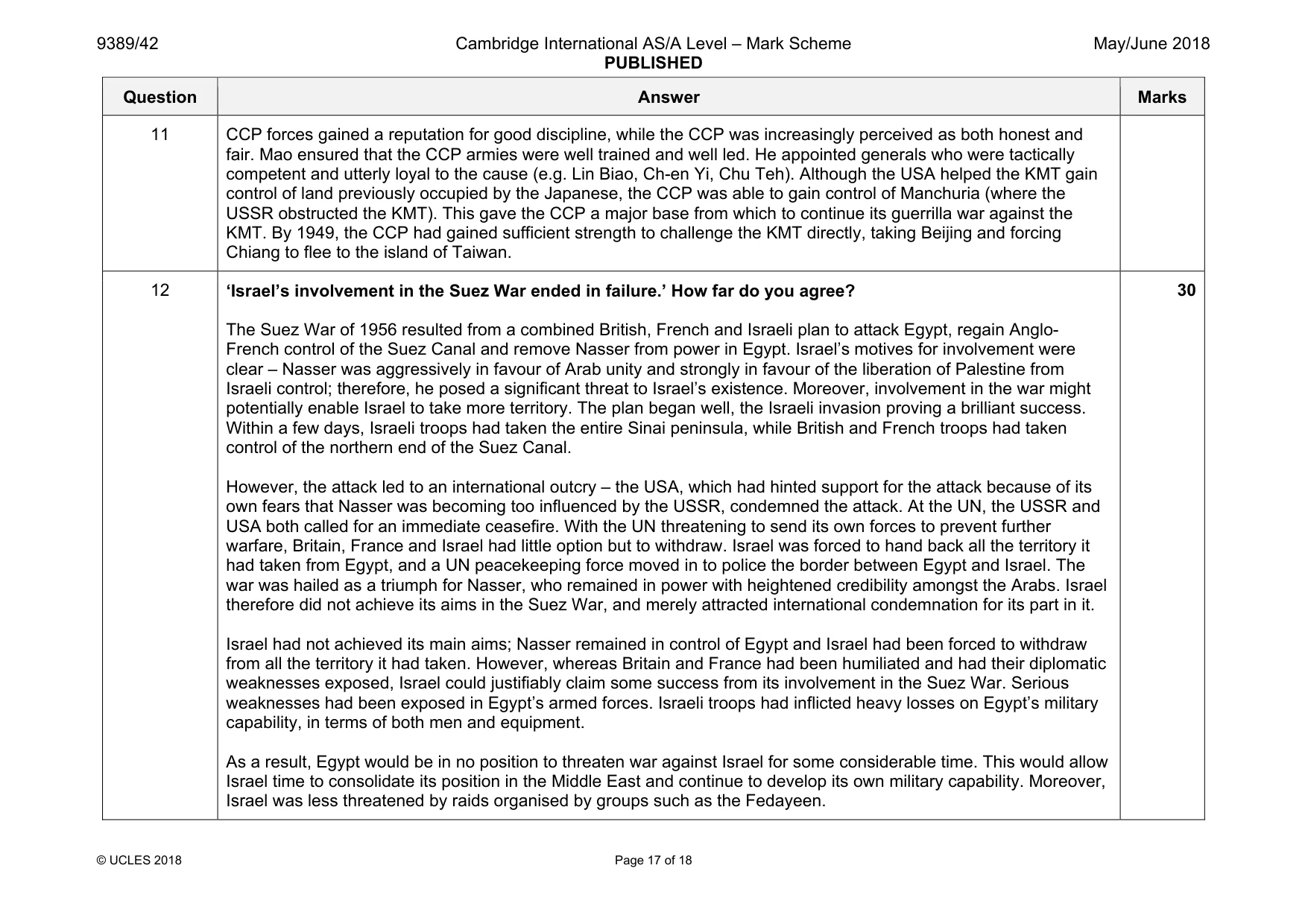
Mark scheme: 11 ‘The victory of the Chinese Communist Party in 1949 was caused by the unpopularity of the Kuomintang.’ How far do you agree? The CCP victory was largely the result of weaknesses within the KMT. Chiang made little use of propaganda and made no real attempt to gain popular support for the KMT. Chiang’s government carried out very little social reform and clearly favoured the wealthier elements in Chinese society (landowners, businessmen, factory owners). Chiang believed that fighting against the Japanese invaders was a hopeless task and, instead, concentrated on fighting against the CCP which he believed posed the biggest threat to the KMT government. This added to the growing unpopularity of the KMT and led to divisions within his own armies (some of his troops even took him prisoner and forced him to restore cooperation with the CCP in order to fight the Japanese). The KMT government was widely seen as inefficient and corrupt; it was alleged that much of the aid received from the USA (which wanted the KMT to win the war because of its fear of communism) went into the pockets of KMT officials. In order to sustain its war against the CCP, the KMT printed more money, leading to inflation and hardship for peasants and middle classes alike. The KMT armies were poorly paid and poorly trained; unlike the CCP armies, they regularly looted the countryside. Faced with well-trained CCP troops, many KMT soldiers simply deserted or changed sides. Mao was an excellent exponent of the art of propaganda, using it effectively to gain popular support for the CCP. He had cultivated the support of the vast majority of the Chinese population, the peasants. Even during the traumas of the Long March, Mao had insisted that his followers show the utmost respect to peasants, while his land redistribution policies offered them hope for an end to poverty and famine. In the areas under CCP control, Mao continued to win popular support with his restrained land policy, which varied according to the needs of each particular area. He successfully portrayed the CCP as the true party of Chinese nationalism, in particular by fighting a guerrilla war against the Japanese. This gained him the support of the middle classes, who resented the threat which the Japanese posed to their livelihoods. As a result, the CCP continued to gain more territory in China; in 1937 the CCP had 5 bases controlling 12 million people; by 1945, it controlled 100 million people from 19 bases. 30 Question Answer Marks 11 CCP forces gained a reputation for good discipline, while the CCP was increasingly perceived as both honest and fair. Mao ensured that the CCP armies were well trained and well led. He appointed generals who were tactically competent and utterly loyal to the cause (e.g. Lin Biao, Ch-en Yi, Chu Teh). Although the USA helped the KMT gain control of land previously occupied by the Japanese, the CCP was able to gain control of Manchuria (where the USSR obstructed the KMT). This gave the CCP a major base from which to continue its guerrilla war against the KMT. By 1949, the CCP had gained sufficient strength to challenge the KMT directly, taking Beijing and forcing Chiang to flee to the island of Taiwan.
What you needed in this session
Cambridge’s own grade thresholds for 2018 May/June, Paper 4 · Variant 2. A higher threshold means an easier paper — the bar moves with how the cohort did.