Cambridge A Level History 9389 — 2020 May/June Paper 4 · Variant 2
9389/42/M/J/20 · 11 questions · 330 marks · ≈371 min
The question paper and its mark scheme, free to read here and free to download. This is Cambridge’s own paper, exactly as it was sat.
Question paper4 pages
Mark scheme19 pages
Answers below. Sit the paper first if you are practising.




Questions as text
Q1 · ‘Bolshevik management of the Russian economy between 1918 and 1924 was successful.’ How…
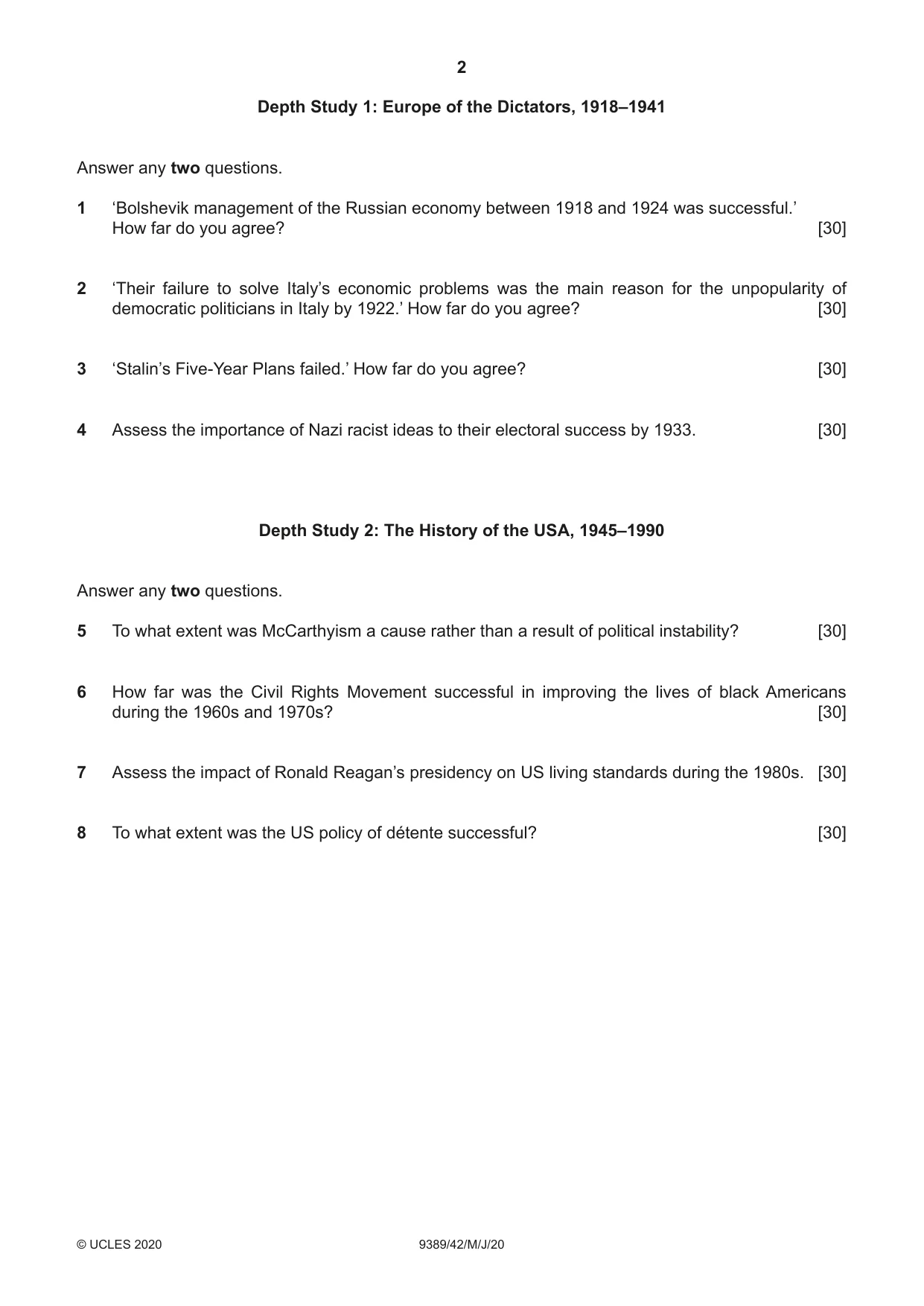
1 ‘Bolshevik management of the Russian economy between 1918 and 1924 was successful.’ How far do you agree? [30]
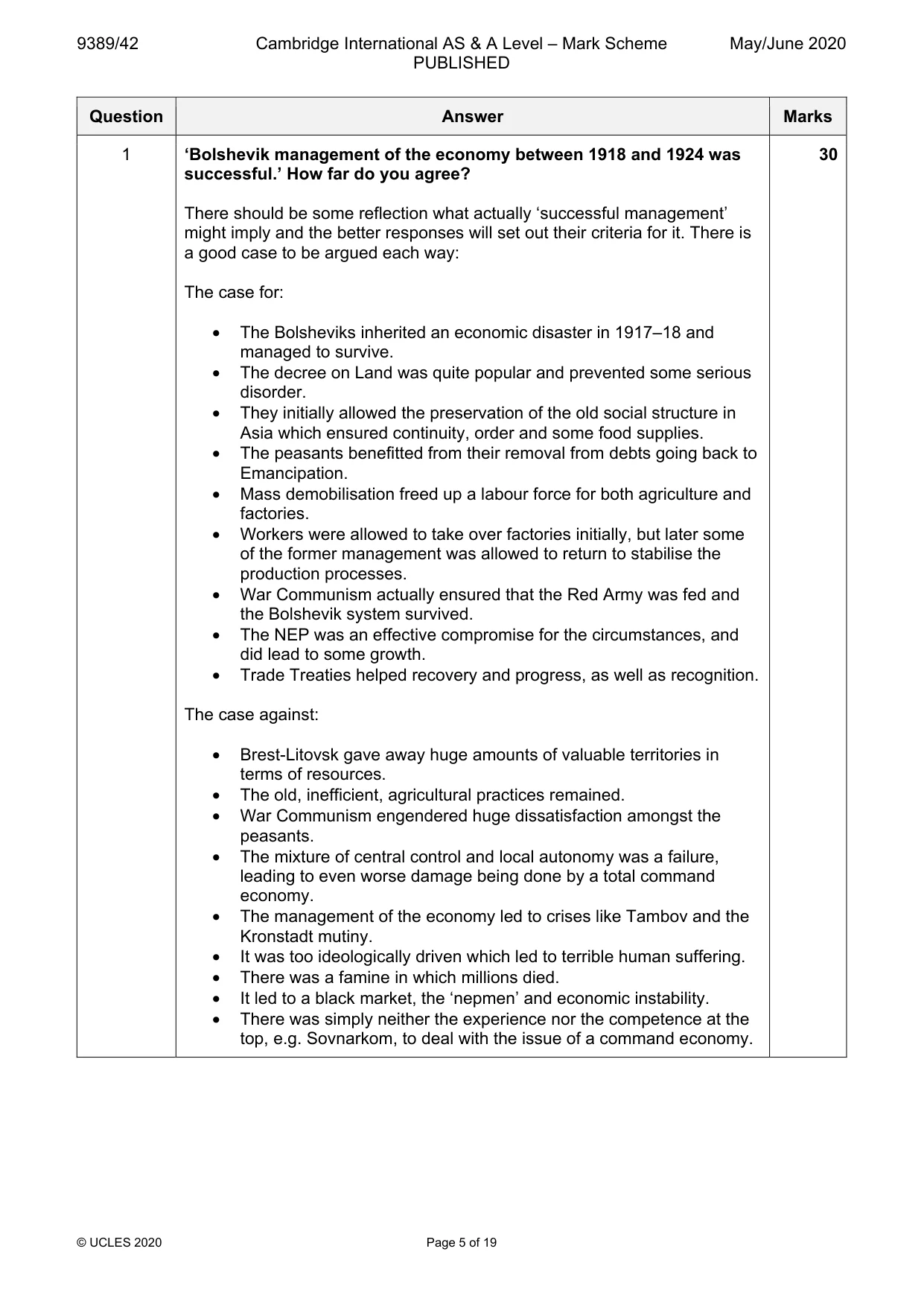
Mark scheme: Question Answer Marks 1 ‘Bolshevik management of the economy between 1918 and 1924 was 30 successful.’ How far do you agree? There should be some reflection what actually ‘successful management’ might imply and the better responses will set out their criteria for it. There is a good case to be argued each way: The case for: • The Bolsheviks inherited an economic disaster in 1917–18 and managed to survive. • The decree on Land was quite popular and prevented some serious disorder. • They initially allowed the preservation of the old social structure in Asia which ensured continuity, order and some food supplies. • The peasants benefitted from their removal from debts going back to Emancipation. • Mass demobilisation freed up a labour force for both agriculture and factories. • Workers were allowed to take over factories initially, but later some of the former management was allowed to return to stabilise the production processes. • War Communism actually ensured that the Red Army was fed and the Bolshevik system survived. • The NEP was an effective compromise for the circumstances, and did lead to some growth. • Trade Treaties helped recovery and progress, as well as recognition. The case against: • Brest-Litovsk gave away huge amounts of valuable territories in terms of resources. • The old, inefficient, agricultural practices remained. • War Communism engendered huge dissatisfaction amongst the peasants. • The mixture of central control and local autonomy was a failure, leading to even worse damage being done by a total command economy. • The management of the economy led to crises like Tambov and the Kronstadt mutiny. • It was too ideologically driven which led to terrible human suffering. • There was a famine in which millions died. • It led to a black market, the ‘nepmen’ and economic instability. • There was simply neither the experience nor the competence at the top, e.g. Sovnarkom, to deal with the issue of a command economy.
Q2 · ‘Their failure to solve Italy’s economic problems was the main reason for the…
2 ‘Their failure to solve Italy’s economic problems was the main reason for the unpopularity of democratic politicians in Italy by 1922.’ How far do you agree? [30]
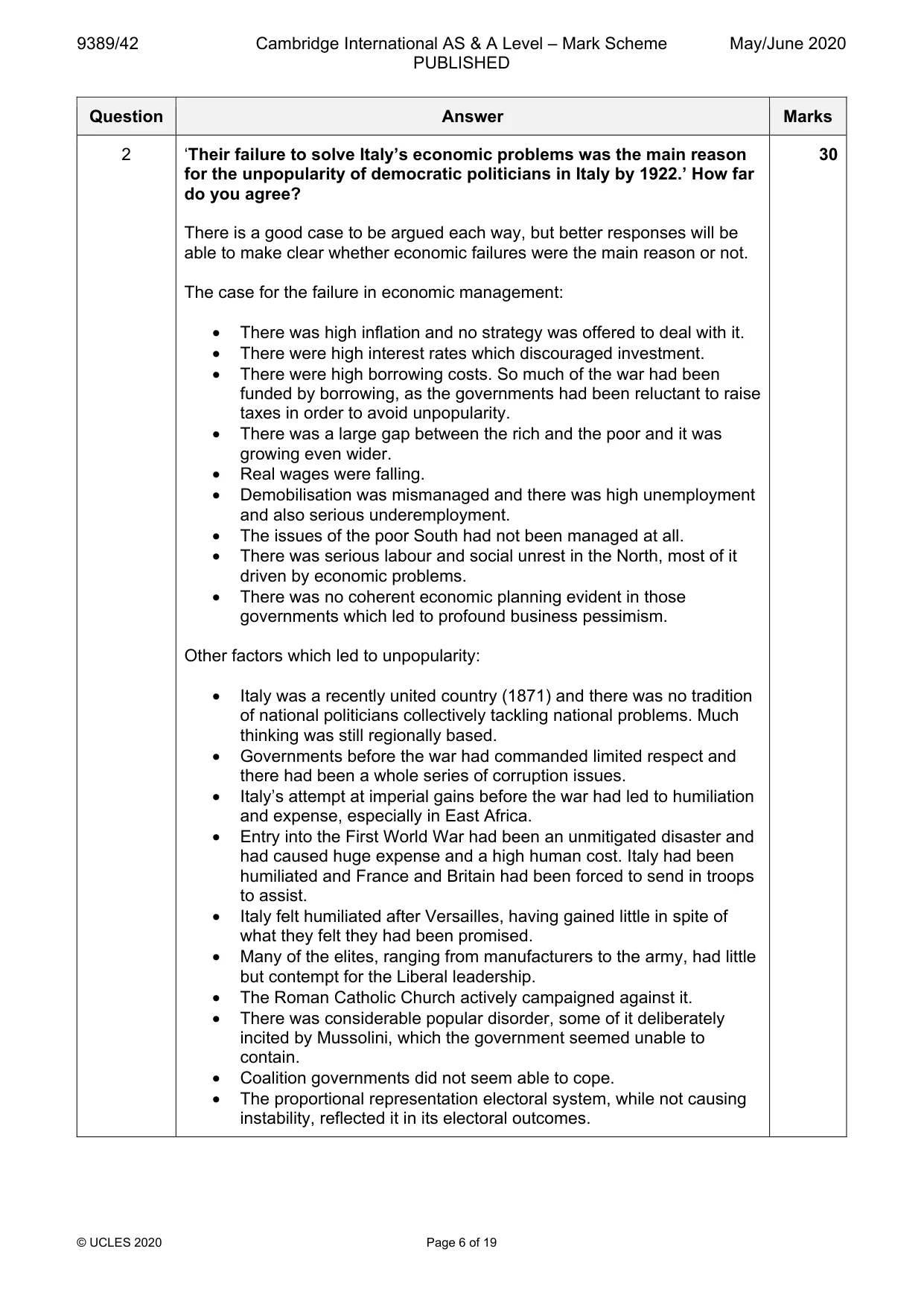
Mark scheme: 2 ‘Their failure to solve Italy’s economic problems was the main reason 30 for the unpopularity of democratic politicians in Italy by 1922.’ How far do you agree? There is a good case to be argued each way, but better responses will be able to make clear whether economic failures were the main reason or not. The case for the failure in economic management: • There was high inflation and no strategy was offered to deal with it. • There were high interest rates which discouraged investment. • There were high borrowing costs. So much of the war had been funded by borrowing, as the governments had been reluctant to raise taxes in order to avoid unpopularity. • There was a large gap between the rich and the poor and it was growing even wider. • Real wages were falling. • Demobilisation was mismanaged and there was high unemployment and also serious underemployment. • The issues of the poor South had not been managed at all. • There was serious labour and social unrest in the North, most of it driven by economic problems. • There was no coherent economic planning evident in those governments which led to profound business pessimism. Other factors which led to unpopularity: • Italy was a recently united country (1871) and there was no tradition of national politicians collectively tackling national problems. Much thinking was still regionally based. • Governments before the war had commanded limited respect and there had been a whole series of corruption issues. • Italy’s attempt at imperial gains before the war had led to humiliation and expense, especially in East Africa. • Entry into the First World War had been an unmitigated disaster and had caused huge expense and a high human cost. Italy had been humiliated and France and Britain had been forced to send in troops to assist. • Italy felt humiliated after Versailles, having gained little in spite of what they felt they had been promised. • Many of the elites, ranging from manufacturers to the army, had little but contempt for the Liberal leadership. • The Roman Catholic Church actively campaigned against it. • There was considerable popular disorder, some of it deliberately incited by Mussolini, which the government seemed unable to contain. • Coalition governments did not seem able to cope. • The proportional representation electoral system, while not causing instability, reflected it in its electoral outcomes.
Q3 · ‘Stalin’s Five-Year Plans failed.’ How far do you agree?
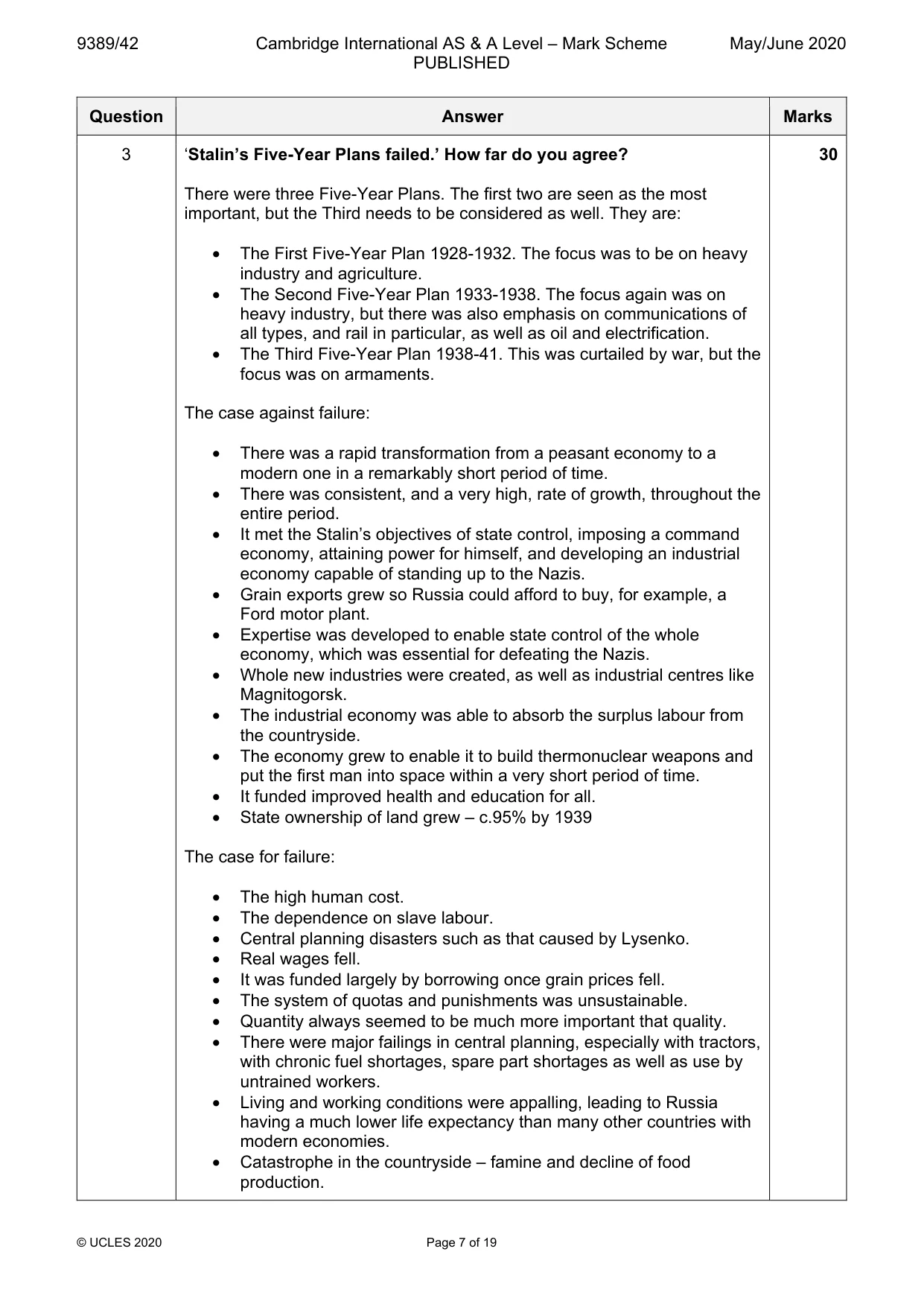
3 ‘Stalin’s Five-Year Plans failed.’ How far do you agree? [30]
Mark scheme: 3 ‘Stalin’s Five-Year Plans failed.’ How far do you agree? 30 There were three Five-Year Plans. The first two are seen as the most important, but the Third needs to be considered as well. They are: • The First Five-Year Plan 1928-1932. The focus was to be on heavy industry and agriculture. • The Second Five-Year Plan 1933-1938. The focus again was on heavy industry, but there was also emphasis on communications of all types, and rail in particular, as well as oil and electrification. • The Third Five-Year Plan 1938-41. This was curtailed by war, but the focus was on armaments. The case against failure: • There was a rapid transformation from a peasant economy to a modern one in a remarkably short period of time. • There was consistent, and a very high, rate of growth, throughout the entire period. • It met the Stalin’s objectives of state control, imposing a command economy, attaining power for himself, and developing an industrial economy capable of standing up to the Nazis. • Grain exports grew so Russia could afford to buy, for example, a Ford motor plant. • Expertise was developed to enable state control of the whole economy, which was essential for defeating the Nazis. • Whole new industries were created, as well as industrial centres like Magnitogorsk. • The industrial economy was able to absorb the surplus labour from the countryside. • The economy grew to enable it to build thermonuclear weapons and put the first man into space within a very short period of time. • It funded improved health and education for all. • State ownership of land grew – c.95% by 1939 The case for failure: • The high human cost. • The dependence on slave labour. • Central planning disasters such as that caused by Lysenko. • Real wages fell. • It was funded largely by borrowing once grain prices fell. • The system of quotas and punishments was unsustainable. • Quantity always seemed to be much more important that quality. • There were major failings in central planning, especially with tractors, with chronic fuel shortages, spare part shortages as well as use by untrained workers. • Living and working conditions were appalling, leading to Russia having a much lower life expectancy than many other countries with modern economies. • Catastrophe in the countryside – famine and decline of food production.
Q4 · Assess the importance of Nazi racist ideas to their electoral success by 1933
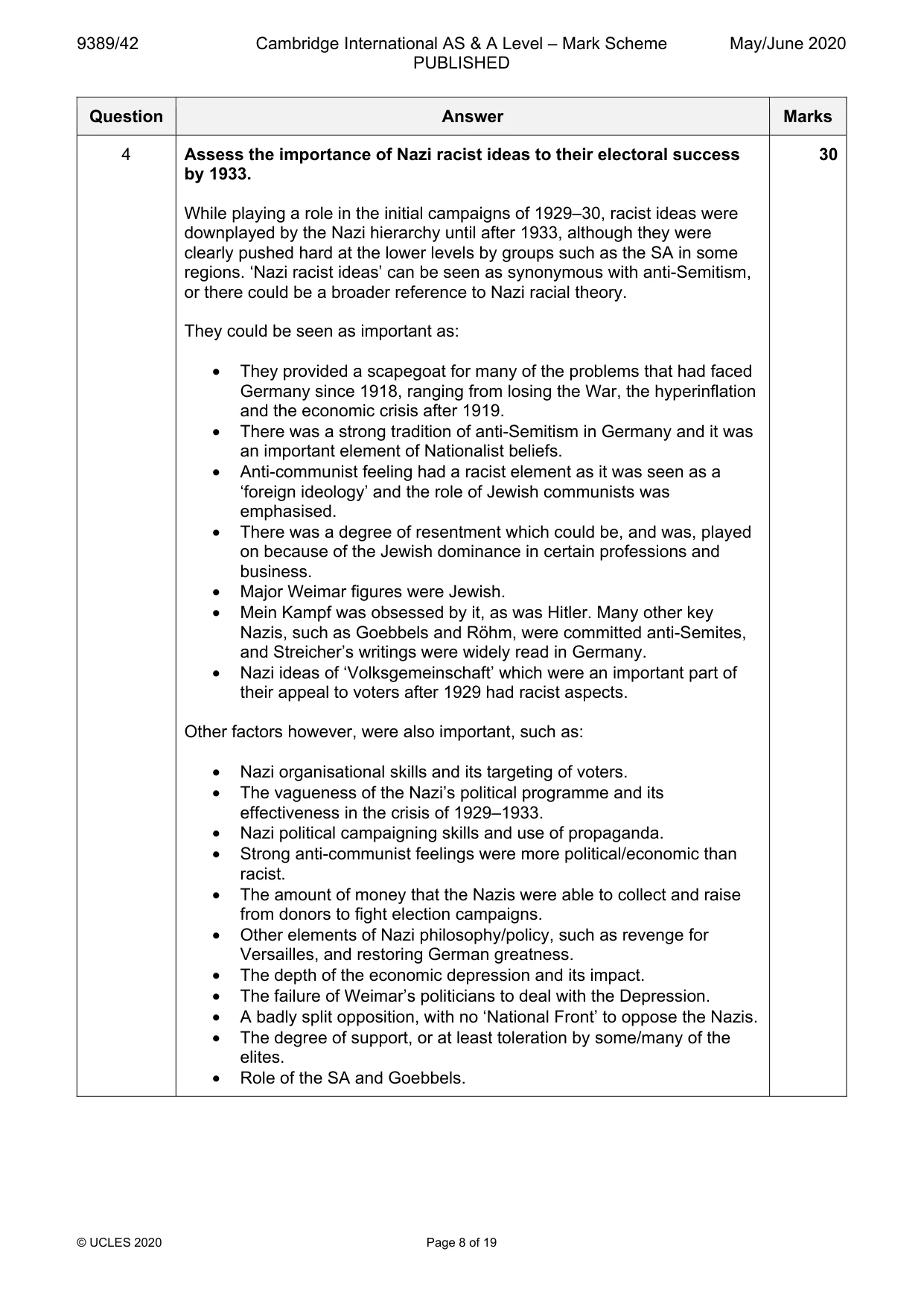
4 Assess the importance of Nazi racist ideas to their electoral success by 1933. [30] Depth Study 2: The History of the USA, 1945–1990 Answer any two questions.
Mark scheme: 4 Assess the importance of Nazi racist ideas to their electoral success 30 by 1933. While playing a role in the initial campaigns of 1929‒30, racist ideas were downplayed by the Nazi hierarchy until after 1933, although they were clearly pushed hard at the lower levels by groups such as the SA in some regions. ‘Nazi racist ideas’ can be seen as synonymous with anti-Semitism, or there could be a broader reference to Nazi racial theory. They could be seen as important as: • They provided a scapegoat for many of the problems that had faced Germany since 1918, ranging from losing the War, the hyperinflation and the economic crisis after 1919. • There was a strong tradition of anti-Semitism in Germany and it was an important element of Nationalist beliefs. • Anti-communist feeling had a racist element as it was seen as a ‘foreign ideology’ and the role of Jewish communists was emphasised. • There was a degree of resentment which could be, and was, played on because of the Jewish dominance in certain professions and business. • Major Weimar figures were Jewish. • Mein Kampf was obsessed by it, as was Hitler. Many other key Nazis, such as Goebbels and Röhm, were committed anti-Semites, and Streicher’s writings were widely read in Germany. • Nazi ideas of ‘Volksgemeinschaft’ which were an important part of their appeal to voters after 1929 had racist aspects. Other factors however, were also important, such as: • Nazi organisational skills and its targeting of voters. • The vagueness of the Nazi’s political programme and its effectiveness in the crisis of 1929–1933. • Nazi political campaigning skills and use of propaganda. • Strong anti-communist feelings were more political/economic than racist. • The amount of money that the Nazis were able to collect and raise from donors to fight election campaigns. • Other elements of Nazi philosophy/policy, such as revenge for Versailles, and restoring German greatness. • The depth of the economic depression and its impact. • The failure of Weimar’s politicians to deal with the Depression. • A badly split opposition, with no ‘National Front’ to oppose the Nazis. • The degree of support, or at least toleration by some/many of the elites. • Role of the SA and Goebbels.
Q5 · To what extent was McCarthyism a cause rather than a result of political instability?
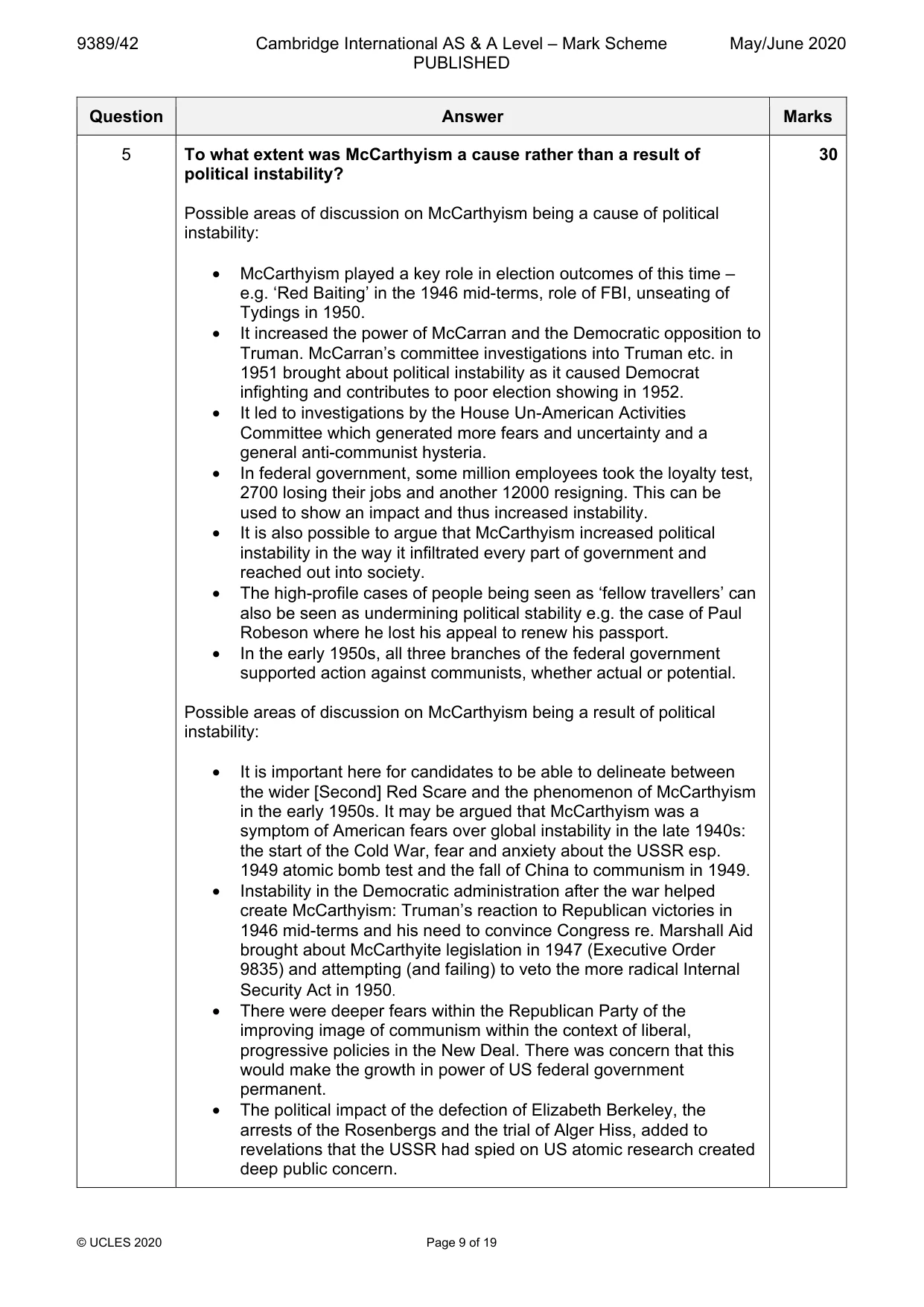
5 To what extent was McCarthyism a cause rather than a result of political instability? [30]
Mark scheme: 5 To what extent was McCarthyism a cause rather than a result of 30 political instability? Possible areas of discussion on McCarthyism being a cause of political instability: • McCarthyism played a key role in election outcomes of this time – e.g. ‘Red Baiting’ in the 1946 mid-terms, role of FBI, unseating of Tydings in 1950. • It increased the power of McCarran and the Democratic opposition to Truman. McCarran’s committee investigations into Truman etc. in 1951 brought about political instability as it caused Democrat infighting and contributes to poor election showing in 1952. • It led to investigations by the House Un-American Activities Committee which generated more fears and uncertainty and a general anti-communist hysteria. • In federal government, some million employees took the loyalty test, 2700 losing their jobs and another 12000 resigning. This can be used to show an impact and thus increased instability. • It is also possible to argue that McCarthyism increased political instability in the way it infiltrated every part of government and reached out into society. • The high-profile cases of people being seen as ‘fellow travellers’ can also be seen as undermining political stability e.g. the case of Paul Robeson where he lost his appeal to renew his passport. • In the early 1950s, all three branches of the federal government supported action against communists, whether actual or potential. Possible areas of discussion on McCarthyism being a result of political instability: • It is important here for candidates to be able to delineate between the wider [Second] Red Scare and the phenomenon of McCarthyism in the early 1950s. It may be argued that McCarthyism was a symptom of American fears over global instability in the late 1940s: the start of the Cold War, fear and anxiety about the USSR esp. 1949 atomic bomb test and the fall of China to communism in 1949. • Instability in the Democratic administration after the war helped create McCarthyism: Truman’s reaction to Republican victories in 1946 mid-terms and his need to convince Congress re. Marshall Aid brought about McCarthyite legislation in 1947 (Executive Order 9835) and attempting (and failing) to veto the more radical Internal Security Act in 1950. • There were deeper fears within the Republican Party of the improving image of communism within the context of liberal, progressive policies in the New Deal. There was concern that this would make the growth in power of US federal government permanent. • The political impact of the defection of Elizabeth Berkeley, the arrests of the Rosenbergs and the trial of Alger Hiss, added to revelations that the USSR had spied on US atomic research created deep public concern.
Q6 · How far was the Civil Rights Movement successful in improving the lives of black…
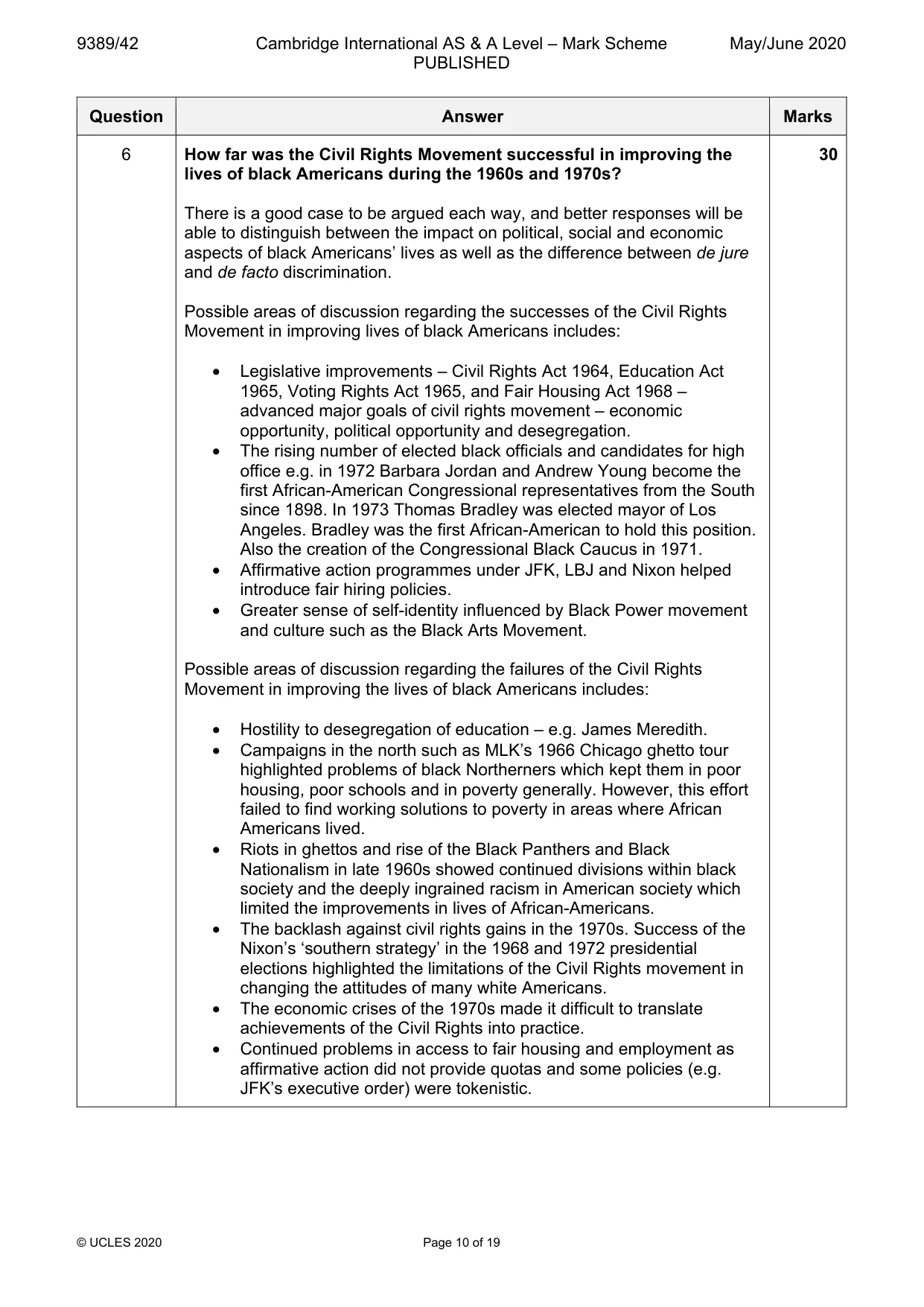
6 How far was the Civil Rights Movement successful in improving the lives of black Americans during the 1960s and 1970s? [30]
Mark scheme: 6 How far was the Civil Rights Movement successful in improving the 30 lives of black Americans during the 1960s and 1970s? There is a good case to be argued each way, and better responses will be able to distinguish between the impact on political, social and economic aspects of black Americans’ lives as well as the difference between de jure and de facto discrimination. Possible areas of discussion regarding the successes of the Civil Rights Movement in improving lives of black Americans includes: • Legislative improvements – Civil Rights Act 1964, Education Act 1965, Voting Rights Act 1965, and Fair Housing Act 1968 – advanced major goals of civil rights movement – economic opportunity, political opportunity and desegregation. • The rising number of elected black officials and candidates for high office e.g. in 1972 Barbara Jordan and Andrew Young become the first African-American Congressional representatives from the South since 1898. In 1973 Thomas Bradley was elected mayor of Los Angeles. Bradley was the first African-American to hold this position. Also the creation of the Congressional Black Caucus in 1971. • Affirmative action programmes under JFK, LBJ and Nixon helped introduce fair hiring policies. • Greater sense of self-identity influenced by Black Power movement and culture such as the Black Arts Movement. Possible areas of discussion regarding the failures of the Civil Rights Movement in improving the lives of black Americans includes: • Hostility to desegregation of education – e.g. James Meredith. • Campaigns in the north such as MLK’s 1966 Chicago ghetto tour highlighted problems of black Northerners which kept them in poor housing, poor schools and in poverty generally. However, this effort failed to find working solutions to poverty in areas where African Americans lived. • Riots in ghettos and rise of the Black Panthers and Black Nationalism in late 1960s showed continued divisions within black society and the deeply ingrained racism in American society which limited the improvements in lives of African-Americans. • The backlash against civil rights gains in the 1970s. Success of the Nixon’s ‘southern strategy’ in the 1968 and 1972 presidential elections highlighted the limitations of the Civil Rights movement in changing the attitudes of many white Americans. • The economic crises of the 1970s made it difficult to translate achievements of the Civil Rights into practice. • Continued problems in access to fair housing and employment as affirmative action did not provide quotas and some policies (e.g. JFK’s executive order) were tokenistic.
Q7 · Assess the impact of Ronald Reagan’s presidency on US living standards during the 1980s
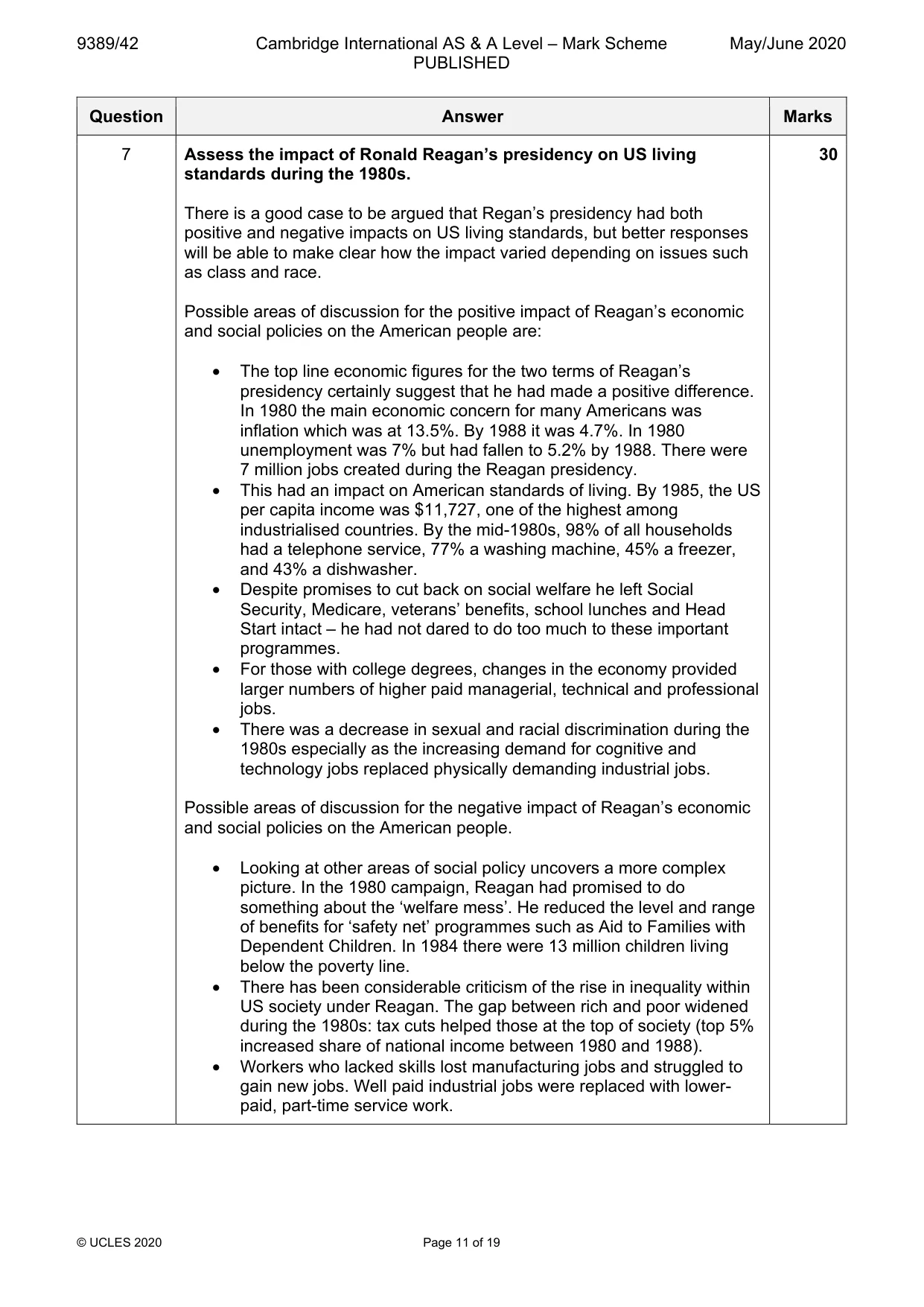
7 Assess the impact of Ronald Reagan’s presidency on US living standards during the 1980s. [30]
Mark scheme: 7 Assess the impact of Ronald Reagan’s presidency on US living 30 standards during the 1980s. There is a good case to be argued that Regan’s presidency had both positive and negative impacts on US living standards, but better responses will be able to make clear how the impact varied depending on issues such as class and race. Possible areas of discussion for the positive impact of Reagan’s economic and social policies on the American people are: • The top line economic figures for the two terms of Reagan’s presidency certainly suggest that he had made a positive difference. In 1980 the main economic concern for many Americans was inflation which was at 13.5%. By 1988 it was 4.7%. In 1980 unemployment was 7% but had fallen to 5.2% by 1988. There were 7 million jobs created during the Reagan presidency. • This had an impact on American standards of living. By 1985, the US per capita income was $11,727, one of the highest among industrialised countries. By the mid-1980s, 98% of all households had a telephone service, 77% a washing machine, 45% a freezer, and 43% a dishwasher. • Despite promises to cut back on social welfare he left Social Security, Medicare, veterans’ benefits, school lunches and Head Start intact – he had not dared to do too much to these important programmes. • For those with college degrees, changes in the economy provided larger numbers of higher paid managerial, technical and professional jobs. • There was a decrease in sexual and racial discrimination during the 1980s especially as the increasing demand for cognitive and technology jobs replaced physically demanding industrial jobs. Possible areas of discussion for the negative impact of Reagan’s economic and social policies on the American people. • Looking at other areas of social policy uncovers a more complex picture. In the 1980 campaign, Reagan had promised to do something about the ‘welfare mess’. He reduced the level and range of benefits for ‘safety net’ programmes such as Aid to Families with Dependent Children. In 1984 there were 13 million children living below the poverty line. • There has been considerable criticism of the rise in inequality within US society under Reagan. The gap between rich and poor widened during the 1980s: tax cuts helped those at the top of society (top 5% increased share of national income between 1980 and 1988). • Workers who lacked skills lost manufacturing jobs and struggled to gain new jobs. Well paid industrial jobs were replaced with lower- paid, part-time service work. 7 • The number of homeless people increased from 200 000 to 400 000. This was particularly noticeable in the inner cities and areas which were largely populated by ethnic minorities. Ghetto schools remained poor and segregated whilst Reagan supported a constitutional amendment to outlaw busing. Although this ultimately failed and similar moves led to people believing that not all living standards mattered as much to Reagan.
Q8 · Depth Study 3: International History, 1945–1991 Answer any two questions
Depth Study 3: International History, 1945–1991 Answer any two questions.
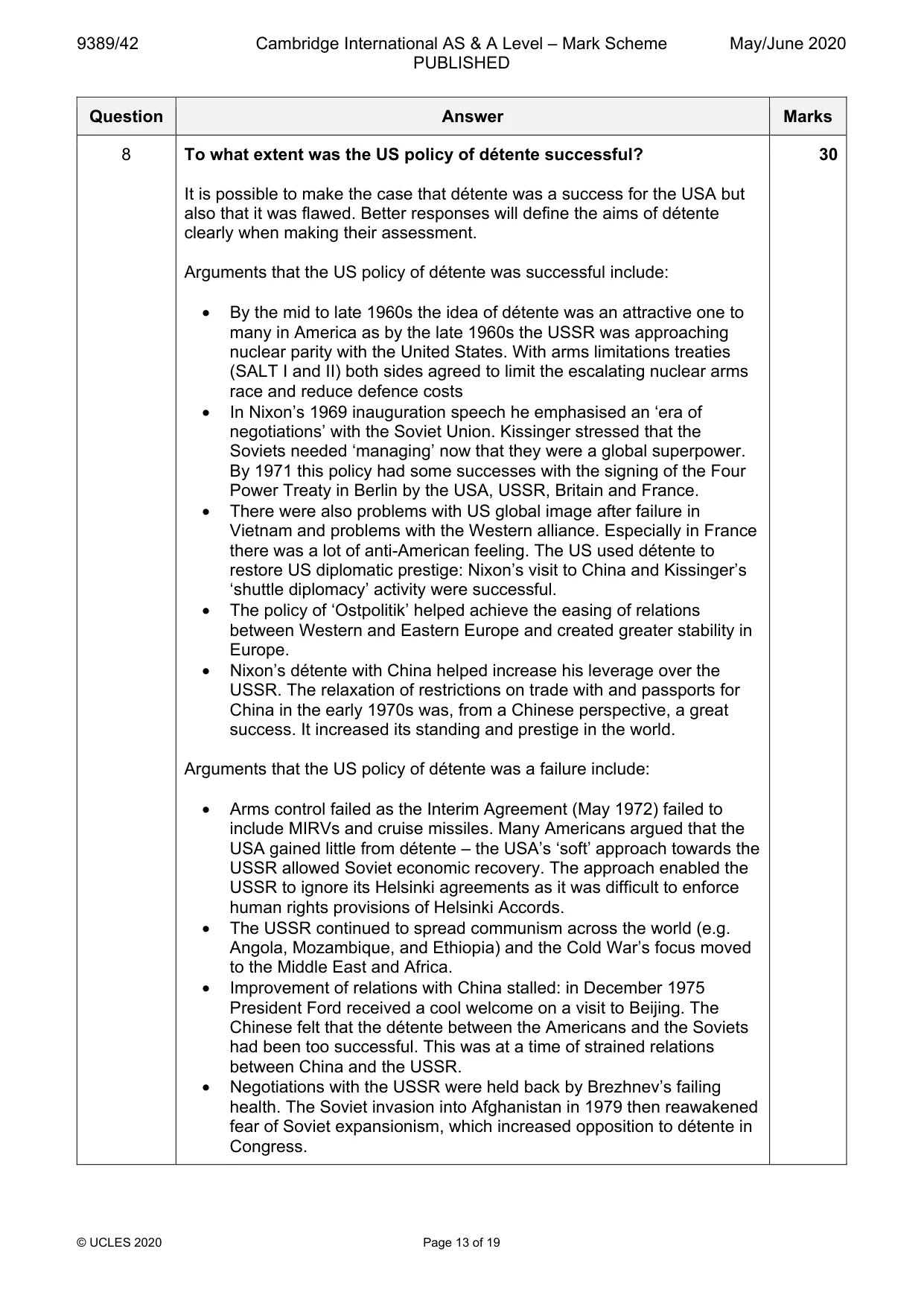
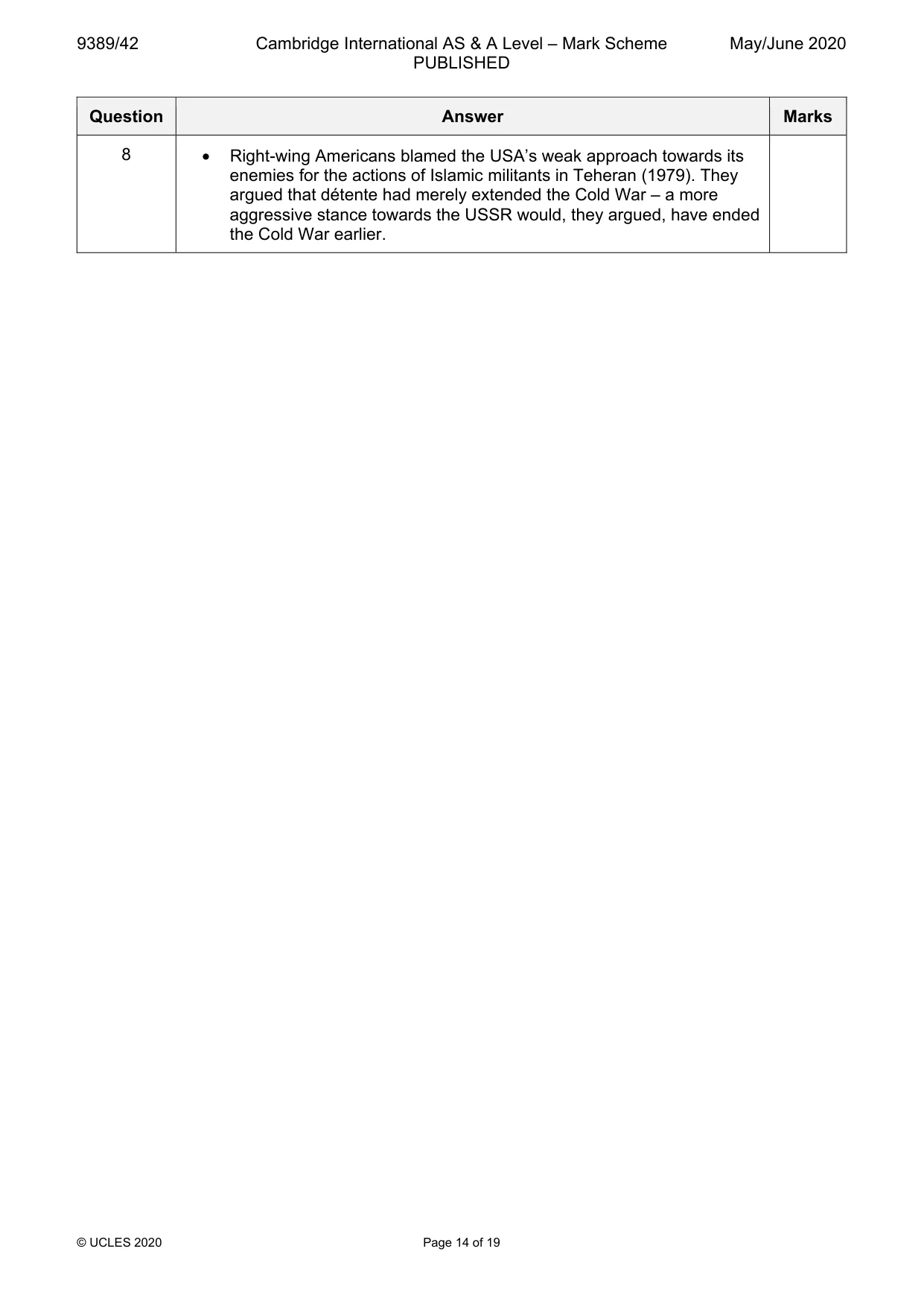
Mark scheme: 8 To what extent was the US policy of détente successful? 30 It is possible to make the case that détente was a success for the USA but also that it was flawed. Better responses will define the aims of détente clearly when making their assessment. Arguments that the US policy of détente was successful include: • By the mid to late 1960s the idea of détente was an attractive one to many in America as by the late 1960s the USSR was approaching nuclear parity with the United States. With arms limitations treaties (SALT I and II) both sides agreed to limit the escalating nuclear arms race and reduce defence costs • In Nixon’s 1969 inauguration speech he emphasised an ‘era of negotiations’ with the Soviet Union. Kissinger stressed that the Soviets needed ‘managing’ now that they were a global superpower. By 1971 this policy had some successes with the signing of the Four Power Treaty in Berlin by the USA, USSR, Britain and France. • There were also problems with US global image after failure in Vietnam and problems with the Western alliance. Especially in France there was a lot of anti-American feeling. The US used détente to restore US diplomatic prestige: Nixon’s visit to China and Kissinger’s ‘shuttle diplomacy’ activity were successful. • The policy of ‘Ostpolitik’ helped achieve the easing of relations between Western and Eastern Europe and created greater stability in Europe. • Nixon’s détente with China helped increase his leverage over the USSR. The relaxation of restrictions on trade with and passports for China in the early 1970s was, from a Chinese perspective, a great success. It increased its standing and prestige in the world. Arguments that the US policy of détente was a failure include: • Arms control failed as the Interim Agreement (May 1972) failed to include MIRVs and cruise missiles. Many Americans argued that the USA gained little from détente – the USA’s ‘soft’ approach towards the USSR allowed Soviet economic recovery. The approach enabled the USSR to ignore its Helsinki agreements as it was difficult to enforce human rights provisions of Helsinki Accords. • The USSR continued to spread communism across the world (e.g. Angola, Mozambique, and Ethiopia) and the Cold War’s focus moved to the Middle East and Africa. • Improvement of relations with China stalled: in December 1975 President Ford received a cool welcome on a visit to Beijing. The Chinese felt that the détente between the Americans and the Soviets had been too successful. This was at a time of strained relations between China and the USSR. • Negotiations with the USSR were held back by Brezhnev’s failing health. The Soviet invasion into Afghanistan in 1979 then reawakened fear of Soviet expansionism, which increased opposition to détente in Congress. 8 • Right-wing Americans blamed the USA’s weak approach towards its enemies for the actions of Islamic militants in Teheran (1979). They argued that détente had merely extended the Cold War – a more aggressive stance towards the USSR would, they argued, have ended the Cold War earlier.
Q9 · Assess the reasons for the spread of the Cold War to Latin America after 1950
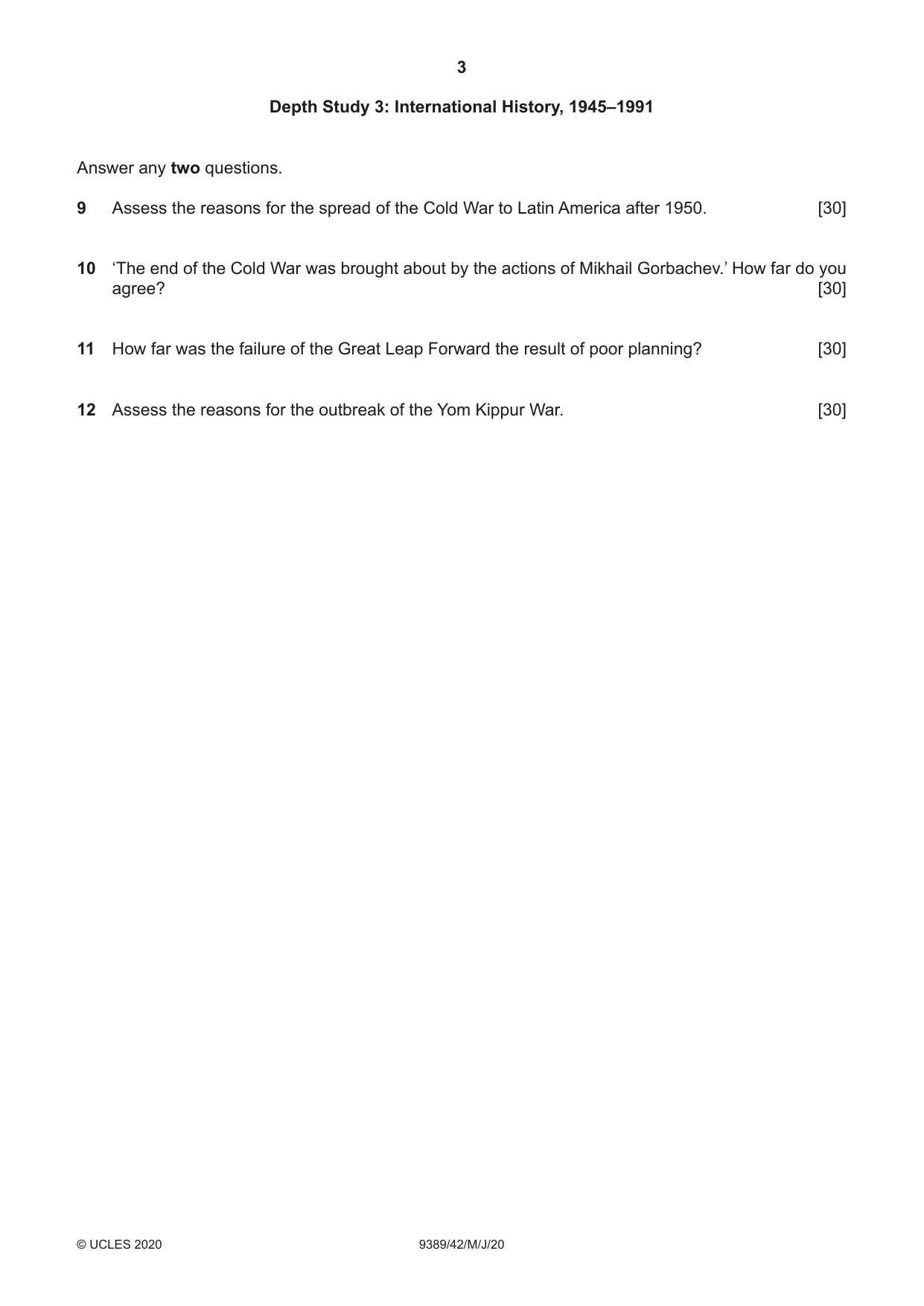
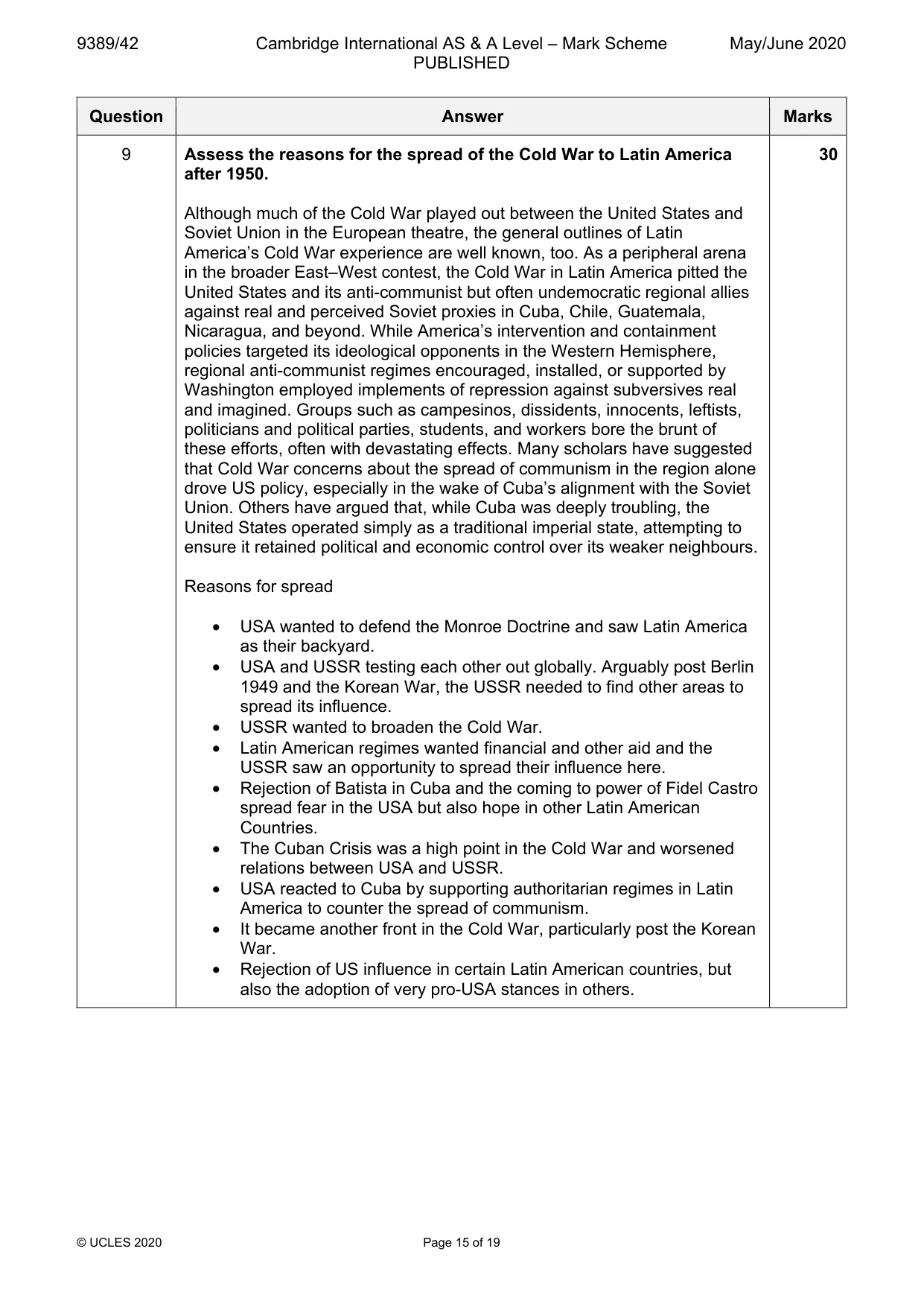
9 Assess the reasons for the spread of the Cold War to Latin America after 1950. [30]
Mark scheme: 9 Assess the reasons for the spread of the Cold War to Latin America 30 after 1950. Although much of the Cold War played out between the United States and Soviet Union in the European theatre, the general outlines of Latin America’s Cold War experience are well known, too. As a peripheral arena in the broader East–West contest, the Cold War in Latin America pitted the United States and its anti-communist but often undemocratic regional allies against real and perceived Soviet proxies in Cuba, Chile, Guatemala, Nicaragua, and beyond. While America’s intervention and containment policies targeted its ideological opponents in the Western Hemisphere, regional anti-communist regimes encouraged, installed, or supported by Washington employed implements of repression against subversives real and imagined. Groups such as campesinos, dissidents, innocents, leftists, politicians and political parties, students, and workers bore the brunt of these efforts, often with devastating effects. Many scholars have suggested that Cold War concerns about the spread of communism in the region alone drove US policy, especially in the wake of Cuba’s alignment with the Soviet Union. Others have argued that, while Cuba was deeply troubling, the United States operated simply as a traditional imperial state, attempting to ensure it retained political and economic control over its weaker neighbours. Reasons for spread • USA wanted to defend the Monroe Doctrine and saw Latin America as their backyard. • USA and USSR testing each other out globally. Arguably post Berlin 1949 and the Korean War, the USSR needed to find other areas to spread its influence. • USSR wanted to broaden the Cold War. • Latin American regimes wanted financial and other aid and the USSR saw an opportunity to spread their influence here. • Rejection of Batista in Cuba and the coming to power of Fidel Castro spread fear in the USA but also hope in other Latin American Countries. • The Cuban Crisis was a high point in the Cold War and worsened relations between USA and USSR. • USA reacted to Cuba by supporting authoritarian regimes in Latin America to counter the spread of communism. • It became another front in the Cold War, particularly post the Korean War. • Rejection of US influence in certain Latin American countries, but also the adoption of very pro-USA stances in others.
Q10 · ‘The end of the Cold War was brought about by the actions of Mikhail Gorbachev.’ How far…
10 ‘The end of the Cold War was brought about by the actions of Mikhail Gorbachev.’ How far do you agree? [30]
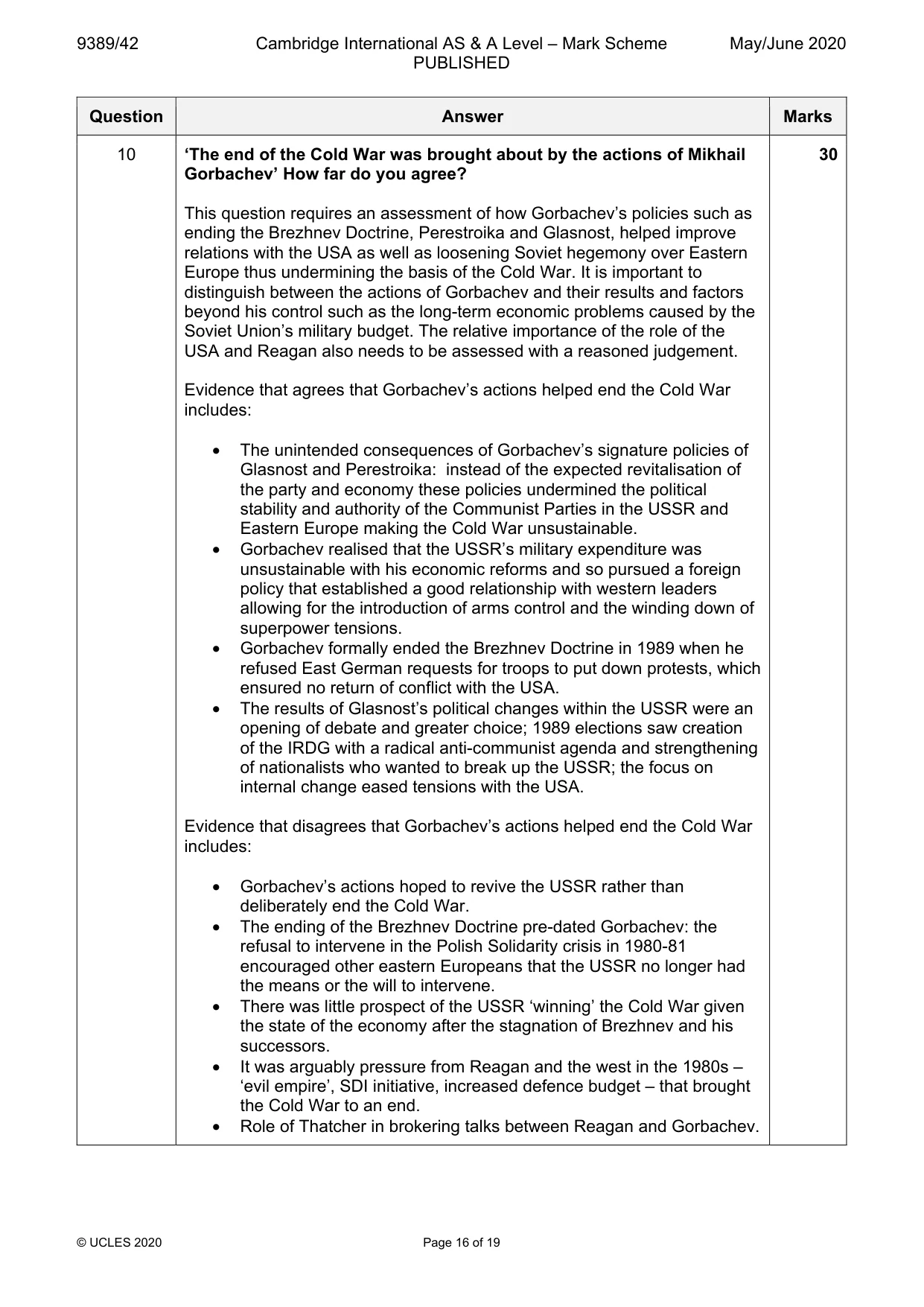
Mark scheme: 10 ‘The end of the Cold War was brought about by the actions of Mikhail 30 Gorbachev’ How far do you agree? This question requires an assessment of how Gorbachev’s policies such as ending the Brezhnev Doctrine, Perestroika and Glasnost, helped improve relations with the USA as well as loosening Soviet hegemony over Eastern Europe thus undermining the basis of the Cold War. It is important to distinguish between the actions of Gorbachev and their results and factors beyond his control such as the long-term economic problems caused by the Soviet Union’s military budget. The relative importance of the role of the USA and Reagan also needs to be assessed with a reasoned judgement. Evidence that agrees that Gorbachev’s actions helped end the Cold War includes: • The unintended consequences of Gorbachev’s signature policies of Glasnost and Perestroika: instead of the expected revitalisation of the party and economy these policies undermined the political stability and authority of the Communist Parties in the USSR and Eastern Europe making the Cold War unsustainable. • Gorbachev realised that the USSR’s military expenditure was unsustainable with his economic reforms and so pursued a foreign policy that established a good relationship with western leaders allowing for the introduction of arms control and the winding down of superpower tensions. • Gorbachev formally ended the Brezhnev Doctrine in 1989 when he refused East German requests for troops to put down protests, which ensured no return of conflict with the USA. • The results of Glasnost’s political changes within the USSR were an opening of debate and greater choice; 1989 elections saw creation of the IRDG with a radical anti-communist agenda and strengthening of nationalists who wanted to break up the USSR; the focus on internal change eased tensions with the USA. Evidence that disagrees that Gorbachev’s actions helped end the Cold War includes: • Gorbachev’s actions hoped to revive the USSR rather than deliberately end the Cold War. • The ending of the Brezhnev Doctrine pre-dated Gorbachev: the refusal to intervene in the Polish Solidarity crisis in 1980-81 encouraged other eastern Europeans that the USSR no longer had the means or the will to intervene. • There was little prospect of the USSR ‘winning’ the Cold War given the state of the economy after the stagnation of Brezhnev and his successors. • It was arguably pressure from Reagan and the west in the 1980s – ‘evil empire’, SDI initiative, increased defence budget – that brought the Cold War to an end. • Role of Thatcher in brokering talks between Reagan and Gorbachev.
Q11 · How far was the failure of the Great Leap Forward the result of poor planning?
11 How far was the failure of the Great Leap Forward the result of poor planning? [30]
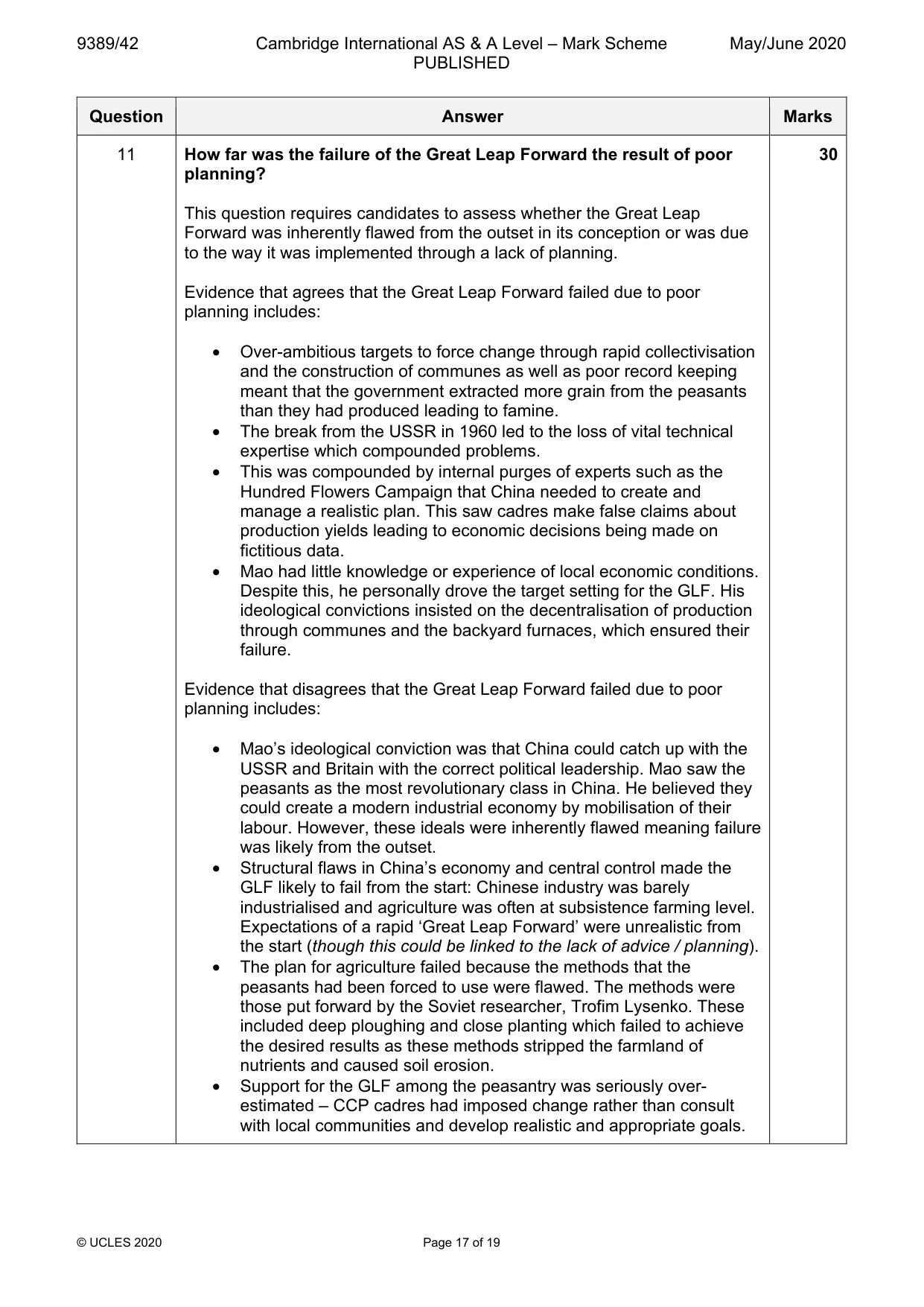
Mark scheme: 11 How far was the failure of the Great Leap Forward the result of poor 30 planning? This question requires candidates to assess whether the Great Leap Forward was inherently flawed from the outset in its conception or was due to the way it was implemented through a lack of planning. Evidence that agrees that the Great Leap Forward failed due to poor planning includes: • Over-ambitious targets to force change through rapid collectivisation and the construction of communes as well as poor record keeping meant that the government extracted more grain from the peasants than they had produced leading to famine. • The break from the USSR in 1960 led to the loss of vital technical expertise which compounded problems. • This was compounded by internal purges of experts such as the Hundred Flowers Campaign that China needed to create and manage a realistic plan. This saw cadres make false claims about production yields leading to economic decisions being made on fictitious data. • Mao had little knowledge or experience of local economic conditions. Despite this, he personally drove the target setting for the GLF. His ideological convictions insisted on the decentralisation of production through communes and the backyard furnaces, which ensured their failure. Evidence that disagrees that the Great Leap Forward failed due to poor planning includes: • Mao’s ideological conviction was that China could catch up with the USSR and Britain with the correct political leadership. Mao saw the peasants as the most revolutionary class in China. He believed they could create a modern industrial economy by mobilisation of their labour. However, these ideals were inherently flawed meaning failure was likely from the outset. • Structural flaws in China’s economy and central control made the GLF likely to fail from the start: Chinese industry was barely industrialised and agriculture was often at subsistence farming level. Expectations of a rapid ‘Great Leap Forward’ were unrealistic from the start (though this could be linked to the lack of advice / planning). • The plan for agriculture failed because the methods that the peasants had been forced to use were flawed. The methods were those put forward by the Soviet researcher, Trofim Lysenko. These included deep ploughing and close planting which failed to achieve the desired results as these methods stripped the farmland of nutrients and caused soil erosion. • Support for the GLF among the peasantry was seriously over- estimated – CCP cadres had imposed change rather than consult with local communities and develop realistic and appropriate goals. 11 • Natural disasters such as a drought in 1959 and the Yellow River flooding made bad harvests in 1959 and 1960 even worse and caused a significant fall in yields, undermining any chance of meeting targets.