Cambridge A Level History 9389 — 2020 Oct/Nov Paper 4 · Variant 2
9389/42/O/N/20 · 19 questions · 60 marks · ≈68 min
The question paper and its mark scheme, free to read here and free to download. This is Cambridge’s own paper, exactly as it was sat.
Question paper4 pages
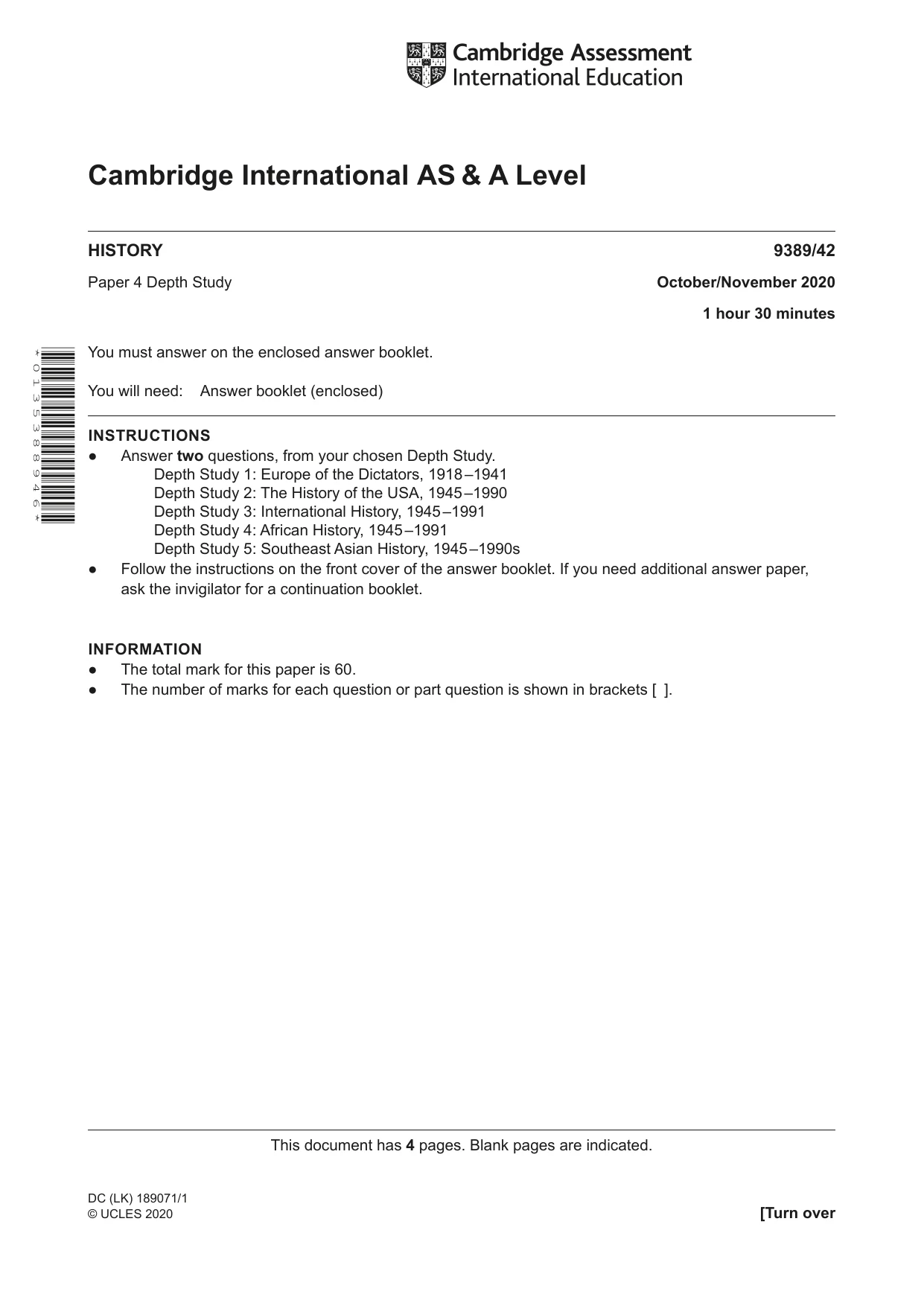
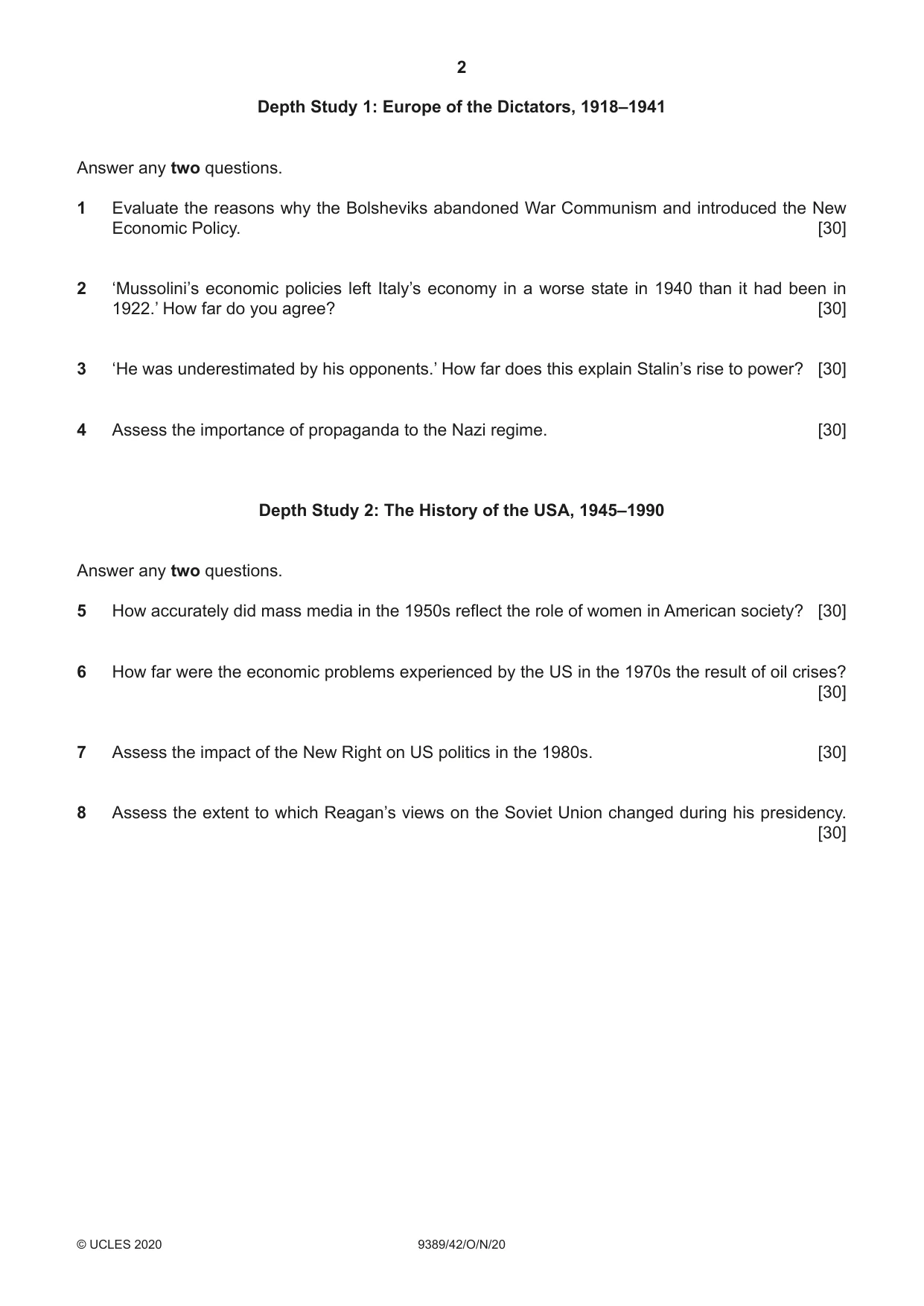
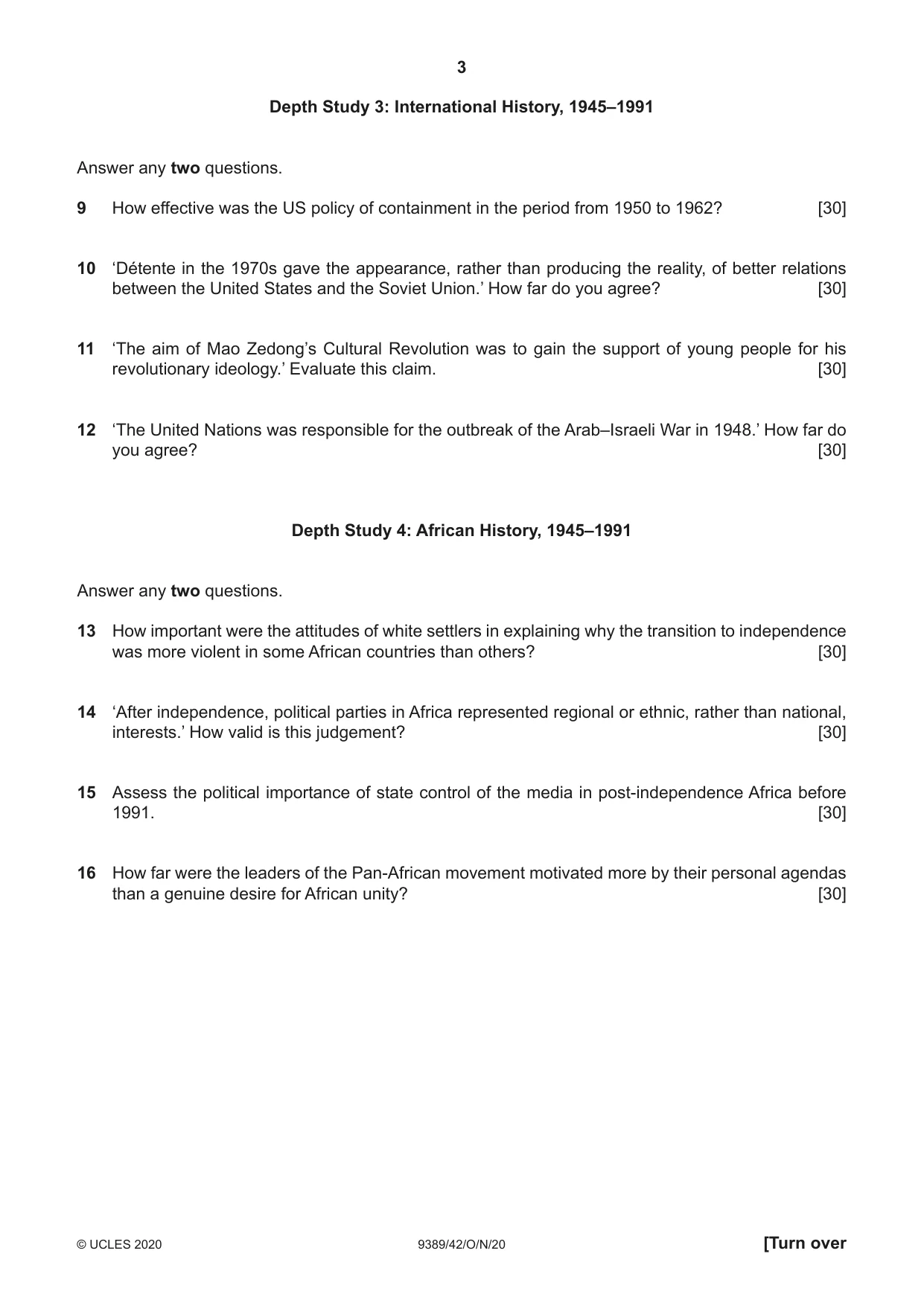
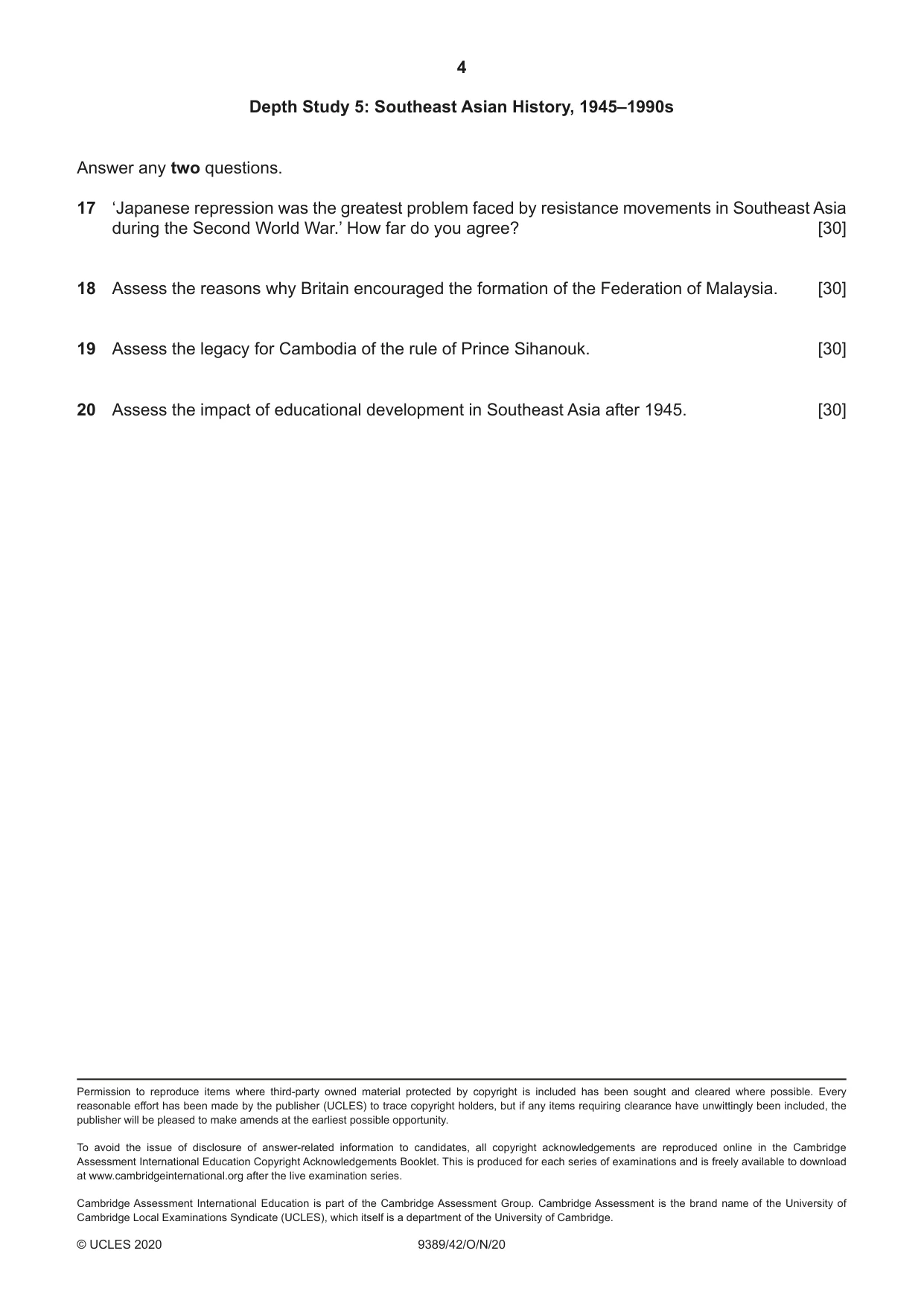
Mark scheme24 pages
Answers below. Sit the paper first if you are practising.

Questions as text
Q1 · Evaluate the reasons why the Bolsheviks abandoned War Communism and introduced the New…
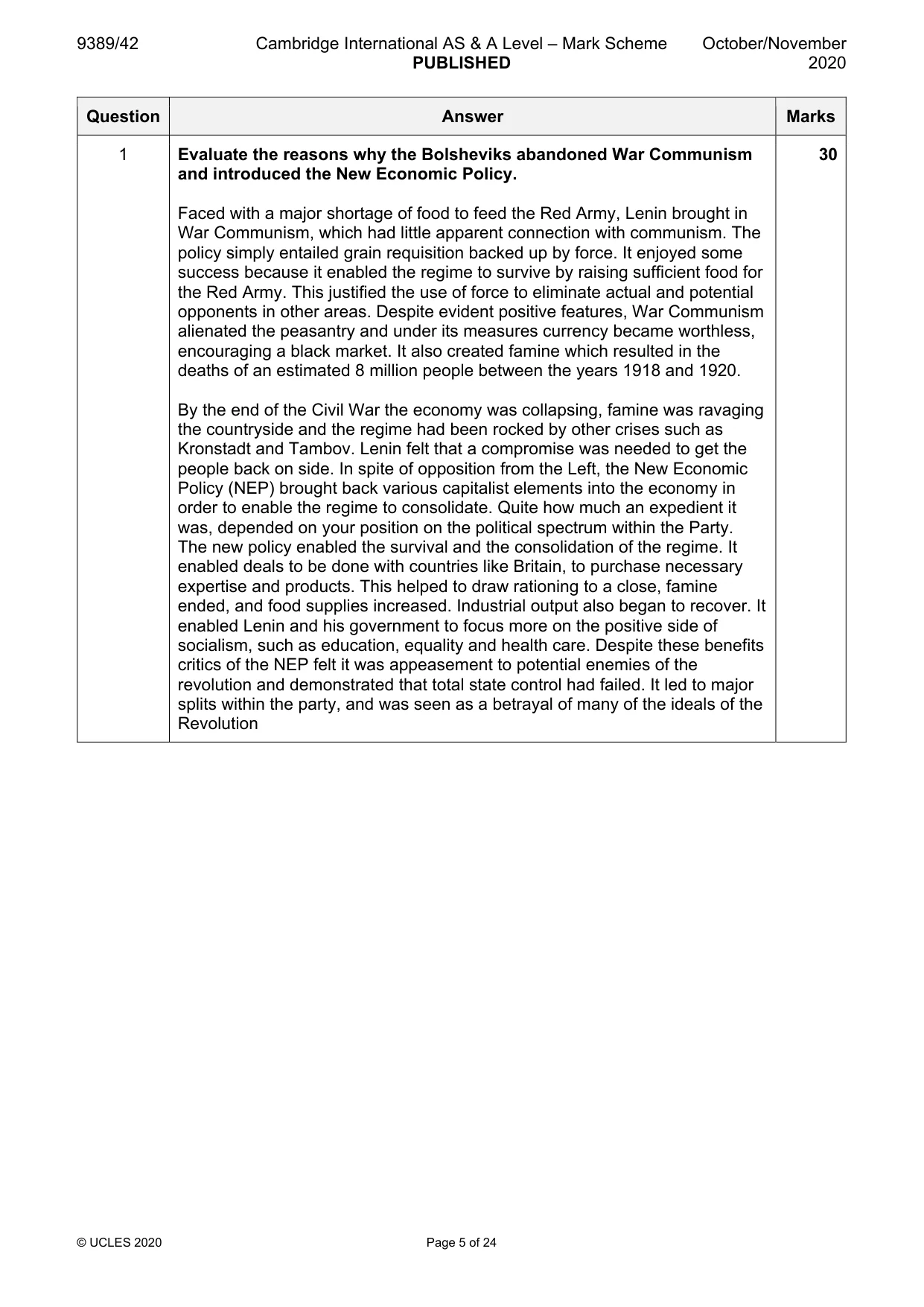
1 Evaluate the reasons why the Bolsheviks abandoned War Communism and introduced the New Economic Policy. [30]
Mark scheme: Question Answer Marks 1 Evaluate the reasons why the Bolsheviks abandoned War Communism 30 and introduced the New Economic Policy. Faced with a major shortage of food to feed the Red Army, Lenin brought in War Communism, which had little apparent connection with communism. The policy simply entailed grain requisition backed up by force. It enjoyed some success because it enabled the regime to survive by raising sufficient food for the Red Army. This justified the use of force to eliminate actual and potential opponents in other areas. Despite evident positive features, War Communism alienated the peasantry and under its measures currency became worthless, encouraging a black market. It also created famine which resulted in the deaths of an estimated 8 million people between the years 1918 and 1920. By the end of the Civil War the economy was collapsing, famine was ravaging the countryside and the regime had been rocked by other crises such as Kronstadt and Tambov. Lenin felt that a compromise was needed to get the people back on side. In spite of opposition from the Left, the New Economic Policy (NEP) brought back various capitalist elements into the economy in order to enable the regime to consolidate. Quite how much an expedient it was, depended on your position on the political spectrum within the Party. The new policy enabled the survival and the consolidation of the regime. It enabled deals to be done with countries like Britain, to purchase necessary expertise and products. This helped to draw rationing to a close, famine ended, and food supplies increased. Industrial output also began to recover. It enabled Lenin and his government to focus more on the positive side of socialism, such as education, equality and health care. Despite these benefits critics of the NEP felt it was appeasement to potential enemies of the revolution and demonstrated that total state control had failed. It led to major splits within the party, and was seen as a betrayal of many of the ideals of the Revolution
Q2 · ‘Mussolini’s economic policies left Italy’s economy in a worse state in 1940 than it had…
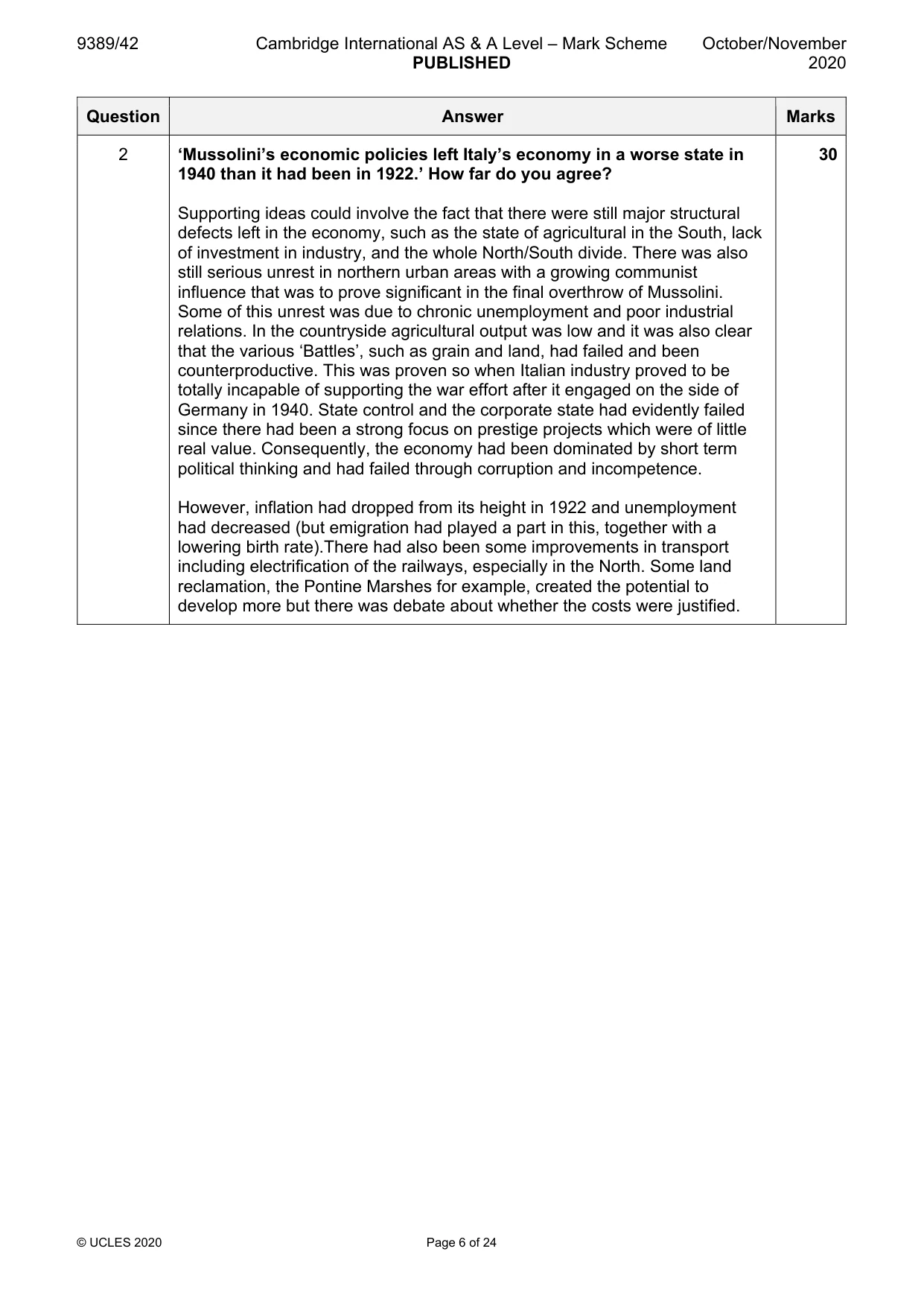
2 ‘Mussolini’s economic policies left Italy’s economy in a worse state in 1940 than it had been in 1922.’ How far do you agree? [30]
Mark scheme: 2 ‘Mussolini’s economic policies left Italy’s economy in a worse state in 30 1940 than it had been in 1922.’ How far do you agree? Supporting ideas could involve the fact that there were still major structural defects left in the economy, such as the state of agricultural in the South, lack of investment in industry, and the whole North/South divide. There was also still serious unrest in northern urban areas with a growing communist influence that was to prove significant in the final overthrow of Mussolini. Some of this unrest was due to chronic unemployment and poor industrial relations. In the countryside agricultural output was low and it was also clear that the various ‘Battles’, such as grain and land, had failed and been counterproductive. This was proven so when Italian industry proved to be totally incapable of supporting the war effort after it engaged on the side of Germany in 1940. State control and the corporate state had evidently failed since there had been a strong focus on prestige projects which were of little real value. Consequently, the economy had been dominated by short term political thinking and had failed through corruption and incompetence. However, inflation had dropped from its height in 1922 and unemployment had decreased (but emigration had played a part in this, together with a lowering birth rate).There had also been some improvements in transport including electrification of the railways, especially in the North. Some land reclamation, the Pontine Marshes for example, created the potential to develop more but there was debate about whether the costs were justified.
Q3 · ‘He was underestimated by his opponents.’ How far does this explain Stalin’s rise to…
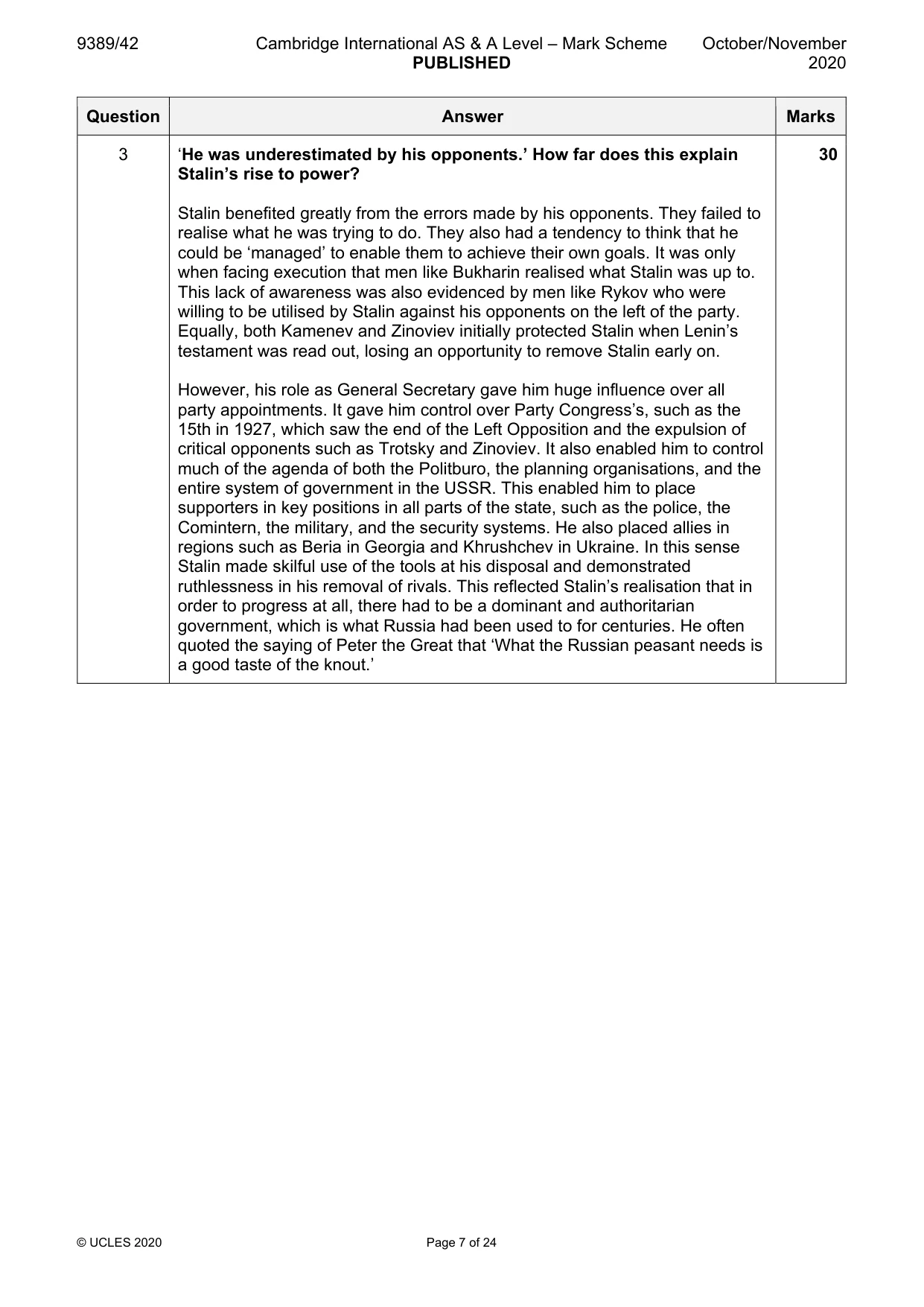
3 ‘He was underestimated by his opponents.’ How far does this explain Stalin’s rise to power? [30]
Mark scheme: 3 ‘He was underestimated by his opponents.’ How far does this explain 30 Stalin’s rise to power? Stalin benefited greatly from the errors made by his opponents. They failed to realise what he was trying to do. They also had a tendency to think that he could be ‘managed’ to enable them to achieve their own goals. It was only when facing execution that men like Bukharin realised what Stalin was up to. This lack of awareness was also evidenced by men like Rykov who were willing to be utilised by Stalin against his opponents on the left of the party. Equally, both Kamenev and Zinoviev initially protected Stalin when Lenin’s testament was read out, losing an opportunity to remove Stalin early on. However, his role as General Secretary gave him huge influence over all party appointments. It gave him control over Party Congress’s, such as the 15th in 1927, which saw the end of the Left Opposition and the expulsion of critical opponents such as Trotsky and Zinoviev. It also enabled him to control much of the agenda of both the Politburo, the planning organisations, and the entire system of government in the USSR. This enabled him to place supporters in key positions in all parts of the state, such as the police, the Comintern, the military, and the security systems. He also placed allies in regions such as Beria in Georgia and Khrushchev in Ukraine. In this sense Stalin made skilful use of the tools at his disposal and demonstrated ruthlessness in his removal of rivals. This reflected Stalin’s realisation that in order to progress at all, there had to be a dominant and authoritarian government, which is what Russia had been used to for centuries. He often quoted the saying of Peter the Great that ‘What the Russian peasant needs is a good taste of the knout.’
Q4 · Assess the importance of propaganda to the Nazi regime
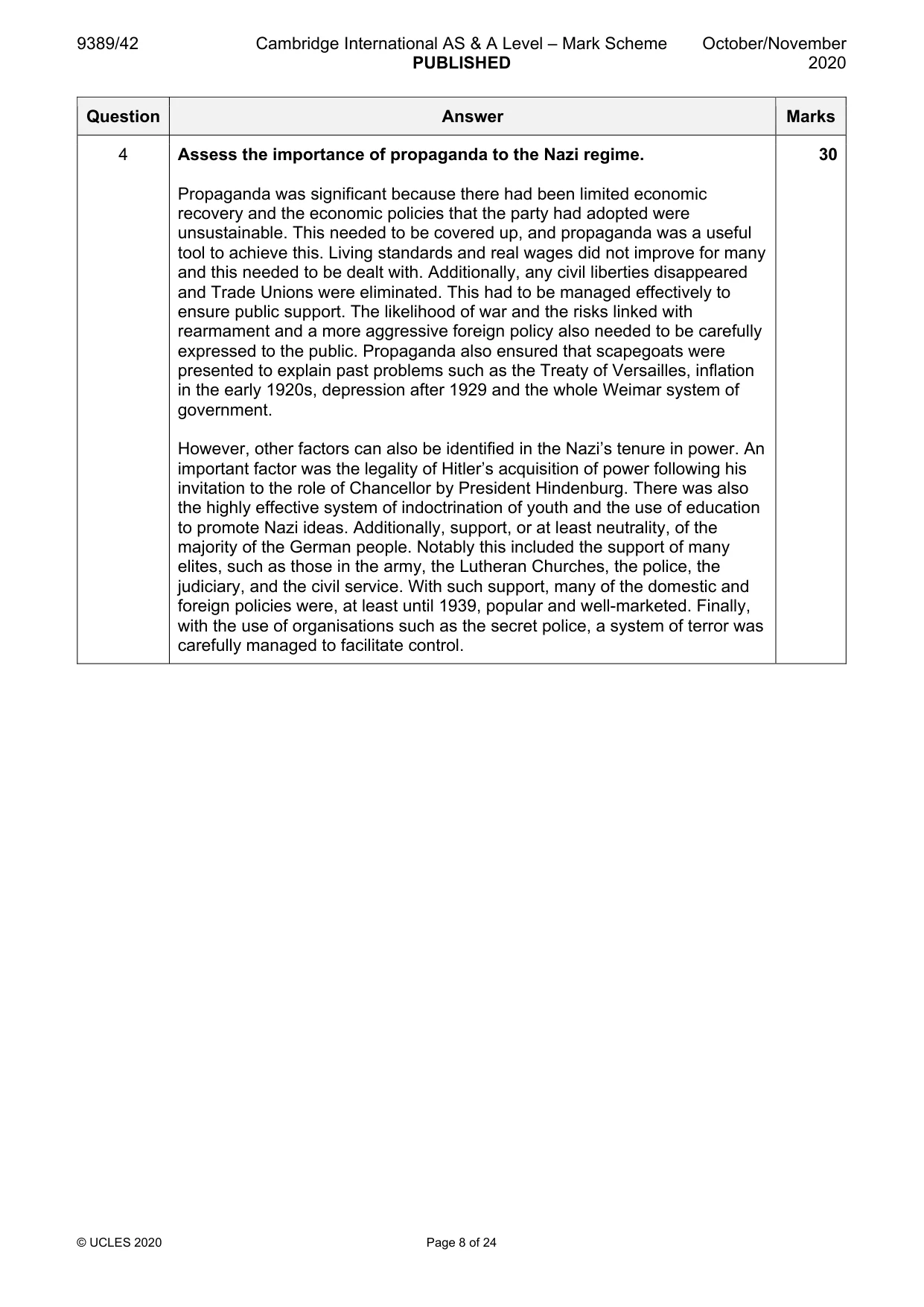
4 Assess the importance of propaganda to the Nazi regime. [30] Depth Study 2: The History of the USA, 1945–1990 Answer any two questions.
Mark scheme: 4 Assess the importance of propaganda to the Nazi regime. 30 Propaganda was significant because there had been limited economic recovery and the economic policies that the party had adopted were unsustainable. This needed to be covered up, and propaganda was a useful tool to achieve this. Living standards and real wages did not improve for many and this needed to be dealt with. Additionally, any civil liberties disappeared and Trade Unions were eliminated. This had to be managed effectively to ensure public support. The likelihood of war and the risks linked with rearmament and a more aggressive foreign policy also needed to be carefully expressed to the public. Propaganda also ensured that scapegoats were presented to explain past problems such as the Treaty of Versailles, inflation in the early 1920s, depression after 1929 and the whole Weimar system of government. However, other factors can also be identified in the Nazi’s tenure in power. An important factor was the legality of Hitler’s acquisition of power following his invitation to the role of Chancellor by President Hindenburg. There was also the highly effective system of indoctrination of youth and the use of education to promote Nazi ideas. Additionally, support, or at least neutrality, of the majority of the German people. Notably this included the support of many elites, such as those in the army, the Lutheran Churches, the police, the judiciary, and the civil service. With such support, many of the domestic and foreign policies were, at least until 1939, popular and well-marketed. Finally, with the use of organisations such as the secret police, a system of terror was carefully managed to facilitate control.
Q5 · How accurately did mass media in the 1950s reflect the role of women in American society?
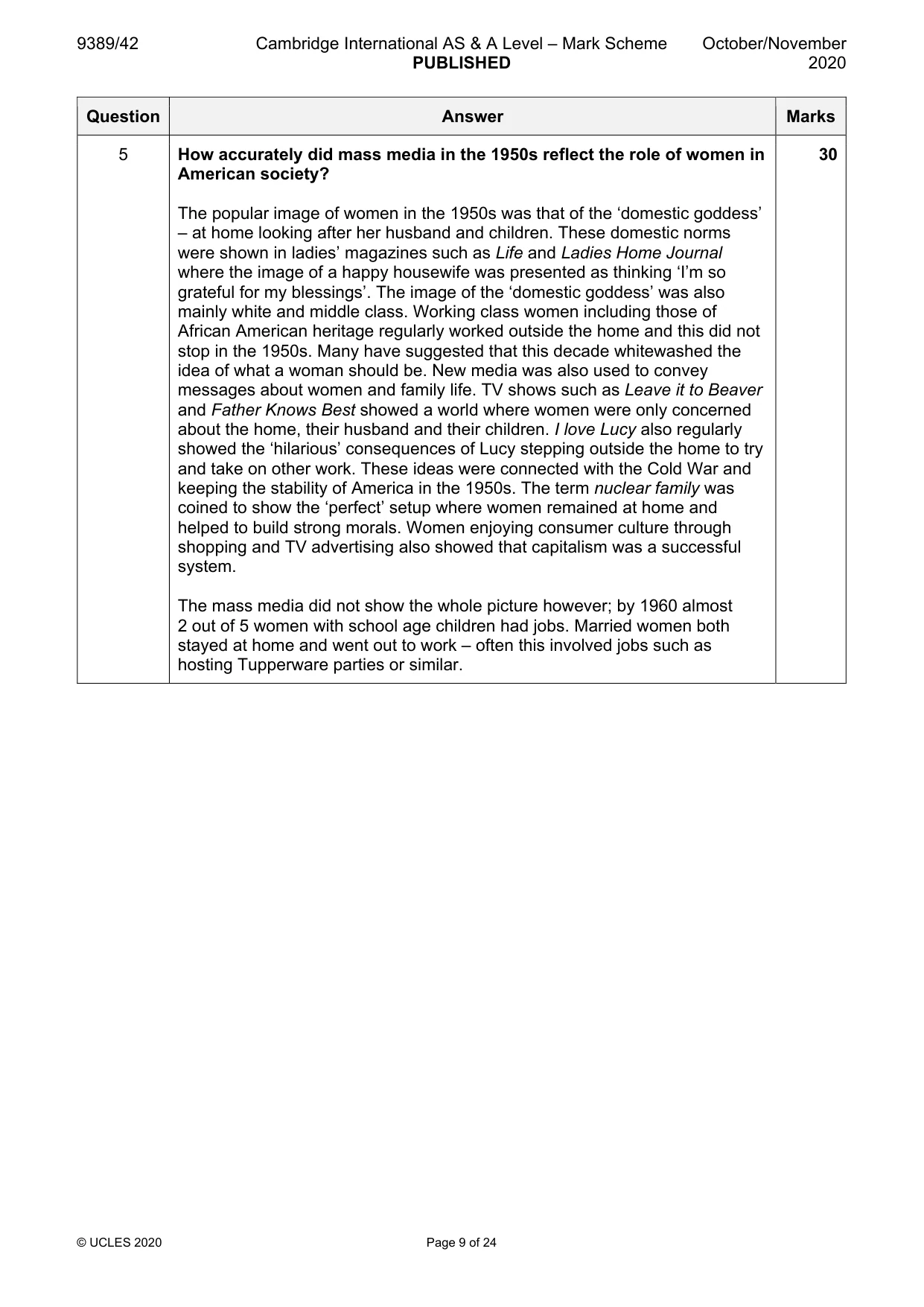
5 How accurately did mass media in the 1950s reflect the role of women in American society? [30]
Mark scheme: 5 How accurately did mass media in the 1950s reflect the role of women in 30 American society? The popular image of women in the 1950s was that of the ‘domestic goddess’ – at home looking after her husband and children. These domestic norms were shown in ladies’ magazines such as Life and Ladies Home Journal where the image of a happy housewife was presented as thinking ‘I’m so grateful for my blessings’. The image of the ‘domestic goddess’ was also mainly white and middle class. Working class women including those of African American heritage regularly worked outside the home and this did not stop in the 1950s. Many have suggested that this decade whitewashed the idea of what a woman should be. New media was also used to convey messages about women and family life. TV shows such as Leave it to Beaver and Father Knows Best showed a world where women were only concerned about the home, their husband and their children. I love Lucy also regularly showed the ‘hilarious’ consequences of Lucy stepping outside the home to try and take on other work. These ideas were connected with the Cold War and keeping the stability of America in the 1950s. The term nuclear family was coined to show the ‘perfect’ setup where women remained at home and helped to build strong morals. Women enjoying consumer culture through shopping and TV advertising also showed that capitalism was a successful system. The mass media did not show the whole picture however; by 1960 almost 2 out of 5 women with school age children had jobs. Married women both stayed at home and went out to work – often this involved jobs such as hosting Tupperware parties or similar.
Q6 · How far were the economic problems experienced by the US in the 1970s the result of oil…
6 How far were the economic problems experienced by the US in the 1970s the result of oil crises? [30]
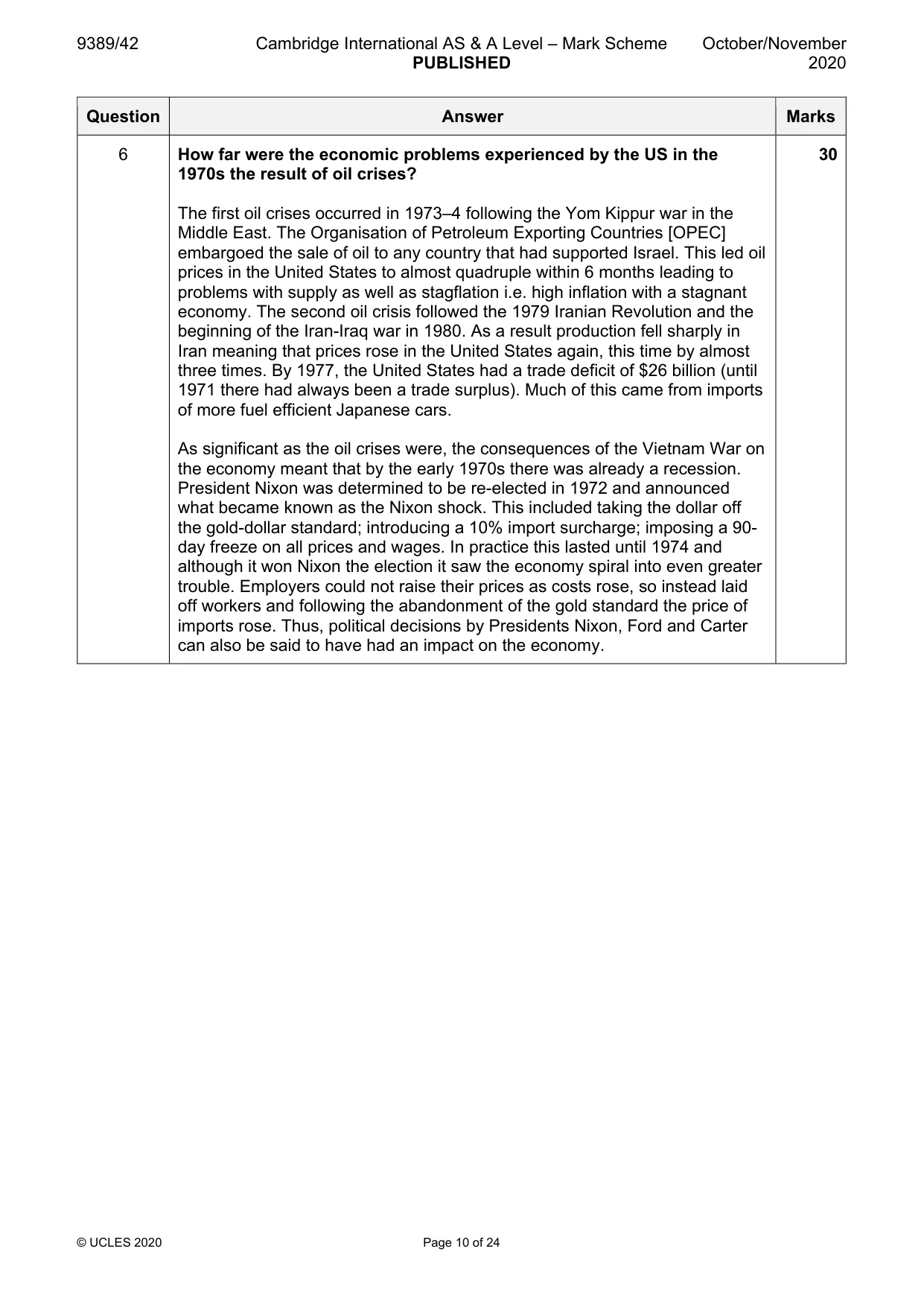
Mark scheme: 6 How far were the economic problems experienced by the US in the 30 1970s the result of oil crises? The first oil crises occurred in 1973–4 following the Yom Kippur war in the Middle East. The Organisation of Petroleum Exporting Countries [OPEC] embargoed the sale of oil to any country that had supported Israel. This led oil prices in the United States to almost quadruple within 6 months leading to problems with supply as well as stagflation i.e. high inflation with a stagnant economy. The second oil crisis followed the 1979 Iranian Revolution and the beginning of the Iran-Iraq war in 1980. As a result production fell sharply in Iran meaning that prices rose in the United States again, this time by almost three times. By 1977, the United States had a trade deficit of $26 billion (until 1971 there had always been a trade surplus). Much of this came from imports of more fuel efficient Japanese cars. As significant as the oil crises were, the consequences of the Vietnam War on the economy meant that by the early 1970s there was already a recession. President Nixon was determined to be re-elected in 1972 and announced what became known as the Nixon shock. This included taking the dollar off the gold-dollar standard; introducing a 10% import surcharge; imposing a 90- day freeze on all prices and wages. In practice this lasted until 1974 and although it won Nixon the election it saw the economy spiral into even greater trouble. Employers could not raise their prices as costs rose, so instead laid off workers and following the abandonment of the gold standard the price of imports rose. Thus, political decisions by Presidents Nixon, Ford and Carter can also be said to have had an impact on the economy. Question Indicative content Marks
Q7 · Assess the impact of the New Right on US politics in the 1980s
7 Assess the impact of the New Right on US politics in the 1980s. [30]
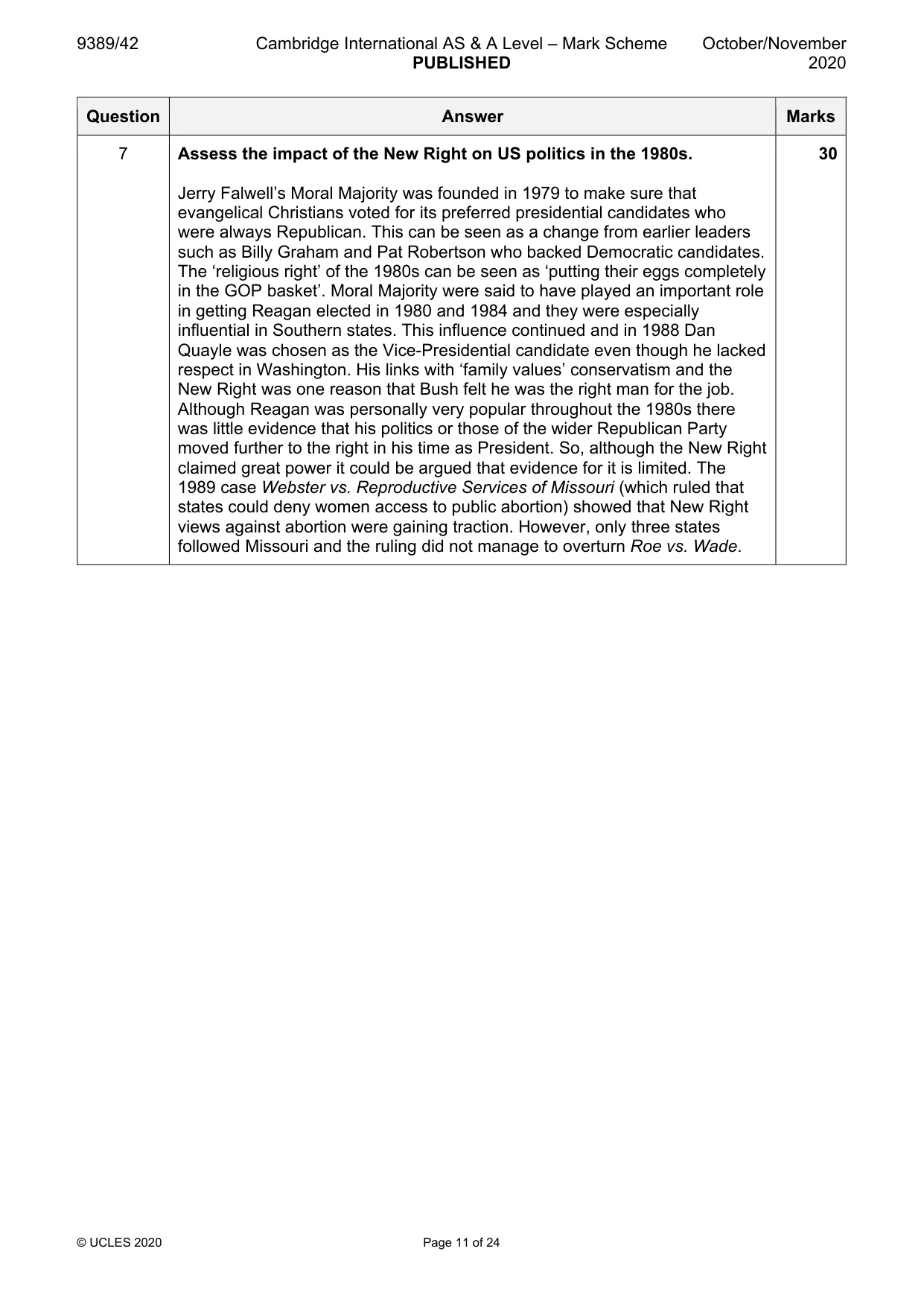
Mark scheme: 7 Assess the impact of the New Right on US politics in the 1980s. 30 Jerry Falwell’s Moral Majority was founded in 1979 to make sure that evangelical Christians voted for its preferred presidential candidates who were always Republican. This can be seen as a change from earlier leaders such as Billy Graham and Pat Robertson who backed Democratic candidates. The ‘religious right’ of the 1980s can be seen as ‘putting their eggs completely in the GOP basket’. Moral Majority were said to have played an important role in getting Reagan elected in 1980 and 1984 and they were especially influential in Southern states. This influence continued and in 1988 Dan Quayle was chosen as the Vice-Presidential candidate even though he lacked respect in Washington. His links with ‘family values’ conservatism and the New Right was one reason that Bush felt he was the right man for the job. Although Reagan was personally very popular throughout the 1980s there was little evidence that his politics or those of the wider Republican Party moved further to the right in his time as President. So, although the New Right claimed great power it could be argued that evidence for it is limited. The 1989 case Webster vs. Reproductive Services of Missouri (which ruled that states could deny women access to public abortion) showed that New Right views against abortion were gaining traction. However, only three states followed Missouri and the ruling did not manage to overturn Roe vs. Wade.
Q8 · Assess the extent to which Reagan’s views on the Soviet Union changed during his…
8 Assess the extent to which Reagan’s views on the Soviet Union changed during his presidency. [30] Depth Study 3: International History, 1945–1991 Answer any two questions.
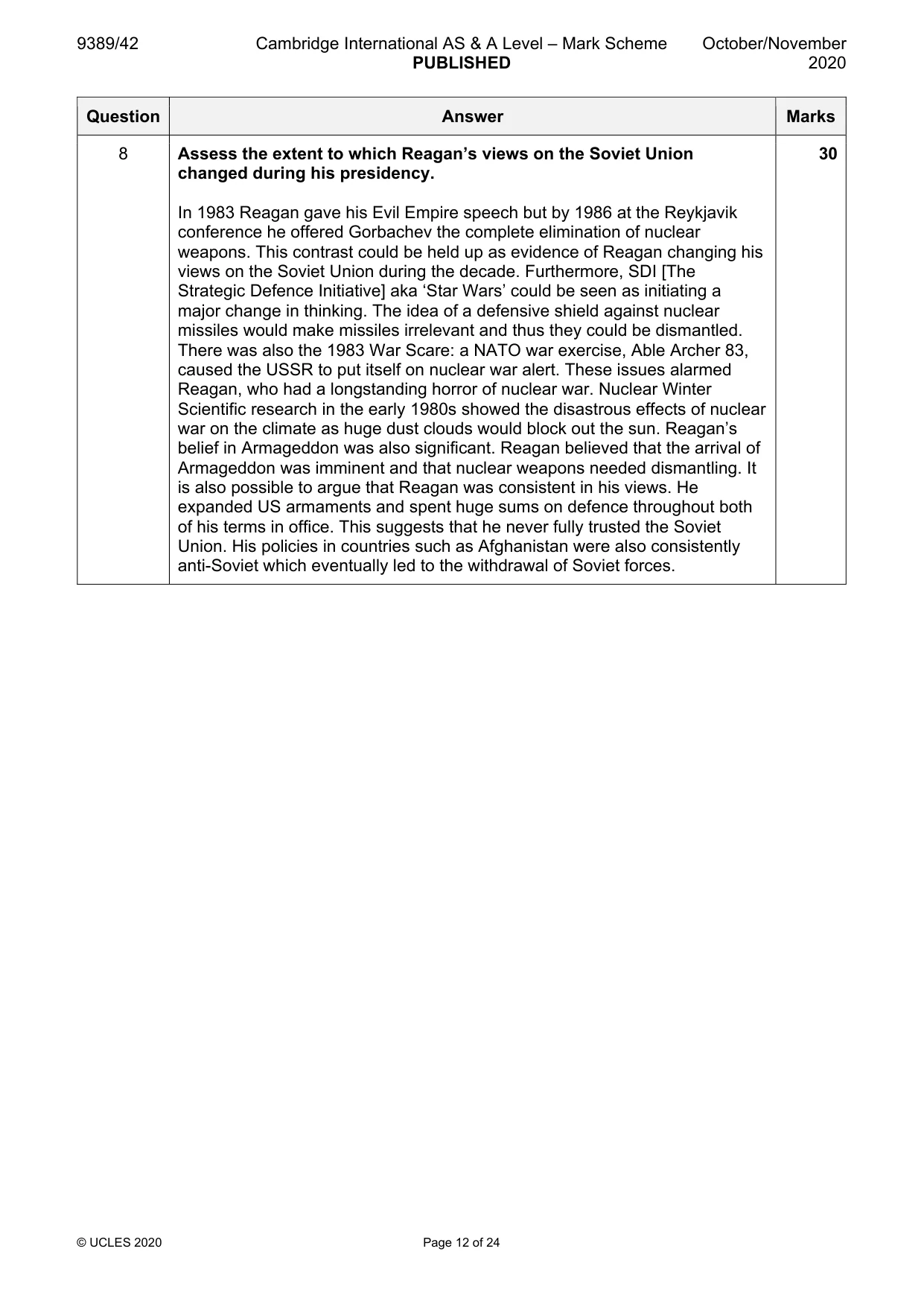
Mark scheme: 8 Assess the extent to which Reagan’s views on the Soviet Union 30 changed during his presidency. In 1983 Reagan gave his Evil Empire speech but by 1986 at the Reykjavik conference he offered Gorbachev the complete elimination of nuclear weapons. This contrast could be held up as evidence of Reagan changing his views on the Soviet Union during the decade. Furthermore, SDI [The Strategic Defence Initiative] aka ‘Star Wars’ could be seen as initiating a major change in thinking. The idea of a defensive shield against nuclear missiles would make missiles irrelevant and thus they could be dismantled. There was also the 1983 War Scare: a NATO war exercise, Able Archer 83, caused the USSR to put itself on nuclear war alert. These issues alarmed Reagan, who had a longstanding horror of nuclear war. Nuclear Winter Scientific research in the early 1980s showed the disastrous effects of nuclear war on the climate as huge dust clouds would block out the sun. Reagan’s belief in Armageddon was also significant. Reagan believed that the arrival of Armageddon was imminent and that nuclear weapons needed dismantling. It is also possible to argue that Reagan was consistent in his views. He expanded US armaments and spent huge sums on defence throughout both of his terms in office. This suggests that he never fully trusted the Soviet Union. His policies in countries such as Afghanistan were also consistently anti-Soviet which eventually led to the withdrawal of Soviet forces. Question Indicative content Marks
Q9 · How effective was the US policy of containment in the period from 1950 to 1962?
9 How effective was the US policy of containment in the period from 1950 to 1962? [30]
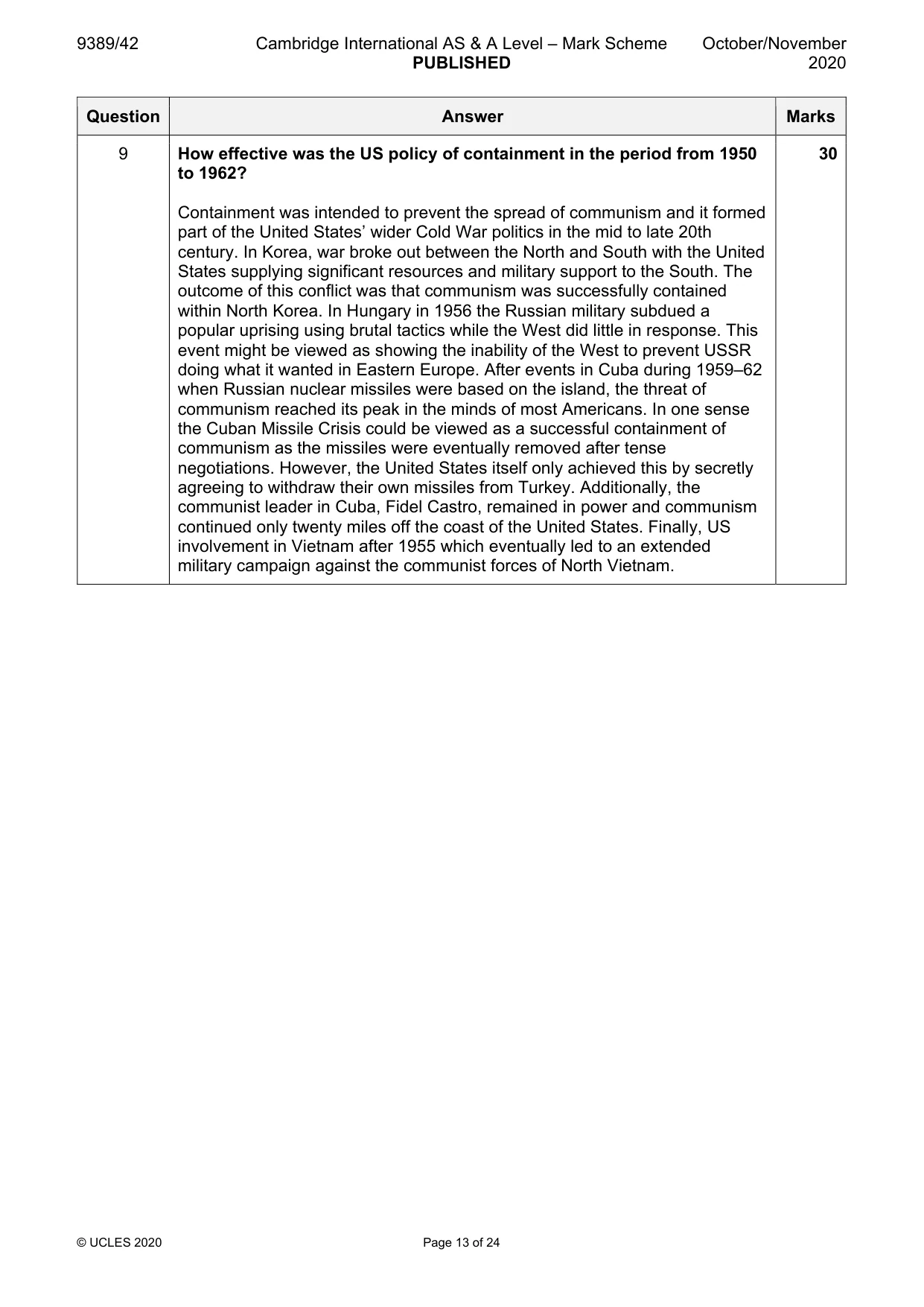
Mark scheme: 9 How effective was the US policy of containment in the period from 1950 30 to 1962? Containment was intended to prevent the spread of communism and it formed part of the United States’ wider Cold War politics in the mid to late 20th century. In Korea, war broke out between the North and South with the United States supplying significant resources and military support to the South. The outcome of this conflict was that communism was successfully contained within North Korea. In Hungary in 1956 the Russian military subdued a popular uprising using brutal tactics while the West did little in response. This event might be viewed as showing the inability of the West to prevent USSR doing what it wanted in Eastern Europe. After events in Cuba during 1959–62 when Russian nuclear missiles were based on the island, the threat of communism reached its peak in the minds of most Americans. In one sense the Cuban Missile Crisis could be viewed as a successful containment of communism as the missiles were eventually removed after tense negotiations. However, the United States itself only achieved this by secretly agreeing to withdraw their own missiles from Turkey. Additionally, the communist leader in Cuba, Fidel Castro, remained in power and communism continued only twenty miles off the coast of the United States. Finally, US involvement in Vietnam after 1955 which eventually led to an extended military campaign against the communist forces of North Vietnam.
Q10 · ‘Détente in the 1970s gave the appearance, rather than producing the reality, of better…
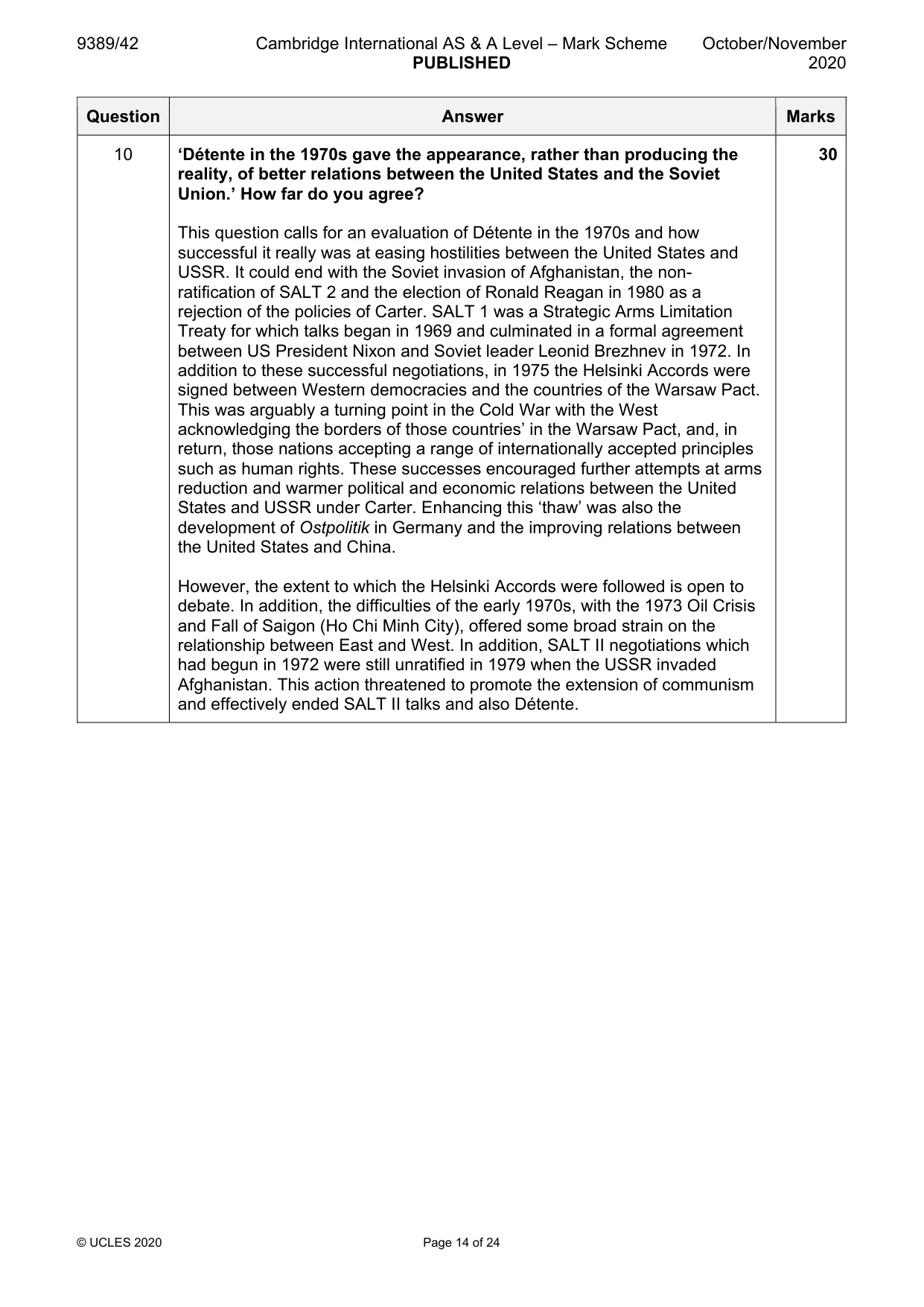
10 ‘Détente in the 1970s gave the appearance, rather than producing the reality, of better relations between the United States and the Soviet Union.’ How far do you agree? [30]
Mark scheme: 10 ‘Détente in the 1970s gave the appearance, rather than producing the 30 reality, of better relations between the United States and the Soviet Union.’ How far do you agree? This question calls for an evaluation of Détente in the 1970s and how successful it really was at easing hostilities between the United States and USSR. It could end with the Soviet invasion of Afghanistan, the non- ratification of SALT 2 and the election of Ronald Reagan in 1980 as a rejection of the policies of Carter. SALT 1 was a Strategic Arms Limitation Treaty for which talks began in 1969 and culminated in a formal agreement between US President Nixon and Soviet leader Leonid Brezhnev in 1972. In addition to these successful negotiations, in 1975 the Helsinki Accords were signed between Western democracies and the countries of the Warsaw Pact. This was arguably a turning point in the Cold War with the West acknowledging the borders of those countries’ in the Warsaw Pact, and, in return, those nations accepting a range of internationally accepted principles such as human rights. These successes encouraged further attempts at arms reduction and warmer political and economic relations between the United States and USSR under Carter. Enhancing this ‘thaw’ was also the development of Ostpolitik in Germany and the improving relations between the United States and China. However, the extent to which the Helsinki Accords were followed is open to debate. In addition, the difficulties of the early 1970s, with the 1973 Oil Crisis and Fall of Saigon (Ho Chi Minh City), offered some broad strain on the relationship between East and West. In addition, SALT II negotiations which had begun in 1972 were still unratified in 1979 when the USSR invaded Afghanistan. This action threatened to promote the extension of communism and effectively ended SALT II talks and also Détente.
Q11 · ‘The aim of Mao Zedong’s Cultural Revolution was to gain the support of young people for…
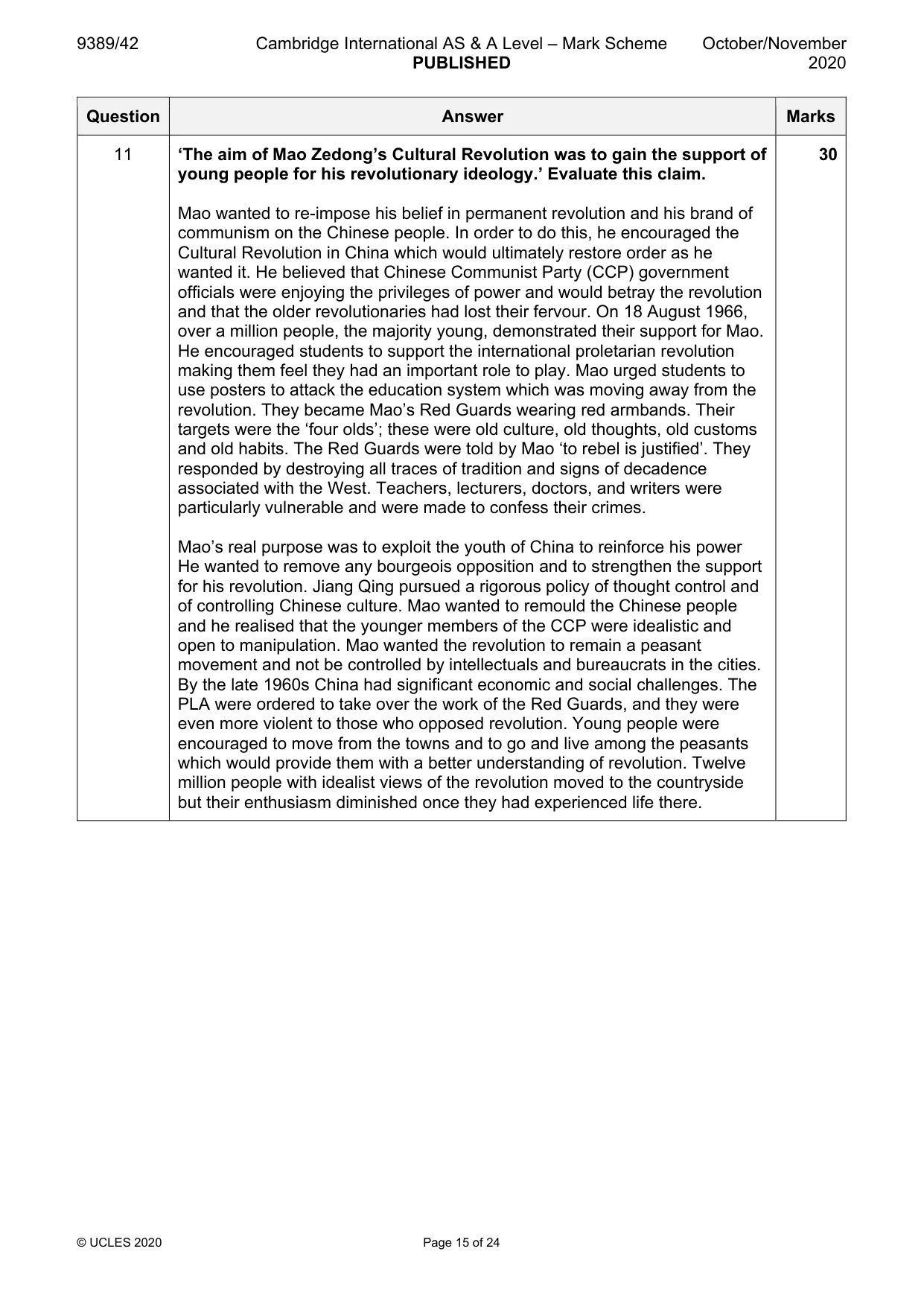
11 ‘The aim of Mao Zedong’s Cultural Revolution was to gain the support of young people for his revolutionary ideology.’ Evaluate this claim. [30]
Mark scheme: 11 ‘The aim of Mao Zedong’s Cultural Revolution was to gain the support of 30 young people for his revolutionary ideology.’ Evaluate this claim. Mao wanted to re-impose his belief in permanent revolution and his brand of communism on the Chinese people. In order to do this, he encouraged the Cultural Revolution in China which would ultimately restore order as he wanted it. He believed that Chinese Communist Party (CCP) government officials were enjoying the privileges of power and would betray the revolution and that the older revolutionaries had lost their fervour. On 18 August 1966, over a million people, the majority young, demonstrated their support for Mao. He encouraged students to support the international proletarian revolution making them feel they had an important role to play. Mao urged students to use posters to attack the education system which was moving away from the revolution. They became Mao’s Red Guards wearing red armbands. Their targets were the ‘four olds’; these were old culture, old thoughts, old customs and old habits. The Red Guards were told by Mao ‘to rebel is justified’. They responded by destroying all traces of tradition and signs of decadence associated with the West. Teachers, lecturers, doctors, and writers were particularly vulnerable and were made to confess their crimes. Mao’s real purpose was to exploit the youth of China to reinforce his power He wanted to remove any bourgeois opposition and to strengthen the support for his revolution. Jiang Qing pursued a rigorous policy of thought control and of controlling Chinese culture. Mao wanted to remould the Chinese people and he realised that the younger members of the CCP were idealistic and open to manipulation. Mao wanted the revolution to remain a peasant movement and not be controlled by intellectuals and bureaucrats in the cities. By the late 1960s China had significant economic and social challenges. The PLA were ordered to take over the work of the Red Guards, and they were even more violent to those who opposed revolution. Young people were encouraged to move from the towns and to go and live among the peasants which would provide them with a better understanding of revolution. Twelve million people with idealist views of the revolution moved to the countryside but their enthusiasm diminished once they had experienced life there.
Q12 · ‘The United Nations was responsible for the outbreak of the Arab–Israeli War in 1948.’…
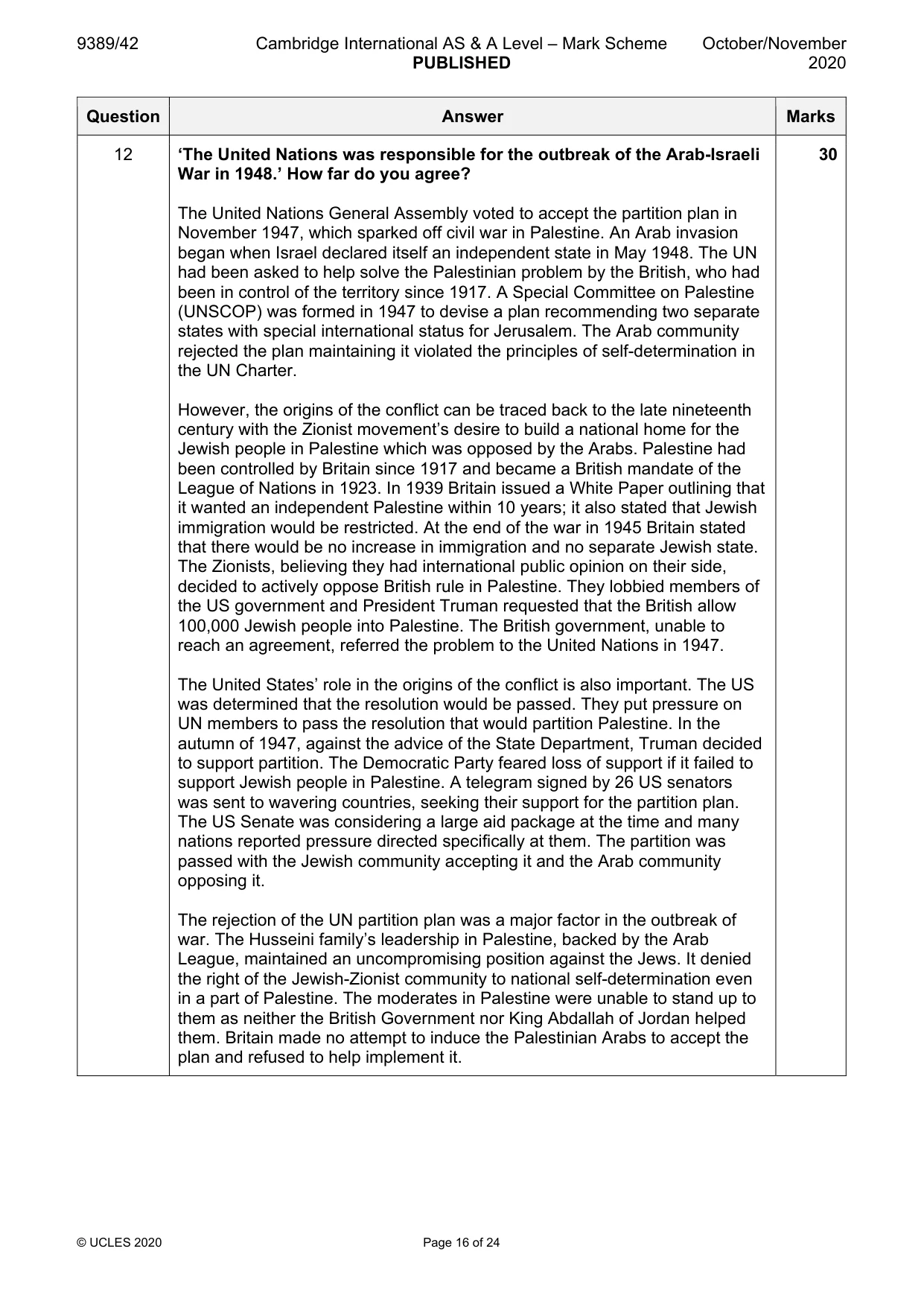
12 ‘The United Nations was responsible for the outbreak of the Arab–Israeli War in 1948.’ How far do you agree? [30] Depth Study 4: African History, 1945–1991 Answer any two questions.
Mark scheme: 12 ‘The United Nations was responsible for the outbreak of the Arab-Israeli 30 War in 1948.’ How far do you agree? The United Nations General Assembly voted to accept the partition plan in November 1947, which sparked off civil war in Palestine. An Arab invasion began when Israel declared itself an independent state in May 1948. The UN had been asked to help solve the Palestinian problem by the British, who had been in control of the territory since 1917. A Special Committee on Palestine (UNSCOP) was formed in 1947 to devise a plan recommending two separate states with special international status for Jerusalem. The Arab community rejected the plan maintaining it violated the principles of self-determination in the UN Charter. However, the origins of the conflict can be traced back to the late nineteenth century with the Zionist movement’s desire to build a national home for the Jewish people in Palestine which was opposed by the Arabs. Palestine had been controlled by Britain since 1917 and became a British mandate of the League of Nations in 1923. In 1939 Britain issued a White Paper outlining that it wanted an independent Palestine within 10 years; it also stated that Jewish immigration would be restricted. At the end of the war in 1945 Britain stated that there would be no increase in immigration and no separate Jewish state. The Zionists, believing they had international public opinion on their side, decided to actively oppose British rule in Palestine. They lobbied members of the US government and President Truman requested that the British allow 100,000 Jewish people into Palestine. The British government, unable to reach an agreement, referred the problem to the United Nations in 1947. The United States’ role in the origins of the conflict is also important. The US was determined that the resolution would be passed. They put pressure on UN members to pass the resolution that would partition Palestine. In the autumn of 1947, against the advice of the State Department, Truman decided to support partition. The Democratic Party feared loss of support if it failed to support Jewish people in Palestine. A telegram signed by 26 US senators was sent to wavering countries, seeking their support for the partition plan. The US Senate was considering a large aid package at the time and many nations reported pressure directed specifically at them. The partition was passed with the Jewish community accepting it and the Arab community opposing it. The rejection of the UN partition plan was a major factor in the outbreak of war. The Husseini family’s leadership in Palestine, backed by the Arab League, maintained an uncompromising position against the Jews. It denied the right of the Jewish-Zionist community to national self-determination even in a part of Palestine. The moderates in Palestine were unable to stand up to them as neither the British Government nor King Abdallah of Jordan helped them. Britain made no attempt to induce the Palestinian Arabs to accept the plan and refused to help implement it.
Q13 · How important were the attitudes of white settlers in explaining why the transition to…
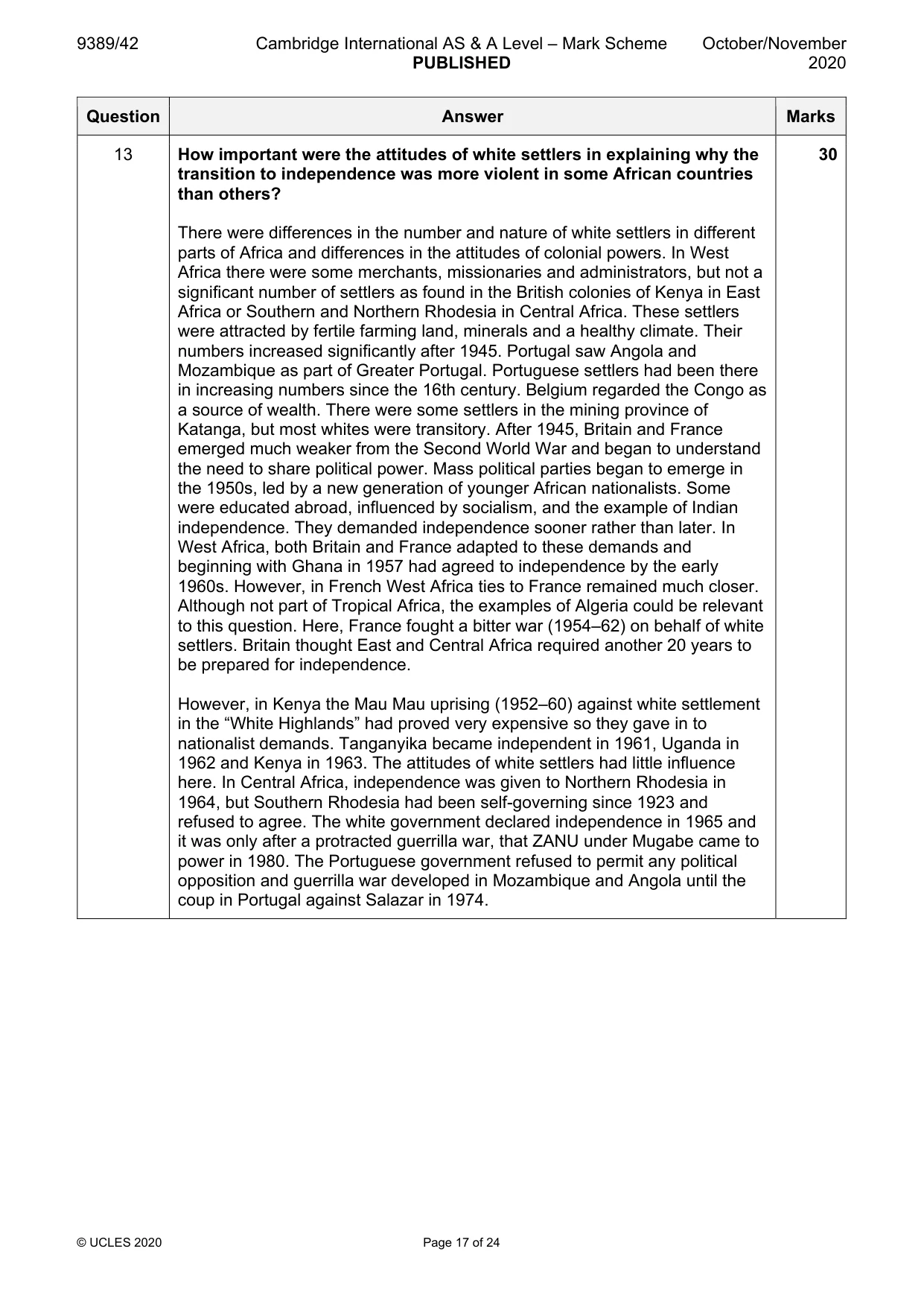
13 How important were the attitudes of white settlers in explaining why the transition to independence was more violent in some African countries than others? [30]
Mark scheme: 13 How important were the attitudes of white settlers in explaining why the 30 transition to independence was more violent in some African countries than others? There were differences in the number and nature of white settlers in different parts of Africa and differences in the attitudes of colonial powers. In West Africa there were some merchants, missionaries and administrators, but not a significant number of settlers as found in the British colonies of Kenya in East Africa or Southern and Northern Rhodesia in Central Africa. These settlers were attracted by fertile farming land, minerals and a healthy climate. Their numbers increased significantly after 1945. Portugal saw Angola and Mozambique as part of Greater Portugal. Portuguese settlers had been there in increasing numbers since the 16th century. Belgium regarded the Congo as a source of wealth. There were some settlers in the mining province of Katanga, but most whites were transitory. After 1945, Britain and France emerged much weaker from the Second World War and began to understand the need to share political power. Mass political parties began to emerge in the 1950s, led by a new generation of younger African nationalists. Some were educated abroad, influenced by socialism, and the example of Indian independence. They demanded independence sooner rather than later. In West Africa, both Britain and France adapted to these demands and beginning with Ghana in 1957 had agreed to independence by the early 1960s. However, in French West Africa ties to France remained much closer. Although not part of Tropical Africa, the examples of Algeria could be relevant to this question. Here, France fought a bitter war (1954–62) on behalf of white settlers. Britain thought East and Central Africa required another 20 years to be prepared for independence. However, in Kenya the Mau Mau uprising (1952–60) against white settlement in the “White Highlands” had proved very expensive so they gave in to nationalist demands. Tanganyika became independent in 1961, Uganda in 1962 and Kenya in 1963. The attitudes of white settlers had little influence here. In Central Africa, independence was given to Northern Rhodesia in 1964, but Southern Rhodesia had been self-governing since 1923 and refused to agree. The white government declared independence in 1965 and it was only after a protracted guerrilla war, that ZANU under Mugabe came to power in 1980. The Portuguese government refused to permit any political opposition and guerrilla war developed in Mozambique and Angola until the coup in Portugal against Salazar in 1974.
Q14 · ‘After independence, political parties in Africa represented regional or ethnic, rather…
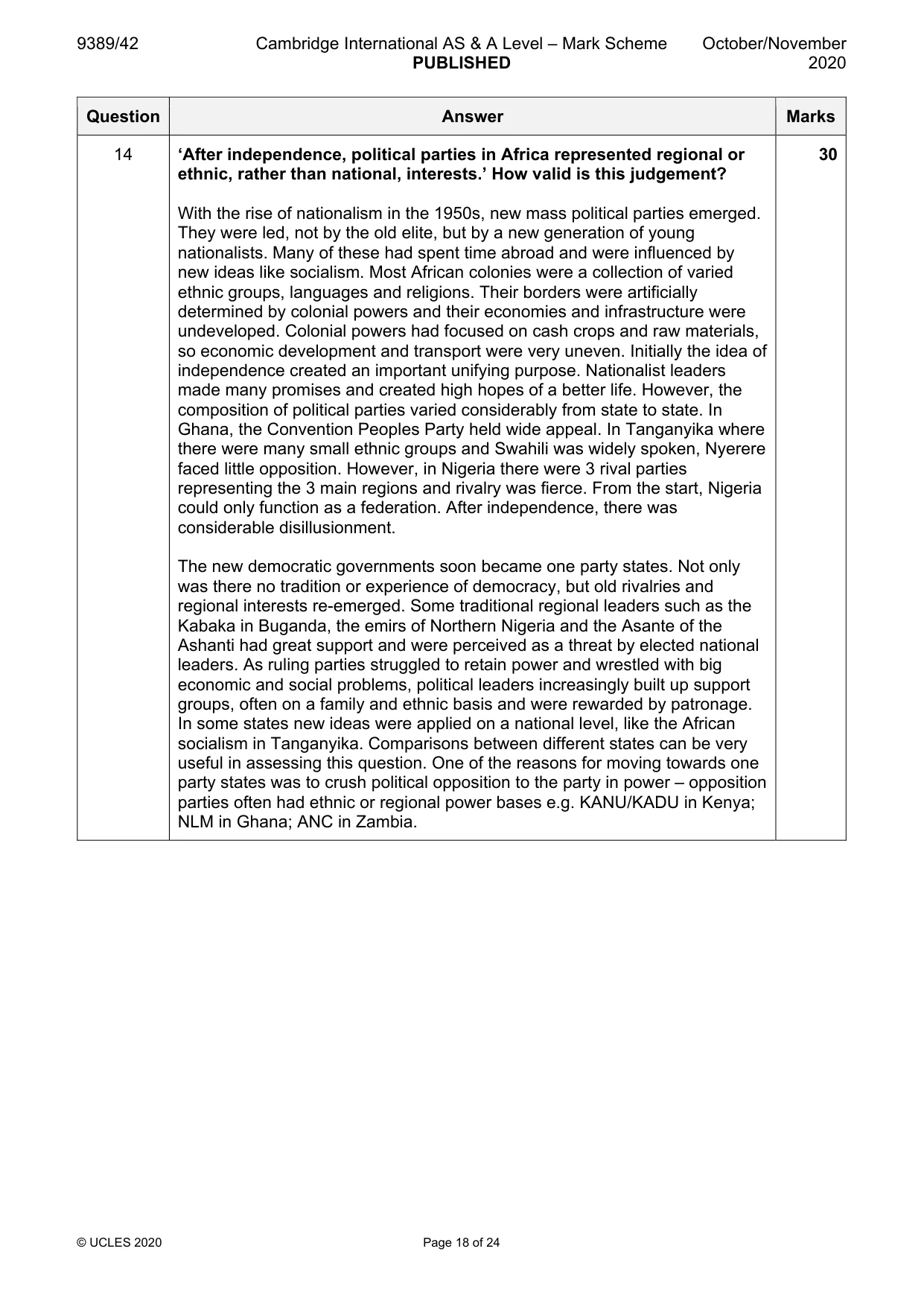
14 ‘After independence, political parties in Africa represented regional or ethnic, rather than national, interests.’ How valid is this judgement? [30]
Mark scheme: 14 ‘After independence, political parties in Africa represented regional or 30 ethnic, rather than national, interests.’ How valid is this judgement? With the rise of nationalism in the 1950s, new mass political parties emerged. They were led, not by the old elite, but by a new generation of young nationalists. Many of these had spent time abroad and were influenced by new ideas like socialism. Most African colonies were a collection of varied ethnic groups, languages and religions. Their borders were artificially determined by colonial powers and their economies and infrastructure were undeveloped. Colonial powers had focused on cash crops and raw materials, so economic development and transport were very uneven. Initially the idea of independence created an important unifying purpose. Nationalist leaders made many promises and created high hopes of a better life. However, the composition of political parties varied considerably from state to state. In Ghana, the Convention Peoples Party held wide appeal. In Tanganyika where there were many small ethnic groups and Swahili was widely spoken, Nyerere faced little opposition. However, in Nigeria there were 3 rival parties representing the 3 main regions and rivalry was fierce. From the start, Nigeria could only function as a federation. After independence, there was considerable disillusionment. The new democratic governments soon became one party states. Not only was there no tradition or experience of democracy, but old rivalries and regional interests re-emerged. Some traditional regional leaders such as the Kabaka in Buganda, the emirs of Northern Nigeria and the Asante of the Ashanti had great support and were perceived as a threat by elected national leaders. As ruling parties struggled to retain power and wrestled with big economic and social problems, political leaders increasingly built up support groups, often on a family and ethnic basis and were rewarded by patronage. In some states new ideas were applied on a national level, like the African socialism in Tanganyika. Comparisons between different states can be very useful in assessing this question. One of the reasons for moving towards one party states was to crush political opposition to the party in power – opposition parties often had ethnic or regional power bases e.g. KANU/KADU in Kenya; NLM in Ghana; ANC in Zambia.
Q15 · Assess the political importance of state control of the media in post-independence Africa…
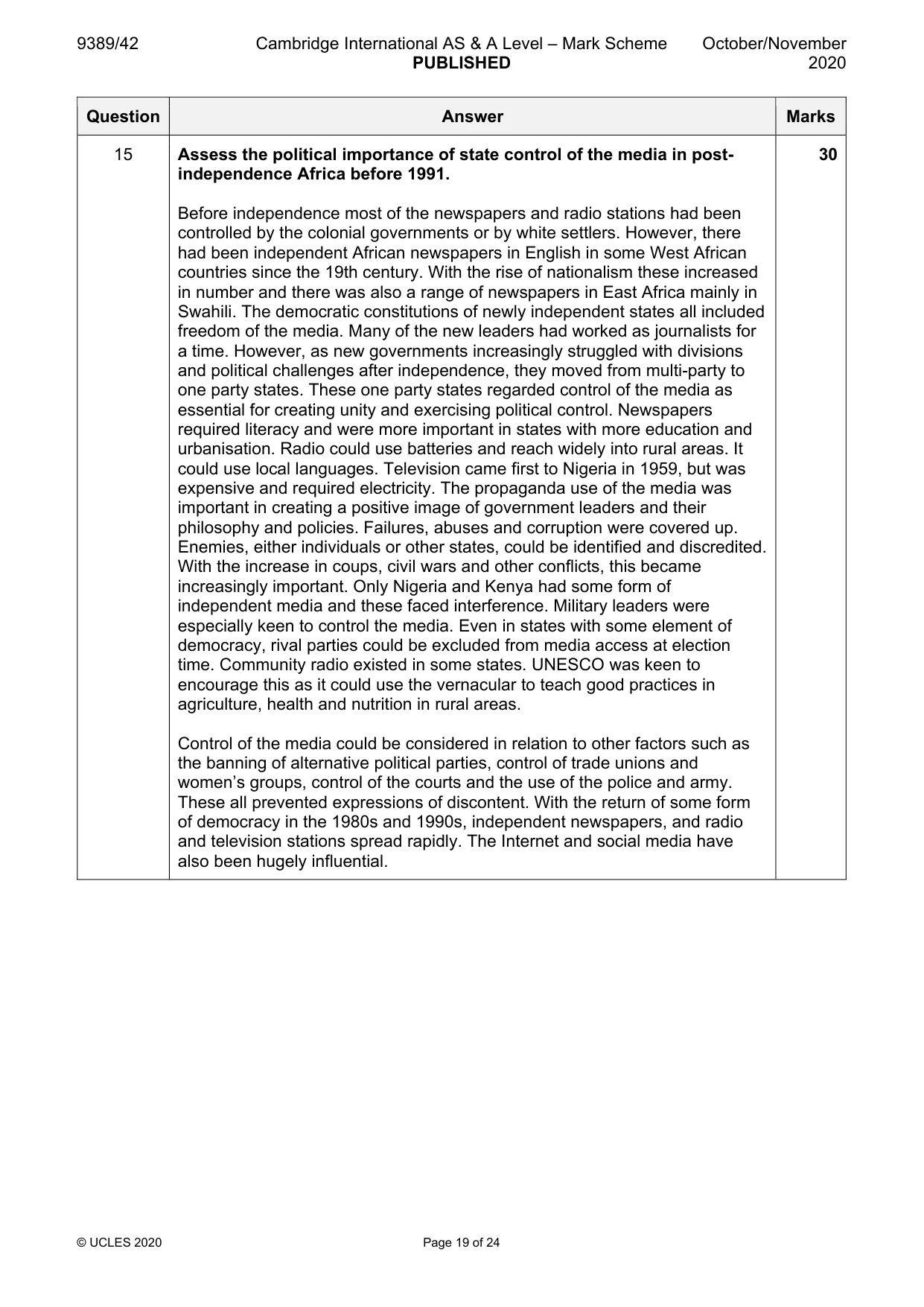
15 Assess the political importance of state control of the media in post-independence Africa before 1991. [30]
Mark scheme: 15 Assess the political importance of state control of the media in post- 30 independence Africa before 1991. Before independence most of the newspapers and radio stations had been controlled by the colonial governments or by white settlers. However, there had been independent African newspapers in English in some West African countries since the 19th century. With the rise of nationalism these increased in number and there was also a range of newspapers in East Africa mainly in Swahili. The democratic constitutions of newly independent states all included freedom of the media. Many of the new leaders had worked as journalists for a time. However, as new governments increasingly struggled with divisions and political challenges after independence, they moved from multi-party to one party states. These one party states regarded control of the media as essential for creating unity and exercising political control. Newspapers required literacy and were more important in states with more education and urbanisation. Radio could use batteries and reach widely into rural areas. It could use local languages. Television came first to Nigeria in 1959, but was expensive and required electricity. The propaganda use of the media was important in creating a positive image of government leaders and their philosophy and policies. Failures, abuses and corruption were covered up. Enemies, either individuals or other states, could be identified and discredited. With the increase in coups, civil wars and other conflicts, this became increasingly important. Only Nigeria and Kenya had some form of independent media and these faced interference. Military leaders were especially keen to control the media. Even in states with some element of democracy, rival parties could be excluded from media access at election time. Community radio existed in some states. UNESCO was keen to encourage this as it could use the vernacular to teach good practices in agriculture, health and nutrition in rural areas. Control of the media could be considered in relation to other factors such as the banning of alternative political parties, control of trade unions and women’s groups, control of the courts and the use of the police and army. These all prevented expressions of discontent. With the return of some form of democracy in the 1980s and 1990s, independent newspapers, and radio and television stations spread rapidly. The Internet and social media have also been hugely influential.
Q16 · How far were the leaders of the Pan-African movement motivated more by their personal…
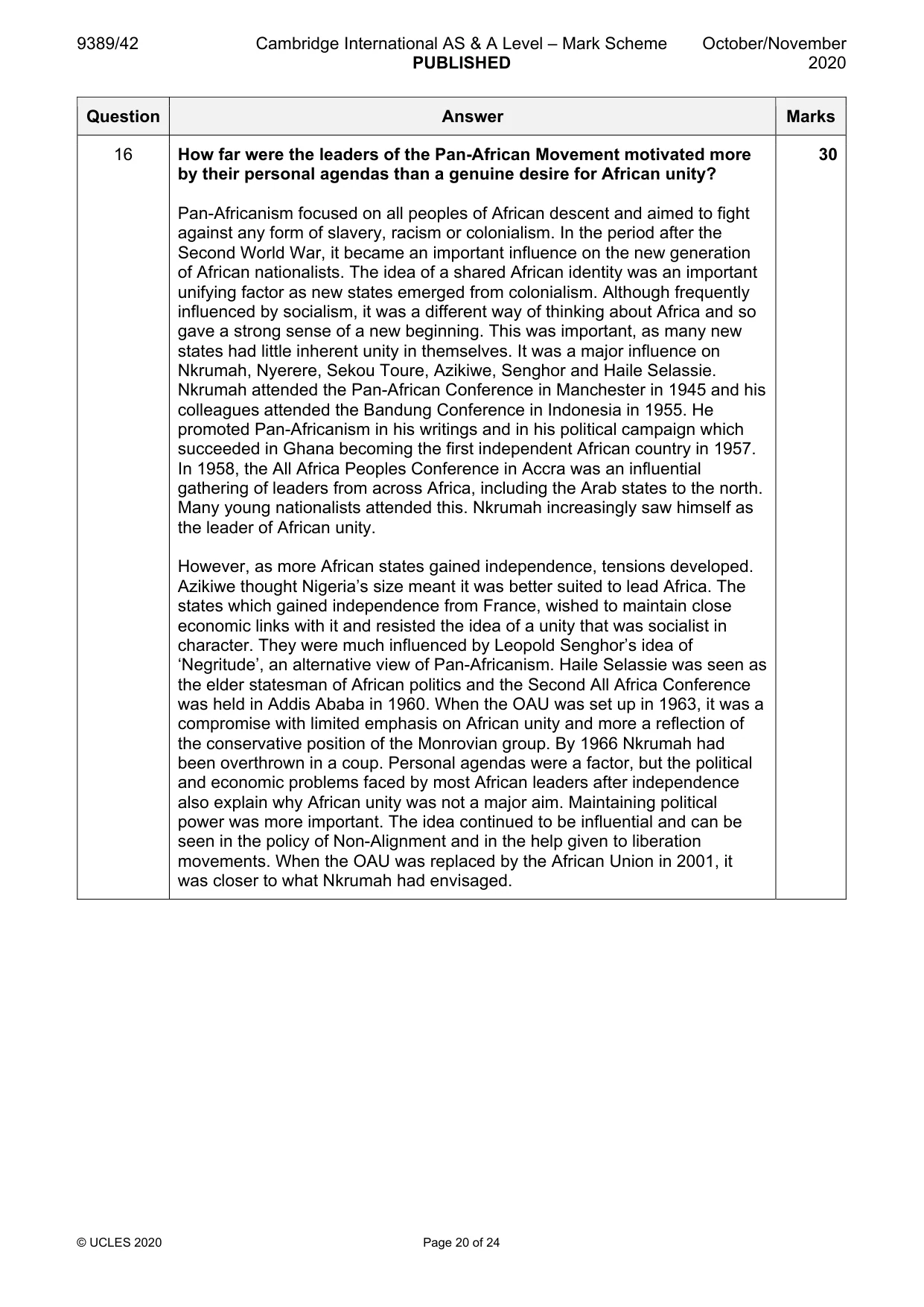
16 How far were the leaders of the Pan-African movement motivated more by their personal agendas than a genuine desire for African unity? [30] Depth Study 5: Southeast Asian History, 1945–1990s Answer any two questions.
Mark scheme: 16 How far were the leaders of the Pan-African Movement motivated more 30 by their personal agendas than a genuine desire for African unity? Pan-Africanism focused on all peoples of African descent and aimed to fight against any form of slavery, racism or colonialism. In the period after the Second World War, it became an important influence on the new generation of African nationalists. The idea of a shared African identity was an important unifying factor as new states emerged from colonialism. Although frequently influenced by socialism, it was a different way of thinking about Africa and so gave a strong sense of a new beginning. This was important, as many new states had little inherent unity in themselves. It was a major influence on Nkrumah, Nyerere, Sekou Toure, Azikiwe, Senghor and Haile Selassie. Nkrumah attended the Pan-African Conference in Manchester in 1945 and his colleagues attended the Bandung Conference in Indonesia in 1955. He promoted Pan-Africanism in his writings and in his political campaign which succeeded in Ghana becoming the first independent African country in 1957. In 1958, the All Africa Peoples Conference in Accra was an influential gathering of leaders from across Africa, including the Arab states to the north. Many young nationalists attended this. Nkrumah increasingly saw himself as the leader of African unity. However, as more African states gained independence, tensions developed. Azikiwe thought Nigeria’s size meant it was better suited to lead Africa. The states which gained independence from France, wished to maintain close economic links with it and resisted the idea of a unity that was socialist in character. They were much influenced by Leopold Senghor’s idea of ‘Negritude’, an alternative view of Pan-Africanism. Haile Selassie was seen as the elder statesman of African politics and the Second All Africa Conference was held in Addis Ababa in 1960. When the OAU was set up in 1963, it was a compromise with limited emphasis on African unity and more a reflection of the conservative position of the Monrovian group. By 1966 Nkrumah had been overthrown in a coup. Personal agendas were a factor, but the political and economic problems faced by most African leaders after independence also explain why African unity was not a major aim. Maintaining political power was more important. The idea continued to be influential and can be seen in the policy of Non-Alignment and in the help given to liberation movements. When the OAU was replaced by the African Union in 2001, it was closer to what Nkrumah had envisaged.
Q17 · ‘Japanese repression was the greatest problem faced by resistance movements in Southeast…
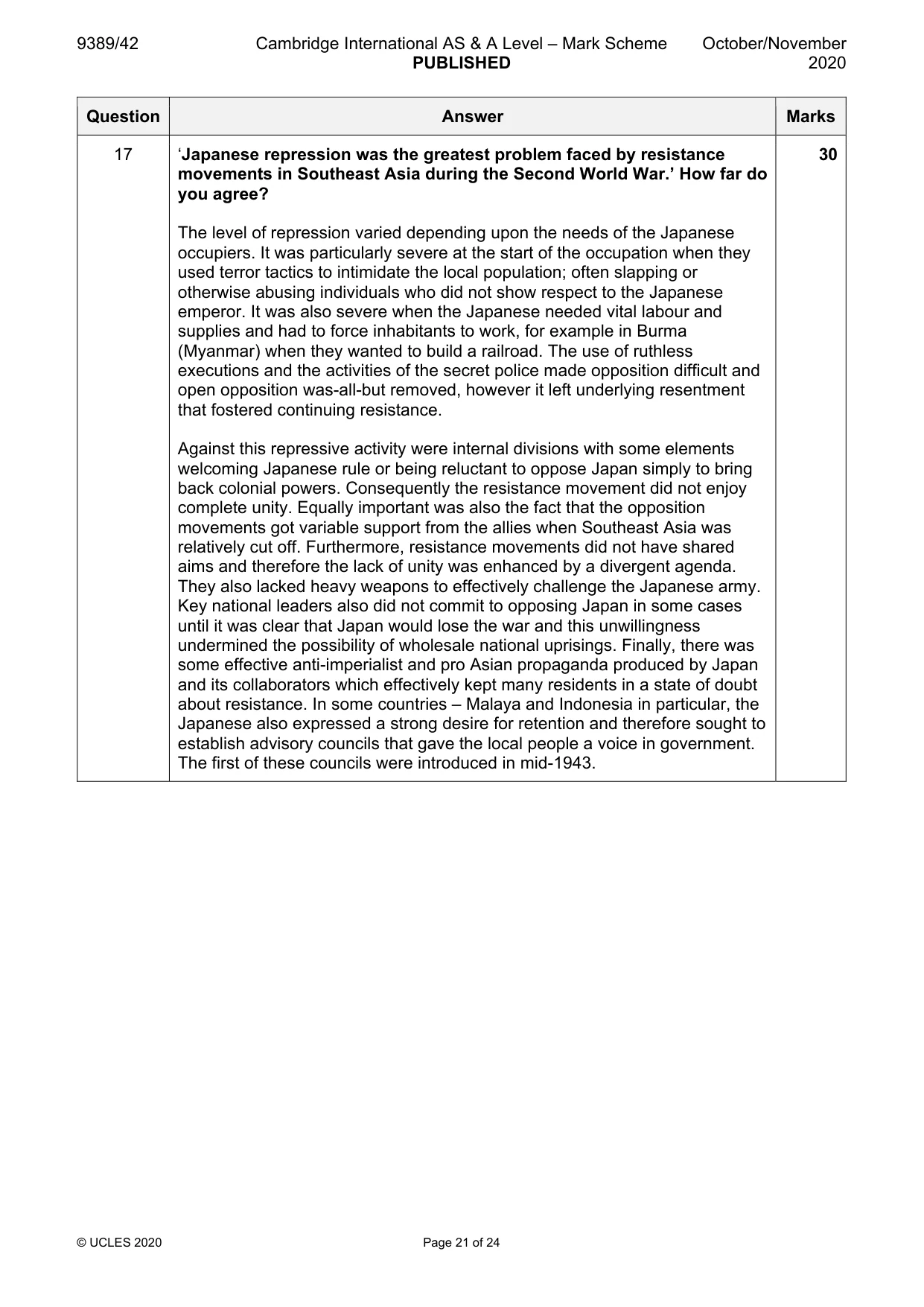
17 ‘Japanese repression was the greatest problem faced by resistance movements in Southeast Asia during the Second World War.’ How far do you agree? [30]
Mark scheme: 17 ‘Japanese repression was the greatest problem faced by resistance 30 movements in Southeast Asia during the Second World War.’ How far do you agree? The level of repression varied depending upon the needs of the Japanese occupiers. It was particularly severe at the start of the occupation when they used terror tactics to intimidate the local population; often slapping or otherwise abusing individuals who did not show respect to the Japanese emperor. It was also severe when the Japanese needed vital labour and supplies and had to force inhabitants to work, for example in Burma (Myanmar) when they wanted to build a railroad. The use of ruthless executions and the activities of the secret police made opposition difficult and open opposition was-all-but removed, however it left underlying resentment that fostered continuing resistance. Against this repressive activity were internal divisions with some elements welcoming Japanese rule or being reluctant to oppose Japan simply to bring back colonial powers. Consequently the resistance movement did not enjoy complete unity. Equally important was also the fact that the opposition movements got variable support from the allies when Southeast Asia was relatively cut off. Furthermore, resistance movements did not have shared aims and therefore the lack of unity was enhanced by a divergent agenda. They also lacked heavy weapons to effectively challenge the Japanese army. Key national leaders also did not commit to opposing Japan in some cases until it was clear that Japan would lose the war and this unwillingness undermined the possibility of wholesale national uprisings. Finally, there was some effective anti-imperialist and pro Asian propaganda produced by Japan and its collaborators which effectively kept many residents in a state of doubt about resistance. In some countries – Malaya and Indonesia in particular, the Japanese also expressed a strong desire for retention and therefore sought to establish advisory councils that gave the local people a voice in government. The first of these councils were introduced in mid-1943.
Q18 · Assess the reasons why Britain encouraged the formation of the Federation of Malaysia
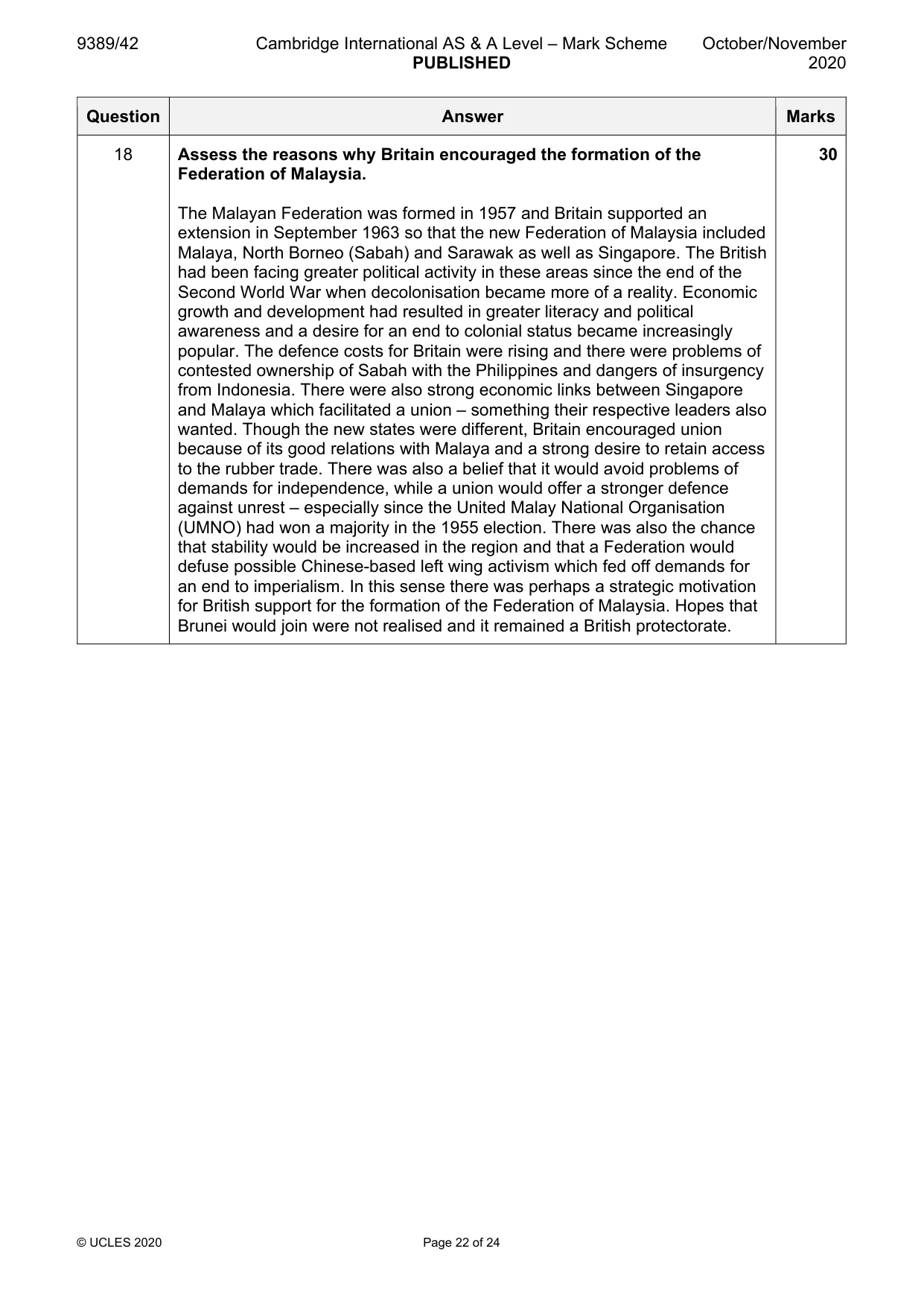
18 Assess the reasons why Britain encouraged the formation of the Federation of Malaysia. [30]
Mark scheme: 18 Assess the reasons why Britain encouraged the formation of the 30 Federation of Malaysia. The Malayan Federation was formed in 1957 and Britain supported an extension in September 1963 so that the new Federation of Malaysia included Malaya, North Borneo (Sabah) and Sarawak as well as Singapore. The British had been facing greater political activity in these areas since the end of the Second World War when decolonisation became more of a reality. Economic growth and development had resulted in greater literacy and political awareness and a desire for an end to colonial status became increasingly popular. The defence costs for Britain were rising and there were problems of contested ownership of Sabah with the Philippines and dangers of insurgency from Indonesia. There were also strong economic links between Singapore and Malaya which facilitated a union – something their respective leaders also wanted. Though the new states were different, Britain encouraged union because of its good relations with Malaya and a strong desire to retain access to the rubber trade. There was also a belief that it would avoid problems of demands for independence, while a union would offer a stronger defence against unrest – especially since the United Malay National Organisation (UMNO) had won a majority in the 1955 election. There was also the chance that stability would be increased in the region and that a Federation would defuse possible Chinese-based left wing activism which fed off demands for an end to imperialism. In this sense there was perhaps a strategic motivation for British support for the formation of the Federation of Malaysia. Hopes that Brunei would join were not realised and it remained a British protectorate.
Q19 · Assess the legacy for Cambodia of the rule of Prince Sihanouk
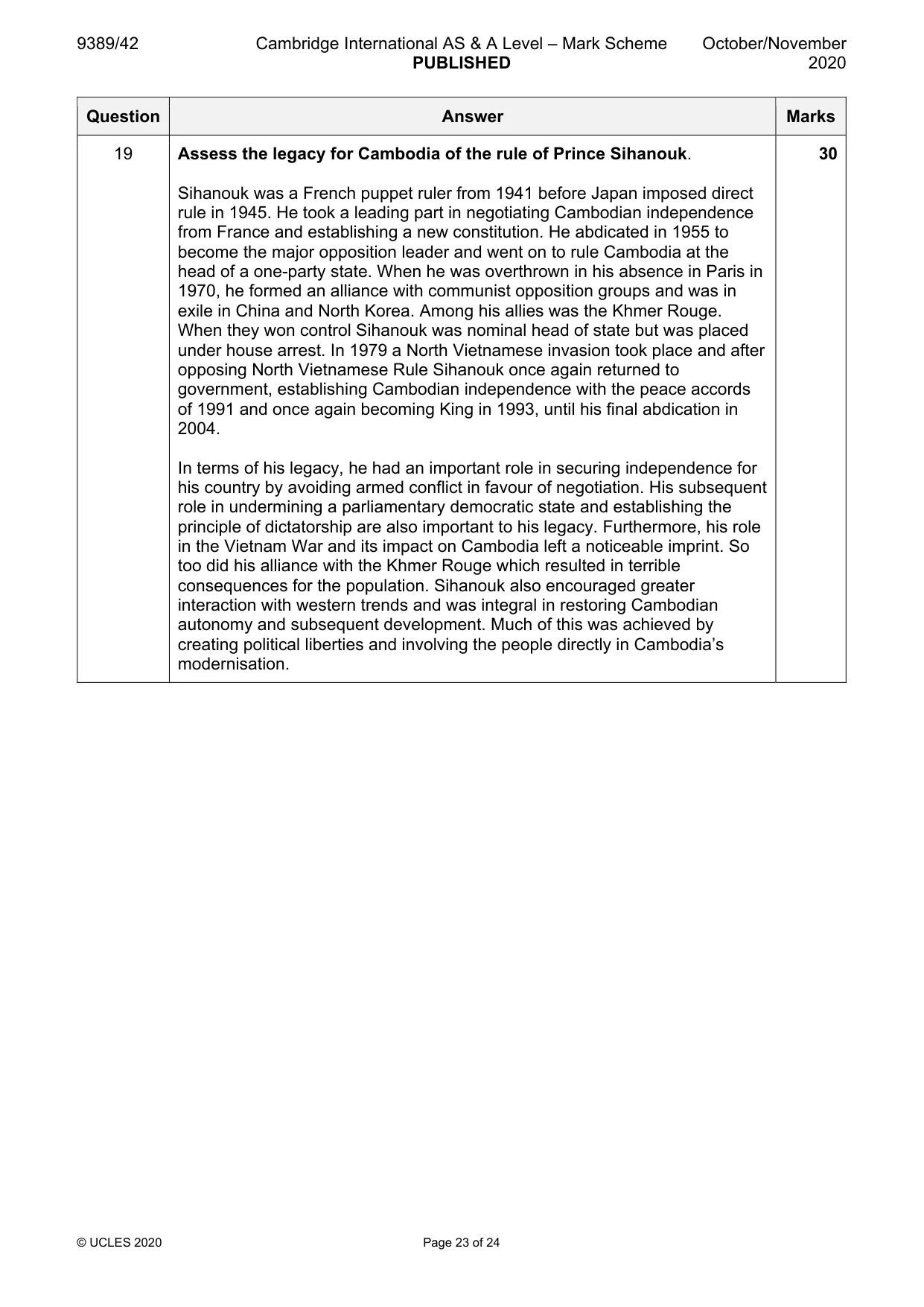
19 Assess the legacy for Cambodia of the rule of Prince Sihanouk. [30]
Mark scheme: 19 Assess the legacy for Cambodia of the rule of Prince Sihanouk. 30 Sihanouk was a French puppet ruler from 1941 before Japan imposed direct rule in 1945. He took a leading part in negotiating Cambodian independence from France and establishing a new constitution. He abdicated in 1955 to become the major opposition leader and went on to rule Cambodia at the head of a one-party state. When he was overthrown in his absence in Paris in 1970, he formed an alliance with communist opposition groups and was in exile in China and North Korea. Among his allies was the Khmer Rouge. When they won control Sihanouk was nominal head of state but was placed under house arrest. In 1979 a North Vietnamese invasion took place and after opposing North Vietnamese Rule Sihanouk once again returned to government, establishing Cambodian independence with the peace accords of 1991 and once again becoming King in 1993, until his final abdication in 2004. In terms of his legacy, he had an important role in securing independence for his country by avoiding armed conflict in favour of negotiation. His subsequent role in undermining a parliamentary democratic state and establishing the principle of dictatorship are also important to his legacy. Furthermore, his role in the Vietnam War and its impact on Cambodia left a noticeable imprint. So too did his alliance with the Khmer Rouge which resulted in terrible consequences for the population. Sihanouk also encouraged greater interaction with western trends and was integral in restoring Cambodian autonomy and subsequent development. Much of this was achieved by creating political liberties and involving the people directly in Cambodia’s modernisation.
What you needed in this session
Cambridge’s own grade thresholds for 2020 Oct/Nov, Paper 4 · Variant 2. A higher threshold means an easier paper — the bar moves with how the cohort did.