Cambridge A Level History 9389 — 2021 May/June Paper 4 · Variant 2
9389/42/M/J/21 · 11 questions · 60 marks · ≈68 min
The question paper and its mark scheme, free to read here and free to download. This is Cambridge’s own paper, exactly as it was sat.
Question paper4 pages
Mark scheme16 pages
Answers below. Sit the paper first if you are practising.

Questions as text
Q1 · ‘It made only limited progress towards creating a communist state.’ Assess this view of…
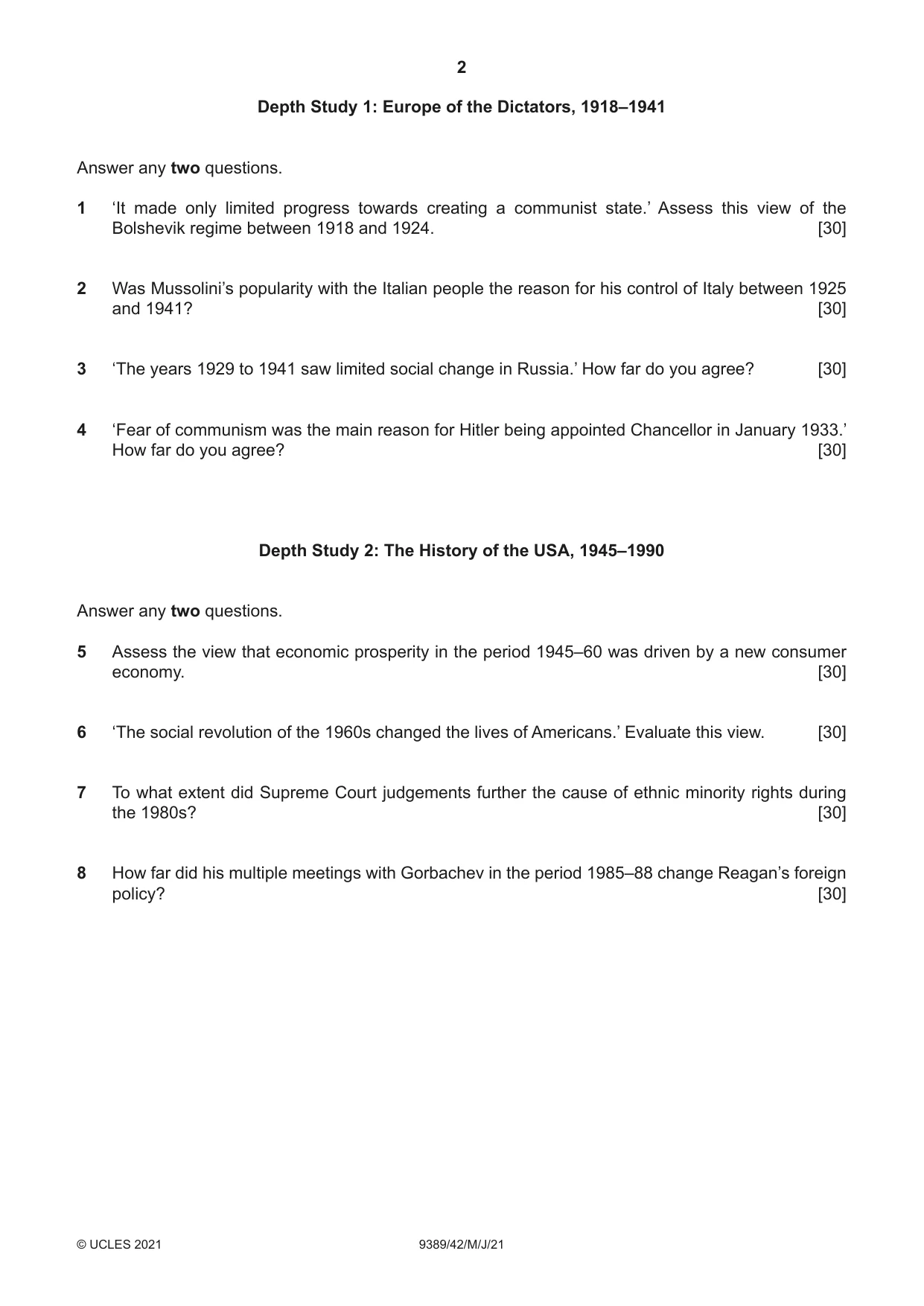
1 ‘It made only limited progress towards creating a communist state.’ Assess this view of the Bolshevik regime between 1918 and 1924. [30]
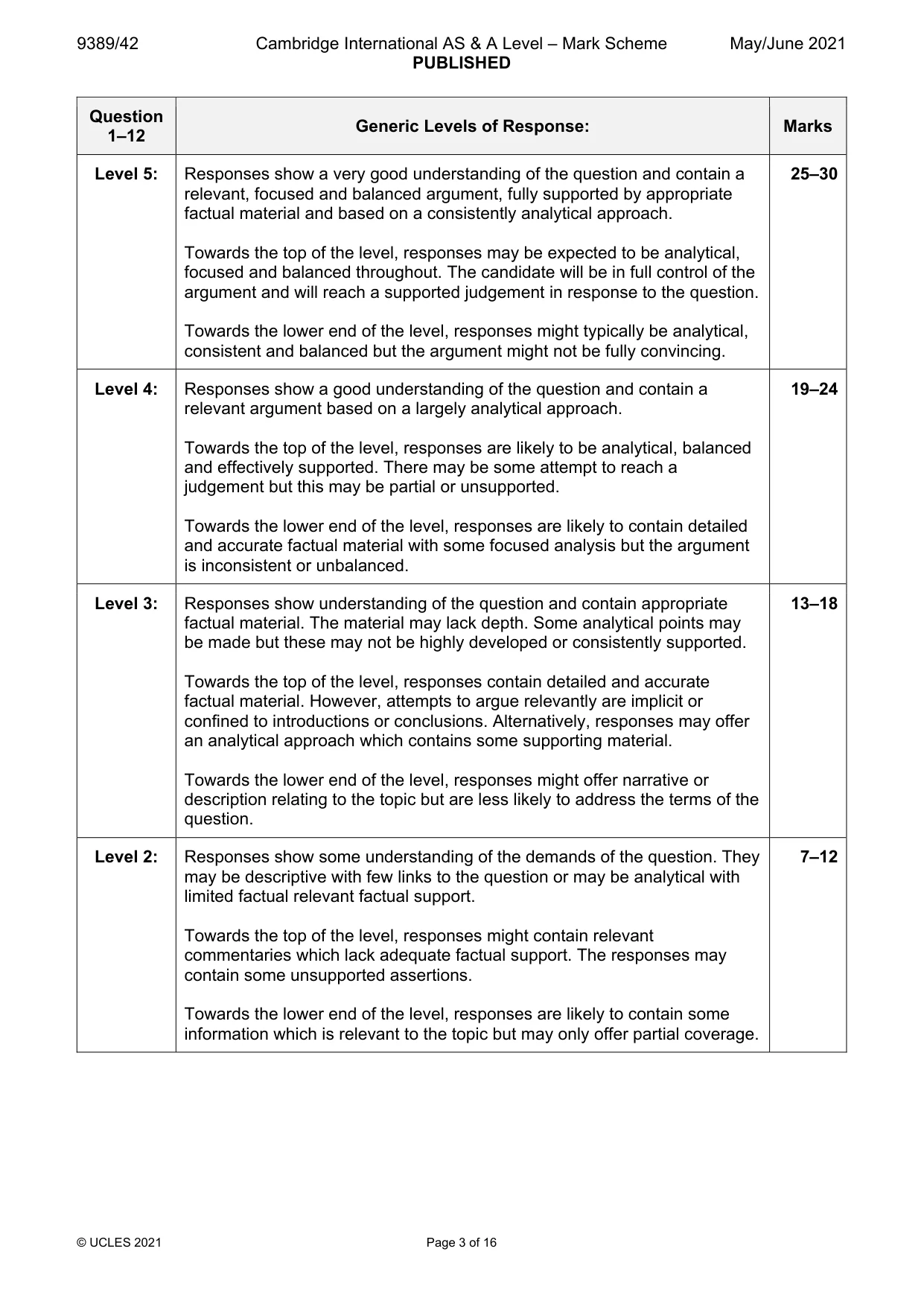
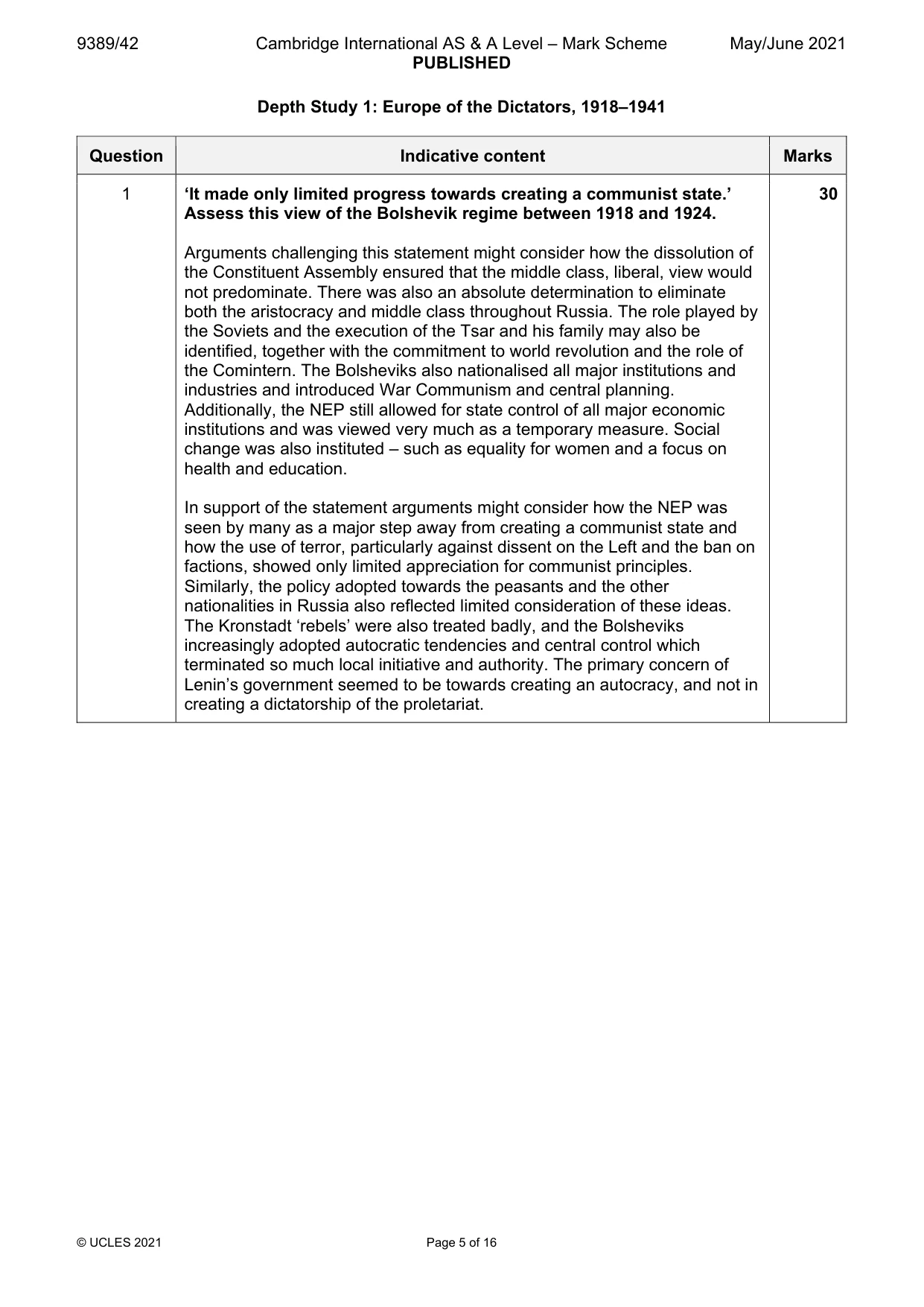
Mark scheme: Question Indicative content Marks 1 ‘It made only limited progress towards creating a communist state.’ 30 Assess this view of the Bolshevik regime between 1918 and 1924. Arguments challenging this statement might consider how the dissolution of the Constituent Assembly ensured that the middle class, liberal, view would not predominate. There was also an absolute determination to eliminate both the aristocracy and middle class throughout Russia. The role played by the Soviets and the execution of the Tsar and his family may also be identified, together with the commitment to world revolution and the role of the Comintern. The Bolsheviks also nationalised all major institutions and industries and introduced War Communism and central planning. Additionally, the NEP still allowed for state control of all major economic institutions and was viewed very much as a temporary measure. Social change was also instituted – such as equality for women and a focus on health and education. In support of the statement arguments might consider how the NEP was seen by many as a major step away from creating a communist state and how the use of terror, particularly against dissent on the Left and the ban on factions, showed only limited appreciation for communist principles. Similarly, the policy adopted towards the peasants and the other nationalities in Russia also reflected limited consideration of these ideas. The Kronstadt ‘rebels’ were also treated badly, and the Bolsheviks increasingly adopted autocratic tendencies and central control which terminated so much local initiative and authority. The primary concern of Lenin’s government seemed to be towards creating an autocracy, and not in creating a dictatorship of the proletariat.
Q2 · Was Mussolini’s popularity with the Italian people the reason for his control of Italy…
2 Was Mussolini’s popularity with the Italian people the reason for his control of Italy between 1925 and 1941? [30]
Mark scheme: 2 Was Mussolini’s popularity with the Italian people the reason for his 30 control of Italy between 1925 and 1941? Arguments challenging the idea of popularity might consider how he had substantial support from the highly influential Roman Catholic Church. The Concordat was a considerable achievement on his part and assisted in his regime gaining considerable social acceptance. It was very important as far as women were concerned. He also had support from the King. While personally the King did not care for Mussolini, his tolerance was important to Mussolini – as was neutrality from the Army (which did not traditionally play an important role in Italian politics) and from Northern manufacturers as well as Southern landowners. Mussolini also used the Acerbo Laws, the assistance arising from the Aventine secession and propaganda to good effect. Arguments might also consider the general weariness of the Italian people towards the political instability suffered by Italy almost continuously since 1871 and particularly since 1918. Mussolini was also able to distance himself from the work of the ras and Squadristi. In support of popularity, arguments might consider how he provided a degree of political stability unknown for decades and seemed determined to restore Italy’s status as a major power, both in the region and beyond. Issues like Locarno and Corfu helped this. He also seemed to be an effective alternative to the Liberal governments, and worse still, a possible communist system. He also appeared to have a solution to Italy’s social and economic problems with his ideas on the Corporate State.
Q3 · ‘The years 1929 to 1941 saw limited social change in Russia.’ How far do you agree?
3 ‘The years 1929 to 1941 saw limited social change in Russia.’ How far do you agree? [30]
Mark scheme: 3 ‘The years 1919 to 1941 saw limited social change in Russia.’ How far 30 do you agree? Arguments challenging the statement might consider the vast economic upheaval in both urban and rural areas which led to inevitable social change. Similarly, the vast increase in mobility and state control of labour meant men and women had to go and work where ordered. Unemployment was a crime and there was total direction of all aspects of life, and the influence of the Church was virtually eliminated. There was also a large increase in health care and education. Furthermore, all aspects of culture were controlled, the state decided what people could read, publish and listen to. There were even controls on permitted nursery rhyme and changes in marriage, divorce and abortion. Careers were, at least in theory, open to talent and class distinctions gradually disappeared. There was also a substantial destruction of elites through the purges. New ones emerged and men rose from the peasantry to the Politburo. Arguments supporting the statement might discuss how one autocracy just replaced another. The Nomenklatura replaced the aristocracy, with their access to the ‘Court’ and a privileged existence. Similarly, the family still remained a central social unit, and the role of women ultimately changed little.
Q4 · ‘Fear of communism was the main reason for Hitler being appointed Chancellor in January…
4 ‘Fear of communism was the main reason for Hitler being appointed Chancellor in January 1933.’ How far do you agree? [30] Depth Study 2: The History of the USA, 1945–1990 Answer any two questions.
Mark scheme: 4 ‘Fear of communism was the main reason for Hitler being appointed 30 Chancellor in January 1933.’ How far do you agree? Arguments supporting the statement might consider how communism was a major factor in influencing the Church. Roman Catholicism was strong in the South and the anti-communist credentials of the Nazis were stressed from the pulpit and in the Catholic press. It was also a significant factor in ensuring the neutrality of the army, and tacit support in some places. It was certainly a factor amongst those who were advising Hindenburg in the critical months of December 1932 and January 1933. Communism was equally significant in influencing many of the major industrialists who gave large, and highly important, sums of money to the Nazis. With news of the impact of the disastrous collectivization policy of Stalin emerging by 1931/2, it was also quite a factor influencing German farmers and many middle- class voters. The rise in the communist vote in Germany in the early 1930s terrified many. The attitudes of many in the police and judiciary was also substantially influenced. Arguments challenging the statement might consider the highly effective propaganda machine run by Goebbels, the oratorical skills of Hitler and the effective use of the SA against all political opponents. The memories of the humiliation of Versailles, the hyperinflation crisis of the early 20s, and the impact of deflation and mass unemployment after 1929 might also be identified. Nazism seemed to offer a better alternative to anything offered by both the Left and the centre, or centre-right and these opponents failed to unite against him. Similarly, the failure of many to realise the nature and extent of the Nazi threat and the feeling that Hitler could be ‘managed’ also helped him to be appointed. Hitler’s decision to remain ‘legal’ and not try and undertake a coup, thereby retaining the appearance of legitimacy and ensuring the consent of Hindenburg in January 1933 was also influential. Depth Study 2: The History of the USA, 1945–1990
Q5 · Assess the view that economic prosperity in the period 1945–60 was driven by a new…
5 Assess the view that economic prosperity in the period 1945–60 was driven by a new consumer economy. [30]
Mark scheme: 5 Assess the view that economic prosperity in the period 1945–60 was 30 driven by a new consumer economy. Discussion of the importance of the consumer economy in the period might consider how there was a great growth in consumer expenditure on a range of products, especially houses, televisions and cars, which was stimulated by the expansion of credit. The first credit card arrived in 1950. Additionally, there was relatively full employment during the period, unemployment rates averaging around 5%. The growth in population was some 20% with the arrival of the baby boomer generation. There was a collective confidence to spend after the depression of the 30s and the sacrifices of the 40s. Discussion of other factors stimulating economic prosperity might identify the dollar’s position as the reserve currency for international trade which helped maintain US dominance and therefore US trade remained strong throughout the period. The provision of grants and loans, e.g. Marshall Aid, to help other states buy US goods also helped to stimulate prosperity, as did the economic policy of the federal administrations of the era, using public funds to encourage growth, if unintentionally, e.g. the Korean War of Truman, the inter-state highway programme of Eisenhower as well as spending on technology research and development.
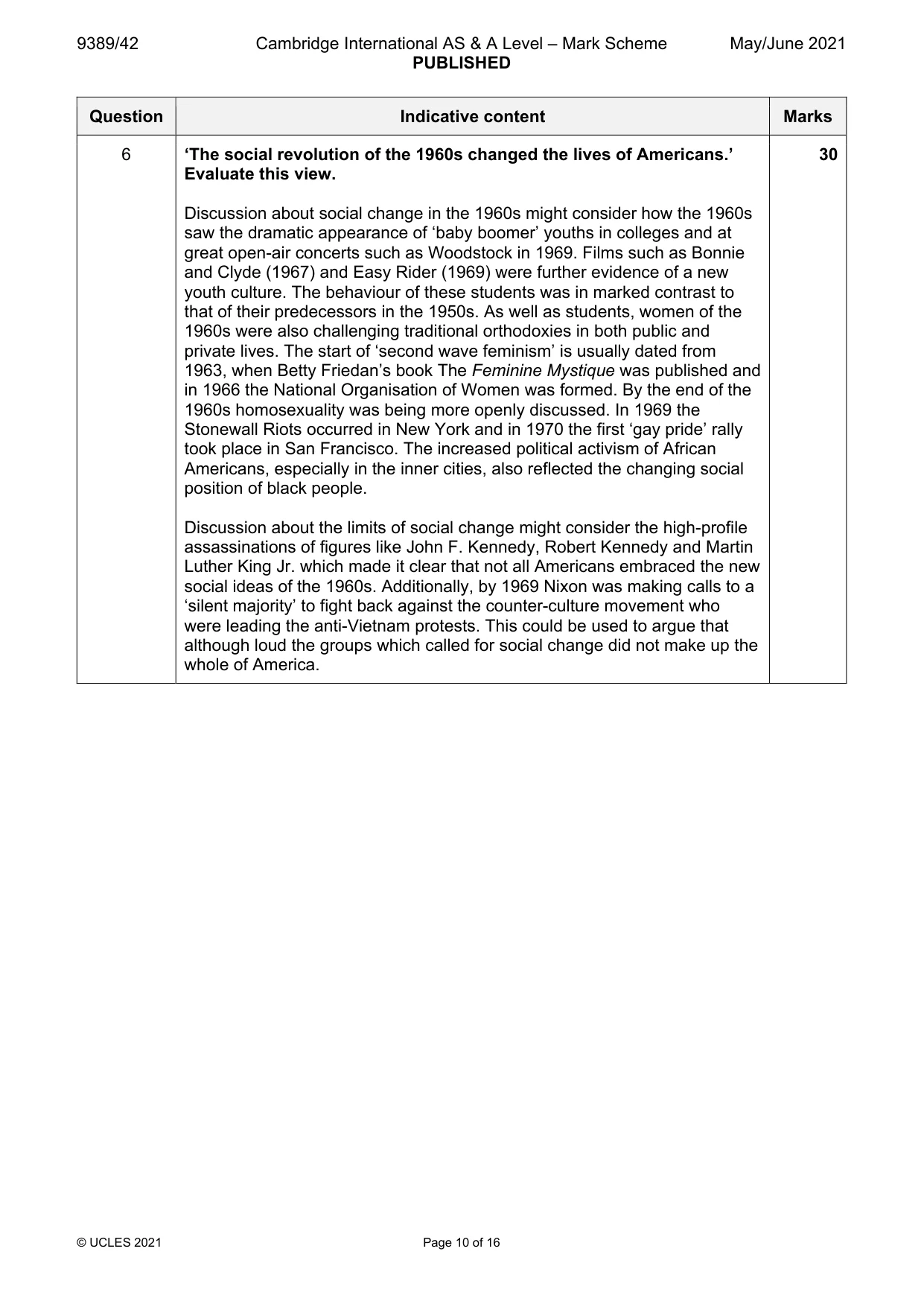
Q6 · ‘The social revolution of the 1960s changed the lives of Americans.’ Evaluate this view
6 ‘The social revolution of the 1960s changed the lives of Americans.’ Evaluate this view. [30]
Mark scheme: 6 ‘The social revolution of the 1960s changed the lives of Americans.’ 30 Evaluate this view. Discussion about social change in the 1960s might consider how the 1960s saw the dramatic appearance of ‘baby boomer’ youths in colleges and at great open-air concerts such as Woodstock in 1969. Films such as Bonnie and Clyde (1967) and Easy Rider (1969) were further evidence of a new youth culture. The behaviour of these students was in marked contrast to that of their predecessors in the 1950s. As well as students, women of the 1960s were also challenging traditional orthodoxies in both public and private lives. The start of ‘second wave feminism’ is usually dated from 1963, when Betty Friedan’s book The Feminine Mystique was published and in 1966 the National Organisation of Women was formed. By the end of the 1960s homosexuality was being more openly discussed. In 1969 the Stonewall Riots occurred in New York and in 1970 the first ‘gay pride’ rally took place in San Francisco. The increased political activism of African Americans, especially in the inner cities, also reflected the changing social position of black people. Discussion about the limits of social change might consider the high-profile assassinations of figures like John F. Kennedy, Robert Kennedy and Martin Luther King Jr. which made it clear that not all Americans embraced the new social ideas of the 1960s. Additionally, by 1969 Nixon was making calls to a ‘silent majority’ to fight back against the counter-culture movement who were leading the anti-Vietnam protests. This could be used to argue that although loud the groups which called for social change did not make up the whole of America.
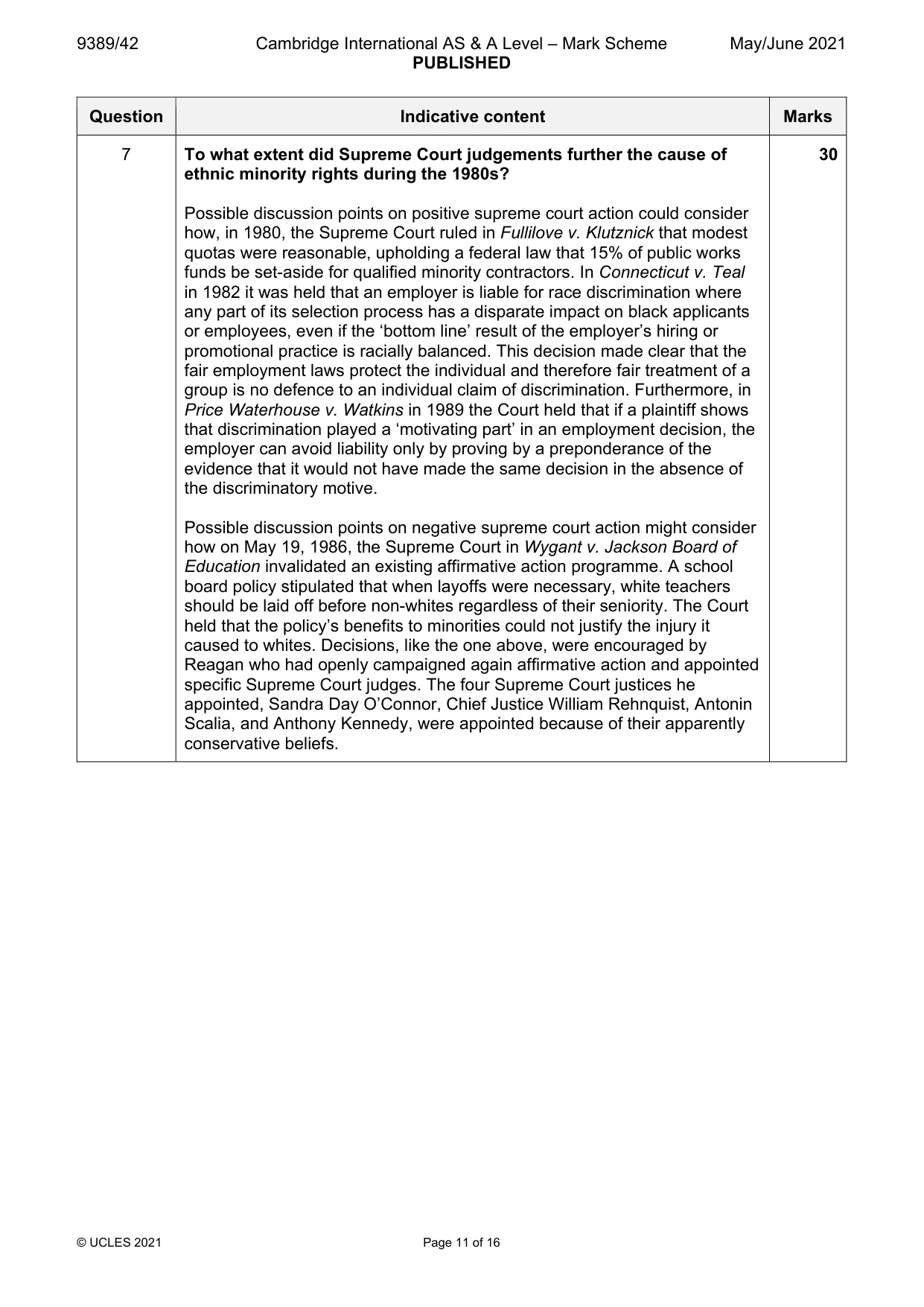
Q7 · To what extent did Supreme Court judgements further the cause of ethnic minority rights…
7 To what extent did Supreme Court judgements further the cause of ethnic minority rights during the 1980s? [30]
Mark scheme: 7 To what extent did Supreme Court judgements further the cause of 30 ethnic minority rights during the 1980s? Possible discussion points on positive supreme court action could consider how, in 1980, the Supreme Court ruled in Fullilove v. Klutznick that modest quotas were reasonable, upholding a federal law that 15% of public works funds be set-aside for qualified minority contractors. In Connecticut v. Teal in 1982 it was held that an employer is liable for race discrimination where any part of its selection process has a disparate impact on black applicants or employees, even if the ‘bottom line’ result of the employer’s hiring or promotional practice is racially balanced. This decision made clear that the fair employment laws protect the individual and therefore fair treatment of a group is no defence to an individual claim of discrimination. Furthermore, in Price Waterhouse v. Watkins in 1989 the Court held that if a plaintiff shows that discrimination played a ‘motivating part’ in an employment decision, the employer can avoid liability only by proving by a preponderance of the evidence that it would not have made the same decision in the absence of the discriminatory motive. Possible discussion points on negative supreme court action might consider how on May 19, 1986, the Supreme Court in Wygant v. Jackson Board of Education invalidated an existing affirmative action programme. A school board policy stipulated that when layoffs were necessary, white teachers should be laid off before non-whites regardless of their seniority. The Court held that the policy’s benefits to minorities could not justify the injury it caused to whites. Decisions, like the one above, were encouraged by Reagan who had openly campaigned again affirmative action and appointed specific Supreme Court judges. The four Supreme Court justices he appointed, Sandra Day O’Connor, Chief Justice William Rehnquist, Antonin Scalia, and Anthony Kennedy, were appointed because of their apparently conservative beliefs.
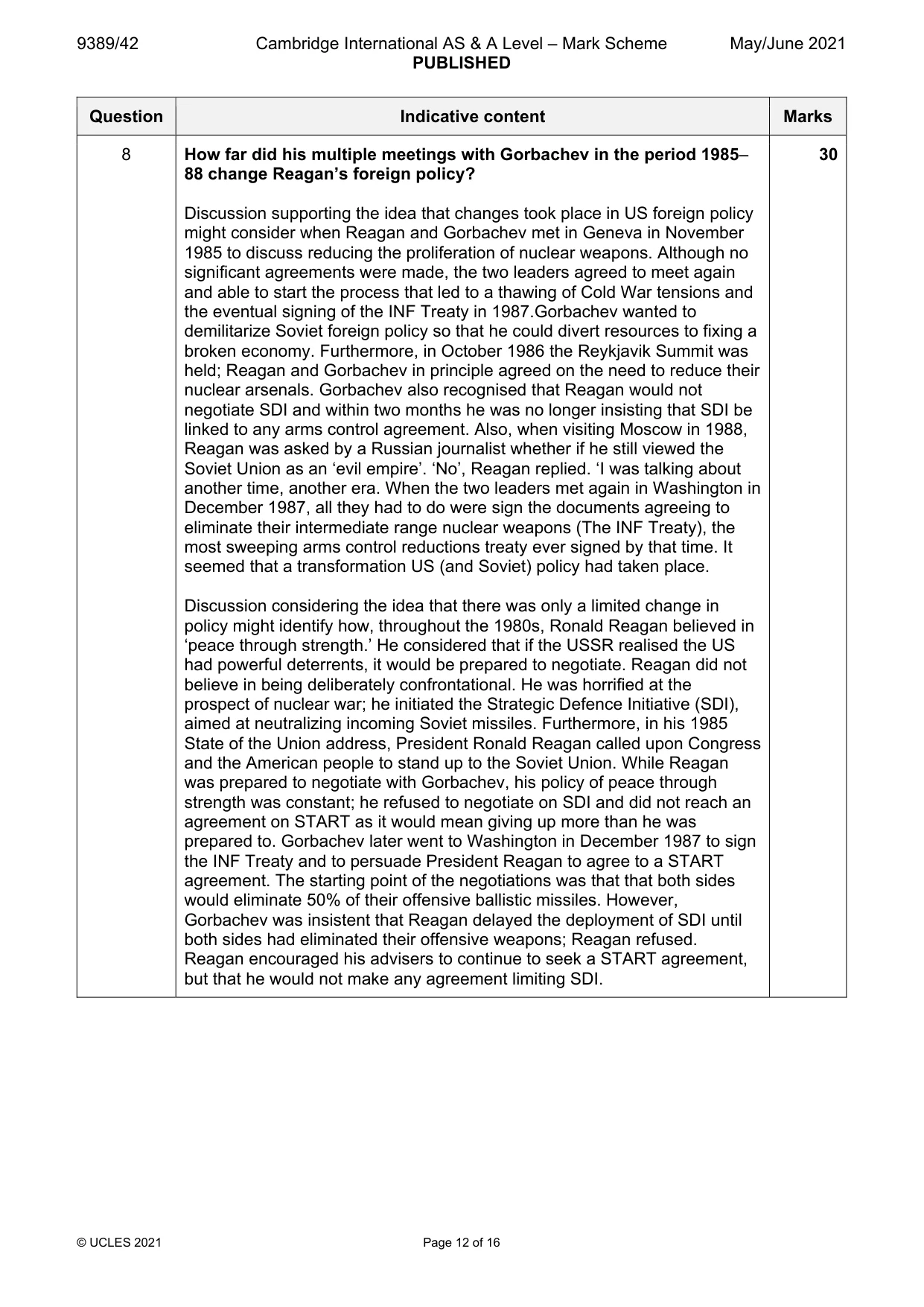
Q8 · How far did his multiple meetings with Gorbachev in the period 1985–88 change Reagan’s…
8 How far did his multiple meetings with Gorbachev in the period 1985–88 change Reagan’s foreign policy? [30] Depth Study 3: International History, 1945–1991 Answer any two questions.
Mark scheme: 8 How far did his multiple meetings with Gorbachev in the period 1985– 30 88 change Reagan’s foreign policy? Discussion supporting the idea that changes took place in US foreign policy might consider when Reagan and Gorbachev met in Geneva in November 1985 to discuss reducing the proliferation of nuclear weapons. Although no significant agreements were made, the two leaders agreed to meet again and able to start the process that led to a thawing of Cold War tensions and the eventual signing of the INF Treaty in 1987.Gorbachev wanted to demilitarize Soviet foreign policy so that he could divert resources to fixing a broken economy. Furthermore, in October 1986 the Reykjavik Summit was held; Reagan and Gorbachev in principle agreed on the need to reduce their nuclear arsenals. Gorbachev also recognised that Reagan would not negotiate SDI and within two months he was no longer insisting that SDI be linked to any arms control agreement. Also, when visiting Moscow in 1988, Reagan was asked by a Russian journalist whether if he still viewed the Soviet Union as an ‘evil empire’. ‘No’, Reagan replied. ‘I was talking about another time, another era. When the two leaders met again in Washington in December 1987, all they had to do were sign the documents agreeing to eliminate their intermediate range nuclear weapons (The INF Treaty), the most sweeping arms control reductions treaty ever signed by that time. It seemed that a transformation US (and Soviet) policy had taken place. Discussion considering the idea that there was only a limited change in policy might identify how, throughout the 1980s, Ronald Reagan believed in ‘peace through strength.’ He considered that if the USSR realised the US had powerful deterrents, it would be prepared to negotiate. Reagan did not believe in being deliberately confrontational. He was horrified at the prospect of nuclear war; he initiated the Strategic Defence Initiative (SDI), aimed at neutralizing incoming Soviet missiles. Furthermore, in his 1985 State of the Union address, President Ronald Reagan called upon Congress and the American people to stand up to the Soviet Union. While Reagan was prepared to negotiate with Gorbachev, his policy of peace through strength was constant; he refused to negotiate on SDI and did not reach an agreement on START as it would mean giving up more than he was prepared to. Gorbachev later went to Washington in December 1987 to sign the INF Treaty and to persuade President Reagan to agree to a START agreement. The starting point of the negotiations was that that both sides would eliminate 50% of their offensive ballistic missiles. However, Gorbachev was insistent that Reagan delayed the deployment of SDI until both sides had eliminated their offensive weapons; Reagan refused. Reagan encouraged his advisers to continue to seek a START agreement, but that he would not make any agreement limiting SDI. Depth Study 3: International History, 1945–1991
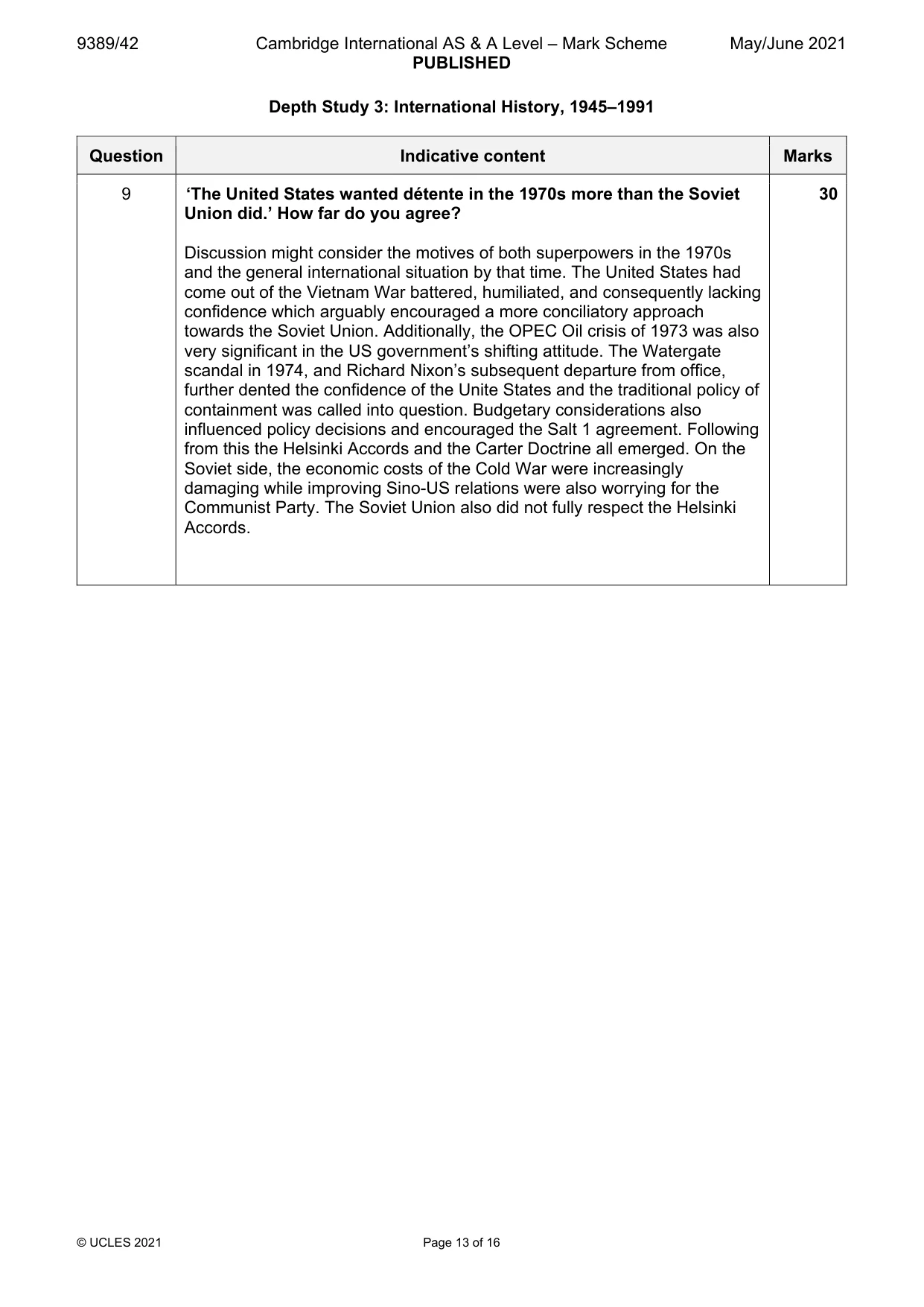
Q9 · ‘The United States wanted détente in the 1970s more than the Soviet Union did.’ How far…
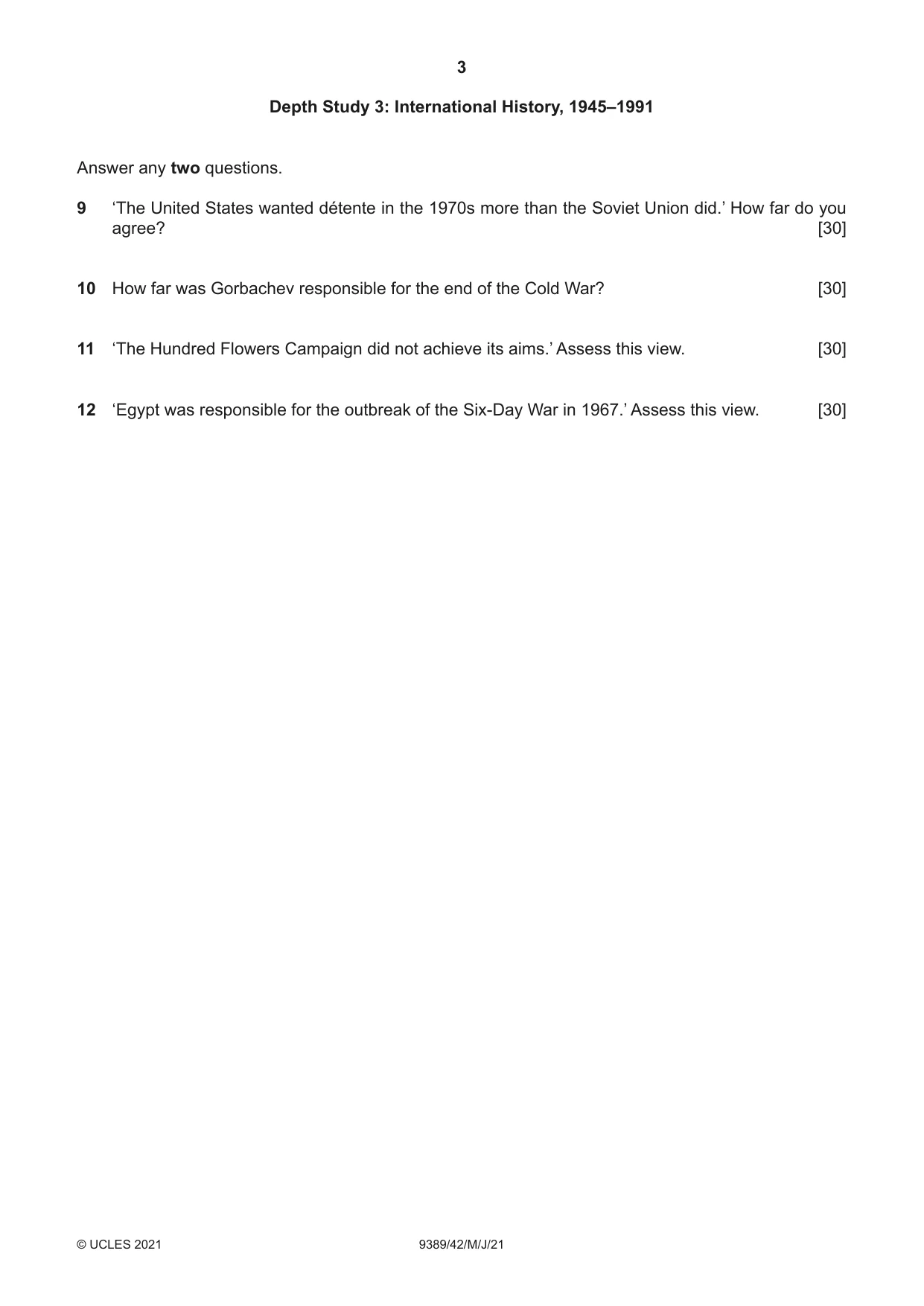
9 ‘The United States wanted détente in the 1970s more than the Soviet Union did.’ How far do you agree? [30]
Mark scheme: 9 ‘The United States wanted détente in the 1970s more than the Soviet 30 Union did.’ How far do you agree? Discussion might consider the motives of both superpowers in the 1970s and the general international situation by that time. The United States had come out of the Vietnam War battered, humiliated, and consequently lacking confidence which arguably encouraged a more conciliatory approach towards the Soviet Union. Additionally, the OPEC Oil crisis of 1973 was also very significant in the US government’s shifting attitude. The Watergate scandal in 1974, and Richard Nixon’s subsequent departure from office, further dented the confidence of the Unite States and the traditional policy of containment was called into question. Budgetary considerations also influenced policy decisions and encouraged the Salt 1 agreement. Following from this the Helsinki Accords and the Carter Doctrine all emerged. On the Soviet side, the economic costs of the Cold War were increasingly damaging while improving Sino-US relations were also worrying for the Communist Party. The Soviet Union also did not fully respect the Helsinki Accords.
Q10 · How far was Gorbachev responsible for the end of the Cold War?
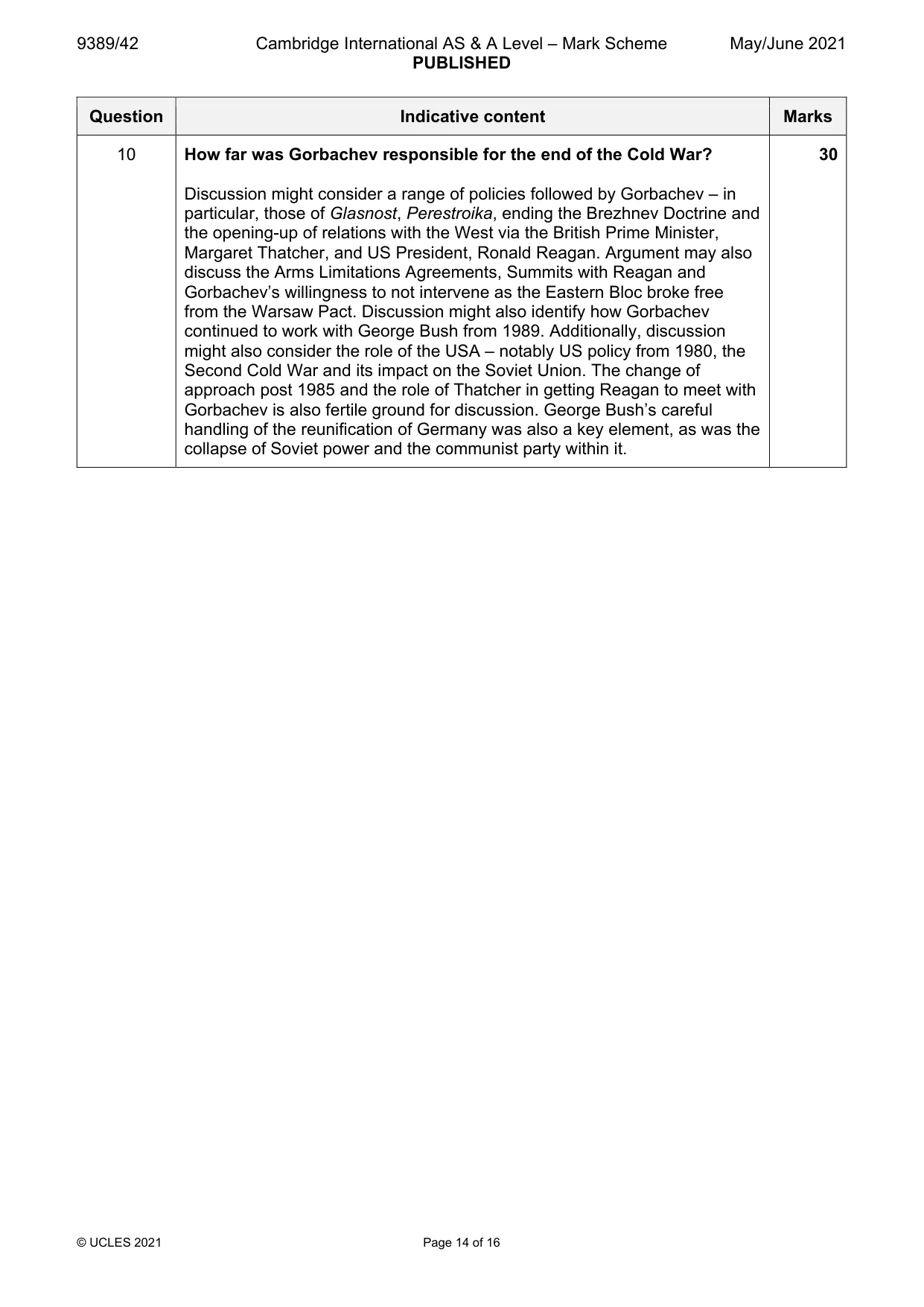
10 How far was Gorbachev responsible for the end of the Cold War? [30]
Mark scheme: 10 How far was Gorbachev responsible for the end of the Cold War? 30 Discussion might consider a range of policies followed by Gorbachev – in particular, those of Glasnost, Perestroika, ending the Brezhnev Doctrine and the opening-up of relations with the West via the British Prime Minister, Margaret Thatcher, and US President, Ronald Reagan. Argument may also discuss the Arms Limitations Agreements, Summits with Reagan and Gorbachev’s willingness to not intervene as the Eastern Bloc broke free from the Warsaw Pact. Discussion might also identify how Gorbachev continued to work with George Bush from 1989. Additionally, discussion might also consider the role of the USA – notably US policy from 1980, the Second Cold War and its impact on the Soviet Union. The change of approach post 1985 and the role of Thatcher in getting Reagan to meet with Gorbachev is also fertile ground for discussion. George Bush’s careful handling of the reunification of Germany was also a key element, as was the collapse of Soviet power and the communist party within it.
Q11 · ‘The Hundred Flowers Campaign did not achieve its aims.’ Assess this view
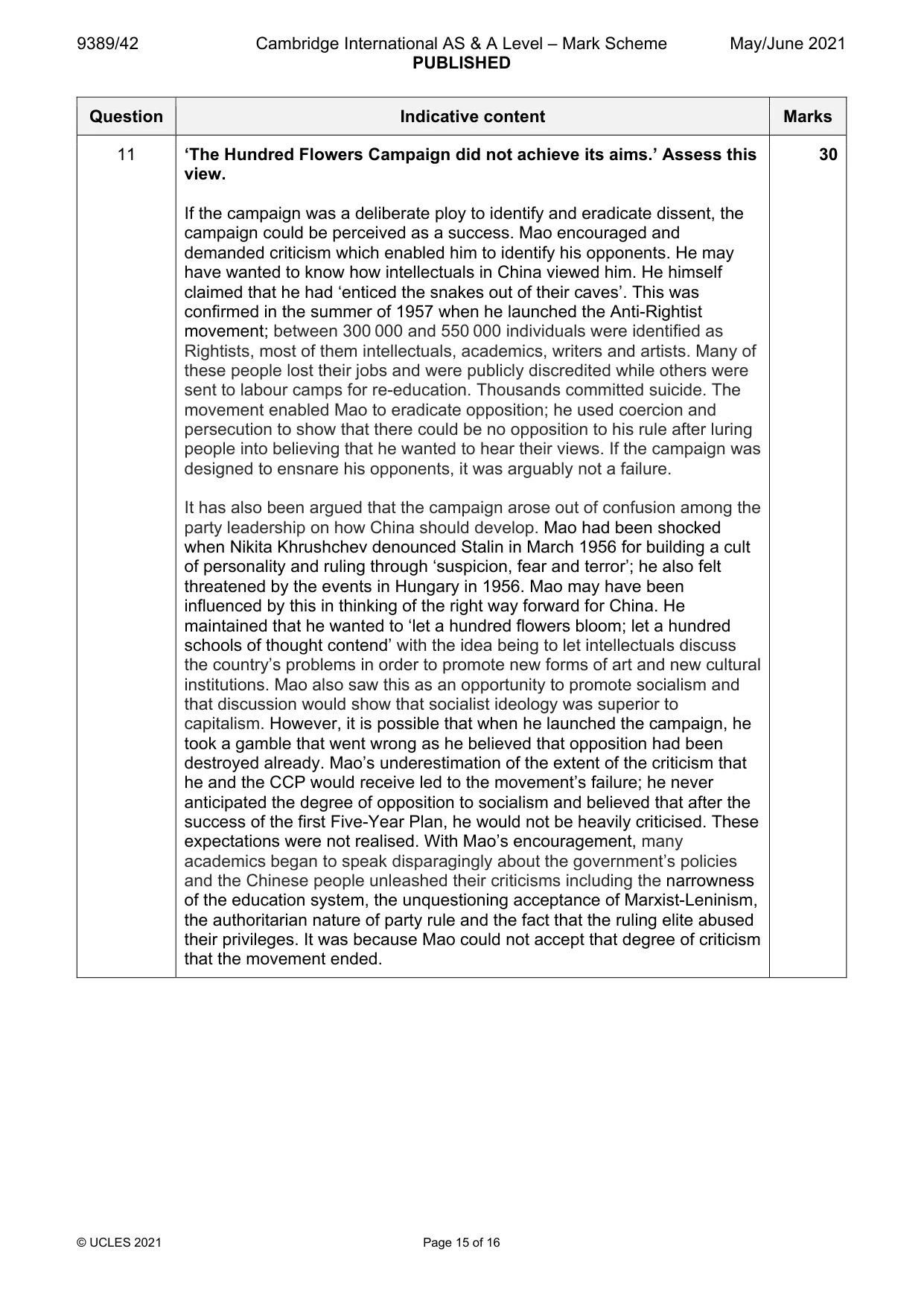
11 ‘The Hundred Flowers Campaign did not achieve its aims.’ Assess this view. [30]
Mark scheme: 11 ‘The Hundred Flowers Campaign did not achieve its aims.’ Assess this 30 view. If the campaign was a deliberate ploy to identify and eradicate dissent, the campaign could be perceived as a success. Mao encouraged and demanded criticism which enabled him to identify his opponents. He may have wanted to know how intellectuals in China viewed him. He himself claimed that he had ‘enticed the snakes out of their caves’. This was confirmed in the summer of 1957 when he launched the Anti-Rightist movement; between 300 000 and 550 000 individuals were identified as Rightists, most of them intellectuals, academics, writers and artists. Many of these people lost their jobs and were publicly discredited while others were sent to labour camps for re-education. Thousands committed suicide. The movement enabled Mao to eradicate opposition; he used coercion and persecution to show that there could be no opposition to his rule after luring people into believing that he wanted to hear their views. If the campaign was designed to ensnare his opponents, it was arguably not a failure. It has also been argued that the campaign arose out of confusion among the party leadership on how China should develop. Mao had been shocked when Nikita Khrushchev denounced Stalin in March 1956 for building a cult of personality and ruling through ‘suspicion, fear and terror’; he also felt threatened by the events in Hungary in 1956. Mao may have been influenced by this in thinking of the right way forward for China. He maintained that he wanted to ‘let a hundred flowers bloom; let a hundred schools of thought contend’ with the idea being to let intellectuals discuss the country’s problems in order to promote new forms of art and new cultural institutions. Mao also saw this as an opportunity to promote socialism and that discussion would show that socialist ideology was superior to capitalism. However, it is possible that when he launched the campaign, he took a gamble that went wrong as he believed that opposition had been destroyed already. Mao’s underestimation of the extent of the criticism that he and the CCP would receive led to the movement’s failure; he never anticipated the degree of opposition to socialism and believed that after the success of the first Five-Year Plan, he would not be heavily criticised. These expectations were not realised. With Mao’s encouragement, many academics began to speak disparagingly about the government’s policies and the Chinese people unleashed their criticisms including the narrowness of the education system, the unquestioning acceptance of Marxist-Leninism, the authoritarian nature of party rule and the fact that the ruling elite abused their privileges. It was because Mao could not accept that degree of criticism that the movement ended.
What you needed in this session
Cambridge’s own grade thresholds for 2021 May/June, Paper 4 · Variant 2. A higher threshold means an easier paper — the bar moves with how the cohort did.