Cambridge A Level History 9389 — 2021 Oct/Nov Paper 3 · Variant 3
9389/33/O/N/21 · 3 questions · 40 marks · ≈45 min
The question paper and its mark scheme, free to read here and free to download. This is Cambridge’s own paper, exactly as it was sat.
Question paper8 pages



Mark scheme7 pages
Answers below. Sit the paper first if you are practising.
Questions as text
Q1 · Read the extract and then answer the question
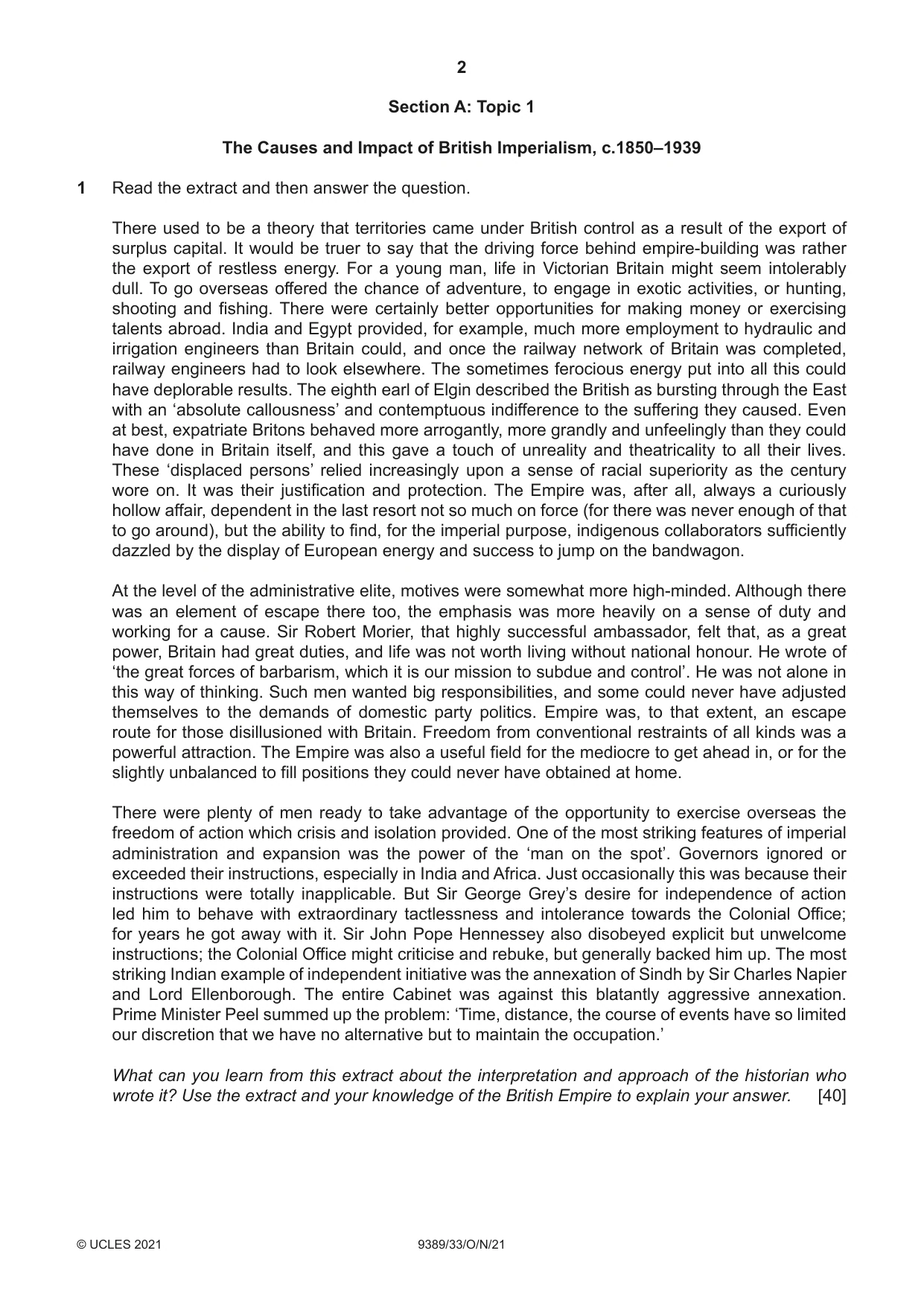
1 Read the extract and then answer the question. There used to be a theory that territories came under British control as a result of the export of surplus capital. It would be truer to say that the driving force behind empire-building was rather the export of restless energy. For a young man, life in Victorian Britain might seem intolerably dull. To go overseas offered the chance of adventure, to engage in exotic activities, or hunting, shooting and fishing. There were certainly better opportunities for making money or exercising talents abroad. India and Egypt provided, for example, much more employment to hydraulic and irrigation engineers than Britain could, and once the railway network of Britain was completed, railway engineers had to look elsewhere. The sometimes ferocious energy put into all this could have deplorable results. The eighth earl of Elgin described the British as bursting through the East with an ‘absolute callousness’ and contemptuous indifference to the suffering they caused. Even at best, expatriate Britons behaved more arrogantly, more grandly and unfeelingly than they could have done in Britain itself, and this gave a touch of unreality and theatricality to all their lives. These ‘displaced persons’ relied increasingly upon a sense of racial superiority as the century wore on. It was their justification and protection. The Empire was, after all, always a curiously hollow affair, dependent in the last resort not so much on force (for there was never enough of that to go around), but the ability to find, for the imperial purpose, indigenous collaborators sufficiently dazzled by the display of European energy and success to jump on the bandwagon. At the level of the administrative elite, motives were somewhat more high-minded. Although there was an element of escape there too, the emphasis was more heavily on a sense of duty and working for a cause. Sir Robert Morier, that highly successful ambassador, felt that, as a great power, Britain had great duties, and life was not worth living without national honour. He wrote of ‘the great forces of barbarism, which it is our mission to subdue and control’. He was not alone in this way of thinking. Such men wanted big responsibilities, and some could never have adjusted themselves to the demands of domestic party politics. Empire was, to that extent, an escape route for those disillusioned with Britain. Freedom from conventional restraints of all kinds was a powerful attraction. The Empire was also a useful field for the mediocre to get ahead in, or for the slightly unbalanced to fill positions they could never have obtained at home. There were plenty of men ready to take advantage of the opportunity to exercise overseas the freedom of action which crisis and isolation provided. One of the most striking features of imperial administration and expansion was the power of the ‘man on the spot’. Governors ignored or exceeded their instructions, especially in India and Africa. Just occasionally this was because their instructions were totally inapplicable. But Sir George Grey’s desire for independence of action led him to behave with extraordinary tactlessness and intolerance towards the Colonial Office; for years he got away with it. Sir John Pope Hennessey also disobeyed explicit but unwelcome instructions; the Colonial Office might criticise and rebuke, but generally backed him up. The most striking Indian example of independent initiative was the annexation of Sindh by Sir Charles Napier and Lord Ellenborough. The entire Cabinet was against this blatantly aggressive annexation. Prime Minister Peel summed up the problem: ‘Time, distance, the course of events have so limited our discretion that we have no alternative but to maintain the occupation.’ What can you learn from this extract about the interpretation and approach of the historian who wrote it? Use the extract and your knowledge of the British Empire to explain your answer. [40]
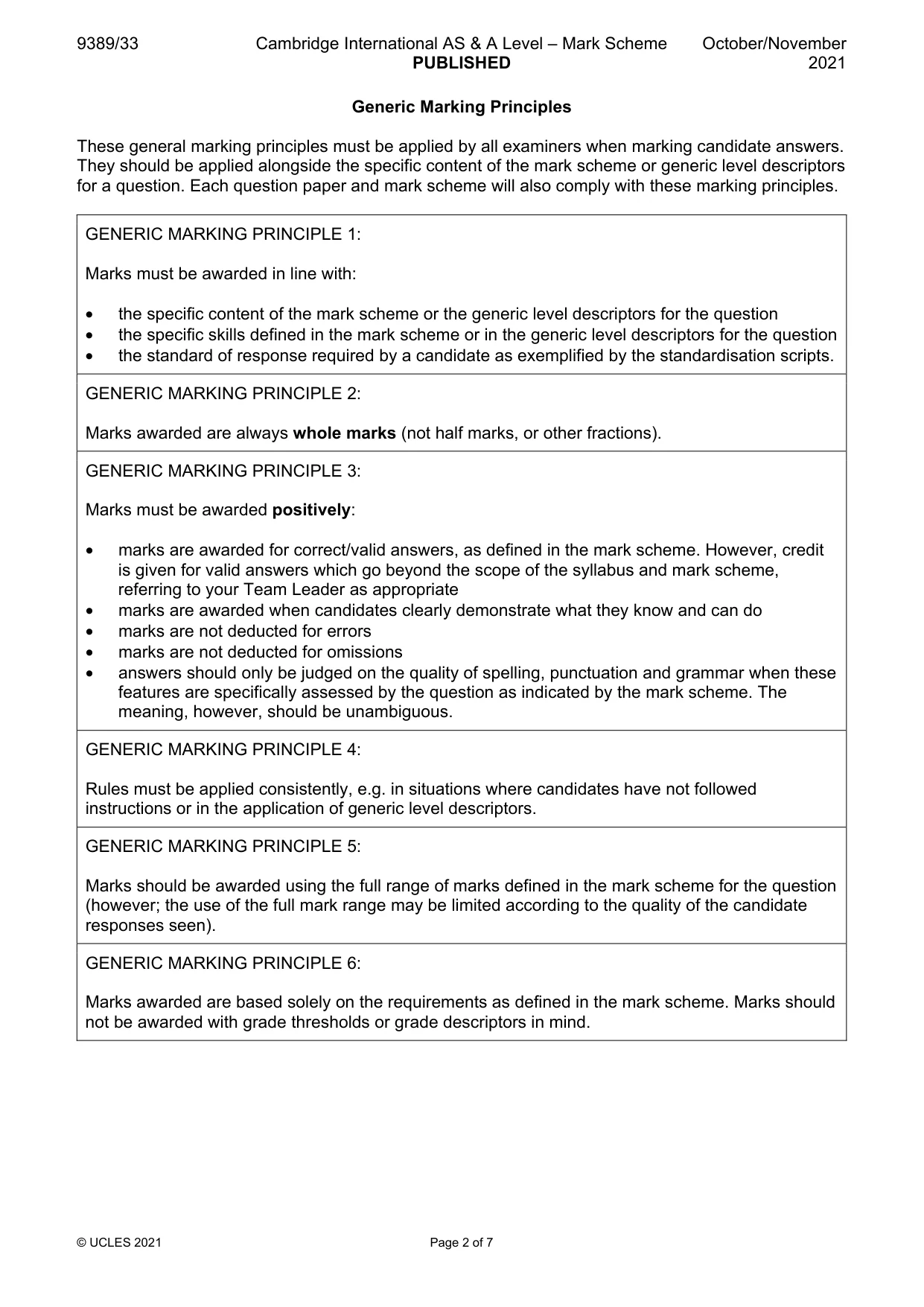
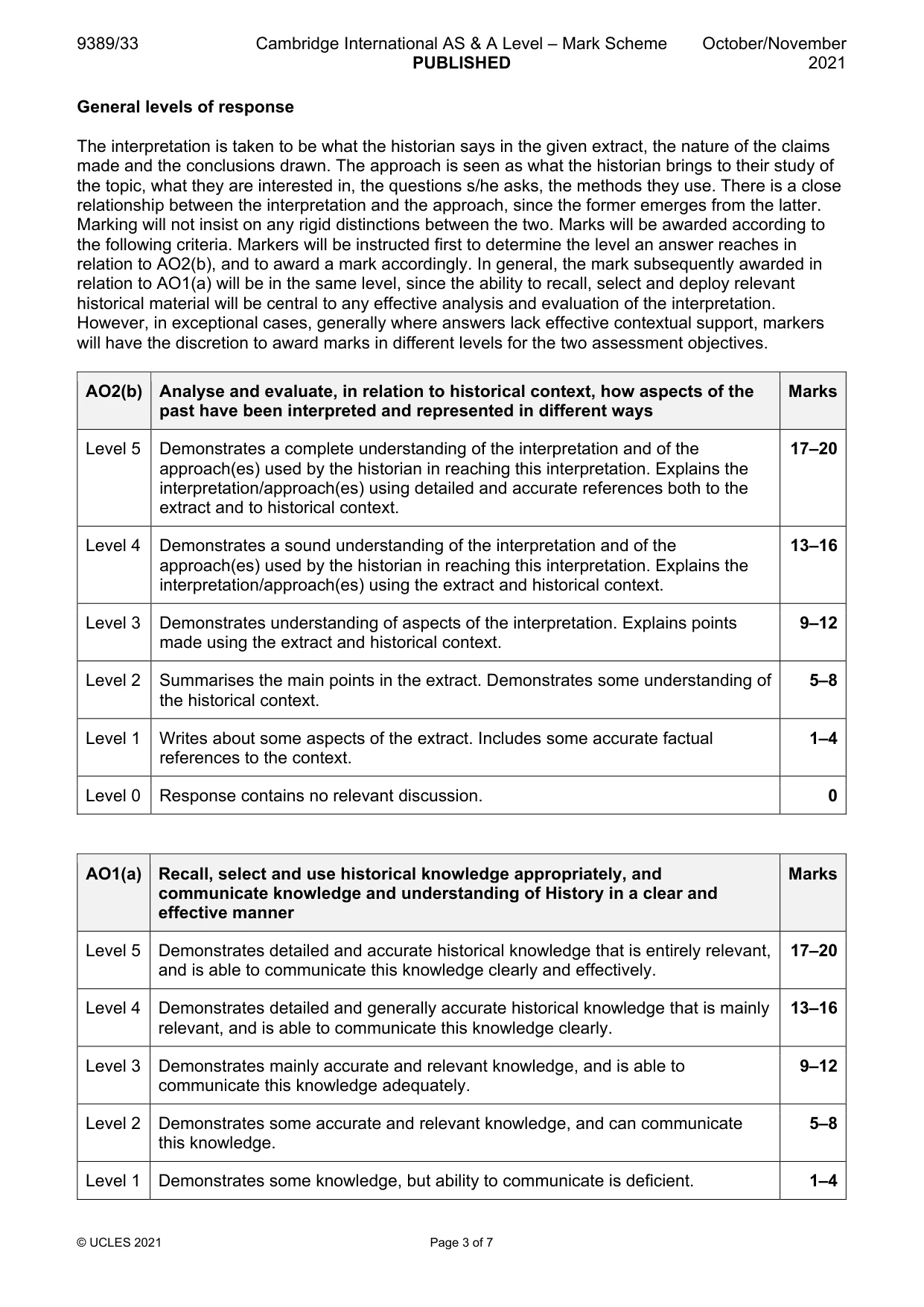
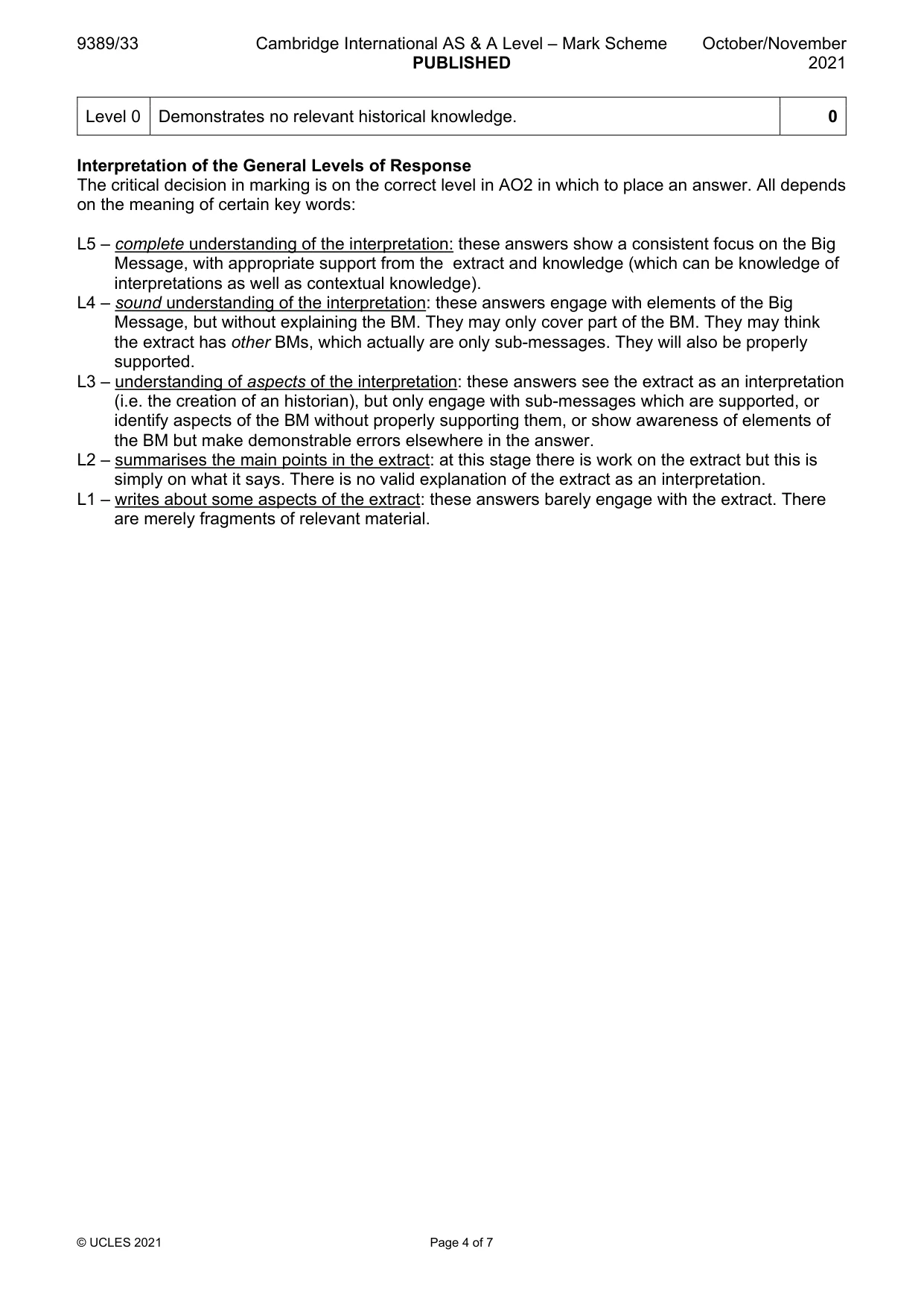
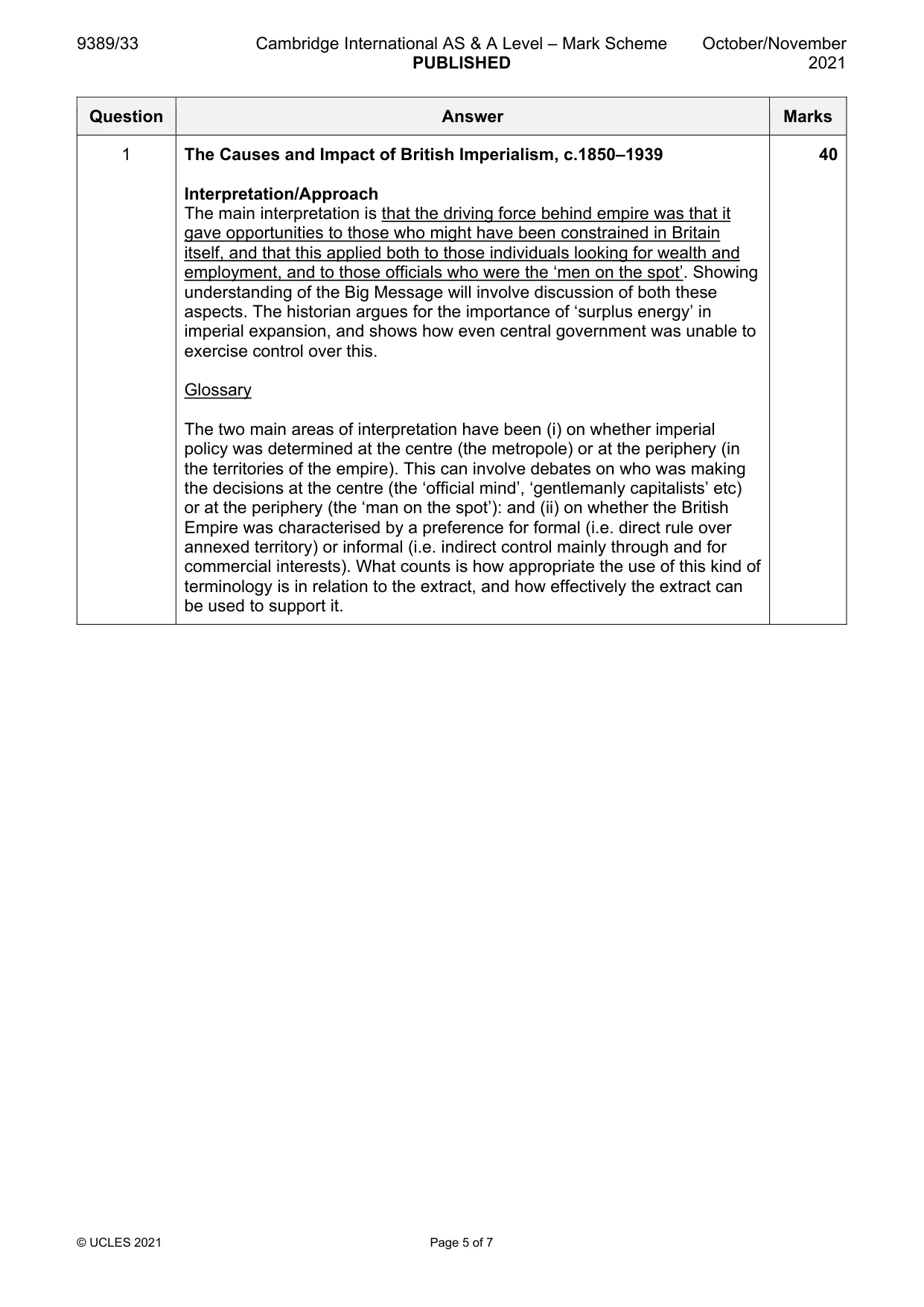
Mark scheme: Question Answer Marks 1 The Causes and Impact of British Imperialism, c.1850–1939 40 Interpretation/Approach The main interpretation is that the driving force behind empire was that it gave opportunities to those who might have been constrained in Britain itself, and that this applied both to those individuals looking for wealth and employment, and to those officials who were the ‘men on the spot’. Showing understanding of the Big Message will involve discussion of both these aspects. The historian argues for the importance of ‘surplus energy’ in imperial expansion, and shows how even central government was unable to exercise control over this. Glossary The two main areas of interpretation have been (i) on whether imperial policy was determined at the centre (the metropole) or at the periphery (in the territories of the empire). This can involve debates on who was making the decisions at the centre (the ‘official mind’, ‘gentlemanly capitalists’ etc) or at the periphery (the ‘man on the spot’): and (ii) on whether the British Empire was characterised by a preference for formal (i.e. direct rule over annexed territory) or informal (i.e. indirect control mainly through and for commercial interests). What counts is how appropriate the use of this kind of terminology is in relation to the extract, and how effectively the extract can be used to support it.
Q2 · Read the extract and then answer the question
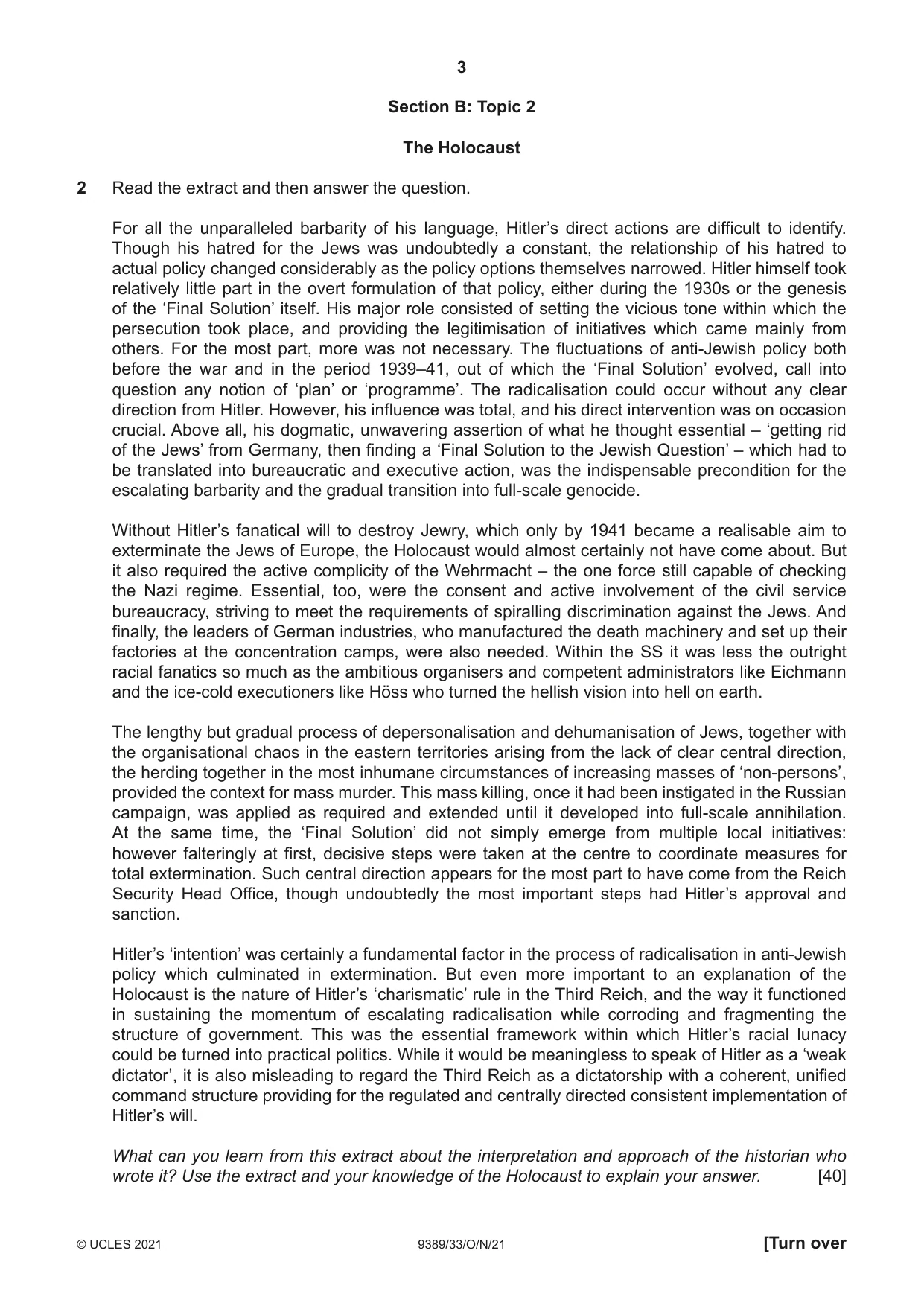
2 Read the extract and then answer the question. For all the unparalleled barbarity of his language, Hitler’s direct actions are difficult to identify. Though his hatred for the Jews was undoubtedly a constant, the relationship of his hatred to actual policy changed considerably as the policy options themselves narrowed. Hitler himself took relatively little part in the overt formulation of that policy, either during the 1930s or the genesis of the ‘Final Solution’ itself. His major role consisted of setting the vicious tone within which the persecution took place, and providing the legitimisation of initiatives which came mainly from others. For the most part, more was not necessary. The fluctuations of anti-Jewish policy both before the war and in the period 1939–41, out of which the ‘Final Solution’ evolved, call into question any notion of ‘plan’ or ‘programme’. The radicalisation could occur without any clear direction from Hitler. However, his influence was total, and his direct intervention was on occasion crucial. Above all, his dogmatic, unwavering assertion of what he thought essential – ‘getting rid of the Jews’ from Germany, then finding a ‘Final Solution to the Jewish Question’ – which had to be translated into bureaucratic and executive action, was the indispensable precondition for the escalating barbarity and the gradual transition into full-scale genocide. Without Hitler’s fanatical will to destroy Jewry, which only by 1941 became a realisable aim to exterminate the Jews of Europe, the Holocaust would almost certainly not have come about. But it also required the active complicity of the Wehrmacht – the one force still capable of checking the Nazi regime. Essential, too, were the consent and active involvement of the civil service bureaucracy, striving to meet the requirements of spiralling discrimination against the Jews. And finally, the leaders of German industries, who manufactured the death machinery and set up their factories at the concentration camps, were also needed. Within the SS it was less the outright racial fanatics so much as the ambitious organisers and competent administrators like Eichmann and the ice-cold executioners like Höss who turned the hellish vision into hell on earth. The lengthy but gradual process of depersonalisation and dehumanisation of Jews, together with the organisational chaos in the eastern territories arising from the lack of clear central direction, the herding together in the most inhumane circumstances of increasing masses of ‘non-persons’, provided the context for mass murder. This mass killing, once it had been instigated in the Russian campaign, was applied as required and extended until it developed into full-scale annihilation. At the same time, the ‘Final Solution’ did not simply emerge from multiple local initiatives: however falteringly at first, decisive steps were taken at the centre to coordinate measures for total extermination. Such central direction appears for the most part to have come from the Reich Security Head Office, though undoubtedly the most important steps had Hitler’s approval and sanction. Hitler’s ‘intention’ was certainly a fundamental factor in the process of radicalisation in anti-Jewish policy which culminated in extermination. But even more important to an explanation of the Holocaust is the nature of Hitler’s ‘charismatic’ rule in the Third Reich, and the way it functioned in sustaining the momentum of escalating radicalisation while corroding and fragmenting the structure of government. This was the essential framework within which Hitler’s racial lunacy could be turned into practical politics. While it would be meaningless to speak of Hitler as a ‘weak dictator’, it is also misleading to regard the Third Reich as a dictatorship with a coherent, unified command structure providing for the regulated and centrally directed consistent implementation of Hitler’s will. What can you learn from this extract about the interpretation and approach of the historian who wrote it? Use the extract and your knowledge of the Holocaust to explain your answer. [40] Section C: Topic 3 The Origins and Development of the Cold War, 1941–1950
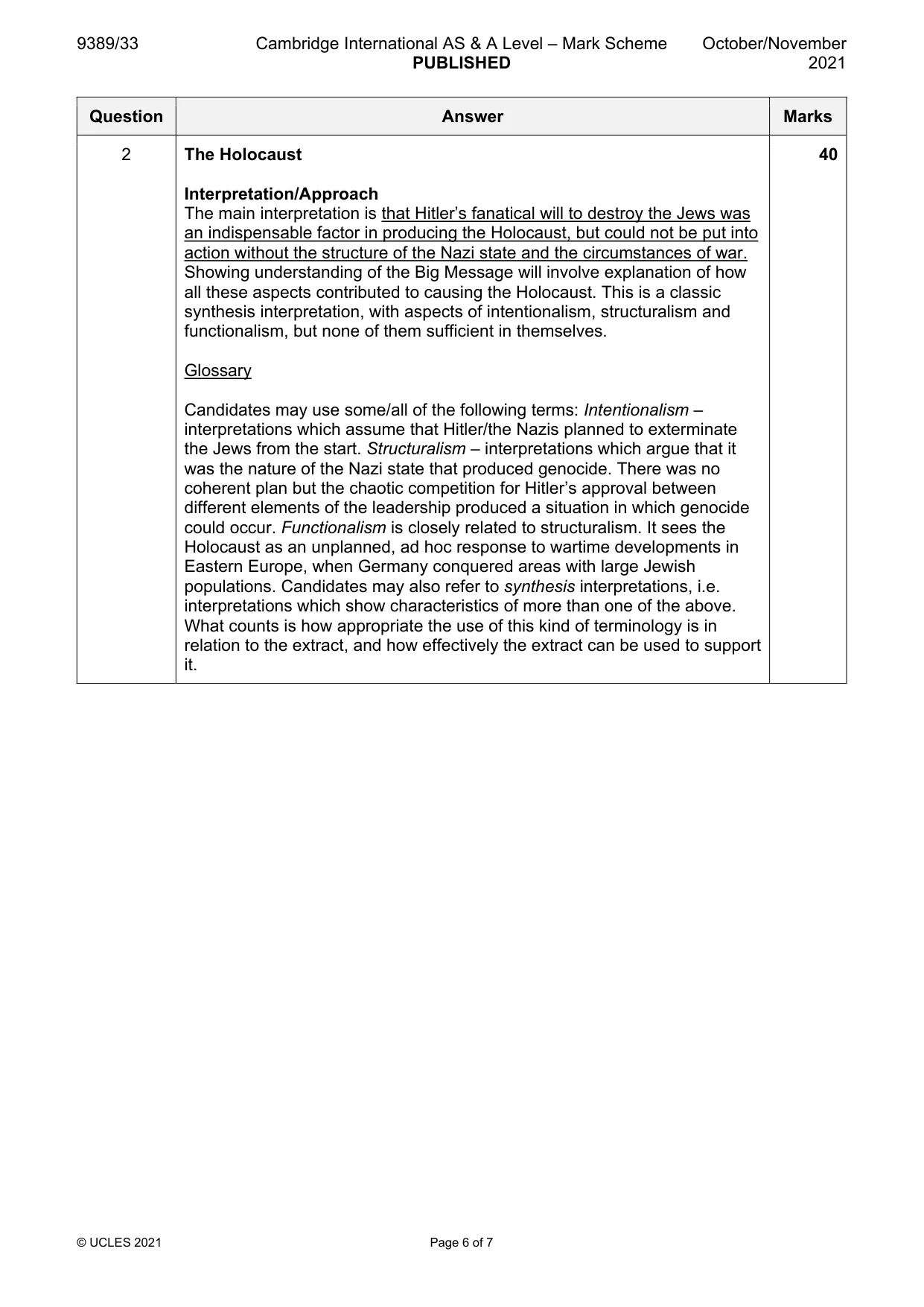
Mark scheme: 2 The Holocaust 40 Interpretation/Approach The main interpretation is that Hitler’s fanatical will to destroy the Jews was an indispensable factor in producing the Holocaust, but could not be put into action without the structure of the Nazi state and the circumstances of war. Showing understanding of the Big Message will involve explanation of how all these aspects contributed to causing the Holocaust. This is a classic synthesis interpretation, with aspects of intentionalism, structuralism and functionalism, but none of them sufficient in themselves. Glossary Candidates may use some/all of the following terms: Intentionalism – interpretations which assume that Hitler/the Nazis planned to exterminate the Jews from the start. Structuralism – interpretations which argue that it was the nature of the Nazi state that produced genocide. There was no coherent plan but the chaotic competition for Hitler’s approval between different elements of the leadership produced a situation in which genocide could occur. Functionalism is closely related to structuralism. It sees the Holocaust as an unplanned, ad hoc response to wartime developments in Eastern Europe, when Germany conquered areas with large Jewish populations. Candidates may also refer to synthesis interpretations, i.e. interpretations which show characteristics of more than one of the above. What counts is how appropriate the use of this kind of terminology is in relation to the extract, and how effectively the extract can be used to support it.
Q3 · Read the extract and then answer the question
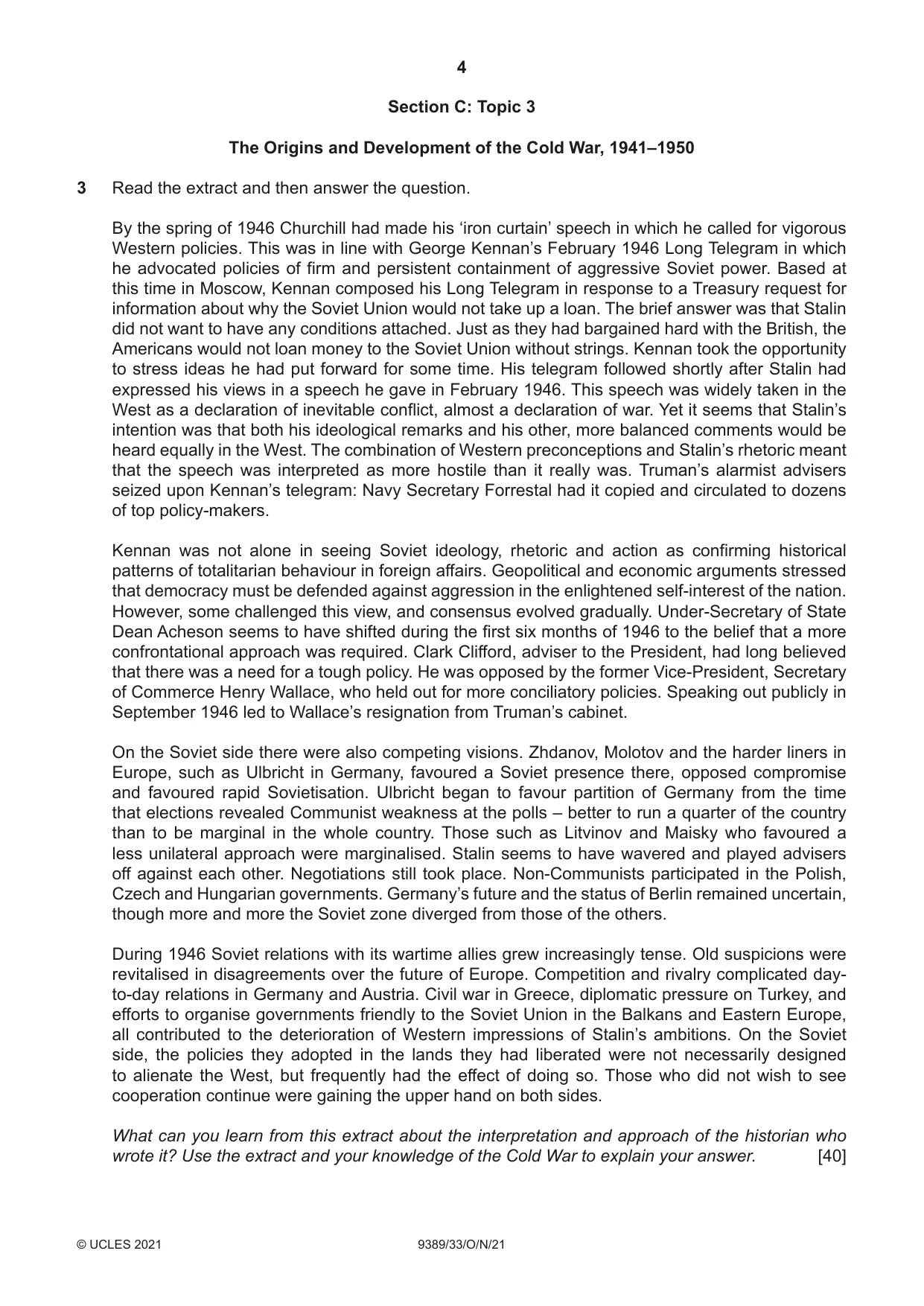
3 Read the extract and then answer the question. By the spring of 1946 Churchill had made his ‘iron curtain’ speech in which he called for vigorous Western policies. This was in line with George Kennan’s February 1946 Long Telegram in which he advocated policies of firm and persistent containment of aggressive Soviet power. Based at this time in Moscow, Kennan composed his Long Telegram in response to a Treasury request for information about why the Soviet Union would not take up a loan. The brief answer was that Stalin did not want to have any conditions attached. Just as they had bargained hard with the British, the Americans would not loan money to the Soviet Union without strings. Kennan took the opportunity to stress ideas he had put forward for some time. His telegram followed shortly after Stalin had expressed his views in a speech he gave in February 1946. This speech was widely taken in the West as a declaration of inevitable conflict, almost a declaration of war. Yet it seems that Stalin’s intention was that both his ideological remarks and his other, more balanced comments would be heard equally in the West. The combination of Western preconceptions and Stalin’s rhetoric meant that the speech was interpreted as more hostile than it really was. Truman’s alarmist advisers seized upon Kennan’s telegram: Navy Secretary Forrestal had it copied and circulated to dozens of top policy-makers. Kennan was not alone in seeing Soviet ideology, rhetoric and action as confirming historical patterns of totalitarian behaviour in foreign affairs. Geopolitical and economic arguments stressed that democracy must be defended against aggression in the enlightened self-interest of the nation. However, some challenged this view, and consensus evolved gradually. Under-Secretary of State Dean Acheson seems to have shifted during the first six months of 1946 to the belief that a more confrontational approach was required. Clark Clifford, adviser to the President, had long believed that there was a need for a tough policy. He was opposed by the former Vice-President, Secretary of Commerce Henry Wallace, who held out for more conciliatory policies. Speaking out publicly in September 1946 led to Wallace’s resignation from Truman’s cabinet. On the Soviet side there were also competing visions. Zhdanov, Molotov and the harder liners in Europe, such as Ulbricht in Germany, favoured a Soviet presence there, opposed compromise and favoured rapid Sovietisation. Ulbricht began to favour partition of Germany from the time that elections revealed Communist weakness at the polls – better to run a quarter of the country than to be marginal in the whole country. Those such as Litvinov and Maisky who favoured a less unilateral approach were marginalised. Stalin seems to have wavered and played advisers off against each other. Negotiations still took place. Non-Communists participated in the Polish, Czech and Hungarian governments. Germany’s future and the status of Berlin remained uncertain, though more and more the Soviet zone diverged from those of the others. During 1946 Soviet relations with its wartime allies grew increasingly tense. Old suspicions were revitalised in disagreements over the future of Europe. Competition and rivalry complicated day- to-day relations in Germany and Austria. Civil war in Greece, diplomatic pressure on Turkey, and efforts to organise governments friendly to the Soviet Union in the Balkans and Eastern Europe, all contributed to the deterioration of Western impressions of Stalin’s ambitions. On the Soviet side, the policies they adopted in the lands they had liberated were not necessarily designed to alienate the West, but frequently had the effect of doing so. Those who did not wish to see cooperation continue were gaining the upper hand on both sides. What can you learn from this extract about the interpretation and approach of the historian who wrote it? Use the extract and your knowledge of the Cold War to explain your answer. [40]
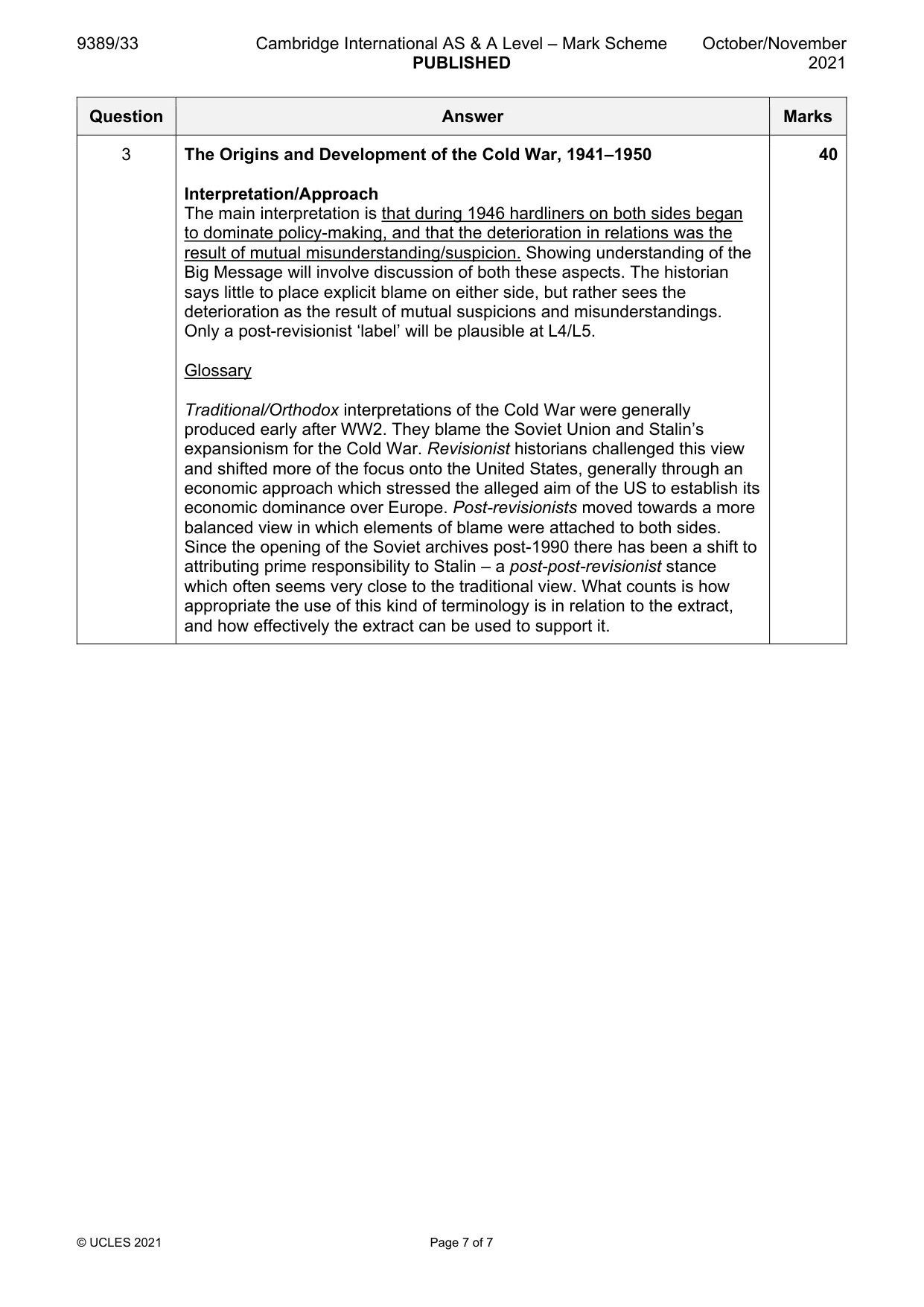
Mark scheme: 3 The Origins and Development of the Cold War, 1941–1950 40 Interpretation/Approach The main interpretation is that during 1946 hardliners on both sides began to dominate policy-making, and that the deterioration in relations was the result of mutual misunderstanding/suspicion. Showing understanding of the Big Message will involve discussion of both these aspects. The historian says little to place explicit blame on either side, but rather sees the deterioration as the result of mutual suspicions and misunderstandings. Only a post-revisionist ‘label’ will be plausible at L4/L5. Glossary Traditional/Orthodox interpretations of the Cold War were generally produced early after WW2. They blame the Soviet Union and Stalin’s expansionism for the Cold War. Revisionist historians challenged this view and shifted more of the focus onto the United States, generally through an economic approach which stressed the alleged aim of the US to establish its economic dominance over Europe. Post-revisionists moved towards a more balanced view in which elements of blame were attached to both sides. Since the opening of the Soviet archives post-1990 there has been a shift to attributing prime responsibility to Stalin – a post-post-revisionist stance which often seems very close to the traditional view. What counts is how appropriate the use of this kind of terminology is in relation to the extract, and how effectively the extract can be used to support it.
What you needed in this session
Cambridge’s own grade thresholds for 2021 Oct/Nov, Paper 3 · Variant 3. A higher threshold means an easier paper — the bar moves with how the cohort did.