Cambridge A Level History 9389 — 2019 May/June Paper 3 · Variant 3
9389/33/M/J/19 · 3 questions · 40 marks · ≈45 min
The question paper and its mark scheme, free to read here and free to download. This is Cambridge’s own paper, exactly as it was sat.
Question paper4 pages
Mark scheme7 pages
Answers below. Sit the paper first if you are practising.

Questions as text
Q1 · Read the extract and then answer the question
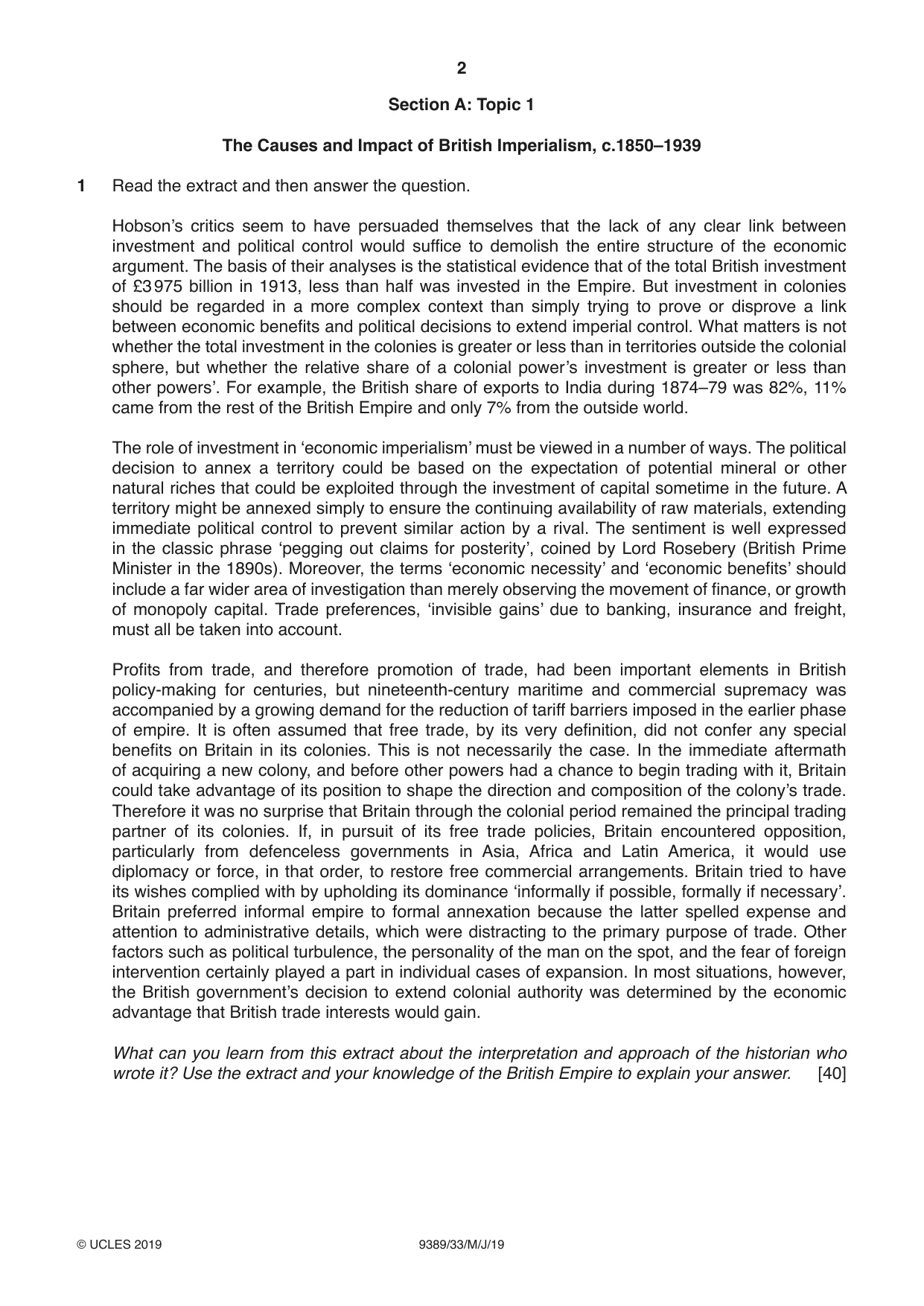
1 Read the extract and then answer the question. Hobson’s critics seem to have persuaded themselves that the lack of any clear link between investment and political control would suffice to demolish the entire structure of the economic argument. The basis of their analyses is the statistical evidence that of the total British investment of £3 975 billion in 1913, less than half was invested in the Empire. But investment in colonies should be regarded in a more complex context than simply trying to prove or disprove a link between economic benefits and political decisions to extend imperial control. What matters is not whether the total investment in the colonies is greater or less than in territories outside the colonial sphere, but whether the relative share of a colonial power’s investment is greater or less than other powers’. For example, the British share of exports to India during 1874–79 was 82%, 11% came from the rest of the British Empire and only 7% from the outside world. The role of investment in ‘economic imperialism’ must be viewed in a number of ways. The political decision to annex a territory could be based on the expectation of potential mineral or other natural riches that could be exploited through the investment of capital sometime in the future. A territory might be annexed simply to ensure the continuing availability of raw materials, extending immediate political control to prevent similar action by a rival. The sentiment is well expressed in the classic phrase ‘pegging out claims for posterity’, coined by Lord Rosebery (British Prime Minister in the 1890s). Moreover, the terms ‘economic necessity’ and ‘economic benefits’ should include a far wider area of investigation than merely observing the movement of finance, or growth of monopoly capital. Trade preferences, ‘invisible gains’ due to banking, insurance and freight, must all be taken into account. Profits from trade, and therefore promotion of trade, had been important elements in British policy-making for centuries, but nineteenth-century maritime and commercial supremacy was accompanied by a growing demand for the reduction of tariff barriers imposed in the earlier phase of empire. It is often assumed that free trade, by its very definition, did not confer any special benefits on Britain in its colonies. This is not necessarily the case. In the immediate aftermath of acquiring a new colony, and before other powers had a chance to begin trading with it, Britain could take advantage of its position to shape the direction and composition of the colony’s trade. Therefore it was no surprise that Britain through the colonial period remained the principal trading partner of its colonies. If, in pursuit of its free trade policies, Britain encountered opposition, particularly from defenceless governments in Asia, Africa and Latin America, it would use diplomacy or force, in that order, to restore free commercial arrangements. Britain tried to have its wishes complied with by upholding its dominance ‘informally if possible, formally if necessary’. Britain preferred informal empire to formal annexation because the latter spelled expense and attention to administrative details, which were distracting to the primary purpose of trade. Other factors such as political turbulence, the personality of the man on the spot, and the fear of foreign intervention certainly played a part in individual cases of expansion. In most situations, however, the British government’s decision to extend colonial authority was determined by the economic advantage that British trade interests would gain. What can you learn from this extract about the interpretation and approach of the historian who wrote it? Use the extract and your knowledge of the British Empire to explain your answer. [40]
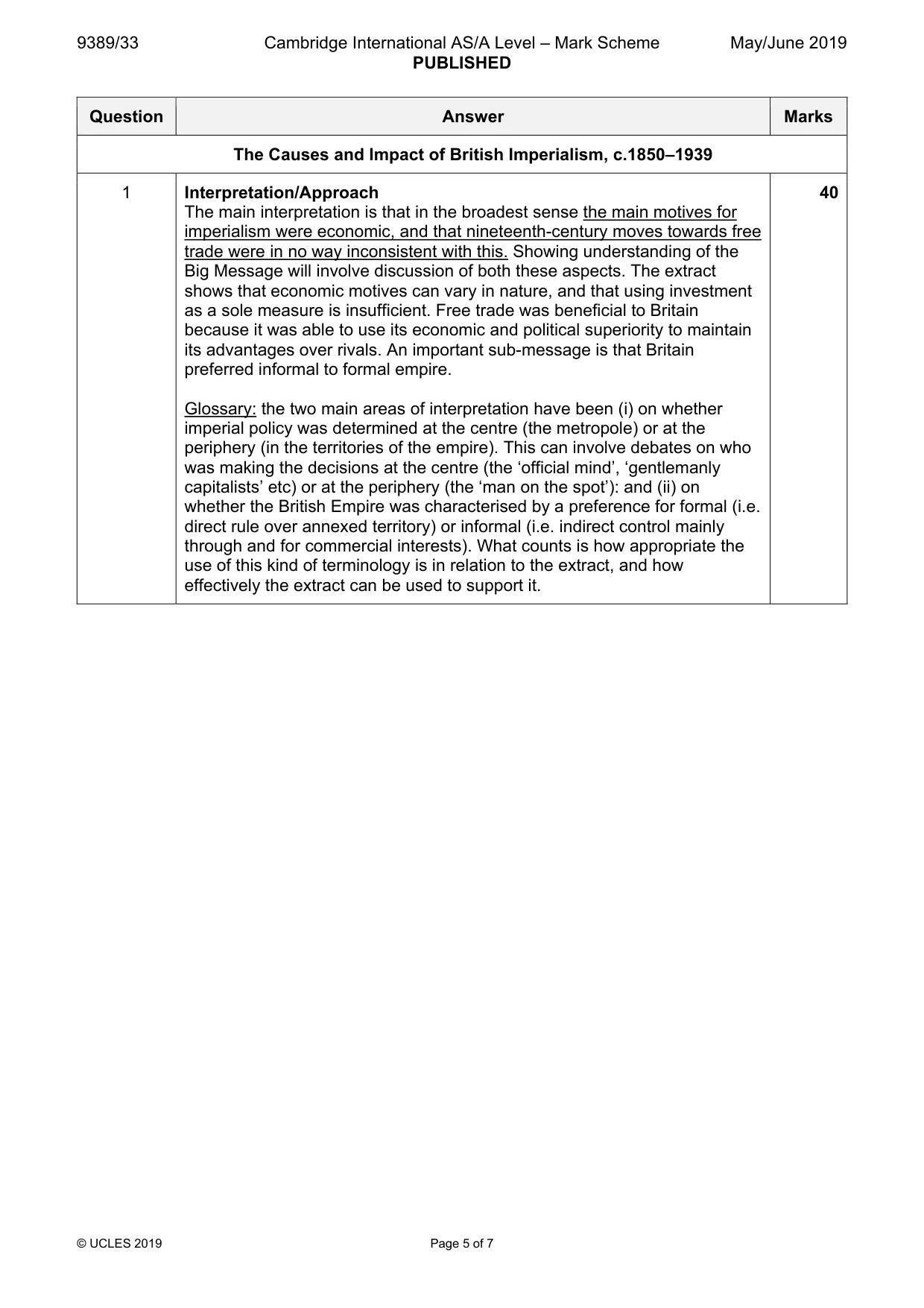
Mark scheme: Question Answer Marks The Causes and Impact of British Imperialism, c.1850–1939 1 Interpretation/Approach 40 The main interpretation is that in the broadest sense the main motives for imperialism were economic, and that nineteenth-century moves towards free trade were in no way inconsistent with this. Showing understanding of the Big Message will involve discussion of both these aspects. The extract shows that economic motives can vary in nature, and that using investment as a sole measure is insufficient. Free trade was beneficial to Britain because it was able to use its economic and political superiority to maintain its advantages over rivals. An important sub-message is that Britain preferred informal to formal empire. Glossary: the two main areas of interpretation have been (i) on whether imperial policy was determined at the centre (the metropole) or at the periphery (in the territories of the empire). This can involve debates on who was making the decisions at the centre (the ‘official mind’, ‘gentlemanly capitalists’ etc) or at the periphery (the ‘man on the spot’): and (ii) on whether the British Empire was characterised by a preference for formal (i.e. direct rule over annexed territory) or informal (i.e. indirect control mainly through and for commercial interests). What counts is how appropriate the use of this kind of terminology is in relation to the extract, and how effectively the extract can be used to support it.
Q2 · Read the extract and then answer the question
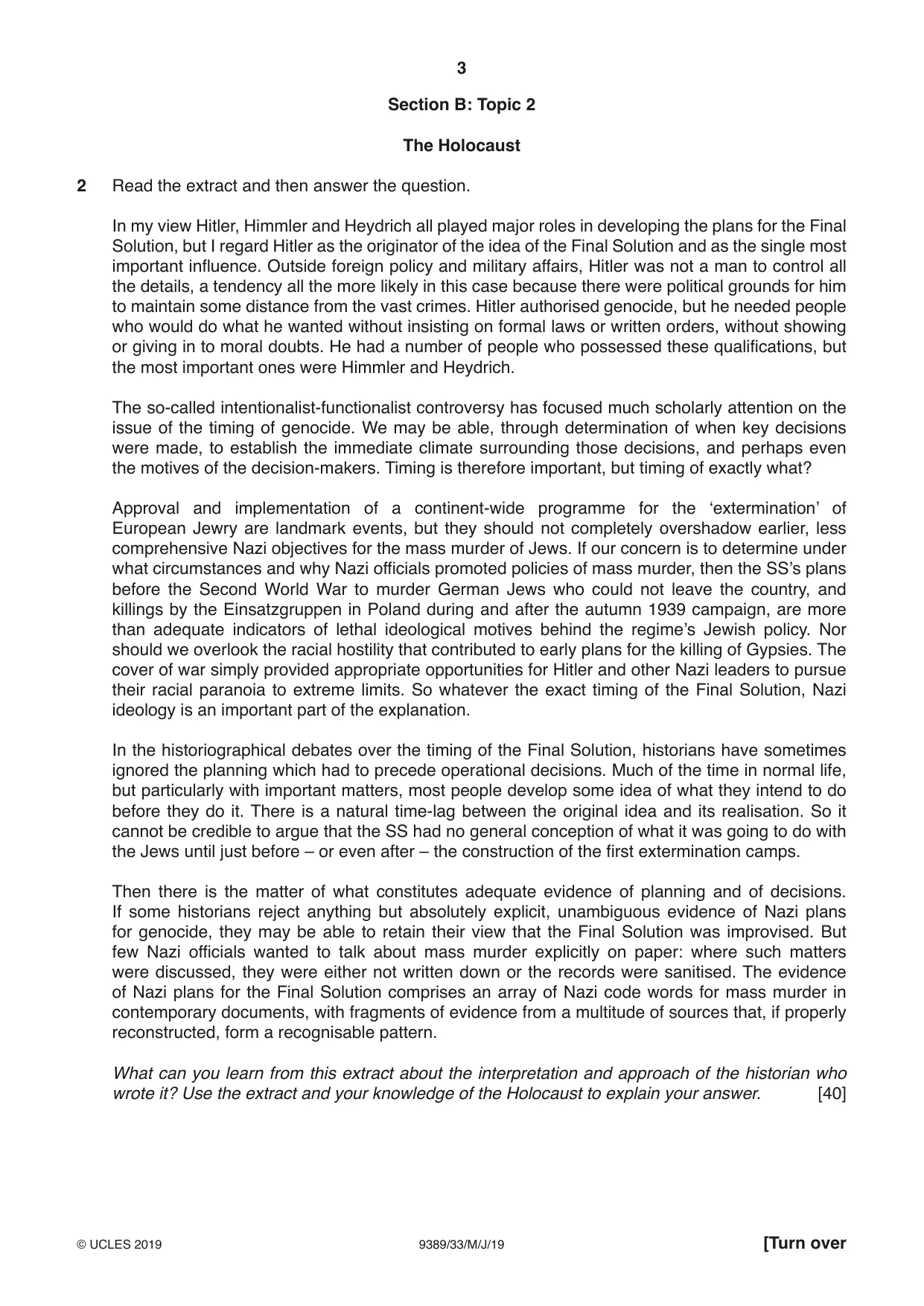
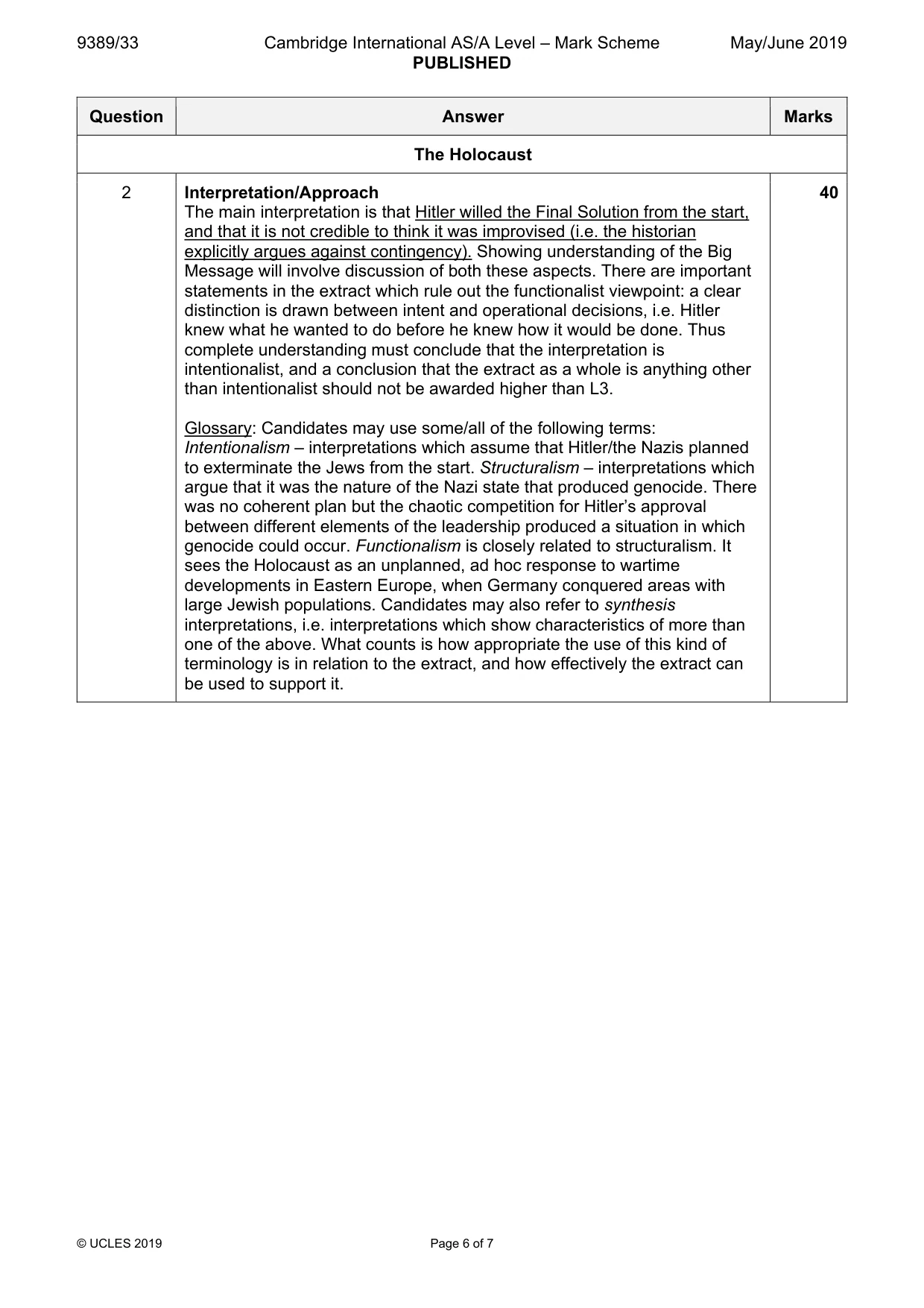
2 Read the extract and then answer the question. In my view Hitler, Himmler and Heydrich all played major roles in developing the plans for the Final Solution, but I regard Hitler as the originator of the idea of the Final Solution and as the single most important influence. Outside foreign policy and military affairs, Hitler was not a man to control all the details, a tendency all the more likely in this case because there were political grounds for him to maintain some distance from the vast crimes. Hitler authorised genocide, but he needed people who would do what he wanted without insisting on formal laws or written orders, without showing or giving in to moral doubts. He had a number of people who possessed these qualifications, but the most important ones were Himmler and Heydrich. The so-called intentionalist-functionalist controversy has focused much scholarly attention on the issue of the timing of genocide. We may be able, through determination of when key decisions were made, to establish the immediate climate surrounding those decisions, and perhaps even the motives of the decision-makers. Timing is therefore important, but timing of exactly what? Approval and implementation of a continent-wide programme for the ‘extermination’ of European Jewry are landmark events, but they should not completely overshadow earlier, less comprehensive Nazi objectives for the mass murder of Jews. If our concern is to determine under what circumstances and why Nazi officials promoted policies of mass murder, then the SS’s plans before the Second World War to murder German Jews who could not leave the country, and killings by the Einsatzgruppen in Poland during and after the autumn 1939 campaign, are more than adequate indicators of lethal ideological motives behind the regime’s Jewish policy. Nor should we overlook the racial hostility that contributed to early plans for the killing of Gypsies. The cover of war simply provided appropriate opportunities for Hitler and other Nazi leaders to pursue their racial paranoia to extreme limits. So whatever the exact timing of the Final Solution, Nazi ideology is an important part of the explanation. In the historiographical debates over the timing of the Final Solution, historians have sometimes ignored the planning which had to precede operational decisions. Much of the time in normal life, but particularly with important matters, most people develop some idea of what they intend to do before they do it. There is a natural time-lag between the original idea and its realisation. So it cannot be credible to argue that the SS had no general conception of what it was going to do with the Jews until just before – or even after – the construction of the first extermination camps. Then there is the matter of what constitutes adequate evidence of planning and of decisions. If some historians reject anything but absolutely explicit, unambiguous evidence of Nazi plans for genocide, they may be able to retain their view that the Final Solution was improvised. But few Nazi officials wanted to talk about mass murder explicitly on paper: where such matters were discussed, they were either not written down or the records were sanitised. The evidence of Nazi plans for the Final Solution comprises an array of Nazi code words for mass murder in contemporary documents, with fragments of evidence from a multitude of sources that, if properly reconstructed, form a recognisable pattern. What can you learn from this extract about the interpretation and approach of the historian who wrote it? Use the extract and your knowledge of the Holocaust to explain your answer. [40] Section C: Topic 3 The Origins and Development of the Cold War, 1941–1950
Mark scheme: 2 Interpretation/Approach 40 The main interpretation is that Hitler willed the Final Solution from the start, and that it is not credible to think it was improvised (i.e. the historian explicitly argues against contingency). Showing understanding of the Big Message will involve discussion of both these aspects. There are important statements in the extract which rule out the functionalist viewpoint: a clear distinction is drawn between intent and operational decisions, i.e. Hitler knew what he wanted to do before he knew how it would be done. Thus complete understanding must conclude that the interpretation is intentionalist, and a conclusion that the extract as a whole is anything other than intentionalist should not be awarded higher than L3. Glossary: Candidates may use some/all of the following terms: Intentionalism – interpretations which assume that Hitler/the Nazis planned to exterminate the Jews from the start. Structuralism – interpretations which argue that it was the nature of the Nazi state that produced genocide. There was no coherent plan but the chaotic competition for Hitler’s approval between different elements of the leadership produced a situation in which genocide could occur. Functionalism is closely related to structuralism. It sees the Holocaust as an unplanned, ad hoc response to wartime developments in Eastern Europe, when Germany conquered areas with large Jewish populations. Candidates may also refer to synthesis interpretations, i.e. interpretations which show characteristics of more than one of the above. What counts is how appropriate the use of this kind of terminology is in relation to the extract, and how effectively the extract can be used to support it.
Q3 · Read the extract and then answer the question
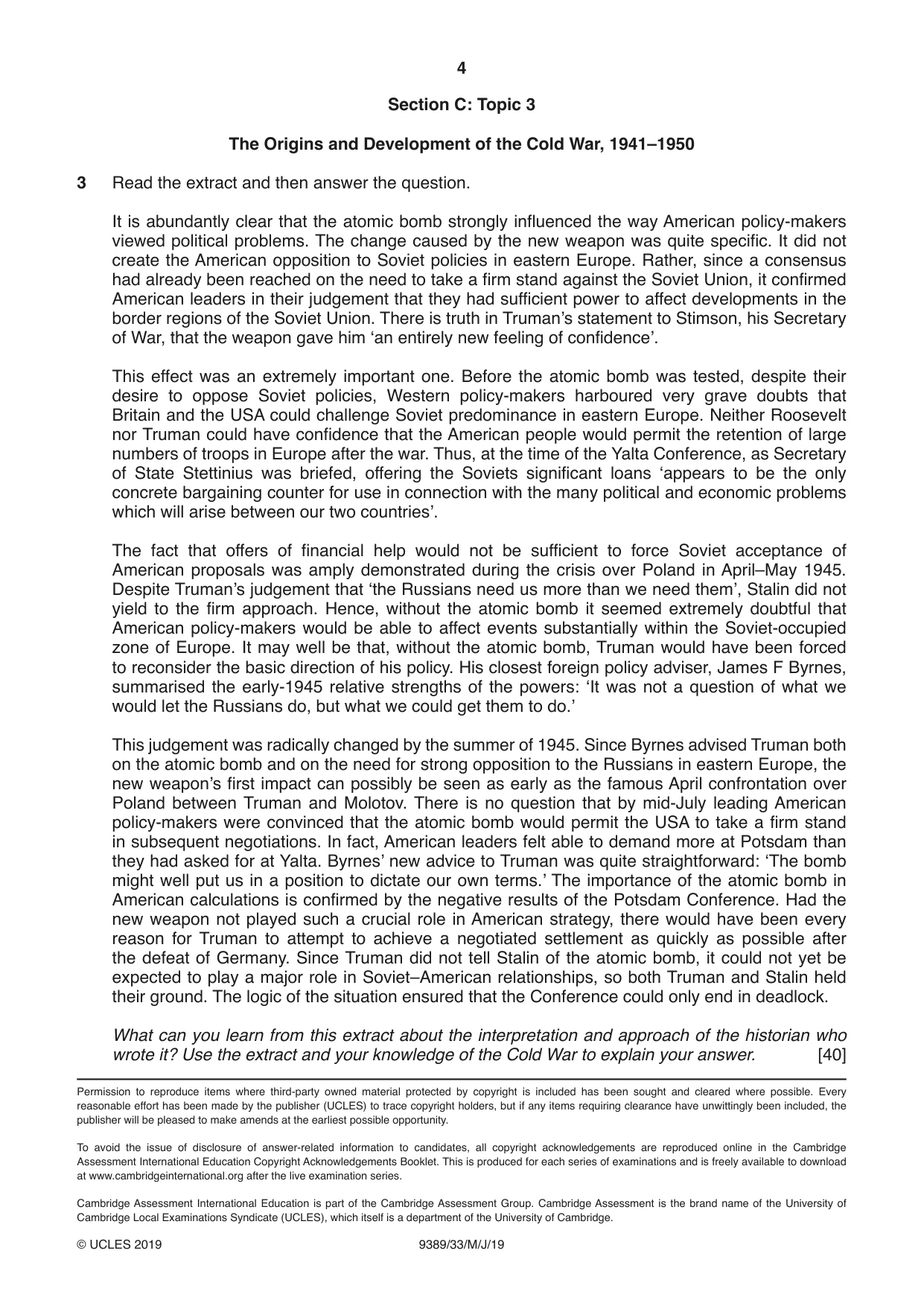
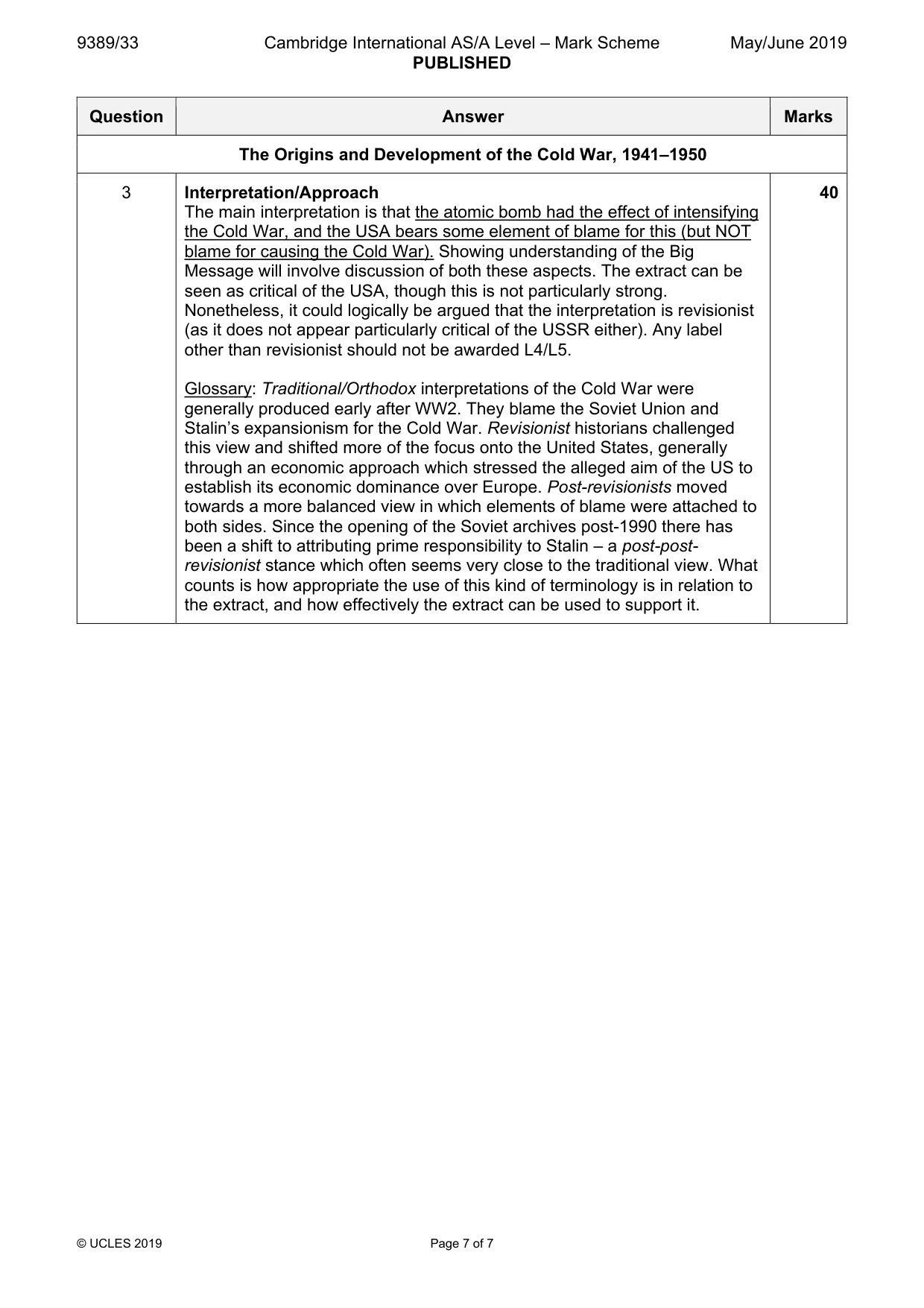
3 Read the extract and then answer the question. It is abundantly clear that the atomic bomb strongly influenced the way American policy-makers viewed political problems. The change caused by the new weapon was quite specific. It did not create the American opposition to Soviet policies in eastern Europe. Rather, since a consensus had already been reached on the need to take a firm stand against the Soviet Union, it confirmed American leaders in their judgement that they had sufficient power to affect developments in the border regions of the Soviet Union. There is truth in Truman’s statement to Stimson, his Secretary of War, that the weapon gave him ‘an entirely new feeling of confidence’. This effect was an extremely important one. Before the atomic bomb was tested, despite their desire to oppose Soviet policies, Western policy-makers harboured very grave doubts that Britain and the USA could challenge Soviet predominance in eastern Europe. Neither Roosevelt nor Truman could have confidence that the American people would permit the retention of large numbers of troops in Europe after the war. Thus, at the time of the Yalta Conference, as Secretary of State Stettinius was briefed, offering the Soviets significant loans ‘appears to be the only concrete bargaining counter for use in connection with the many political and economic problems which will arise between our two countries’. The fact that offers of financial help would not be sufficient to force Soviet acceptance of American proposals was amply demonstrated during the crisis over Poland in April–May 1945. Despite Truman’s judgement that ‘the Russians need us more than we need them’, Stalin did not yield to the firm approach. Hence, without the atomic bomb it seemed extremely doubtful that American policy-makers would be able to affect events substantially within the Soviet-occupied zone of Europe. It may well be that, without the atomic bomb, Truman would have been forced to reconsider the basic direction of his policy. His closest foreign policy adviser, James F Byrnes, summarised the early-1945 relative strengths of the powers: ‘It was not a question of what we would let the Russians do, but what we could get them to do.’ This judgement was radically changed by the summer of 1945. Since Byrnes advised Truman both on the atomic bomb and on the need for strong opposition to the Russians in eastern Europe, the new weapon’s first impact can possibly be seen as early as the famous April confrontation over Poland between Truman and Molotov. There is no question that by mid-July leading American policy-makers were convinced that the atomic bomb would permit the USA to take a firm stand in subsequent negotiations. In fact, American leaders felt able to demand more at Potsdam than they had asked for at Yalta. Byrnes’ new advice to Truman was quite straightforward: ‘The bomb might well put us in a position to dictate our own terms.’ The importance of the atomic bomb in American calculations is confirmed by the negative results of the Potsdam Conference. Had the new weapon not played such a crucial role in American strategy, there would have been every reason for Truman to attempt to achieve a negotiated settlement as quickly as possible after the defeat of Germany. Since Truman did not tell Stalin of the atomic bomb, it could not yet be expected to play a major role in Soviet–American relationships, so both Truman and Stalin held their ground. The logic of the situation ensured that the Conference could only end in deadlock. What can you learn from this extract about the interpretation and approach of the historian who wrote it? Use the extract and your knowledge of the Cold War to explain your answer. [40]
Mark scheme: 3 Interpretation/Approach 40 The main interpretation is that the atomic bomb had the effect of intensifying the Cold War, and the USA bears some element of blame for this (but NOT blame for causing the Cold War). Showing understanding of the Big Message will involve discussion of both these aspects. The extract can be seen as critical of the USA, though this is not particularly strong. Nonetheless, it could logically be argued that the interpretation is revisionist (as it does not appear particularly critical of the USSR either). Any label other than revisionist should not be awarded L4/L5. Glossary: Traditional/Orthodox interpretations of the Cold War were generally produced early after WW2. They blame the Soviet Union and Stalin’s expansionism for the Cold War. Revisionist historians challenged this view and shifted more of the focus onto the United States, generally through an economic approach which stressed the alleged aim of the US to establish its economic dominance over Europe. Post-revisionists moved towards a more balanced view in which elements of blame were attached to both sides. Since the opening of the Soviet archives post-1990 there has been a shift to attributing prime responsibility to Stalin – a post-post- revisionist stance which often seems very close to the traditional view. What counts is how appropriate the use of this kind of terminology is in relation to the extract, and how effectively the extract can be used to support it.
What you needed in this session
Cambridge’s own grade thresholds for 2019 May/June, Paper 3 · Variant 3. A higher threshold means an easier paper — the bar moves with how the cohort did.