Cambridge A Level History 9389 — 2019 Oct/Nov Paper 3 · Variant 3
9389/33/O/N/19 · 3 questions · 40 marks · ≈45 min
The question paper and its mark scheme, free to read here and free to download. This is Cambridge’s own paper, exactly as it was sat.
Question paper4 pages
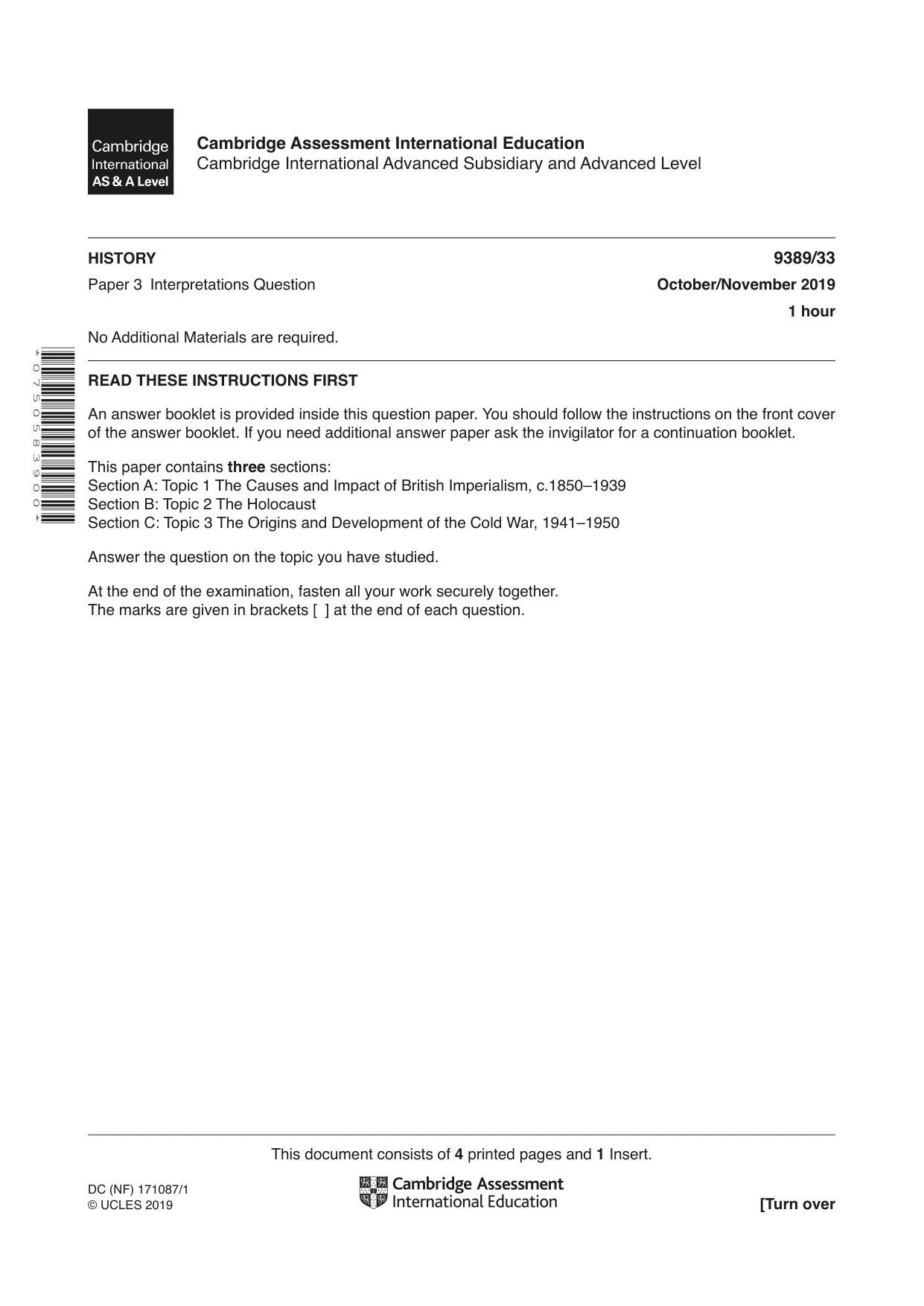
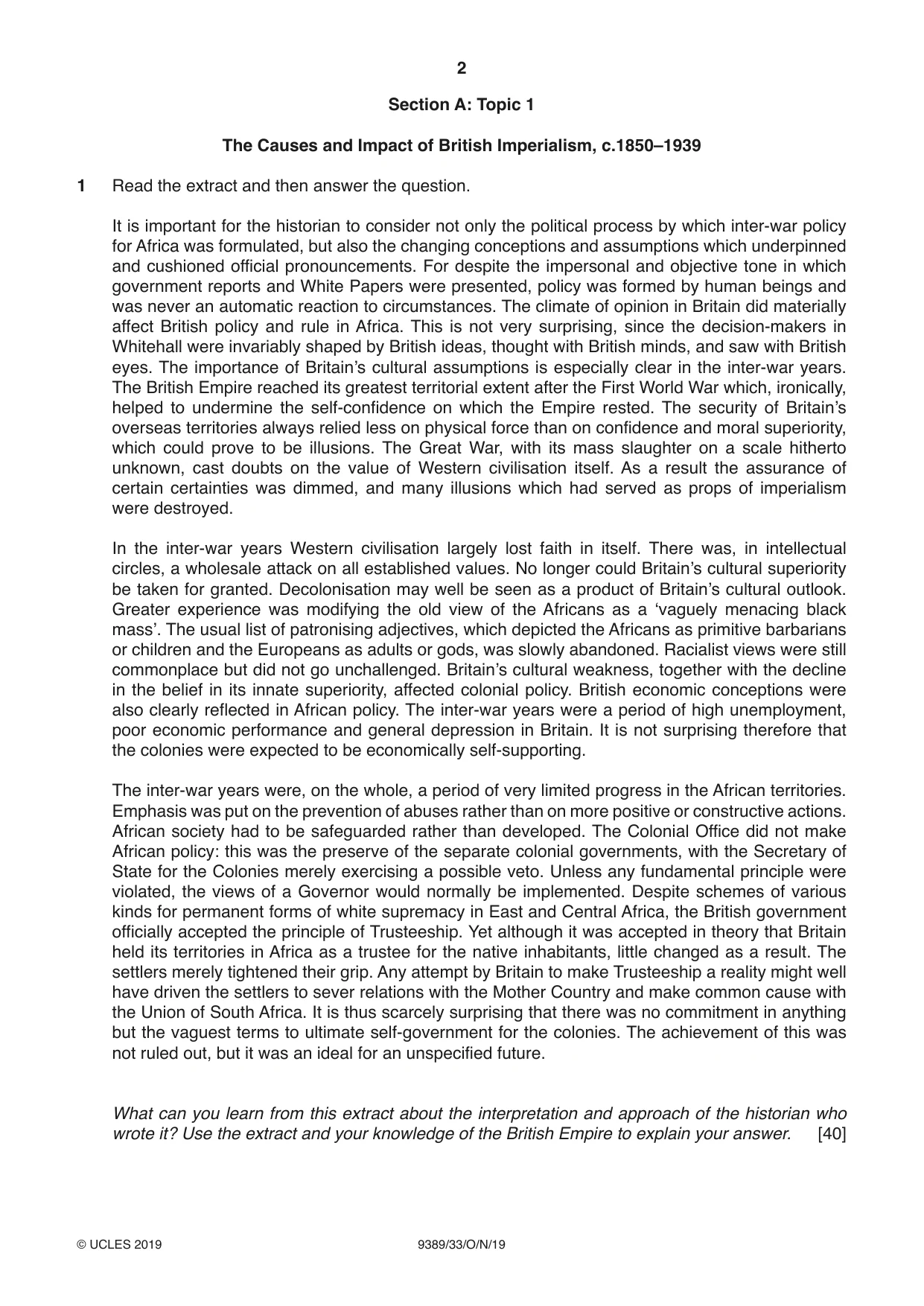
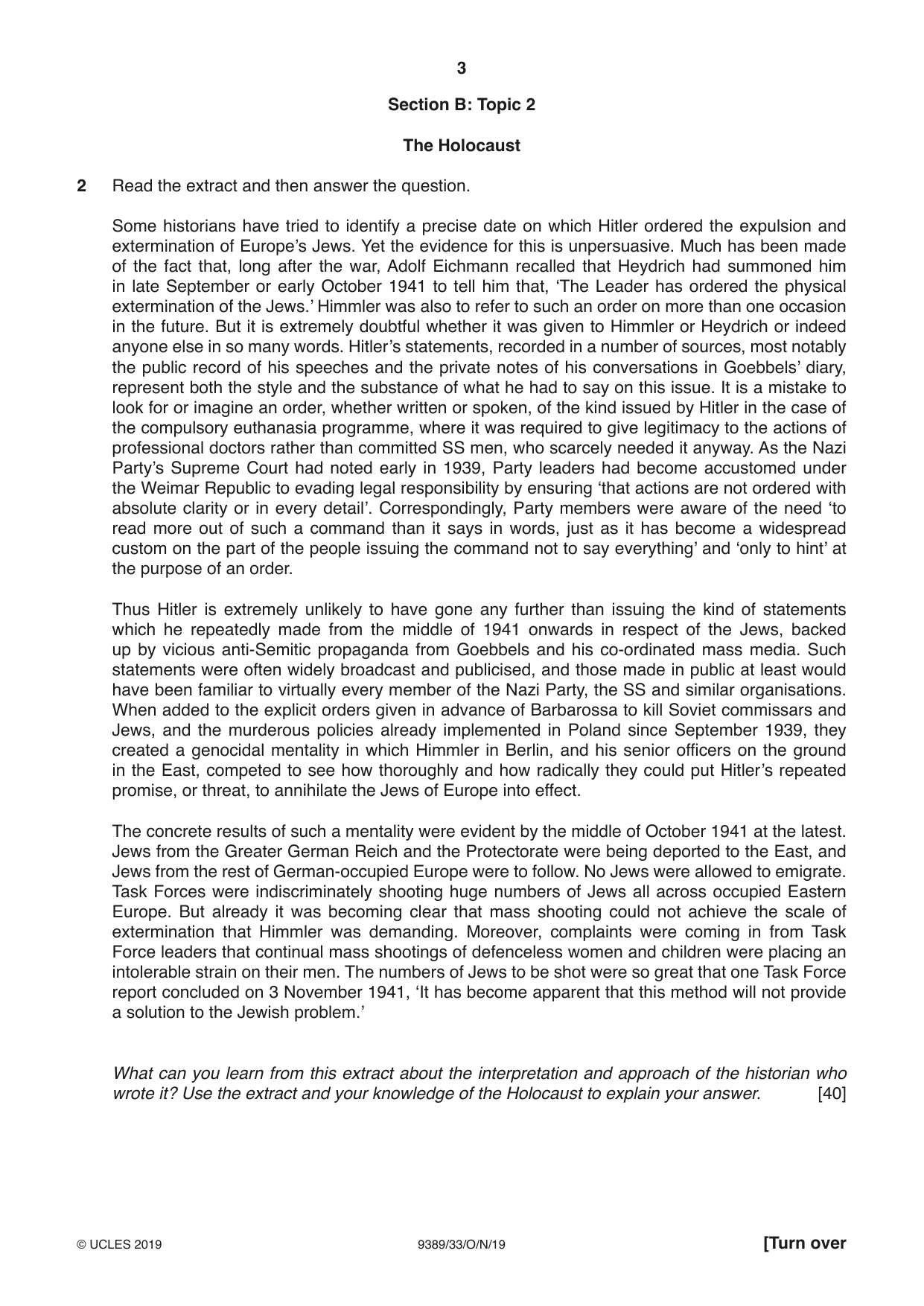
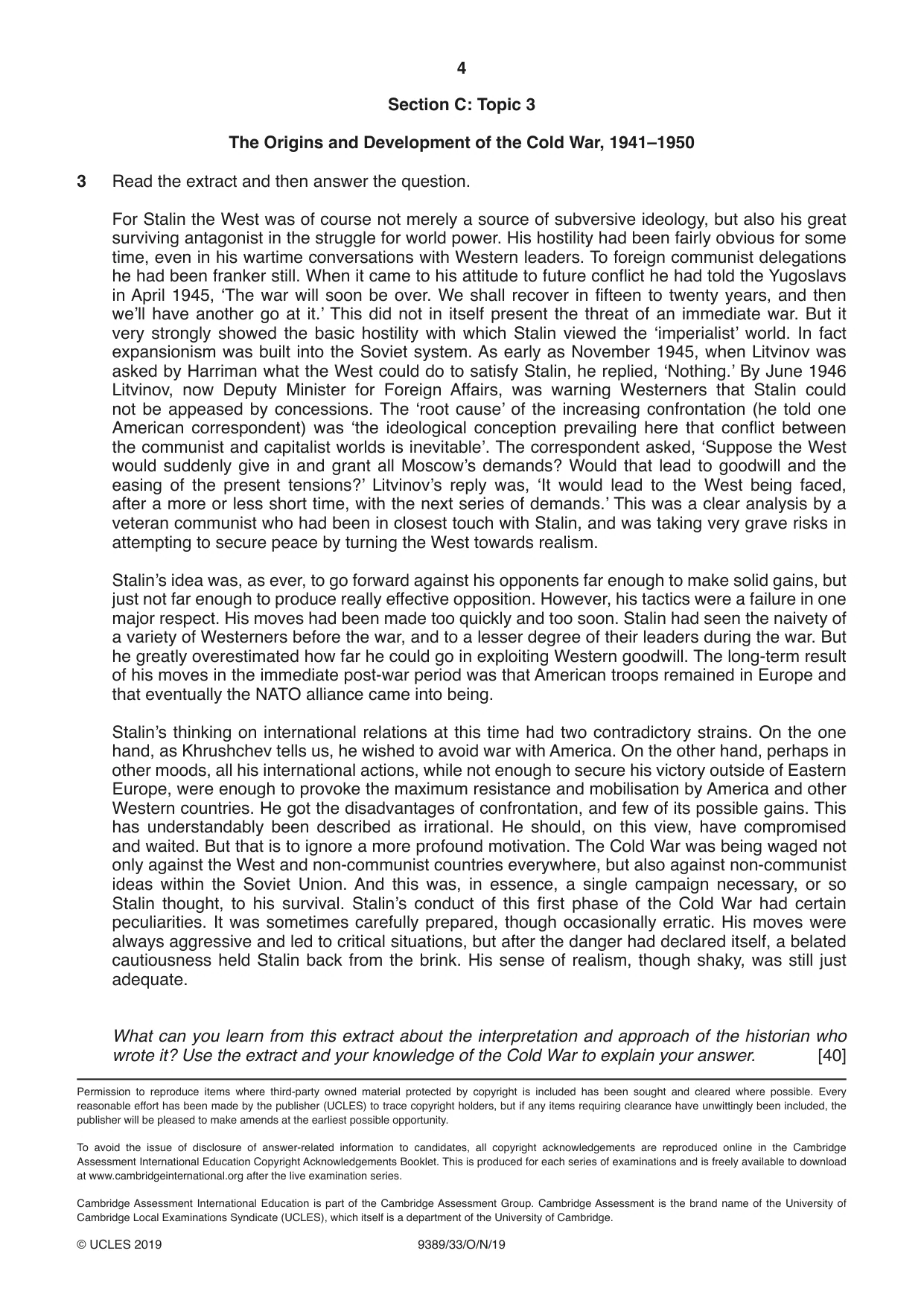
Mark scheme7 pages
Answers below. Sit the paper first if you are practising.

Questions as text
Q1 · Read the extract and then answer the question
1 Read the extract and then answer the question. It is important for the historian to consider not only the political process by which inter-war policy for Africa was formulated, but also the changing conceptions and assumptions which underpinned and cushioned official pronouncements. For despite the impersonal and objective tone in which government reports and White Papers were presented, policy was formed by human beings and was never an automatic reaction to circumstances. The climate of opinion in Britain did materially affect British policy and rule in Africa. This is not very surprising, since the decision-makers in Whitehall were invariably shaped by British ideas, thought with British minds, and saw with British eyes. The importance of Britain’s cultural assumptions is especially clear in the inter-war years. The British Empire reached its greatest territorial extent after the First World War which, ironically, helped to undermine the self-confidence on which the Empire rested. The security of Britain’s overseas territories always relied less on physical force than on confidence and moral superiority, which could prove to be illusions. The Great War, with its mass slaughter on a scale hitherto unknown, cast doubts on the value of Western civilisation itself. As a result the assurance of certain certainties was dimmed, and many illusions which had served as props of imperialism were destroyed. In the inter-war years Western civilisation largely lost faith in itself. There was, in intellectual circles, a wholesale attack on all established values. No longer could Britain’s cultural superiority be taken for granted. Decolonisation may well be seen as a product of Britain’s cultural outlook. Greater experience was modifying the old view of the Africans as a ‘vaguely menacing black mass’. The usual list of patronising adjectives, which depicted the Africans as primitive barbarians or children and the Europeans as adults or gods, was slowly abandoned. Racialist views were still commonplace but did not go unchallenged. Britain’s cultural weakness, together with the decline in the belief in its innate superiority, affected colonial policy. British economic conceptions were also clearly reflected in African policy. The inter-war years were a period of high unemployment, poor economic performance and general depression in Britain. It is not surprising therefore that the colonies were expected to be economically self-supporting. The inter-war years were, on the whole, a period of very limited progress in the African territories. Emphasis was put on the prevention of abuses rather than on more positive or constructive actions. African society had to be safeguarded rather than developed. The Colonial Office did not make African policy: this was the preserve of the separate colonial governments, with the Secretary of State for the Colonies merely exercising a possible veto. Unless any fundamental principle were violated, the views of a Governor would normally be implemented. Despite schemes of various kinds for permanent forms of white supremacy in East and Central Africa, the British government officially accepted the principle of Trusteeship. Yet although it was accepted in theory that Britain held its territories in Africa as a trustee for the native inhabitants, little changed as a result. The settlers merely tightened their grip. Any attempt by Britain to make Trusteeship a reality might well have driven the settlers to sever relations with the Mother Country and make common cause with the Union of South Africa. It is thus scarcely surprising that there was no commitment in anything but the vaguest terms to ultimate self-government for the colonies. The achievement of this was not ruled out, but it was an ideal for an unspecified future. What can you learn from this extract about the interpretation and approach of the historian who wrote it? Use the extract and your knowledge of the British Empire to explain your answer. [40]
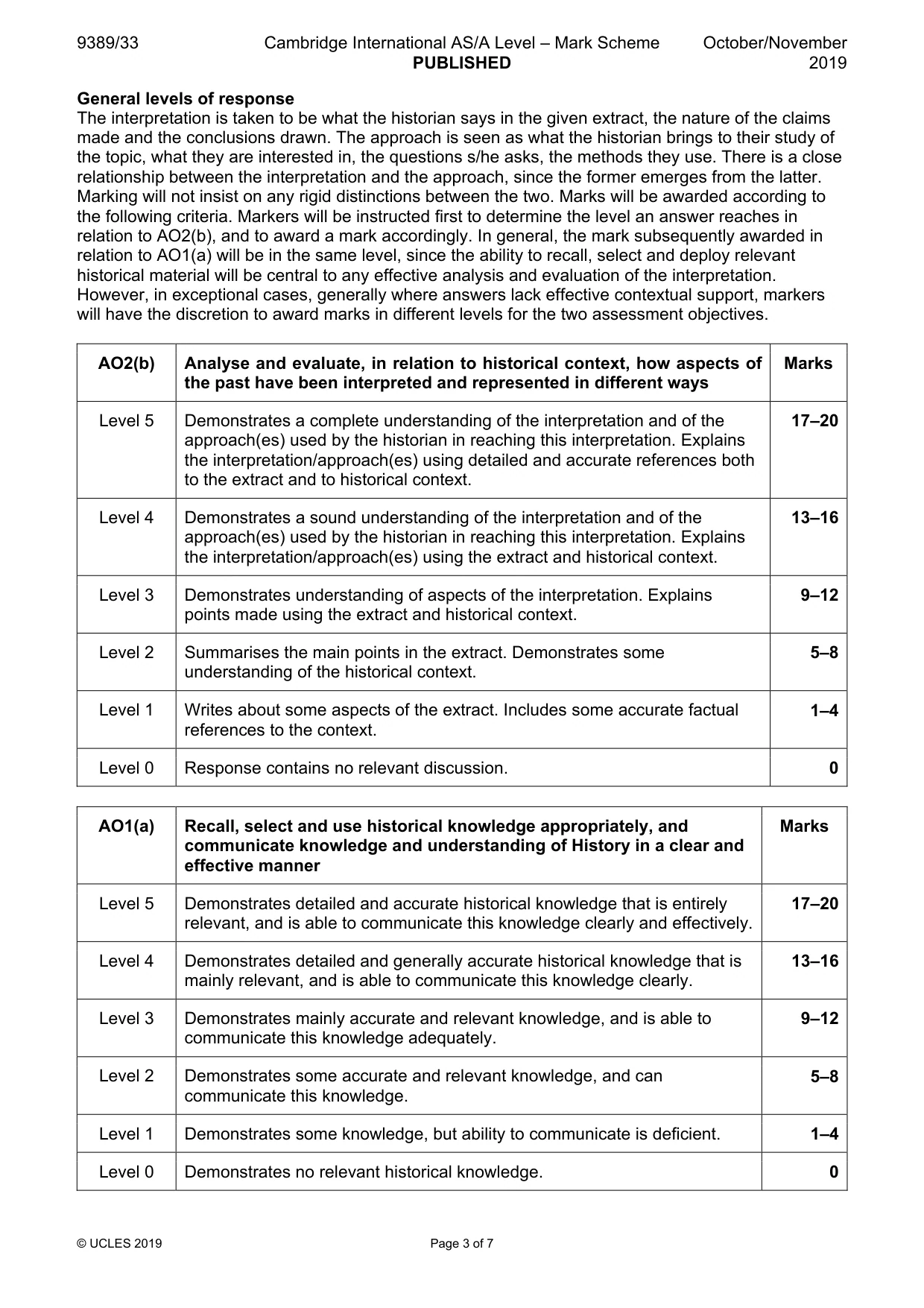
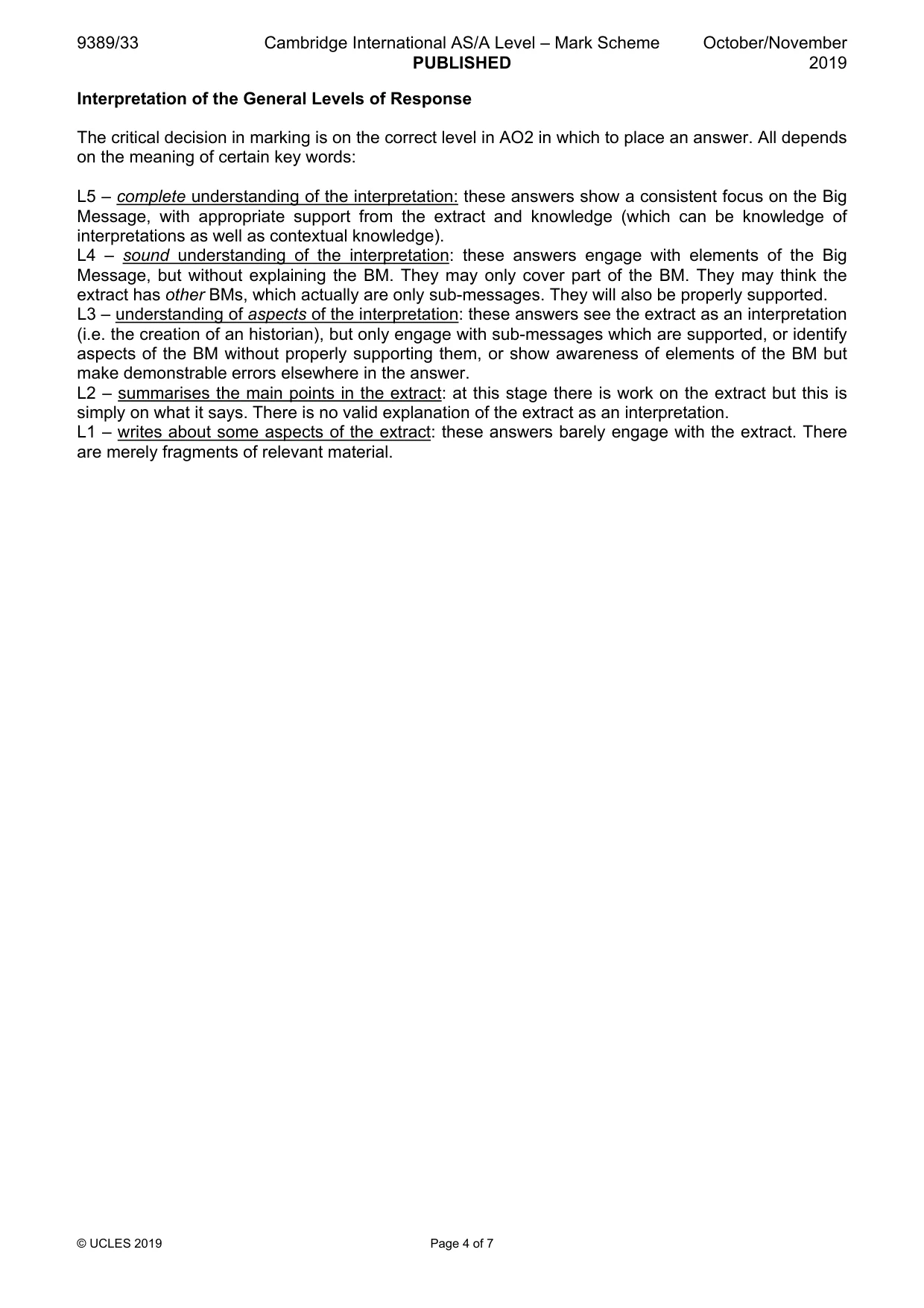
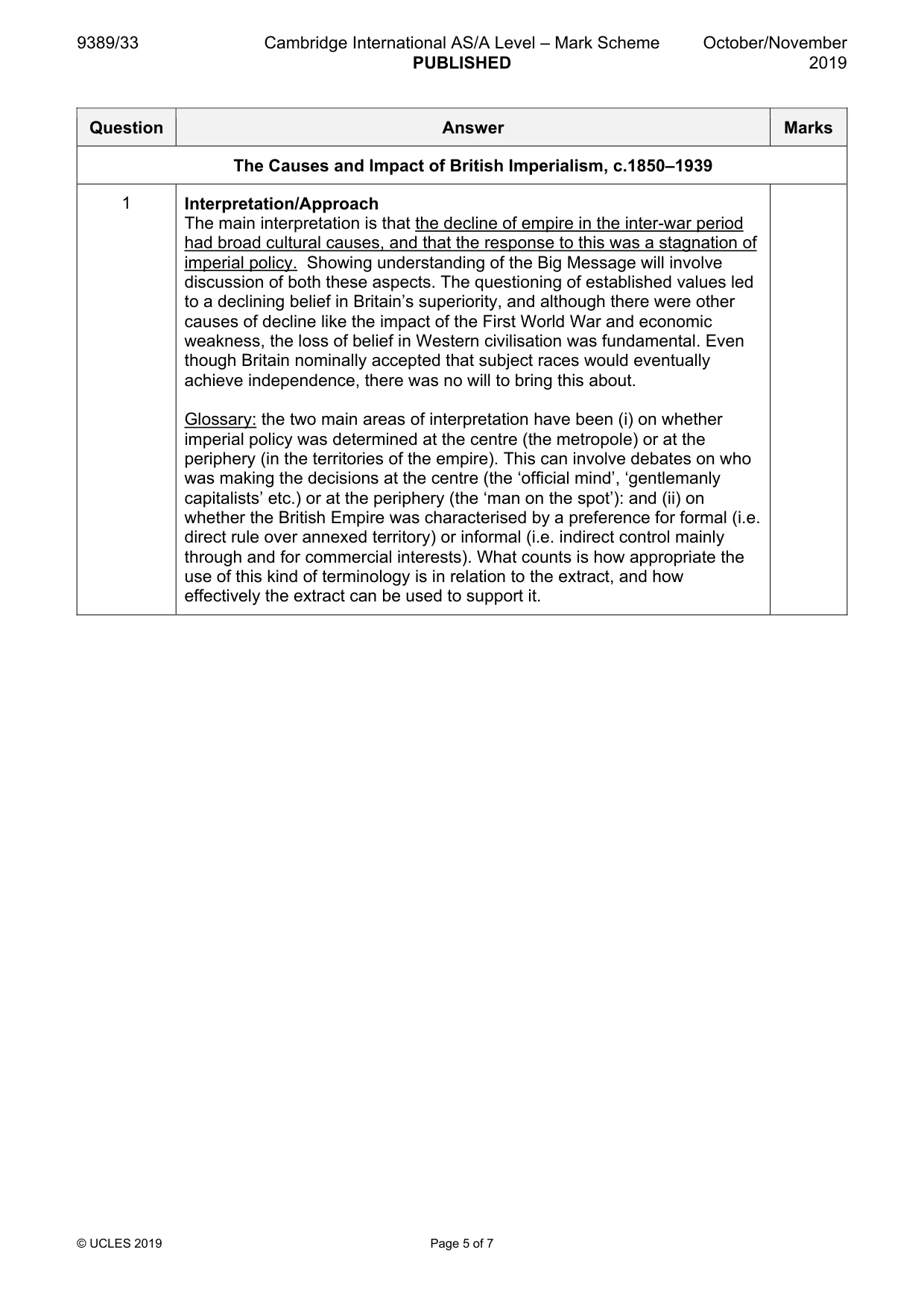
Mark scheme: Question Answer Marks The Causes and Impact of British Imperialism, c.1850–1939 1 Interpretation/Approach The main interpretation is that the decline of empire in the inter-war period had broad cultural causes, and that the response to this was a stagnation of imperial policy. Showing understanding of the Big Message will involve discussion of both these aspects. The questioning of established values led to a declining belief in Britain’s superiority, and although there were other causes of decline like the impact of the First World War and economic weakness, the loss of belief in Western civilisation was fundamental. Even though Britain nominally accepted that subject races would eventually achieve independence, there was no will to bring this about. Glossary: the two main areas of interpretation have been (i) on whether imperial policy was determined at the centre (the metropole) or at the periphery (in the territories of the empire). This can involve debates on who was making the decisions at the centre (the ‘official mind’, ‘gentlemanly capitalists’ etc.) or at the periphery (the ‘man on the spot’): and (ii) on whether the British Empire was characterised by a preference for formal (i.e. direct rule over annexed territory) or informal (i.e. indirect control mainly through and for commercial interests). What counts is how appropriate the use of this kind of terminology is in relation to the extract, and how effectively the extract can be used to support it.
Q2 · Read the extract and then answer the question
2 Read the extract and then answer the question. Some historians have tried to identify a precise date on which Hitler ordered the expulsion and extermination of Europe’s Jews. Yet the evidence for this is unpersuasive. Much has been made of the fact that, long after the war, Adolf Eichmann recalled that Heydrich had summoned him in late September or early October 1941 to tell him that, ‘The Leader has ordered the physical extermination of the Jews.’ Himmler was also to refer to such an order on more than one occasion in the future. But it is extremely doubtful whether it was given to Himmler or Heydrich or indeed anyone else in so many words. Hitler’s statements, recorded in a number of sources, most notably the public record of his speeches and the private notes of his conversations in Goebbels’ diary, represent both the style and the substance of what he had to say on this issue. It is a mistake to look for or imagine an order, whether written or spoken, of the kind issued by Hitler in the case of the compulsory euthanasia programme, where it was required to give legitimacy to the actions of professional doctors rather than committed SS men, who scarcely needed it anyway. As the Nazi Party’s Supreme Court had noted early in 1939, Party leaders had become accustomed under the Weimar Republic to evading legal responsibility by ensuring ‘that actions are not ordered with absolute clarity or in every detail’. Correspondingly, Party members were aware of the need ‘to read more out of such a command than it says in words, just as it has become a widespread custom on the part of the people issuing the command not to say everything’ and ‘only to hint’ at the purpose of an order. Thus Hitler is extremely unlikely to have gone any further than issuing the kind of statements which he repeatedly made from the middle of 1941 onwards in respect of the Jews, backed up by vicious anti-Semitic propaganda from Goebbels and his co-ordinated mass media. Such statements were often widely broadcast and publicised, and those made in public at least would have been familiar to virtually every member of the Nazi Party, the SS and similar organisations. When added to the explicit orders given in advance of Barbarossa to kill Soviet commissars and Jews, and the murderous policies already implemented in Poland since September 1939, they created a genocidal mentality in which Himmler in Berlin, and his senior officers on the ground in the East, competed to see how thoroughly and how radically they could put Hitler’s repeated promise, or threat, to annihilate the Jews of Europe into effect. The concrete results of such a mentality were evident by the middle of October 1941 at the latest. Jews from the Greater German Reich and the Protectorate were being deported to the East, and Jews from the rest of German-occupied Europe were to follow. No Jews were allowed to emigrate. Task Forces were indiscriminately shooting huge numbers of Jews all across occupied Eastern Europe. But already it was becoming clear that mass shooting could not achieve the scale of extermination that Himmler was demanding. Moreover, complaints were coming in from Task Force leaders that continual mass shootings of defenceless women and children were placing an intolerable strain on their men. The numbers of Jews to be shot were so great that one Task Force report concluded on 3 November 1941, ‘It has become apparent that this method will not provide a solution to the Jewish problem.’ What can you learn from this extract about the interpretation and approach of the historian who wrote it? Use the extract and your knowledge of the Holocaust to explain your answer. [40] Section C: Topic 3 The Origins and Development of the Cold War, 1941–1950
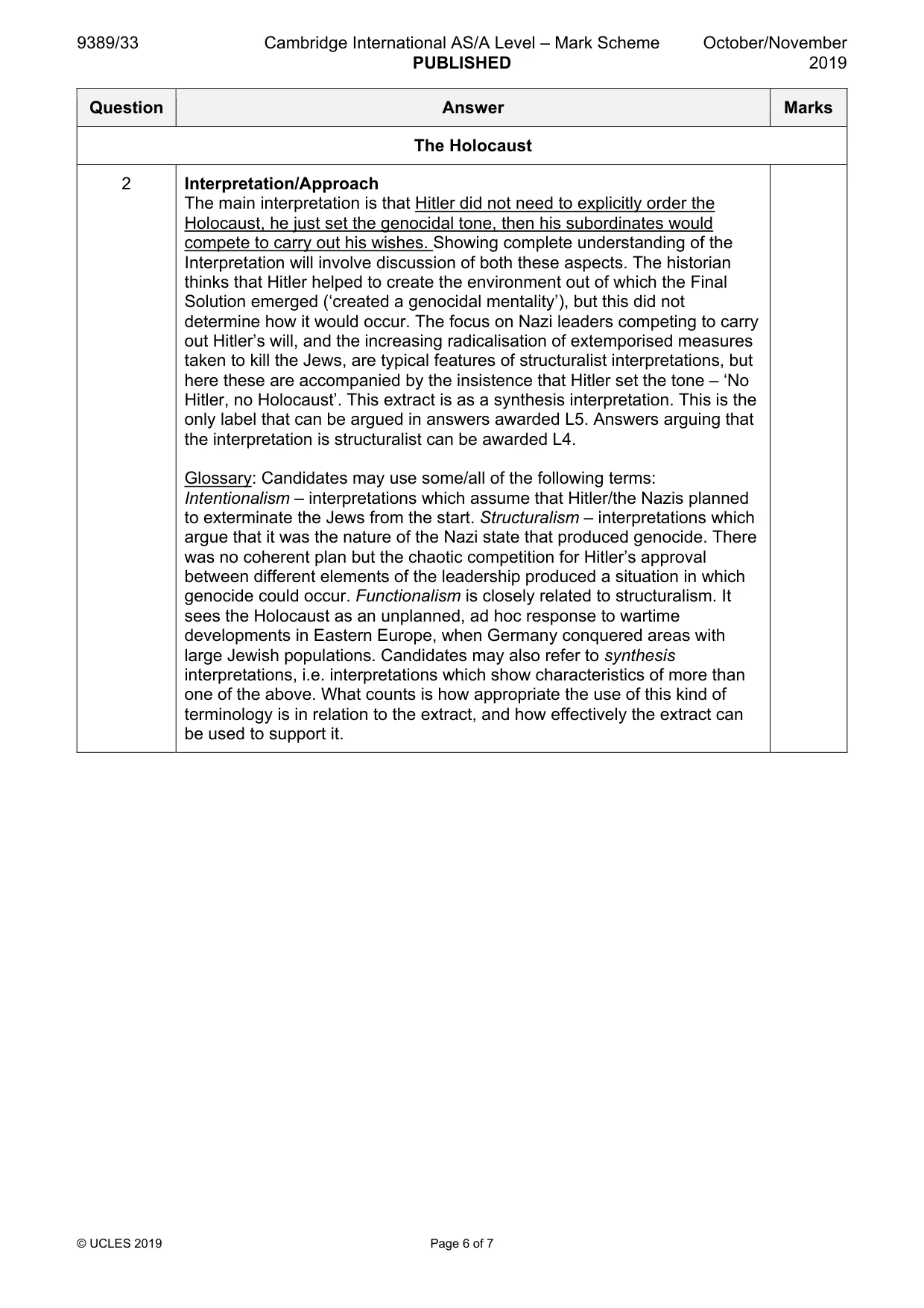
Mark scheme: Question Answer Marks The Holocaust 2 Interpretation/Approach The main interpretation is that Hitler did not need to explicitly order the Holocaust, he just set the genocidal tone, then his subordinates would compete to carry out his wishes. Showing complete understanding of the Interpretation will involve discussion of both these aspects. The historian thinks that Hitler helped to create the environment out of which the Final Solution emerged (‘created a genocidal mentality’), but this did not determine how it would occur. The focus on Nazi leaders competing to carry out Hitler’s will, and the increasing radicalisation of extemporised measures taken to kill the Jews, are typical features of structuralist interpretations, but here these are accompanied by the insistence that Hitler set the tone – ‘No Hitler, no Holocaust’. This extract is as a synthesis interpretation. This is the only label that can be argued in answers awarded L5. Answers arguing that the interpretation is structuralist can be awarded L4. Glossary: Candidates may use some/all of the following terms: Intentionalism – interpretations which assume that Hitler/the Nazis planned to exterminate the Jews from the start. Structuralism – interpretations which argue that it was the nature of the Nazi state that produced genocide. There was no coherent plan but the chaotic competition for Hitler’s approval between different elements of the leadership produced a situation in which genocide could occur. Functionalism is closely related to structuralism. It sees the Holocaust as an unplanned, ad hoc response to wartime developments in Eastern Europe, when Germany conquered areas with large Jewish populations. Candidates may also refer to synthesis interpretations, i.e. interpretations which show characteristics of more than one of the above. What counts is how appropriate the use of this kind of terminology is in relation to the extract, and how effectively the extract can be used to support it.
Q3 · Read the extract and then answer the question
3 Read the extract and then answer the question. For Stalin the West was of course not merely a source of subversive ideology, but also his great surviving antagonist in the struggle for world power. His hostility had been fairly obvious for some time, even in his wartime conversations with Western leaders. To foreign communist delegations he had been franker still. When it came to his attitude to future conflict he had told the Yugoslavs in April 1945, ‘The war will soon be over. We shall recover in fifteen to twenty years, and then we’ll have another go at it.’ This did not in itself present the threat of an immediate war. But it very strongly showed the basic hostility with which Stalin viewed the ‘imperialist’ world. In fact expansionism was built into the Soviet system. As early as November 1945, when Litvinov was asked by Harriman what the West could do to satisfy Stalin, he replied, ‘Nothing.’ By June 1946 Litvinov, now Deputy Minister for Foreign Affairs, was warning Westerners that Stalin could not be appeased by concessions. The ‘root cause’ of the increasing confrontation (he told one American correspondent) was ‘the ideological conception prevailing here that conflict between the communist and capitalist worlds is inevitable’. The correspondent asked, ‘Suppose the West would suddenly give in and grant all Moscow’s demands? Would that lead to goodwill and the easing of the present tensions?’ Litvinov’s reply was, ‘It would lead to the West being faced, after a more or less short time, with the next series of demands.’ This was a clear analysis by a veteran communist who had been in closest touch with Stalin, and was taking very grave risks in attempting to secure peace by turning the West towards realism. Stalin’s idea was, as ever, to go forward against his opponents far enough to make solid gains, but just not far enough to produce really effective opposition. However, his tactics were a failure in one major respect. His moves had been made too quickly and too soon. Stalin had seen the naivety of a variety of Westerners before the war, and to a lesser degree of their leaders during the war. But he greatly overestimated how far he could go in exploiting Western goodwill. The long-term result of his moves in the immediate post-war period was that American troops remained in Europe and that eventually the NATO alliance came into being. Stalin’s thinking on international relations at this time had two contradictory strains. On the one hand, as Khrushchev tells us, he wished to avoid war with America. On the other hand, perhaps in other moods, all his international actions, while not enough to secure his victory outside of Eastern Europe, were enough to provoke the maximum resistance and mobilisation by America and other Western countries. He got the disadvantages of confrontation, and few of its possible gains. This has understandably been described as irrational. He should, on this view, have compromised and waited. But that is to ignore a more profound motivation. The Cold War was being waged not only against the West and non-communist countries everywhere, but also against non-communist ideas within the Soviet Union. And this was, in essence, a single campaign necessary, or so Stalin thought, to his survival. Stalin’s conduct of this first phase of the Cold War had certain peculiarities. It was sometimes carefully prepared, though occasionally erratic. His moves were always aggressive and led to critical situations, but after the danger had declared itself, a belated cautiousness held Stalin back from the brink. His sense of realism, though shaky, was still just adequate. What can you learn from this extract about the interpretation and approach of the historian who wrote it? Use the extract and your knowledge of the Cold War to explain your answer. [40]
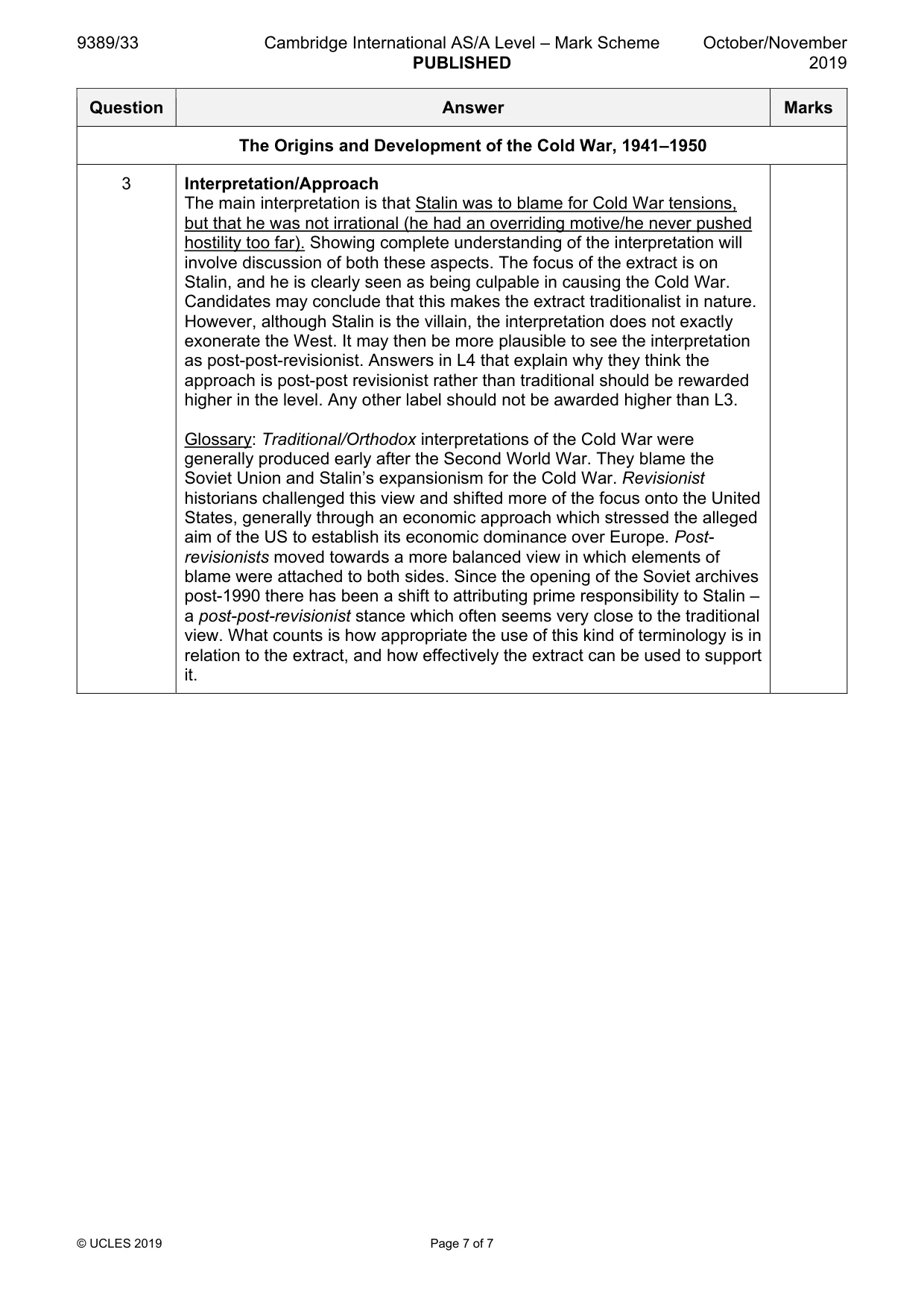
Mark scheme: Question Answer Marks The Origins and Development of the Cold War, 1941–1950 3 Interpretation/Approach The main interpretation is that Stalin was to blame for Cold War tensions, but that he was not irrational (he had an overriding motive/he never pushed hostility too far). Showing complete understanding of the interpretation will involve discussion of both these aspects. The focus of the extract is on Stalin, and he is clearly seen as being culpable in causing the Cold War. Candidates may conclude that this makes the extract traditionalist in nature. However, although Stalin is the villain, the interpretation does not exactly exonerate the West. It may then be more plausible to see the interpretation as post-post-revisionist. Answers in L4 that explain why they think the approach is post-post revisionist rather than traditional should be rewarded higher in the level. Any other label should not be awarded higher than L3. Glossary: Traditional/Orthodox interpretations of the Cold War were generally produced early after the Second World War. They blame the Soviet Union and Stalin’s expansionism for the Cold War. Revisionist historians challenged this view and shifted more of the focus onto the United States, generally through an economic approach which stressed the alleged aim of the US to establish its economic dominance over Europe. Post- revisionists moved towards a more balanced view in which elements of blame were attached to both sides. Since the opening of the Soviet archives post-1990 there has been a shift to attributing prime responsibility to Stalin – a post-post-revisionist stance which often seems very close to the traditional view. What counts is how appropriate the use of this kind of terminology is in relation to the extract, and how effectively the extract can be used to support it.
What you needed in this session
Cambridge’s own grade thresholds for 2019 Oct/Nov, Paper 3 · Variant 3. A higher threshold means an easier paper — the bar moves with how the cohort did.