Cambridge A Level History 9389 — 2021 Oct/Nov Paper 3 · Variant 1
9389/31/O/N/21 · 3 questions · 40 marks · ≈45 min
The question paper and its mark scheme, free to read here and free to download. This is Cambridge’s own paper, exactly as it was sat.
Question paper8 pages
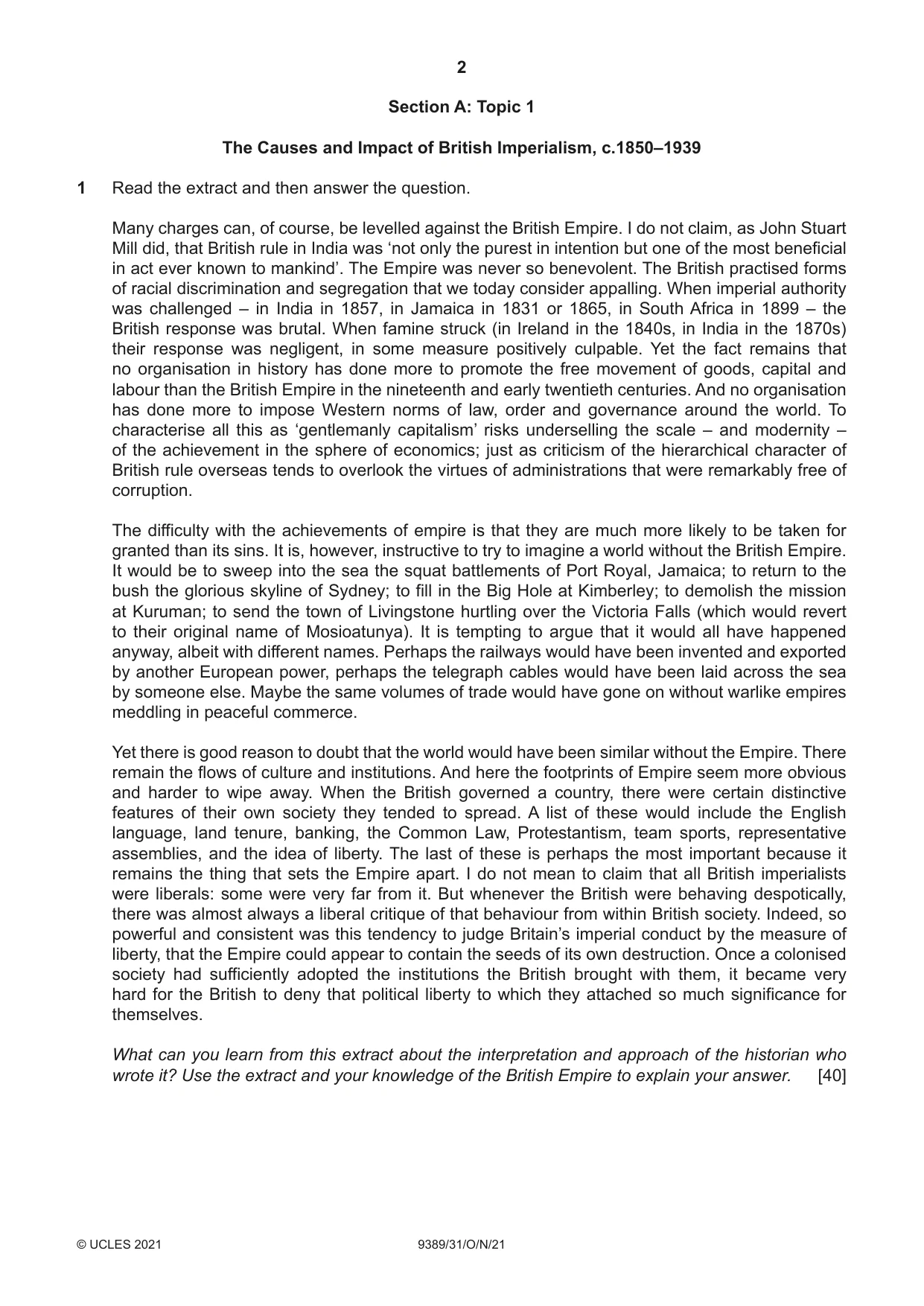
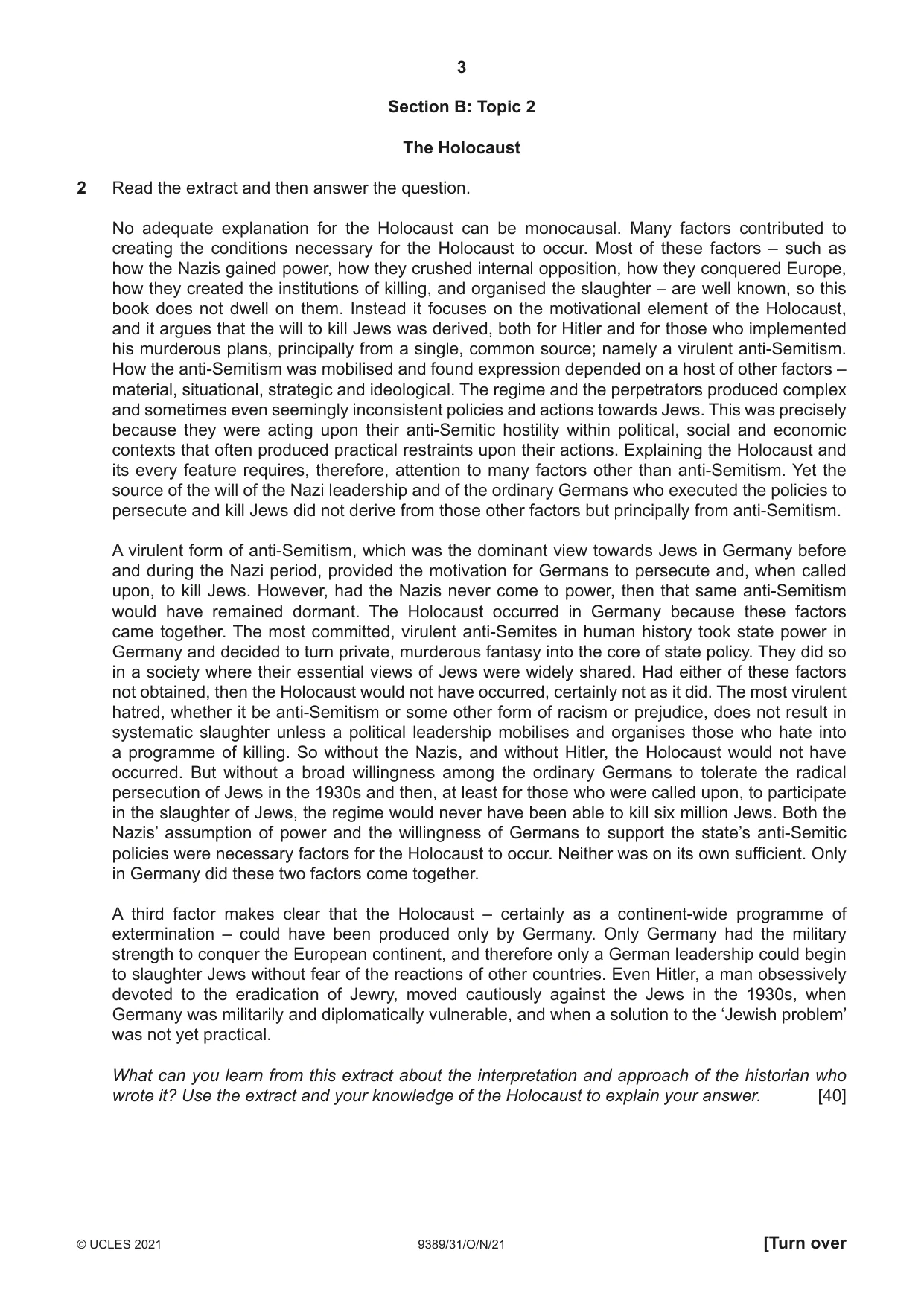
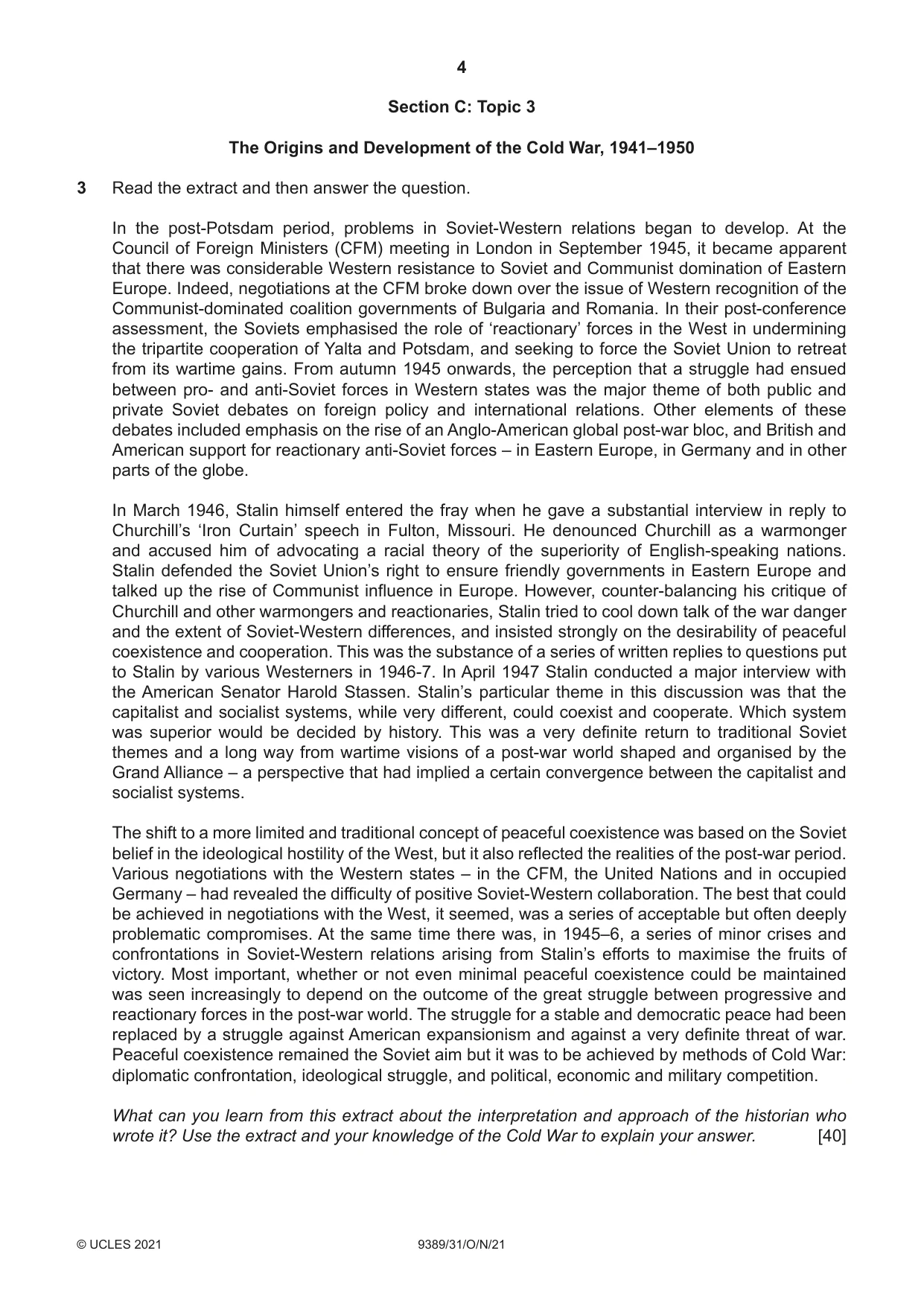



Mark scheme7 pages
Answers below. Sit the paper first if you are practising.

Questions as text
Q1 · Read the extract and then answer the question
1 Read the extract and then answer the question. Many charges can, of course, be levelled against the British Empire. I do not claim, as John Stuart Mill did, that British rule in India was ‘not only the purest in intention but one of the most beneficial in act ever known to mankind’. The Empire was never so benevolent. The British practised forms of racial discrimination and segregation that we today consider appalling. When imperial authority was challenged – in India in 1857, in Jamaica in 1831 or 1865, in South Africa in 1899 – the British response was brutal. When famine struck (in Ireland in the 1840s, in India in the 1870s) their response was negligent, in some measure positively culpable. Yet the fact remains that no organisation in history has done more to promote the free movement of goods, capital and labour than the British Empire in the nineteenth and early twentieth centuries. And no organisation has done more to impose Western norms of law, order and governance around the world. To characterise all this as ‘gentlemanly capitalism’ risks underselling the scale – and modernity – of the achievement in the sphere of economics; just as criticism of the hierarchical character of British rule overseas tends to overlook the virtues of administrations that were remarkably free of corruption. The difficulty with the achievements of empire is that they are much more likely to be taken for granted than its sins. It is, however, instructive to try to imagine a world without the British Empire. It would be to sweep into the sea the squat battlements of Port Royal, Jamaica; to return to the bush the glorious skyline of Sydney; to fill in the Big Hole at Kimberley; to demolish the mission at Kuruman; to send the town of Livingstone hurtling over the Victoria Falls (which would revert to their original name of Mosioatunya). It is tempting to argue that it would all have happened anyway, albeit with different names. Perhaps the railways would have been invented and exported by another European power, perhaps the telegraph cables would have been laid across the sea by someone else. Maybe the same volumes of trade would have gone on without warlike empires meddling in peaceful commerce. Yet there is good reason to doubt that the world would have been similar without the Empire. There remain the flows of culture and institutions. And here the footprints of Empire seem more obvious and harder to wipe away. When the British governed a country, there were certain distinctive features of their own society they tended to spread. A list of these would include the English language, land tenure, banking, the Common Law, Protestantism, team sports, representative assemblies, and the idea of liberty. The last of these is perhaps the most important because it remains the thing that sets the Empire apart. I do not mean to claim that all British imperialists were liberals: some were very far from it. But whenever the British were behaving despotically, there was almost always a liberal critique of that behaviour from within British society. Indeed, so powerful and consistent was this tendency to judge Britain’s imperial conduct by the measure of liberty, that the Empire could appear to contain the seeds of its own destruction. Once a colonised society had sufficiently adopted the institutions the British brought with them, it became very hard for the British to deny that political liberty to which they attached so much significance for themselves. What can you learn from this extract about the interpretation and approach of the historian who wrote it? Use the extract and your knowledge of the British Empire to explain your answer. [40]
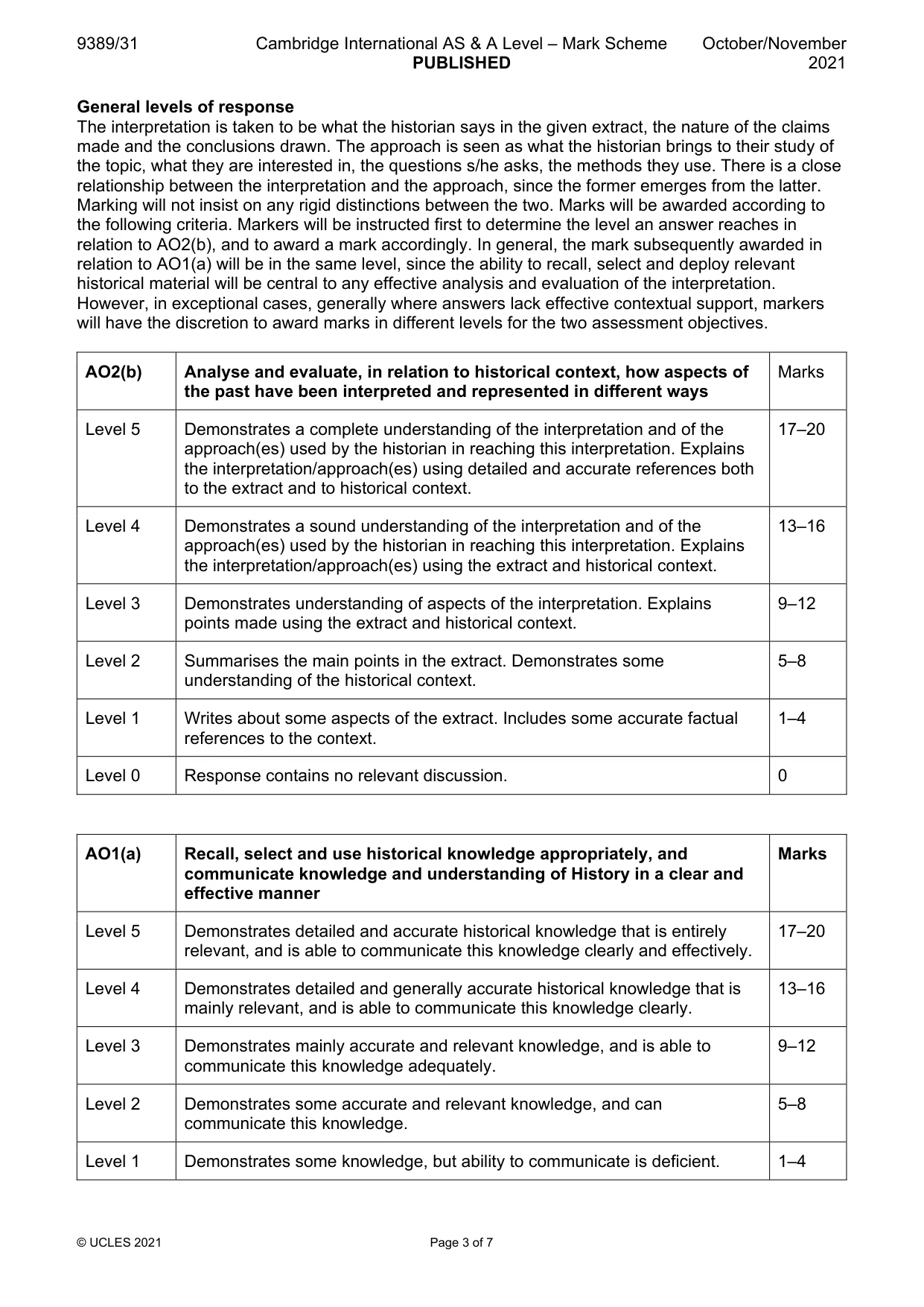
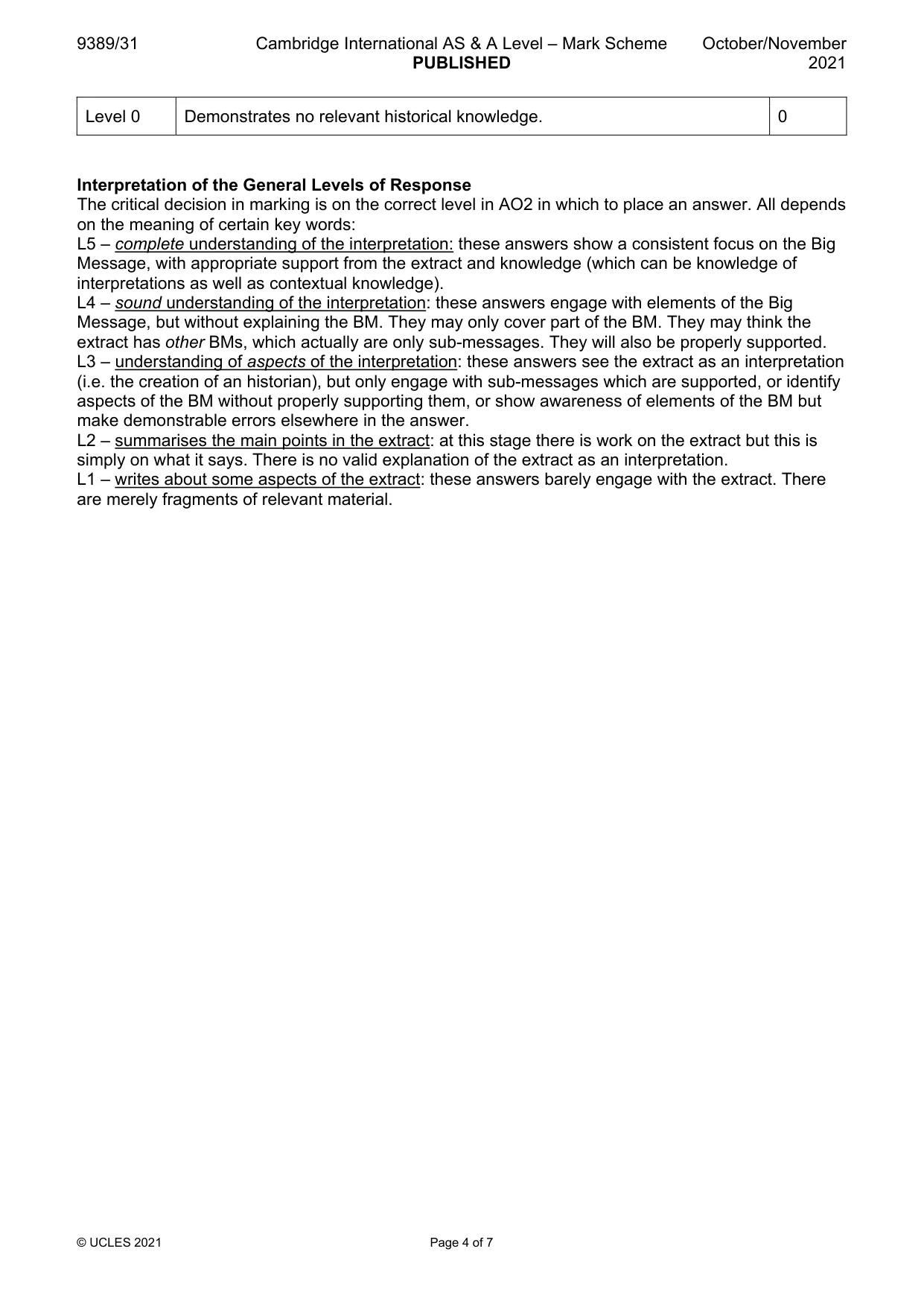
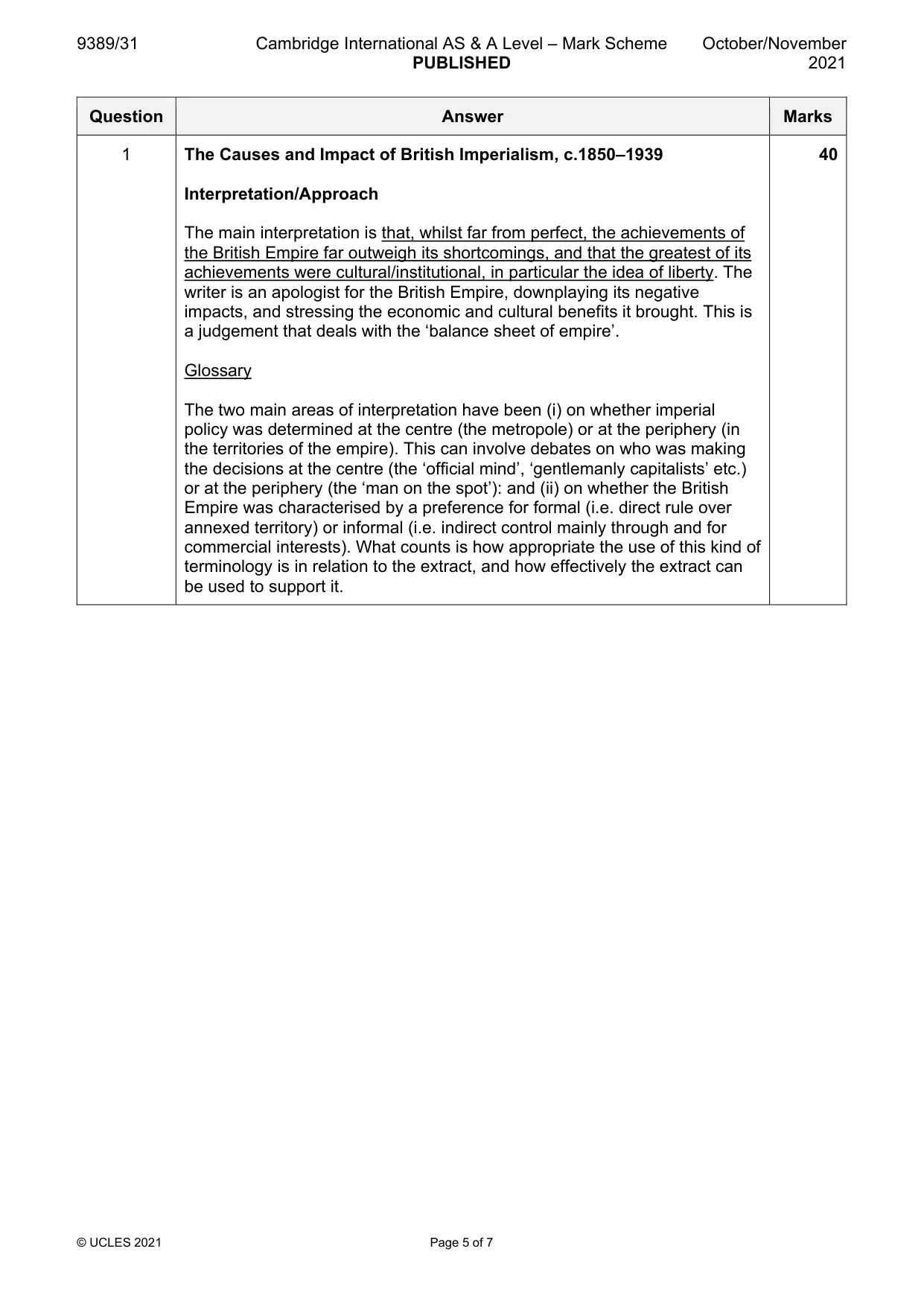
Mark scheme: Question Answer Marks 1 The Causes and Impact of British Imperialism, c.1850–1939 40 Interpretation/Approach The main interpretation is that, whilst far from perfect, the achievements of the British Empire far outweigh its shortcomings, and that the greatest of its achievements were cultural/institutional, in particular the idea of liberty. The writer is an apologist for the British Empire, downplaying its negative impacts, and stressing the economic and cultural benefits it brought. This is a judgement that deals with the ‘balance sheet of empire’. Glossary The two main areas of interpretation have been (i) on whether imperial policy was determined at the centre (the metropole) or at the periphery (in the territories of the empire). This can involve debates on who was making the decisions at the centre (the ‘official mind’, ‘gentlemanly capitalists’ etc.) or at the periphery (the ‘man on the spot’): and (ii) on whether the British Empire was characterised by a preference for formal (i.e. direct rule over annexed territory) or informal (i.e. indirect control mainly through and for commercial interests). What counts is how appropriate the use of this kind of terminology is in relation to the extract, and how effectively the extract can be used to support it.
Q2 · Read the extract and then answer the question
2 Read the extract and then answer the question. No adequate explanation for the Holocaust can be monocausal. Many factors contributed to creating the conditions necessary for the Holocaust to occur. Most of these factors – such as how the Nazis gained power, how they crushed internal opposition, how they conquered Europe, how they created the institutions of killing, and organised the slaughter – are well known, so this book does not dwell on them. Instead it focuses on the motivational element of the Holocaust, and it argues that the will to kill Jews was derived, both for Hitler and for those who implemented his murderous plans, principally from a single, common source; namely a virulent anti-Semitism. How the anti-Semitism was mobilised and found expression depended on a host of other factors – material, situational, strategic and ideological. The regime and the perpetrators produced complex and sometimes even seemingly inconsistent policies and actions towards Jews. This was precisely because they were acting upon their anti-Semitic hostility within political, social and economic contexts that often produced practical restraints upon their actions. Explaining the Holocaust and its every feature requires, therefore, attention to many factors other than anti-Semitism. Yet the source of the will of the Nazi leadership and of the ordinary Germans who executed the policies to persecute and kill Jews did not derive from those other factors but principally from anti-Semitism. A virulent form of anti-Semitism, which was the dominant view towards Jews in Germany before and during the Nazi period, provided the motivation for Germans to persecute and, when called upon, to kill Jews. However, had the Nazis never come to power, then that same anti-Semitism would have remained dormant. The Holocaust occurred in Germany because these factors came together. The most committed, virulent anti-Semites in human history took state power in Germany and decided to turn private, murderous fantasy into the core of state policy. They did so in a society where their essential views of Jews were widely shared. Had either of these factors not obtained, then the Holocaust would not have occurred, certainly not as it did. The most virulent hatred, whether it be anti-Semitism or some other form of racism or prejudice, does not result in systematic slaughter unless a political leadership mobilises and organises those who hate into a programme of killing. So without the Nazis, and without Hitler, the Holocaust would not have occurred. But without a broad willingness among the ordinary Germans to tolerate the radical persecution of Jews in the 1930s and then, at least for those who were called upon, to participate in the slaughter of Jews, the regime would never have been able to kill six million Jews. Both the Nazis’ assumption of power and the willingness of Germans to support the state’s anti-Semitic policies were necessary factors for the Holocaust to occur. Neither was on its own sufficient. Only in Germany did these two factors come together. A third factor makes clear that the Holocaust – certainly as a continent-wide programme of extermination – could have been produced only by Germany. Only Germany had the military strength to conquer the European continent, and therefore only a German leadership could begin to slaughter Jews without fear of the reactions of other countries. Even Hitler, a man obsessively devoted to the eradication of Jewry, moved cautiously against the Jews in the 1930s, when Germany was militarily and diplomatically vulnerable, and when a solution to the ‘Jewish problem’ was not yet practical. What can you learn from this extract about the interpretation and approach of the historian who wrote it? Use the extract and your knowledge of the Holocaust to explain your answer. [40] Section C: Topic 3 The Origins and Development of the Cold War, 1941–1950
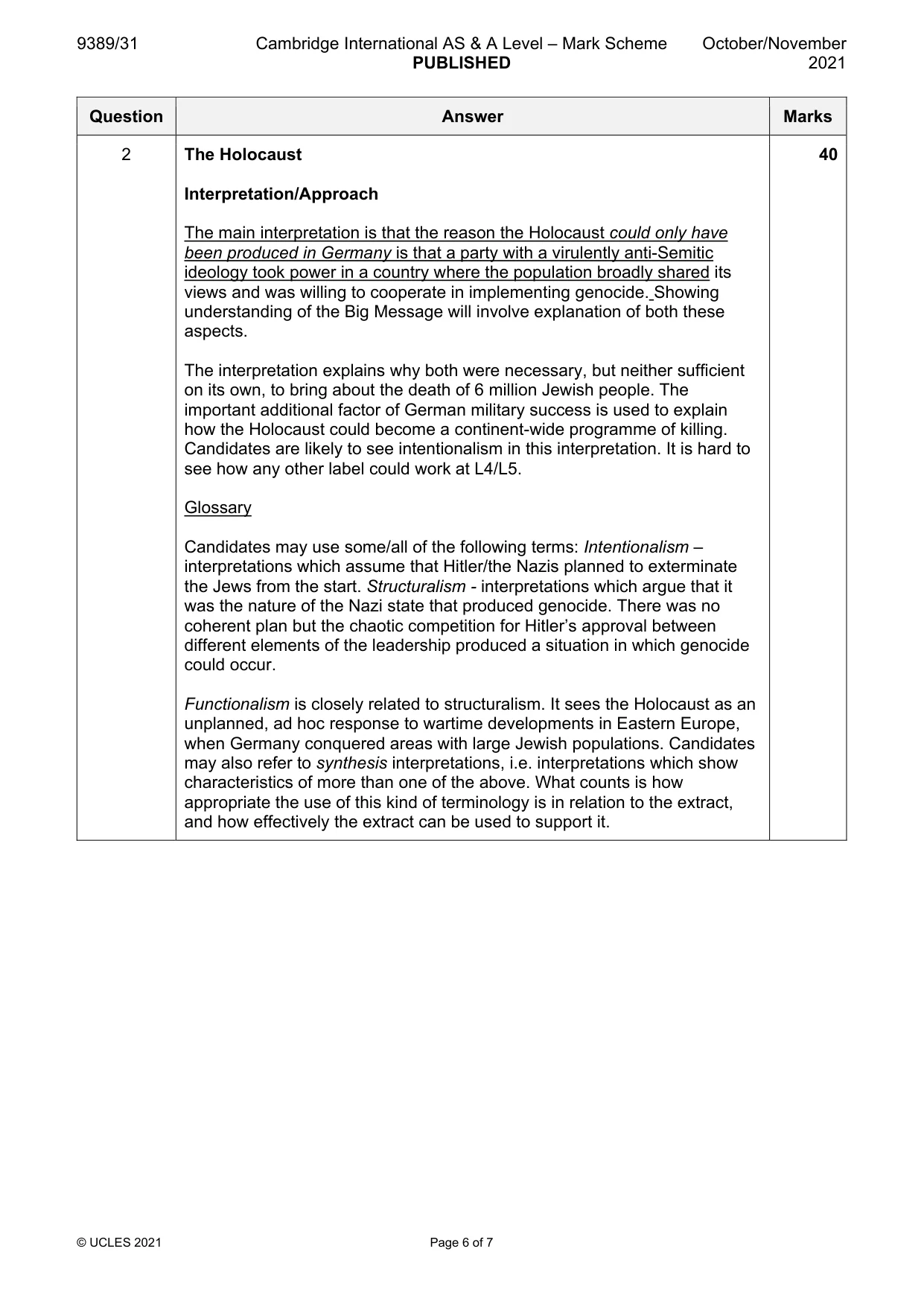
Mark scheme: 2 The Holocaust 40 Interpretation/Approach The main interpretation is that the reason the Holocaust could only have been produced in Germany is that a party with a virulently anti-Semitic ideology took power in a country where the population broadly shared its views and was willing to cooperate in implementing genocide. Showing understanding of the Big Message will involve explanation of both these aspects. The interpretation explains why both were necessary, but neither sufficient on its own, to bring about the death of 6 million Jewish people. The important additional factor of German military success is used to explain how the Holocaust could become a continent-wide programme of killing. Candidates are likely to see intentionalism in this interpretation. It is hard to see how any other label could work at L4/L5. Glossary Candidates may use some/all of the following terms: Intentionalism – interpretations which assume that Hitler/the Nazis planned to exterminate the Jews from the start. Structuralism - interpretations which argue that it was the nature of the Nazi state that produced genocide. There was no coherent plan but the chaotic competition for Hitler’s approval between different elements of the leadership produced a situation in which genocide could occur. Functionalism is closely related to structuralism. It sees the Holocaust as an unplanned, ad hoc response to wartime developments in Eastern Europe, when Germany conquered areas with large Jewish populations. Candidates may also refer to synthesis interpretations, i.e. interpretations which show characteristics of more than one of the above. What counts is how appropriate the use of this kind of terminology is in relation to the extract, and how effectively the extract can be used to support it.
Q3 · Read the extract and then answer the question
3 Read the extract and then answer the question. In the post-Potsdam period, problems in Soviet-Western relations began to develop. At the Council of Foreign Ministers (CFM) meeting in London in September 1945, it became apparent that there was considerable Western resistance to Soviet and Communist domination of Eastern Europe. Indeed, negotiations at the CFM broke down over the issue of Western recognition of the Communist-dominated coalition governments of Bulgaria and Romania. In their post-conference assessment, the Soviets emphasised the role of ‘reactionary’ forces in the West in undermining the tripartite cooperation of Yalta and Potsdam, and seeking to force the Soviet Union to retreat from its wartime gains. From autumn 1945 onwards, the perception that a struggle had ensued between pro- and anti-Soviet forces in Western states was the major theme of both public and private Soviet debates on foreign policy and international relations. Other elements of these debates included emphasis on the rise of an Anglo-American global post-war bloc, and British and American support for reactionary anti-Soviet forces – in Eastern Europe, in Germany and in other parts of the globe. In March 1946, Stalin himself entered the fray when he gave a substantial interview in reply to Churchill’s ‘Iron Curtain’ speech in Fulton, Missouri. He denounced Churchill as a warmonger and accused him of advocating a racial theory of the superiority of English-speaking nations. Stalin defended the Soviet Union’s right to ensure friendly governments in Eastern Europe and talked up the rise of Communist influence in Europe. However, counter-balancing his critique of Churchill and other warmongers and reactionaries, Stalin tried to cool down talk of the war danger and the extent of Soviet-Western differences, and insisted strongly on the desirability of peaceful coexistence and cooperation. This was the substance of a series of written replies to questions put to Stalin by various Westerners in 1946-7. In April 1947 Stalin conducted a major interview with the American Senator Harold Stassen. Stalin’s particular theme in this discussion was that the capitalist and socialist systems, while very different, could coexist and cooperate. Which system was superior would be decided by history. This was a very definite return to traditional Soviet themes and a long way from wartime visions of a post-war world shaped and organised by the Grand Alliance – a perspective that had implied a certain convergence between the capitalist and socialist systems. The shift to a more limited and traditional concept of peaceful coexistence was based on the Soviet belief in the ideological hostility of the West, but it also reflected the realities of the post-war period. Various negotiations with the Western states – in the CFM, the United Nations and in occupied Germany – had revealed the difficulty of positive Soviet-Western collaboration. The best that could be achieved in negotiations with the West, it seemed, was a series of acceptable but often deeply problematic compromises. At the same time there was, in 1945–6, a series of minor crises and confrontations in Soviet-Western relations arising from Stalin’s efforts to maximise the fruits of victory. Most important, whether or not even minimal peaceful coexistence could be maintained was seen increasingly to depend on the outcome of the great struggle between progressive and reactionary forces in the post-war world. The struggle for a stable and democratic peace had been replaced by a struggle against American expansionism and against a very definite threat of war. Peaceful coexistence remained the Soviet aim but it was to be achieved by methods of Cold War: diplomatic confrontation, ideological struggle, and political, economic and military competition. What can you learn from this extract about the interpretation and approach of the historian who wrote it? Use the extract and your knowledge of the Cold War to explain your answer. [40]
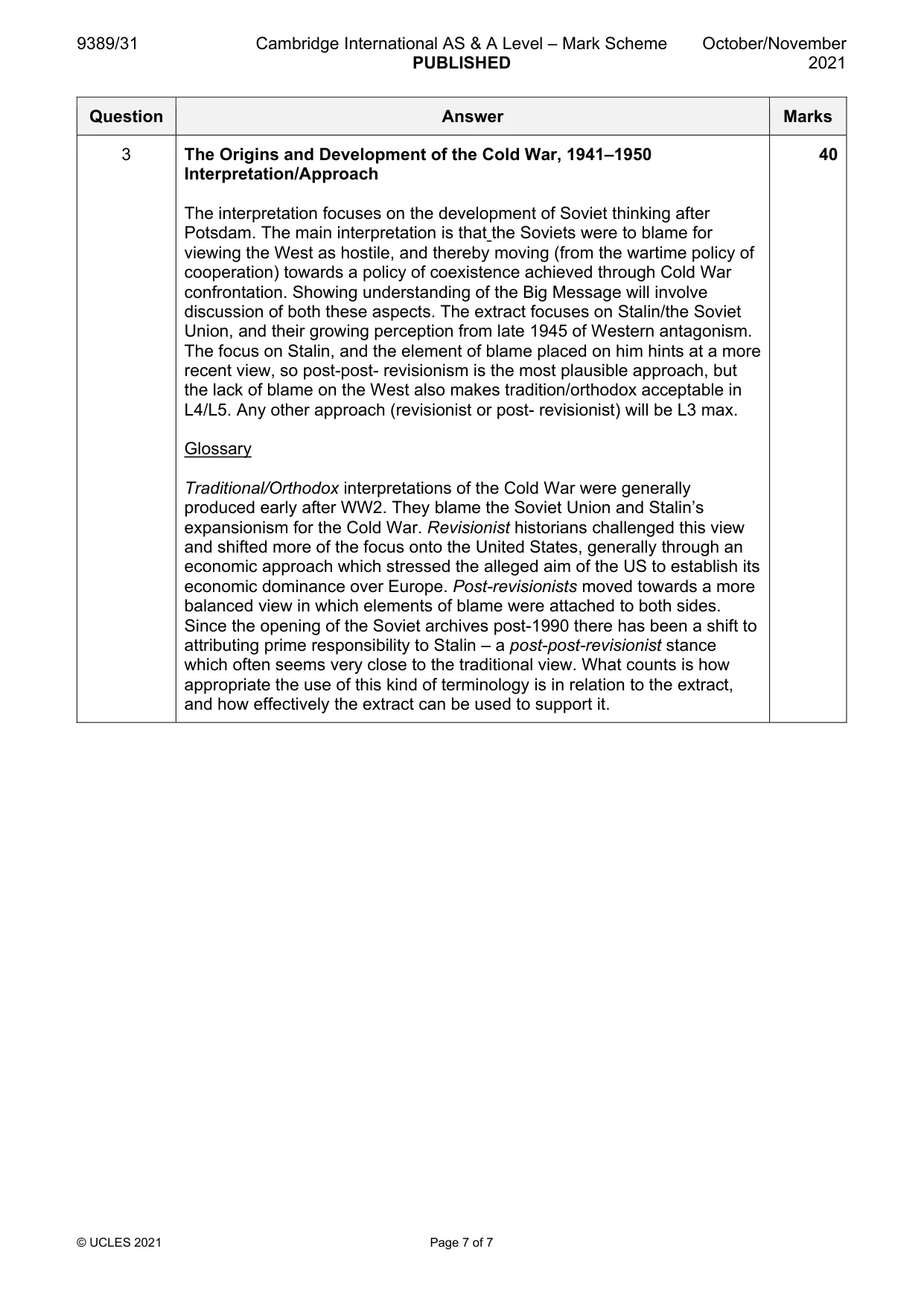
Mark scheme: 3 The Origins and Development of the Cold War, 1941–1950 40 Interpretation/Approach The interpretation focuses on the development of Soviet thinking after Potsdam. The main interpretation is that the Soviets were to blame for viewing the West as hostile, and thereby moving (from the wartime policy of cooperation) towards a policy of coexistence achieved through Cold War confrontation. Showing understanding of the Big Message will involve discussion of both these aspects. The extract focuses on Stalin/the Soviet Union, and their growing perception from late 1945 of Western antagonism. The focus on Stalin, and the element of blame placed on him hints at a more recent view, so post-post- revisionism is the most plausible approach, but the lack of blame on the West also makes tradition/orthodox acceptable in L4/L5. Any other approach (revisionist or post- revisionist) will be L3 max. Glossary Traditional/Orthodox interpretations of the Cold War were generally produced early after WW2. They blame the Soviet Union and Stalin’s expansionism for the Cold War. Revisionist historians challenged this view and shifted more of the focus onto the United States, generally through an economic approach which stressed the alleged aim of the US to establish its economic dominance over Europe. Post-revisionists moved towards a more balanced view in which elements of blame were attached to both sides. Since the opening of the Soviet archives post-1990 there has been a shift to attributing prime responsibility to Stalin – a post-post-revisionist stance which often seems very close to the traditional view. What counts is how appropriate the use of this kind of terminology is in relation to the extract, and how effectively the extract can be used to support it.
What you needed in this session
Cambridge’s own grade thresholds for 2021 Oct/Nov, Paper 3 · Variant 1. A higher threshold means an easier paper — the bar moves with how the cohort did.