Cambridge A Level History 9389 — 2020 Oct/Nov Paper 3 · Variant 3
9389/33/O/N/20 · 3 questions · 40 marks · ≈45 min
The question paper and its mark scheme, free to read here and free to download. This is Cambridge’s own paper, exactly as it was sat.
Question paper4 pages
Mark scheme7 pages
Answers below. Sit the paper first if you are practising.
Questions as text
Q1 · Read the extract and then answer the question
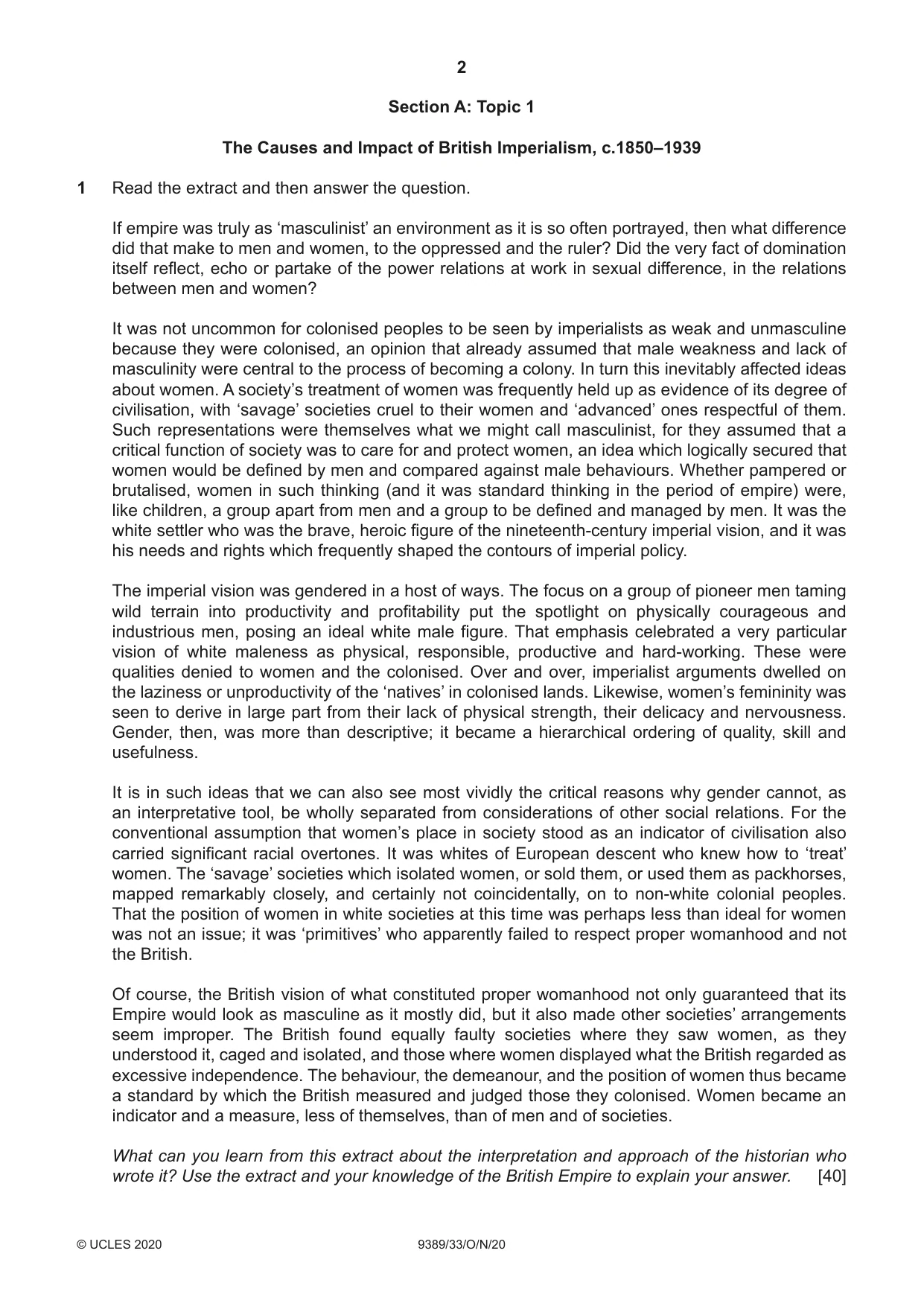
1 Read the extract and then answer the question. If empire was truly as ‘masculinist’ an environment as it is so often portrayed, then what difference did that make to men and women, to the oppressed and the ruler? Did the very fact of domination itself reflect, echo or partake of the power relations at work in sexual difference, in the relations between men and women? It was not uncommon for colonised peoples to be seen by imperialists as weak and unmasculine because they were colonised, an opinion that already assumed that male weakness and lack of masculinity were central to the process of becoming a colony. In turn this inevitably affected ideas about women. A society’s treatment of women was frequently held up as evidence of its degree of civilisation, with ‘savage’ societies cruel to their women and ‘advanced’ ones respectful of them. Such representations were themselves what we might call masculinist, for they assumed that a critical function of society was to care for and protect women, an idea which logically secured that women would be defined by men and compared against male behaviours. Whether pampered or brutalised, women in such thinking (and it was standard thinking in the period of empire) were, like children, a group apart from men and a group to be defined and managed by men. It was the white settler who was the brave, heroic figure of the nineteenth-century imperial vision, and it was his needs and rights which frequently shaped the contours of imperial policy. The imperial vision was gendered in a host of ways. The focus on a group of pioneer men taming wild terrain into productivity and profitability put the spotlight on physically courageous and industrious men, posing an ideal white male figure. That emphasis celebrated a very particular vision of white maleness as physical, responsible, productive and hard-working. These were qualities denied to women and the colonised. Over and over, imperialist arguments dwelled on the laziness or unproductivity of the ‘natives’ in colonised lands. Likewise, women’s femininity was seen to derive in large part from their lack of physical strength, their delicacy and nervousness. Gender, then, was more than descriptive; it became a hierarchical ordering of quality, skill and usefulness. It is in such ideas that we can also see most vividly the critical reasons why gender cannot, as an interpretative tool, be wholly separated from considerations of other social relations. For the conventional assumption that women’s place in society stood as an indicator of civilisation also carried significant racial overtones. It was whites of European descent who knew how to ‘treat’ women. The ‘savage’ societies which isolated women, or sold them, or used them as packhorses, mapped remarkably closely, and certainly not coincidentally, on to non-white colonial peoples. That the position of women in white societies at this time was perhaps less than ideal for women was not an issue; it was ‘primitives’ who apparently failed to respect proper womanhood and not the British. Of course, the British vision of what constituted proper womanhood not only guaranteed that its Empire would look as masculine as it mostly did, but it also made other societies’ arrangements seem improper. The British found equally faulty societies where they saw women, as they understood it, caged and isolated, and those where women displayed what the British regarded as excessive independence. The behaviour, the demeanour, and the position of women thus became a standard by which the British measured and judged those they colonised. Women became an indicator and a measure, less of themselves, than of men and of societies. What can you learn from this extract about the interpretation and approach of the historian who wrote it? Use the extract and your knowledge of the British Empire to explain your answer. [40]
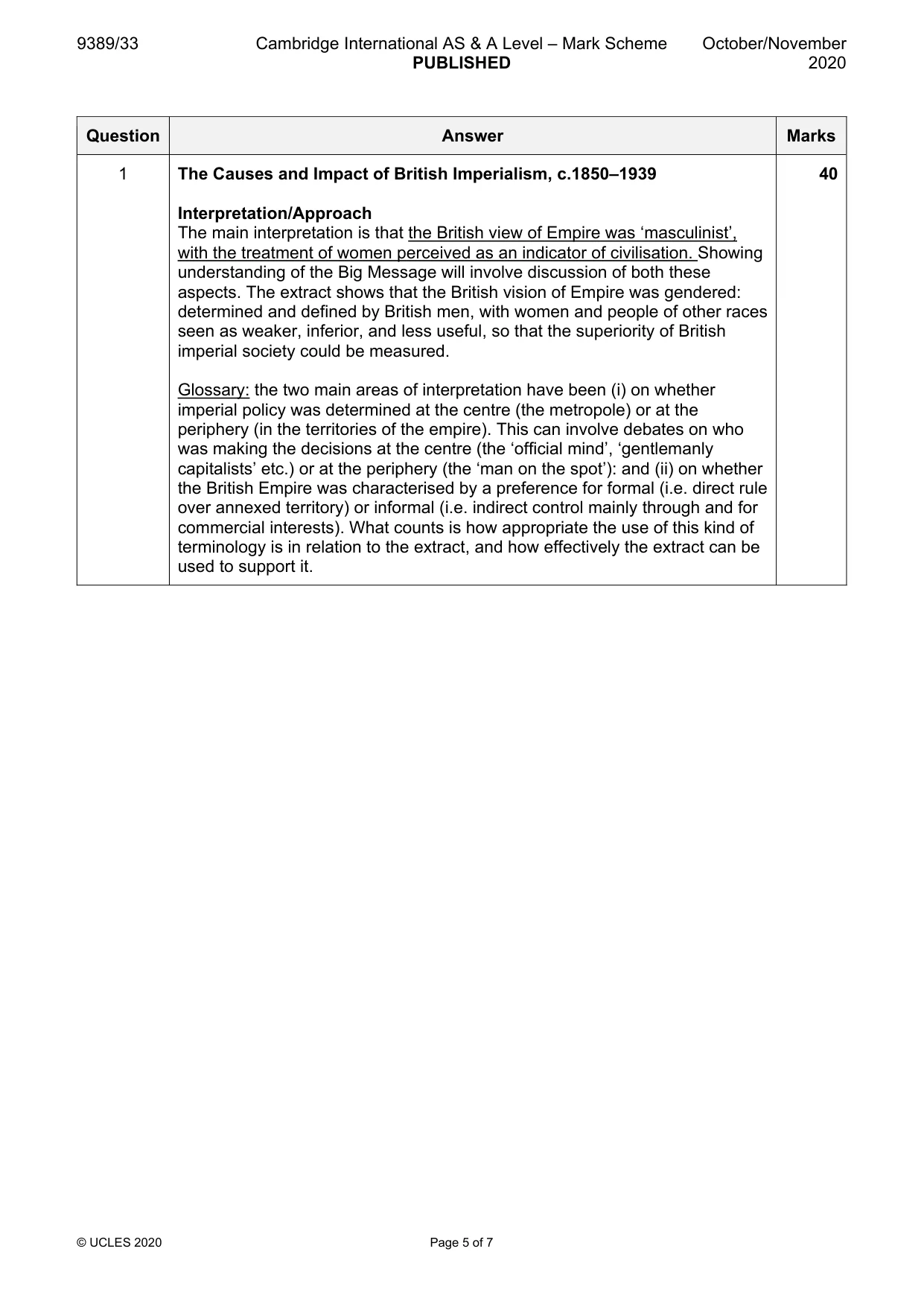
Mark scheme: Question Answer Marks 1 The Causes and Impact of British Imperialism, c.1850–1939 40 Interpretation/Approach The main interpretation is that the British view of Empire was ‘masculinist’, with the treatment of women perceived as an indicator of civilisation. Showing understanding of the Big Message will involve discussion of both these aspects. The extract shows that the British vision of Empire was gendered: determined and defined by British men, with women and people of other races seen as weaker, inferior, and less useful, so that the superiority of British imperial society could be measured. Glossary: the two main areas of interpretation have been (i) on whether imperial policy was determined at the centre (the metropole) or at the periphery (in the territories of the empire). This can involve debates on who was making the decisions at the centre (the ‘official mind’, ‘gentlemanly capitalists’ etc.) or at the periphery (the ‘man on the spot’): and (ii) on whether the British Empire was characterised by a preference for formal (i.e. direct rule over annexed territory) or informal (i.e. indirect control mainly through and for commercial interests). What counts is how appropriate the use of this kind of terminology is in relation to the extract, and how effectively the extract can be used to support it.
Q2 · Read the extract and then answer the question
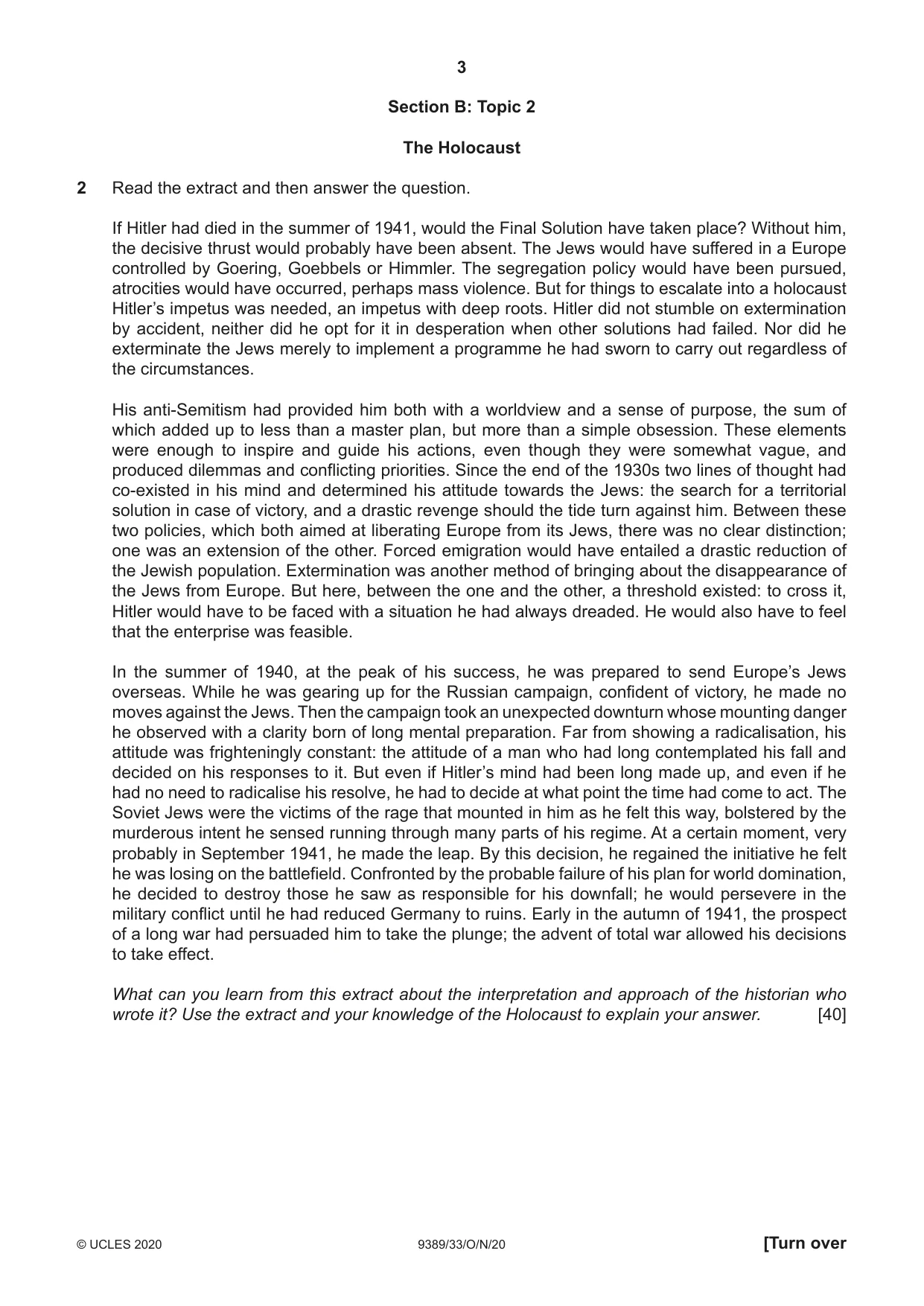
2 Read the extract and then answer the question. If Hitler had died in the summer of 1941, would the Final Solution have taken place? Without him, the decisive thrust would probably have been absent. The Jews would have suffered in a Europe controlled by Goering, Goebbels or Himmler. The segregation policy would have been pursued, atrocities would have occurred, perhaps mass violence. But for things to escalate into a holocaust Hitler’s impetus was needed, an impetus with deep roots. Hitler did not stumble on extermination by accident, neither did he opt for it in desperation when other solutions had failed. Nor did he exterminate the Jews merely to implement a programme he had sworn to carry out regardless of the circumstances. His anti-Semitism had provided him both with a worldview and a sense of purpose, the sum of which added up to less than a master plan, but more than a simple obsession. These elements were enough to inspire and guide his actions, even though they were somewhat vague, and produced dilemmas and conflicting priorities. Since the end of the 1930s two lines of thought had co-existed in his mind and determined his attitude towards the Jews: the search for a territorial solution in case of victory, and a drastic revenge should the tide turn against him. Between these two policies, which both aimed at liberating Europe from its Jews, there was no clear distinction; one was an extension of the other. Forced emigration would have entailed a drastic reduction of the Jewish population. Extermination was another method of bringing about the disappearance of the Jews from Europe. But here, between the one and the other, a threshold existed: to cross it, Hitler would have to be faced with a situation he had always dreaded. He would also have to feel that the enterprise was feasible. In the summer of 1940, at the peak of his success, he was prepared to send Europe’s Jews overseas. While he was gearing up for the Russian campaign, confident of victory, he made no moves against the Jews. Then the campaign took an unexpected downturn whose mounting danger he observed with a clarity born of long mental preparation. Far from showing a radicalisation, his attitude was frighteningly constant: the attitude of a man who had long contemplated his fall and decided on his responses to it. But even if Hitler’s mind had been long made up, and even if he had no need to radicalise his resolve, he had to decide at what point the time had come to act. The Soviet Jews were the victims of the rage that mounted in him as he felt this way, bolstered by the murderous intent he sensed running through many parts of his regime. At a certain moment, very probably in September 1941, he made the leap. By this decision, he regained the initiative he felt he was losing on the battlefield. Confronted by the probable failure of his plan for world domination, he decided to destroy those he saw as responsible for his downfall; he would persevere in the military conflict until he had reduced Germany to ruins. Early in the autumn of 1941, the prospect of a long war had persuaded him to take the plunge; the advent of total war allowed his decisions to take effect. What can you learn from this extract about the interpretation and approach of the historian who wrote it? Use the extract and your knowledge of the Holocaust to explain your answer. [40] Section C: Topic 3 The Origins and Development of the Cold War, 1941–1950
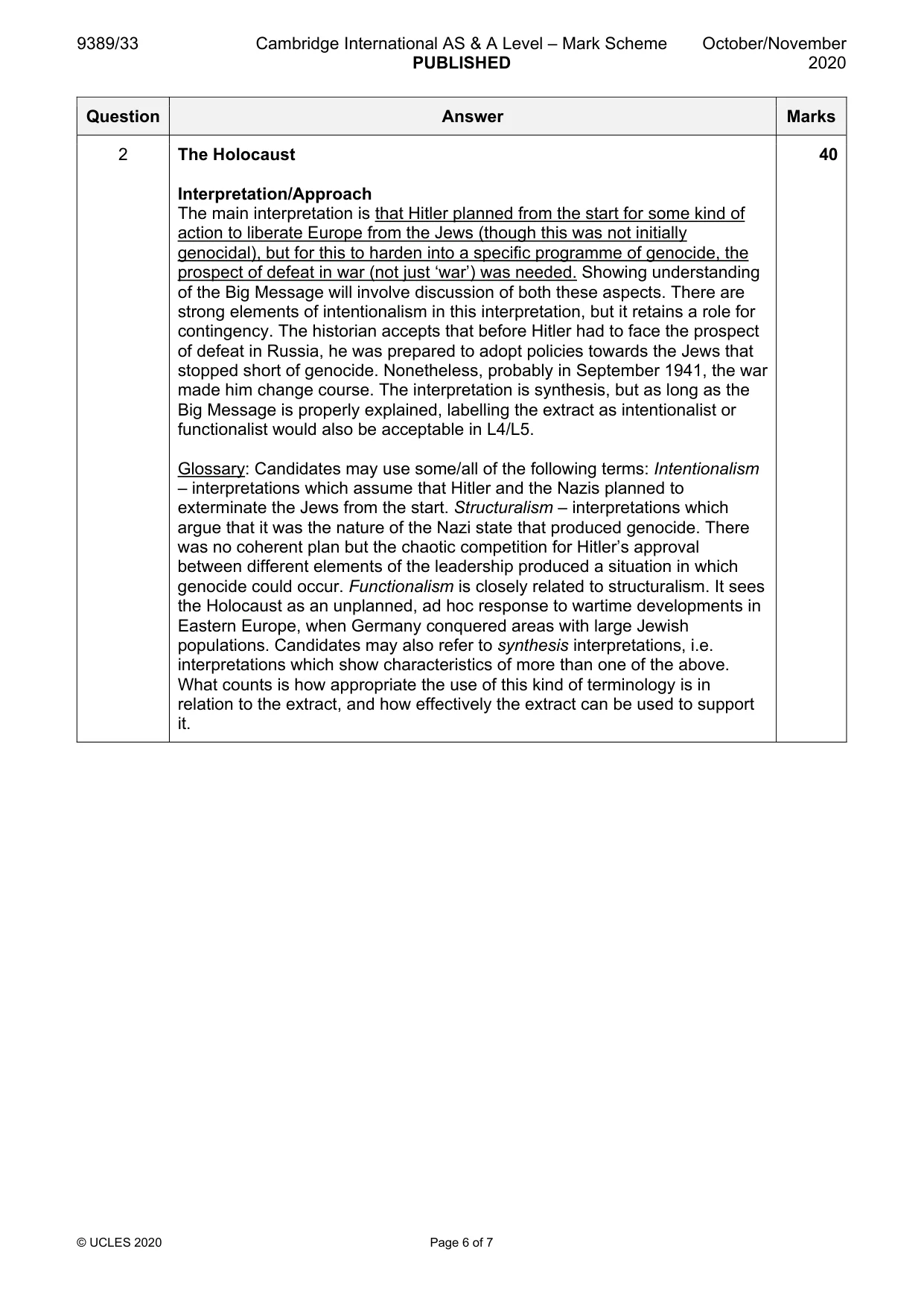
Mark scheme: 2 The Holocaust 40 Interpretation/Approach The main interpretation is that Hitler planned from the start for some kind of action to liberate Europe from the Jews (though this was not initially genocidal), but for this to harden into a specific programme of genocide, the prospect of defeat in war (not just ‘war’) was needed. Showing understanding of the Big Message will involve discussion of both these aspects. There are strong elements of intentionalism in this interpretation, but it retains a role for contingency. The historian accepts that before Hitler had to face the prospect of defeat in Russia, he was prepared to adopt policies towards the Jews that stopped short of genocide. Nonetheless, probably in September 1941, the war made him change course. The interpretation is synthesis, but as long as the Big Message is properly explained, labelling the extract as intentionalist or functionalist would also be acceptable in L4/L5. Glossary: Candidates may use some/all of the following terms: Intentionalism – interpretations which assume that Hitler and the Nazis planned to exterminate the Jews from the start. Structuralism – interpretations which argue that it was the nature of the Nazi state that produced genocide. There was no coherent plan but the chaotic competition for Hitler’s approval between different elements of the leadership produced a situation in which genocide could occur. Functionalism is closely related to structuralism. It sees the Holocaust as an unplanned, ad hoc response to wartime developments in Eastern Europe, when Germany conquered areas with large Jewish populations. Candidates may also refer to synthesis interpretations, i.e. interpretations which show characteristics of more than one of the above. What counts is how appropriate the use of this kind of terminology is in relation to the extract, and how effectively the extract can be used to support it.
Q3 · Read the extract and then answer the question
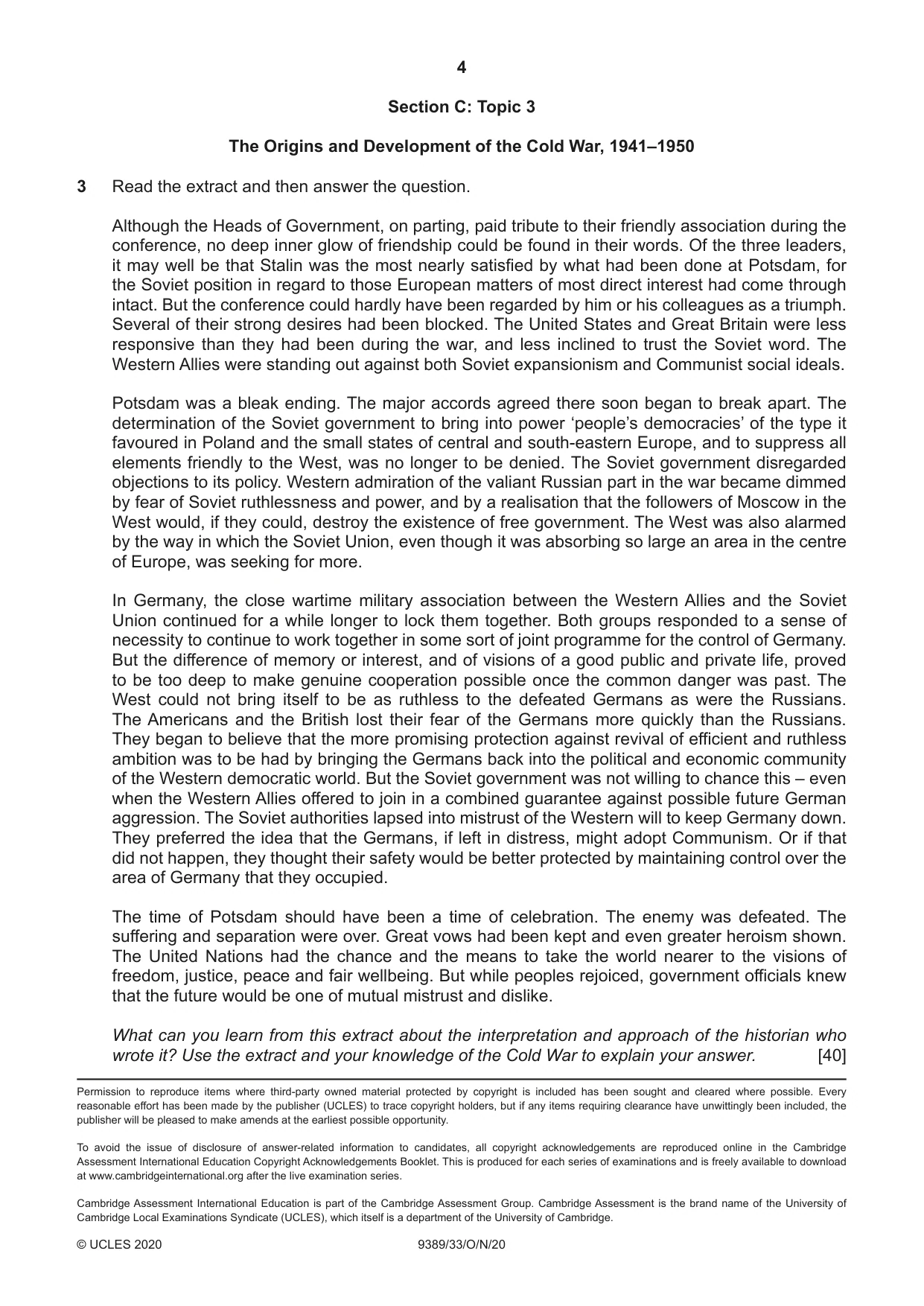
3 Read the extract and then answer the question. Although the Heads of Government, on parting, paid tribute to their friendly association during the conference, no deep inner glow of friendship could be found in their words. Of the three leaders, it may well be that Stalin was the most nearly satisfied by what had been done at Potsdam, for the Soviet position in regard to those European matters of most direct interest had come through intact. But the conference could hardly have been regarded by him or his colleagues as a triumph. Several of their strong desires had been blocked. The United States and Great Britain were less responsive than they had been during the war, and less inclined to trust the Soviet word. The Western Allies were standing out against both Soviet expansionism and Communist social ideals. Potsdam was a bleak ending. The major accords agreed there soon began to break apart. The determination of the Soviet government to bring into power ‘people’s democracies’ of the type it favoured in Poland and the small states of central and south-eastern Europe, and to suppress all elements friendly to the West, was no longer to be denied. The Soviet government disregarded objections to its policy. Western admiration of the valiant Russian part in the war became dimmed by fear of Soviet ruthlessness and power, and by a realisation that the followers of Moscow in the West would, if they could, destroy the existence of free government. The West was also alarmed by the way in which the Soviet Union, even though it was absorbing so large an area in the centre of Europe, was seeking for more. In Germany, the close wartime military association between the Western Allies and the Soviet Union continued for a while longer to lock them together. Both groups responded to a sense of necessity to continue to work together in some sort of joint programme for the control of Germany. But the difference of memory or interest, and of visions of a good public and private life, proved to be too deep to make genuine cooperation possible once the common danger was past. The West could not bring itself to be as ruthless to the defeated Germans as were the Russians. The Americans and the British lost their fear of the Germans more quickly than the Russians. They began to believe that the more promising protection against revival of efficient and ruthless ambition was to be had by bringing the Germans back into the political and economic community of the Western democratic world. But the Soviet government was not willing to chance this – even when the Western Allies offered to join in a combined guarantee against possible future German aggression. The Soviet authorities lapsed into mistrust of the Western will to keep Germany down. They preferred the idea that the Germans, if left in distress, might adopt Communism. Or if that did not happen, they thought their safety would be better protected by maintaining control over the area of Germany that they occupied. The time of Potsdam should have been a time of celebration. The enemy was defeated. The suffering and separation were over. Great vows had been kept and even greater heroism shown. The United Nations had the chance and the means to take the world nearer to the visions of freedom, justice, peace and fair wellbeing. But while peoples rejoiced, government officials knew that the future would be one of mutual mistrust and dislike. What can you learn from this extract about the interpretation and approach of the historian who wrote it? Use the extract and your knowledge of the Cold War to explain your answer. [40]
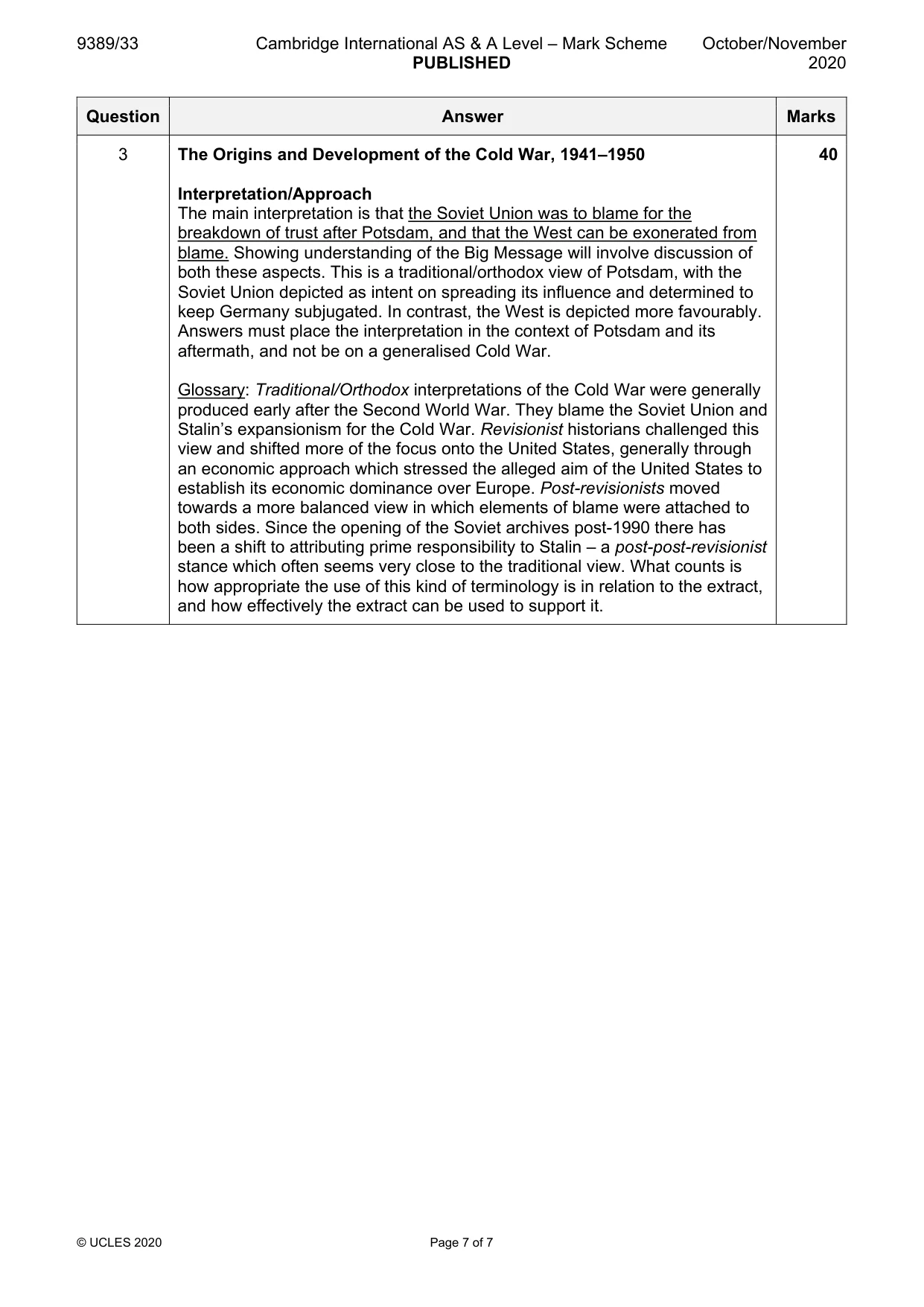
Mark scheme: 3 The Origins and Development of the Cold War, 1941–1950 40 Interpretation/Approach The main interpretation is that the Soviet Union was to blame for the breakdown of trust after Potsdam, and that the West can be exonerated from blame. Showing understanding of the Big Message will involve discussion of both these aspects. This is a traditional/orthodox view of Potsdam, with the Soviet Union depicted as intent on spreading its influence and determined to keep Germany subjugated. In contrast, the West is depicted more favourably. Answers must place the interpretation in the context of Potsdam and its aftermath, and not be on a generalised Cold War. Glossary: Traditional/Orthodox interpretations of the Cold War were generally produced early after the Second World War. They blame the Soviet Union and Stalin’s expansionism for the Cold War. Revisionist historians challenged this view and shifted more of the focus onto the United States, generally through an economic approach which stressed the alleged aim of the United States to establish its economic dominance over Europe. Post-revisionists moved towards a more balanced view in which elements of blame were attached to both sides. Since the opening of the Soviet archives post-1990 there has been a shift to attributing prime responsibility to Stalin – a post-post-revisionist stance which often seems very close to the traditional view. What counts is how appropriate the use of this kind of terminology is in relation to the extract, and how effectively the extract can be used to support it.
What you needed in this session
Cambridge’s own grade thresholds for 2020 Oct/Nov, Paper 3 · Variant 3. A higher threshold means an easier paper — the bar moves with how the cohort did.