Cambridge A Level History 9389 — 2021 Oct/Nov Paper 3 · Variant 2
9389/32/O/N/21 · 3 questions · 40 marks · ≈45 min
The question paper and its mark scheme, free to read here and free to download. This is Cambridge’s own paper, exactly as it was sat.
Question paper4 pages
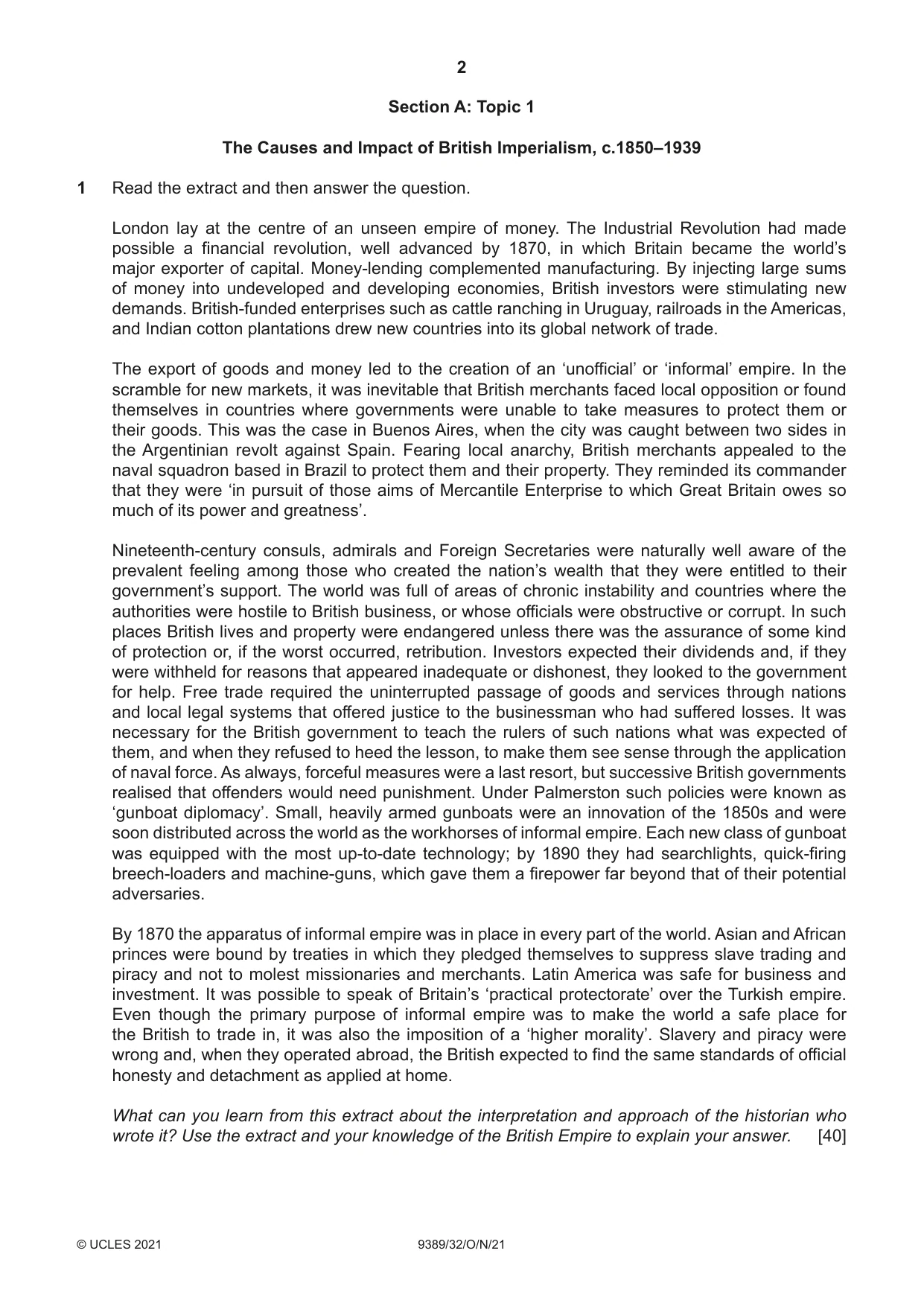
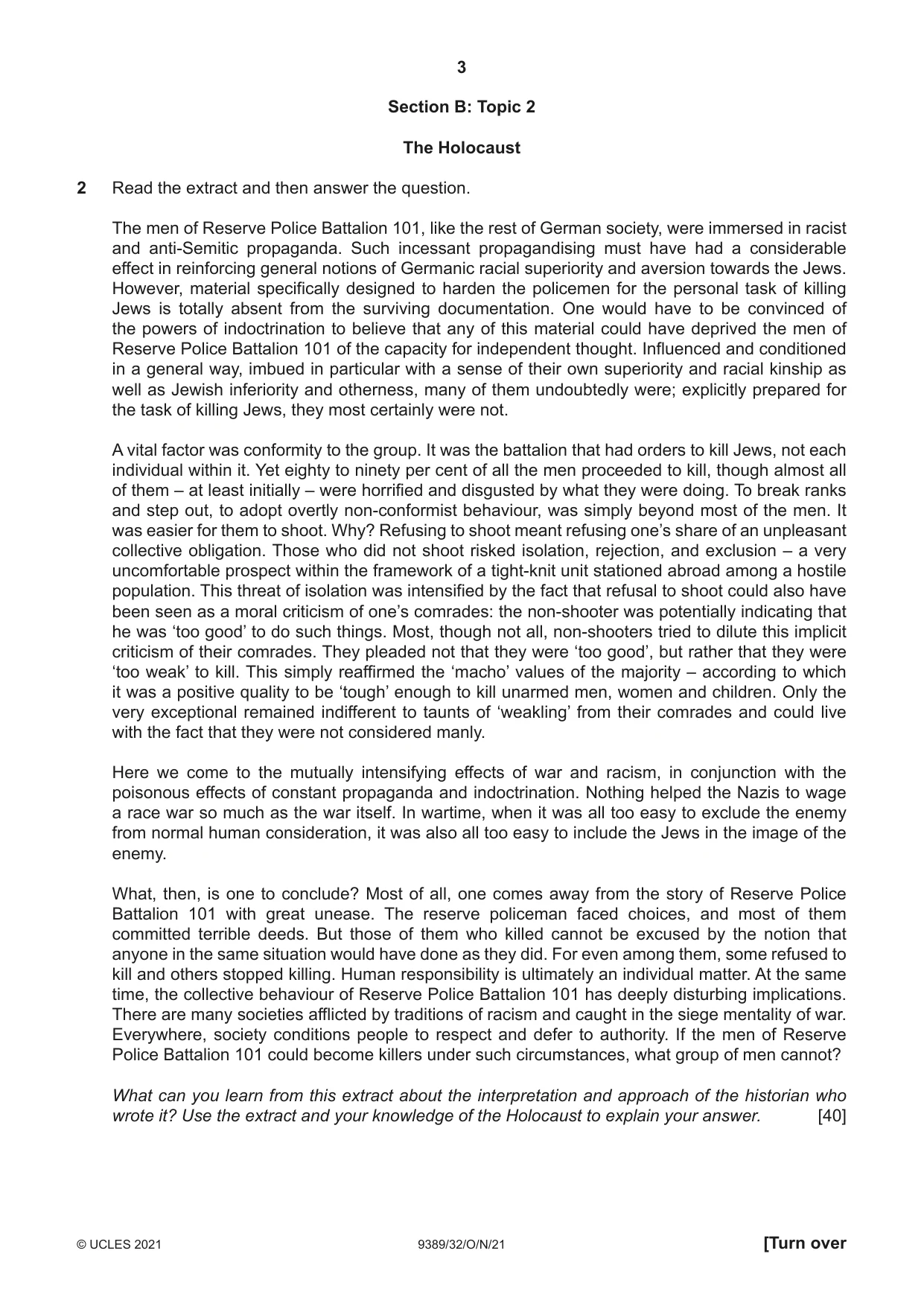
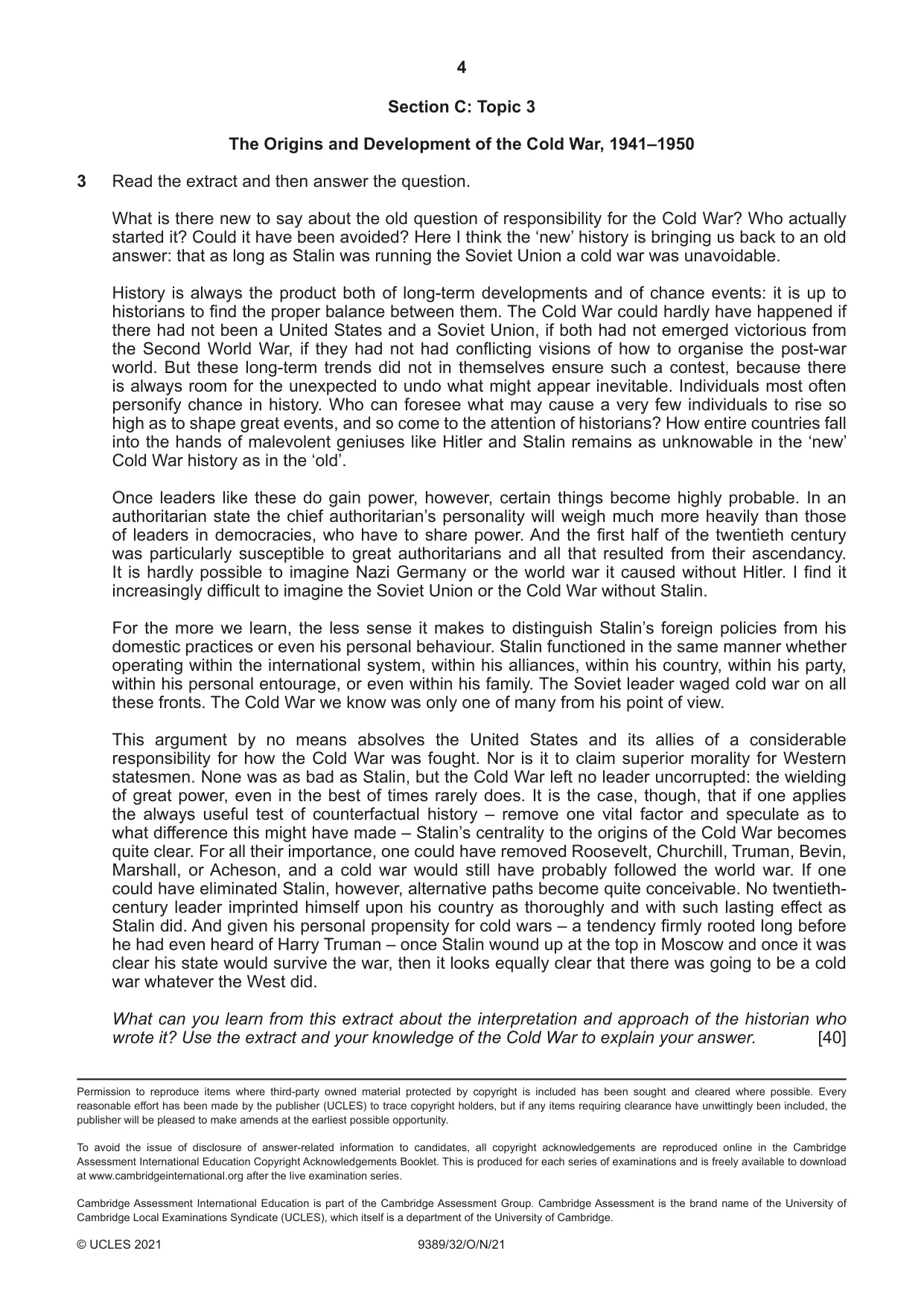
Mark scheme7 pages
Answers below. Sit the paper first if you are practising.
Questions as text
Q1 · Read the extract and then answer the question
1 Read the extract and then answer the question. London lay at the centre of an unseen empire of money. The Industrial Revolution had made possible a financial revolution, well advanced by 1870, in which Britain became the world’s major exporter of capital. Money-lending complemented manufacturing. By injecting large sums of money into undeveloped and developing economies, British investors were stimulating new demands. British-funded enterprises such as cattle ranching in Uruguay, railroads in the Americas, and Indian cotton plantations drew new countries into its global network of trade. The export of goods and money led to the creation of an ‘unofficial’ or ‘informal’ empire. In the scramble for new markets, it was inevitable that British merchants faced local opposition or found themselves in countries where governments were unable to take measures to protect them or their goods. This was the case in Buenos Aires, when the city was caught between two sides in the Argentinian revolt against Spain. Fearing local anarchy, British merchants appealed to the naval squadron based in Brazil to protect them and their property. They reminded its commander that they were ‘in pursuit of those aims of Mercantile Enterprise to which Great Britain owes so much of its power and greatness’. Nineteenth-century consuls, admirals and Foreign Secretaries were naturally well aware of the prevalent feeling among those who created the nation’s wealth that they were entitled to their government’s support. The world was full of areas of chronic instability and countries where the authorities were hostile to British business, or whose officials were obstructive or corrupt. In such places British lives and property were endangered unless there was the assurance of some kind of protection or, if the worst occurred, retribution. Investors expected their dividends and, if they were withheld for reasons that appeared inadequate or dishonest, they looked to the government for help. Free trade required the uninterrupted passage of goods and services through nations and local legal systems that offered justice to the businessman who had suffered losses. It was necessary for the British government to teach the rulers of such nations what was expected of them, and when they refused to heed the lesson, to make them see sense through the application of naval force. As always, forceful measures were a last resort, but successive British governments realised that offenders would need punishment. Under Palmerston such policies were known as ‘gunboat diplomacy’. Small, heavily armed gunboats were an innovation of the 1850s and were soon distributed across the world as the workhorses of informal empire. Each new class of gunboat was equipped with the most up-to-date technology; by 1890 they had searchlights, quick-firing breech-loaders and machine-guns, which gave them a firepower far beyond that of their potential adversaries. By 1870 the apparatus of informal empire was in place in every part of the world. Asian and African princes were bound by treaties in which they pledged themselves to suppress slave trading and piracy and not to molest missionaries and merchants. Latin America was safe for business and investment. It was possible to speak of Britain’s ‘practical protectorate’ over the Turkish empire. Even though the primary purpose of informal empire was to make the world a safe place for the British to trade in, it was also the imposition of a ‘higher morality’. Slavery and piracy were wrong and, when they operated abroad, the British expected to find the same standards of official honesty and detachment as applied at home. What can you learn from this extract about the interpretation and approach of the historian who wrote it? Use the extract and your knowledge of the British Empire to explain your answer. [40]
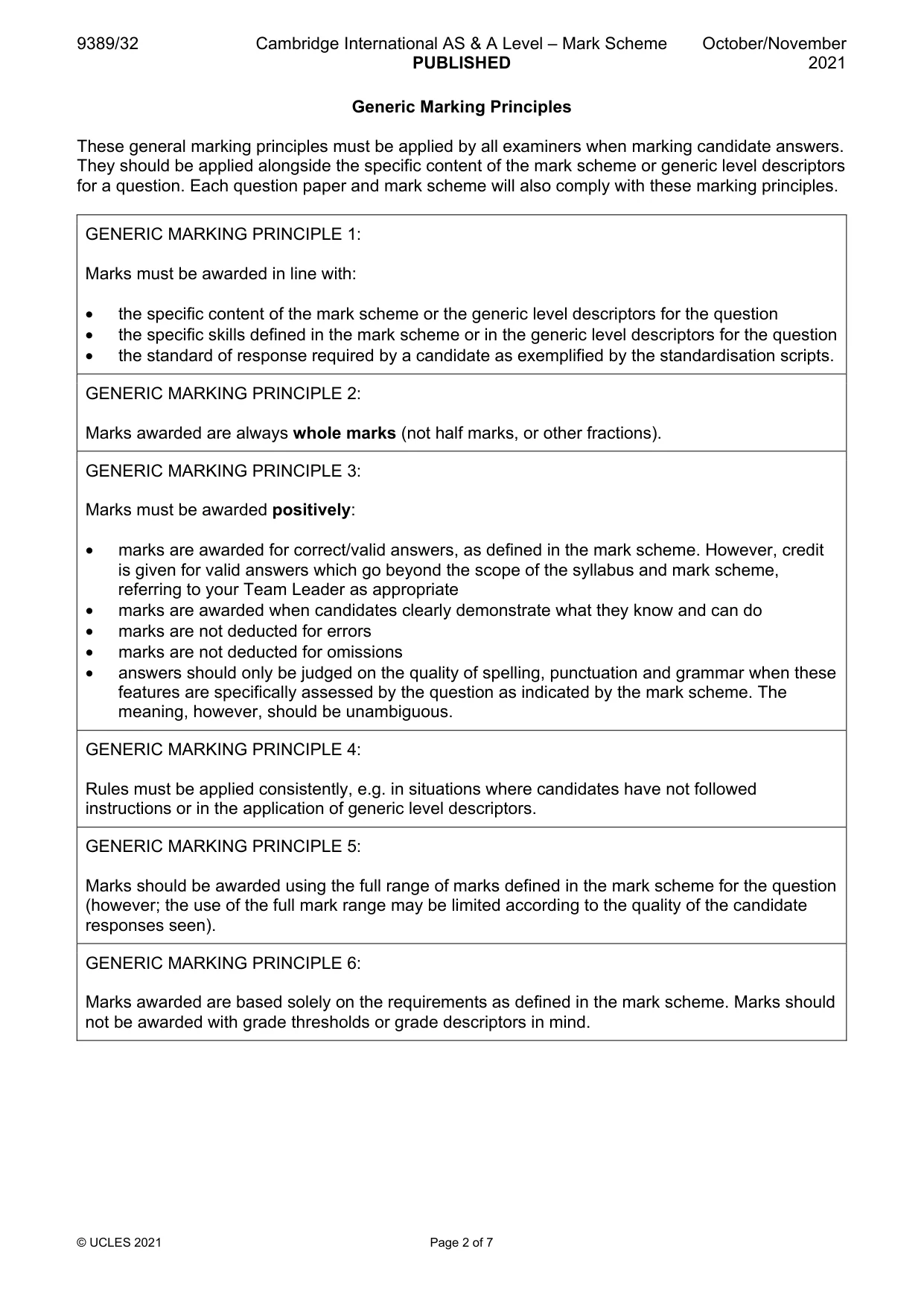
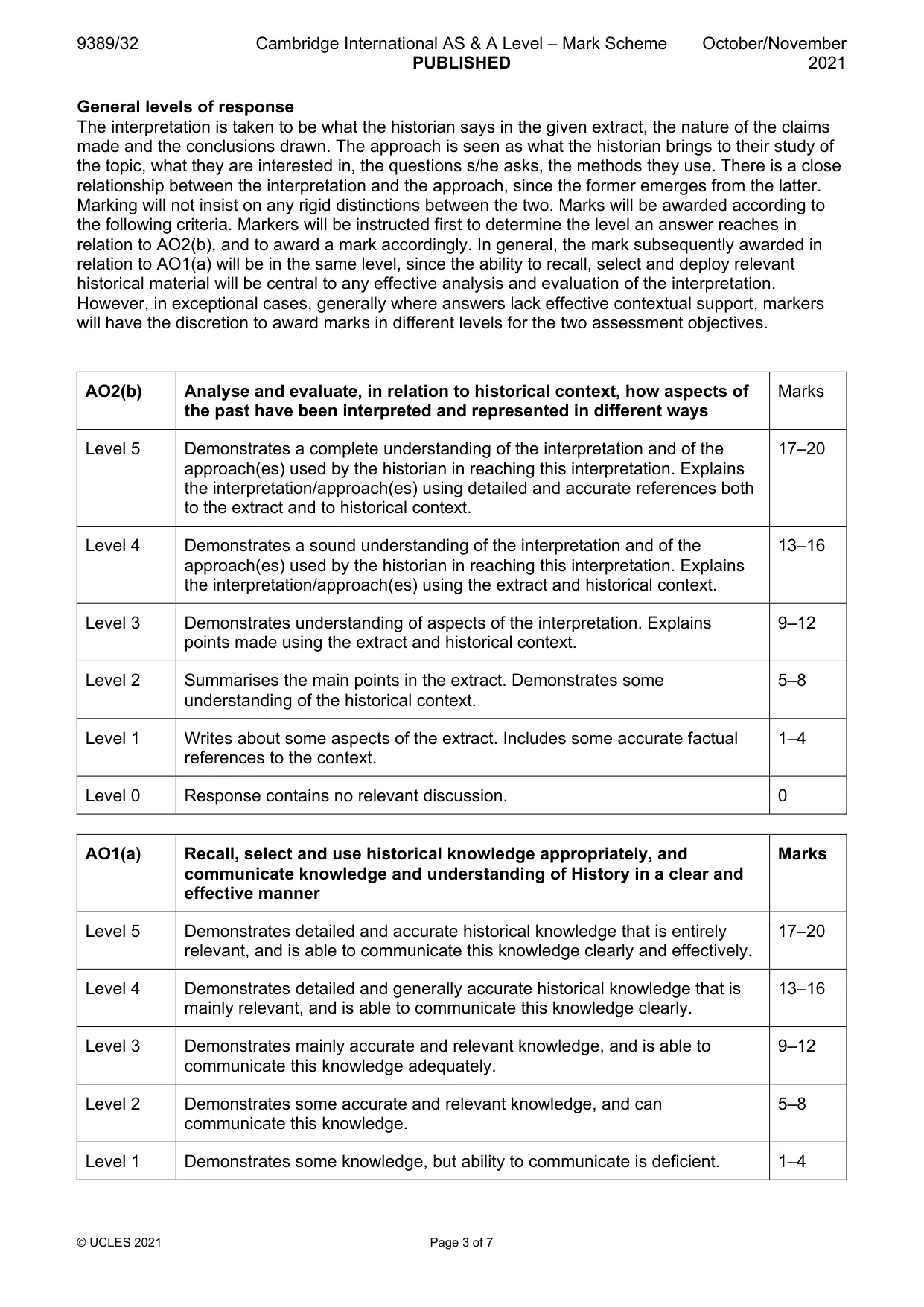
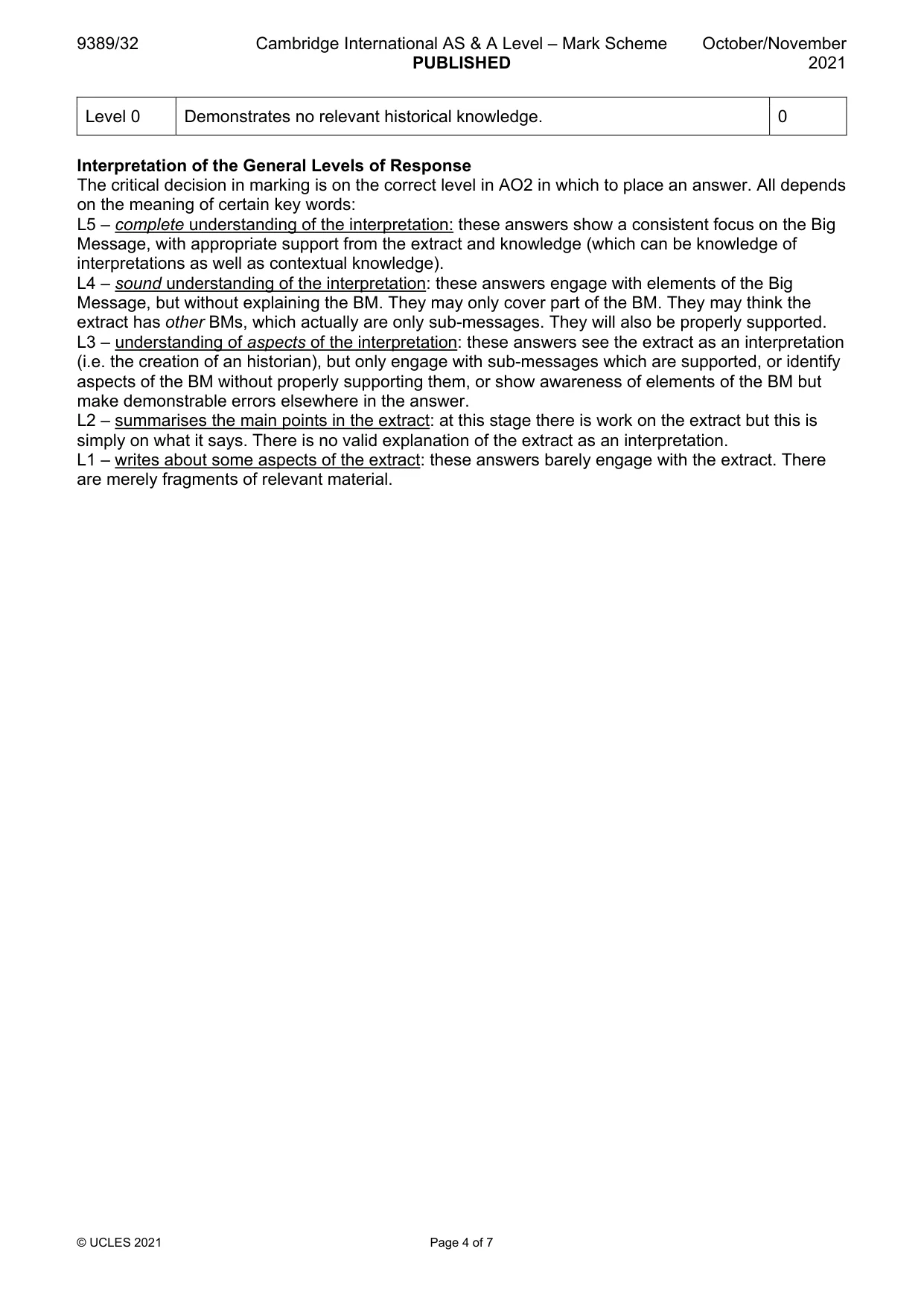
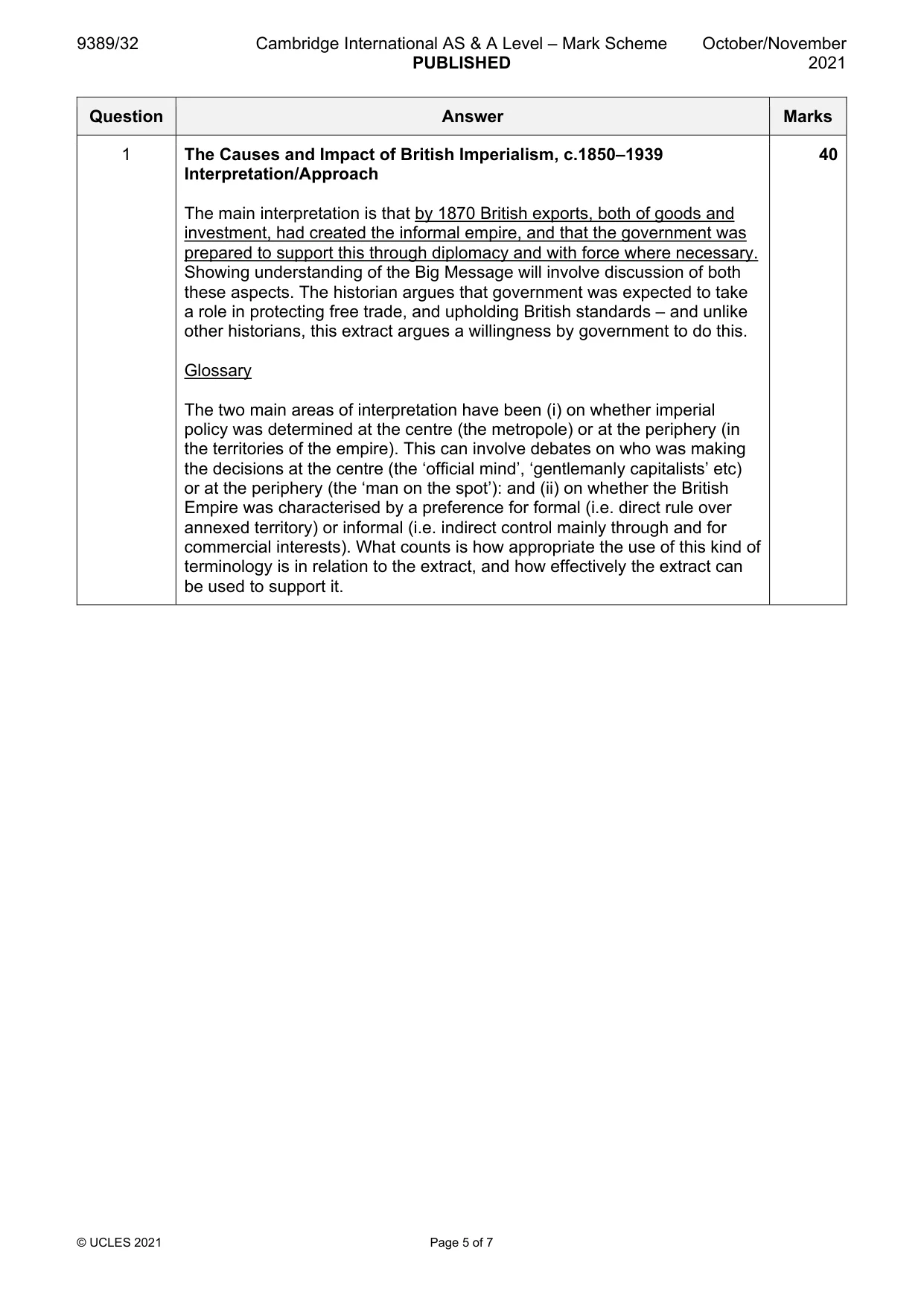
Mark scheme: Question Answer Marks 1 The Causes and Impact of British Imperialism, c.1850–1939 40 Interpretation/Approach The main interpretation is that by 1870 British exports, both of goods and investment, had created the informal empire, and that the government was prepared to support this through diplomacy and with force where necessary. Showing understanding of the Big Message will involve discussion of both these aspects. The historian argues that government was expected to take a role in protecting free trade, and upholding British standards – and unlike other historians, this extract argues a willingness by government to do this. Glossary The two main areas of interpretation have been (i) on whether imperial policy was determined at the centre (the metropole) or at the periphery (in the territories of the empire). This can involve debates on who was making the decisions at the centre (the ‘official mind’, ‘gentlemanly capitalists’ etc) or at the periphery (the ‘man on the spot’): and (ii) on whether the British Empire was characterised by a preference for formal (i.e. direct rule over annexed territory) or informal (i.e. indirect control mainly through and for commercial interests). What counts is how appropriate the use of this kind of terminology is in relation to the extract, and how effectively the extract can be used to support it.
Q2 · Read the extract and then answer the question
2 Read the extract and then answer the question. The men of Reserve Police Battalion 101, like the rest of German society, were immersed in racist and anti-Semitic propaganda. Such incessant propagandising must have had a considerable effect in reinforcing general notions of Germanic racial superiority and aversion towards the Jews. However, material specifically designed to harden the policemen for the personal task of killing Jews is totally absent from the surviving documentation. One would have to be convinced of the powers of indoctrination to believe that any of this material could have deprived the men of Reserve Police Battalion 101 of the capacity for independent thought. Influenced and conditioned in a general way, imbued in particular with a sense of their own superiority and racial kinship as well as Jewish inferiority and otherness, many of them undoubtedly were; explicitly prepared for the task of killing Jews, they most certainly were not. A vital factor was conformity to the group. It was the battalion that had orders to kill Jews, not each individual within it. Yet eighty to ninety per cent of all the men proceeded to kill, though almost all of them – at least initially – were horrified and disgusted by what they were doing. To break ranks and step out, to adopt overtly non-conformist behaviour, was simply beyond most of the men. It was easier for them to shoot. Why? Refusing to shoot meant refusing one’s share of an unpleasant collective obligation. Those who did not shoot risked isolation, rejection, and exclusion – a very uncomfortable prospect within the framework of a tight-knit unit stationed abroad among a hostile population. This threat of isolation was intensified by the fact that refusal to shoot could also have been seen as a moral criticism of one’s comrades: the non-shooter was potentially indicating that he was ‘too good’ to do such things. Most, though not all, non-shooters tried to dilute this implicit criticism of their comrades. They pleaded not that they were ‘too good’, but rather that they were ‘too weak’ to kill. This simply reaffirmed the ‘macho’ values of the majority – according to which it was a positive quality to be ‘tough’ enough to kill unarmed men, women and children. Only the very exceptional remained indifferent to taunts of ‘weakling’ from their comrades and could live with the fact that they were not considered manly. Here we come to the mutually intensifying effects of war and racism, in conjunction with the poisonous effects of constant propaganda and indoctrination. Nothing helped the Nazis to wage a race war so much as the war itself. In wartime, when it was all too easy to exclude the enemy from normal human consideration, it was also all too easy to include the Jews in the image of the enemy. What, then, is one to conclude? Most of all, one comes away from the story of Reserve Police Battalion 101 with great unease. The reserve policeman faced choices, and most of them committed terrible deeds. But those of them who killed cannot be excused by the notion that anyone in the same situation would have done as they did. For even among them, some refused to kill and others stopped killing. Human responsibility is ultimately an individual matter. At the same time, the collective behaviour of Reserve Police Battalion 101 has deeply disturbing implications. There are many societies afflicted by traditions of racism and caught in the siege mentality of war. Everywhere, society conditions people to respect and defer to authority. If the men of Reserve Police Battalion 101 could become killers under such circumstances, what group of men cannot? What can you learn from this extract about the interpretation and approach of the historian who wrote it? Use the extract and your knowledge of the Holocaust to explain your answer. [40] Section C: Topic 3 The Origins and Development of the Cold War, 1941–1950
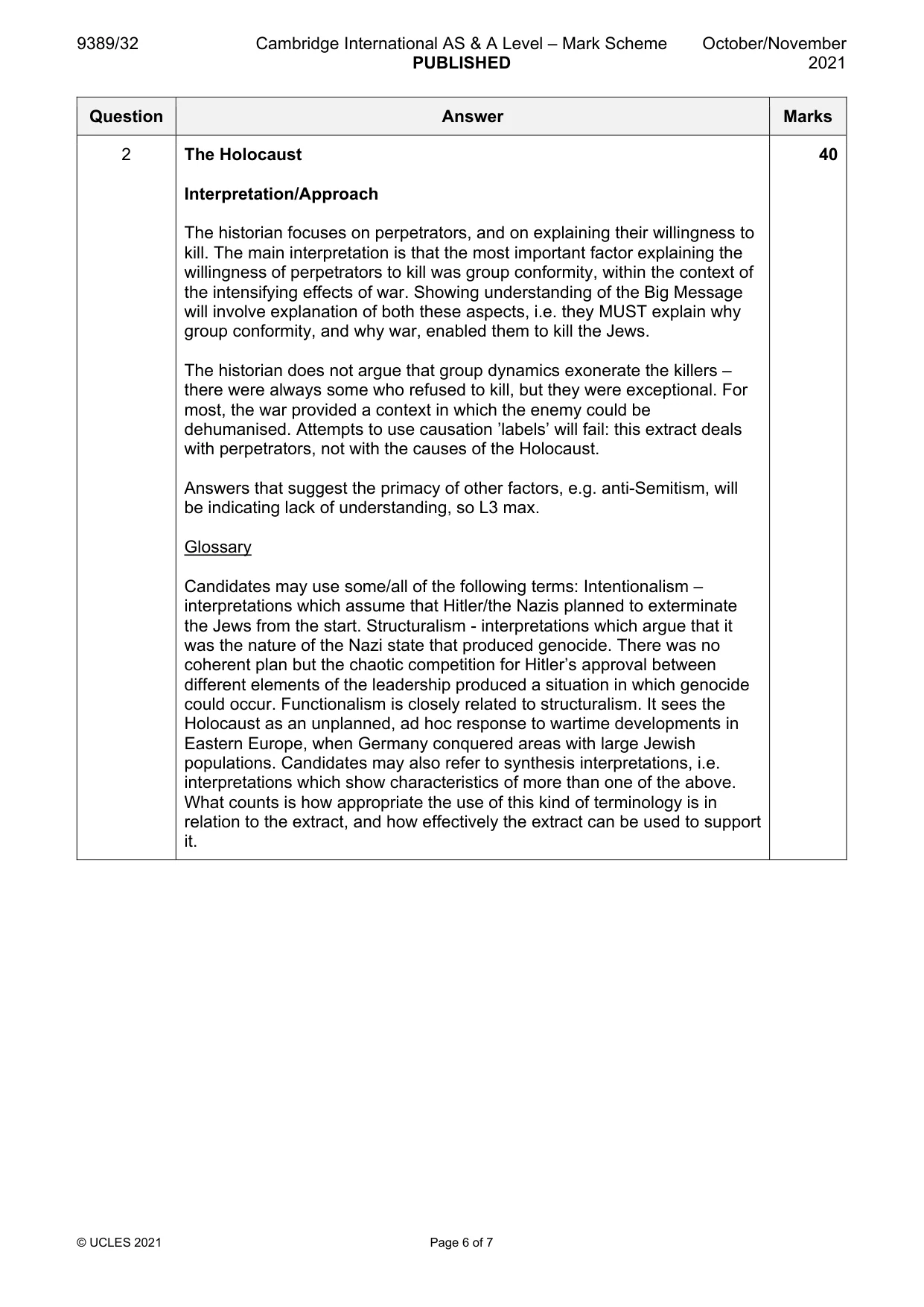
Mark scheme: 2 The Holocaust 40 Interpretation/Approach The historian focuses on perpetrators, and on explaining their willingness to kill. The main interpretation is that the most important factor explaining the willingness of perpetrators to kill was group conformity, within the context of the intensifying effects of war. Showing understanding of the Big Message will involve explanation of both these aspects, i.e. they MUST explain why group conformity, and why war, enabled them to kill the Jews. The historian does not argue that group dynamics exonerate the killers – there were always some who refused to kill, but they were exceptional. For most, the war provided a context in which the enemy could be dehumanised. Attempts to use causation ’labels’ will fail: this extract deals with perpetrators, not with the causes of the Holocaust. Answers that suggest the primacy of other factors, e.g. anti-Semitism, will be indicating lack of understanding, so L3 max. Glossary Candidates may use some/all of the following terms: Intentionalism – interpretations which assume that Hitler/the Nazis planned to exterminate the Jews from the start. Structuralism - interpretations which argue that it was the nature of the Nazi state that produced genocide. There was no coherent plan but the chaotic competition for Hitler’s approval between different elements of the leadership produced a situation in which genocide could occur. Functionalism is closely related to structuralism. It sees the Holocaust as an unplanned, ad hoc response to wartime developments in Eastern Europe, when Germany conquered areas with large Jewish populations. Candidates may also refer to synthesis interpretations, i.e. interpretations which show characteristics of more than one of the above. What counts is how appropriate the use of this kind of terminology is in relation to the extract, and how effectively the extract can be used to support it.
Q3 · Read the extract and then answer the question
3 Read the extract and then answer the question. What is there new to say about the old question of responsibility for the Cold War? Who actually started it? Could it have been avoided? Here I think the ‘new’ history is bringing us back to an old answer: that as long as Stalin was running the Soviet Union a cold war was unavoidable. History is always the product both of long-term developments and of chance events: it is up to historians to find the proper balance between them. The Cold War could hardly have happened if there had not been a United States and a Soviet Union, if both had not emerged victorious from the Second World War, if they had not had conflicting visions of how to organise the post-war world. But these long-term trends did not in themselves ensure such a contest, because there is always room for the unexpected to undo what might appear inevitable. Individuals most often personify chance in history. Who can foresee what may cause a very few individuals to rise so high as to shape great events, and so come to the attention of historians? How entire countries fall into the hands of malevolent geniuses like Hitler and Stalin remains as unknowable in the ‘new’ Cold War history as in the ‘old’. Once leaders like these do gain power, however, certain things become highly probable. In an authoritarian state the chief authoritarian’s personality will weigh much more heavily than those of leaders in democracies, who have to share power. And the first half of the twentieth century was particularly susceptible to great authoritarians and all that resulted from their ascendancy. It is hardly possible to imagine Nazi Germany or the world war it caused without Hitler. I find it increasingly difficult to imagine the Soviet Union or the Cold War without Stalin. For the more we learn, the less sense it makes to distinguish Stalin’s foreign policies from his domestic practices or even his personal behaviour. Stalin functioned in the same manner whether operating within the international system, within his alliances, within his country, within his party, within his personal entourage, or even within his family. The Soviet leader waged cold war on all these fronts. The Cold War we know was only one of many from his point of view. This argument by no means absolves the United States and its allies of a considerable responsibility for how the Cold War was fought. Nor is it to claim superior morality for Western statesmen. None was as bad as Stalin, but the Cold War left no leader uncorrupted: the wielding of great power, even in the best of times rarely does. It is the case, though, that if one applies the always useful test of counterfactual history – remove one vital factor and speculate as to what difference this might have made – Stalin’s centrality to the origins of the Cold War becomes quite clear. For all their importance, one could have removed Roosevelt, Churchill, Truman, Bevin, Marshall, or Acheson, and a cold war would still have probably followed the world war. If one could have eliminated Stalin, however, alternative paths become quite conceivable. No twentieth- century leader imprinted himself upon his country as thoroughly and with such lasting effect as Stalin did. And given his personal propensity for cold wars – a tendency firmly rooted long before he had even heard of Harry Truman – once Stalin wound up at the top in Moscow and once it was clear his state would survive the war, then it looks equally clear that there was going to be a cold war whatever the West did. What can you learn from this extract about the interpretation and approach of the historian who wrote it? Use the extract and your knowledge of the Cold War to explain your answer. [40]
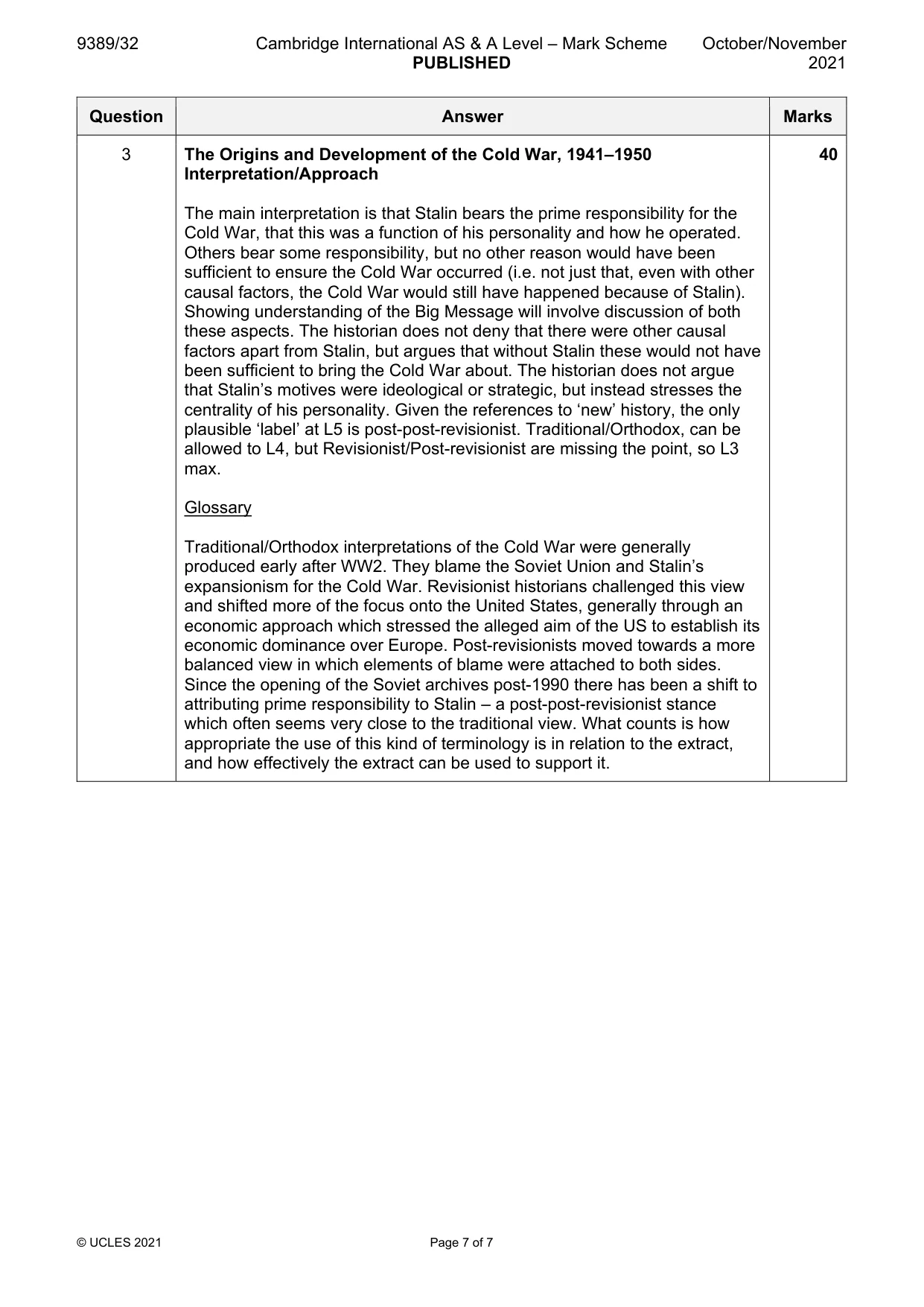
Mark scheme: 3 The Origins and Development of the Cold War, 1941–1950 40 Interpretation/Approach The main interpretation is that Stalin bears the prime responsibility for the Cold War, that this was a function of his personality and how he operated. Others bear some responsibility, but no other reason would have been sufficient to ensure the Cold War occurred (i.e. not just that, even with other causal factors, the Cold War would still have happened because of Stalin). Showing understanding of the Big Message will involve discussion of both these aspects. The historian does not deny that there were other causal factors apart from Stalin, but argues that without Stalin these would not have been sufficient to bring the Cold War about. The historian does not argue that Stalin’s motives were ideological or strategic, but instead stresses the centrality of his personality. Given the references to ‘new’ history, the only plausible ‘label’ at L5 is post-post-revisionist. Traditional/Orthodox, can be allowed to L4, but Revisionist/Post-revisionist are missing the point, so L3 max. Glossary Traditional/Orthodox interpretations of the Cold War were generally produced early after WW2. They blame the Soviet Union and Stalin’s expansionism for the Cold War. Revisionist historians challenged this view and shifted more of the focus onto the United States, generally through an economic approach which stressed the alleged aim of the US to establish its economic dominance over Europe. Post-revisionists moved towards a more balanced view in which elements of blame were attached to both sides. Since the opening of the Soviet archives post-1990 there has been a shift to attributing prime responsibility to Stalin – a post-post-revisionist stance which often seems very close to the traditional view. What counts is how appropriate the use of this kind of terminology is in relation to the extract, and how effectively the extract can be used to support it.
What you needed in this session
Cambridge’s own grade thresholds for 2021 Oct/Nov, Paper 3 · Variant 2. A higher threshold means an easier paper — the bar moves with how the cohort did.