Cambridge A Level History 9389 — 2018 May/June Paper 3 · Variant 3
9389/33/M/J/18 · 3 questions · 40 marks · ≈45 min
The question paper and its mark scheme, free to read here and free to download. This is Cambridge’s own paper, exactly as it was sat.
Question paper4 pages
Mark scheme7 pages
Answers below. Sit the paper first if you are practising.
Questions as text
Q1 · Read the extract and then answer the question
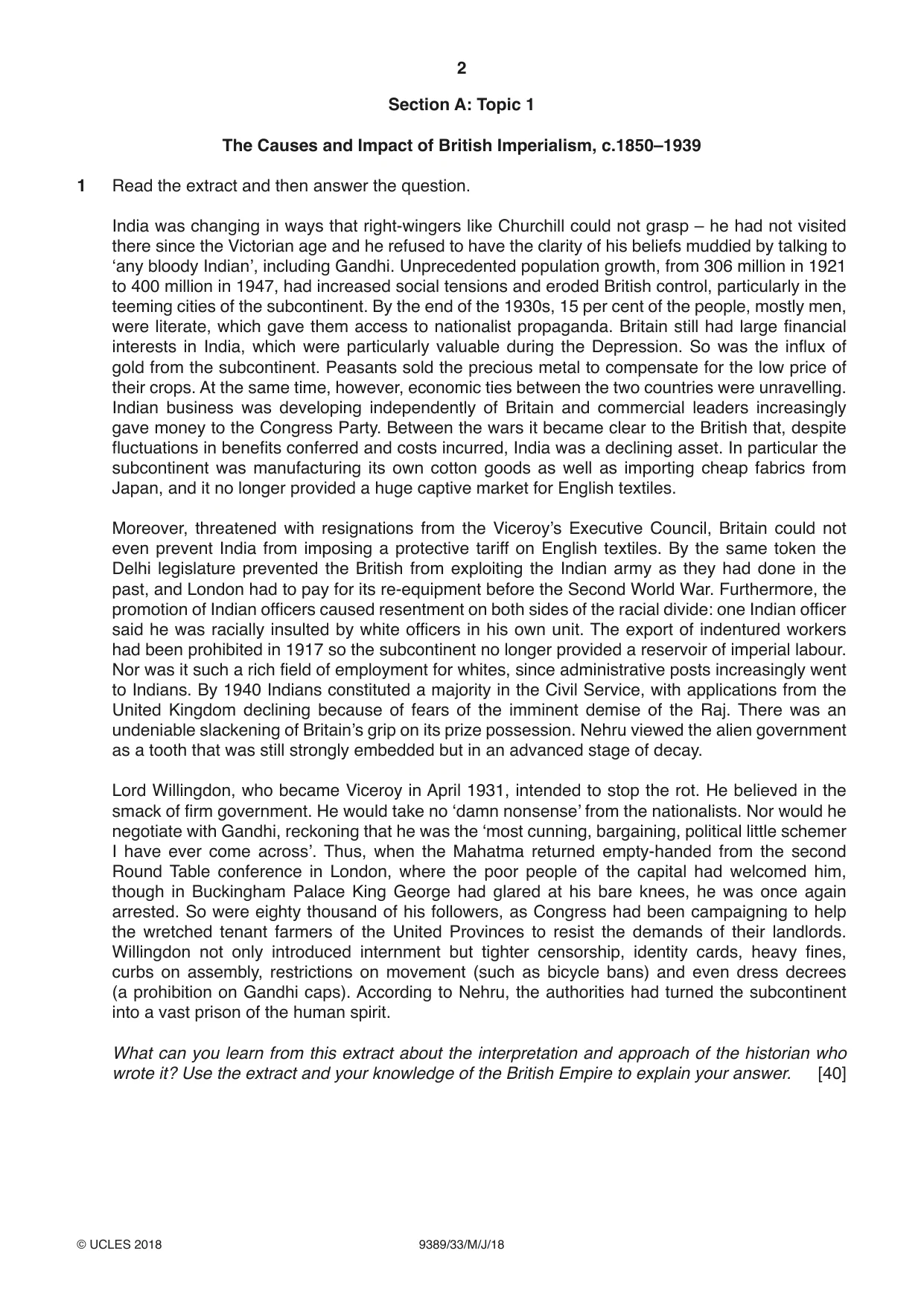
1 Read the extract and then answer the question. India was changing in ways that right-wingers like Churchill could not grasp – he had not visited there since the Victorian age and he refused to have the clarity of his beliefs muddied by talking to ‘any bloody Indian’, including Gandhi. Unprecedented population growth, from 306 million in 1921 to 400 million in 1947, had increased social tensions and eroded British control, particularly in the teeming cities of the subcontinent. By the end of the 1930s, 15 per cent of the people, mostly men, were literate, which gave them access to nationalist propaganda. Britain still had large financial interests in India, which were particularly valuable during the Depression. So was the influx of gold from the subcontinent. Peasants sold the precious metal to compensate for the low price of their crops. At the same time, however, economic ties between the two countries were unravelling. Indian business was developing independently of Britain and commercial leaders increasingly gave money to the Congress Party. Between the wars it became clear to the British that, despite fluctuations in benefits conferred and costs incurred, India was a declining asset. In particular the subcontinent was manufacturing its own cotton goods as well as importing cheap fabrics from Japan, and it no longer provided a huge captive market for English textiles. Moreover, threatened with resignations from the Viceroy’s Executive Council, Britain could not even prevent India from imposing a protective tariff on English textiles. By the same token the Delhi legislature prevented the British from exploiting the Indian army as they had done in the past, and London had to pay for its re-equipment before the Second World War. Furthermore, the promotion of Indian officers caused resentment on both sides of the racial divide: one Indian officer said he was racially insulted by white officers in his own unit. The export of indentured workers had been prohibited in 1917 so the subcontinent no longer provided a reservoir of imperial labour. Nor was it such a rich field of employment for whites, since administrative posts increasingly went to Indians. By 1940 Indians constituted a majority in the Civil Service, with applications from the United Kingdom declining because of fears of the imminent demise of the Raj. There was an undeniable slackening of Britain’s grip on its prize possession. Nehru viewed the alien government as a tooth that was still strongly embedded but in an advanced stage of decay. Lord Willingdon, who became Viceroy in April 1931, intended to stop the rot. He believed in the smack of firm government. He would take no ‘damn nonsense’ from the nationalists. Nor would he negotiate with Gandhi, reckoning that he was the ‘most cunning, bargaining, political little schemer I have ever come across’. Thus, when the Mahatma returned empty-handed from the second Round Table conference in London, where the poor people of the capital had welcomed him, though in Buckingham Palace King George had glared at his bare knees, he was once again arrested. So were eighty thousand of his followers, as Congress had been campaigning to help the wretched tenant farmers of the United Provinces to resist the demands of their landlords. Willingdon not only introduced internment but tighter censorship, identity cards, heavy fines, curbs on assembly, restrictions on movement (such as bicycle bans) and even dress decrees (a prohibition on Gandhi caps). According to Nehru, the authorities had turned the subcontinent into a vast prison of the human spirit. What can you learn from this extract about the interpretation and approach of the historian who wrote it? Use the extract and your knowledge of the British Empire to explain your answer. [40]
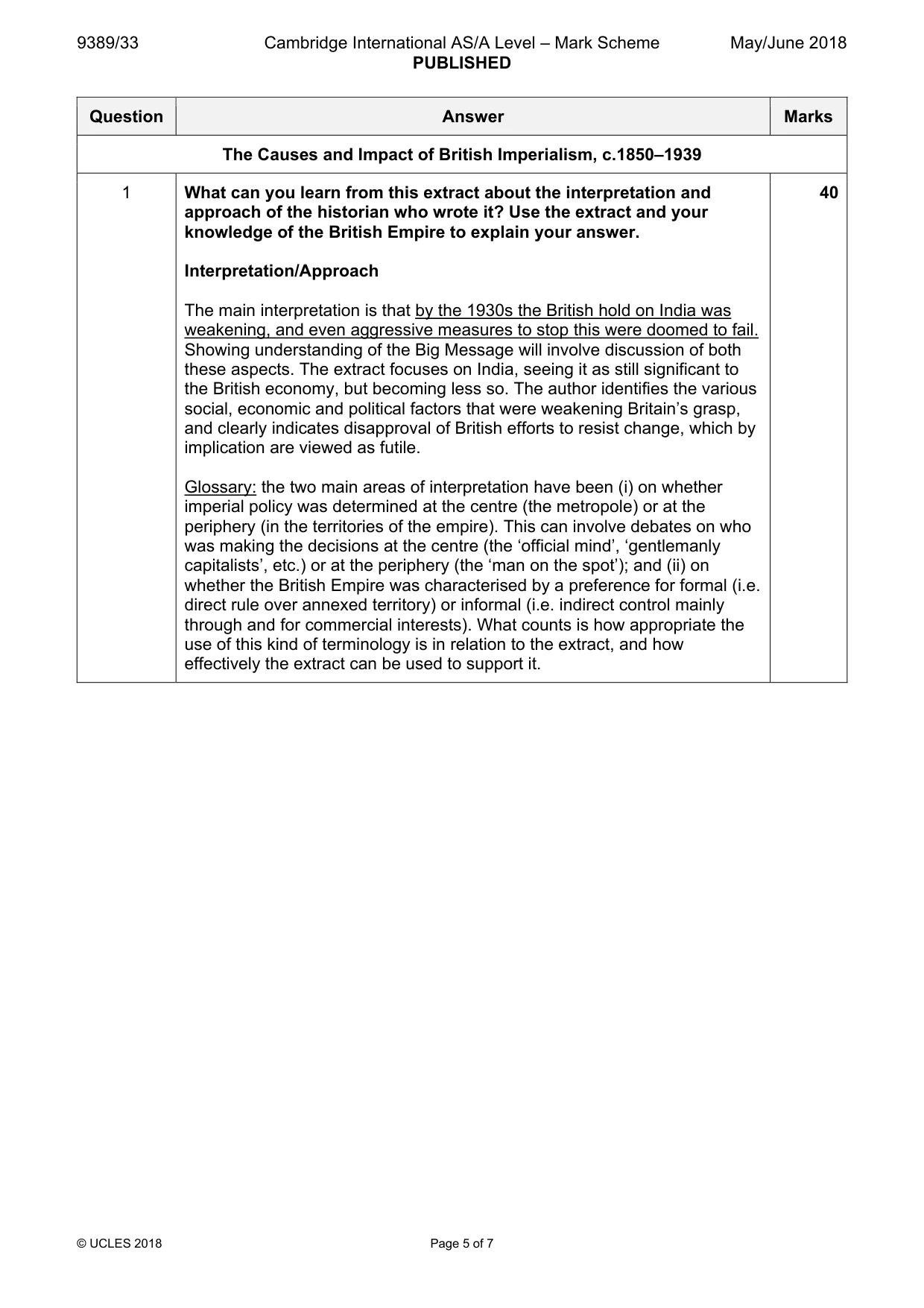
Mark scheme: Question Answer Marks The Causes and Impact of British Imperialism, c.1850–1939 1 What can you learn from this extract about the interpretation and 40 approach of the historian who wrote it? Use the extract and your knowledge of the British Empire to explain your answer. Interpretation/Approach The main interpretation is that by the 1930s the British hold on India was weakening, and even aggressive measures to stop this were doomed to fail. Showing understanding of the Big Message will involve discussion of both these aspects. The extract focuses on India, seeing it as still significant to the British economy, but becoming less so. The author identifies the various social, economic and political factors that were weakening Britain’s grasp, and clearly indicates disapproval of British efforts to resist change, which by implication are viewed as futile. Glossary: the two main areas of interpretation have been (i) on whether imperial policy was determined at the centre (the metropole) or at the periphery (in the territories of the empire). This can involve debates on who was making the decisions at the centre (the ‘official mind’, ‘gentlemanly capitalists’, etc.) or at the periphery (the ‘man on the spot’); and (ii) on whether the British Empire was characterised by a preference for formal (i.e. direct rule over annexed territory) or informal (i.e. indirect control mainly through and for commercial interests). What counts is how appropriate the use of this kind of terminology is in relation to the extract, and how effectively the extract can be used to support it.
Q2 · Read the extract and then answer the question
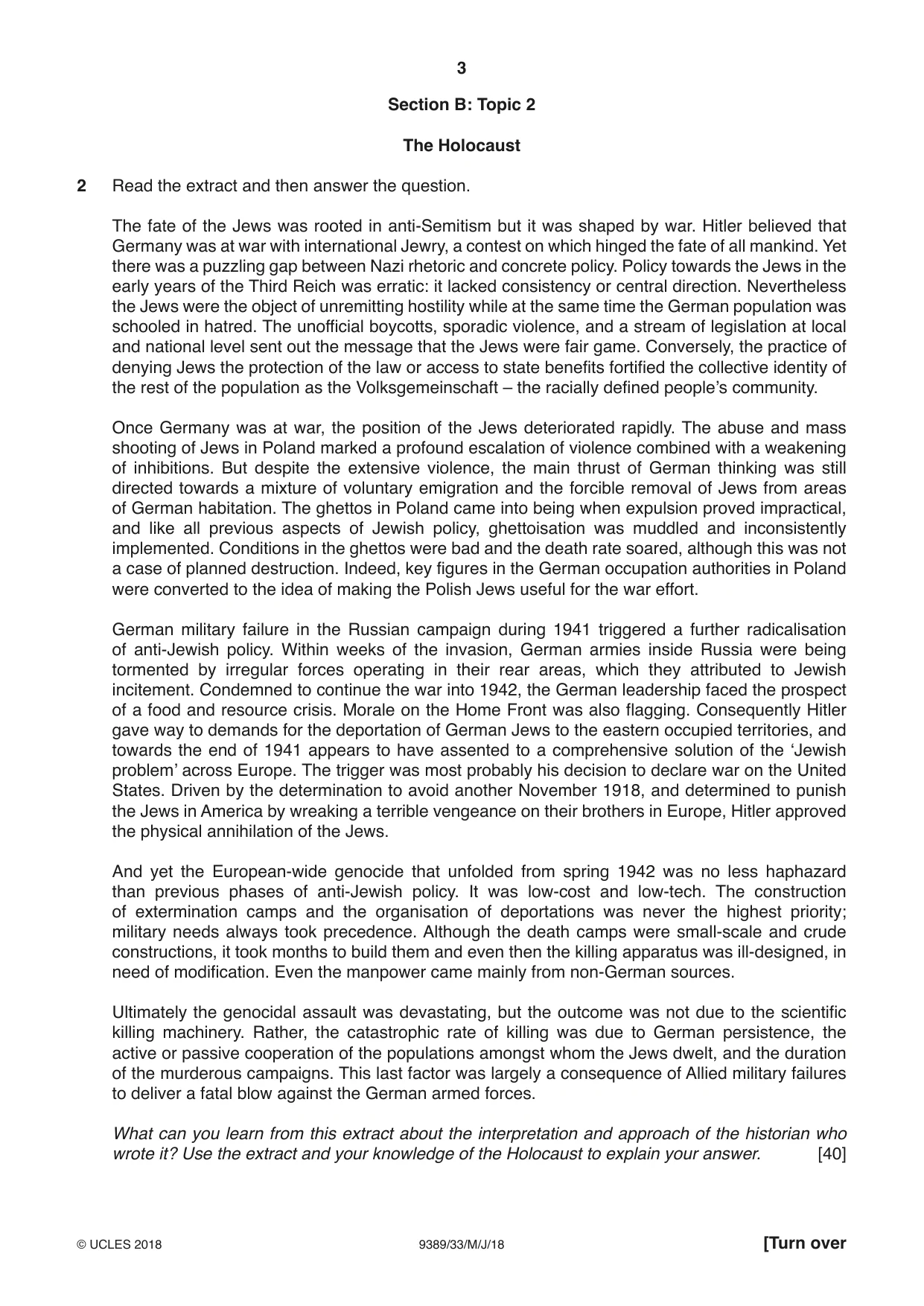
2 Read the extract and then answer the question. The fate of the Jews was rooted in anti-Semitism but it was shaped by war. Hitler believed that Germany was at war with international Jewry, a contest on which hinged the fate of all mankind. Yet there was a puzzling gap between Nazi rhetoric and concrete policy. Policy towards the Jews in the early years of the Third Reich was erratic: it lacked consistency or central direction. Nevertheless the Jews were the object of unremitting hostility while at the same time the German population was schooled in hatred. The unofficial boycotts, sporadic violence, and a stream of legislation at local and national level sent out the message that the Jews were fair game. Conversely, the practice of denying Jews the protection of the law or access to state benefits fortified the collective identity of the rest of the population as the Volksgemeinschaft – the racially defined people’s community. Once Germany was at war, the position of the Jews deteriorated rapidly. The abuse and mass shooting of Jews in Poland marked a profound escalation of violence combined with a weakening of inhibitions. But despite the extensive violence, the main thrust of German thinking was still directed towards a mixture of voluntary emigration and the forcible removal of Jews from areas of German habitation. The ghettos in Poland came into being when expulsion proved impractical, and like all previous aspects of Jewish policy, ghettoisation was muddled and inconsistently implemented. Conditions in the ghettos were bad and the death rate soared, although this was not a case of planned destruction. Indeed, key figures in the German occupation authorities in Poland were converted to the idea of making the Polish Jews useful for the war effort. German military failure in the Russian campaign during 1941 triggered a further radicalisation of anti-Jewish policy. Within weeks of the invasion, German armies inside Russia were being tormented by irregular forces operating in their rear areas, which they attributed to Jewish incitement. Condemned to continue the war into 1942, the German leadership faced the prospect of a food and resource crisis. Morale on the Home Front was also flagging. Consequently Hitler gave way to demands for the deportation of German Jews to the eastern occupied territories, and towards the end of 1941 appears to have assented to a comprehensive solution of the ‘Jewish problem’ across Europe. The trigger was most probably his decision to declare war on the United States. Driven by the determination to avoid another November 1918, and determined to punish the Jews in America by wreaking a terrible vengeance on their brothers in Europe, Hitler approved the physical annihilation of the Jews. And yet the European-wide genocide that unfolded from spring 1942 was no less haphazard than previous phases of anti-Jewish policy. It was low-cost and low-tech. The construction of extermination camps and the organisation of deportations was never the highest priority; military needs always took precedence. Although the death camps were small-scale and crude constructions, it took months to build them and even then the killing apparatus was ill-designed, in need of modification. Even the manpower came mainly from non-German sources. Ultimately the genocidal assault was devastating, but the outcome was not due to the scientific killing machinery. Rather, the catastrophic rate of killing was due to German persistence, the active or passive cooperation of the populations amongst whom the Jews dwelt, and the duration of the murderous campaigns. This last factor was largely a consequence of Allied military failures to deliver a fatal blow against the German armed forces. What can you learn from this extract about the interpretation and approach of the historian who wrote it? Use the extract and your knowledge of the Holocaust to explain your answer. [40] Section C: Topic 3 The Origins and Development of the Cold War, 1941–1950
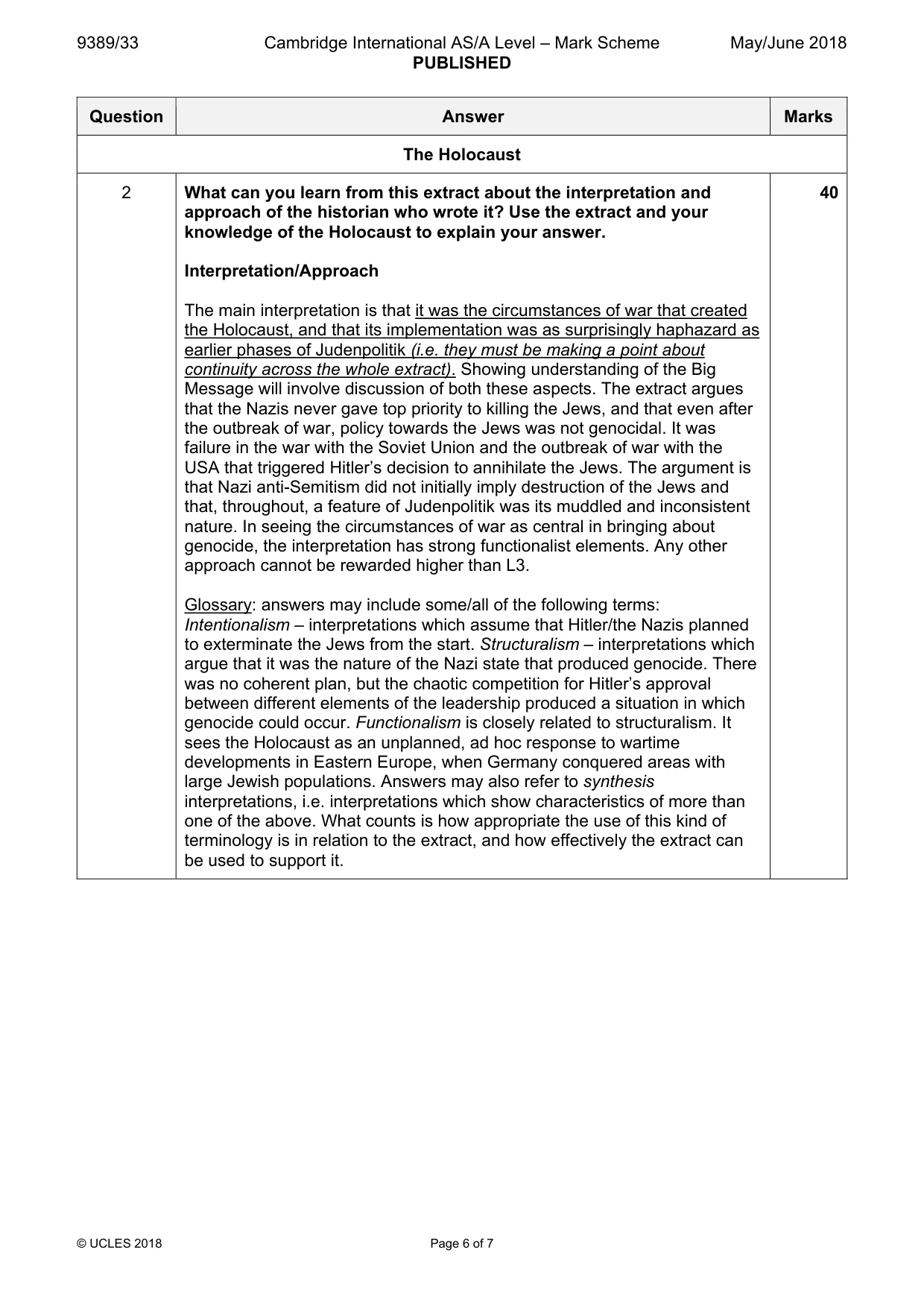
Mark scheme: 2 What can you learn from this extract about the interpretation and 40 approach of the historian who wrote it? Use the extract and your knowledge of the Holocaust to explain your answer. Interpretation/Approach The main interpretation is that it was the circumstances of war that created the Holocaust, and that its implementation was as surprisingly haphazard as earlier phases of Judenpolitik (i.e. they must be making a point about continuity across the whole extract). Showing understanding of the Big Message will involve discussion of both these aspects. The extract argues that the Nazis never gave top priority to killing the Jews, and that even after the outbreak of war, policy towards the Jews was not genocidal. It was failure in the war with the Soviet Union and the outbreak of war with the USA that triggered Hitler’s decision to annihilate the Jews. The argument is that Nazi anti-Semitism did not initially imply destruction of the Jews and that, throughout, a feature of Judenpolitik was its muddled and inconsistent nature. In seeing the circumstances of war as central in bringing about genocide, the interpretation has strong functionalist elements. Any other approach cannot be rewarded higher than L3. Glossary: answers may include some/all of the following terms: Intentionalism – interpretations which assume that Hitler/the Nazis planned to exterminate the Jews from the start. Structuralism – interpretations which argue that it was the nature of the Nazi state that produced genocide. There was no coherent plan, but the chaotic competition for Hitler’s approval between different elements of the leadership produced a situation in which genocide could occur. Functionalism is closely related to structuralism. It sees the Holocaust as an unplanned, ad hoc response to wartime developments in Eastern Europe, when Germany conquered areas with large Jewish populations. Answers may also refer to synthesis interpretations, i.e. interpretations which show characteristics of more than one of the above. What counts is how appropriate the use of this kind of terminology is in relation to the extract, and how effectively the extract can be used to support it.
Q3 · Read the extract and then answer the question
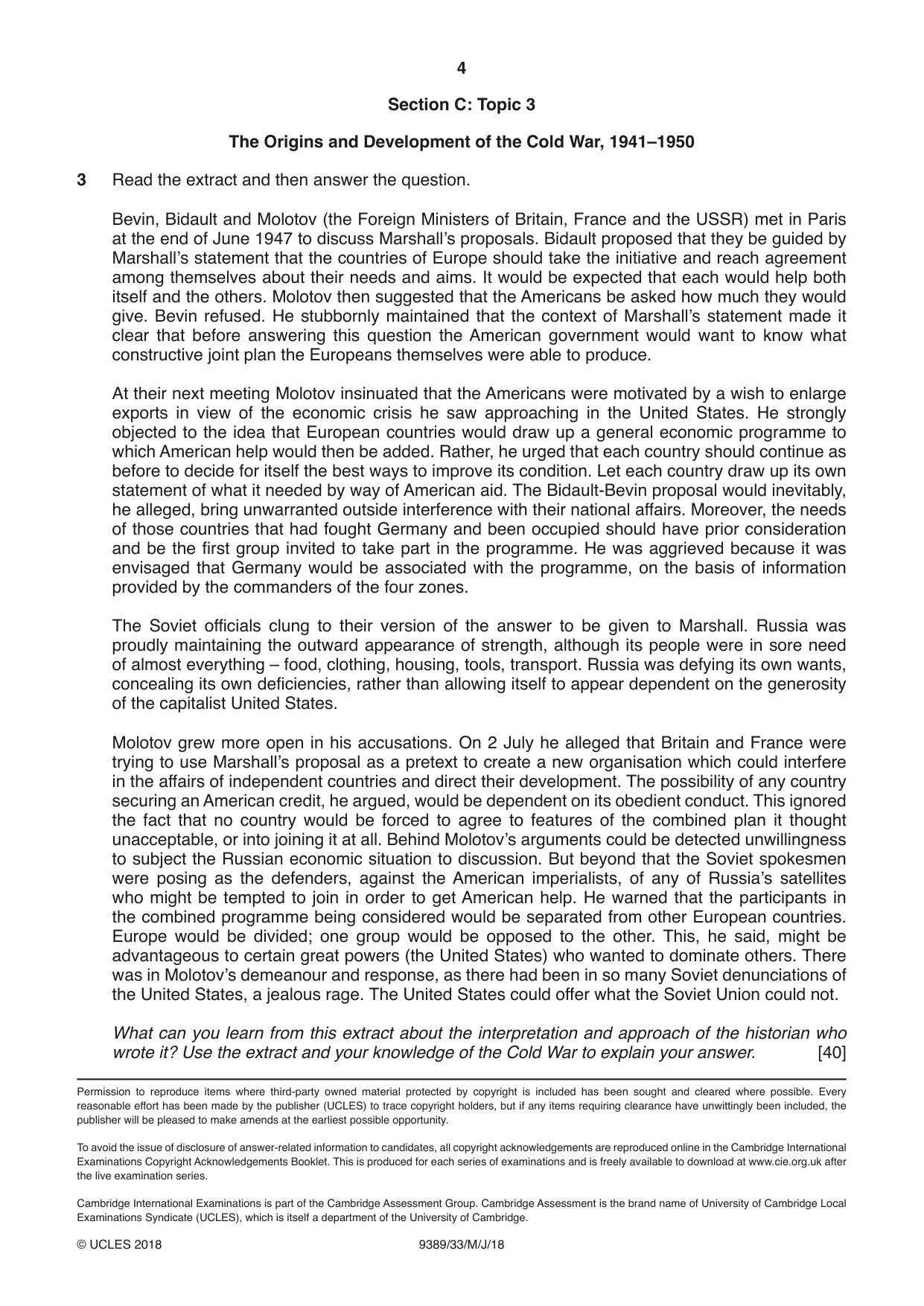
3 Read the extract and then answer the question. Bevin, Bidault and Molotov (the Foreign Ministers of Britain, France and the USSR) met in Paris at the end of June 1947 to discuss Marshall’s proposals. Bidault proposed that they be guided by Marshall’s statement that the countries of Europe should take the initiative and reach agreement among themselves about their needs and aims. It would be expected that each would help both itself and the others. Molotov then suggested that the Americans be asked how much they would give. Bevin refused. He stubbornly maintained that the context of Marshall’s statement made it clear that before answering this question the American government would want to know what constructive joint plan the Europeans themselves were able to produce. At their next meeting Molotov insinuated that the Americans were motivated by a wish to enlarge exports in view of the economic crisis he saw approaching in the United States. He strongly objected to the idea that European countries would draw up a general economic programme to which American help would then be added. Rather, he urged that each country should continue as before to decide for itself the best ways to improve its condition. Let each country draw up its own statement of what it needed by way of American aid. The Bidault-Bevin proposal would inevitably, he alleged, bring unwarranted outside interference with their national affairs. Moreover, the needs of those countries that had fought Germany and been occupied should have prior consideration and be the first group invited to take part in the programme. He was aggrieved because it was envisaged that Germany would be associated with the programme, on the basis of information provided by the commanders of the four zones. The Soviet officials clung to their version of the answer to be given to Marshall. Russia was proudly maintaining the outward appearance of strength, although its people were in sore need of almost everything – food, clothing, housing, tools, transport. Russia was defying its own wants, concealing its own deficiencies, rather than allowing itself to appear dependent on the generosity of the capitalist United States. Molotov grew more open in his accusations. On 2 July he alleged that Britain and France were trying to use Marshall’s proposal as a pretext to create a new organisation which could interfere in the affairs of independent countries and direct their development. The possibility of any country securing an American credit, he argued, would be dependent on its obedient conduct. This ignored the fact that no country would be forced to agree to features of the combined plan it thought unacceptable, or into joining it at all. Behind Molotov’s arguments could be detected unwillingness to subject the Russian economic situation to discussion. But beyond that the Soviet spokesmen were posing as the defenders, against the American imperialists, of any of Russia’s satellites who might be tempted to join in order to get American help. He warned that the participants in the combined programme being considered would be separated from other European countries. Europe would be divided; one group would be opposed to the other. This, he said, might be advantageous to certain great powers (the United States) who wanted to dominate others. There was in Molotov’s demeanour and response, as there had been in so many Soviet denunciations of the United States, a jealous rage. The United States could offer what the Soviet Union could not. What can you learn from this extract about the interpretation and approach of the historian who wrote it? Use the extract and your knowledge of the Cold War to explain your answer. [40]
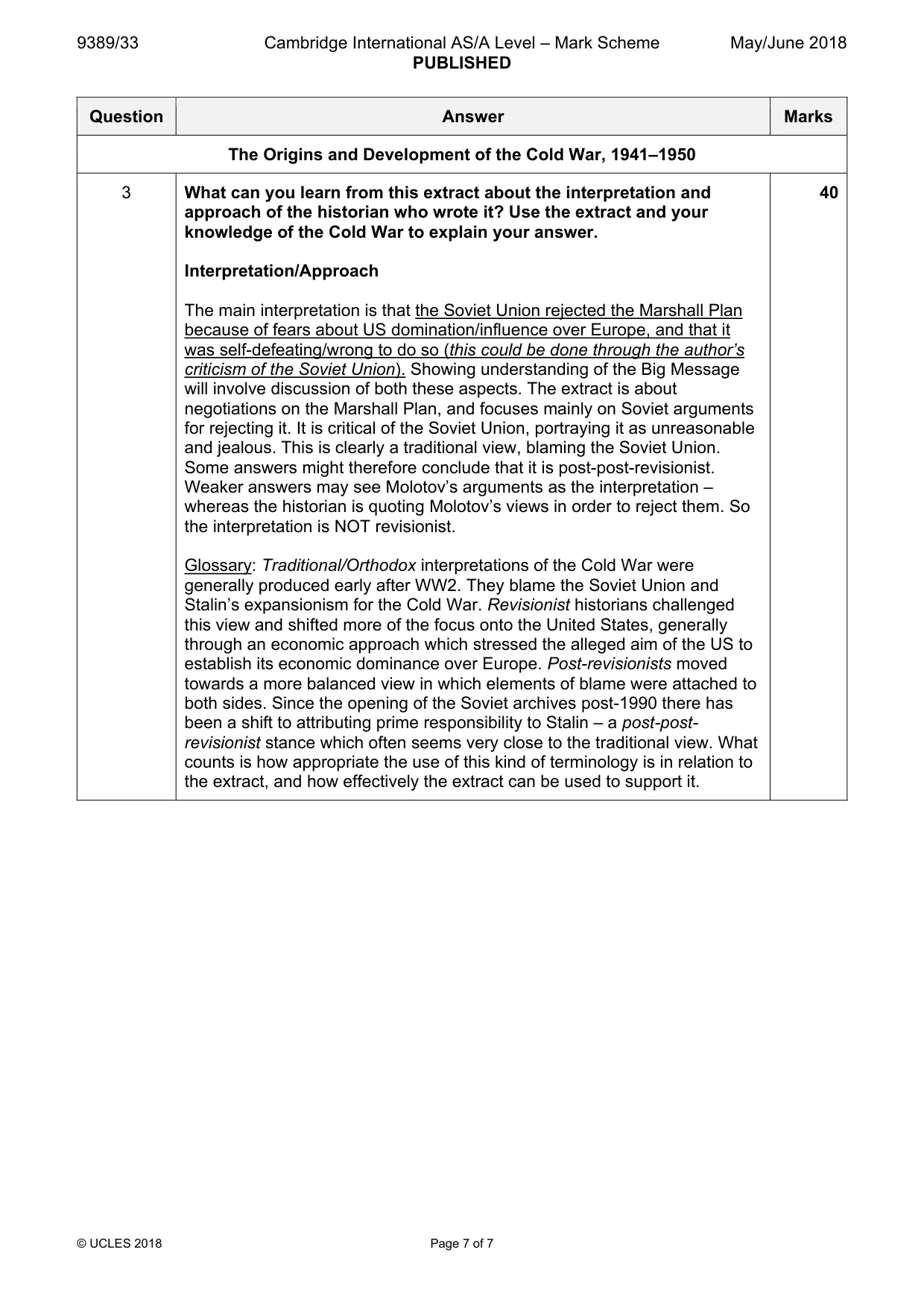
Mark scheme: 3 What can you learn from this extract about the interpretation and 40 approach of the historian who wrote it? Use the extract and your knowledge of the Cold War to explain your answer. Interpretation/Approach The main interpretation is that the Soviet Union rejected the Marshall Plan because of fears about US domination/influence over Europe, and that it was self-defeating/wrong to do so (this could be done through the author’s criticism of the Soviet Union). Showing understanding of the Big Message will involve discussion of both these aspects. The extract is about negotiations on the Marshall Plan, and focuses mainly on Soviet arguments for rejecting it. It is critical of the Soviet Union, portraying it as unreasonable and jealous. This is clearly a traditional view, blaming the Soviet Union. Some answers might therefore conclude that it is post-post-revisionist. Weaker answers may see Molotov’s arguments as the interpretation – whereas the historian is quoting Molotov’s views in order to reject them. So the interpretation is NOT revisionist. Glossary: Traditional/Orthodox interpretations of the Cold War were generally produced early after WW2. They blame the Soviet Union and Stalin’s expansionism for the Cold War. Revisionist historians challenged this view and shifted more of the focus onto the United States, generally through an economic approach which stressed the alleged aim of the US to establish its economic dominance over Europe. Post-revisionists moved towards a more balanced view in which elements of blame were attached to both sides. Since the opening of the Soviet archives post-1990 there has been a shift to attributing prime responsibility to Stalin – a post-post- revisionist stance which often seems very close to the traditional view. What counts is how appropriate the use of this kind of terminology is in relation to the extract, and how effectively the extract can be used to support it.
What you needed in this session
Cambridge’s own grade thresholds for 2018 May/June, Paper 3 · Variant 3. A higher threshold means an easier paper — the bar moves with how the cohort did.