Cambridge A Level History 9389 — 2021 Oct/Nov Paper 2 · Variant 1
9389/21/O/N/21 · 12 questions · 60 marks · ≈68 min
The question paper and its mark scheme, free to read here and free to download. This is Cambridge’s own paper, exactly as it was sat.
Question paper4 pages
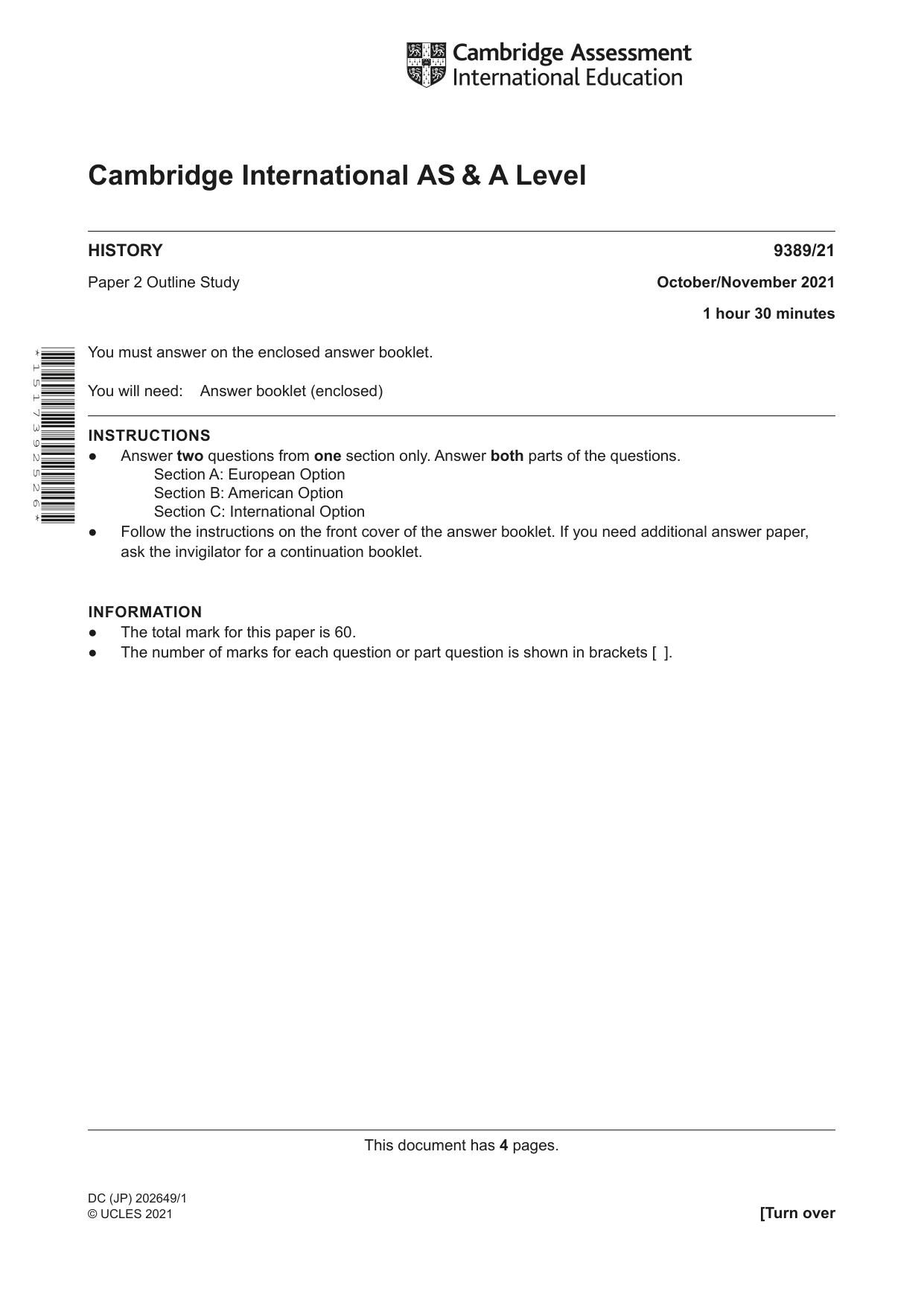
Mark scheme16 pages
Answers below. Sit the paper first if you are practising.

Questions as text
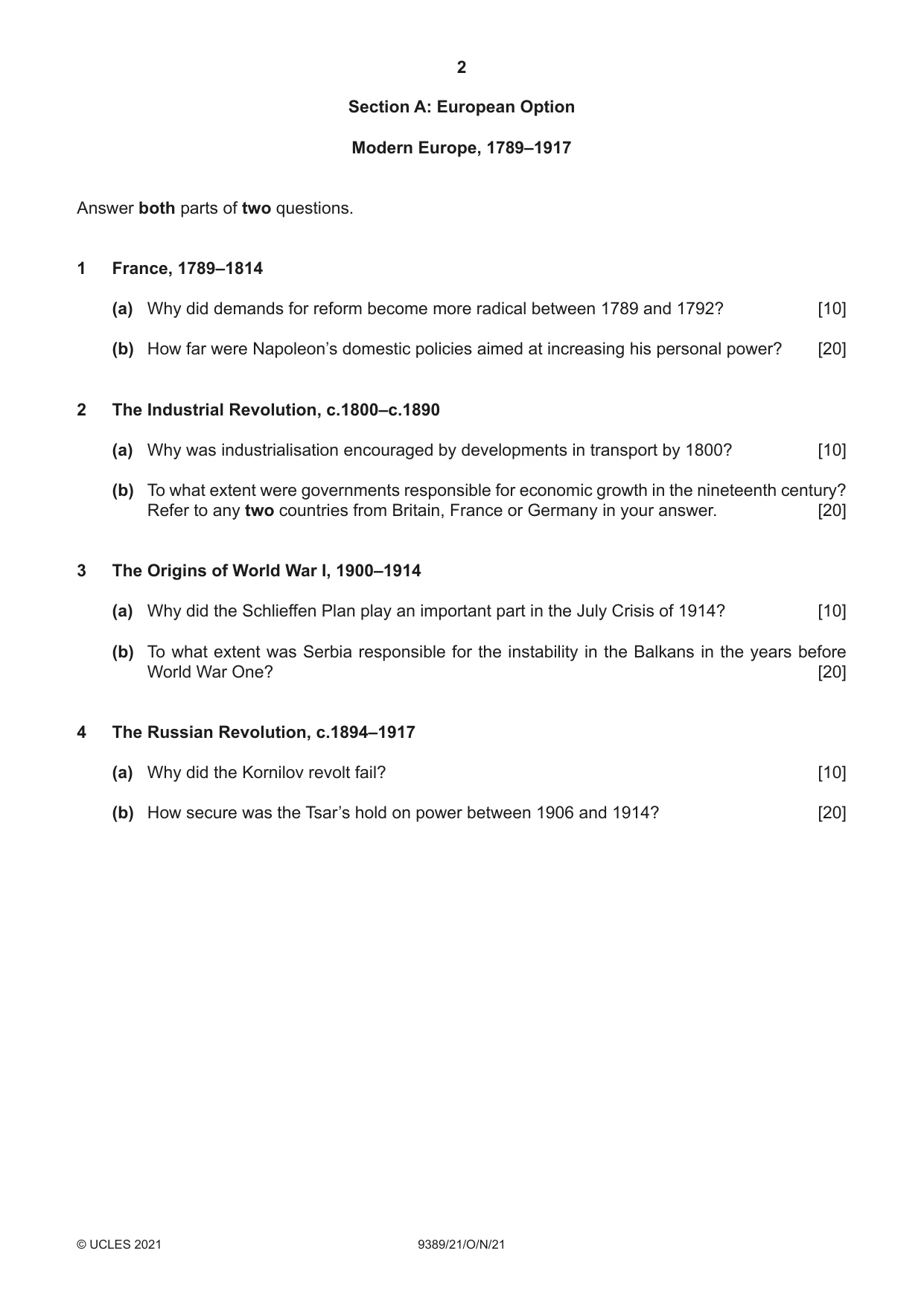
Q1 · France, 1789–1814 (a) Why did demands for reform become more radical between 1789 and…
1 France, 1789–1814 (a) Why did demands for reform become more radical between 1789 and 1792? [10] (b) How far were Napoleon’s domestic policies aimed at increasing his personal power? [20]
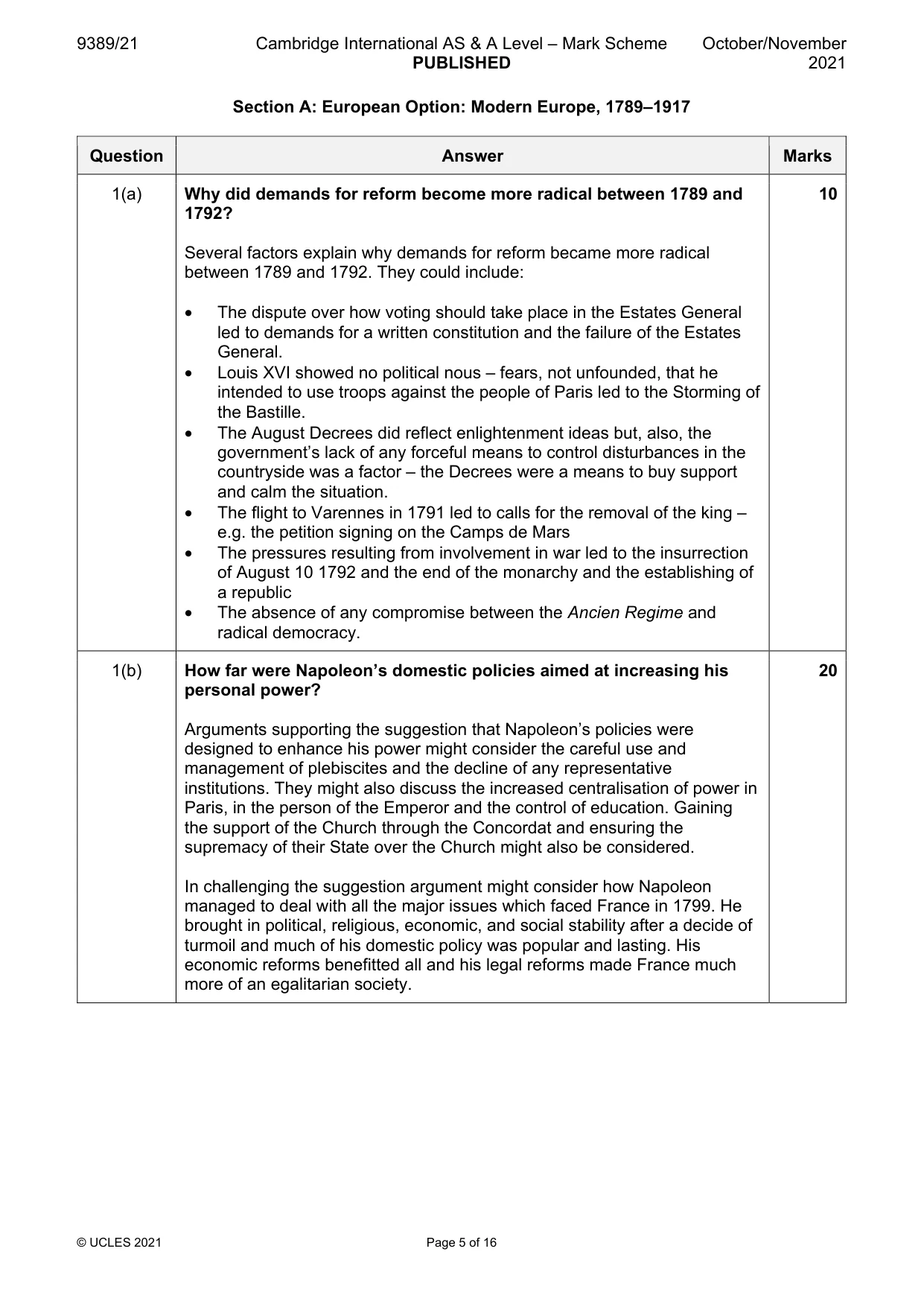
Mark scheme: Question Answer Marks 1(a) Why did demands for reform become more radical between 1789 and 10 1792? Several factors explain why demands for reform became more radical between 1789 and 1792. They could include: • The dispute over how voting should take place in the Estates General led to demands for a written constitution and the failure of the Estates General. • Louis XVI showed no political nous – fears, not unfounded, that he intended to use troops against the people of Paris led to the Storming of the Bastille. • The August Decrees did reflect enlightenment ideas but, also, the government’s lack of any forceful means to control disturbances in the countryside was a factor – the Decrees were a means to buy support and calm the situation. • The flight to Varennes in 1791 led to calls for the removal of the king – e.g. the petition signing on the Camps de Mars • The pressures resulting from involvement in war led to the insurrection of August 10 1792 and the end of the monarchy and the establishing of a republic • The absence of any compromise between the Ancien Regime and radical democracy. 1(b) How far were Napoleon’s domestic policies aimed at increasing his 20 personal power? Arguments supporting the suggestion that Napoleon’s policies were designed to enhance his power might consider the careful use and management of plebiscites and the decline of any representative institutions. They might also discuss the increased centralisation of power in Paris, in the person of the Emperor and the control of education. Gaining the support of the Church through the Concordat and ensuring the supremacy of their State over the Church might also be considered. In challenging the suggestion argument might consider how Napoleon managed to deal with all the major issues which faced France in 1799. He brought in political, religious, economic, and social stability after a decide of turmoil and much of his domestic policy was popular and lasting. His economic reforms benefitted all and his legal reforms made France much more of an egalitarian society.
Q2 · The Industrial Revolution, c.1800–c.1890 (a) Why was industrialisation encouraged by…
2 The Industrial Revolution, c.1800–c.1890 (a) Why was industrialisation encouraged by developments in transport by 1800? [10] (b) To what extent were governments responsible for economic growth in the nineteenth century? Refer to any two countries from Britain, France or Germany in your answer. [20]
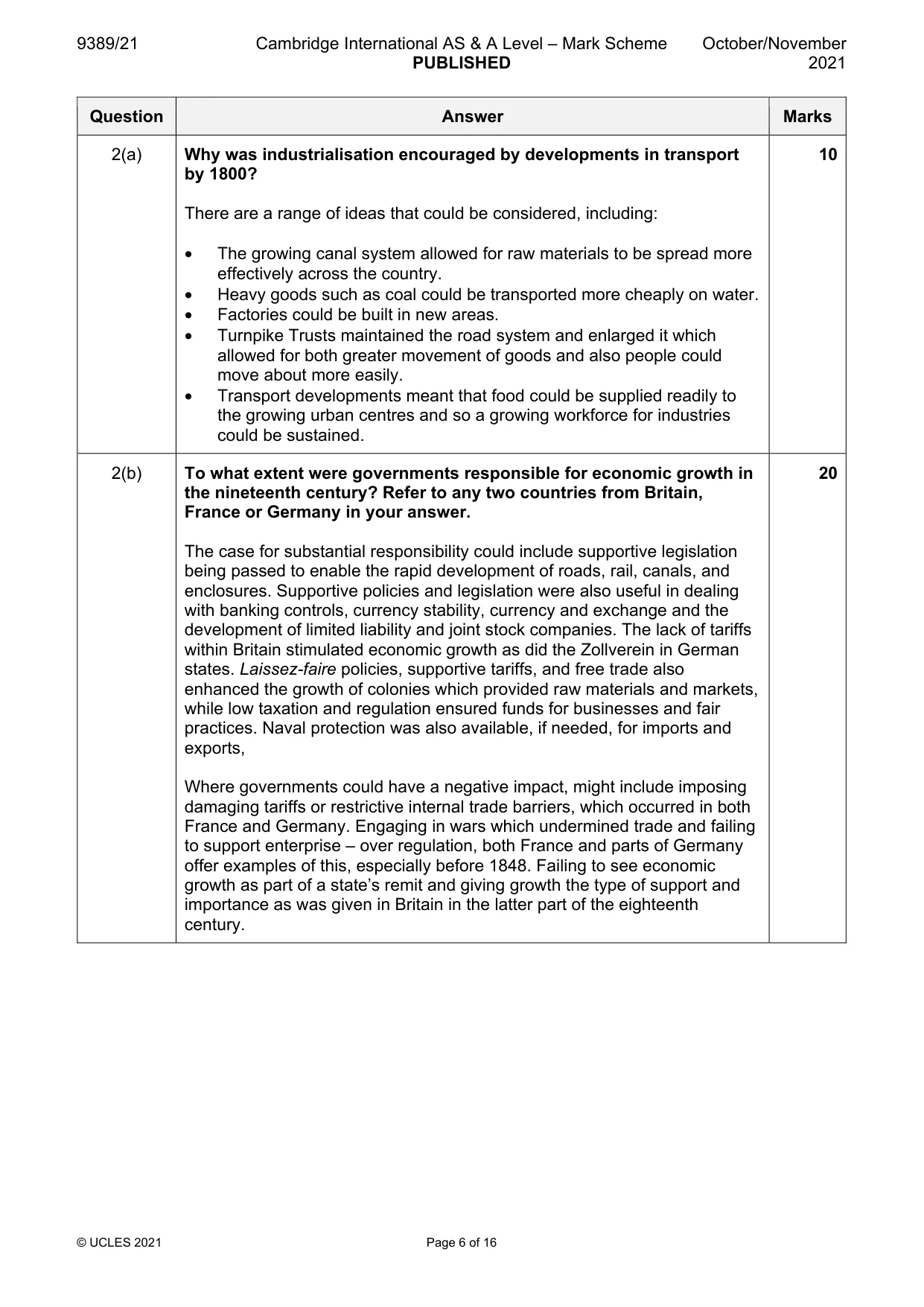
Mark scheme: 2(a) Why was industrialisation encouraged by developments in transport 10 by 1800? There are a range of ideas that could be considered, including: • The growing canal system allowed for raw materials to be spread more effectively across the country. • Heavy goods such as coal could be transported more cheaply on water. • Factories could be built in new areas. • Turnpike Trusts maintained the road system and enlarged it which allowed for both greater movement of goods and also people could move about more easily. • Transport developments meant that food could be supplied readily to the growing urban centres and so a growing workforce for industries could be sustained. 2(b) To what extent were governments responsible for economic growth in 20 the nineteenth century? Refer to any two countries from Britain, France or Germany in your answer. The case for substantial responsibility could include supportive legislation being passed to enable the rapid development of roads, rail, canals, and enclosures. Supportive policies and legislation were also useful in dealing with banking controls, currency stability, currency and exchange and the development of limited liability and joint stock companies. The lack of tariffs within Britain stimulated economic growth as did the Zollverein in German states. Laissez-faire policies, supportive tariffs, and free trade also enhanced the growth of colonies which provided raw materials and markets, while low taxation and regulation ensured funds for businesses and fair practices. Naval protection was also available, if needed, for imports and exports, Where governments could have a negative impact, might include imposing damaging tariffs or restrictive internal trade barriers, which occurred in both France and Germany. Engaging in wars which undermined trade and failing to support enterprise – over regulation, both France and parts of Germany offer examples of this, especially before 1848. Failing to see economic growth as part of a state’s remit and giving growth the type of support and importance as was given in Britain in the latter part of the eighteenth century.
Q3 · The Origins of World War I, 1900–1914 (a) Why did the Schlieffen Plan play an important…
3 The Origins of World War I, 1900–1914 (a) Why did the Schlieffen Plan play an important part in the July Crisis of 1914? [10] (b) To what extent was Serbia responsible for the instability in the Balkans in the years before World War One? [20]
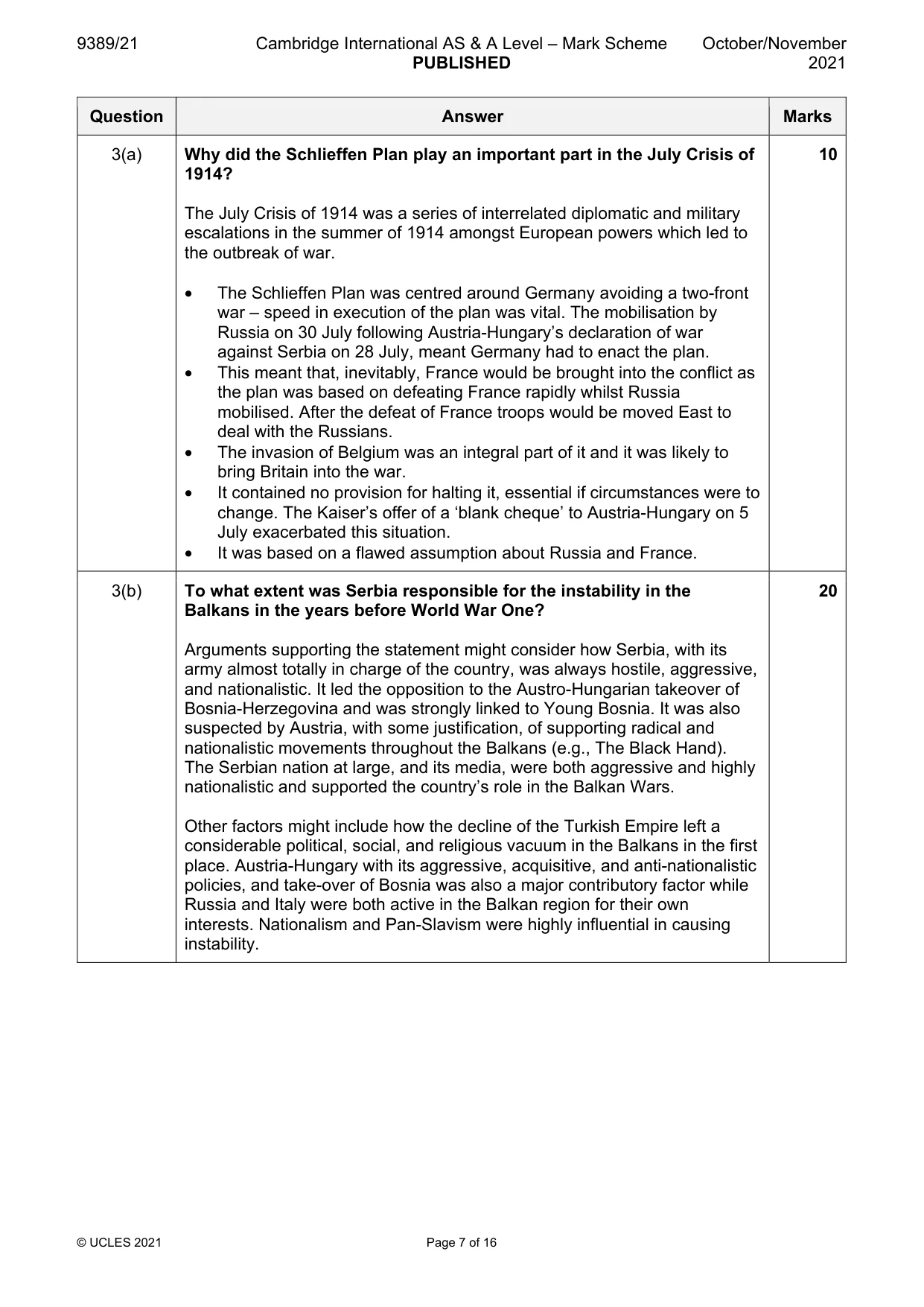
Mark scheme: 3(a) Why did the Schlieffen Plan play an important part in the July Crisis of 10 1914? The July Crisis of 1914 was a series of interrelated diplomatic and military escalations in the summer of 1914 amongst European powers which led to the outbreak of war. • The Schlieffen Plan was centred around Germany avoiding a two-front war – speed in execution of the plan was vital. The mobilisation by Russia on 30 July following Austria-Hungary’s declaration of war against Serbia on 28 July, meant Germany had to enact the plan. • This meant that, inevitably, France would be brought into the conflict as the plan was based on defeating France rapidly whilst Russia mobilised. After the defeat of France troops would be moved East to deal with the Russians. • The invasion of Belgium was an integral part of it and it was likely to bring Britain into the war. • It contained no provision for halting it, essential if circumstances were to change. The Kaiser’s offer of a ‘blank cheque’ to Austria-Hungary on 5 July exacerbated this situation. • It was based on a flawed assumption about Russia and France. 3(b) To what extent was Serbia responsible for the instability in the 20 Balkans in the years before World War One? Arguments supporting the statement might consider how Serbia, with its army almost totally in charge of the country, was always hostile, aggressive, and nationalistic. It led the opposition to the Austro-Hungarian takeover of Bosnia-Herzegovina and was strongly linked to Young Bosnia. It was also suspected by Austria, with some justification, of supporting radical and nationalistic movements throughout the Balkans (e.g., The Black Hand). The Serbian nation at large, and its media, were both aggressive and highly nationalistic and supported the country’s role in the Balkan Wars. Other factors might include how the decline of the Turkish Empire left a considerable political, social, and religious vacuum in the Balkans in the first place. Austria-Hungary with its aggressive, acquisitive, and anti-nationalistic policies, and take-over of Bosnia was also a major contributory factor while Russia and Italy were both active in the Balkan region for their own interests. Nationalism and Pan-Slavism were highly influential in causing instability.
Q4 · The Russian Revolution, c.1894–1917 (a) Why did the Kornilov revolt fail?
4 The Russian Revolution, c.1894–1917 (a) Why did the Kornilov revolt fail? [10] (b) How secure was the Tsar’s hold on power between 1906 and 1914? [20]
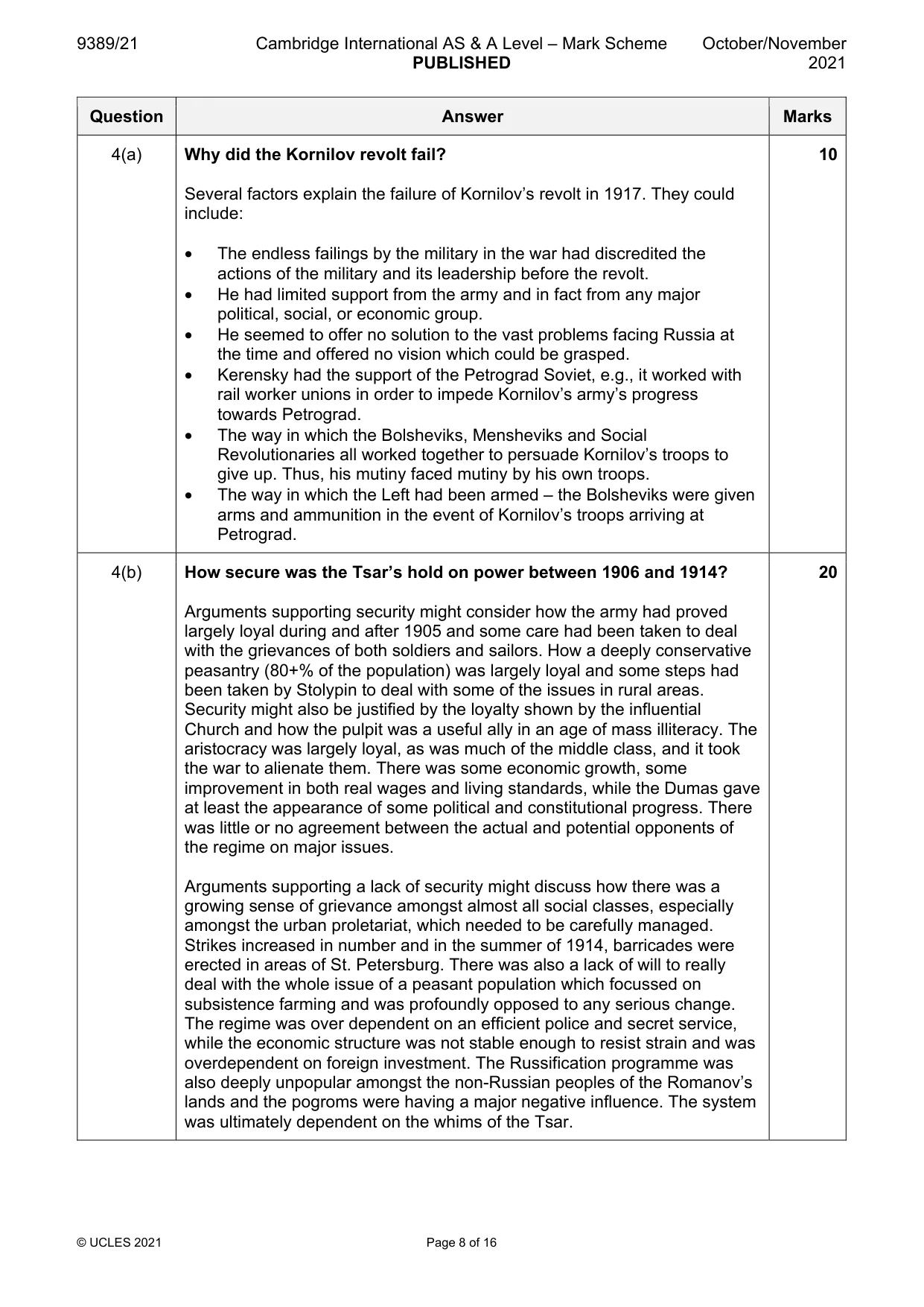
Mark scheme: 4(a) Why did the Kornilov revolt fail? 10 Several factors explain the failure of Kornilov’s revolt in 1917. They could include: • The endless failings by the military in the war had discredited the actions of the military and its leadership before the revolt. • He had limited support from the army and in fact from any major political, social, or economic group. • He seemed to offer no solution to the vast problems facing Russia at the time and offered no vision which could be grasped. • Kerensky had the support of the Petrograd Soviet, e.g., it worked with rail worker unions in order to impede Kornilov’s army’s progress towards Petrograd. • The way in which the Bolsheviks, Mensheviks and Social Revolutionaries all worked together to persuade Kornilov’s troops to give up. Thus, his mutiny faced mutiny by his own troops. • The way in which the Left had been armed – the Bolsheviks were given arms and ammunition in the event of Kornilov’s troops arriving at Petrograd. 4(b) How secure was the Tsar’s hold on power between 1906 and 1914? 20 Arguments supporting security might consider how the army had proved largely loyal during and after 1905 and some care had been taken to deal with the grievances of both soldiers and sailors. How a deeply conservative peasantry (80+% of the population) was largely loyal and some steps had been taken by Stolypin to deal with some of the issues in rural areas. Security might also be justified by the loyalty shown by the influential Church and how the pulpit was a useful ally in an age of mass illiteracy. The aristocracy was largely loyal, as was much of the middle class, and it took the war to alienate them. There was some economic growth, some improvement in both real wages and living standards, while the Dumas gave at least the appearance of some political and constitutional progress. There was little or no agreement between the actual and potential opponents of the regime on major issues. Arguments supporting a lack of security might discuss how there was a growing sense of grievance amongst almost all social classes, especially amongst the urban proletariat, which needed to be carefully managed. Strikes increased in number and in the summer of 1914, barricades were erected in areas of St. Petersburg. There was also a lack of will to really deal with the whole issue of a peasant population which focussed on subsistence farming and was profoundly opposed to any serious change. The regime was over dependent on an efficient police and secret service, while the economic structure was not stable enough to resist strain and was overdependent on foreign investment. The Russification programme was also deeply unpopular amongst the non-Russian peoples of the Romanov’s lands and the pogroms were having a major negative influence. The system was ultimately dependent on the whims of the Tsar. Section B: American Option: The History of the USA, 1840–1941
Q5 · The Expansion of US Power from the 1840s to the 1930s (a) Why did the United States…
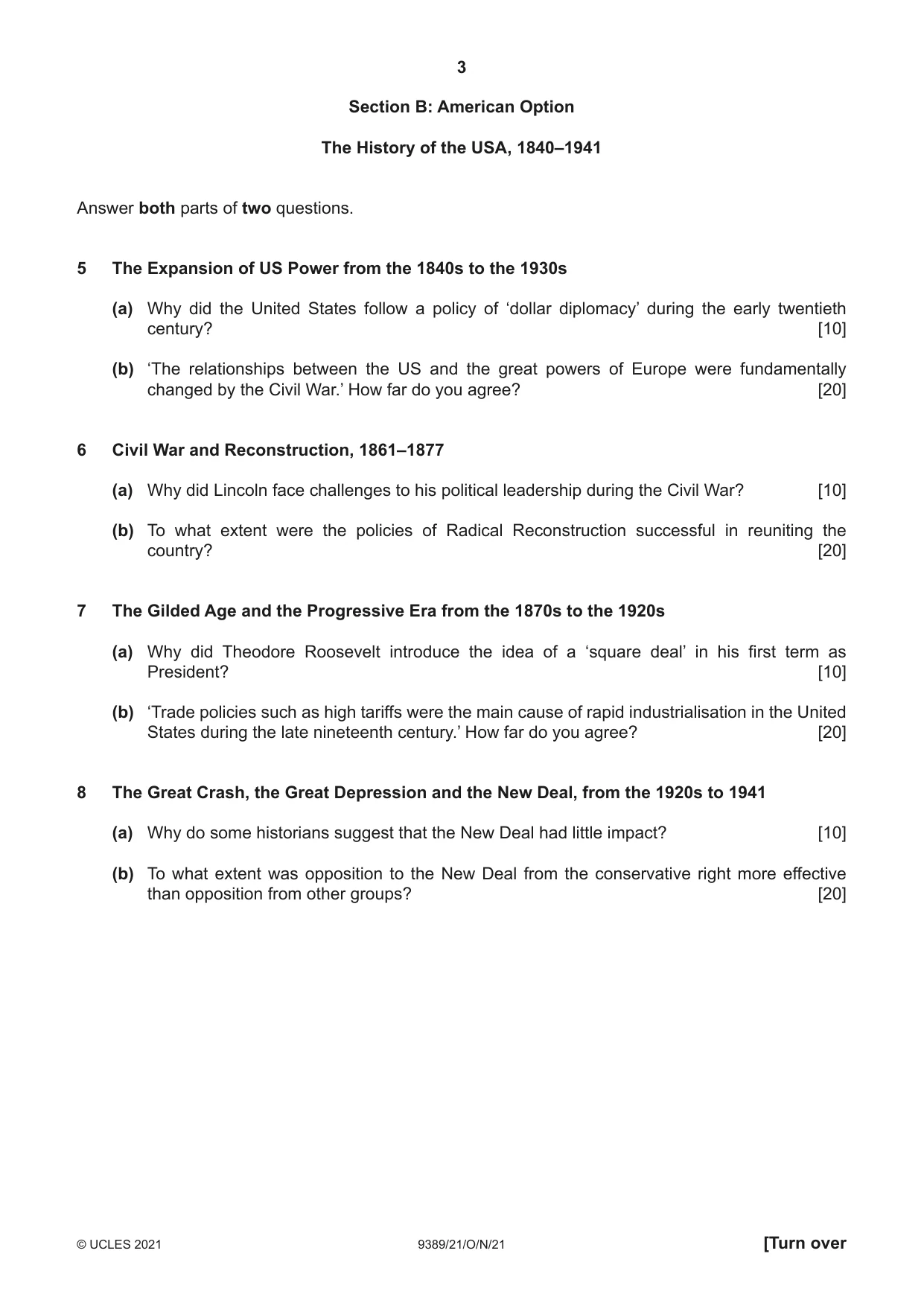
5 The Expansion of US Power from the 1840s to the 1930s (a) Why did the United States follow a policy of ‘dollar diplomacy’ during the early twentieth century? [10] (b) ‘The relationships between the US and the great powers of Europe were fundamentally changed by the Civil War.’ How far do you agree? [20]
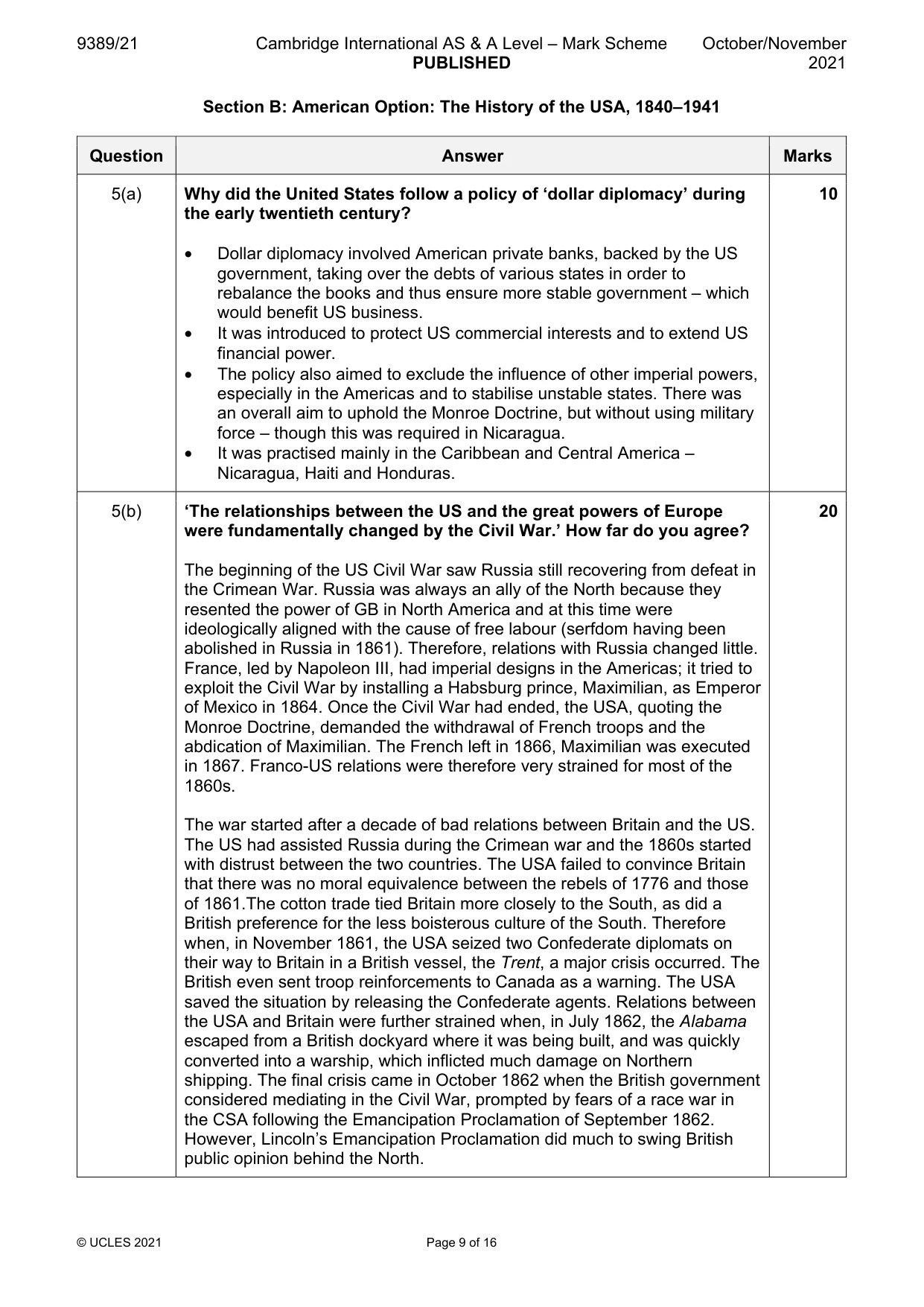
Mark scheme: 5(a) Why did the United States follow a policy of ‘dollar diplomacy’ during 10 the early twentieth century? • Dollar diplomacy involved American private banks, backed by the US government, taking over the debts of various states in order to rebalance the books and thus ensure more stable government – which would benefit US business. • It was introduced to protect US commercial interests and to extend US financial power. • The policy also aimed to exclude the influence of other imperial powers, especially in the Americas and to stabilise unstable states. There was an overall aim to uphold the Monroe Doctrine, but without using military force – though this was required in Nicaragua. • It was practised mainly in the Caribbean and Central America – Nicaragua, Haiti and Honduras. 5(b) ‘The relationships between the US and the great powers of Europe 20 were fundamentally changed by the Civil War.’ How far do you agree? The beginning of the US Civil War saw Russia still recovering from defeat in the Crimean War. Russia was always an ally of the North because they resented the power of GB in North America and at this time were ideologically aligned with the cause of free labour (serfdom having been abolished in Russia in 1861). Therefore, relations with Russia changed little. France, led by Napoleon III, had imperial designs in the Americas; it tried to exploit the Civil War by installing a Habsburg prince, Maximilian, as Emperor of Mexico in 1864. Once the Civil War had ended, the USA, quoting the Monroe Doctrine, demanded the withdrawal of French troops and the abdication of Maximilian. The French left in 1866, Maximilian was executed in 1867. Franco-US relations were therefore very strained for most of the 1860s. The war started after a decade of bad relations between Britain and the US. The US had assisted Russia during the Crimean war and the 1860s started with distrust between the two countries. The USA failed to convince Britain that there was no moral equivalence between the rebels of 1776 and those of 1861.The cotton trade tied Britain more closely to the South, as did a British preference for the less boisterous culture of the South. Therefore when, in November 1861, the USA seized two Confederate diplomats on their way to Britain in a British vessel, the Trent, a major crisis occurred. The British even sent troop reinforcements to Canada as a warning. The USA saved the situation by releasing the Confederate agents. Relations between the USA and Britain were further strained when, in July 1862, the Alabama escaped from a British dockyard where it was being built, and was quickly converted into a warship, which inflicted much damage on Northern shipping. The final crisis came in October 1862 when the British government considered mediating in the Civil War, prompted by fears of a race war in the CSA following the Emancipation Proclamation of September 1862. However, Lincoln’s Emancipation Proclamation did much to swing British public opinion behind the North.
Q6 · Civil War and Reconstruction, 1861–1877 (a) Why did Lincoln face challenges to his…
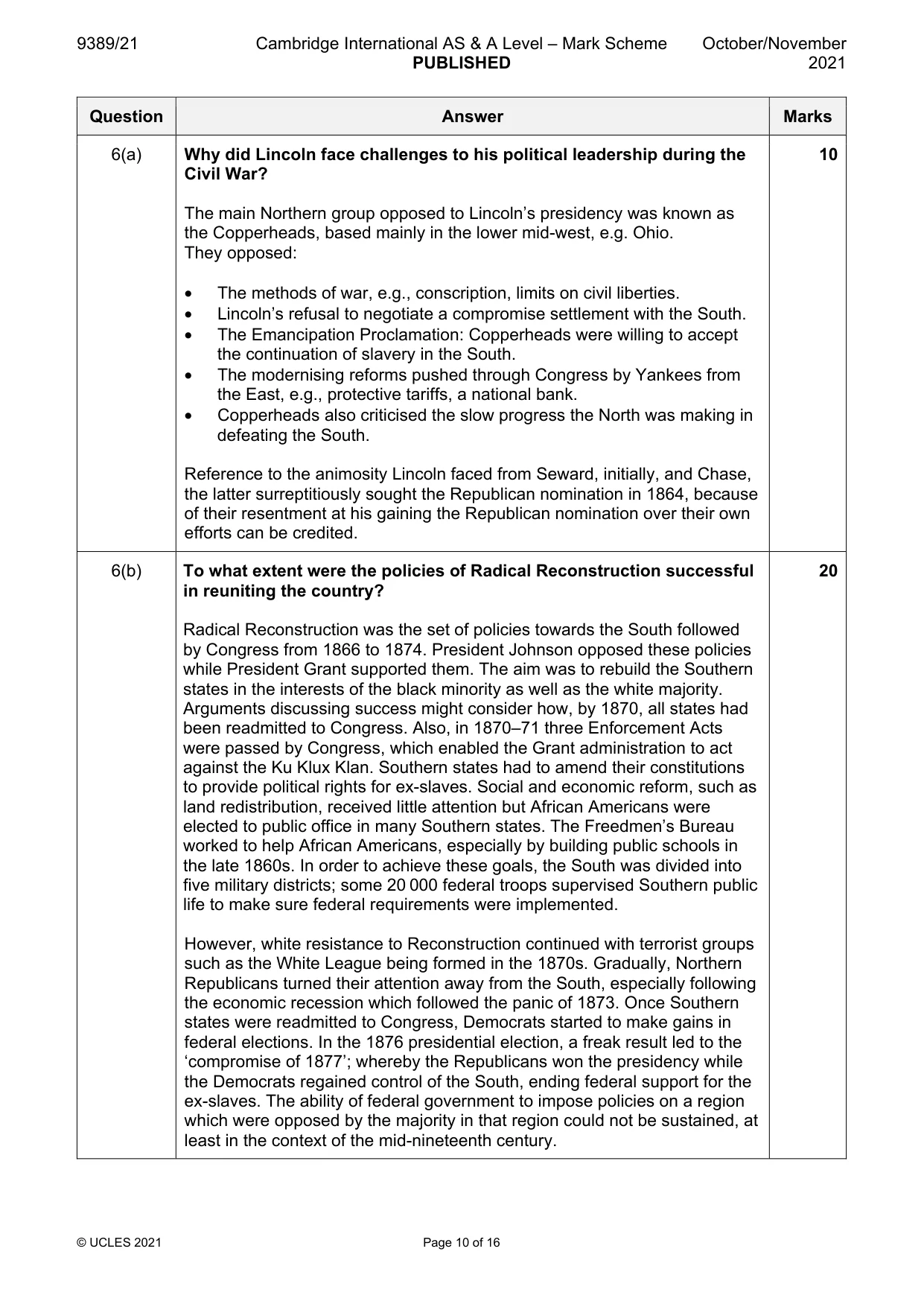
6 Civil War and Reconstruction, 1861–1877 (a) Why did Lincoln face challenges to his political leadership during the Civil War? [10] (b) To what extent were the policies of Radical Reconstruction successful in reuniting the country? [20]
Mark scheme: 6(a) Why did Lincoln face challenges to his political leadership during the 10 Civil War? The main Northern group opposed to Lincoln’s presidency was known as the Copperheads, based mainly in the lower mid-west, e.g. Ohio. They opposed: • The methods of war, e.g., conscription, limits on civil liberties. • Lincoln’s refusal to negotiate a compromise settlement with the South. • The Emancipation Proclamation: Copperheads were willing to accept the continuation of slavery in the South. • The modernising reforms pushed through Congress by Yankees from the East, e.g., protective tariffs, a national bank. • Copperheads also criticised the slow progress the North was making in defeating the South. Reference to the animosity Lincoln faced from Seward, initially, and Chase, the latter surreptitiously sought the Republican nomination in 1864, because of their resentment at his gaining the Republican nomination over their own efforts can be credited. 6(b) To what extent were the policies of Radical Reconstruction successful 20 in reuniting the country? Radical Reconstruction was the set of policies towards the South followed by Congress from 1866 to 1874. President Johnson opposed these policies while President Grant supported them. The aim was to rebuild the Southern states in the interests of the black minority as well as the white majority. Arguments discussing success might consider how, by 1870, all states had been readmitted to Congress. Also, in 1870–71 three Enforcement Acts were passed by Congress, which enabled the Grant administration to act against the Ku Klux Klan. Southern states had to amend their constitutions to provide political rights for ex-slaves. Social and economic reform, such as land redistribution, received little attention but African Americans were elected to public office in many Southern states. The Freedmen’s Bureau worked to help African Americans, especially by building public schools in the late 1860s. In order to achieve these goals, the South was divided into five military districts; some 20 000 federal troops supervised Southern public life to make sure federal requirements were implemented. However, white resistance to Reconstruction continued with terrorist groups such as the White League being formed in the 1870s. Gradually, Northern Republicans turned their attention away from the South, especially following the economic recession which followed the panic of 1873. Once Southern states were readmitted to Congress, Democrats started to make gains in federal elections. In the 1876 presidential election, a freak result led to the ‘compromise of 1877’; whereby the Republicans won the presidency while the Democrats regained control of the South, ending federal support for the ex-slaves. The ability of federal government to impose policies on a region which were opposed by the majority in that region could not be sustained, at least in the context of the mid-nineteenth century.
Q7 · The Gilded Age and the Progressive Era from the 1870s to the 1920s (a) Why did Theodore…
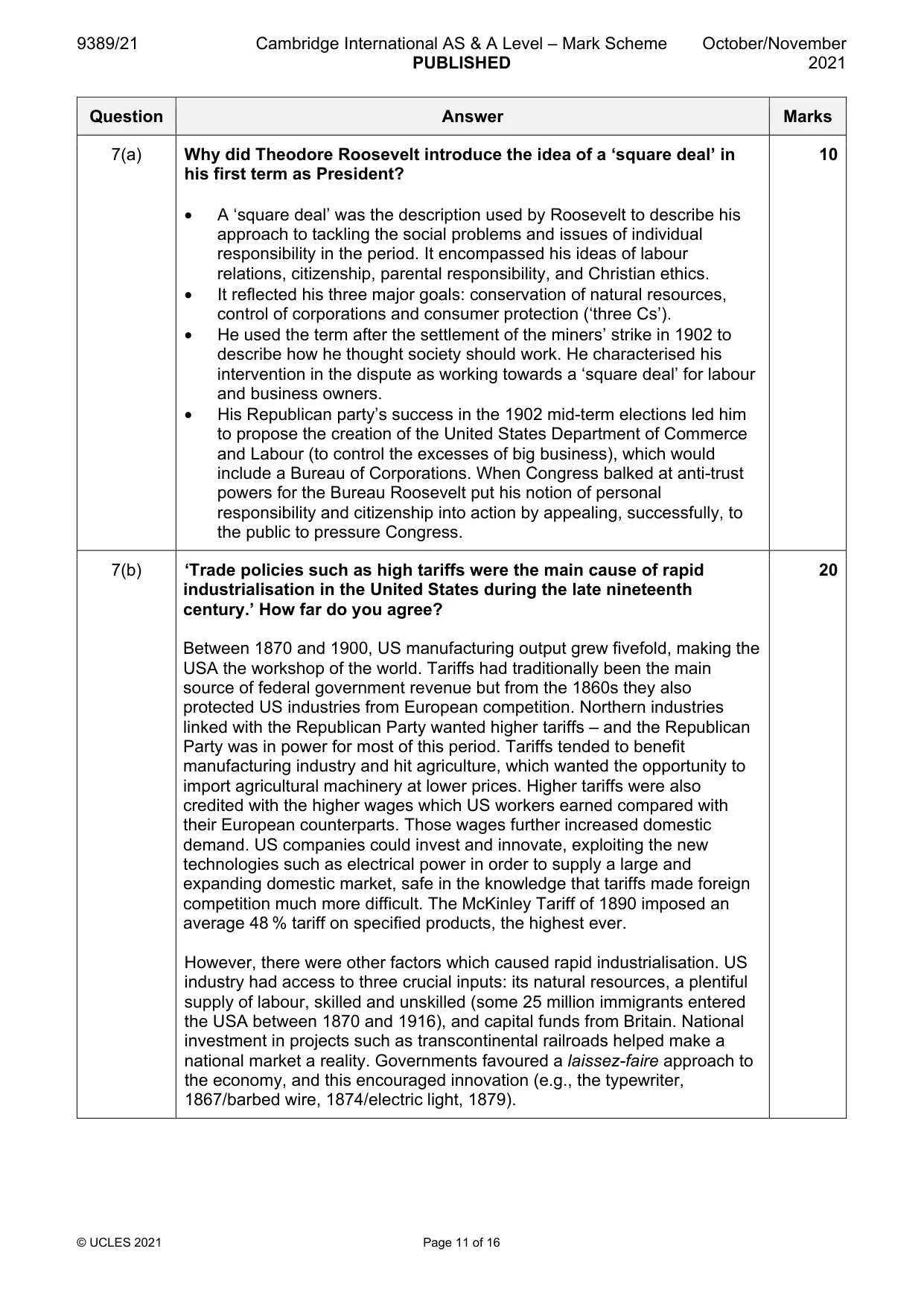
7 The Gilded Age and the Progressive Era from the 1870s to the 1920s (a) Why did Theodore Roosevelt introduce the idea of a ‘square deal’ in his first term as President? [10] (b) ‘Trade policies such as high tariffs were the main cause of rapid industrialisation in the United States during the late nineteenth century.’ How far do you agree? [20]
Mark scheme: 7(a) Why did Theodore Roosevelt introduce the idea of a ‘square deal’ in 10 his first term as President? • A ‘square deal’ was the description used by Roosevelt to describe his approach to tackling the social problems and issues of individual responsibility in the period. It encompassed his ideas of labour relations, citizenship, parental responsibility, and Christian ethics. • It reflected his three major goals: conservation of natural resources, control of corporations and consumer protection (‘three Cs’). • He used the term after the settlement of the miners’ strike in 1902 to describe how he thought society should work. He characterised his intervention in the dispute as working towards a ‘square deal’ for labour and business owners. • His Republican party’s success in the 1902 mid-term elections led him to propose the creation of the United States Department of Commerce and Labour (to control the excesses of big business), which would include a Bureau of Corporations. When Congress balked at anti-trust powers for the Bureau Roosevelt put his notion of personal responsibility and citizenship into action by appealing, successfully, to the public to pressure Congress. 7(b) ‘Trade policies such as high tariffs were the main cause of rapid 20 industrialisation in the United States during the late nineteenth century.’ How far do you agree? Between 1870 and 1900, US manufacturing output grew fivefold, making the USA the workshop of the world. Tariffs had traditionally been the main source of federal government revenue but from the 1860s they also protected US industries from European competition. Northern industries linked with the Republican Party wanted higher tariffs – and the Republican Party was in power for most of this period. Tariffs tended to benefit manufacturing industry and hit agriculture, which wanted the opportunity to import agricultural machinery at lower prices. Higher tariffs were also credited with the higher wages which US workers earned compared with their European counterparts. Those wages further increased domestic demand. US companies could invest and innovate, exploiting the new technologies such as electrical power in order to supply a large and expanding domestic market, safe in the knowledge that tariffs made foreign competition much more difficult. The McKinley Tariff of 1890 imposed an average 48 % tariff on specified products, the highest ever. However, there were other factors which caused rapid industrialisation. US industry had access to three crucial inputs: its natural resources, a plentiful supply of labour, skilled and unskilled (some 25 million immigrants entered the USA between 1870 and 1916), and capital funds from Britain. National investment in projects such as transcontinental railroads helped make a national market a reality. Governments favoured a laissez-faire approach to the economy, and this encouraged innovation (e.g., the typewriter, 1867/barbed wire, 1874/electric light, 1879).
Q8 · The Great Crash, the Great Depression and the New Deal, from the 1920s to 1941 (a) Why do…
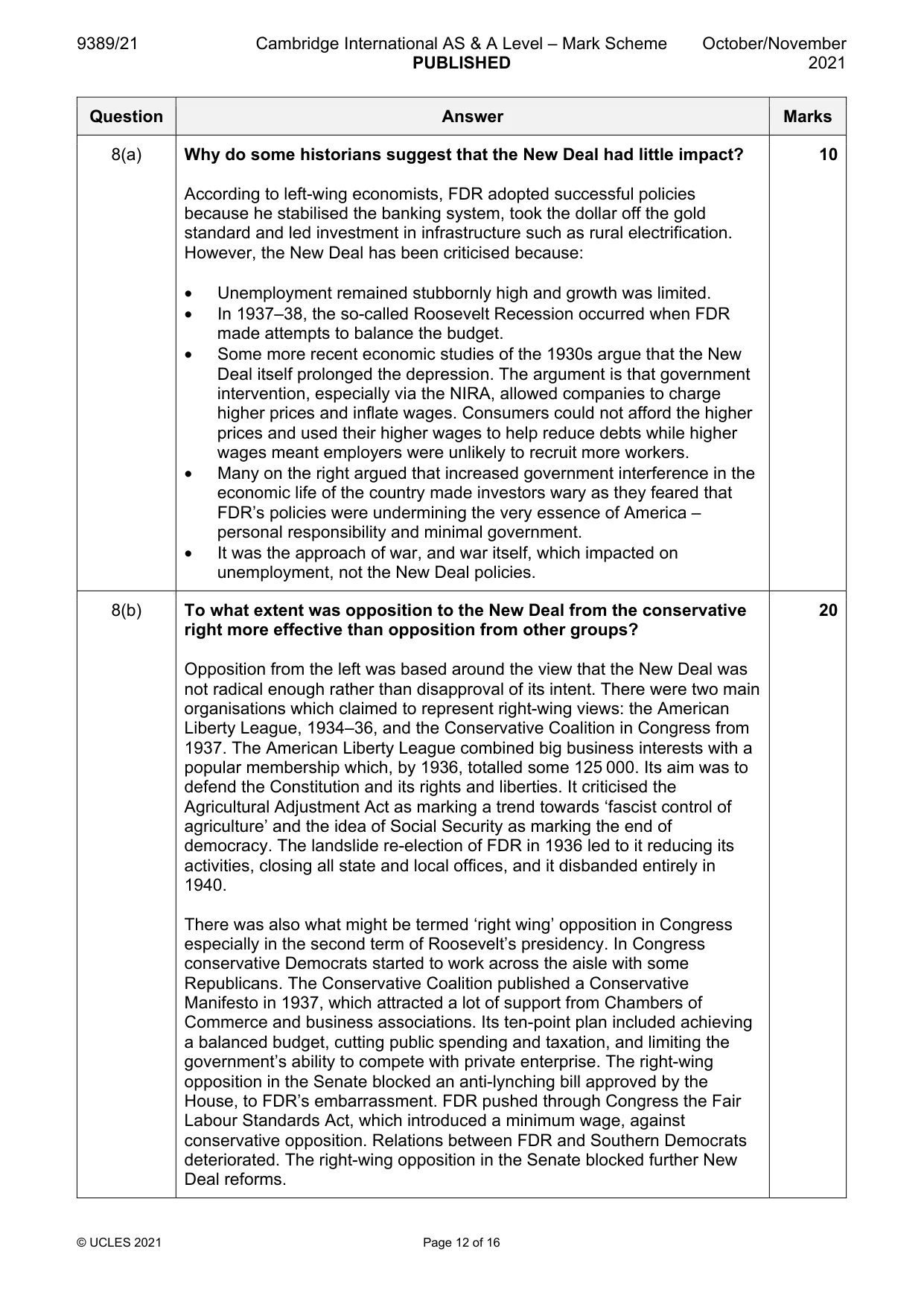
8 The Great Crash, the Great Depression and the New Deal, from the 1920s to 1941 (a) Why do some historians suggest that the New Deal had little impact? [10] (b) To what extent was opposition to the New Deal from the conservative right more effective than opposition from other groups? [20] Section C: International Option International Relations, 1871–1945 Answer both parts of two questions.
Mark scheme: 8(a) Why do some historians suggest that the New Deal had little impact? 10 According to left-wing economists, FDR adopted successful policies because he stabilised the banking system, took the dollar off the gold standard and led investment in infrastructure such as rural electrification. However, the New Deal has been criticised because: • Unemployment remained stubbornly high and growth was limited. • In 1937–38, the so-called Roosevelt Recession occurred when FDR made attempts to balance the budget. • Some more recent economic studies of the 1930s argue that the New Deal itself prolonged the depression. The argument is that government intervention, especially via the NIRA, allowed companies to charge higher prices and inflate wages. Consumers could not afford the higher prices and used their higher wages to help reduce debts while higher wages meant employers were unlikely to recruit more workers. • Many on the right argued that increased government interference in the economic life of the country made investors wary as they feared that FDR’s policies were undermining the very essence of America – personal responsibility and minimal government. • It was the approach of war, and war itself, which impacted on unemployment, not the New Deal policies. 8(b) To what extent was opposition to the New Deal from the conservative 20 right more effective than opposition from other groups? Opposition from the left was based around the view that the New Deal was not radical enough rather than disapproval of its intent. There were two main organisations which claimed to represent right-wing views: the American Liberty League, 1934–36, and the Conservative Coalition in Congress from 1937. The American Liberty League combined big business interests with a popular membership which, by 1936, totalled some 125 000. Its aim was to defend the Constitution and its rights and liberties. It criticised the Agricultural Adjustment Act as marking a trend towards ‘fascist control of agriculture’ and the idea of Social Security as marking the end of democracy. The landslide re-election of FDR in 1936 led to it reducing its activities, closing all state and local offices, and it disbanded entirely in 1940. There was also what might be termed ‘right wing’ opposition in Congress especially in the second term of Roosevelt’s presidency. In Congress conservative Democrats started to work across the aisle with some Republicans. The Conservative Coalition published a Conservative Manifesto in 1937, which attracted a lot of support from Chambers of Commerce and business associations. Its ten-point plan included achieving a balanced budget, cutting public spending and taxation, and limiting the government’s ability to compete with private enterprise. The right-wing opposition in the Senate blocked an anti-lynching bill approved by the House, to FDR’s embarrassment. FDR pushed through Congress the Fair Labour Standards Act, which introduced a minimum wage, against conservative opposition. Relations between FDR and Southern Democrats deteriorated. The right-wing opposition in the Senate blocked further New Deal reforms. Section C: International Option: International Relations, 1871–1945
Q9 · International Relations, 1871–1918 (a) Why did the United States enter the First World…
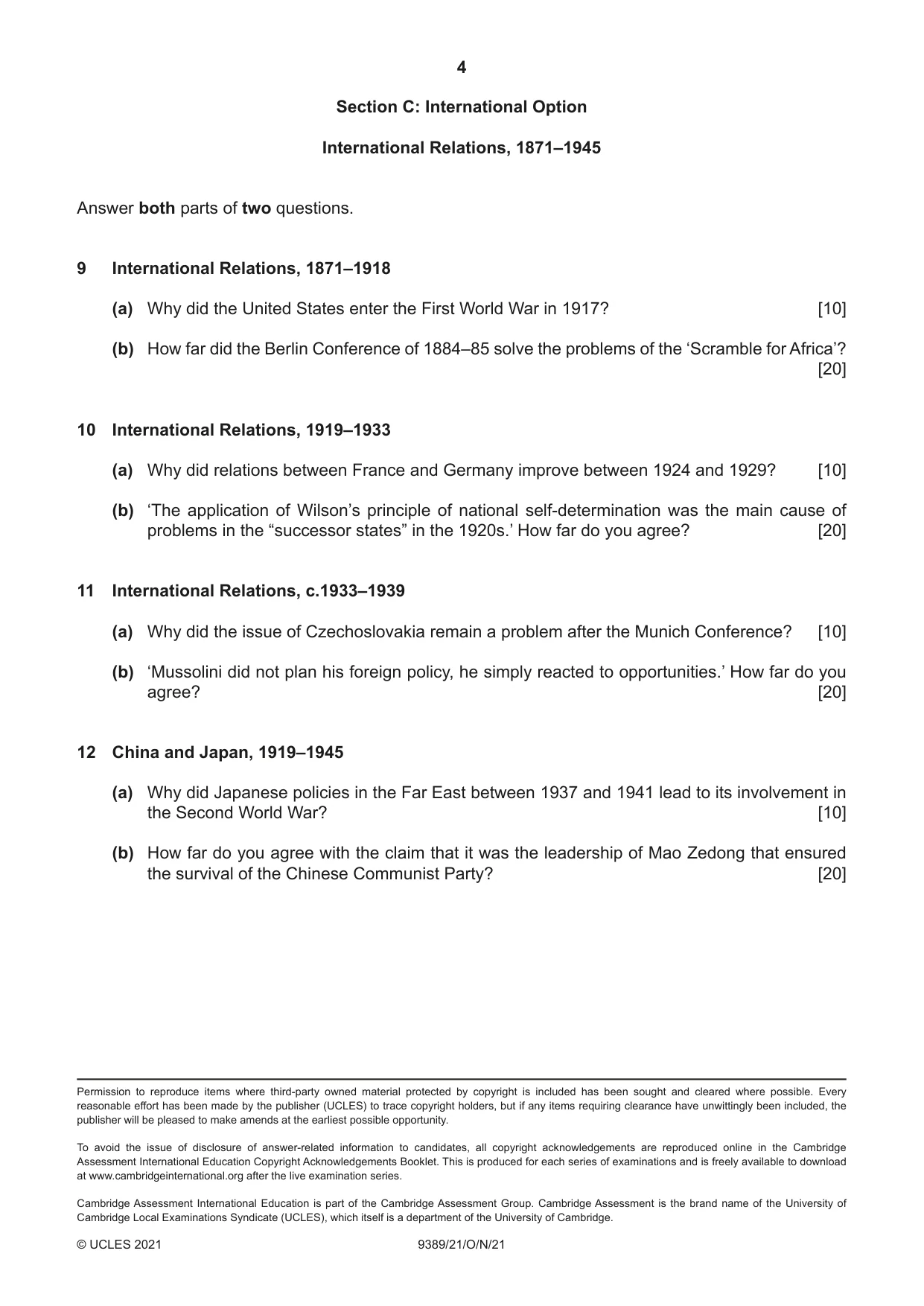
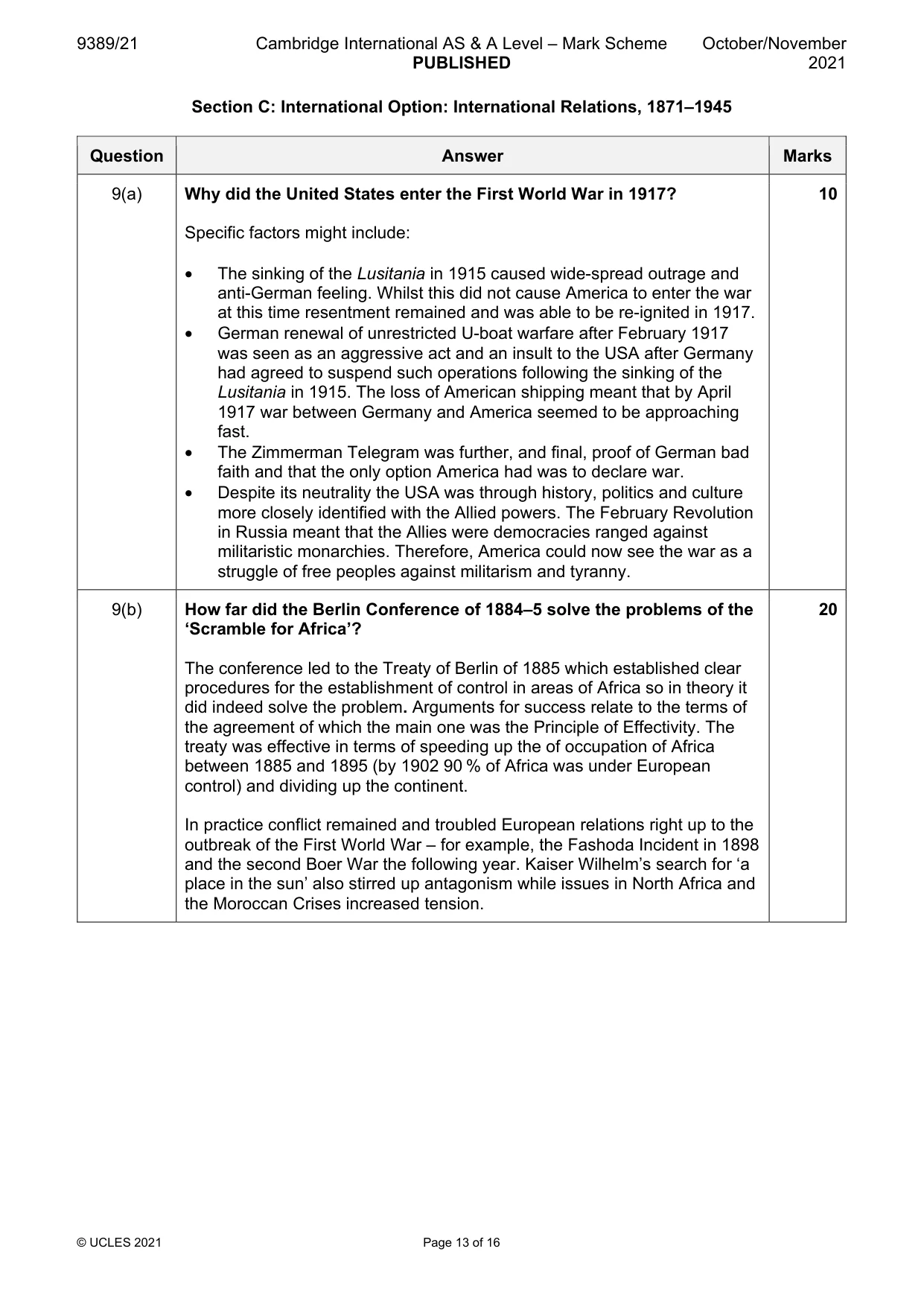
9 International Relations, 1871–1918 (a) Why did the United States enter the First World War in 1917? [10] (b) How far did the Berlin Conference of 1884–85 solve the problems of the ‘Scramble for Africa’? [20]
Mark scheme: 9(a) Why did the United States enter the First World War in 1917? 10 Specific factors might include: • The sinking of the Lusitania in 1915 caused wide-spread outrage and anti-German feeling. Whilst this did not cause America to enter the war at this time resentment remained and was able to be re-ignited in 1917. • German renewal of unrestricted U-boat warfare after February 1917 was seen as an aggressive act and an insult to the USA after Germany had agreed to suspend such operations following the sinking of the Lusitania in 1915. The loss of American shipping meant that by April 1917 war between Germany and America seemed to be approaching fast. • The Zimmerman Telegram was further, and final, proof of German bad faith and that the only option America had was to declare war. • Despite its neutrality the USA was through history, politics and culture more closely identified with the Allied powers. The February Revolution in Russia meant that the Allies were democracies ranged against militaristic monarchies. Therefore, America could now see the war as a struggle of free peoples against militarism and tyranny. 9(b) How far did the Berlin Conference of 1884–5 solve the problems of the 20 ‘Scramble for Africa’? The conference led to the Treaty of Berlin of 1885 which established clear procedures for the establishment of control in areas of Africa so in theory it did indeed solve the problem. Arguments for success relate to the terms of the agreement of which the main one was the Principle of Effectivity. The treaty was effective in terms of speeding up the of occupation of Africa between 1885 and 1895 (by 1902 90 % of Africa was under European control) and dividing up the continent. In practice conflict remained and troubled European relations right up to the outbreak of the First World War – for example, the Fashoda Incident in 1898 and the second Boer War the following year. Kaiser Wilhelm’s search for ‘a place in the sun’ also stirred up antagonism while issues in North Africa and the Moroccan Crises increased tension.
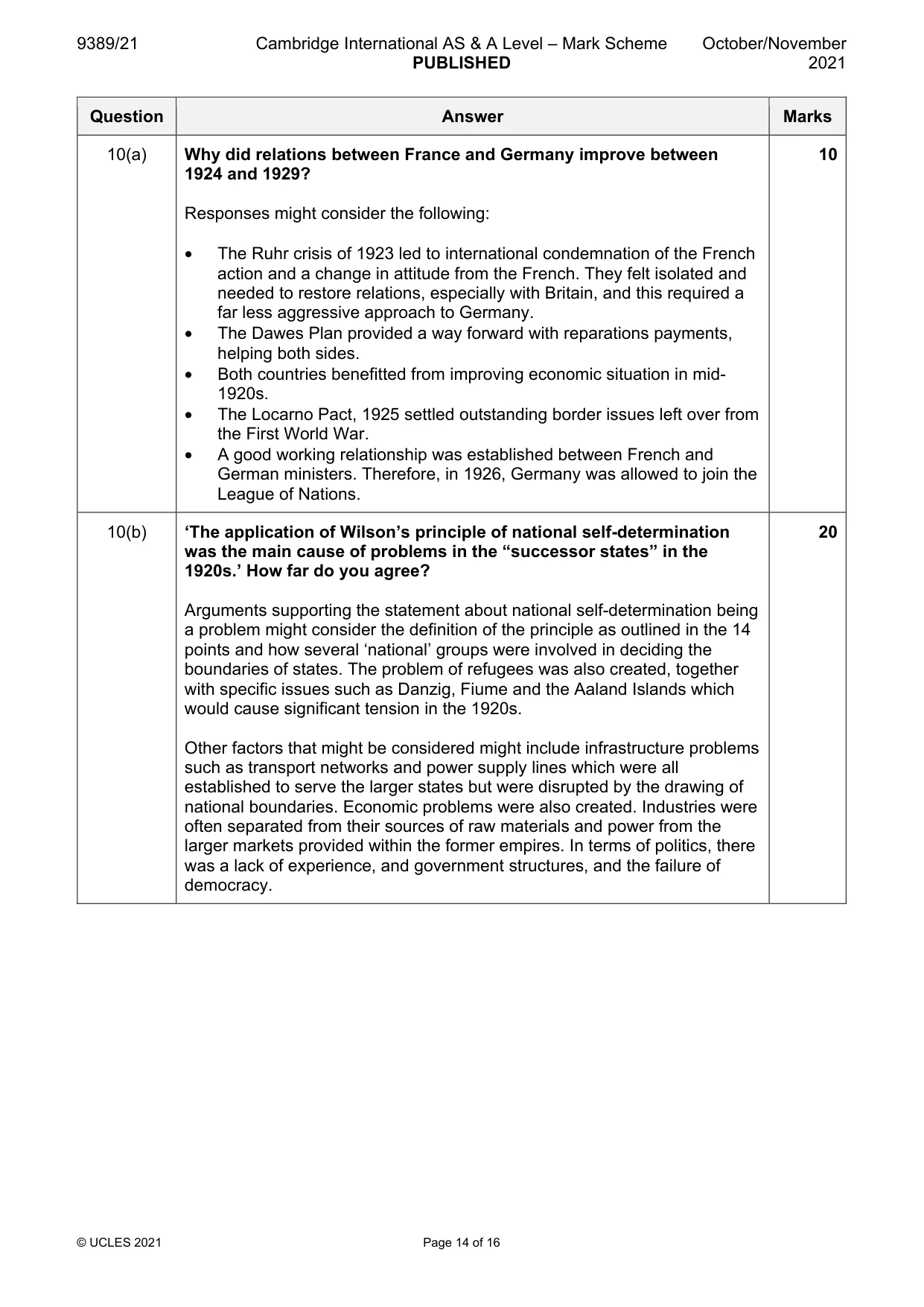
Q10 · International Relations, 1919–1933 (a) Why did relations between France and Germany…
10 International Relations, 1919–1933 (a) Why did relations between France and Germany improve between 1924 and 1929? [10] (b) ‘The application of Wilson’s principle of national self-determination was the main cause of problems in the “successor states” in the 1920s.’ How far do you agree? [20]
Mark scheme: 10(a) Why did relations between France and Germany improve between 10 1924 and 1929? Responses might consider the following: • The Ruhr crisis of 1923 led to international condemnation of the French action and a change in attitude from the French. They felt isolated and needed to restore relations, especially with Britain, and this required a far less aggressive approach to Germany. • The Dawes Plan provided a way forward with reparations payments, helping both sides. • Both countries benefitted from improving economic situation in mid- 1920s. • The Locarno Pact, 1925 settled outstanding border issues left over from the First World War. • A good working relationship was established between French and German ministers. Therefore, in 1926, Germany was allowed to join the League of Nations. 10(b) ‘The application of Wilson’s principle of national self-determination 20 was the main cause of problems in the “successor states” in the 1920s.’ How far do you agree? Arguments supporting the statement about national self-determination being a problem might consider the definition of the principle as outlined in the 14 points and how several ‘national’ groups were involved in deciding the boundaries of states. The problem of refugees was also created, together with specific issues such as Danzig, Fiume and the Aaland Islands which would cause significant tension in the 1920s. Other factors that might be considered might include infrastructure problems such as transport networks and power supply lines which were all established to serve the larger states but were disrupted by the drawing of national boundaries. Economic problems were also created. Industries were often separated from their sources of raw materials and power from the larger markets provided within the former empires. In terms of politics, there was a lack of experience, and government structures, and the failure of democracy.
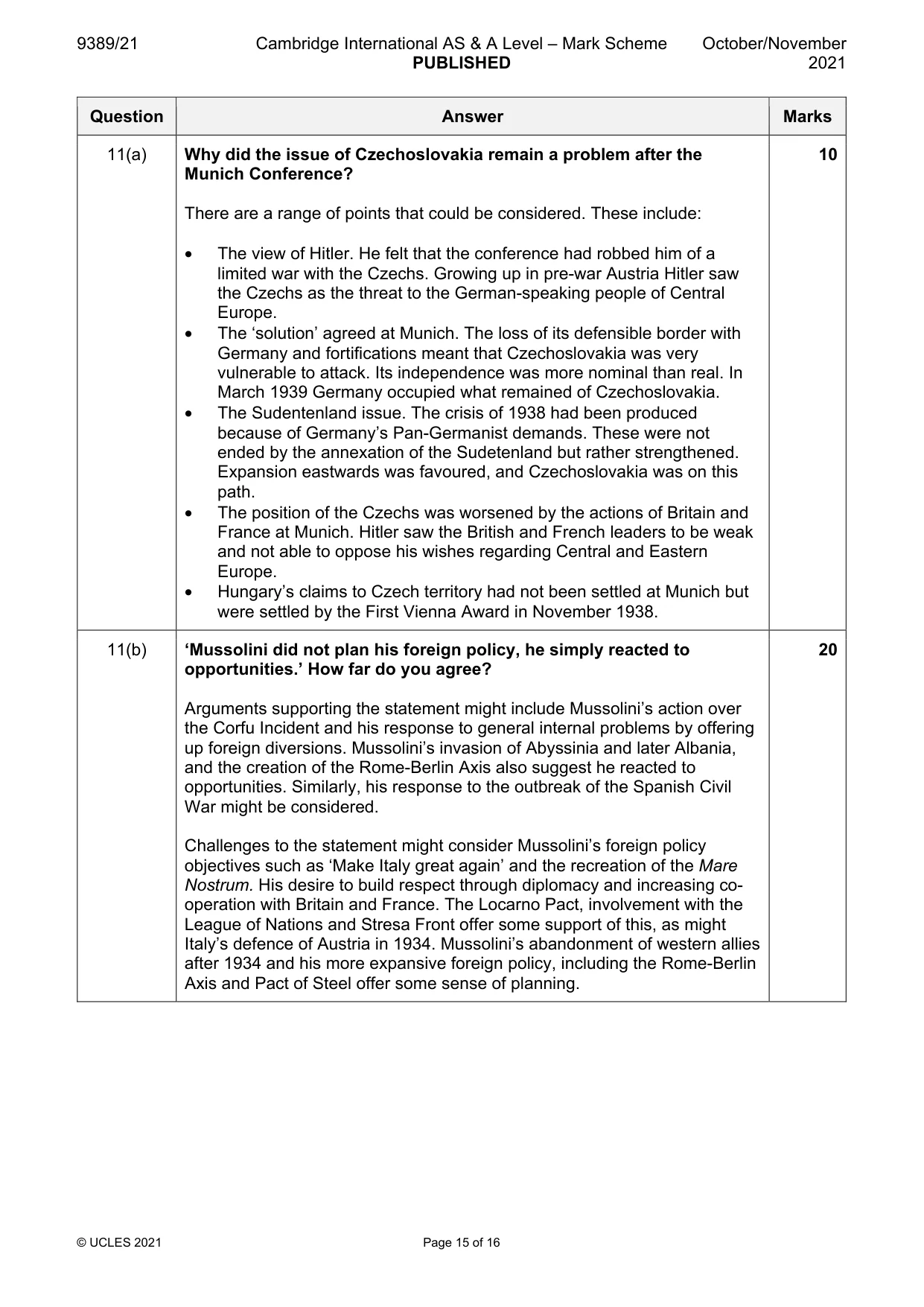
Q11 · International Relations, c.1933–1939 (a) Why did the issue of Czechoslovakia remain a…
11 International Relations, c.1933–1939 (a) Why did the issue of Czechoslovakia remain a problem after the Munich Conference? [10] (b) ‘Mussolini did not plan his foreign policy, he simply reacted to opportunities.’ How far do you agree? [20]
Mark scheme: 11(a) Why did the issue of Czechoslovakia remain a problem after the 10 Munich Conference? There are a range of points that could be considered. These include: • The view of Hitler. He felt that the conference had robbed him of a limited war with the Czechs. Growing up in pre-war Austria Hitler saw the Czechs as the threat to the German-speaking people of Central Europe. • The ‘solution’ agreed at Munich. The loss of its defensible border with Germany and fortifications meant that Czechoslovakia was very vulnerable to attack. Its independence was more nominal than real. In March 1939 Germany occupied what remained of Czechoslovakia. • The Sudentenland issue. The crisis of 1938 had been produced because of Germany’s Pan-Germanist demands. These were not ended by the annexation of the Sudetenland but rather strengthened. Expansion eastwards was favoured, and Czechoslovakia was on this path. • The position of the Czechs was worsened by the actions of Britain and France at Munich. Hitler saw the British and French leaders to be weak and not able to oppose his wishes regarding Central and Eastern Europe. • Hungary’s claims to Czech territory had not been settled at Munich but were settled by the First Vienna Award in November 1938. 11(b) ‘Mussolini did not plan his foreign policy, he simply reacted to 20 opportunities.’ How far do you agree? Arguments supporting the statement might include Mussolini’s action over the Corfu Incident and his response to general internal problems by offering up foreign diversions. Mussolini’s invasion of Abyssinia and later Albania, and the creation of the Rome-Berlin Axis also suggest he reacted to opportunities. Similarly, his response to the outbreak of the Spanish Civil War might be considered. Challenges to the statement might consider Mussolini’s foreign policy objectives such as ‘Make Italy great again’ and the recreation of the Mare Nostrum. His desire to build respect through diplomacy and increasing co- operation with Britain and France. The Locarno Pact, involvement with the League of Nations and Stresa Front offer some support of this, as might Italy’s defence of Austria in 1934. Mussolini’s abandonment of western allies after 1934 and his more expansive foreign policy, including the Rome-Berlin Axis and Pact of Steel offer some sense of planning.
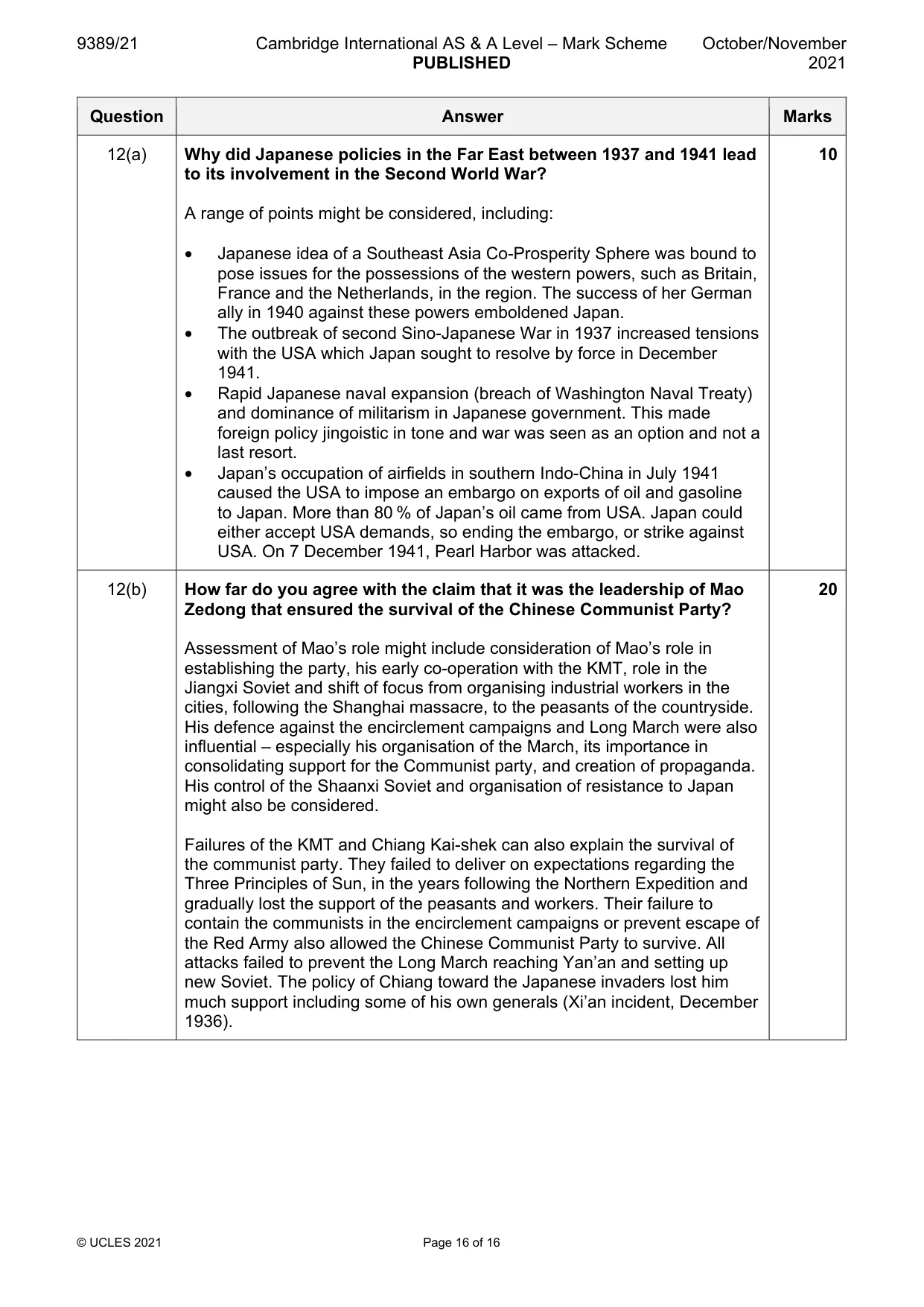
Q12 · China and Japan, 1919–1945 (a) Why did Japanese policies in the Far East between 1937 and…
12 China and Japan, 1919–1945 (a) Why did Japanese policies in the Far East between 1937 and 1941 lead to its involvement in the Second World War? [10] (b) How far do you agree with the claim that it was the leadership of Mao Zedong that ensured the survival of the Chinese Communist Party? [20]
Mark scheme: 12(a) Why did Japanese policies in the Far East between 1937 and 1941 lead 10 to its involvement in the Second World War? A range of points might be considered, including: • Japanese idea of a Southeast Asia Co-Prosperity Sphere was bound to pose issues for the possessions of the western powers, such as Britain, France and the Netherlands, in the region. The success of her German ally in 1940 against these powers emboldened Japan. • The outbreak of second Sino-Japanese War in 1937 increased tensions with the USA which Japan sought to resolve by force in December 1941. • Rapid Japanese naval expansion (breach of Washington Naval Treaty) and dominance of militarism in Japanese government. This made foreign policy jingoistic in tone and war was seen as an option and not a last resort. • Japan’s occupation of airfields in southern Indo-China in July 1941 caused the USA to impose an embargo on exports of oil and gasoline to Japan. More than 80 % of Japan’s oil came from USA. Japan could either accept USA demands, so ending the embargo, or strike against USA. On 7 December 1941, Pearl Harbor was attacked. 12(b) How far do you agree with the claim that it was the leadership of Mao 20 Zedong that ensured the survival of the Chinese Communist Party? Assessment of Mao’s role might include consideration of Mao’s role in establishing the party, his early co-operation with the KMT, role in the Jiangxi Soviet and shift of focus from organising industrial workers in the cities, following the Shanghai massacre, to the peasants of the countryside. His defence against the encirclement campaigns and Long March were also influential – especially his organisation of the March, its importance in consolidating support for the Communist party, and creation of propaganda. His control of the Shaanxi Soviet and organisation of resistance to Japan might also be considered. Failures of the KMT and Chiang Kai-shek can also explain the survival of the communist party. They failed to deliver on expectations regarding the Three Principles of Sun, in the years following the Northern Expedition and gradually lost the support of the peasants and workers. Their failure to contain the communists in the encirclement campaigns or prevent escape of the Red Army also allowed the Chinese Communist Party to survive. All attacks failed to prevent the Long March reaching Yan’an and setting up new Soviet. The policy of Chiang toward the Japanese invaders lost him much support including some of his own generals (Xi’an incident, December 1936).
What you needed in this session
Cambridge’s own grade thresholds for 2021 Oct/Nov, Paper 2 · Variant 1. A higher threshold means an easier paper — the bar moves with how the cohort did.