Cambridge A Level History 9389 — 2021 Oct/Nov Paper 2 · Variant 3
9389/23/O/N/21 · 12 questions · 60 marks · ≈68 min
The question paper and its mark scheme, free to read here and free to download. This is Cambridge’s own paper, exactly as it was sat.
Question paper4 pages
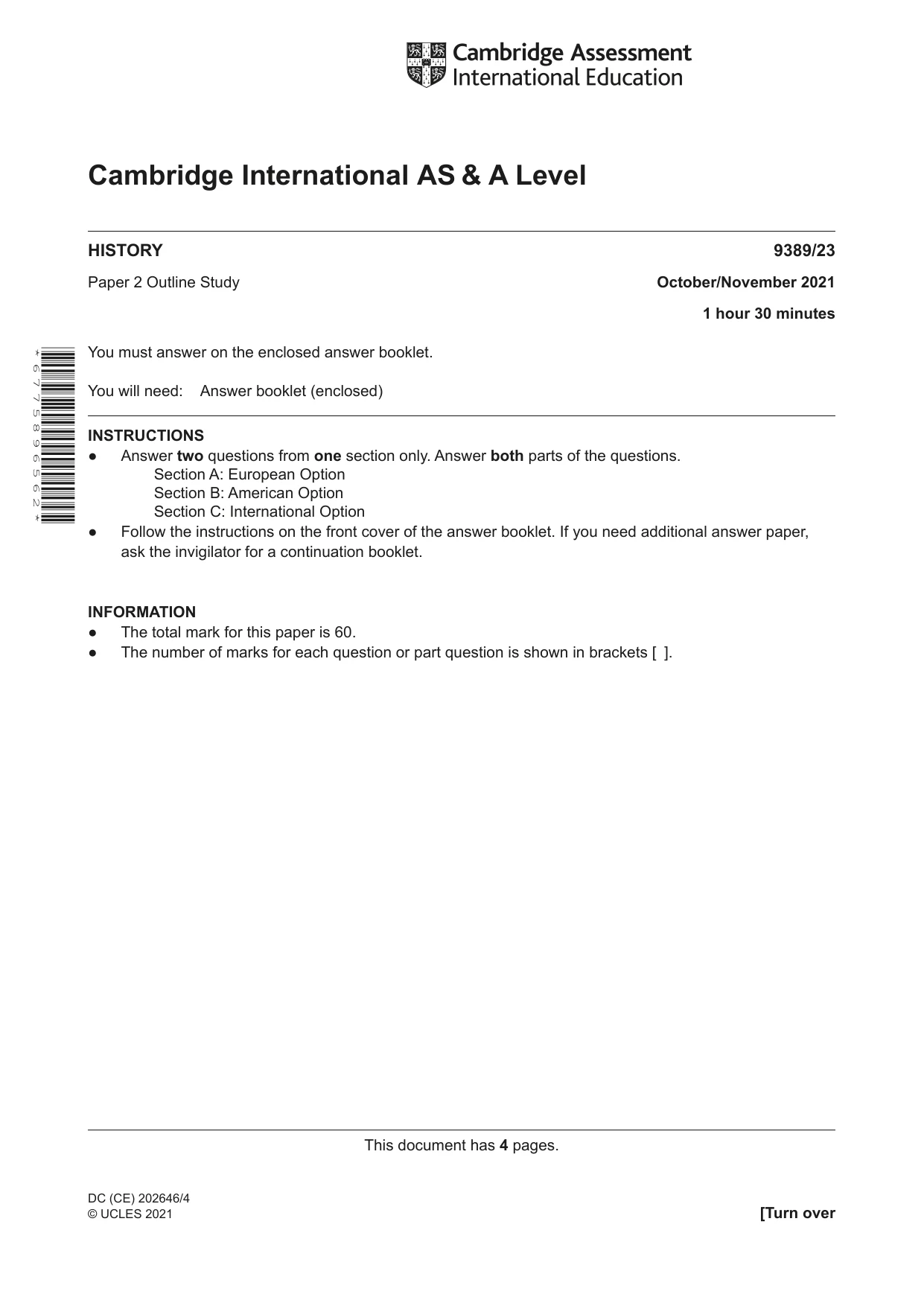
Mark scheme16 pages
Answers below. Sit the paper first if you are practising.

Questions as text
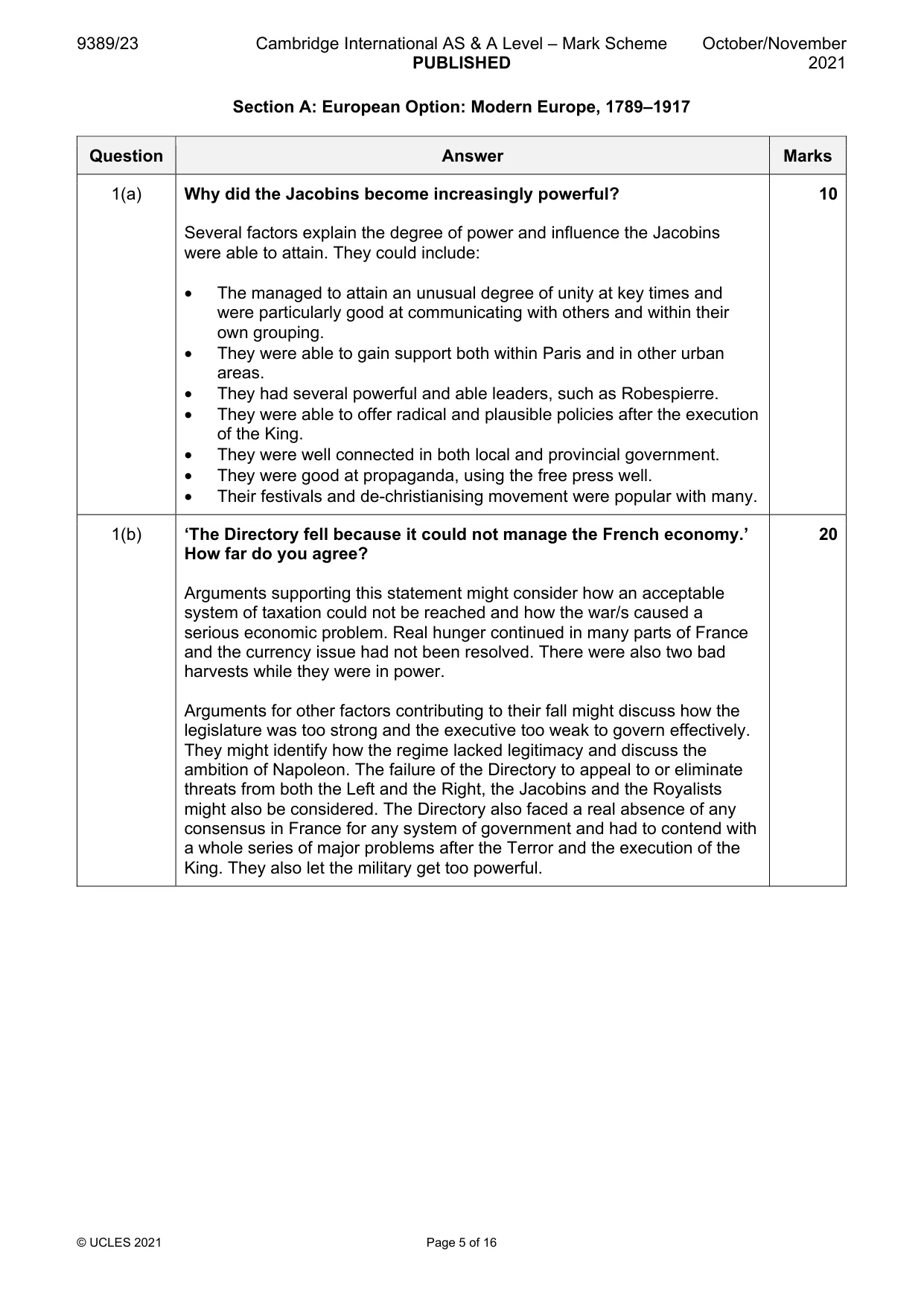
Q1 · France, 1789–1814 (a) Why did the Jacobins become increasingly powerful?
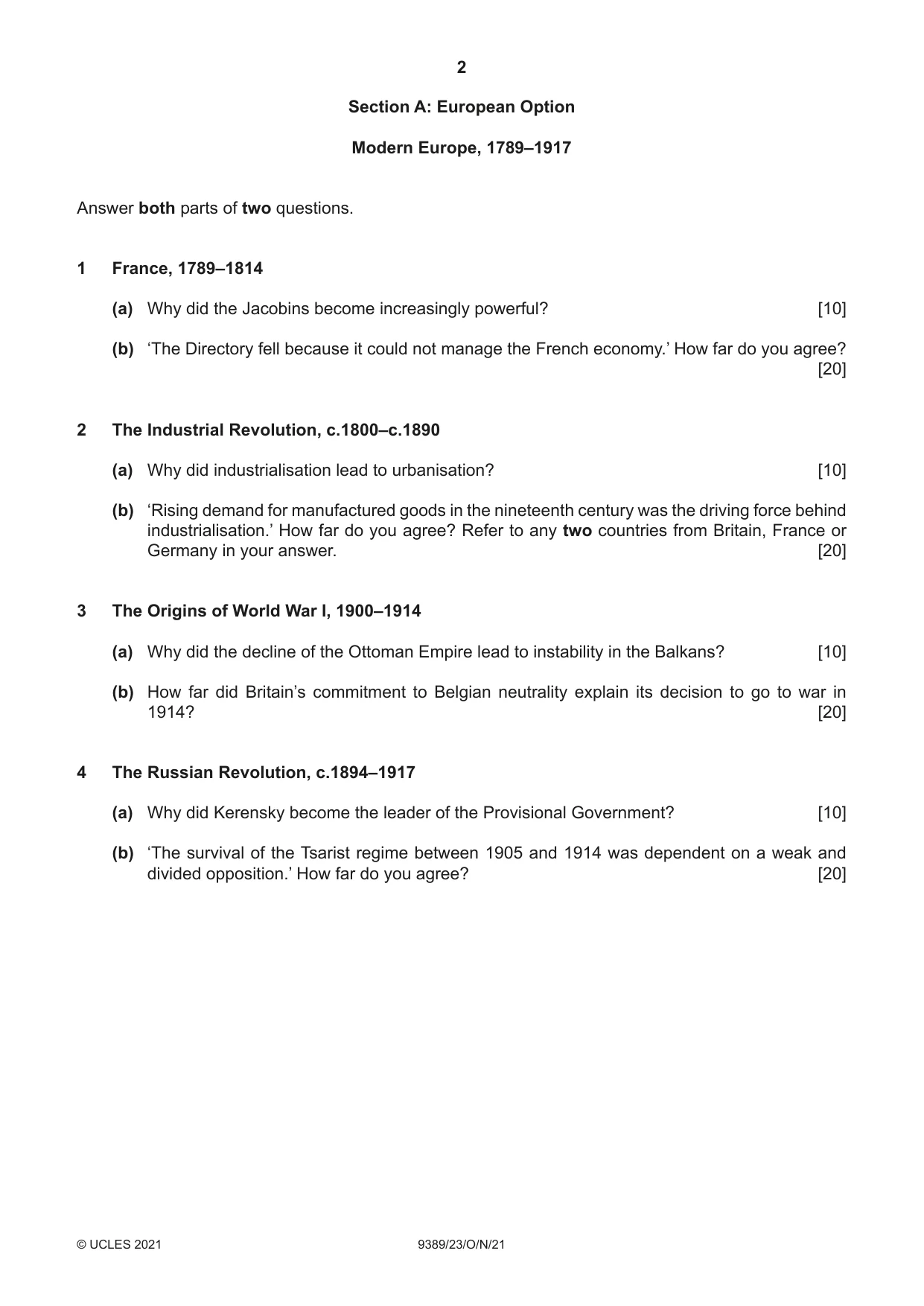
1 France, 1789–1814 (a) Why did the Jacobins become increasingly powerful? [10] (b) ‘The Directory fell because it could not manage the French economy.’ How far do you agree? [20]
Mark scheme: Question Answer Marks 1(a) Why did the Jacobins become increasingly powerful? 10 Several factors explain the degree of power and influence the Jacobins were able to attain. They could include: • The managed to attain an unusual degree of unity at key times and were particularly good at communicating with others and within their own grouping. • They were able to gain support both within Paris and in other urban areas. • They had several powerful and able leaders, such as Robespierre. • They were able to offer radical and plausible policies after the execution of the King. • They were well connected in both local and provincial government. • They were good at propaganda, using the free press well. • Their festivals and de-christianising movement were popular with many. 1(b) ‘The Directory fell because it could not manage the French economy.’ 20 How far do you agree? Arguments supporting this statement might consider how an acceptable system of taxation could not be reached and how the war/s caused a serious economic problem. Real hunger continued in many parts of France and the currency issue had not been resolved. There were also two bad harvests while they were in power. Arguments for other factors contributing to their fall might discuss how the legislature was too strong and the executive too weak to govern effectively. They might identify how the regime lacked legitimacy and discuss the ambition of Napoleon. The failure of the Directory to appeal to or eliminate threats from both the Left and the Right, the Jacobins and the Royalists might also be considered. The Directory also faced a real absence of any consensus in France for any system of government and had to contend with a whole series of major problems after the Terror and the execution of the King. They also let the military get too powerful.
Q2 · The Industrial Revolution, c.1800–c.1890 (a) Why did industrialisation lead to…
2 The Industrial Revolution, c.1800–c.1890 (a) Why did industrialisation lead to urbanisation? [10] (b) ‘Rising demand for manufactured goods in the nineteenth century was the driving force behind industrialisation.’ How far do you agree? Refer to any two countries from Britain, France or Germany in your answer. [20]
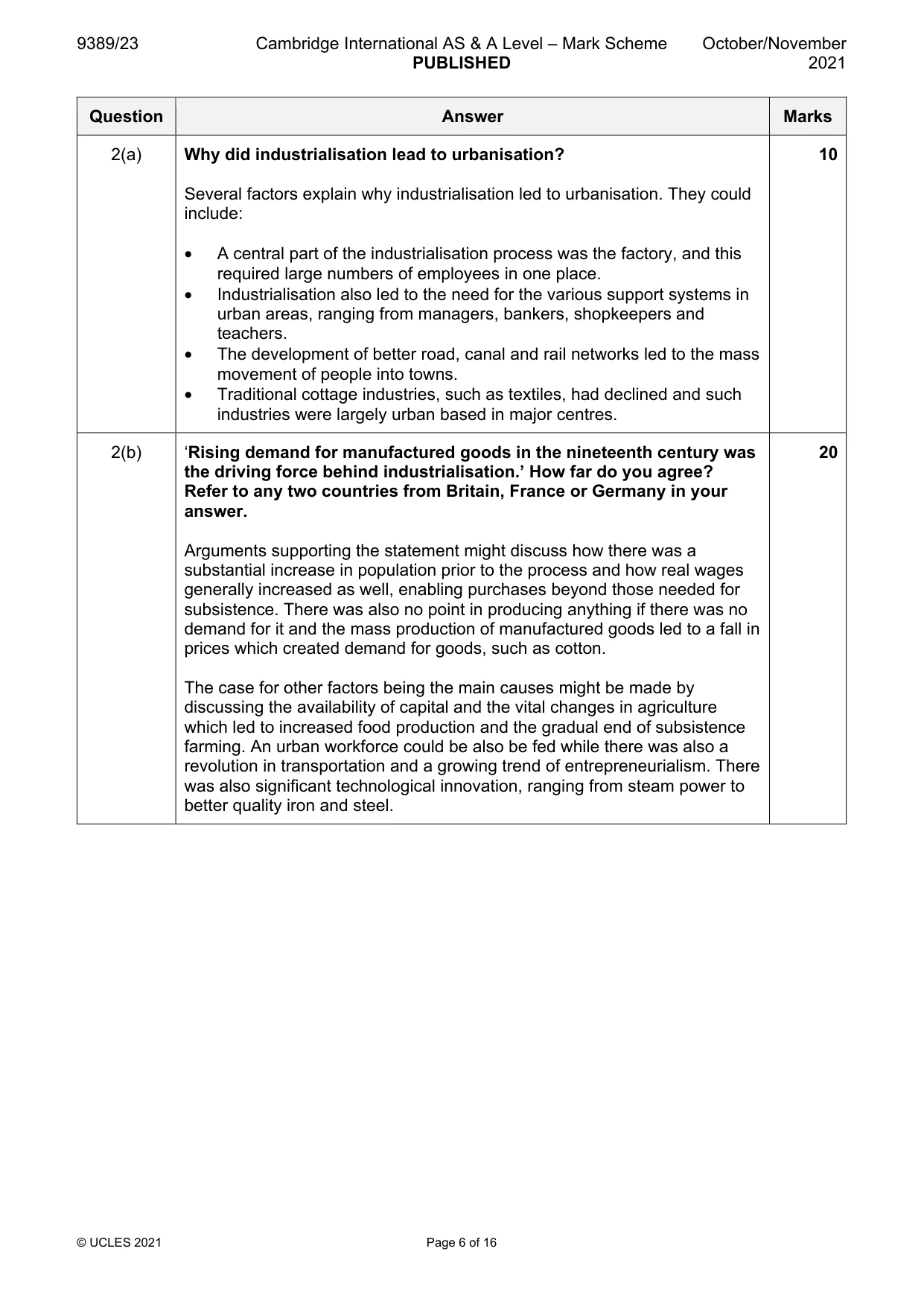
Mark scheme: 2(a) Why did industrialisation lead to urbanisation? 10 Several factors explain why industrialisation led to urbanisation. They could include: • A central part of the industrialisation process was the factory, and this required large numbers of employees in one place. • Industrialisation also led to the need for the various support systems in urban areas, ranging from managers, bankers, shopkeepers and teachers. • The development of better road, canal and rail networks led to the mass movement of people into towns. • Traditional cottage industries, such as textiles, had declined and such industries were largely urban based in major centres. 2(b) ‘Rising demand for manufactured goods in the nineteenth century was 20 the driving force behind industrialisation.’ How far do you agree? Refer to any two countries from Britain, France or Germany in your answer. Arguments supporting the statement might discuss how there was a substantial increase in population prior to the process and how real wages generally increased as well, enabling purchases beyond those needed for subsistence. There was also no point in producing anything if there was no demand for it and the mass production of manufactured goods led to a fall in prices which created demand for goods, such as cotton. The case for other factors being the main causes might be made by discussing the availability of capital and the vital changes in agriculture which led to increased food production and the gradual end of subsistence farming. An urban workforce could be also be fed while there was also a revolution in transportation and a growing trend of entrepreneurialism. There was also significant technological innovation, ranging from steam power to better quality iron and steel.
Q3 · The Origins of World War I, 1900–1914 (a) Why did the decline of the Ottoman Empire lead…
3 The Origins of World War I, 1900–1914 (a) Why did the decline of the Ottoman Empire lead to instability in the Balkans? [10] (b) How far did Britain’s commitment to Belgian neutrality explain its decision to go to war in 1914? [20]
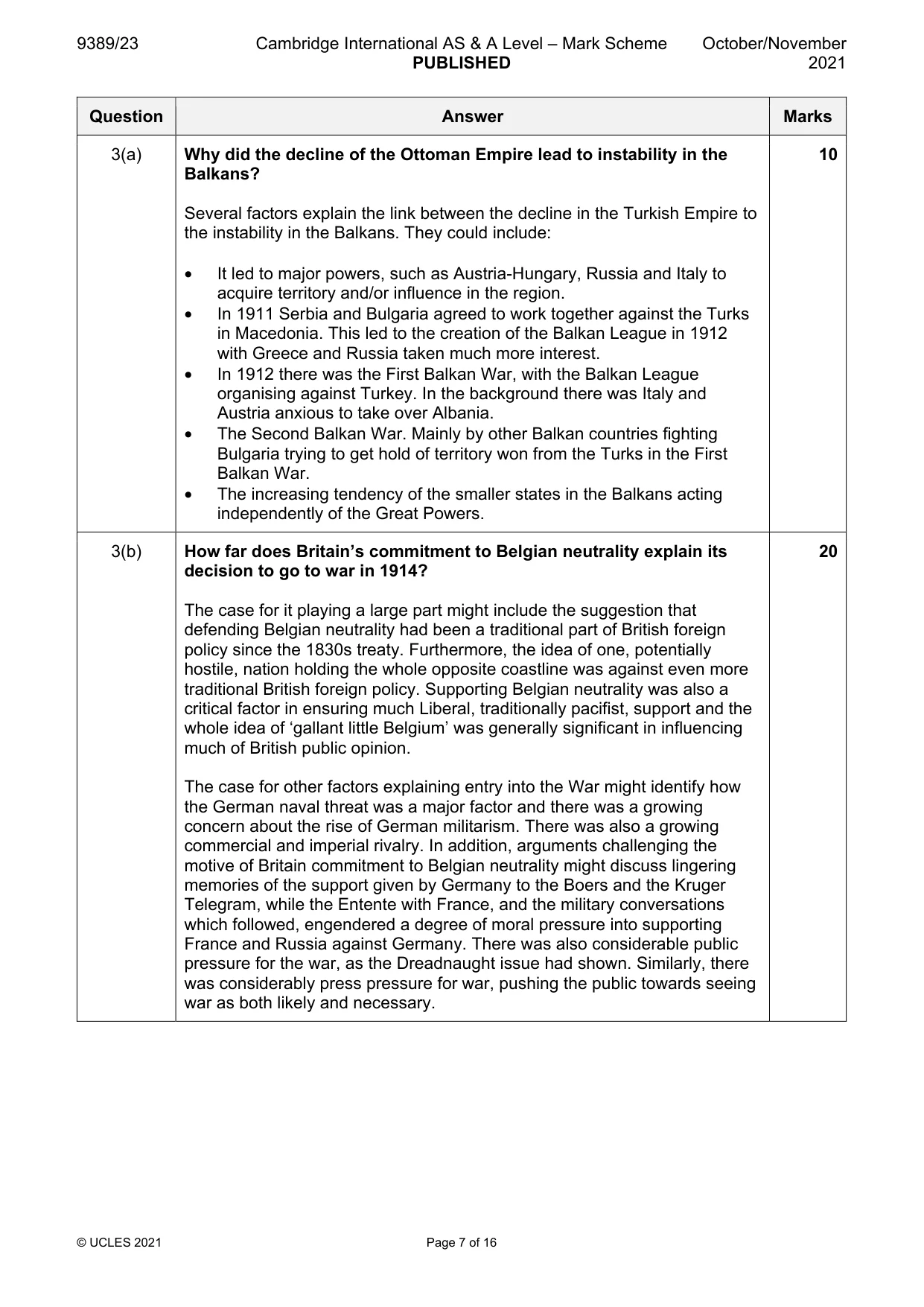
Mark scheme: 3(a) Why did the decline of the Ottoman Empire lead to instability in the 10 Balkans? Several factors explain the link between the decline in the Turkish Empire to the instability in the Balkans. They could include: • It led to major powers, such as Austria-Hungary, Russia and Italy to acquire territory and/or influence in the region. • In 1911 Serbia and Bulgaria agreed to work together against the Turks in Macedonia. This led to the creation of the Balkan League in 1912 with Greece and Russia taken much more interest. • In 1912 there was the First Balkan War, with the Balkan League organising against Turkey. In the background there was Italy and Austria anxious to take over Albania. • The Second Balkan War. Mainly by other Balkan countries fighting Bulgaria trying to get hold of territory won from the Turks in the First Balkan War. • The increasing tendency of the smaller states in the Balkans acting independently of the Great Powers. 3(b) How far does Britain’s commitment to Belgian neutrality explain its 20 decision to go to war in 1914? The case for it playing a large part might include the suggestion that defending Belgian neutrality had been a traditional part of British foreign policy since the 1830s treaty. Furthermore, the idea of one, potentially hostile, nation holding the whole opposite coastline was against even more traditional British foreign policy. Supporting Belgian neutrality was also a critical factor in ensuring much Liberal, traditionally pacifist, support and the whole idea of ‘gallant little Belgium’ was generally significant in influencing much of British public opinion. The case for other factors explaining entry into the War might identify how the German naval threat was a major factor and there was a growing concern about the rise of German militarism. There was also a growing commercial and imperial rivalry. In addition, arguments challenging the motive of Britain commitment to Belgian neutrality might discuss lingering memories of the support given by Germany to the Boers and the Kruger Telegram, while the Entente with France, and the military conversations which followed, engendered a degree of moral pressure into supporting France and Russia against Germany. There was also considerable public pressure for the war, as the Dreadnaught issue had shown. Similarly, there was considerably press pressure for war, pushing the public towards seeing war as both likely and necessary.
Q4 · The Russian Revolution, c.1894–1917 (a) Why did Kerensky become the leader of the…
4 The Russian Revolution, c.1894–1917 (a) Why did Kerensky become the leader of the Provisional Government? [10] (b) ‘The survival of the Tsarist regime between 1905 and 1914 was dependent on a weak and divided opposition.’ How far do you agree? [20]
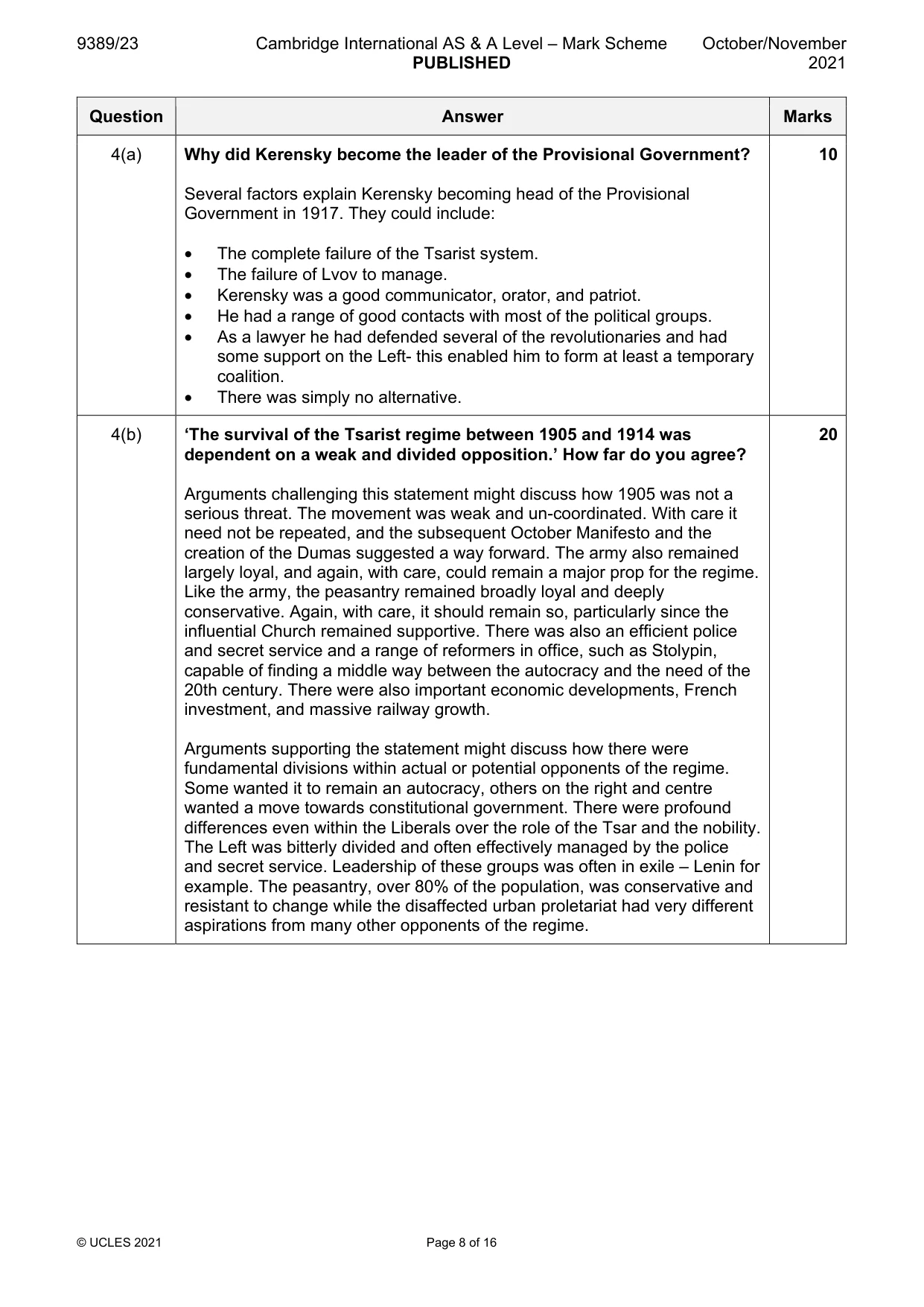
Mark scheme: 4(a) Why did Kerensky become the leader of the Provisional Government? 10 Several factors explain Kerensky becoming head of the Provisional Government in 1917. They could include: • The complete failure of the Tsarist system. • The failure of Lvov to manage. • Kerensky was a good communicator, orator, and patriot. • He had a range of good contacts with most of the political groups. • As a lawyer he had defended several of the revolutionaries and had some support on the Left- this enabled him to form at least a temporary coalition. • There was simply no alternative. 4(b) ‘The survival of the Tsarist regime between 1905 and 1914 was 20 dependent on a weak and divided opposition.’ How far do you agree? Arguments challenging this statement might discuss how 1905 was not a serious threat. The movement was weak and un-coordinated. With care it need not be repeated, and the subsequent October Manifesto and the creation of the Dumas suggested a way forward. The army also remained largely loyal, and again, with care, could remain a major prop for the regime. Like the army, the peasantry remained broadly loyal and deeply conservative. Again, with care, it should remain so, particularly since the influential Church remained supportive. There was also an efficient police and secret service and a range of reformers in office, such as Stolypin, capable of finding a middle way between the autocracy and the need of the 20th century. There were also important economic developments, French investment, and massive railway growth. Arguments supporting the statement might discuss how there were fundamental divisions within actual or potential opponents of the regime. Some wanted it to remain an autocracy, others on the right and centre wanted a move towards constitutional government. There were profound differences even within the Liberals over the role of the Tsar and the nobility. The Left was bitterly divided and often effectively managed by the police and secret service. Leadership of these groups was often in exile – Lenin for example. The peasantry, over 80% of the population, was conservative and resistant to change while the disaffected urban proletariat had very different aspirations from many other opponents of the regime. Section B: American Option: The History of the USA, 1840–1941
Q5 · The Expansion of US Power, from the 1840s to the 1930s (a) Why did the USA fight the…
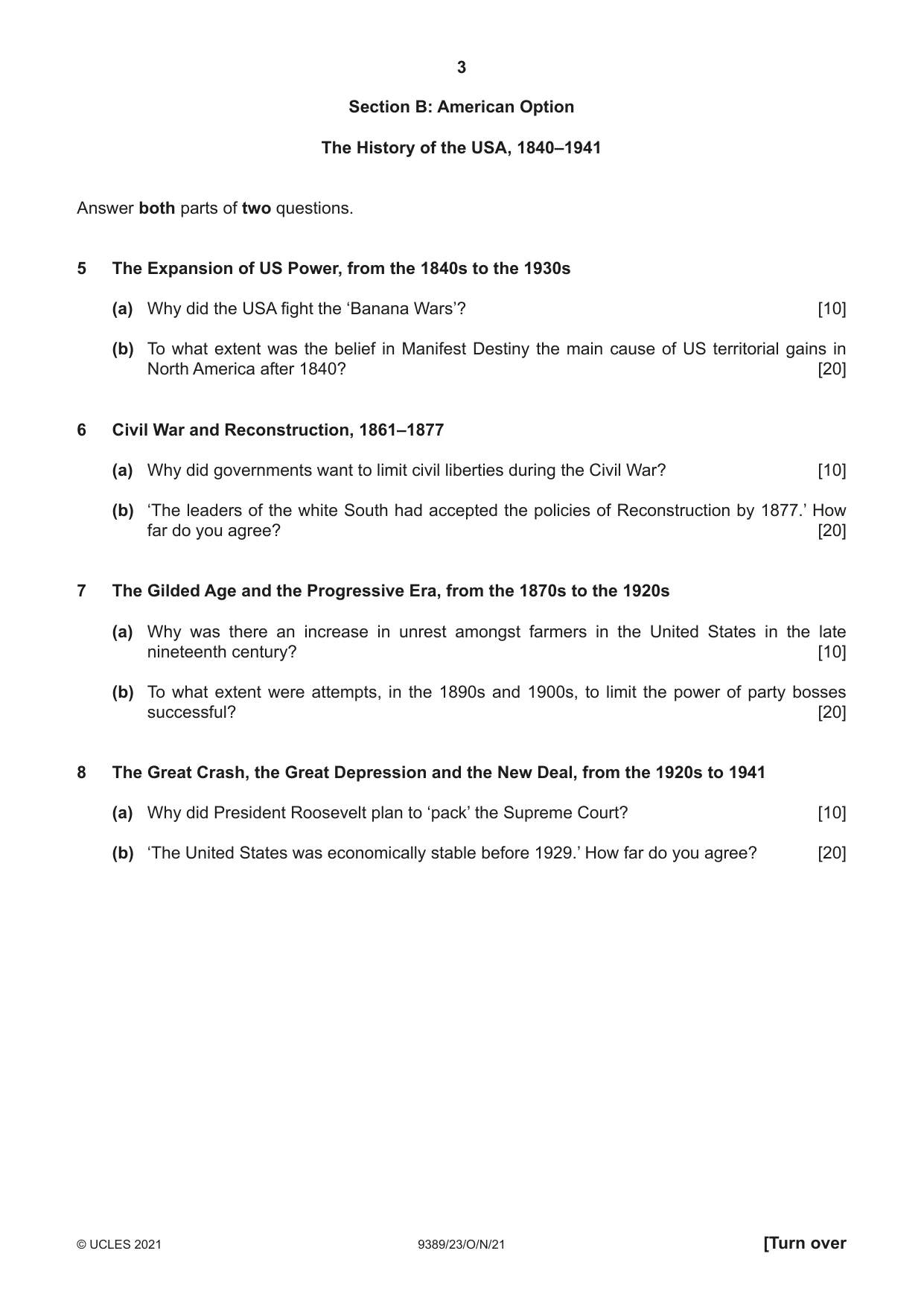
5 The Expansion of US Power, from the 1840s to the 1930s (a) Why did the USA fight the ‘Banana Wars’? [10] (b) To what extent was the belief in Manifest Destiny the main cause of US territorial gains in North America after 1840? [20]
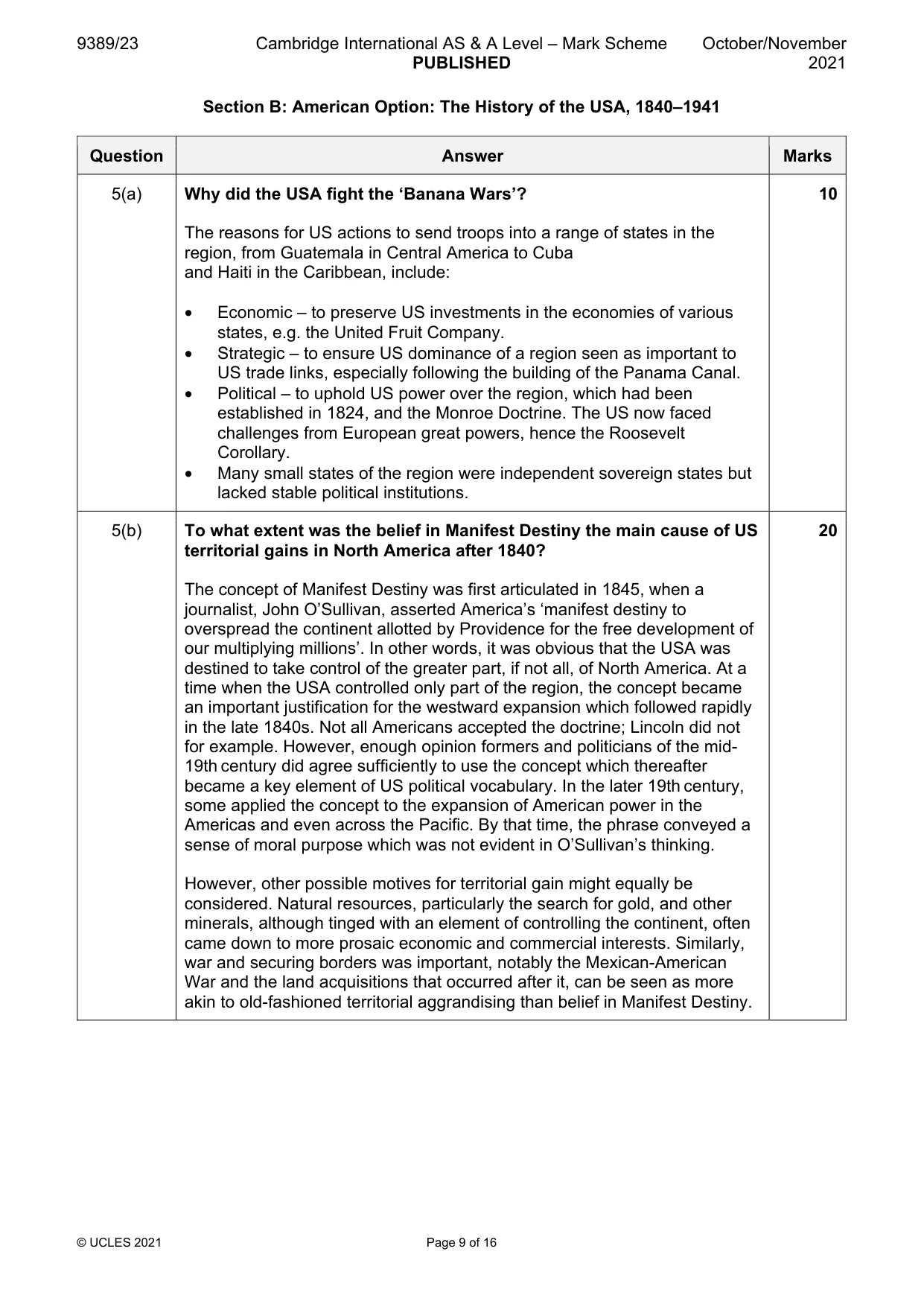
Mark scheme: 5(a) Why did the USA fight the ‘Banana Wars’? 10 The reasons for US actions to send troops into a range of states in the region, from Guatemala in Central America to Cuba and Haiti in the Caribbean, include: • Economic – to preserve US investments in the economies of various states, e.g. the United Fruit Company. • Strategic – to ensure US dominance of a region seen as important to US trade links, especially following the building of the Panama Canal. • Political – to uphold US power over the region, which had been established in 1824, and the Monroe Doctrine. The US now faced challenges from European great powers, hence the Roosevelt Corollary. • Many small states of the region were independent sovereign states but lacked stable political institutions. 5(b) To what extent was the belief in Manifest Destiny the main cause of US 20 territorial gains in North America after 1840? The concept of Manifest Destiny was first articulated in 1845, when a journalist, John O’Sullivan, asserted America’s ‘manifest destiny to overspread the continent allotted by Providence for the free development of our multiplying millions’. In other words, it was obvious that the USA was destined to take control of the greater part, if not all, of North America. At a time when the USA controlled only part of the region, the concept became an important justification for the westward expansion which followed rapidly in the late 1840s. Not all Americans accepted the doctrine; Lincoln did not for example. However, enough opinion formers and politicians of the mid- 19th century did agree sufficiently to use the concept which thereafter became a key element of US political vocabulary. In the later 19th century, some applied the concept to the expansion of American power in the Americas and even across the Pacific. By that time, the phrase conveyed a sense of moral purpose which was not evident in O’Sullivan’s thinking. However, other possible motives for territorial gain might equally be considered. Natural resources, particularly the search for gold, and other minerals, although tinged with an element of controlling the continent, often came down to more prosaic economic and commercial interests. Similarly, war and securing borders was important, notably the Mexican-American War and the land acquisitions that occurred after it, can be seen as more akin to old-fashioned territorial aggrandising than belief in Manifest Destiny.
Q6 · Civil War and Reconstruction, 1861–1877 (a) Why did governments want to limit civil…
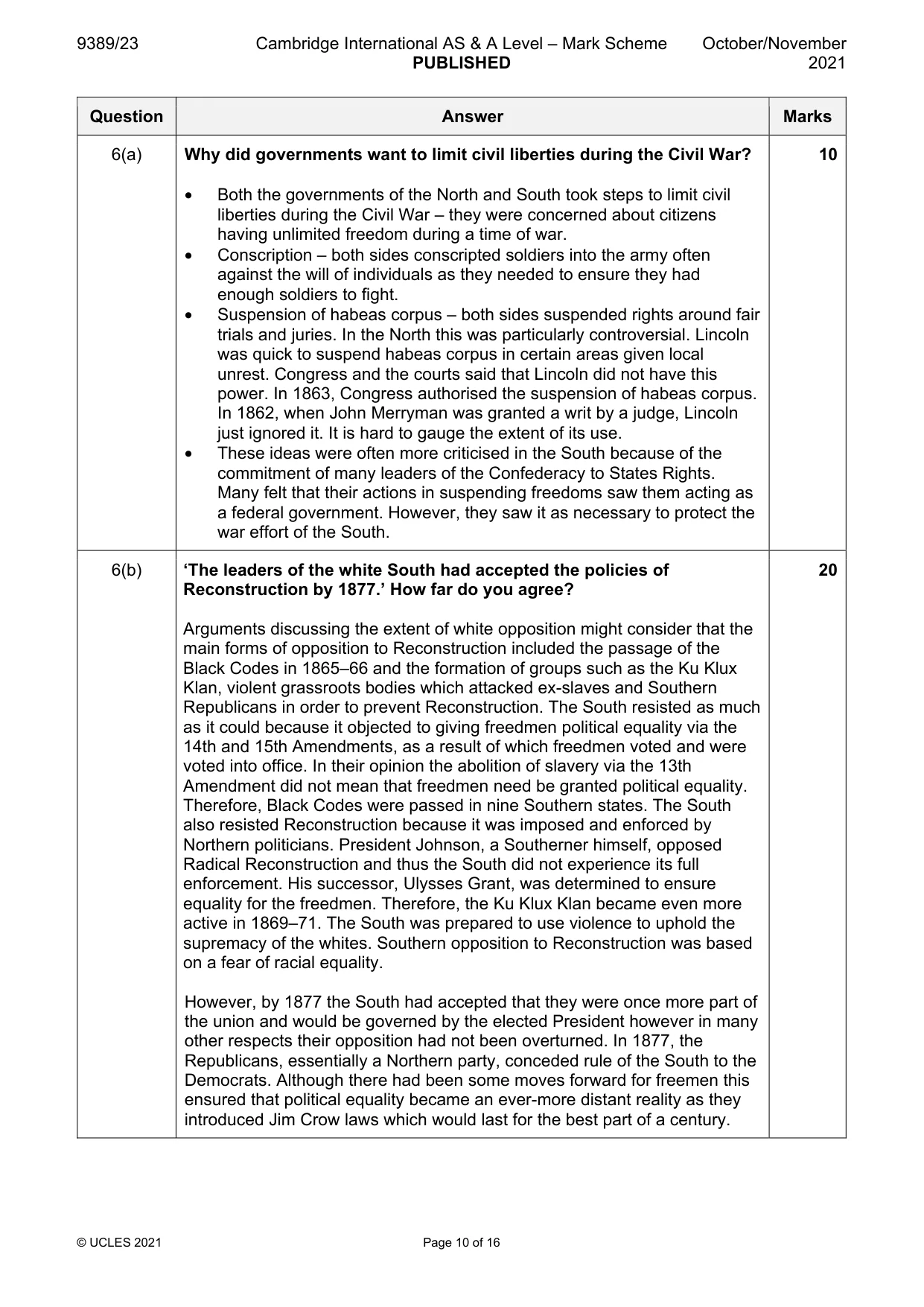
6 Civil War and Reconstruction, 1861–1877 (a) Why did governments want to limit civil liberties during the Civil War? [10] (b) ‘The leaders of the white South had accepted the policies of Reconstruction by 1877.’ How far do you agree? [20]
Mark scheme: 6(a) Why did governments want to limit civil liberties during the Civil War? 10 • Both the governments of the North and South took steps to limit civil liberties during the Civil War – they were concerned about citizens having unlimited freedom during a time of war. • Conscription – both sides conscripted soldiers into the army often against the will of individuals as they needed to ensure they had enough soldiers to fight. • Suspension of habeas corpus – both sides suspended rights around fair trials and juries. In the North this was particularly controversial. Lincoln was quick to suspend habeas corpus in certain areas given local unrest. Congress and the courts said that Lincoln did not have this power. In 1863, Congress authorised the suspension of habeas corpus. In 1862, when John Merryman was granted a writ by a judge, Lincoln just ignored it. It is hard to gauge the extent of its use. • These ideas were often more criticised in the South because of the commitment of many leaders of the Confederacy to States Rights. Many felt that their actions in suspending freedoms saw them acting as a federal government. However, they saw it as necessary to protect the war effort of the South. 6(b) ‘The leaders of the white South had accepted the policies of 20 Reconstruction by 1877.’ How far do you agree? Arguments discussing the extent of white opposition might consider that the main forms of opposition to Reconstruction included the passage of the Black Codes in 1865–66 and the formation of groups such as the Ku Klux Klan, violent grassroots bodies which attacked ex-slaves and Southern Republicans in order to prevent Reconstruction. The South resisted as much as it could because it objected to giving freedmen political equality via the 14th and 15th Amendments, as a result of which freedmen voted and were voted into office. In their opinion the abolition of slavery via the 13th Amendment did not mean that freedmen need be granted political equality. Therefore, Black Codes were passed in nine Southern states. The South also resisted Reconstruction because it was imposed and enforced by Northern politicians. President Johnson, a Southerner himself, opposed Radical Reconstruction and thus the South did not experience its full enforcement. His successor, Ulysses Grant, was determined to ensure equality for the freedmen. Therefore, the Ku Klux Klan became even more active in 1869–71. The South was prepared to use violence to uphold the supremacy of the whites. Southern opposition to Reconstruction was based on a fear of racial equality. However, by 1877 the South had accepted that they were once more part of the union and would be governed by the elected President however in many other respects their opposition had not been overturned. In 1877, the Republicans, essentially a Northern party, conceded rule of the South to the Democrats. Although there had been some moves forward for freemen this ensured that political equality became an ever-more distant reality as they introduced Jim Crow laws which would last for the best part of a century.
Q7 · The Gilded Age and the Progressive Era, from the 1870s to the 1920s (a) Why was there an…
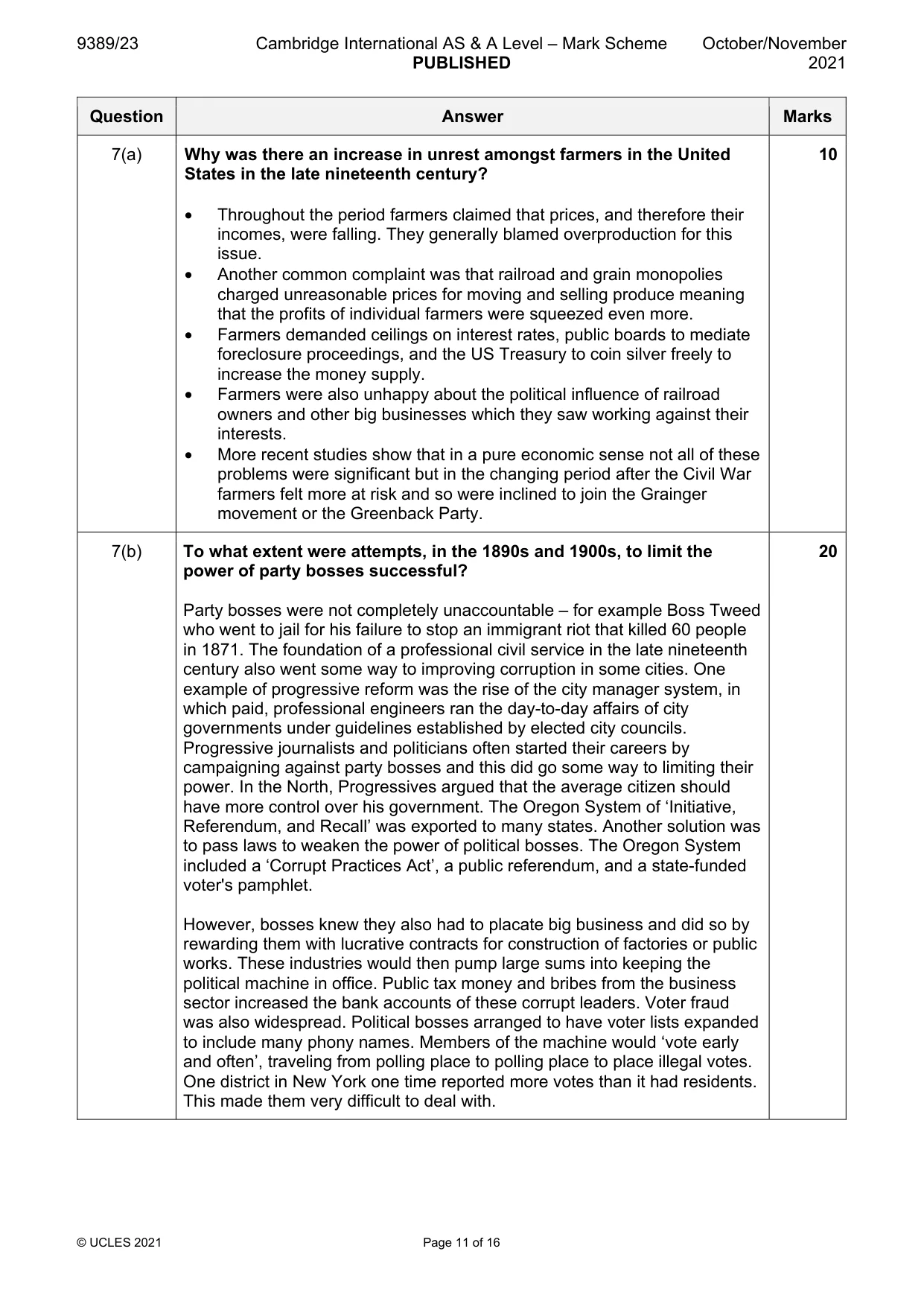
7 The Gilded Age and the Progressive Era, from the 1870s to the 1920s (a) Why was there an increase in unrest amongst farmers in the United States in the late nineteenth century? [10] (b) To what extent were attempts, in the 1890s and 1900s, to limit the power of party bosses successful? [20]
Mark scheme: 7(a) Why was there an increase in unrest amongst farmers in the United 10 States in the late nineteenth century? • Throughout the period farmers claimed that prices, and therefore their incomes, were falling. They generally blamed overproduction for this issue. • Another common complaint was that railroad and grain monopolies charged unreasonable prices for moving and selling produce meaning that the profits of individual farmers were squeezed even more. • Farmers demanded ceilings on interest rates, public boards to mediate foreclosure proceedings, and the US Treasury to coin silver freely to increase the money supply. • Farmers were also unhappy about the political influence of railroad owners and other big businesses which they saw working against their interests. • More recent studies show that in a pure economic sense not all of these problems were significant but in the changing period after the Civil War farmers felt more at risk and so were inclined to join the Grainger movement or the Greenback Party. 7(b) To what extent were attempts, in the 1890s and 1900s, to limit the 20 power of party bosses successful? Party bosses were not completely unaccountable – for example Boss Tweed who went to jail for his failure to stop an immigrant riot that killed 60 people in 1871. The foundation of a professional civil service in the late nineteenth century also went some way to improving corruption in some cities. One example of progressive reform was the rise of the city manager system, in which paid, professional engineers ran the day-to-day affairs of city governments under guidelines established by elected city councils. Progressive journalists and politicians often started their careers by campaigning against party bosses and this did go some way to limiting their power. In the North, Progressives argued that the average citizen should have more control over his government. The Oregon System of ‘Initiative, Referendum, and Recall’ was exported to many states. Another solution was to pass laws to weaken the power of political bosses. The Oregon System included a ‘Corrupt Practices Act’, a public referendum, and a state-funded voter's pamphlet. However, bosses knew they also had to placate big business and did so by rewarding them with lucrative contracts for construction of factories or public works. These industries would then pump large sums into keeping the political machine in office. Public tax money and bribes from the business sector increased the bank accounts of these corrupt leaders. Voter fraud was also widespread. Political bosses arranged to have voter lists expanded to include many phony names. Members of the machine would ‘vote early and often’, traveling from polling place to polling place to place illegal votes. One district in New York one time reported more votes than it had residents. This made them very difficult to deal with.
Q8 · The Great Crash, the Great Depression and the New Deal, from the 1920s to 1941 (a) Why…
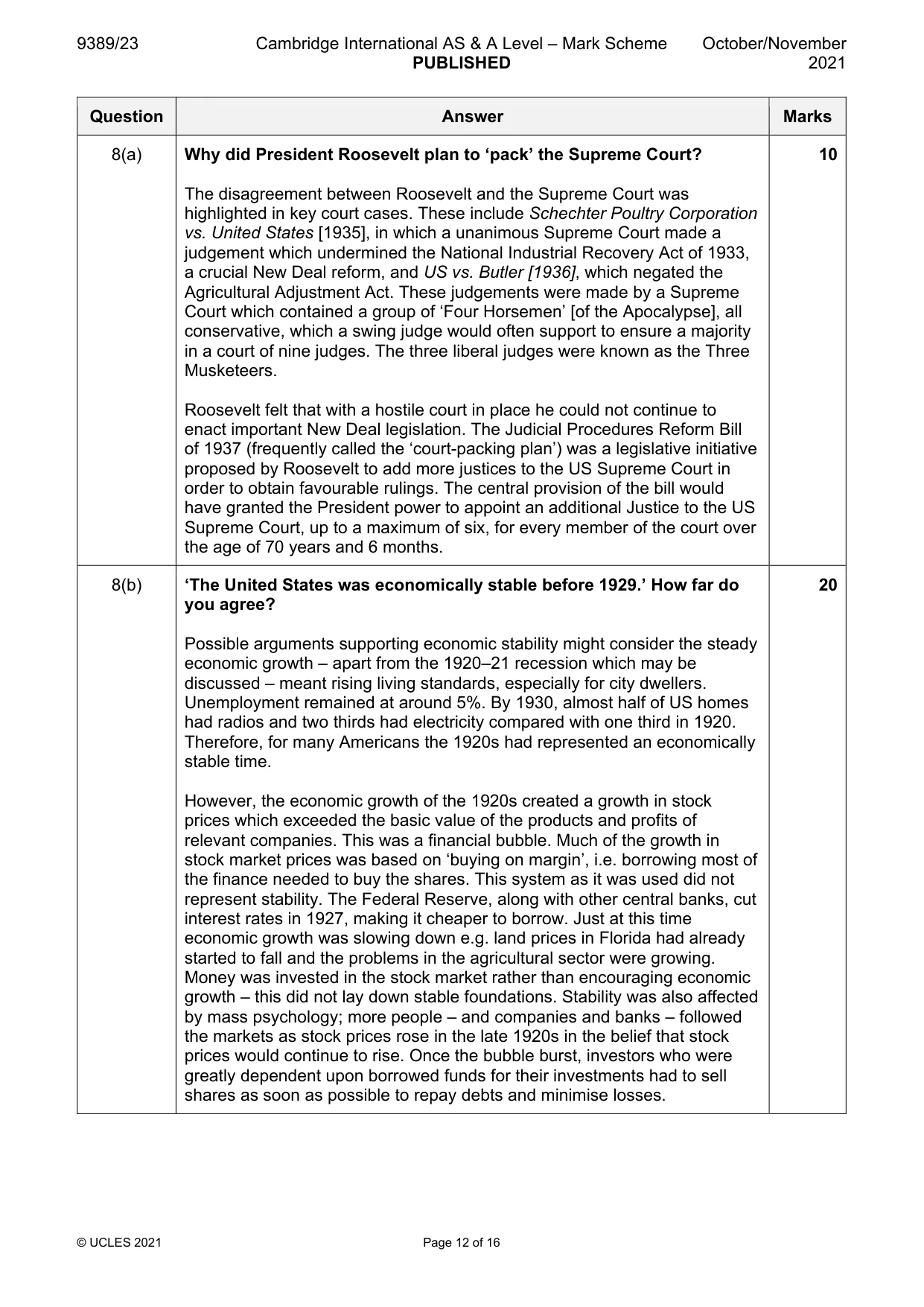
8 The Great Crash, the Great Depression and the New Deal, from the 1920s to 1941 (a) Why did President Roosevelt plan to ‘pack’ the Supreme Court? [10] (b) ‘The United States was economically stable before 1929.’ How far do you agree? [20] Section C: International Option International Relations, 1871–1945 Answer both parts of two questions.
Mark scheme: 8(a) Why did President Roosevelt plan to ‘pack’ the Supreme Court? 10 The disagreement between Roosevelt and the Supreme Court was highlighted in key court cases. These include Schechter Poultry Corporation vs. United States [1935], in which a unanimous Supreme Court made a judgement which undermined the National Industrial Recovery Act of 1933, a crucial New Deal reform, and US vs. Butler [1936], which negated the Agricultural Adjustment Act. These judgements were made by a Supreme Court which contained a group of ‘Four Horsemen’ [of the Apocalypse], all conservative, which a swing judge would often support to ensure a majority in a court of nine judges. The three liberal judges were known as the Three Musketeers. Roosevelt felt that with a hostile court in place he could not continue to enact important New Deal legislation. The Judicial Procedures Reform Bill of 1937 (frequently called the ‘court-packing plan’) was a legislative initiative proposed by Roosevelt to add more justices to the US Supreme Court in order to obtain favourable rulings. The central provision of the bill would have granted the President power to appoint an additional Justice to the US Supreme Court, up to a maximum of six, for every member of the court over the age of 70 years and 6 months. 8(b) ‘The United States was economically stable before 1929.’ How far do 20 you agree? Possible arguments supporting economic stability might consider the steady economic growth – apart from the 1920–21 recession which may be discussed – meant rising living standards, especially for city dwellers. Unemployment remained at around 5%. By 1930, almost half of US homes had radios and two thirds had electricity compared with one third in 1920. Therefore, for many Americans the 1920s had represented an economically stable time. However, the economic growth of the 1920s created a growth in stock prices which exceeded the basic value of the products and profits of relevant companies. This was a financial bubble. Much of the growth in stock market prices was based on ‘buying on margin’, i.e. borrowing most of the finance needed to buy the shares. This system as it was used did not represent stability. The Federal Reserve, along with other central banks, cut interest rates in 1927, making it cheaper to borrow. Just at this time economic growth was slowing down e.g. land prices in Florida had already started to fall and the problems in the agricultural sector were growing. Money was invested in the stock market rather than encouraging economic growth – this did not lay down stable foundations. Stability was also affected by mass psychology; more people – and companies and banks – followed the markets as stock prices rose in the late 1920s in the belief that stock prices would continue to rise. Once the bubble burst, investors who were greatly dependent upon borrowed funds for their investments had to sell shares as soon as possible to repay debts and minimise losses. Section C: International Option: International Relations, 1871–1945
Q9 · International Relations, 1871–1918 (a) Why did Anglo–French relations improve after the…
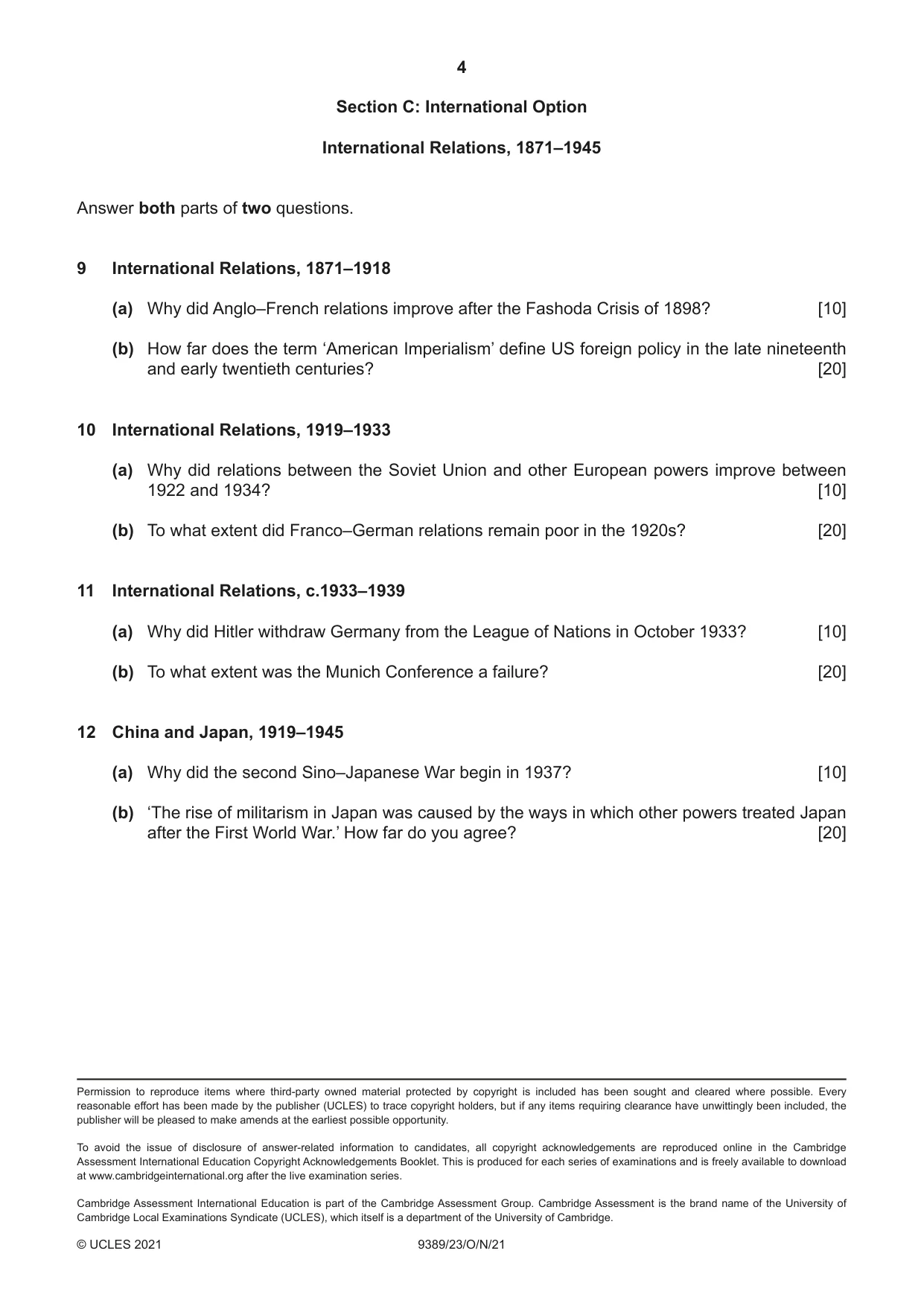
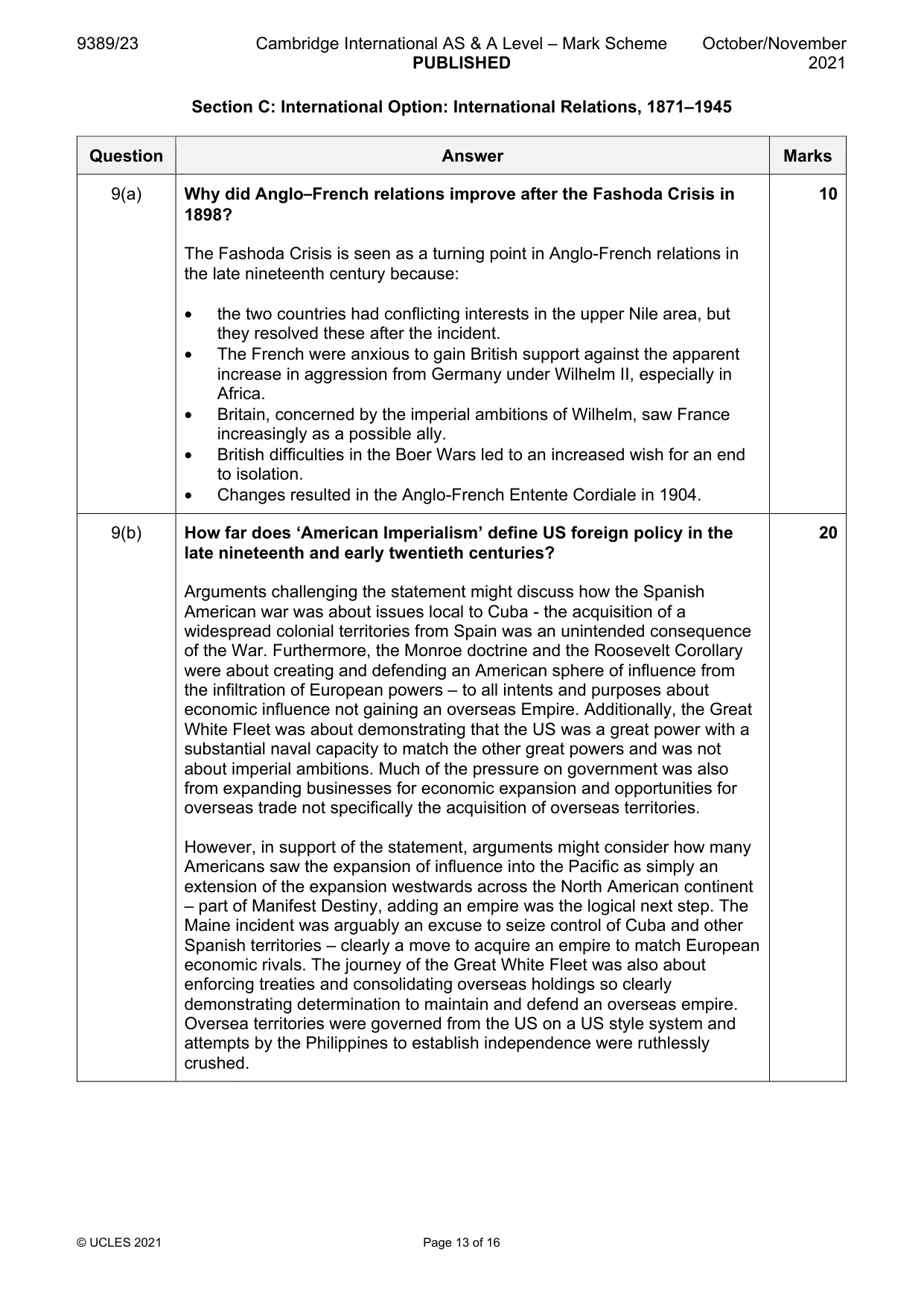
9 International Relations, 1871–1918 (a) Why did Anglo–French relations improve after the Fashoda Crisis of 1898? [10] (b) How far does the term ‘American Imperialism’ define US foreign policy in the late nineteenth and early twentieth centuries? [20]
Mark scheme: 9(a) Why did Anglo–French relations improve after the Fashoda Crisis in 10 1898? The Fashoda Crisis is seen as a turning point in Anglo-French relations in the late nineteenth century because: • the two countries had conflicting interests in the upper Nile area, but they resolved these after the incident. • The French were anxious to gain British support against the apparent increase in aggression from Germany under Wilhelm II, especially in Africa. • Britain, concerned by the imperial ambitions of Wilhelm, saw France increasingly as a possible ally. • British difficulties in the Boer Wars led to an increased wish for an end to isolation. • Changes resulted in the Anglo-French Entente Cordiale in 1904. 9(b) How far does ‘American Imperialism’ define US foreign policy in the 20 late nineteenth and early twentieth centuries? Arguments challenging the statement might discuss how the Spanish American war was about issues local to Cuba - the acquisition of a widespread colonial territories from Spain was an unintended consequence of the War. Furthermore, the Monroe doctrine and the Roosevelt Corollary were about creating and defending an American sphere of influence from the infiltration of European powers – to all intents and purposes about economic influence not gaining an overseas Empire. Additionally, the Great White Fleet was about demonstrating that the US was a great power with a substantial naval capacity to match the other great powers and was not about imperial ambitions. Much of the pressure on government was also from expanding businesses for economic expansion and opportunities for overseas trade not specifically the acquisition of overseas territories. However, in support of the statement, arguments might consider how many Americans saw the expansion of influence into the Pacific as simply an extension of the expansion westwards across the North American continent – part of Manifest Destiny, adding an empire was the logical next step. The Maine incident was arguably an excuse to seize control of Cuba and other Spanish territories – clearly a move to acquire an empire to match European economic rivals. The journey of the Great White Fleet was also about enforcing treaties and consolidating overseas holdings so clearly demonstrating determination to maintain and defend an overseas empire. Oversea territories were governed from the US on a US style system and attempts by the Philippines to establish independence were ruthlessly crushed.
Q10 · International Relations, 1919–1933 (a) Why did relations between the Soviet Union and…
10 International Relations, 1919–1933 (a) Why did relations between the Soviet Union and other European powers improve between 1922 and 1934? [10] (b) To what extent did Franco–German relations remain poor in the 1920s? [20]
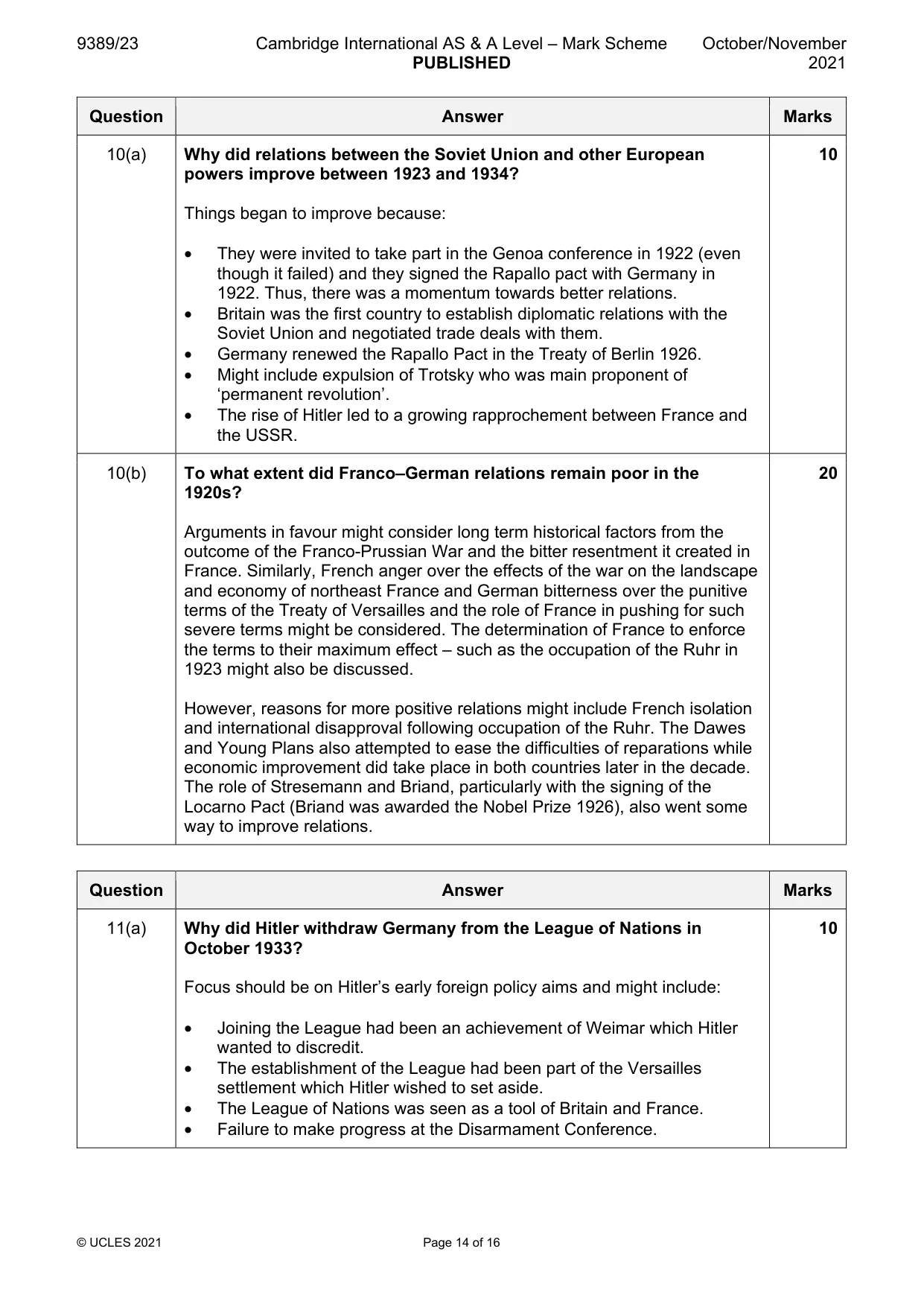
Mark scheme: 10(a) Why did relations between the Soviet Union and other European 10 powers improve between 1923 and 1934? Things began to improve because: • They were invited to take part in the Genoa conference in 1922 (even though it failed) and they signed the Rapallo pact with Germany in 1922. Thus, there was a momentum towards better relations. • Britain was the first country to establish diplomatic relations with the Soviet Union and negotiated trade deals with them. • Germany renewed the Rapallo Pact in the Treaty of Berlin 1926. • Might include expulsion of Trotsky who was main proponent of ‘permanent revolution’. • The rise of Hitler led to a growing rapprochement between France and the USSR. 10(b) To what extent did Franco–German relations remain poor in the 20 1920s? Arguments in favour might consider long term historical factors from the outcome of the Franco-Prussian War and the bitter resentment it created in France. Similarly, French anger over the effects of the war on the landscape and economy of northeast France and German bitterness over the punitive terms of the Treaty of Versailles and the role of France in pushing for such severe terms might be considered. The determination of France to enforce the terms to their maximum effect – such as the occupation of the Ruhr in 1923 might also be discussed. However, reasons for more positive relations might include French isolation and international disapproval following occupation of the Ruhr. The Dawes and Young Plans also attempted to ease the difficulties of reparations while economic improvement did take place in both countries later in the decade. The role of Stresemann and Briand, particularly with the signing of the Locarno Pact (Briand was awarded the Nobel Prize 1926), also went some way to improve relations.
Q11 · International Relations, c.1933–1939 (a) Why did Hitler withdraw Germany from the League…
11 International Relations, c.1933–1939 (a) Why did Hitler withdraw Germany from the League of Nations in October 1933? [10] (b) To what extent was the Munich Conference a failure? [20]
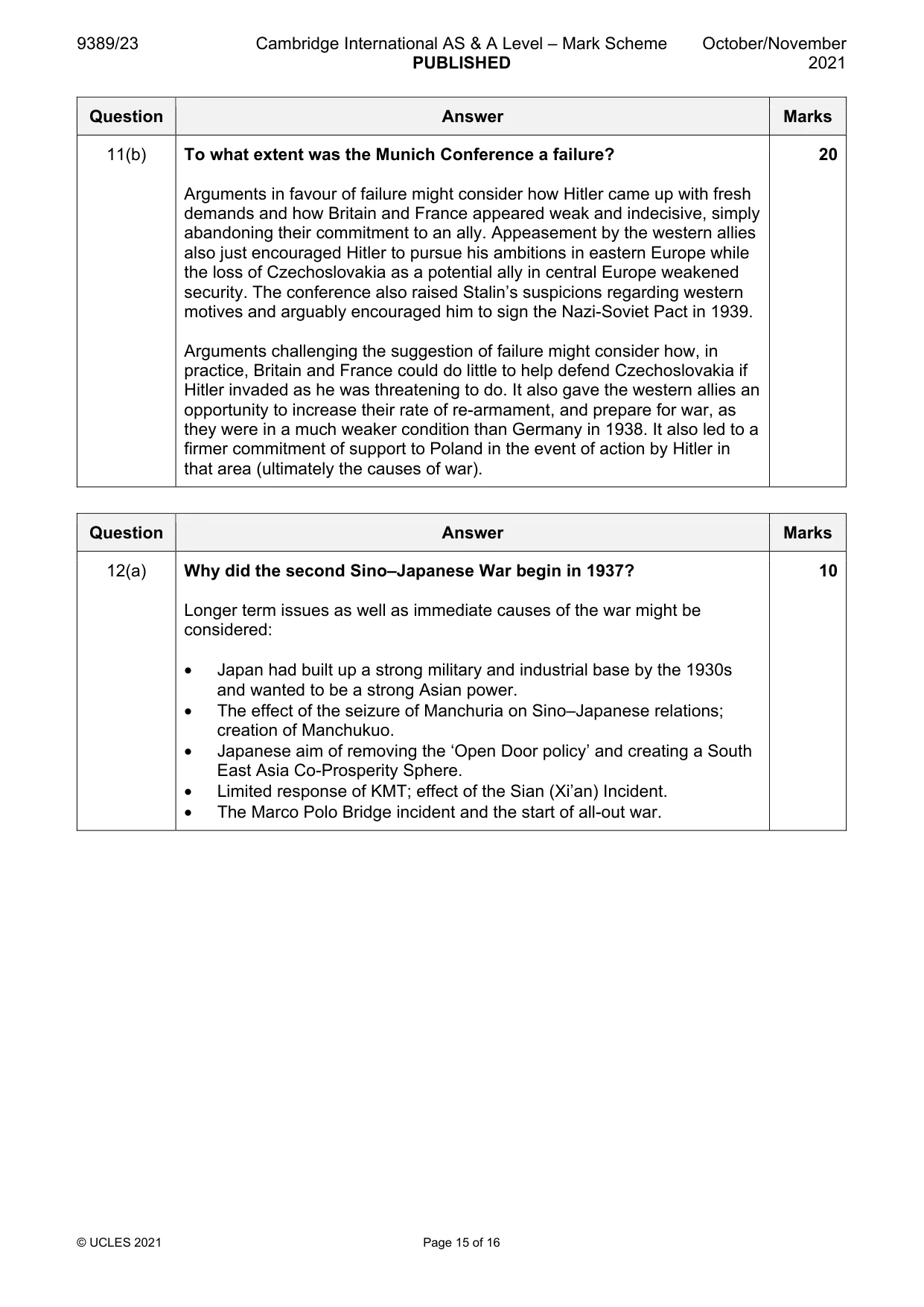
Mark scheme: 11(a) Why did Hitler withdraw Germany from the League of Nations in 10 October 1933? Focus should be on Hitler’s early foreign policy aims and might include: • Joining the League had been an achievement of Weimar which Hitler wanted to discredit. • The establishment of the League had been part of the Versailles settlement which Hitler wished to set aside. • The League of Nations was seen as a tool of Britain and France. • Failure to make progress at the Disarmament Conference. 11(b) To what extent was the Munich Conference a failure? 20 Arguments in favour of failure might consider how Hitler came up with fresh demands and how Britain and France appeared weak and indecisive, simply abandoning their commitment to an ally. Appeasement by the western allies also just encouraged Hitler to pursue his ambitions in eastern Europe while the loss of Czechoslovakia as a potential ally in central Europe weakened security. The conference also raised Stalin’s suspicions regarding western motives and arguably encouraged him to sign the Nazi-Soviet Pact in 1939. Arguments challenging the suggestion of failure might consider how, in practice, Britain and France could do little to help defend Czechoslovakia if Hitler invaded as he was threatening to do. It also gave the western allies an opportunity to increase their rate of re-armament, and prepare for war, as they were in a much weaker condition than Germany in 1938. It also led to a firmer commitment of support to Poland in the event of action by Hitler in that area (ultimately the causes of war).
Q12 · China and Japan, 1919–1945 (a) Why did the second Sino–Japanese War begin in 1937?
12 China and Japan, 1919–1945 (a) Why did the second Sino–Japanese War begin in 1937? [10] (b) ‘The rise of militarism in Japan was caused by the ways in which other powers treated Japan after the First World War.’ How far do you agree? [20]
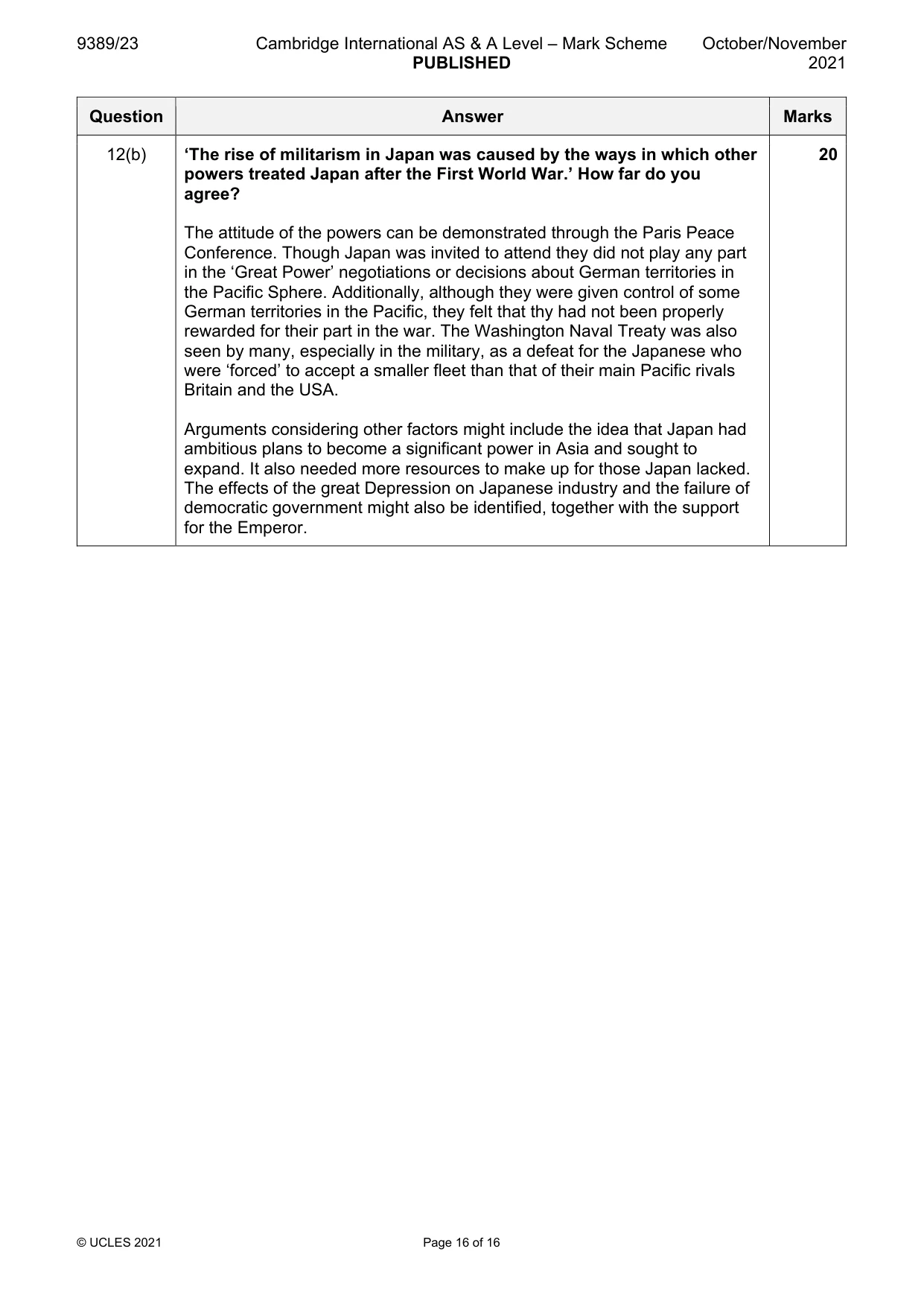
Mark scheme: 12(a) Why did the second Sino–Japanese War begin in 1937? 10 Longer term issues as well as immediate causes of the war might be considered: • Japan had built up a strong military and industrial base by the 1930s and wanted to be a strong Asian power. • The effect of the seizure of Manchuria on Sino–Japanese relations; creation of Manchukuo. • Japanese aim of removing the ‘Open Door policy’ and creating a South East Asia Co-Prosperity Sphere. • Limited response of KMT; effect of the Sian (Xi’an) Incident. • The Marco Polo Bridge incident and the start of all-out war. 12(b) ‘The rise of militarism in Japan was caused by the ways in which other 20 powers treated Japan after the First World War.’ How far do you agree? The attitude of the powers can be demonstrated through the Paris Peace Conference. Though Japan was invited to attend they did not play any part in the ‘Great Power’ negotiations or decisions about German territories in the Pacific Sphere. Additionally, although they were given control of some German territories in the Pacific, they felt that thy had not been properly rewarded for their part in the war. The Washington Naval Treaty was also seen by many, especially in the military, as a defeat for the Japanese who were ‘forced’ to accept a smaller fleet than that of their main Pacific rivals Britain and the USA. Arguments considering other factors might include the idea that Japan had ambitious plans to become a significant power in Asia and sought to expand. It also needed more resources to make up for those Japan lacked. The effects of the great Depression on Japanese industry and the failure of democratic government might also be identified, together with the support for the Emperor.
What you needed in this session
Cambridge’s own grade thresholds for 2021 Oct/Nov, Paper 2 · Variant 3. A higher threshold means an easier paper — the bar moves with how the cohort did.