Cambridge A Level History 9389 — 2020 Oct/Nov Paper 4 · Variant 1
9389/41/O/N/20 · 19 questions · 60 marks · ≈68 min
The question paper and its mark scheme, free to read here and free to download. This is Cambridge’s own paper, exactly as it was sat.
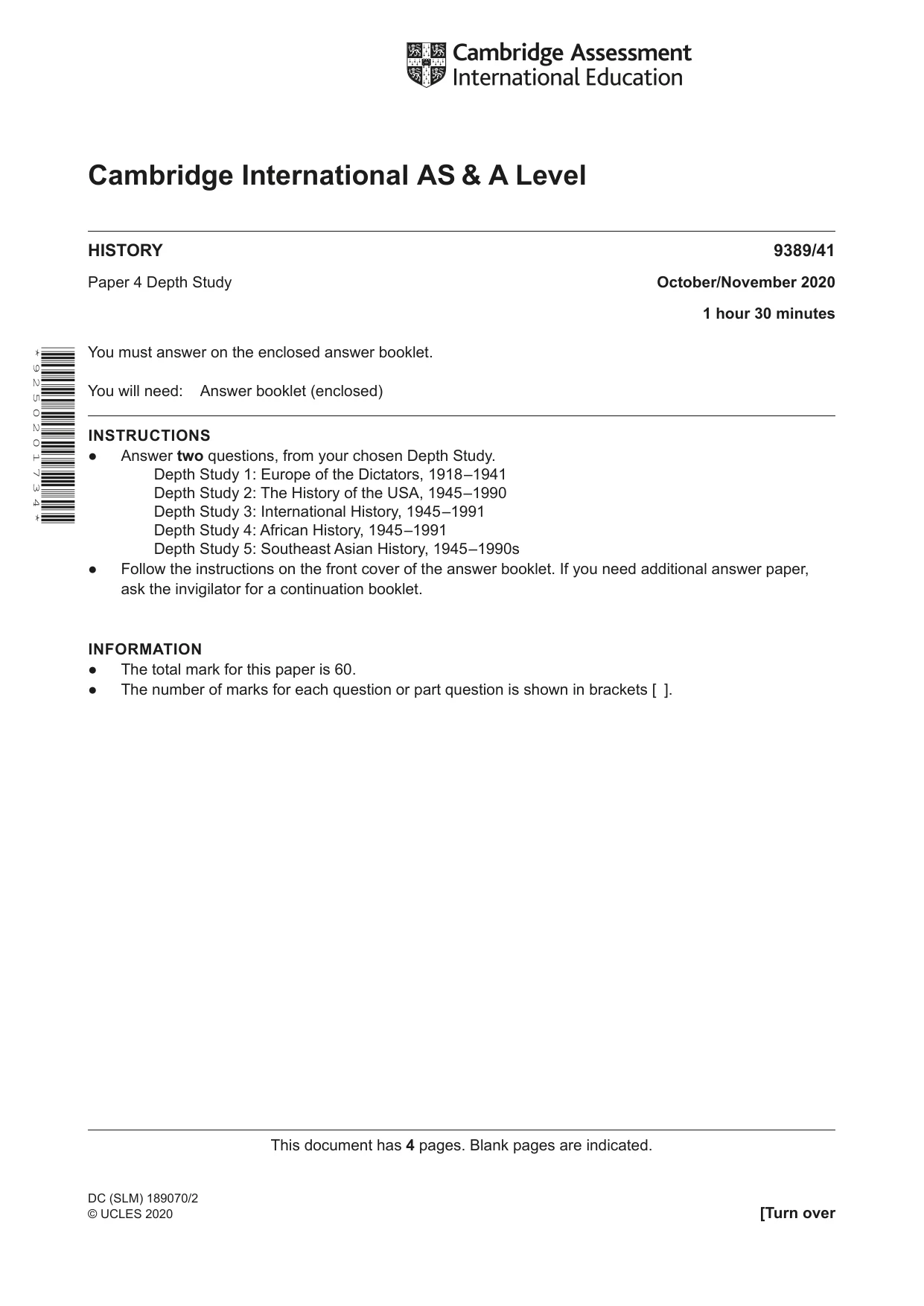
Question paper4 pages
Mark scheme24 pages
Answers below. Sit the paper first if you are practising.

Questions as text
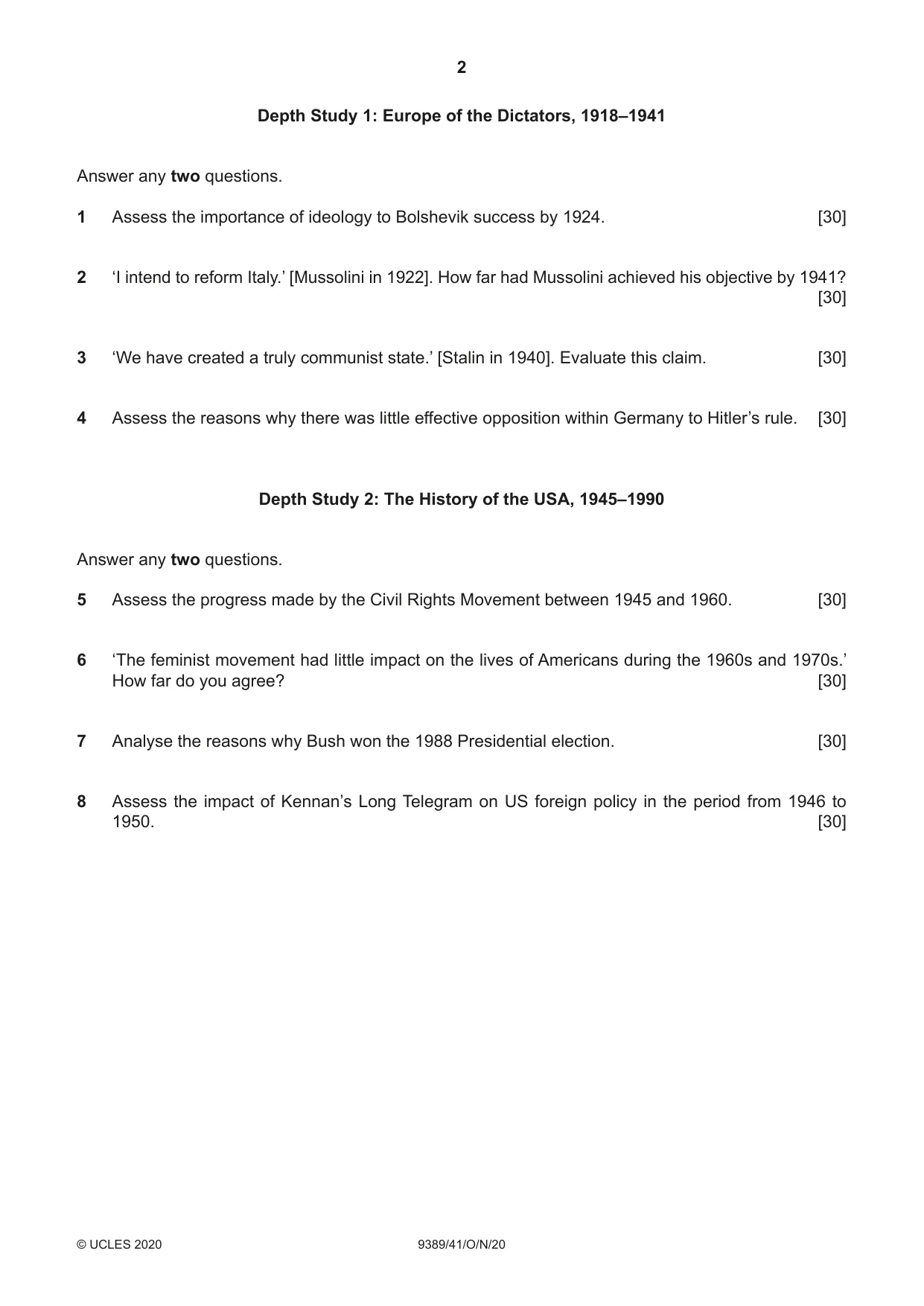
Q1 · Assess the importance of ideology to Bolshevik success by 1924
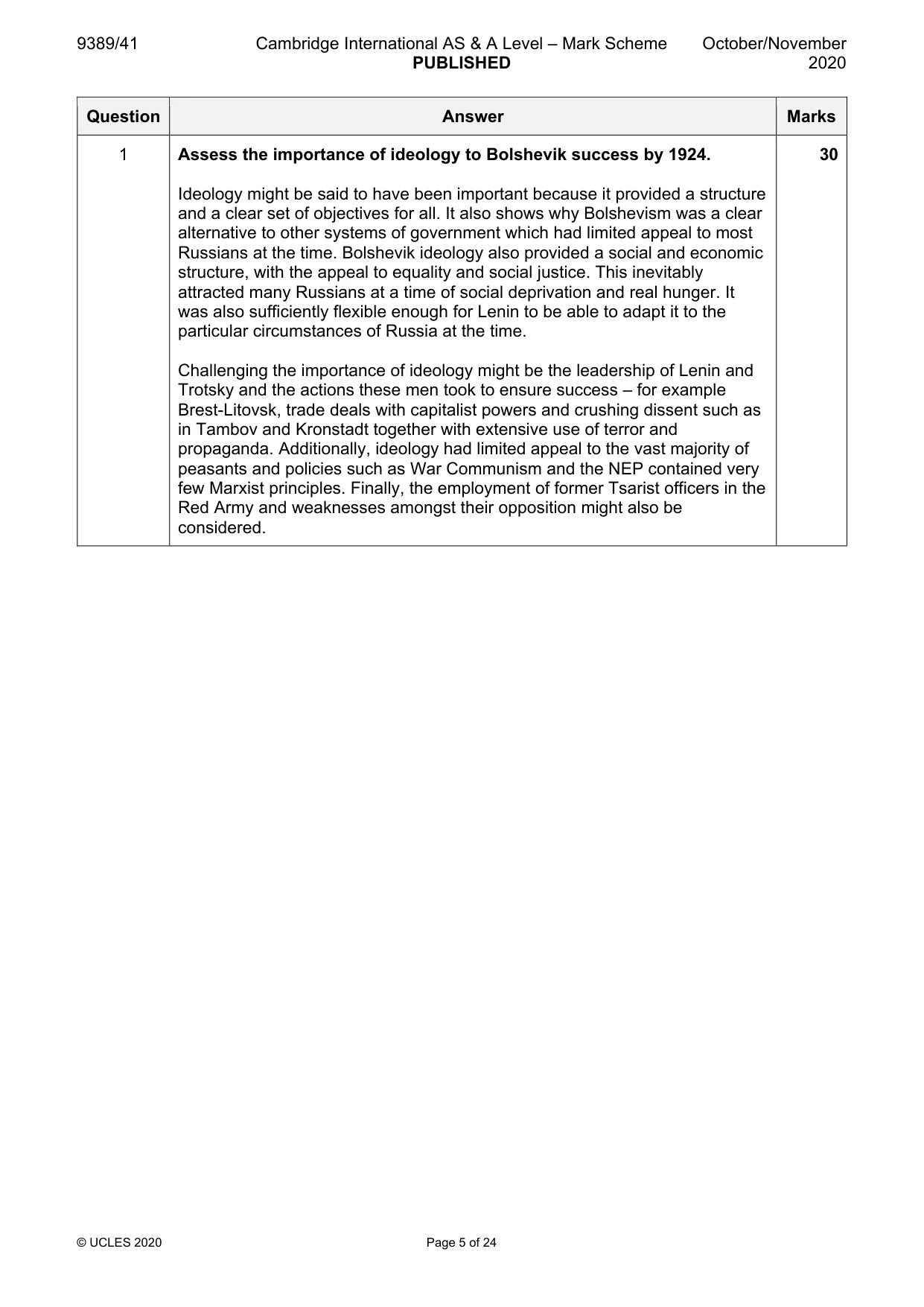
1 Assess the importance of ideology to Bolshevik success by 1924. [30]
Mark scheme: Question Answer Marks 1 Assess the importance of ideology to Bolshevik success by 1924. 30 Ideology might be said to have been important because it provided a structure and a clear set of objectives for all. It also shows why Bolshevism was a clear alternative to other systems of government which had limited appeal to most Russians at the time. Bolshevik ideology also provided a social and economic structure, with the appeal to equality and social justice. This inevitably attracted many Russians at a time of social deprivation and real hunger. It was also sufficiently flexible enough for Lenin to be able to adapt it to the particular circumstances of Russia at the time. Challenging the importance of ideology might be the leadership of Lenin and Trotsky and the actions these men took to ensure success – for example Brest-Litovsk, trade deals with capitalist powers and crushing dissent such as in Tambov and Kronstadt together with extensive use of terror and propaganda. Additionally, ideology had limited appeal to the vast majority of peasants and policies such as War Communism and the NEP contained very few Marxist principles. Finally, the employment of former Tsarist officers in the Red Army and weaknesses amongst their opposition might also be considered.
Q2 · ‘I intend to reform Italy.’ [Mussolini in 1922]
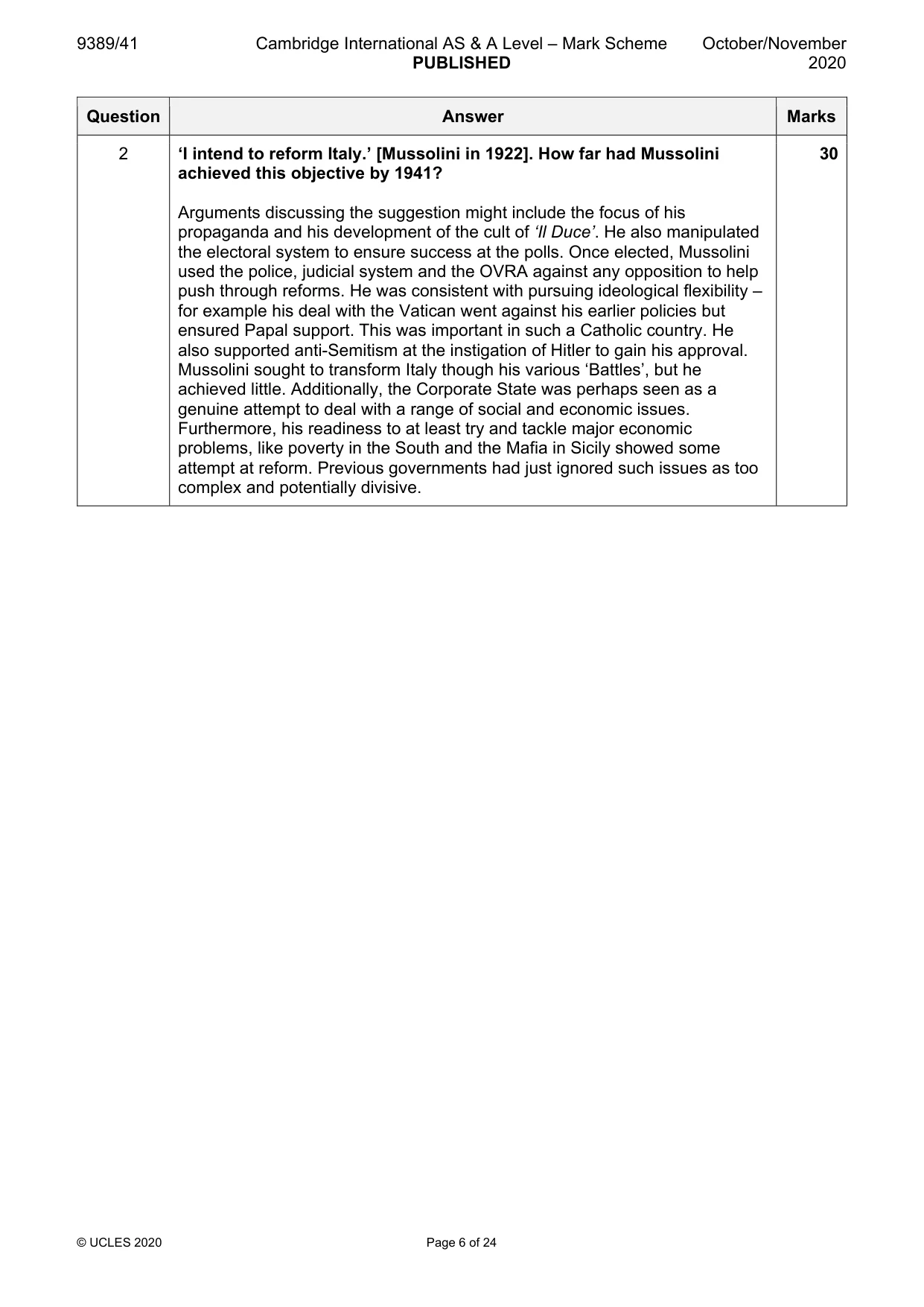
2 ‘I intend to reform Italy.’ [Mussolini in 1922]. How far had Mussolini achieved his objective by 1941? [30]
Mark scheme: 2 ‘I intend to reform Italy.’ [Mussolini in 1922]. How far had Mussolini 30 achieved this objective by 1941? Arguments discussing the suggestion might include the focus of his propaganda and his development of the cult of ‘Il Duce’. He also manipulated the electoral system to ensure success at the polls. Once elected, Mussolini used the police, judicial system and the OVRA against any opposition to help push through reforms. He was consistent with pursuing ideological flexibility – for example his deal with the Vatican went against his earlier policies but ensured Papal support. This was important in such a Catholic country. He also supported anti-Semitism at the instigation of Hitler to gain his approval. Mussolini sought to transform Italy though his various ‘Battles’, but he achieved little. Additionally, the Corporate State was perhaps seen as a genuine attempt to deal with a range of social and economic issues. Furthermore, his readiness to at least try and tackle major economic problems, like poverty in the South and the Mafia in Sicily showed some attempt at reform. Previous governments had just ignored such issues as too complex and potentially divisive.
Q3 · ‘We have created a truly communist state.’ [Stalin in 1940]
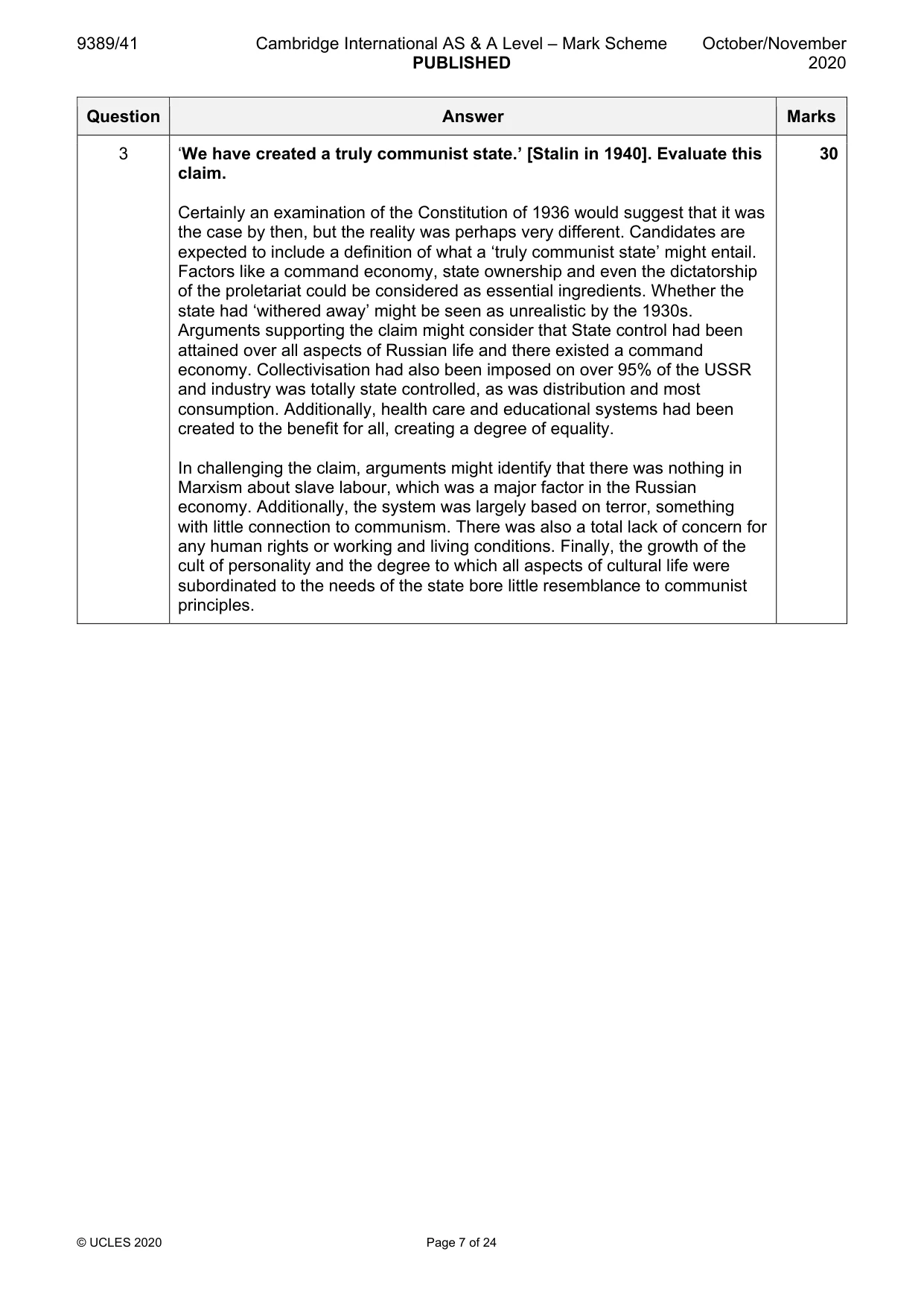
3 ‘We have created a truly communist state.’ [Stalin in 1940]. Evaluate this claim. [30]
Mark scheme: 3 ‘We have created a truly communist state.’ [Stalin in 1940]. Evaluate this 30 claim. Certainly an examination of the Constitution of 1936 would suggest that it was the case by then, but the reality was perhaps very different. Candidates are expected to include a definition of what a ‘truly communist state’ might entail. Factors like a command economy, state ownership and even the dictatorship of the proletariat could be considered as essential ingredients. Whether the state had ‘withered away’ might be seen as unrealistic by the 1930s. Arguments supporting the claim might consider that State control had been attained over all aspects of Russian life and there existed a command economy. Collectivisation had also been imposed on over 95% of the USSR and industry was totally state controlled, as was distribution and most consumption. Additionally, health care and educational systems had been created to the benefit for all, creating a degree of equality. In challenging the claim, arguments might identify that there was nothing in Marxism about slave labour, which was a major factor in the Russian economy. Additionally, the system was largely based on terror, something with little connection to communism. There was also a total lack of concern for any human rights or working and living conditions. Finally, the growth of the cult of personality and the degree to which all aspects of cultural life were subordinated to the needs of the state bore little resemblance to communist principles.
Q4 · Assess the reasons why there was little effective opposition within Germany to Hitler’s…
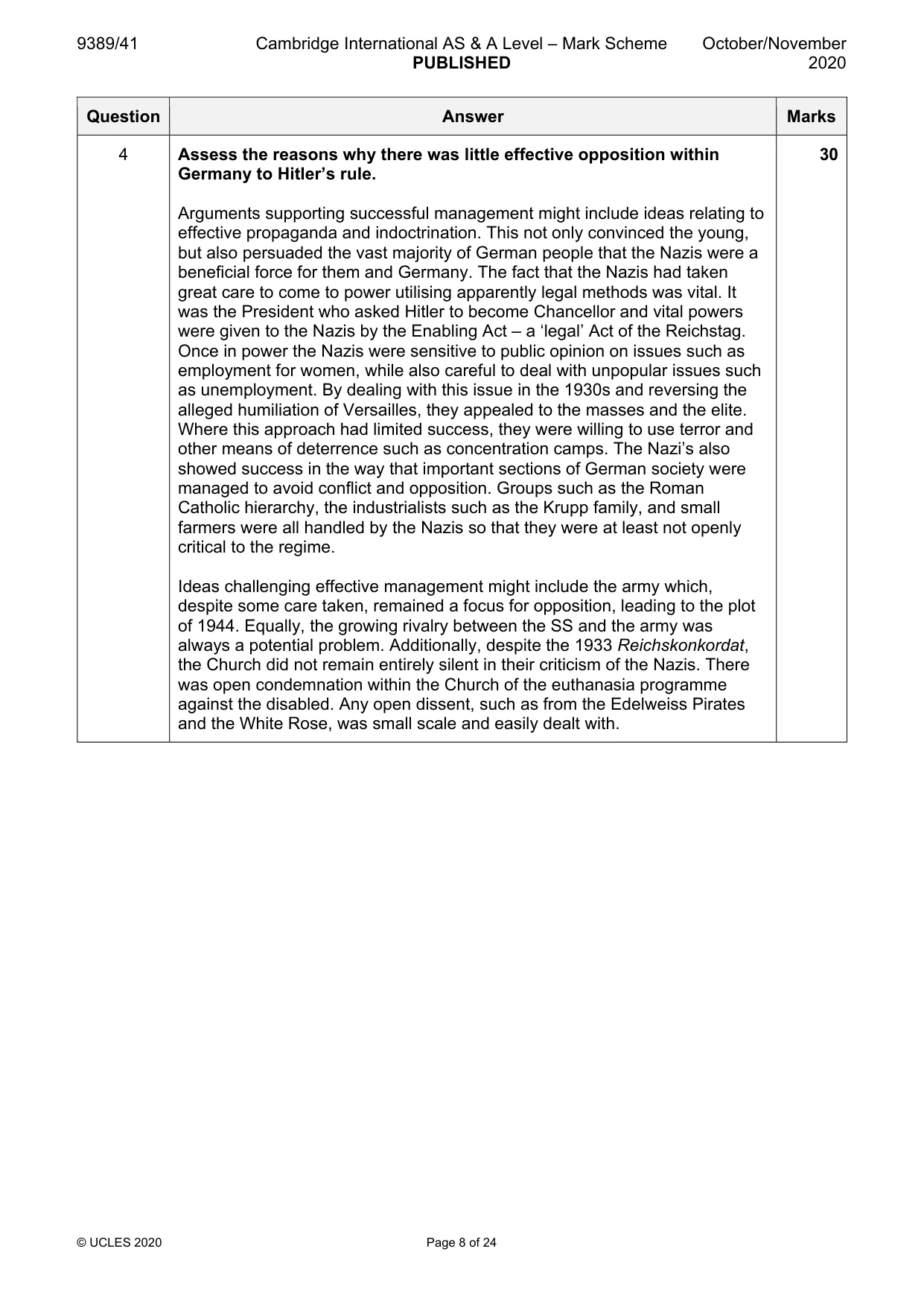
4 Assess the reasons why there was little effective opposition within Germany to Hitler’s rule. [30] Depth Study 2: The History of the USA, 1945–1990 Answer any two questions.
Mark scheme: 4 Assess the reasons why there was little effective opposition within 30 Germany to Hitler’s rule. Arguments supporting successful management might include ideas relating to effective propaganda and indoctrination. This not only convinced the young, but also persuaded the vast majority of German people that the Nazis were a beneficial force for them and Germany. The fact that the Nazis had taken great care to come to power utilising apparently legal methods was vital. It was the President who asked Hitler to become Chancellor and vital powers were given to the Nazis by the Enabling Act – a ‘legal’ Act of the Reichstag. Once in power the Nazis were sensitive to public opinion on issues such as employment for women, while also careful to deal with unpopular issues such as unemployment. By dealing with this issue in the 1930s and reversing the alleged humiliation of Versailles, they appealed to the masses and the elite. Where this approach had limited success, they were willing to use terror and other means of deterrence such as concentration camps. The Nazi’s also showed success in the way that important sections of German society were managed to avoid conflict and opposition. Groups such as the Roman Catholic hierarchy, the industrialists such as the Krupp family, and small farmers were all handled by the Nazis so that they were at least not openly critical to the regime. Ideas challenging effective management might include the army which, despite some care taken, remained a focus for opposition, leading to the plot of 1944. Equally, the growing rivalry between the SS and the army was always a potential problem. Additionally, despite the 1933 Reichskonkordat, the Church did not remain entirely silent in their criticism of the Nazis. There was open condemnation within the Church of the euthanasia programme against the disabled. Any open dissent, such as from the Edelweiss Pirates and the White Rose, was small scale and easily dealt with.
Q5 · Assess the progress made by the Civil Rights Movement between 1945 and 1960
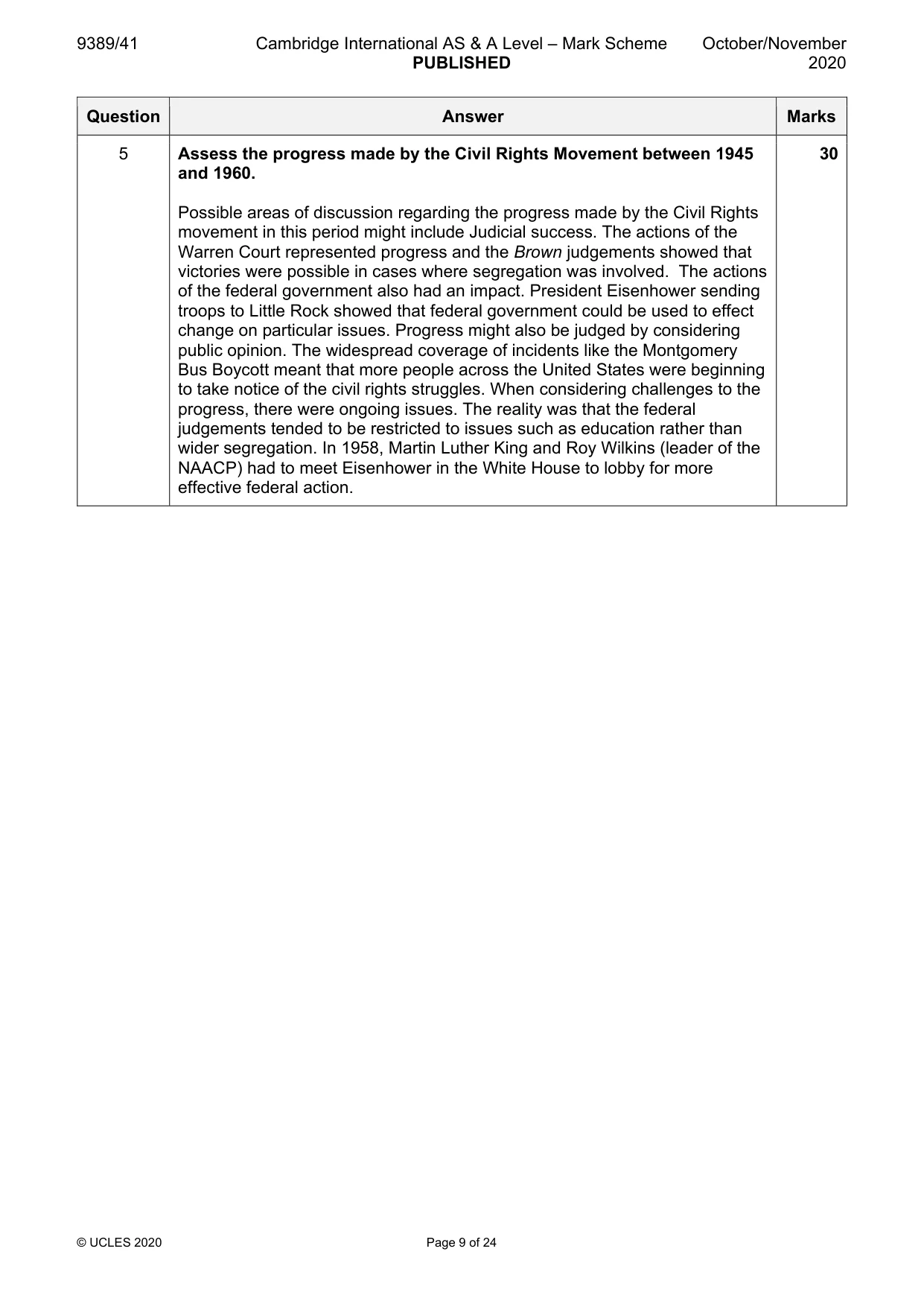
5 Assess the progress made by the Civil Rights Movement between 1945 and 1960. [30]
Mark scheme: 5 Assess the progress made by the Civil Rights Movement between 1945 30 and 1960. Possible areas of discussion regarding the progress made by the Civil Rights movement in this period might include Judicial success. The actions of the Warren Court represented progress and the Brown judgements showed that victories were possible in cases where segregation was involved. The actions of the federal government also had an impact. President Eisenhower sending troops to Little Rock showed that federal government could be used to effect change on particular issues. Progress might also be judged by considering public opinion. The widespread coverage of incidents like the Montgomery Bus Boycott meant that more people across the United States were beginning to take notice of the civil rights struggles. When considering challenges to the progress, there were ongoing issues. The reality was that the federal judgements tended to be restricted to issues such as education rather than wider segregation. In 1958, Martin Luther King and Roy Wilkins (leader of the NAACP) had to meet Eisenhower in the White House to lobby for more effective federal action.
Q6 · ‘The feminist movement had little impact on the lives of Americans during the 1960s and…
6 ‘The feminist movement had little impact on the lives of Americans during the 1960s and 1970s.’ How far do you agree? [30]
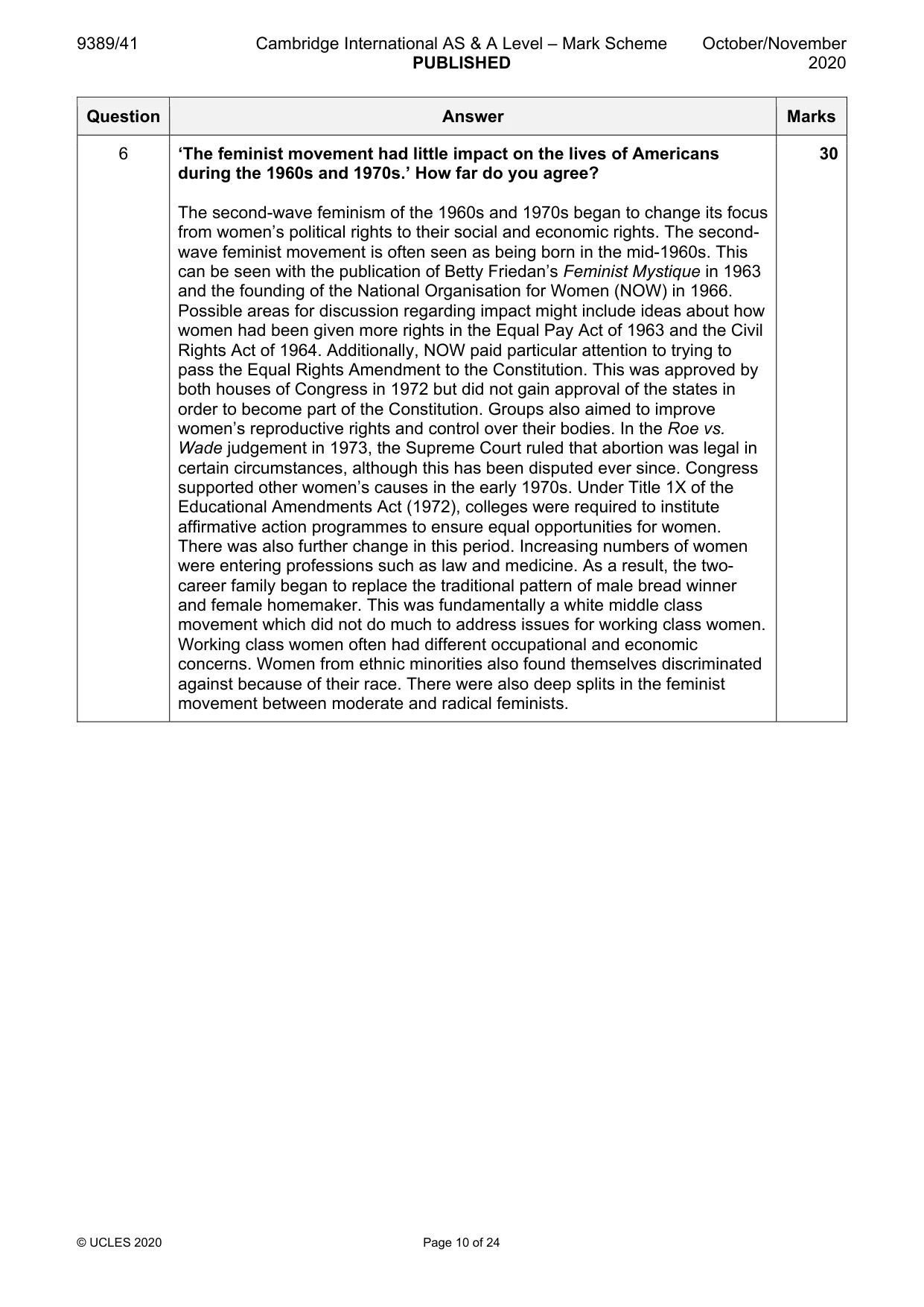
Mark scheme: 6 ‘The feminist movement had little impact on the lives of Americans 30 during the 1960s and 1970s.’ How far do you agree? The second-wave feminism of the 1960s and 1970s began to change its focus from women’s political rights to their social and economic rights. The second- wave feminist movement is often seen as being born in the mid-1960s. This can be seen with the publication of Betty Friedan’s Feminist Mystique in 1963 and the founding of the National Organisation for Women (NOW) in 1966. Possible areas for discussion regarding impact might include ideas about how women had been given more rights in the Equal Pay Act of 1963 and the Civil Rights Act of 1964. Additionally, NOW paid particular attention to trying to pass the Equal Rights Amendment to the Constitution. This was approved by both houses of Congress in 1972 but did not gain approval of the states in order to become part of the Constitution. Groups also aimed to improve women’s reproductive rights and control over their bodies. In the Roe vs. Wade judgement in 1973, the Supreme Court ruled that abortion was legal in certain circumstances, although this has been disputed ever since. Congress supported other women’s causes in the early 1970s. Under Title 1X of the Educational Amendments Act (1972), colleges were required to institute affirmative action programmes to ensure equal opportunities for women. There was also further change in this period. Increasing numbers of women were entering professions such as law and medicine. As a result, the two- career family began to replace the traditional pattern of male bread winner and female homemaker. This was fundamentally a white middle class movement which did not do much to address issues for working class women. Working class women often had different occupational and economic concerns. Women from ethnic minorities also found themselves discriminated against because of their race. There were also deep splits in the feminist movement between moderate and radical feminists.
Q7 · Analyse the reasons why Bush won the 1988 Presidential election
7 Analyse the reasons why Bush won the 1988 Presidential election. [30]
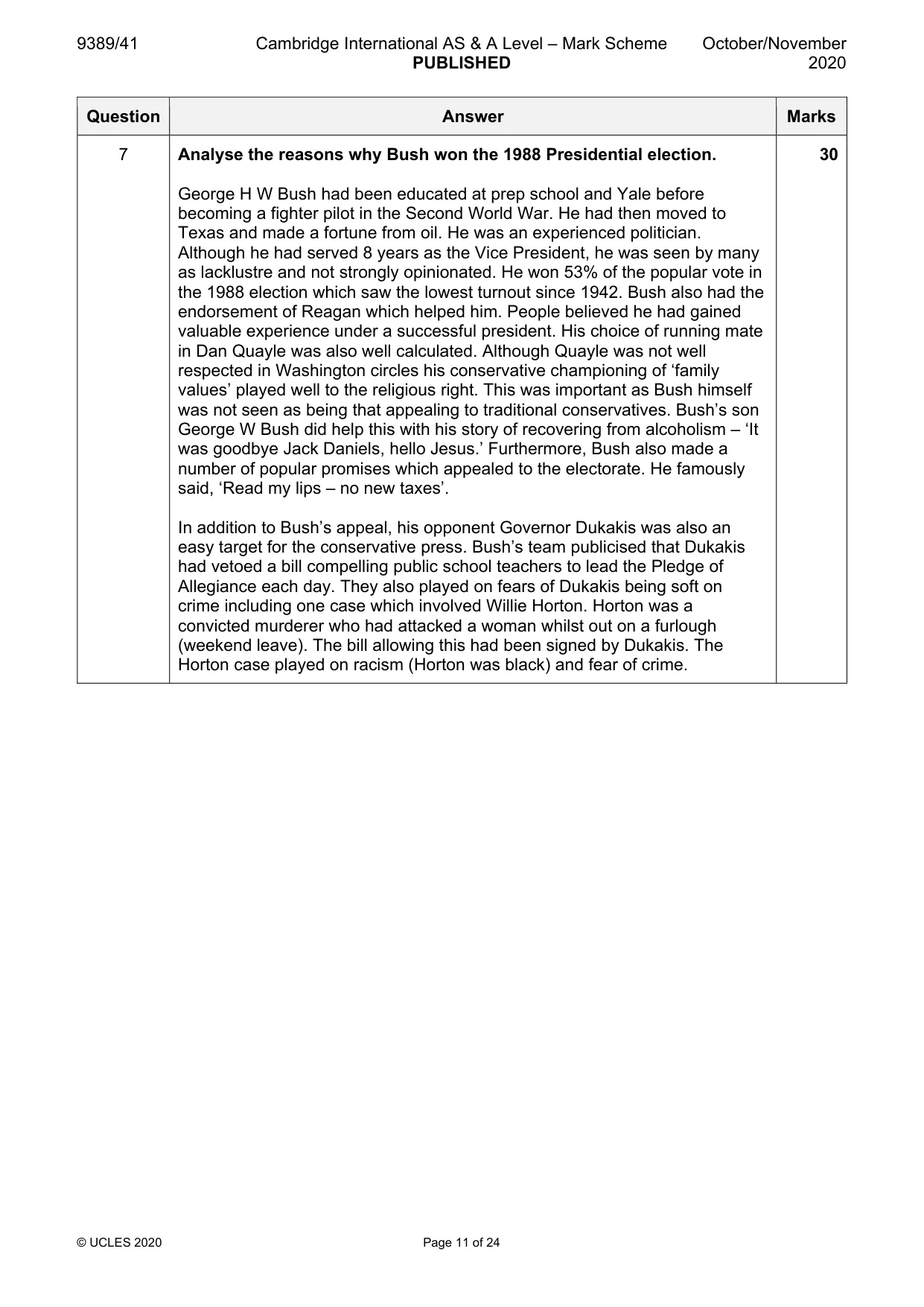
Mark scheme: 7 Analyse the reasons why Bush won the 1988 Presidential election. 30 George H W Bush had been educated at prep school and Yale before becoming a fighter pilot in the Second World War. He had then moved to Texas and made a fortune from oil. He was an experienced politician. Although he had served 8 years as the Vice President, he was seen by many as lacklustre and not strongly opinionated. He won 53% of the popular vote in the 1988 election which saw the lowest turnout since 1942. Bush also had the endorsement of Reagan which helped him. People believed he had gained valuable experience under a successful president. His choice of running mate in Dan Quayle was also well calculated. Although Quayle was not well respected in Washington circles his conservative championing of ‘family values’ played well to the religious right. This was important as Bush himself was not seen as being that appealing to traditional conservatives. Bush’s son George W Bush did help this with his story of recovering from alcoholism – ‘It was goodbye Jack Daniels, hello Jesus.’ Furthermore, Bush also made a number of popular promises which appealed to the electorate. He famously said, ‘Read my lips – no new taxes’. In addition to Bush’s appeal, his opponent Governor Dukakis was also an easy target for the conservative press. Bush’s team publicised that Dukakis had vetoed a bill compelling public school teachers to lead the Pledge of Allegiance each day. They also played on fears of Dukakis being soft on crime including one case which involved Willie Horton. Horton was a convicted murderer who had attacked a woman whilst out on a furlough (weekend leave). The bill allowing this had been signed by Dukakis. The Horton case played on racism (Horton was black) and fear of crime.
Q8 · Assess the impact of Kennan’s Long Telegram on US foreign policy in the period from 1946…
8 Assess the impact of Kennan’s Long Telegram on US foreign policy in the period from 1946 to 1950. [30] Depth Study 3: International History, 1945–1991 Answer any two questions.
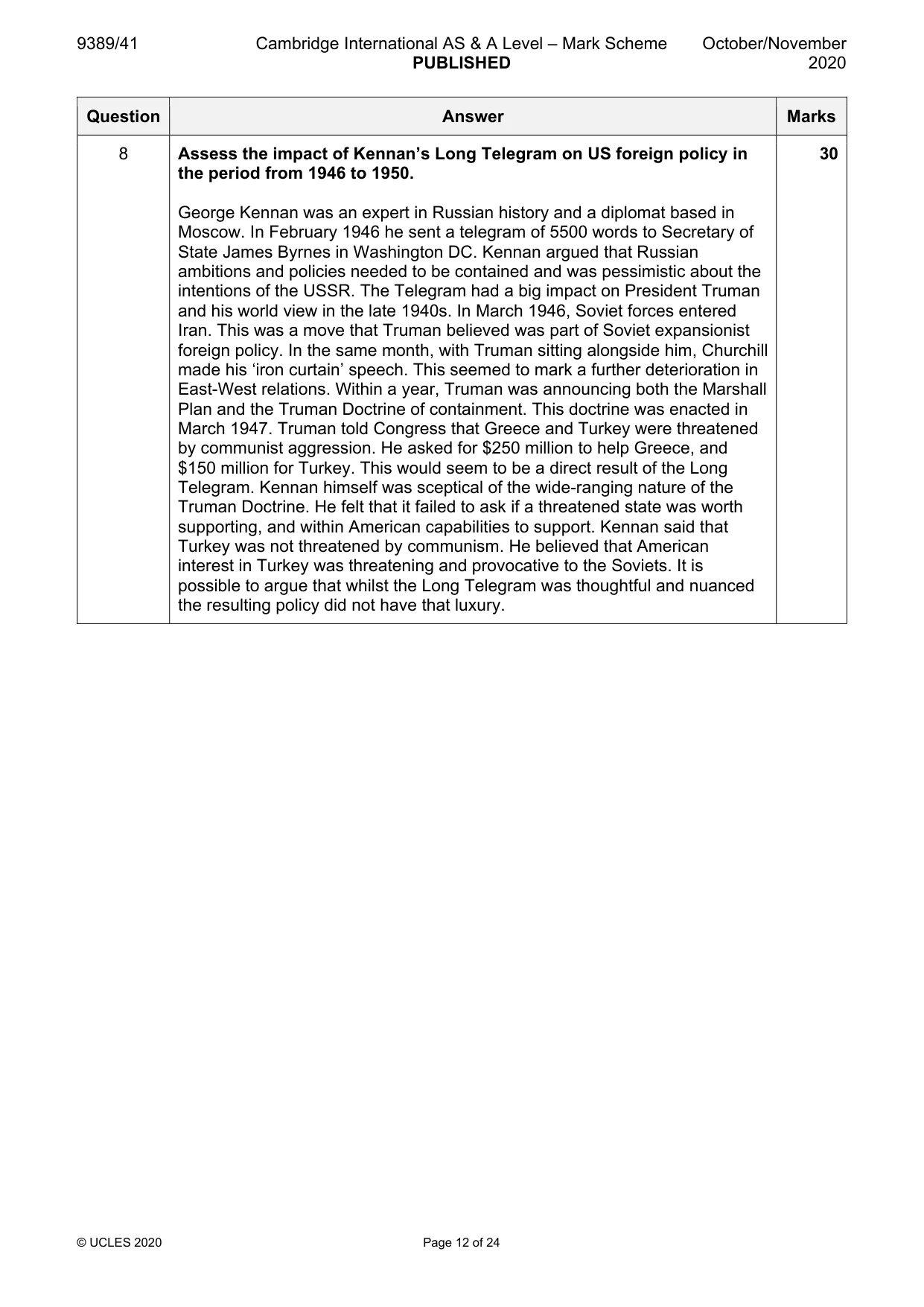
Mark scheme: 8 Assess the impact of Kennan’s Long Telegram on US foreign policy in 30 the period from 1946 to 1950. George Kennan was an expert in Russian history and a diplomat based in Moscow. In February 1946 he sent a telegram of 5500 words to Secretary of State James Byrnes in Washington DC. Kennan argued that Russian ambitions and policies needed to be contained and was pessimistic about the intentions of the USSR. The Telegram had a big impact on President Truman and his world view in the late 1940s. In March 1946, Soviet forces entered Iran. This was a move that Truman believed was part of Soviet expansionist foreign policy. In the same month, with Truman sitting alongside him, Churchill made his ‘iron curtain’ speech. This seemed to mark a further deterioration in East-West relations. Within a year, Truman was announcing both the Marshall Plan and the Truman Doctrine of containment. This doctrine was enacted in March 1947. Truman told Congress that Greece and Turkey were threatened by communist aggression. He asked for $250 million to help Greece, and $150 million for Turkey. This would seem to be a direct result of the Long Telegram. Kennan himself was sceptical of the wide-ranging nature of the Truman Doctrine. He felt that it failed to ask if a threatened state was worth supporting, and within American capabilities to support. Kennan said that Turkey was not threatened by communism. He believed that American interest in Turkey was threatening and provocative to the Soviets. It is possible to argue that whilst the Long Telegram was thoughtful and nuanced the resulting policy did not have that luxury.
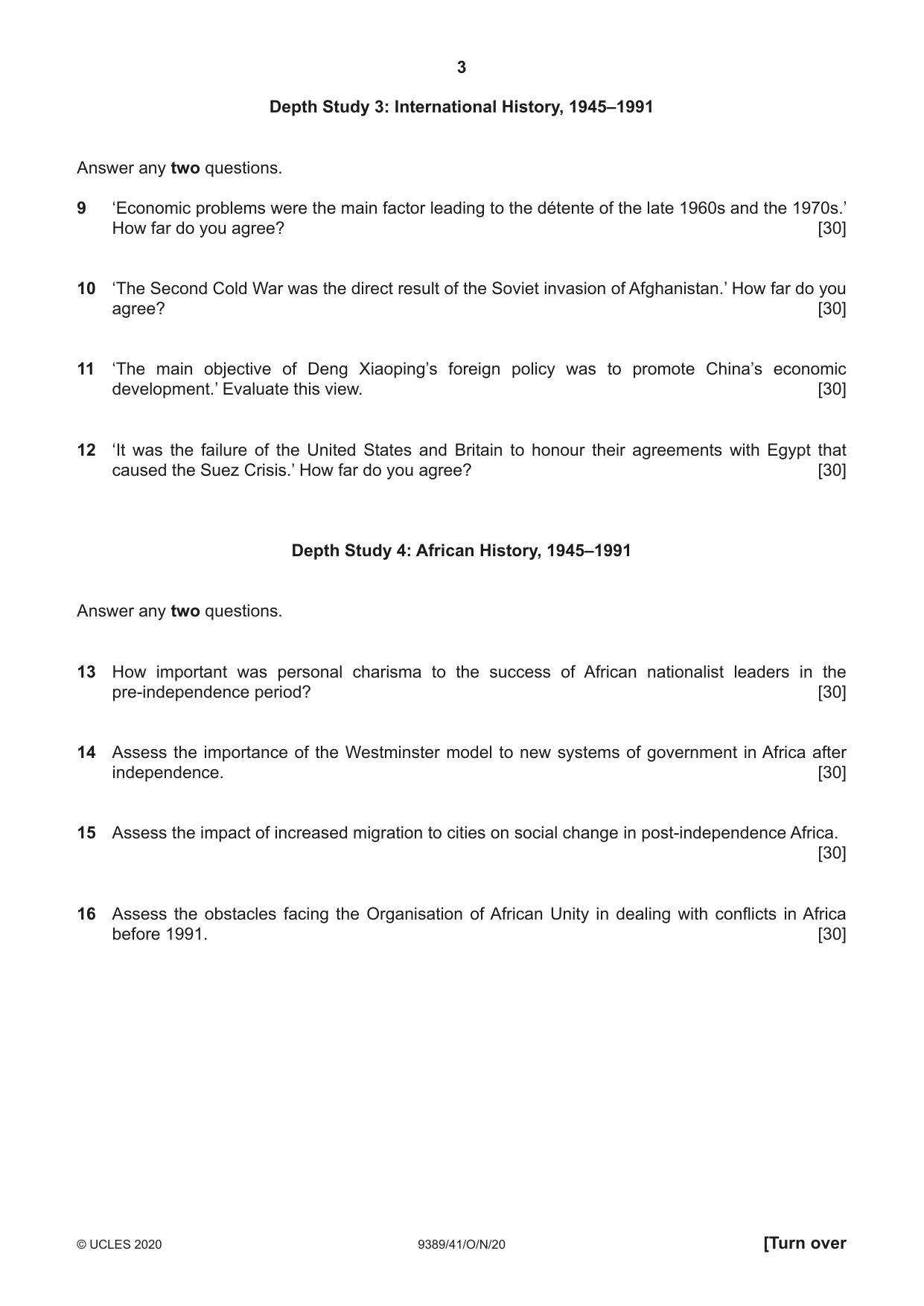
Q9 · ‘Economic problems were the main factor leading to the détente of the late 1960s and the…
9 ‘Economic problems were the main factor leading to the détente of the late 1960s and the 1970s.’ How far do you agree? [30]
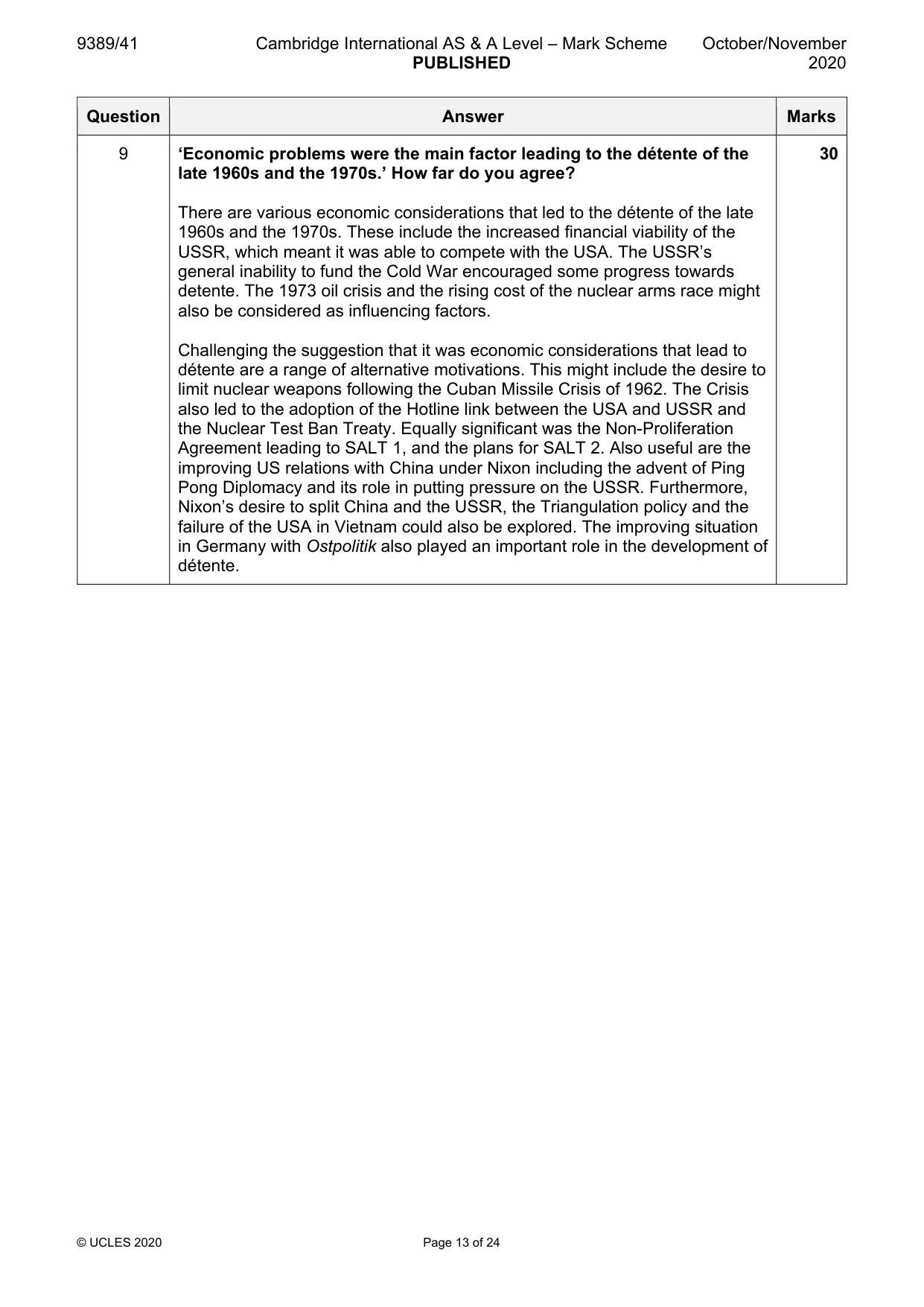
Mark scheme: 9 ‘Economic problems were the main factor leading to the détente of the 30 late 1960s and the 1970s.’ How far do you agree? There are various economic considerations that led to the détente of the late 1960s and the 1970s. These include the increased financial viability of the USSR, which meant it was able to compete with the USA. The USSR’s general inability to fund the Cold War encouraged some progress towards detente. The 1973 oil crisis and the rising cost of the nuclear arms race might also be considered as influencing factors. Challenging the suggestion that it was economic considerations that lead to détente are a range of alternative motivations. This might include the desire to limit nuclear weapons following the Cuban Missile Crisis of 1962. The Crisis also led to the adoption of the Hotline link between the USA and USSR and the Nuclear Test Ban Treaty. Equally significant was the Non-Proliferation Agreement leading to SALT 1, and the plans for SALT 2. Also useful are the improving US relations with China under Nixon including the advent of Ping Pong Diplomacy and its role in putting pressure on the USSR. Furthermore, Nixon’s desire to split China and the USSR, the Triangulation policy and the failure of the USA in Vietnam could also be explored. The improving situation in Germany with Ostpolitik also played an important role in the development of détente.
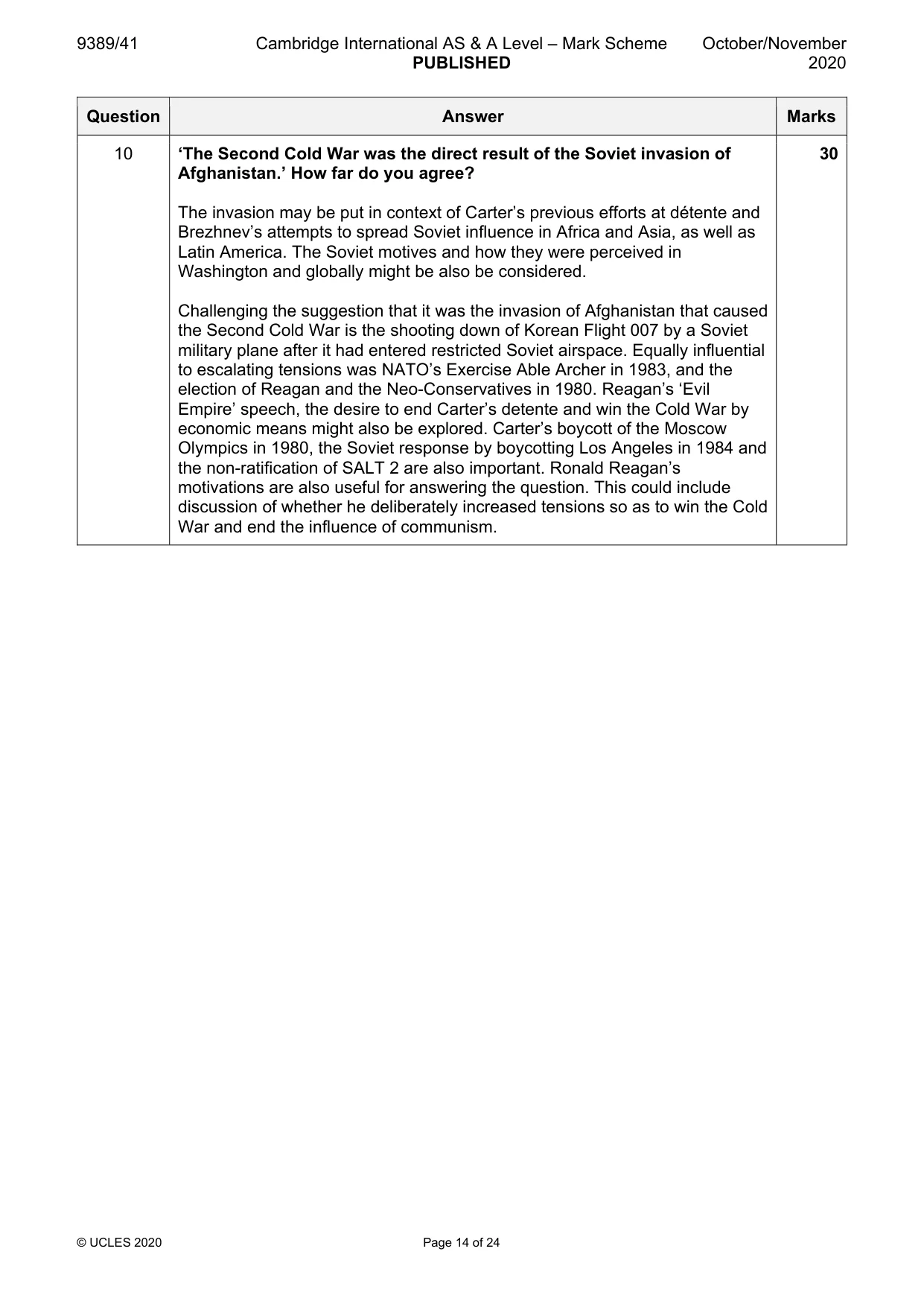
Q10 · ‘The Second Cold War was the direct result of the Soviet invasion of Afghanistan.’ How…
10 ‘The Second Cold War was the direct result of the Soviet invasion of Afghanistan.’ How far do you agree? [30]
Mark scheme: 10 ‘The Second Cold War was the direct result of the Soviet invasion of 30 Afghanistan.’ How far do you agree? The invasion may be put in context of Carter’s previous efforts at détente and Brezhnev’s attempts to spread Soviet influence in Africa and Asia, as well as Latin America. The Soviet motives and how they were perceived in Washington and globally might be also be considered. Challenging the suggestion that it was the invasion of Afghanistan that caused the Second Cold War is the shooting down of Korean Flight 007 by a Soviet military plane after it had entered restricted Soviet airspace. Equally influential to escalating tensions was NATO’s Exercise Able Archer in 1983, and the election of Reagan and the Neo-Conservatives in 1980. Reagan’s ‘Evil Empire’ speech, the desire to end Carter’s detente and win the Cold War by economic means might also be explored. Carter’s boycott of the Moscow Olympics in 1980, the Soviet response by boycotting Los Angeles in 1984 and the non-ratification of SALT 2 are also important. Ronald Reagan’s motivations are also useful for answering the question. This could include discussion of whether he deliberately increased tensions so as to win the Cold War and end the influence of communism.
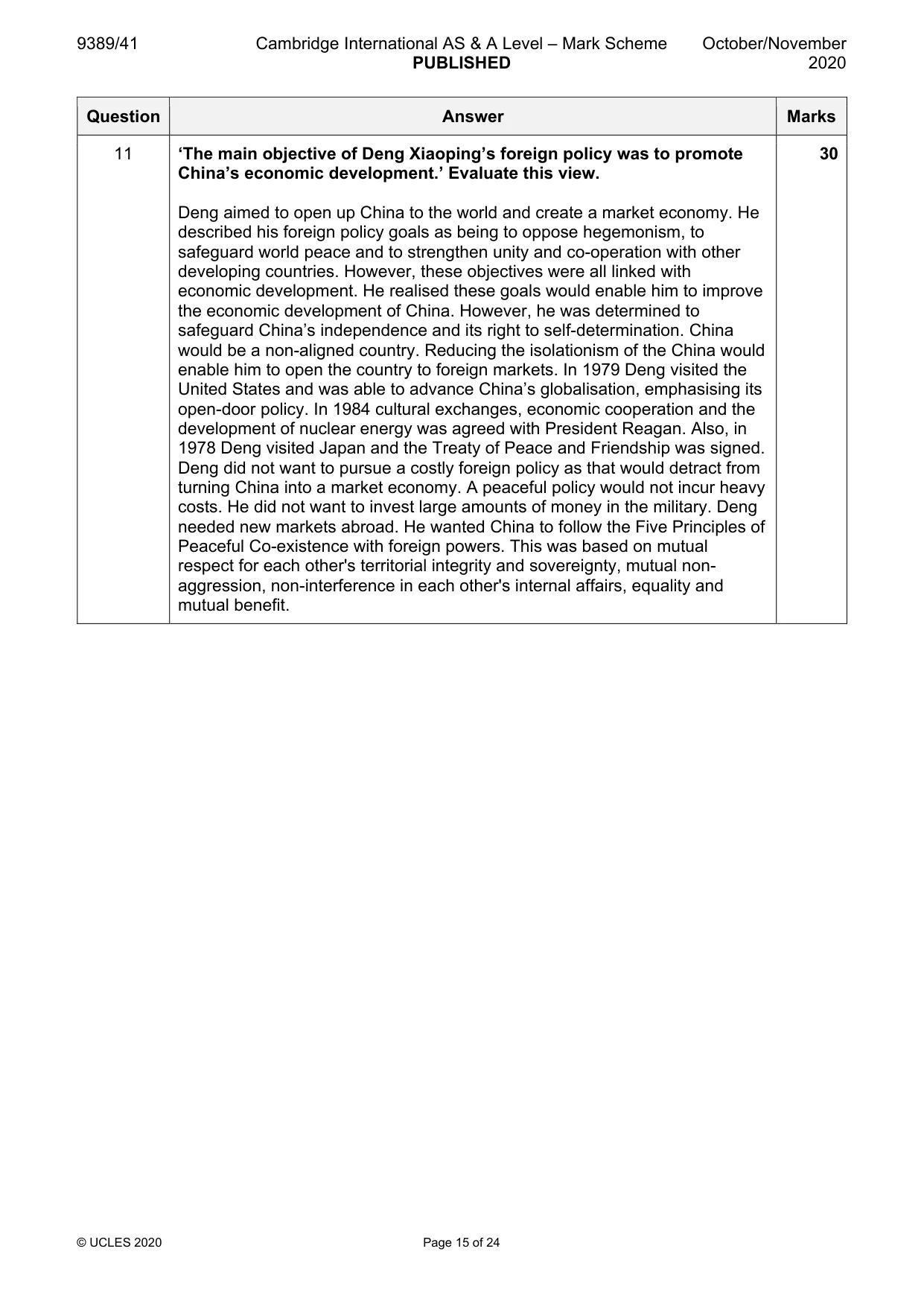
Q11 · ‘The main objective of Deng Xiaoping’s foreign policy was to promote China’s economic…
11 ‘The main objective of Deng Xiaoping’s foreign policy was to promote China’s economic development.’ Evaluate this view. [30]
Mark scheme: 11 ‘The main objective of Deng Xiaoping’s foreign policy was to promote 30 China’s economic development.’ Evaluate this view. Deng aimed to open up China to the world and create a market economy. He described his foreign policy goals as being to oppose hegemonism, to safeguard world peace and to strengthen unity and co-operation with other developing countries. However, these objectives were all linked with economic development. He realised these goals would enable him to improve the economic development of China. However, he was determined to safeguard China’s independence and its right to self-determination. China would be a non-aligned country. Reducing the isolationism of the China would enable him to open the country to foreign markets. In 1979 Deng visited the United States and was able to advance China’s globalisation, emphasising its open-door policy. In 1984 cultural exchanges, economic cooperation and the development of nuclear energy was agreed with President Reagan. Also, in 1978 Deng visited Japan and the Treaty of Peace and Friendship was signed. Deng did not want to pursue a costly foreign policy as that would detract from turning China into a market economy. A peaceful policy would not incur heavy costs. He did not want to invest large amounts of money in the military. Deng needed new markets abroad. He wanted China to follow the Five Principles of Peaceful Co-existence with foreign powers. This was based on mutual respect for each other's territorial integrity and sovereignty, mutual non- aggression, non-interference in each other's internal affairs, equality and mutual benefit.
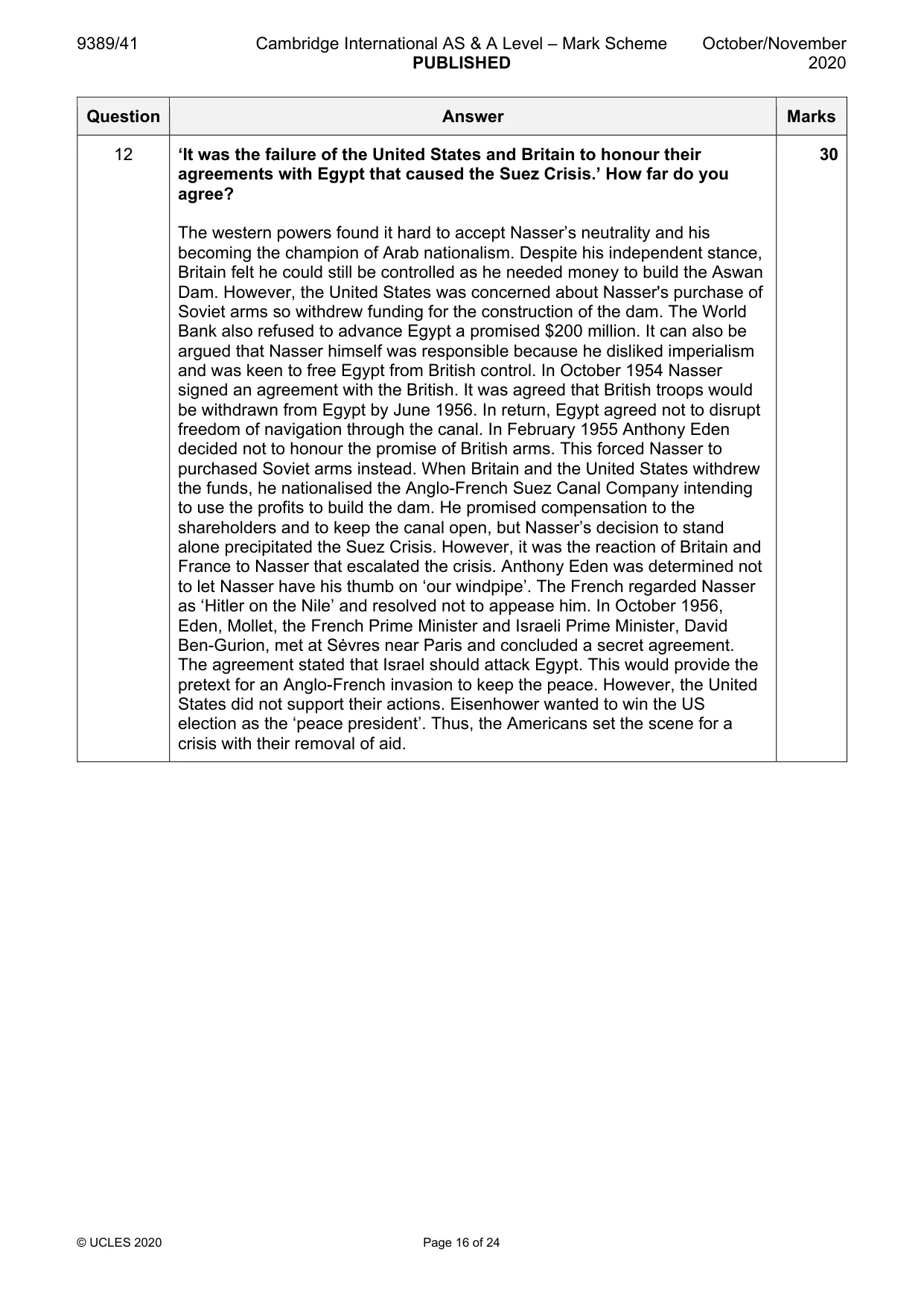
Q12 · ‘It was the failure of the United States and Britain to honour their agreements with…
12 ‘It was the failure of the United States and Britain to honour their agreements with Egypt that caused the Suez Crisis.’ How far do you agree? [30] Depth Study 4: African History, 1945–1991 Answer any two questions.
Mark scheme: 12 ‘It was the failure of the United States and Britain to honour their 30 agreements with Egypt that caused the Suez Crisis.’ How far do you agree? The western powers found it hard to accept Nasser’s neutrality and his becoming the champion of Arab nationalism. Despite his independent stance, Britain felt he could still be controlled as he needed money to build the Aswan Dam. However, the United States was concerned about Nasser's purchase of Soviet arms so withdrew funding for the construction of the dam. The World Bank also refused to advance Egypt a promised $200 million. It can also be argued that Nasser himself was responsible because he disliked imperialism and was keen to free Egypt from British control. In October 1954 Nasser signed an agreement with the British. It was agreed that British troops would be withdrawn from Egypt by June 1956. In return, Egypt agreed not to disrupt freedom of navigation through the canal. In February 1955 Anthony Eden decided not to honour the promise of British arms. This forced Nasser to purchased Soviet arms instead. When Britain and the United States withdrew the funds, he nationalised the Anglo-French Suez Canal Company intending to use the profits to build the dam. He promised compensation to the shareholders and to keep the canal open, but Nasser’s decision to stand alone precipitated the Suez Crisis. However, it was the reaction of Britain and France to Nasser that escalated the crisis. Anthony Eden was determined not to let Nasser have his thumb on ‘our windpipe’. The French regarded Nasser as ‘Hitler on the Nile’ and resolved not to appease him. In October 1956, Eden, Mollet, the French Prime Minister and Israeli Prime Minister, David Ben-Gurion, met at Sėvres near Paris and concluded a secret agreement. The agreement stated that Israel should attack Egypt. This would provide the pretext for an Anglo-French invasion to keep the peace. However, the United States did not support their actions. Eisenhower wanted to win the US election as the ‘peace president’. Thus, the Americans set the scene for a crisis with their removal of aid.
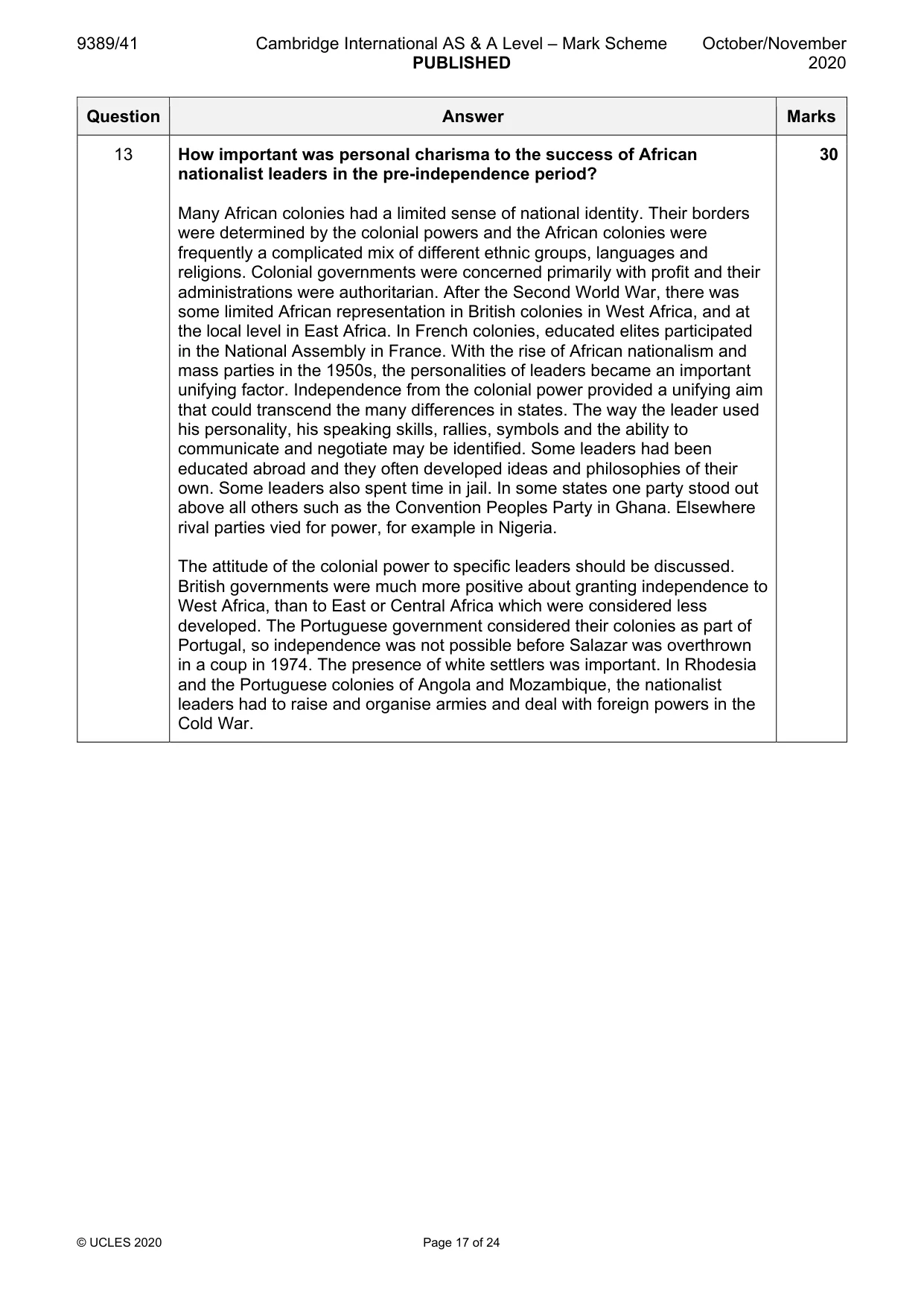
Q13 · How important was personal charisma to the success of African nationalist leaders in the…
13 How important was personal charisma to the success of African nationalist leaders in the pre‑independence period? [30]
Mark scheme: 13 How important was personal charisma to the success of African 30 nationalist leaders in the pre-independence period? Many African colonies had a limited sense of national identity. Their borders were determined by the colonial powers and the African colonies were frequently a complicated mix of different ethnic groups, languages and religions. Colonial governments were concerned primarily with profit and their administrations were authoritarian. After the Second World War, there was some limited African representation in British colonies in West Africa, and at the local level in East Africa. In French colonies, educated elites participated in the National Assembly in France. With the rise of African nationalism and mass parties in the 1950s, the personalities of leaders became an important unifying factor. Independence from the colonial power provided a unifying aim that could transcend the many differences in states. The way the leader used his personality, his speaking skills, rallies, symbols and the ability to communicate and negotiate may be identified. Some leaders had been educated abroad and they often developed ideas and philosophies of their own. Some leaders also spent time in jail. In some states one party stood out above all others such as the Convention Peoples Party in Ghana. Elsewhere rival parties vied for power, for example in Nigeria. The attitude of the colonial power to specific leaders should be discussed. British governments were much more positive about granting independence to West Africa, than to East or Central Africa which were considered less developed. The Portuguese government considered their colonies as part of Portugal, so independence was not possible before Salazar was overthrown in a coup in 1974. The presence of white settlers was important. In Rhodesia and the Portuguese colonies of Angola and Mozambique, the nationalist leaders had to raise and organise armies and deal with foreign powers in the Cold War.
Q14 · Assess the importance of the Westminster model to new systems of government in Africa…
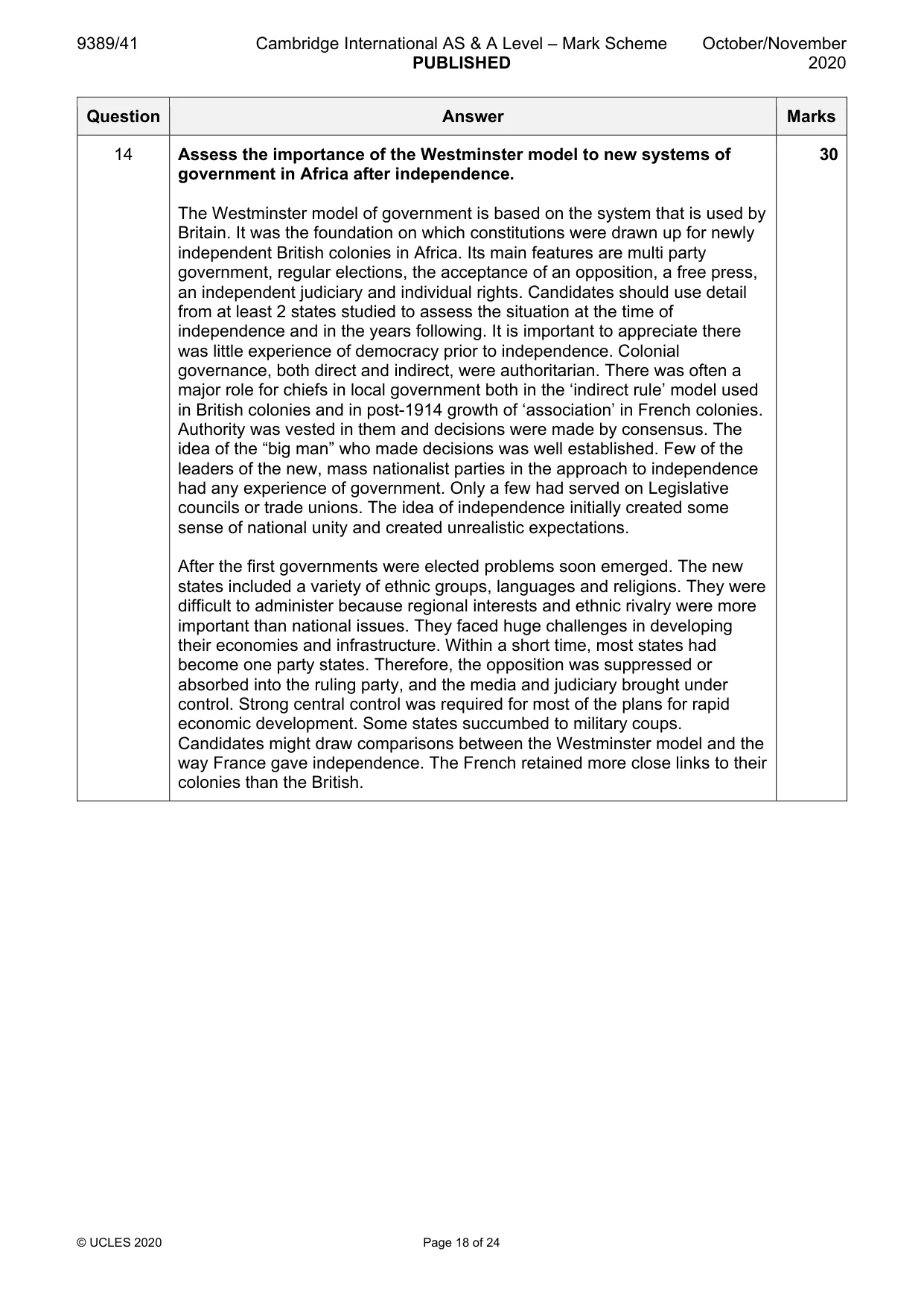
14 Assess the importance of the Westminster model to new systems of government in Africa after independence. [30]
Mark scheme: 14 Assess the importance of the Westminster model to new systems of 30 government in Africa after independence. The Westminster model of government is based on the system that is used by Britain. It was the foundation on which constitutions were drawn up for newly independent British colonies in Africa. Its main features are multi party government, regular elections, the acceptance of an opposition, a free press, an independent judiciary and individual rights. Candidates should use detail from at least 2 states studied to assess the situation at the time of independence and in the years following. It is important to appreciate there was little experience of democracy prior to independence. Colonial governance, both direct and indirect, were authoritarian. There was often a major role for chiefs in local government both in the ‘indirect rule’ model used in British colonies and in post-1914 growth of ‘association’ in French colonies. Authority was vested in them and decisions were made by consensus. The idea of the “big man” who made decisions was well established. Few of the leaders of the new, mass nationalist parties in the approach to independence had any experience of government. Only a few had served on Legislative councils or trade unions. The idea of independence initially created some sense of national unity and created unrealistic expectations. After the first governments were elected problems soon emerged. The new states included a variety of ethnic groups, languages and religions. They were difficult to administer because regional interests and ethnic rivalry were more important than national issues. They faced huge challenges in developing their economies and infrastructure. Within a short time, most states had become one party states. Therefore, the opposition was suppressed or absorbed into the ruling party, and the media and judiciary brought under control. Strong central control was required for most of the plans for rapid economic development. Some states succumbed to military coups. Candidates might draw comparisons between the Westminster model and the way France gave independence. The French retained more close links to their colonies than the British.
Q15 · Assess the impact of increased migration to cities on social change in post‑independence…
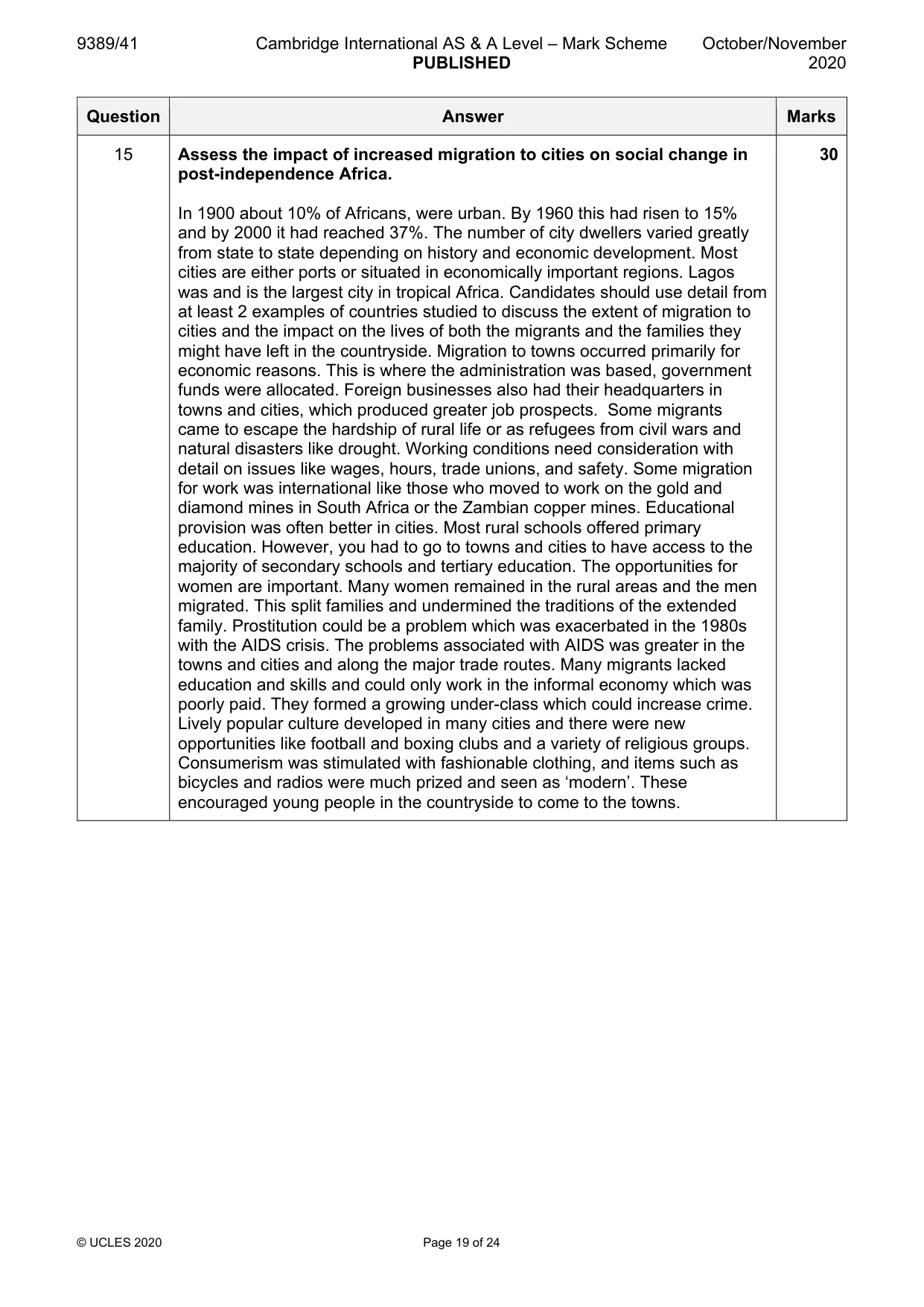
15 Assess the impact of increased migration to cities on social change in post‑independence Africa. [30]
Mark scheme: 15 Assess the impact of increased migration to cities on social change in 30 post-independence Africa. In 1900 about 10% of Africans, were urban. By 1960 this had risen to 15% and by 2000 it had reached 37%. The number of city dwellers varied greatly from state to state depending on history and economic development. Most cities are either ports or situated in economically important regions. Lagos was and is the largest city in tropical Africa. Candidates should use detail from at least 2 examples of countries studied to discuss the extent of migration to cities and the impact on the lives of both the migrants and the families they might have left in the countryside. Migration to towns occurred primarily for economic reasons. This is where the administration was based, government funds were allocated. Foreign businesses also had their headquarters in towns and cities, which produced greater job prospects. Some migrants came to escape the hardship of rural life or as refugees from civil wars and natural disasters like drought. Working conditions need consideration with detail on issues like wages, hours, trade unions, and safety. Some migration for work was international like those who moved to work on the gold and diamond mines in South Africa or the Zambian copper mines. Educational provision was often better in cities. Most rural schools offered primary education. However, you had to go to towns and cities to have access to the majority of secondary schools and tertiary education. The opportunities for women are important. Many women remained in the rural areas and the men migrated. This split families and undermined the traditions of the extended family. Prostitution could be a problem which was exacerbated in the 1980s with the AIDS crisis. The problems associated with AIDS was greater in the towns and cities and along the major trade routes. Many migrants lacked education and skills and could only work in the informal economy which was poorly paid. They formed a growing under-class which could increase crime. Lively popular culture developed in many cities and there were new opportunities like football and boxing clubs and a variety of religious groups. Consumerism was stimulated with fashionable clothing, and items such as bicycles and radios were much prized and seen as ‘modern’. These encouraged young people in the countryside to come to the towns.
Q16 · Assess the obstacles facing the Organisation of African Unity in dealing with conflicts…
16 Assess the obstacles facing the Organisation of African Unity in dealing with conflicts in Africa before 1991. [30] Depth Study 5: Southeast Asian History, 1945–1990s Answer any two questions.
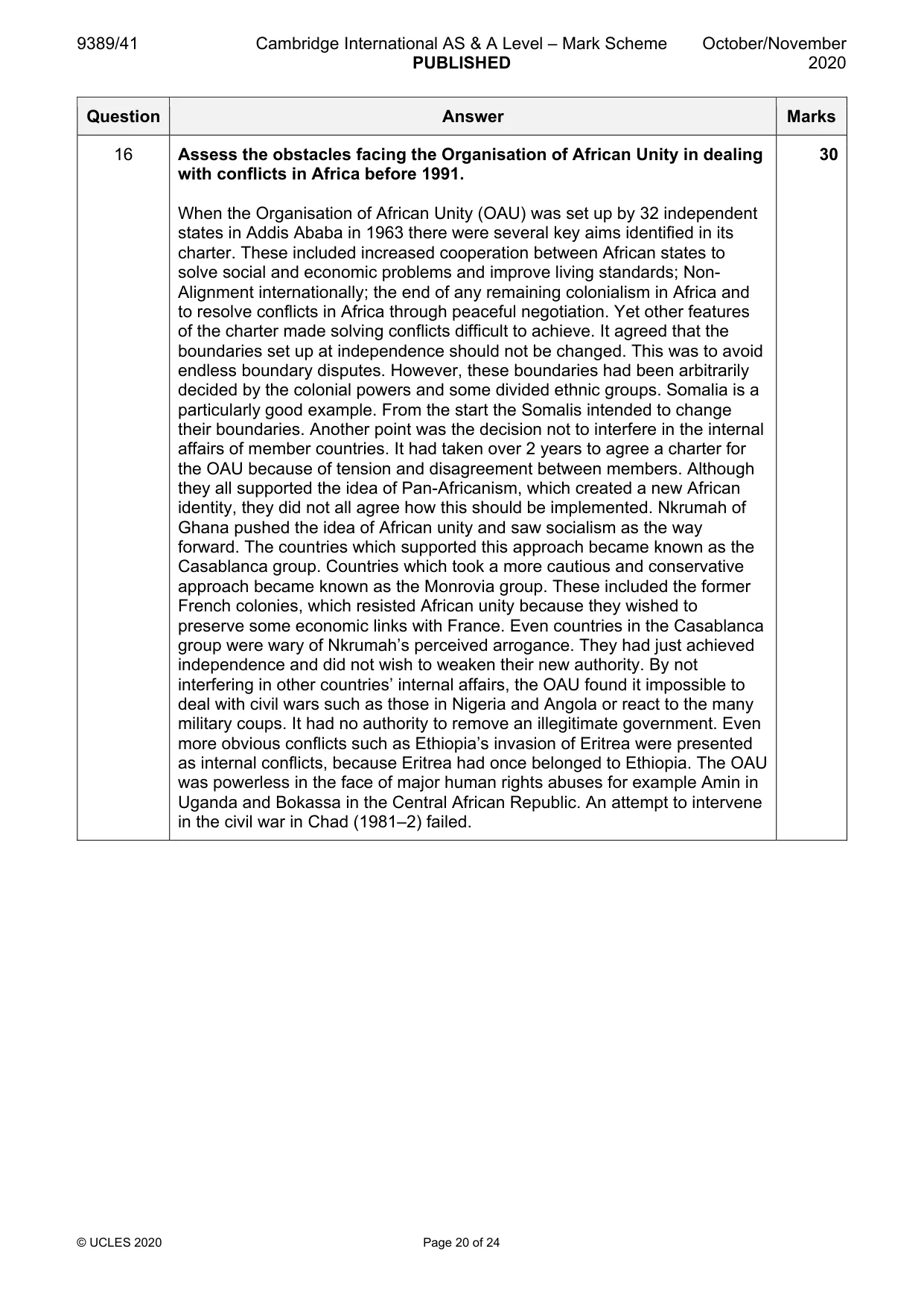
Mark scheme: 16 Assess the obstacles facing the Organisation of African Unity in dealing 30 with conflicts in Africa before 1991. When the Organisation of African Unity (OAU) was set up by 32 independent states in Addis Ababa in 1963 there were several key aims identified in its charter. These included increased cooperation between African states to solve social and economic problems and improve living standards; Non- Alignment internationally; the end of any remaining colonialism in Africa and to resolve conflicts in Africa through peaceful negotiation. Yet other features of the charter made solving conflicts difficult to achieve. It agreed that the boundaries set up at independence should not be changed. This was to avoid endless boundary disputes. However, these boundaries had been arbitrarily decided by the colonial powers and some divided ethnic groups. Somalia is a particularly good example. From the start the Somalis intended to change their boundaries. Another point was the decision not to interfere in the internal affairs of member countries. It had taken over 2 years to agree a charter for the OAU because of tension and disagreement between members. Although they all supported the idea of Pan-Africanism, which created a new African identity, they did not all agree how this should be implemented. Nkrumah of Ghana pushed the idea of African unity and saw socialism as the way forward. The countries which supported this approach became known as the Casablanca group. Countries which took a more cautious and conservative approach became known as the Monrovia group. These included the former French colonies, which resisted African unity because they wished to preserve some economic links with France. Even countries in the Casablanca group were wary of Nkrumah’s perceived arrogance. They had just achieved independence and did not wish to weaken their new authority. By not interfering in other countries’ internal affairs, the OAU found it impossible to deal with civil wars such as those in Nigeria and Angola or react to the many military coups. It had no authority to remove an illegitimate government. Even more obvious conflicts such as Ethiopia’s invasion of Eritrea were presented as internal conflicts, because Eritrea had once belonged to Ethiopia. The OAU was powerless in the face of major human rights abuses for example Amin in Uganda and Bokassa in the Central African Republic. An attempt to intervene in the civil war in Chad (1981–2) failed.
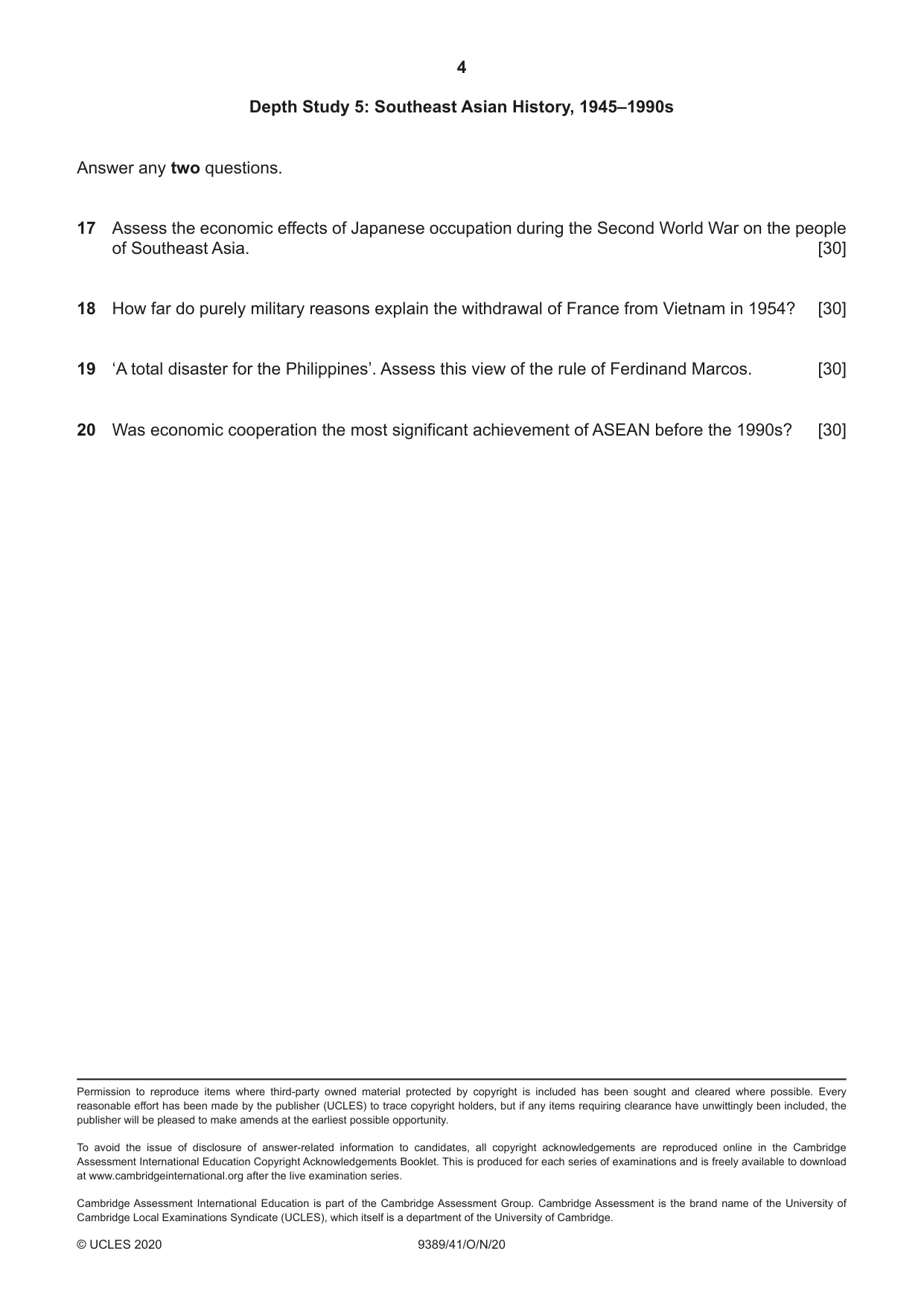
Q17 · Assess the economic effects of Japanese occupation during the Second World War on the…
17 Assess the economic effects of Japanese occupation during the Second World War on the people of Southeast Asia. [30]
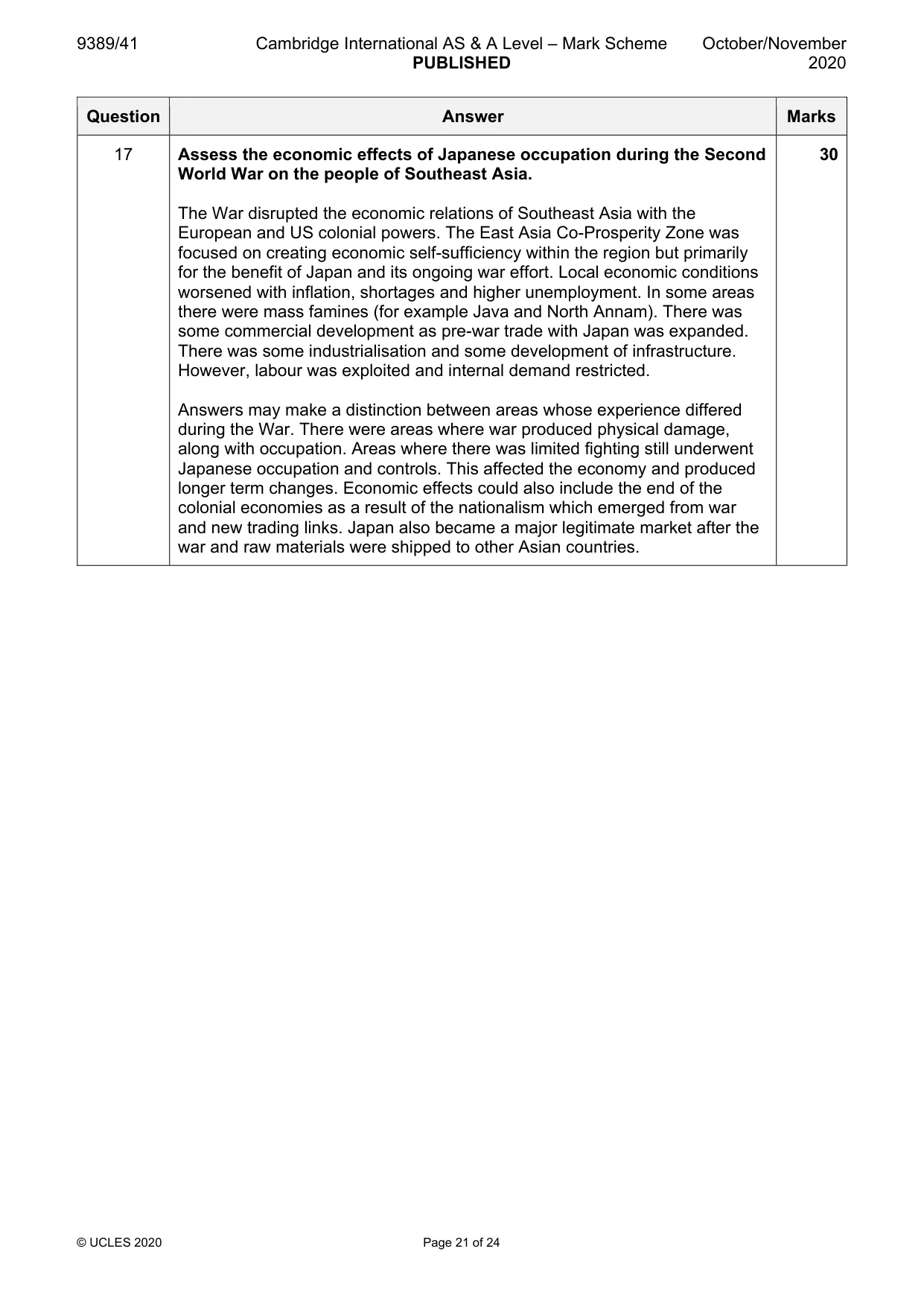
Mark scheme: 17 Assess the economic effects of Japanese occupation during the Second 30 World War on the people of Southeast Asia. The War disrupted the economic relations of Southeast Asia with the European and US colonial powers. The East Asia Co-Prosperity Zone was focused on creating economic self-sufficiency within the region but primarily for the benefit of Japan and its ongoing war effort. Local economic conditions worsened with inflation, shortages and higher unemployment. In some areas there were mass famines (for example Java and North Annam). There was some commercial development as pre-war trade with Japan was expanded. There was some industrialisation and some development of infrastructure. However, labour was exploited and internal demand restricted. Answers may make a distinction between areas whose experience differed during the War. There were areas where war produced physical damage, along with occupation. Areas where there was limited fighting still underwent Japanese occupation and controls. This affected the economy and produced longer term changes. Economic effects could also include the end of the colonial economies as a result of the nationalism which emerged from war and new trading links. Japan also became a major legitimate market after the war and raw materials were shipped to other Asian countries.
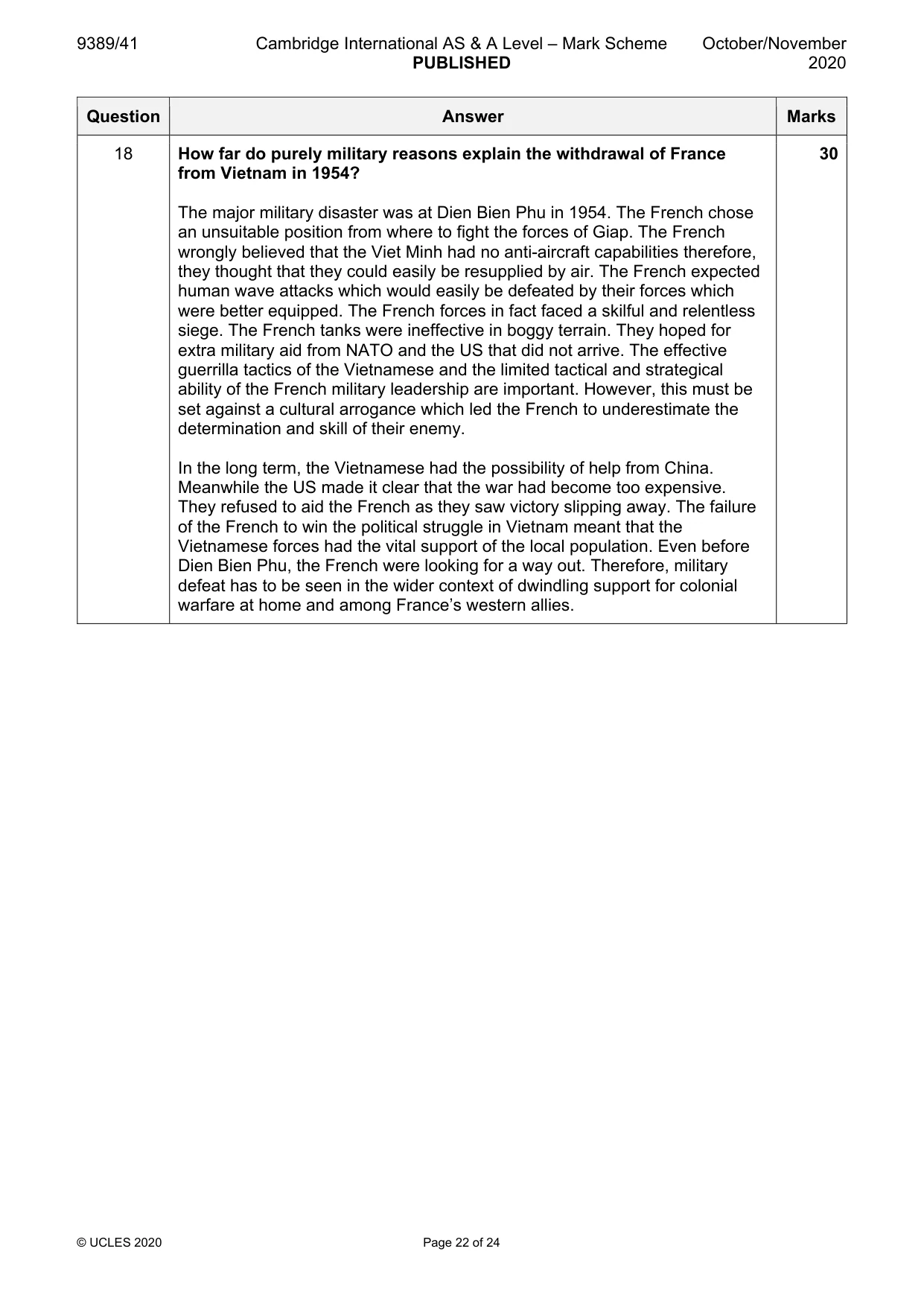
Q18 · How far do purely military reasons explain the withdrawal of France from Vietnam in 1954?
18 How far do purely military reasons explain the withdrawal of France from Vietnam in 1954? [30]
Mark scheme: 18 How far do purely military reasons explain the withdrawal of France 30 from Vietnam in 1954? The major military disaster was at Dien Bien Phu in 1954. The French chose an unsuitable position from where to fight the forces of Giap. The French wrongly believed that the Viet Minh had no anti-aircraft capabilities therefore, they thought that they could easily be resupplied by air. The French expected human wave attacks which would easily be defeated by their forces which were better equipped. The French forces in fact faced a skilful and relentless siege. The French tanks were ineffective in boggy terrain. They hoped for extra military aid from NATO and the US that did not arrive. The effective guerrilla tactics of the Vietnamese and the limited tactical and strategical ability of the French military leadership are important. However, this must be set against a cultural arrogance which led the French to underestimate the determination and skill of their enemy. In the long term, the Vietnamese had the possibility of help from China. Meanwhile the US made it clear that the war had become too expensive. They refused to aid the French as they saw victory slipping away. The failure of the French to win the political struggle in Vietnam meant that the Vietnamese forces had the vital support of the local population. Even before Dien Bien Phu, the French were looking for a way out. Therefore, military defeat has to be seen in the wider context of dwindling support for colonial warfare at home and among France’s western allies.
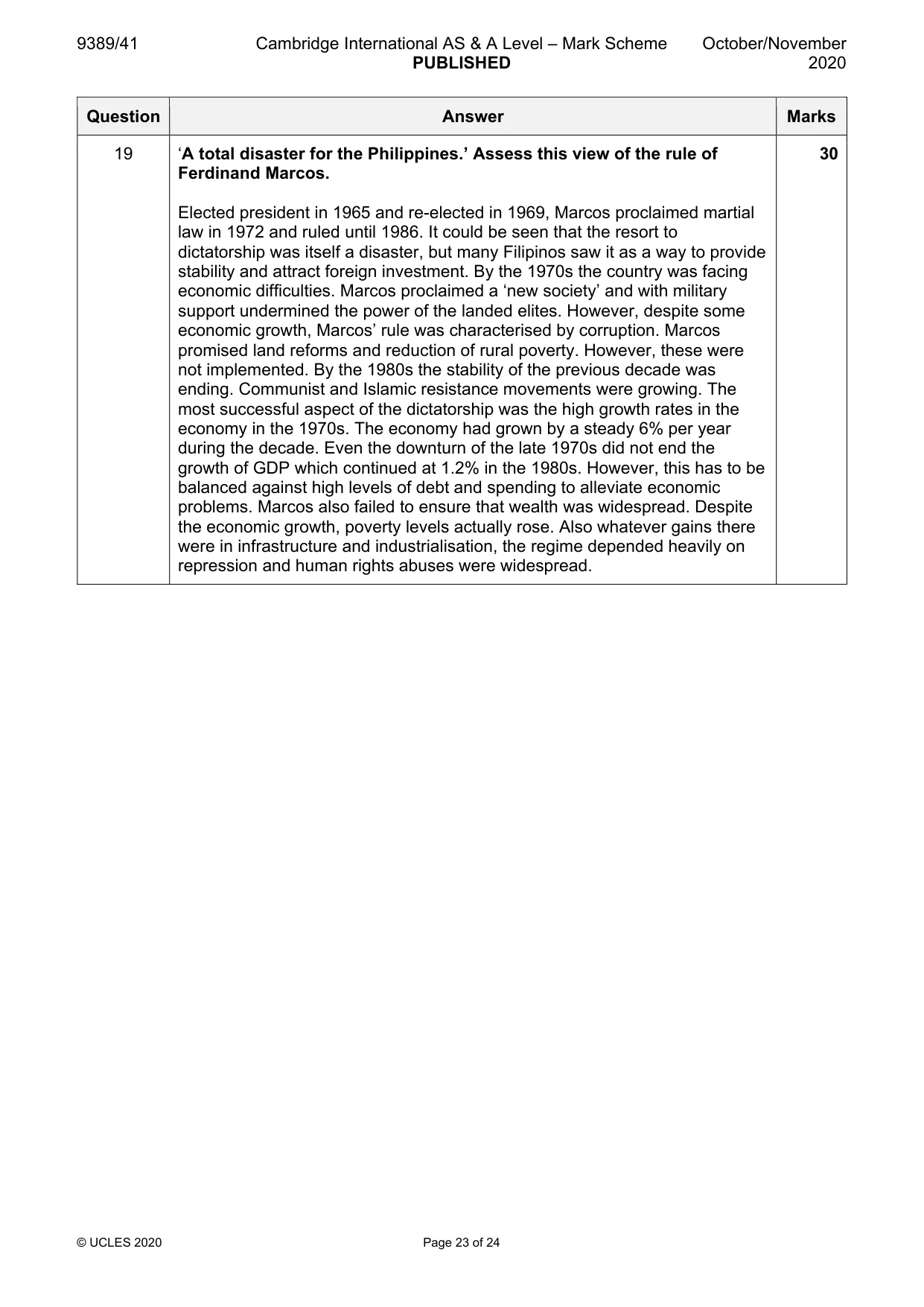
Q19 · ‘A total disaster for the Philippines’
19 ‘A total disaster for the Philippines’. Assess this view of the rule of Ferdinand Marcos. [30]
Mark scheme: 19 ‘A total disaster for the Philippines.’ Assess this view of the rule of 30 Ferdinand Marcos. Elected president in 1965 and re-elected in 1969, Marcos proclaimed martial law in 1972 and ruled until 1986. It could be seen that the resort to dictatorship was itself a disaster, but many Filipinos saw it as a way to provide stability and attract foreign investment. By the 1970s the country was facing economic difficulties. Marcos proclaimed a ‘new society’ and with military support undermined the power of the landed elites. However, despite some economic growth, Marcos’ rule was characterised by corruption. Marcos promised land reforms and reduction of rural poverty. However, these were not implemented. By the 1980s the stability of the previous decade was ending. Communist and Islamic resistance movements were growing. The most successful aspect of the dictatorship was the high growth rates in the economy in the 1970s. The economy had grown by a steady 6% per year during the decade. Even the downturn of the late 1970s did not end the growth of GDP which continued at 1.2% in the 1980s. However, this has to be balanced against high levels of debt and spending to alleviate economic problems. Marcos also failed to ensure that wealth was widespread. Despite the economic growth, poverty levels actually rose. Also whatever gains there were in infrastructure and industrialisation, the regime depended heavily on repression and human rights abuses were widespread.
What you needed in this session
Cambridge’s own grade thresholds for 2020 Oct/Nov, Paper 4 · Variant 1. A higher threshold means an easier paper — the bar moves with how the cohort did.