Cambridge A Level History 9389 — 2020 Oct/Nov Paper 3 · Variant 1
9389/31/O/N/20 · 3 questions · 40 marks · ≈45 min
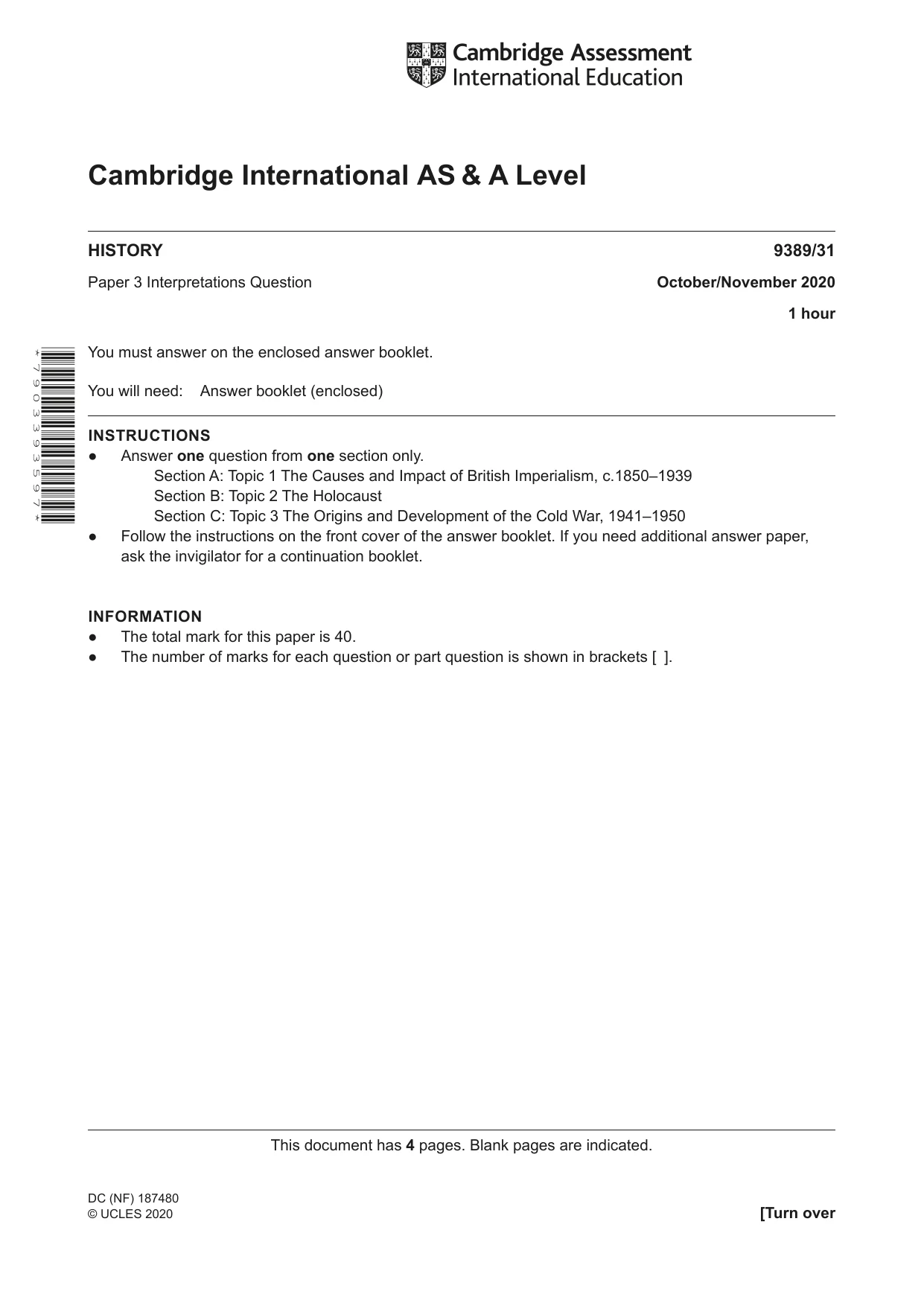
The question paper and its mark scheme, free to read here and free to download. This is Cambridge’s own paper, exactly as it was sat.
Question paper4 pages
Mark scheme7 pages
Answers below. Sit the paper first if you are practising.
Questions as text
Q1 · Read the extract and then answer the question
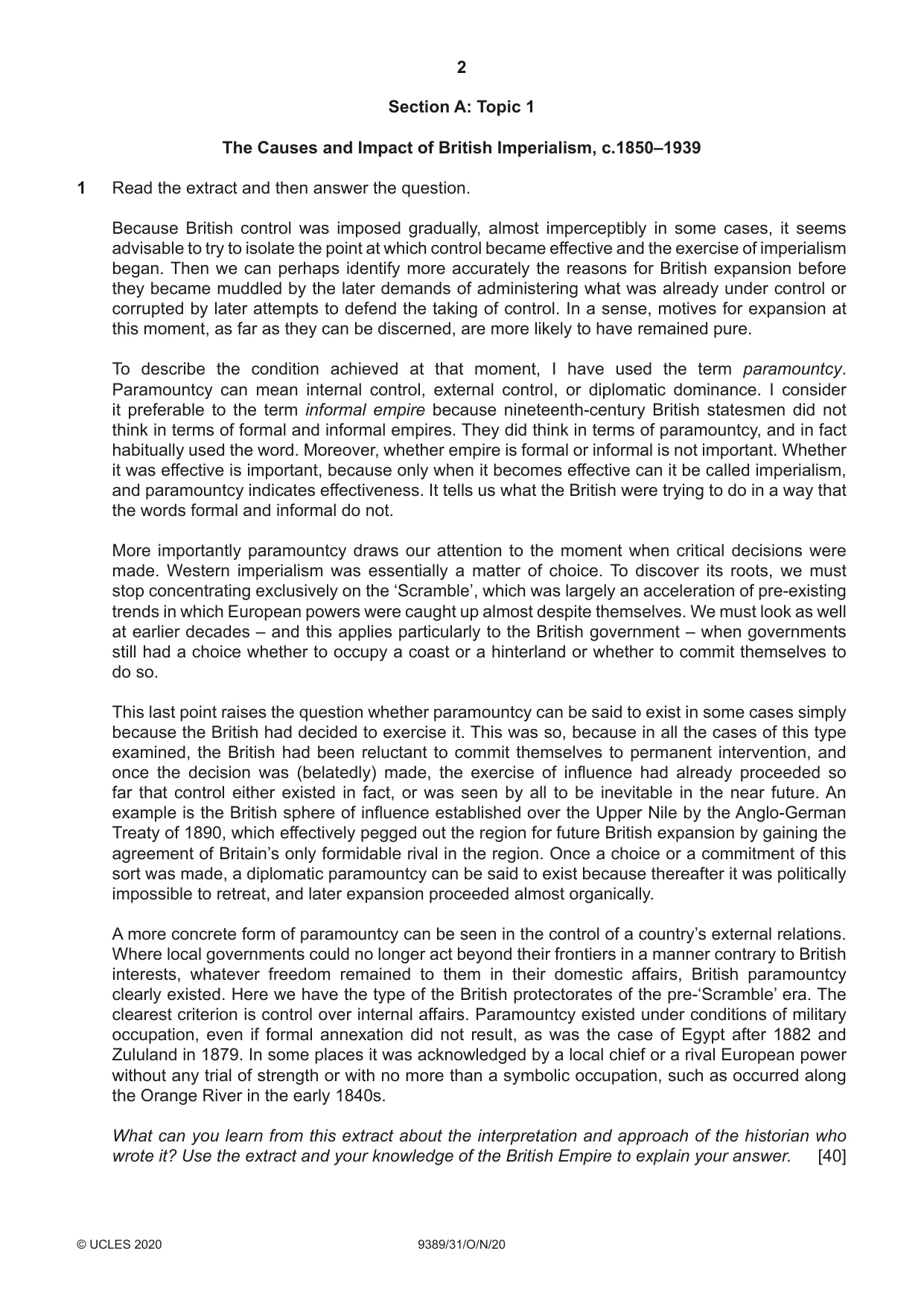
1 Read the extract and then answer the question. Because British control was imposed gradually, almost imperceptibly in some cases, it seems advisable to try to isolate the point at which control became effective and the exercise of imperialism began. Then we can perhaps identify more accurately the reasons for British expansion before they became muddled by the later demands of administering what was already under control or corrupted by later attempts to defend the taking of control. In a sense, motives for expansion at this moment, as far as they can be discerned, are more likely to have remained pure. To describe the condition achieved at that moment, I have used the term paramountcy. Paramountcy can mean internal control, external control, or diplomatic dominance. I consider it preferable to the term informal empire because nineteenth-century British statesmen did not think in terms of formal and informal empires. They did think in terms of paramountcy, and in fact habitually used the word. Moreover, whether empire is formal or informal is not important. Whether it was effective is important, because only when it becomes effective can it be called imperialism, and paramountcy indicates effectiveness. It tells us what the British were trying to do in a way that the words formal and informal do not. More importantly paramountcy draws our attention to the moment when critical decisions were made. Western imperialism was essentially a matter of choice. To discover its roots, we must stop concentrating exclusively on the ‘Scramble’, which was largely an acceleration of pre-existing trends in which European powers were caught up almost despite themselves. We must look as well at earlier decades – and this applies particularly to the British government – when governments still had a choice whether to occupy a coast or a hinterland or whether to commit themselves to do so. This last point raises the question whether paramountcy can be said to exist in some cases simply because the British had decided to exercise it. This was so, because in all the cases of this type examined, the British had been reluctant to commit themselves to permanent intervention, and once the decision was (belatedly) made, the exercise of influence had already proceeded so far that control either existed in fact, or was seen by all to be inevitable in the near future. An example is the British sphere of influence established over the Upper Nile by the Anglo-German Treaty of 1890, which effectively pegged out the region for future British expansion by gaining the agreement of Britain’s only formidable rival in the region. Once a choice or a commitment of this sort was made, a diplomatic paramountcy can be said to exist because thereafter it was politically impossible to retreat, and later expansion proceeded almost organically. A more concrete form of paramountcy can be seen in the control of a country’s external relations. Where local governments could no longer act beyond their frontiers in a manner contrary to British interests, whatever freedom remained to them in their domestic affairs, British paramountcy clearly existed. Here we have the type of the British protectorates of the pre-‘Scramble’ era. The clearest criterion is control over internal affairs. Paramountcy existed under conditions of military occupation, even if formal annexation did not result, as was the case of Egypt after 1882 and Zululand in 1879. In some places it was acknowledged by a local chief or a rival European power without any trial of strength or with no more than a symbolic occupation, such as occurred along the Orange River in the early 1840s. What can you learn from this extract about the interpretation and approach of the historian who wrote it? Use the extract and your knowledge of the British Empire to explain your answer. [40]
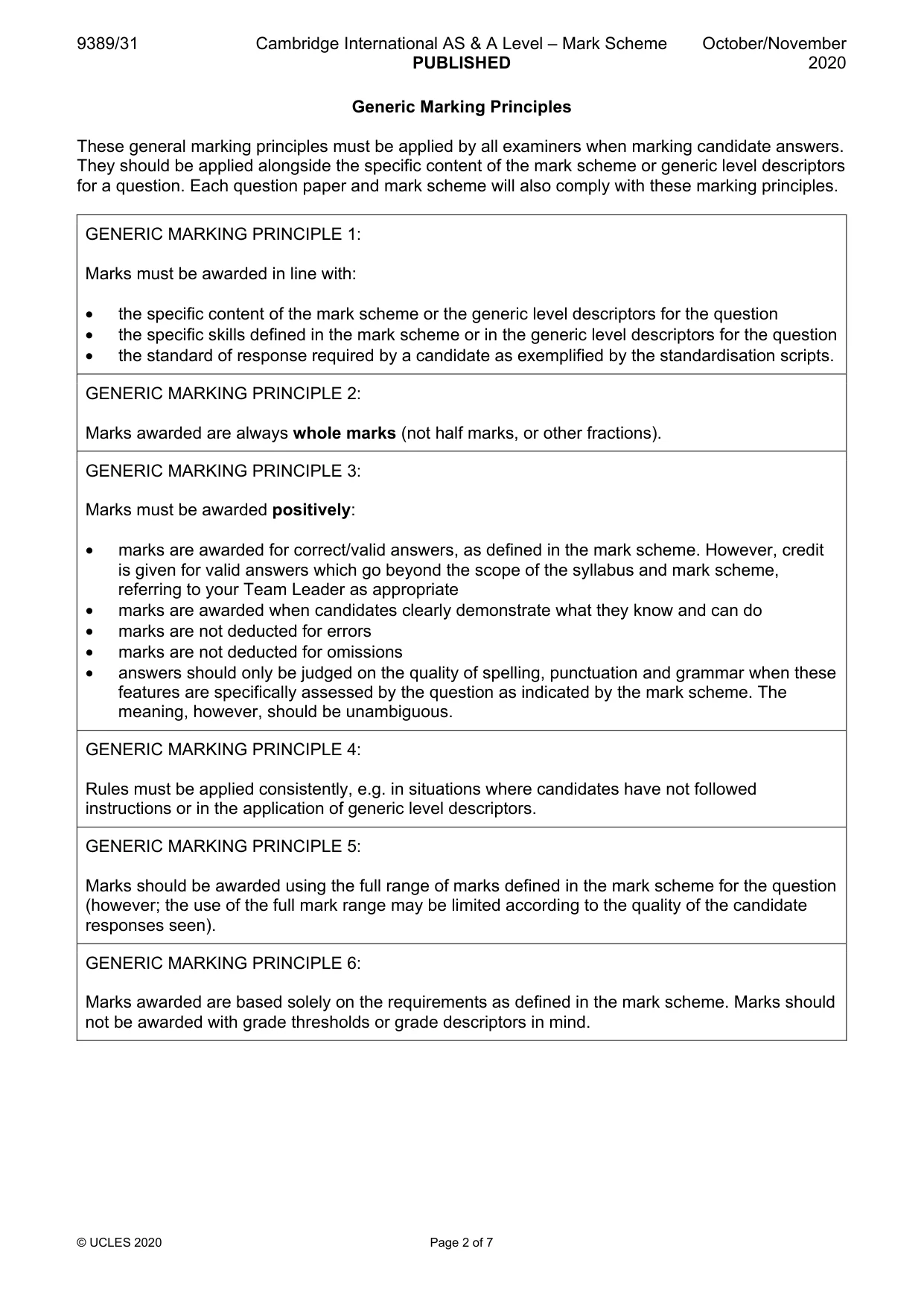
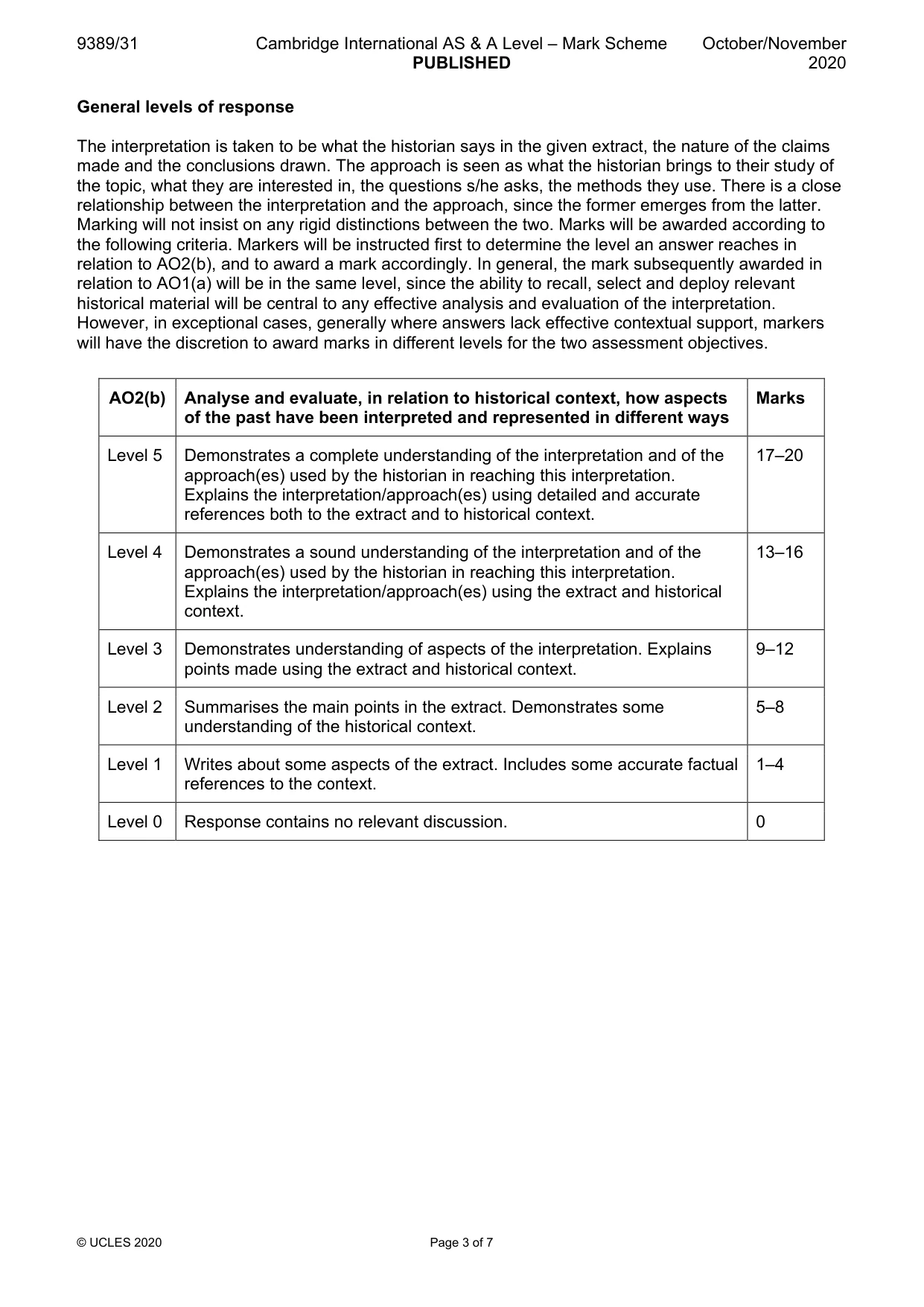
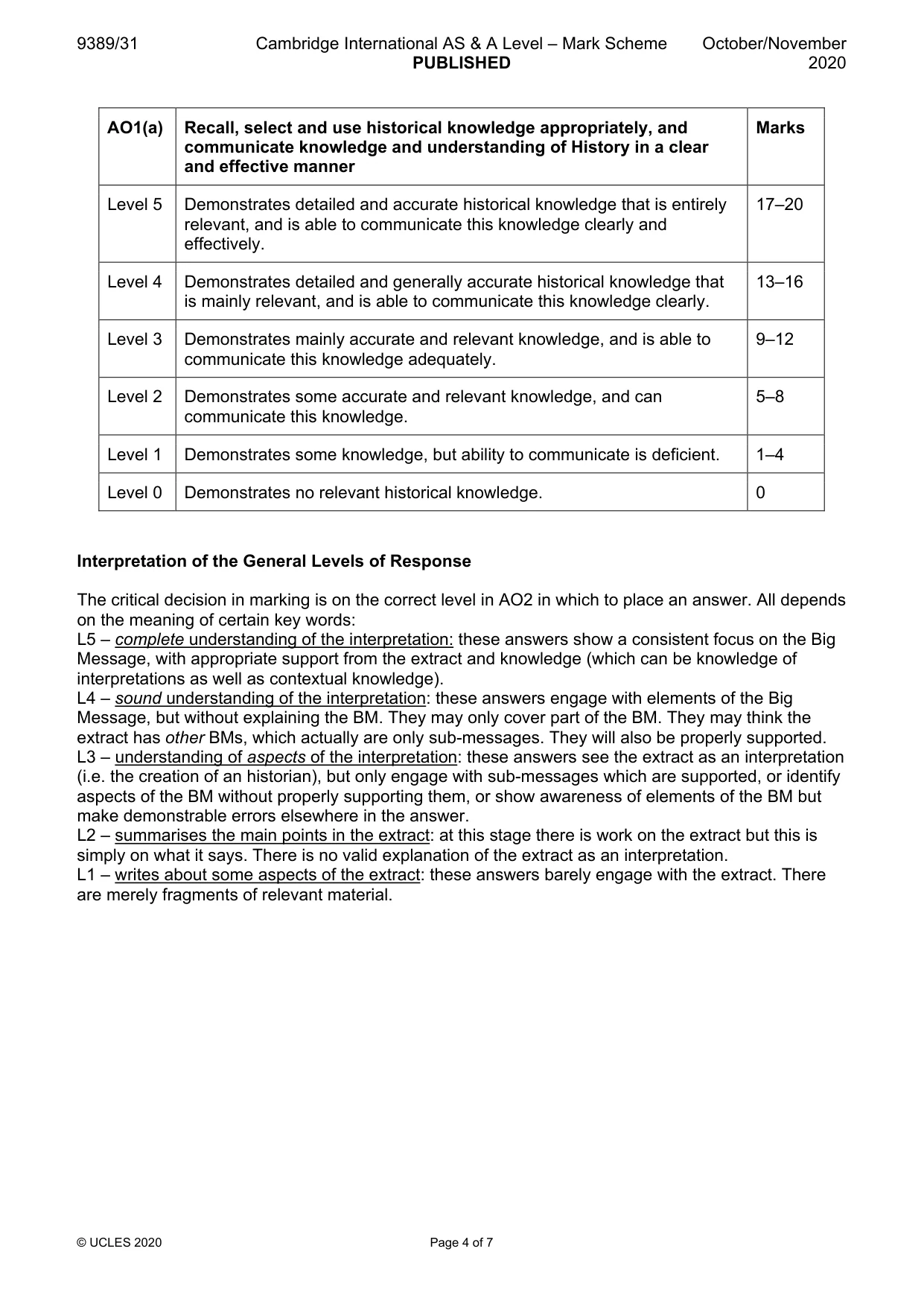
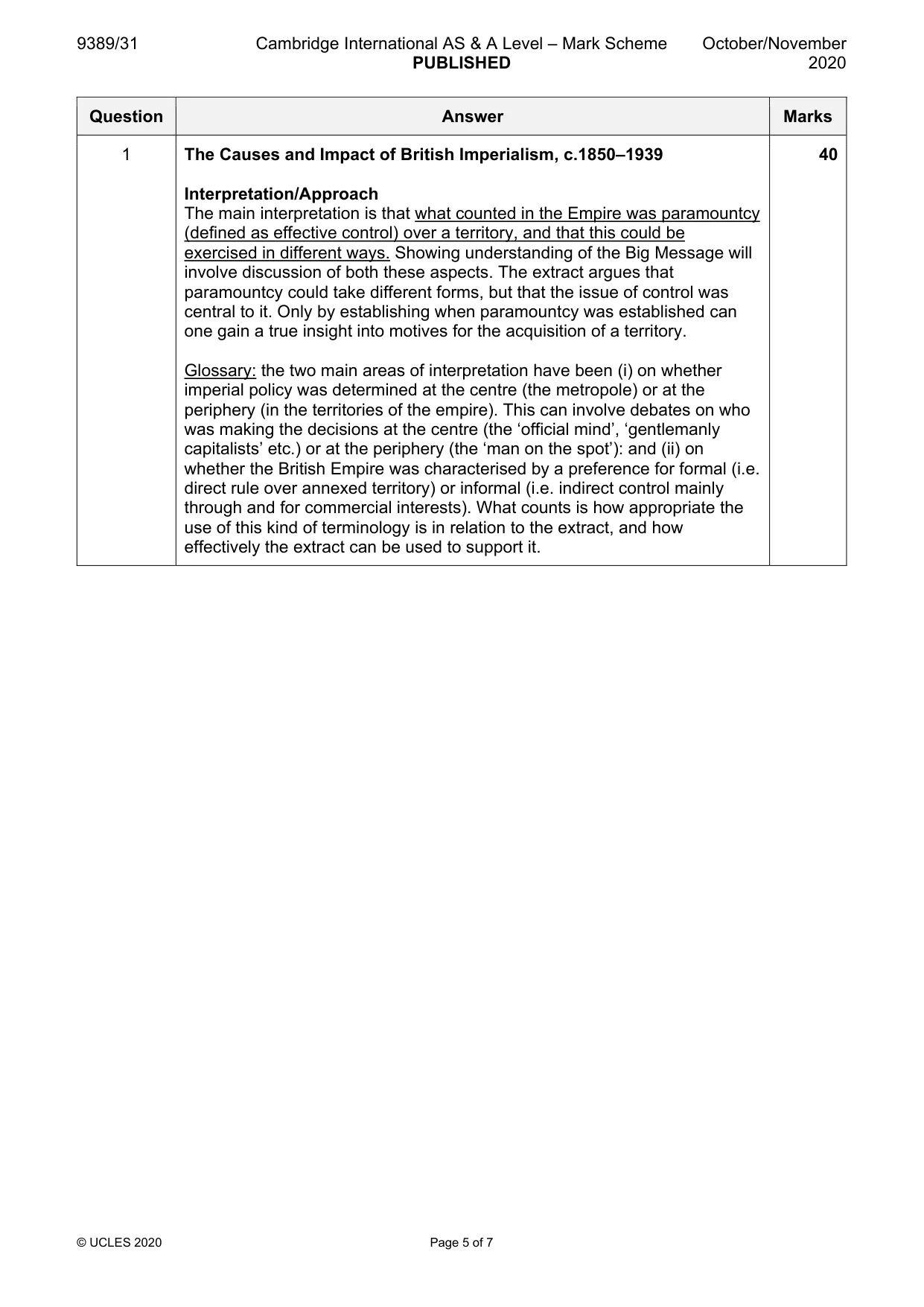
Mark scheme: Question Answer Marks 1 The Causes and Impact of British Imperialism, c.1850–1939 40 Interpretation/Approach The main interpretation is that what counted in the Empire was paramountcy (defined as effective control) over a territory, and that this could be exercised in different ways. Showing understanding of the Big Message will involve discussion of both these aspects. The extract argues that paramountcy could take different forms, but that the issue of control was central to it. Only by establishing when paramountcy was established can one gain a true insight into motives for the acquisition of a territory. Glossary: the two main areas of interpretation have been (i) on whether imperial policy was determined at the centre (the metropole) or at the periphery (in the territories of the empire). This can involve debates on who was making the decisions at the centre (the ‘official mind’, ‘gentlemanly capitalists’ etc.) or at the periphery (the ‘man on the spot’): and (ii) on whether the British Empire was characterised by a preference for formal (i.e. direct rule over annexed territory) or informal (i.e. indirect control mainly through and for commercial interests). What counts is how appropriate the use of this kind of terminology is in relation to the extract, and how effectively the extract can be used to support it.
Q2 · Read the extract and then answer the question
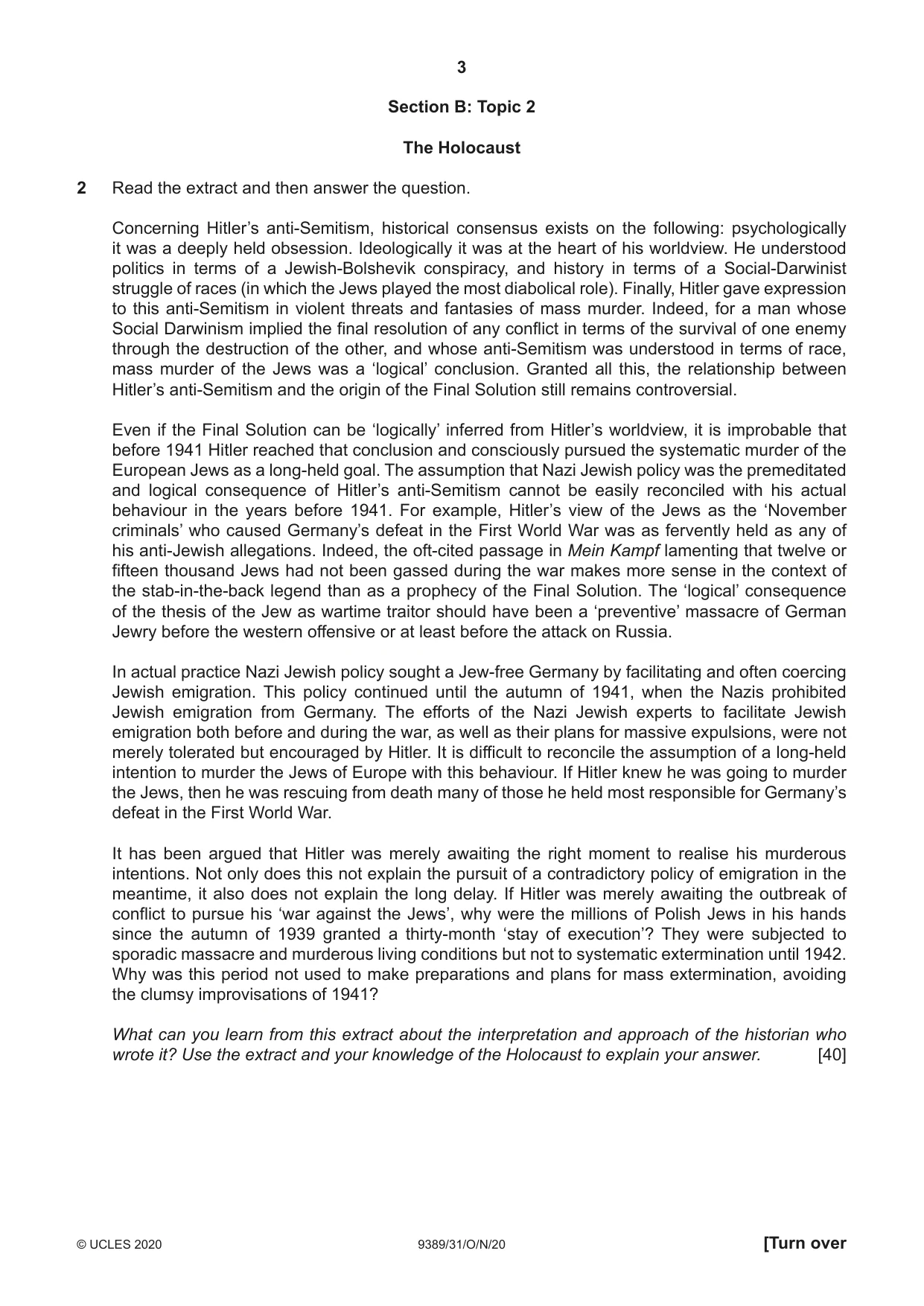
2 Read the extract and then answer the question. Concerning Hitler’s anti-Semitism, historical consensus exists on the following: psychologically it was a deeply held obsession. Ideologically it was at the heart of his worldview. He understood politics in terms of a Jewish-Bolshevik conspiracy, and history in terms of a Social-Darwinist struggle of races (in which the Jews played the most diabolical role). Finally, Hitler gave expression to this anti-Semitism in violent threats and fantasies of mass murder. Indeed, for a man whose Social Darwinism implied the final resolution of any conflict in terms of the survival of one enemy through the destruction of the other, and whose anti-Semitism was understood in terms of race, mass murder of the Jews was a ‘logical’ conclusion. Granted all this, the relationship between Hitler’s anti-Semitism and the origin of the Final Solution still remains controversial. Even if the Final Solution can be ‘logically’ inferred from Hitler’s worldview, it is improbable that before 1941 Hitler reached that conclusion and consciously pursued the systematic murder of the European Jews as a long-held goal. The assumption that Nazi Jewish policy was the premeditated and logical consequence of Hitler’s anti-Semitism cannot be easily reconciled with his actual behaviour in the years before 1941. For example, Hitler’s view of the Jews as the ‘November criminals’ who caused Germany’s defeat in the First World War was as fervently held as any of his anti-Jewish allegations. Indeed, the oft-cited passage in Mein Kampf lamenting that twelve or fifteen thousand Jews had not been gassed during the war makes more sense in the context of the stab-in-the-back legend than as a prophecy of the Final Solution. The ‘logical’ consequence of the thesis of the Jew as wartime traitor should have been a ‘preventive’ massacre of German Jewry before the western offensive or at least before the attack on Russia. In actual practice Nazi Jewish policy sought a Jew-free Germany by facilitating and often coercing Jewish emigration. This policy continued until the autumn of 1941, when the Nazis prohibited Jewish emigration from Germany. The efforts of the Nazi Jewish experts to facilitate Jewish emigration both before and during the war, as well as their plans for massive expulsions, were not merely tolerated but encouraged by Hitler. It is difficult to reconcile the assumption of a long-held intention to murder the Jews of Europe with this behaviour. If Hitler knew he was going to murder the Jews, then he was rescuing from death many of those he held most responsible for Germany’s defeat in the First World War. It has been argued that Hitler was merely awaiting the right moment to realise his murderous intentions. Not only does this not explain the pursuit of a contradictory policy of emigration in the meantime, it also does not explain the long delay. If Hitler was merely awaiting the outbreak of conflict to pursue his ‘war against the Jews’, why were the millions of Polish Jews in his hands since the autumn of 1939 granted a thirty-month ‘stay of execution’? They were subjected to sporadic massacre and murderous living conditions but not to systematic extermination until 1942. Why was this period not used to make preparations and plans for mass extermination, avoiding the clumsy improvisations of 1941? What can you learn from this extract about the interpretation and approach of the historian who wrote it? Use the extract and your knowledge of the Holocaust to explain your answer. [40] Section C: Topic 3 The Origins and Development of the Cold War, 1941–1950
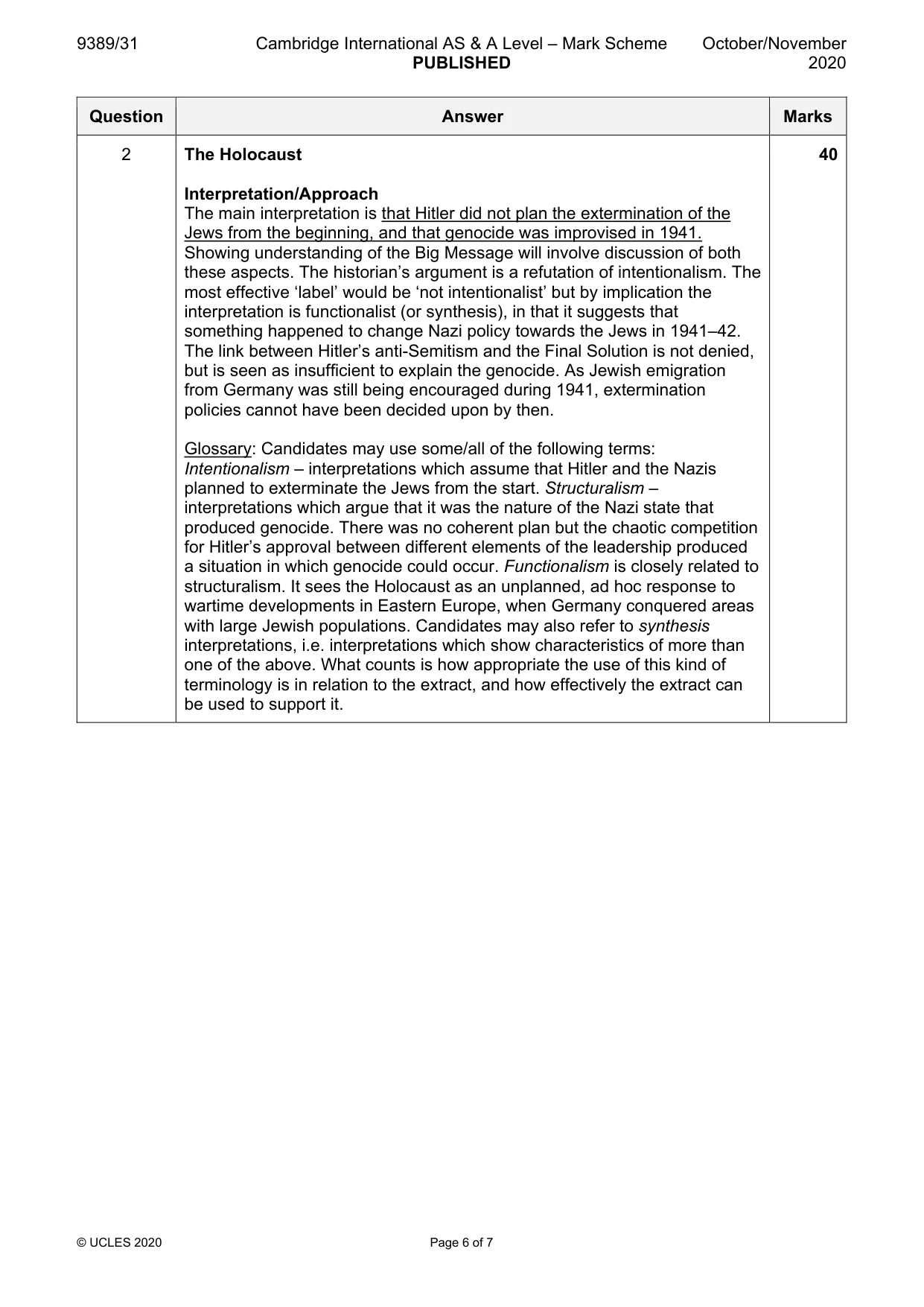
Mark scheme: 2 The Holocaust 40 Interpretation/Approach The main interpretation is that Hitler did not plan the extermination of the Jews from the beginning, and that genocide was improvised in 1941. Showing understanding of the Big Message will involve discussion of both these aspects. The historian’s argument is a refutation of intentionalism. The most effective ‘label’ would be ‘not intentionalist’ but by implication the interpretation is functionalist (or synthesis), in that it suggests that something happened to change Nazi policy towards the Jews in 1941–42. The link between Hitler’s anti-Semitism and the Final Solution is not denied, but is seen as insufficient to explain the genocide. As Jewish emigration from Germany was still being encouraged during 1941, extermination policies cannot have been decided upon by then. Glossary: Candidates may use some/all of the following terms: Intentionalism – interpretations which assume that Hitler and the Nazis planned to exterminate the Jews from the start. Structuralism – interpretations which argue that it was the nature of the Nazi state that produced genocide. There was no coherent plan but the chaotic competition for Hitler’s approval between different elements of the leadership produced a situation in which genocide could occur. Functionalism is closely related to structuralism. It sees the Holocaust as an unplanned, ad hoc response to wartime developments in Eastern Europe, when Germany conquered areas with large Jewish populations. Candidates may also refer to synthesis interpretations, i.e. interpretations which show characteristics of more than one of the above. What counts is how appropriate the use of this kind of terminology is in relation to the extract, and how effectively the extract can be used to support it.
Q3 · Read the extract and then answer the question
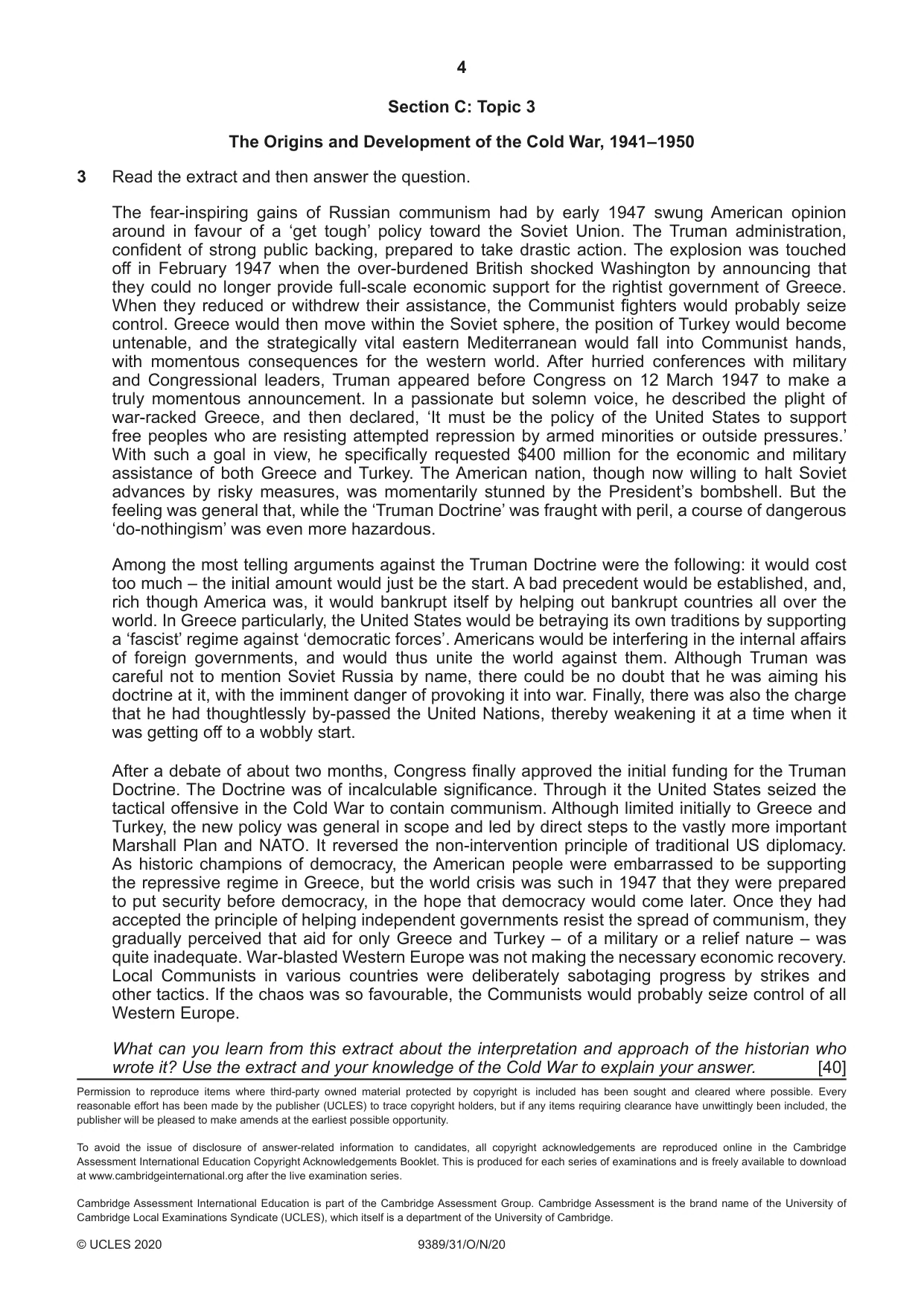
3 Read the extract and then answer the question. The fear-inspiring gains of Russian communism had by early 1947 swung American opinion around in favour of a ‘get tough’ policy toward the Soviet Union. The Truman administration, confident of strong public backing, prepared to take drastic action. The explosion was touched off in February 1947 when the over-burdened British shocked Washington by announcing that they could no longer provide full-scale economic support for the rightist government of Greece. When they reduced or withdrew their assistance, the Communist fighters would probably seize control. Greece would then move within the Soviet sphere, the position of Turkey would become untenable, and the strategically vital eastern Mediterranean would fall into Communist hands, with momentous consequences for the western world. After hurried conferences with military and Congressional leaders, Truman appeared before Congress on 12 March 1947 to make a truly momentous announcement. In a passionate but solemn voice, he described the plight of war-racked Greece, and then declared, ‘It must be the policy of the United States to support free peoples who are resisting attempted repression by armed minorities or outside pressures.’ With such a goal in view, he specifically requested $400 million for the economic and military assistance of both Greece and Turkey. The American nation, though now willing to halt Soviet advances by risky measures, was momentarily stunned by the President’s bombshell. But the feeling was general that, while the ‘Truman Doctrine’ was fraught with peril, a course of dangerous ‘do-nothingism’ was even more hazardous. Among the most telling arguments against the Truman Doctrine were the following: it would cost too much – the initial amount would just be the start. A bad precedent would be established, and, rich though America was, it would bankrupt itself by helping out bankrupt countries all over the world. In Greece particularly, the United States would be betraying its own traditions by supporting a ‘fascist’ regime against ‘democratic forces’. Americans would be interfering in the internal affairs of foreign governments, and would thus unite the world against them. Although Truman was careful not to mention Soviet Russia by name, there could be no doubt that he was aiming his doctrine at it, with the imminent danger of provoking it into war. Finally, there was also the charge that he had thoughtlessly by-passed the United Nations, thereby weakening it at a time when it was getting off to a wobbly start. After a debate of about two months, Congress finally approved the initial funding for the Truman Doctrine. The Doctrine was of incalculable significance. Through it the United States seized the tactical offensive in the Cold War to contain communism. Although limited initially to Greece and Turkey, the new policy was general in scope and led by direct steps to the vastly more important Marshall Plan and NATO. It reversed the non-intervention principle of traditional US diplomacy. As historic champions of democracy, the American people were embarrassed to be supporting the repressive regime in Greece, but the world crisis was such in 1947 that they were prepared to put security before democracy, in the hope that democracy would come later. Once they had accepted the principle of helping independent governments resist the spread of communism, they gradually perceived that aid for only Greece and Turkey – of a military or a relief nature – was quite inadequate. War-blasted Western Europe was not making the necessary economic recovery. Local Communists in various countries were deliberately sabotaging progress by strikes and other tactics. If the chaos was so favourable, the Communists would probably seize control of all Western Europe. What can you learn from this extract about the interpretation and approach of the historian who wrote it? Use the extract and your knowledge of the Cold War to explain your answer. [40]
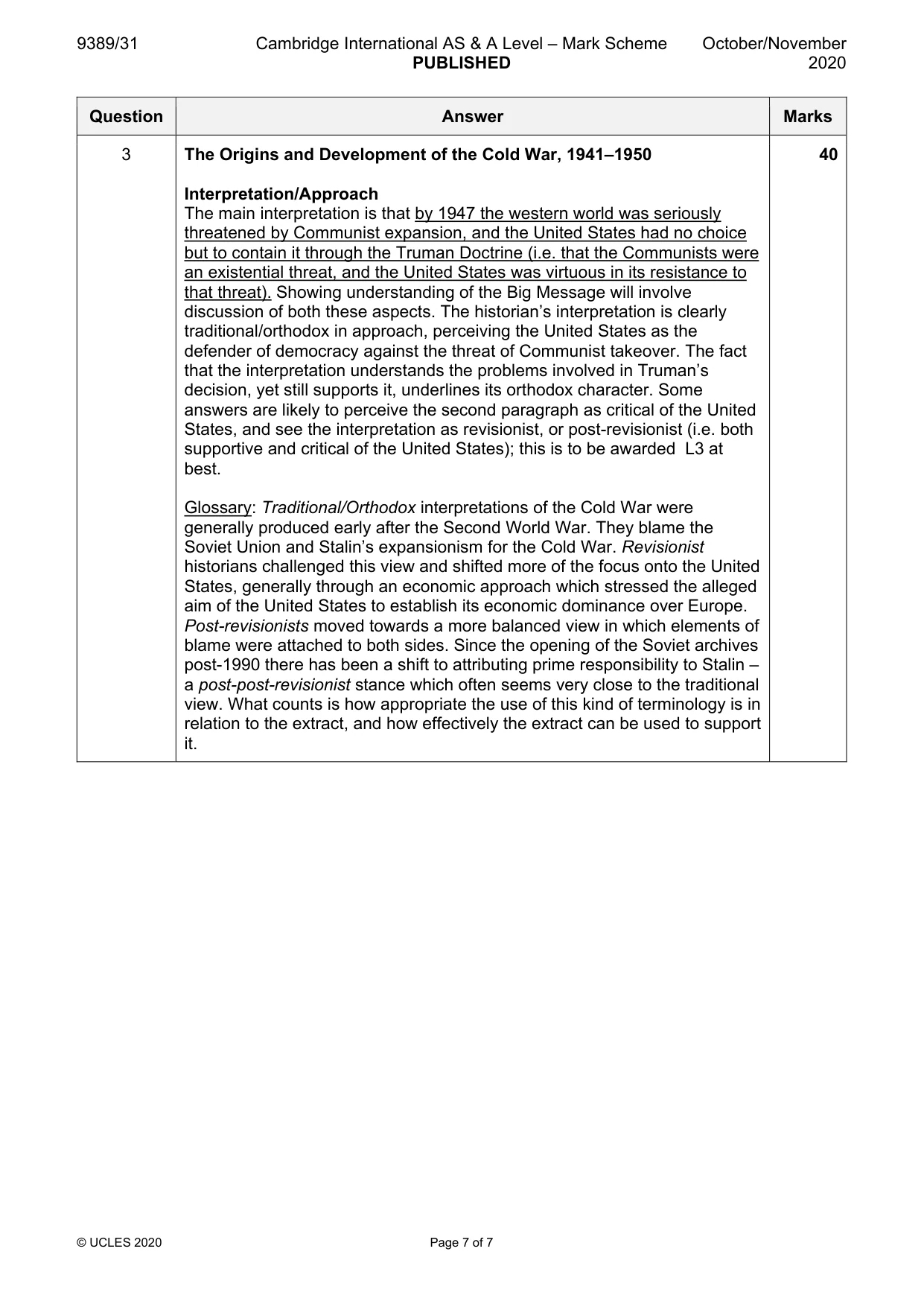
Mark scheme: 3 The Origins and Development of the Cold War, 1941–1950 40 Interpretation/Approach The main interpretation is that by 1947 the western world was seriously threatened by Communist expansion, and the United States had no choice but to contain it through the Truman Doctrine (i.e. that the Communists were an existential threat, and the United States was virtuous in its resistance to that threat). Showing understanding of the Big Message will involve discussion of both these aspects. The historian’s interpretation is clearly traditional/orthodox in approach, perceiving the United States as the defender of democracy against the threat of Communist takeover. The fact that the interpretation understands the problems involved in Truman’s decision, yet still supports it, underlines its orthodox character. Some answers are likely to perceive the second paragraph as critical of the United States, and see the interpretation as revisionist, or post-revisionist (i.e. both supportive and critical of the United States); this is to be awarded L3 at best. Glossary: Traditional/Orthodox interpretations of the Cold War were generally produced early after the Second World War. They blame the Soviet Union and Stalin’s expansionism for the Cold War. Revisionist historians challenged this view and shifted more of the focus onto the United States, generally through an economic approach which stressed the alleged aim of the United States to establish its economic dominance over Europe. Post-revisionists moved towards a more balanced view in which elements of blame were attached to both sides. Since the opening of the Soviet archives post-1990 there has been a shift to attributing prime responsibility to Stalin – a post-post-revisionist stance which often seems very close to the traditional view. What counts is how appropriate the use of this kind of terminology is in relation to the extract, and how effectively the extract can be used to support it.
What you needed in this session
Cambridge’s own grade thresholds for 2020 Oct/Nov, Paper 3 · Variant 1. A higher threshold means an easier paper — the bar moves with how the cohort did.