Cambridge A Level History 9389 — 2020 Oct/Nov Paper 3 · Variant 2
9389/32/O/N/20 · 3 questions · 40 marks · ≈45 min
The question paper and its mark scheme, free to read here and free to download. This is Cambridge’s own paper, exactly as it was sat.
Question paper4 pages
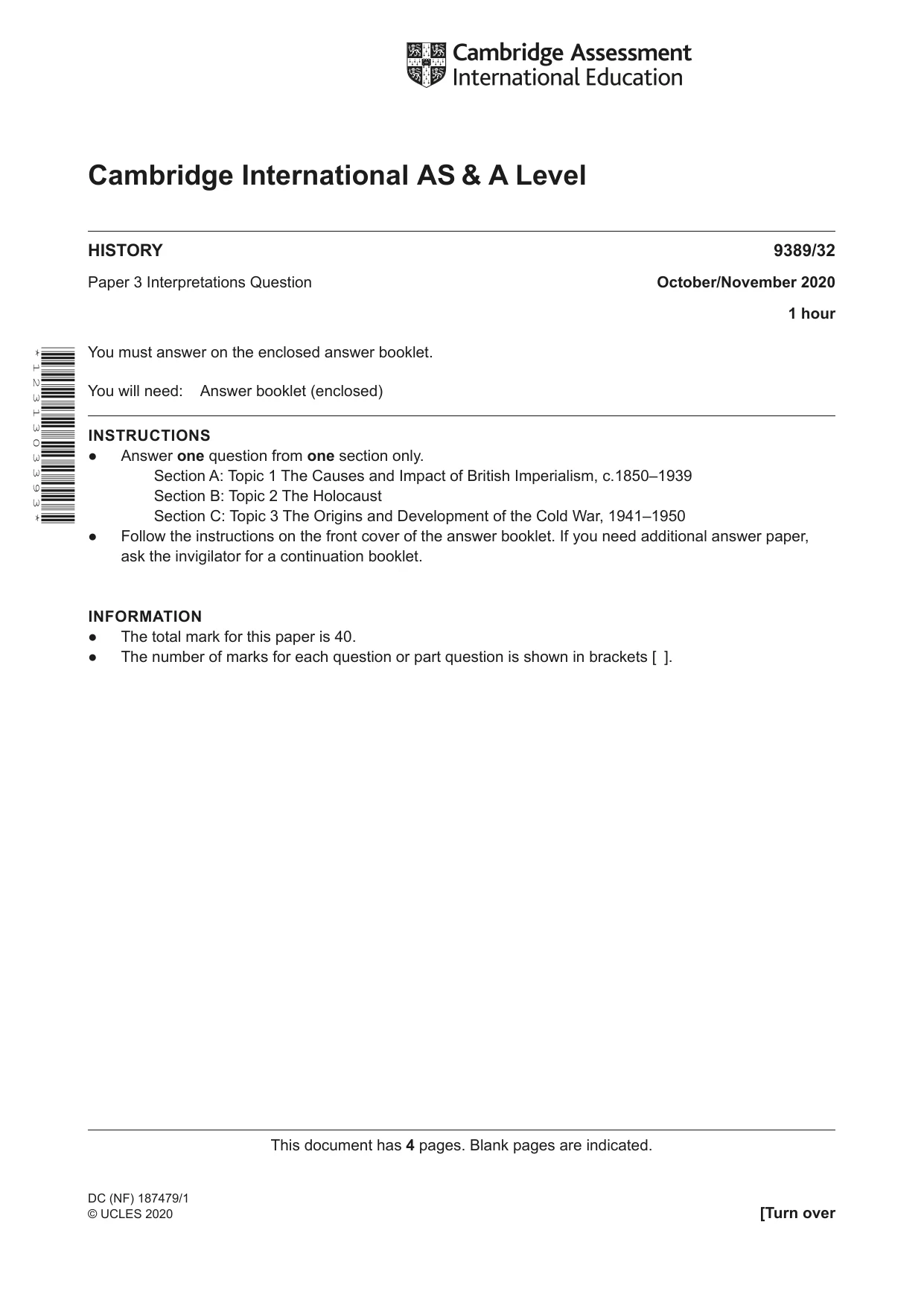
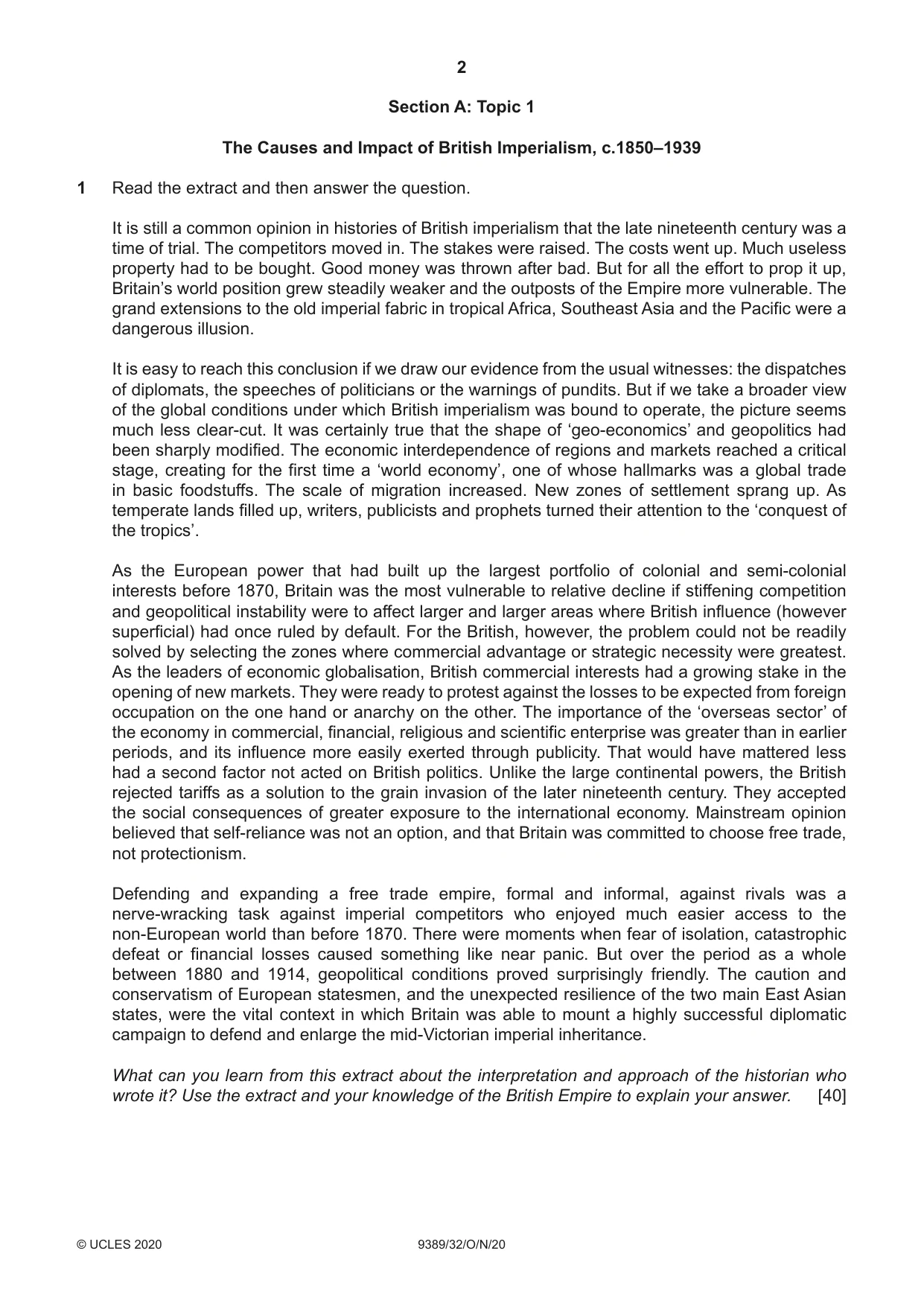
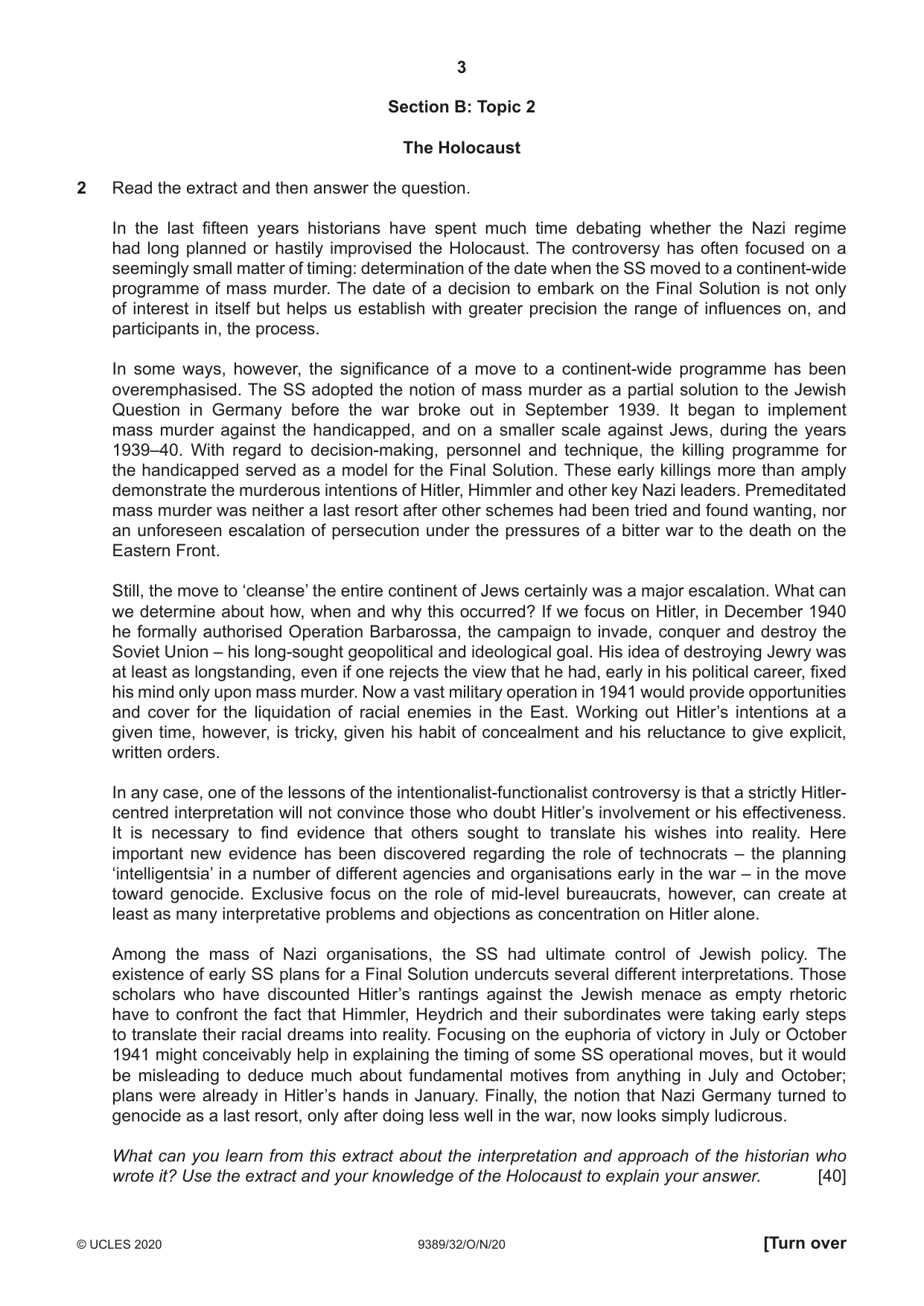
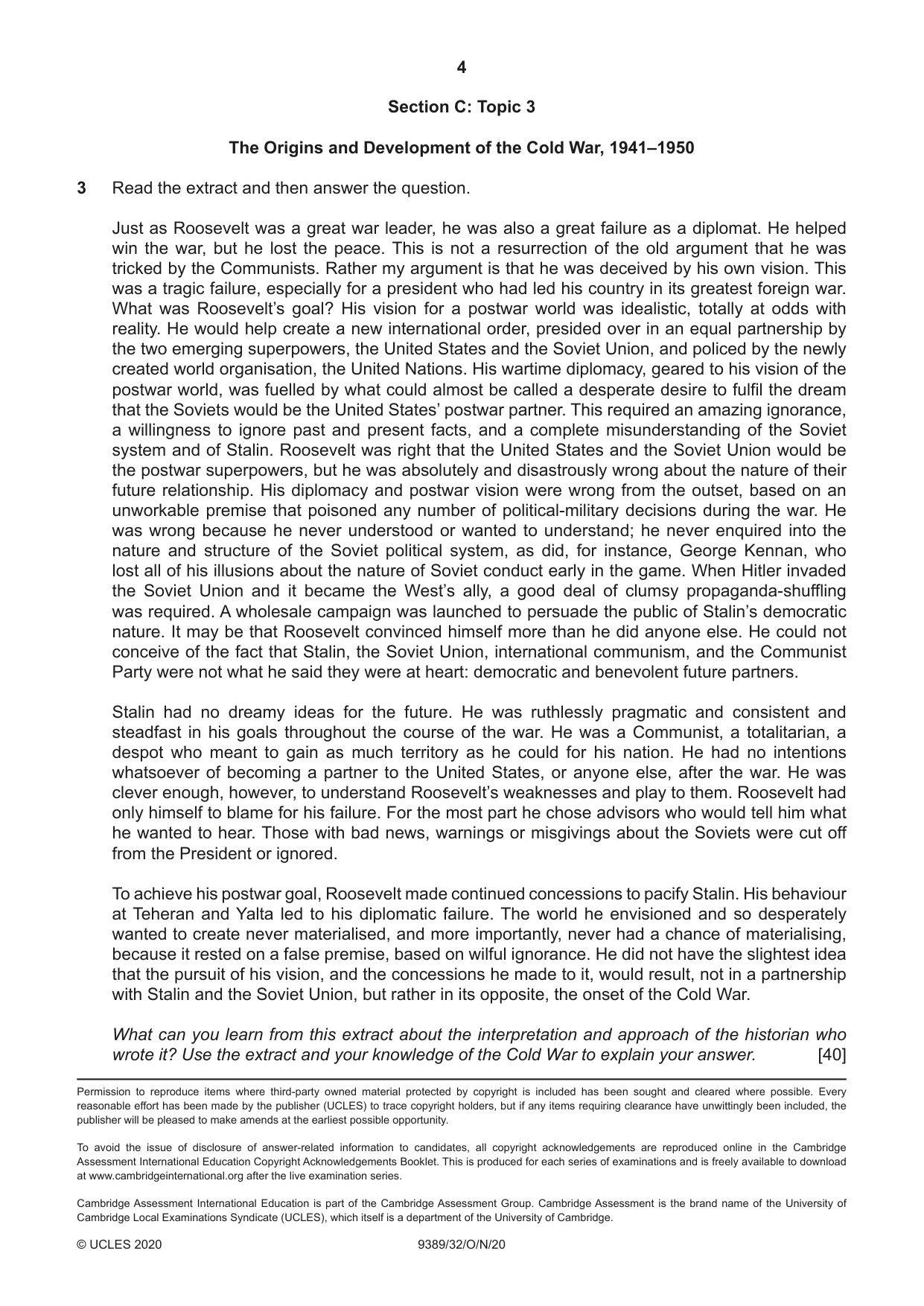
Mark scheme7 pages
Answers below. Sit the paper first if you are practising.
Questions as text
Q1 · Read the extract and then answer the question
1 Read the extract and then answer the question. It is still a common opinion in histories of British imperialism that the late nineteenth century was a time of trial. The competitors moved in. The stakes were raised. The costs went up. Much useless property had to be bought. Good money was thrown after bad. But for all the effort to prop it up, Britain’s world position grew steadily weaker and the outposts of the Empire more vulnerable. The grand extensions to the old imperial fabric in tropical Africa, Southeast Asia and the Pacific were a dangerous illusion. It is easy to reach this conclusion if we draw our evidence from the usual witnesses: the dispatches of diplomats, the speeches of politicians or the warnings of pundits. But if we take a broader view of the global conditions under which British imperialism was bound to operate, the picture seems much less clear-cut. It was certainly true that the shape of ‘geo-economics’ and geopolitics had been sharply modified. The economic interdependence of regions and markets reached a critical stage, creating for the first time a ‘world economy’, one of whose hallmarks was a global trade in basic foodstuffs. The scale of migration increased. New zones of settlement sprang up. As temperate lands filled up, writers, publicists and prophets turned their attention to the ‘conquest of the tropics’. As the European power that had built up the largest portfolio of colonial and semi-colonial interests before 1870, Britain was the most vulnerable to relative decline if stiffening competition and geopolitical instability were to affect larger and larger areas where British influence (however superficial) had once ruled by default. For the British, however, the problem could not be readily solved by selecting the zones where commercial advantage or strategic necessity were greatest. As the leaders of economic globalisation, British commercial interests had a growing stake in the opening of new markets. They were ready to protest against the losses to be expected from foreign occupation on the one hand or anarchy on the other. The importance of the ‘overseas sector’ of the economy in commercial, financial, religious and scientific enterprise was greater than in earlier periods, and its influence more easily exerted through publicity. That would have mattered less had a second factor not acted on British politics. Unlike the large continental powers, the British rejected tariffs as a solution to the grain invasion of the later nineteenth century. They accepted the social consequences of greater exposure to the international economy. Mainstream opinion believed that self-reliance was not an option, and that Britain was committed to choose free trade, not protectionism. Defending and expanding a free trade empire, formal and informal, against rivals was a nerve-wracking task against imperial competitors who enjoyed much easier access to the non-European world than before 1870. There were moments when fear of isolation, catastrophic defeat or financial losses caused something like near panic. But over the period as a whole between 1880 and 1914, geopolitical conditions proved surprisingly friendly. The caution and conservatism of European statesmen, and the unexpected resilience of the two main East Asian states, were the vital context in which Britain was able to mount a highly successful diplomatic campaign to defend and enlarge the mid-Victorian imperial inheritance. What can you learn from this extract about the interpretation and approach of the historian who wrote it? Use the extract and your knowledge of the British Empire to explain your answer. [40]
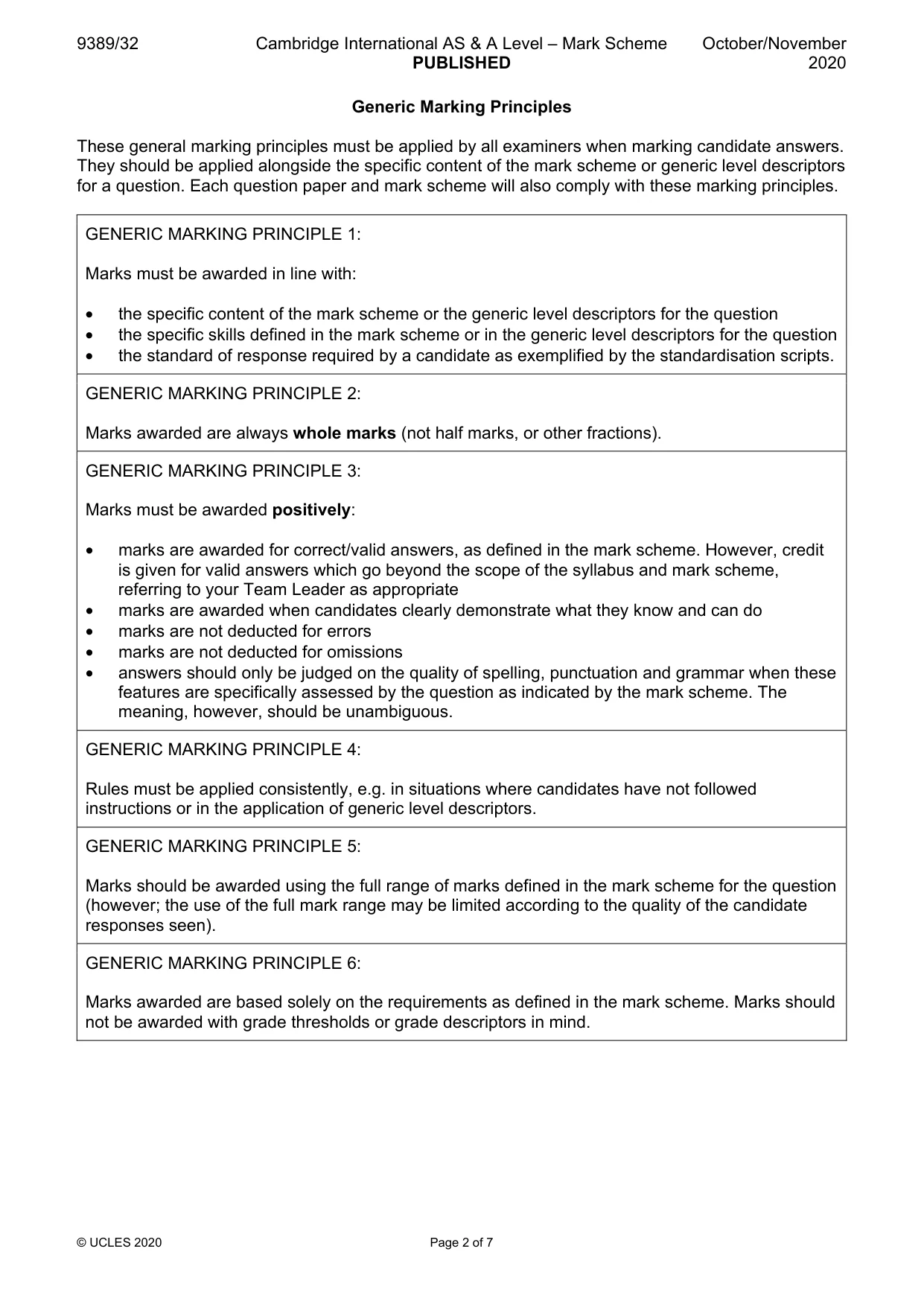
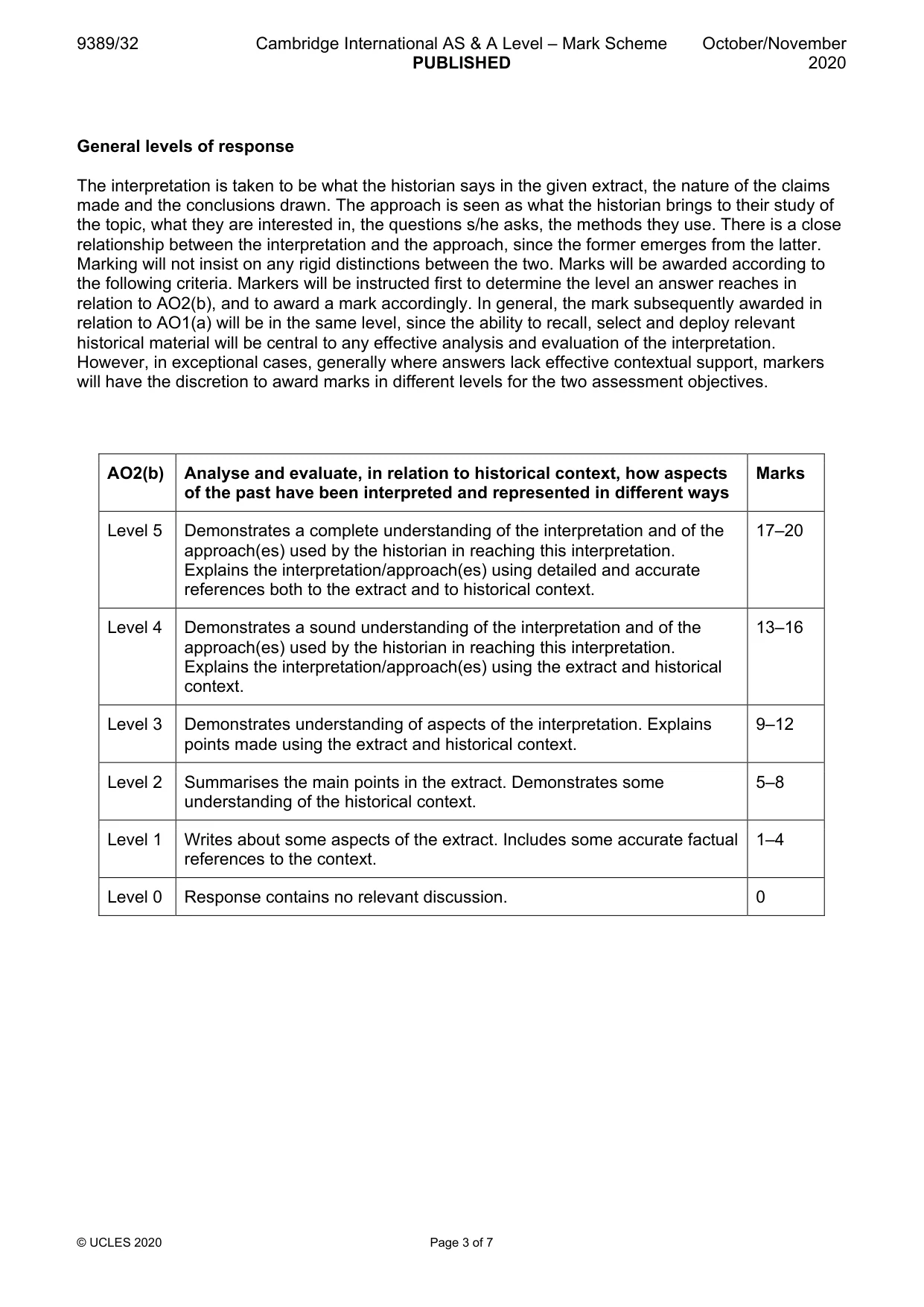
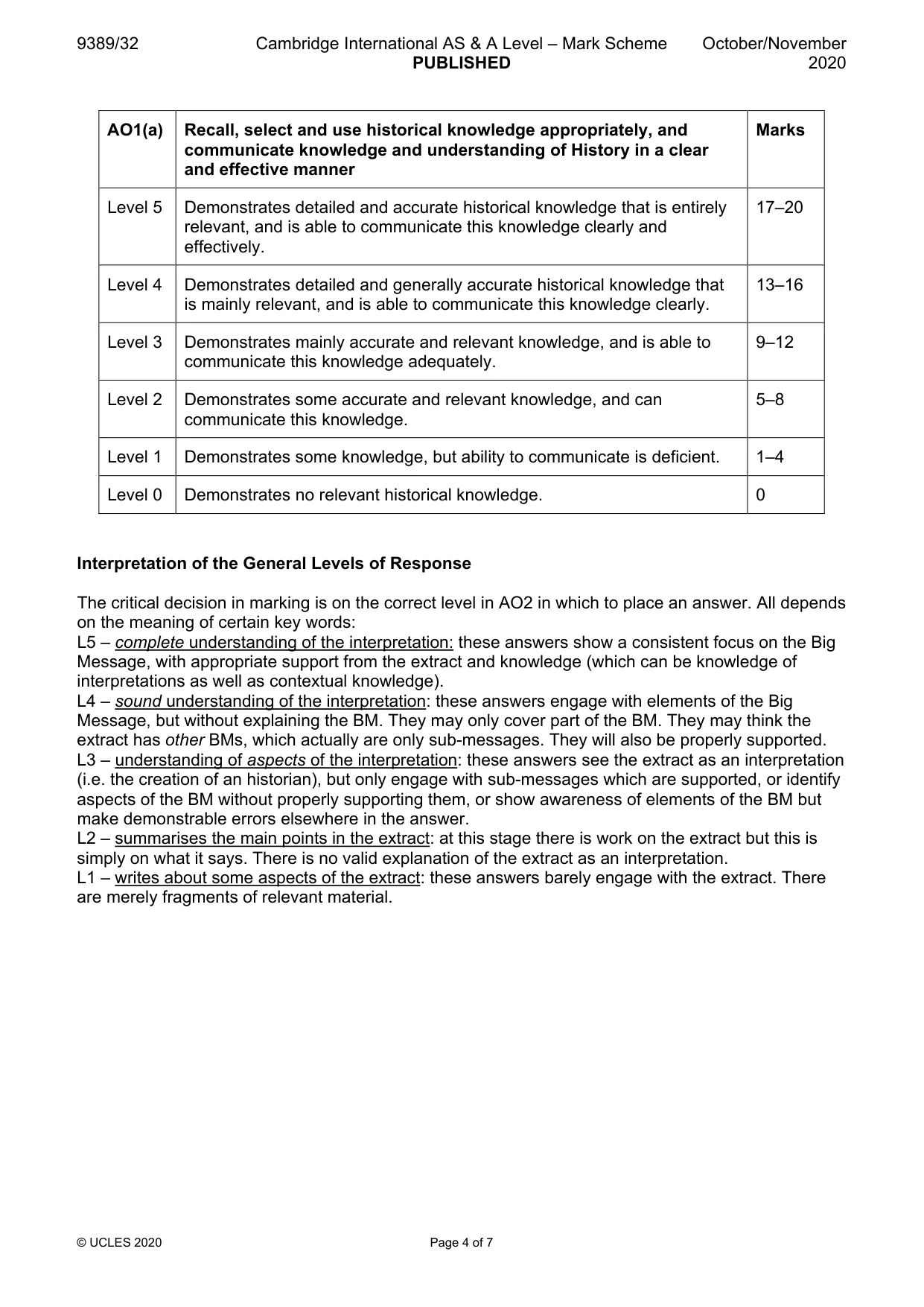
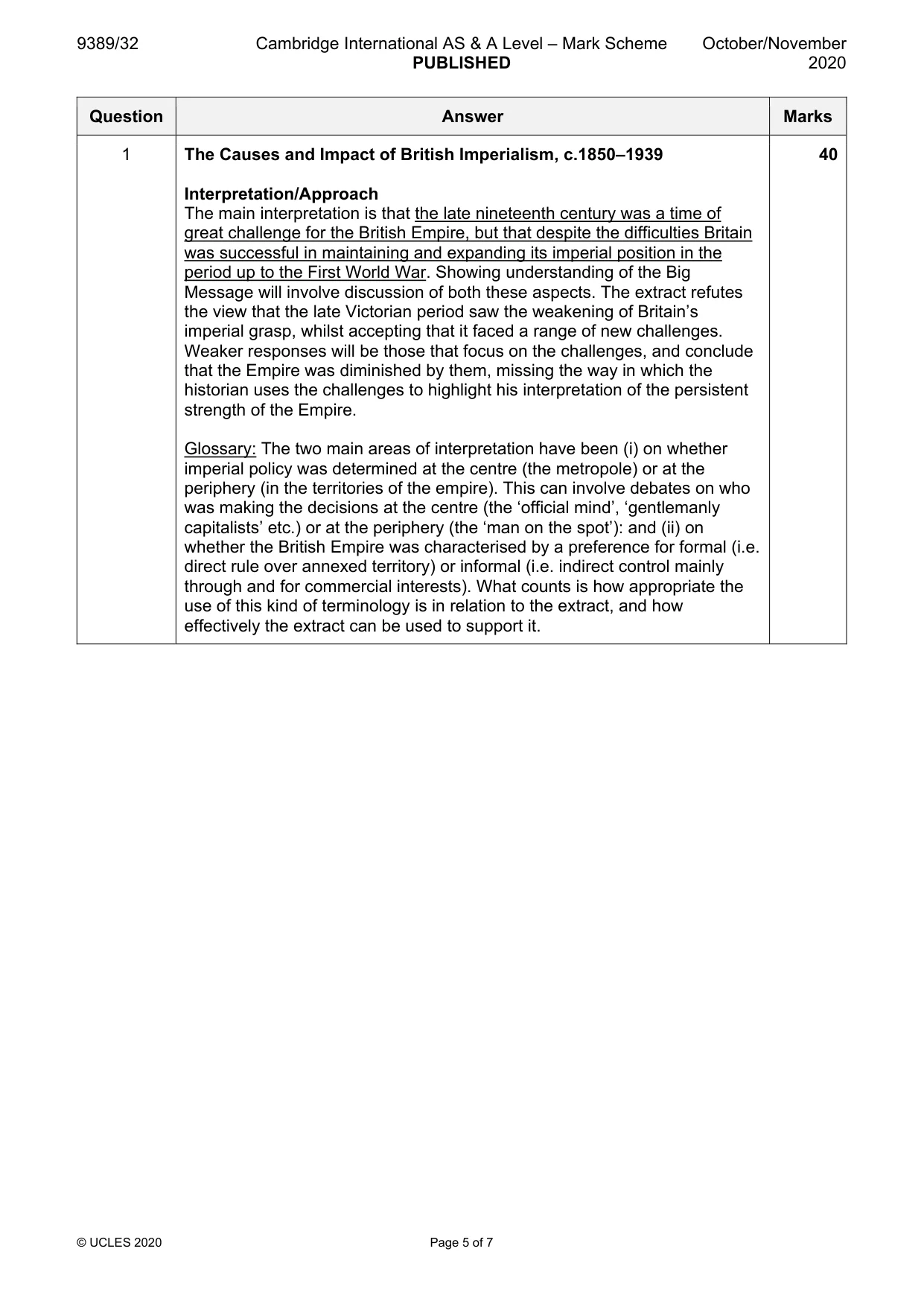
Mark scheme: Question Answer Marks 1 The Causes and Impact of British Imperialism, c.1850–1939 40 Interpretation/Approach The main interpretation is that the late nineteenth century was a time of great challenge for the British Empire, but that despite the difficulties Britain was successful in maintaining and expanding its imperial position in the period up to the First World War. Showing understanding of the Big Message will involve discussion of both these aspects. The extract refutes the view that the late Victorian period saw the weakening of Britain’s imperial grasp, whilst accepting that it faced a range of new challenges. Weaker responses will be those that focus on the challenges, and conclude that the Empire was diminished by them, missing the way in which the historian uses the challenges to highlight his interpretation of the persistent strength of the Empire. Glossary: The two main areas of interpretation have been (i) on whether imperial policy was determined at the centre (the metropole) or at the periphery (in the territories of the empire). This can involve debates on who was making the decisions at the centre (the ‘official mind’, ‘gentlemanly capitalists’ etc.) or at the periphery (the ‘man on the spot’): and (ii) on whether the British Empire was characterised by a preference for formal (i.e. direct rule over annexed territory) or informal (i.e. indirect control mainly through and for commercial interests). What counts is how appropriate the use of this kind of terminology is in relation to the extract, and how effectively the extract can be used to support it.
Q2 · Read the extract and then answer the question
2 Read the extract and then answer the question. In the last fifteen years historians have spent much time debating whether the Nazi regime had long planned or hastily improvised the Holocaust. The controversy has often focused on a seemingly small matter of timing: determination of the date when the SS moved to a continent-wide programme of mass murder. The date of a decision to embark on the Final Solution is not only of interest in itself but helps us establish with greater precision the range of influences on, and participants in, the process. In some ways, however, the significance of a move to a continent-wide programme has been overemphasised. The SS adopted the notion of mass murder as a partial solution to the Jewish Question in Germany before the war broke out in September 1939. It began to implement mass murder against the handicapped, and on a smaller scale against Jews, during the years 1939–40. With regard to decision-making, personnel and technique, the killing programme for the handicapped served as a model for the Final Solution. These early killings more than amply demonstrate the murderous intentions of Hitler, Himmler and other key Nazi leaders. Premeditated mass murder was neither a last resort after other schemes had been tried and found wanting, nor an unforeseen escalation of persecution under the pressures of a bitter war to the death on the Eastern Front. Still, the move to ‘cleanse’ the entire continent of Jews certainly was a major escalation. What can we determine about how, when and why this occurred? If we focus on Hitler, in December 1940 he formally authorised Operation Barbarossa, the campaign to invade, conquer and destroy the Soviet Union – his long-sought geopolitical and ideological goal. His idea of destroying Jewry was at least as longstanding, even if one rejects the view that he had, early in his political career, fixed his mind only upon mass murder. Now a vast military operation in 1941 would provide opportunities and cover for the liquidation of racial enemies in the East. Working out Hitler’s intentions at a given time, however, is tricky, given his habit of concealment and his reluctance to give explicit, written orders. In any case, one of the lessons of the intentionalist-functionalist controversy is that a strictly Hitler- centred interpretation will not convince those who doubt Hitler’s involvement or his effectiveness. It is necessary to find evidence that others sought to translate his wishes into reality. Here important new evidence has been discovered regarding the role of technocrats – the planning ‘intelligentsia’ in a number of different agencies and organisations early in the war – in the move toward genocide. Exclusive focus on the role of mid-level bureaucrats, however, can create at least as many interpretative problems and objections as concentration on Hitler alone. Among the mass of Nazi organisations, the SS had ultimate control of Jewish policy. The existence of early SS plans for a Final Solution undercuts several different interpretations. Those scholars who have discounted Hitler’s rantings against the Jewish menace as empty rhetoric have to confront the fact that Himmler, Heydrich and their subordinates were taking early steps to translate their racial dreams into reality. Focusing on the euphoria of victory in July or October 1941 might conceivably help in explaining the timing of some SS operational moves, but it would be misleading to deduce much about fundamental motives from anything in July and October; plans were already in Hitler’s hands in January. Finally, the notion that Nazi Germany turned to genocide as a last resort, only after doing less well in the war, now looks simply ludicrous. What can you learn from this extract about the interpretation and approach of the historian who wrote it? Use the extract and your knowledge of the Holocaust to explain your answer. [40] Section C: Topic 3 The Origins and Development of the Cold War, 1941–1950
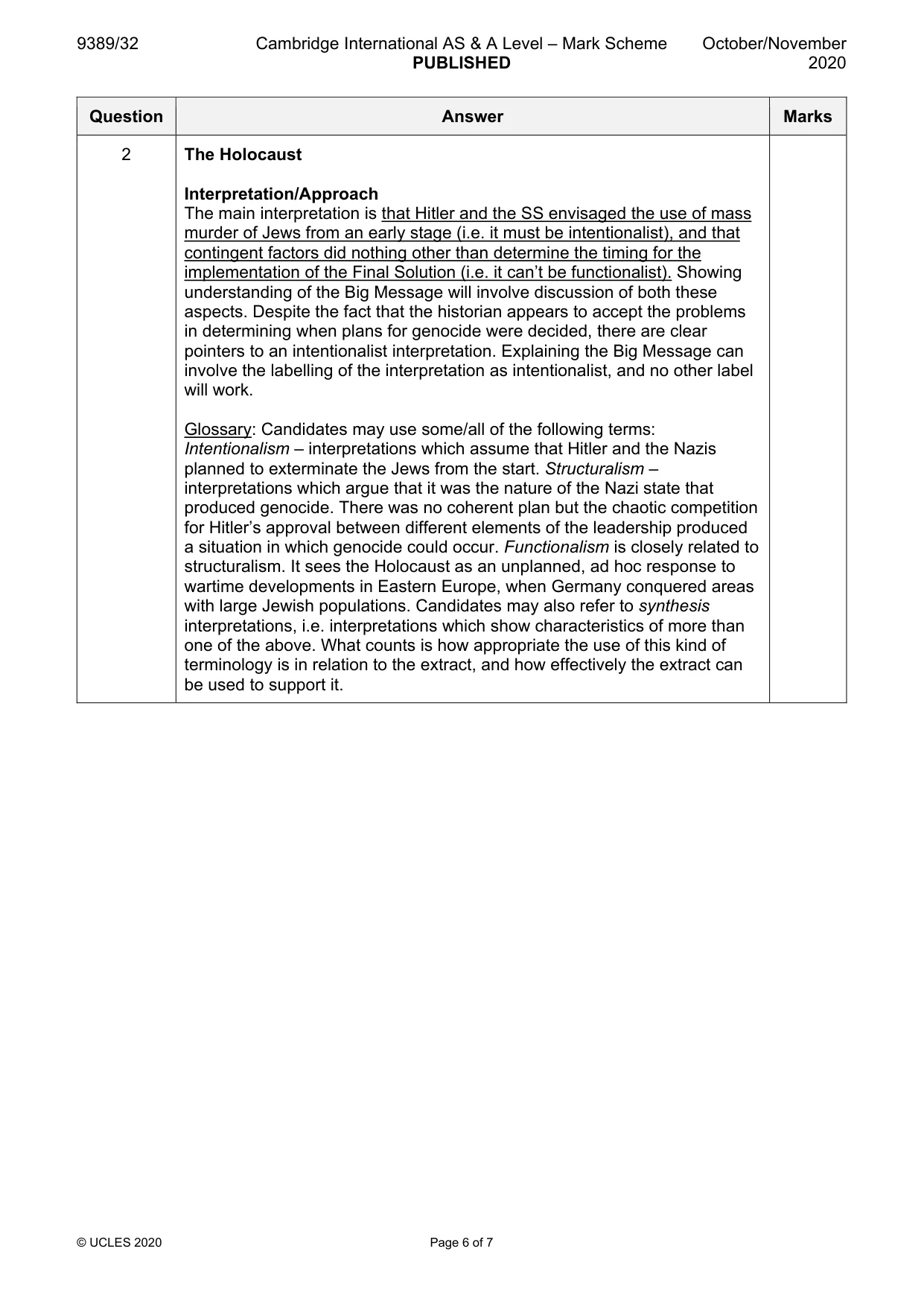
Mark scheme: 2 The Holocaust Interpretation/Approach The main interpretation is that Hitler and the SS envisaged the use of mass murder of Jews from an early stage (i.e. it must be intentionalist), and that contingent factors did nothing other than determine the timing for the implementation of the Final Solution (i.e. it can’t be functionalist). Showing understanding of the Big Message will involve discussion of both these aspects. Despite the fact that the historian appears to accept the problems in determining when plans for genocide were decided, there are clear pointers to an intentionalist interpretation. Explaining the Big Message can involve the labelling of the interpretation as intentionalist, and no other label will work. Glossary: Candidates may use some/all of the following terms: Intentionalism – interpretations which assume that Hitler and the Nazis planned to exterminate the Jews from the start. Structuralism – interpretations which argue that it was the nature of the Nazi state that produced genocide. There was no coherent plan but the chaotic competition for Hitler’s approval between different elements of the leadership produced a situation in which genocide could occur. Functionalism is closely related to structuralism. It sees the Holocaust as an unplanned, ad hoc response to wartime developments in Eastern Europe, when Germany conquered areas with large Jewish populations. Candidates may also refer to synthesis interpretations, i.e. interpretations which show characteristics of more than one of the above. What counts is how appropriate the use of this kind of terminology is in relation to the extract, and how effectively the extract can be used to support it.
Q3 · Read the extract and then answer the question
3 Read the extract and then answer the question. Just as Roosevelt was a great war leader, he was also a great failure as a diplomat. He helped win the war, but he lost the peace. This is not a resurrection of the old argument that he was tricked by the Communists. Rather my argument is that he was deceived by his own vision. This was a tragic failure, especially for a president who had led his country in its greatest foreign war. What was Roosevelt’s goal? His vision for a postwar world was idealistic, totally at odds with reality. He would help create a new international order, presided over in an equal partnership by the two emerging superpowers, the United States and the Soviet Union, and policed by the newly created world organisation, the United Nations. His wartime diplomacy, geared to his vision of the postwar world, was fuelled by what could almost be called a desperate desire to fulfil the dream that the Soviets would be the United States’ postwar partner. This required an amazing ignorance, a willingness to ignore past and present facts, and a complete misunderstanding of the Soviet system and of Stalin. Roosevelt was right that the United States and the Soviet Union would be the postwar superpowers, but he was absolutely and disastrously wrong about the nature of their future relationship. His diplomacy and postwar vision were wrong from the outset, based on an unworkable premise that poisoned any number of political-military decisions during the war. He was wrong because he never understood or wanted to understand; he never enquired into the nature and structure of the Soviet political system, as did, for instance, George Kennan, who lost all of his illusions about the nature of Soviet conduct early in the game. When Hitler invaded the Soviet Union and it became the West’s ally, a good deal of clumsy propaganda-shuffling was required. A wholesale campaign was launched to persuade the public of Stalin’s democratic nature. It may be that Roosevelt convinced himself more than he did anyone else. He could not conceive of the fact that Stalin, the Soviet Union, international communism, and the Communist Party were not what he said they were at heart: democratic and benevolent future partners. Stalin had no dreamy ideas for the future. He was ruthlessly pragmatic and consistent and steadfast in his goals throughout the course of the war. He was a Communist, a totalitarian, a despot who meant to gain as much territory as he could for his nation. He had no intentions whatsoever of becoming a partner to the United States, or anyone else, after the war. He was clever enough, however, to understand Roosevelt’s weaknesses and play to them. Roosevelt had only himself to blame for his failure. For the most part he chose advisors who would tell him what he wanted to hear. Those with bad news, warnings or misgivings about the Soviets were cut off from the President or ignored. To achieve his postwar goal, Roosevelt made continued concessions to pacify Stalin. His behaviour at Teheran and Yalta led to his diplomatic failure. The world he envisioned and so desperately wanted to create never materialised, and more importantly, never had a chance of materialising, because it rested on a false premise, based on wilful ignorance. He did not have the slightest idea that the pursuit of his vision, and the concessions he made to it, would result, not in a partnership with Stalin and the Soviet Union, but rather in its opposite, the onset of the Cold War. What can you learn from this extract about the interpretation and approach of the historian who wrote it? Use the extract and your knowledge of the Cold War to explain your answer. [40]
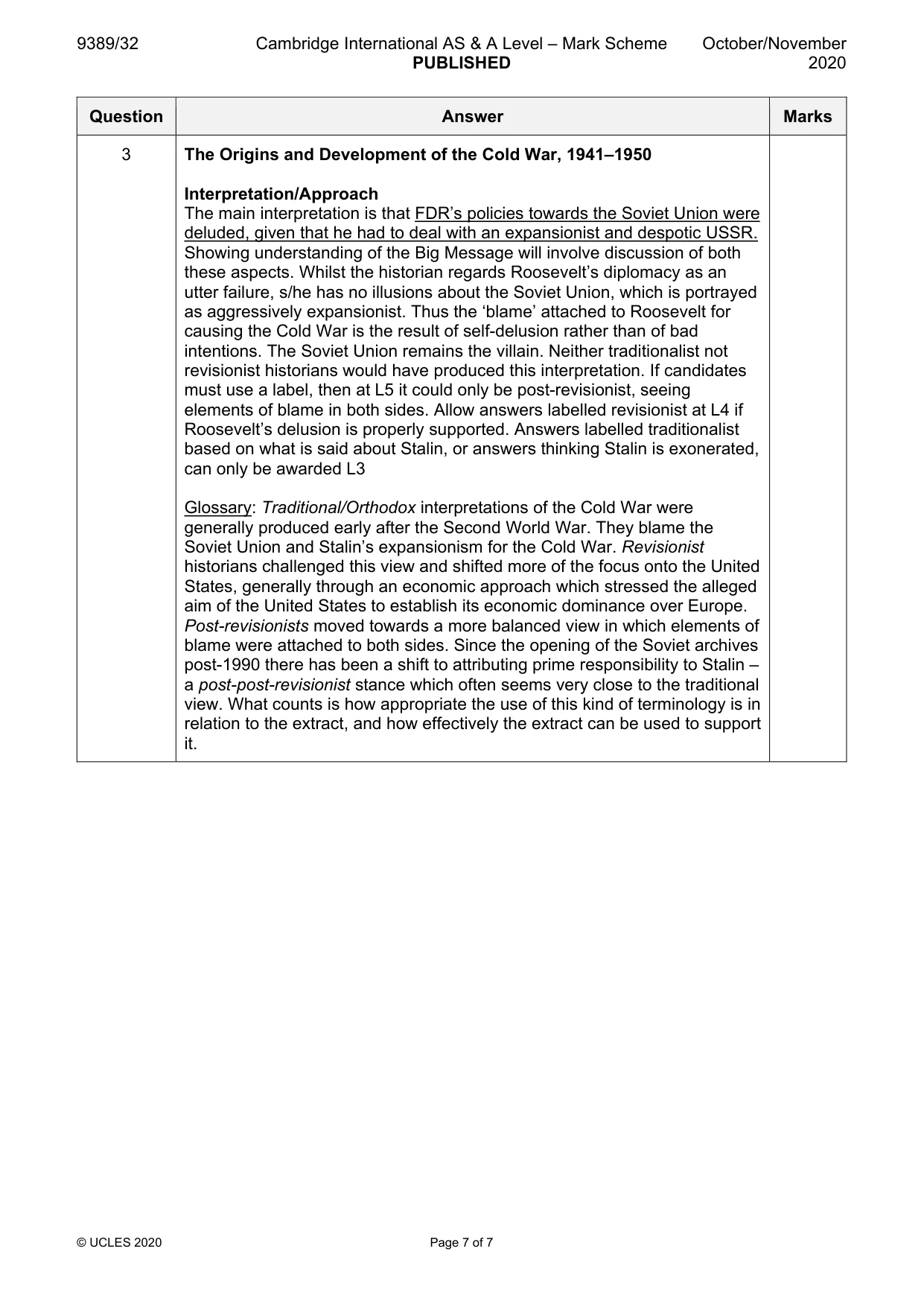
Mark scheme: 3 The Origins and Development of the Cold War, 1941–1950 Interpretation/Approach The main interpretation is that FDR’s policies towards the Soviet Union were deluded, given that he had to deal with an expansionist and despotic USSR. Showing understanding of the Big Message will involve discussion of both these aspects. Whilst the historian regards Roosevelt’s diplomacy as an utter failure, s/he has no illusions about the Soviet Union, which is portrayed as aggressively expansionist. Thus the ‘blame’ attached to Roosevelt for causing the Cold War is the result of self-delusion rather than of bad intentions. The Soviet Union remains the villain. Neither traditionalist not revisionist historians would have produced this interpretation. If candidates must use a label, then at L5 it could only be post-revisionist, seeing elements of blame in both sides. Allow answers labelled revisionist at L4 if Roosevelt’s delusion is properly supported. Answers labelled traditionalist based on what is said about Stalin, or answers thinking Stalin is exonerated, can only be awarded L3 Glossary: Traditional/Orthodox interpretations of the Cold War were generally produced early after the Second World War. They blame the Soviet Union and Stalin’s expansionism for the Cold War. Revisionist historians challenged this view and shifted more of the focus onto the United States, generally through an economic approach which stressed the alleged aim of the United States to establish its economic dominance over Europe. Post-revisionists moved towards a more balanced view in which elements of blame were attached to both sides. Since the opening of the Soviet archives post-1990 there has been a shift to attributing prime responsibility to Stalin – a post-post-revisionist stance which often seems very close to the traditional view. What counts is how appropriate the use of this kind of terminology is in relation to the extract, and how effectively the extract can be used to support it.
What you needed in this session
Cambridge’s own grade thresholds for 2020 Oct/Nov, Paper 3 · Variant 2. A higher threshold means an easier paper — the bar moves with how the cohort did.