Cambridge A Level History 9389 — 2020 Oct/Nov Paper 2 · Variant 1
9389/21/O/N/20 · 12 questions · 60 marks · ≈68 min
The question paper and its mark scheme, free to read here and free to download. This is Cambridge’s own paper, exactly as it was sat.
Question paper4 pages
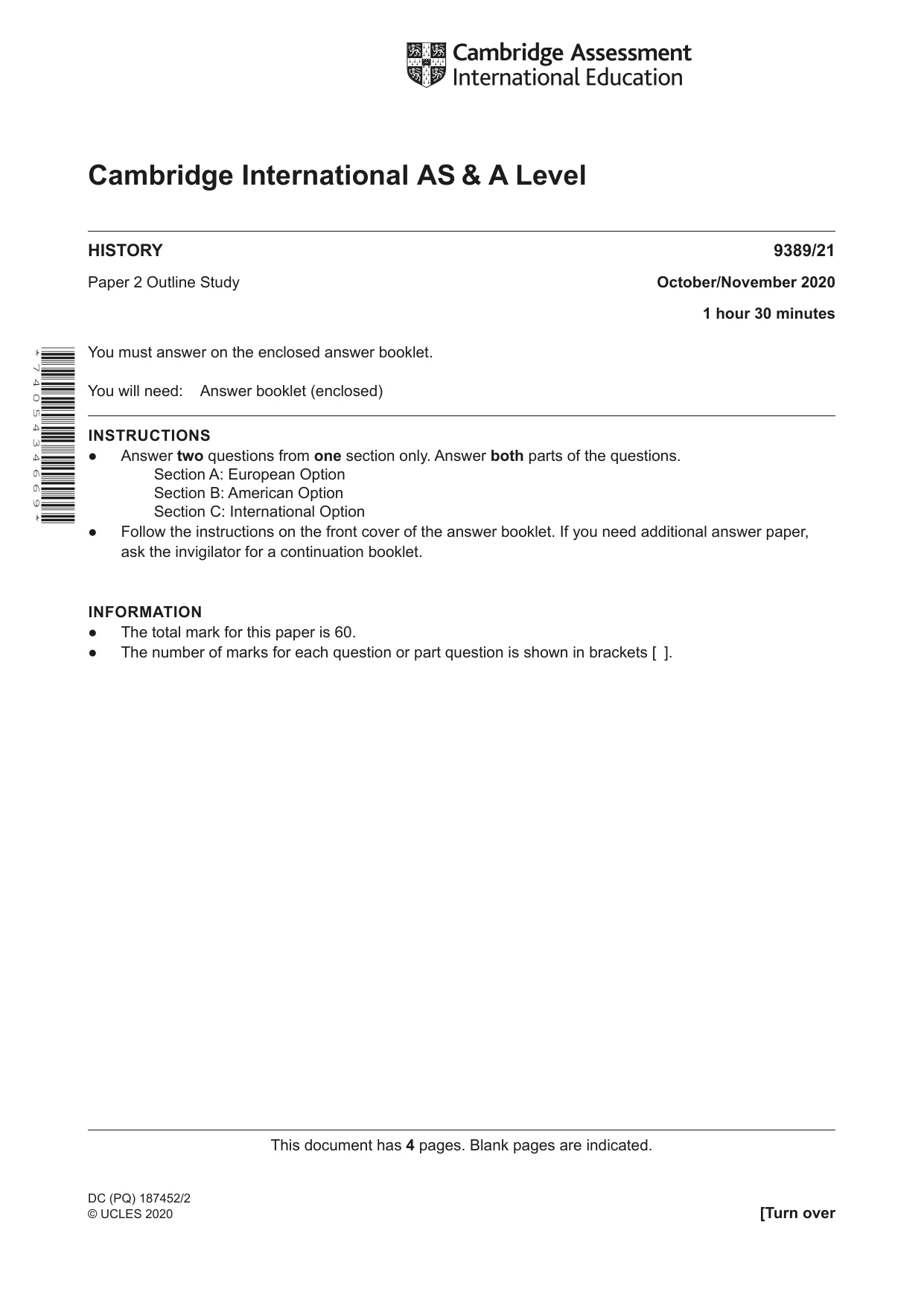
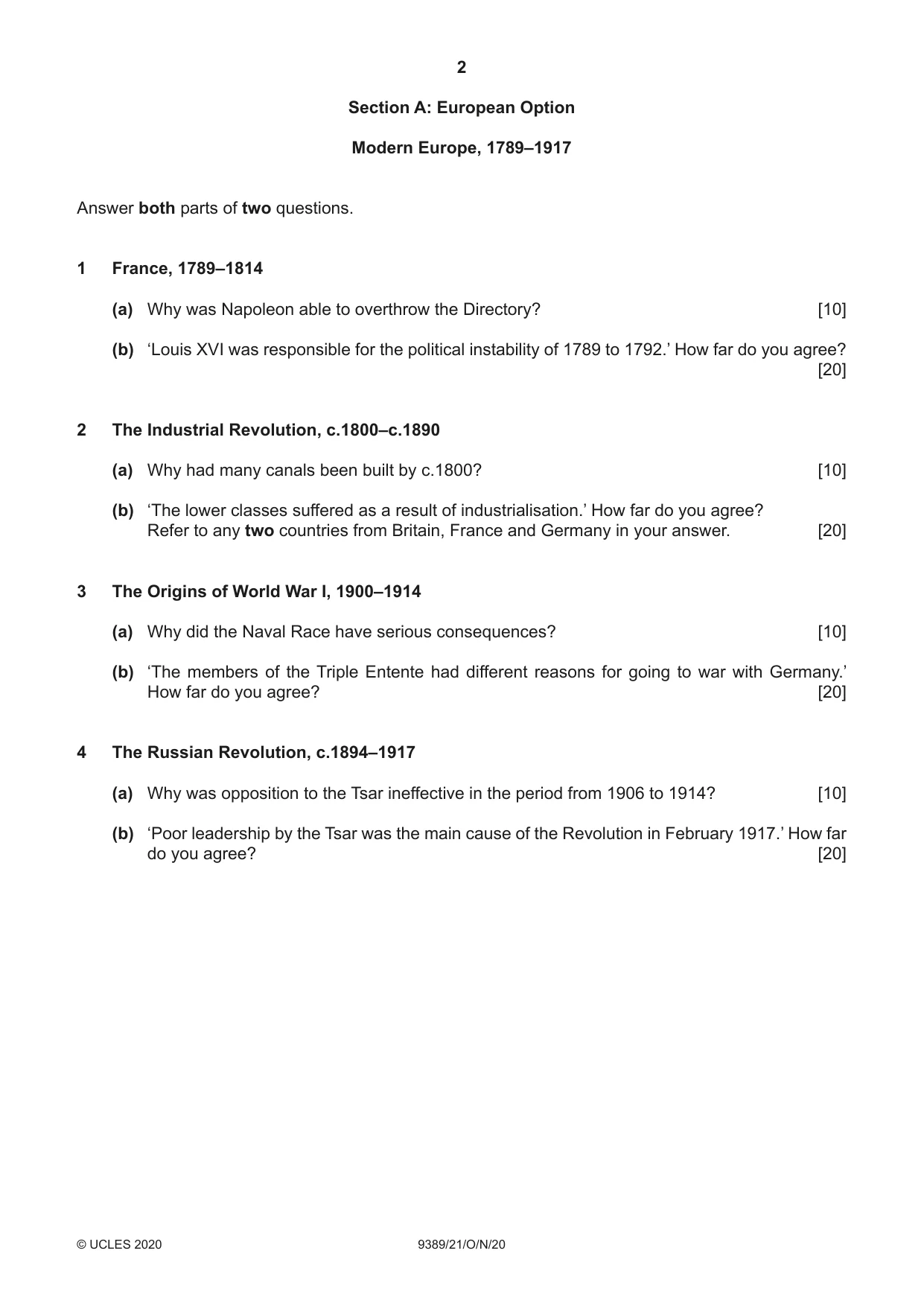
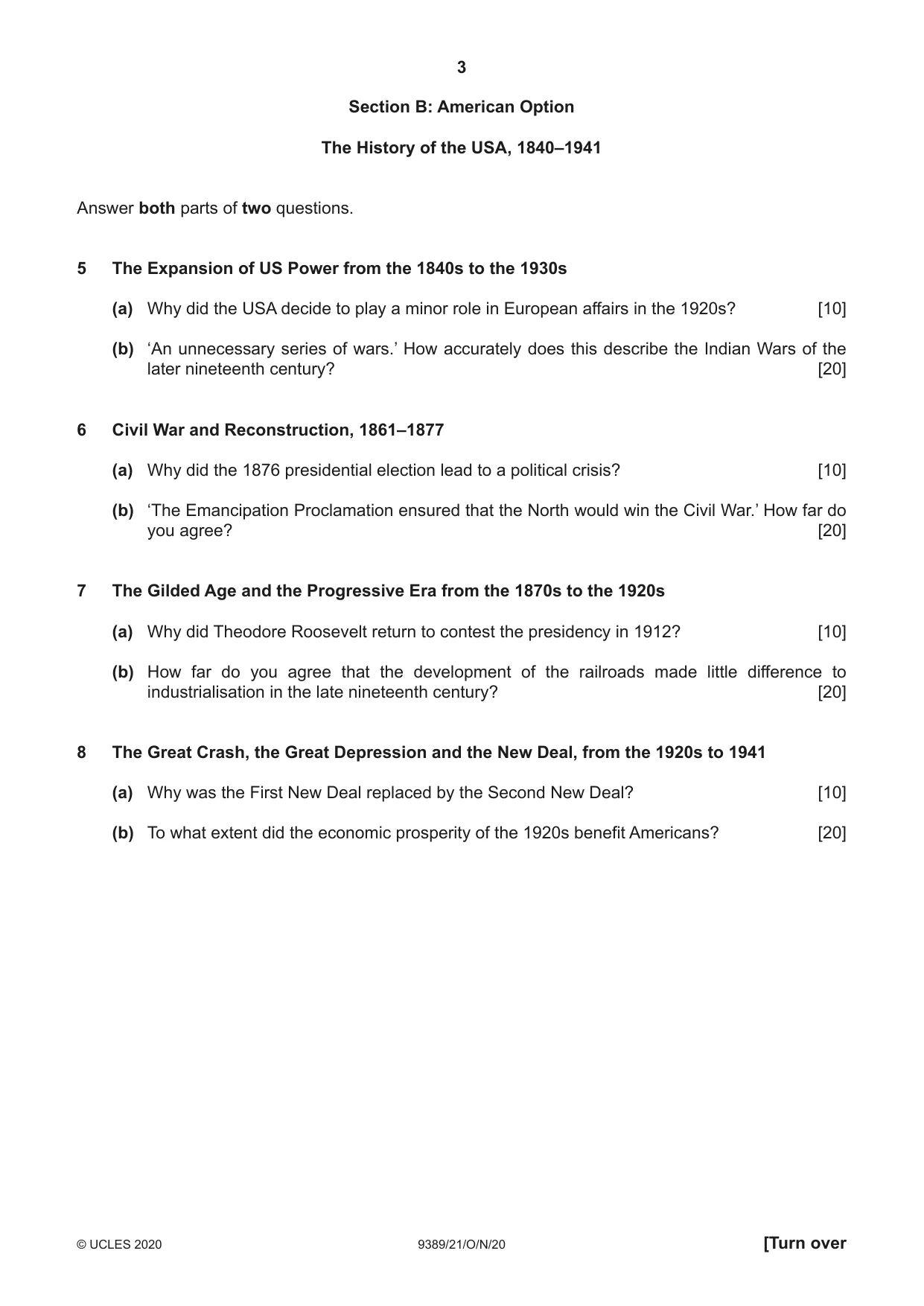
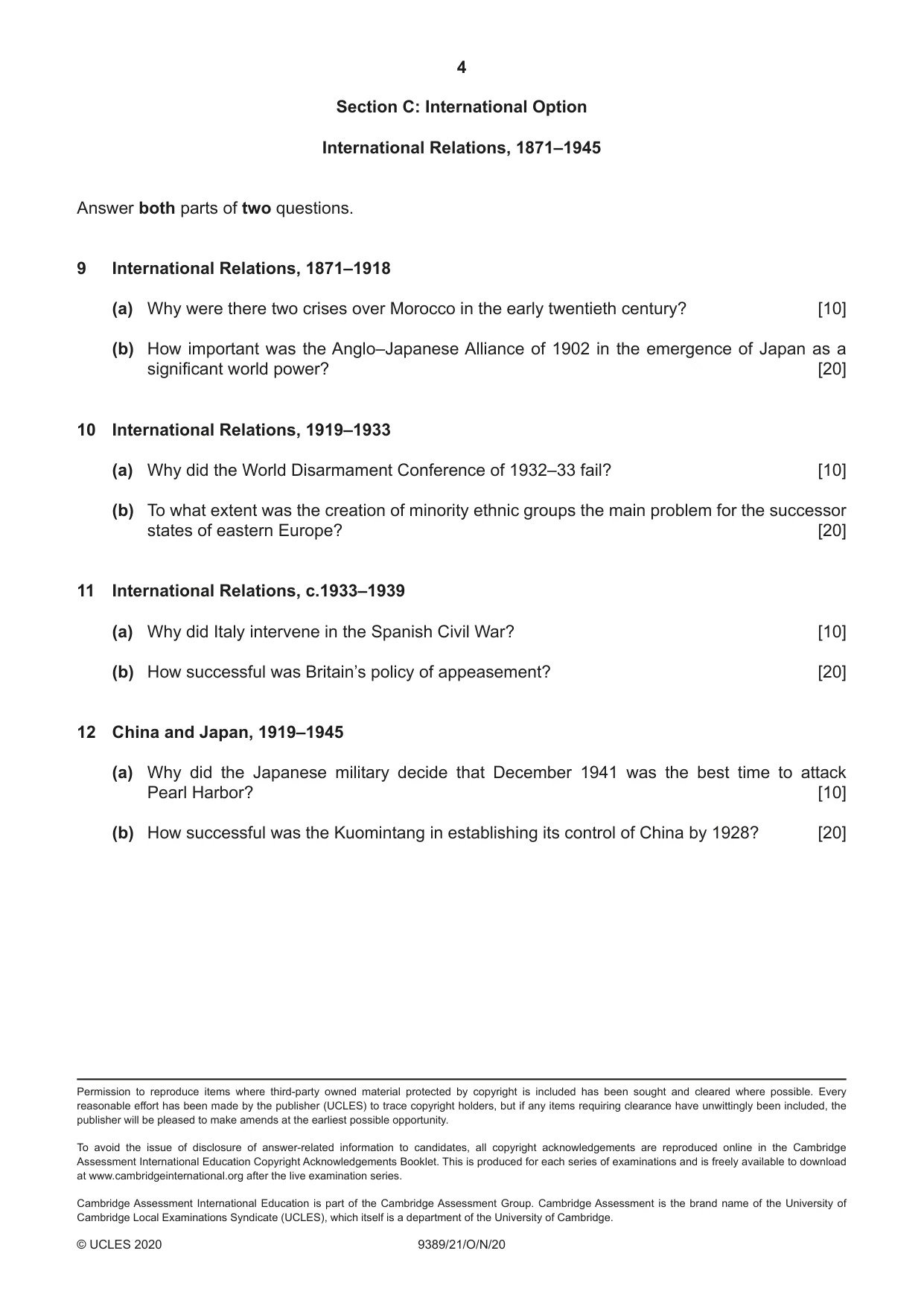
Mark scheme18 pages
Answers below. Sit the paper first if you are practising.

Questions as text
Q1 · France, 1789–1814 (a) Why was Napoleon able to overthrow the Directory?
1 France, 1789–1814 (a) Why was Napoleon able to overthrow the Directory? [10] (b) ‘Louis XVI was responsible for the political instability of 1789 to 1792.’ How far do you agree? [20]
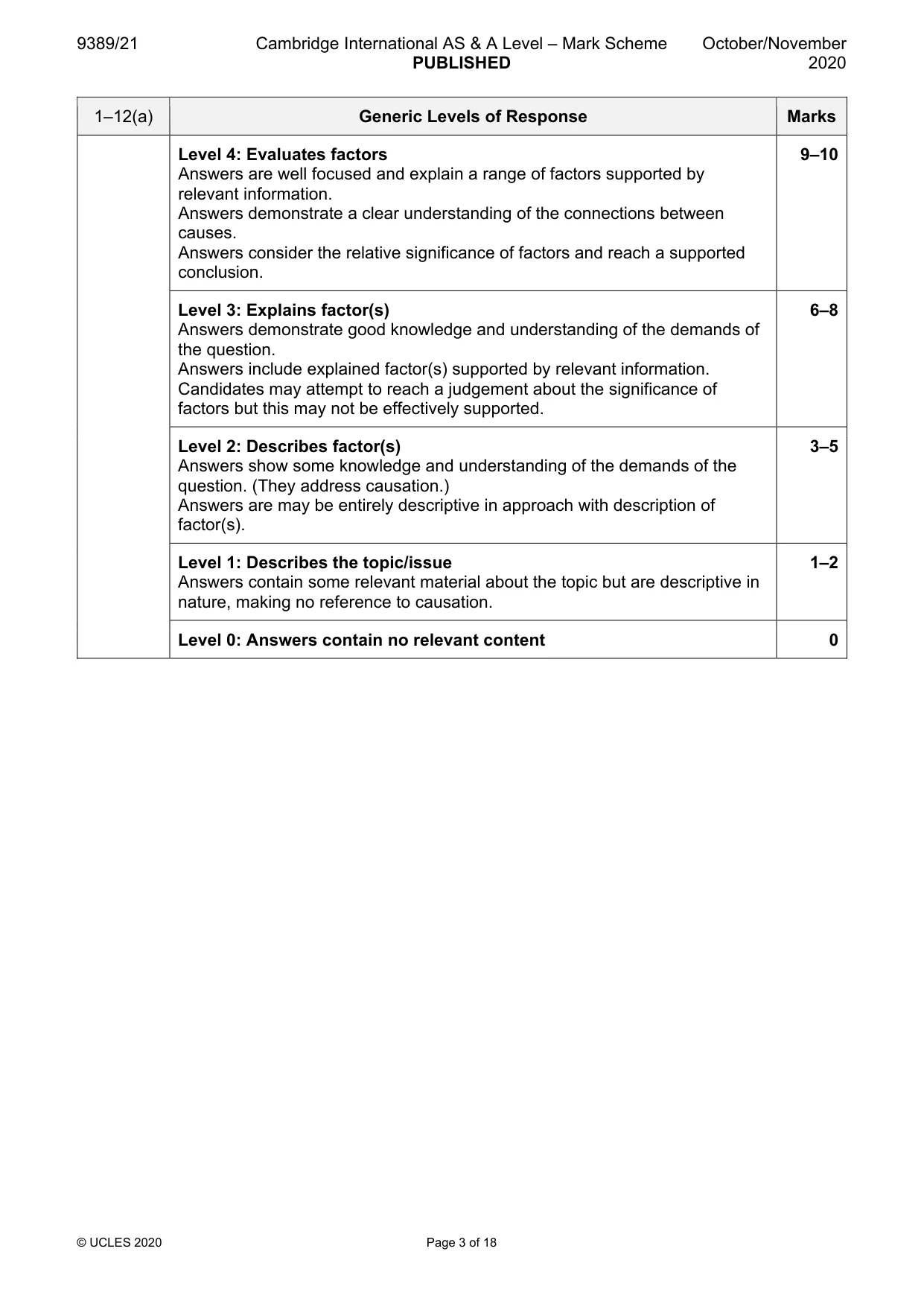
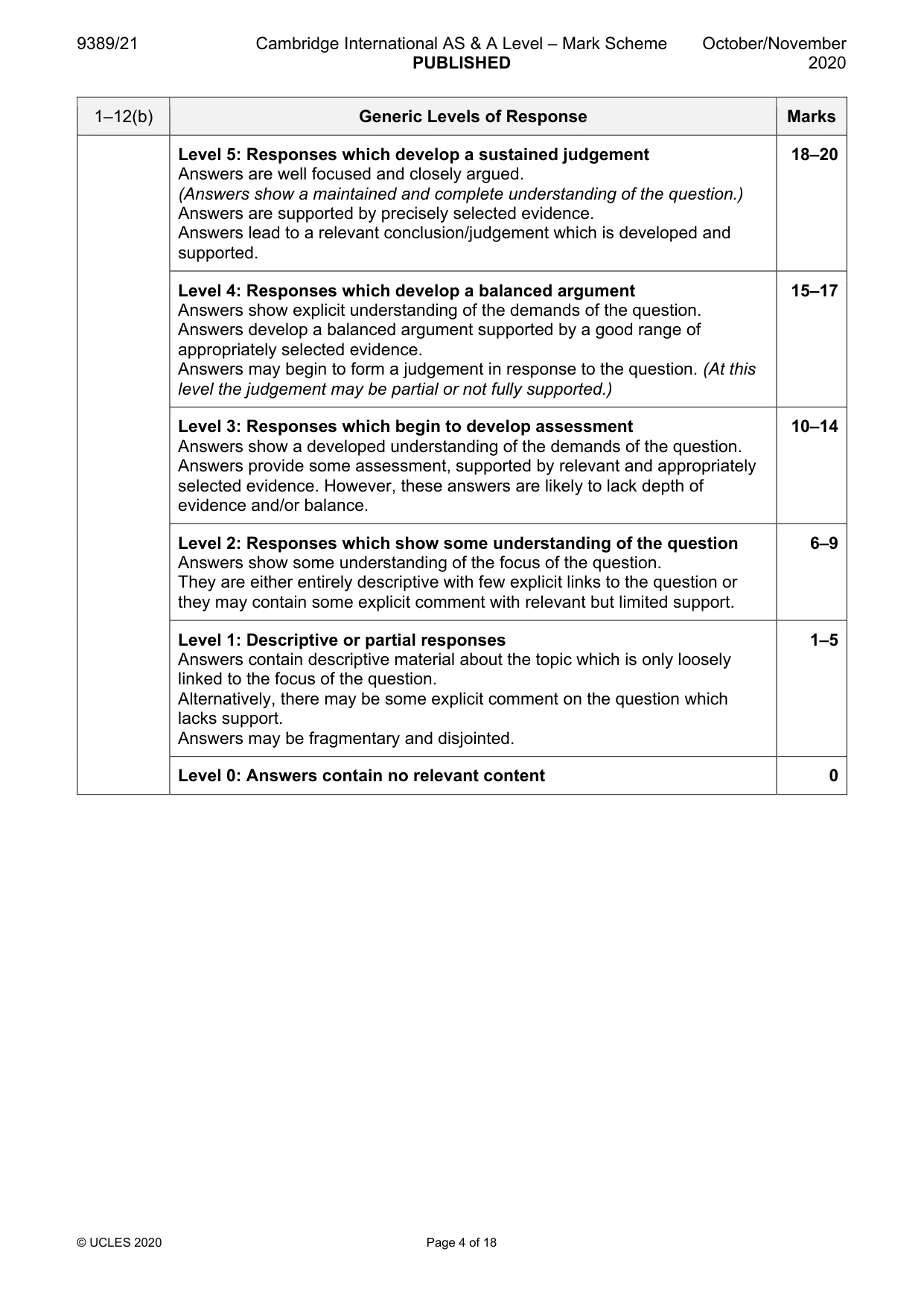
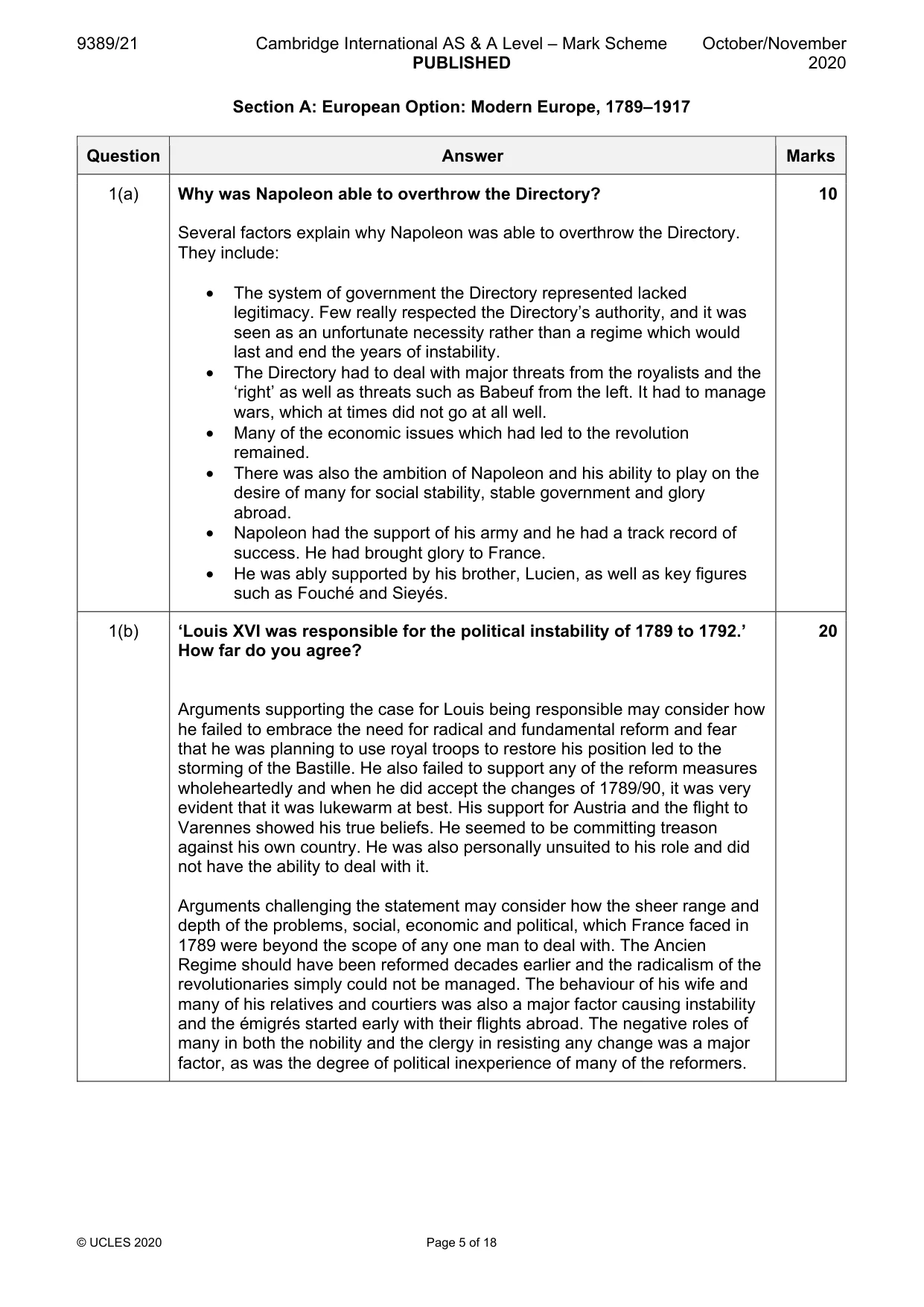
Mark scheme: Question Answer Marks 1(a) Why was Napoleon able to overthrow the Directory? 10 Several factors explain why Napoleon was able to overthrow the Directory. They include: • The system of government the Directory represented lacked legitimacy. Few really respected the Directory’s authority, and it was seen as an unfortunate necessity rather than a regime which would last and end the years of instability. • The Directory had to deal with major threats from the royalists and the ‘right’ as well as threats such as Babeuf from the left. It had to manage wars, which at times did not go at all well. • Many of the economic issues which had led to the revolution remained. • There was also the ambition of Napoleon and his ability to play on the desire of many for social stability, stable government and glory abroad. • Napoleon had the support of his army and he had a track record of success. He had brought glory to France. • He was ably supported by his brother, Lucien, as well as key figures such as Fouché and Sieyés. 1(b) ‘Louis XVI was responsible for the political instability of 1789 to 1792.’ 20 How far do you agree? Arguments supporting the case for Louis being responsible may consider how he failed to embrace the need for radical and fundamental reform and fear that he was planning to use royal troops to restore his position led to the storming of the Bastille. He also failed to support any of the reform measures wholeheartedly and when he did accept the changes of 1789/90, it was very evident that it was lukewarm at best. His support for Austria and the flight to Varennes showed his true beliefs. He seemed to be committing treason against his own country. He was also personally unsuited to his role and did not have the ability to deal with it. Arguments challenging the statement may consider how the sheer range and depth of the problems, social, economic and political, which France faced in 1789 were beyond the scope of any one man to deal with. The Ancien Regime should have been reformed decades earlier and the radicalism of the revolutionaries simply could not be managed. The behaviour of his wife and many of his relatives and courtiers was also a major factor causing instability and the émigrés started early with their flights abroad. The negative roles of many in both the nobility and the clergy in resisting any change was a major factor, as was the degree of political inexperience of many of the reformers.
Q2 · The Industrial Revolution, c.1800–c.1890 (a) Why had many canals been built by c.1800?
2 The Industrial Revolution, c.1800–c.1890 (a) Why had many canals been built by c.1800? [10] (b) ‘The lower classes suffered as a result of industrialisation.’ How far do you agree? Refer to any two countries from Britain, France and Germany in your answer. [20]
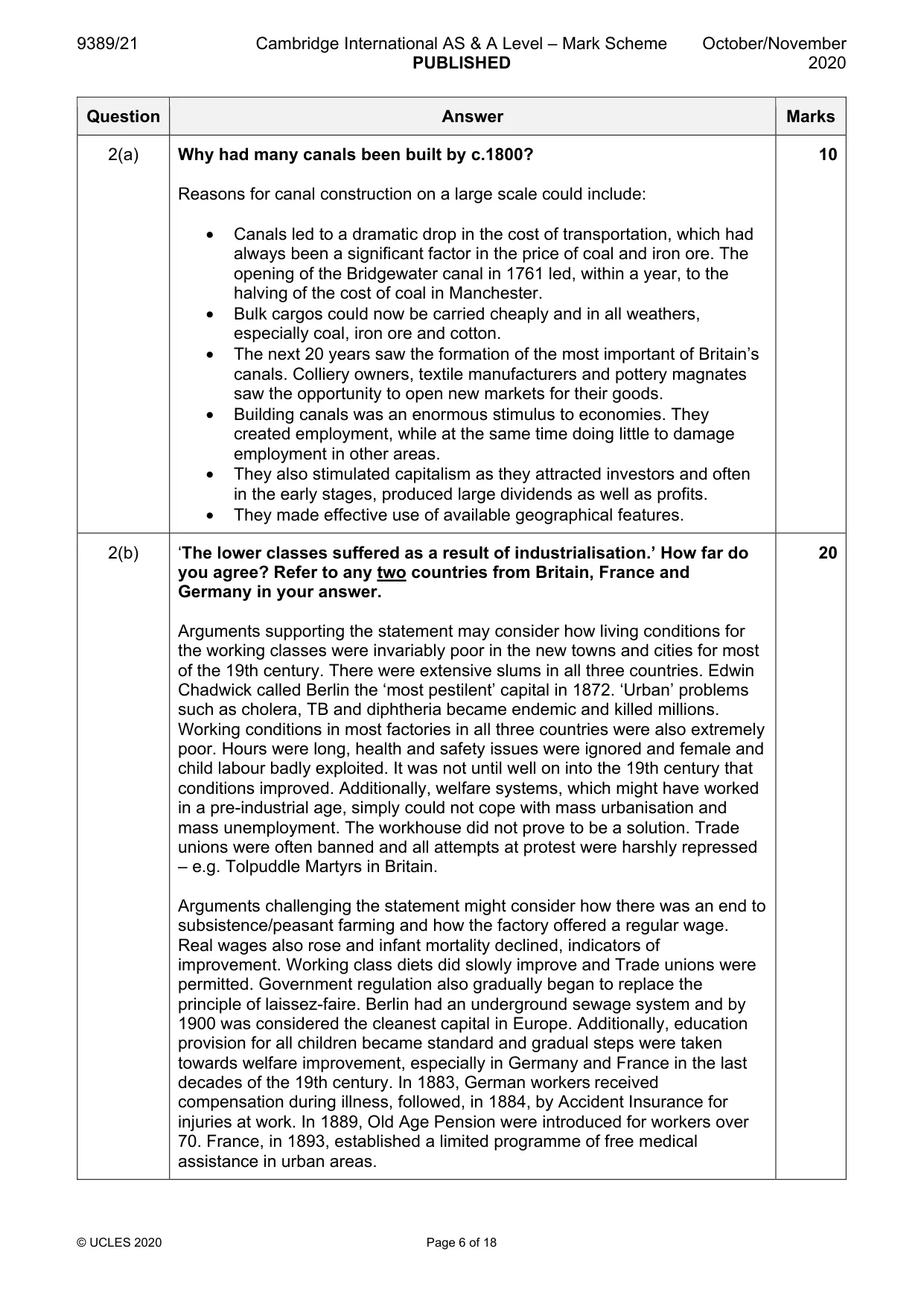
Mark scheme: 2(a) Why had many canals been built by c.1800? 10 Reasons for canal construction on a large scale could include: • Canals led to a dramatic drop in the cost of transportation, which had always been a significant factor in the price of coal and iron ore. The opening of the Bridgewater canal in 1761 led, within a year, to the halving of the cost of coal in Manchester. • Bulk cargos could now be carried cheaply and in all weathers, especially coal, iron ore and cotton. • The next 20 years saw the formation of the most important of Britain’s canals. Colliery owners, textile manufacturers and pottery magnates saw the opportunity to open new markets for their goods. • Building canals was an enormous stimulus to economies. They created employment, while at the same time doing little to damage employment in other areas. • They also stimulated capitalism as they attracted investors and often in the early stages, produced large dividends as well as profits. • They made effective use of available geographical features. 2(b) ‘The lower classes suffered as a result of industrialisation.’ How far do 20 you agree? Refer to any two countries from Britain, France and Germany in your answer. Arguments supporting the statement may consider how living conditions for the working classes were invariably poor in the new towns and cities for most of the 19th century. There were extensive slums in all three countries. Edwin Chadwick called Berlin the ‘most pestilent’ capital in 1872. ‘Urban’ problems such as cholera, TB and diphtheria became endemic and killed millions. Working conditions in most factories in all three countries were also extremely poor. Hours were long, health and safety issues were ignored and female and child labour badly exploited. It was not until well on into the 19th century that conditions improved. Additionally, welfare systems, which might have worked in a pre-industrial age, simply could not cope with mass urbanisation and mass unemployment. The workhouse did not prove to be a solution. Trade unions were often banned and all attempts at protest were harshly repressed – e.g. Tolpuddle Martyrs in Britain. Arguments challenging the statement might consider how there was an end to subsistence/peasant farming and how the factory offered a regular wage. Real wages also rose and infant mortality declined, indicators of improvement. Working class diets did slowly improve and Trade unions were permitted. Government regulation also gradually began to replace the principle of laissez-faire. Berlin had an underground sewage system and by 1900 was considered the cleanest capital in Europe. Additionally, education provision for all children became standard and gradual steps were taken towards welfare improvement, especially in Germany and France in the last decades of the 19th century. In 1883, German workers received compensation during illness, followed, in 1884, by Accident Insurance for injuries at work. In 1889, Old Age Pension were introduced for workers over 70. France, in 1893, established a limited programme of free medical assistance in urban areas.
Q3 · The Origins of World War I, 1900–1914 (a) Why did the Naval Race have serious…
3 The Origins of World War I, 1900–1914 (a) Why did the Naval Race have serious consequences? [10] (b) ‘The members of the Triple Entente had different reasons for going to war with Germany.’ How far do you agree? [20]
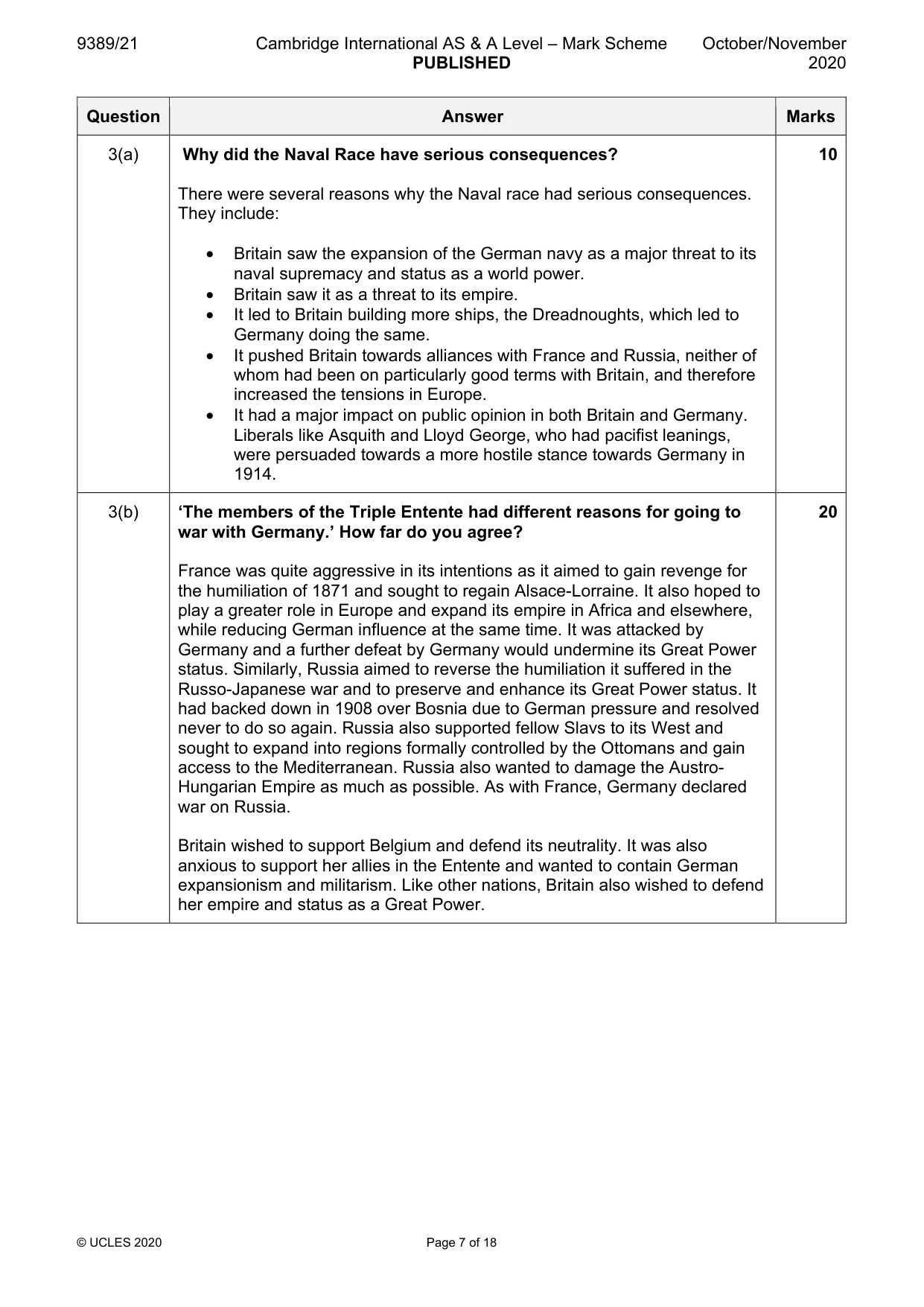
Mark scheme: 3(a) Why did the Naval Race have serious consequences? 10 There were several reasons why the Naval race had serious consequences. They include: • Britain saw the expansion of the German navy as a major threat to its naval supremacy and status as a world power. • Britain saw it as a threat to its empire. • It led to Britain building more ships, the Dreadnoughts, which led to Germany doing the same. • It pushed Britain towards alliances with France and Russia, neither of whom had been on particularly good terms with Britain, and therefore increased the tensions in Europe. • It had a major impact on public opinion in both Britain and Germany. Liberals like Asquith and Lloyd George, who had pacifist leanings, were persuaded towards a more hostile stance towards Germany in 1914. 3(b) ‘The members of the Triple Entente had different reasons for going to 20 war with Germany.’ How far do you agree? France was quite aggressive in its intentions as it aimed to gain revenge for the humiliation of 1871 and sought to regain Alsace-Lorraine. It also hoped to play a greater role in Europe and expand its empire in Africa and elsewhere, while reducing German influence at the same time. It was attacked by Germany and a further defeat by Germany would undermine its Great Power status. Similarly, Russia aimed to reverse the humiliation it suffered in the Russo-Japanese war and to preserve and enhance its Great Power status. It had backed down in 1908 over Bosnia due to German pressure and resolved never to do so again. Russia also supported fellow Slavs to its West and sought to expand into regions formally controlled by the Ottomans and gain access to the Mediterranean. Russia also wanted to damage the Austro- Hungarian Empire as much as possible. As with France, Germany declared war on Russia. Britain wished to support Belgium and defend its neutrality. It was also anxious to support her allies in the Entente and wanted to contain German expansionism and militarism. Like other nations, Britain also wished to defend her empire and status as a Great Power.
Q4 · The Russian Revolution, c.1894–1917 (a) Why was opposition to the Tsar ineffective in the…
4 The Russian Revolution, c.1894–1917 (a) Why was opposition to the Tsar ineffective in the period from 1906 to 1914? [10] (b) ‘Poor leadership by the Tsar was the main cause of the Revolution in February 1917.’ How far do you agree? [20]
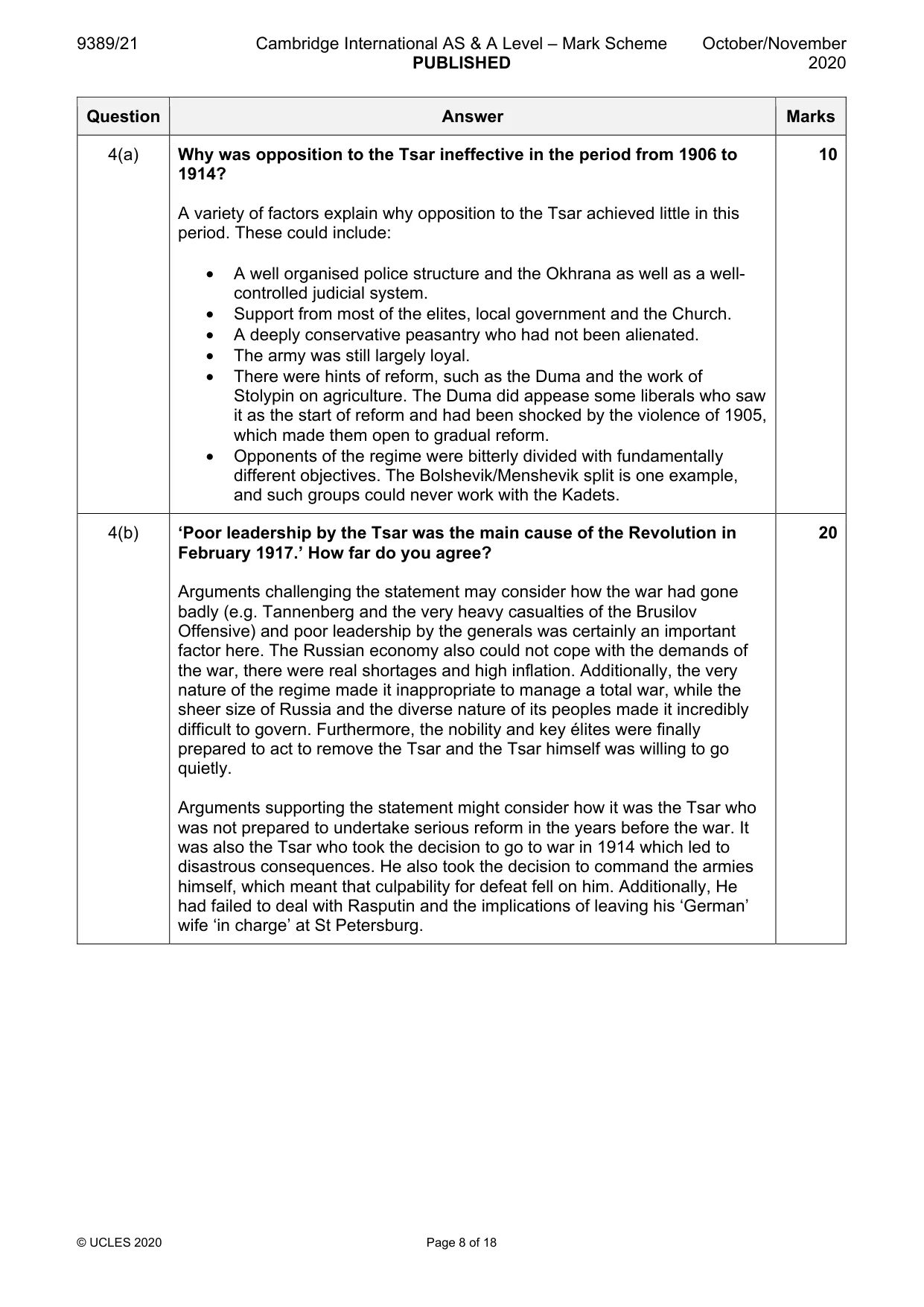
Mark scheme: 4(a) Why was opposition to the Tsar ineffective in the period from 1906 to 10 1914? A variety of factors explain why opposition to the Tsar achieved little in this period. These could include: • A well organised police structure and the Okhrana as well as a well- controlled judicial system. • Support from most of the elites, local government and the Church. • A deeply conservative peasantry who had not been alienated. • The army was still largely loyal. • There were hints of reform, such as the Duma and the work of Stolypin on agriculture. The Duma did appease some liberals who saw it as the start of reform and had been shocked by the violence of 1905, which made them open to gradual reform. • Opponents of the regime were bitterly divided with fundamentally different objectives. The Bolshevik/Menshevik split is one example, and such groups could never work with the Kadets. 4(b) ‘Poor leadership by the Tsar was the main cause of the Revolution in 20 February 1917.’ How far do you agree? Arguments challenging the statement may consider how the war had gone badly (e.g. Tannenberg and the very heavy casualties of the Brusilov Offensive) and poor leadership by the generals was certainly an important factor here. The Russian economy also could not cope with the demands of the war, there were real shortages and high inflation. Additionally, the very nature of the regime made it inappropriate to manage a total war, while the sheer size of Russia and the diverse nature of its peoples made it incredibly difficult to govern. Furthermore, the nobility and key élites were finally prepared to act to remove the Tsar and the Tsar himself was willing to go quietly. Arguments supporting the statement might consider how it was the Tsar who was not prepared to undertake serious reform in the years before the war. It was also the Tsar who took the decision to go to war in 1914 which led to disastrous consequences. He also took the decision to command the armies himself, which meant that culpability for defeat fell on him. Additionally, He had failed to deal with Rasputin and the implications of leaving his ‘German’ wife ‘in charge’ at St Petersburg. Section B: American Option: The History of the USA, 1840–1941
Q5 · The Expansion of US Power from the 1840s to the 1930s (a) Why did the USA decide to play…
5 The Expansion of US Power from the 1840s to the 1930s (a) Why did the USA decide to play a minor role in European affairs in the 1920s? [10] (b) ‘An unnecessary series of wars.’ How accurately does this describe the Indian Wars of the later nineteenth century? [20]
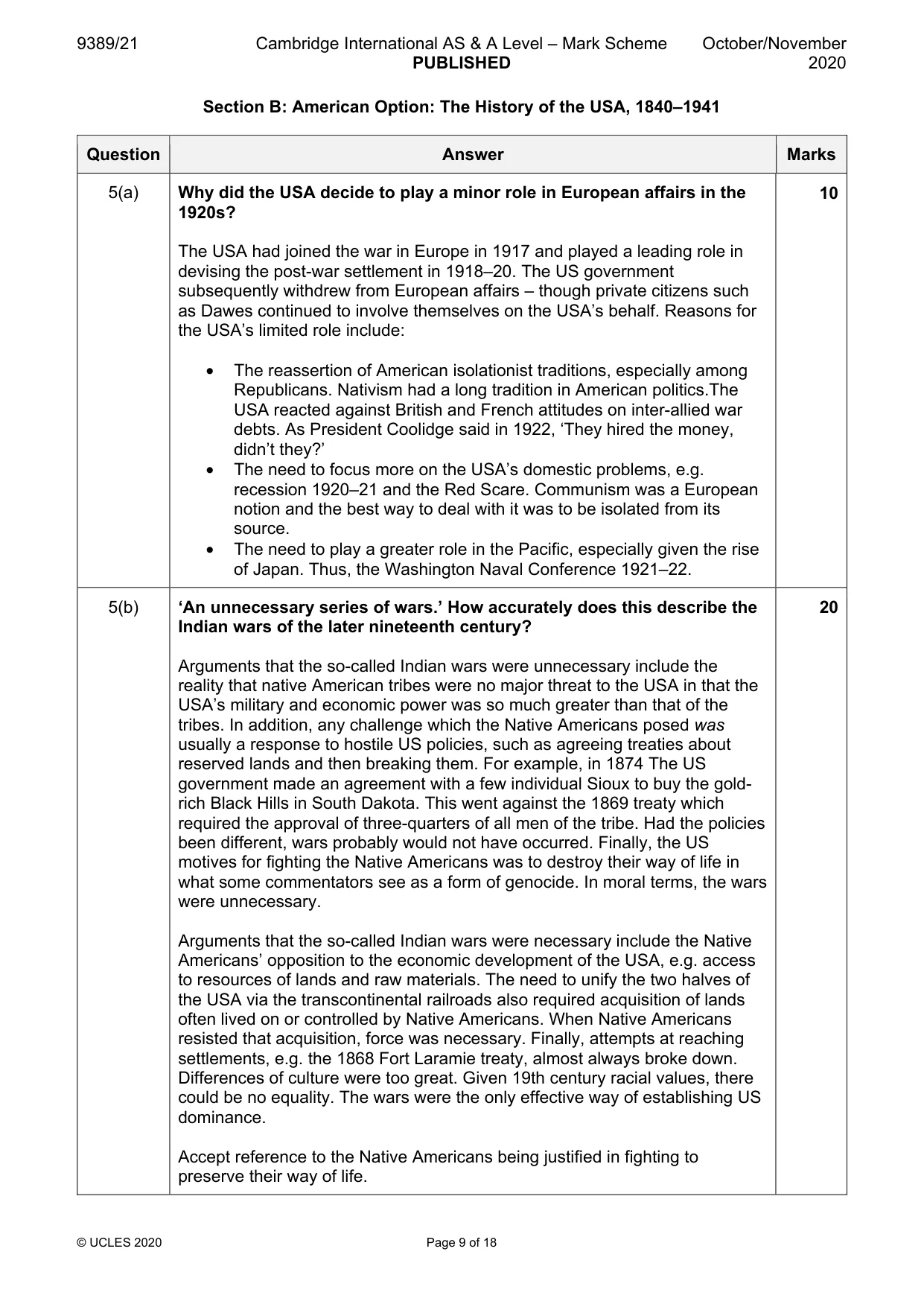
Mark scheme: 5(a) Why did the USA decide to play a minor role in European affairs in the 10 1920s? The USA had joined the war in Europe in 1917 and played a leading role in devising the post-war settlement in 1918–20. The US government subsequently withdrew from European affairs – though private citizens such as Dawes continued to involve themselves on the USA’s behalf. Reasons for the USA’s limited role include: • The reassertion of American isolationist traditions, especially among Republicans. Nativism had a long tradition in American politics.The USA reacted against British and French attitudes on inter-allied war debts. As President Coolidge said in 1922, ‘They hired the money, didn’t they?’ • The need to focus more on the USA’s domestic problems, e.g. recession 1920–21 and the Red Scare. Communism was a European notion and the best way to deal with it was to be isolated from its source. • The need to play a greater role in the Pacific, especially given the rise of Japan. Thus, the Washington Naval Conference 1921–22. 5(b) ‘An unnecessary series of wars.’ How accurately does this describe the 20 Indian wars of the later nineteenth century? Arguments that the so-called Indian wars were unnecessary include the reality that native American tribes were no major threat to the USA in that the USA’s military and economic power was so much greater than that of the tribes. In addition, any challenge which the Native Americans posed was usually a response to hostile US policies, such as agreeing treaties about reserved lands and then breaking them. For example, in 1874 The US government made an agreement with a few individual Sioux to buy the gold- rich Black Hills in South Dakota. This went against the 1869 treaty which required the approval of three-quarters of all men of the tribe. Had the policies been different, wars probably would not have occurred. Finally, the US motives for fighting the Native Americans was to destroy their way of life in what some commentators see as a form of genocide. In moral terms, the wars were unnecessary. Arguments that the so-called Indian wars were necessary include the Native Americans’ opposition to the economic development of the USA, e.g. access to resources of lands and raw materials. The need to unify the two halves of the USA via the transcontinental railroads also required acquisition of lands often lived on or controlled by Native Americans. When Native Americans resisted that acquisition, force was necessary. Finally, attempts at reaching settlements, e.g. the 1868 Fort Laramie treaty, almost always broke down. Differences of culture were too great. Given 19th century racial values, there could be no equality. The wars were the only effective way of establishing US dominance. Accept reference to the Native Americans being justified in fighting to preserve their way of life.
Q6 · Civil War and Reconstruction, 1861–1877 (a) Why did the 1876 presidential election lead…
6 Civil War and Reconstruction, 1861–1877 (a) Why did the 1876 presidential election lead to a political crisis? [10] (b) ‘The Emancipation Proclamation ensured that the North would win the Civil War.’ How far do you agree? [20]
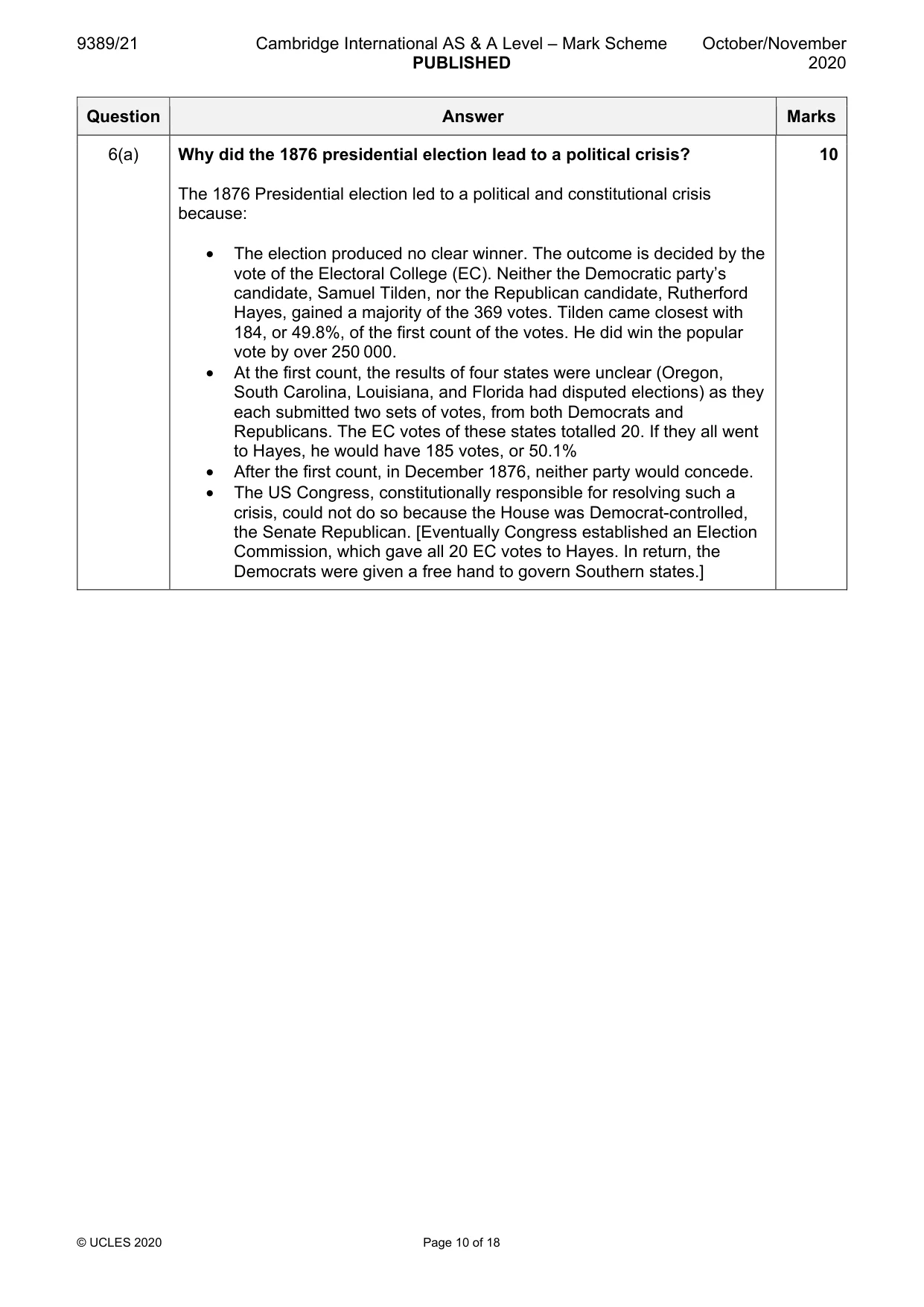
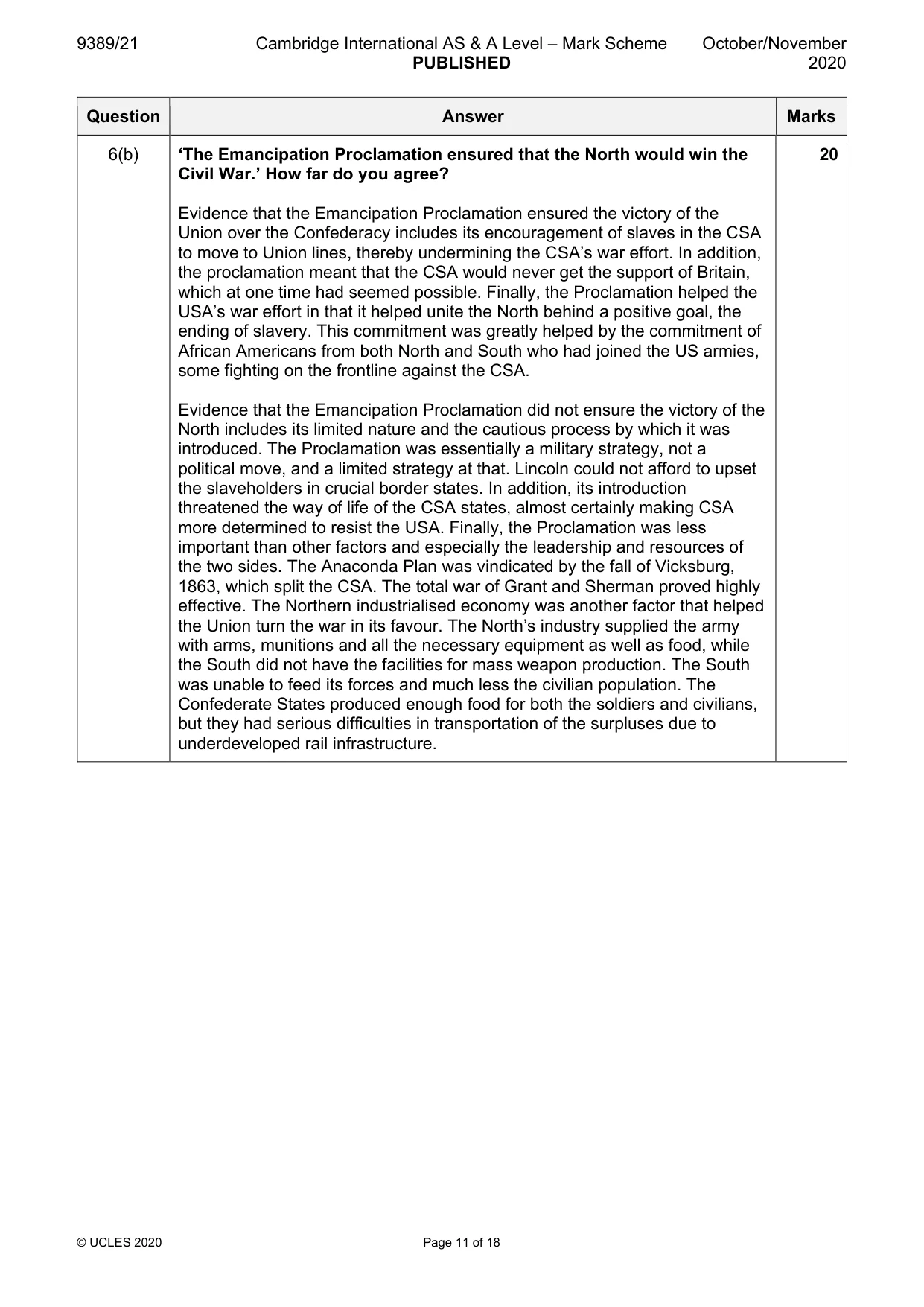
Mark scheme: 6(a) Why did the 1876 presidential election lead to a political crisis? 10 The 1876 Presidential election led to a political and constitutional crisis because: • The election produced no clear winner. The outcome is decided by the vote of the Electoral College (EC). Neither the Democratic party’s candidate, Samuel Tilden, nor the Republican candidate, Rutherford Hayes, gained a majority of the 369 votes. Tilden came closest with 184, or 49.8%, of the first count of the votes. He did win the popular vote by over 250 000. • At the first count, the results of four states were unclear (Oregon, South Carolina, Louisiana, and Florida had disputed elections) as they each submitted two sets of votes, from both Democrats and Republicans. The EC votes of these states totalled 20. If they all went to Hayes, he would have 185 votes, or 50.1% • After the first count, in December 1876, neither party would concede. • The US Congress, constitutionally responsible for resolving such a crisis, could not do so because the House was Democrat-controlled, the Senate Republican. [Eventually Congress established an Election Commission, which gave all 20 EC votes to Hayes. In return, the Democrats were given a free hand to govern Southern states.] 6(b) ‘The Emancipation Proclamation ensured that the North would win the 20 Civil War.’ How far do you agree? Evidence that the Emancipation Proclamation ensured the victory of the Union over the Confederacy includes its encouragement of slaves in the CSA to move to Union lines, thereby undermining the CSA’s war effort. In addition, the proclamation meant that the CSA would never get the support of Britain, which at one time had seemed possible. Finally, the Proclamation helped the USA’s war effort in that it helped unite the North behind a positive goal, the ending of slavery. This commitment was greatly helped by the commitment of African Americans from both North and South who had joined the US armies, some fighting on the frontline against the CSA. Evidence that the Emancipation Proclamation did not ensure the victory of the North includes its limited nature and the cautious process by which it was introduced. The Proclamation was essentially a military strategy, not a political move, and a limited strategy at that. Lincoln could not afford to upset the slaveholders in crucial border states. In addition, its introduction threatened the way of life of the CSA states, almost certainly making CSA more determined to resist the USA. Finally, the Proclamation was less important than other factors and especially the leadership and resources of the two sides. The Anaconda Plan was vindicated by the fall of Vicksburg, 1863, which split the CSA. The total war of Grant and Sherman proved highly effective. The Northern industrialised economy was another factor that helped the Union turn the war in its favour. The North’s industry supplied the army with arms, munitions and all the necessary equipment as well as food, while the South did not have the facilities for mass weapon production. The South was unable to feed its forces and much less the civilian population. The Confederate States produced enough food for both the soldiers and civilians, but they had serious difficulties in transportation of the surpluses due to underdeveloped rail infrastructure.
Q7 · The Gilded Age and the Progressive Era from the 1870s to the 1920s (a) Why did Theodore…
7 The Gilded Age and the Progressive Era from the 1870s to the 1920s (a) Why did Theodore Roosevelt return to contest the presidency in 1912? [10] (b) How far do you agree that the development of the railroads made little difference to industrialisation in the late nineteenth century? [20]
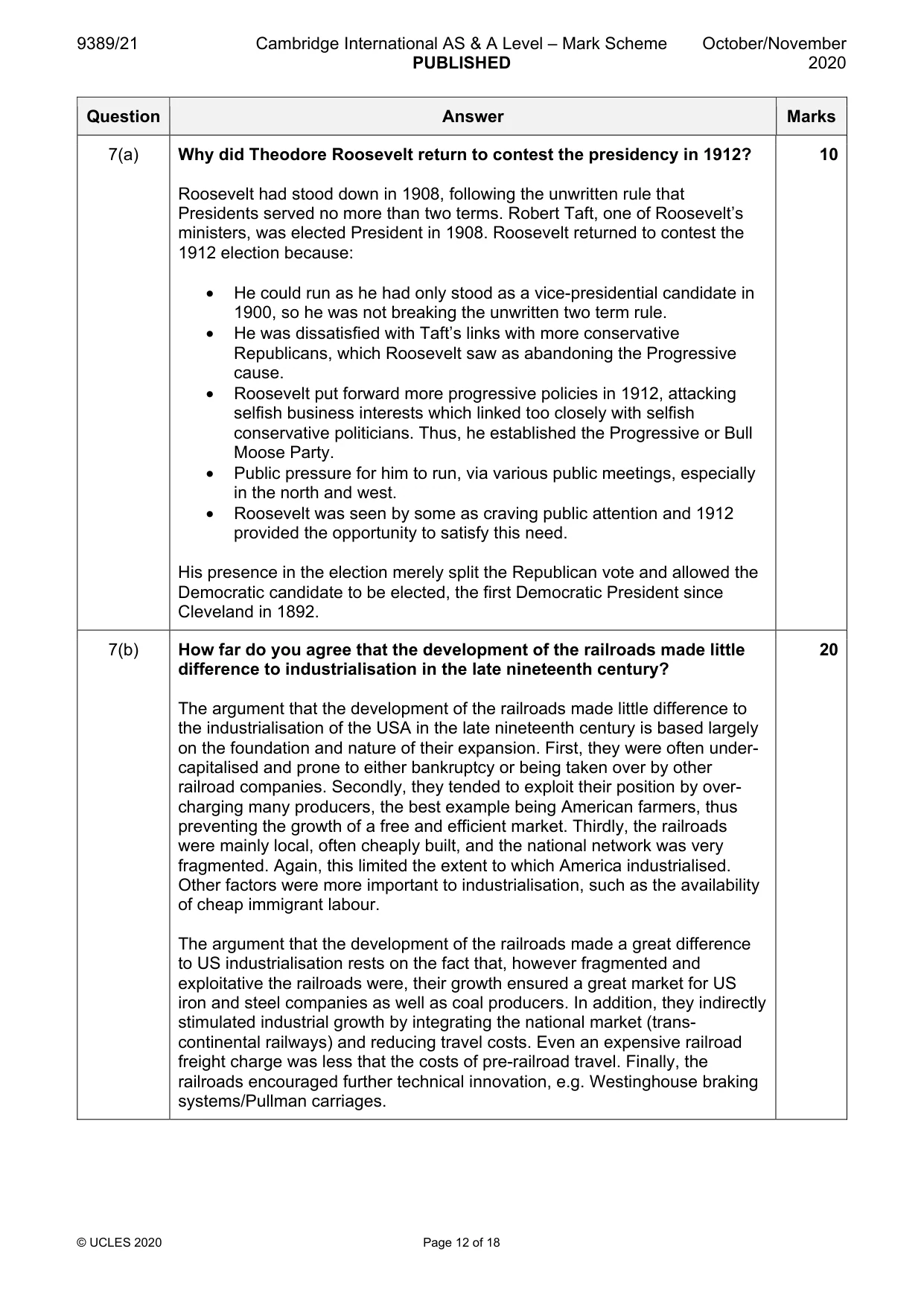
Mark scheme: 7(a) Why did Theodore Roosevelt return to contest the presidency in 1912? 10 Roosevelt had stood down in 1908, following the unwritten rule that Presidents served no more than two terms. Robert Taft, one of Roosevelt’s ministers, was elected President in 1908. Roosevelt returned to contest the 1912 election because: • He could run as he had only stood as a vice-presidential candidate in 1900, so he was not breaking the unwritten two term rule. • He was dissatisfied with Taft’s links with more conservative Republicans, which Roosevelt saw as abandoning the Progressive cause. • Roosevelt put forward more progressive policies in 1912, attacking selfish business interests which linked too closely with selfish conservative politicians. Thus, he established the Progressive or Bull Moose Party. • Public pressure for him to run, via various public meetings, especially in the north and west. • Roosevelt was seen by some as craving public attention and 1912 provided the opportunity to satisfy this need. His presence in the election merely split the Republican vote and allowed the Democratic candidate to be elected, the first Democratic President since Cleveland in 1892. 7(b) How far do you agree that the development of the railroads made little 20 difference to industrialisation in the late nineteenth century? The argument that the development of the railroads made little difference to the industrialisation of the USA in the late nineteenth century is based largely on the foundation and nature of their expansion. First, they were often under- capitalised and prone to either bankruptcy or being taken over by other railroad companies. Secondly, they tended to exploit their position by over- charging many producers, the best example being American farmers, thus preventing the growth of a free and efficient market. Thirdly, the railroads were mainly local, often cheaply built, and the national network was very fragmented. Again, this limited the extent to which America industrialised. Other factors were more important to industrialisation, such as the availability of cheap immigrant labour. The argument that the development of the railroads made a great difference to US industrialisation rests on the fact that, however fragmented and exploitative the railroads were, their growth ensured a great market for US iron and steel companies as well as coal producers. In addition, they indirectly stimulated industrial growth by integrating the national market (trans- continental railways) and reducing travel costs. Even an expensive railroad freight charge was less that the costs of pre-railroad travel. Finally, the railroads encouraged further technical innovation, e.g. Westinghouse braking systems/Pullman carriages.
Q8 · The Great Crash, the Great Depression and the New Deal, from the 1920s to 1941 (a) Why…
8 The Great Crash, the Great Depression and the New Deal, from the 1920s to 1941 (a) Why was the First New Deal replaced by the Second New Deal? [10] (b) To what extent did the economic prosperity of the 1920s benefit Americans? [20] Section C: International Option International Relations, 1871–1945 Answer both parts of two questions.
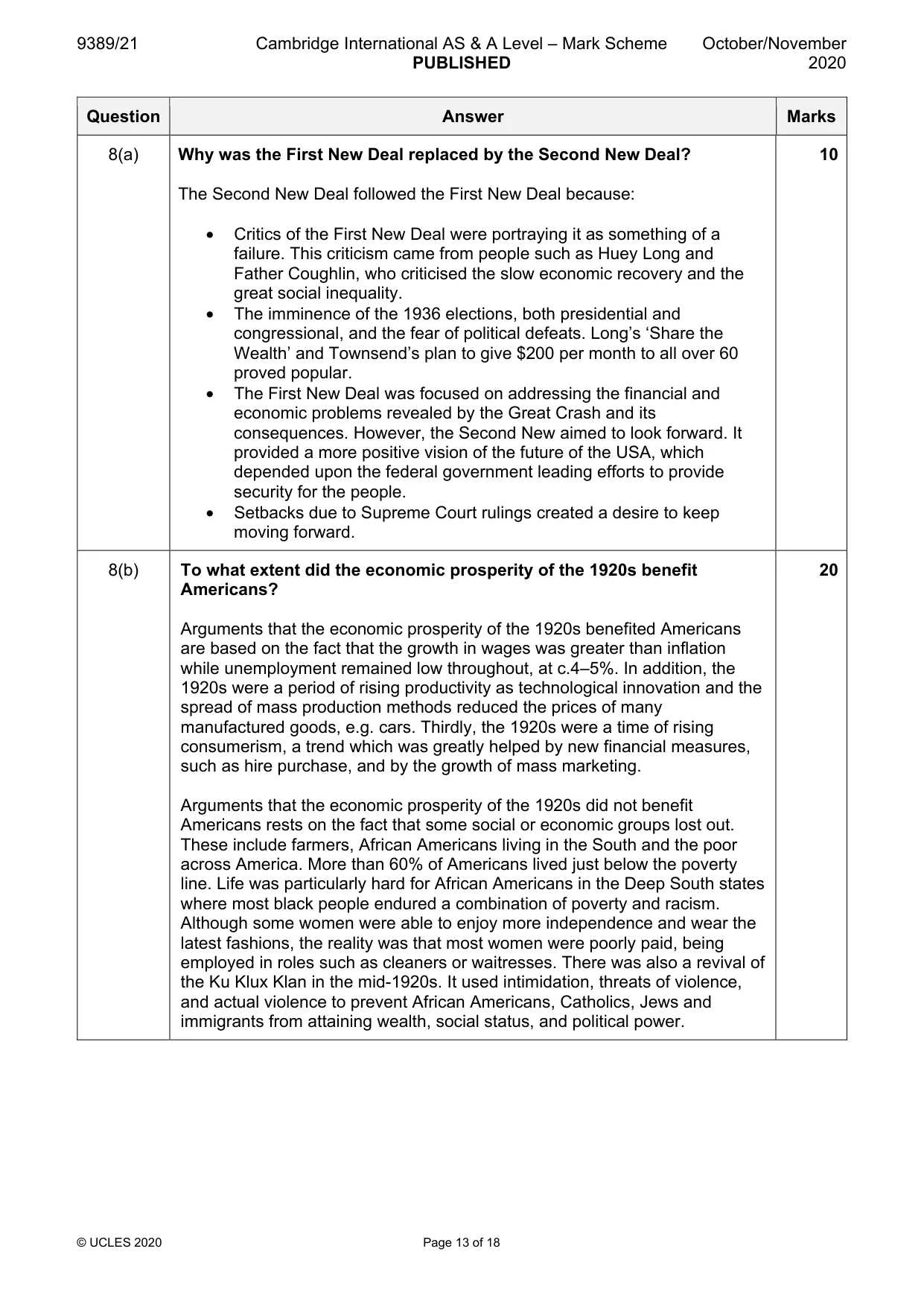
Mark scheme: 8(a) Why was the First New Deal replaced by the Second New Deal? 10 The Second New Deal followed the First New Deal because: • Critics of the First New Deal were portraying it as something of a failure. This criticism came from people such as Huey Long and Father Coughlin, who criticised the slow economic recovery and the great social inequality. • The imminence of the 1936 elections, both presidential and congressional, and the fear of political defeats. Long’s ‘Share the Wealth’ and Townsend’s plan to give $200 per month to all over 60 proved popular. • The First New Deal was focused on addressing the financial and economic problems revealed by the Great Crash and its consequences. However, the Second New aimed to look forward. It provided a more positive vision of the future of the USA, which depended upon the federal government leading efforts to provide security for the people. • Setbacks due to Supreme Court rulings created a desire to keep moving forward. 8(b) To what extent did the economic prosperity of the 1920s benefit 20 Americans? Arguments that the economic prosperity of the 1920s benefited Americans are based on the fact that the growth in wages was greater than inflation while unemployment remained low throughout, at c.4–5%. In addition, the 1920s were a period of rising productivity as technological innovation and the spread of mass production methods reduced the prices of many manufactured goods, e.g. cars. Thirdly, the 1920s were a time of rising consumerism, a trend which was greatly helped by new financial measures, such as hire purchase, and by the growth of mass marketing. Arguments that the economic prosperity of the 1920s did not benefit Americans rests on the fact that some social or economic groups lost out. These include farmers, African Americans living in the South and the poor across America. More than 60% of Americans lived just below the poverty line. Life was particularly hard for African Americans in the Deep South states where most black people endured a combination of poverty and racism. Although some women were able to enjoy more independence and wear the latest fashions, the reality was that most women were poorly paid, being employed in roles such as cleaners or waitresses. There was also a revival of the Ku Klux Klan in the mid-1920s. It used intimidation, threats of violence, and actual violence to prevent African Americans, Catholics, Jews and immigrants from attaining wealth, social status, and political power. Section C: International Option: International Relations, 1871–1945
Q9 · International Relations, 1871–1918 (a) Why were there two crises over Morocco in the…
9 International Relations, 1871–1918 (a) Why were there two crises over Morocco in the early twentieth century? [10] (b) How important was the Anglo–Japanese Alliance of 1902 in the emergence of Japan as a significant world power? [20]
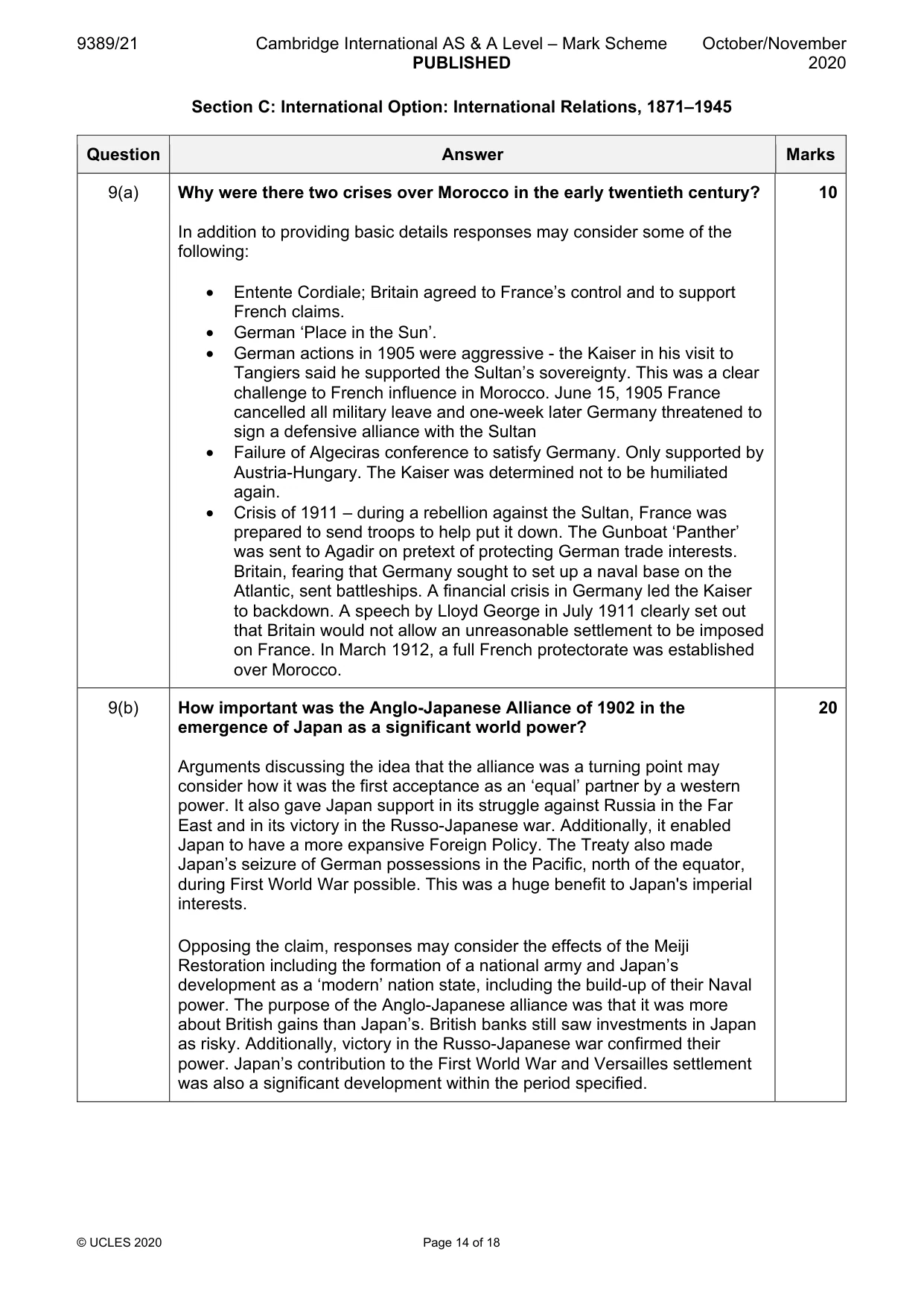
Mark scheme: 9(a) Why were there two crises over Morocco in the early twentieth century? 10 In addition to providing basic details responses may consider some of the following: • Entente Cordiale; Britain agreed to France’s control and to support French claims. • German ‘Place in the Sun’. • German actions in 1905 were aggressive - the Kaiser in his visit to Tangiers said he supported the Sultan’s sovereignty. This was a clear challenge to French influence in Morocco. June 15, 1905 France cancelled all military leave and one-week later Germany threatened to sign a defensive alliance with the Sultan • Failure of Algeciras conference to satisfy Germany. Only supported by Austria-Hungary. The Kaiser was determined not to be humiliated again. • Crisis of 1911 – during a rebellion against the Sultan, France was prepared to send troops to help put it down. The Gunboat ‘Panther’ was sent to Agadir on pretext of protecting German trade interests. Britain, fearing that Germany sought to set up a naval base on the Atlantic, sent battleships. A financial crisis in Germany led the Kaiser to backdown. A speech by Lloyd George in July 1911 clearly set out that Britain would not allow an unreasonable settlement to be imposed on France. In March 1912, a full French protectorate was established over Morocco. 9(b) How important was the Anglo-Japanese Alliance of 1902 in the 20 emergence of Japan as a significant world power? Arguments discussing the idea that the alliance was a turning point may consider how it was the first acceptance as an ‘equal’ partner by a western power. It also gave Japan support in its struggle against Russia in the Far East and in its victory in the Russo-Japanese war. Additionally, it enabled Japan to have a more expansive Foreign Policy. The Treaty also made Japan’s seizure of German possessions in the Pacific, north of the equator, during First World War possible. This was a huge benefit to Japan's imperial interests. Opposing the claim, responses may consider the effects of the Meiji Restoration including the formation of a national army and Japan’s development as a ‘modern’ nation state, including the build-up of their Naval power. The purpose of the Anglo-Japanese alliance was that it was more about British gains than Japan’s. British banks still saw investments in Japan as risky. Additionally, victory in the Russo-Japanese war confirmed their power. Japan’s contribution to the First World War and Versailles settlement was also a significant development within the period specified.
Q10 · International Relations, 1919–1933 (a) Why did the World Disarmament Conference of…
10 International Relations, 1919–1933 (a) Why did the World Disarmament Conference of 1932–33 fail? [10] (b) To what extent was the creation of minority ethnic groups the main problem for the successor states of eastern Europe? [20]
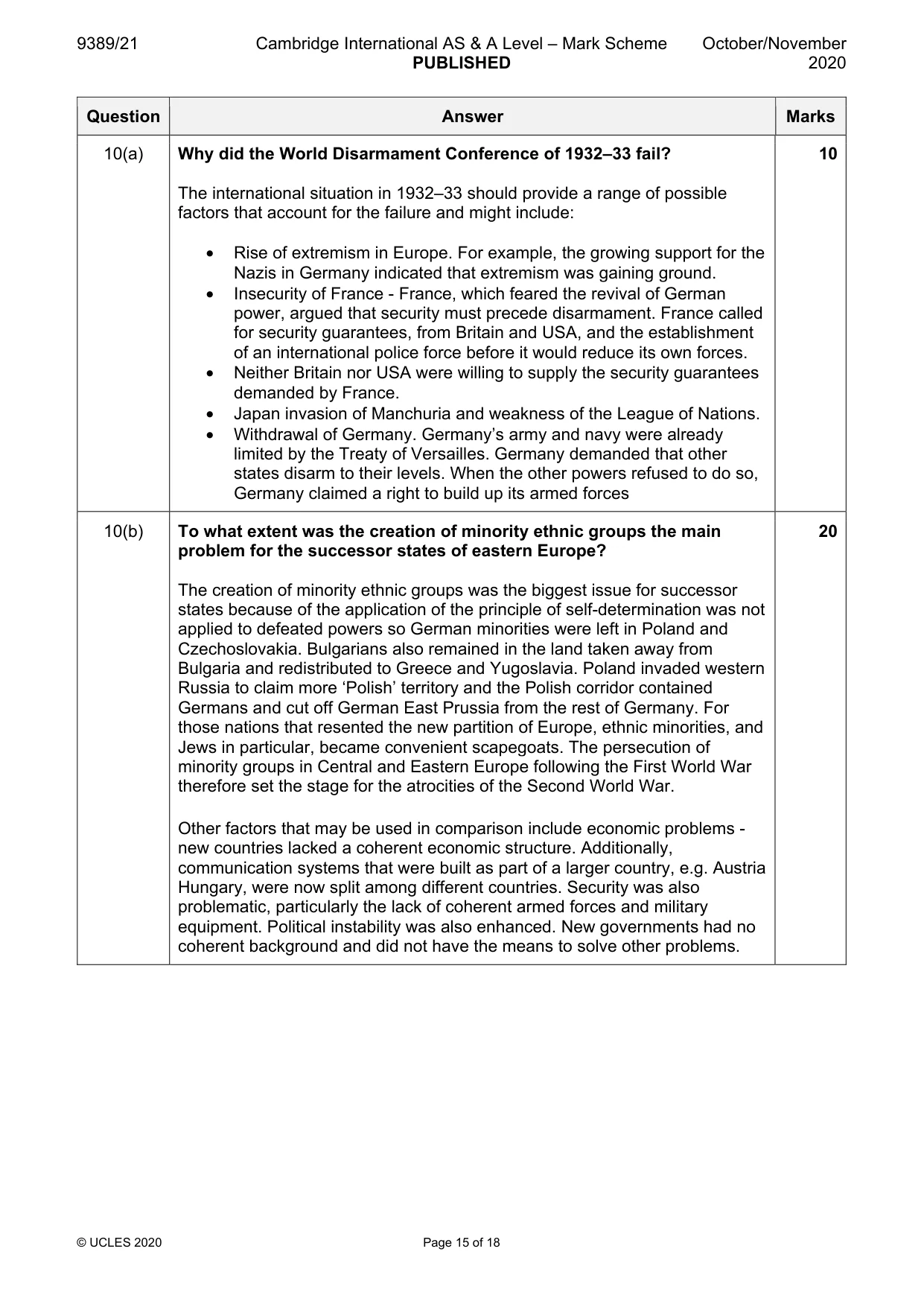
Mark scheme: 10(a) Why did the World Disarmament Conference of 1932–33 fail? 10 The international situation in 1932–33 should provide a range of possible factors that account for the failure and might include: • Rise of extremism in Europe. For example, the growing support for the Nazis in Germany indicated that extremism was gaining ground. • Insecurity of France - France, which feared the revival of German power, argued that security must precede disarmament. France called for security guarantees, from Britain and USA, and the establishment of an international police force before it would reduce its own forces. • Neither Britain nor USA were willing to supply the security guarantees demanded by France. • Japan invasion of Manchuria and weakness of the League of Nations. • Withdrawal of Germany. Germany’s army and navy were already limited by the Treaty of Versailles. Germany demanded that other states disarm to their levels. When the other powers refused to do so, Germany claimed a right to build up its armed forces 10(b) To what extent was the creation of minority ethnic groups the main 20 problem for the successor states of eastern Europe? The creation of minority ethnic groups was the biggest issue for successor states because of the application of the principle of self-determination was not applied to defeated powers so German minorities were left in Poland and Czechoslovakia. Bulgarians also remained in the land taken away from Bulgaria and redistributed to Greece and Yugoslavia. Poland invaded western Russia to claim more ‘Polish’ territory and the Polish corridor contained Germans and cut off German East Prussia from the rest of Germany. For those nations that resented the new partition of Europe, ethnic minorities, and Jews in particular, became convenient scapegoats. The persecution of minority groups in Central and Eastern Europe following the First World War therefore set the stage for the atrocities of the Second World War. Other factors that may be used in comparison include economic problems - new countries lacked a coherent economic structure. Additionally, communication systems that were built as part of a larger country, e.g. Austria Hungary, were now split among different countries. Security was also problematic, particularly the lack of coherent armed forces and military equipment. Political instability was also enhanced. New governments had no coherent background and did not have the means to solve other problems.
Q11 · International Relations, c.1933–1939 (a) Why did Italy intervene in the Spanish Civil War?
11 International Relations, c.1933–1939 (a) Why did Italy intervene in the Spanish Civil War? [10] (b) How successful was Britain’s policy of appeasement? [20]
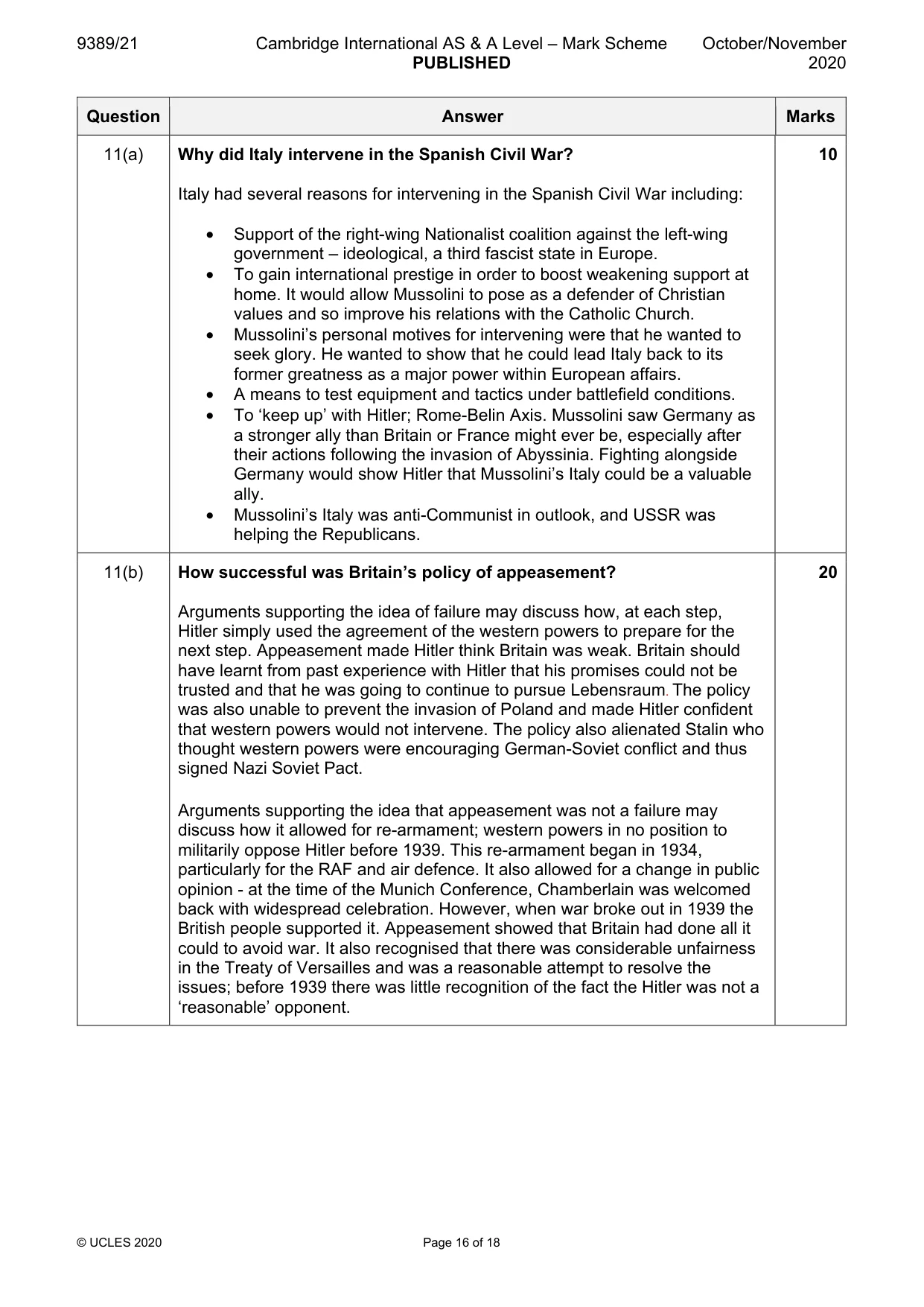
Mark scheme: 11(a) Why did Italy intervene in the Spanish Civil War? 10 Italy had several reasons for intervening in the Spanish Civil War including: • Support of the right-wing Nationalist coalition against the left-wing government – ideological, a third fascist state in Europe. • To gain international prestige in order to boost weakening support at home. It would allow Mussolini to pose as a defender of Christian values and so improve his relations with the Catholic Church. • Mussolini’s personal motives for intervening were that he wanted to seek glory. He wanted to show that he could lead Italy back to its former greatness as a major power within European affairs. • A means to test equipment and tactics under battlefield conditions. • To ‘keep up’ with Hitler; Rome-Belin Axis. Mussolini saw Germany as a stronger ally than Britain or France might ever be, especially after their actions following the invasion of Abyssinia. Fighting alongside Germany would show Hitler that Mussolini’s Italy could be a valuable ally. • Mussolini’s Italy was anti-Communist in outlook, and USSR was helping the Republicans. 11(b) How successful was Britain’s policy of appeasement? 20 Arguments supporting the idea of failure may discuss how, at each step, Hitler simply used the agreement of the western powers to prepare for the next step. Appeasement made Hitler think Britain was weak. Britain should have learnt from past experience with Hitler that his promises could not be trusted and that he was going to continue to pursue Lebensraum. The policy was also unable to prevent the invasion of Poland and made Hitler confident that western powers would not intervene. The policy also alienated Stalin who thought western powers were encouraging German-Soviet conflict and thus signed Nazi Soviet Pact. Arguments supporting the idea that appeasement was not a failure may discuss how it allowed for re-armament; western powers in no position to militarily oppose Hitler before 1939. This re-armament began in 1934, particularly for the RAF and air defence. It also allowed for a change in public opinion - at the time of the Munich Conference, Chamberlain was welcomed back with widespread celebration. However, when war broke out in 1939 the British people supported it. Appeasement showed that Britain had done all it could to avoid war. It also recognised that there was considerable unfairness in the Treaty of Versailles and was a reasonable attempt to resolve the issues; before 1939 there was little recognition of the fact the Hitler was not a ‘reasonable’ opponent.
Q12 · China and Japan, 1919–1945 (a) Why did the Japanese military decide that December 1941…
12 China and Japan, 1919–1945 (a) Why did the Japanese military decide that December 1941 was the best time to attack Pearl Harbor? [10] (b) How successful was the Kuomintang in establishing its control of China by 1928? [20]
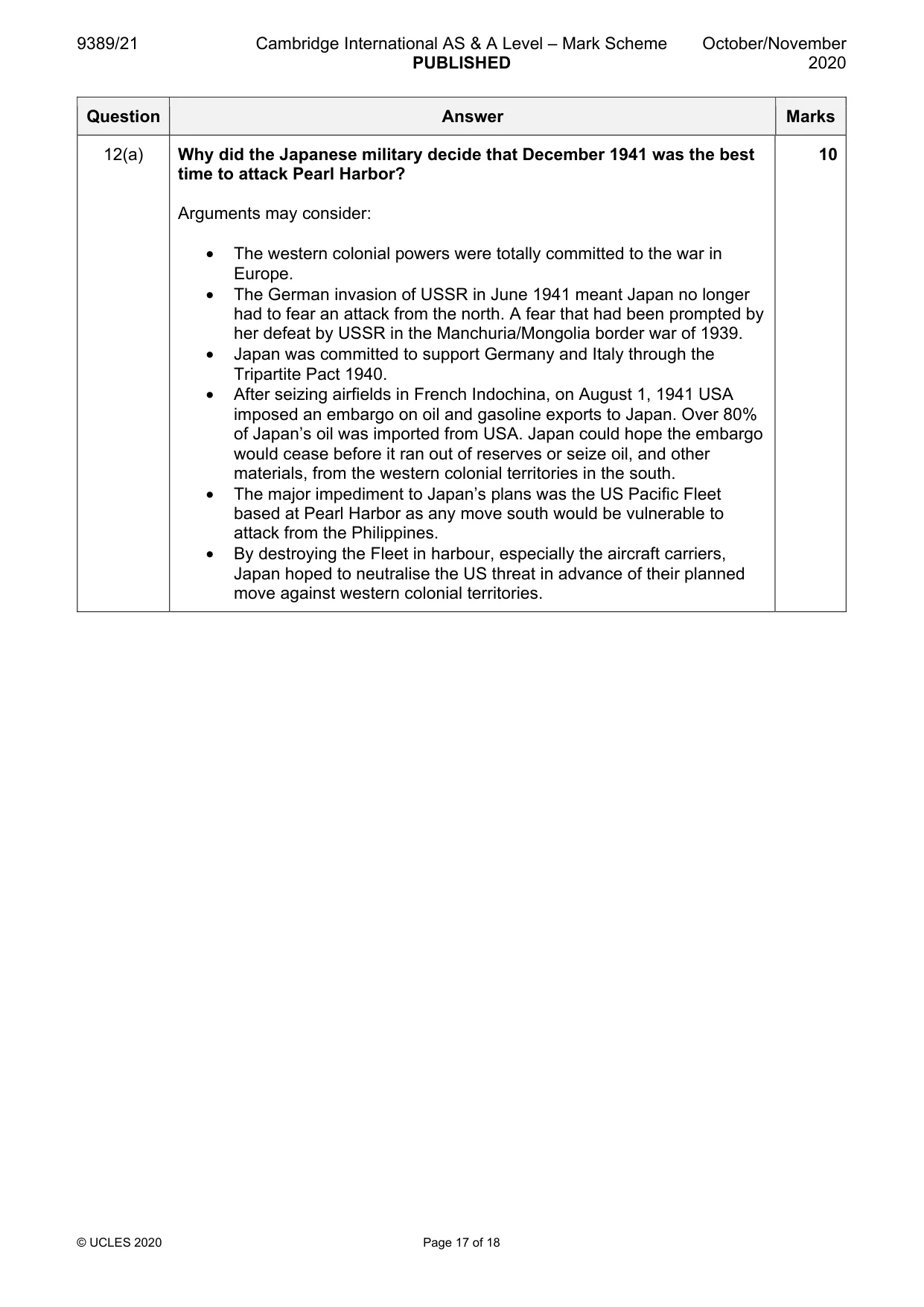
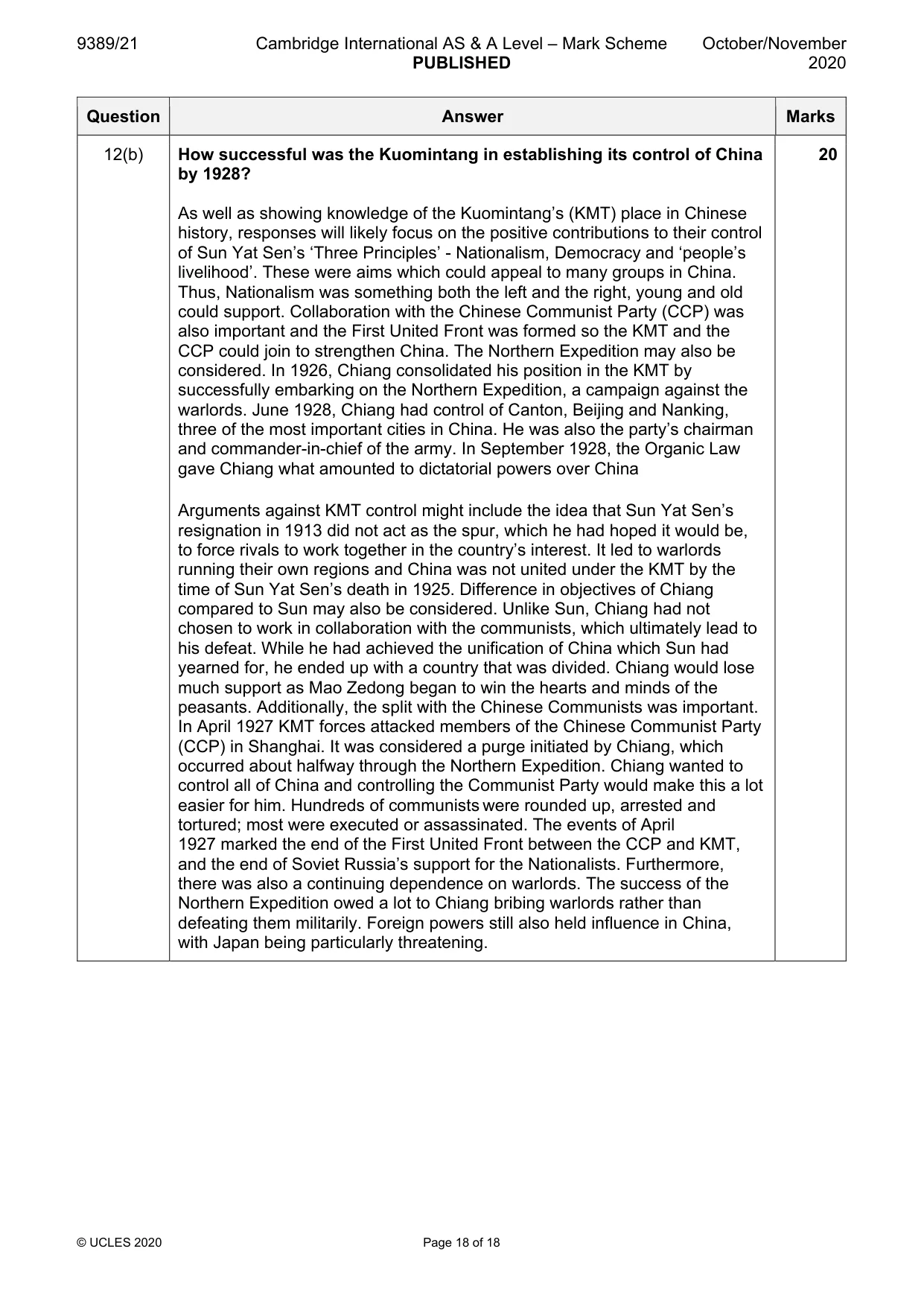
Mark scheme: 12(a) Why did the Japanese military decide that December 1941 was the best 10 time to attack Pearl Harbor? Arguments may consider: • The western colonial powers were totally committed to the war in Europe. • The German invasion of USSR in June 1941 meant Japan no longer had to fear an attack from the north. A fear that had been prompted by her defeat by USSR in the Manchuria/Mongolia border war of 1939. • Japan was committed to support Germany and Italy through the Tripartite Pact 1940. • After seizing airfields in French Indochina, on August 1, 1941 USA imposed an embargo on oil and gasoline exports to Japan. Over 80% of Japan’s oil was imported from USA. Japan could hope the embargo would cease before it ran out of reserves or seize oil, and other materials, from the western colonial territories in the south. • The major impediment to Japan’s plans was the US Pacific Fleet based at Pearl Harbor as any move south would be vulnerable to attack from the Philippines. • By destroying the Fleet in harbour, especially the aircraft carriers, Japan hoped to neutralise the US threat in advance of their planned move against western colonial territories. 12(b) How successful was the Kuomintang in establishing its control of China 20 by 1928? As well as showing knowledge of the Kuomintang’s (KMT) place in Chinese history, responses will likely focus on the positive contributions to their control of Sun Yat Sen’s ‘Three Principles’ - Nationalism, Democracy and ‘people’s livelihood’. These were aims which could appeal to many groups in China. Thus, Nationalism was something both the left and the right, young and old could support. Collaboration with the Chinese Communist Party (CCP) was also important and the First United Front was formed so the KMT and the CCP could join to strengthen China. The Northern Expedition may also be considered. In 1926, Chiang consolidated his position in the KMT by successfully embarking on the Northern Expedition, a campaign against the warlords. June 1928, Chiang had control of Canton, Beijing and Nanking, three of the most important cities in China. He was also the party’s chairman and commander-in-chief of the army. In September 1928, the Organic Law gave Chiang what amounted to dictatorial powers over China Arguments against KMT control might include the idea that Sun Yat Sen’s resignation in 1913 did not act as the spur, which he had hoped it would be, to force rivals to work together in the country’s interest. It led to warlords running their own regions and China was not united under the KMT by the time of Sun Yat Sen’s death in 1925. Difference in objectives of Chiang compared to Sun may also be considered. Unlike Sun, Chiang had not chosen to work in collaboration with the communists, which ultimately lead to his defeat. While he had achieved the unification of China which Sun had yearned for, he ended up with a country that was divided. Chiang would lose much support as Mao Zedong began to win the hearts and minds of the peasants. Additionally, the split with the Chinese Communists was important. In April 1927 KMT forces attacked members of the Chinese Communist Party (CCP) in Shanghai. It was considered a purge initiated by Chiang, which occurred about halfway through the Northern Expedition. Chiang wanted to control all of China and controlling the Communist Party would make this a lot easier for him. Hundreds of communists were rounded up, arrested and tortured; most were executed or assassinated. The events of April 1927 marked the end of the First United Front between the CCP and KMT, and the end of Soviet Russia’s support for the Nationalists. Furthermore, there was also a continuing dependence on warlords. The success of the Northern Expedition owed a lot to Chiang bribing warlords rather than defeating them militarily. Foreign powers still also held influence in China, with Japan being particularly threatening.
What you needed in this session
Cambridge’s own grade thresholds for 2020 Oct/Nov, Paper 2 · Variant 1. A higher threshold means an easier paper — the bar moves with how the cohort did.