Cambridge A Level History 9389 — 2020 Oct/Nov Paper 2 · Variant 3
9389/23/O/N/20 · 12 questions · 60 marks · ≈68 min
The question paper and its mark scheme, free to read here and free to download. This is Cambridge’s own paper, exactly as it was sat.
Question paper4 pages
Mark scheme18 pages
Answers below. Sit the paper first if you are practising.

Questions as text
Q1 · France, 1789–1814 (a) Why did the working-class people in Paris play such an important…
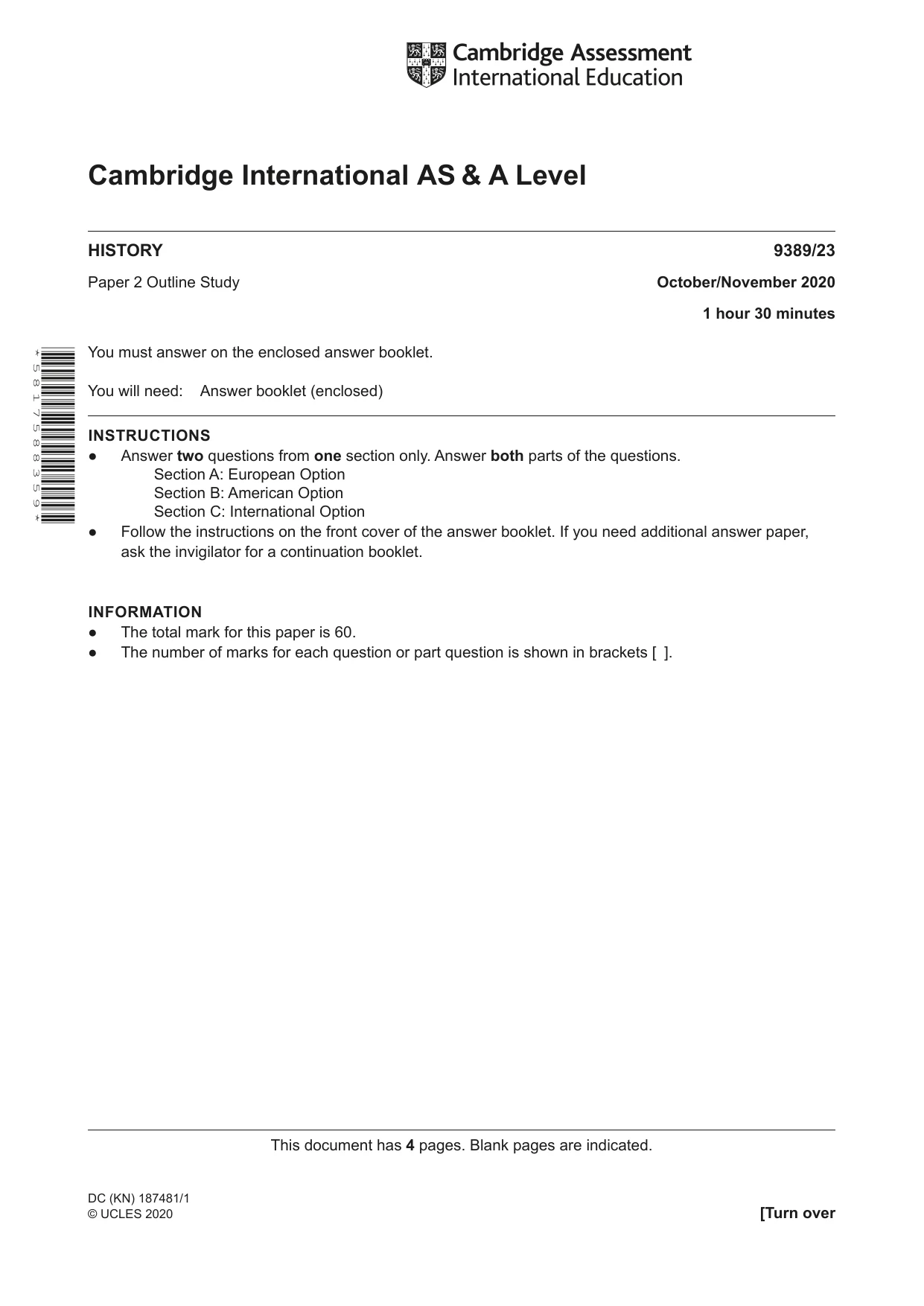
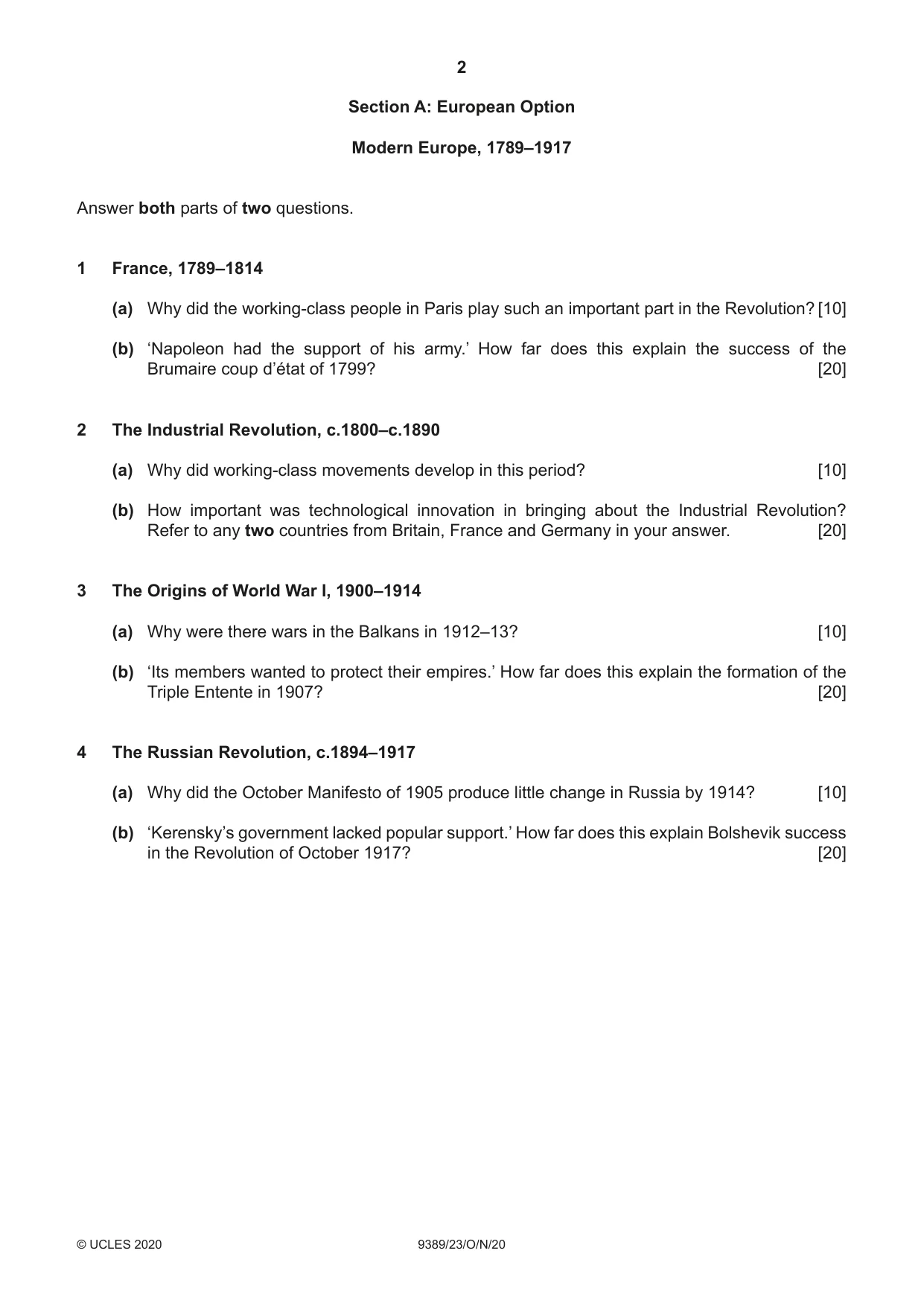
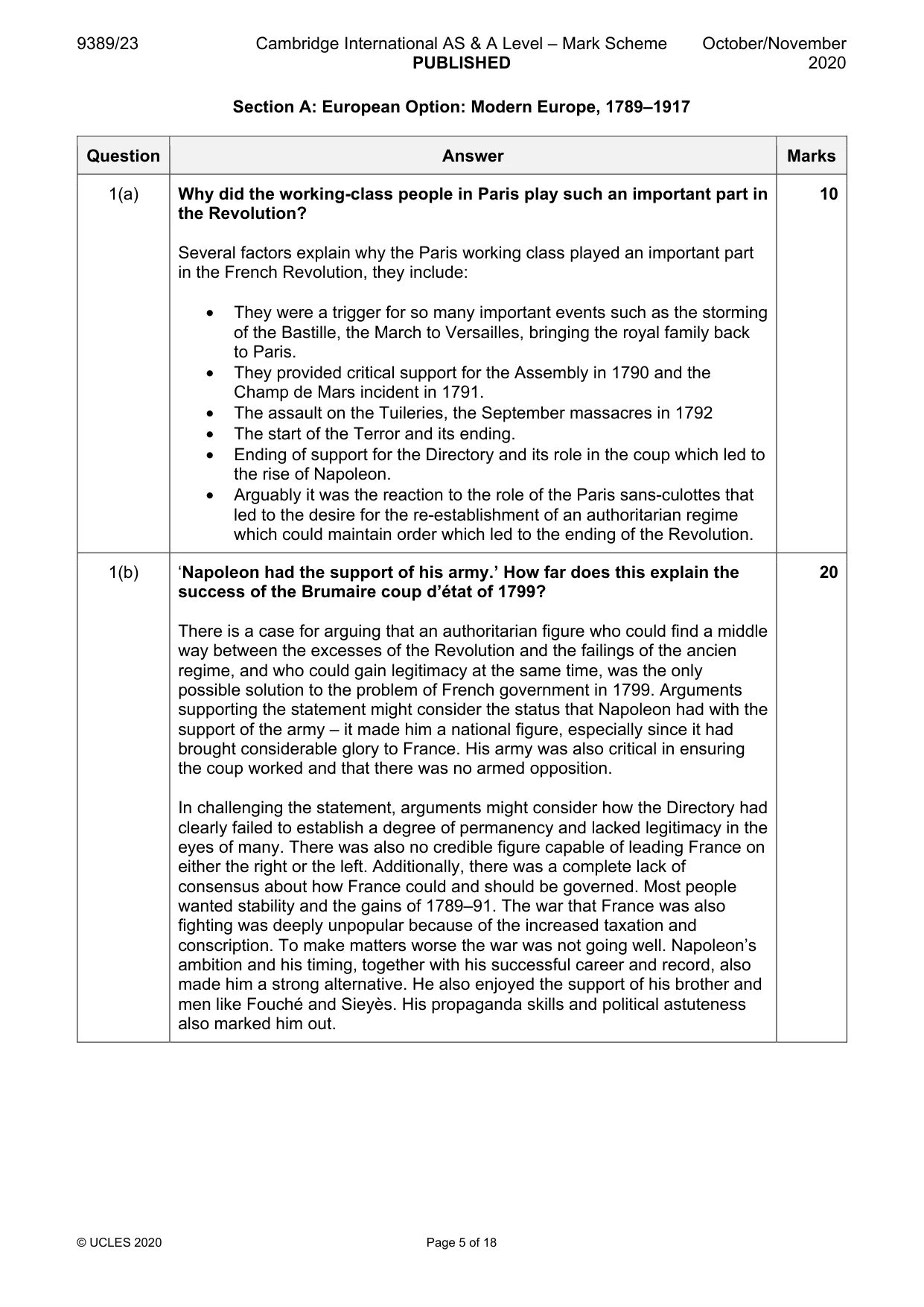
1 France, 1789–1814 (a) Why did the working-class people in Paris play such an important part in the Revolution? [10] (b) ‘Napoleon had the support of his army.’ How far does this explain the success of the Brumaire coup d’état of 1799? [20]
Mark scheme: Question Answer Marks 1(a) Why did the working-class people in Paris play such an important part in 10 the Revolution? Several factors explain why the Paris working class played an important part in the French Revolution, they include: • They were a trigger for so many important events such as the storming of the Bastille, the March to Versailles, bringing the royal family back to Paris. • They provided critical support for the Assembly in 1790 and the Champ de Mars incident in 1791. • The assault on the Tuileries, the September massacres in 1792 • The start of the Terror and its ending. • Ending of support for the Directory and its role in the coup which led to the rise of Napoleon. • Arguably it was the reaction to the role of the Paris sans-culottes that led to the desire for the re-establishment of an authoritarian regime which could maintain order which led to the ending of the Revolution. 1(b) ‘Napoleon had the support of his army.’ How far does this explain the 20 success of the Brumaire coup d’état of 1799? There is a case for arguing that an authoritarian figure who could find a middle way between the excesses of the Revolution and the failings of the ancien regime, and who could gain legitimacy at the same time, was the only possible solution to the problem of French government in 1799. Arguments supporting the statement might consider the status that Napoleon had with the support of the army – it made him a national figure, especially since it had brought considerable glory to France. His army was also critical in ensuring the coup worked and that there was no armed opposition. In challenging the statement, arguments might consider how the Directory had clearly failed to establish a degree of permanency and lacked legitimacy in the eyes of many. There was also no credible figure capable of leading France on either the right or the left. Additionally, there was a complete lack of consensus about how France could and should be governed. Most people wanted stability and the gains of 1789–91. The war that France was also fighting was deeply unpopular because of the increased taxation and conscription. To make matters worse the war was not going well. Napoleon’s ambition and his timing, together with his successful career and record, also made him a strong alternative. He also enjoyed the support of his brother and men like Fouché and Sieyès. His propaganda skills and political astuteness also marked him out.
Q2 · The Industrial Revolution, c.1800–c.1890 (a) Why did working-class movements develop in…
2 The Industrial Revolution, c.1800–c.1890 (a) Why did working-class movements develop in this period? [10] (b) How important was technological innovation in bringing about the Industrial Revolution? Refer to any two countries from Britain, France and Germany in your answer. [20]
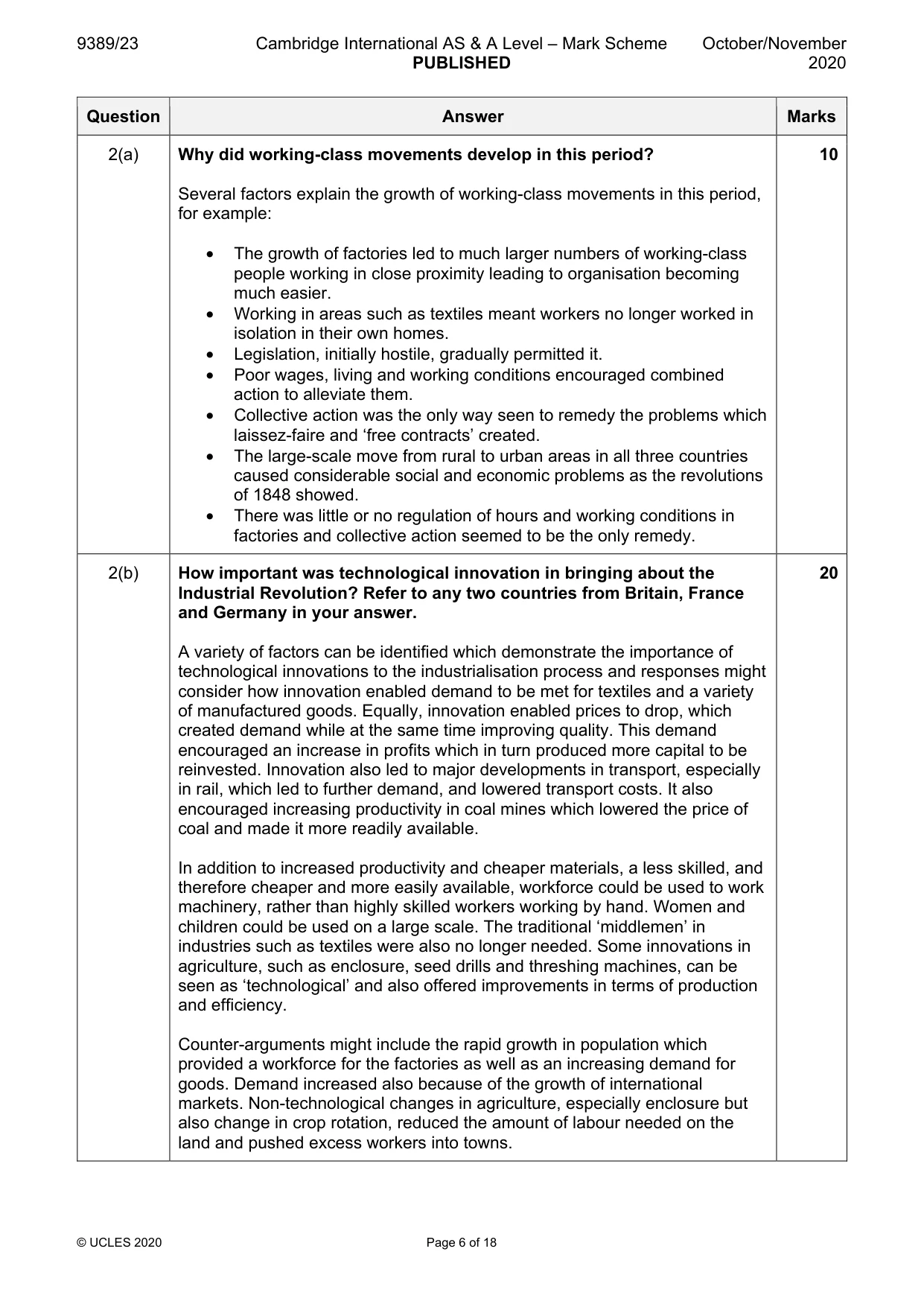
Mark scheme: 2(a) Why did working-class movements develop in this period? 10 Several factors explain the growth of working-class movements in this period, for example: • The growth of factories led to much larger numbers of working-class people working in close proximity leading to organisation becoming much easier. • Working in areas such as textiles meant workers no longer worked in isolation in their own homes. • Legislation, initially hostile, gradually permitted it. • Poor wages, living and working conditions encouraged combined action to alleviate them. • Collective action was the only way seen to remedy the problems which laissez-faire and ‘free contracts’ created. • The large-scale move from rural to urban areas in all three countries caused considerable social and economic problems as the revolutions of 1848 showed. • There was little or no regulation of hours and working conditions in factories and collective action seemed to be the only remedy. 2(b) How important was technological innovation in bringing about the 20 Industrial Revolution? Refer to any two countries from Britain, France and Germany in your answer. A variety of factors can be identified which demonstrate the importance of technological innovations to the industrialisation process and responses might consider how innovation enabled demand to be met for textiles and a variety of manufactured goods. Equally, innovation enabled prices to drop, which created demand while at the same time improving quality. This demand encouraged an increase in profits which in turn produced more capital to be reinvested. Innovation also led to major developments in transport, especially in rail, which led to further demand, and lowered transport costs. It also encouraged increasing productivity in coal mines which lowered the price of coal and made it more readily available. In addition to increased productivity and cheaper materials, a less skilled, and therefore cheaper and more easily available, workforce could be used to work machinery, rather than highly skilled workers working by hand. Women and children could be used on a large scale. The traditional ‘middlemen’ in industries such as textiles were also no longer needed. Some innovations in agriculture, such as enclosure, seed drills and threshing machines, can be seen as ‘technological’ and also offered improvements in terms of production and efficiency. Counter-arguments might include the rapid growth in population which provided a workforce for the factories as well as an increasing demand for goods. Demand increased also because of the growth of international markets. Non-technological changes in agriculture, especially enclosure but also change in crop rotation, reduced the amount of labour needed on the land and pushed excess workers into towns.
Q3 · The Origins of World War I, 1900–1914 (a) Why were there wars in the Balkans in 1912–13?
3 The Origins of World War I, 1900–1914 (a) Why were there wars in the Balkans in 1912–13? [10] (b) ‘Its members wanted to protect their empires.’ How far does this explain the formation of the Triple Entente in 1907? [20]
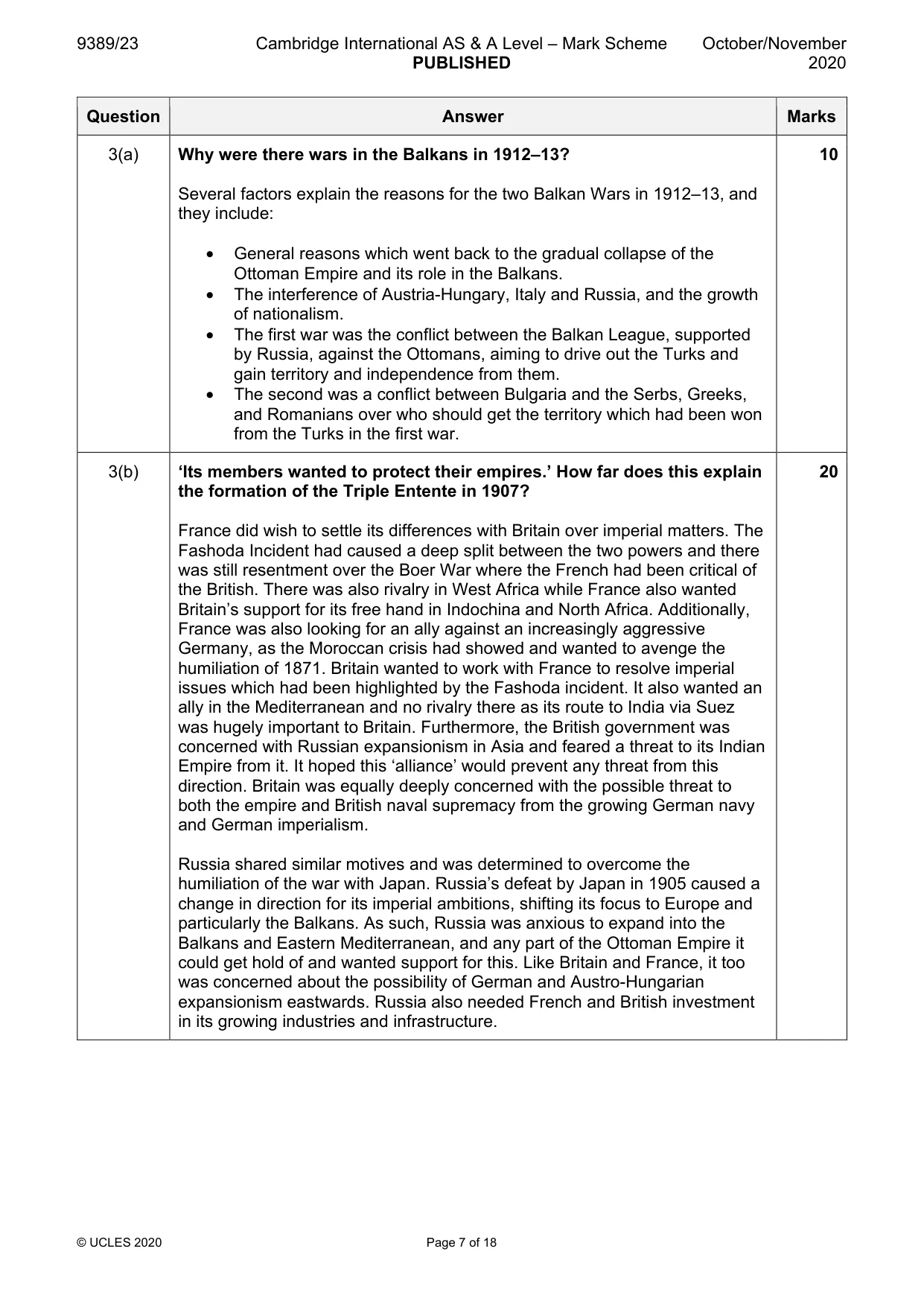
Mark scheme: 3(a) Why were there wars in the Balkans in 1912–13? 10 Several factors explain the reasons for the two Balkan Wars in 1912–13, and they include: • General reasons which went back to the gradual collapse of the Ottoman Empire and its role in the Balkans. • The interference of Austria-Hungary, Italy and Russia, and the growth of nationalism. • The first war was the conflict between the Balkan League, supported by Russia, against the Ottomans, aiming to drive out the Turks and gain territory and independence from them. • The second was a conflict between Bulgaria and the Serbs, Greeks, and Romanians over who should get the territory which had been won from the Turks in the first war. 3(b) ‘Its members wanted to protect their empires.’ How far does this explain 20 the formation of the Triple Entente in 1907? France did wish to settle its differences with Britain over imperial matters. The Fashoda Incident had caused a deep split between the two powers and there was still resentment over the Boer War where the French had been critical of the British. There was also rivalry in West Africa while France also wanted Britain’s support for its free hand in Indochina and North Africa. Additionally, France was also looking for an ally against an increasingly aggressive Germany, as the Moroccan crisis had showed and wanted to avenge the humiliation of 1871. Britain wanted to work with France to resolve imperial issues which had been highlighted by the Fashoda incident. It also wanted an ally in the Mediterranean and no rivalry there as its route to India via Suez was hugely important to Britain. Furthermore, the British government was concerned with Russian expansionism in Asia and feared a threat to its Indian Empire from it. It hoped this ‘alliance’ would prevent any threat from this direction. Britain was equally deeply concerned with the possible threat to both the empire and British naval supremacy from the growing German navy and German imperialism. Russia shared similar motives and was determined to overcome the humiliation of the war with Japan. Russia’s defeat by Japan in 1905 caused a change in direction for its imperial ambitions, shifting its focus to Europe and particularly the Balkans. As such, Russia was anxious to expand into the Balkans and Eastern Mediterranean, and any part of the Ottoman Empire it could get hold of and wanted support for this. Like Britain and France, it too was concerned about the possibility of German and Austro-Hungarian expansionism eastwards. Russia also needed French and British investment in its growing industries and infrastructure.
Q4 · The Russian Revolution, c.1894–1917 (a) Why did the October Manifesto of 1905 produce…
4 The Russian Revolution, c.1894–1917 (a) Why did the October Manifesto of 1905 produce little change in Russia by 1914? [10] (b) ‘Kerensky’s government lacked popular support.’ How far does this explain Bolshevik success in the Revolution of October 1917? [20]
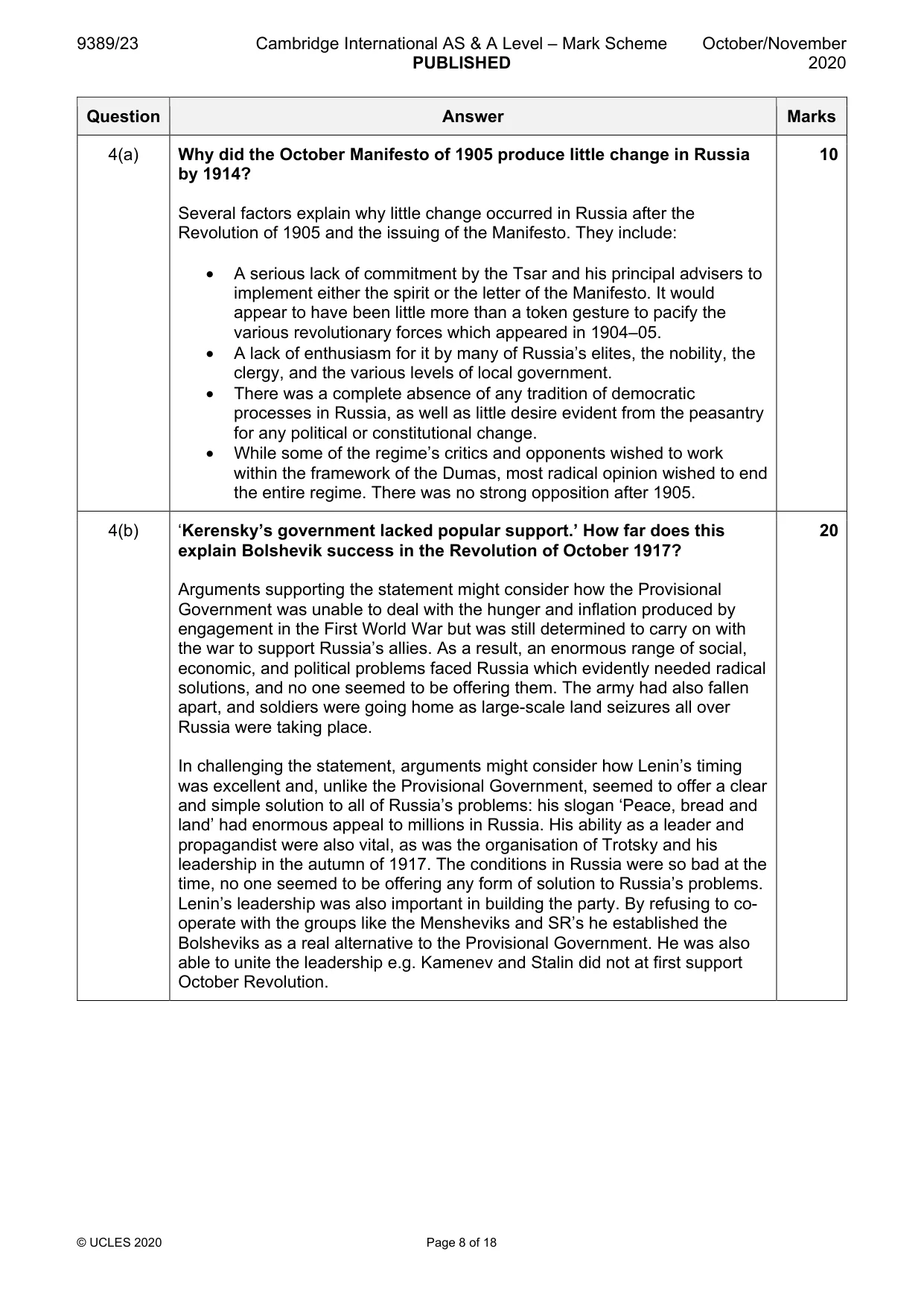
Mark scheme: 4(a) Why did the October Manifesto of 1905 produce little change in Russia 10 by 1914? Several factors explain why little change occurred in Russia after the Revolution of 1905 and the issuing of the Manifesto. They include: • A serious lack of commitment by the Tsar and his principal advisers to implement either the spirit or the letter of the Manifesto. It would appear to have been little more than a token gesture to pacify the various revolutionary forces which appeared in 1904–05. • A lack of enthusiasm for it by many of Russia’s elites, the nobility, the clergy, and the various levels of local government. • There was a complete absence of any tradition of democratic processes in Russia, as well as little desire evident from the peasantry for any political or constitutional change. • While some of the regime’s critics and opponents wished to work within the framework of the Dumas, most radical opinion wished to end the entire regime. There was no strong opposition after 1905. 4(b) ‘Kerensky’s government lacked popular support.’ How far does this 20 explain Bolshevik success in the Revolution of October 1917? Arguments supporting the statement might consider how the Provisional Government was unable to deal with the hunger and inflation produced by engagement in the First World War but was still determined to carry on with the war to support Russia’s allies. As a result, an enormous range of social, economic, and political problems faced Russia which evidently needed radical solutions, and no one seemed to be offering them. The army had also fallen apart, and soldiers were going home as large-scale land seizures all over Russia were taking place. In challenging the statement, arguments might consider how Lenin’s timing was excellent and, unlike the Provisional Government, seemed to offer a clear and simple solution to all of Russia’s problems: his slogan ‘Peace, bread and land’ had enormous appeal to millions in Russia. His ability as a leader and propagandist were also vital, as was the organisation of Trotsky and his leadership in the autumn of 1917. The conditions in Russia were so bad at the time, no one seemed to be offering any form of solution to Russia’s problems. Lenin’s leadership was also important in building the party. By refusing to co- operate with the groups like the Mensheviks and SR’s he established the Bolsheviks as a real alternative to the Provisional Government. He was also able to unite the leadership e.g. Kamenev and Stalin did not at first support October Revolution. Section B: American Option: The History of the USA, 1840–1941
Q5 · The Expansion of US Power from the 1840s to the 1930s (a) Why did the peace settlement…
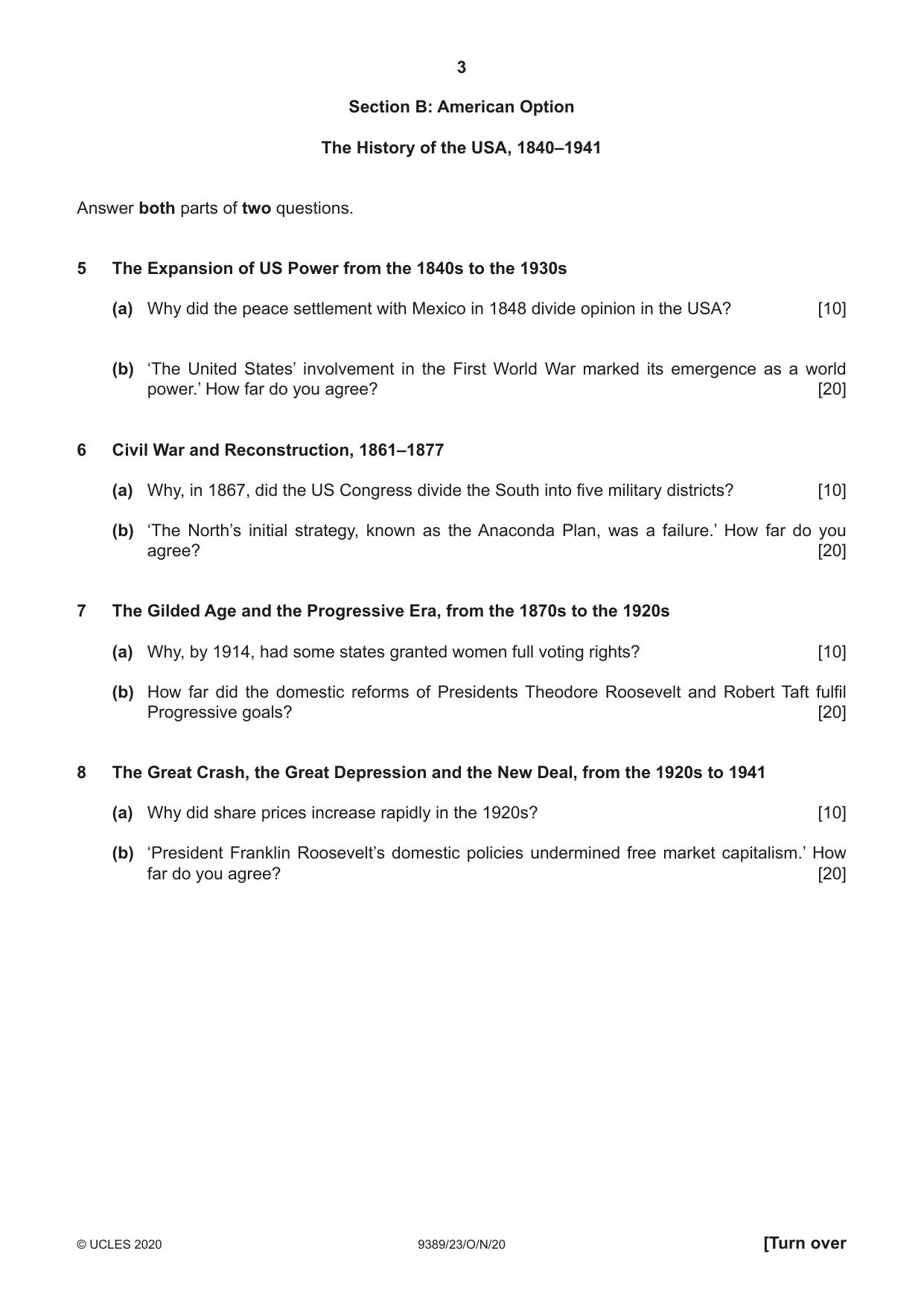
5 The Expansion of US Power from the 1840s to the 1930s (a) Why did the peace settlement with Mexico in 1848 divide opinion in the USA? [10] (b) ‘The United States’ involvement in the First World War marked its emergence as a world power.’ How far do you agree? [20]
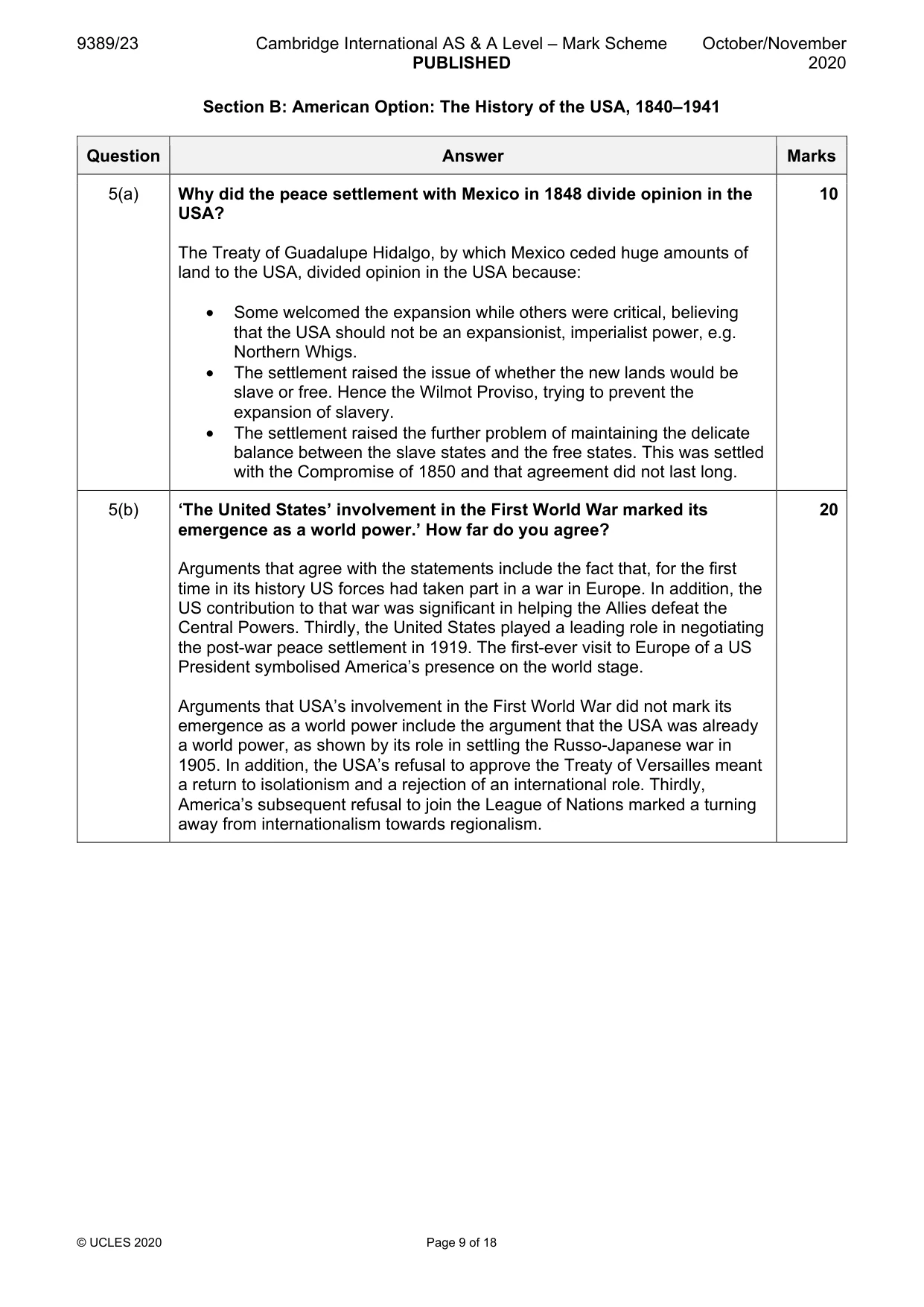
Mark scheme: 5(a) Why did the peace settlement with Mexico in 1848 divide opinion in the 10 USA? The Treaty of Guadalupe Hidalgo, by which Mexico ceded huge amounts of land to the USA, divided opinion in the USA because: • Some welcomed the expansion while others were critical, believing that the USA should not be an expansionist, imperialist power, e.g. Northern Whigs. • The settlement raised the issue of whether the new lands would be slave or free. Hence the Wilmot Proviso, trying to prevent the expansion of slavery. • The settlement raised the further problem of maintaining the delicate balance between the slave states and the free states. This was settled with the Compromise of 1850 and that agreement did not last long. 5(b) ‘The United States’ involvement in the First World War marked its 20 emergence as a world power.’ How far do you agree? Arguments that agree with the statements include the fact that, for the first time in its history US forces had taken part in a war in Europe. In addition, the US contribution to that war was significant in helping the Allies defeat the Central Powers. Thirdly, the United States played a leading role in negotiating the post-war peace settlement in 1919. The first-ever visit to Europe of a US President symbolised America’s presence on the world stage. Arguments that USA’s involvement in the First World War did not mark its emergence as a world power include the argument that the USA was already a world power, as shown by its role in settling the Russo-Japanese war in 1905. In addition, the USA’s refusal to approve the Treaty of Versailles meant a return to isolationism and a rejection of an international role. Thirdly, America’s subsequent refusal to join the League of Nations marked a turning away from internationalism towards regionalism.
Q6 · Civil War and Reconstruction, 1861–1877 (a) Why, in 1867, did the US Congress divide the…
6 Civil War and Reconstruction, 1861–1877 (a) Why, in 1867, did the US Congress divide the South into five military districts? [10] (b) ‘The North’s initial strategy, known as the Anaconda Plan, was a failure.’ How far do you agree? [20]
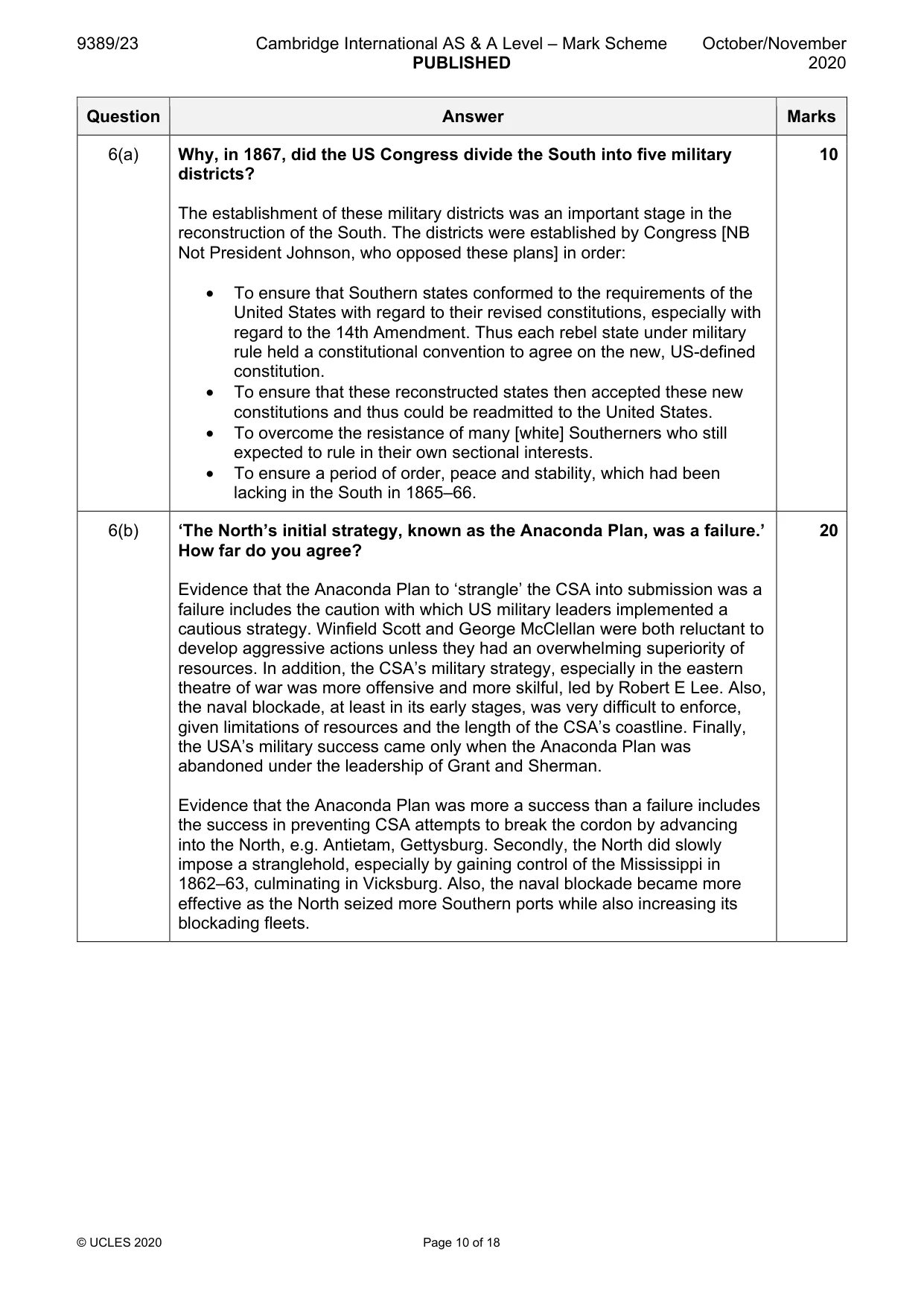
Mark scheme: 6(a) Why, in 1867, did the US Congress divide the South into five military 10 districts? The establishment of these military districts was an important stage in the reconstruction of the South. The districts were established by Congress [NB Not President Johnson, who opposed these plans] in order: • To ensure that Southern states conformed to the requirements of the United States with regard to their revised constitutions, especially with regard to the 14th Amendment. Thus each rebel state under military rule held a constitutional convention to agree on the new, US-defined constitution. • To ensure that these reconstructed states then accepted these new constitutions and thus could be readmitted to the United States. • To overcome the resistance of many [white] Southerners who still expected to rule in their own sectional interests. • To ensure a period of order, peace and stability, which had been lacking in the South in 1865–66. 6(b) ‘The North’s initial strategy, known as the Anaconda Plan, was a failure.’ 20 How far do you agree? Evidence that the Anaconda Plan to ‘strangle’ the CSA into submission was a failure includes the caution with which US military leaders implemented a cautious strategy. Winfield Scott and George McClellan were both reluctant to develop aggressive actions unless they had an overwhelming superiority of resources. In addition, the CSA’s military strategy, especially in the eastern theatre of war was more offensive and more skilful, led by Robert E Lee. Also, the naval blockade, at least in its early stages, was very difficult to enforce, given limitations of resources and the length of the CSA’s coastline. Finally, the USA’s military success came only when the Anaconda Plan was abandoned under the leadership of Grant and Sherman. Evidence that the Anaconda Plan was more a success than a failure includes the success in preventing CSA attempts to break the cordon by advancing into the North, e.g. Antietam, Gettysburg. Secondly, the North did slowly impose a stranglehold, especially by gaining control of the Mississippi in 1862–63, culminating in Vicksburg. Also, the naval blockade became more effective as the North seized more Southern ports while also increasing its blockading fleets.
Q7 · The Gilded Age and the Progressive Era, from the 1870s to the 1920s (a) Why, by 1914, had…
7 The Gilded Age and the Progressive Era, from the 1870s to the 1920s (a) Why, by 1914, had some states granted women full voting rights? [10] (b) How far did the domestic reforms of Presidents Theodore Roosevelt and Robert Taft fulfil Progressive goals? [20]
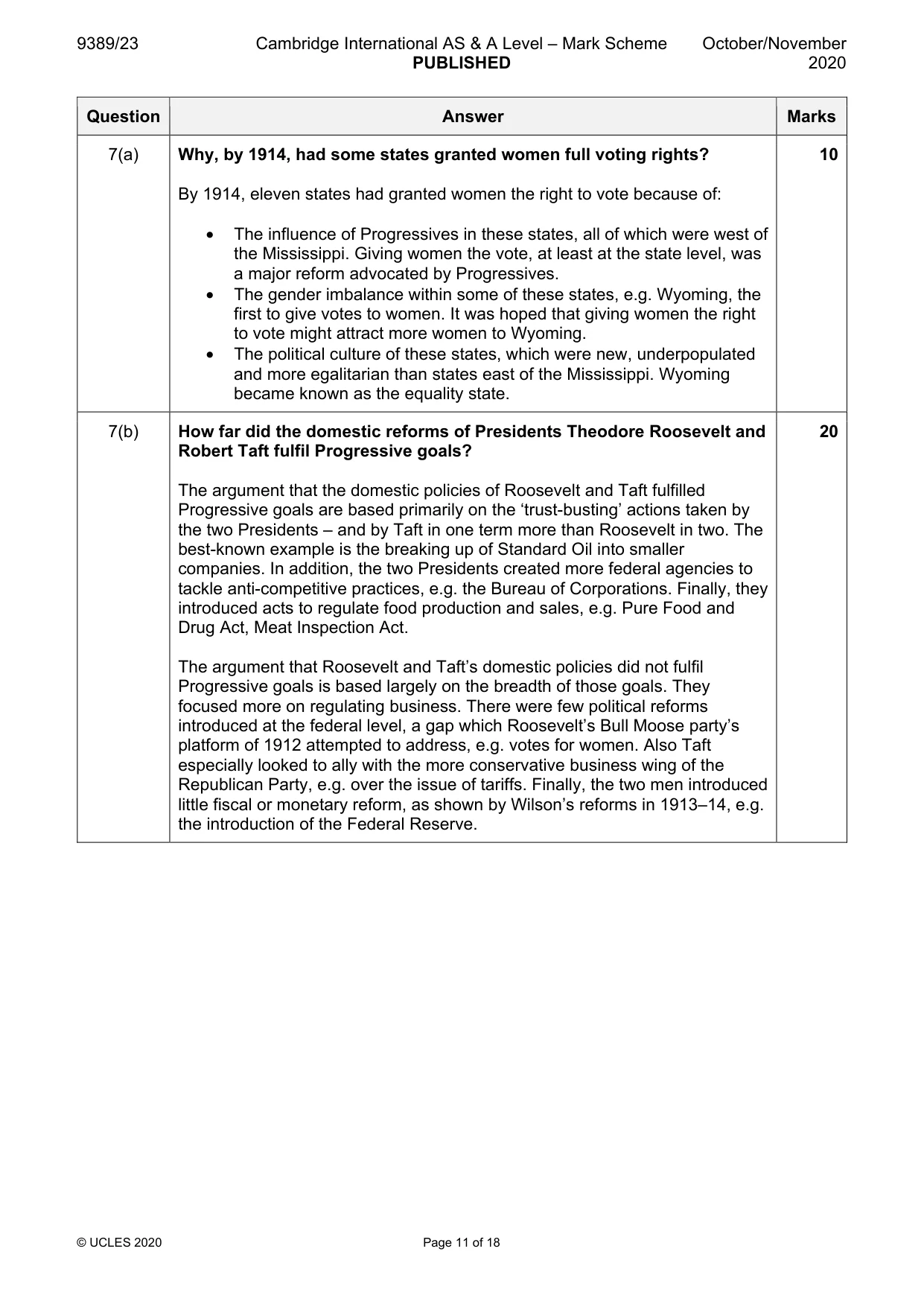
Mark scheme: 7(a) Why, by 1914, had some states granted women full voting rights? 10 By 1914, eleven states had granted women the right to vote because of: • The influence of Progressives in these states, all of which were west of the Mississippi. Giving women the vote, at least at the state level, was a major reform advocated by Progressives. • The gender imbalance within some of these states, e.g. Wyoming, the first to give votes to women. It was hoped that giving women the right to vote might attract more women to Wyoming. • The political culture of these states, which were new, underpopulated and more egalitarian than states east of the Mississippi. Wyoming became known as the equality state. 7(b) How far did the domestic reforms of Presidents Theodore Roosevelt and 20 Robert Taft fulfil Progressive goals? The argument that the domestic policies of Roosevelt and Taft fulfilled Progressive goals are based primarily on the ‘trust-busting’ actions taken by the two Presidents – and by Taft in one term more than Roosevelt in two. The best-known example is the breaking up of Standard Oil into smaller companies. In addition, the two Presidents created more federal agencies to tackle anti-competitive practices, e.g. the Bureau of Corporations. Finally, they introduced acts to regulate food production and sales, e.g. Pure Food and Drug Act, Meat Inspection Act. The argument that Roosevelt and Taft’s domestic policies did not fulfil Progressive goals is based largely on the breadth of those goals. They focused more on regulating business. There were few political reforms introduced at the federal level, a gap which Roosevelt’s Bull Moose party’s platform of 1912 attempted to address, e.g. votes for women. Also Taft especially looked to ally with the more conservative business wing of the Republican Party, e.g. over the issue of tariffs. Finally, the two men introduced little fiscal or monetary reform, as shown by Wilson’s reforms in 1913–14, e.g. the introduction of the Federal Reserve.
Q8 · The Great Crash, the Great Depression and the New Deal, from the 1920s to 1941 (a) Why…
8 The Great Crash, the Great Depression and the New Deal, from the 1920s to 1941 (a) Why did share prices increase rapidly in the 1920s? [10] (b) ‘President Franklin Roosevelt’s domestic policies undermined free market capitalism.’ How far do you agree? [20] Section C: International Option International Relations, 1871–1945 Answer both parts of two questions.
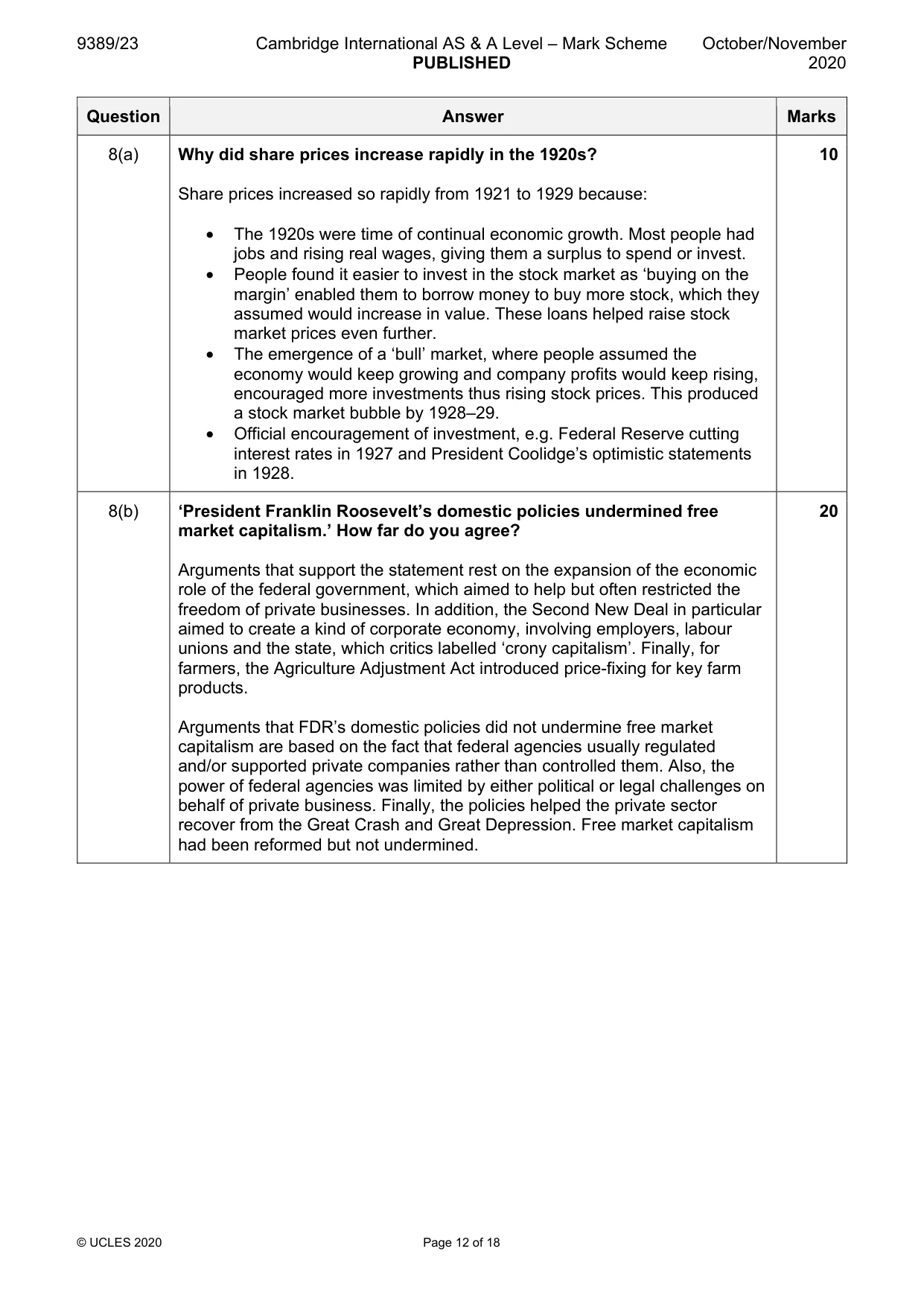
Mark scheme: 8(a) Why did share prices increase rapidly in the 1920s? 10 Share prices increased so rapidly from 1921 to 1929 because: • The 1920s were time of continual economic growth. Most people had jobs and rising real wages, giving them a surplus to spend or invest. • People found it easier to invest in the stock market as ‘buying on the margin’ enabled them to borrow money to buy more stock, which they assumed would increase in value. These loans helped raise stock market prices even further. • The emergence of a ‘bull’ market, where people assumed the economy would keep growing and company profits would keep rising, encouraged more investments thus rising stock prices. This produced a stock market bubble by 1928–29. • Official encouragement of investment, e.g. Federal Reserve cutting interest rates in 1927 and President Coolidge’s optimistic statements in 1928. 8(b) ‘President Franklin Roosevelt’s domestic policies undermined free 20 market capitalism.’ How far do you agree? Arguments that support the statement rest on the expansion of the economic role of the federal government, which aimed to help but often restricted the freedom of private businesses. In addition, the Second New Deal in particular aimed to create a kind of corporate economy, involving employers, labour unions and the state, which critics labelled ‘crony capitalism’. Finally, for farmers, the Agriculture Adjustment Act introduced price-fixing for key farm products. Arguments that FDR’s domestic policies did not undermine free market capitalism are based on the fact that federal agencies usually regulated and/or supported private companies rather than controlled them. Also, the power of federal agencies was limited by either political or legal challenges on behalf of private business. Finally, the policies helped the private sector recover from the Great Crash and Great Depression. Free market capitalism had been reformed but not undermined. Section C: International Option: International Relations, 1871–1945
Q9 · International Relations, 1871–1918 (a) Why did Russia begin a full mobilisation of its…
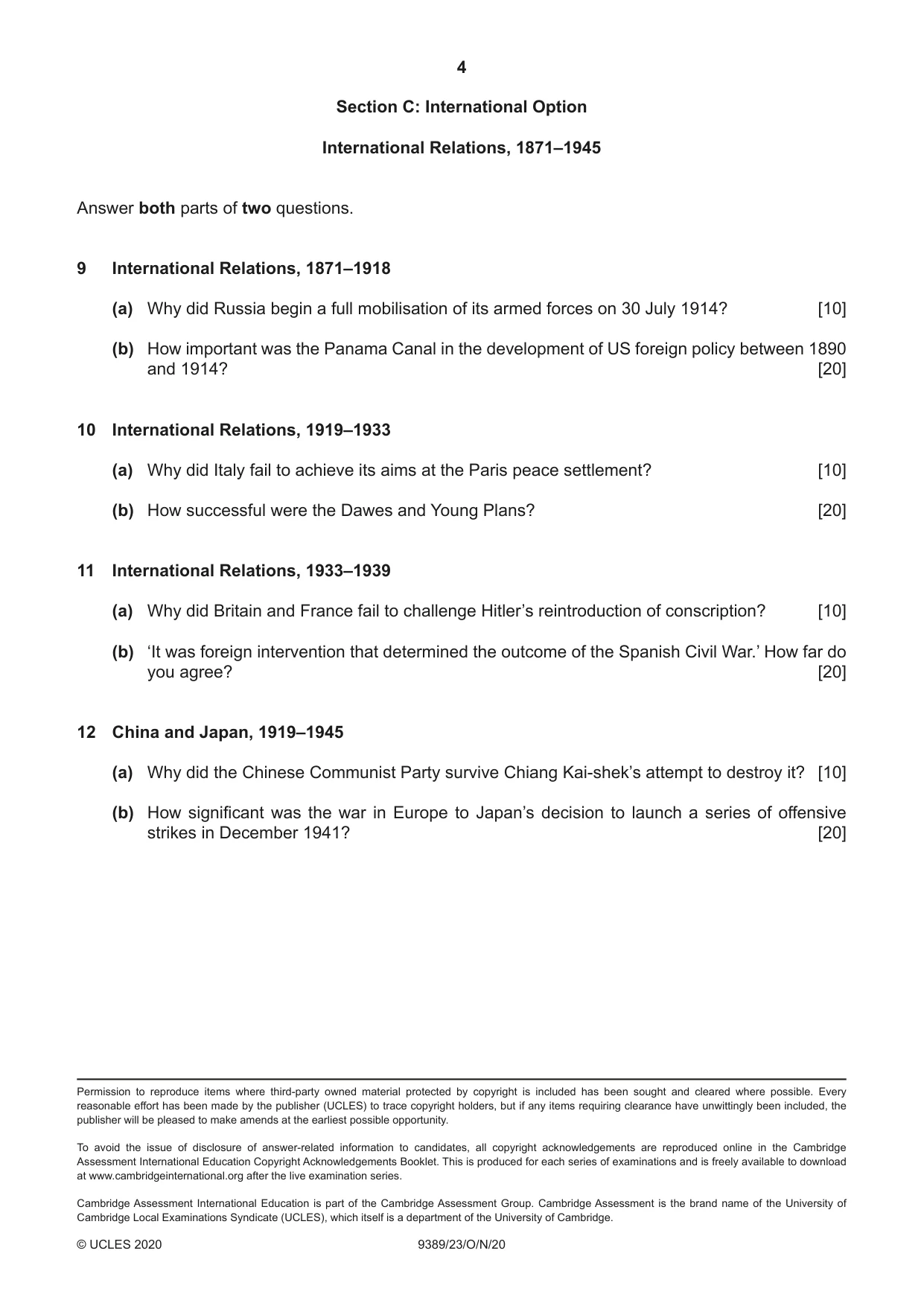
9 International Relations, 1871–1918 (a) Why did Russia begin a full mobilisation of its armed forces on 30 July 1914? [10] (b) How important was the Panama Canal in the development of US foreign policy between 1890 and 1914? [20]
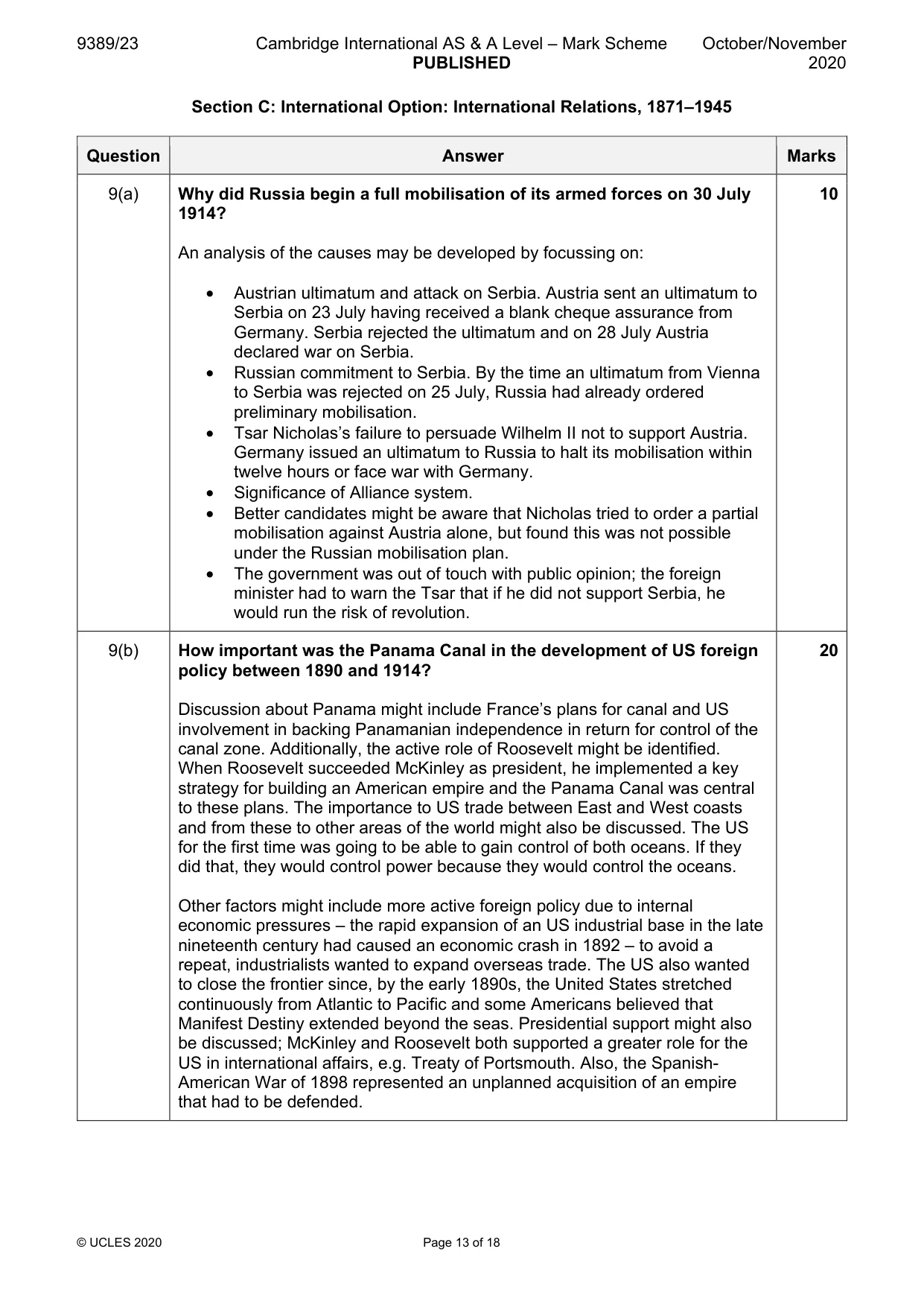
Mark scheme: 9(a) Why did Russia begin a full mobilisation of its armed forces on 30 July 10 1914? An analysis of the causes may be developed by focussing on: • Austrian ultimatum and attack on Serbia. Austria sent an ultimatum to Serbia on 23 July having received a blank cheque assurance from Germany. Serbia rejected the ultimatum and on 28 July Austria declared war on Serbia. • Russian commitment to Serbia. By the time an ultimatum from Vienna to Serbia was rejected on 25 July, Russia had already ordered preliminary mobilisation. • Tsar Nicholas’s failure to persuade Wilhelm II not to support Austria. Germany issued an ultimatum to Russia to halt its mobilisation within twelve hours or face war with Germany. • Significance of Alliance system. • Better candidates might be aware that Nicholas tried to order a partial mobilisation against Austria alone, but found this was not possible under the Russian mobilisation plan. • The government was out of touch with public opinion; the foreign minister had to warn the Tsar that if he did not support Serbia, he would run the risk of revolution. 9(b) How important was the Panama Canal in the development of US foreign 20 policy between 1890 and 1914? Discussion about Panama might include France’s plans for canal and US involvement in backing Panamanian independence in return for control of the canal zone. Additionally, the active role of Roosevelt might be identified. When Roosevelt succeeded McKinley as president, he implemented a key strategy for building an American empire and the Panama Canal was central to these plans. The importance to US trade between East and West coasts and from these to other areas of the world might also be discussed. The US for the first time was going to be able to gain control of both oceans. If they did that, they would control power because they would control the oceans. Other factors might include more active foreign policy due to internal economic pressures – the rapid expansion of an US industrial base in the late nineteenth century had caused an economic crash in 1892 – to avoid a repeat, industrialists wanted to expand overseas trade. The US also wanted to close the frontier since, by the early 1890s, the United States stretched continuously from Atlantic to Pacific and some Americans believed that Manifest Destiny extended beyond the seas. Presidential support might also be discussed; McKinley and Roosevelt both supported a greater role for the US in international affairs, e.g. Treaty of Portsmouth. Also, the Spanish- American War of 1898 represented an unplanned acquisition of an empire that had to be defended.
Q10 · International Relations, 1919–1933 (a) Why did Italy fail to achieve its aims at the…
10 International Relations, 1919–1933 (a) Why did Italy fail to achieve its aims at the Paris peace settlement? [10] (b) How successful were the Dawes and Young Plans? [20]
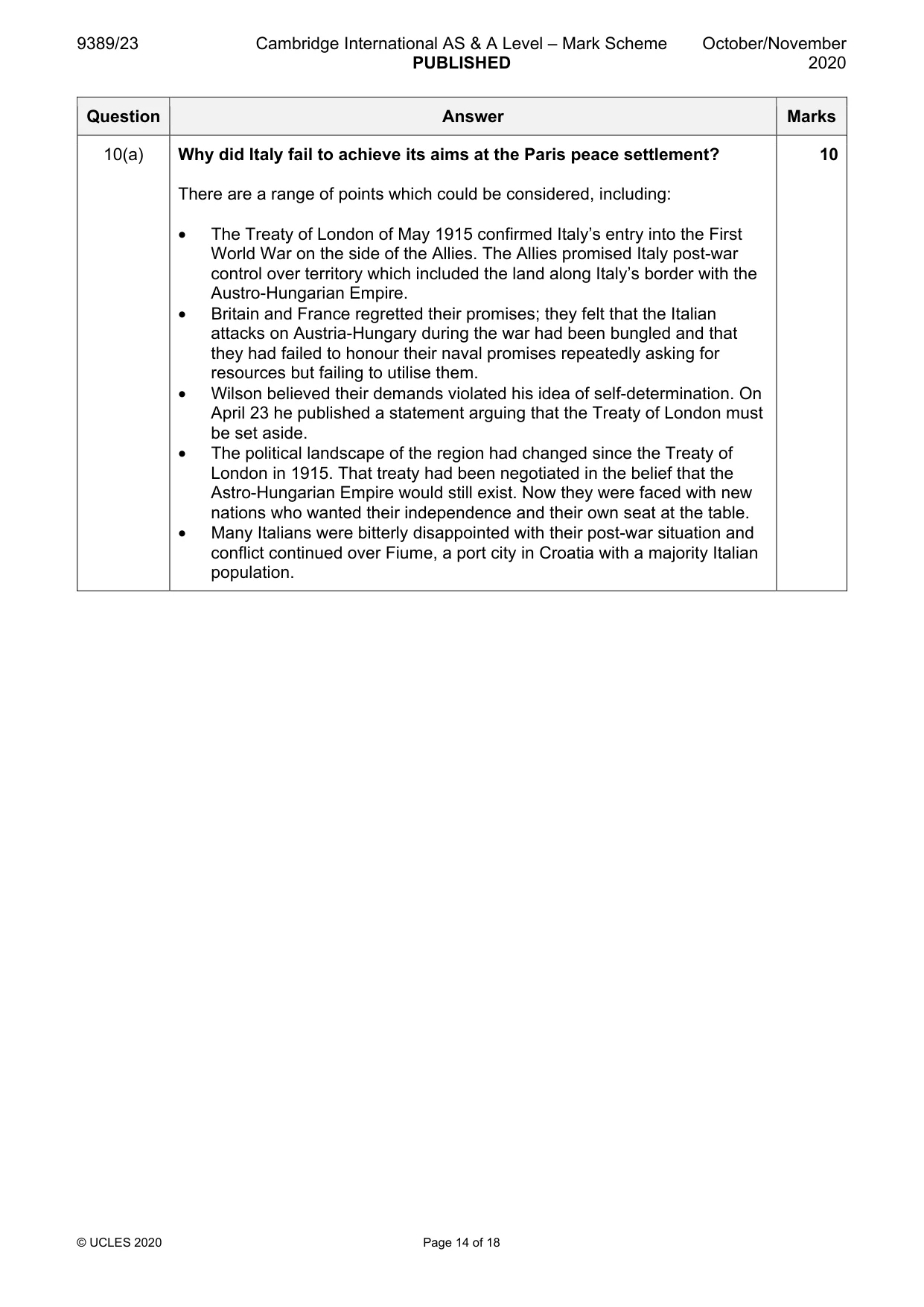
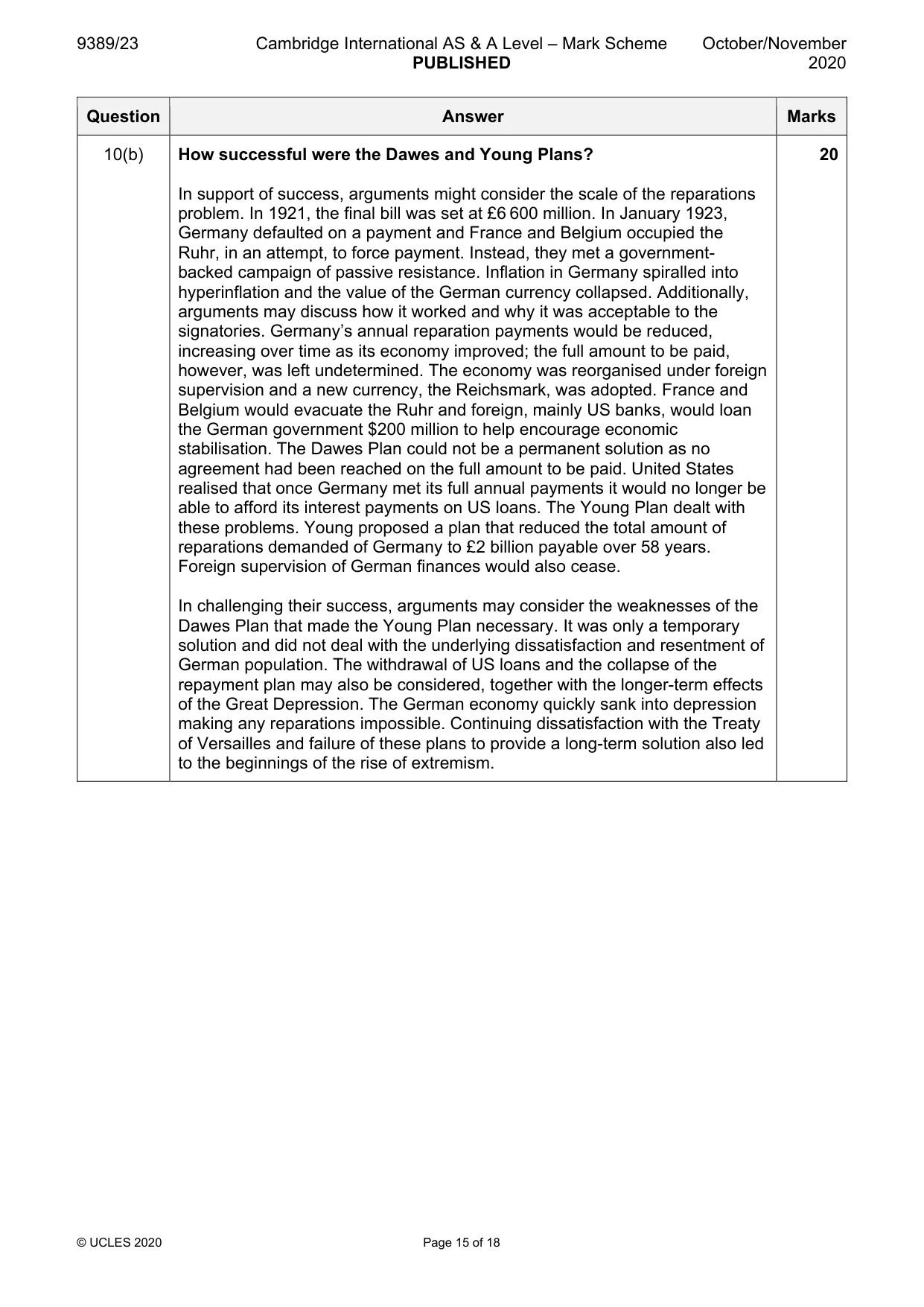
Mark scheme: 10(a) Why did Italy fail to achieve its aims at the Paris peace settlement? 10 There are a range of points which could be considered, including: • The Treaty of London of May 1915 confirmed Italy’s entry into the First World War on the side of the Allies. The Allies promised Italy post-war control over territory which included the land along Italy’s border with the Austro-Hungarian Empire. • Britain and France regretted their promises; they felt that the Italian attacks on Austria-Hungary during the war had been bungled and that they had failed to honour their naval promises repeatedly asking for resources but failing to utilise them. • Wilson believed their demands violated his idea of self-determination. On April 23 he published a statement arguing that the Treaty of London must be set aside. • The political landscape of the region had changed since the Treaty of London in 1915. That treaty had been negotiated in the belief that the Astro-Hungarian Empire would still exist. Now they were faced with new nations who wanted their independence and their own seat at the table. • Many Italians were bitterly disappointed with their post-war situation and conflict continued over Fiume, a port city in Croatia with a majority Italian population. 10(b) How successful were the Dawes and Young Plans? 20 In support of success, arguments might consider the scale of the reparations problem. In 1921, the final bill was set at £6 600 million. In January 1923, Germany defaulted on a payment and France and Belgium occupied the Ruhr, in an attempt, to force payment. Instead, they met a government- backed campaign of passive resistance. Inflation in Germany spiralled into hyperinflation and the value of the German currency collapsed. Additionally, arguments may discuss how it worked and why it was acceptable to the signatories. Germany’s annual reparation payments would be reduced, increasing over time as its economy improved; the full amount to be paid, however, was left undetermined. The economy was reorganised under foreign supervision and a new currency, the Reichsmark, was adopted. France and Belgium would evacuate the Ruhr and foreign, mainly US banks, would loan the German government $200 million to help encourage economic stabilisation. The Dawes Plan could not be a permanent solution as no agreement had been reached on the full amount to be paid. United States realised that once Germany met its full annual payments it would no longer be able to afford its interest payments on US loans. The Young Plan dealt with these problems. Young proposed a plan that reduced the total amount of reparations demanded of Germany to £2 billion payable over 58 years. Foreign supervision of German finances would also cease. In challenging their success, arguments may consider the weaknesses of the Dawes Plan that made the Young Plan necessary. It was only a temporary solution and did not deal with the underlying dissatisfaction and resentment of German population. The withdrawal of US loans and the collapse of the repayment plan may also be considered, together with the longer-term effects of the Great Depression. The German economy quickly sank into depression making any reparations impossible. Continuing dissatisfaction with the Treaty of Versailles and failure of these plans to provide a long-term solution also led to the beginnings of the rise of extremism.
Q11 · International Relations, 1933–1939 (a) Why did Britain and France fail to challenge…
11 International Relations, 1933–1939 (a) Why did Britain and France fail to challenge Hitler’s reintroduction of conscription? [10] (b) ‘It was foreign intervention that determined the outcome of the Spanish Civil War.’ How far do you agree? [20]
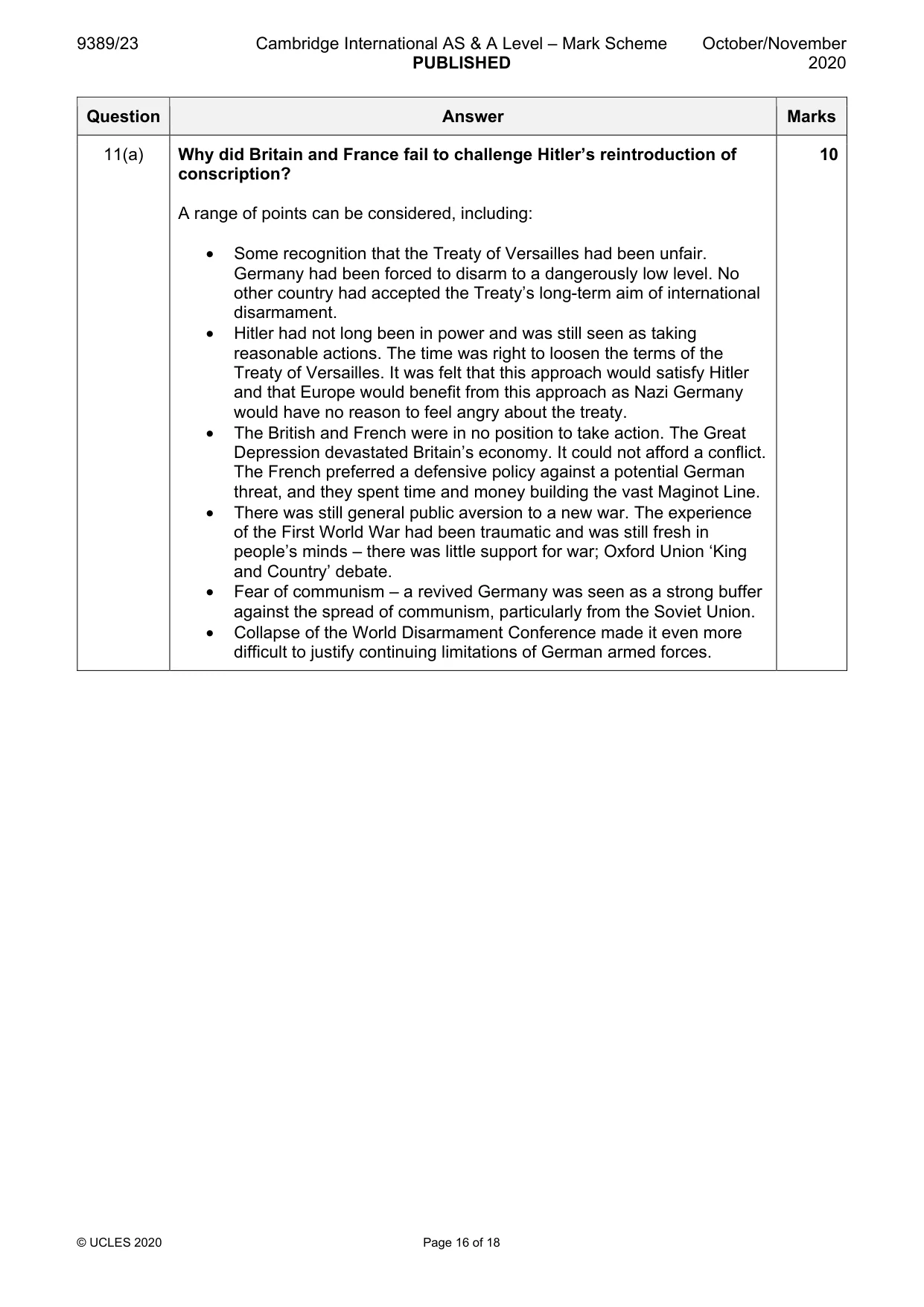
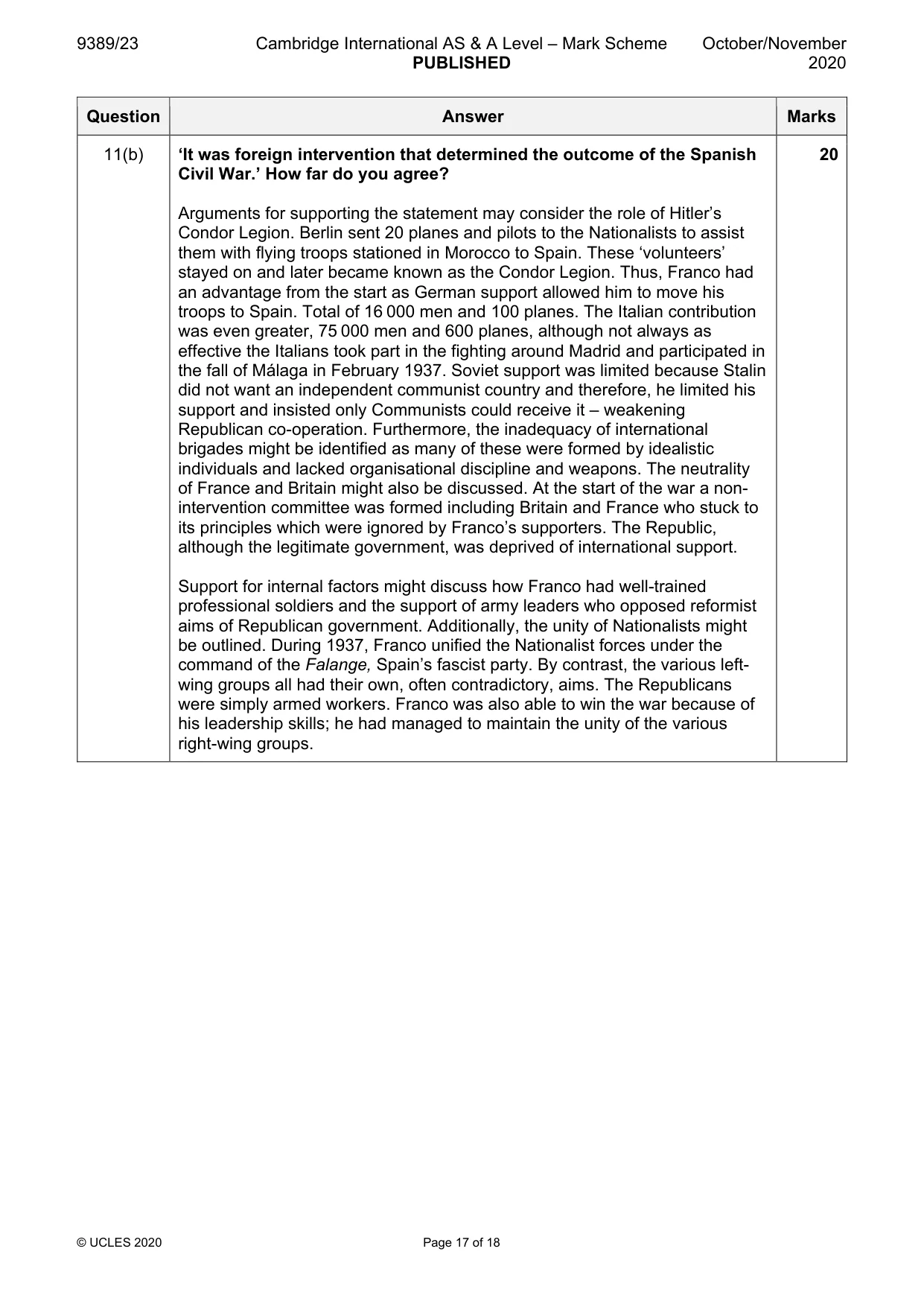
Mark scheme: 11(a) Why did Britain and France fail to challenge Hitler’s reintroduction of 10 conscription? A range of points can be considered, including: • Some recognition that the Treaty of Versailles had been unfair. Germany had been forced to disarm to a dangerously low level. No other country had accepted the Treaty’s long-term aim of international disarmament. • Hitler had not long been in power and was still seen as taking reasonable actions. The time was right to loosen the terms of the Treaty of Versailles. It was felt that this approach would satisfy Hitler and that Europe would benefit from this approach as Nazi Germany would have no reason to feel angry about the treaty. • The British and French were in no position to take action. The Great Depression devastated Britain’s economy. It could not afford a conflict. The French preferred a defensive policy against a potential German threat, and they spent time and money building the vast Maginot Line. • There was still general public aversion to a new war. The experience of the First World War had been traumatic and was still fresh in people’s minds – there was little support for war; Oxford Union ‘King and Country’ debate. • Fear of communism – a revived Germany was seen as a strong buffer against the spread of communism, particularly from the Soviet Union. • Collapse of the World Disarmament Conference made it even more difficult to justify continuing limitations of German armed forces. 11(b) ‘It was foreign intervention that determined the outcome of the Spanish 20 Civil War.’ How far do you agree? Arguments for supporting the statement may consider the role of Hitler’s Condor Legion. Berlin sent 20 planes and pilots to the Nationalists to assist them with flying troops stationed in Morocco to Spain. These ‘volunteers’ stayed on and later became known as the Condor Legion. Thus, Franco had an advantage from the start as German support allowed him to move his troops to Spain. Total of 16 000 men and 100 planes. The Italian contribution was even greater, 75 000 men and 600 planes, although not always as effective the Italians took part in the fighting around Madrid and participated in the fall of Málaga in February 1937. Soviet support was limited because Stalin did not want an independent communist country and therefore, he limited his support and insisted only Communists could receive it – weakening Republican co-operation. Furthermore, the inadequacy of international brigades might be identified as many of these were formed by idealistic individuals and lacked organisational discipline and weapons. The neutrality of France and Britain might also be discussed. At the start of the war a non- intervention committee was formed including Britain and France who stuck to its principles which were ignored by Franco’s supporters. The Republic, although the legitimate government, was deprived of international support. Support for internal factors might discuss how Franco had well-trained professional soldiers and the support of army leaders who opposed reformist aims of Republican government. Additionally, the unity of Nationalists might be outlined. During 1937, Franco unified the Nationalist forces under the command of the Falange, Spain’s fascist party. By contrast, the various left- wing groups all had their own, often contradictory, aims. The Republicans were simply armed workers. Franco was also able to win the war because of his leadership skills; he had managed to maintain the unity of the various right-wing groups.
Q12 · China and Japan, 1919–1945 (a) Why did the Chinese Communist Party survive Chiang…
12 China and Japan, 1919–1945 (a) Why did the Chinese Communist Party survive Chiang Kai-shek’s attempt to destroy it? [10] (b) How significant was the war in Europe to Japan’s decision to launch a series of offensive strikes in December 1941? [20]
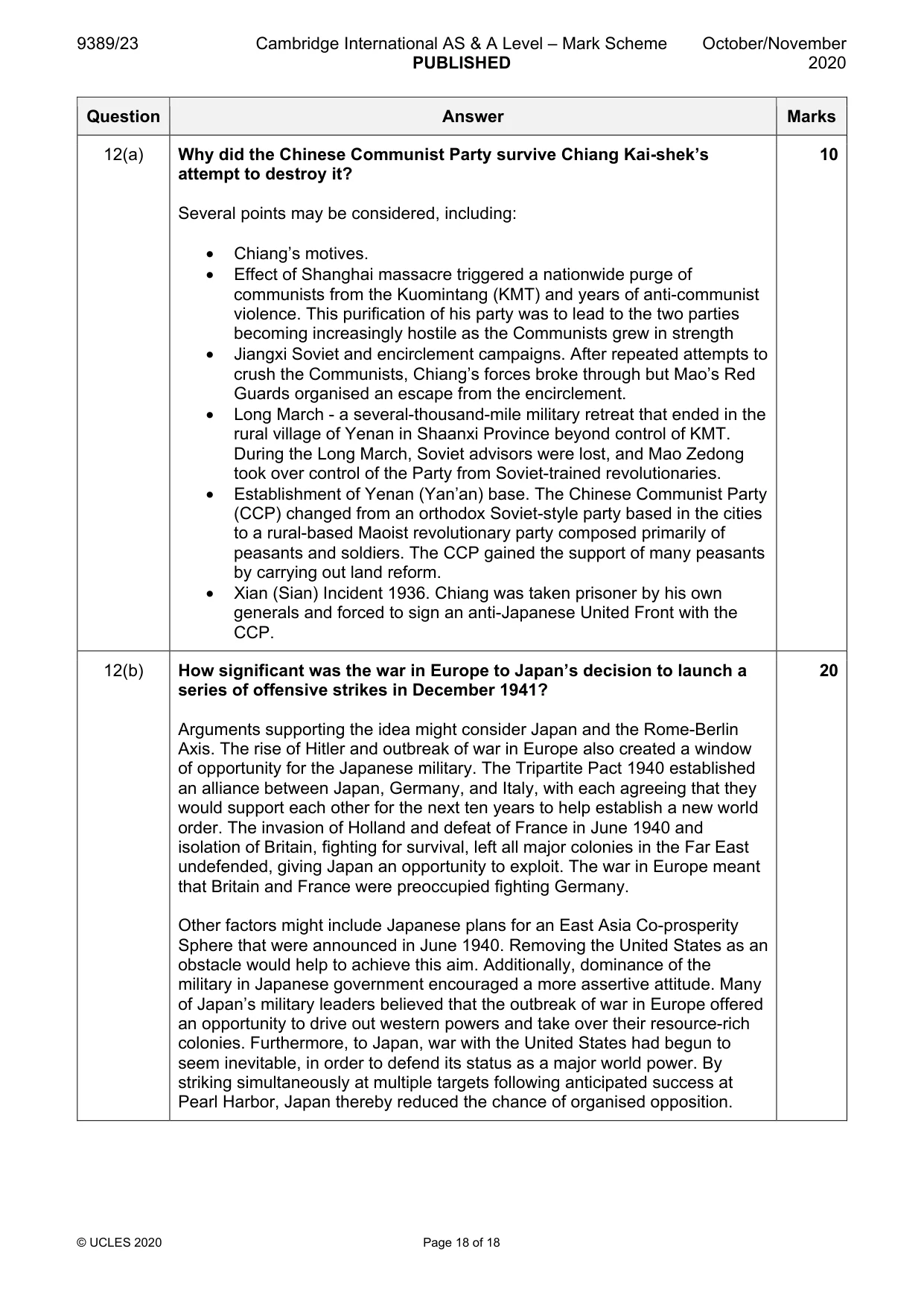
Mark scheme: 12(a) Why did the Chinese Communist Party survive Chiang Kai-shek’s 10 attempt to destroy it? Several points may be considered, including: • Chiang’s motives. • Effect of Shanghai massacre triggered a nationwide purge of communists from the Kuomintang (KMT) and years of anti-communist violence. This purification of his party was to lead to the two parties becoming increasingly hostile as the Communists grew in strength • Jiangxi Soviet and encirclement campaigns. After repeated attempts to crush the Communists, Chiang’s forces broke through but Mao’s Red Guards organised an escape from the encirclement. • Long March - a several-thousand-mile military retreat that ended in the rural village of Yenan in Shaanxi Province beyond control of KMT. During the Long March, Soviet advisors were lost, and Mao Zedong took over control of the Party from Soviet-trained revolutionaries. • Establishment of Yenan (Yan’an) base. The Chinese Communist Party (CCP) changed from an orthodox Soviet-style party based in the cities to a rural-based Maoist revolutionary party composed primarily of peasants and soldiers. The CCP gained the support of many peasants by carrying out land reform. • Xian (Sian) Incident 1936. Chiang was taken prisoner by his own generals and forced to sign an anti-Japanese United Front with the CCP. 12(b) How significant was the war in Europe to Japan’s decision to launch a 20 series of offensive strikes in December 1941? Arguments supporting the idea might consider Japan and the Rome-Berlin Axis. The rise of Hitler and outbreak of war in Europe also created a window of opportunity for the Japanese military. The Tripartite Pact 1940 established an alliance between Japan, Germany, and Italy, with each agreeing that they would support each other for the next ten years to help establish a new world order. The invasion of Holland and defeat of France in June 1940 and isolation of Britain, fighting for survival, left all major colonies in the Far East undefended, giving Japan an opportunity to exploit. The war in Europe meant that Britain and France were preoccupied fighting Germany. Other factors might include Japanese plans for an East Asia Co-prosperity Sphere that were announced in June 1940. Removing the United States as an obstacle would help to achieve this aim. Additionally, dominance of the military in Japanese government encouraged a more assertive attitude. Many of Japan’s military leaders believed that the outbreak of war in Europe offered an opportunity to drive out western powers and take over their resource-rich colonies. Furthermore, to Japan, war with the United States had begun to seem inevitable, in order to defend its status as a major world power. By striking simultaneously at multiple targets following anticipated success at Pearl Harbor, Japan thereby reduced the chance of organised opposition.
What you needed in this session
Cambridge’s own grade thresholds for 2020 Oct/Nov, Paper 2 · Variant 3. A higher threshold means an easier paper — the bar moves with how the cohort did.