Cambridge A Level History 9389 — 2018 May/June Paper 4 · Variant 1
9389/41/M/J/18 · 11 questions · 60 marks · ≈68 min
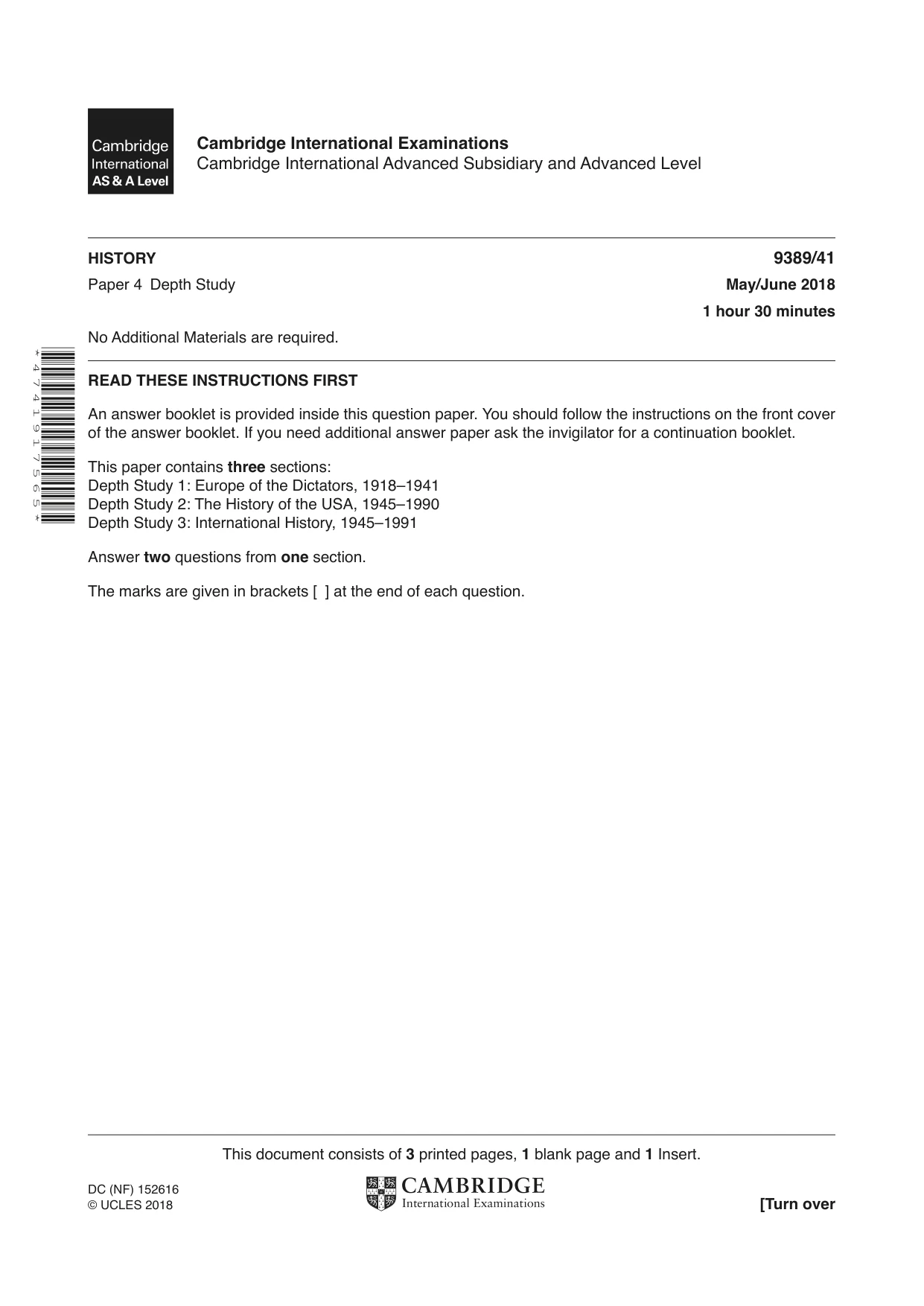
The question paper and its mark scheme, free to read here and free to download. This is Cambridge’s own paper, exactly as it was sat.
Question paper4 pages
Mark scheme15 pages
Answers below. Sit the paper first if you are practising.
Questions as text
Q1 · To what extent were Lenin’s policies determined by necessity rather than by ideology?
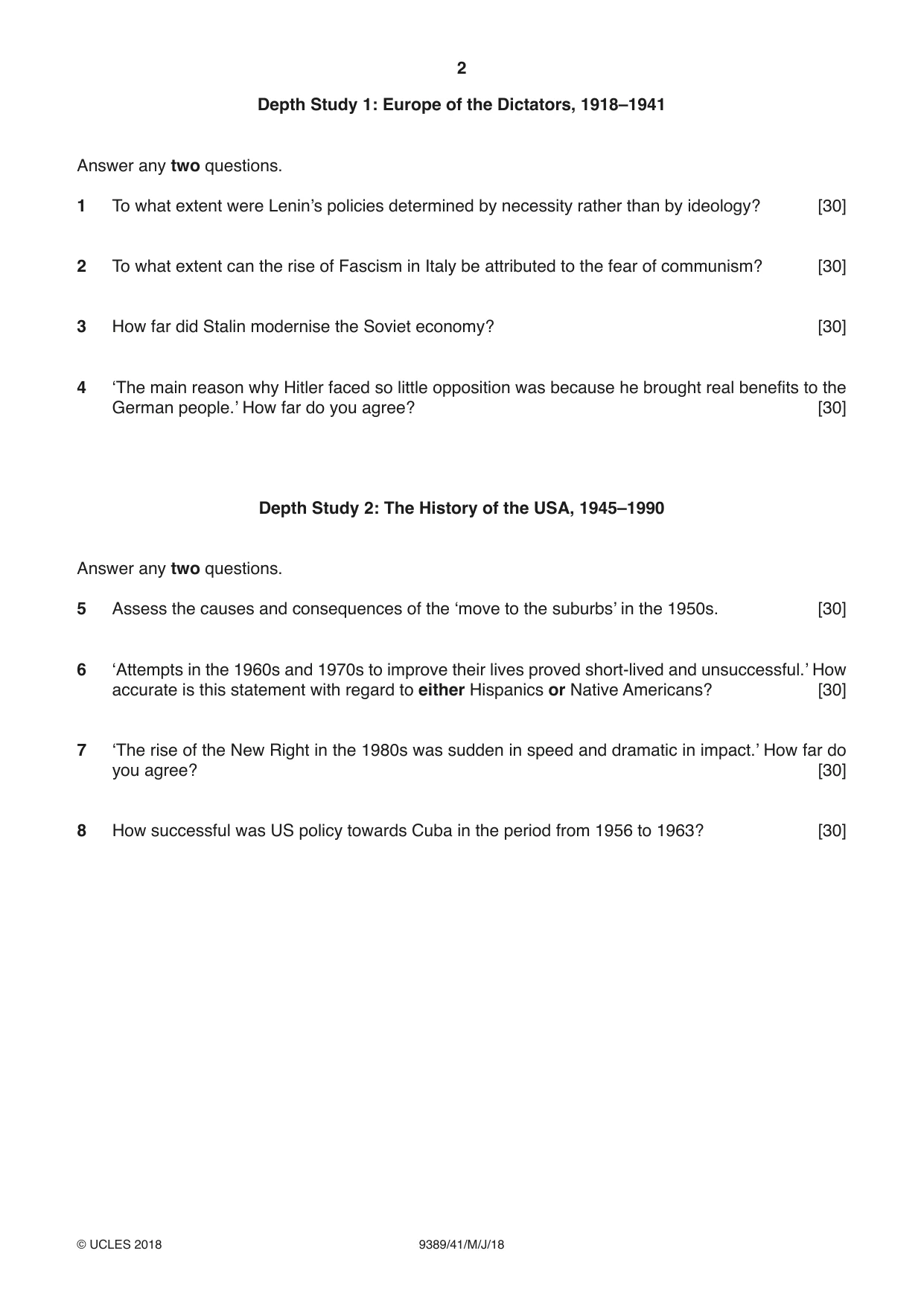
1 To what extent were Lenin’s policies determined by necessity rather than by ideology? [30]
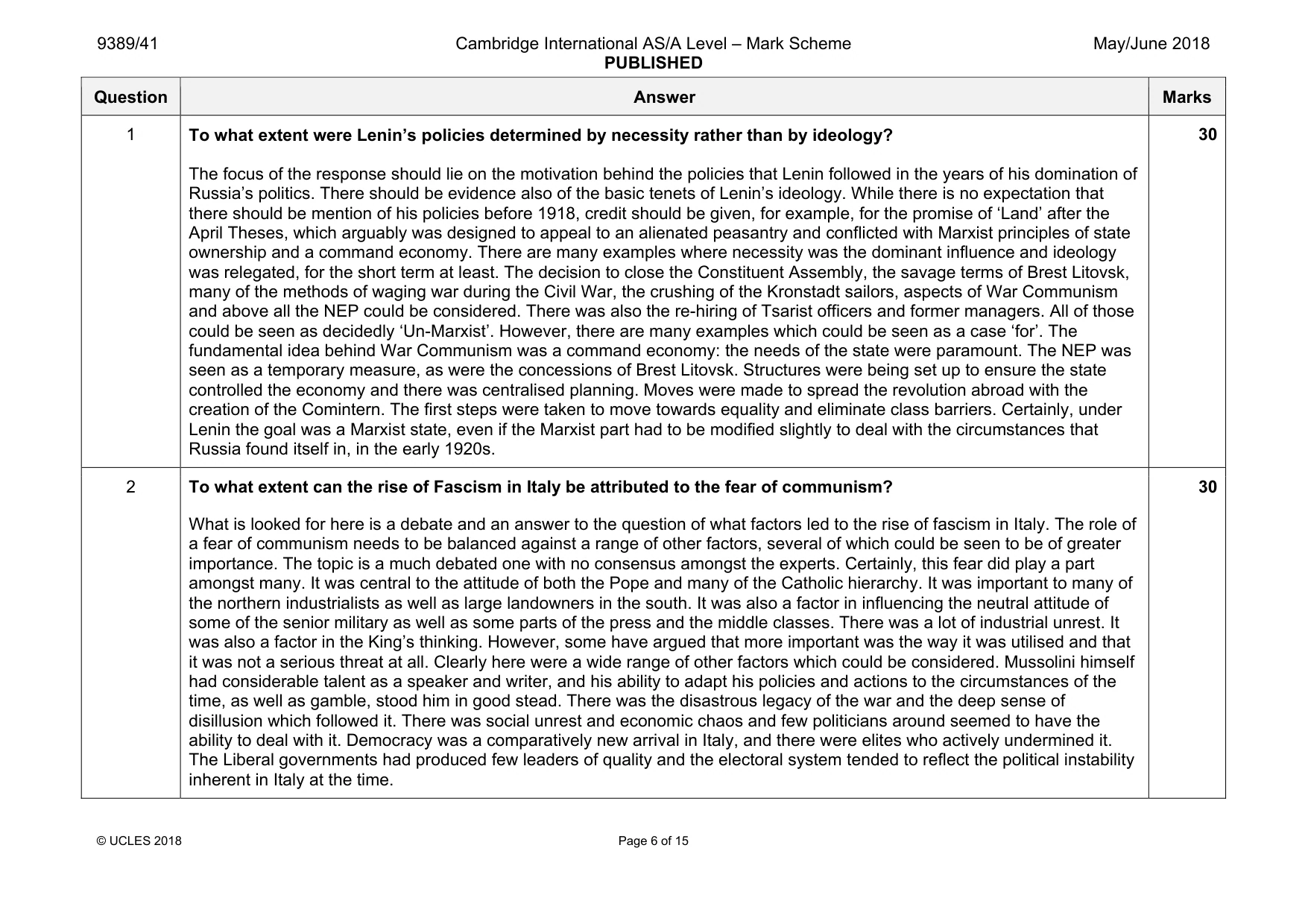
Mark scheme: 1 To what extent were Lenin’s policies determined by necessity rather than by ideology? The focus of the response should lie on the motivation behind the policies that Lenin followed in the years of his domination of Russia’s politics. There should be evidence also of the basic tenets of Lenin’s ideology. While there is no expectation that there should be mention of his policies before 1918, credit should be given, for example, for the promise of ‘Land’ after the April Theses, which arguably was designed to appeal to an alienated peasantry and conflicted with Marxist principles of state ownership and a command economy. There are many examples where necessity was the dominant influence and ideology was relegated, for the short term at least. The decision to close the Constituent Assembly, the savage terms of Brest Litovsk, many of the methods of waging war during the Civil War, the crushing of the Kronstadt sailors, aspects of War Communism and above all the NEP could be considered. There was also the re-hiring of Tsarist officers and former managers. All of those could be seen as decidedly ‘Un-Marxist’. However, there are many examples which could be seen as a case ‘for’. The fundamental idea behind War Communism was a command economy: the needs of the state were paramount. The NEP was seen as a temporary measure, as were the concessions of Brest Litovsk. Structures were being set up to ensure the state controlled the economy and there was centralised planning. Moves were made to spread the revolution abroad with the creation of the Comintern. The first steps were taken to move towards equality and eliminate class barriers. Certainly, under Lenin the goal was a Marxist state, even if the Marxist part had to be modified slightly to deal with the circumstances that Russia found itself in, in the early 1920s. 30
Q2 · To what extent can the rise of Fascism in Italy be attributed to the fear of communism?
2 To what extent can the rise of Fascism in Italy be attributed to the fear of communism? [30]
Mark scheme: 2 To what extent can the rise of Fascism in Italy be attributed to the fear of communism? What is looked for here is a debate and an answer to the question of what factors led to the rise of fascism in Italy. The role of a fear of communism needs to be balanced against a range of other factors, several of which could be seen to be of greater importance. The topic is a much debated one with no consensus amongst the experts. Certainly, this fear did play a part amongst many. It was central to the attitude of both the Pope and many of the Catholic hierarchy. It was important to many of the northern industrialists as well as large landowners in the south. It was also a factor in influencing the neutral attitude of some of the senior military as well as some parts of the press and the middle classes. There was a lot of industrial unrest. It was also a factor in the King’s thinking. However, some have argued that more important was the way it was utilised and that it was not a serious threat at all. Clearly here were a wide range of other factors which could be considered. Mussolini himself had considerable talent as a speaker and writer, and his ability to adapt his policies and actions to the circumstances of the time, as well as gamble, stood him in good stead. There was the disastrous legacy of the war and the deep sense of disillusion which followed it. There was social unrest and economic chaos and few politicians around seemed to have the ability to deal with it. Democracy was a comparatively new arrival in Italy, and there were elites who actively undermined it. The Liberal governments had produced few leaders of quality and the electoral system tended to reflect the political instability inherent in Italy at the time. 30
Q3 · How far did Stalin modernise the Soviet economy?
3 How far did Stalin modernise the Soviet economy? [30]
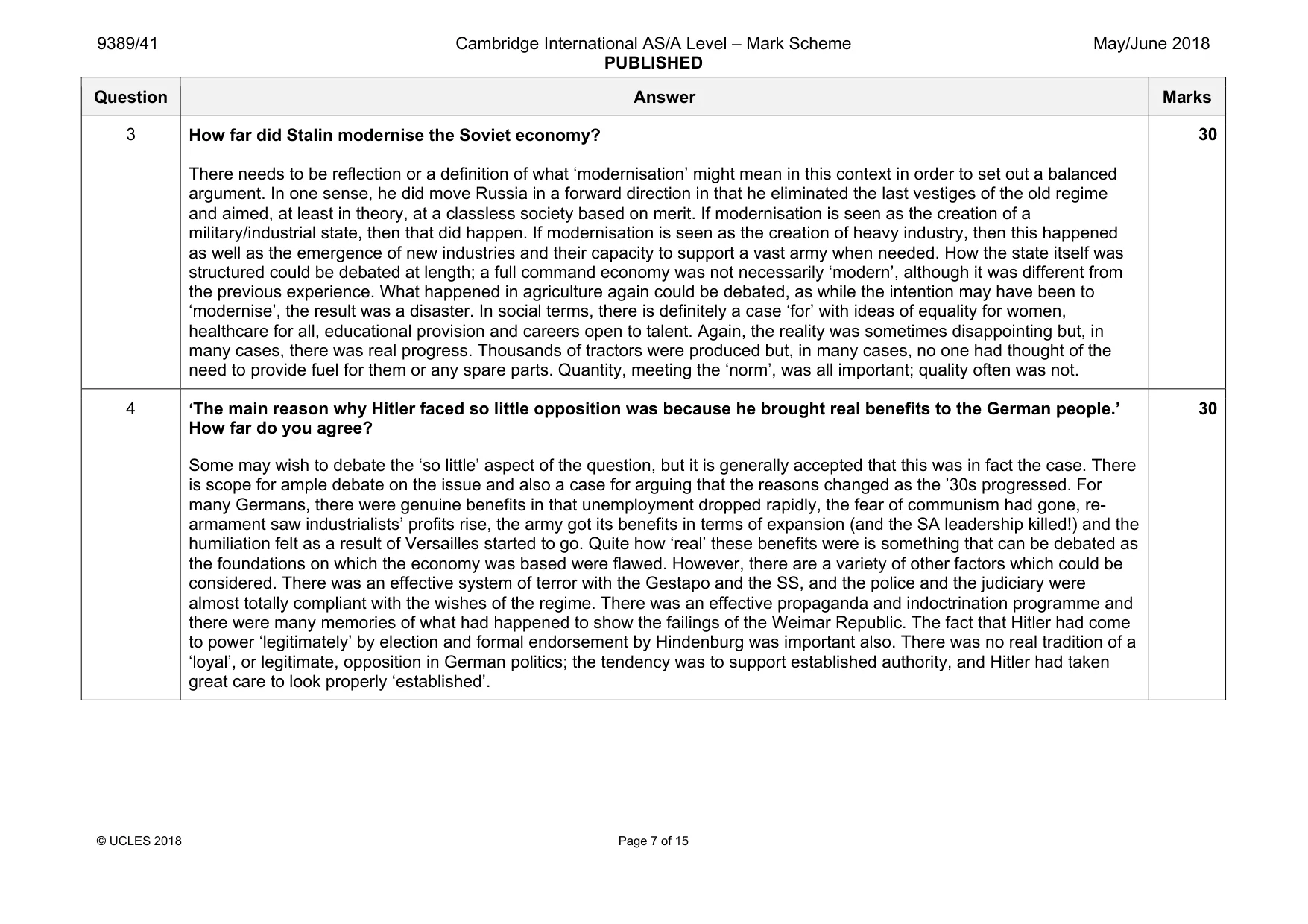
Mark scheme: 3 How far did Stalin modernise the Soviet economy? There needs to be reflection or a definition of what ‘modernisation’ might mean in this context in order to set out a balanced argument. In one sense, he did move Russia in a forward direction in that he eliminated the last vestiges of the old regime and aimed, at least in theory, at a classless society based on merit. If modernisation is seen as the creation of a military/industrial state, then that did happen. If modernisation is seen as the creation of heavy industry, then this happened as well as the emergence of new industries and their capacity to support a vast army when needed. How the state itself was structured could be debated at length; a full command economy was not necessarily ‘modern’, although it was different from the previous experience. What happened in agriculture again could be debated, as while the intention may have been to ‘modernise’, the result was a disaster. In social terms, there is definitely a case ‘for’ with ideas of equality for women, healthcare for all, educational provision and careers open to talent. Again, the reality was sometimes disappointing but, in many cases, there was real progress. Thousands of tractors were produced but, in many cases, no one had thought of the need to provide fuel for them or any spare parts. Quantity, meeting the ‘norm’, was all important; quality often was not. 30
Q4 · ‘The main reason why Hitler faced so little opposition was because he brought real…
4 ‘The main reason why Hitler faced so little opposition was because he brought real benefits to the German people.’ How far do you agree? [30] Depth Study 2: The History of the USA, 1945–1990 Answer any two questions.
Mark scheme: 4 ‘The main reason why Hitler faced so little opposition was because he brought real benefits to the German people.’ How far do you agree? Some may wish to debate the ‘so little’ aspect of the question, but it is generally accepted that this was in fact the case. There is scope for ample debate on the issue and also a case for arguing that the reasons changed as the ’30s progressed. For many Germans, there were genuine benefits in that unemployment dropped rapidly, the fear of communism had gone, re- armament saw industrialists’ profits rise, the army got its benefits in terms of expansion (and the SA leadership killed!) and the humiliation felt as a result of Versailles started to go. Quite how ‘real’ these benefits were is something that can be debated as the foundations on which the economy was based were flawed. However, there are a variety of other factors which could be considered. There was an effective system of terror with the Gestapo and the SS, and the police and the judiciary were almost totally compliant with the wishes of the regime. There was an effective propaganda and indoctrination programme and there were many memories of what had happened to show the failings of the Weimar Republic. The fact that Hitler had come to power ‘legitimately’ by election and formal endorsement by Hindenburg was important also. There was no real tradition of a ‘loyal’, or legitimate, opposition in German politics; the tendency was to support established authority, and Hitler had taken great care to look properly ‘established’. 30
Q5 · Assess the causes and consequences of the ‘move to the suburbs’ in the 1950s
5 Assess the causes and consequences of the ‘move to the suburbs’ in the 1950s. [30]
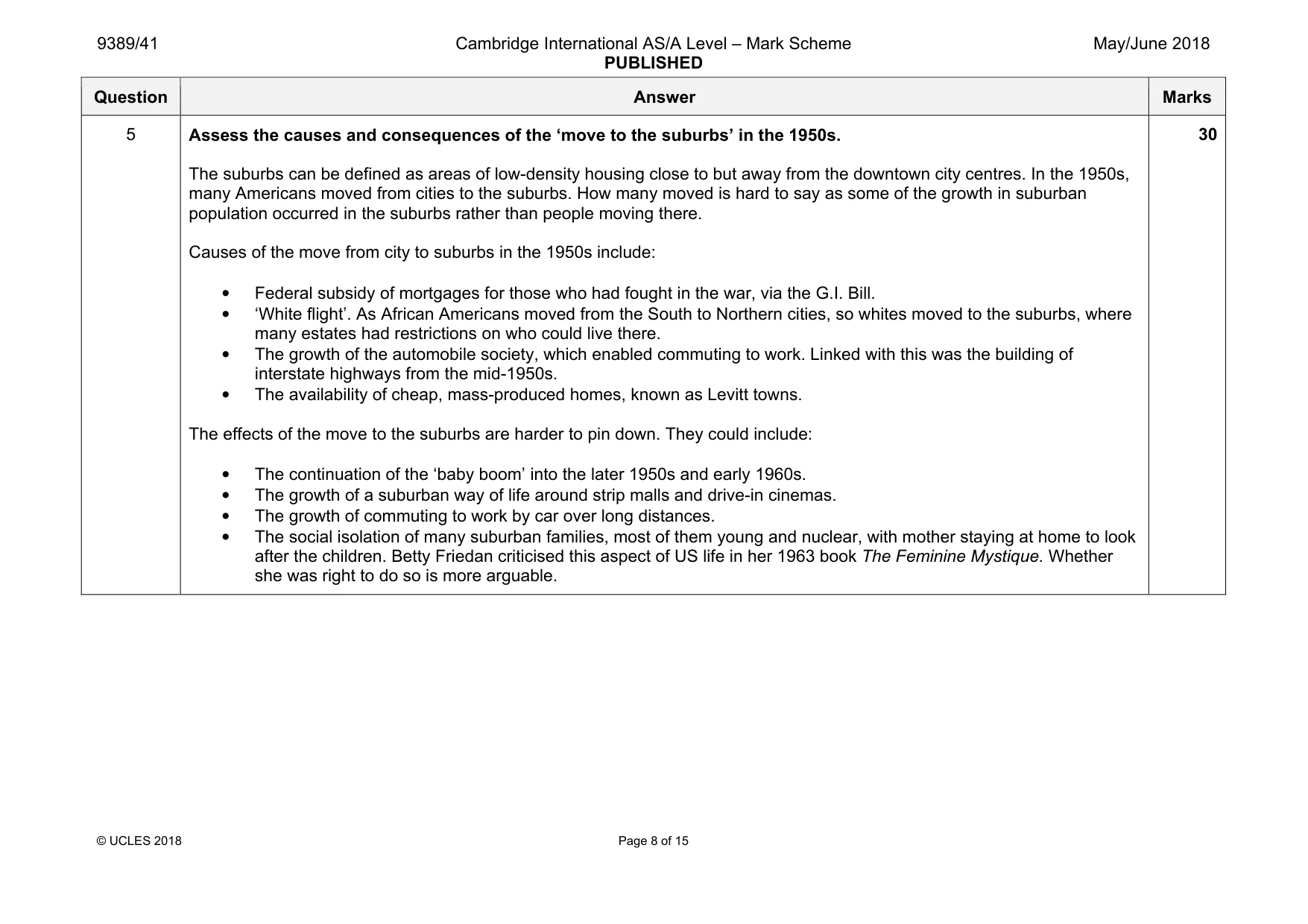
Mark scheme: 5 Assess the causes and consequences of the ‘move to the suburbs’ in the 1950s. The suburbs can be defined as areas of low-density housing close to but away from the downtown city centres. In the 1950s, many Americans moved from cities to the suburbs. How many moved is hard to say as some of the growth in suburban population occurred in the suburbs rather than people moving there. Causes of the move from city to suburbs in the 1950s include: • Federal subsidy of mortgages for those who had fought in the war, via the G.I. Bill. • ‘White flight’. As African Americans moved from the South to Northern cities, so whites moved to the suburbs, where many estates had restrictions on who could live there. • The growth of the automobile society, which enabled commuting to work. Linked with this was the building of interstate highways from the mid-1950s. • The availability of cheap, mass-produced homes, known as Levitt towns. The effects of the move to the suburbs are harder to pin down. They could include: • The continuation of the ‘baby boom’ into the later 1950s and early 1960s. • The growth of a suburban way of life around strip malls and drive-in cinemas. • The growth of commuting to work by car over long distances. • The social isolation of many suburban families, most of them young and nuclear, with mother staying at home to look after the children. Betty Friedan criticised this aspect of US life in her 1963 book The Feminine Mystique. Whether she was right to do so is more arguable. 30
Q6 · ‘Attempts in the 1960s and 1970s to improve their lives proved short-lived and…
6 ‘Attempts in the 1960s and 1970s to improve their lives proved short-lived and unsuccessful.’ How accurate is this statement with regard to either Hispanics or Native Americans? [30]
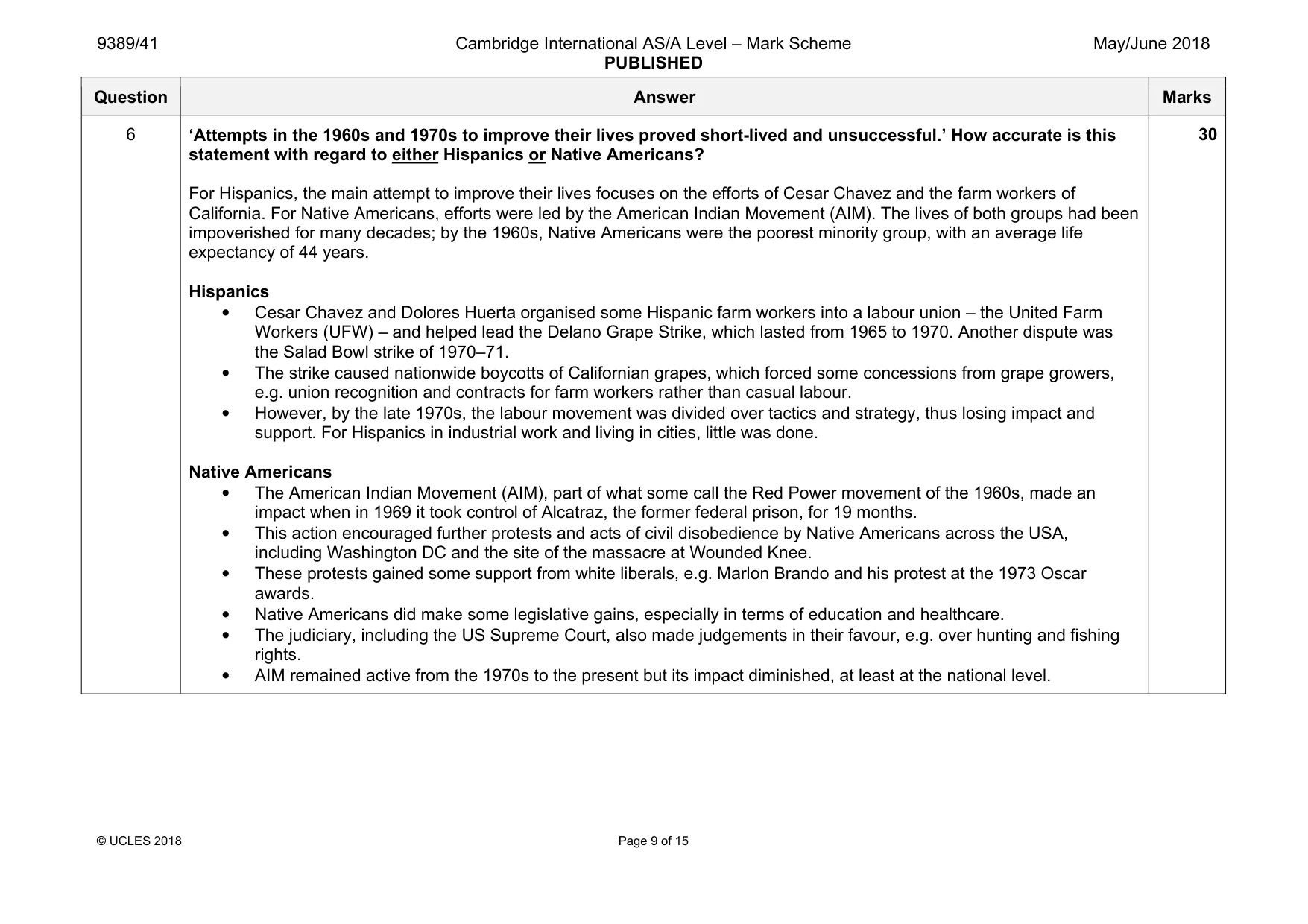
Mark scheme: 6 ‘Attempts in the 1960s and 1970s to improve their lives proved short-lived and unsuccessful.’ How accurate is this statement with regard to either Hispanics or Native Americans? For Hispanics, the main attempt to improve their lives focuses on the efforts of Cesar Chavez and the farm workers of California. For Native Americans, efforts were led by the American Indian Movement (AIM). The lives of both groups had been impoverished for many decades; by the 1960s, Native Americans were the poorest minority group, with an average life expectancy of 44 years. Hispanics • Cesar Chavez and Dolores Huerta organised some Hispanic farm workers into a labour union – the United Farm Workers (UFW) – and helped lead the Delano Grape Strike, which lasted from 1965 to 1970. Another dispute was the Salad Bowl strike of 1970–71. • The strike caused nationwide boycotts of Californian grapes, which forced some concessions from grape growers, e.g. union recognition and contracts for farm workers rather than casual labour. • However, by the late 1970s, the labour movement was divided over tactics and strategy, thus losing impact and support. For Hispanics in industrial work and living in cities, little was done. Native Americans • The American Indian Movement (AIM), part of what some call the Red Power movement of the 1960s, made an impact when in 1969 it took control of Alcatraz, the former federal prison, for 19 months. • This action encouraged further protests and acts of civil disobedience by Native Americans across the USA, including Washington DC and the site of the massacre at Wounded Knee. • These protests gained some support from white liberals, e.g. Marlon Brando and his protest at the 1973 Oscar awards. • Native Americans did make some legislative gains, especially in terms of education and healthcare. • The judiciary, including the US Supreme Court, also made judgements in their favour, e.g. over hunting and fishing rights. • AIM remained active from the 1970s to the present but its impact diminished, at least at the national level. 30
Q7 · ‘The rise of the New Right in the 1980s was sudden in speed and dramatic in impact.’ How…
7 ‘The rise of the New Right in the 1980s was sudden in speed and dramatic in impact.’ How far do you agree? [30]
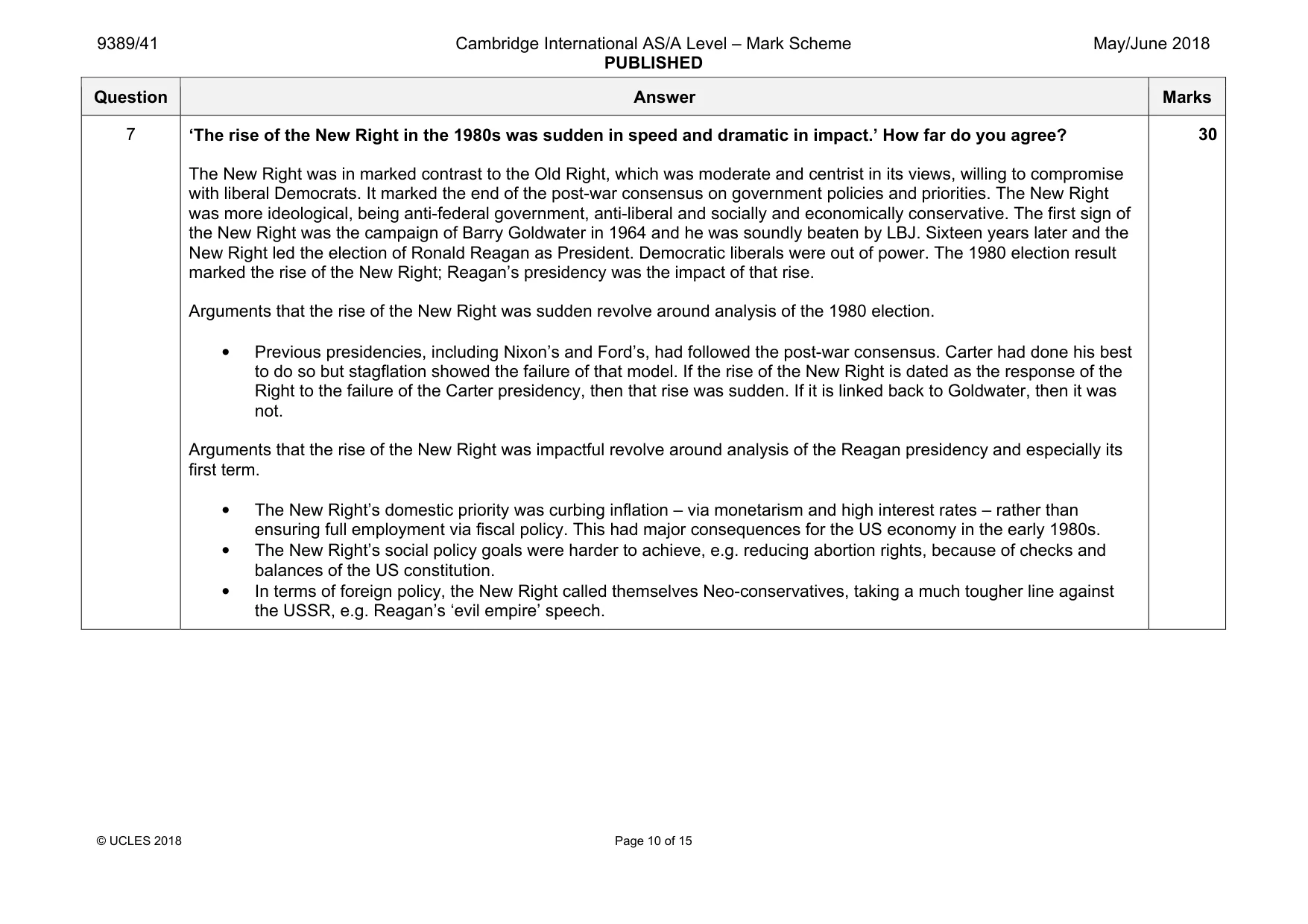
Mark scheme: 7 ‘The rise of the New Right in the 1980s was sudden in speed and dramatic in impact.’ How far do you agree? The New Right was in marked contrast to the Old Right, which was moderate and centrist in its views, willing to compromise with liberal Democrats. It marked the end of the post-war consensus on government policies and priorities. The New Right was more ideological, being anti-federal government, anti-liberal and socially and economically conservative. The first sign of the New Right was the campaign of Barry Goldwater in 1964 and he was soundly beaten by LBJ. Sixteen years later and the New Right led the election of Ronald Reagan as President. Democratic liberals were out of power. The 1980 election result marked the rise of the New Right; Reagan’s presidency was the impact of that rise. Arguments that the rise of the New Right was sudden revolve around analysis of the 1980 election. • Previous presidencies, including Nixon’s and Ford’s, had followed the post-war consensus. Carter had done his best to do so but stagflation showed the failure of that model. If the rise of the New Right is dated as the response of the Right to the failure of the Carter presidency, then that rise was sudden. If it is linked back to Goldwater, then it was not. Arguments that the rise of the New Right was impactful revolve around analysis of the Reagan presidency and especially its first term. • The New Right’s domestic priority was curbing inflation – via monetarism and high interest rates – rather than ensuring full employment via fiscal policy. This had major consequences for the US economy in the early 1980s. • The New Right’s social policy goals were harder to achieve, e.g. reducing abortion rights, because of checks and balances of the US constitution. • In terms of foreign policy, the New Right called themselves Neo-conservatives, taking a much tougher line against the USSR, e.g. Reagan’s ‘evil empire’ speech. 30
Q8 · Depth Study 3: International History, 1945–1991 Answer any two questions
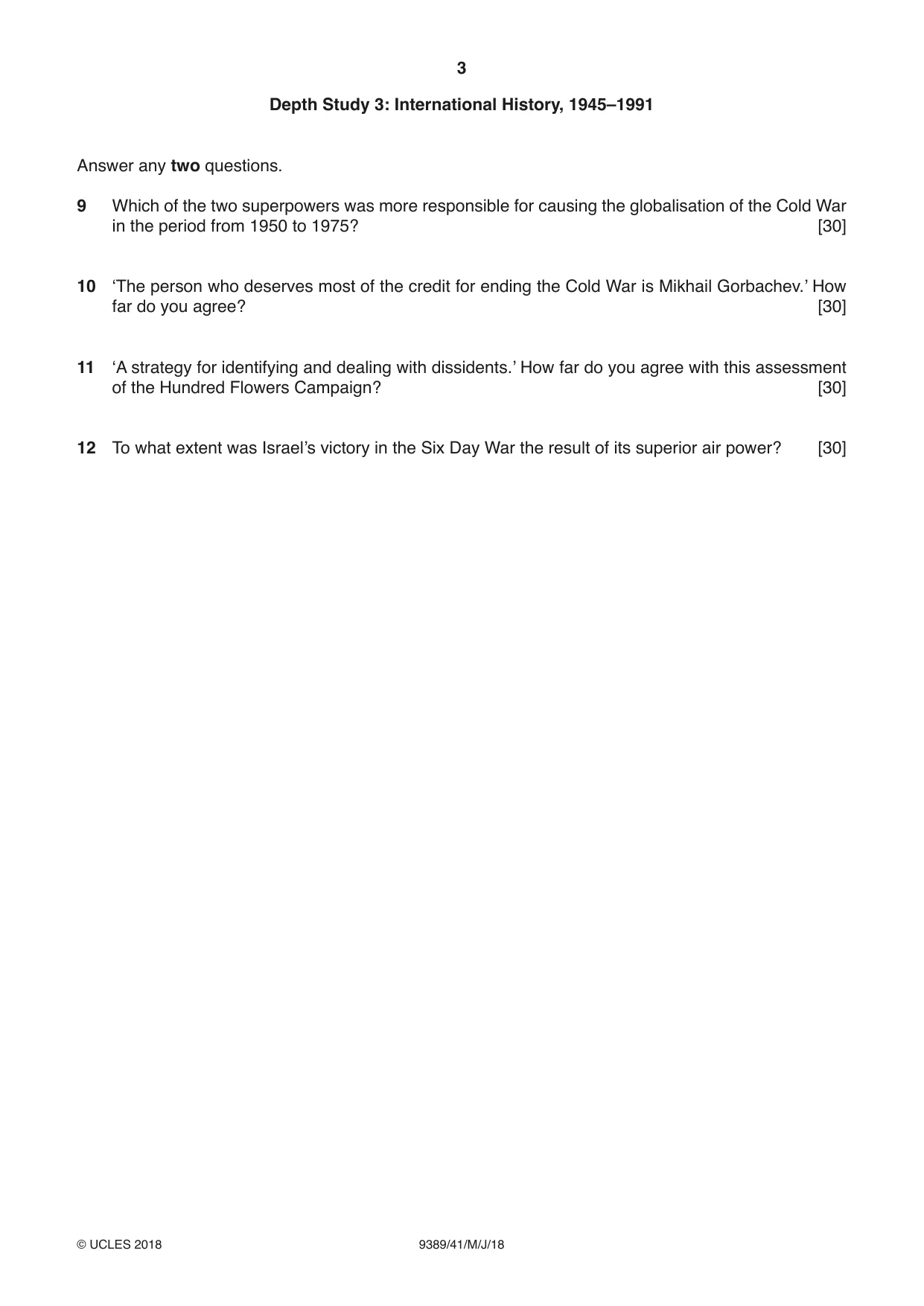
Depth Study 3: International History, 1945–1991 Answer any two questions.
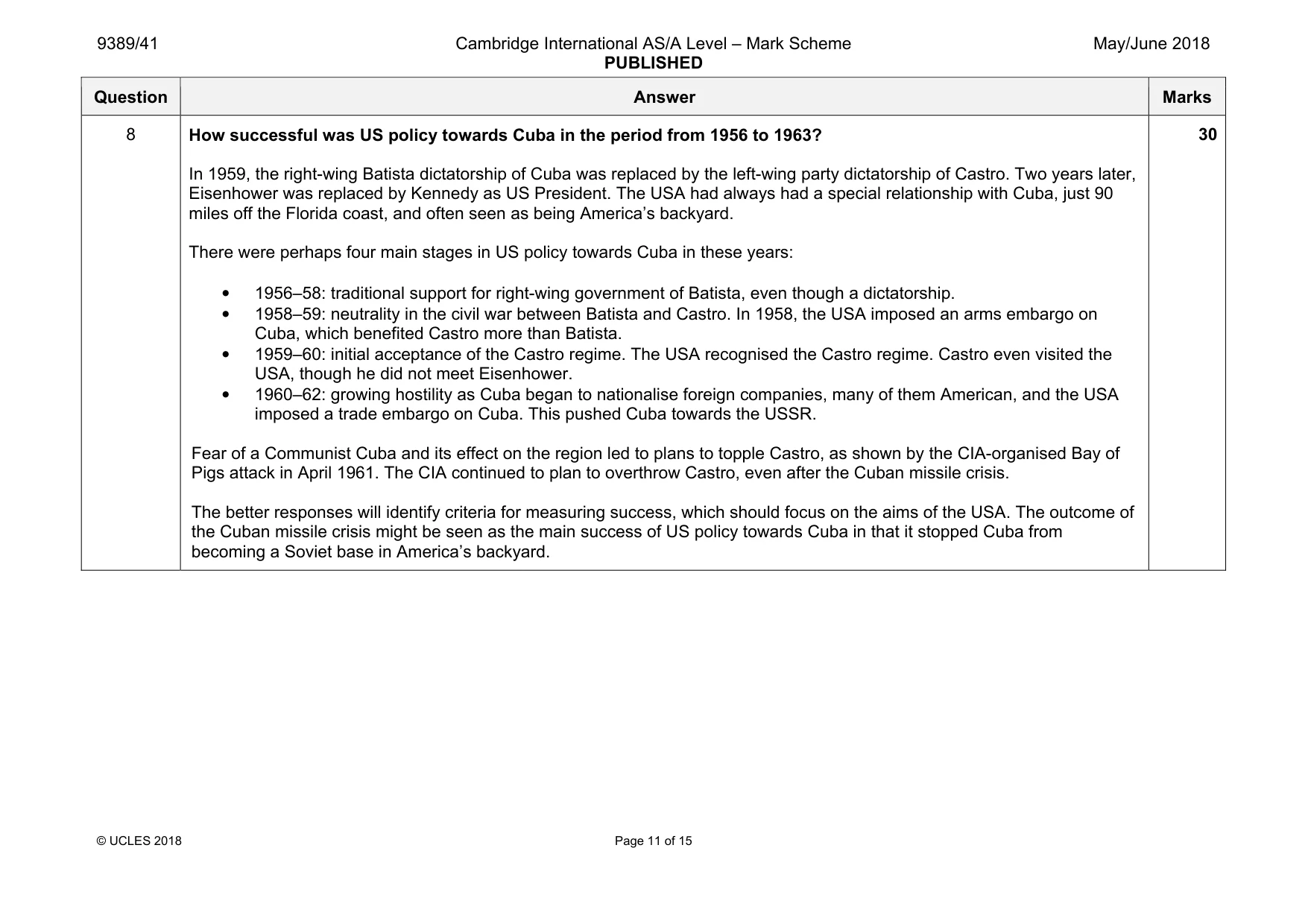
Mark scheme: 8 How successful was US policy towards Cuba in the period from 1956 to 1963? In 1959, the right-wing Batista dictatorship of Cuba was replaced by the left-wing party dictatorship of Castro. Two years later, Eisenhower was replaced by Kennedy as US President. The USA had always had a special relationship with Cuba, just 90 miles off the Florida coast, and often seen as being America’s backyard. There were perhaps four main stages in US policy towards Cuba in these years: • 1956–58: traditional support for right-wing government of Batista, even though a dictatorship. • 1958–59: neutrality in the civil war between Batista and Castro. In 1958, the USA imposed an arms embargo on Cuba, which benefited Castro more than Batista. • 1959–60: initial acceptance of the Castro regime. The USA recognised the Castro regime. Castro even visited the USA, though he did not meet Eisenhower. • 1960–62: growing hostility as Cuba began to nationalise foreign companies, many of them American, and the USA imposed a trade embargo on Cuba. This pushed Cuba towards the USSR. Fear of a Communist Cuba and its effect on the region led to plans to topple Castro, as shown by the CIA-organised Bay of Pigs attack in April 1961. The CIA continued to plan to overthrow Castro, even after the Cuban missile crisis. The better responses will identify criteria for measuring success, which should focus on the aims of the USA. The outcome of the Cuban missile crisis might be seen as the main success of US policy towards Cuba in that it stopped Cuba from becoming a Soviet base in America’s backyard. 30
Q9 · Which of the two superpowers was more responsible for causing the globalisation of the…
9 Which of the two superpowers was more responsible for causing the globalisation of the Cold War in the period from 1950 to 1975? [30]
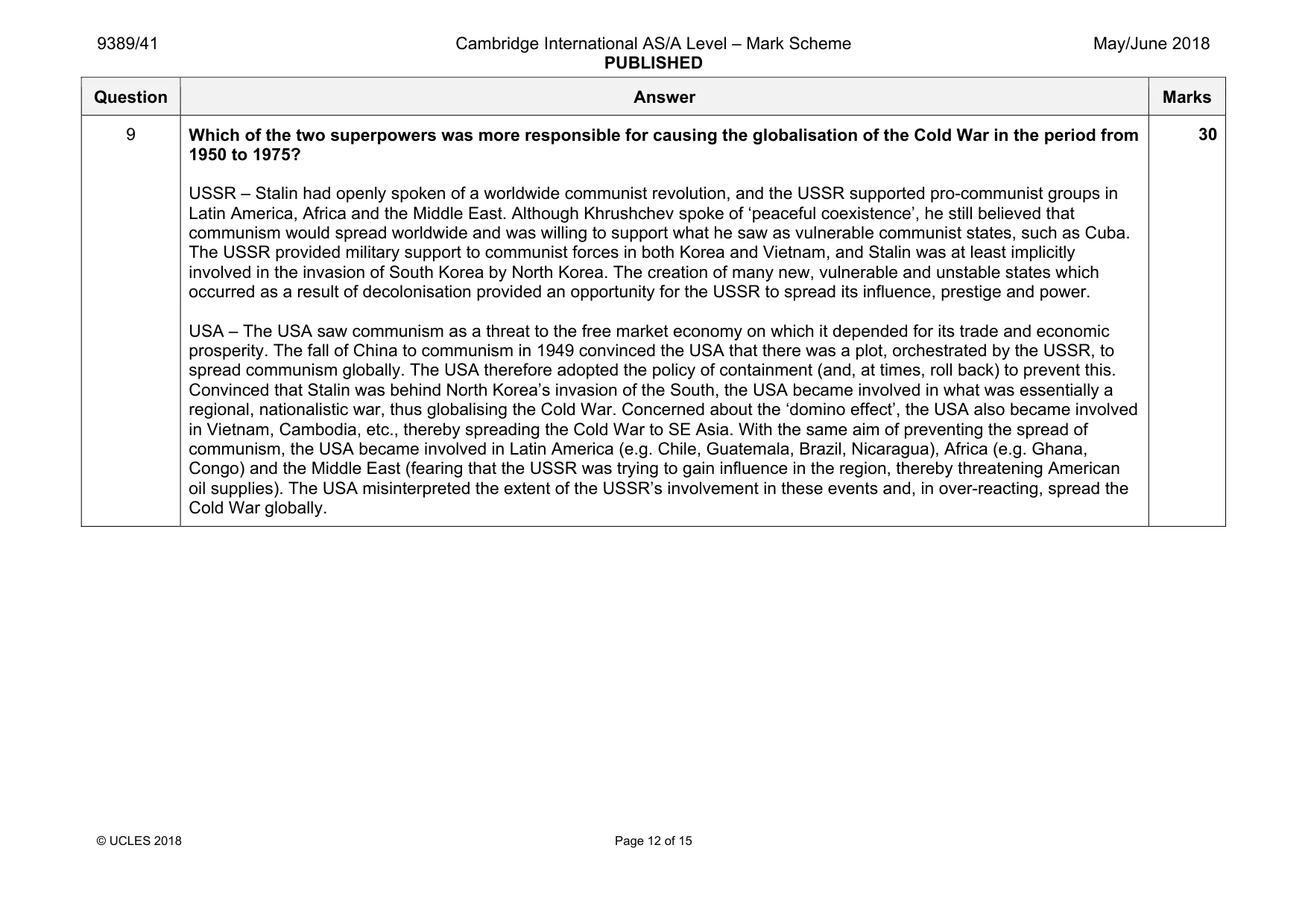
Mark scheme: 9 Which of the two superpowers was more responsible for causing the globalisation of the Cold War in the period from 1950 to 1975? USSR – Stalin had openly spoken of a worldwide communist revolution, and the USSR supported pro-communist groups in Latin America, Africa and the Middle East. Although Khrushchev spoke of ‘peaceful coexistence’, he still believed that communism would spread worldwide and was willing to support what he saw as vulnerable communist states, such as Cuba. The USSR provided military support to communist forces in both Korea and Vietnam, and Stalin was at least implicitly involved in the invasion of South Korea by North Korea. The creation of many new, vulnerable and unstable states which occurred as a result of decolonisation provided an opportunity for the USSR to spread its influence, prestige and power. USA – The USA saw communism as a threat to the free market economy on which it depended for its trade and economic prosperity. The fall of China to communism in 1949 convinced the USA that there was a plot, orchestrated by the USSR, to spread communism globally. The USA therefore adopted the policy of containment (and, at times, roll back) to prevent this. Convinced that Stalin was behind North Korea’s invasion of the South, the USA became involved in what was essentially a regional, nationalistic war, thus globalising the Cold War. Concerned about the ‘domino effect’, the USA also became involved in Vietnam, Cambodia, etc., thereby spreading the Cold War to SE Asia. With the same aim of preventing the spread of communism, the USA became involved in Latin America (e.g. Chile, Guatemala, Brazil, Nicaragua), Africa (e.g. Ghana, Congo) and the Middle East (fearing that the USSR was trying to gain influence in the region, thereby threatening American oil supplies). The USA misinterpreted the extent of the USSR’s involvement in these events and, in over-reacting, spread the Cold War globally. 30
Q10 · ‘The person who deserves most of the credit for ending the Cold War is Mikhail…
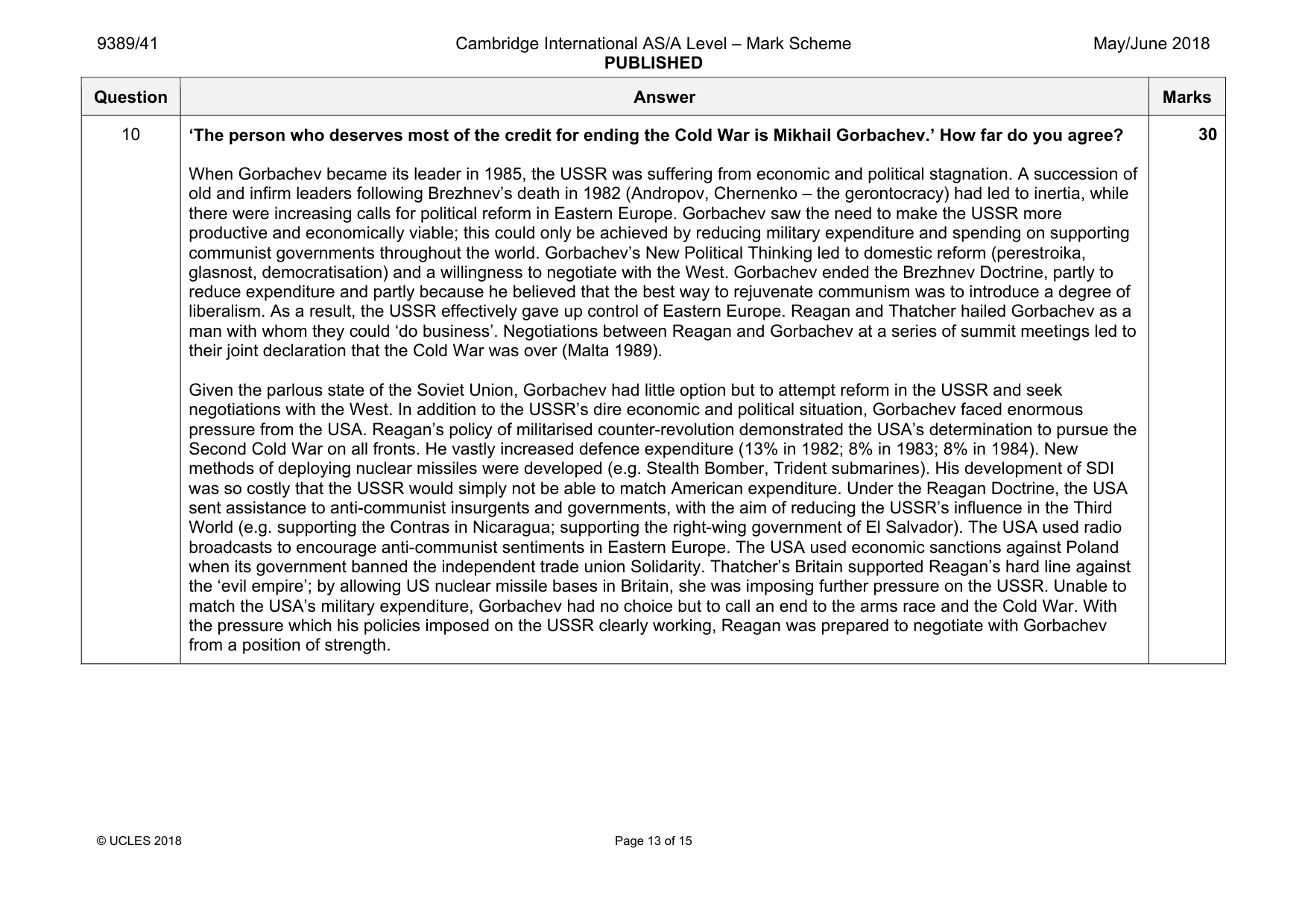
10 ‘The person who deserves most of the credit for ending the Cold War is Mikhail Gorbachev.’ How far do you agree? [30]
Mark scheme: 10 ‘The person who deserves most of the credit for ending the Cold War is Mikhail Gorbachev.’ How far do you agree? When Gorbachev became its leader in 1985, the USSR was suffering from economic and political stagnation. A succession of old and infirm leaders following Brezhnev’s death in 1982 (Andropov, Chernenko – the gerontocracy) had led to inertia, while there were increasing calls for political reform in Eastern Europe. Gorbachev saw the need to make the USSR more productive and economically viable; this could only be achieved by reducing military expenditure and spending on supporting communist governments throughout the world. Gorbachev’s New Political Thinking led to domestic reform (perestroika, glasnost, democratisation) and a willingness to negotiate with the West. Gorbachev ended the Brezhnev Doctrine, partly to reduce expenditure and partly because he believed that the best way to rejuvenate communism was to introduce a degree of liberalism. As a result, the USSR effectively gave up control of Eastern Europe. Reagan and Thatcher hailed Gorbachev as a man with whom they could ‘do business’. Negotiations between Reagan and Gorbachev at a series of summit meetings led to their joint declaration that the Cold War was over (Malta 1989). Given the parlous state of the Soviet Union, Gorbachev had little option but to attempt reform in the USSR and seek negotiations with the West. In addition to the USSR’s dire economic and political situation, Gorbachev faced enormous pressure from the USA. Reagan’s policy of militarised counter-revolution demonstrated the USA’s determination to pursue the Second Cold War on all fronts. He vastly increased defence expenditure (13% in 1982; 8% in 1983; 8% in 1984). New methods of deploying nuclear missiles were developed (e.g. Stealth Bomber, Trident submarines). His development of SDI was so costly that the USSR would simply not be able to match American expenditure. Under the Reagan Doctrine, the USA sent assistance to anti-communist insurgents and governments, with the aim of reducing the USSR’s influence in the Third World (e.g. supporting the Contras in Nicaragua; supporting the right-wing government of El Salvador). The USA used radio broadcasts to encourage anti-communist sentiments in Eastern Europe. The USA used economic sanctions against Poland when its government banned the independent trade union Solidarity. Thatcher’s Britain supported Reagan’s hard line against the ‘evil empire’; by allowing US nuclear missile bases in Britain, she was imposing further pressure on the USSR. Unable to match the USA’s military expenditure, Gorbachev had no choice but to call an end to the arms race and the Cold War. With the pressure which his policies imposed on the USSR clearly working, Reagan was prepared to negotiate with Gorbachev from a position of strength. 30
Q11 · ‘A strategy for identifying and dealing with dissidents.’ How far do you agree with this…
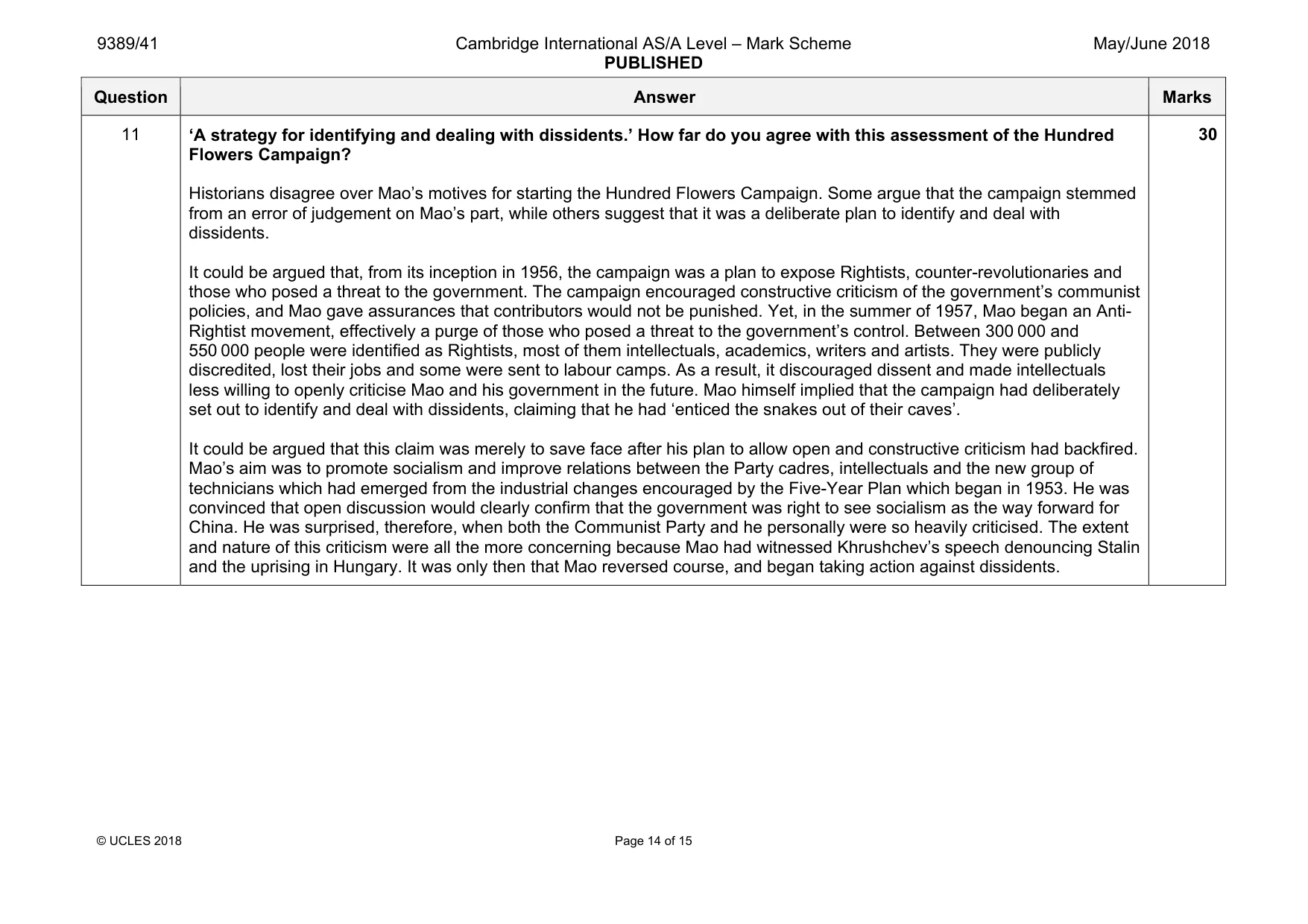
11 ‘A strategy for identifying and dealing with dissidents.’ How far do you agree with this assessment of the Hundred Flowers Campaign? [30]
Mark scheme: 11 ‘A strategy for identifying and dealing with dissidents.’ How far do you agree with this assessment of the Hundred Flowers Campaign? Historians disagree over Mao’s motives for starting the Hundred Flowers Campaign. Some argue that the campaign stemmed from an error of judgement on Mao’s part, while others suggest that it was a deliberate plan to identify and deal with dissidents. It could be argued that, from its inception in 1956, the campaign was a plan to expose Rightists, counter-revolutionaries and those who posed a threat to the government. The campaign encouraged constructive criticism of the government’s communist policies, and Mao gave assurances that contributors would not be punished. Yet, in the summer of 1957, Mao began an Anti- Rightist movement, effectively a purge of those who posed a threat to the government’s control. Between 300 000 and 550 000 people were identified as Rightists, most of them intellectuals, academics, writers and artists. They were publicly discredited, lost their jobs and some were sent to labour camps. As a result, it discouraged dissent and made intellectuals less willing to openly criticise Mao and his government in the future. Mao himself implied that the campaign had deliberately set out to identify and deal with dissidents, claiming that he had ‘enticed the snakes out of their caves’. It could be argued that this claim was merely to save face after his plan to allow open and constructive criticism had backfired. Mao’s aim was to promote socialism and improve relations between the Party cadres, intellectuals and the new group of technicians which had emerged from the industrial changes encouraged by the Five-Year Plan which began in 1953. He was convinced that open discussion would clearly confirm that the government was right to see socialism as the way forward for China. He was surprised, therefore, when both the Communist Party and he personally were so heavily criticised. The extent and nature of this criticism were all the more concerning because Mao had witnessed Khrushchev’s speech denouncing Stalin and the uprising in Hungary. It was only then that Mao reversed course, and began taking action against dissidents. 30
What you needed in this session
Cambridge’s own grade thresholds for 2018 May/June, Paper 4 · Variant 1. A higher threshold means an easier paper — the bar moves with how the cohort did.