Cambridge A Level History 9389 — 2018 May/June Paper 3 · Variant 1
9389/31/M/J/18 · 3 questions · 40 marks · ≈45 min
The question paper and its mark scheme, free to read here and free to download. This is Cambridge’s own paper, exactly as it was sat.
Question paper4 pages
Mark scheme7 pages
Answers below. Sit the paper first if you are practising.
Questions as text
Q1 · Read the extract and then answer the question
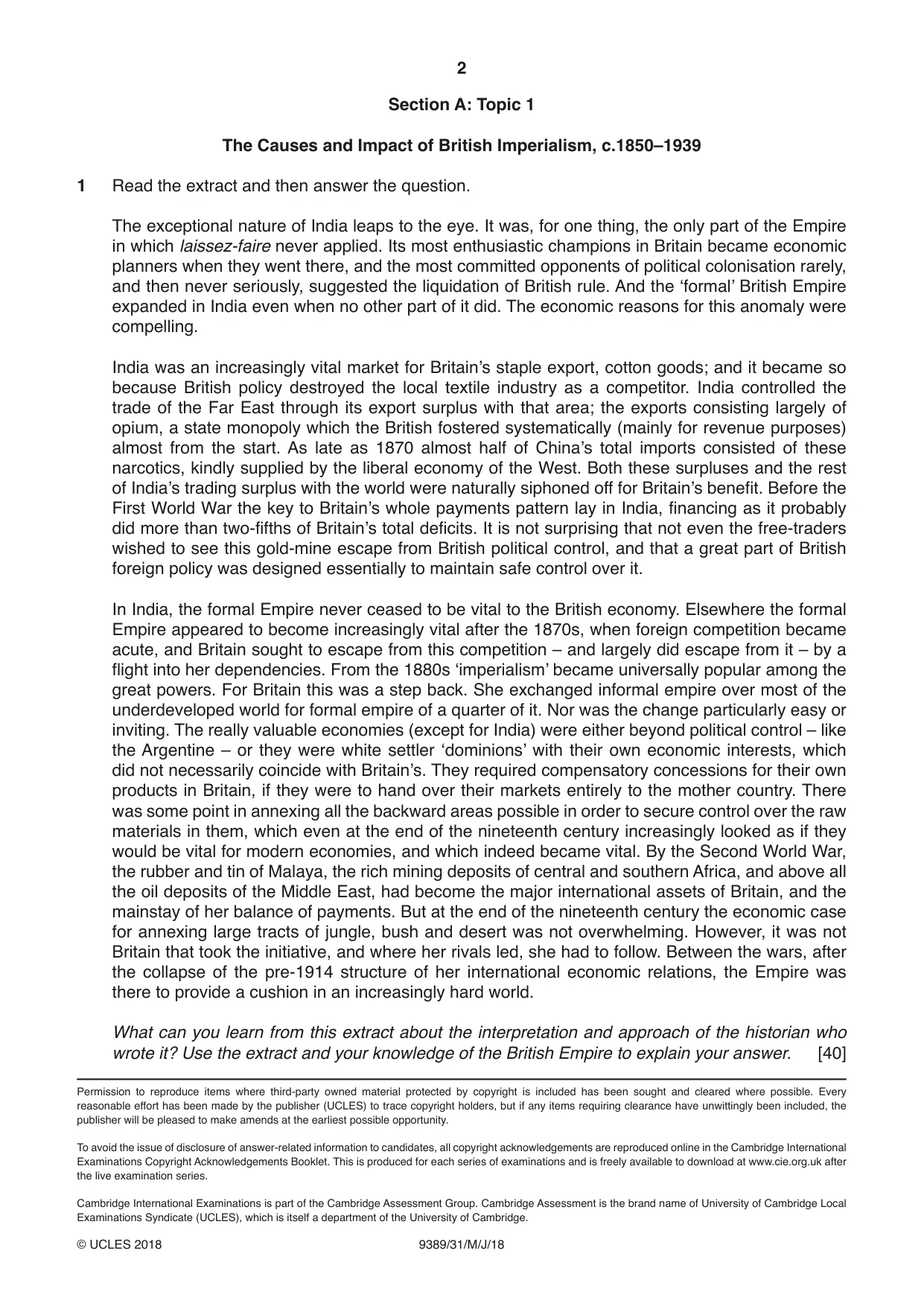
1 Read the extract and then answer the question. The exceptional nature of India leaps to the eye. It was, for one thing, the only part of the Empire in which laissez-faire never applied. Its most enthusiastic champions in Britain became economic planners when they went there, and the most committed opponents of political colonisation rarely, and then never seriously, suggested the liquidation of British rule. And the ‘formal’ British Empire expanded in India even when no other part of it did. The economic reasons for this anomaly were compelling. India was an increasingly vital market for Britain’s staple export, cotton goods; and it became so because British policy destroyed the local textile industry as a competitor. India controlled the trade of the Far East through its export surplus with that area; the exports consisting largely of opium, a state monopoly which the British fostered systematically (mainly for revenue purposes) almost from the start. As late as 1870 almost half of China’s total imports consisted of these narcotics, kindly supplied by the liberal economy of the West. Both these surpluses and the rest of India’s trading surplus with the world were naturally siphoned off for Britain’s benefit. Before the First World War the key to Britain’s whole payments pattern lay in India, financing as it probably did more than two-fifths of Britain’s total deficits. It is not surprising that not even the free-traders wished to see this gold-mine escape from British political control, and that a great part of British foreign policy was designed essentially to maintain safe control over it. In India, the formal Empire never ceased to be vital to the British economy. Elsewhere the formal Empire appeared to become increasingly vital after the 1870s, when foreign competition became acute, and Britain sought to escape from this competition – and largely did escape from it – by a flight into her dependencies. From the 1880s ‘imperialism’ became universally popular among the great powers. For Britain this was a step back. She exchanged informal empire over most of the underdeveloped world for formal empire of a quarter of it. Nor was the change particularly easy or inviting. The really valuable economies (except for India) were either beyond political control – like the Argentine – or they were white settler ‘dominions’ with their own economic interests, which did not necessarily coincide with Britain’s. They required compensatory concessions for their own products in Britain, if they were to hand over their markets entirely to the mother country. There was some point in annexing all the backward areas possible in order to secure control over the raw materials in them, which even at the end of the nineteenth century increasingly looked as if they would be vital for modern economies, and which indeed became vital. By the Second World War, the rubber and tin of Malaya, the rich mining deposits of central and southern Africa, and above all the oil deposits of the Middle East, had become the major international assets of Britain, and the mainstay of her balance of payments. But at the end of the nineteenth century the economic case for annexing large tracts of jungle, bush and desert was not overwhelming. However, it was not Britain that took the initiative, and where her rivals led, she had to follow. Between the wars, after the collapse of the pre-1914 structure of her international economic relations, the Empire was there to provide a cushion in an increasingly hard world. What can you learn from this extract about the interpretation and approach of the historian who wrote it? Use the extract and your knowledge of the British Empire to explain your answer. [40]
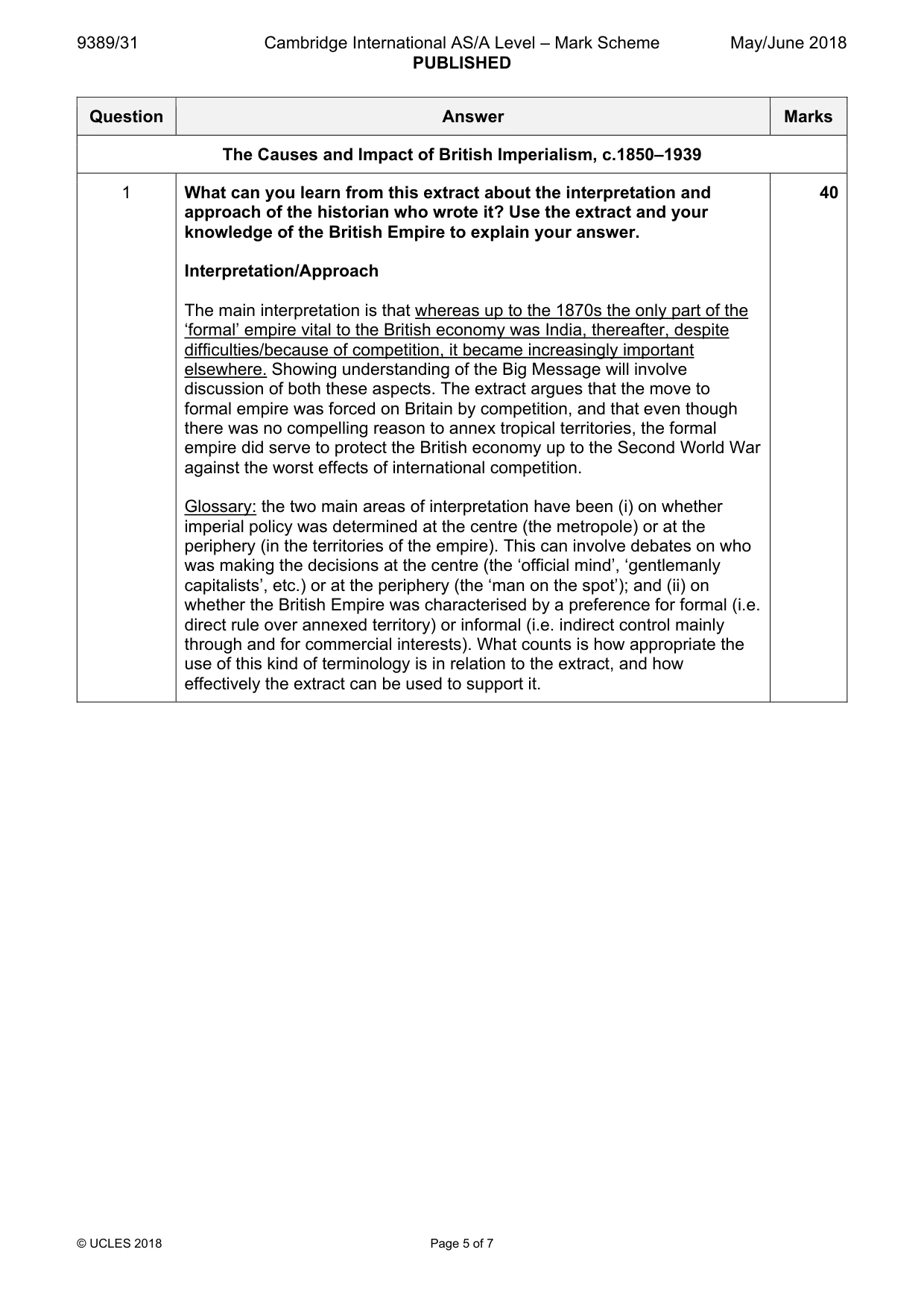
Mark scheme: Question Answer Marks The Causes and Impact of British Imperialism, c.1850–1939 1 What can you learn from this extract about the interpretation and 40 approach of the historian who wrote it? Use the extract and your knowledge of the British Empire to explain your answer. Interpretation/Approach The main interpretation is that whereas up to the 1870s the only part of the ‘formal’ empire vital to the British economy was India, thereafter, despite difficulties/because of competition, it became increasingly important elsewhere. Showing understanding of the Big Message will involve discussion of both these aspects. The extract argues that the move to formal empire was forced on Britain by competition, and that even though there was no compelling reason to annex tropical territories, the formal empire did serve to protect the British economy up to the Second World War against the worst effects of international competition. Glossary: the two main areas of interpretation have been (i) on whether imperial policy was determined at the centre (the metropole) or at the periphery (in the territories of the empire). This can involve debates on who was making the decisions at the centre (the ‘official mind’, ‘gentlemanly capitalists’, etc.) or at the periphery (the ‘man on the spot’); and (ii) on whether the British Empire was characterised by a preference for formal (i.e. direct rule over annexed territory) or informal (i.e. indirect control mainly through and for commercial interests). What counts is how appropriate the use of this kind of terminology is in relation to the extract, and how effectively the extract can be used to support it.
Q2 · Read the extract and then answer the question
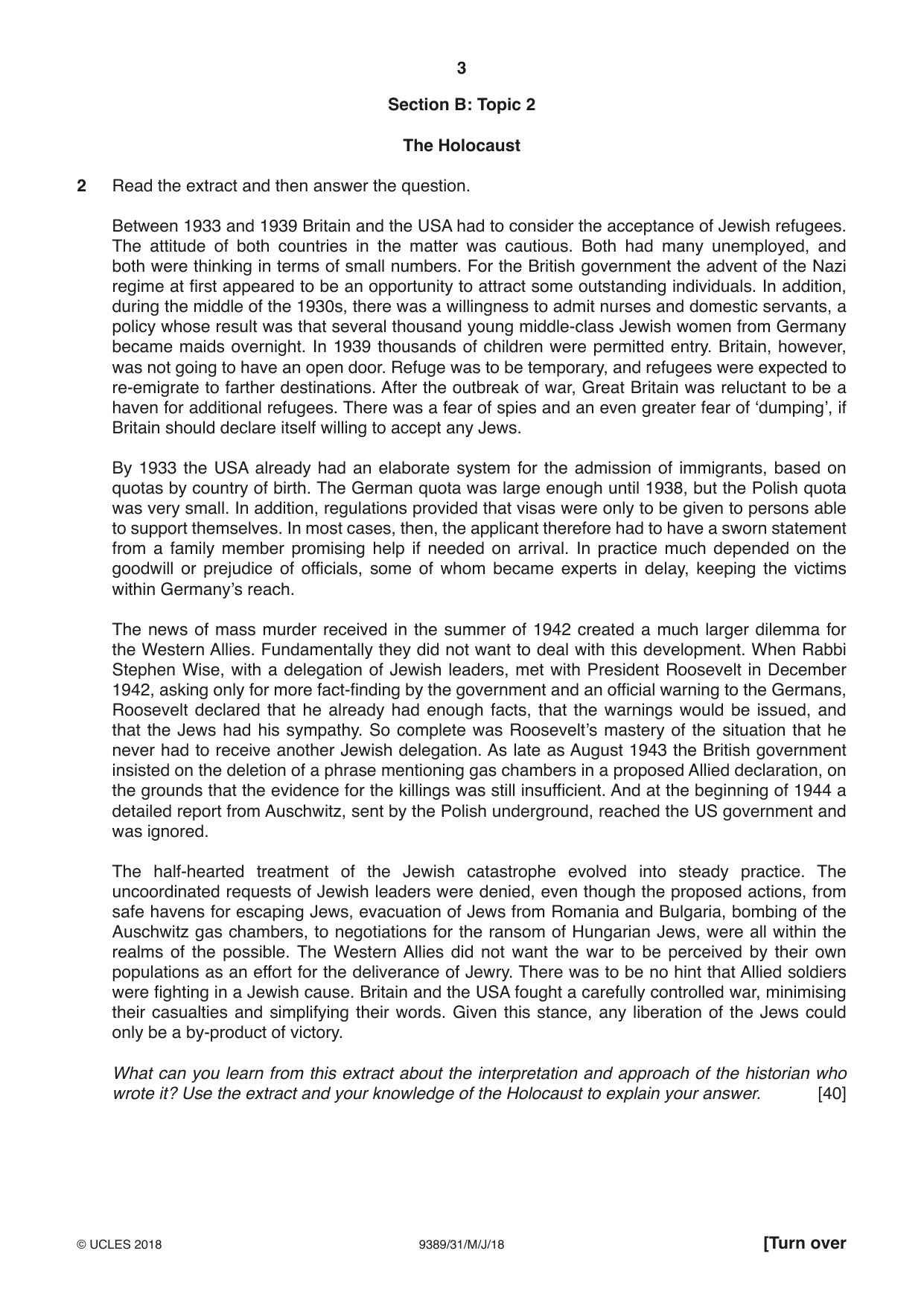
2 Read the extract and then answer the question. Between 1933 and 1939 Britain and the USA had to consider the acceptance of Jewish refugees. The attitude of both countries in the matter was cautious. Both had many unemployed, and both were thinking in terms of small numbers. For the British government the advent of the Nazi regime at first appeared to be an opportunity to attract some outstanding individuals. In addition, during the middle of the 1930s, there was a willingness to admit nurses and domestic servants, a policy whose result was that several thousand young middle-class Jewish women from Germany became maids overnight. In 1939 thousands of children were permitted entry. Britain, however, was not going to have an open door. Refuge was to be temporary, and refugees were expected to re-emigrate to farther destinations. After the outbreak of war, Great Britain was reluctant to be a haven for additional refugees. There was a fear of spies and an even greater fear of ‘dumping’, if Britain should declare itself willing to accept any Jews. By 1933 the USA already had an elaborate system for the admission of immigrants, based on quotas by country of birth. The German quota was large enough until 1938, but the Polish quota was very small. In addition, regulations provided that visas were only to be given to persons able to support themselves. In most cases, then, the applicant therefore had to have a sworn statement from a family member promising help if needed on arrival. In practice much depended on the goodwill or prejudice of officials, some of whom became experts in delay, keeping the victims within Germany’s reach. The news of mass murder received in the summer of 1942 created a much larger dilemma for the Western Allies. Fundamentally they did not want to deal with this development. When Rabbi Stephen Wise, with a delegation of Jewish leaders, met with President Roosevelt in December 1942, asking only for more fact-finding by the government and an official warning to the Germans, Roosevelt declared that he already had enough facts, that the warnings would be issued, and that the Jews had his sympathy. So complete was Roosevelt’s mastery of the situation that he never had to receive another Jewish delegation. As late as August 1943 the British government insisted on the deletion of a phrase mentioning gas chambers in a proposed Allied declaration, on the grounds that the evidence for the killings was still insufficient. And at the beginning of 1944 a detailed report from Auschwitz, sent by the Polish underground, reached the US government and was ignored. The half-hearted treatment of the Jewish catastrophe evolved into steady practice. The uncoordinated requests of Jewish leaders were denied, even though the proposed actions, from safe havens for escaping Jews, evacuation of Jews from Romania and Bulgaria, bombing of the Auschwitz gas chambers, to negotiations for the ransom of Hungarian Jews, were all within the realms of the possible. The Western Allies did not want the war to be perceived by their own populations as an effort for the deliverance of Jewry. There was to be no hint that Allied soldiers were fighting in a Jewish cause. Britain and the USA fought a carefully controlled war, minimising their casualties and simplifying their words. Given this stance, any liberation of the Jews could only be a by-product of victory. What can you learn from this extract about the interpretation and approach of the historian who wrote it? Use the extract and your knowledge of the Holocaust to explain your answer. [40] Section C: Topic 3 The Origins and Development of the Cold War, 1941–1950
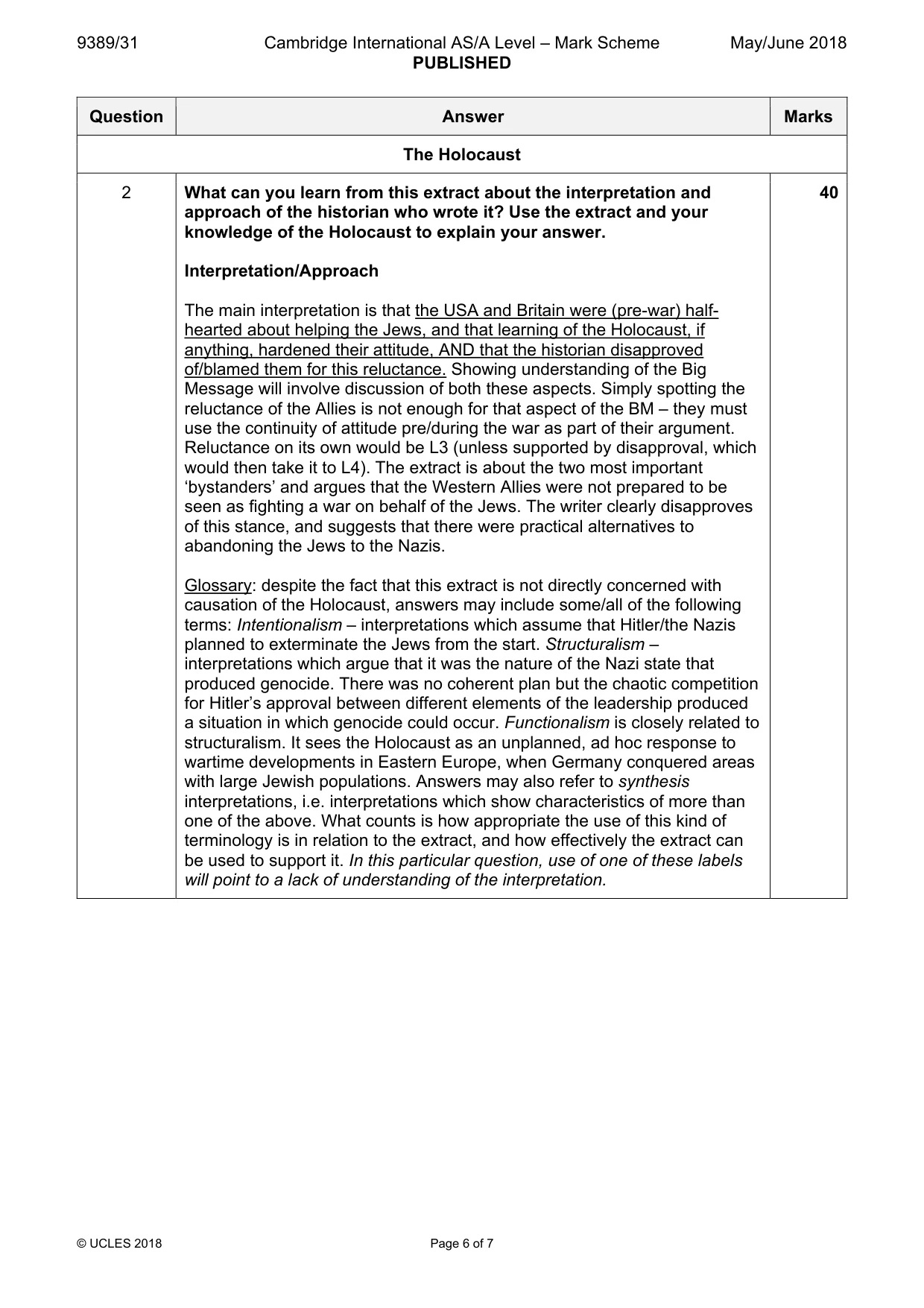
Mark scheme: 2 What can you learn from this extract about the interpretation and 40 approach of the historian who wrote it? Use the extract and your knowledge of the Holocaust to explain your answer. Interpretation/Approach The main interpretation is that the USA and Britain were (pre-war) half- hearted about helping the Jews, and that learning of the Holocaust, if anything, hardened their attitude, AND that the historian disapproved of/blamed them for this reluctance. Showing understanding of the Big Message will involve discussion of both these aspects. Simply spotting the reluctance of the Allies is not enough for that aspect of the BM – they must use the continuity of attitude pre/during the war as part of their argument. Reluctance on its own would be L3 (unless supported by disapproval, which would then take it to L4). The extract is about the two most important ‘bystanders’ and argues that the Western Allies were not prepared to be seen as fighting a war on behalf of the Jews. The writer clearly disapproves of this stance, and suggests that there were practical alternatives to abandoning the Jews to the Nazis. Glossary: despite the fact that this extract is not directly concerned with causation of the Holocaust, answers may include some/all of the following terms: Intentionalism – interpretations which assume that Hitler/the Nazis planned to exterminate the Jews from the start. Structuralism – interpretations which argue that it was the nature of the Nazi state that produced genocide. There was no coherent plan but the chaotic competition for Hitler’s approval between different elements of the leadership produced a situation in which genocide could occur. Functionalism is closely related to structuralism. It sees the Holocaust as an unplanned, ad hoc response to wartime developments in Eastern Europe, when Germany conquered areas with large Jewish populations. Answers may also refer to synthesis interpretations, i.e. interpretations which show characteristics of more than one of the above. What counts is how appropriate the use of this kind of terminology is in relation to the extract, and how effectively the extract can be used to support it. In this particular question, use of one of these labels will point to a lack of understanding of the interpretation.
Q3 · Read the extract and then answer the question
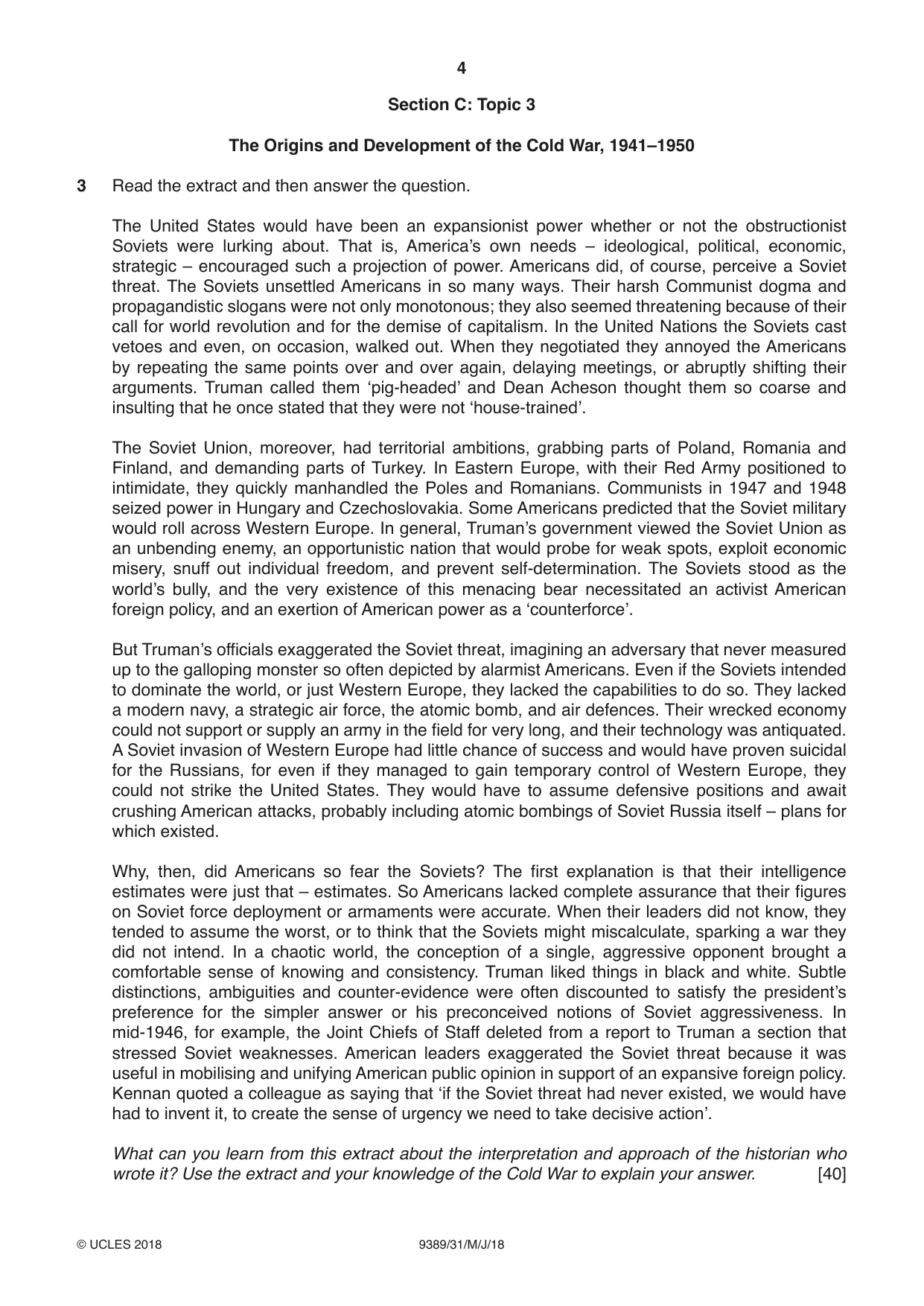
3 Read the extract and then answer the question. The United States would have been an expansionist power whether or not the obstructionist Soviets were lurking about. That is, America’s own needs – ideological, political, economic, strategic – encouraged such a projection of power. Americans did, of course, perceive a Soviet threat. The Soviets unsettled Americans in so many ways. Their harsh Communist dogma and propagandistic slogans were not only monotonous; they also seemed threatening because of their call for world revolution and for the demise of capitalism. In the United Nations the Soviets cast vetoes and even, on occasion, walked out. When they negotiated they annoyed the Americans by repeating the same points over and over again, delaying meetings, or abruptly shifting their arguments. Truman called them ‘pig-headed’ and Dean Acheson thought them so coarse and insulting that he once stated that they were not ‘house-trained’. The Soviet Union, moreover, had territorial ambitions, grabbing parts of Poland, Romania and Finland, and demanding parts of Turkey. In Eastern Europe, with their Red Army positioned to intimidate, they quickly manhandled the Poles and Romanians. Communists in 1947 and 1948 seized power in Hungary and Czechoslovakia. Some Americans predicted that the Soviet military would roll across Western Europe. In general, Truman’s government viewed the Soviet Union as an unbending enemy, an opportunistic nation that would probe for weak spots, exploit economic misery, snuff out individual freedom, and prevent self-determination. The Soviets stood as the world’s bully, and the very existence of this menacing bear necessitated an activist American foreign policy, and an exertion of American power as a ‘counterforce’. But Truman’s officials exaggerated the Soviet threat, imagining an adversary that never measured up to the galloping monster so often depicted by alarmist Americans. Even if the Soviets intended to dominate the world, or just Western Europe, they lacked the capabilities to do so. They lacked a modern navy, a strategic air force, the atomic bomb, and air defences. Their wrecked economy could not support or supply an army in the field for very long, and their technology was antiquated. A Soviet invasion of Western Europe had little chance of success and would have proven suicidal for the Russians, for even if they managed to gain temporary control of Western Europe, they could not strike the United States. They would have to assume defensive positions and await crushing American attacks, probably including atomic bombings of Soviet Russia itself – plans for which existed. Why, then, did Americans so fear the Soviets? The first explanation is that their intelligence estimates were just that – estimates. So Americans lacked complete assurance that their figures on Soviet force deployment or armaments were accurate. When their leaders did not know, they tended to assume the worst, or to think that the Soviets might miscalculate, sparking a war they did not intend. In a chaotic world, the conception of a single, aggressive opponent brought a comfortable sense of knowing and consistency. Truman liked things in black and white. Subtle distinctions, ambiguities and counter-evidence were often discounted to satisfy the president’s preference for the simpler answer or his preconceived notions of Soviet aggressiveness. In mid-1946, for example, the Joint Chiefs of Staff deleted from a report to Truman a section that stressed Soviet weaknesses. American leaders exaggerated the Soviet threat because it was useful in mobilising and unifying American public opinion in support of an expansive foreign policy. Kennan quoted a colleague as saying that ‘if the Soviet threat had never existed, we would have had to invent it, to create the sense of urgency we need to take decisive action’. What can you learn from this extract about the interpretation and approach of the historian who wrote it? Use the extract and your knowledge of the Cold War to explain your answer. [40]
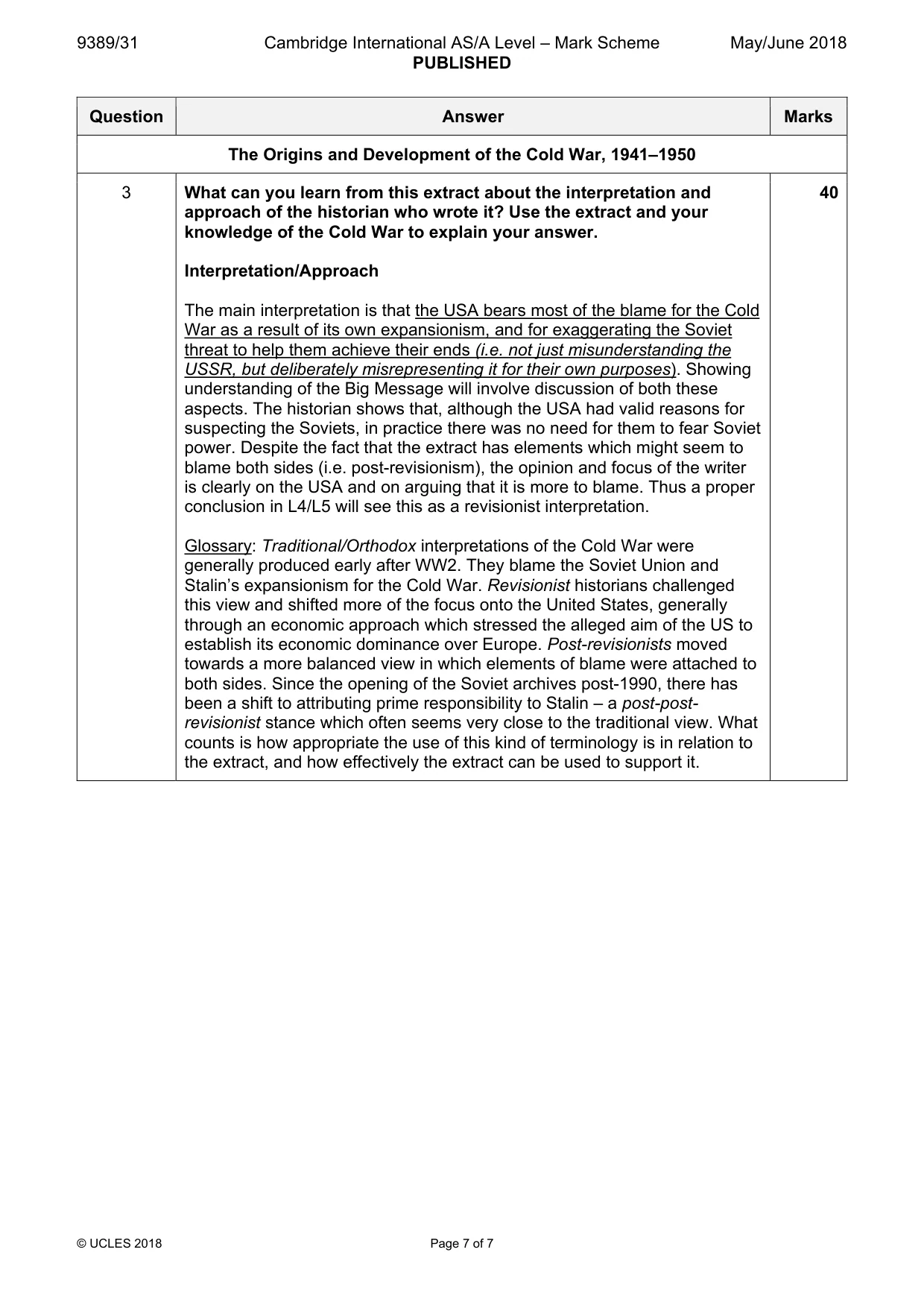
Mark scheme: 3 What can you learn from this extract about the interpretation and 40 approach of the historian who wrote it? Use the extract and your knowledge of the Cold War to explain your answer. Interpretation/Approach The main interpretation is that the USA bears most of the blame for the Cold War as a result of its own expansionism, and for exaggerating the Soviet threat to help them achieve their ends (i.e. not just misunderstanding the USSR, but deliberately misrepresenting it for their own purposes). Showing understanding of the Big Message will involve discussion of both these aspects. The historian shows that, although the USA had valid reasons for suspecting the Soviets, in practice there was no need for them to fear Soviet power. Despite the fact that the extract has elements which might seem to blame both sides (i.e. post-revisionism), the opinion and focus of the writer is clearly on the USA and on arguing that it is more to blame. Thus a proper conclusion in L4/L5 will see this as a revisionist interpretation. Glossary: Traditional/Orthodox interpretations of the Cold War were generally produced early after WW2. They blame the Soviet Union and Stalin’s expansionism for the Cold War. Revisionist historians challenged this view and shifted more of the focus onto the United States, generally through an economic approach which stressed the alleged aim of the US to establish its economic dominance over Europe. Post-revisionists moved towards a more balanced view in which elements of blame were attached to both sides. Since the opening of the Soviet archives post-1990, there has been a shift to attributing prime responsibility to Stalin – a post-post- revisionist stance which often seems very close to the traditional view. What counts is how appropriate the use of this kind of terminology is in relation to the extract, and how effectively the extract can be used to support it.
What you needed in this session
Cambridge’s own grade thresholds for 2018 May/June, Paper 3 · Variant 1. A higher threshold means an easier paper — the bar moves with how the cohort did.