Cambridge A Level History 9389 — 2018 May/June Paper 3 · Variant 2
9389/32/M/J/18 · 3 questions · 40 marks · ≈45 min
The question paper and its mark scheme, free to read here and free to download. This is Cambridge’s own paper, exactly as it was sat.
Question paper4 pages
Mark scheme7 pages
Answers below. Sit the paper first if you are practising.
Questions as text
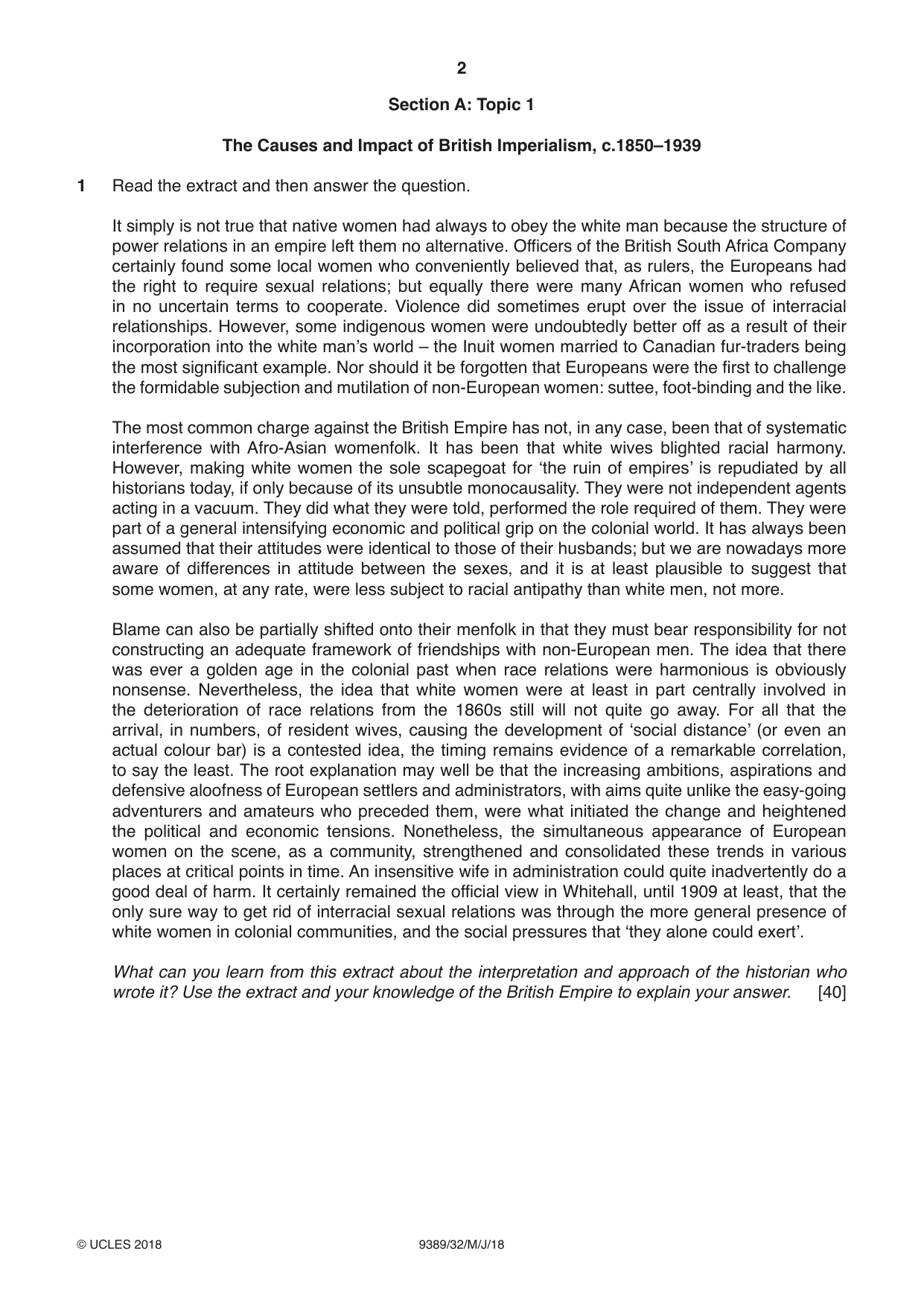
Q1 · Read the extract and then answer the question
1 Read the extract and then answer the question. It simply is not true that native women had always to obey the white man because the structure of power relations in an empire left them no alternative. Officers of the British South Africa Company certainly found some local women who conveniently believed that, as rulers, the Europeans had the right to require sexual relations; but equally there were many African women who refused in no uncertain terms to cooperate. Violence did sometimes erupt over the issue of interracial relationships. However, some indigenous women were undoubtedly better off as a result of their incorporation into the white man’s world – the Inuit women married to Canadian fur-traders being the most significant example. Nor should it be forgotten that Europeans were the first to challenge the formidable subjection and mutilation of non-European women: suttee, foot-binding and the like. The most common charge against the British Empire has not, in any case, been that of systematic interference with Afro-Asian womenfolk. It has been that white wives blighted racial harmony. However, making white women the sole scapegoat for ‘the ruin of empires’ is repudiated by all historians today, if only because of its unsubtle monocausality. They were not independent agents acting in a vacuum. They did what they were told, performed the role required of them. They were part of a general intensifying economic and political grip on the colonial world. It has always been assumed that their attitudes were identical to those of their husbands; but we are nowadays more aware of differences in attitude between the sexes, and it is at least plausible to suggest that some women, at any rate, were less subject to racial antipathy than white men, not more. Blame can also be partially shifted onto their menfolk in that they must bear responsibility for not constructing an adequate framework of friendships with non-European men. The idea that there was ever a golden age in the colonial past when race relations were harmonious is obviously nonsense. Nevertheless, the idea that white women were at least in part centrally involved in the deterioration of race relations from the 1860s still will not quite go away. For all that the arrival, in numbers, of resident wives, causing the development of ‘social distance’ (or even an actual colour bar) is a contested idea, the timing remains evidence of a remarkable correlation, to say the least. The root explanation may well be that the increasing ambitions, aspirations and defensive aloofness of European settlers and administrators, with aims quite unlike the easy-going adventurers and amateurs who preceded them, were what initiated the change and heightened the political and economic tensions. Nonetheless, the simultaneous appearance of European women on the scene, as a community, strengthened and consolidated these trends in various places at critical points in time. An insensitive wife in administration could quite inadvertently do a good deal of harm. It certainly remained the official view in Whitehall, until 1909 at least, that the only sure way to get rid of interracial sexual relations was through the more general presence of white women in colonial communities, and the social pressures that ‘they alone could exert’. What can you learn from this extract about the interpretation and approach of the historian who wrote it? Use the extract and your knowledge of the British Empire to explain your answer. [40]
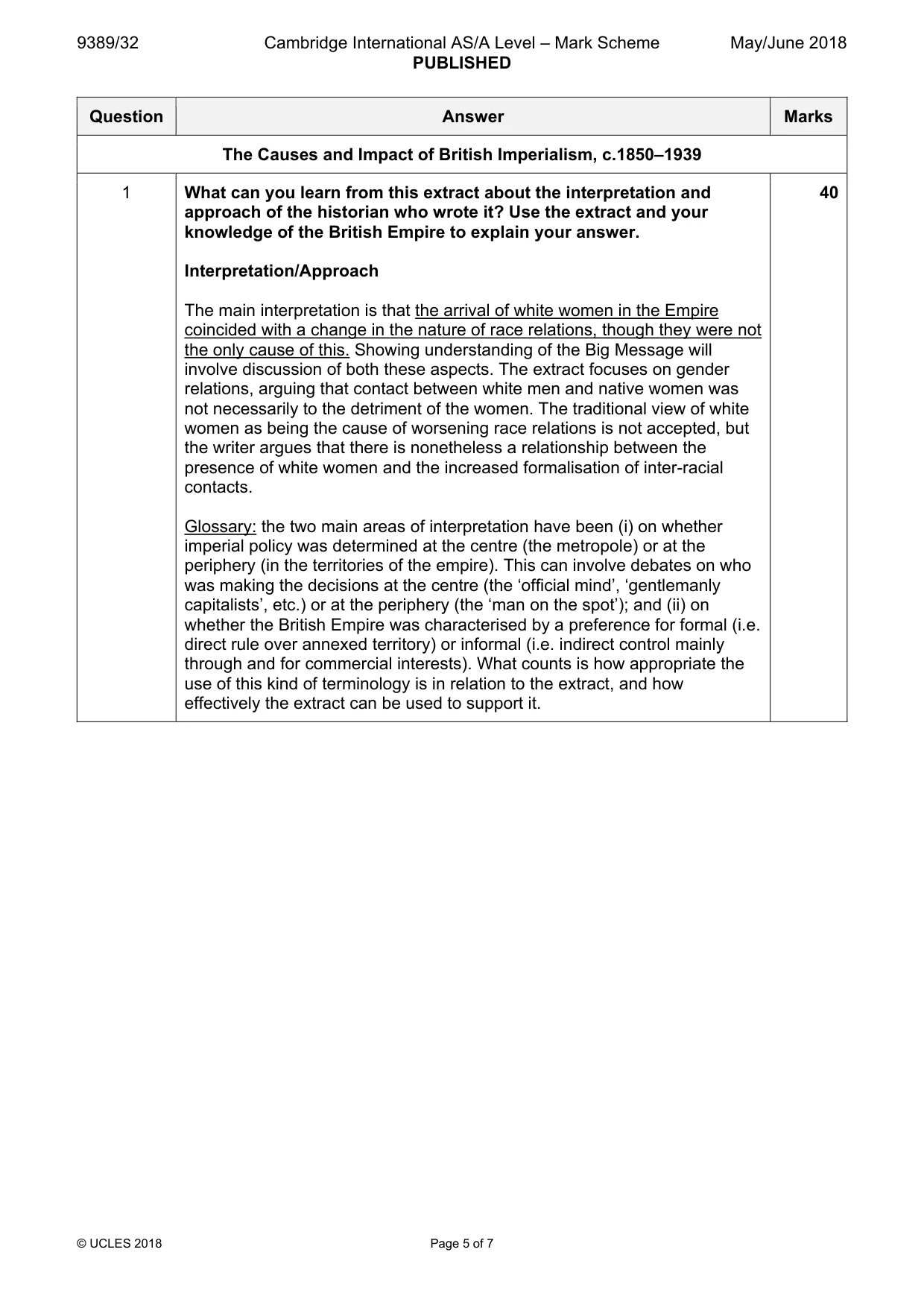
Mark scheme: Question Answer Marks The Causes and Impact of British Imperialism, c.1850–1939 1 What can you learn from this extract about the interpretation and 40 approach of the historian who wrote it? Use the extract and your knowledge of the British Empire to explain your answer. Interpretation/Approach The main interpretation is that the arrival of white women in the Empire coincided with a change in the nature of race relations, though they were not the only cause of this. Showing understanding of the Big Message will involve discussion of both these aspects. The extract focuses on gender relations, arguing that contact between white men and native women was not necessarily to the detriment of the women. The traditional view of white women as being the cause of worsening race relations is not accepted, but the writer argues that there is nonetheless a relationship between the presence of white women and the increased formalisation of inter-racial contacts. Glossary: the two main areas of interpretation have been (i) on whether imperial policy was determined at the centre (the metropole) or at the periphery (in the territories of the empire). This can involve debates on who was making the decisions at the centre (the ‘official mind’, ‘gentlemanly capitalists’, etc.) or at the periphery (the ‘man on the spot’); and (ii) on whether the British Empire was characterised by a preference for formal (i.e. direct rule over annexed territory) or informal (i.e. indirect control mainly through and for commercial interests). What counts is how appropriate the use of this kind of terminology is in relation to the extract, and how effectively the extract can be used to support it.
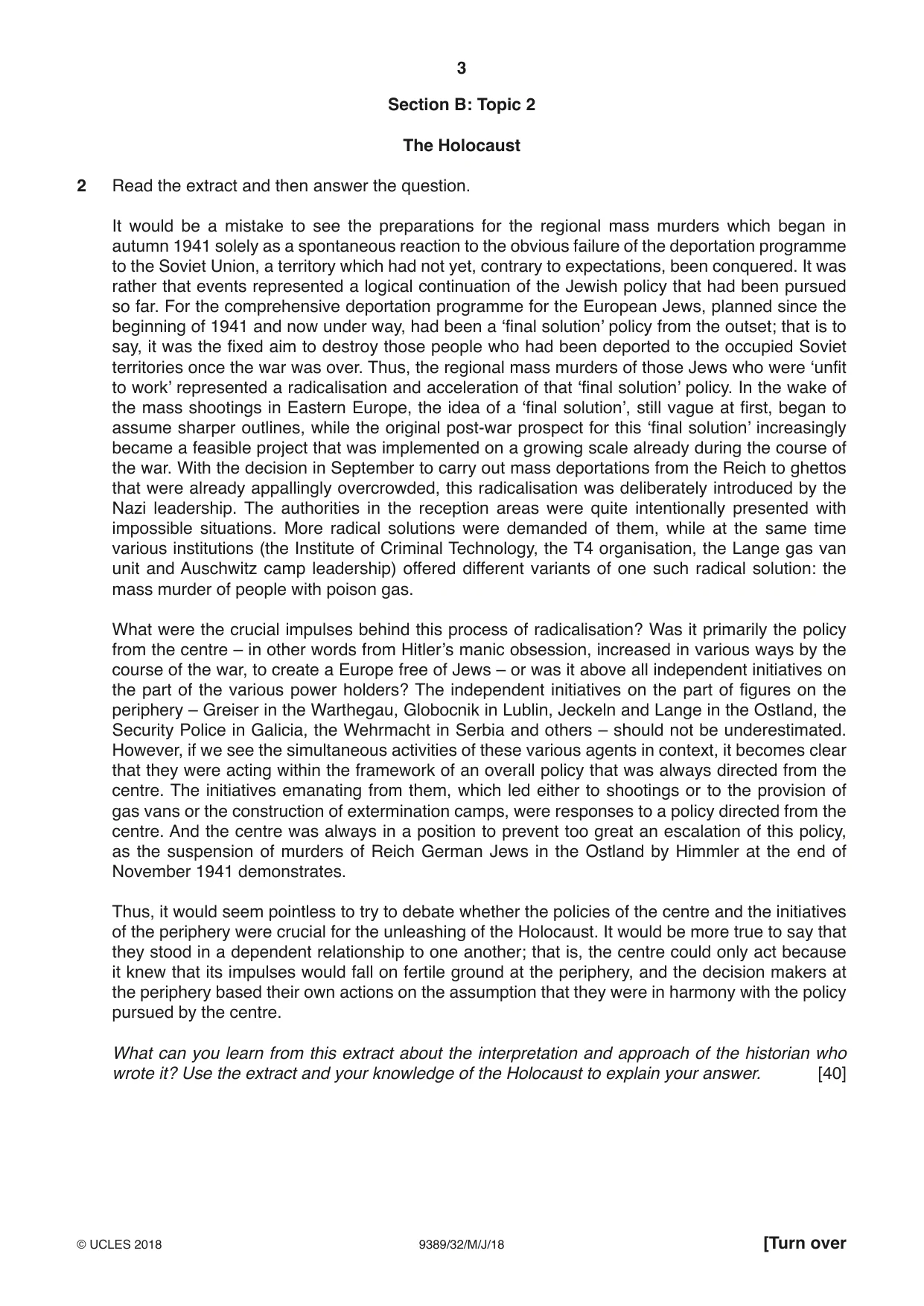
Q2 · Read the extract and then answer the question
2 Read the extract and then answer the question. It would be a mistake to see the preparations for the regional mass murders which began in autumn 1941 solely as a spontaneous reaction to the obvious failure of the deportation programme to the Soviet Union, a territory which had not yet, contrary to expectations, been conquered. It was rather that events represented a logical continuation of the Jewish policy that had been pursued so far. For the comprehensive deportation programme for the European Jews, planned since the beginning of 1941 and now under way, had been a ‘final solution’ policy from the outset; that is to say, it was the fixed aim to destroy those people who had been deported to the occupied Soviet territories once the war was over. Thus, the regional mass murders of those Jews who were ‘unfit to work’ represented a radicalisation and acceleration of that ‘final solution’ policy. In the wake of the mass shootings in Eastern Europe, the idea of a ‘final solution’, still vague at first, began to assume sharper outlines, while the original post-war prospect for this ‘final solution’ increasingly became a feasible project that was implemented on a growing scale already during the course of the war. With the decision in September to carry out mass deportations from the Reich to ghettos that were already appallingly overcrowded, this radicalisation was deliberately introduced by the Nazi leadership. The authorities in the reception areas were quite intentionally presented with impossible situations. More radical solutions were demanded of them, while at the same time various institutions (the Institute of Criminal Technology, the T4 organisation, the Lange gas van unit and Auschwitz camp leadership) offered different variants of one such radical solution: the mass murder of people with poison gas. What were the crucial impulses behind this process of radicalisation? Was it primarily the policy from the centre – in other words from Hitler’s manic obsession, increased in various ways by the course of the war, to create a Europe free of Jews – or was it above all independent initiatives on the part of the various power holders? The independent initiatives on the part of figures on the periphery – Greiser in the Warthegau, Globocnik in Lublin, Jeckeln and Lange in the Ostland, the Security Police in Galicia, the Wehrmacht in Serbia and others – should not be underestimated. However, if we see the simultaneous activities of these various agents in context, it becomes clear that they were acting within the framework of an overall policy that was always directed from the centre. The initiatives emanating from them, which led either to shootings or to the provision of gas vans or the construction of extermination camps, were responses to a policy directed from the centre. And the centre was always in a position to prevent too great an escalation of this policy, as the suspension of murders of Reich German Jews in the Ostland by Himmler at the end of November 1941 demonstrates. Thus, it would seem pointless to try to debate whether the policies of the centre and the initiatives of the periphery were crucial for the unleashing of the Holocaust. It would be more true to say that they stood in a dependent relationship to one another; that is, the centre could only act because it knew that its impulses would fall on fertile ground at the periphery, and the decision makers at the periphery based their own actions on the assumption that they were in harmony with the policy pursued by the centre. What can you learn from this extract about the interpretation and approach of the historian who wrote it? Use the extract and your knowledge of the Holocaust to explain your answer. [40] Section C: Topic 3 The Origins and Development of the Cold War, 1941–1950
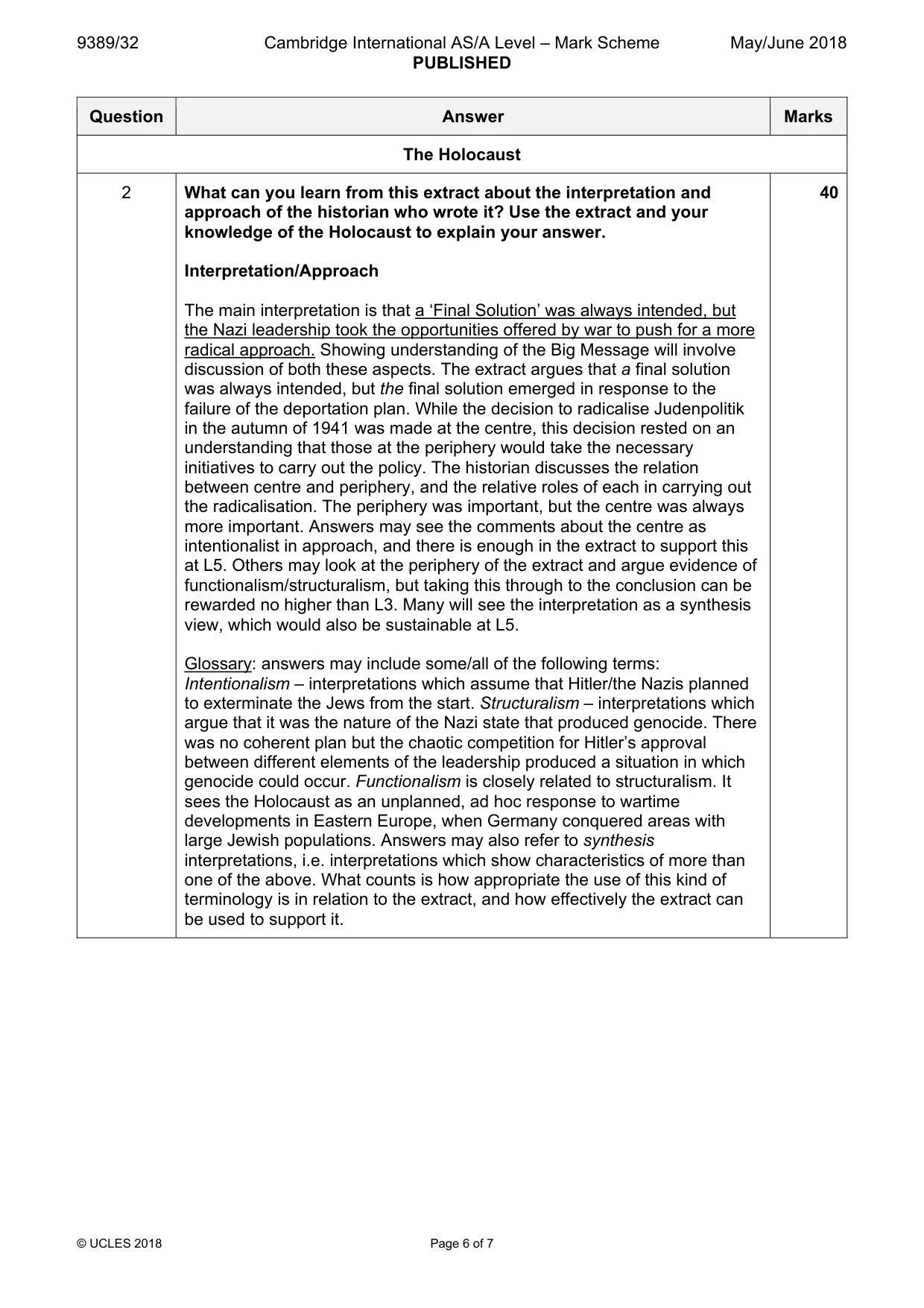
Mark scheme: 2 What can you learn from this extract about the interpretation and 40 approach of the historian who wrote it? Use the extract and your knowledge of the Holocaust to explain your answer. Interpretation/Approach The main interpretation is that a ‘Final Solution’ was always intended, but the Nazi leadership took the opportunities offered by war to push for a more radical approach. Showing understanding of the Big Message will involve discussion of both these aspects. The extract argues that a final solution was always intended, but the final solution emerged in response to the failure of the deportation plan. While the decision to radicalise Judenpolitik in the autumn of 1941 was made at the centre, this decision rested on an understanding that those at the periphery would take the necessary initiatives to carry out the policy. The historian discusses the relation between centre and periphery, and the relative roles of each in carrying out the radicalisation. The periphery was important, but the centre was always more important. Answers may see the comments about the centre as intentionalist in approach, and there is enough in the extract to support this at L5. Others may look at the periphery of the extract and argue evidence of functionalism/structuralism, but taking this through to the conclusion can be rewarded no higher than L3. Many will see the interpretation as a synthesis view, which would also be sustainable at L5. Glossary: answers may include some/all of the following terms: Intentionalism – interpretations which assume that Hitler/the Nazis planned to exterminate the Jews from the start. Structuralism – interpretations which argue that it was the nature of the Nazi state that produced genocide. There was no coherent plan but the chaotic competition for Hitler’s approval between different elements of the leadership produced a situation in which genocide could occur. Functionalism is closely related to structuralism. It sees the Holocaust as an unplanned, ad hoc response to wartime developments in Eastern Europe, when Germany conquered areas with large Jewish populations. Answers may also refer to synthesis interpretations, i.e. interpretations which show characteristics of more than one of the above. What counts is how appropriate the use of this kind of terminology is in relation to the extract, and how effectively the extract can be used to support it.
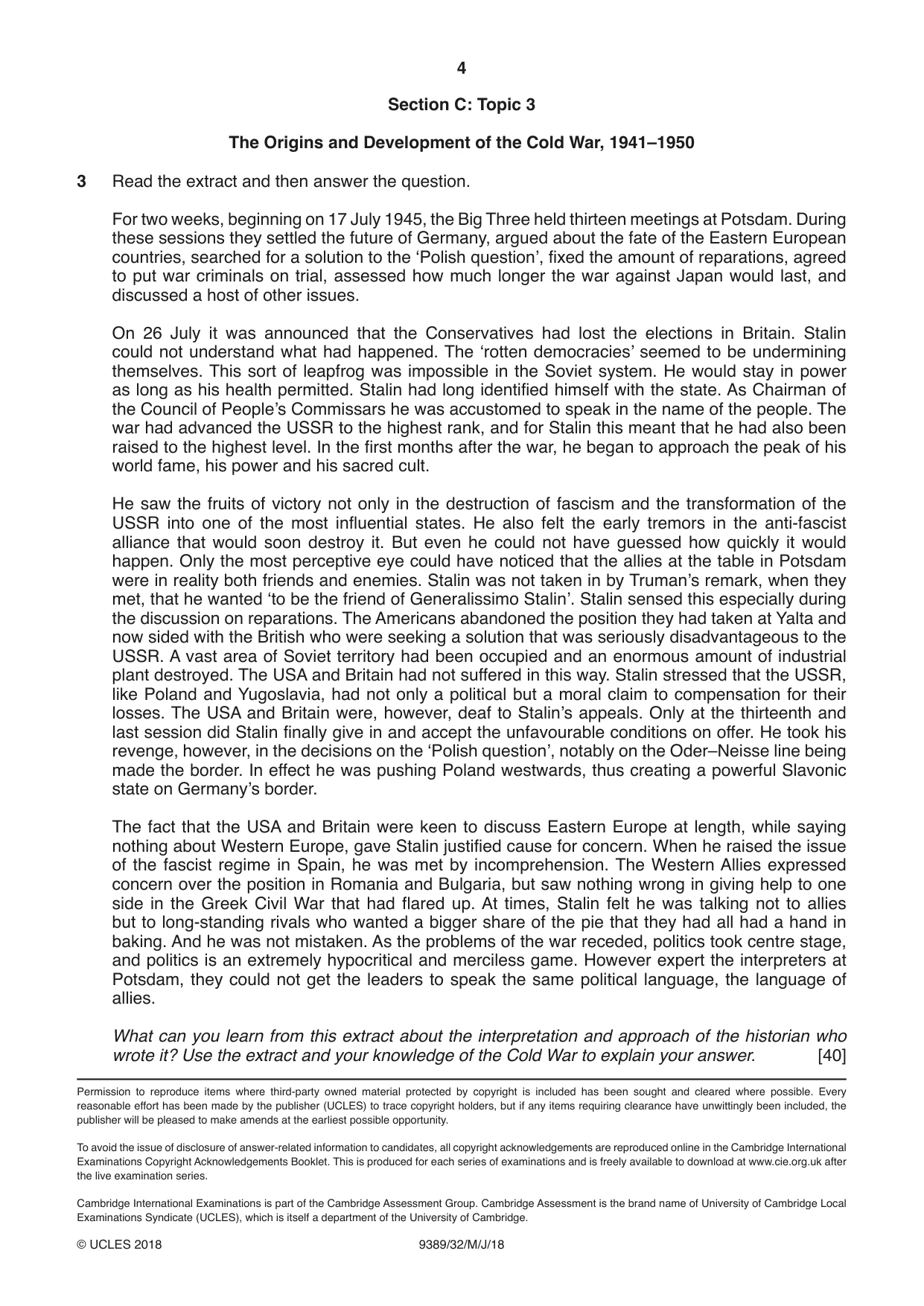
Q3 · Read the extract and then answer the question
3 Read the extract and then answer the question. For two weeks, beginning on 17 July 1945, the Big Three held thirteen meetings at Potsdam. During these sessions they settled the future of Germany, argued about the fate of the Eastern European countries, searched for a solution to the ‘Polish question’, fixed the amount of reparations, agreed to put war criminals on trial, assessed how much longer the war against Japan would last, and discussed a host of other issues. On 26 July it was announced that the Conservatives had lost the elections in Britain. Stalin could not understand what had happened. The ‘rotten democracies’ seemed to be undermining themselves. This sort of leapfrog was impossible in the Soviet system. He would stay in power as long as his health permitted. Stalin had long identified himself with the state. As Chairman of the Council of People’s Commissars he was accustomed to speak in the name of the people. The war had advanced the USSR to the highest rank, and for Stalin this meant that he had also been raised to the highest level. In the first months after the war, he began to approach the peak of his world fame, his power and his sacred cult. He saw the fruits of victory not only in the destruction of fascism and the transformation of the USSR into one of the most influential states. He also felt the early tremors in the anti-fascist alliance that would soon destroy it. But even he could not have guessed how quickly it would happen. Only the most perceptive eye could have noticed that the allies at the table in Potsdam were in reality both friends and enemies. Stalin was not taken in by Truman’s remark, when they met, that he wanted ‘to be the friend of Generalissimo Stalin’. Stalin sensed this especially during the discussion on reparations. The Americans abandoned the position they had taken at Yalta and now sided with the British who were seeking a solution that was seriously disadvantageous to the USSR. A vast area of Soviet territory had been occupied and an enormous amount of industrial plant destroyed. The USA and Britain had not suffered in this way. Stalin stressed that the USSR, like Poland and Yugoslavia, had not only a political but a moral claim to compensation for their losses. The USA and Britain were, however, deaf to Stalin’s appeals. Only at the thirteenth and last session did Stalin finally give in and accept the unfavourable conditions on offer. He took his revenge, however, in the decisions on the ‘Polish question’, notably on the Oder–Neisse line being made the border. In effect he was pushing Poland westwards, thus creating a powerful Slavonic state on Germany’s border. The fact that the USA and Britain were keen to discuss Eastern Europe at length, while saying nothing about Western Europe, gave Stalin justified cause for concern. When he raised the issue of the fascist regime in Spain, he was met by incomprehension. The Western Allies expressed concern over the position in Romania and Bulgaria, but saw nothing wrong in giving help to one side in the Greek Civil War that had flared up. At times, Stalin felt he was talking not to allies but to long-standing rivals who wanted a bigger share of the pie that they had all had a hand in baking. And he was not mistaken. As the problems of the war receded, politics took centre stage, and politics is an extremely hypocritical and merciless game. However expert the interpreters at Potsdam, they could not get the leaders to speak the same political language, the language of allies. What can you learn from this extract about the interpretation and approach of the historian who wrote it? Use the extract and your knowledge of the Cold War to explain your answer. [40]
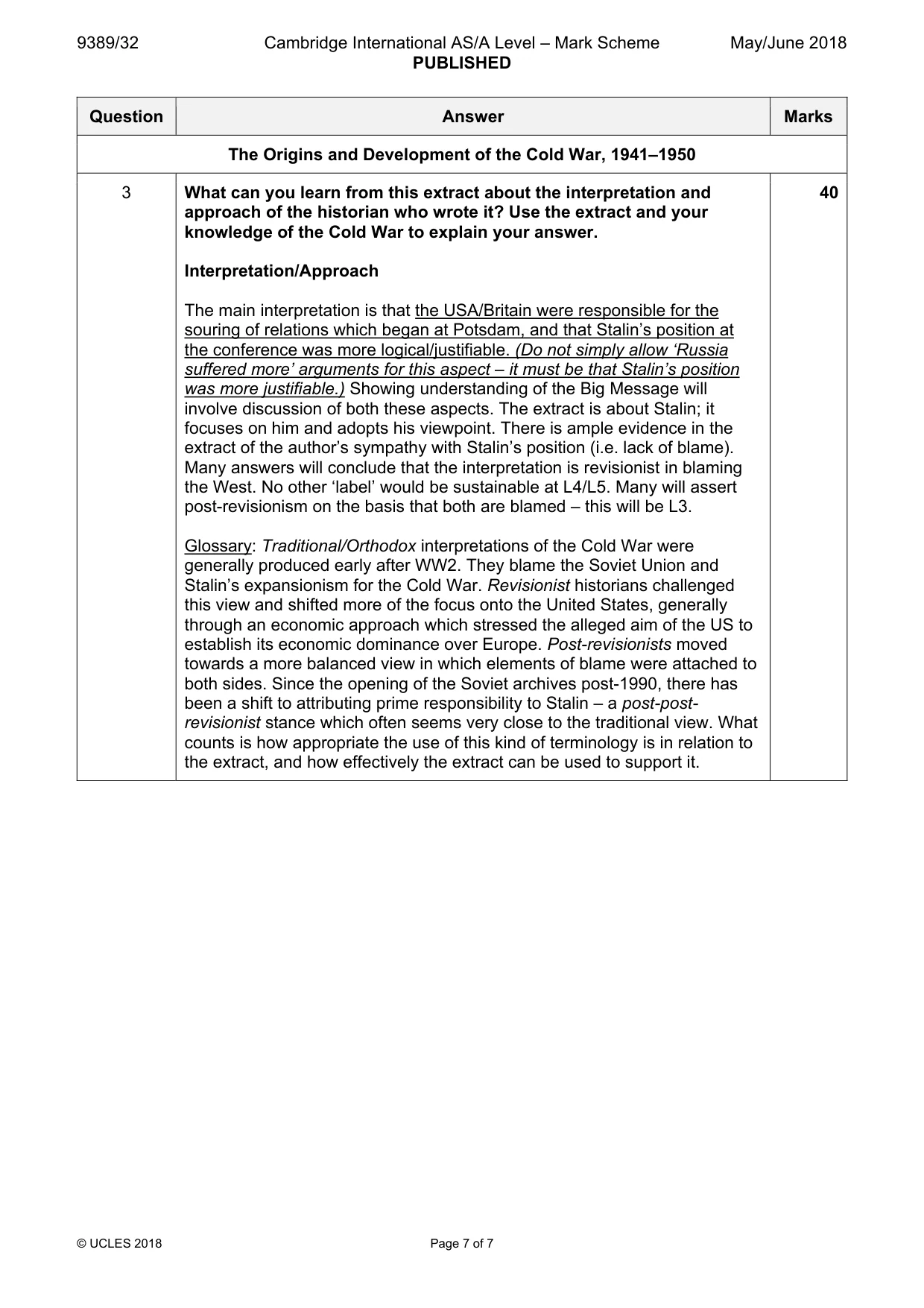
Mark scheme: 3 What can you learn from this extract about the interpretation and 40 approach of the historian who wrote it? Use the extract and your knowledge of the Cold War to explain your answer. Interpretation/Approach The main interpretation is that the USA/Britain were responsible for the souring of relations which began at Potsdam, and that Stalin’s position at the conference was more logical/justifiable. (Do not simply allow ‘Russia suffered more’ arguments for this aspect – it must be that Stalin’s position was more justifiable.) Showing understanding of the Big Message will involve discussion of both these aspects. The extract is about Stalin; it focuses on him and adopts his viewpoint. There is ample evidence in the extract of the author’s sympathy with Stalin’s position (i.e. lack of blame). Many answers will conclude that the interpretation is revisionist in blaming the West. No other ‘label’ would be sustainable at L4/L5. Many will assert post-revisionism on the basis that both are blamed – this will be L3. Glossary: Traditional/Orthodox interpretations of the Cold War were generally produced early after WW2. They blame the Soviet Union and Stalin’s expansionism for the Cold War. Revisionist historians challenged this view and shifted more of the focus onto the United States, generally through an economic approach which stressed the alleged aim of the US to establish its economic dominance over Europe. Post-revisionists moved towards a more balanced view in which elements of blame were attached to both sides. Since the opening of the Soviet archives post-1990, there has been a shift to attributing prime responsibility to Stalin – a post-post- revisionist stance which often seems very close to the traditional view. What counts is how appropriate the use of this kind of terminology is in relation to the extract, and how effectively the extract can be used to support it.
What you needed in this session
Cambridge’s own grade thresholds for 2018 May/June, Paper 3 · Variant 2. A higher threshold means an easier paper — the bar moves with how the cohort did.