Cambridge A Level History 9389 — 2018 May/June Paper 2 · Variant 1
9389/21/M/J/18 · 12 questions · 60 marks · ≈68 min
The question paper and its mark scheme, free to read here and free to download. This is Cambridge’s own paper, exactly as it was sat.
Question paper4 pages
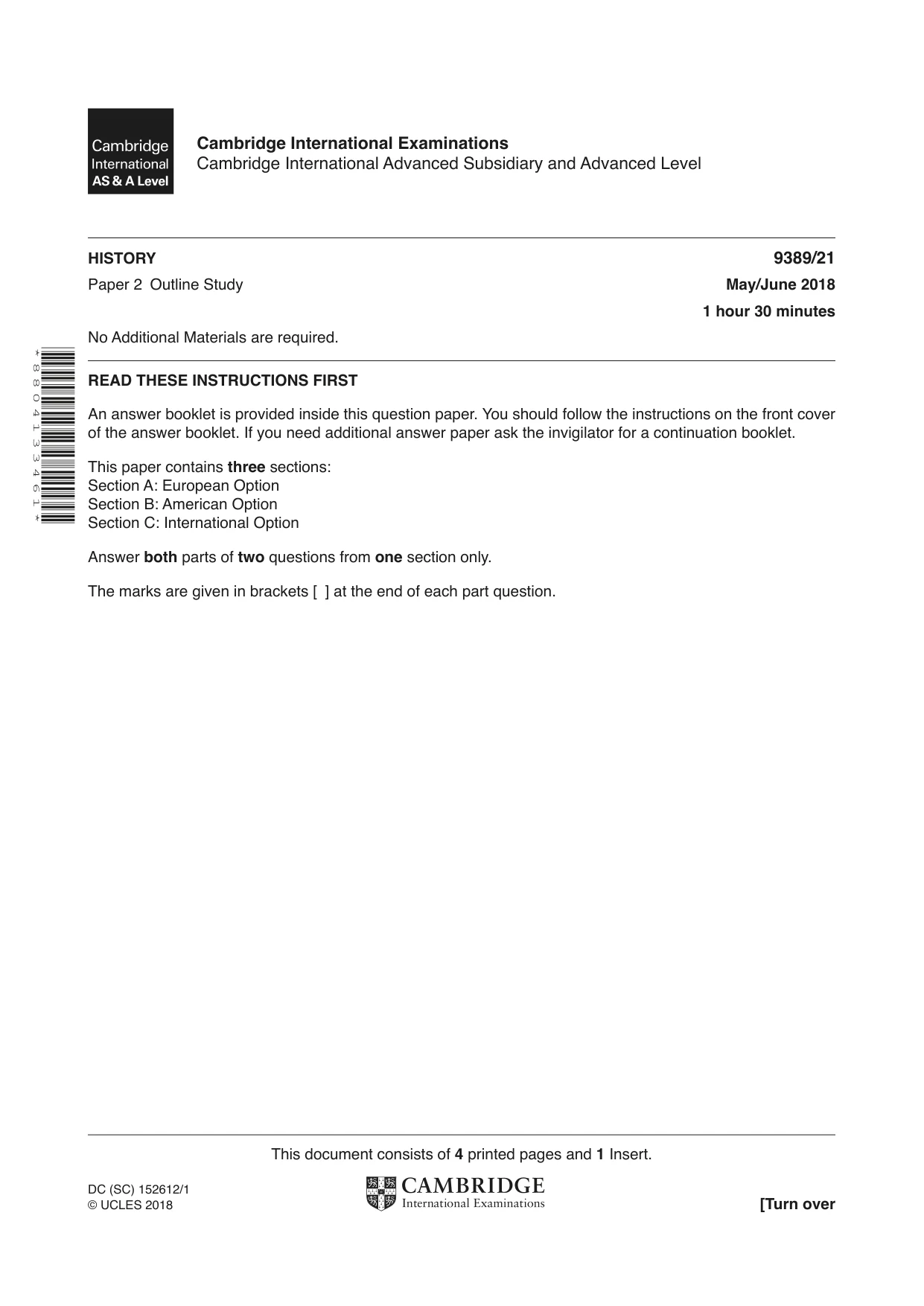
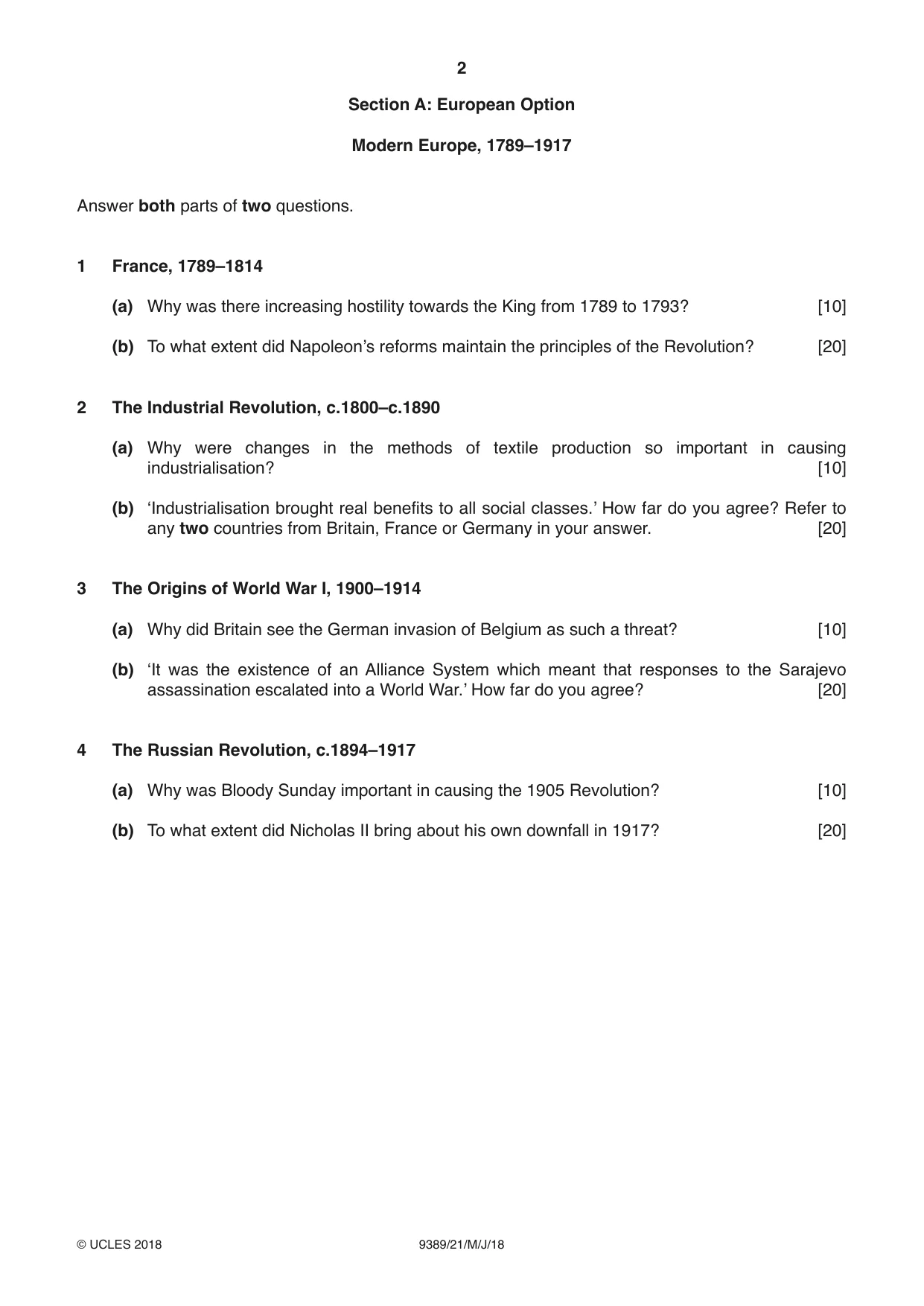
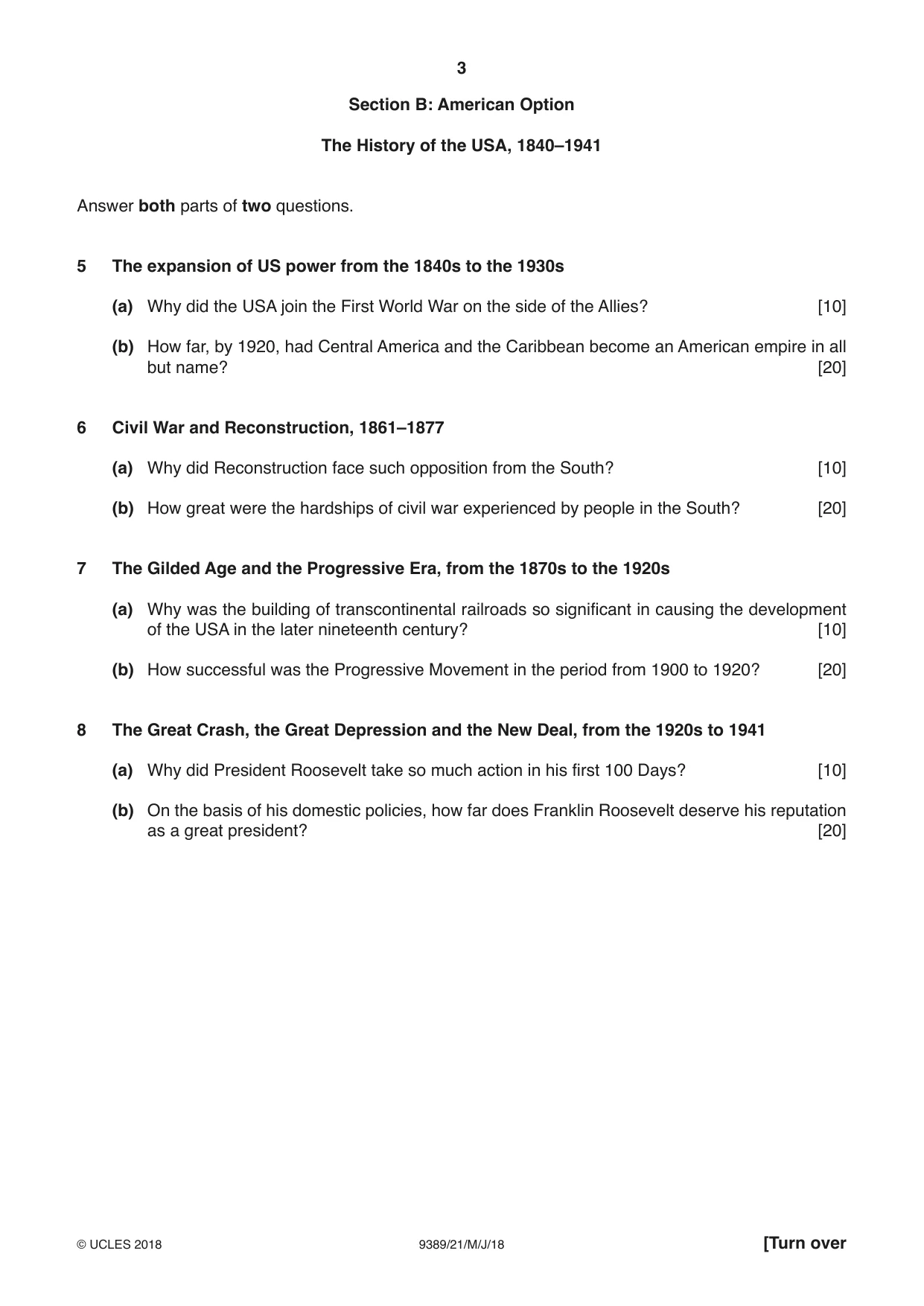
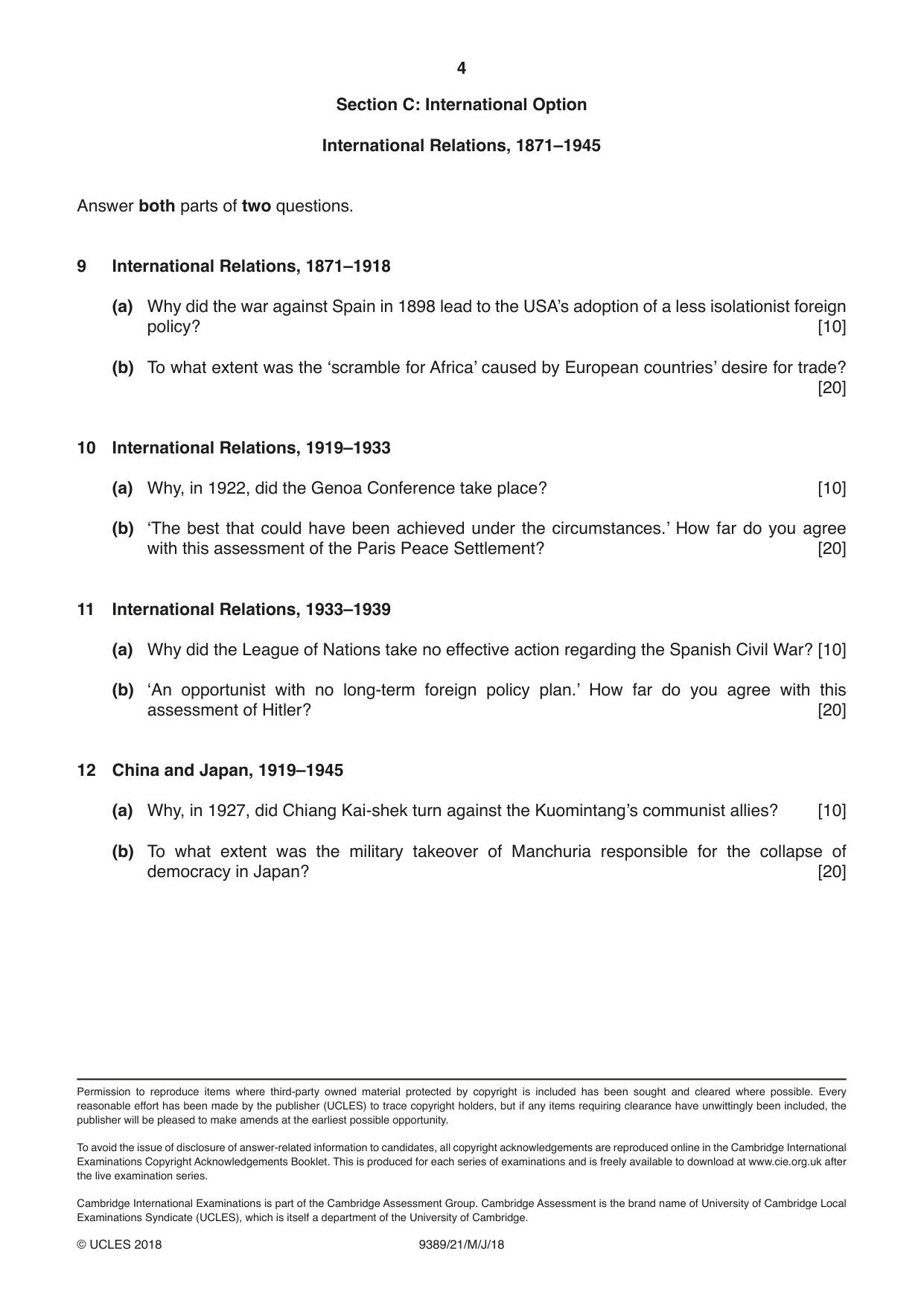
Mark scheme23 pages
Answers below. Sit the paper first if you are practising.
Questions as text
Q1 · France, 1789–1814 (a) Why was there increasing hostility towards the King from 1789 to…
1 France, 1789–1814 (a) Why was there increasing hostility towards the King from 1789 to 1793? [10] (b) To what extent did Napoleon’s reforms maintain the principles of the Revolution? [20]
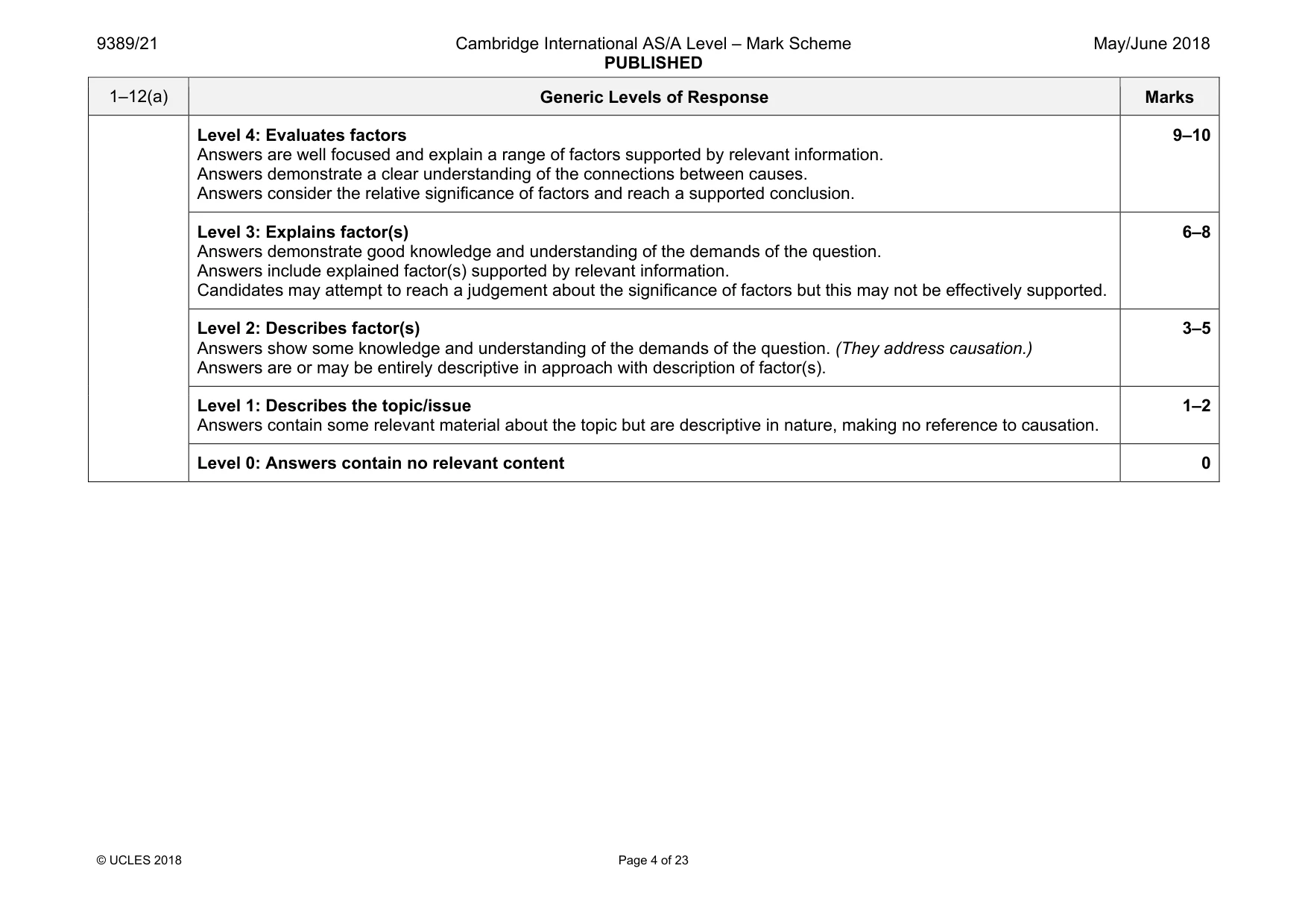
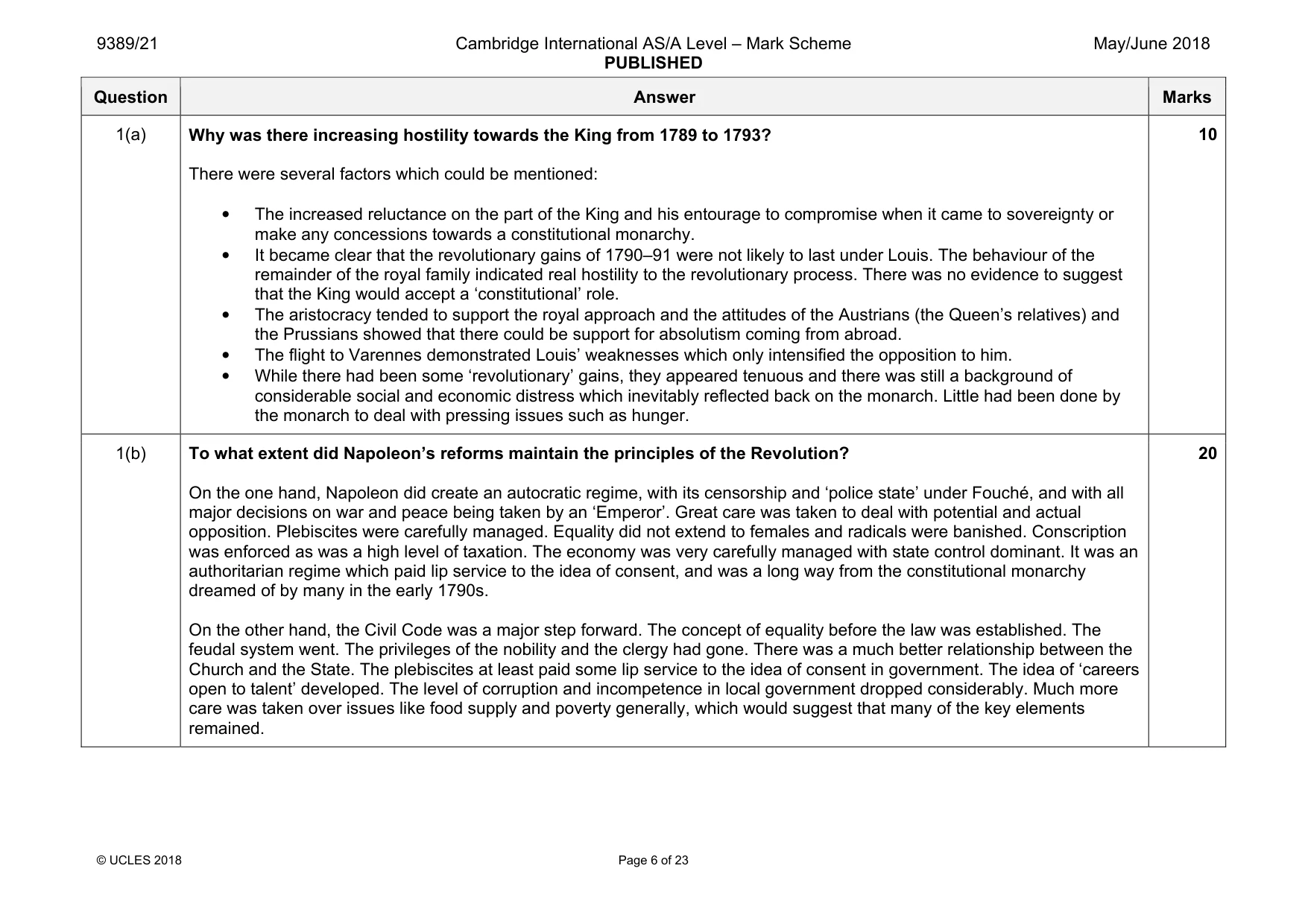
Mark scheme: 1(a) Why was there increasing hostility towards the King from 1789 to 1793? There were several factors which could be mentioned: • The increased reluctance on the part of the King and his entourage to compromise when it came to sovereignty or make any concessions towards a constitutional monarchy. • It became clear that the revolutionary gains of 1790–91 were not likely to last under Louis. The behaviour of the remainder of the royal family indicated real hostility to the revolutionary process. There was no evidence to suggest that the King would accept a ‘constitutional’ role. • The aristocracy tended to support the royal approach and the attitudes of the Austrians (the Queen’s relatives) and the Prussians showed that there could be support for absolutism coming from abroad. • The flight to Varennes demonstrated Louis’ weaknesses which only intensified the opposition to him. • While there had been some ‘revolutionary’ gains, they appeared tenuous and there was still a background of considerable social and economic distress which inevitably reflected back on the monarch. Little had been done by the monarch to deal with pressing issues such as hunger. 10 1(b) To what extent did Napoleon’s reforms maintain the principles of the Revolution? On the one hand, Napoleon did create an autocratic regime, with its censorship and ‘police state’ under Fouché, and with all major decisions on war and peace being taken by an ‘Emperor’. Great care was taken to deal with potential and actual opposition. Plebiscites were carefully managed. Equality did not extend to females and radicals were banished. Conscription was enforced as was a high level of taxation. The economy was very carefully managed with state control dominant. It was an authoritarian regime which paid lip service to the idea of consent, and was a long way from the constitutional monarchy dreamed of by many in the early 1790s. On the other hand, the Civil Code was a major step forward. The concept of equality before the law was established. The feudal system went. The privileges of the nobility and the clergy had gone. There was a much better relationship between the Church and the State. The plebiscites at least paid some lip service to the idea of consent in government. The idea of ‘careers open to talent’ developed. The level of corruption and incompetence in local government dropped considerably. Much more care was taken over issues like food supply and poverty generally, which would suggest that many of the key elements remained. 20
Q2 · The Industrial Revolution, c.1800–c.1890 (a) Why were changes in the methods of textile…
2 The Industrial Revolution, c.1800–c.1890 (a) Why were changes in the methods of textile production so important in causing industrialisation? [10] (b) ‘Industrialisation brought real benefits to all social classes.’ How far do you agree? Refer to any two countries from Britain, France or Germany in your answer. [20]
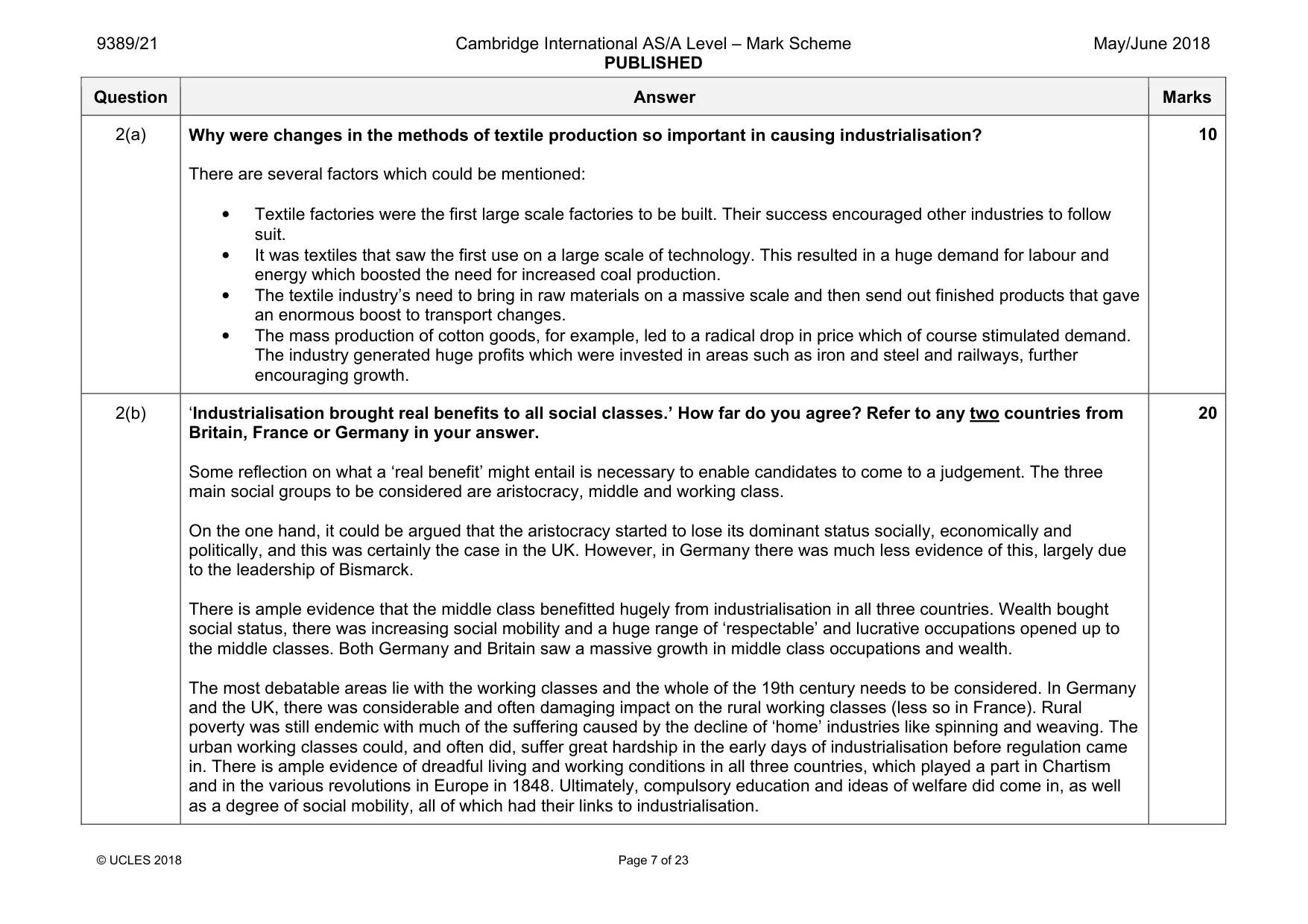
Mark scheme: 2(a) Why were changes in the methods of textile production so important in causing industrialisation? There are several factors which could be mentioned: • Textile factories were the first large scale factories to be built. Their success encouraged other industries to follow suit. • It was textiles that saw the first use on a large scale of technology. This resulted in a huge demand for labour and energy which boosted the need for increased coal production. • The textile industry’s need to bring in raw materials on a massive scale and then send out finished products that gave an enormous boost to transport changes. • The mass production of cotton goods, for example, led to a radical drop in price which of course stimulated demand. The industry generated huge profits which were invested in areas such as iron and steel and railways, further encouraging growth. 10 2(b) ‘Industrialisation brought real benefits to all social classes.’ How far do you agree? Refer to any two countries from Britain, France or Germany in your answer. Some reflection on what a ‘real benefit’ might entail is necessary to enable candidates to come to a judgement. The three main social groups to be considered are aristocracy, middle and working class. On the one hand, it could be argued that the aristocracy started to lose its dominant status socially, economically and politically, and this was certainly the case in the UK. However, in Germany there was much less evidence of this, largely due to the leadership of Bismarck. There is ample evidence that the middle class benefitted hugely from industrialisation in all three countries. Wealth bought social status, there was increasing social mobility and a huge range of ‘respectable’ and lucrative occupations opened up to the middle classes. Both Germany and Britain saw a massive growth in middle class occupations and wealth. The most debatable areas lie with the working classes and the whole of the 19th century needs to be considered. In Germany and the UK, there was considerable and often damaging impact on the rural working classes (less so in France). Rural poverty was still endemic with much of the suffering caused by the decline of ‘home’ industries like spinning and weaving. The urban working classes could, and often did, suffer great hardship in the early days of industrialisation before regulation came in. There is ample evidence of dreadful living and working conditions in all three countries, which played a part in Chartism and in the various revolutions in Europe in 1848. Ultimately, compulsory education and ideas of welfare did come in, as well as a degree of social mobility, all of which had their links to industrialisation. 20
Q3 · The Origins of World War I, 1900–1914 (a) Why did Britain see the German invasion of…
3 The Origins of World War I, 1900–1914 (a) Why did Britain see the German invasion of Belgium as such a threat? [10] (b) ‘It was the existence of an Alliance System which meant that responses to the Sarajevo assassination escalated into a World War.’ How far do you agree? [20]
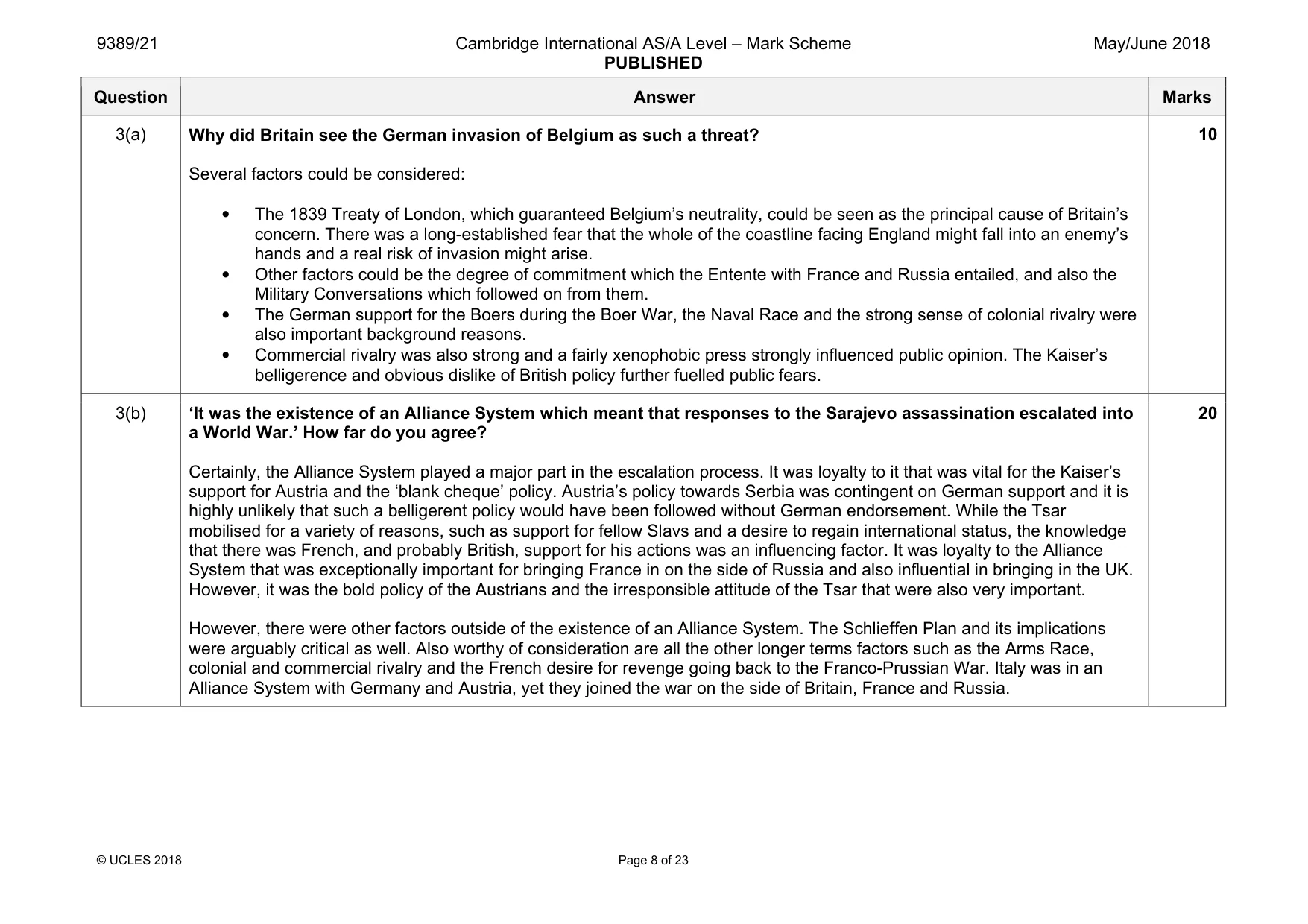
Mark scheme: 3(a) Why did Britain see the German invasion of Belgium as such a threat? Several factors could be considered: • The 1839 Treaty of London, which guaranteed Belgium’s neutrality, could be seen as the principal cause of Britain’s concern. There was a long-established fear that the whole of the coastline facing England might fall into an enemy’s hands and a real risk of invasion might arise. • Other factors could be the degree of commitment which the Entente with France and Russia entailed, and also the Military Conversations which followed on from them. • The German support for the Boers during the Boer War, the Naval Race and the strong sense of colonial rivalry were also important background reasons. • Commercial rivalry was also strong and a fairly xenophobic press strongly influenced public opinion. The Kaiser’s belligerence and obvious dislike of British policy further fuelled public fears. 10 3(b) ‘It was the existence of an Alliance System which meant that responses to the Sarajevo assassination escalated into a World War.’ How far do you agree? Certainly, the Alliance System played a major part in the escalation process. It was loyalty to it that was vital for the Kaiser’s support for Austria and the ‘blank cheque’ policy. Austria’s policy towards Serbia was contingent on German support and it is highly unlikely that such a belligerent policy would have been followed without German endorsement. While the Tsar mobilised for a variety of reasons, such as support for fellow Slavs and a desire to regain international status, the knowledge that there was French, and probably British, support for his actions was an influencing factor. It was loyalty to the Alliance System that was exceptionally important for bringing France in on the side of Russia and also influential in bringing in the UK. However, it was the bold policy of the Austrians and the irresponsible attitude of the Tsar that were also very important. However, there were other factors outside of the existence of an Alliance System. The Schlieffen Plan and its implications were arguably critical as well. Also worthy of consideration are all the other longer terms factors such as the Arms Race, colonial and commercial rivalry and the French desire for revenge going back to the Franco-Prussian War. Italy was in an Alliance System with Germany and Austria, yet they joined the war on the side of Britain, France and Russia. 20
Q4 · The Russian Revolution, c.1894–1917 (a) Why was Bloody Sunday important in causing the…
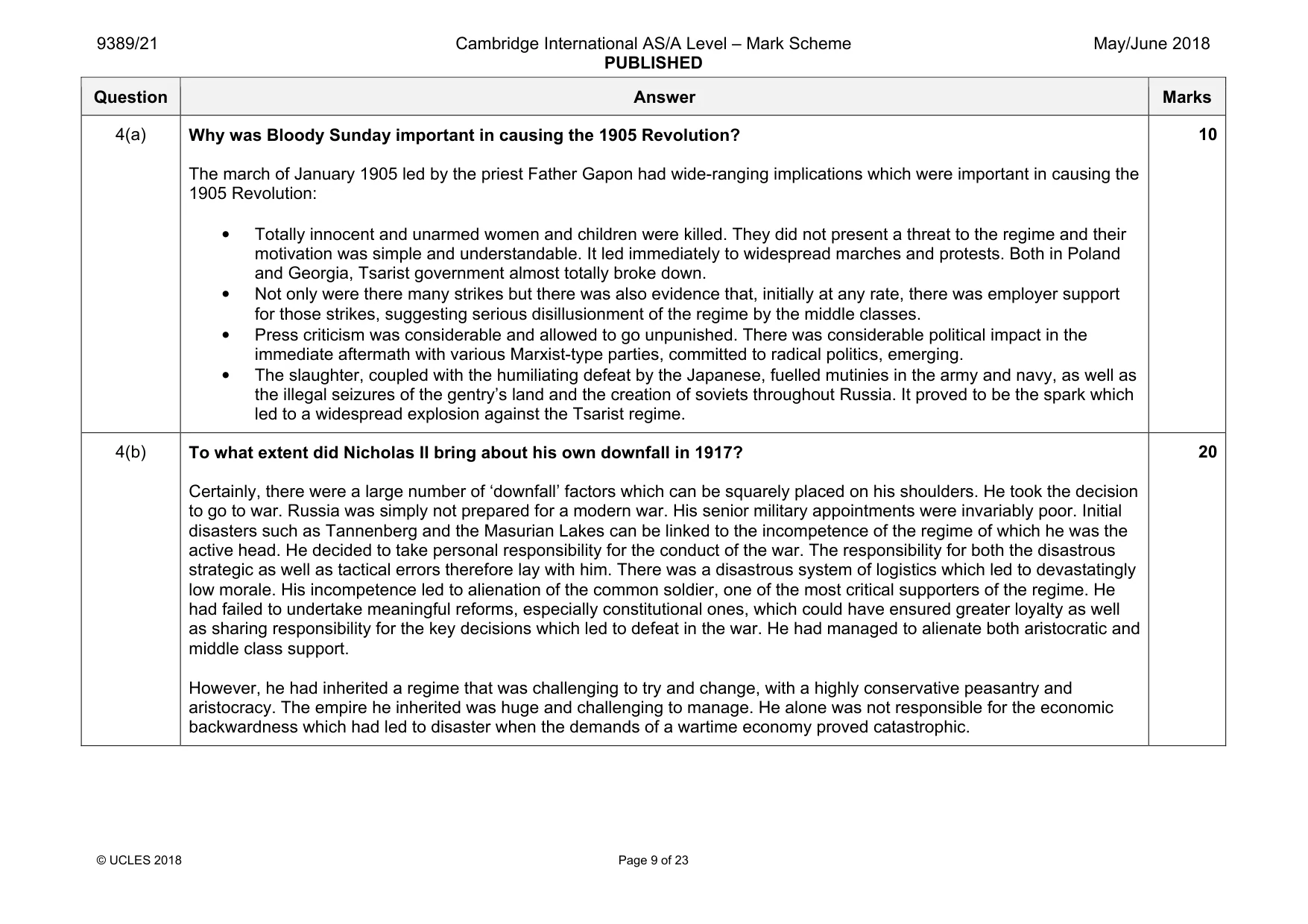
4 The Russian Revolution, c.1894–1917 (a) Why was Bloody Sunday important in causing the 1905 Revolution? [10] (b) To what extent did Nicholas II bring about his own downfall in 1917? [20]
Mark scheme: 4(a) Why was Bloody Sunday important in causing the 1905 Revolution? The march of January 1905 led by the priest Father Gapon had wide-ranging implications which were important in causing the 1905 Revolution: • Totally innocent and unarmed women and children were killed. They did not present a threat to the regime and their motivation was simple and understandable. It led immediately to widespread marches and protests. Both in Poland and Georgia, Tsarist government almost totally broke down. • Not only were there many strikes but there was also evidence that, initially at any rate, there was employer support for those strikes, suggesting serious disillusionment of the regime by the middle classes. • Press criticism was considerable and allowed to go unpunished. There was considerable political impact in the immediate aftermath with various Marxist-type parties, committed to radical politics, emerging. • The slaughter, coupled with the humiliating defeat by the Japanese, fuelled mutinies in the army and navy, as well as the illegal seizures of the gentry’s land and the creation of soviets throughout Russia. It proved to be the spark which led to a widespread explosion against the Tsarist regime. 10 4(b) To what extent did Nicholas II bring about his own downfall in 1917? Certainly, there were a large number of ‘downfall’ factors which can be squarely placed on his shoulders. He took the decision to go to war. Russia was simply not prepared for a modern war. His senior military appointments were invariably poor. Initial disasters such as Tannenberg and the Masurian Lakes can be linked to the incompetence of the regime of which he was the active head. He decided to take personal responsibility for the conduct of the war. The responsibility for both the disastrous strategic as well as tactical errors therefore lay with him. There was a disastrous system of logistics which led to devastatingly low morale. His incompetence led to alienation of the common soldier, one of the most critical supporters of the regime. He had failed to undertake meaningful reforms, especially constitutional ones, which could have ensured greater loyalty as well as sharing responsibility for the key decisions which led to defeat in the war. He had managed to alienate both aristocratic and middle class support. However, he had inherited a regime that was challenging to try and change, with a highly conservative peasantry and aristocracy. The empire he inherited was huge and challenging to manage. He alone was not responsible for the economic backwardness which had led to disaster when the demands of a wartime economy proved catastrophic. 20
Q5 · The expansion of US power from the 1840s to the 1930s (a) Why did the USA join the First…
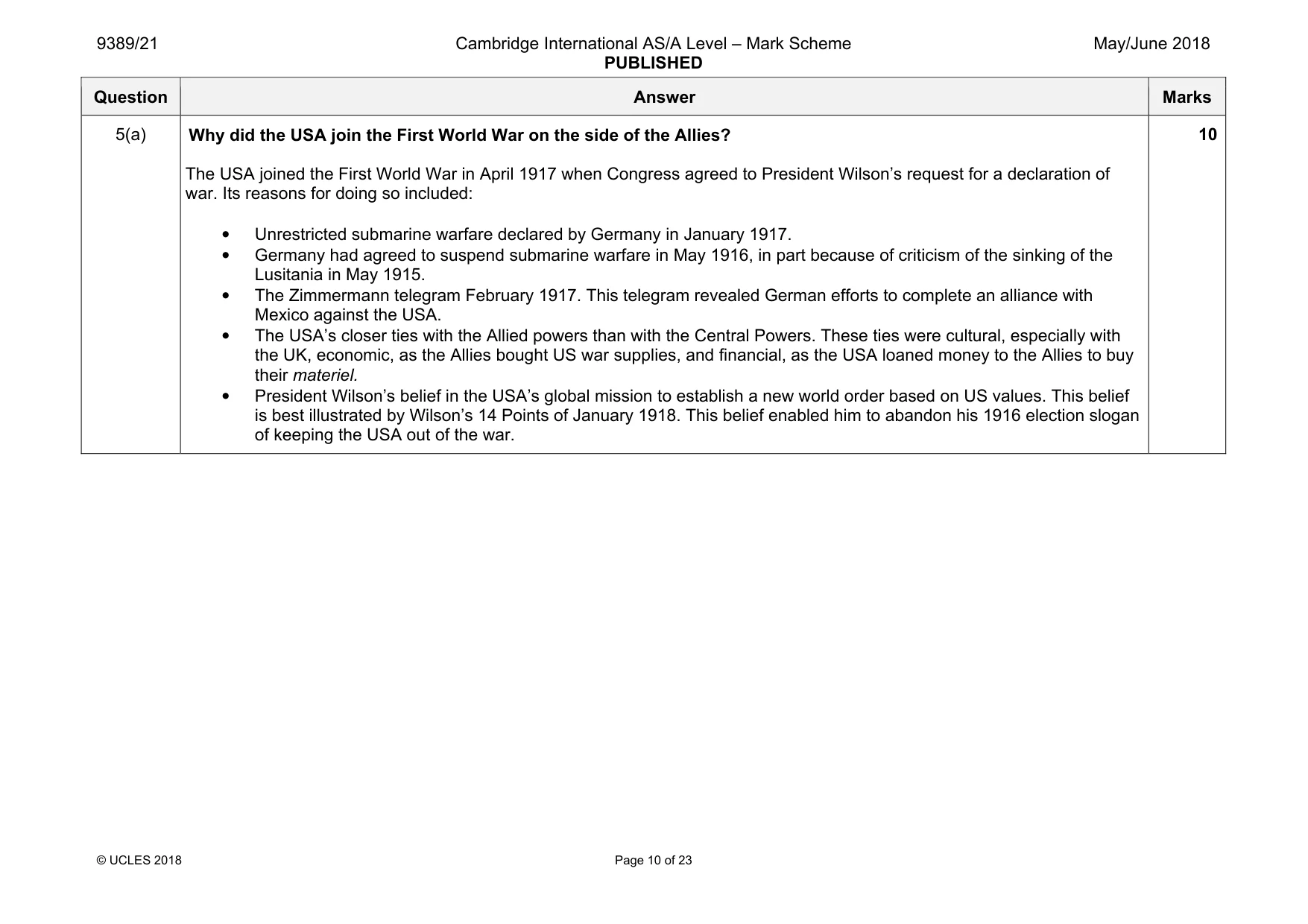
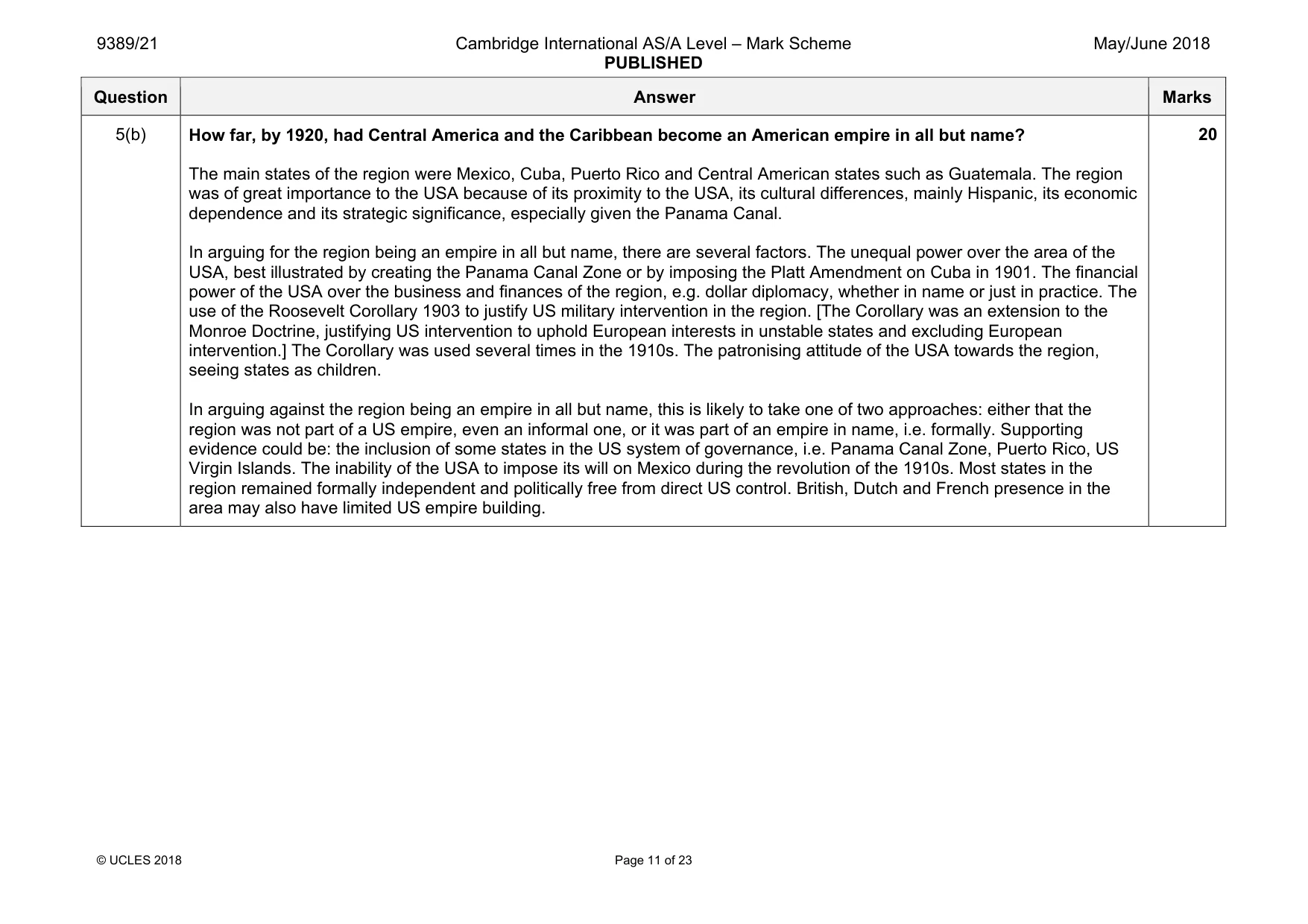
5 The expansion of US power from the 1840s to the 1930s (a) Why did the USA join the First World War on the side of the Allies? [10] (b) How far, by 1920, had Central America and the Caribbean become an American empire in all but name? [20]
Mark scheme: 5(a) Why did the USA join the First World War on the side of the Allies? The USA joined the First World War in April 1917 when Congress agreed to President Wilson’s request for a declaration of war. Its reasons for doing so included: • Unrestricted submarine warfare declared by Germany in January 1917. • Germany had agreed to suspend submarine warfare in May 1916, in part because of criticism of the sinking of the Lusitania in May 1915. • The Zimmermann telegram February 1917. This telegram revealed German efforts to complete an alliance with Mexico against the USA. • The USA’s closer ties with the Allied powers than with the Central Powers. These ties were cultural, especially with the UK, economic, as the Allies bought US war supplies, and financial, as the USA loaned money to the Allies to buy their materiel. • President Wilson’s belief in the USA’s global mission to establish a new world order based on US values. This belief is best illustrated by Wilson’s 14 Points of January 1918. This belief enabled him to abandon his 1916 election slogan of keeping the USA out of the war. 10 Question Answer Marks 5(b) How far, by 1920, had Central America and the Caribbean become an American empire in all but name? The main states of the region were Mexico, Cuba, Puerto Rico and Central American states such as Guatemala. The region was of great importance to the USA because of its proximity to the USA, its cultural differences, mainly Hispanic, its economic dependence and its strategic significance, especially given the Panama Canal. In arguing for the region being an empire in all but name, there are several factors. The unequal power over the area of the USA, best illustrated by creating the Panama Canal Zone or by imposing the Platt Amendment on Cuba in 1901. The financial power of the USA over the business and finances of the region, e.g. dollar diplomacy, whether in name or just in practice. The use of the Roosevelt Corollary 1903 to justify US military intervention in the region. [The Corollary was an extension to the Monroe Doctrine, justifying US intervention to uphold European interests in unstable states and excluding European intervention.] The Corollary was used several times in the 1910s. The patronising attitude of the USA towards the region, seeing states as children. In arguing against the region being an empire in all but name, this is likely to take one of two approaches: either that the region was not part of a US empire, even an informal one, or it was part of an empire in name, i.e. formally. Supporting evidence could be: the inclusion of some states in the US system of governance, i.e. Panama Canal Zone, Puerto Rico, US Virgin Islands. The inability of the USA to impose its will on Mexico during the revolution of the 1910s. Most states in the region remained formally independent and politically free from direct US control. British, Dutch and French presence in the area may also have limited US empire building. 20
Q6 · Civil War and Reconstruction, 1861–1877 (a) Why did Reconstruction face such opposition…
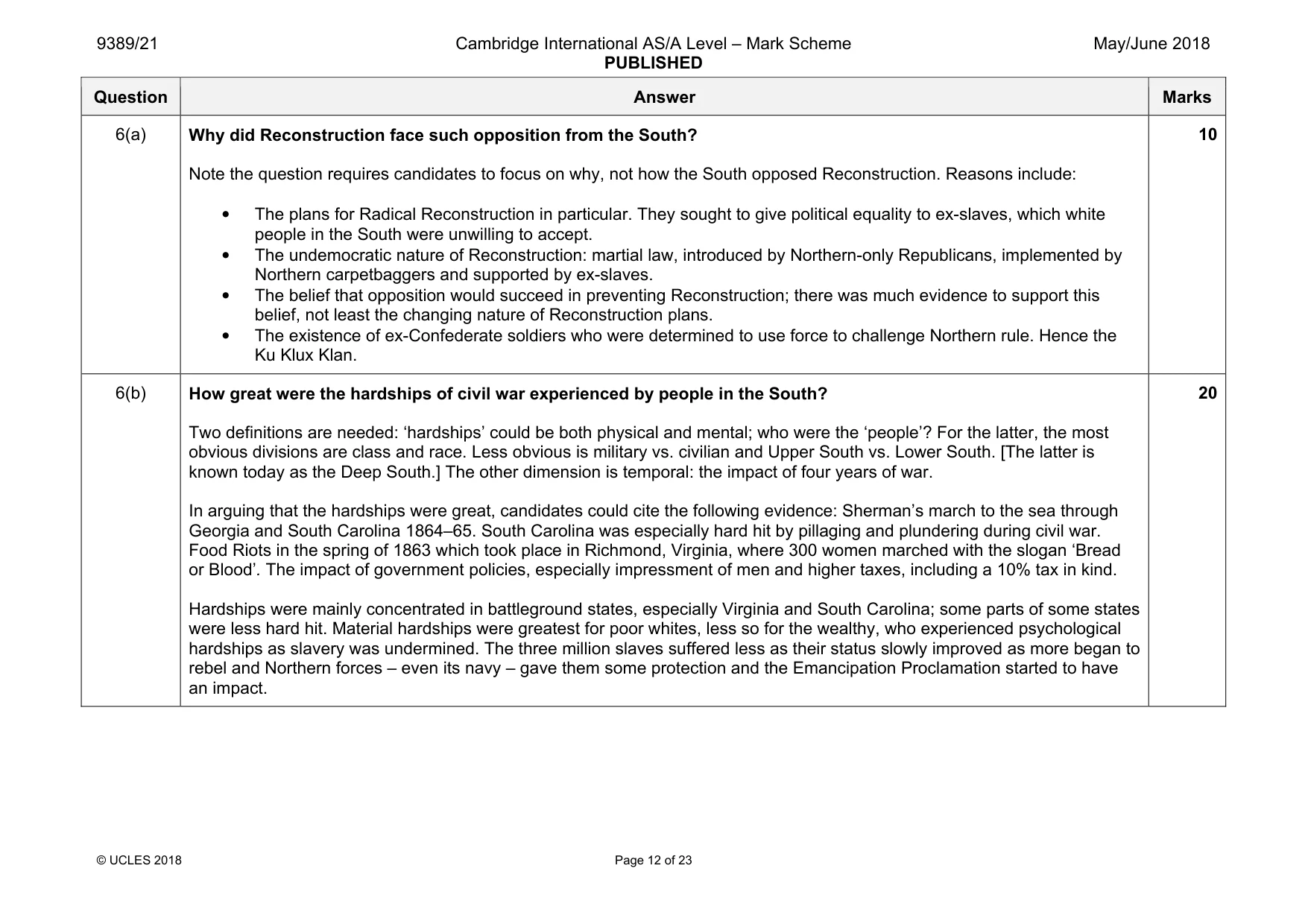
6 Civil War and Reconstruction, 1861–1877 (a) Why did Reconstruction face such opposition from the South? [10] (b) How great were the hardships of civil war experienced by people in the South? [20]
Mark scheme: 6(a) Why did Reconstruction face such opposition from the South? Note the question requires candidates to focus on why, not how the South opposed Reconstruction. Reasons include: • The plans for Radical Reconstruction in particular. They sought to give political equality to ex-slaves, which white people in the South were unwilling to accept. • The undemocratic nature of Reconstruction: martial law, introduced by Northern-only Republicans, implemented by Northern carpetbaggers and supported by ex-slaves. • The belief that opposition would succeed in preventing Reconstruction; there was much evidence to support this belief, not least the changing nature of Reconstruction plans. • The existence of ex-Confederate soldiers who were determined to use force to challenge Northern rule. Hence the Ku Klux Klan. 10 6(b) How great were the hardships of civil war experienced by people in the South? Two definitions are needed: ‘hardships’ could be both physical and mental; who were the ‘people’? For the latter, the most obvious divisions are class and race. Less obvious is military vs. civilian and Upper South vs. Lower South. [The latter is known today as the Deep South.] The other dimension is temporal: the impact of four years of war. In arguing that the hardships were great, candidates could cite the following evidence: Sherman’s march to the sea through Georgia and South Carolina 1864–65. South Carolina was especially hard hit by pillaging and plundering during civil war. Food Riots in the spring of 1863 which took place in Richmond, Virginia, where 300 women marched with the slogan ‘Bread or Blood’. The impact of government policies, especially impressment of men and higher taxes, including a 10% tax in kind. Hardships were mainly concentrated in battleground states, especially Virginia and South Carolina; some parts of some states were less hard hit. Material hardships were greatest for poor whites, less so for the wealthy, who experienced psychological hardships as slavery was undermined. The three million slaves suffered less as their status slowly improved as more began to rebel and Northern forces – even its navy – gave them some protection and the Emancipation Proclamation started to have an impact. 20
Q7 · The Gilded Age and the Progressive Era, from the 1870s to the 1920s (a) Why was the…
7 The Gilded Age and the Progressive Era, from the 1870s to the 1920s (a) Why was the building of transcontinental railroads so significant in causing the development of the USA in the later nineteenth century? [10] (b) How successful was the Progressive Movement in the period from 1900 to 1920? [20]
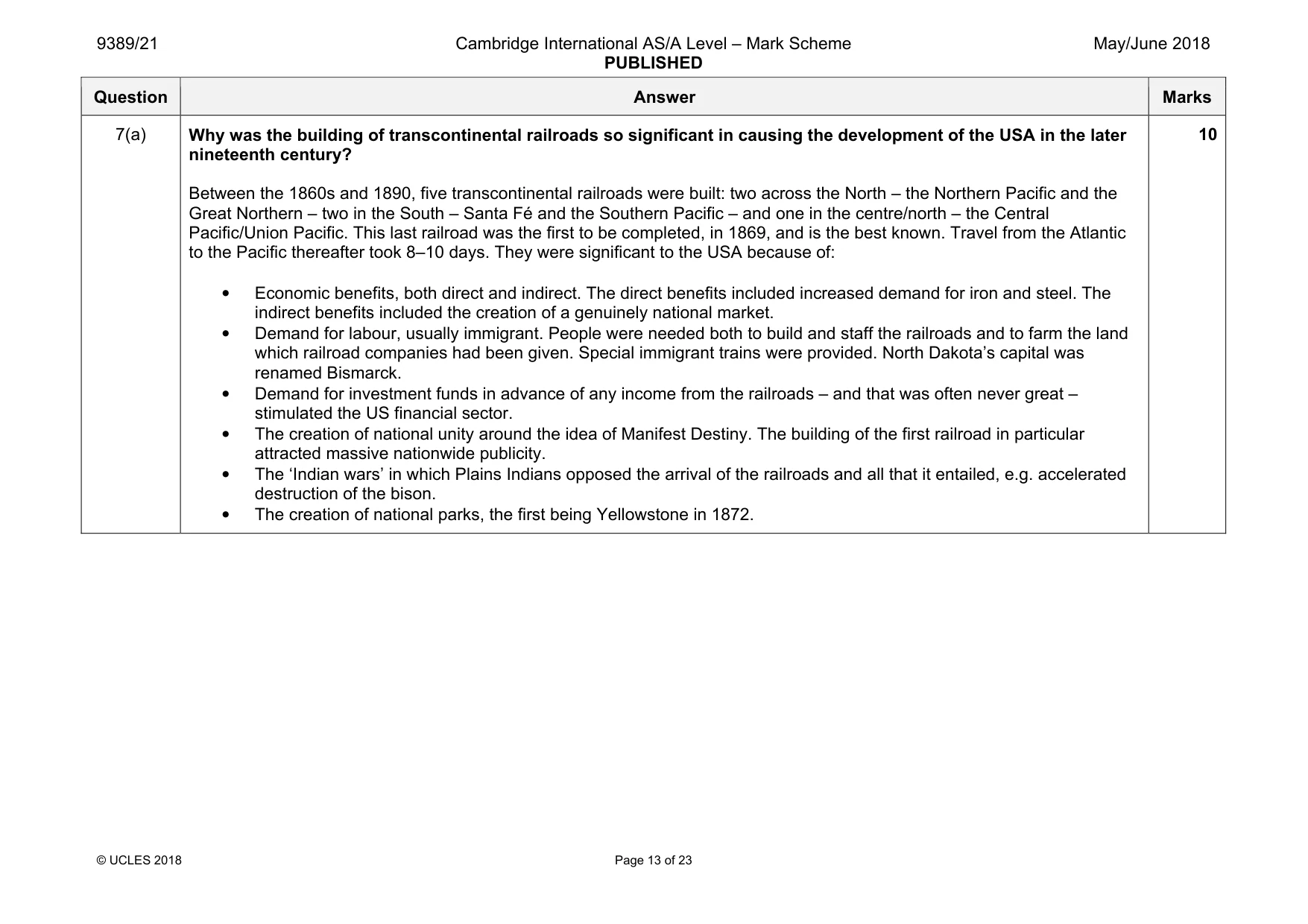
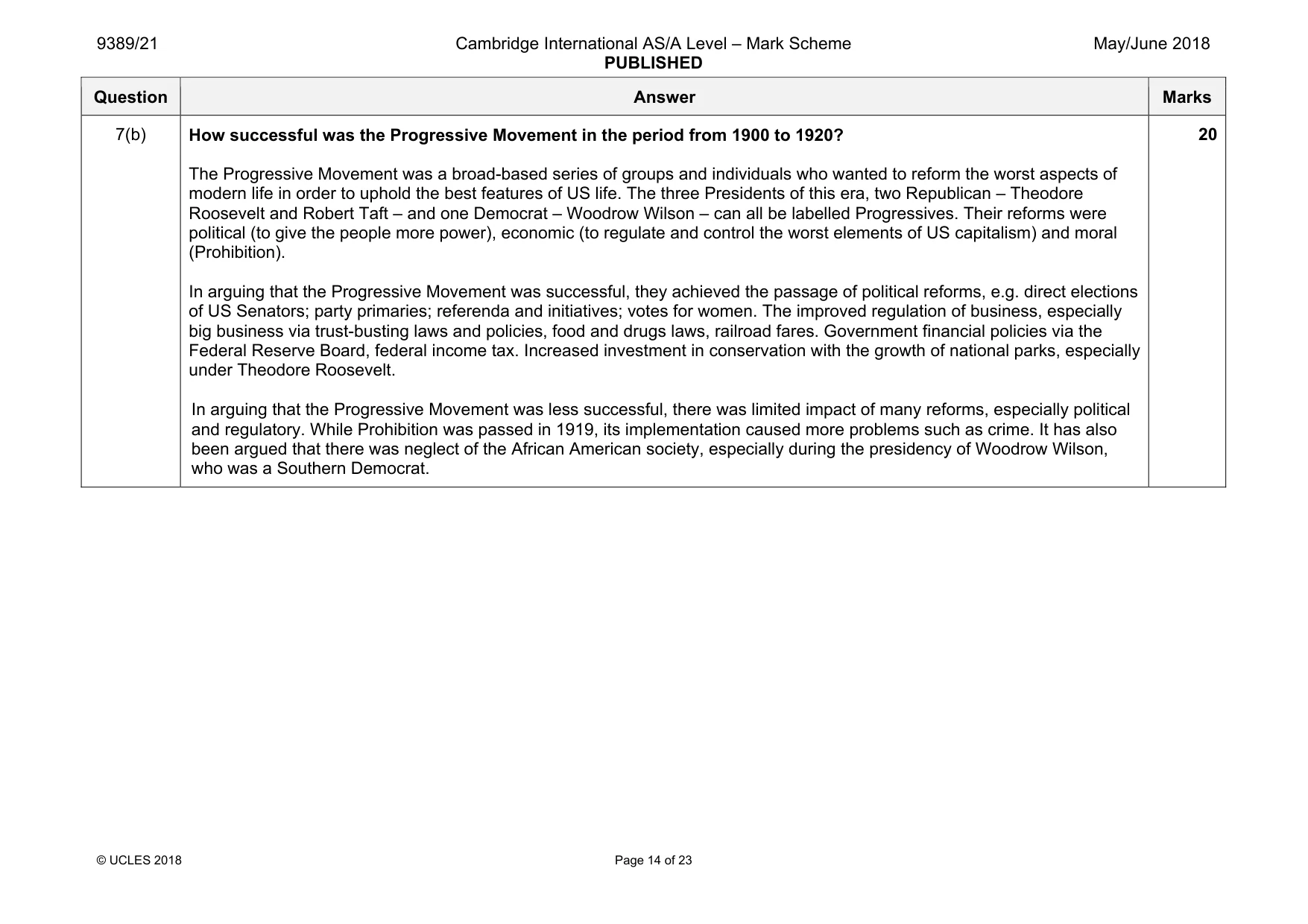
Mark scheme: 7(a) Why was the building of transcontinental railroads so significant in causing the development of the USA in the later nineteenth century? Between the 1860s and 1890, five transcontinental railroads were built: two across the North – the Northern Pacific and the Great Northern – two in the South – Santa Fé and the Southern Pacific – and one in the centre/north – the Central Pacific/Union Pacific. This last railroad was the first to be completed, in 1869, and is the best known. Travel from the Atlantic to the Pacific thereafter took 8–10 days. They were significant to the USA because of: • Economic benefits, both direct and indirect. The direct benefits included increased demand for iron and steel. The indirect benefits included the creation of a genuinely national market. • Demand for labour, usually immigrant. People were needed both to build and staff the railroads and to farm the land which railroad companies had been given. Special immigrant trains were provided. North Dakota’s capital was renamed Bismarck. • Demand for investment funds in advance of any income from the railroads – and that was often never great – stimulated the US financial sector. • The creation of national unity around the idea of Manifest Destiny. The building of the first railroad in particular attracted massive nationwide publicity. • The ‘Indian wars’ in which Plains Indians opposed the arrival of the railroads and all that it entailed, e.g. accelerated destruction of the bison. • The creation of national parks, the first being Yellowstone in 1872. 10 Question Answer Marks 7(b) How successful was the Progressive Movement in the period from 1900 to 1920? The Progressive Movement was a broad-based series of groups and individuals who wanted to reform the worst aspects of modern life in order to uphold the best features of US life. The three Presidents of this era, two Republican – Theodore Roosevelt and Robert Taft – and one Democrat – Woodrow Wilson – can all be labelled Progressives. Their reforms were political (to give the people more power), economic (to regulate and control the worst elements of US capitalism) and moral (Prohibition). In arguing that the Progressive Movement was successful, they achieved the passage of political reforms, e.g. direct elections of US Senators; party primaries; referenda and initiatives; votes for women. The improved regulation of business, especially big business via trust-busting laws and policies, food and drugs laws, railroad fares. Government financial policies via the Federal Reserve Board, federal income tax. Increased investment in conservation with the growth of national parks, especially under Theodore Roosevelt. In arguing that the Progressive Movement was less successful, there was limited impact of many reforms, especially political and regulatory. While Prohibition was passed in 1919, its implementation caused more problems such as crime. It has also been argued that there was neglect of the African American society, especially during the presidency of Woodrow Wilson, who was a Southern Democrat. 20
Q8 · The Great Crash, the Great Depression and the New Deal, from the 1920s to 1941 (a) Why…
8 The Great Crash, the Great Depression and the New Deal, from the 1920s to 1941 (a) Why did President Roosevelt take so much action in his first 100 Days? [10] (b) On the basis of his domestic policies, how far does Franklin Roosevelt deserve his reputation as a great president? [20] Section C: International Option International Relations, 1871–1945 Answer both parts of two questions.
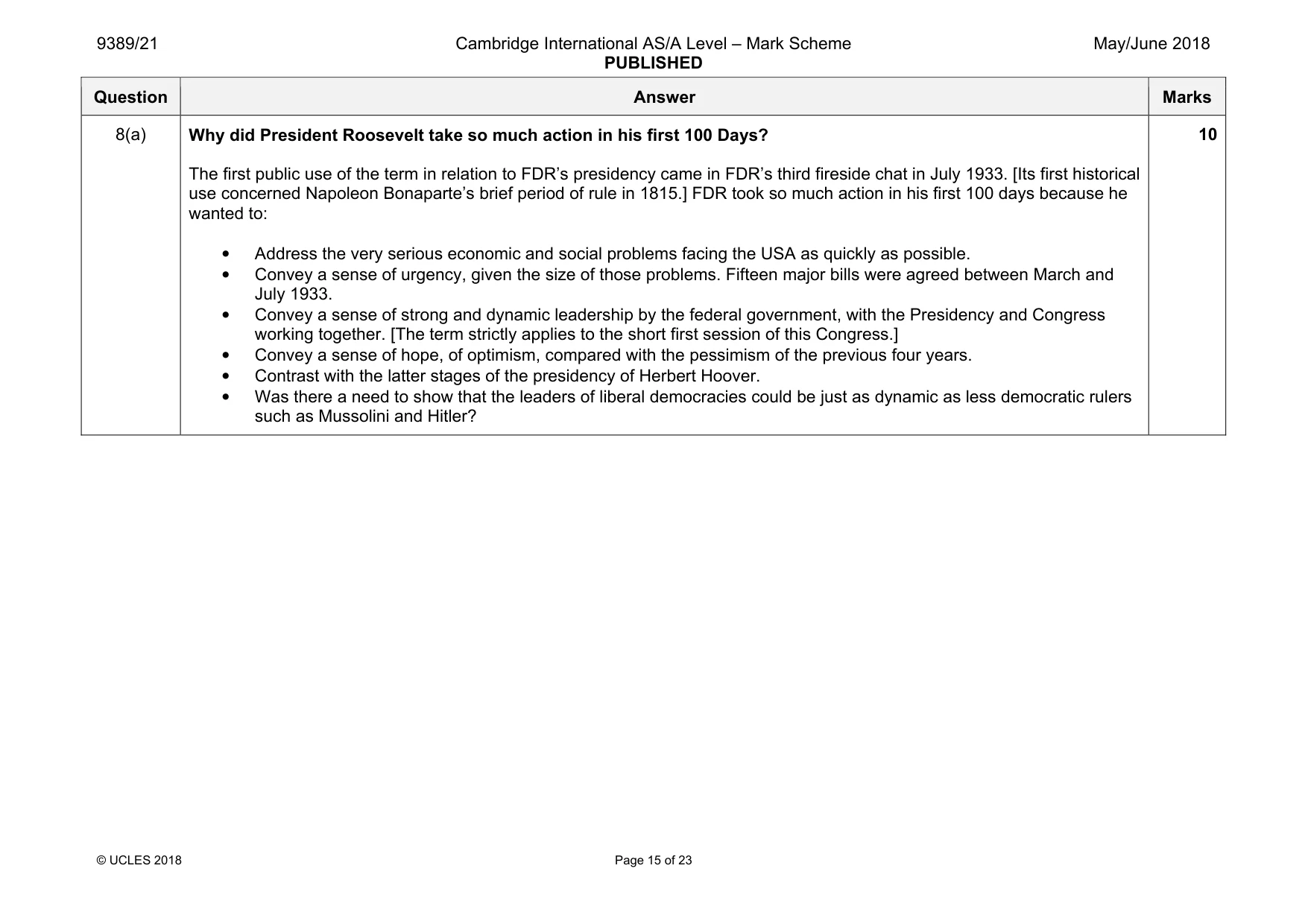
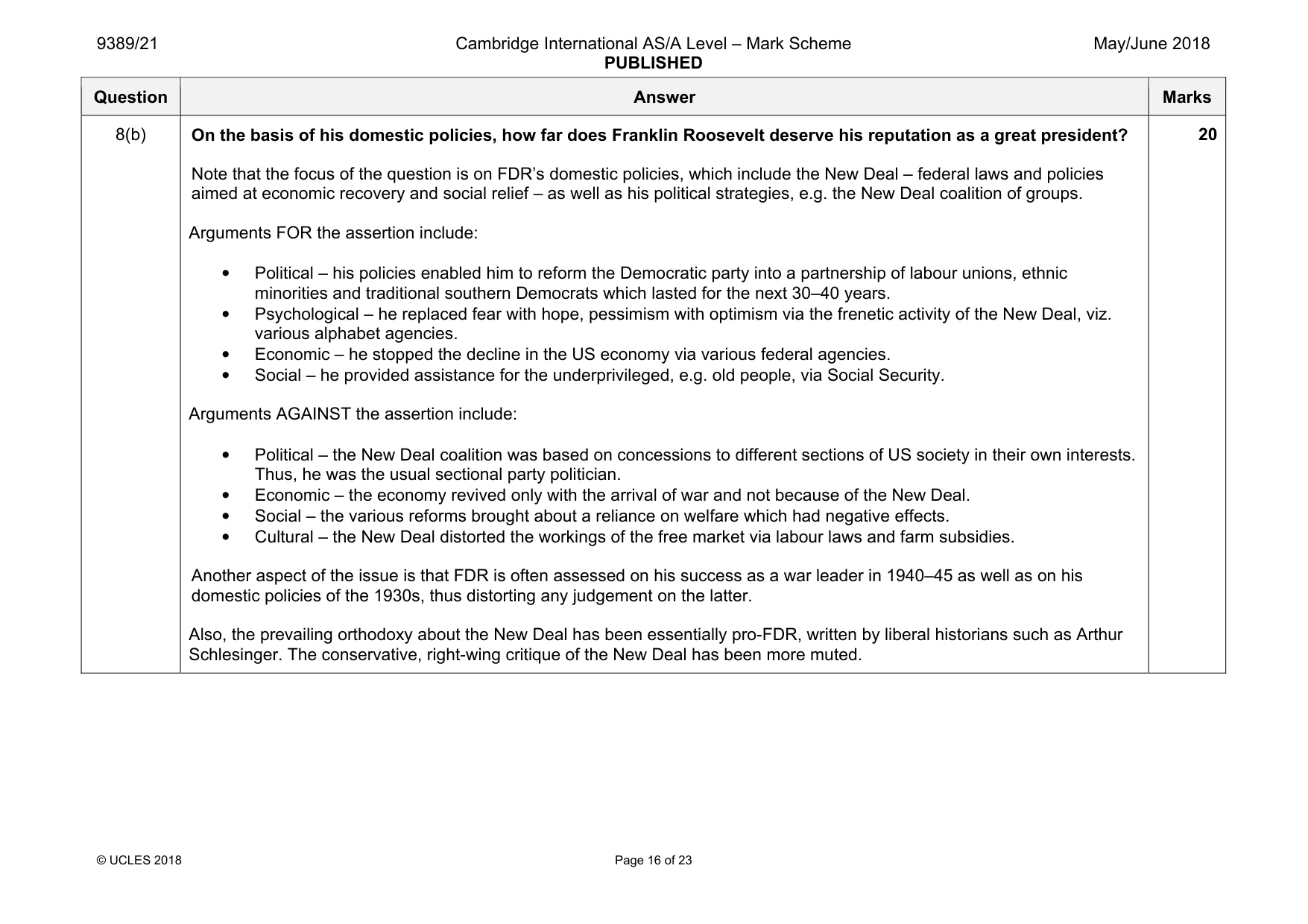
Mark scheme: 8(a) Why did President Roosevelt take so much action in his first 100 Days? The first public use of the term in relation to FDR’s presidency came in FDR’s third fireside chat in July 1933. [Its first historical use concerned Napoleon Bonaparte’s brief period of rule in 1815.] FDR took so much action in his first 100 days because he wanted to: • Address the very serious economic and social problems facing the USA as quickly as possible. • Convey a sense of urgency, given the size of those problems. Fifteen major bills were agreed between March and July 1933. • Convey a sense of strong and dynamic leadership by the federal government, with the Presidency and Congress working together. [The term strictly applies to the short first session of this Congress.] • Convey a sense of hope, of optimism, compared with the pessimism of the previous four years. • Contrast with the latter stages of the presidency of Herbert Hoover. • Was there a need to show that the leaders of liberal democracies could be just as dynamic as less democratic rulers such as Mussolini and Hitler? 10 Question Answer Marks 8(b) On the basis of his domestic policies, how far does Franklin Roosevelt deserve his reputation as a great president? Note that the focus of the question is on FDR’s domestic policies, which include the New Deal – federal laws and policies aimed at economic recovery and social relief – as well as his political strategies, e.g. the New Deal coalition of groups. Arguments FOR the assertion include: • Political – his policies enabled him to reform the Democratic party into a partnership of labour unions, ethnic minorities and traditional southern Democrats which lasted for the next 30–40 years. • Psychological – he replaced fear with hope, pessimism with optimism via the frenetic activity of the New Deal, viz. various alphabet agencies. • Economic – he stopped the decline in the US economy via various federal agencies. • Social – he provided assistance for the underprivileged, e.g. old people, via Social Security. Arguments AGAINST the assertion include: • Political – the New Deal coalition was based on concessions to different sections of US society in their own interests. Thus, he was the usual sectional party politician. • Economic – the economy revived only with the arrival of war and not because of the New Deal. • Social – the various reforms brought about a reliance on welfare which had negative effects. • Cultural – the New Deal distorted the workings of the free market via labour laws and farm subsidies. Another aspect of the issue is that FDR is often assessed on his success as a war leader in 1940–45 as well as on his domestic policies of the 1930s, thus distorting any judgement on the latter. Also, the prevailing orthodoxy about the New Deal has been essentially pro-FDR, written by liberal historians such as Arthur Schlesinger. The conservative, right-wing critique of the New Deal has been more muted. 20
Q9 · International Relations, 1871–1918 (a) Why did the war against Spain in 1898 lead to the…
9 International Relations, 1871–1918 (a) Why did the war against Spain in 1898 lead to the USA’s adoption of a less isolationist foreign policy? [10] (b) To what extent was the ‘scramble for Africa’ caused by European countries’ desire for trade? [20]
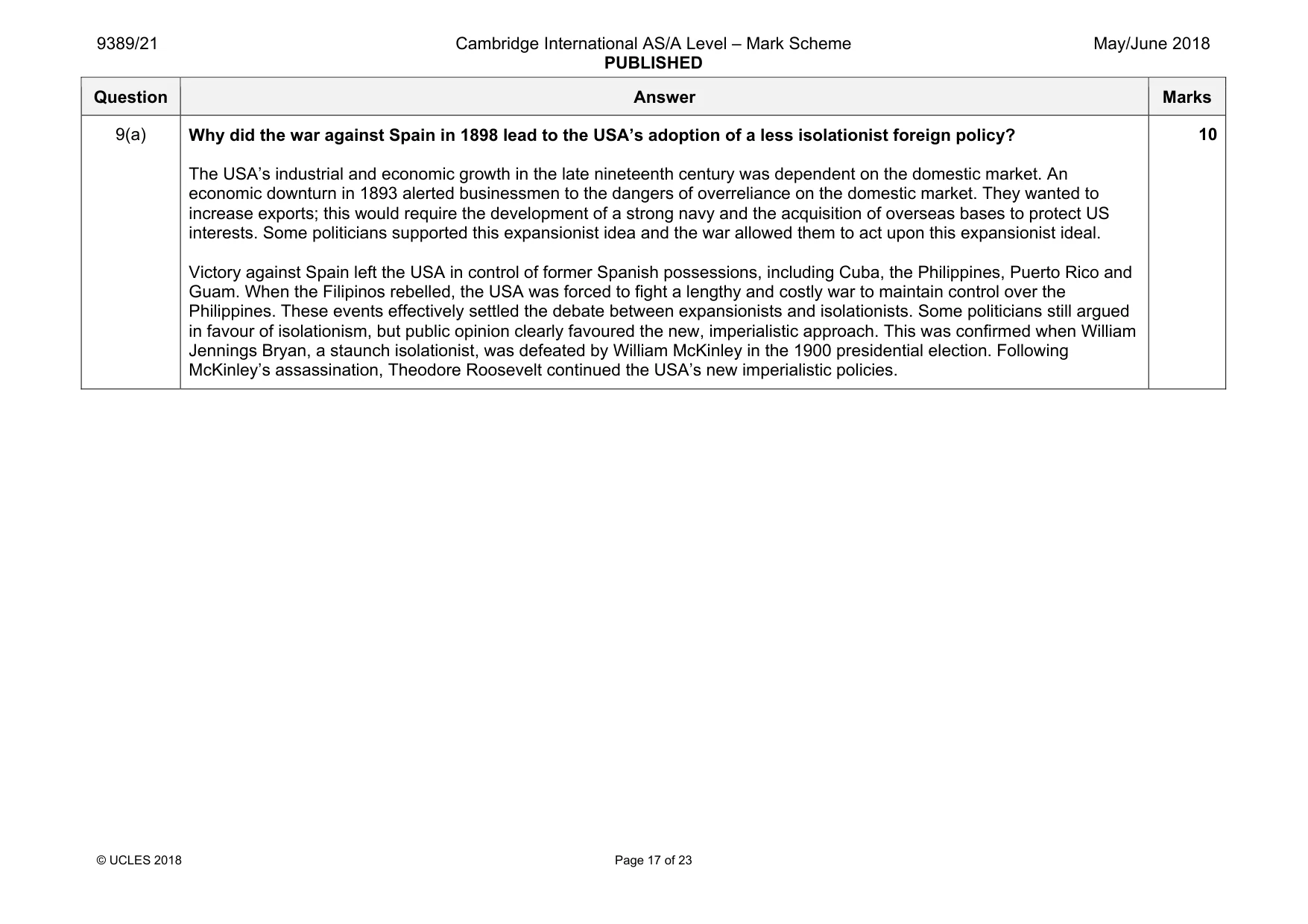
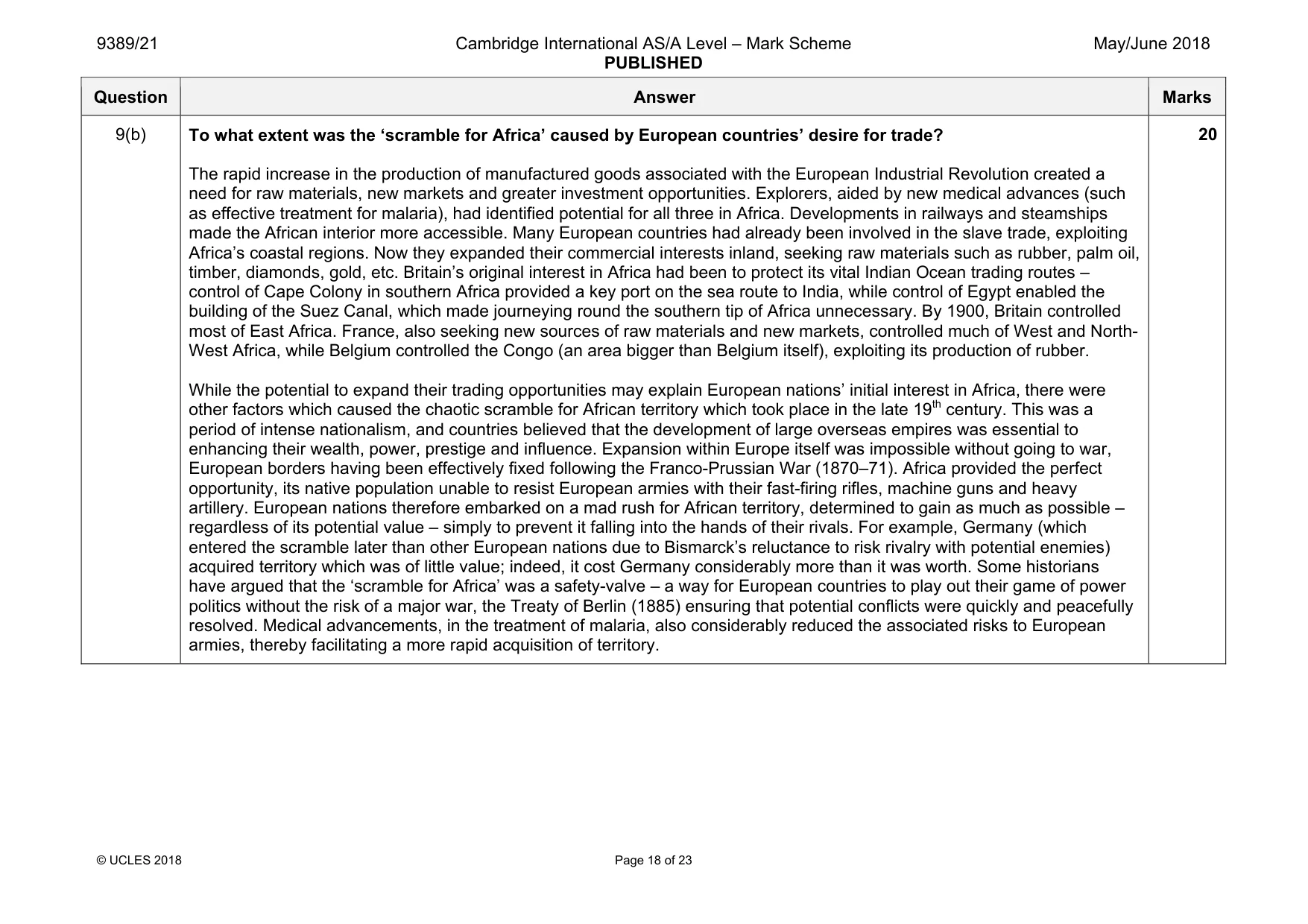
Mark scheme: 9(a) Why did the war against Spain in 1898 lead to the USA’s adoption of a less isolationist foreign policy? The USA’s industrial and economic growth in the late nineteenth century was dependent on the domestic market. An economic downturn in 1893 alerted businessmen to the dangers of overreliance on the domestic market. They wanted to increase exports; this would require the development of a strong navy and the acquisition of overseas bases to protect US interests. Some politicians supported this expansionist idea and the war allowed them to act upon this expansionist ideal. Victory against Spain left the USA in control of former Spanish possessions, including Cuba, the Philippines, Puerto Rico and Guam. When the Filipinos rebelled, the USA was forced to fight a lengthy and costly war to maintain control over the Philippines. These events effectively settled the debate between expansionists and isolationists. Some politicians still argued in favour of isolationism, but public opinion clearly favoured the new, imperialistic approach. This was confirmed when William Jennings Bryan, a staunch isolationist, was defeated by William McKinley in the 1900 presidential election. Following McKinley’s assassination, Theodore Roosevelt continued the USA’s new imperialistic policies. 10 Question Answer Marks 9(b) To what extent was the ‘scramble for Africa’ caused by European countries’ desire for trade? The rapid increase in the production of manufactured goods associated with the European Industrial Revolution created a need for raw materials, new markets and greater investment opportunities. Explorers, aided by new medical advances (such as effective treatment for malaria), had identified potential for all three in Africa. Developments in railways and steamships made the African interior more accessible. Many European countries had already been involved in the slave trade, exploiting Africa’s coastal regions. Now they expanded their commercial interests inland, seeking raw materials such as rubber, palm oil, timber, diamonds, gold, etc. Britain’s original interest in Africa had been to protect its vital Indian Ocean trading routes – control of Cape Colony in southern Africa provided a key port on the sea route to India, while control of Egypt enabled the building of the Suez Canal, which made journeying round the southern tip of Africa unnecessary. By 1900, Britain controlled most of East Africa. France, also seeking new sources of raw materials and new markets, controlled much of West and North- West Africa, while Belgium controlled the Congo (an area bigger than Belgium itself), exploiting its production of rubber. While the potential to expand their trading opportunities may explain European nations’ initial interest in Africa, there were other factors which caused the chaotic scramble for African territory which took place in the late 19th century. This was a period of intense nationalism, and countries believed that the development of large overseas empires was essential to enhancing their wealth, power, prestige and influence. Expansion within Europe itself was impossible without going to war, European borders having been effectively fixed following the Franco-Prussian War (1870–71). Africa provided the perfect opportunity, its native population unable to resist European armies with their fast-firing rifles, machine guns and heavy artillery. European nations therefore embarked on a mad rush for African territory, determined to gain as much as possible – regardless of its potential value – simply to prevent it falling into the hands of their rivals. For example, Germany (which entered the scramble later than other European nations due to Bismarck’s reluctance to risk rivalry with potential enemies) acquired territory which was of little value; indeed, it cost Germany considerably more than it was worth. Some historians have argued that the ‘scramble for Africa’ was a safety-valve – a way for European countries to play out their game of power politics without the risk of a major war, the Treaty of Berlin (1885) ensuring that potential conflicts were quickly and peacefully resolved. Medical advancements, in the treatment of malaria, also considerably reduced the associated risks to European armies, thereby facilitating a more rapid acquisition of territory. 20
Q10 · International Relations, 1919–1933 (a) Why, in 1922, did the Genoa Conference take place?
10 International Relations, 1919–1933 (a) Why, in 1922, did the Genoa Conference take place? [10] (b) ‘The best that could have been achieved under the circumstances.’ How far do you agree with this assessment of the Paris Peace Settlement? [20]
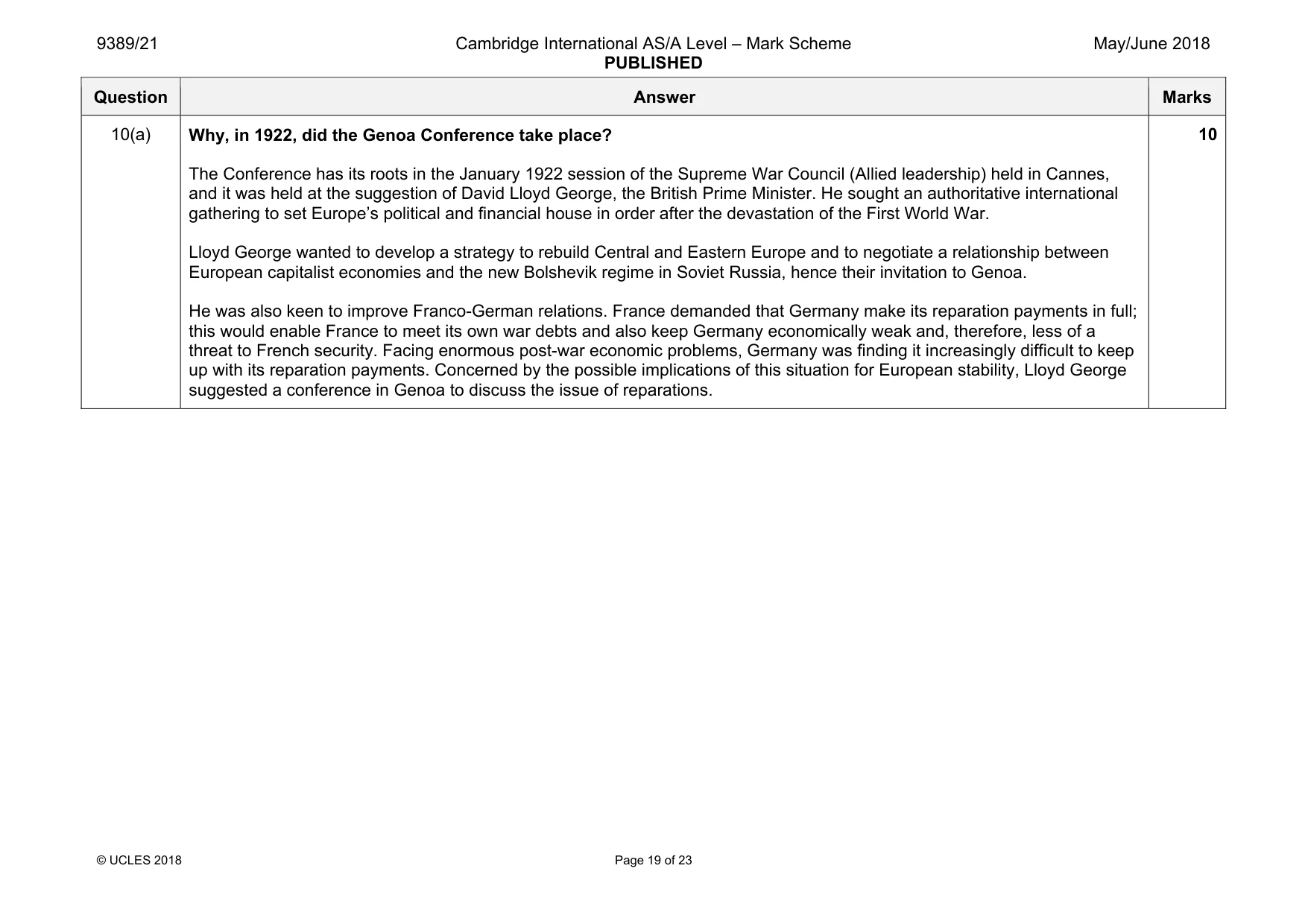
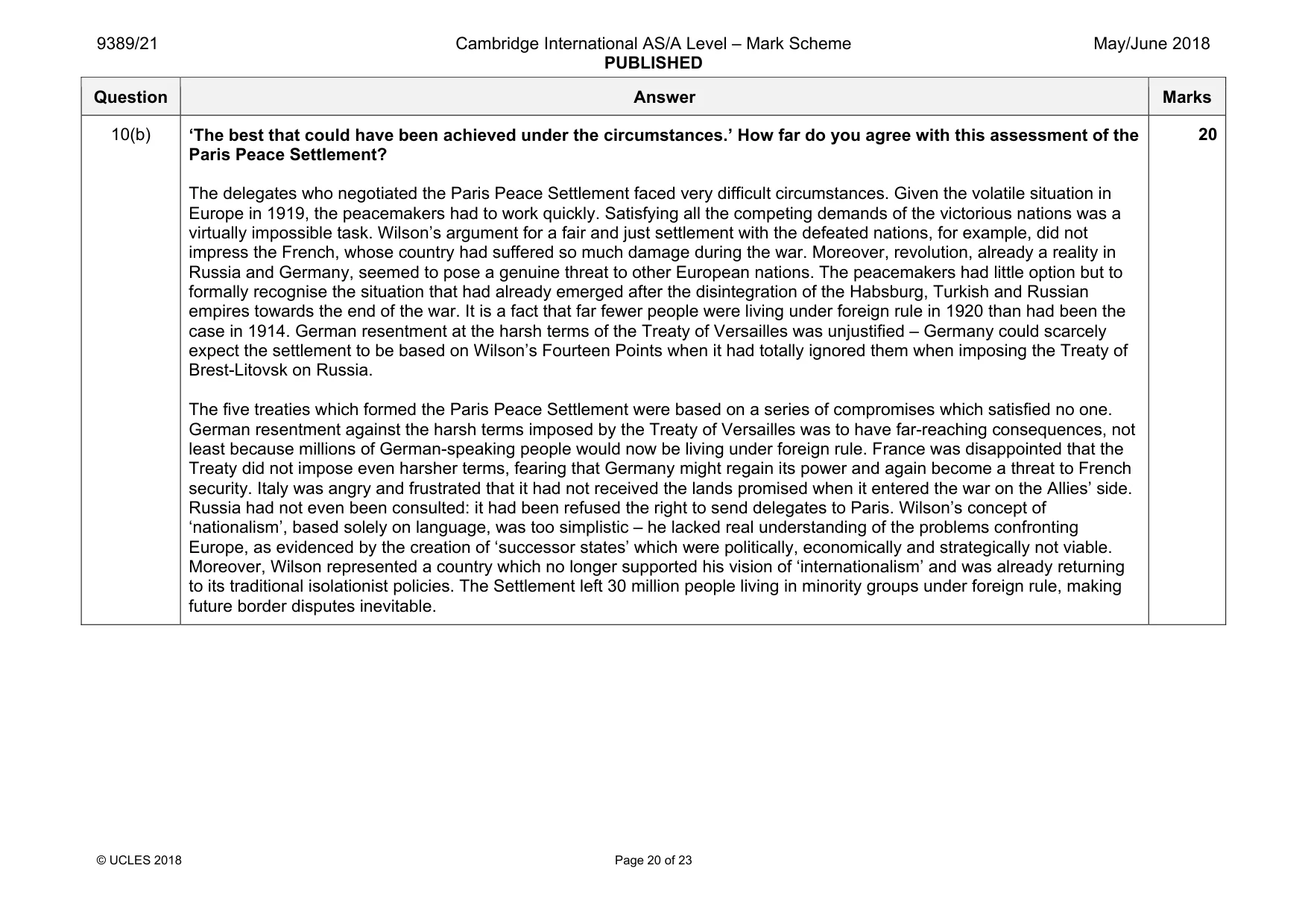
Mark scheme: 10(a) Why, in 1922, did the Genoa Conference take place? The Conference has its roots in the January 1922 session of the Supreme War Council (Allied leadership) held in Cannes, and it was held at the suggestion of David Lloyd George, the British Prime Minister. He sought an authoritative international gathering to set Europe’s political and financial house in order after the devastation of the First World War. Lloyd George wanted to develop a strategy to rebuild Central and Eastern Europe and to negotiate a relationship between European capitalist economies and the new Bolshevik regime in Soviet Russia, hence their invitation to Genoa. He was also keen to improve Franco-German relations. France demanded that Germany make its reparation payments in full; this would enable France to meet its own war debts and also keep Germany economically weak and, therefore, less of a threat to French security. Facing enormous post-war economic problems, Germany was finding it increasingly difficult to keep up with its reparation payments. Concerned by the possible implications of this situation for European stability, Lloyd George suggested a conference in Genoa to discuss the issue of reparations. 10 Question Answer Marks 10(b) ‘The best that could have been achieved under the circumstances.’ How far do you agree with this assessment of the Paris Peace Settlement? The delegates who negotiated the Paris Peace Settlement faced very difficult circumstances. Given the volatile situation in Europe in 1919, the peacemakers had to work quickly. Satisfying all the competing demands of the victorious nations was a virtually impossible task. Wilson’s argument for a fair and just settlement with the defeated nations, for example, did not impress the French, whose country had suffered so much damage during the war. Moreover, revolution, already a reality in Russia and Germany, seemed to pose a genuine threat to other European nations. The peacemakers had little option but to formally recognise the situation that had already emerged after the disintegration of the Habsburg, Turkish and Russian empires towards the end of the war. It is a fact that far fewer people were living under foreign rule in 1920 than had been the case in 1914. German resentment at the harsh terms of the Treaty of Versailles was unjustified – Germany could scarcely expect the settlement to be based on Wilson’s Fourteen Points when it had totally ignored them when imposing the Treaty of Brest-Litovsk on Russia. The five treaties which formed the Paris Peace Settlement were based on a series of compromises which satisfied no one. German resentment against the harsh terms imposed by the Treaty of Versailles was to have far-reaching consequences, not least because millions of German-speaking people would now be living under foreign rule. France was disappointed that the Treaty did not impose even harsher terms, fearing that Germany might regain its power and again become a threat to French security. Italy was angry and frustrated that it had not received the lands promised when it entered the war on the Allies’ side. Russia had not even been consulted: it had been refused the right to send delegates to Paris. Wilson’s concept of ‘nationalism’, based solely on language, was too simplistic – he lacked real understanding of the problems confronting Europe, as evidenced by the creation of ‘successor states’ which were politically, economically and strategically not viable. Moreover, Wilson represented a country which no longer supported his vision of ‘internationalism’ and was already returning to its traditional isolationist policies. The Settlement left 30 million people living in minority groups under foreign rule, making future border disputes inevitable. 20
Q11 · International Relations, 1933–1939 (a) Why did the League of Nations take no effective…
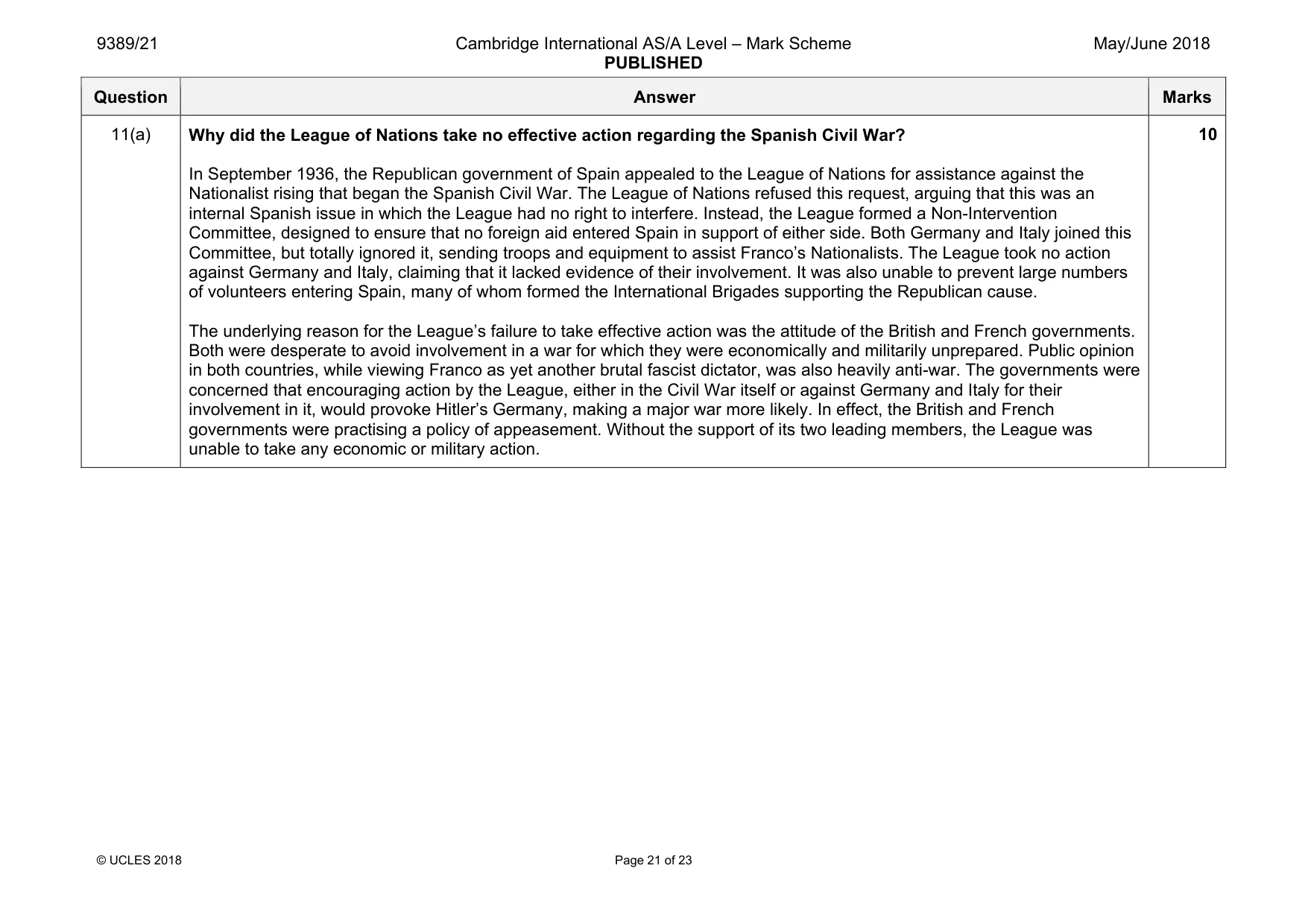
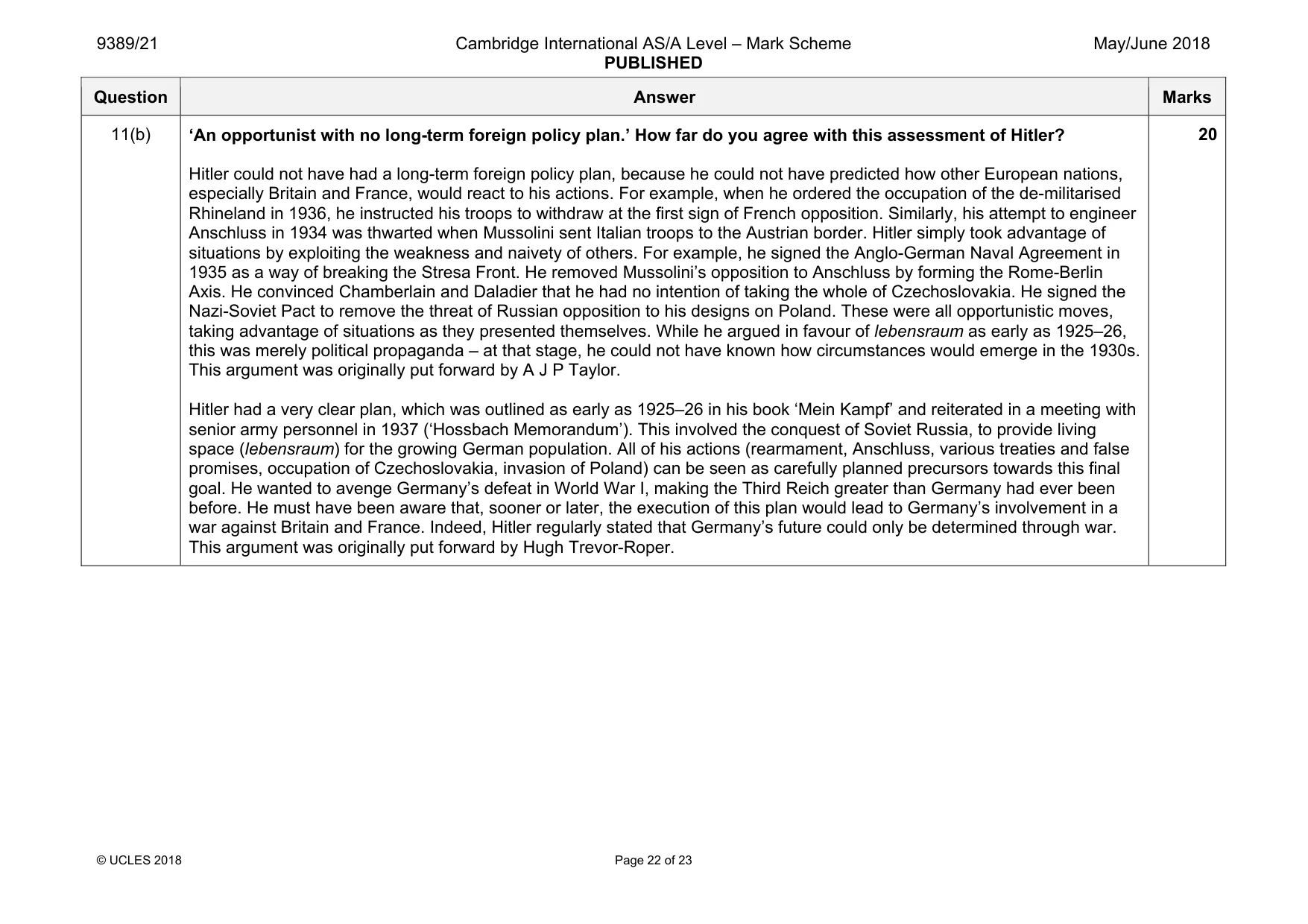
11 International Relations, 1933–1939 (a) Why did the League of Nations take no effective action regarding the Spanish Civil War? [10] (b) ‘An opportunist with no long-term foreign policy plan.’ How far do you agree with this assessment of Hitler? [20]
Mark scheme: 11(a) Why did the League of Nations take no effective action regarding the Spanish Civil War? In September 1936, the Republican government of Spain appealed to the League of Nations for assistance against the Nationalist rising that began the Spanish Civil War. The League of Nations refused this request, arguing that this was an internal Spanish issue in which the League had no right to interfere. Instead, the League formed a Non-Intervention Committee, designed to ensure that no foreign aid entered Spain in support of either side. Both Germany and Italy joined this Committee, but totally ignored it, sending troops and equipment to assist Franco’s Nationalists. The League took no action against Germany and Italy, claiming that it lacked evidence of their involvement. It was also unable to prevent large numbers of volunteers entering Spain, many of whom formed the International Brigades supporting the Republican cause. The underlying reason for the League’s failure to take effective action was the attitude of the British and French governments. Both were desperate to avoid involvement in a war for which they were economically and militarily unprepared. Public opinion in both countries, while viewing Franco as yet another brutal fascist dictator, was also heavily anti-war. The governments were concerned that encouraging action by the League, either in the Civil War itself or against Germany and Italy for their involvement in it, would provoke Hitler’s Germany, making a major war more likely. In effect, the British and French governments were practising a policy of appeasement. Without the support of its two leading members, the League was unable to take any economic or military action. 10 Question Answer Marks 11(b) ‘An opportunist with no long-term foreign policy plan.’ How far do you agree with this assessment of Hitler? Hitler could not have had a long-term foreign policy plan, because he could not have predicted how other European nations, especially Britain and France, would react to his actions. For example, when he ordered the occupation of the de-militarised Rhineland in 1936, he instructed his troops to withdraw at the first sign of French opposition. Similarly, his attempt to engineer Anschluss in 1934 was thwarted when Mussolini sent Italian troops to the Austrian border. Hitler simply took advantage of situations by exploiting the weakness and naivety of others. For example, he signed the Anglo-German Naval Agreement in 1935 as a way of breaking the Stresa Front. He removed Mussolini’s opposition to Anschluss by forming the Rome-Berlin Axis. He convinced Chamberlain and Daladier that he had no intention of taking the whole of Czechoslovakia. He signed the Nazi-Soviet Pact to remove the threat of Russian opposition to his designs on Poland. These were all opportunistic moves, taking advantage of situations as they presented themselves. While he argued in favour of lebensraum as early as 1925–26, this was merely political propaganda – at that stage, he could not have known how circumstances would emerge in the 1930s. This argument was originally put forward by A J P Taylor. Hitler had a very clear plan, which was outlined as early as 1925–26 in his book ‘Mein Kampf’ and reiterated in a meeting with senior army personnel in 1937 (‘Hossbach Memorandum’). This involved the conquest of Soviet Russia, to provide living space (lebensraum) for the growing German population. All of his actions (rearmament, Anschluss, various treaties and false promises, occupation of Czechoslovakia, invasion of Poland) can be seen as carefully planned precursors towards this final goal. He wanted to avenge Germany’s defeat in World War I, making the Third Reich greater than Germany had ever been before. He must have been aware that, sooner or later, the execution of this plan would lead to Germany’s involvement in a war against Britain and France. Indeed, Hitler regularly stated that Germany’s future could only be determined through war. This argument was originally put forward by Hugh Trevor-Roper. 20
Q12 · China and Japan, 1919–1945 (a) Why, in 1927, did Chiang Kai-shek turn against the…
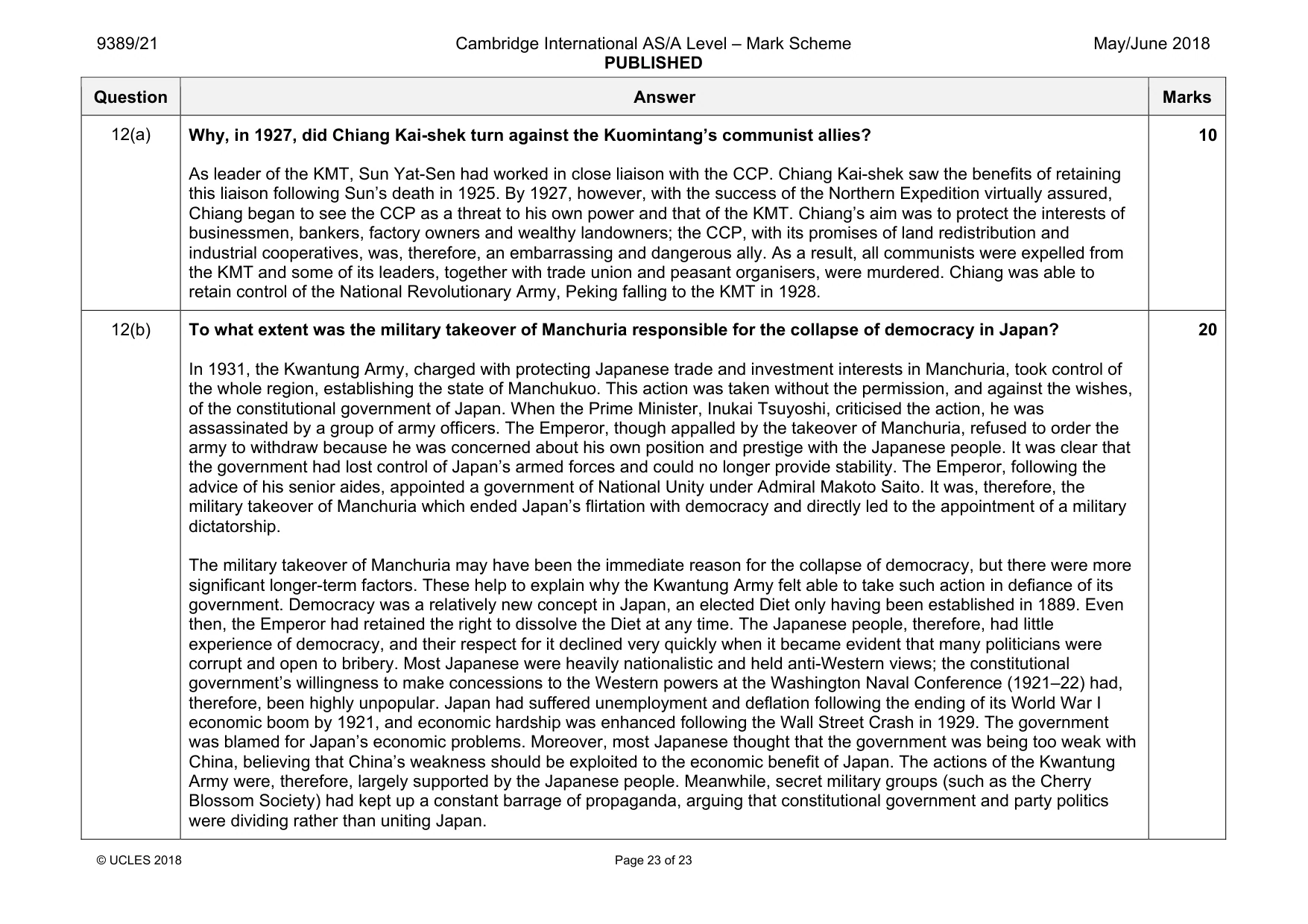
12 China and Japan, 1919–1945 (a) Why, in 1927, did Chiang Kai-shek turn against the Kuomintang’s communist allies? [10] (b) To what extent was the military takeover of Manchuria responsible for the collapse of democracy in Japan? [20]
Mark scheme: 12(a) Why, in 1927, did Chiang Kai-shek turn against the Kuomintang’s communist allies? As leader of the KMT, Sun Yat-Sen had worked in close liaison with the CCP. Chiang Kai-shek saw the benefits of retaining this liaison following Sun’s death in 1925. By 1927, however, with the success of the Northern Expedition virtually assured, Chiang began to see the CCP as a threat to his own power and that of the KMT. Chiang’s aim was to protect the interests of businessmen, bankers, factory owners and wealthy landowners; the CCP, with its promises of land redistribution and industrial cooperatives, was, therefore, an embarrassing and dangerous ally. As a result, all communists were expelled from the KMT and some of its leaders, together with trade union and peasant organisers, were murdered. Chiang was able to retain control of the National Revolutionary Army, Peking falling to the KMT in 1928. 10 12(b) To what extent was the military takeover of Manchuria responsible for the collapse of democracy in Japan? In 1931, the Kwantung Army, charged with protecting Japanese trade and investment interests in Manchuria, took control of the whole region, establishing the state of Manchukuo. This action was taken without the permission, and against the wishes, of the constitutional government of Japan. When the Prime Minister, Inukai Tsuyoshi, criticised the action, he was assassinated by a group of army officers. The Emperor, though appalled by the takeover of Manchuria, refused to order the army to withdraw because he was concerned about his own position and prestige with the Japanese people. It was clear that the government had lost control of Japan’s armed forces and could no longer provide stability. The Emperor, following the advice of his senior aides, appointed a government of National Unity under Admiral Makoto Saito. It was, therefore, the military takeover of Manchuria which ended Japan’s flirtation with democracy and directly led to the appointment of a military dictatorship. The military takeover of Manchuria may have been the immediate reason for the collapse of democracy, but there were more significant longer-term factors. These help to explain why the Kwantung Army felt able to take such action in defiance of its government. Democracy was a relatively new concept in Japan, an elected Diet only having been established in 1889. Even then, the Emperor had retained the right to dissolve the Diet at any time. The Japanese people, therefore, had little experience of democracy, and their respect for it declined very quickly when it became evident that many politicians were corrupt and open to bribery. Most Japanese were heavily nationalistic and held anti-Western views; the constitutional government’s willingness to make concessions to the Western powers at the Washington Naval Conference (1921–22) had, therefore, been highly unpopular. Japan had suffered unemployment and deflation following the ending of its World War I economic boom by 1921, and economic hardship was enhanced following the Wall Street Crash in 1929. The government was blamed for Japan’s economic problems. Moreover, most Japanese thought that the government was being too weak with China, believing that China’s weakness should be exploited to the economic benefit of Japan. The actions of the Kwantung Army were, therefore, largely supported by the Japanese people. Meanwhile, secret military groups (such as the Cherry Blossom Society) had kept up a constant barrage of propaganda, arguing that constitutional government and party politics were dividing rather than uniting Japan. 20
What you needed in this session
Cambridge’s own grade thresholds for 2018 May/June, Paper 2 · Variant 1. A higher threshold means an easier paper — the bar moves with how the cohort did.