Cambridge A Level History 9389 — 2018 May/June Paper 2 · Variant 3
9389/23/M/J/18 · 12 questions · 60 marks · ≈68 min
The question paper and its mark scheme, free to read here and free to download. This is Cambridge’s own paper, exactly as it was sat.
Question paper4 pages
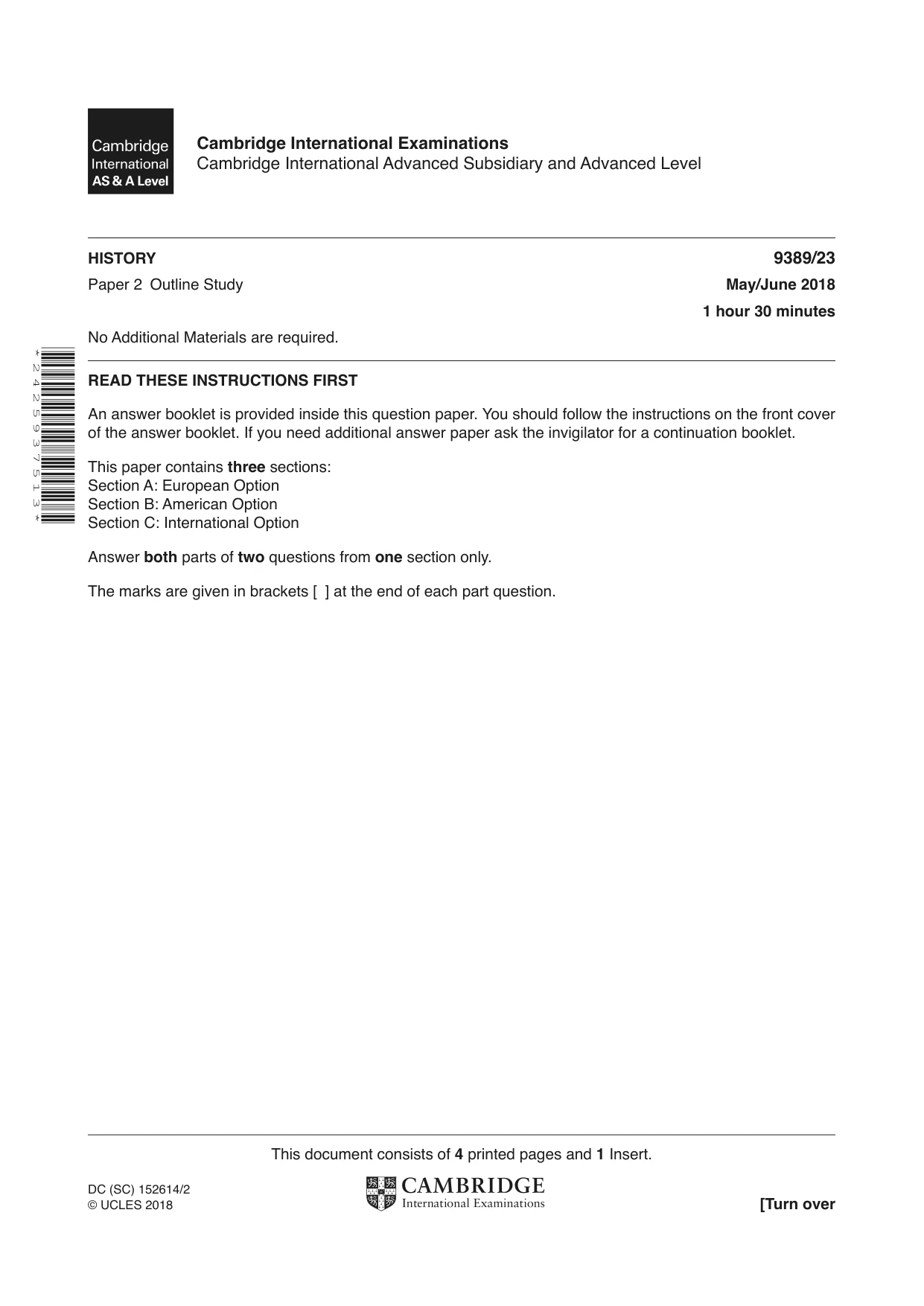
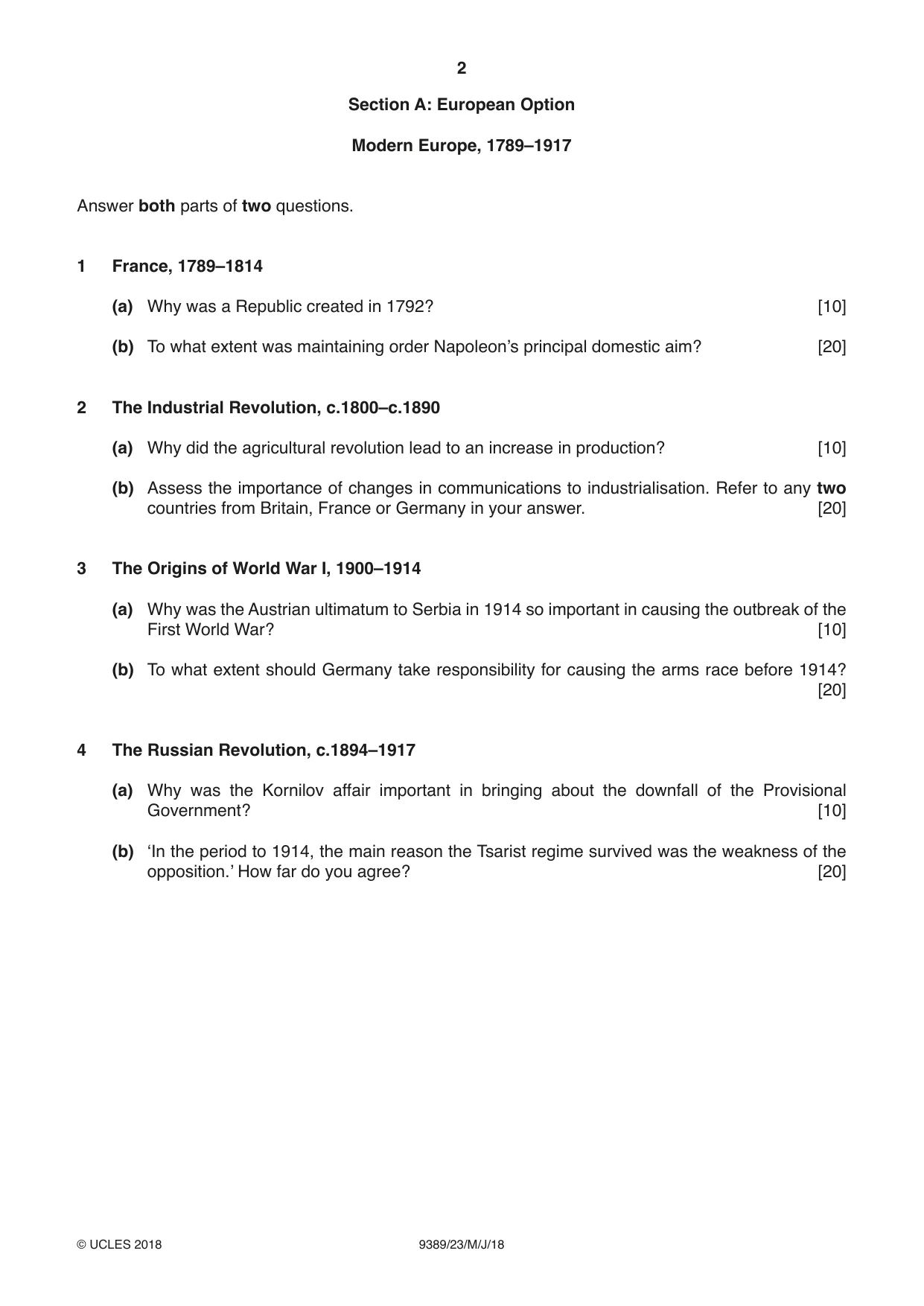
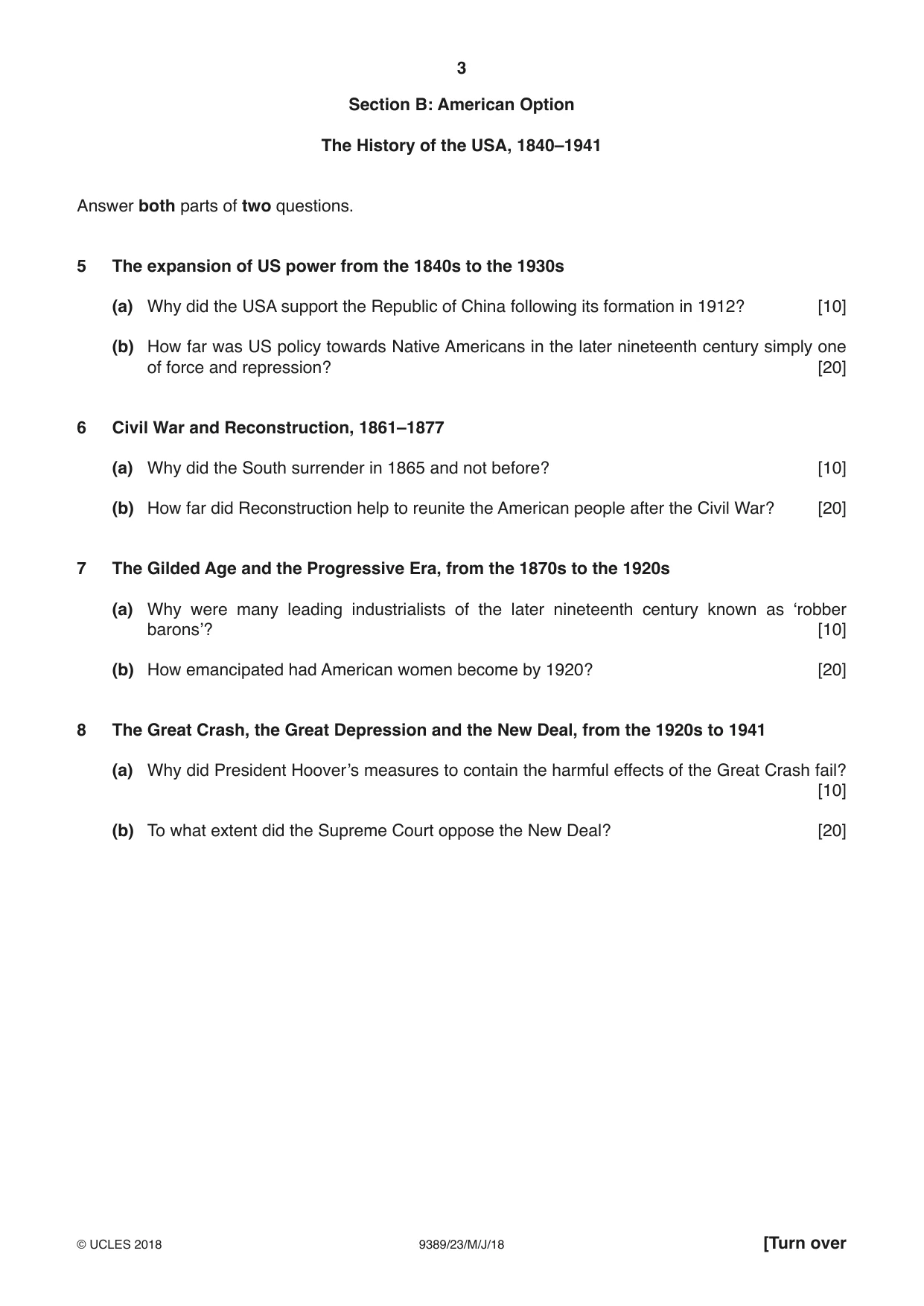
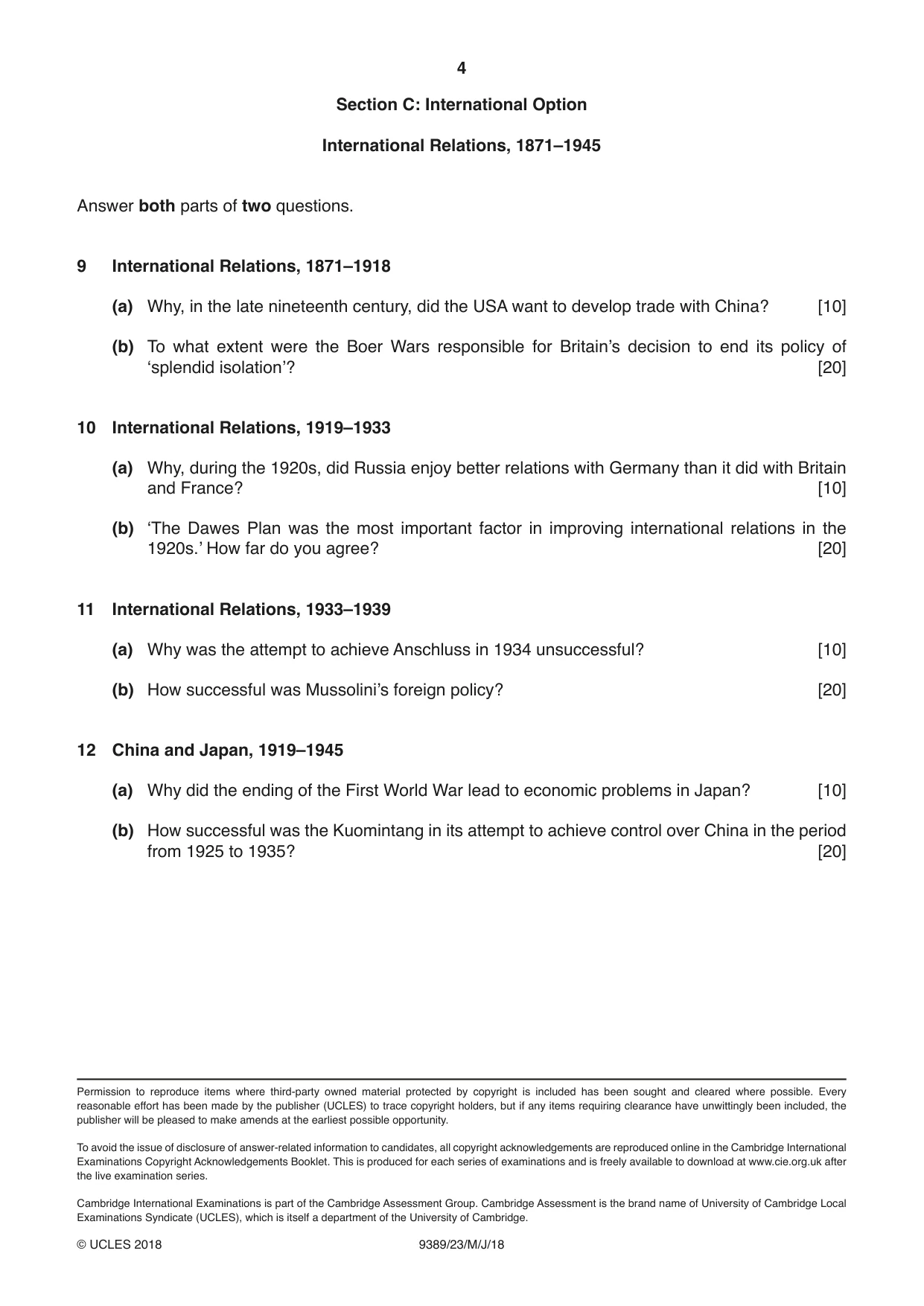
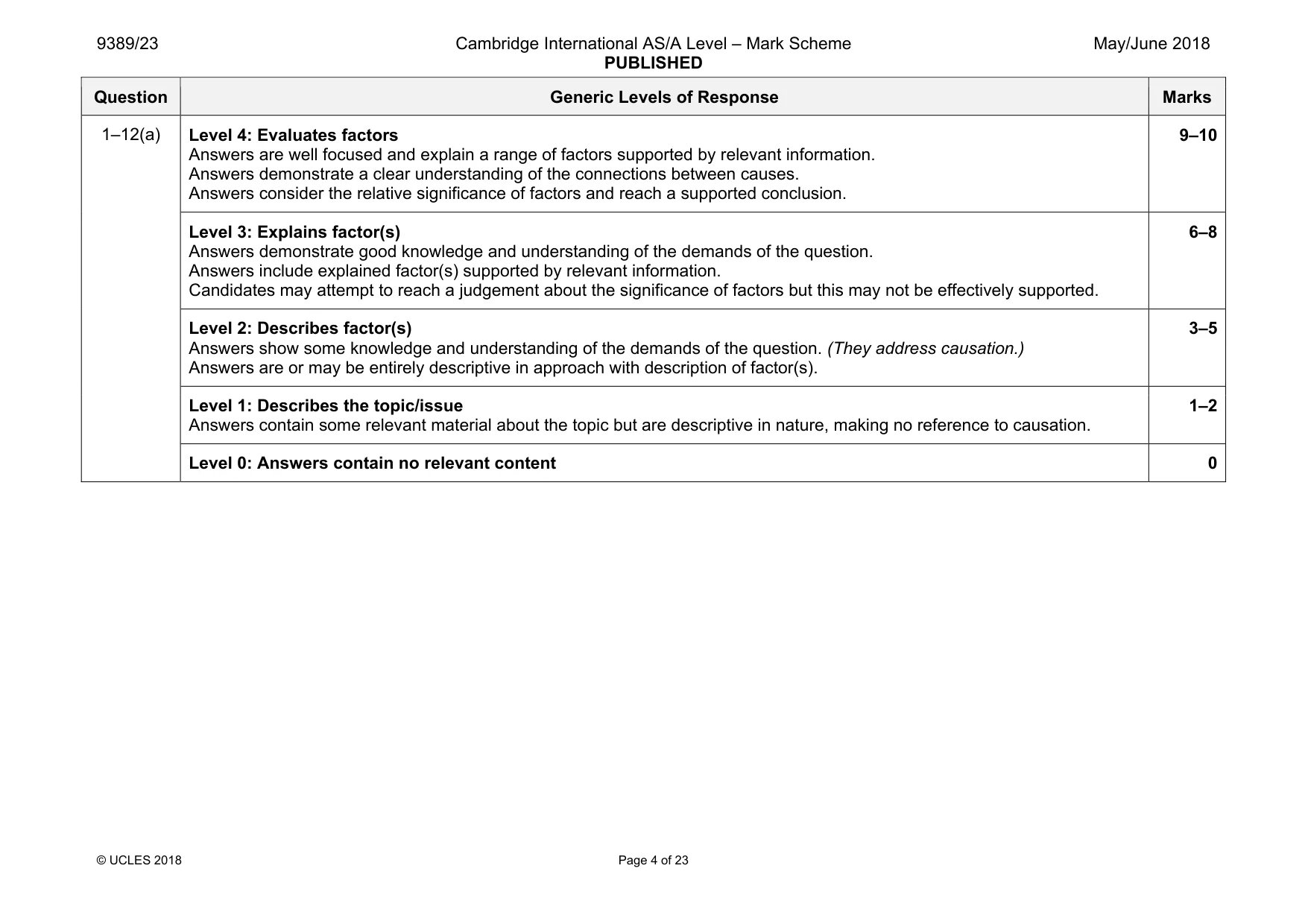
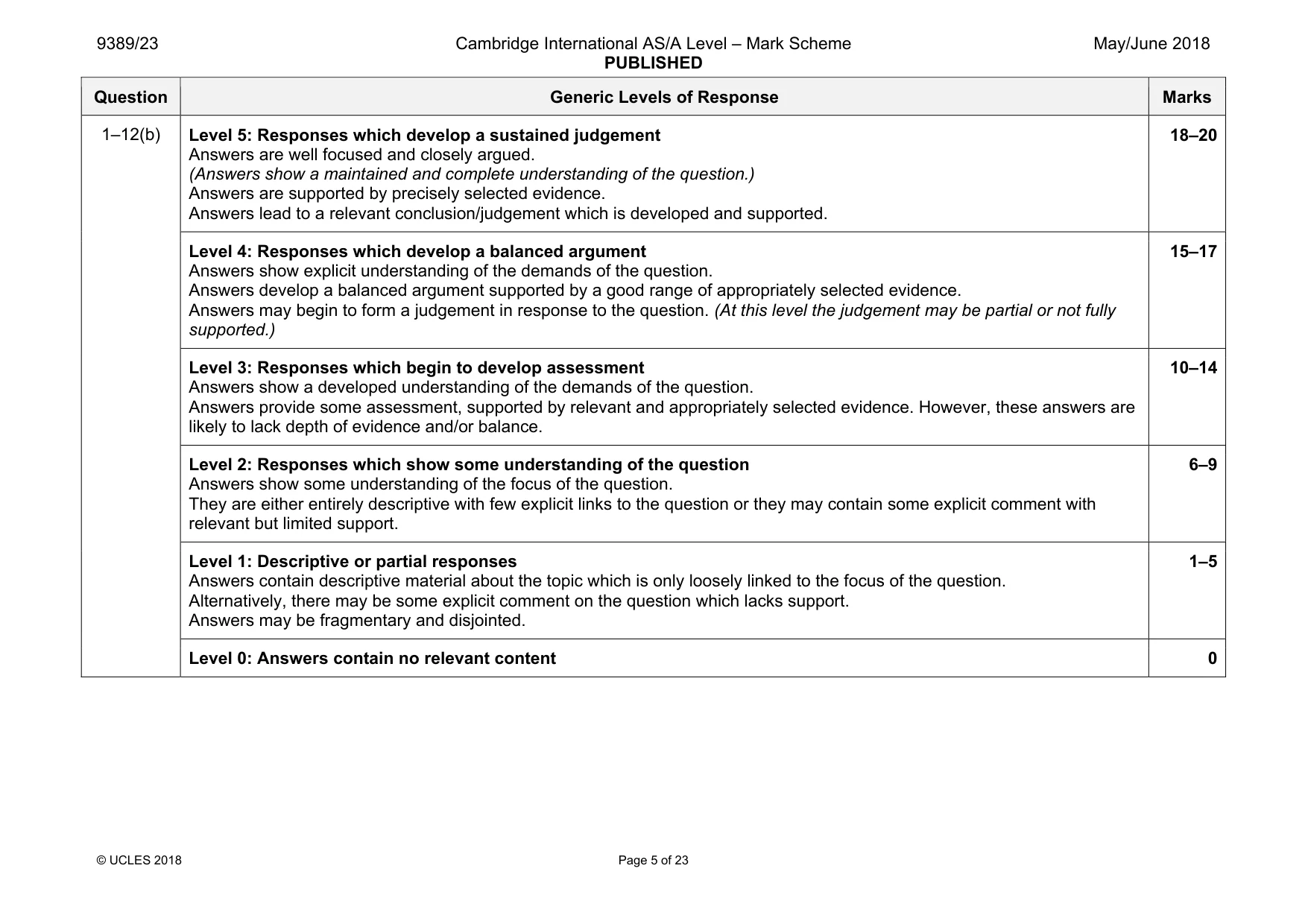
Mark scheme23 pages
Answers below. Sit the paper first if you are practising.

Questions as text
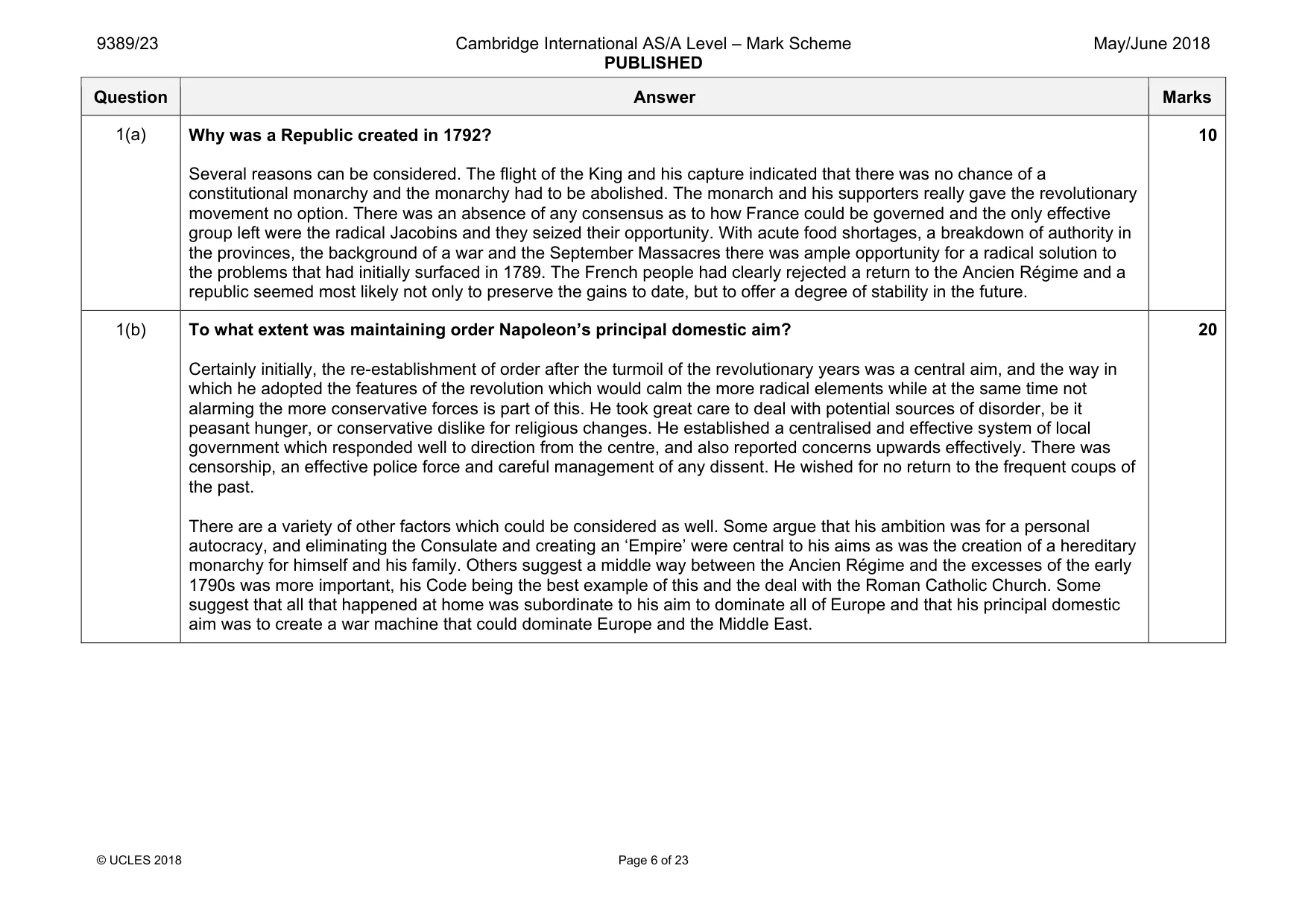
Q1 · France, 1789–1814 (a) Why was a Republic created in 1792?
1 France, 1789–1814 (a) Why was a Republic created in 1792? [10] (b) To what extent was maintaining order Napoleon’s principal domestic aim? [20]
Mark scheme: 1(a) Why was a Republic created in 1792? Several reasons can be considered. The flight of the King and his capture indicated that there was no chance of a constitutional monarchy and the monarchy had to be abolished. The monarch and his supporters really gave the revolutionary movement no option. There was an absence of any consensus as to how France could be governed and the only effective group left were the radical Jacobins and they seized their opportunity. With acute food shortages, a breakdown of authority in the provinces, the background of a war and the September Massacres there was ample opportunity for a radical solution to the problems that had initially surfaced in 1789. The French people had clearly rejected a return to the Ancien Régime and a republic seemed most likely not only to preserve the gains to date, but to offer a degree of stability in the future. 10 1(b) To what extent was maintaining order Napoleon’s principal domestic aim? Certainly initially, the re-establishment of order after the turmoil of the revolutionary years was a central aim, and the way in which he adopted the features of the revolution which would calm the more radical elements while at the same time not alarming the more conservative forces is part of this. He took great care to deal with potential sources of disorder, be it peasant hunger, or conservative dislike for religious changes. He established a centralised and effective system of local government which responded well to direction from the centre, and also reported concerns upwards effectively. There was censorship, an effective police force and careful management of any dissent. He wished for no return to the frequent coups of the past. There are a variety of other factors which could be considered as well. Some argue that his ambition was for a personal autocracy, and eliminating the Consulate and creating an ‘Empire’ were central to his aims as was the creation of a hereditary monarchy for himself and his family. Others suggest a middle way between the Ancien Régime and the excesses of the early 1790s was more important, his Code being the best example of this and the deal with the Roman Catholic Church. Some suggest that all that happened at home was subordinate to his aim to dominate all of Europe and that his principal domestic aim was to create a war machine that could dominate Europe and the Middle East. 20
Q2 · The Industrial Revolution, c.1800–c.1890 (a) Why did the agricultural revolution lead to…
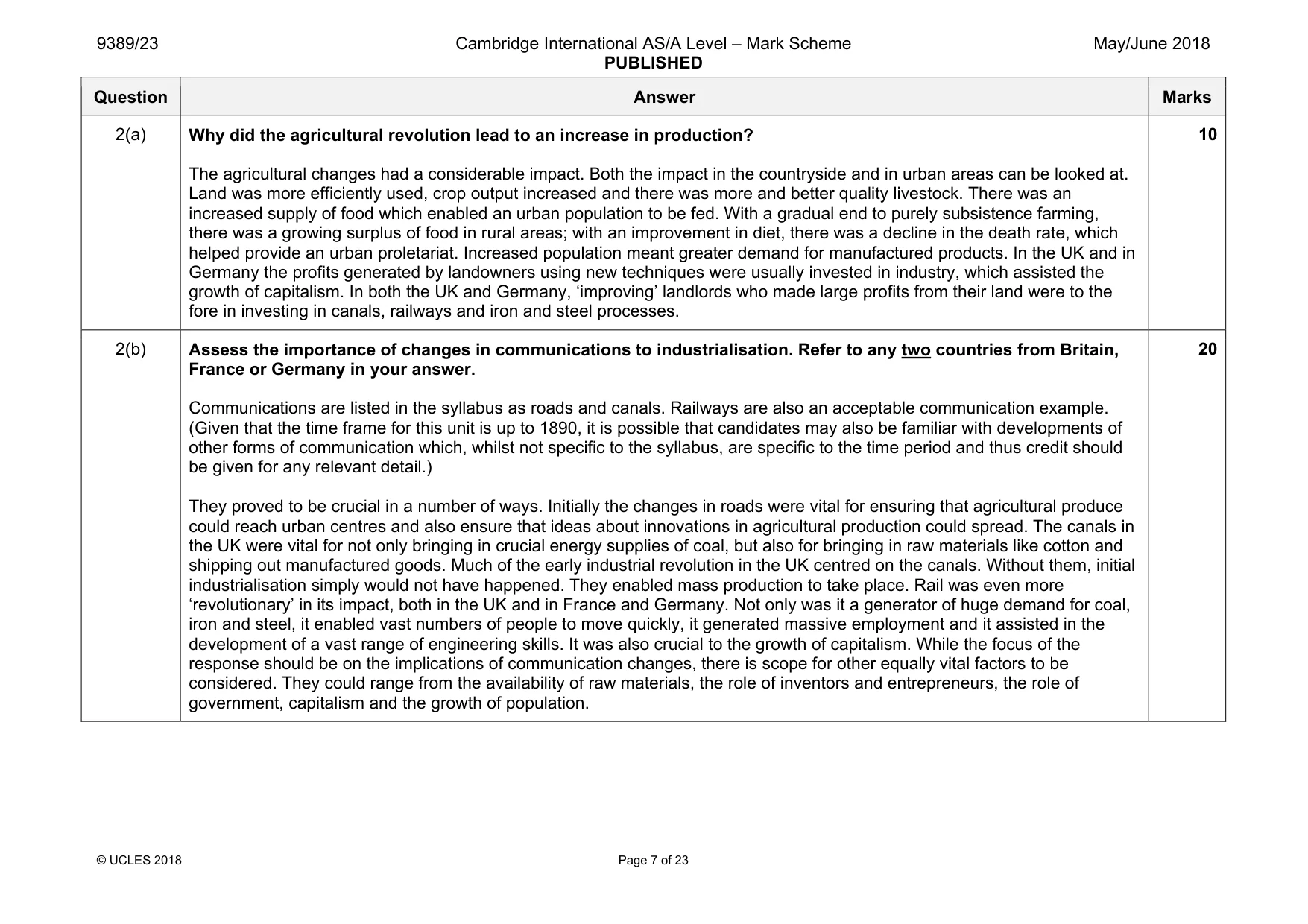
2 The Industrial Revolution, c.1800–c.1890 (a) Why did the agricultural revolution lead to an increase in production? [10] (b) Assess the importance of changes in communications to industrialisation. Refer to any two countries from Britain, France or Germany in your answer. [20]
Mark scheme: 2(a) Why did the agricultural revolution lead to an increase in production? The agricultural changes had a considerable impact. Both the impact in the countryside and in urban areas can be looked at. Land was more efficiently used, crop output increased and there was more and better quality livestock. There was an increased supply of food which enabled an urban population to be fed. With a gradual end to purely subsistence farming, there was a growing surplus of food in rural areas; with an improvement in diet, there was a decline in the death rate, which helped provide an urban proletariat. Increased population meant greater demand for manufactured products. In the UK and in Germany the profits generated by landowners using new techniques were usually invested in industry, which assisted the growth of capitalism. In both the UK and Germany, ‘improving’ landlords who made large profits from their land were to the fore in investing in canals, railways and iron and steel processes. 10 2(b) Assess the importance of changes in communications to industrialisation. Refer to any two countries from Britain, France or Germany in your answer. Communications are listed in the syllabus as roads and canals. Railways are also an acceptable communication example. (Given that the time frame for this unit is up to 1890, it is possible that candidates may also be familiar with developments of other forms of communication which, whilst not specific to the syllabus, are specific to the time period and thus credit should be given for any relevant detail.) They proved to be crucial in a number of ways. Initially the changes in roads were vital for ensuring that agricultural produce could reach urban centres and also ensure that ideas about innovations in agricultural production could spread. The canals in the UK were vital for not only bringing in crucial energy supplies of coal, but also for bringing in raw materials like cotton and shipping out manufactured goods. Much of the early industrial revolution in the UK centred on the canals. Without them, initial industrialisation simply would not have happened. They enabled mass production to take place. Rail was even more ‘revolutionary’ in its impact, both in the UK and in France and Germany. Not only was it a generator of huge demand for coal, iron and steel, it enabled vast numbers of people to move quickly, it generated massive employment and it assisted in the development of a vast range of engineering skills. It was also crucial to the growth of capitalism. While the focus of the response should be on the implications of communication changes, there is scope for other equally vital factors to be considered. They could range from the availability of raw materials, the role of inventors and entrepreneurs, the role of government, capitalism and the growth of population. 20
Q3 · The Origins of World War I, 1900–1914 (a) Why was the Austrian ultimatum to Serbia in…
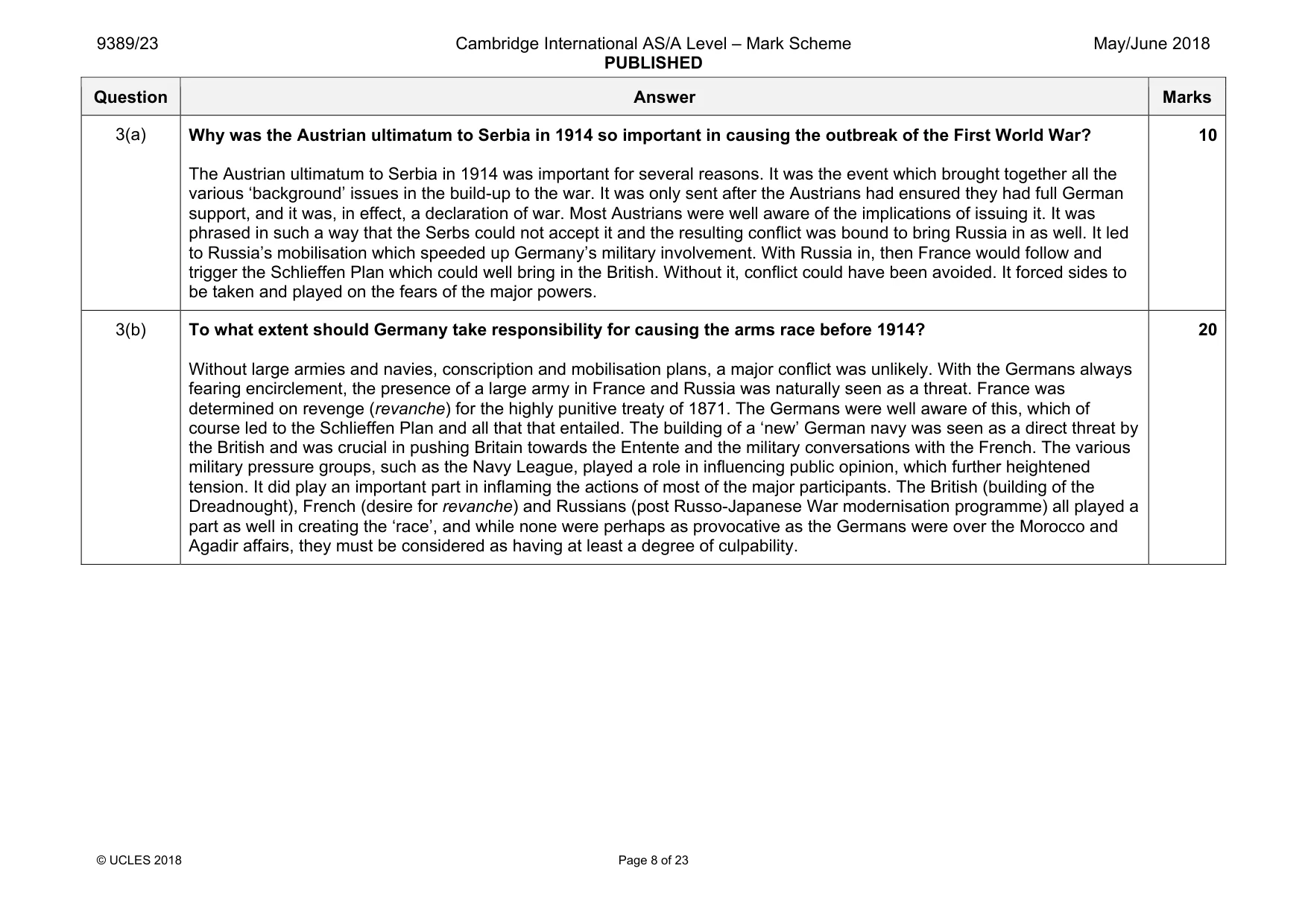
3 The Origins of World War I, 1900–1914 (a) Why was the Austrian ultimatum to Serbia in 1914 so important in causing the outbreak of the First World War? [10] (b) To what extent should Germany take responsibility for causing the arms race before 1914? [20]
Mark scheme: 3(a) Why was the Austrian ultimatum to Serbia in 1914 so important in causing the outbreak of the First World War? The Austrian ultimatum to Serbia in 1914 was important for several reasons. It was the event which brought together all the various ‘background’ issues in the build-up to the war. It was only sent after the Austrians had ensured they had full German support, and it was, in effect, a declaration of war. Most Austrians were well aware of the implications of issuing it. It was phrased in such a way that the Serbs could not accept it and the resulting conflict was bound to bring Russia in as well. It led to Russia’s mobilisation which speeded up Germany’s military involvement. With Russia in, then France would follow and trigger the Schlieffen Plan which could well bring in the British. Without it, conflict could have been avoided. It forced sides to be taken and played on the fears of the major powers. 10 3(b) To what extent should Germany take responsibility for causing the arms race before 1914? Without large armies and navies, conscription and mobilisation plans, a major conflict was unlikely. With the Germans always fearing encirclement, the presence of a large army in France and Russia was naturally seen as a threat. France was determined on revenge (revanche) for the highly punitive treaty of 1871. The Germans were well aware of this, which of course led to the Schlieffen Plan and all that that entailed. The building of a ‘new’ German navy was seen as a direct threat by the British and was crucial in pushing Britain towards the Entente and the military conversations with the French. The various military pressure groups, such as the Navy League, played a role in influencing public opinion, which further heightened tension. It did play an important part in inflaming the actions of most of the major participants. The British (building of the Dreadnought), French (desire for revanche) and Russians (post Russo-Japanese War modernisation programme) all played a part as well in creating the ‘race’, and while none were perhaps as provocative as the Germans were over the Morocco and Agadir affairs, they must be considered as having at least a degree of culpability. 20
Q4 · The Russian Revolution, c.1894–1917 (a) Why was the Kornilov affair important in bringing…
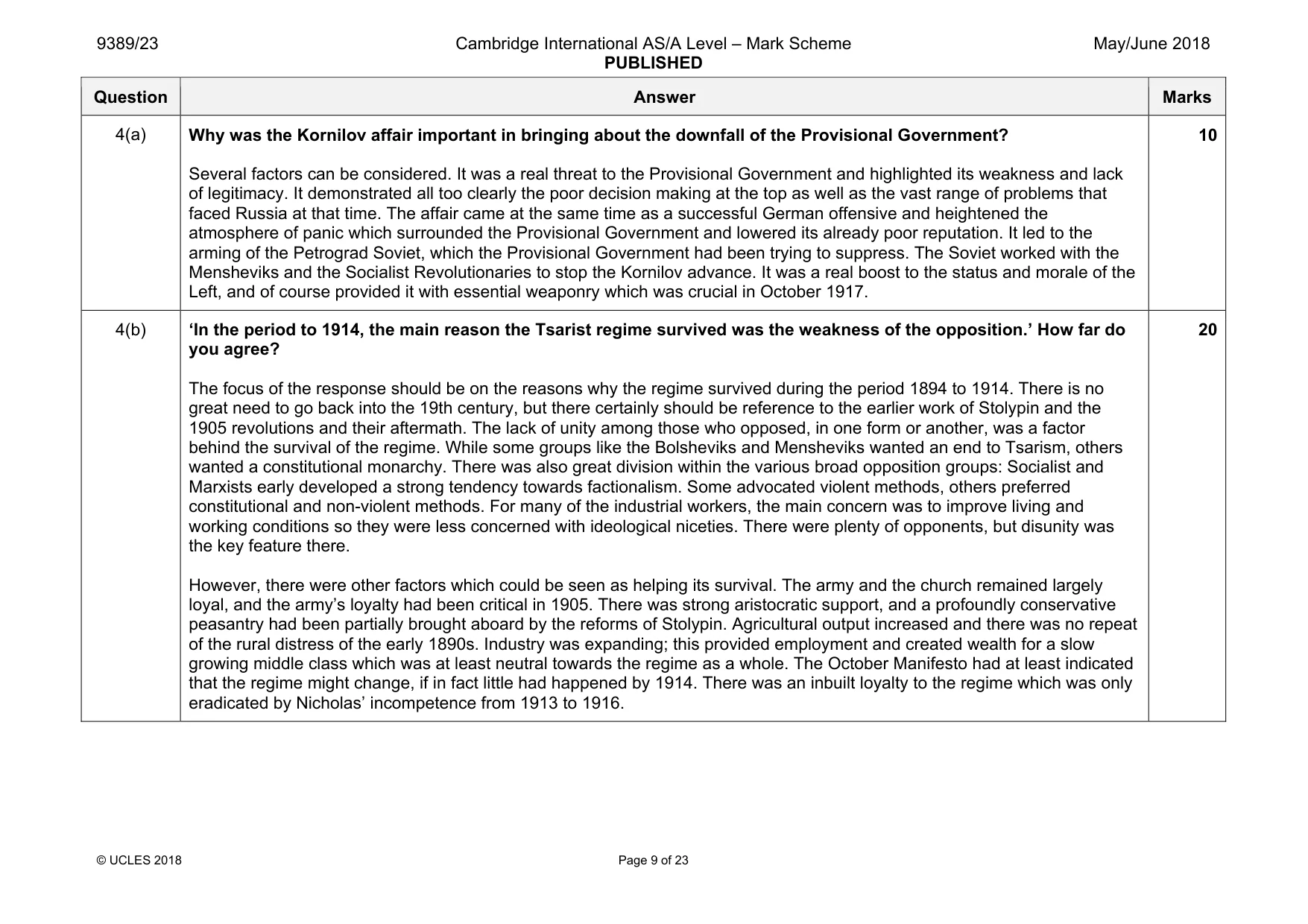
4 The Russian Revolution, c.1894–1917 (a) Why was the Kornilov affair important in bringing about the downfall of the Provisional Government? [10] (b) ‘In the period to 1914, the main reason the Tsarist regime survived was the weakness of the opposition.’ How far do you agree? [20]
Mark scheme: 4(a) Why was the Kornilov affair important in bringing about the downfall of the Provisional Government? Several factors can be considered. It was a real threat to the Provisional Government and highlighted its weakness and lack of legitimacy. It demonstrated all too clearly the poor decision making at the top as well as the vast range of problems that faced Russia at that time. The affair came at the same time as a successful German offensive and heightened the atmosphere of panic which surrounded the Provisional Government and lowered its already poor reputation. It led to the arming of the Petrograd Soviet, which the Provisional Government had been trying to suppress. The Soviet worked with the Mensheviks and the Socialist Revolutionaries to stop the Kornilov advance. It was a real boost to the status and morale of the Left, and of course provided it with essential weaponry which was crucial in October 1917. 10 4(b) ‘In the period to 1914, the main reason the Tsarist regime survived was the weakness of the opposition.’ How far do you agree? The focus of the response should be on the reasons why the regime survived during the period 1894 to 1914. There is no great need to go back into the 19th century, but there certainly should be reference to the earlier work of Stolypin and the 1905 revolutions and their aftermath. The lack of unity among those who opposed, in one form or another, was a factor behind the survival of the regime. While some groups like the Bolsheviks and Mensheviks wanted an end to Tsarism, others wanted a constitutional monarchy. There was also great division within the various broad opposition groups: Socialist and Marxists early developed a strong tendency towards factionalism. Some advocated violent methods, others preferred constitutional and non-violent methods. For many of the industrial workers, the main concern was to improve living and working conditions so they were less concerned with ideological niceties. There were plenty of opponents, but disunity was the key feature there. However, there were other factors which could be seen as helping its survival. The army and the church remained largely loyal, and the army’s loyalty had been critical in 1905. There was strong aristocratic support, and a profoundly conservative peasantry had been partially brought aboard by the reforms of Stolypin. Agricultural output increased and there was no repeat of the rural distress of the early 1890s. Industry was expanding; this provided employment and created wealth for a slow growing middle class which was at least neutral towards the regime as a whole. The October Manifesto had at least indicated that the regime might change, if in fact little had happened by 1914. There was an inbuilt loyalty to the regime which was only eradicated by Nicholas’ incompetence from 1913 to 1916. 20
Q5 · The expansion of US power from the 1840s to the 1930s (a) Why did the USA support the…
5 The expansion of US power from the 1840s to the 1930s (a) Why did the USA support the Republic of China following its formation in 1912? [10] (b) How far was US policy towards Native Americans in the later nineteenth century simply one of force and repression? [20]
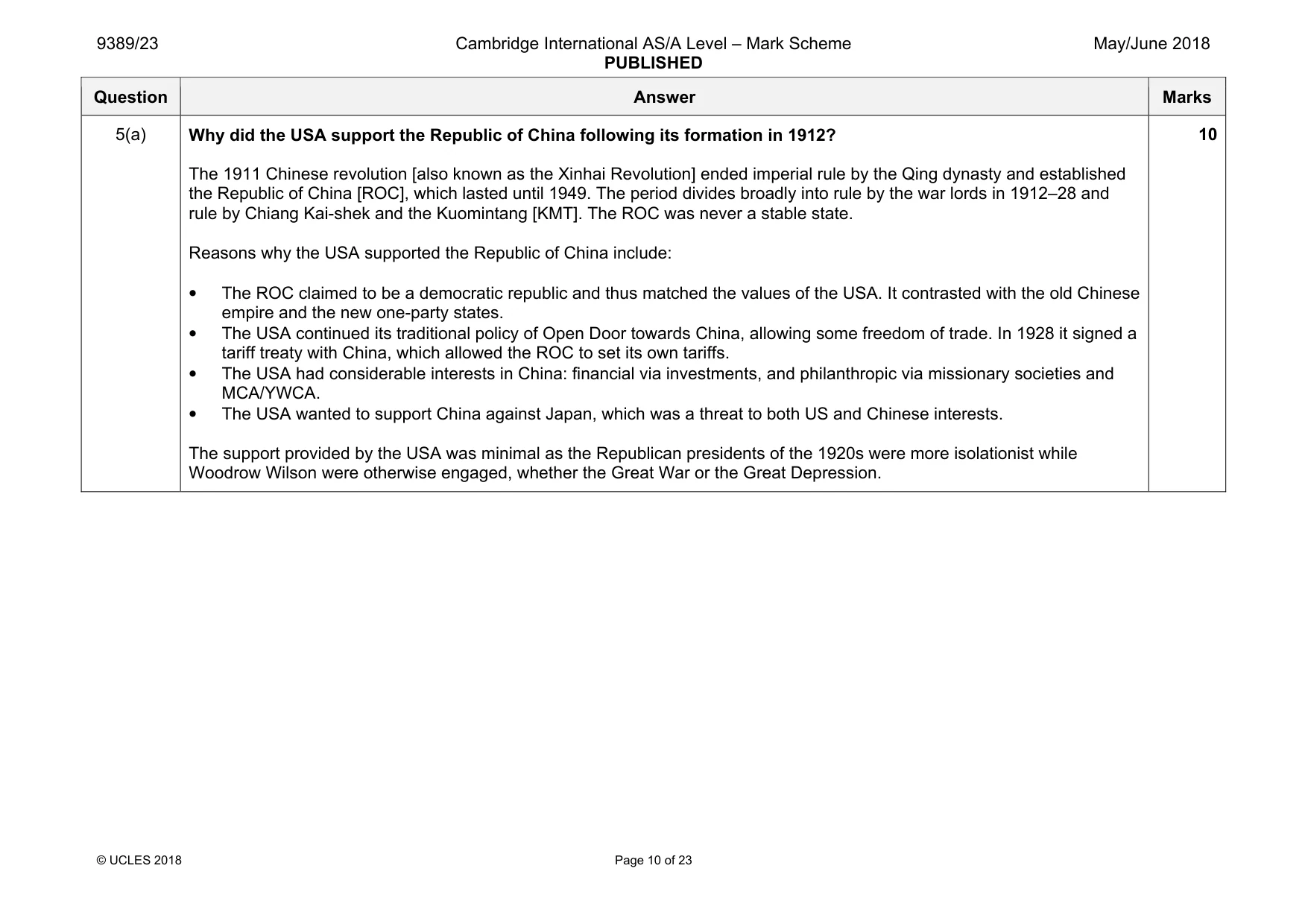
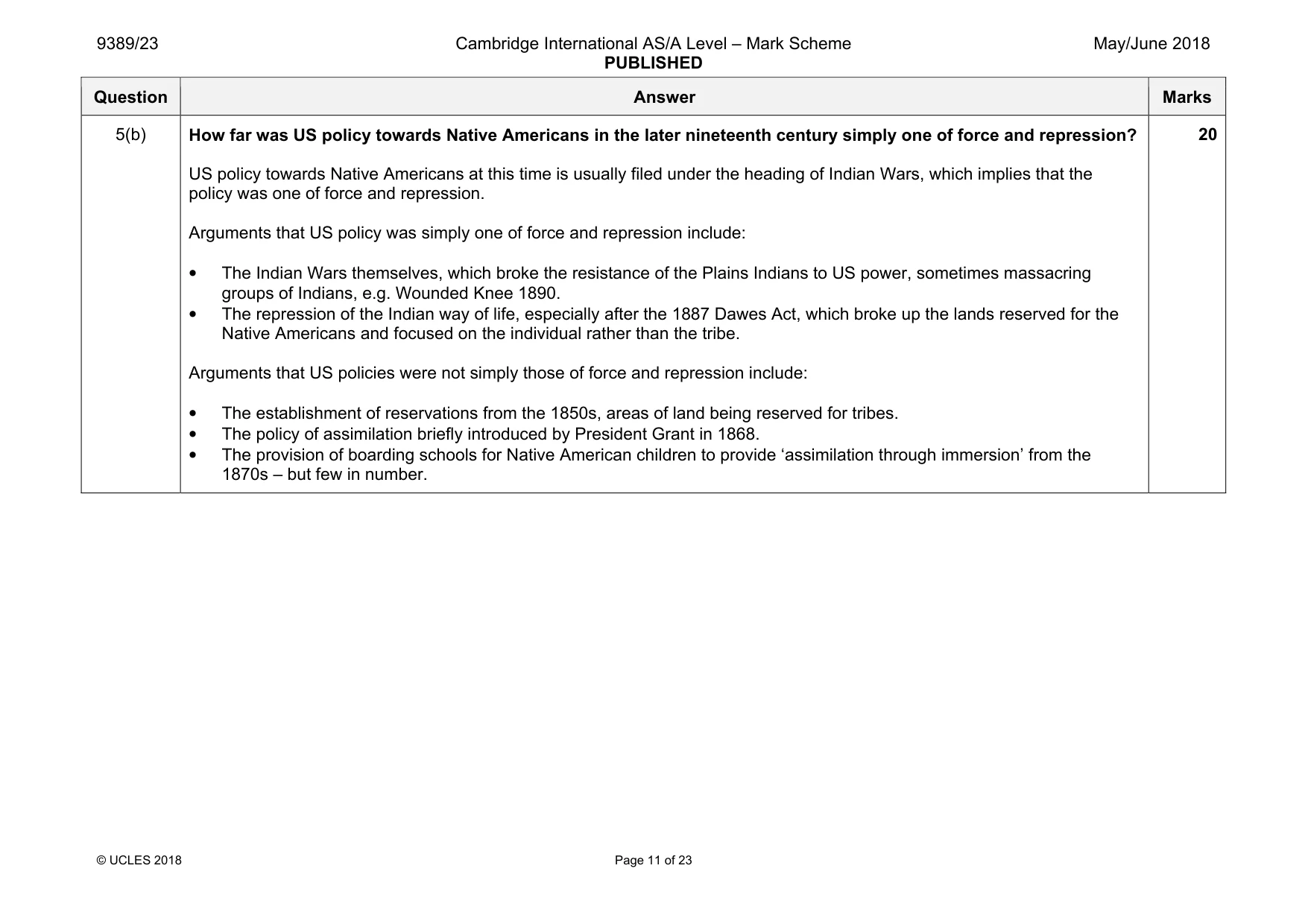
Mark scheme: 5(a) Why did the USA support the Republic of China following its formation in 1912? The 1911 Chinese revolution [also known as the Xinhai Revolution] ended imperial rule by the Qing dynasty and established the Republic of China [ROC], which lasted until 1949. The period divides broadly into rule by the war lords in 1912–28 and rule by Chiang Kai-shek and the Kuomintang [KMT]. The ROC was never a stable state. Reasons why the USA supported the Republic of China include: • The ROC claimed to be a democratic republic and thus matched the values of the USA. It contrasted with the old Chinese empire and the new one-party states. • The USA continued its traditional policy of Open Door towards China, allowing some freedom of trade. In 1928 it signed a tariff treaty with China, which allowed the ROC to set its own tariffs. • The USA had considerable interests in China: financial via investments, and philanthropic via missionary societies and MCA/YWCA. • The USA wanted to support China against Japan, which was a threat to both US and Chinese interests. The support provided by the USA was minimal as the Republican presidents of the 1920s were more isolationist while Woodrow Wilson were otherwise engaged, whether the Great War or the Great Depression. 10 Question Answer Marks 5(b) How far was US policy towards Native Americans in the later nineteenth century simply one of force and repression? US policy towards Native Americans at this time is usually filed under the heading of Indian Wars, which implies that the policy was one of force and repression. Arguments that US policy was simply one of force and repression include: • The Indian Wars themselves, which broke the resistance of the Plains Indians to US power, sometimes massacring groups of Indians, e.g. Wounded Knee 1890. • The repression of the Indian way of life, especially after the 1887 Dawes Act, which broke up the lands reserved for the Native Americans and focused on the individual rather than the tribe. Arguments that US policies were not simply those of force and repression include: • The establishment of reservations from the 1850s, areas of land being reserved for tribes. • The policy of assimilation briefly introduced by President Grant in 1868. • The provision of boarding schools for Native American children to provide ‘assimilation through immersion’ from the 1870s – but few in number. 20
Q6 · Civil War and Reconstruction, 1861–1877 (a) Why did the South surrender in 1865 and not…
6 Civil War and Reconstruction, 1861–1877 (a) Why did the South surrender in 1865 and not before? [10] (b) How far did Reconstruction help to reunite the American people after the Civil War? [20]
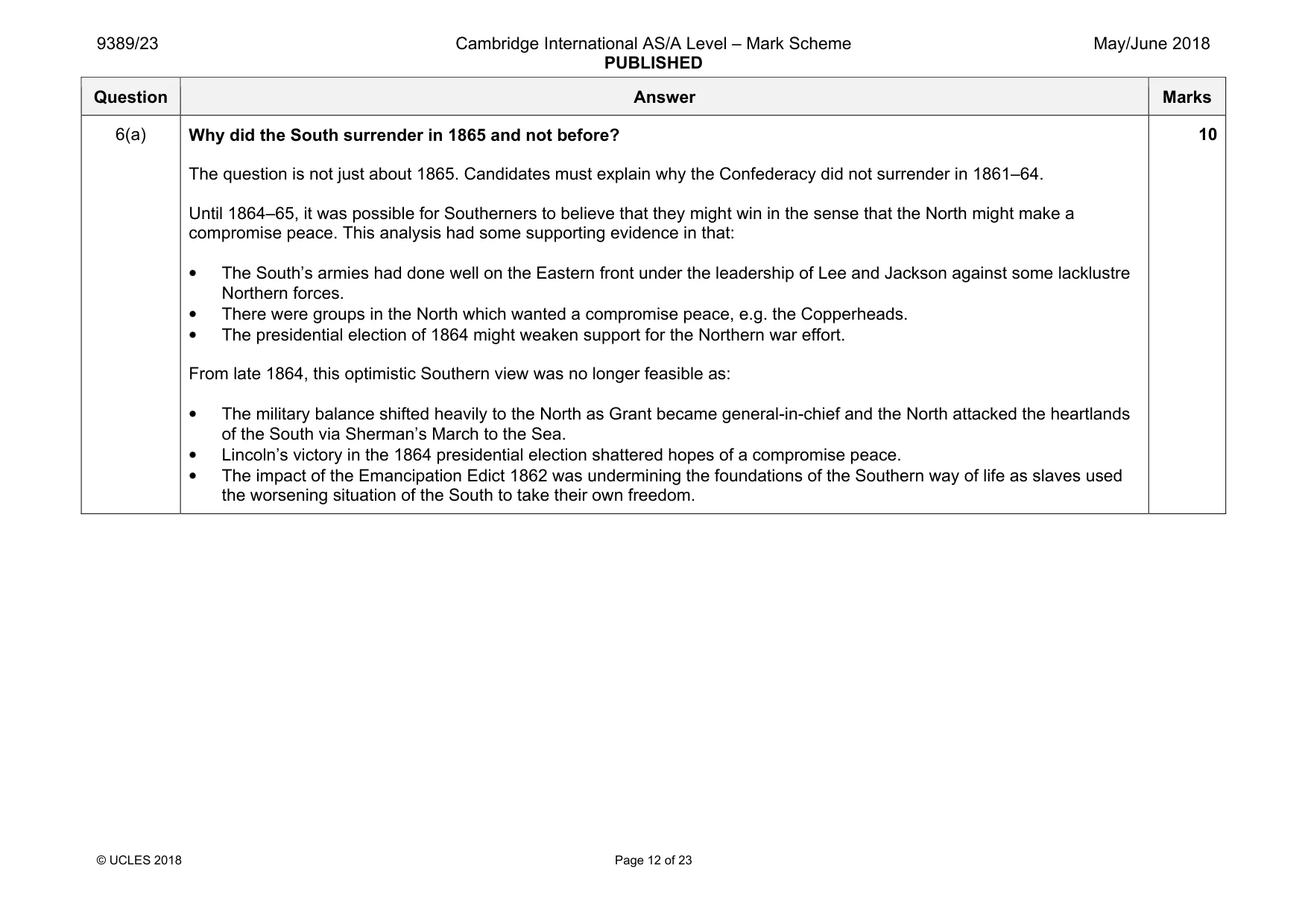
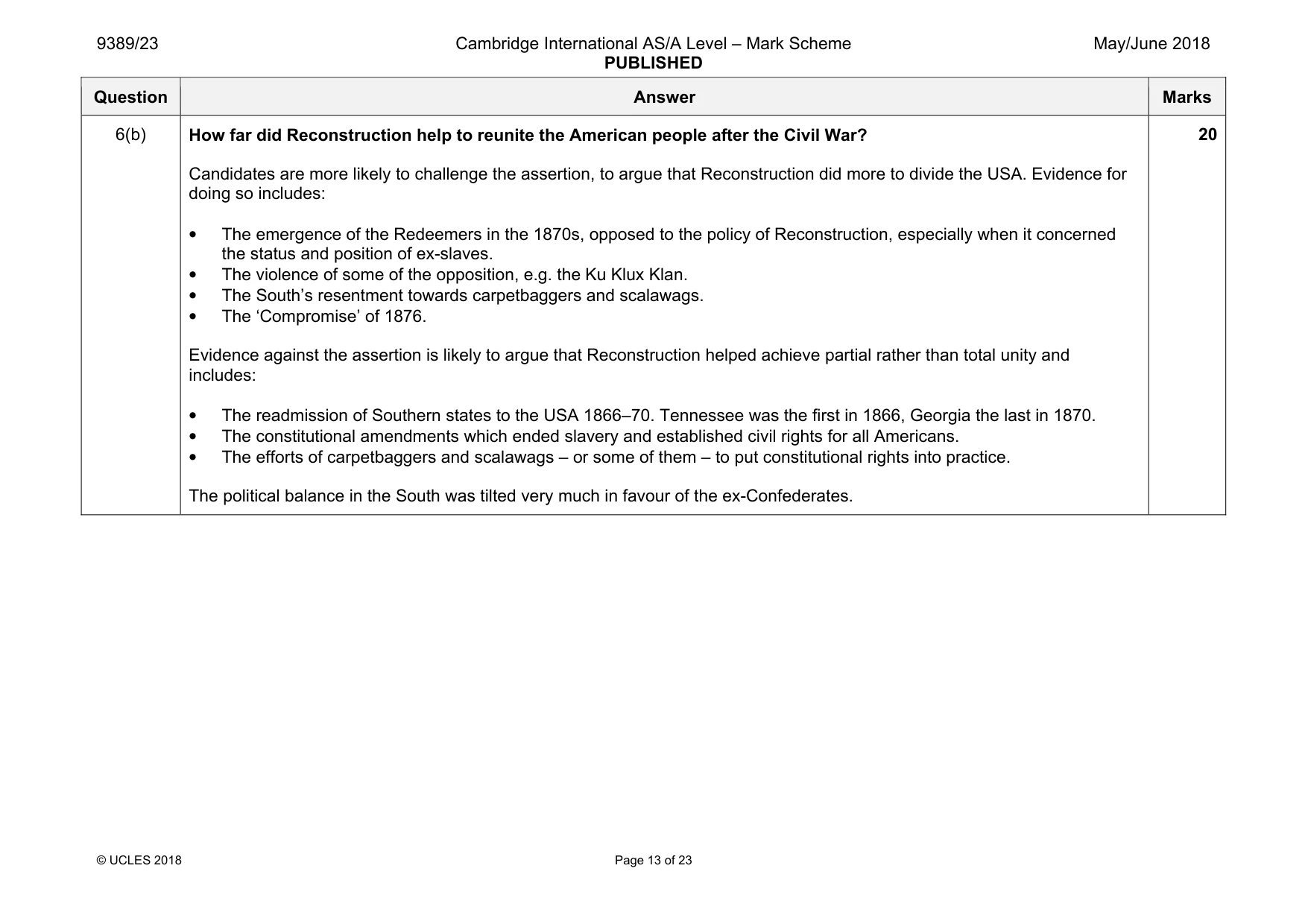
Mark scheme: 6(a) Why did the South surrender in 1865 and not before? The question is not just about 1865. Candidates must explain why the Confederacy did not surrender in 1861–64. Until 1864–65, it was possible for Southerners to believe that they might win in the sense that the North might make a compromise peace. This analysis had some supporting evidence in that: • The South’s armies had done well on the Eastern front under the leadership of Lee and Jackson against some lacklustre Northern forces. • There were groups in the North which wanted a compromise peace, e.g. the Copperheads. • The presidential election of 1864 might weaken support for the Northern war effort. From late 1864, this optimistic Southern view was no longer feasible as: • The military balance shifted heavily to the North as Grant became general-in-chief and the North attacked the heartlands of the South via Sherman’s March to the Sea. • Lincoln’s victory in the 1864 presidential election shattered hopes of a compromise peace. • The impact of the Emancipation Edict 1862 was undermining the foundations of the Southern way of life as slaves used the worsening situation of the South to take their own freedom. 10 Question Answer Marks 6(b) How far did Reconstruction help to reunite the American people after the Civil War? Candidates are more likely to challenge the assertion, to argue that Reconstruction did more to divide the USA. Evidence for doing so includes: • The emergence of the Redeemers in the 1870s, opposed to the policy of Reconstruction, especially when it concerned the status and position of ex-slaves. • The violence of some of the opposition, e.g. the Ku Klux Klan. • The South’s resentment towards carpetbaggers and scalawags. • The ‘Compromise’ of 1876. Evidence against the assertion is likely to argue that Reconstruction helped achieve partial rather than total unity and includes: • The readmission of Southern states to the USA 1866–70. Tennessee was the first in 1866, Georgia the last in 1870. • The constitutional amendments which ended slavery and established civil rights for all Americans. • The efforts of carpetbaggers and scalawags – or some of them – to put constitutional rights into practice. The political balance in the South was tilted very much in favour of the ex-Confederates. 20
Q7 · The Gilded Age and the Progressive Era, from the 1870s to the 1920s (a) Why were many…
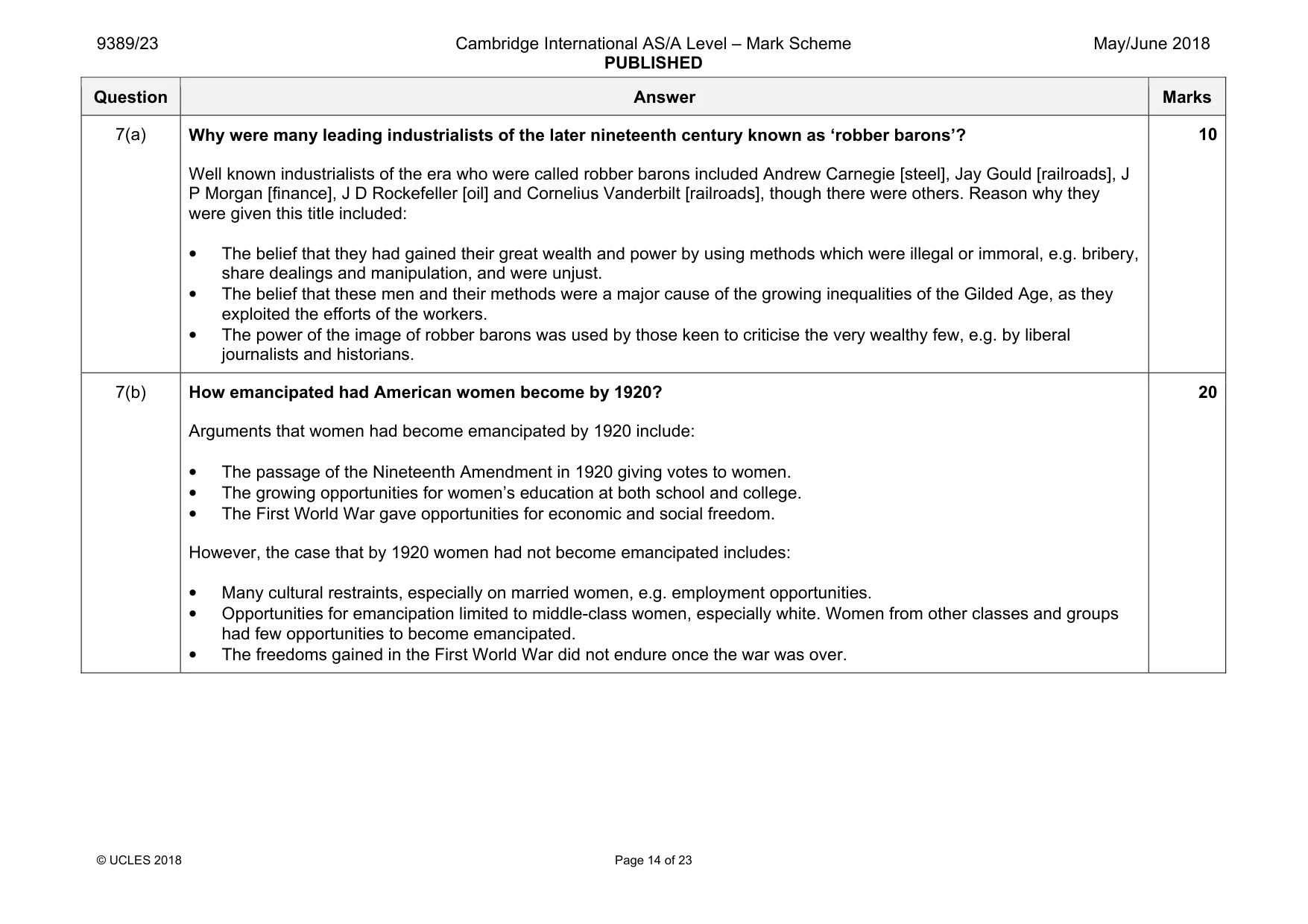
7 The Gilded Age and the Progressive Era, from the 1870s to the 1920s (a) Why were many leading industrialists of the later nineteenth century known as ‘robber barons’? [10] (b) How emancipated had American women become by 1920? [20]
Mark scheme: 7(a) Why were many leading industrialists of the later nineteenth century known as ‘robber barons’? Well known industrialists of the era who were called robber barons included Andrew Carnegie [steel], Jay Gould [railroads], J P Morgan [finance], J D Rockefeller [oil] and Cornelius Vanderbilt [railroads], though there were others. Reason why they were given this title included: • The belief that they had gained their great wealth and power by using methods which were illegal or immoral, e.g. bribery, share dealings and manipulation, and were unjust. • The belief that these men and their methods were a major cause of the growing inequalities of the Gilded Age, as they exploited the efforts of the workers. • The power of the image of robber barons was used by those keen to criticise the very wealthy few, e.g. by liberal journalists and historians. 10 7(b) How emancipated had American women become by 1920? Arguments that women had become emancipated by 1920 include: • The passage of the Nineteenth Amendment in 1920 giving votes to women. • The growing opportunities for women’s education at both school and college. • The First World War gave opportunities for economic and social freedom. However, the case that by 1920 women had not become emancipated includes: • Many cultural restraints, especially on married women, e.g. employment opportunities. • Opportunities for emancipation limited to middle-class women, especially white. Women from other classes and groups had few opportunities to become emancipated. • The freedoms gained in the First World War did not endure once the war was over. 20
Q8 · The Great Crash, the Great Depression and the New Deal, from the 1920s to 1941 (a) Why…
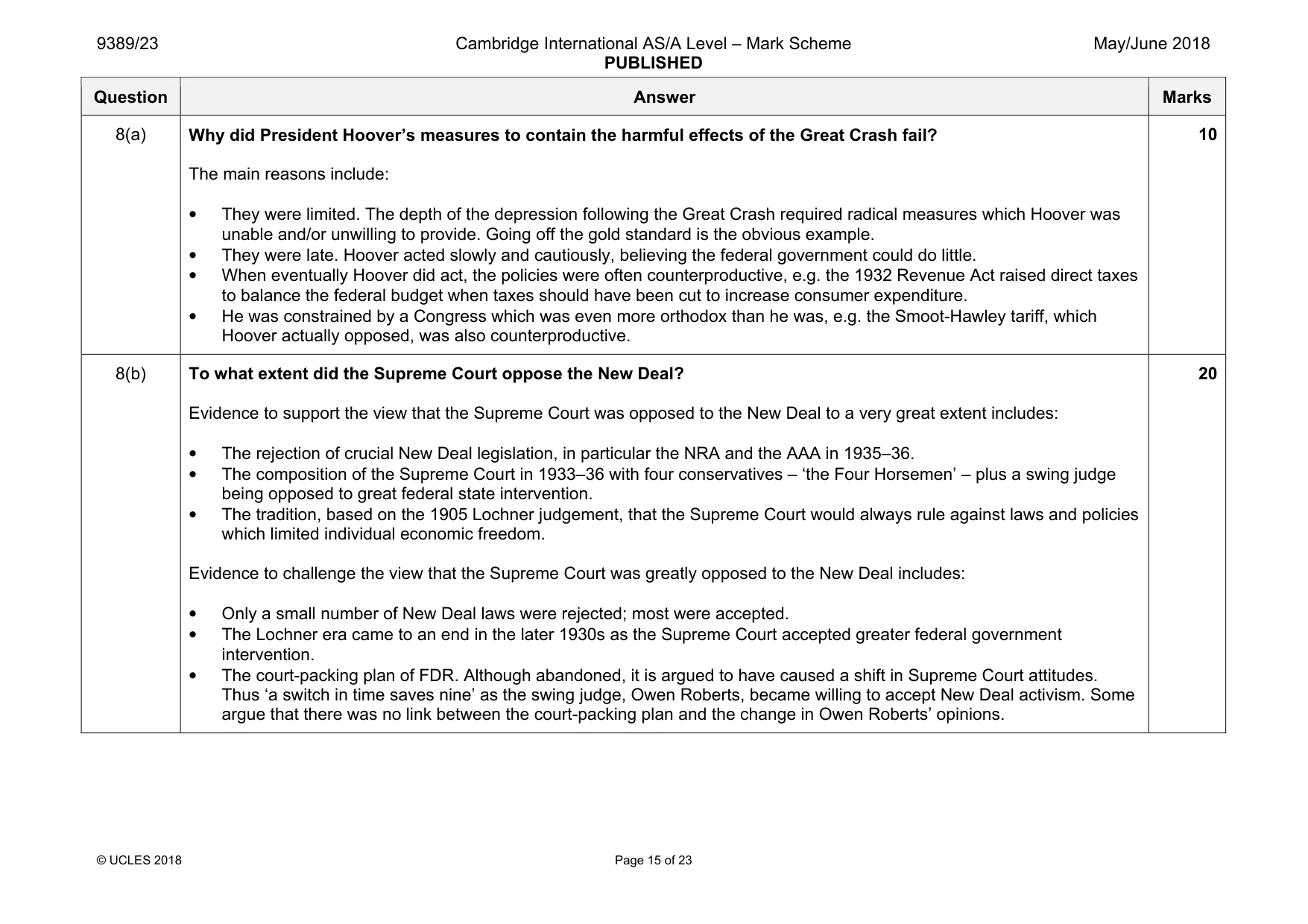
8 The Great Crash, the Great Depression and the New Deal, from the 1920s to 1941 (a) Why did President Hoover’s measures to contain the harmful effects of the Great Crash fail? [10] (b) To what extent did the Supreme Court oppose the New Deal? [20] Section C: International Option International Relations, 1871–1945 Answer both parts of two questions.
Mark scheme: 8(a) Why did President Hoover’s measures to contain the harmful effects of the Great Crash fail? The main reasons include: • They were limited. The depth of the depression following the Great Crash required radical measures which Hoover was unable and/or unwilling to provide. Going off the gold standard is the obvious example. • They were late. Hoover acted slowly and cautiously, believing the federal government could do little. • When eventually Hoover did act, the policies were often counterproductive, e.g. the 1932 Revenue Act raised direct taxes to balance the federal budget when taxes should have been cut to increase consumer expenditure. • He was constrained by a Congress which was even more orthodox than he was, e.g. the Smoot-Hawley tariff, which Hoover actually opposed, was also counterproductive. 10 8(b) To what extent did the Supreme Court oppose the New Deal? Evidence to support the view that the Supreme Court was opposed to the New Deal to a very great extent includes: • The rejection of crucial New Deal legislation, in particular the NRA and the AAA in 1935–36. • The composition of the Supreme Court in 1933–36 with four conservatives – ‘the Four Horsemen’ – plus a swing judge being opposed to great federal state intervention. • The tradition, based on the 1905 Lochner judgement, that the Supreme Court would always rule against laws and policies which limited individual economic freedom. Evidence to challenge the view that the Supreme Court was greatly opposed to the New Deal includes: • Only a small number of New Deal laws were rejected; most were accepted. • The Lochner era came to an end in the later 1930s as the Supreme Court accepted greater federal government intervention. • The court-packing plan of FDR. Although abandoned, it is argued to have caused a shift in Supreme Court attitudes. Thus ‘a switch in time saves nine’ as the swing judge, Owen Roberts, became willing to accept New Deal activism. Some argue that there was no link between the court-packing plan and the change in Owen Roberts’ opinions. 20
Q9 · International Relations, 1871–1918 (a) Why, in the late nineteenth century, did the USA…
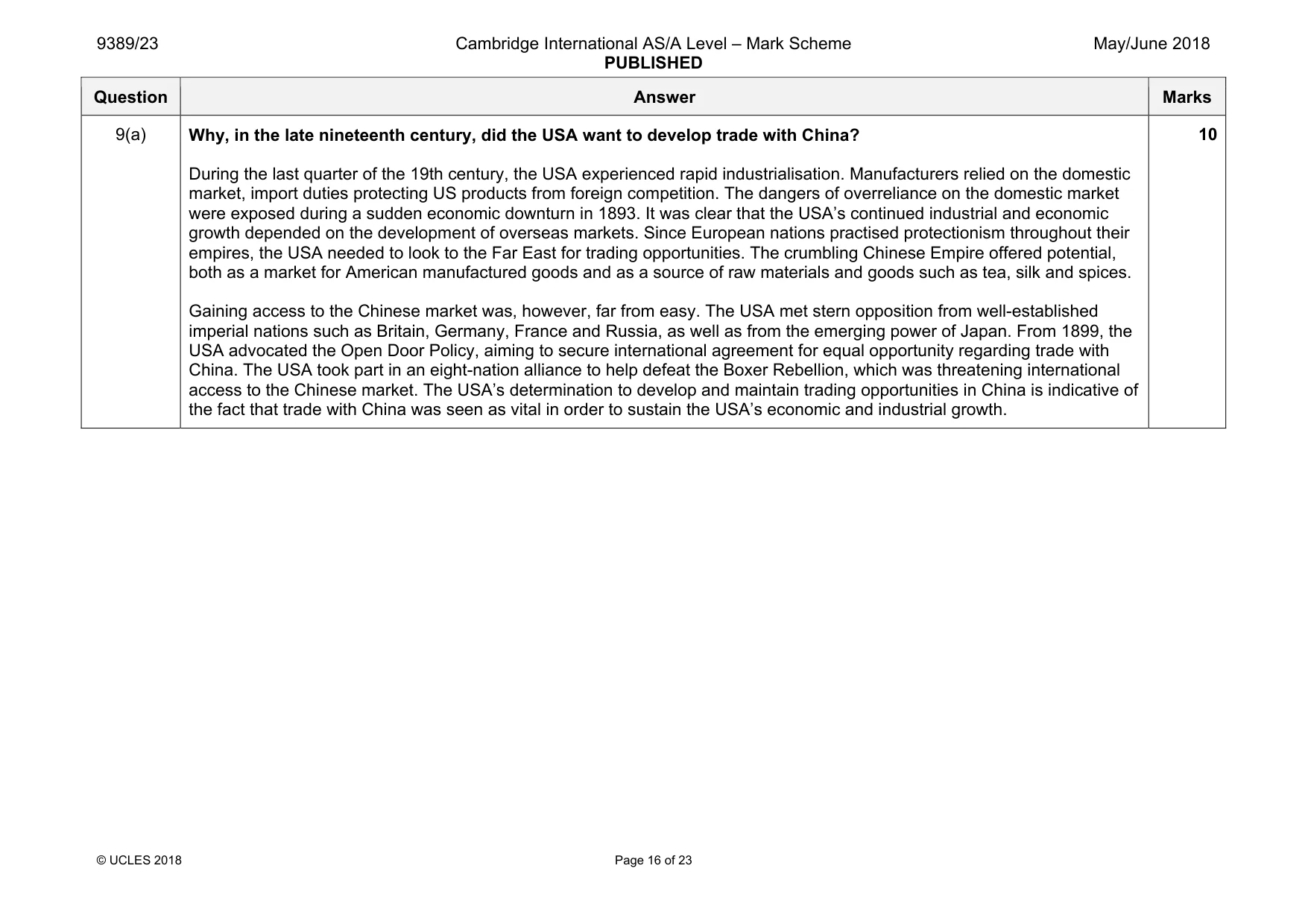
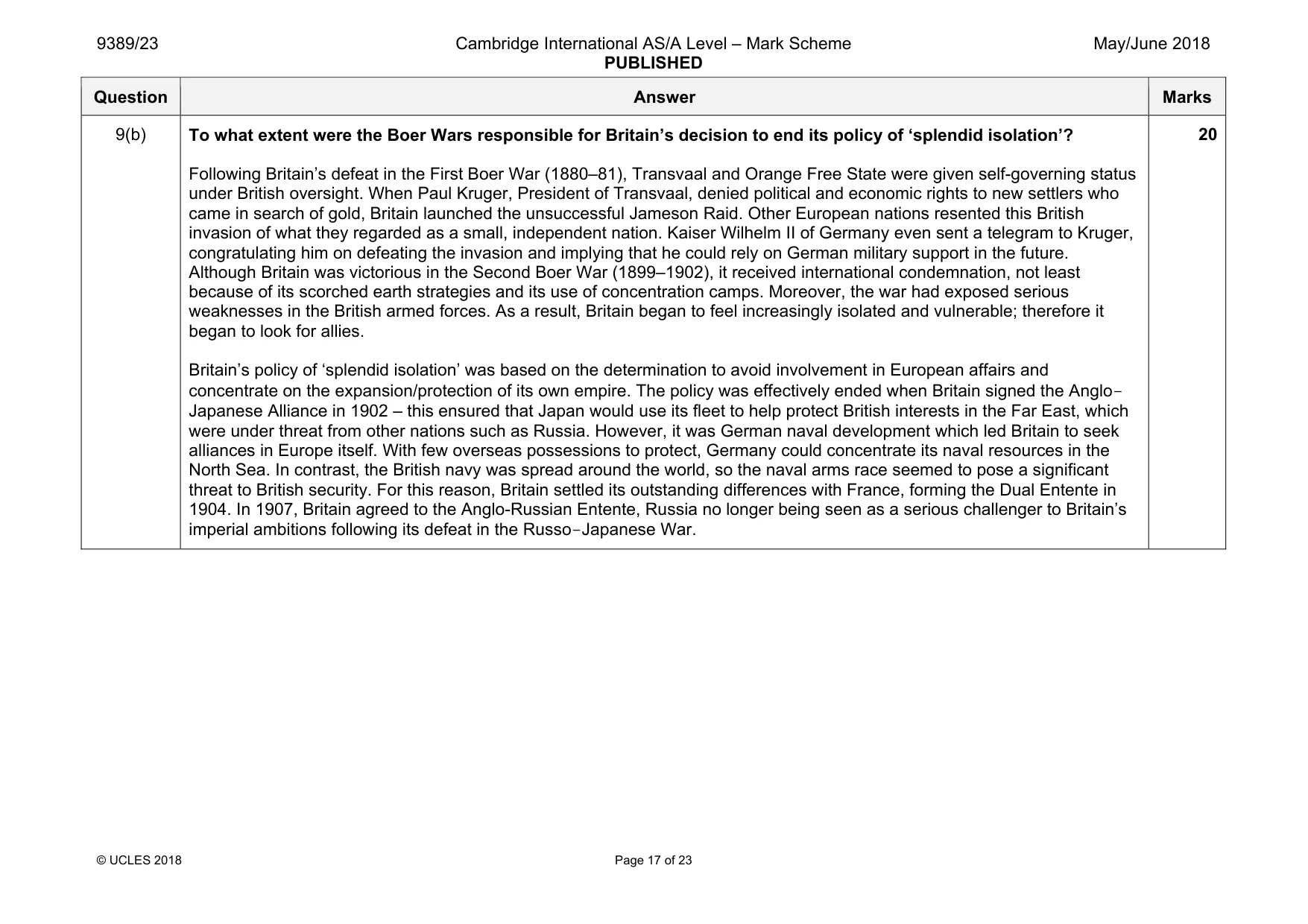
9 International Relations, 1871–1918 (a) Why, in the late nineteenth century, did the USA want to develop trade with China? [10] (b) To what extent were the Boer Wars responsible for Britain’s decision to end its policy of ‘splendid isolation’? [20]
Mark scheme: 9(a) Why, in the late nineteenth century, did the USA want to develop trade with China? During the last quarter of the 19th century, the USA experienced rapid industrialisation. Manufacturers relied on the domestic market, import duties protecting US products from foreign competition. The dangers of overreliance on the domestic market were exposed during a sudden economic downturn in 1893. It was clear that the USA’s continued industrial and economic growth depended on the development of overseas markets. Since European nations practised protectionism throughout their empires, the USA needed to look to the Far East for trading opportunities. The crumbling Chinese Empire offered potential, both as a market for American manufactured goods and as a source of raw materials and goods such as tea, silk and spices. Gaining access to the Chinese market was, however, far from easy. The USA met stern opposition from well-established imperial nations such as Britain, Germany, France and Russia, as well as from the emerging power of Japan. From 1899, the USA advocated the Open Door Policy, aiming to secure international agreement for equal opportunity regarding trade with China. The USA took part in an eight-nation alliance to help defeat the Boxer Rebellion, which was threatening international access to the Chinese market. The USA’s determination to develop and maintain trading opportunities in China is indicative of the fact that trade with China was seen as vital in order to sustain the USA’s economic and industrial growth. 10 Question Answer Marks 9(b) To what extent were the Boer Wars responsible for Britain’s decision to end its policy of ‘splendid isolation’? Following Britain’s defeat in the First Boer War (1880–81), Transvaal and Orange Free State were given self-governing status under British oversight. When Paul Kruger, President of Transvaal, denied political and economic rights to new settlers who came in search of gold, Britain launched the unsuccessful Jameson Raid. Other European nations resented this British invasion of what they regarded as a small, independent nation. Kaiser Wilhelm II of Germany even sent a telegram to Kruger, congratulating him on defeating the invasion and implying that he could rely on German military support in the future. Although Britain was victorious in the Second Boer War (1899–1902), it received international condemnation, not least because of its scorched earth strategies and its use of concentration camps. Moreover, the war had exposed serious weaknesses in the British armed forces. As a result, Britain began to feel increasingly isolated and vulnerable; therefore it began to look for allies. Britain’s policy of ‘splendid isolation’ was based on the determination to avoid involvement in European affairs and concentrate on the expansion/protection of its own empire. The policy was effectively ended when Britain signed the Anglo- Japanese Alliance in 1902 – this ensured that Japan would use its fleet to help protect British interests in the Far East, which were under threat from other nations such as Russia. However, it was German naval development which led Britain to seek alliances in Europe itself. With few overseas possessions to protect, Germany could concentrate its naval resources in the North Sea. In contrast, the British navy was spread around the world, so the naval arms race seemed to pose a significant threat to British security. For this reason, Britain settled its outstanding differences with France, forming the Dual Entente in 1904. In 1907, Britain agreed to the Anglo-Russian Entente, Russia no longer being seen as a serious challenger to Britain’s imperial ambitions following its defeat in the Russo-Japanese War. 20
Q10 · International Relations, 1919–1933 (a) Why, during the 1920s, did Russia enjoy better…
10 International Relations, 1919–1933 (a) Why, during the 1920s, did Russia enjoy better relations with Germany than it did with Britain and France? [10] (b) ‘The Dawes Plan was the most important factor in improving international relations in the 1920s.’ How far do you agree? [20]
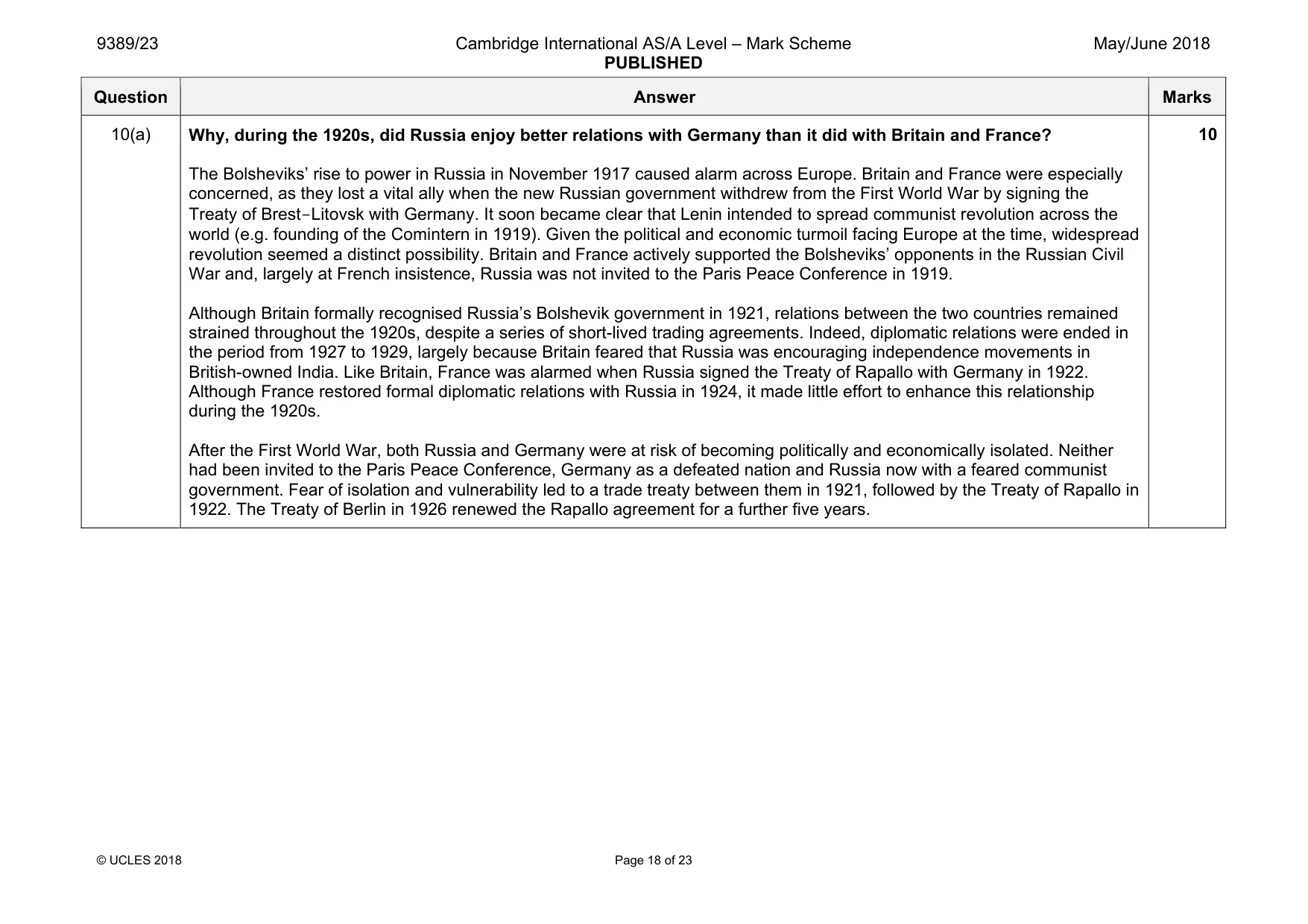
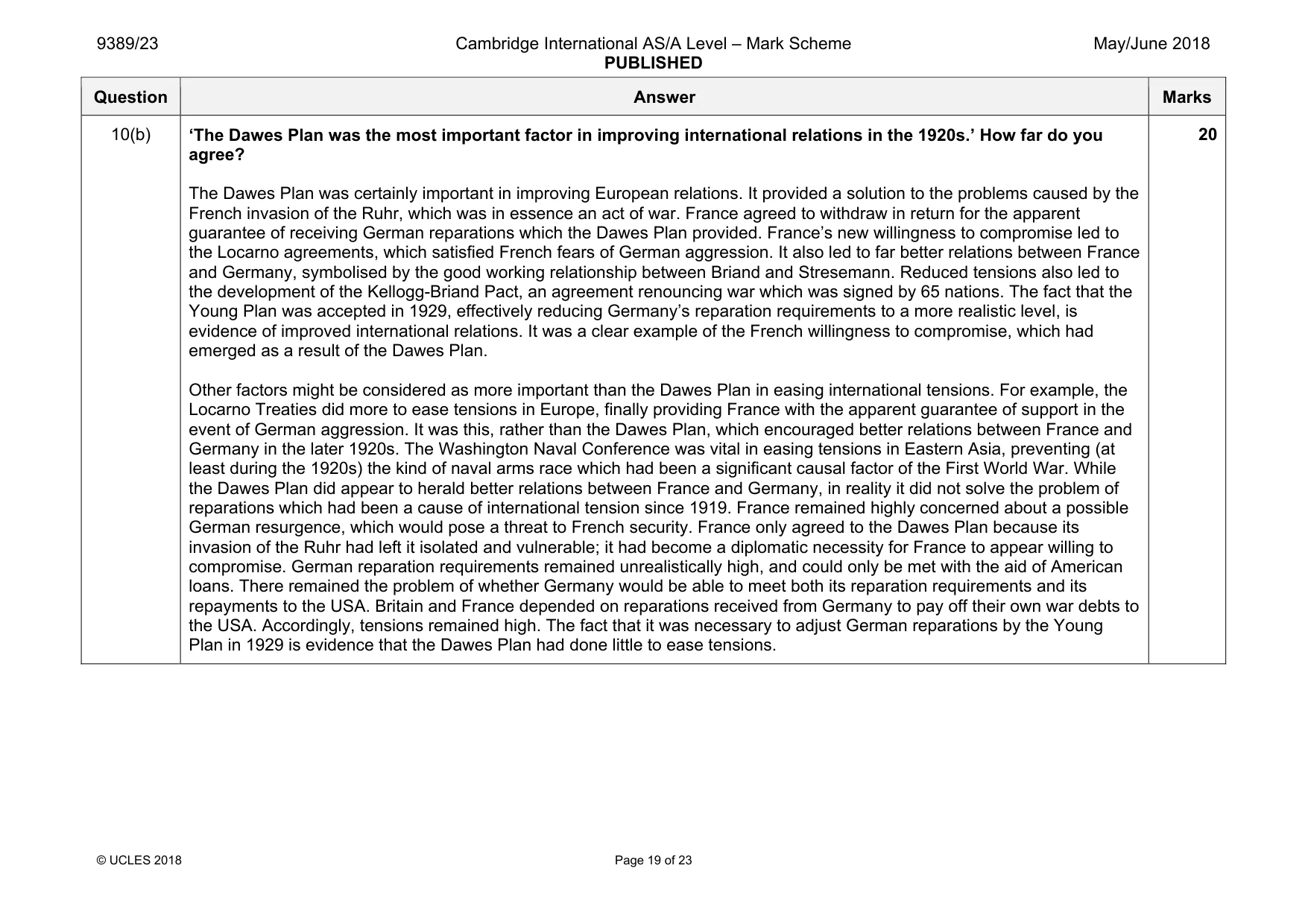
Mark scheme: 10(a) Why, during the 1920s, did Russia enjoy better relations with Germany than it did with Britain and France? The Bolsheviks’ rise to power in Russia in November 1917 caused alarm across Europe. Britain and France were especially concerned, as they lost a vital ally when the new Russian government withdrew from the First World War by signing the Treaty of Brest-Litovsk with Germany. It soon became clear that Lenin intended to spread communist revolution across the world (e.g. founding of the Comintern in 1919). Given the political and economic turmoil facing Europe at the time, widespread revolution seemed a distinct possibility. Britain and France actively supported the Bolsheviks’ opponents in the Russian Civil War and, largely at French insistence, Russia was not invited to the Paris Peace Conference in 1919. Although Britain formally recognised Russia’s Bolshevik government in 1921, relations between the two countries remained strained throughout the 1920s, despite a series of short-lived trading agreements. Indeed, diplomatic relations were ended in the period from 1927 to 1929, largely because Britain feared that Russia was encouraging independence movements in British-owned India. Like Britain, France was alarmed when Russia signed the Treaty of Rapallo with Germany in 1922. Although France restored formal diplomatic relations with Russia in 1924, it made little effort to enhance this relationship during the 1920s. After the First World War, both Russia and Germany were at risk of becoming politically and economically isolated. Neither had been invited to the Paris Peace Conference, Germany as a defeated nation and Russia now with a feared communist government. Fear of isolation and vulnerability led to a trade treaty between them in 1921, followed by the Treaty of Rapallo in 1922. The Treaty of Berlin in 1926 renewed the Rapallo agreement for a further five years. 10 Question Answer Marks 10(b) ‘The Dawes Plan was the most important factor in improving international relations in the 1920s.’ How far do you agree? The Dawes Plan was certainly important in improving European relations. It provided a solution to the problems caused by the French invasion of the Ruhr, which was in essence an act of war. France agreed to withdraw in return for the apparent guarantee of receiving German reparations which the Dawes Plan provided. France’s new willingness to compromise led to the Locarno agreements, which satisfied French fears of German aggression. It also led to far better relations between France and Germany, symbolised by the good working relationship between Briand and Stresemann. Reduced tensions also led to the development of the Kellogg-Briand Pact, an agreement renouncing war which was signed by 65 nations. The fact that the Young Plan was accepted in 1929, effectively reducing Germany’s reparation requirements to a more realistic level, is evidence of improved international relations. It was a clear example of the French willingness to compromise, which had emerged as a result of the Dawes Plan. Other factors might be considered as more important than the Dawes Plan in easing international tensions. For example, the Locarno Treaties did more to ease tensions in Europe, finally providing France with the apparent guarantee of support in the event of German aggression. It was this, rather than the Dawes Plan, which encouraged better relations between France and Germany in the later 1920s. The Washington Naval Conference was vital in easing tensions in Eastern Asia, preventing (at least during the 1920s) the kind of naval arms race which had been a significant causal factor of the First World War. While the Dawes Plan did appear to herald better relations between France and Germany, in reality it did not solve the problem of reparations which had been a cause of international tension since 1919. France remained highly concerned about a possible German resurgence, which would pose a threat to French security. France only agreed to the Dawes Plan because its invasion of the Ruhr had left it isolated and vulnerable; it had become a diplomatic necessity for France to appear willing to compromise. German reparation requirements remained unrealistically high, and could only be met with the aid of American loans. There remained the problem of whether Germany would be able to meet both its reparation requirements and its repayments to the USA. Britain and France depended on reparations received from Germany to pay off their own war debts to the USA. Accordingly, tensions remained high. The fact that it was necessary to adjust German reparations by the Young Plan in 1929 is evidence that the Dawes Plan had done little to ease tensions. 20
Q11 · International Relations, 1933–1939 (a) Why was the attempt to achieve Anschluss in 1934…
11 International Relations, 1933–1939 (a) Why was the attempt to achieve Anschluss in 1934 unsuccessful? [10] (b) How successful was Mussolini’s foreign policy? [20]
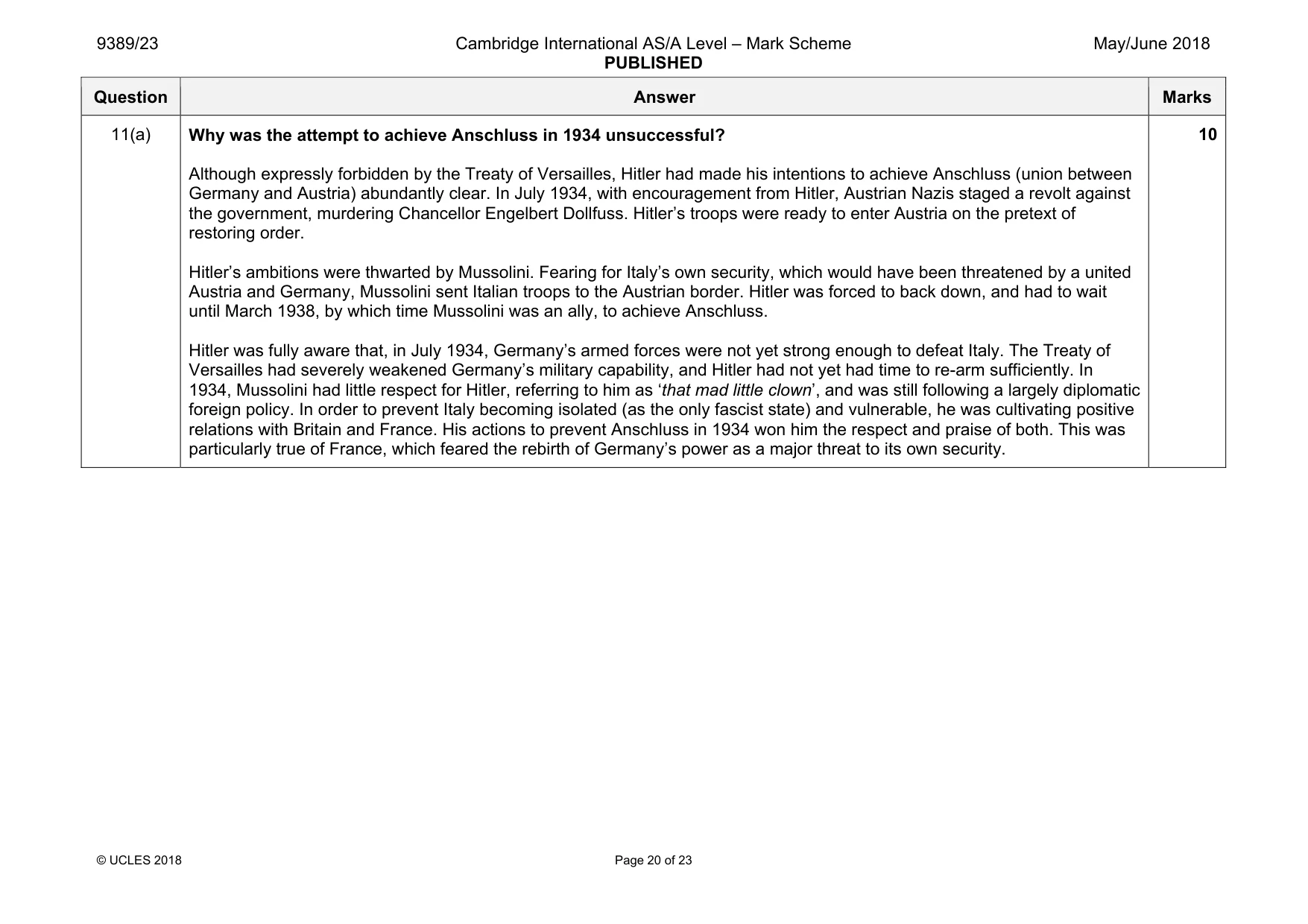
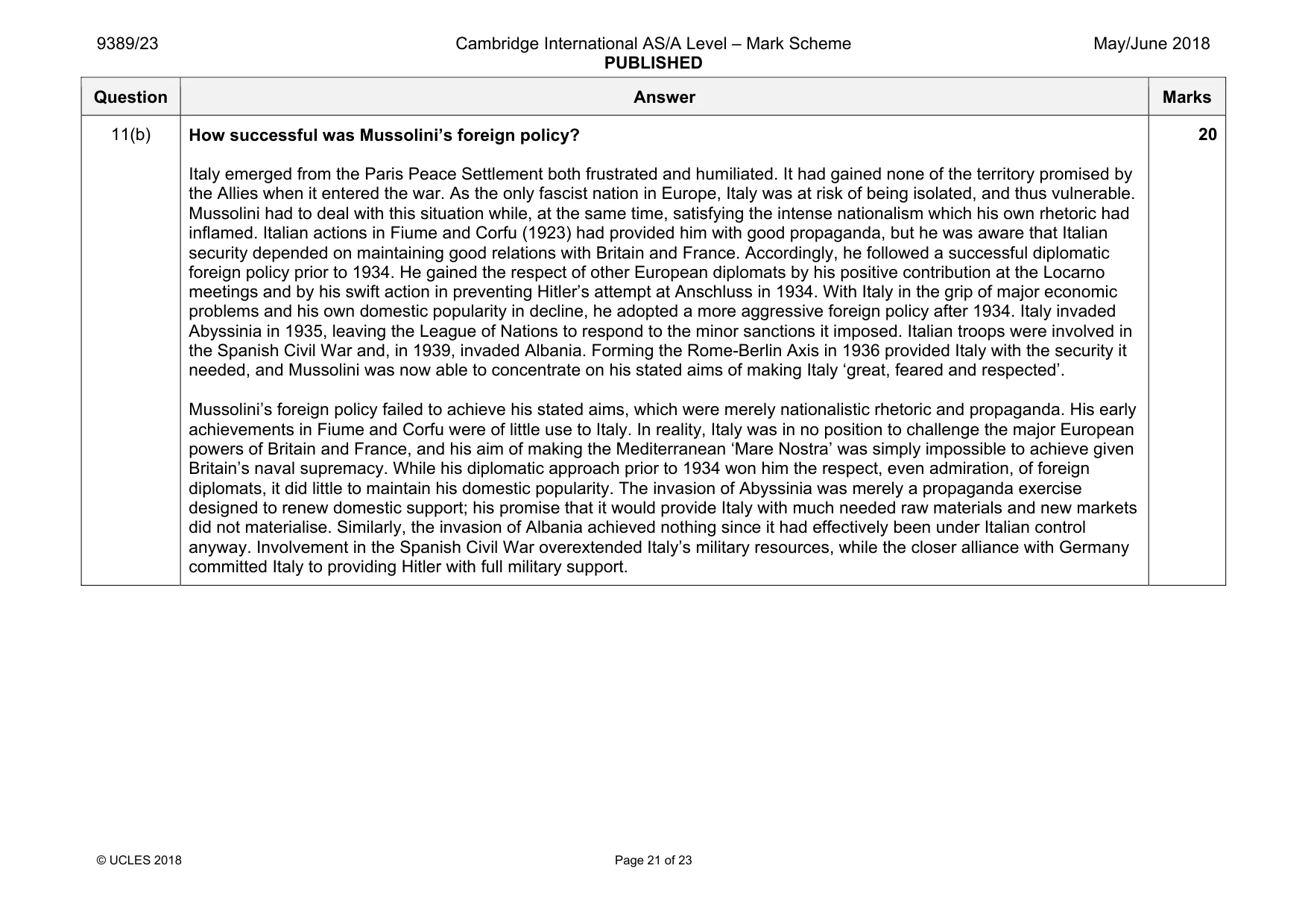
Mark scheme: 11(a) Why was the attempt to achieve Anschluss in 1934 unsuccessful? Although expressly forbidden by the Treaty of Versailles, Hitler had made his intentions to achieve Anschluss (union between Germany and Austria) abundantly clear. In July 1934, with encouragement from Hitler, Austrian Nazis staged a revolt against the government, murdering Chancellor Engelbert Dollfuss. Hitler’s troops were ready to enter Austria on the pretext of restoring order. Hitler’s ambitions were thwarted by Mussolini. Fearing for Italy’s own security, which would have been threatened by a united Austria and Germany, Mussolini sent Italian troops to the Austrian border. Hitler was forced to back down, and had to wait until March 1938, by which time Mussolini was an ally, to achieve Anschluss. Hitler was fully aware that, in July 1934, Germany’s armed forces were not yet strong enough to defeat Italy. The Treaty of Versailles had severely weakened Germany’s military capability, and Hitler had not yet had time to re-arm sufficiently. In 1934, Mussolini had little respect for Hitler, referring to him as ‘that mad little clown’, and was still following a largely diplomatic foreign policy. In order to prevent Italy becoming isolated (as the only fascist state) and vulnerable, he was cultivating positive relations with Britain and France. His actions to prevent Anschluss in 1934 won him the respect and praise of both. This was particularly true of France, which feared the rebirth of Germany’s power as a major threat to its own security. 10 Question Answer Marks 11(b) How successful was Mussolini’s foreign policy? Italy emerged from the Paris Peace Settlement both frustrated and humiliated. It had gained none of the territory promised by the Allies when it entered the war. As the only fascist nation in Europe, Italy was at risk of being isolated, and thus vulnerable. Mussolini had to deal with this situation while, at the same time, satisfying the intense nationalism which his own rhetoric had inflamed. Italian actions in Fiume and Corfu (1923) had provided him with good propaganda, but he was aware that Italian security depended on maintaining good relations with Britain and France. Accordingly, he followed a successful diplomatic foreign policy prior to 1934. He gained the respect of other European diplomats by his positive contribution at the Locarno meetings and by his swift action in preventing Hitler’s attempt at Anschluss in 1934. With Italy in the grip of major economic problems and his own domestic popularity in decline, he adopted a more aggressive foreign policy after 1934. Italy invaded Abyssinia in 1935, leaving the League of Nations to respond to the minor sanctions it imposed. Italian troops were involved in the Spanish Civil War and, in 1939, invaded Albania. Forming the Rome-Berlin Axis in 1936 provided Italy with the security it needed, and Mussolini was now able to concentrate on his stated aims of making Italy ‘great, feared and respected’. Mussolini’s foreign policy failed to achieve his stated aims, which were merely nationalistic rhetoric and propaganda. His early achievements in Fiume and Corfu were of little use to Italy. In reality, Italy was in no position to challenge the major European powers of Britain and France, and his aim of making the Mediterranean ‘Mare Nostra’ was simply impossible to achieve given Britain’s naval supremacy. While his diplomatic approach prior to 1934 won him the respect, even admiration, of foreign diplomats, it did little to maintain his domestic popularity. The invasion of Abyssinia was merely a propaganda exercise designed to renew domestic support; his promise that it would provide Italy with much needed raw materials and new markets did not materialise. Similarly, the invasion of Albania achieved nothing since it had effectively been under Italian control anyway. Involvement in the Spanish Civil War overextended Italy’s military resources, while the closer alliance with Germany committed Italy to providing Hitler with full military support. 20
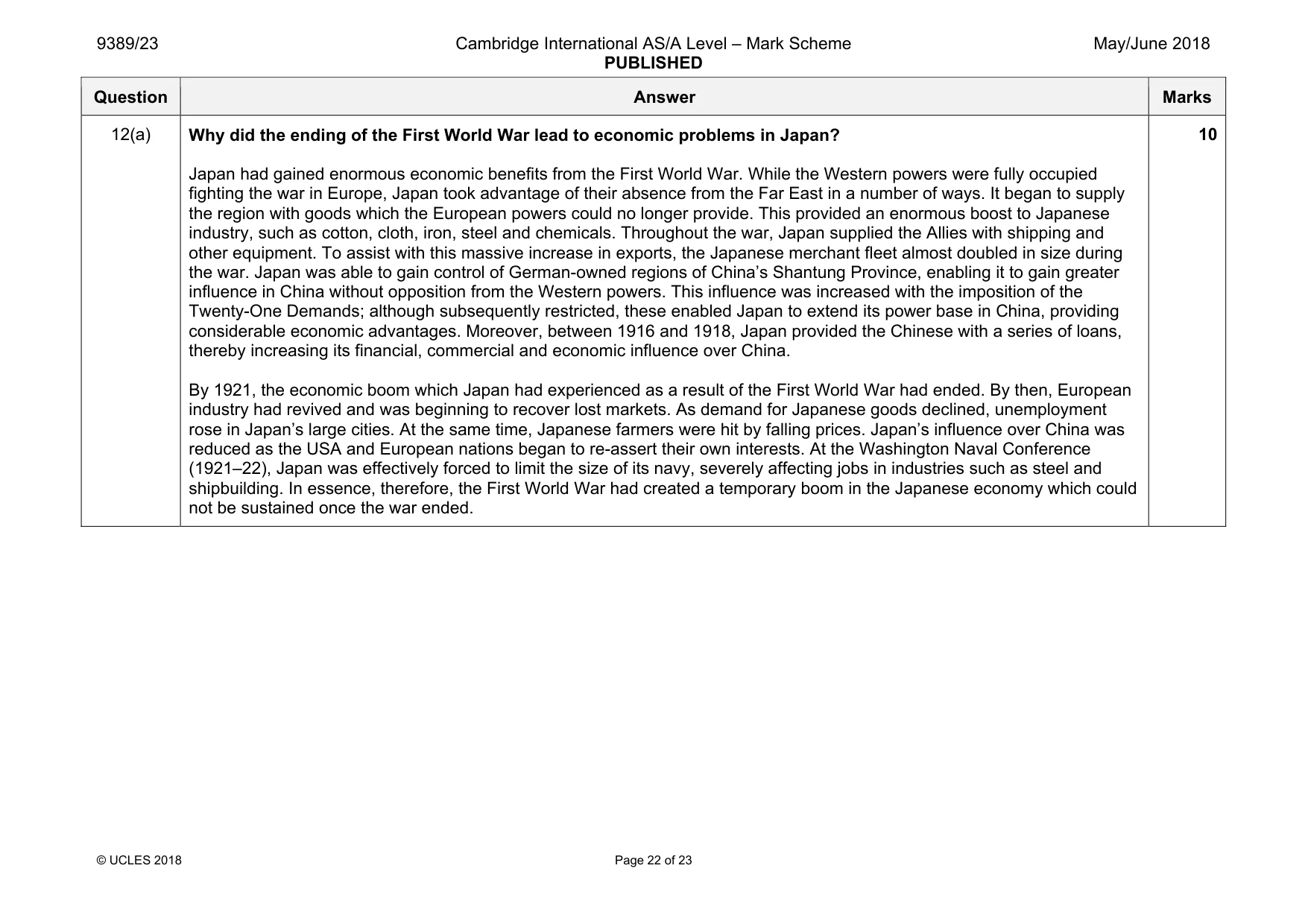
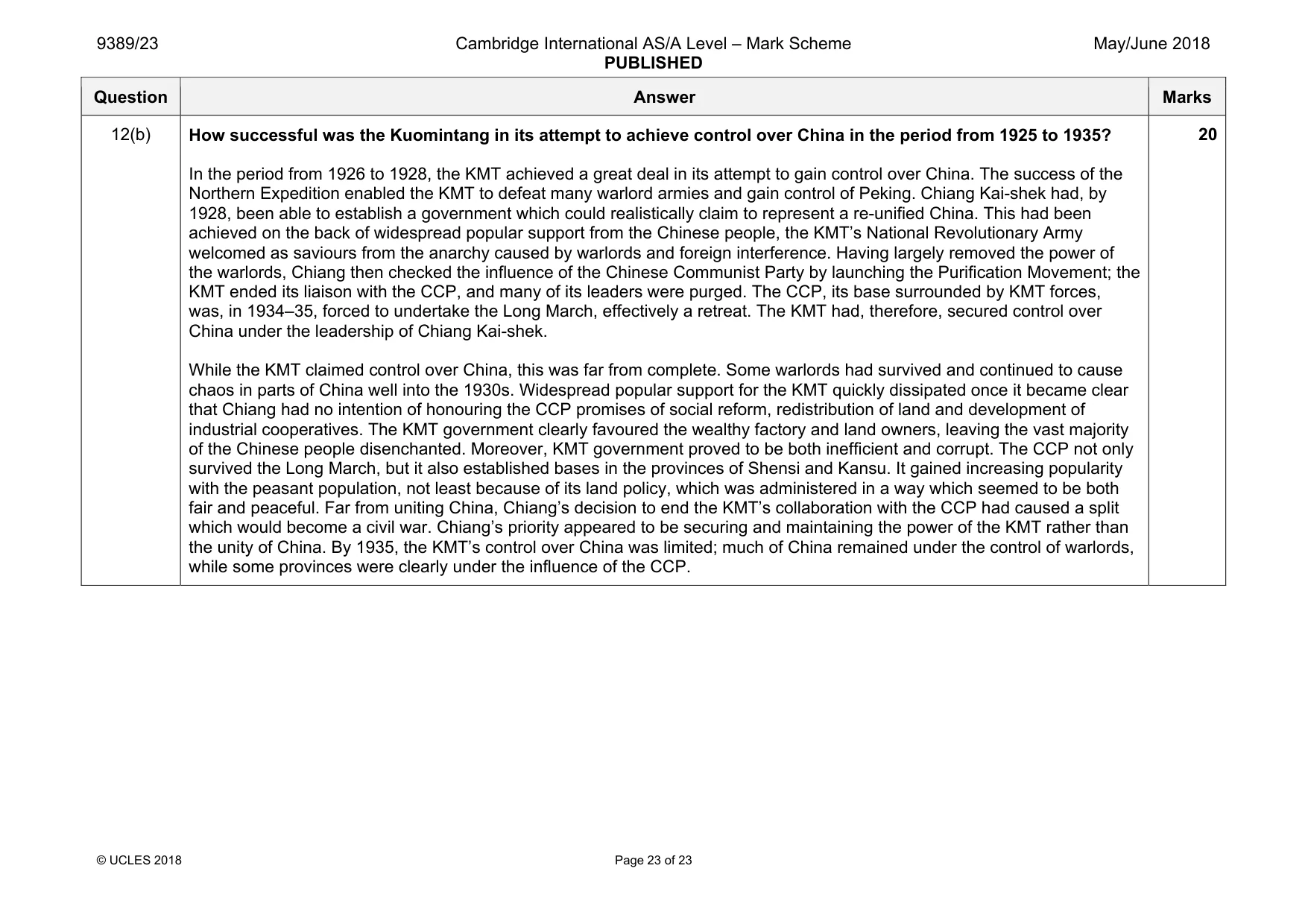
Q12 · China and Japan, 1919–1945 (a) Why did the ending of the First World War lead to economic…
12 China and Japan, 1919–1945 (a) Why did the ending of the First World War lead to economic problems in Japan? [10] (b) How successful was the Kuomintang in its attempt to achieve control over China in the period from 1925 to 1935? [20]
Mark scheme: 12(a) Why did the ending of the First World War lead to economic problems in Japan? Japan had gained enormous economic benefits from the First World War. While the Western powers were fully occupied fighting the war in Europe, Japan took advantage of their absence from the Far East in a number of ways. It began to supply the region with goods which the European powers could no longer provide. This provided an enormous boost to Japanese industry, such as cotton, cloth, iron, steel and chemicals. Throughout the war, Japan supplied the Allies with shipping and other equipment. To assist with this massive increase in exports, the Japanese merchant fleet almost doubled in size during the war. Japan was able to gain control of German-owned regions of China’s Shantung Province, enabling it to gain greater influence in China without opposition from the Western powers. This influence was increased with the imposition of the Twenty-One Demands; although subsequently restricted, these enabled Japan to extend its power base in China, providing considerable economic advantages. Moreover, between 1916 and 1918, Japan provided the Chinese with a series of loans, thereby increasing its financial, commercial and economic influence over China. By 1921, the economic boom which Japan had experienced as a result of the First World War had ended. By then, European industry had revived and was beginning to recover lost markets. As demand for Japanese goods declined, unemployment rose in Japan’s large cities. At the same time, Japanese farmers were hit by falling prices. Japan’s influence over China was reduced as the USA and European nations began to re-assert their own interests. At the Washington Naval Conference (1921–22), Japan was effectively forced to limit the size of its navy, severely affecting jobs in industries such as steel and shipbuilding. In essence, therefore, the First World War had created a temporary boom in the Japanese economy which could not be sustained once the war ended. 10 Question Answer Marks 12(b) How successful was the Kuomintang in its attempt to achieve control over China in the period from 1925 to 1935? In the period from 1926 to 1928, the KMT achieved a great deal in its attempt to gain control over China. The success of the Northern Expedition enabled the KMT to defeat many warlord armies and gain control of Peking. Chiang Kai-shek had, by 1928, been able to establish a government which could realistically claim to represent a re-unified China. This had been achieved on the back of widespread popular support from the Chinese people, the KMT’s National Revolutionary Army welcomed as saviours from the anarchy caused by warlords and foreign interference. Having largely removed the power of the warlords, Chiang then checked the influence of the Chinese Communist Party by launching the Purification Movement; the KMT ended its liaison with the CCP, and many of its leaders were purged. The CCP, its base surrounded by KMT forces, was, in 1934–35, forced to undertake the Long March, effectively a retreat. The KMT had, therefore, secured control over China under the leadership of Chiang Kai-shek. While the KMT claimed control over China, this was far from complete. Some warlords had survived and continued to cause chaos in parts of China well into the 1930s. Widespread popular support for the KMT quickly dissipated once it became clear that Chiang had no intention of honouring the CCP promises of social reform, redistribution of land and development of industrial cooperatives. The KMT government clearly favoured the wealthy factory and land owners, leaving the vast majority of the Chinese people disenchanted. Moreover, KMT government proved to be both inefficient and corrupt. The CCP not only survived the Long March, but it also established bases in the provinces of Shensi and Kansu. It gained increasing popularity with the peasant population, not least because of its land policy, which was administered in a way which seemed to be both fair and peaceful. Far from uniting China, Chiang’s decision to end the KMT’s collaboration with the CCP had caused a split which would become a civil war. Chiang’s priority appeared to be securing and maintaining the power of the KMT rather than the unity of China. By 1935, the KMT’s control over China was limited; much of China remained under the control of warlords, while some provinces were clearly under the influence of the CCP. 20
What you needed in this session
Cambridge’s own grade thresholds for 2018 May/June, Paper 2 · Variant 3. A higher threshold means an easier paper — the bar moves with how the cohort did.