Cambridge A Level History 9389 — 2017 Oct/Nov Paper 4 · Variant 3
9389/43/O/N/17 · 60 marks · ≈68 min
The question paper and its mark scheme, free to read here and free to download. This is Cambridge’s own paper, exactly as it was sat.
Question paper4 pages
Mark scheme21 pages
Answers below. Sit the paper first if you are practising.
Paper as text
Question paper, page 1
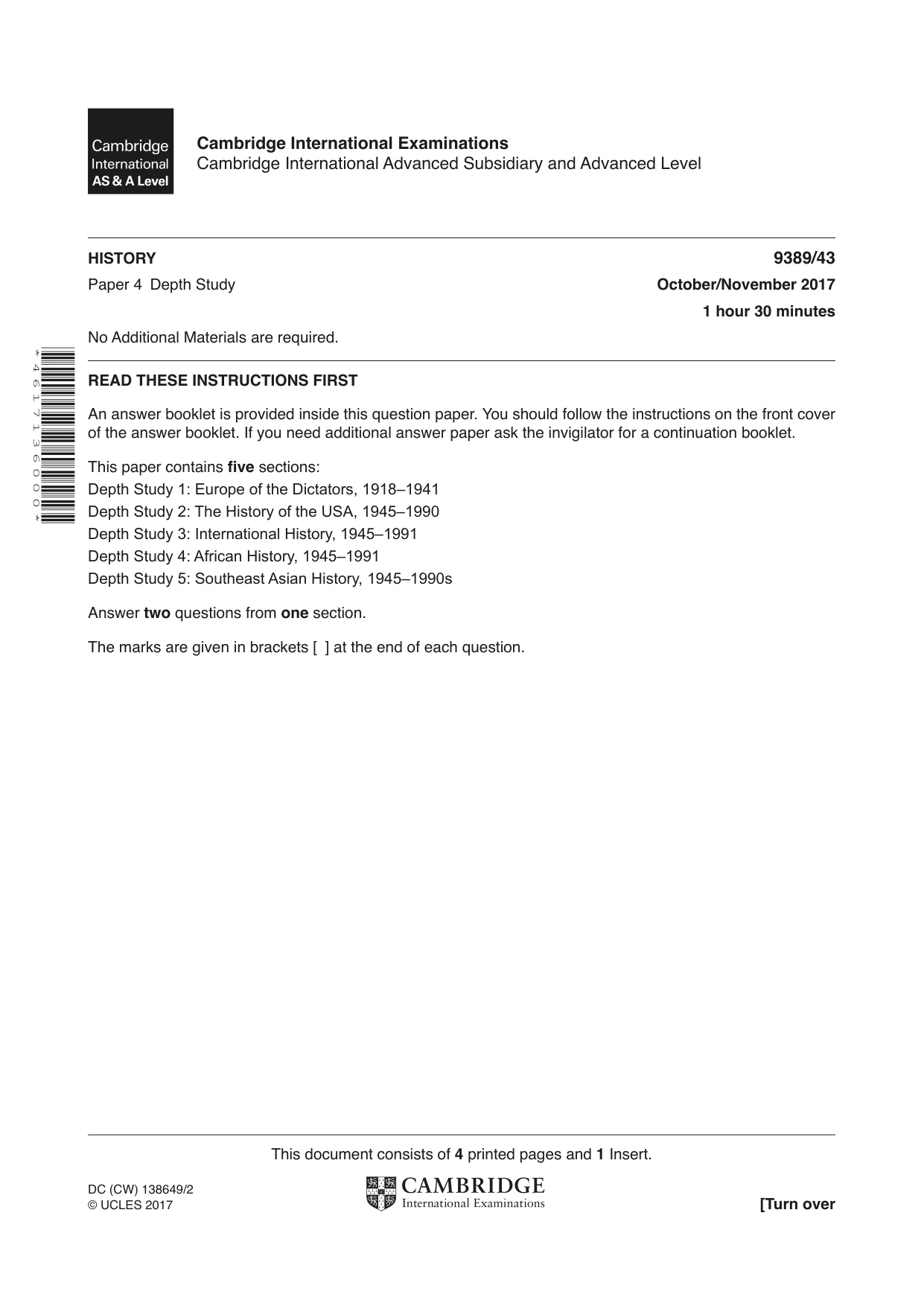
* 4 6 1 7 1 3 6 0 0 0 * This document consists of 4 printed pages and 1 Insert. DC (CW) 138649/2 © UCLES 2017 [Turn over HISTORY 9389/43 Paper 4 Depth Study October/November 2017 1 hour 30 minutes No Additional Materials are required. READ THESE INSTRUCTIONS FIRST An answer booklet is provided inside this question paper. You should follow the instructions on the front cover of the answer booklet. If you need additional answer paper ask the invigilator for a continuation booklet. This paper contains five sections: Depth Study 1: Europe of the Dictators, 1918–1941 Depth Study 2: The History of the USA, 1945–1990 Depth Study 3: International History, 1945–1991 Depth Study 4: African History, 1945–1991 Depth Study 5: Southeast Asian History, 1945–1990s Answer two questions from one section. The marks are given in brackets [ ] at the end of each question. Cambridge International Examinations Cambridge International Advanced Subsidiary and Advanced Level
Question paper, page 2
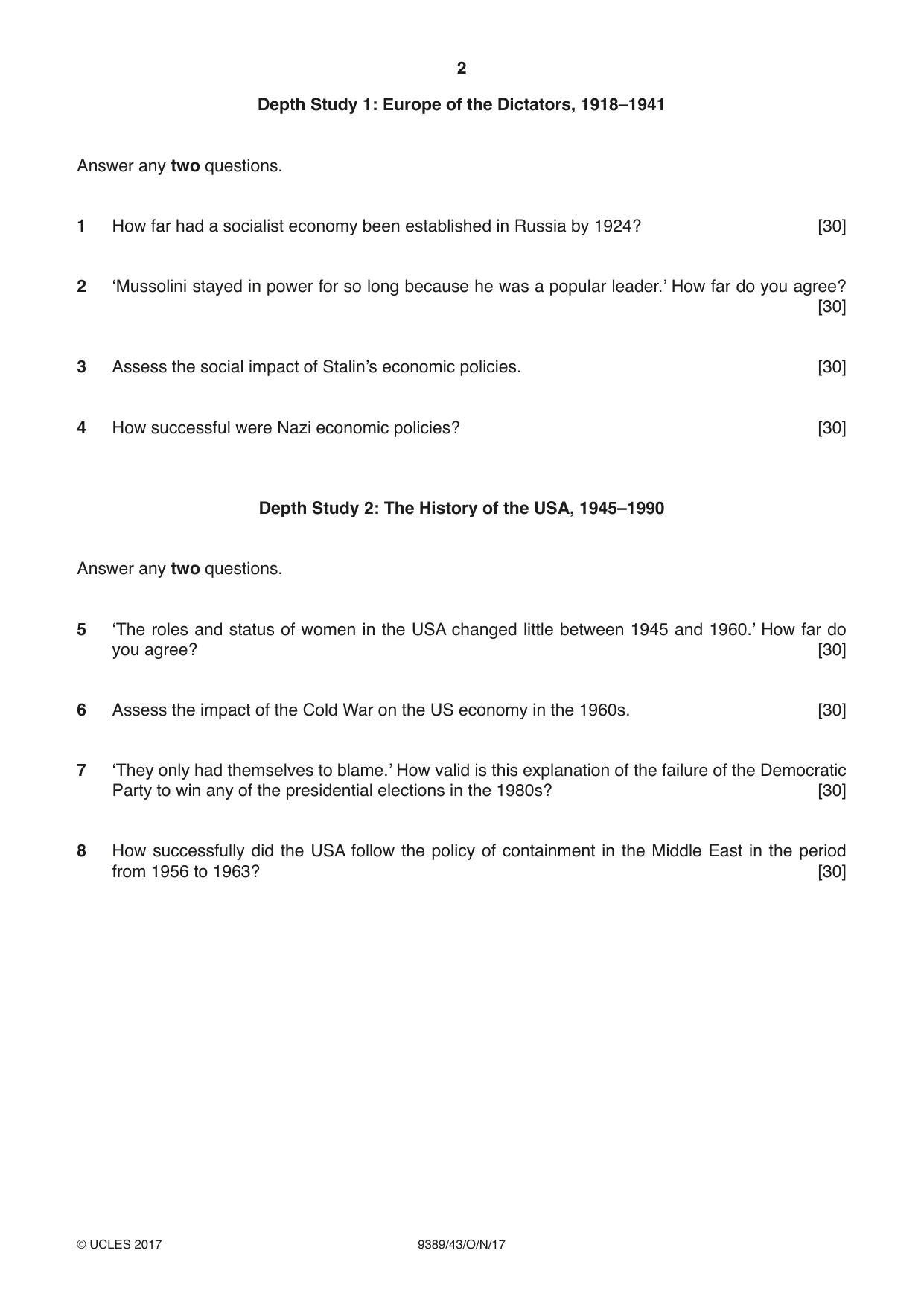
2 9389/43/O/N/17 © UCLES 2017 Depth Study 1: Europe of the Dictators, 1918–1941 Answer any two questions. 1 How far had a socialist economy been established in Russia by 1924? [30] 2 ‘Mussolini stayed in power for so long because he was a popular leader.’ How far do you agree? [30] 3 Assess the social impact of Stalin’s economic policies. [30] 4 How successful were Nazi economic policies? [30] Depth Study 2: The History of the USA, 1945–1990 Answer any two questions. 5 ‘The roles and status of women in the USA changed little between 1945 and 1960.’ How far do you agree? [30] 6 Assess the impact of the Cold War on the US economy in the 1960s. [30] 7 ‘They only had themselves to blame.’ How valid is this explanation of the failure of the Democratic Party to win any of the presidential elections in the 1980s? [30] 8 How successfully did the USA follow the policy of containment in the Middle East in the period from 1956 to 1963? [30]
Question paper, page 3
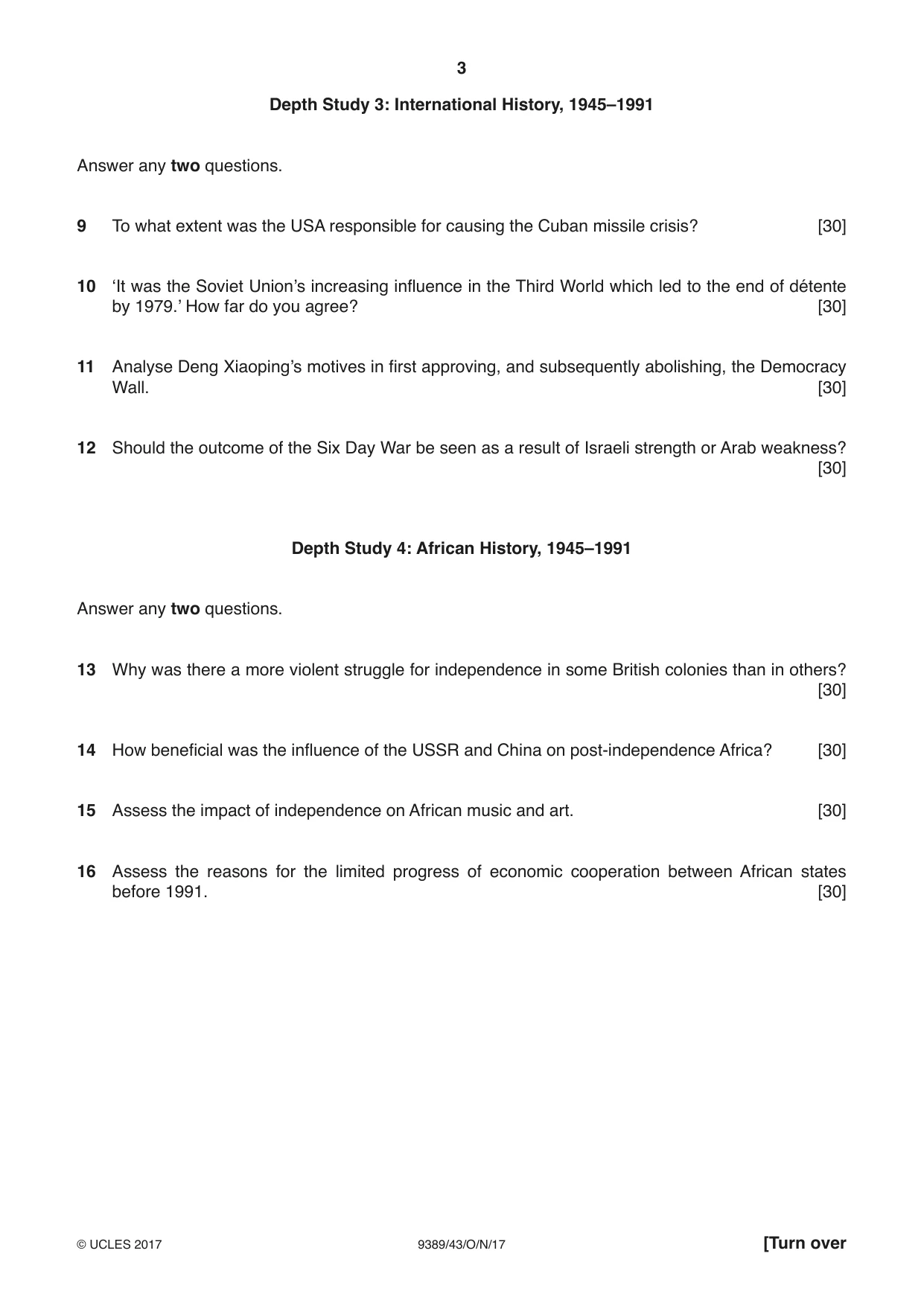
3 9389/43/O/N/17 © UCLES 2017 [Turn over Depth Study 3: International History, 1945–1991 Answer any two questions. 9 To what extent was the USA responsible for causing the Cuban missile crisis? [30] 10 ‘It was the Soviet Union’s increasing influence in the Third World which led to the end of détente by 1979.’ How far do you agree? [30] 11 Analyse Deng Xiaoping’s motives in first approving, and subsequently abolishing, the Democracy Wall. [30] 12 Should the outcome of the Six Day War be seen as a result of Israeli strength or Arab weakness? [30] Depth Study 4: African History, 1945–1991 Answer any two questions. 13 Why was there a more violent struggle for independence in some British colonies than in others? [30] 14 How beneficial was the influence of the USSR and China on post-independence Africa? [30] 15 Assess the impact of independence on African music and art. [30] 16 Assess the reasons for the limited progress of economic cooperation between African states before 1991. [30]
Question paper, page 4
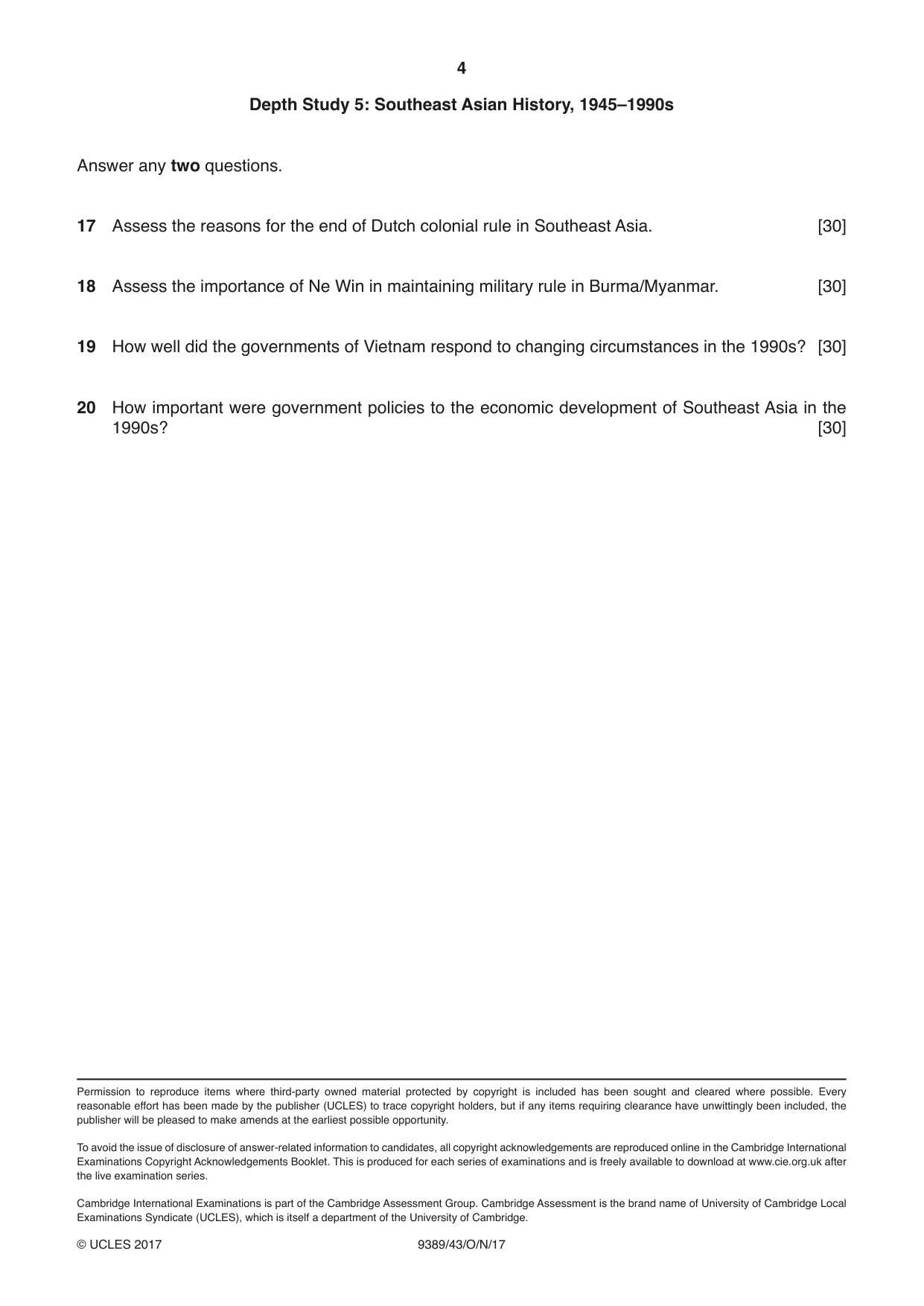
4 9389/43/O/N/17 © UCLES 2017 Permission to reproduce items where third-party owned material protected by copyright is included has been sought and cleared where possible. Every reasonable effort has been made by the publisher (UCLES) to trace copyright holders, but if any items requiring clearance have unwittingly been included, the publisher will be pleased to make amends at the earliest possible opportunity. To avoid the issue of disclosure of answer-related information to candidates, all copyright acknowledgements are reproduced online in the Cambridge International Examinations Copyright Acknowledgements Booklet. This is produced for each series of examinations and is freely available to download at www.cie.org.uk after the live examination series. Cambridge International Examinations is part of the Cambridge Assessment Group. Cambridge Assessment is the brand name of University of Cambridge Local Examinations Syndicate (UCLES), which is itself a department of the University of Cambridge. Depth Study 5: Southeast Asian History, 1945–1990s Answer any two questions. 17 Assess the reasons for the end of Dutch colonial rule in Southeast Asia. [30] 18 Assess the importance of Ne Win in maintaining military rule in Burma/Myanmar. [30] 19 How well did the governments of Vietnam respond to changing circumstances in the 1990s? [30] 20 How important were government policies to the economic development of Southeast Asia in the 1990s? [30]
Mark scheme, page 1
® IGCSE is a registered trademark. This document consists of 21 printed pages. © UCLES 2017 [Turn over Cambridge Assessment International Education Cambridge International Advanced Subsidiary and Advanced Level HISTORY 9389/43 Paper 4 Depth Study October/November 2017 MARK SCHEME Maximum Mark: 60 Published This mark scheme is published as an aid to teachers and candidates, to indicate the requirements of the examination. It shows the basis on which Examiners were instructed to award marks. It does not indicate the details of the discussions that took place at an Examiners’ meeting before marking began, which would have considered the acceptability of alternative answers. Mark schemes should be read in conjunction with the question paper and the Principal Examiner Report for Teachers. Cambridge International will not enter into discussions about these mark schemes. Cambridge International is publishing the mark schemes for the October/November 2017 series for most Cambridge IGCSE®, Cambridge International A and AS Level components and some Cambridge O Level components.
Mark scheme, page 2
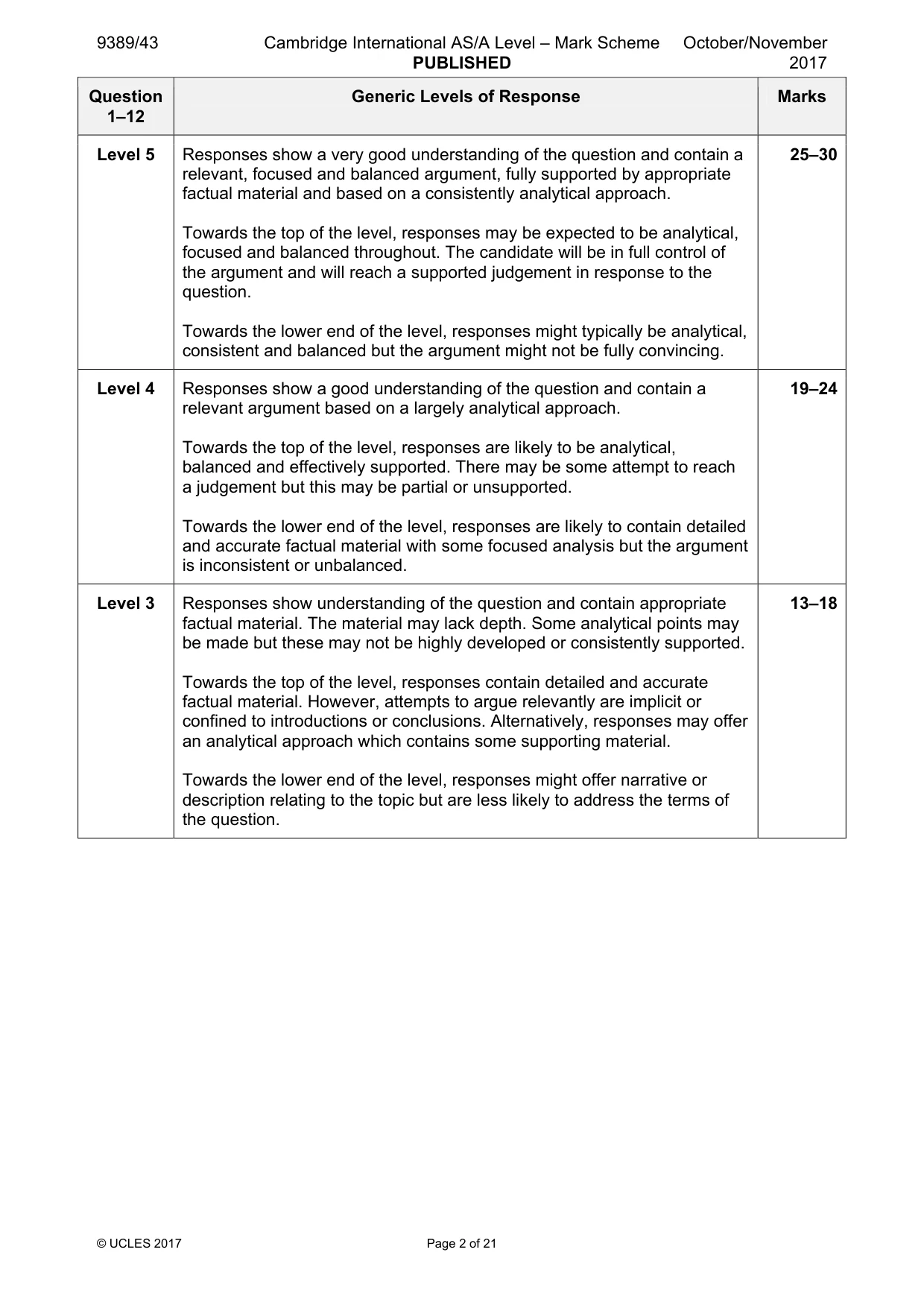
9389/43 Cambridge International AS/A Level – Mark Scheme PUBLISHED October/November 2017 © UCLES 2017 Page 2 of 21 Question 1–12 Generic Levels of Response Marks Level 5 Responses show a very good understanding of the question and contain a relevant, focused and balanced argument, fully supported by appropriate factual material and based on a consistently analytical approach. Towards the top of the level, responses may be expected to be analytical, focused and balanced throughout. The candidate will be in full control of the argument and will reach a supported judgement in response to the question. Towards the lower end of the level, responses might typically be analytical, consistent and balanced but the argument might not be fully convincing. 25–30 Level 4 Responses show a good understanding of the question and contain a relevant argument based on a largely analytical approach. Towards the top of the level, responses are likely to be analytical, balanced and effectively supported. There may be some attempt to reach a judgement but this may be partial or unsupported. Towards the lower end of the level, responses are likely to contain detailed and accurate factual material with some focused analysis but the argument is inconsistent or unbalanced. 19–24 Level 3 Responses show understanding of the question and contain appropriate factual material. The material may lack depth. Some analytical points may be made but these may not be highly developed or consistently supported. Towards the top of the level, responses contain detailed and accurate factual material. However, attempts to argue relevantly are implicit or confined to introductions or conclusions. Alternatively, responses may offer an analytical approach which contains some supporting material. Towards the lower end of the level, responses might offer narrative or description relating to the topic but are less likely to address the terms of the question. 13–18
Mark scheme, page 3
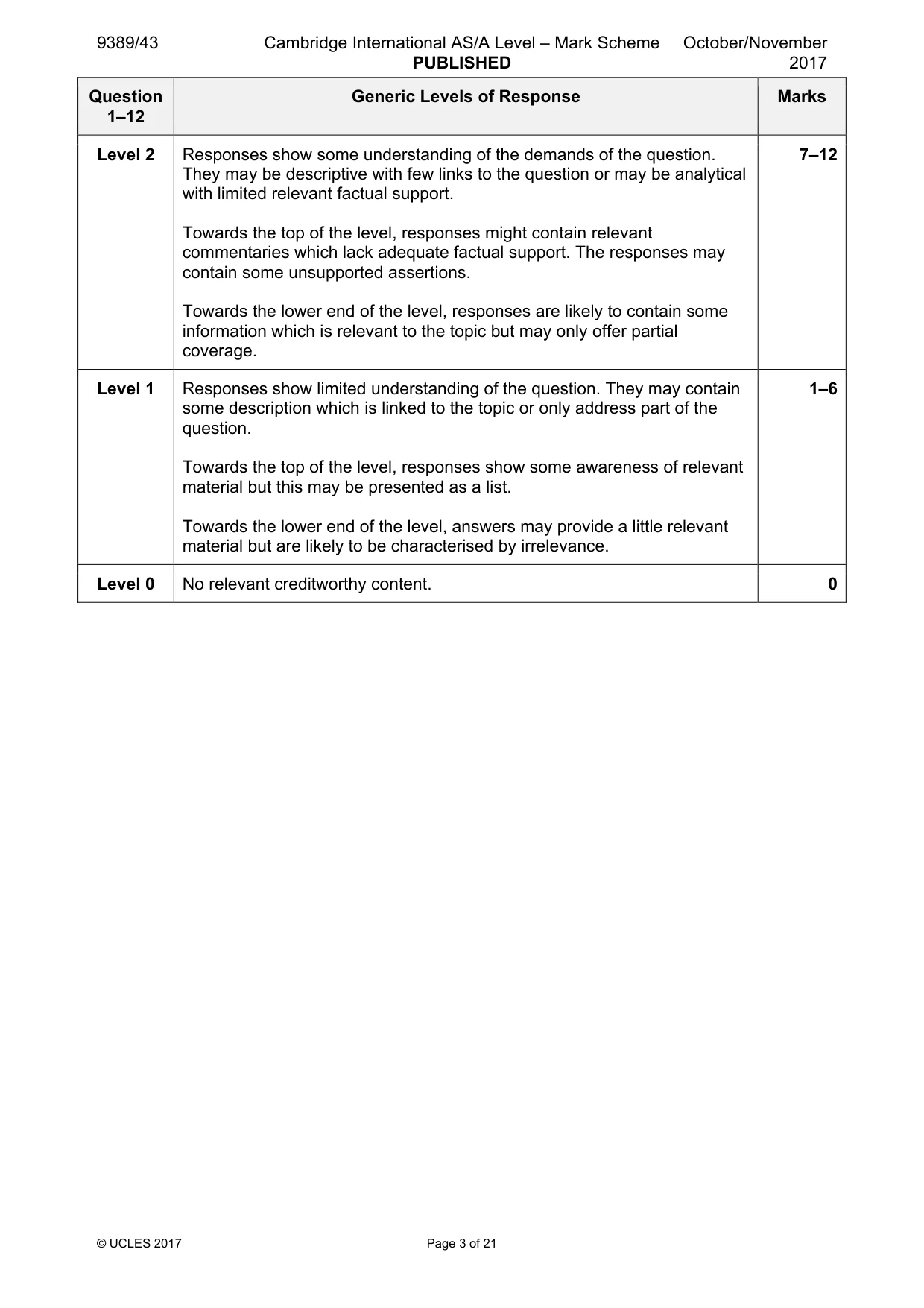
9389/43 Cambridge International AS/A Level – Mark Scheme PUBLISHED October/November 2017 © UCLES 2017 Page 3 of 21 Question 1–12 Generic Levels of Response Marks Level 2 Responses show some understanding of the demands of the question. They may be descriptive with few links to the question or may be analytical with limited relevant factual support. Towards the top of the level, responses might contain relevant commentaries which lack adequate factual support. The responses may contain some unsupported assertions. Towards the lower end of the level, responses are likely to contain some information which is relevant to the topic but may only offer partial coverage. 7–12 Level 1 Responses show limited understanding of the question. They may contain some description which is linked to the topic or only address part of the question. Towards the top of the level, responses show some awareness of relevant material but this may be presented as a list. Towards the lower end of the level, answers may provide a little relevant material but are likely to be characterised by irrelevance. 1–6 Level 0 No relevant creditworthy content. 0
Mark scheme, page 4
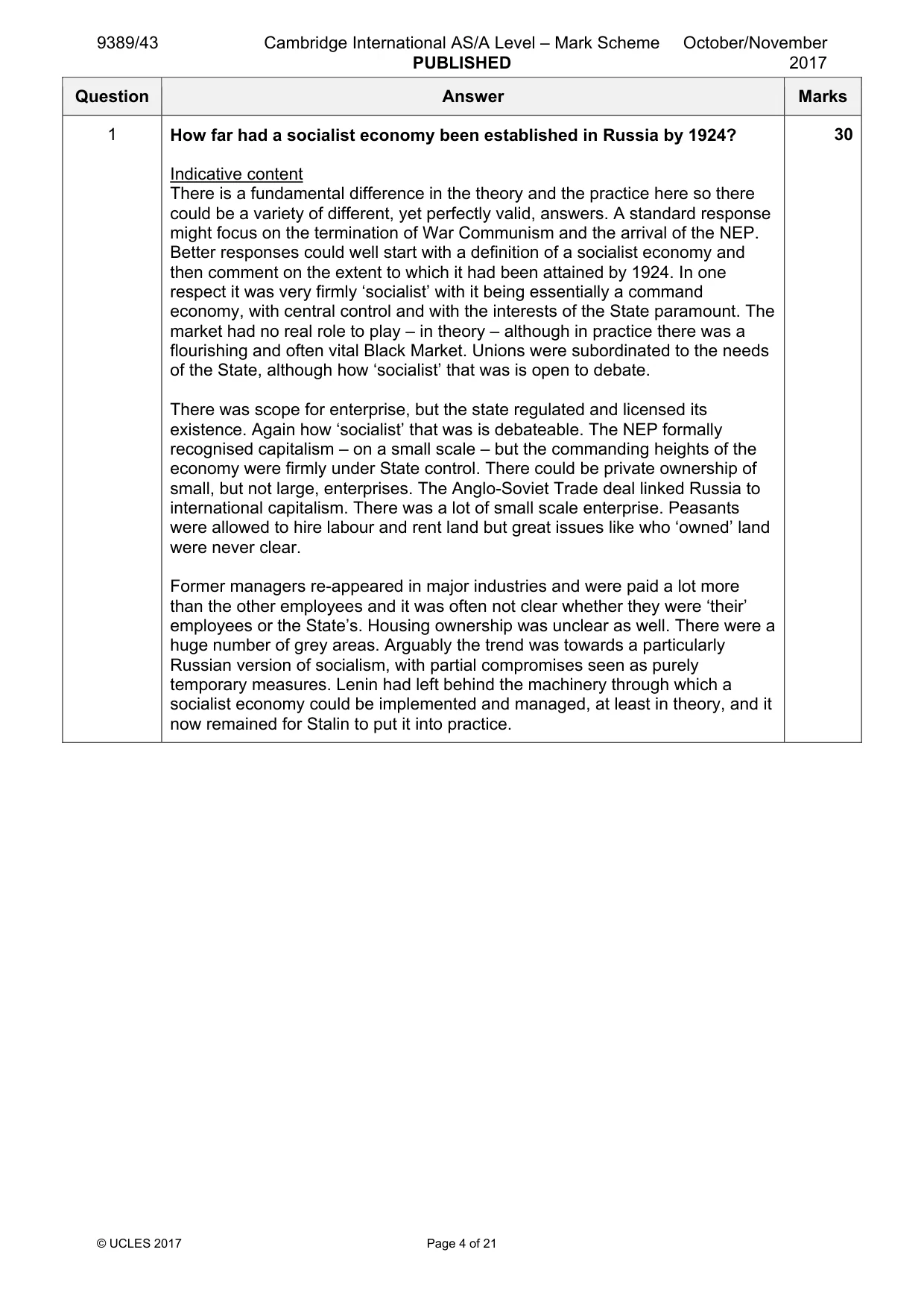
9389/43 Cambridge International AS/A Level – Mark Scheme PUBLISHED October/November 2017 © UCLES 2017 Page 4 of 21 Question Answer Marks 1 How far had a socialist economy been established in Russia by 1924? Indicative content There is a fundamental difference in the theory and the practice here so there could be a variety of different, yet perfectly valid, answers. A standard response might focus on the termination of War Communism and the arrival of the NEP. Better responses could well start with a definition of a socialist economy and then comment on the extent to which it had been attained by 1924. In one respect it was very firmly ‘socialist’ with it being essentially a command economy, with central control and with the interests of the State paramount. The market had no real role to play – in theory – although in practice there was a flourishing and often vital Black Market. Unions were subordinated to the needs of the State, although how ‘socialist’ that was is open to debate. There was scope for enterprise, but the state regulated and licensed its existence. Again how ‘socialist’ that was is debateable. The NEP formally recognised capitalism – on a small scale – but the commanding heights of the economy were firmly under State control. There could be private ownership of small, but not large, enterprises. The Anglo-Soviet Trade deal linked Russia to international capitalism. There was a lot of small scale enterprise. Peasants were allowed to hire labour and rent land but great issues like who ‘owned’ land were never clear. Former managers re-appeared in major industries and were paid a lot more than the other employees and it was often not clear whether they were ‘their’ employees or the State’s. Housing ownership was unclear as well. There were a huge number of grey areas. Arguably the trend was towards a particularly Russian version of socialism, with partial compromises seen as purely temporary measures. Lenin had left behind the machinery through which a socialist economy could be implemented and managed, at least in theory, and it now remained for Stalin to put it into practice. 30
Mark scheme, page 5
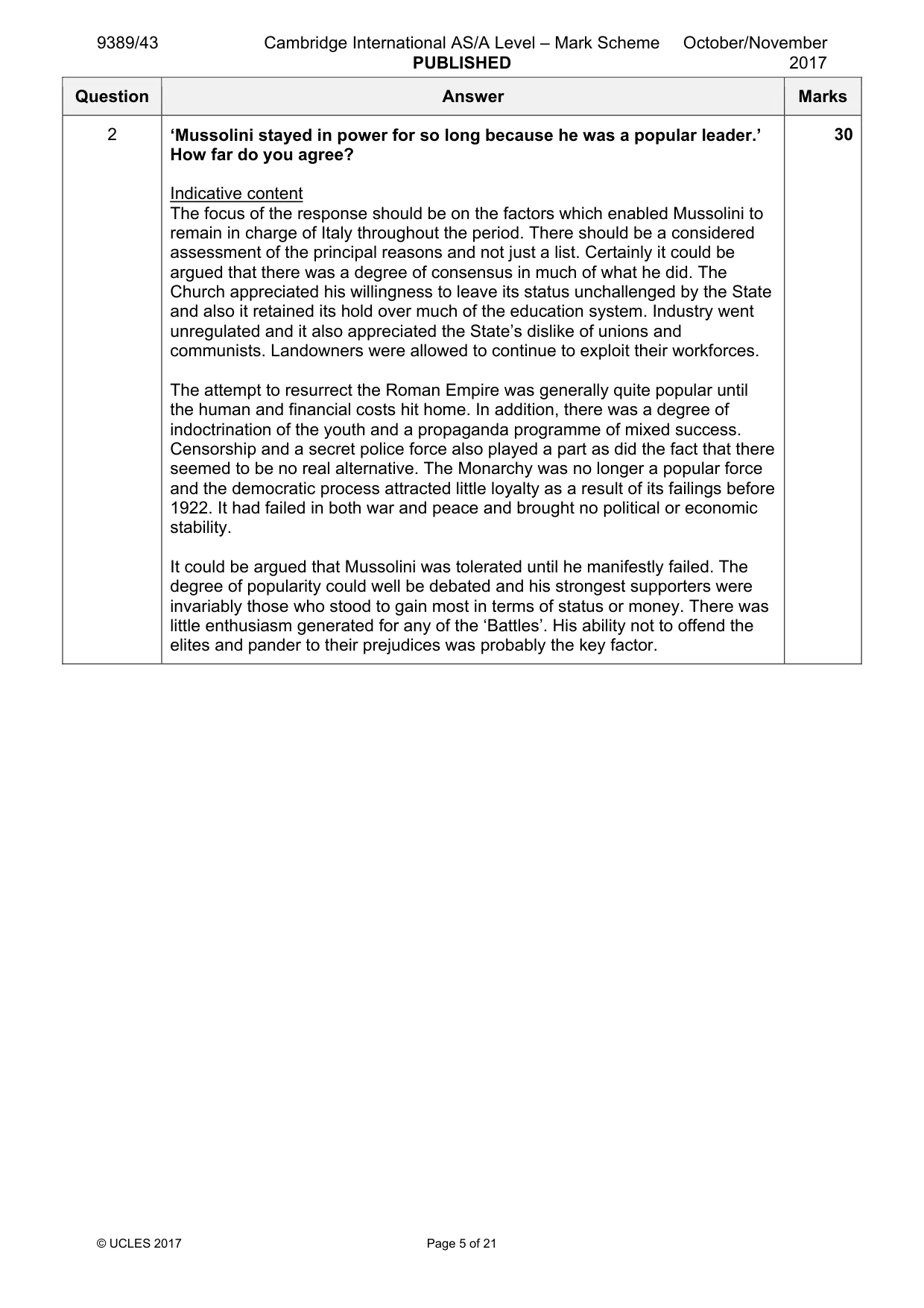
9389/43 Cambridge International AS/A Level – Mark Scheme PUBLISHED October/November 2017 © UCLES 2017 Page 5 of 21 Question Answer Marks 2 ‘Mussolini stayed in power for so long because he was a popular leader.’ How far do you agree? Indicative content The focus of the response should be on the factors which enabled Mussolini to remain in charge of Italy throughout the period. There should be a considered assessment of the principal reasons and not just a list. Certainly it could be argued that there was a degree of consensus in much of what he did. The Church appreciated his willingness to leave its status unchallenged by the State and also it retained its hold over much of the education system. Industry went unregulated and it also appreciated the State’s dislike of unions and communists. Landowners were allowed to continue to exploit their workforces. The attempt to resurrect the Roman Empire was generally quite popular until the human and financial costs hit home. In addition, there was a degree of indoctrination of the youth and a propaganda programme of mixed success. Censorship and a secret police force also played a part as did the fact that there seemed to be no real alternative. The Monarchy was no longer a popular force and the democratic process attracted little loyalty as a result of its failings before 1922. It had failed in both war and peace and brought no political or economic stability. It could be argued that Mussolini was tolerated until he manifestly failed. The degree of popularity could well be debated and his strongest supporters were invariably those who stood to gain most in terms of status or money. There was little enthusiasm generated for any of the ‘Battles’. His ability not to offend the elites and pander to their prejudices was probably the key factor. 30
Mark scheme, page 6
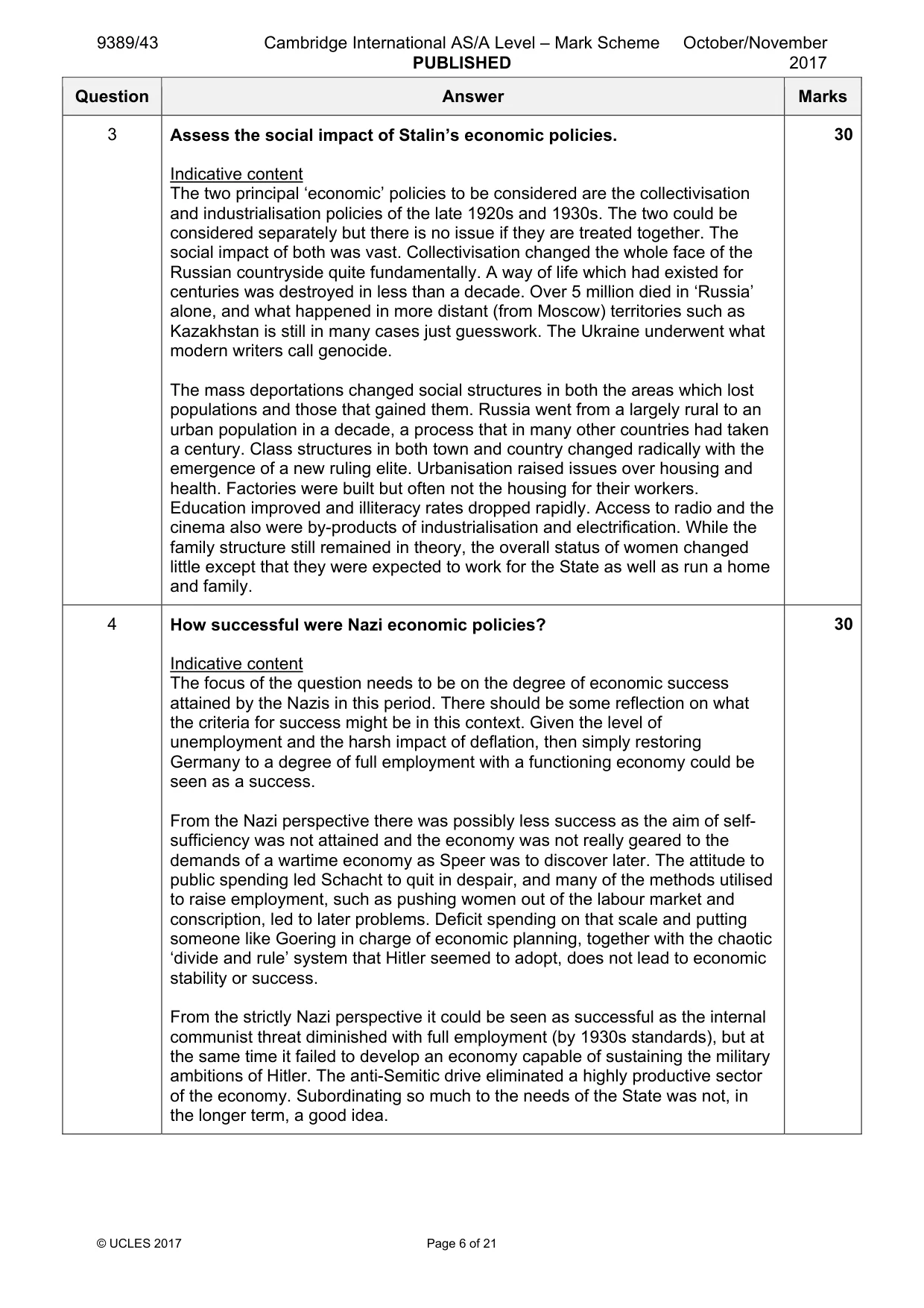
9389/43 Cambridge International AS/A Level – Mark Scheme PUBLISHED October/November 2017 © UCLES 2017 Page 6 of 21 Question Answer Marks 3 Assess the social impact of Stalin’s economic policies. Indicative content The two principal ‘economic’ policies to be considered are the collectivisation and industrialisation policies of the late 1920s and 1930s. The two could be considered separately but there is no issue if they are treated together. The social impact of both was vast. Collectivisation changed the whole face of the Russian countryside quite fundamentally. A way of life which had existed for centuries was destroyed in less than a decade. Over 5 million died in ‘Russia’ alone, and what happened in more distant (from Moscow) territories such as Kazakhstan is still in many cases just guesswork. The Ukraine underwent what modern writers call genocide. The mass deportations changed social structures in both the areas which lost populations and those that gained them. Russia went from a largely rural to an urban population in a decade, a process that in many other countries had taken a century. Class structures in both town and country changed radically with the emergence of a new ruling elite. Urbanisation raised issues over housing and health. Factories were built but often not the housing for their workers. Education improved and illiteracy rates dropped rapidly. Access to radio and the cinema also were by-products of industrialisation and electrification. While the family structure still remained in theory, the overall status of women changed little except that they were expected to work for the State as well as run a home and family. 30 4 How successful were Nazi economic policies? Indicative content The focus of the question needs to be on the degree of economic success attained by the Nazis in this period. There should be some reflection on what the criteria for success might be in this context. Given the level of unemployment and the harsh impact of deflation, then simply restoring Germany to a degree of full employment with a functioning economy could be seen as a success. From the Nazi perspective there was possibly less success as the aim of self- sufficiency was not attained and the economy was not really geared to the demands of a wartime economy as Speer was to discover later. The attitude to public spending led Schacht to quit in despair, and many of the methods utilised to raise employment, such as pushing women out of the labour market and conscription, led to later problems. Deficit spending on that scale and putting someone like Goering in charge of economic planning, together with the chaotic ‘divide and rule’ system that Hitler seemed to adopt, does not lead to economic stability or success. From the strictly Nazi perspective it could be seen as successful as the internal communist threat diminished with full employment (by 1930s standards), but at the same time it failed to develop an economy capable of sustaining the military ambitions of Hitler. The anti-Semitic drive eliminated a highly productive sector of the economy. Subordinating so much to the needs of the State was not, in the longer term, a good idea. 30
Mark scheme, page 7
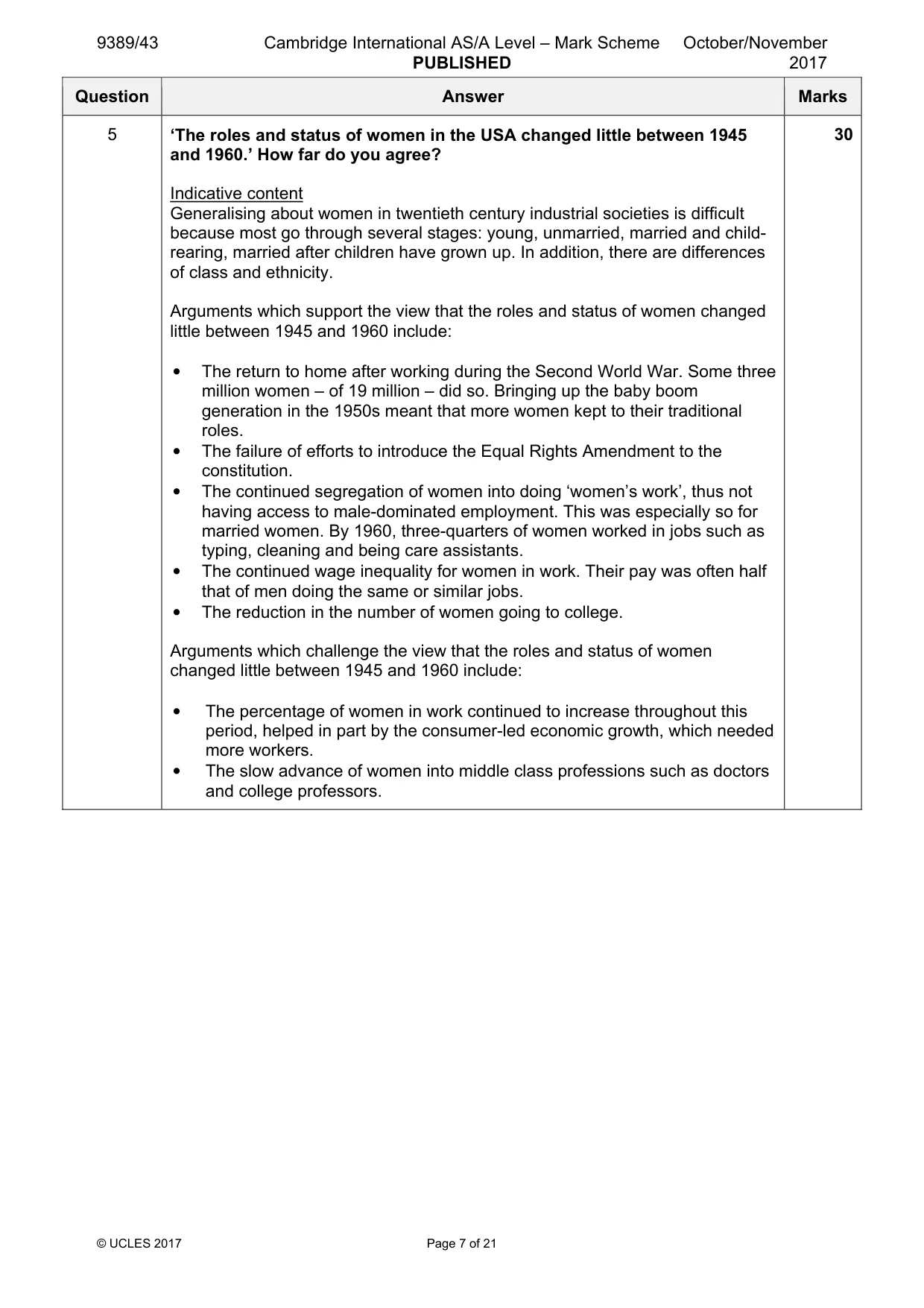
9389/43 Cambridge International AS/A Level – Mark Scheme PUBLISHED October/November 2017 © UCLES 2017 Page 7 of 21 Question Answer Marks 5 ‘The roles and status of women in the USA changed little between 1945 and 1960.’ How far do you agree? Indicative content Generalising about women in twentieth century industrial societies is difficult because most go through several stages: young, unmarried, married and child- rearing, married after children have grown up. In addition, there are differences of class and ethnicity. Arguments which support the view that the roles and status of women changed little between 1945 and 1960 include: • The return to home after working during the Second World War. Some three million women – of 19 million – did so. Bringing up the baby boom generation in the 1950s meant that more women kept to their traditional roles. • The failure of efforts to introduce the Equal Rights Amendment to the constitution. • The continued segregation of women into doing ‘women’s work’, thus not having access to male-dominated employment. This was especially so for married women. By 1960, three-quarters of women worked in jobs such as typing, cleaning and being care assistants. • The continued wage inequality for women in work. Their pay was often half that of men doing the same or similar jobs. • The reduction in the number of women going to college. Arguments which challenge the view that the roles and status of women changed little between 1945 and 1960 include: • The percentage of women in work continued to increase throughout this period, helped in part by the consumer-led economic growth, which needed more workers. • The slow advance of women into middle class professions such as doctors and college professors. 30
Mark scheme, page 8
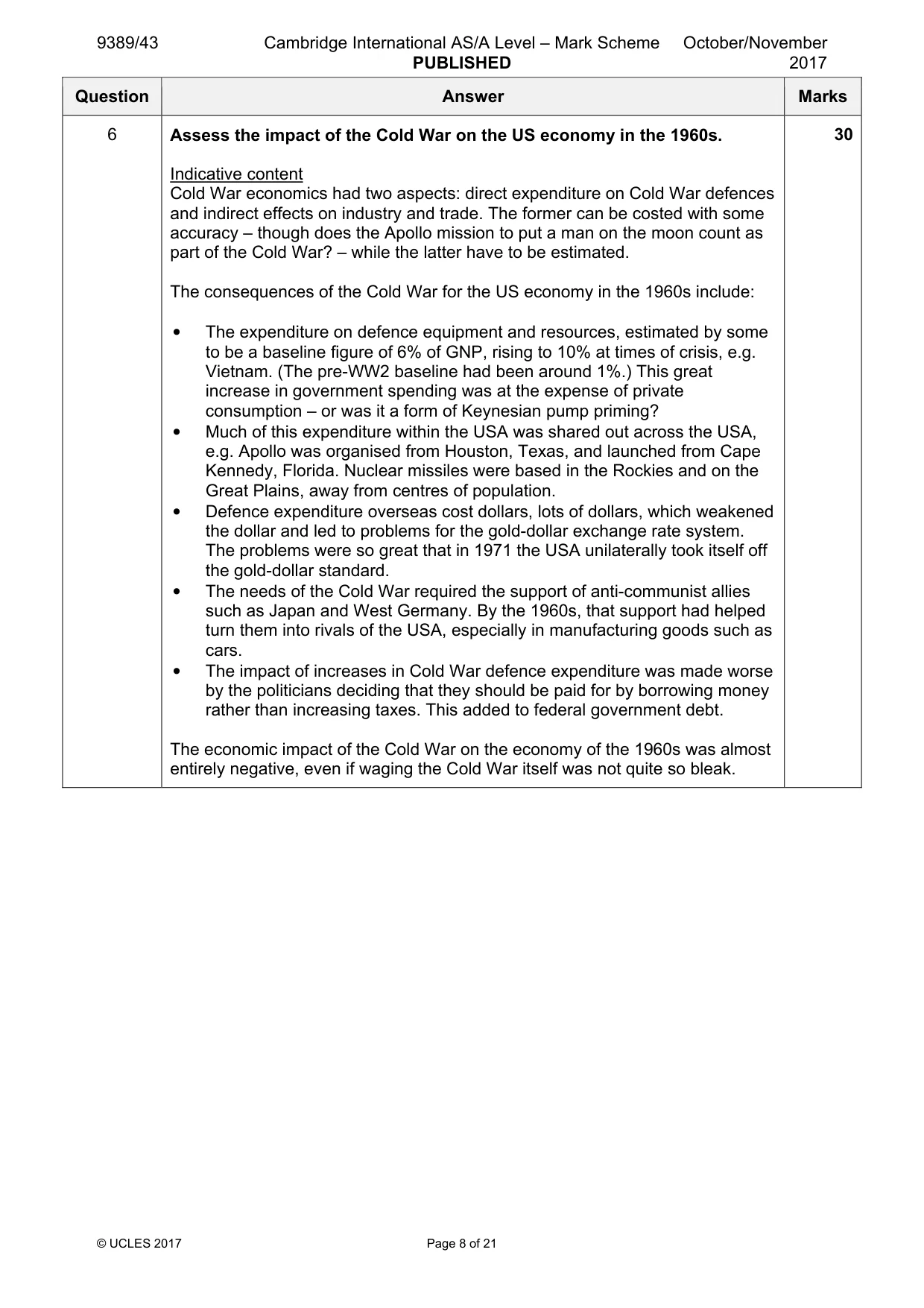
9389/43 Cambridge International AS/A Level – Mark Scheme PUBLISHED October/November 2017 © UCLES 2017 Page 8 of 21 Question Answer Marks 6 Assess the impact of the Cold War on the US economy in the 1960s. Indicative content Cold War economics had two aspects: direct expenditure on Cold War defences and indirect effects on industry and trade. The former can be costed with some accuracy – though does the Apollo mission to put a man on the moon count as part of the Cold War? – while the latter have to be estimated. The consequences of the Cold War for the US economy in the 1960s include: • The expenditure on defence equipment and resources, estimated by some to be a baseline figure of 6% of GNP, rising to 10% at times of crisis, e.g. Vietnam. (The pre-WW2 baseline had been around 1%.) This great increase in government spending was at the expense of private consumption – or was it a form of Keynesian pump priming? • Much of this expenditure within the USA was shared out across the USA, e.g. Apollo was organised from Houston, Texas, and launched from Cape Kennedy, Florida. Nuclear missiles were based in the Rockies and on the Great Plains, away from centres of population. • Defence expenditure overseas cost dollars, lots of dollars, which weakened the dollar and led to problems for the gold-dollar exchange rate system. The problems were so great that in 1971 the USA unilaterally took itself off the gold-dollar standard. • The needs of the Cold War required the support of anti-communist allies such as Japan and West Germany. By the 1960s, that support had helped turn them into rivals of the USA, especially in manufacturing goods such as cars. • The impact of increases in Cold War defence expenditure was made worse by the politicians deciding that they should be paid for by borrowing money rather than increasing taxes. This added to federal government debt. The economic impact of the Cold War on the economy of the 1960s was almost entirely negative, even if waging the Cold War itself was not quite so bleak. 30
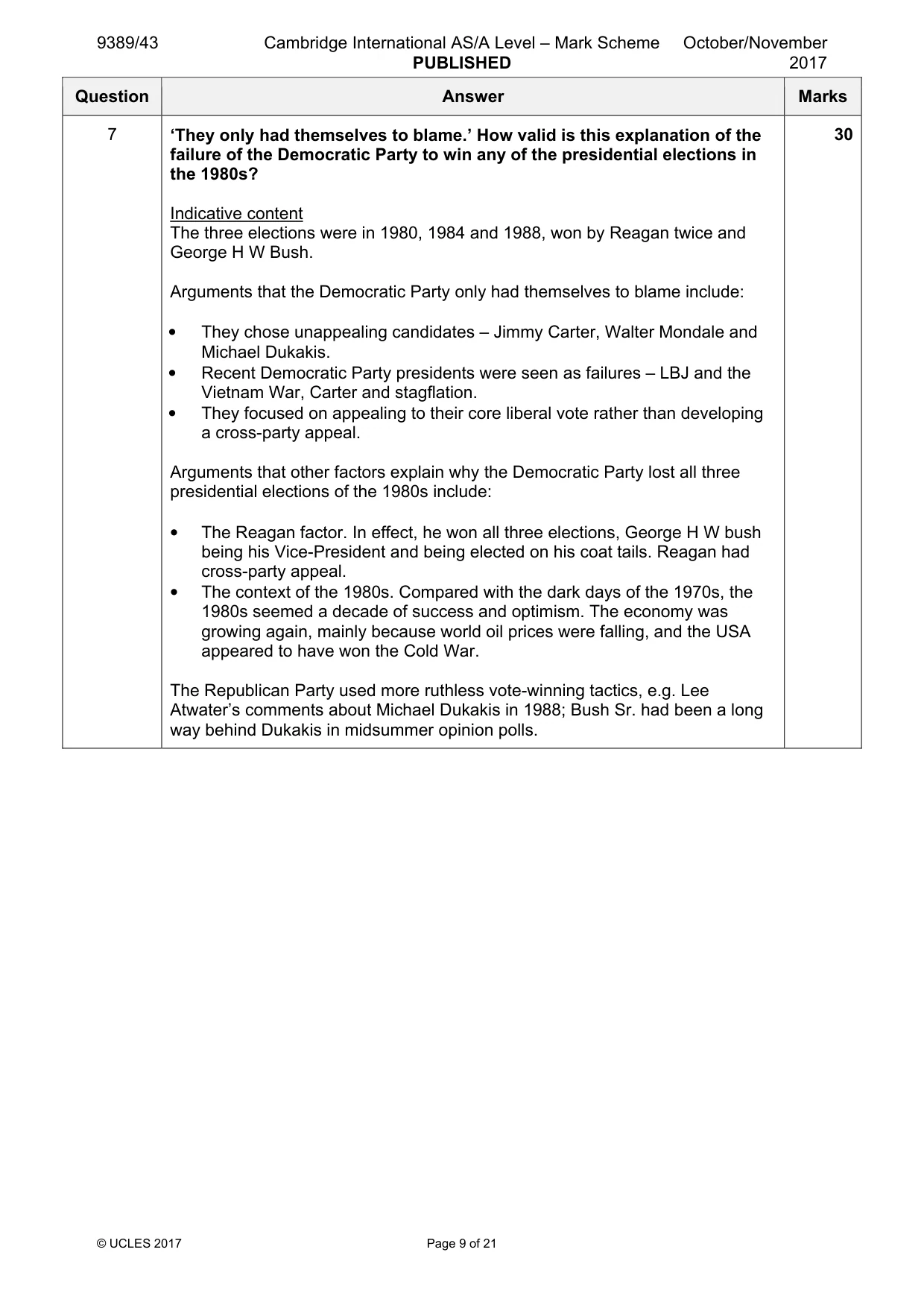
Mark scheme, page 9
9389/43 Cambridge International AS/A Level – Mark Scheme PUBLISHED October/November 2017 © UCLES 2017 Page 9 of 21 Question Answer Marks 7 ‘They only had themselves to blame.’ How valid is this explanation of the failure of the Democratic Party to win any of the presidential elections in the 1980s? Indicative content The three elections were in 1980, 1984 and 1988, won by Reagan twice and George H W Bush. Arguments that the Democratic Party only had themselves to blame include: • They chose unappealing candidates – Jimmy Carter, Walter Mondale and Michael Dukakis. • Recent Democratic Party presidents were seen as failures – LBJ and the Vietnam War, Carter and stagflation. • They focused on appealing to their core liberal vote rather than developing a cross-party appeal. Arguments that other factors explain why the Democratic Party lost all three presidential elections of the 1980s include: • The Reagan factor. In effect, he won all three elections, George H W bush being his Vice-President and being elected on his coat tails. Reagan had cross-party appeal. • The context of the 1980s. Compared with the dark days of the 1970s, the 1980s seemed a decade of success and optimism. The economy was growing again, mainly because world oil prices were falling, and the USA appeared to have won the Cold War. The Republican Party used more ruthless vote-winning tactics, e.g. Lee Atwater’s comments about Michael Dukakis in 1988; Bush Sr. had been a long way behind Dukakis in midsummer opinion polls. 30
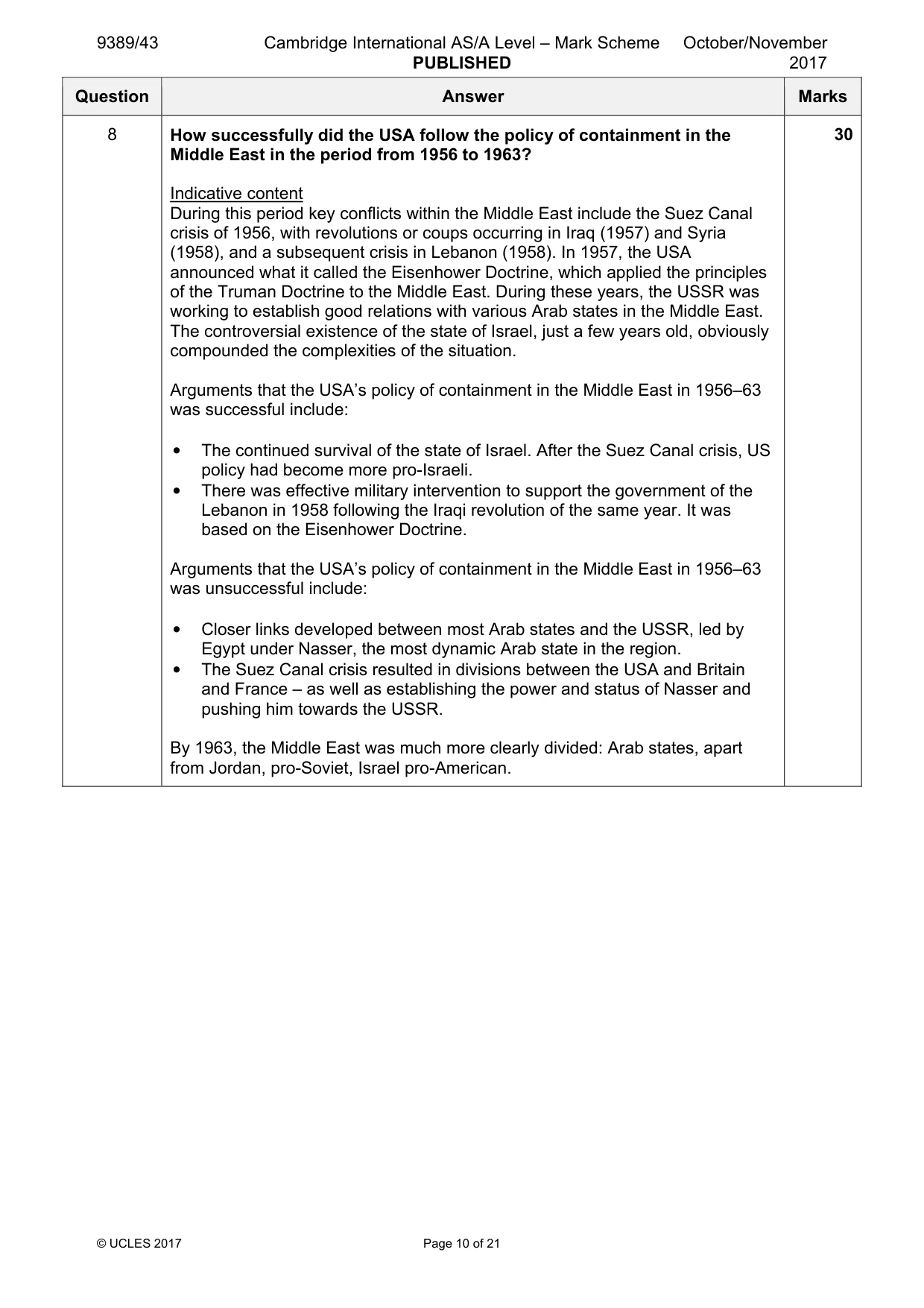
Mark scheme, page 10
9389/43 Cambridge International AS/A Level – Mark Scheme PUBLISHED October/November 2017 © UCLES 2017 Page 10 of 21 Question Answer Marks 8 How successfully did the USA follow the policy of containment in the Middle East in the period from 1956 to 1963? Indicative content During this period key conflicts within the Middle East include the Suez Canal crisis of 1956, with revolutions or coups occurring in Iraq (1957) and Syria (1958), and a subsequent crisis in Lebanon (1958). In 1957, the USA announced what it called the Eisenhower Doctrine, which applied the principles of the Truman Doctrine to the Middle East. During these years, the USSR was working to establish good relations with various Arab states in the Middle East. The controversial existence of the state of Israel, just a few years old, obviously compounded the complexities of the situation. Arguments that the USA’s policy of containment in the Middle East in 1956–63 was successful include: • The continued survival of the state of Israel. After the Suez Canal crisis, US policy had become more pro-Israeli. • There was effective military intervention to support the government of the Lebanon in 1958 following the Iraqi revolution of the same year. It was based on the Eisenhower Doctrine. Arguments that the USA’s policy of containment in the Middle East in 1956–63 was unsuccessful include: • Closer links developed between most Arab states and the USSR, led by Egypt under Nasser, the most dynamic Arab state in the region. • The Suez Canal crisis resulted in divisions between the USA and Britain and France – as well as establishing the power and status of Nasser and pushing him towards the USSR. By 1963, the Middle East was much more clearly divided: Arab states, apart from Jordan, pro-Soviet, Israel pro-American. 30
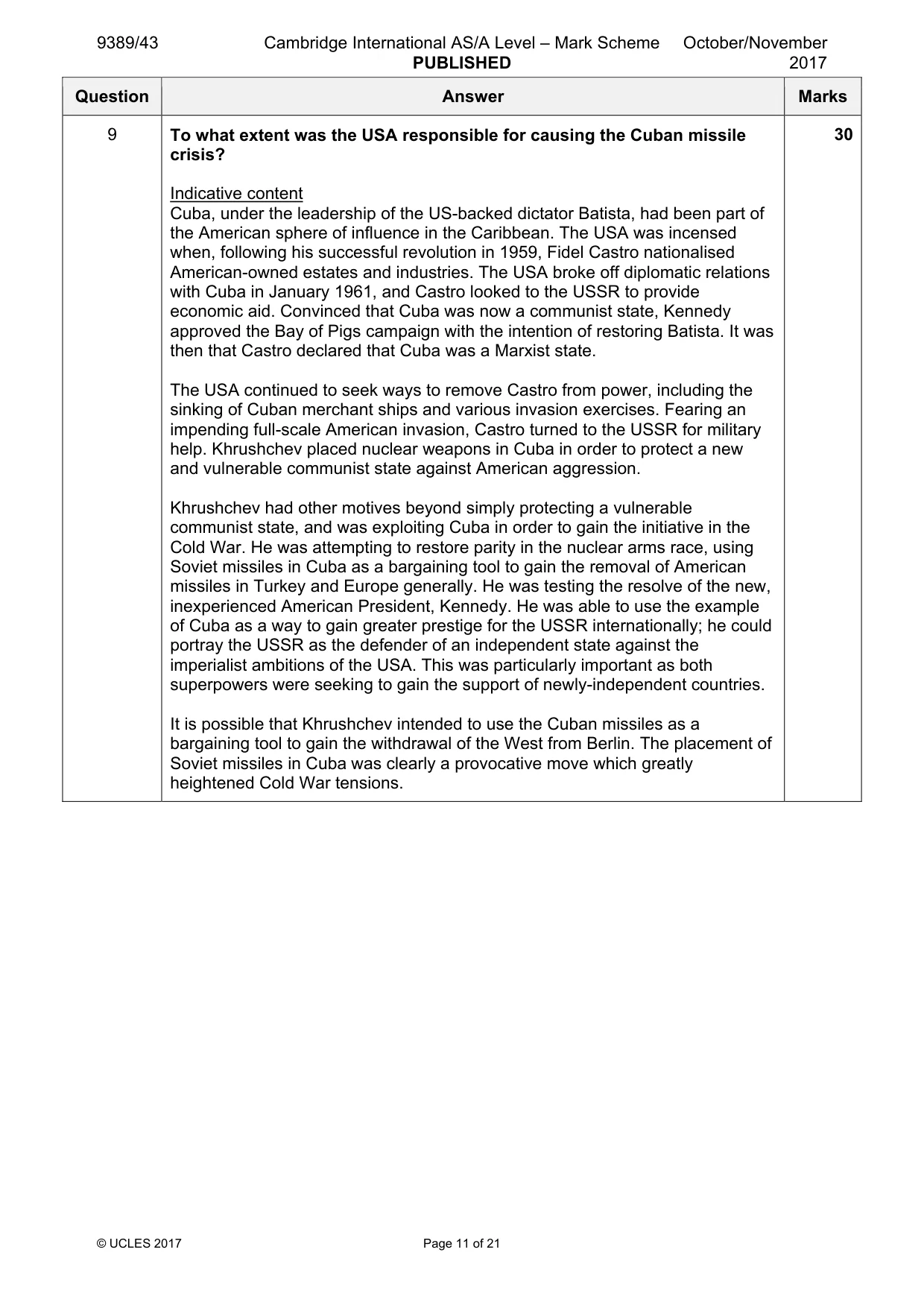
Mark scheme, page 11
9389/43 Cambridge International AS/A Level – Mark Scheme PUBLISHED October/November 2017 © UCLES 2017 Page 11 of 21 Question Answer Marks 9 To what extent was the USA responsible for causing the Cuban missile crisis? Indicative content Cuba, under the leadership of the US-backed dictator Batista, had been part of the American sphere of influence in the Caribbean. The USA was incensed when, following his successful revolution in 1959, Fidel Castro nationalised American-owned estates and industries. The USA broke off diplomatic relations with Cuba in January 1961, and Castro looked to the USSR to provide economic aid. Convinced that Cuba was now a communist state, Kennedy approved the Bay of Pigs campaign with the intention of restoring Batista. It was then that Castro declared that Cuba was a Marxist state. The USA continued to seek ways to remove Castro from power, including the sinking of Cuban merchant ships and various invasion exercises. Fearing an impending full-scale American invasion, Castro turned to the USSR for military help. Khrushchev placed nuclear weapons in Cuba in order to protect a new and vulnerable communist state against American aggression. Khrushchev had other motives beyond simply protecting a vulnerable communist state, and was exploiting Cuba in order to gain the initiative in the Cold War. He was attempting to restore parity in the nuclear arms race, using Soviet missiles in Cuba as a bargaining tool to gain the removal of American missiles in Turkey and Europe generally. He was testing the resolve of the new, inexperienced American President, Kennedy. He was able to use the example of Cuba as a way to gain greater prestige for the USSR internationally; he could portray the USSR as the defender of an independent state against the imperialist ambitions of the USA. This was particularly important as both superpowers were seeking to gain the support of newly-independent countries. It is possible that Khrushchev intended to use the Cuban missiles as a bargaining tool to gain the withdrawal of the West from Berlin. The placement of Soviet missiles in Cuba was clearly a provocative move which greatly heightened Cold War tensions. 30
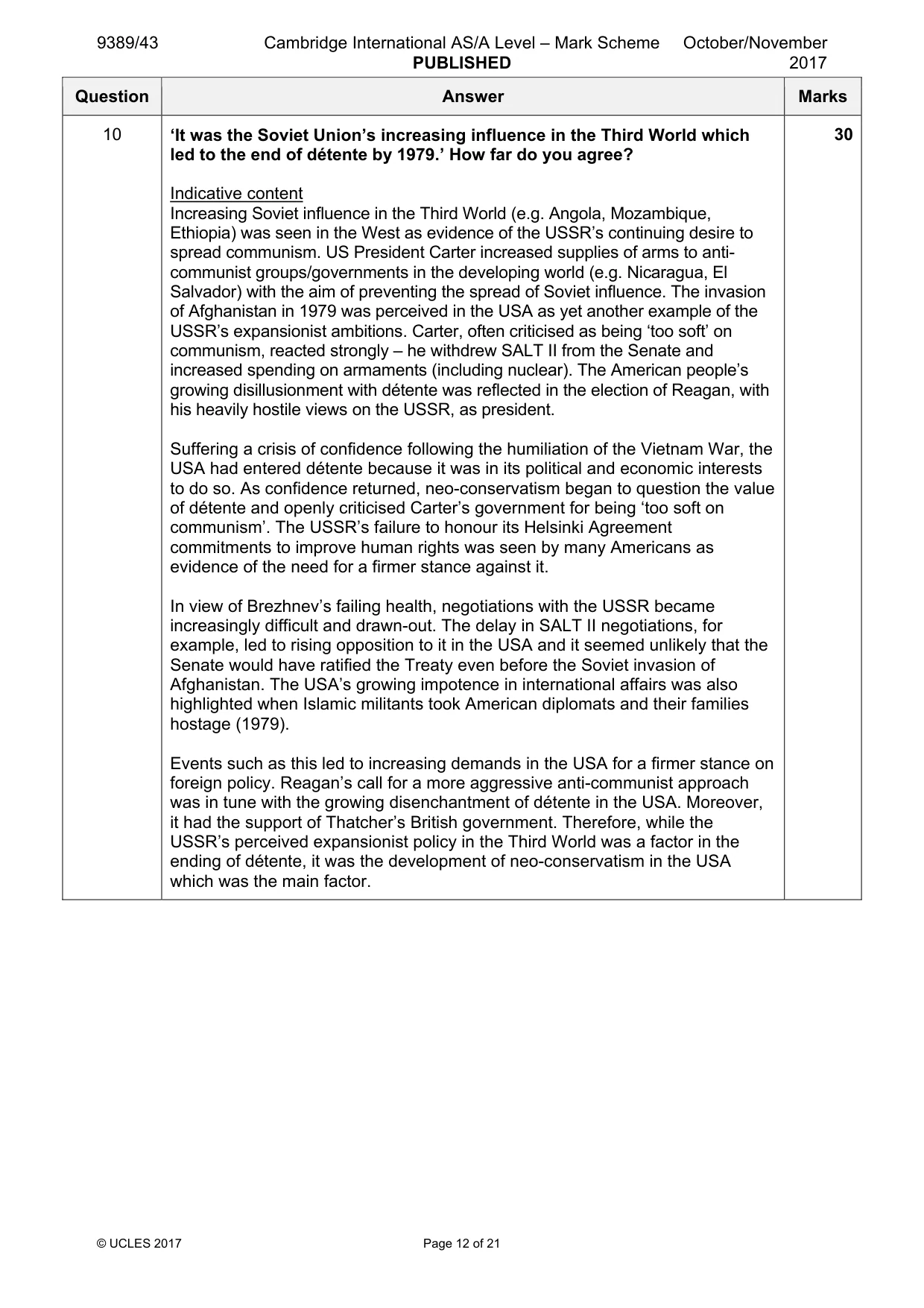
Mark scheme, page 12
9389/43 Cambridge International AS/A Level – Mark Scheme PUBLISHED October/November 2017 © UCLES 2017 Page 12 of 21 Question Answer Marks 10 ‘It was the Soviet Union’s increasing influence in the Third World which led to the end of détente by 1979.’ How far do you agree? Indicative content Increasing Soviet influence in the Third World (e.g. Angola, Mozambique, Ethiopia) was seen in the West as evidence of the USSR’s continuing desire to spread communism. US President Carter increased supplies of arms to anti- communist groups/governments in the developing world (e.g. Nicaragua, El Salvador) with the aim of preventing the spread of Soviet influence. The invasion of Afghanistan in 1979 was perceived in the USA as yet another example of the USSR’s expansionist ambitions. Carter, often criticised as being ‘too soft’ on communism, reacted strongly – he withdrew SALT II from the Senate and increased spending on armaments (including nuclear). The American people’s growing disillusionment with détente was reflected in the election of Reagan, with his heavily hostile views on the USSR, as president. Suffering a crisis of confidence following the humiliation of the Vietnam War, the USA had entered détente because it was in its political and economic interests to do so. As confidence returned, neo-conservatism began to question the value of détente and openly criticised Carter’s government for being ‘too soft on communism’. The USSR’s failure to honour its Helsinki Agreement commitments to improve human rights was seen by many Americans as evidence of the need for a firmer stance against it. In view of Brezhnev’s failing health, negotiations with the USSR became increasingly difficult and drawn-out. The delay in SALT II negotiations, for example, led to rising opposition to it in the USA and it seemed unlikely that the Senate would have ratified the Treaty even before the Soviet invasion of Afghanistan. The USA’s growing impotence in international affairs was also highlighted when Islamic militants took American diplomats and their families hostage (1979). Events such as this led to increasing demands in the USA for a firmer stance on foreign policy. Reagan’s call for a more aggressive anti-communist approach was in tune with the growing disenchantment of détente in the USA. Moreover, it had the support of Thatcher’s British government. Therefore, while the USSR’s perceived expansionist policy in the Third World was a factor in the ending of détente, it was the development of neo-conservatism in the USA which was the main factor. 30
Mark scheme, page 13
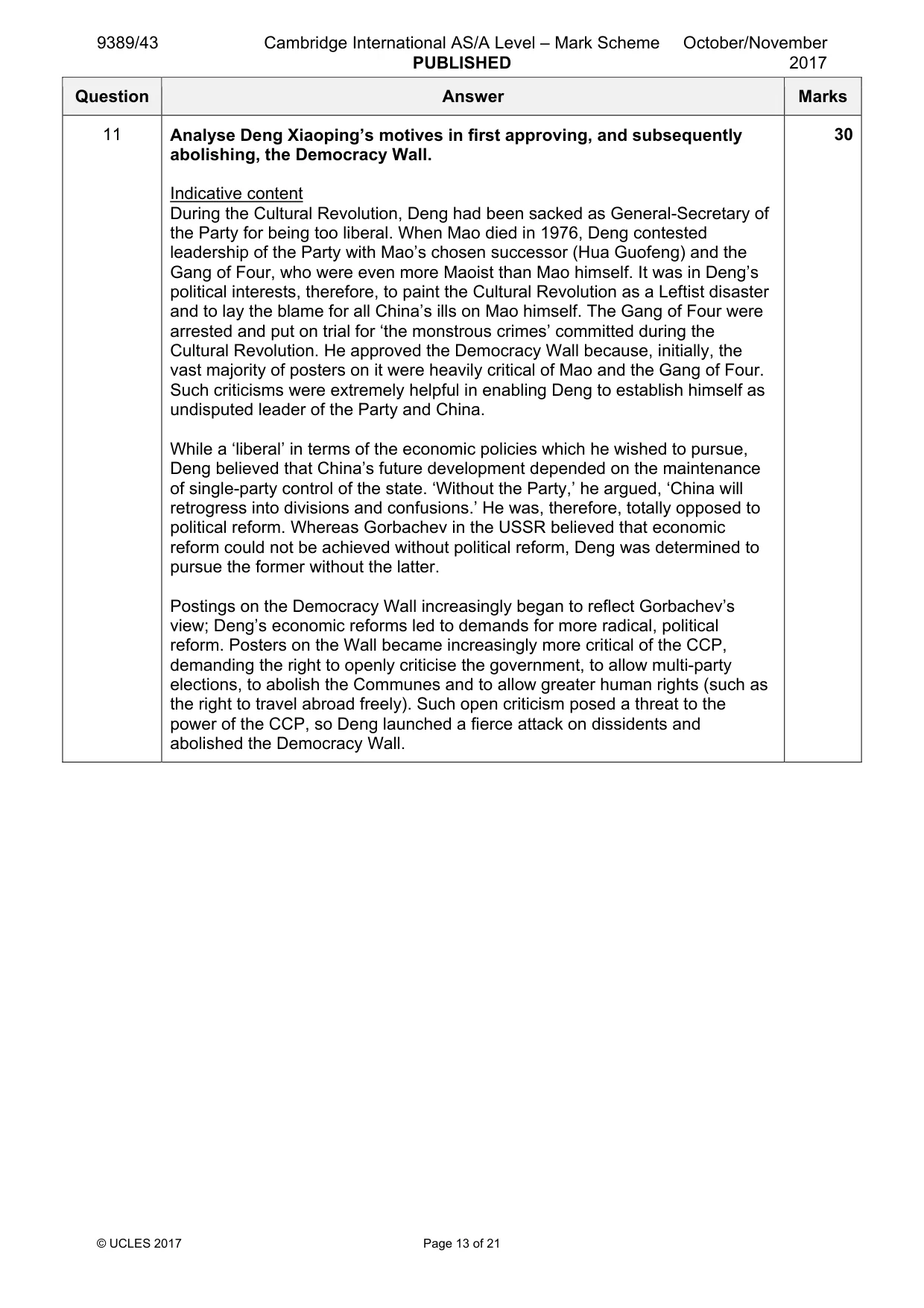
9389/43 Cambridge International AS/A Level – Mark Scheme PUBLISHED October/November 2017 © UCLES 2017 Page 13 of 21 Question Answer Marks 11 Analyse Deng Xiaoping’s motives in first approving, and subsequently abolishing, the Democracy Wall. Indicative content During the Cultural Revolution, Deng had been sacked as General-Secretary of the Party for being too liberal. When Mao died in 1976, Deng contested leadership of the Party with Mao’s chosen successor (Hua Guofeng) and the Gang of Four, who were even more Maoist than Mao himself. It was in Deng’s political interests, therefore, to paint the Cultural Revolution as a Leftist disaster and to lay the blame for all China’s ills on Mao himself. The Gang of Four were arrested and put on trial for ‘the monstrous crimes’ committed during the Cultural Revolution. He approved the Democracy Wall because, initially, the vast majority of posters on it were heavily critical of Mao and the Gang of Four. Such criticisms were extremely helpful in enabling Deng to establish himself as undisputed leader of the Party and China. While a ‘liberal’ in terms of the economic policies which he wished to pursue, Deng believed that China’s future development depended on the maintenance of single-party control of the state. ‘Without the Party,’ he argued, ‘China will retrogress into divisions and confusions.’ He was, therefore, totally opposed to political reform. Whereas Gorbachev in the USSR believed that economic reform could not be achieved without political reform, Deng was determined to pursue the former without the latter. Postings on the Democracy Wall increasingly began to reflect Gorbachev’s view; Deng’s economic reforms led to demands for more radical, political reform. Posters on the Wall became increasingly more critical of the CCP, demanding the right to openly criticise the government, to allow multi-party elections, to abolish the Communes and to allow greater human rights (such as the right to travel abroad freely). Such open criticism posed a threat to the power of the CCP, so Deng launched a fierce attack on dissidents and abolished the Democracy Wall. 30
Mark scheme, page 14
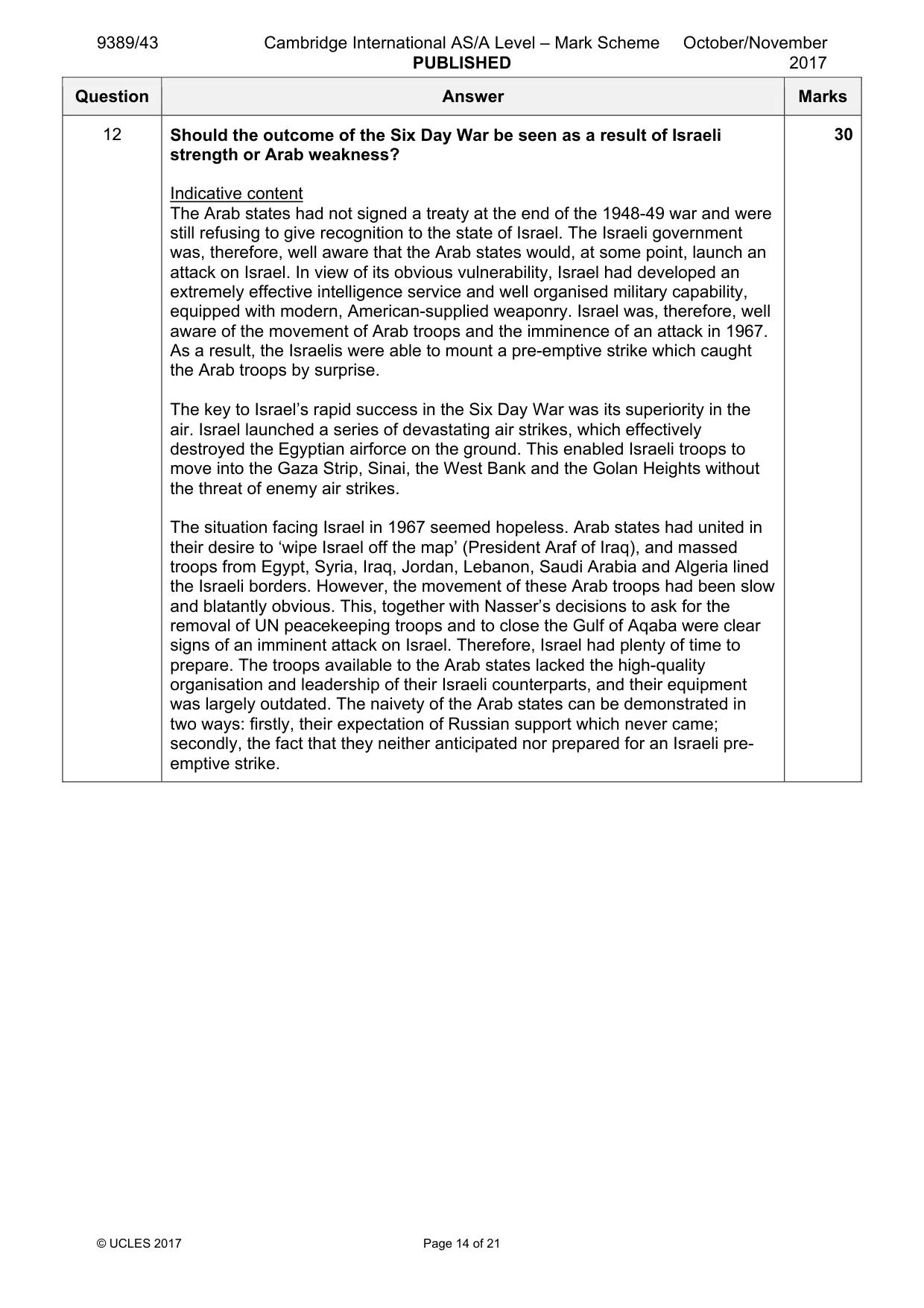
9389/43 Cambridge International AS/A Level – Mark Scheme PUBLISHED October/November 2017 © UCLES 2017 Page 14 of 21 Question Answer Marks 12 Should the outcome of the Six Day War be seen as a result of Israeli strength or Arab weakness? Indicative content The Arab states had not signed a treaty at the end of the 1948-49 war and were still refusing to give recognition to the state of Israel. The Israeli government was, therefore, well aware that the Arab states would, at some point, launch an attack on Israel. In view of its obvious vulnerability, Israel had developed an extremely effective intelligence service and well organised military capability, equipped with modern, American-supplied weaponry. Israel was, therefore, well aware of the movement of Arab troops and the imminence of an attack in 1967. As a result, the Israelis were able to mount a pre-emptive strike which caught the Arab troops by surprise. The key to Israel’s rapid success in the Six Day War was its superiority in the air. Israel launched a series of devastating air strikes, which effectively destroyed the Egyptian airforce on the ground. This enabled Israeli troops to move into the Gaza Strip, Sinai, the West Bank and the Golan Heights without the threat of enemy air strikes. The situation facing Israel in 1967 seemed hopeless. Arab states had united in their desire to ‘wipe Israel off the map’ (President Araf of Iraq), and massed troops from Egypt, Syria, Iraq, Jordan, Lebanon, Saudi Arabia and Algeria lined the Israeli borders. However, the movement of these Arab troops had been slow and blatantly obvious. This, together with Nasser’s decisions to ask for the removal of UN peacekeeping troops and to close the Gulf of Aqaba were clear signs of an imminent attack on Israel. Therefore, Israel had plenty of time to prepare. The troops available to the Arab states lacked the high-quality organisation and leadership of their Israeli counterparts, and their equipment was largely outdated. The naivety of the Arab states can be demonstrated in two ways: firstly, their expectation of Russian support which never came; secondly, the fact that they neither anticipated nor prepared for an Israeli pre- emptive strike. 30
Mark scheme, page 15
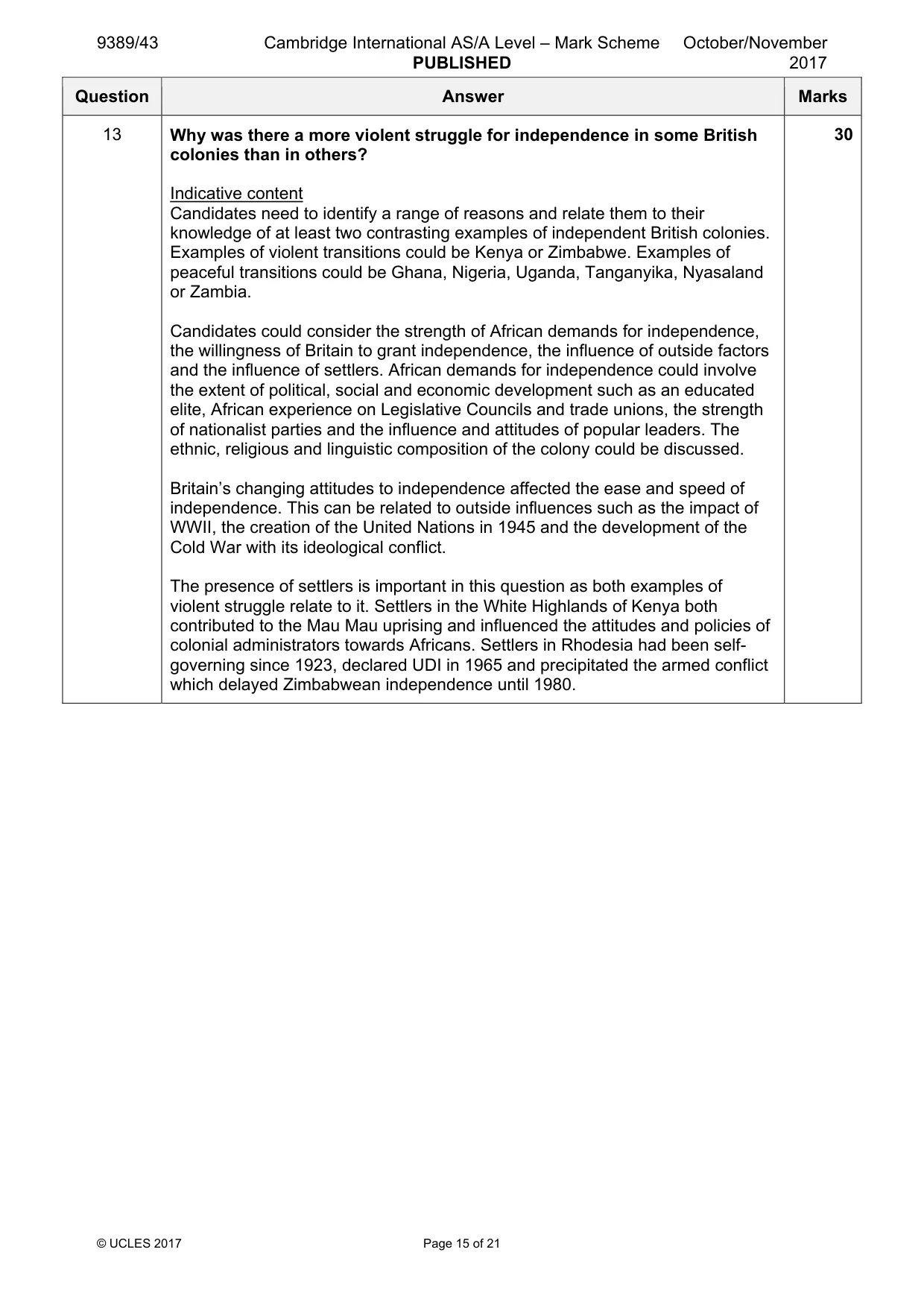
9389/43 Cambridge International AS/A Level – Mark Scheme PUBLISHED October/November 2017 © UCLES 2017 Page 15 of 21 Question Answer Marks 13 Why was there a more violent struggle for independence in some British colonies than in others? Indicative content Candidates need to identify a range of reasons and relate them to their knowledge of at least two contrasting examples of independent British colonies. Examples of violent transitions could be Kenya or Zimbabwe. Examples of peaceful transitions could be Ghana, Nigeria, Uganda, Tanganyika, Nyasaland or Zambia. Candidates could consider the strength of African demands for independence, the willingness of Britain to grant independence, the influence of outside factors and the influence of settlers. African demands for independence could involve the extent of political, social and economic development such as an educated elite, African experience on Legislative Councils and trade unions, the strength of nationalist parties and the influence and attitudes of popular leaders. The ethnic, religious and linguistic composition of the colony could be discussed. Britain’s changing attitudes to independence affected the ease and speed of independence. This can be related to outside influences such as the impact of WWII, the creation of the United Nations in 1945 and the development of the Cold War with its ideological conflict. The presence of settlers is important in this question as both examples of violent struggle relate to it. Settlers in the White Highlands of Kenya both contributed to the Mau Mau uprising and influenced the attitudes and policies of colonial administrators towards Africans. Settlers in Rhodesia had been self- governing since 1923, declared UDI in 1965 and precipitated the armed conflict which delayed Zimbabwean independence until 1980. 30
Mark scheme, page 16
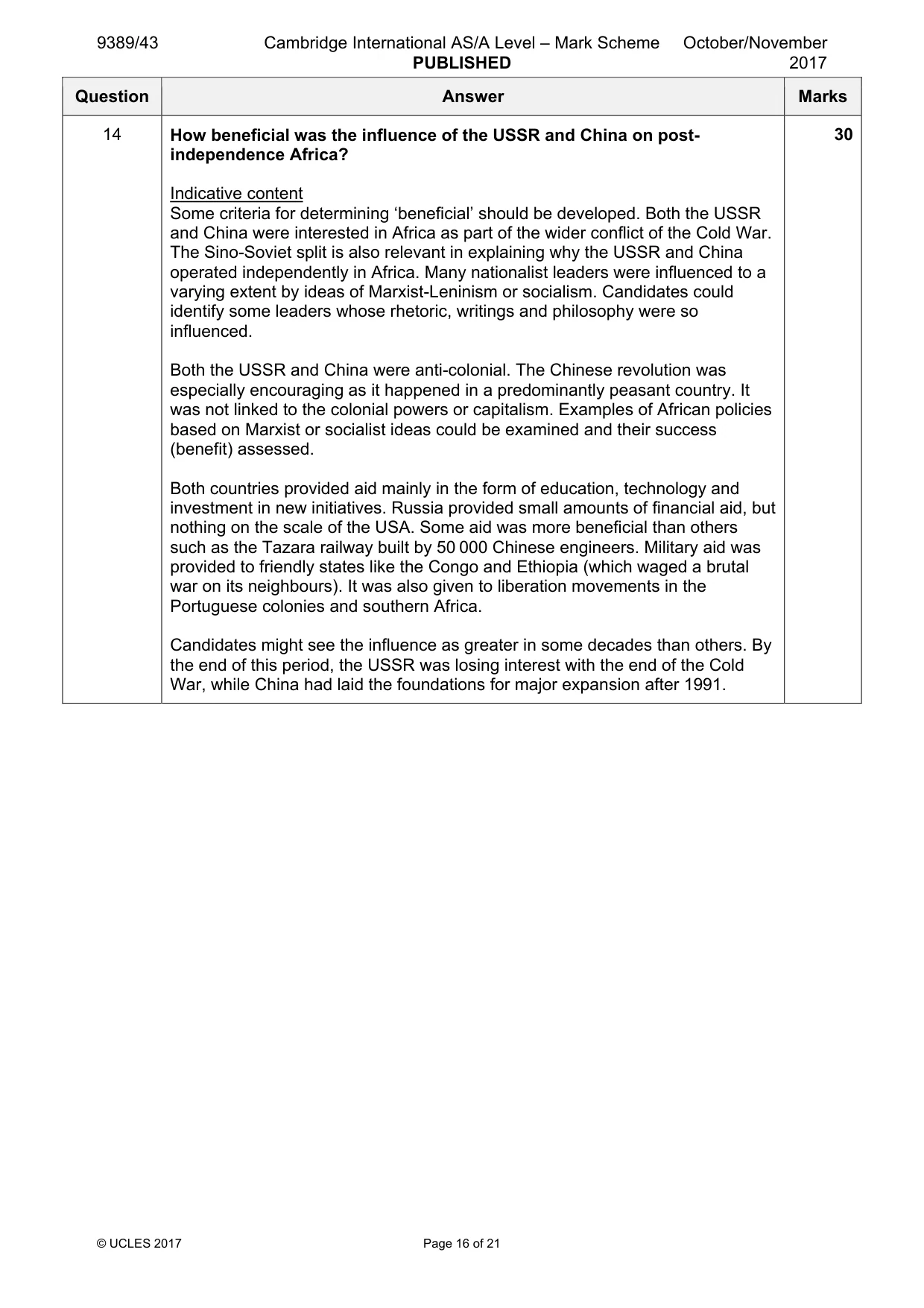
9389/43 Cambridge International AS/A Level – Mark Scheme PUBLISHED October/November 2017 © UCLES 2017 Page 16 of 21 Question Answer Marks 14 How beneficial was the influence of the USSR and China on post- independence Africa? Indicative content Some criteria for determining ‘beneficial’ should be developed. Both the USSR and China were interested in Africa as part of the wider conflict of the Cold War. The Sino-Soviet split is also relevant in explaining why the USSR and China operated independently in Africa. Many nationalist leaders were influenced to a varying extent by ideas of Marxist-Leninism or socialism. Candidates could identify some leaders whose rhetoric, writings and philosophy were so influenced. Both the USSR and China were anti-colonial. The Chinese revolution was especially encouraging as it happened in a predominantly peasant country. It was not linked to the colonial powers or capitalism. Examples of African policies based on Marxist or socialist ideas could be examined and their success (benefit) assessed. Both countries provided aid mainly in the form of education, technology and investment in new initiatives. Russia provided small amounts of financial aid, but nothing on the scale of the USA. Some aid was more beneficial than others such as the Tazara railway built by 50 000 Chinese engineers. Military aid was provided to friendly states like the Congo and Ethiopia (which waged a brutal war on its neighbours). It was also given to liberation movements in the Portuguese colonies and southern Africa. Candidates might see the influence as greater in some decades than others. By the end of this period, the USSR was losing interest with the end of the Cold War, while China had laid the foundations for major expansion after 1991. 30
Mark scheme, page 17
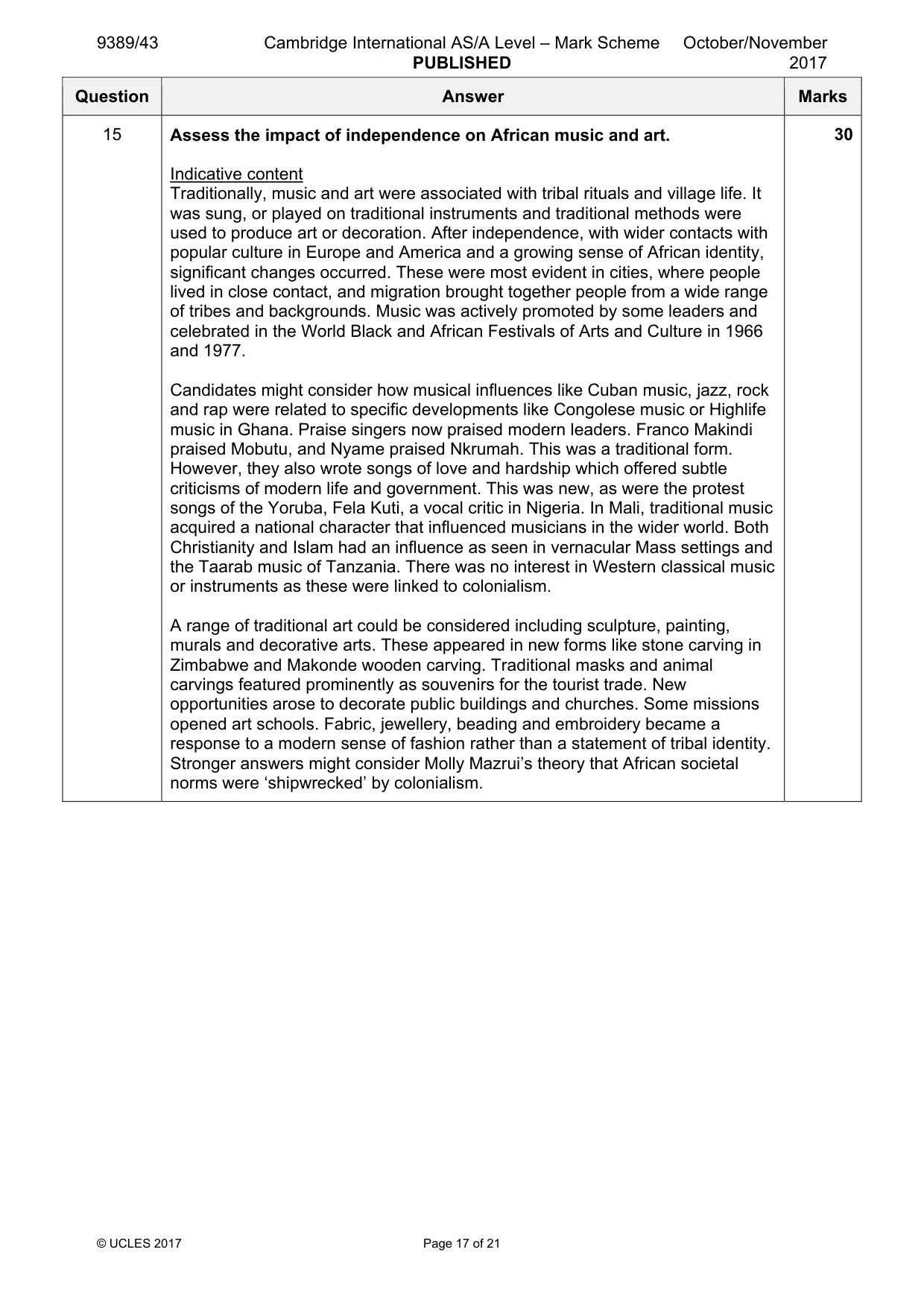
9389/43 Cambridge International AS/A Level – Mark Scheme PUBLISHED October/November 2017 © UCLES 2017 Page 17 of 21 Question Answer Marks 15 Assess the impact of independence on African music and art. Indicative content Traditionally, music and art were associated with tribal rituals and village life. It was sung, or played on traditional instruments and traditional methods were used to produce art or decoration. After independence, with wider contacts with popular culture in Europe and America and a growing sense of African identity, significant changes occurred. These were most evident in cities, where people lived in close contact, and migration brought together people from a wide range of tribes and backgrounds. Music was actively promoted by some leaders and celebrated in the World Black and African Festivals of Arts and Culture in 1966 and 1977. Candidates might consider how musical influences like Cuban music, jazz, rock and rap were related to specific developments like Congolese music or Highlife music in Ghana. Praise singers now praised modern leaders. Franco Makindi praised Mobutu, and Nyame praised Nkrumah. This was a traditional form. However, they also wrote songs of love and hardship which offered subtle criticisms of modern life and government. This was new, as were the protest songs of the Yoruba, Fela Kuti, a vocal critic in Nigeria. In Mali, traditional music acquired a national character that influenced musicians in the wider world. Both Christianity and Islam had an influence as seen in vernacular Mass settings and the Taarab music of Tanzania. There was no interest in Western classical music or instruments as these were linked to colonialism. A range of traditional art could be considered including sculpture, painting, murals and decorative arts. These appeared in new forms like stone carving in Zimbabwe and Makonde wooden carving. Traditional masks and animal carvings featured prominently as souvenirs for the tourist trade. New opportunities arose to decorate public buildings and churches. Some missions opened art schools. Fabric, jewellery, beading and embroidery became a response to a modern sense of fashion rather than a statement of tribal identity. Stronger answers might consider Molly Mazrui’s theory that African societal norms were ‘shipwrecked’ by colonialism. 30
Mark scheme, page 18
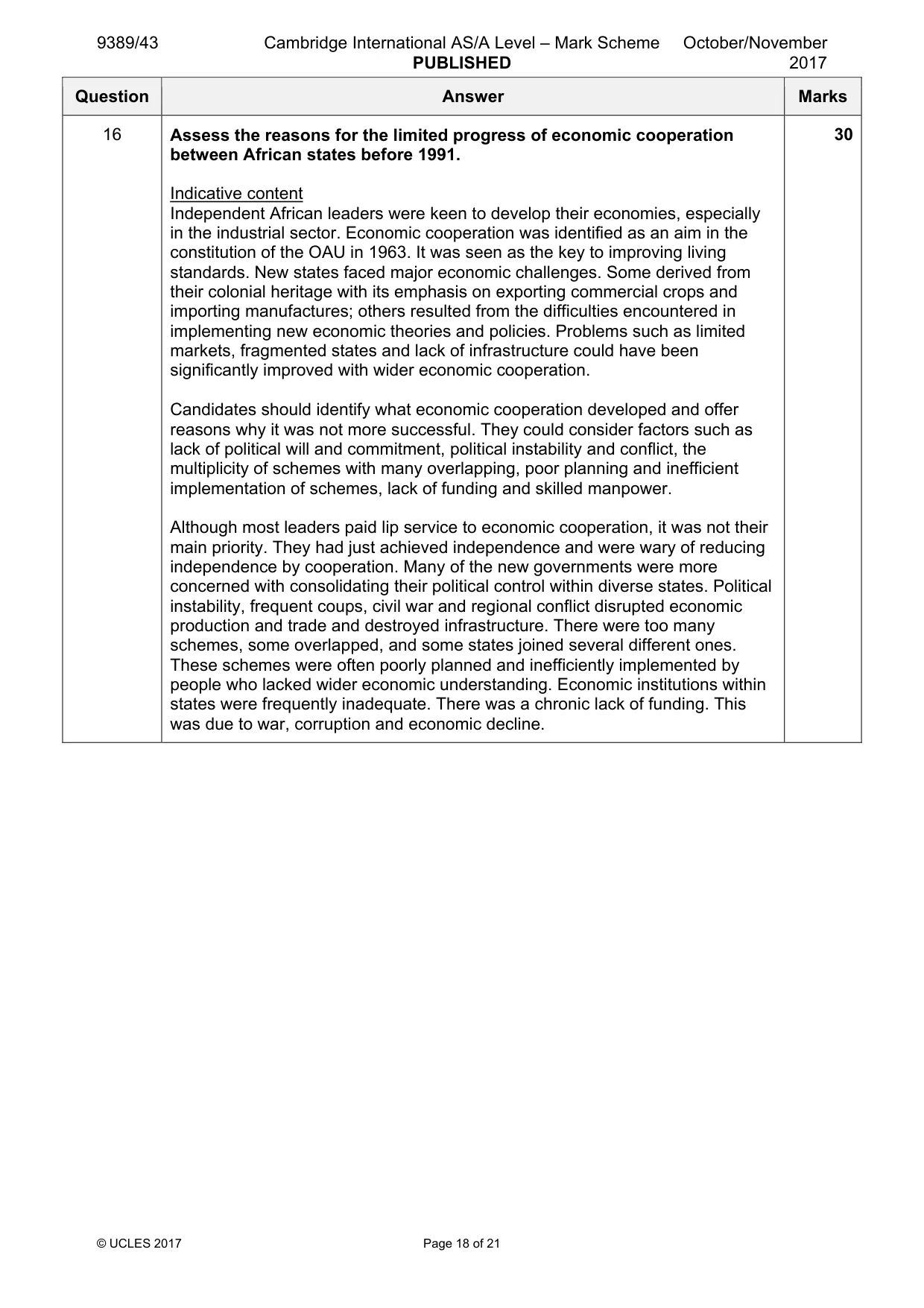
9389/43 Cambridge International AS/A Level – Mark Scheme PUBLISHED October/November 2017 © UCLES 2017 Page 18 of 21 Question Answer Marks 16 Assess the reasons for the limited progress of economic cooperation between African states before 1991. Indicative content Independent African leaders were keen to develop their economies, especially in the industrial sector. Economic cooperation was identified as an aim in the constitution of the OAU in 1963. It was seen as the key to improving living standards. New states faced major economic challenges. Some derived from their colonial heritage with its emphasis on exporting commercial crops and importing manufactures; others resulted from the difficulties encountered in implementing new economic theories and policies. Problems such as limited markets, fragmented states and lack of infrastructure could have been significantly improved with wider economic cooperation. Candidates should identify what economic cooperation developed and offer reasons why it was not more successful. They could consider factors such as lack of political will and commitment, political instability and conflict, the multiplicity of schemes with many overlapping, poor planning and inefficient implementation of schemes, lack of funding and skilled manpower. Although most leaders paid lip service to economic cooperation, it was not their main priority. They had just achieved independence and were wary of reducing independence by cooperation. Many of the new governments were more concerned with consolidating their political control within diverse states. Political instability, frequent coups, civil war and regional conflict disrupted economic production and trade and destroyed infrastructure. There were too many schemes, some overlapped, and some states joined several different ones. These schemes were often poorly planned and inefficiently implemented by people who lacked wider economic understanding. Economic institutions within states were frequently inadequate. There was a chronic lack of funding. This was due to war, corruption and economic decline. 30
Mark scheme, page 19
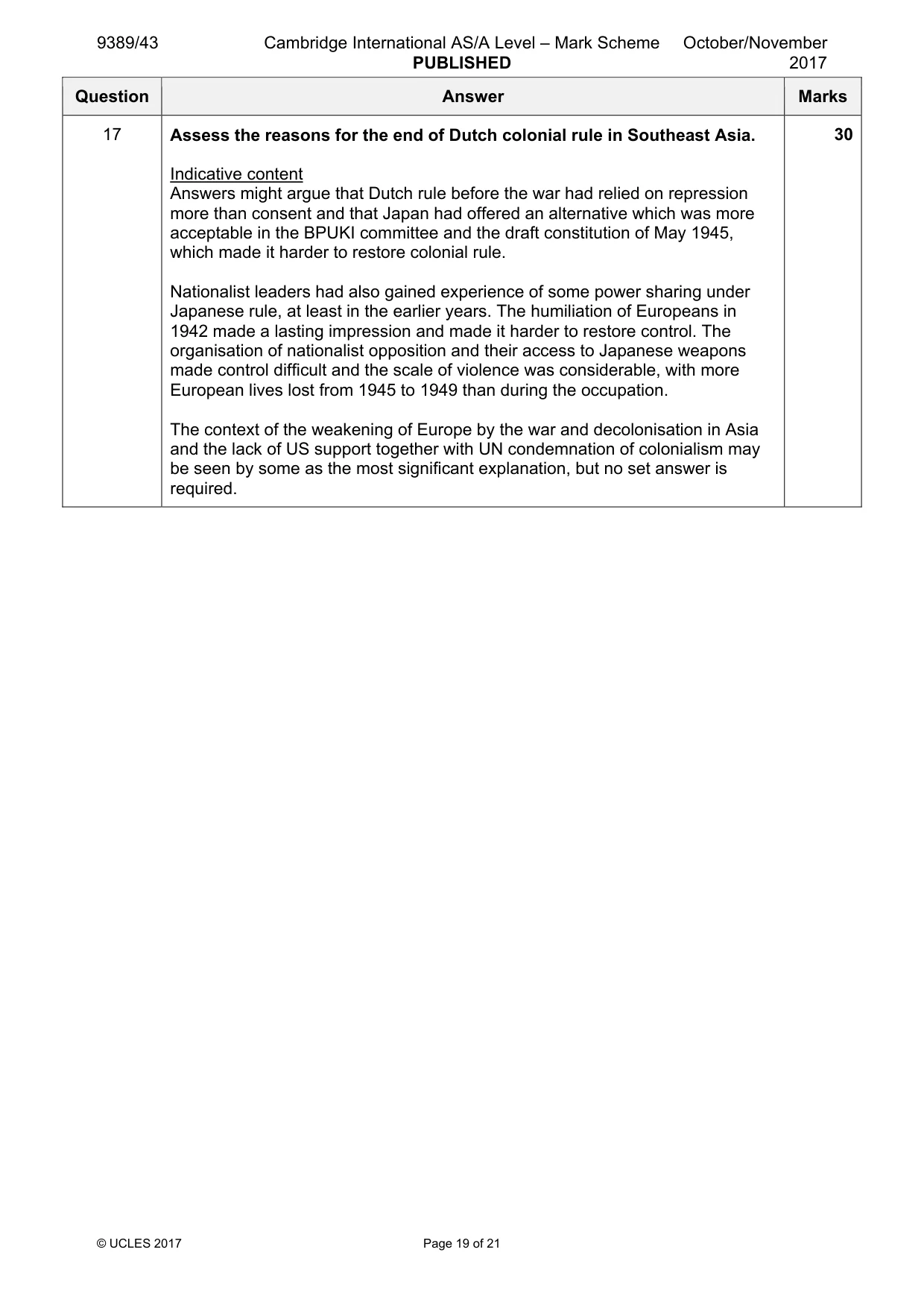
9389/43 Cambridge International AS/A Level – Mark Scheme PUBLISHED October/November 2017 © UCLES 2017 Page 19 of 21 Question Answer Marks 17 Assess the reasons for the end of Dutch colonial rule in Southeast Asia. Indicative content Answers might argue that Dutch rule before the war had relied on repression more than consent and that Japan had offered an alternative which was more acceptable in the BPUKI committee and the draft constitution of May 1945, which made it harder to restore colonial rule. Nationalist leaders had also gained experience of some power sharing under Japanese rule, at least in the earlier years. The humiliation of Europeans in 1942 made a lasting impression and made it harder to restore control. The organisation of nationalist opposition and their access to Japanese weapons made control difficult and the scale of violence was considerable, with more European lives lost from 1945 to 1949 than during the occupation. The context of the weakening of Europe by the war and decolonisation in Asia and the lack of US support together with UN condemnation of colonialism may be seen by some as the most significant explanation, but no set answer is required. 30
Mark scheme, page 20
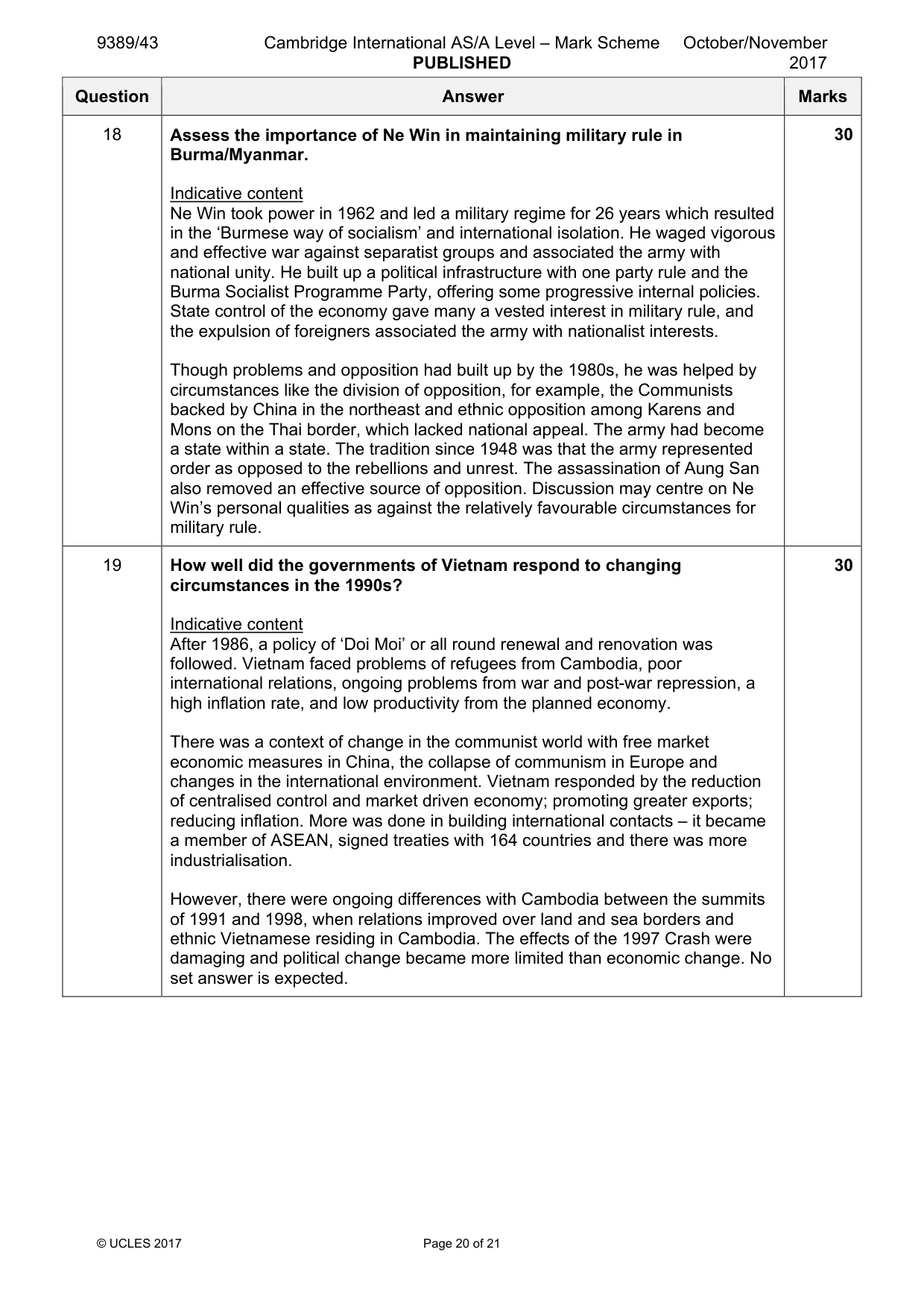
9389/43 Cambridge International AS/A Level – Mark Scheme PUBLISHED October/November 2017 © UCLES 2017 Page 20 of 21 Question Answer Marks 18 Assess the importance of Ne Win in maintaining military rule in Burma/Myanmar. Indicative content Ne Win took power in 1962 and led a military regime for 26 years which resulted in the ‘Burmese way of socialism’ and international isolation. He waged vigorous and effective war against separatist groups and associated the army with national unity. He built up a political infrastructure with one party rule and the Burma Socialist Programme Party, offering some progressive internal policies. State control of the economy gave many a vested interest in military rule, and the expulsion of foreigners associated the army with nationalist interests. Though problems and opposition had built up by the 1980s, he was helped by circumstances like the division of opposition, for example, the Communists backed by China in the northeast and ethnic opposition among Karens and Mons on the Thai border, which lacked national appeal. The army had become a state within a state. The tradition since 1948 was that the army represented order as opposed to the rebellions and unrest. The assassination of Aung San also removed an effective source of opposition. Discussion may centre on Ne Win’s personal qualities as against the relatively favourable circumstances for military rule. 30 19 How well did the governments of Vietnam respond to changing circumstances in the 1990s? Indicative content After 1986, a policy of ‘Doi Moi’ or all round renewal and renovation was followed. Vietnam faced problems of refugees from Cambodia, poor international relations, ongoing problems from war and post-war repression, a high inflation rate, and low productivity from the planned economy. There was a context of change in the communist world with free market economic measures in China, the collapse of communism in Europe and changes in the international environment. Vietnam responded by the reduction of centralised control and market driven economy; promoting greater exports; reducing inflation. More was done in building international contacts – it became a member of ASEAN, signed treaties with 164 countries and there was more industrialisation. However, there were ongoing differences with Cambodia between the summits of 1991 and 1998, when relations improved over land and sea borders and ethnic Vietnamese residing in Cambodia. The effects of the 1997 Crash were damaging and political change became more limited than economic change. No set answer is expected. 30
Mark scheme, page 21
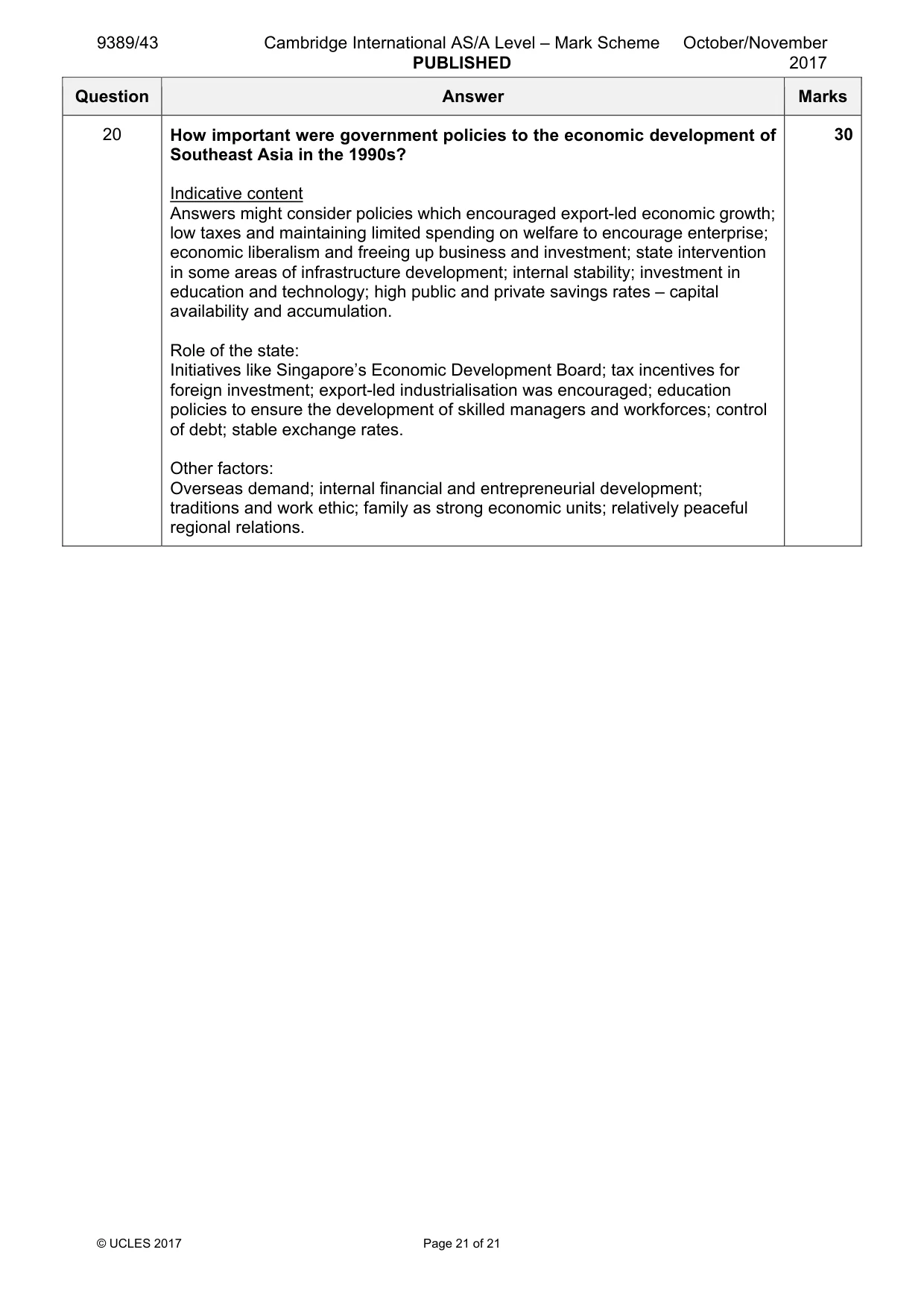
9389/43 Cambridge International AS/A Level – Mark Scheme PUBLISHED October/November 2017 © UCLES 2017 Page 21 of 21 Question Answer Marks 20 How important were government policies to the economic development of Southeast Asia in the 1990s? Indicative content Answers might consider policies which encouraged export-led economic growth; low taxes and maintaining limited spending on welfare to encourage enterprise; economic liberalism and freeing up business and investment; state intervention in some areas of infrastructure development; internal stability; investment in education and technology; high public and private savings rates – capital availability and accumulation. Role of the state: Initiatives like Singapore’s Economic Development Board; tax incentives for foreign investment; export-led industrialisation was encouraged; education policies to ensure the development of skilled managers and workforces; control of debt; stable exchange rates. Other factors: Overseas demand; internal financial and entrepreneurial development; traditions and work ethic; family as strong economic units; relatively peaceful regional relations. 30
What you needed in this session
Cambridge’s own grade thresholds for 2017 Oct/Nov, Paper 4 · Variant 3. A higher threshold means an easier paper — the bar moves with how the cohort did.