Cambridge A Level History 9389 — 2017 Oct/Nov Paper 4 · Variant 1
9389/41/O/N/17 · 19 questions · 60 marks · ≈68 min
The question paper and its mark scheme, free to read here and free to download. This is Cambridge’s own paper, exactly as it was sat.
Question paper4 pages
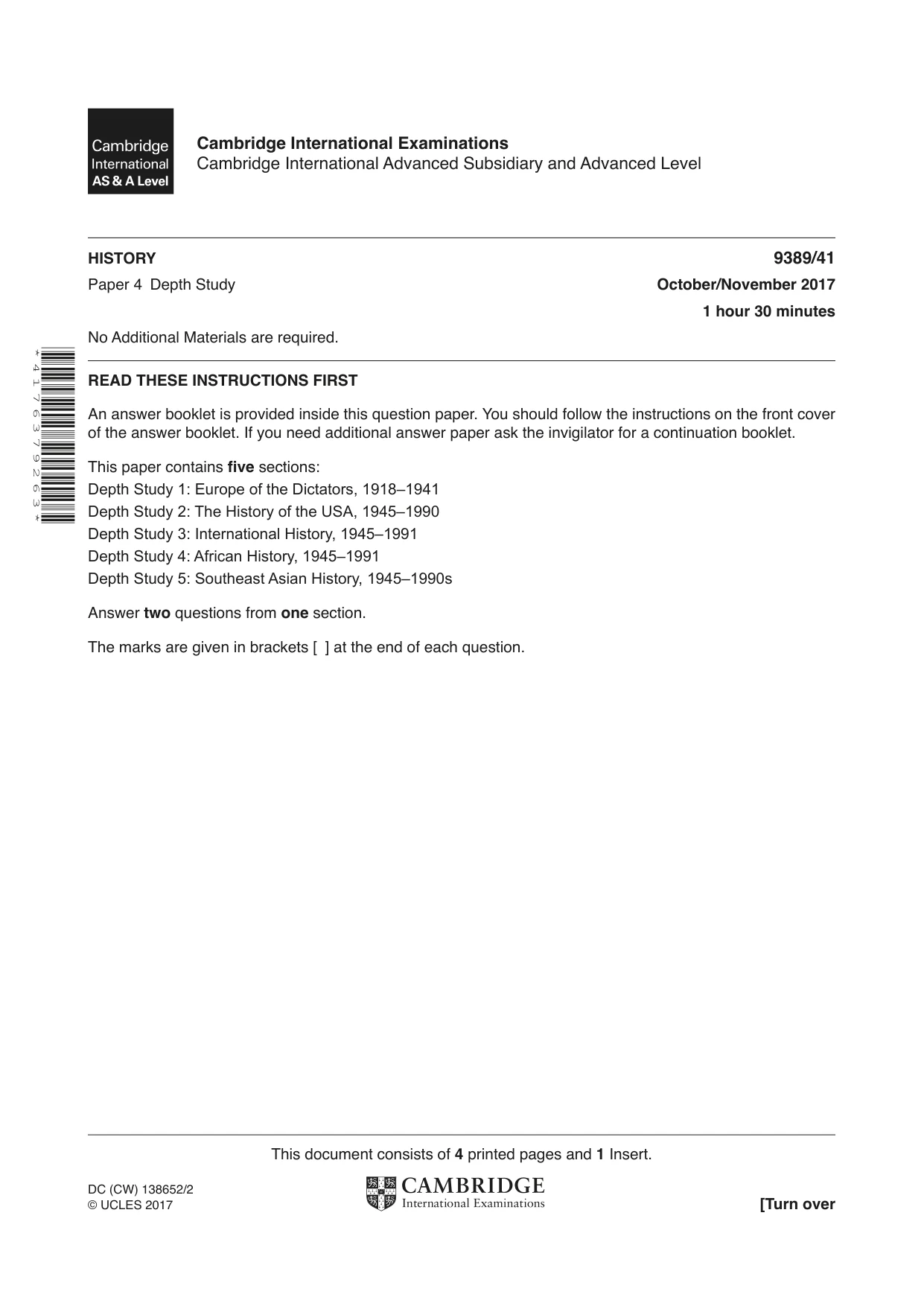
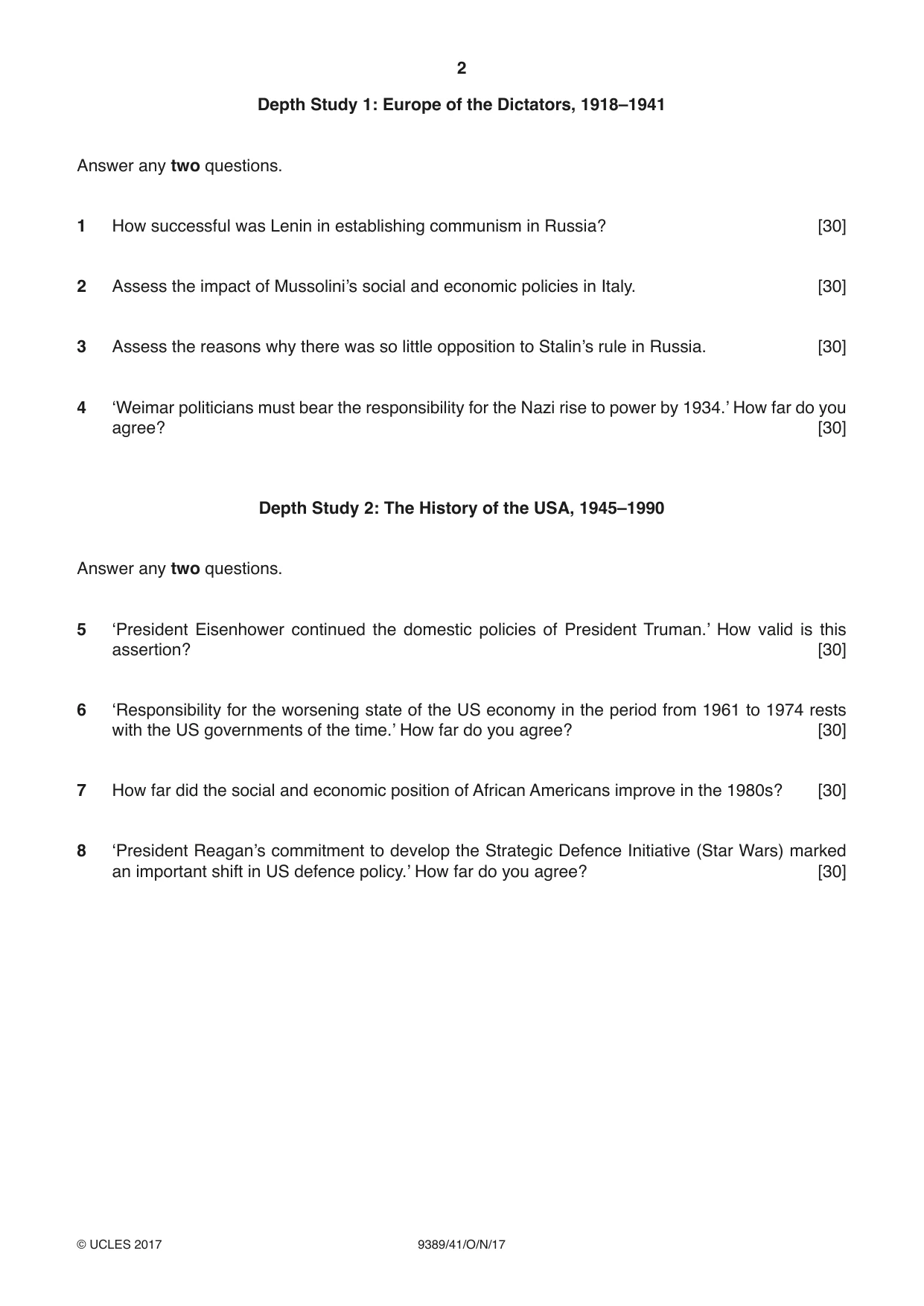
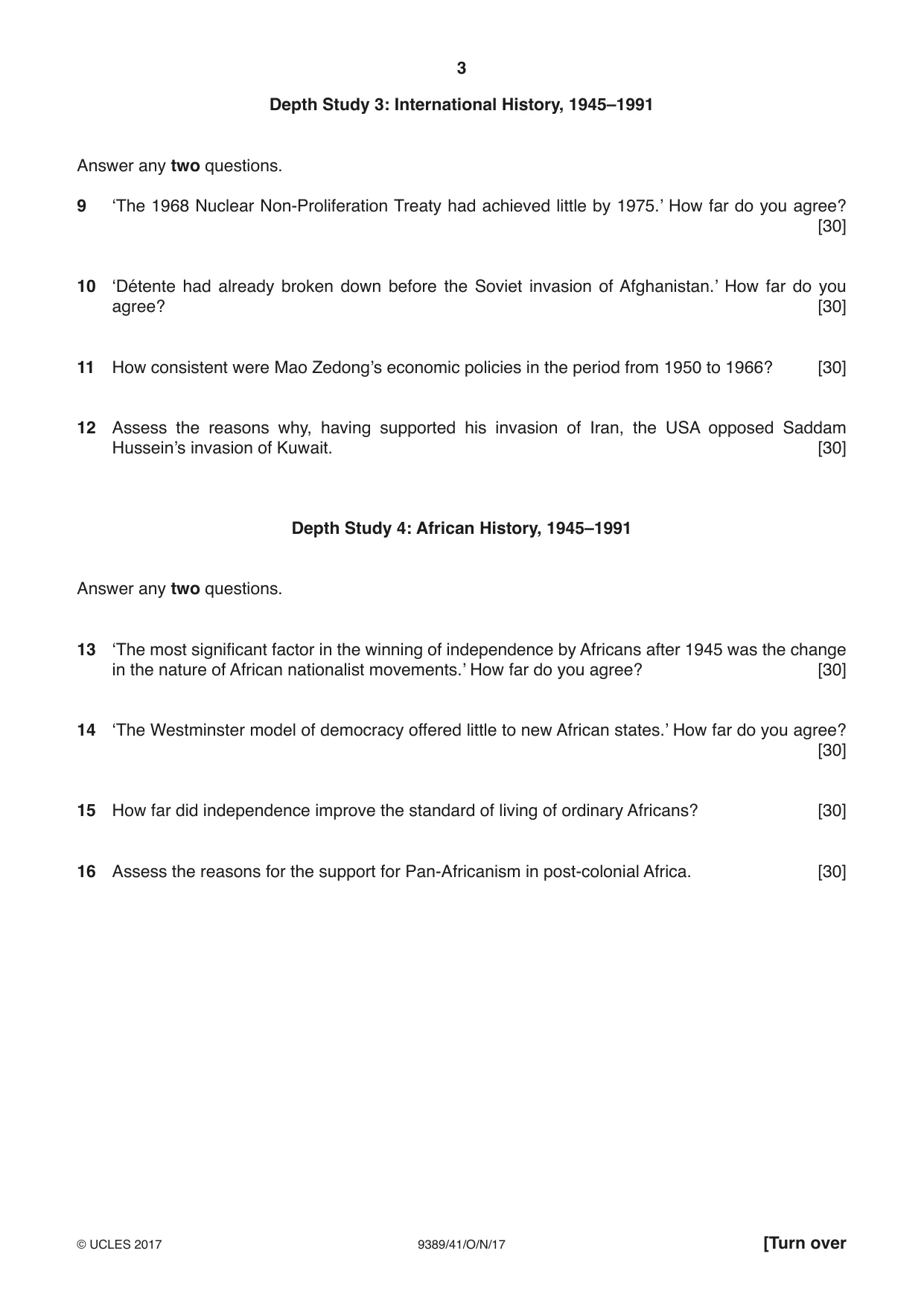
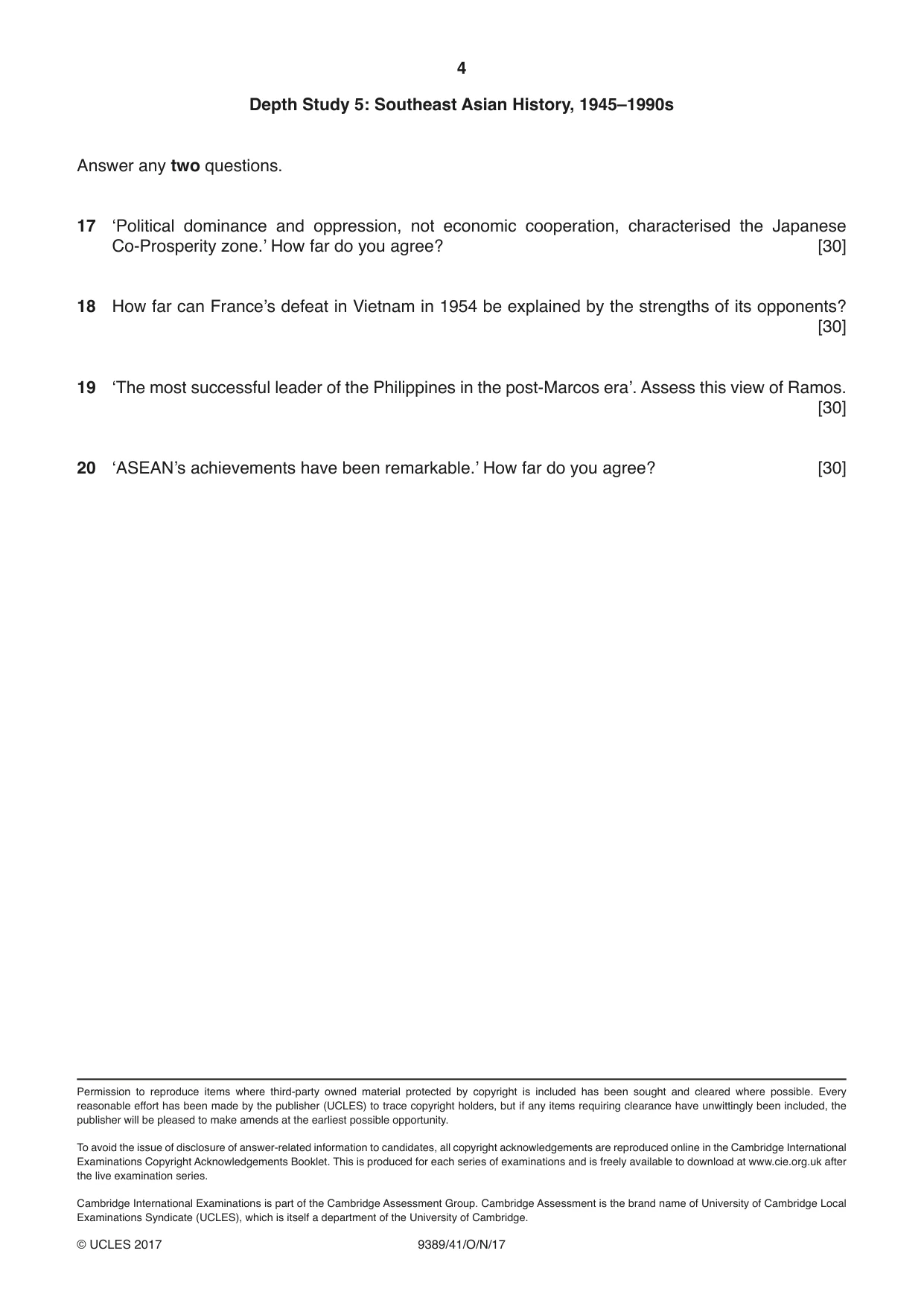
Mark scheme21 pages
Answers below. Sit the paper first if you are practising.
Questions as text
Q1 · How successful was Lenin in establishing communism in Russia?
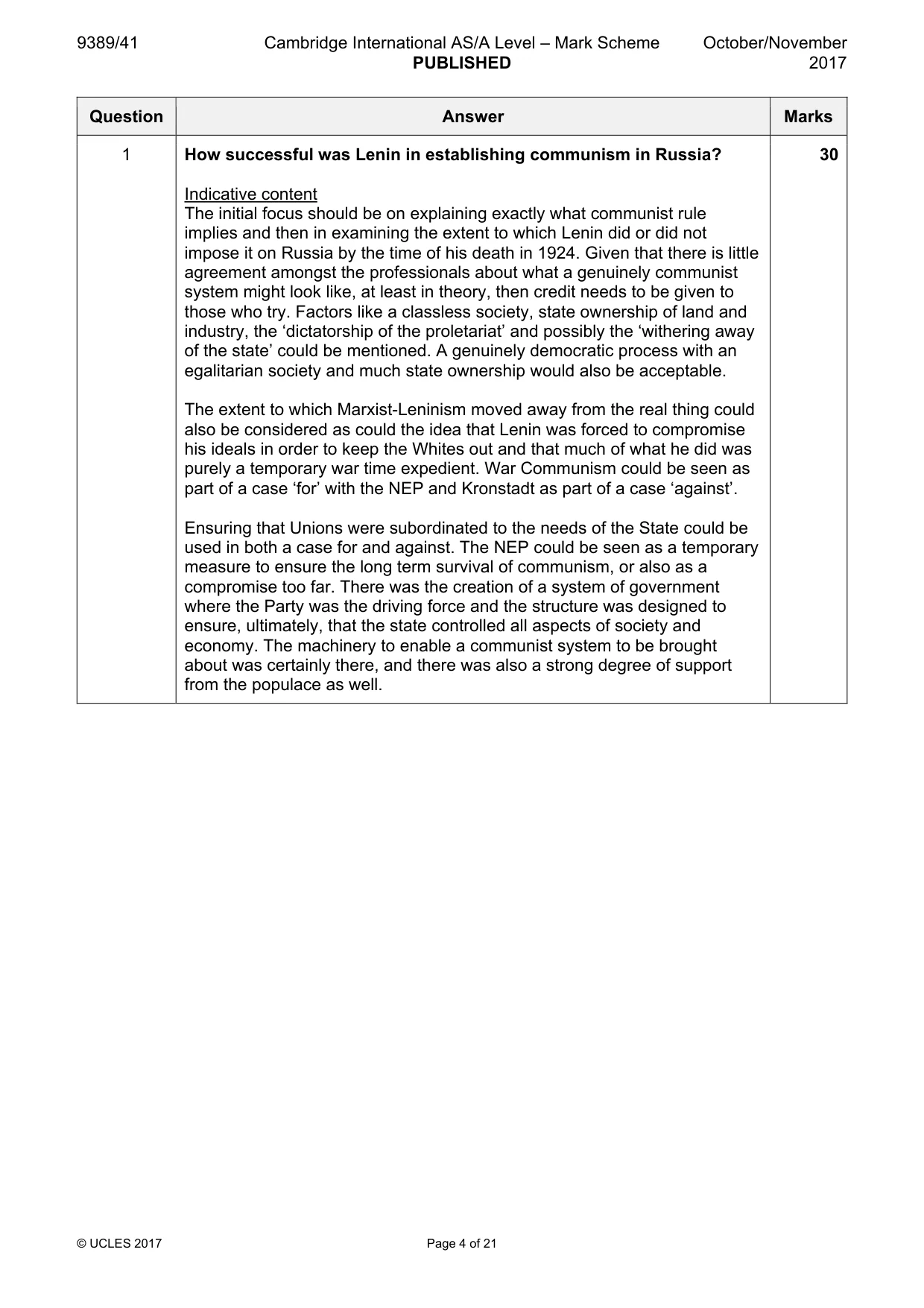
1 How successful was Lenin in establishing communism in Russia? [30]
Mark scheme: Question Answer Marks 1 How successful was Lenin in establishing communism in Russia? 30 Indicative content The initial focus should be on explaining exactly what communist rule implies and then in examining the extent to which Lenin did or did not impose it on Russia by the time of his death in 1924. Given that there is little agreement amongst the professionals about what a genuinely communist system might look like, at least in theory, then credit needs to be given to those who try. Factors like a classless society, state ownership of land and industry, the ‘dictatorship of the proletariat’ and possibly the ‘withering away of the state’ could be mentioned. A genuinely democratic process with an egalitarian society and much state ownership would also be acceptable. The extent to which Marxist-Leninism moved away from the real thing could also be considered as could the idea that Lenin was forced to compromise his ideals in order to keep the Whites out and that much of what he did was purely a temporary war time expedient. War Communism could be seen as part of a case ‘for’ with the NEP and Kronstadt as part of a case ‘against’. Ensuring that Unions were subordinated to the needs of the State could be used in both a case for and against. The NEP could be seen as a temporary measure to ensure the long term survival of communism, or also as a compromise too far. There was the creation of a system of government where the Party was the driving force and the structure was designed to ensure, ultimately, that the state controlled all aspects of society and economy. The machinery to enable a communist system to be brought about was certainly there, and there was also a strong degree of support from the populace as well.
Q2 · Assess the impact of Mussolini’s social and economic policies in Italy
2 Assess the impact of Mussolini’s social and economic policies in Italy. [30]
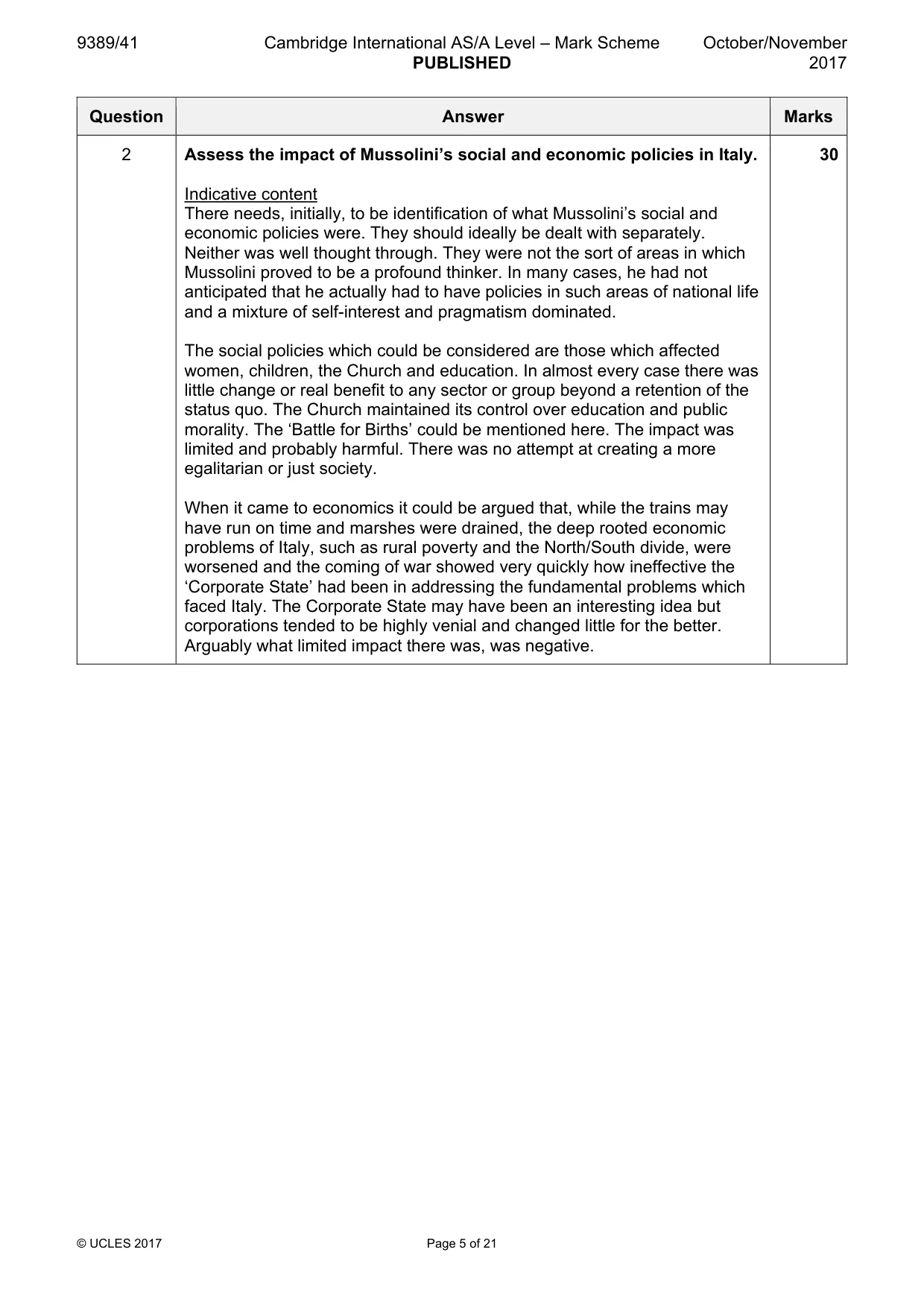
Mark scheme: 2 Assess the impact of Mussolini’s social and economic policies in Italy. 30 Indicative content There needs, initially, to be identification of what Mussolini’s social and economic policies were. They should ideally be dealt with separately. Neither was well thought through. They were not the sort of areas in which Mussolini proved to be a profound thinker. In many cases, he had not anticipated that he actually had to have policies in such areas of national life and a mixture of self-interest and pragmatism dominated. The social policies which could be considered are those which affected women, children, the Church and education. In almost every case there was little change or real benefit to any sector or group beyond a retention of the status quo. The Church maintained its control over education and public morality. The ‘Battle for Births’ could be mentioned here. The impact was limited and probably harmful. There was no attempt at creating a more egalitarian or just society. When it came to economics it could be argued that, while the trains may have run on time and marshes were drained, the deep rooted economic problems of Italy, such as rural poverty and the North/South divide, were worsened and the coming of war showed very quickly how ineffective the ‘Corporate State’ had been in addressing the fundamental problems which faced Italy. The Corporate State may have been an interesting idea but corporations tended to be highly venial and changed little for the better. Arguably what limited impact there was, was negative.
Q3 · Assess the reasons why there was so little opposition to Stalin’s rule in Russia
3 Assess the reasons why there was so little opposition to Stalin’s rule in Russia. [30]
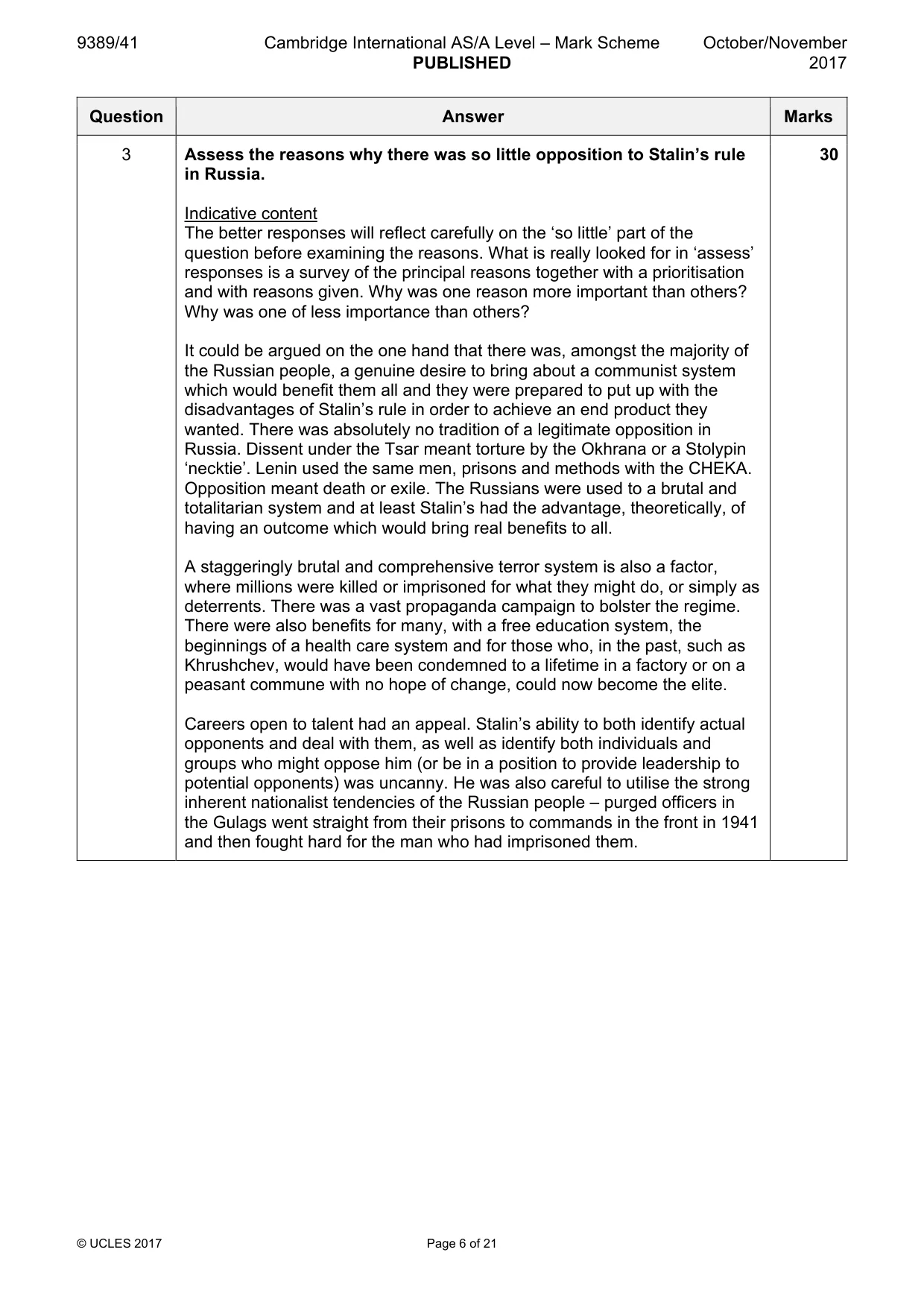
Mark scheme: 3 Assess the reasons why there was so little opposition to Stalin’s rule 30 in Russia. Indicative content The better responses will reflect carefully on the ‘so little’ part of the question before examining the reasons. What is really looked for in ‘assess’ responses is a survey of the principal reasons together with a prioritisation and with reasons given. Why was one reason more important than others? Why was one of less importance than others? It could be argued on the one hand that there was, amongst the majority of the Russian people, a genuine desire to bring about a communist system which would benefit them all and they were prepared to put up with the disadvantages of Stalin’s rule in order to achieve an end product they wanted. There was absolutely no tradition of a legitimate opposition in Russia. Dissent under the Tsar meant torture by the Okhrana or a Stolypin ‘necktie’. Lenin used the same men, prisons and methods with the CHEKA. Opposition meant death or exile. The Russians were used to a brutal and totalitarian system and at least Stalin’s had the advantage, theoretically, of having an outcome which would bring real benefits to all. A staggeringly brutal and comprehensive terror system is also a factor, where millions were killed or imprisoned for what they might do, or simply as deterrents. There was a vast propaganda campaign to bolster the regime. There were also benefits for many, with a free education system, the beginnings of a health care system and for those who, in the past, such as Khrushchev, would have been condemned to a lifetime in a factory or on a peasant commune with no hope of change, could now become the elite. Careers open to talent had an appeal. Stalin’s ability to both identify actual opponents and deal with them, as well as identify both individuals and groups who might oppose him (or be in a position to provide leadership to potential opponents) was uncanny. He was also careful to utilise the strong inherent nationalist tendencies of the Russian people – purged officers in the Gulags went straight from their prisons to commands in the front in 1941 and then fought hard for the man who had imprisoned them.
Q4 · ‘Weimar politicians must bear the responsibility for the Nazi rise to power by 1934.’ How…
4 ‘Weimar politicians must bear the responsibility for the Nazi rise to power by 1934.’ How far do you agree? [30] Depth Study 2: The History of the USA, 1945–1990 Answer any two questions.
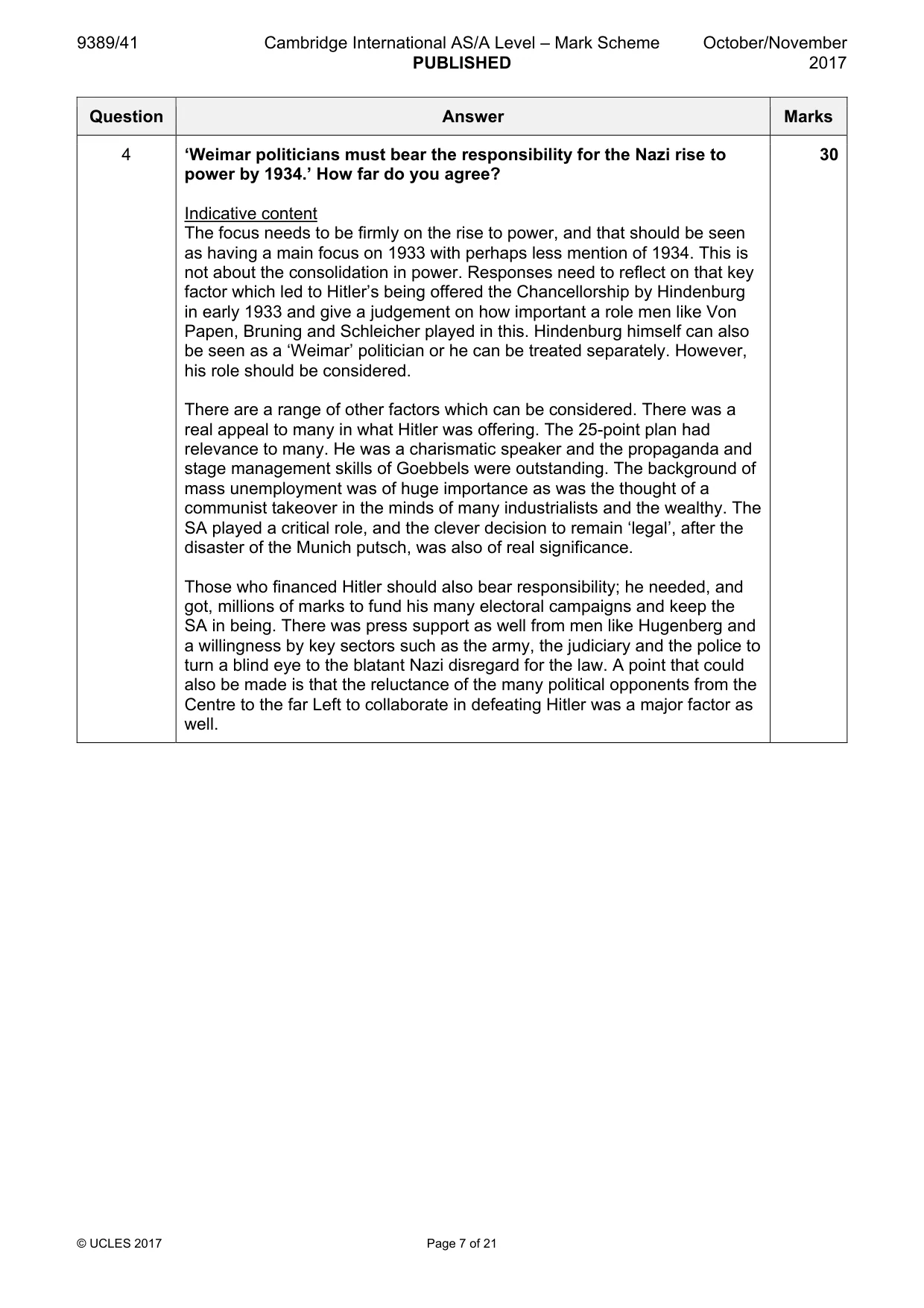
Mark scheme: 4 ‘Weimar politicians must bear the responsibility for the Nazi rise to 30 power by 1934.’ How far do you agree? Indicative content The focus needs to be firmly on the rise to power, and that should be seen as having a main focus on 1933 with perhaps less mention of 1934. This is not about the consolidation in power. Responses need to reflect on that key factor which led to Hitler’s being offered the Chancellorship by Hindenburg in early 1933 and give a judgement on how important a role men like Von Papen, Bruning and Schleicher played in this. Hindenburg himself can also be seen as a ‘Weimar’ politician or he can be treated separately. However, his role should be considered. There are a range of other factors which can be considered. There was a real appeal to many in what Hitler was offering. The 25-point plan had relevance to many. He was a charismatic speaker and the propaganda and stage management skills of Goebbels were outstanding. The background of mass unemployment was of huge importance as was the thought of a communist takeover in the minds of many industrialists and the wealthy. The SA played a critical role, and the clever decision to remain ‘legal’, after the disaster of the Munich putsch, was also of real significance. Those who financed Hitler should also bear responsibility; he needed, and got, millions of marks to fund his many electoral campaigns and keep the SA in being. There was press support as well from men like Hugenberg and a willingness by key sectors such as the army, the judiciary and the police to turn a blind eye to the blatant Nazi disregard for the law. A point that could also be made is that the reluctance of the many political opponents from the Centre to the far Left to collaborate in defeating Hitler was a major factor as well.
Q5 · ‘President Eisenhower continued the domestic policies of President Truman.’ How valid is…
5 ‘President Eisenhower continued the domestic policies of President Truman.’ How valid is this assertion? [30]
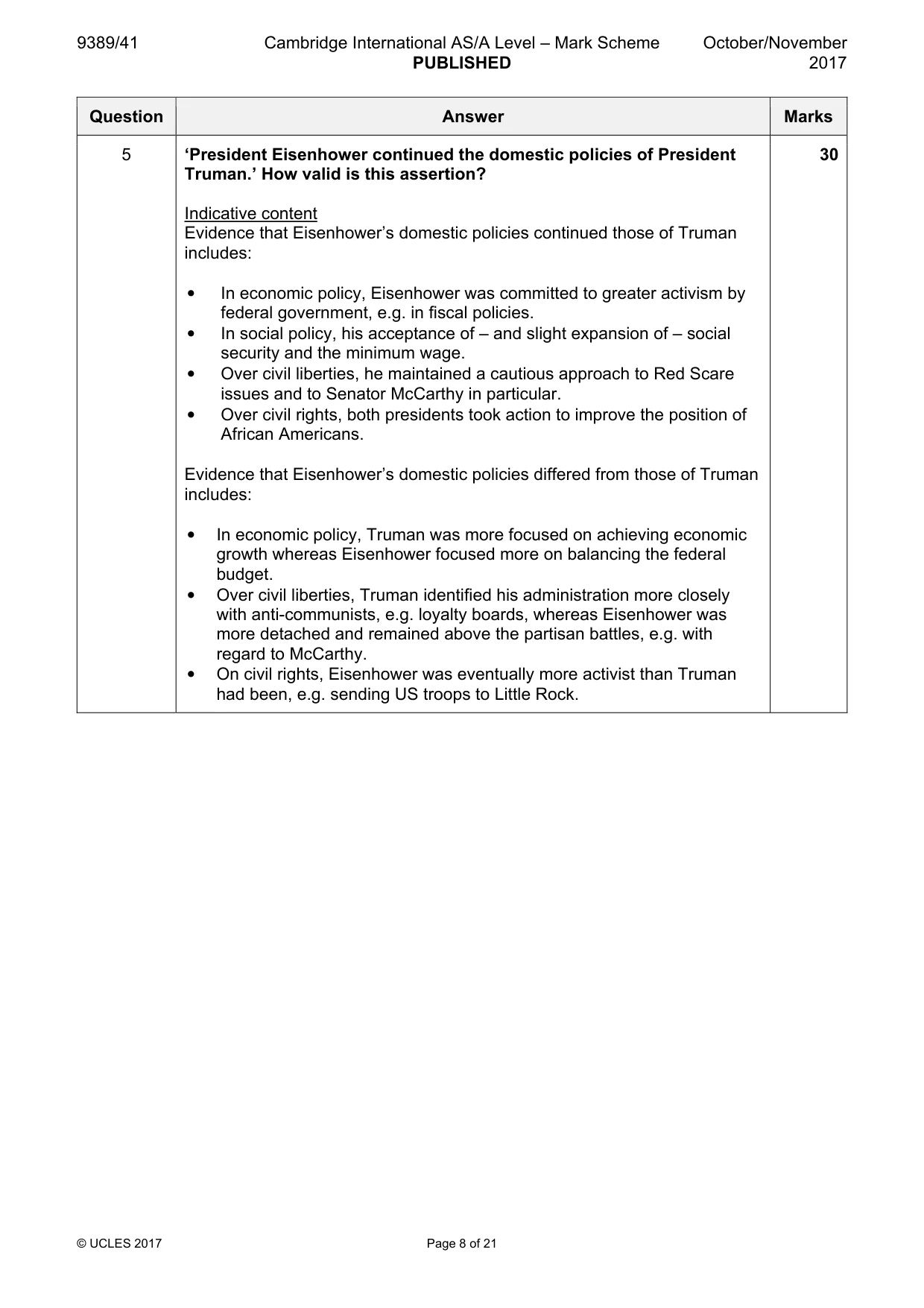
Mark scheme: 5 ‘President Eisenhower continued the domestic policies of President 30 Truman.’ How valid is this assertion? Indicative content Evidence that Eisenhower’s domestic policies continued those of Truman includes: • In economic policy, Eisenhower was committed to greater activism by federal government, e.g. in fiscal policies. • In social policy, his acceptance of – and slight expansion of – social security and the minimum wage. • Over civil liberties, he maintained a cautious approach to Red Scare issues and to Senator McCarthy in particular. • Over civil rights, both presidents took action to improve the position of African Americans. Evidence that Eisenhower’s domestic policies differed from those of Truman includes: • In economic policy, Truman was more focused on achieving economic growth whereas Eisenhower focused more on balancing the federal budget. • Over civil liberties, Truman identified his administration more closely with anti-communists, e.g. loyalty boards, whereas Eisenhower was more detached and remained above the partisan battles, e.g. with regard to McCarthy. • On civil rights, Eisenhower was eventually more activist than Truman had been, e.g. sending US troops to Little Rock.
Q6 · ‘Responsibility for the worsening state of the US economy in the period from 1961 to 1974…
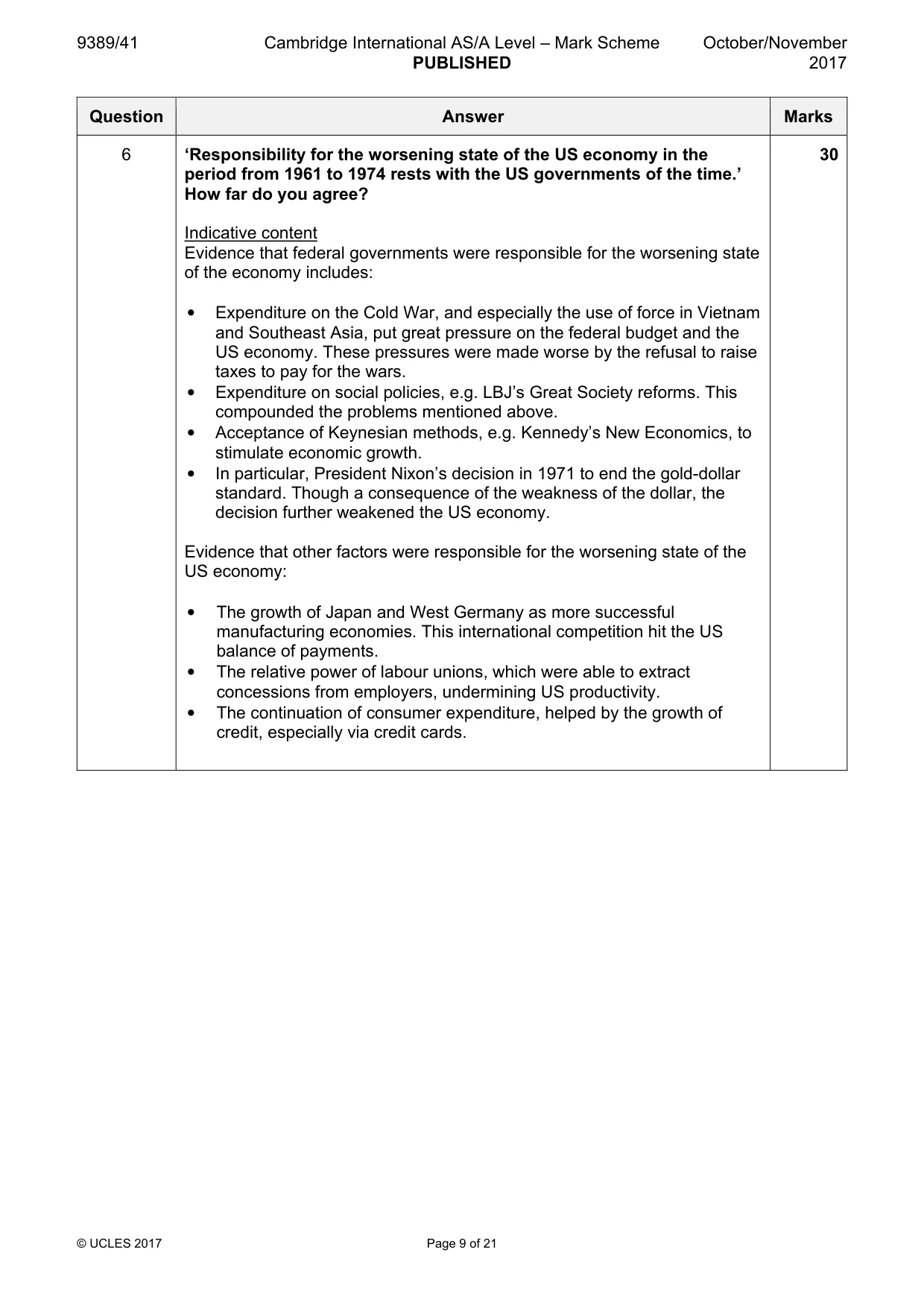
6 ‘Responsibility for the worsening state of the US economy in the period from 1961 to 1974 rests with the US governments of the time.’ How far do you agree? [30]
Mark scheme: 6 ‘Responsibility for the worsening state of the US economy in the 30 period from 1961 to 1974 rests with the US governments of the time.’ How far do you agree? Indicative content Evidence that federal governments were responsible for the worsening state of the economy includes: • Expenditure on the Cold War, and especially the use of force in Vietnam and Southeast Asia, put great pressure on the federal budget and the US economy. These pressures were made worse by the refusal to raise taxes to pay for the wars. • Expenditure on social policies, e.g. LBJ’s Great Society reforms. This compounded the problems mentioned above. • Acceptance of Keynesian methods, e.g. Kennedy’s New Economics, to stimulate economic growth. • In particular, President Nixon’s decision in 1971 to end the gold-dollar standard. Though a consequence of the weakness of the dollar, the decision further weakened the US economy. Evidence that other factors were responsible for the worsening state of the US economy: • The growth of Japan and West Germany as more successful manufacturing economies. This international competition hit the US balance of payments. • The relative power of labour unions, which were able to extract concessions from employers, undermining US productivity. • The continuation of consumer expenditure, helped by the growth of credit, especially via credit cards.
Q7 · How far did the social and economic position of African Americans improve in the 1980s?
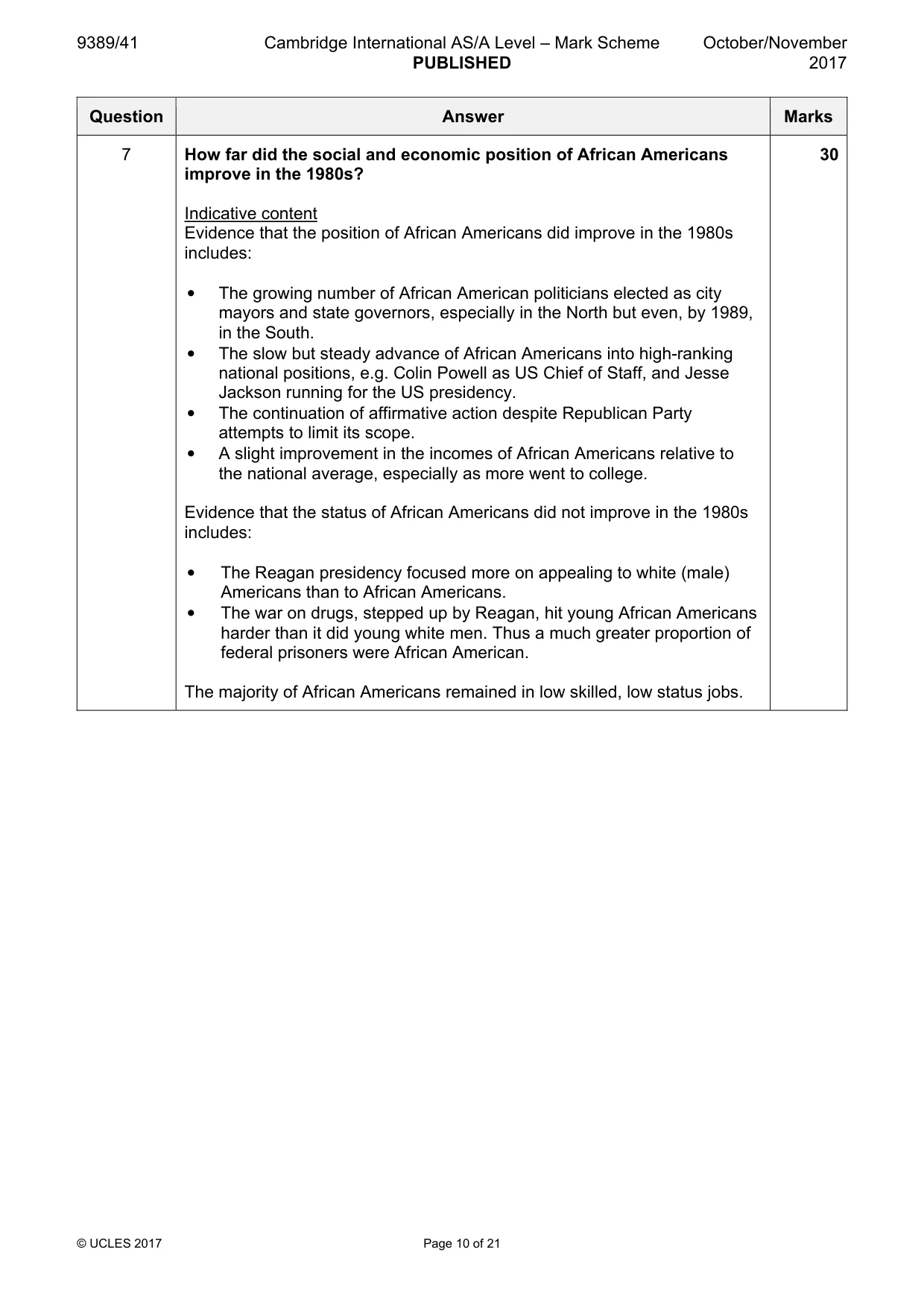
7 How far did the social and economic position of African Americans improve in the 1980s? [30]
Mark scheme: 7 How far did the social and economic position of African Americans 30 improve in the 1980s? Indicative content Evidence that the position of African Americans did improve in the 1980s includes: • The growing number of African American politicians elected as city mayors and state governors, especially in the North but even, by 1989, in the South. • The slow but steady advance of African Americans into high-ranking national positions, e.g. Colin Powell as US Chief of Staff, and Jesse Jackson running for the US presidency. • The continuation of affirmative action despite Republican Party attempts to limit its scope. • A slight improvement in the incomes of African Americans relative to the national average, especially as more went to college. Evidence that the status of African Americans did not improve in the 1980s includes: • The Reagan presidency focused more on appealing to white (male) Americans than to African Americans. • The war on drugs, stepped up by Reagan, hit young African Americans harder than it did young white men. Thus a much greater proportion of federal prisoners were African American. The majority of African Americans remained in low skilled, low status jobs.
Q8 · ‘President Reagan’s commitment to develop the Strategic Defence Initiative (Star Wars)…
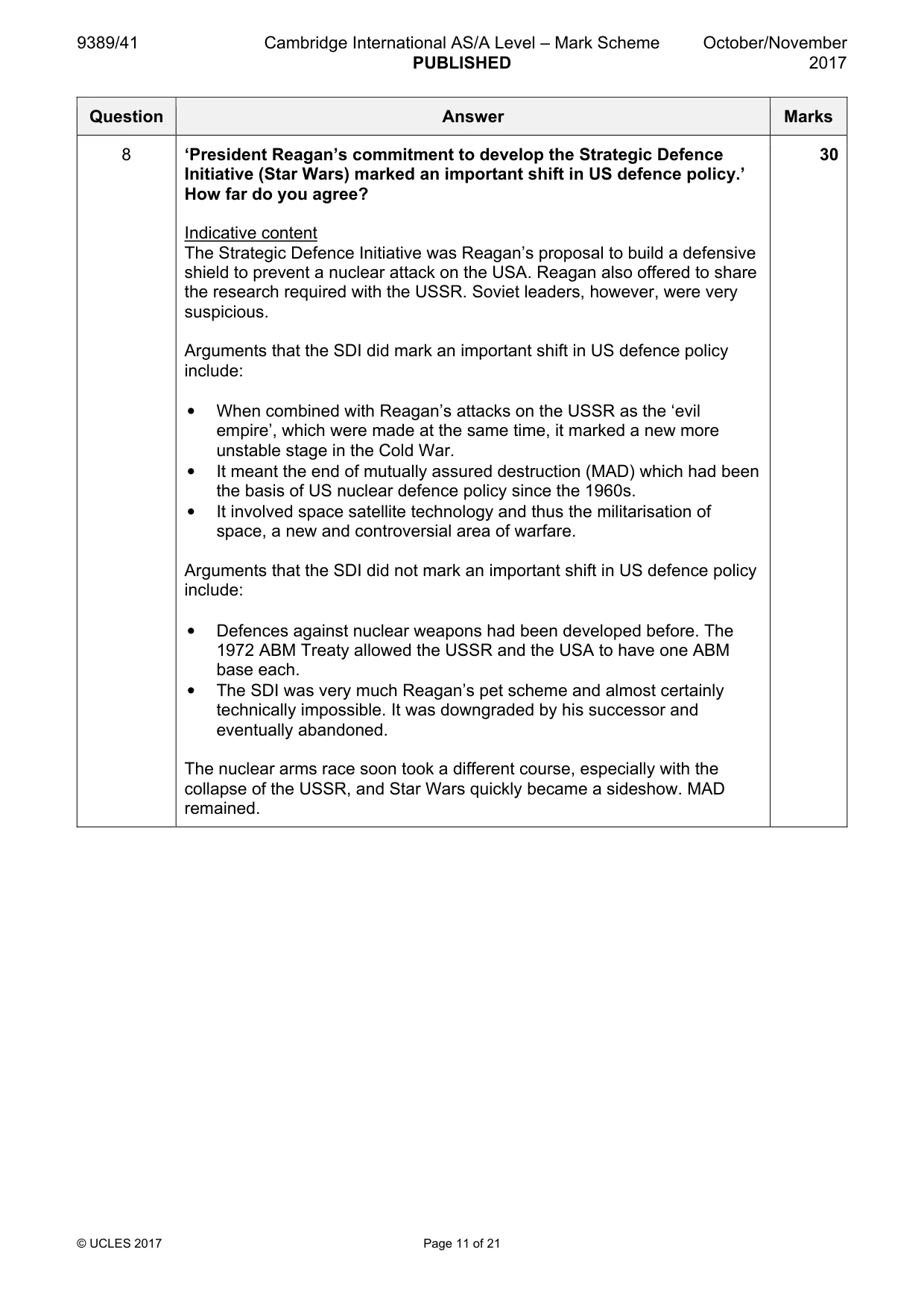
8 ‘President Reagan’s commitment to develop the Strategic Defence Initiative (Star Wars) marked an important shift in US defence policy.’ How far do you agree? [30] Depth Study 3: International History, 1945–1991 Answer any two questions.
Mark scheme: 8 ‘President Reagan’s commitment to develop the Strategic Defence 30 Initiative (Star Wars) marked an important shift in US defence policy.’ How far do you agree? Indicative content The Strategic Defence Initiative was Reagan’s proposal to build a defensive shield to prevent a nuclear attack on the USA. Reagan also offered to share the research required with the USSR. Soviet leaders, however, were very suspicious. Arguments that the SDI did mark an important shift in US defence policy include: • When combined with Reagan’s attacks on the USSR as the ‘evil empire’, which were made at the same time, it marked a new more unstable stage in the Cold War. • It meant the end of mutually assured destruction (MAD) which had been the basis of US nuclear defence policy since the 1960s. • It involved space satellite technology and thus the militarisation of space, a new and controversial area of warfare. Arguments that the SDI did not mark an important shift in US defence policy include: • Defences against nuclear weapons had been developed before. The 1972 ABM Treaty allowed the USSR and the USA to have one ABM base each. • The SDI was very much Reagan’s pet scheme and almost certainly technically impossible. It was downgraded by his successor and eventually abandoned. The nuclear arms race soon took a different course, especially with the collapse of the USSR, and Star Wars quickly became a sideshow. MAD remained.
Q9 · ‘The 1968 Nuclear Non-Proliferation Treaty had achieved little by 1975.’ How far do you…
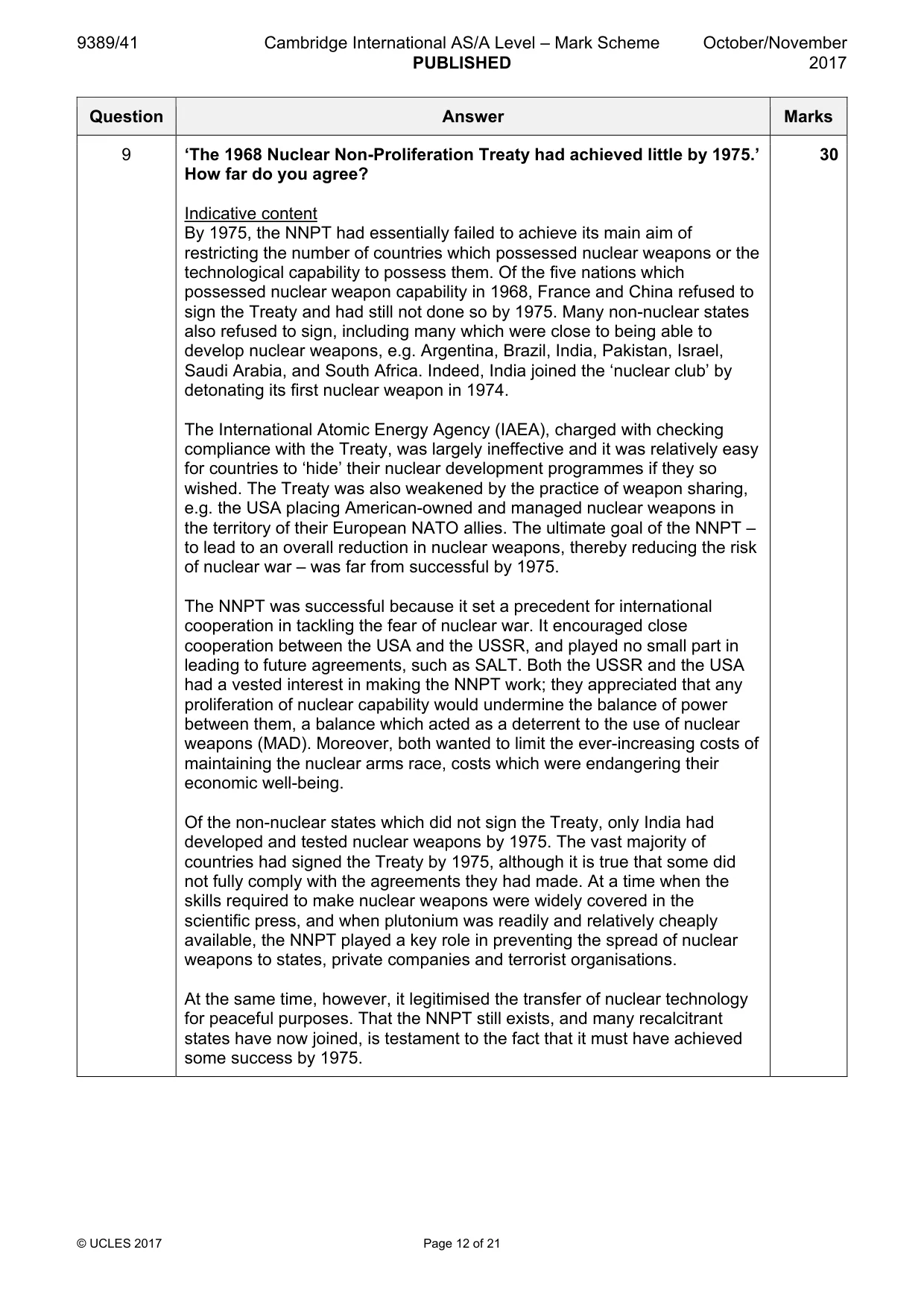
9 ‘The 1968 Nuclear Non-Proliferation Treaty had achieved little by 1975.’ How far do you agree? [30]
Mark scheme: 9 ‘The 1968 Nuclear Non-Proliferation Treaty had achieved little by 1975.’ 30 How far do you agree? Indicative content By 1975, the NNPT had essentially failed to achieve its main aim of restricting the number of countries which possessed nuclear weapons or the technological capability to possess them. Of the five nations which possessed nuclear weapon capability in 1968, France and China refused to sign the Treaty and had still not done so by 1975. Many non-nuclear states also refused to sign, including many which were close to being able to develop nuclear weapons, e.g. Argentina, Brazil, India, Pakistan, Israel, Saudi Arabia, and South Africa. Indeed, India joined the ‘nuclear club’ by detonating its first nuclear weapon in 1974. The International Atomic Energy Agency (IAEA), charged with checking compliance with the Treaty, was largely ineffective and it was relatively easy for countries to ‘hide’ their nuclear development programmes if they so wished. The Treaty was also weakened by the practice of weapon sharing, e.g. the USA placing American-owned and managed nuclear weapons in the territory of their European NATO allies. The ultimate goal of the NNPT – to lead to an overall reduction in nuclear weapons, thereby reducing the risk of nuclear war – was far from successful by 1975. The NNPT was successful because it set a precedent for international cooperation in tackling the fear of nuclear war. It encouraged close cooperation between the USA and the USSR, and played no small part in leading to future agreements, such as SALT. Both the USSR and the USA had a vested interest in making the NNPT work; they appreciated that any proliferation of nuclear capability would undermine the balance of power between them, a balance which acted as a deterrent to the use of nuclear weapons (MAD). Moreover, both wanted to limit the ever-increasing costs of maintaining the nuclear arms race, costs which were endangering their economic well-being. Of the non-nuclear states which did not sign the Treaty, only India had developed and tested nuclear weapons by 1975. The vast majority of countries had signed the Treaty by 1975, although it is true that some did not fully comply with the agreements they had made. At a time when the skills required to make nuclear weapons were widely covered in the scientific press, and when plutonium was readily and relatively cheaply available, the NNPT played a key role in preventing the spread of nuclear weapons to states, private companies and terrorist organisations. At the same time, however, it legitimised the transfer of nuclear technology for peaceful purposes. That the NNPT still exists, and many recalcitrant states have now joined, is testament to the fact that it must have achieved some success by 1975.
Q10 · ‘Détente had already broken down before the Soviet invasion of Afghanistan.’ How far do…
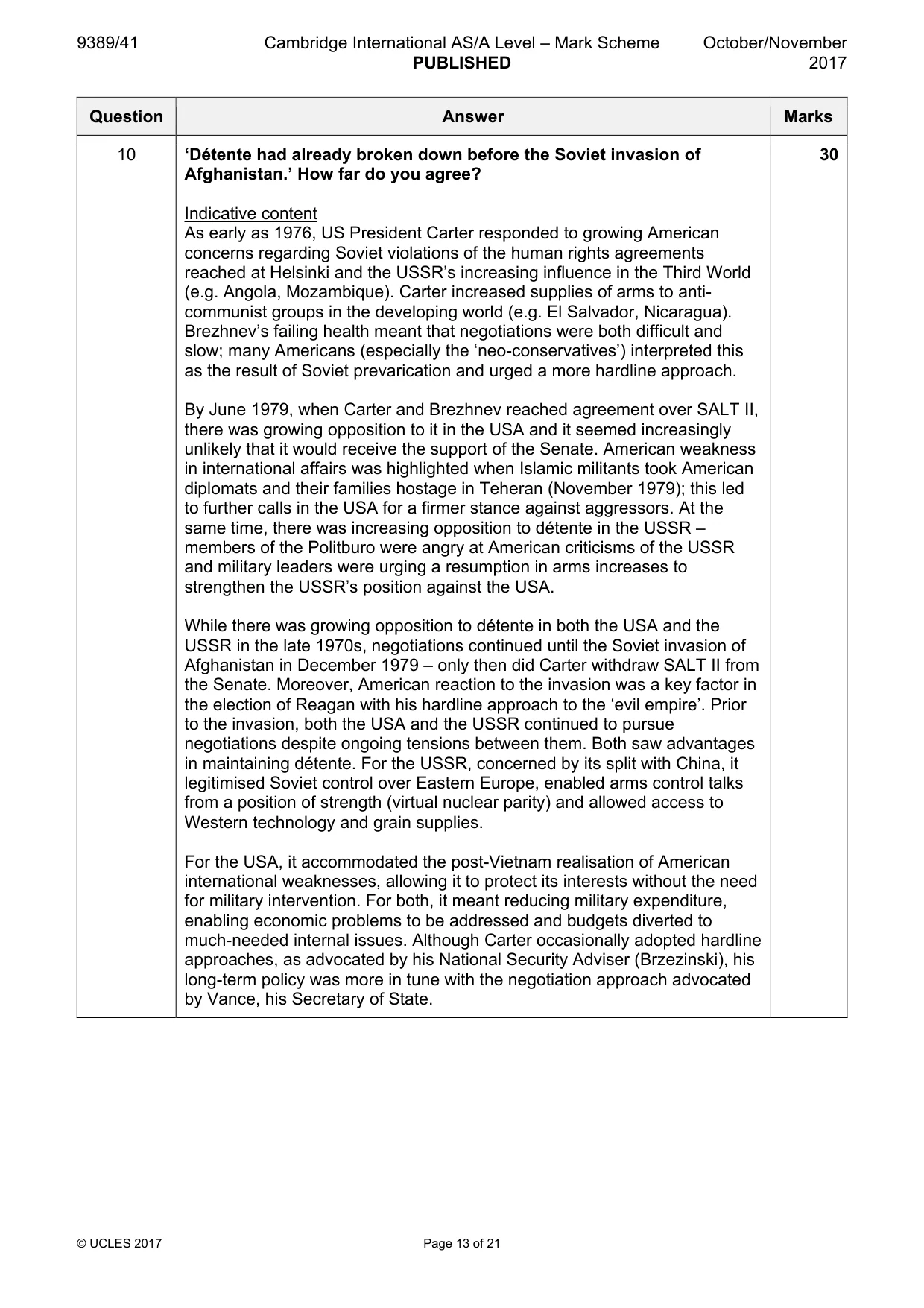
10 ‘Détente had already broken down before the Soviet invasion of Afghanistan.’ How far do you agree? [30]
Mark scheme: 10 ‘Détente had already broken down before the Soviet invasion of 30 Afghanistan.’ How far do you agree? Indicative content As early as 1976, US President Carter responded to growing American concerns regarding Soviet violations of the human rights agreements reached at Helsinki and the USSR’s increasing influence in the Third World (e.g. Angola, Mozambique). Carter increased supplies of arms to anti- communist groups in the developing world (e.g. El Salvador, Nicaragua). Brezhnev’s failing health meant that negotiations were both difficult and slow; many Americans (especially the ‘neo-conservatives’) interpreted this as the result of Soviet prevarication and urged a more hardline approach. By June 1979, when Carter and Brezhnev reached agreement over SALT II, there was growing opposition to it in the USA and it seemed increasingly unlikely that it would receive the support of the Senate. American weakness in international affairs was highlighted when Islamic militants took American diplomats and their families hostage in Teheran (November 1979); this led to further calls in the USA for a firmer stance against aggressors. At the same time, there was increasing opposition to détente in the USSR – members of the Politburo were angry at American criticisms of the USSR and military leaders were urging a resumption in arms increases to strengthen the USSR’s position against the USA. While there was growing opposition to détente in both the USA and the USSR in the late 1970s, negotiations continued until the Soviet invasion of Afghanistan in December 1979 – only then did Carter withdraw SALT II from the Senate. Moreover, American reaction to the invasion was a key factor in the election of Reagan with his hardline approach to the ‘evil empire’. Prior to the invasion, both the USA and the USSR continued to pursue negotiations despite ongoing tensions between them. Both saw advantages in maintaining détente. For the USSR, concerned by its split with China, it legitimised Soviet control over Eastern Europe, enabled arms control talks from a position of strength (virtual nuclear parity) and allowed access to Western technology and grain supplies. For the USA, it accommodated the post-Vietnam realisation of American international weaknesses, allowing it to protect its interests without the need for military intervention. For both, it meant reducing military expenditure, enabling economic problems to be addressed and budgets diverted to much-needed internal issues. Although Carter occasionally adopted hardline approaches, as advocated by his National Security Adviser (Brzezinski), his long-term policy was more in tune with the negotiation approach advocated by Vance, his Secretary of State.
Q11 · How consistent were Mao Zedong’s economic policies in the period from 1950 to 1966?
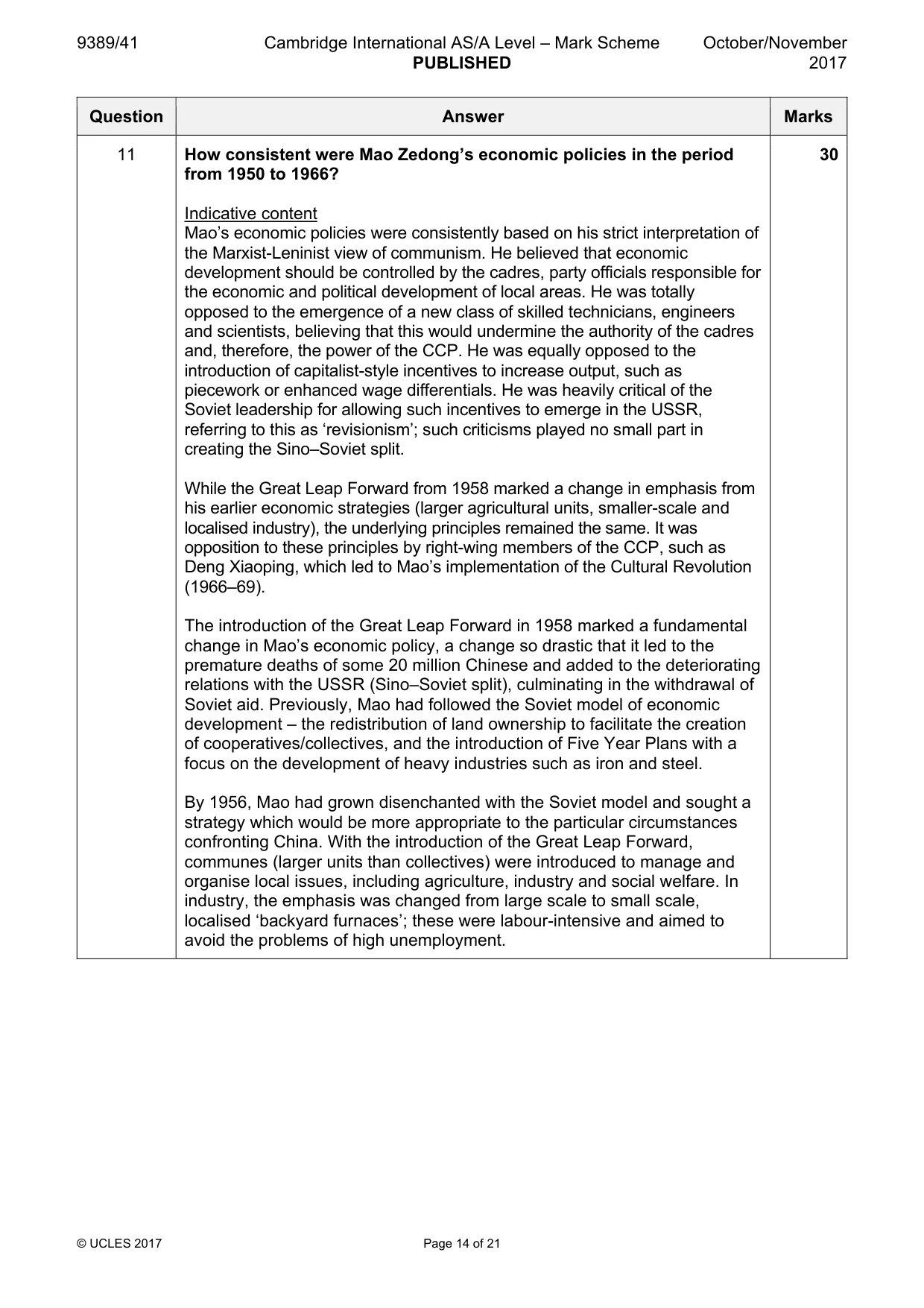
11 How consistent were Mao Zedong’s economic policies in the period from 1950 to 1966? [30]
Mark scheme: 11 How consistent were Mao Zedong’s economic policies in the period 30 from 1950 to 1966? Indicative content Mao’s economic policies were consistently based on his strict interpretation of the Marxist-Leninist view of communism. He believed that economic development should be controlled by the cadres, party officials responsible for the economic and political development of local areas. He was totally opposed to the emergence of a new class of skilled technicians, engineers and scientists, believing that this would undermine the authority of the cadres and, therefore, the power of the CCP. He was equally opposed to the introduction of capitalist-style incentives to increase output, such as piecework or enhanced wage differentials. He was heavily critical of the Soviet leadership for allowing such incentives to emerge in the USSR, referring to this as ‘revisionism’; such criticisms played no small part in creating the Sino–Soviet split. While the Great Leap Forward from 1958 marked a change in emphasis from his earlier economic strategies (larger agricultural units, smaller-scale and localised industry), the underlying principles remained the same. It was opposition to these principles by right-wing members of the CCP, such as Deng Xiaoping, which led to Mao’s implementation of the Cultural Revolution (1966–69). The introduction of the Great Leap Forward in 1958 marked a fundamental change in Mao’s economic policy, a change so drastic that it led to the premature deaths of some 20 million Chinese and added to the deteriorating relations with the USSR (Sino–Soviet split), culminating in the withdrawal of Soviet aid. Previously, Mao had followed the Soviet model of economic development – the redistribution of land ownership to facilitate the creation of cooperatives/collectives, and the introduction of Five Year Plans with a focus on the development of heavy industries such as iron and steel. By 1956, Mao had grown disenchanted with the Soviet model and sought a strategy which would be more appropriate to the particular circumstances confronting China. With the introduction of the Great Leap Forward, communes (larger units than collectives) were introduced to manage and organise local issues, including agriculture, industry and social welfare. In industry, the emphasis was changed from large scale to small scale, localised ‘backyard furnaces’; these were labour-intensive and aimed to avoid the problems of high unemployment.
Q12 · Assess the reasons why, having supported his invasion of Iran, the USA opposed Saddam…
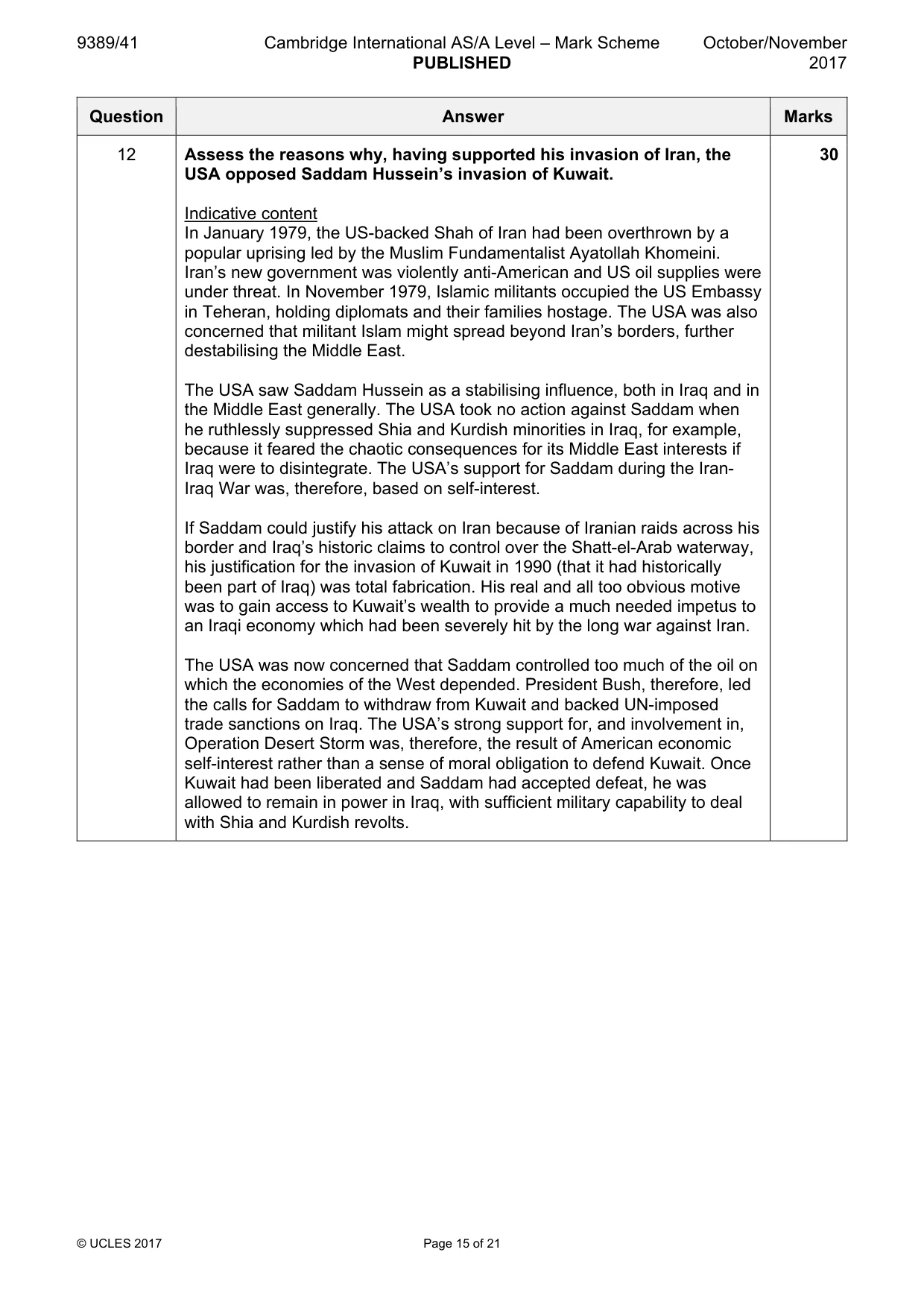
12 Assess the reasons why, having supported his invasion of Iran, the USA opposed Saddam Hussein’s invasion of Kuwait. [30] Depth Study 4: African History, 1945–1991 Answer any two questions.
Mark scheme: 12 Assess the reasons why, having supported his invasion of Iran, the 30 USA opposed Saddam Hussein’s invasion of Kuwait. Indicative content In January 1979, the US-backed Shah of Iran had been overthrown by a popular uprising led by the Muslim Fundamentalist Ayatollah Khomeini. Iran’s new government was violently anti-American and US oil supplies were under threat. In November 1979, Islamic militants occupied the US Embassy in Teheran, holding diplomats and their families hostage. The USA was also concerned that militant Islam might spread beyond Iran’s borders, further destabilising the Middle East. The USA saw Saddam Hussein as a stabilising influence, both in Iraq and in the Middle East generally. The USA took no action against Saddam when he ruthlessly suppressed Shia and Kurdish minorities in Iraq, for example, because it feared the chaotic consequences for its Middle East interests if Iraq were to disintegrate. The USA’s support for Saddam during the Iran- Iraq War was, therefore, based on self-interest. If Saddam could justify his attack on Iran because of Iranian raids across his border and Iraq’s historic claims to control over the Shatt-el-Arab waterway, his justification for the invasion of Kuwait in 1990 (that it had historically been part of Iraq) was total fabrication. His real and all too obvious motive was to gain access to Kuwait’s wealth to provide a much needed impetus to an Iraqi economy which had been severely hit by the long war against Iran. The USA was now concerned that Saddam controlled too much of the oil on which the economies of the West depended. President Bush, therefore, led the calls for Saddam to withdraw from Kuwait and backed UN-imposed trade sanctions on Iraq. The USA’s strong support for, and involvement in, Operation Desert Storm was, therefore, the result of American economic self-interest rather than a sense of moral obligation to defend Kuwait. Once Kuwait had been liberated and Saddam had accepted defeat, he was allowed to remain in power in Iraq, with sufficient military capability to deal with Shia and Kurdish revolts.
Q13 · ‘The most significant factor in the winning of independence by Africans after 1945 was…
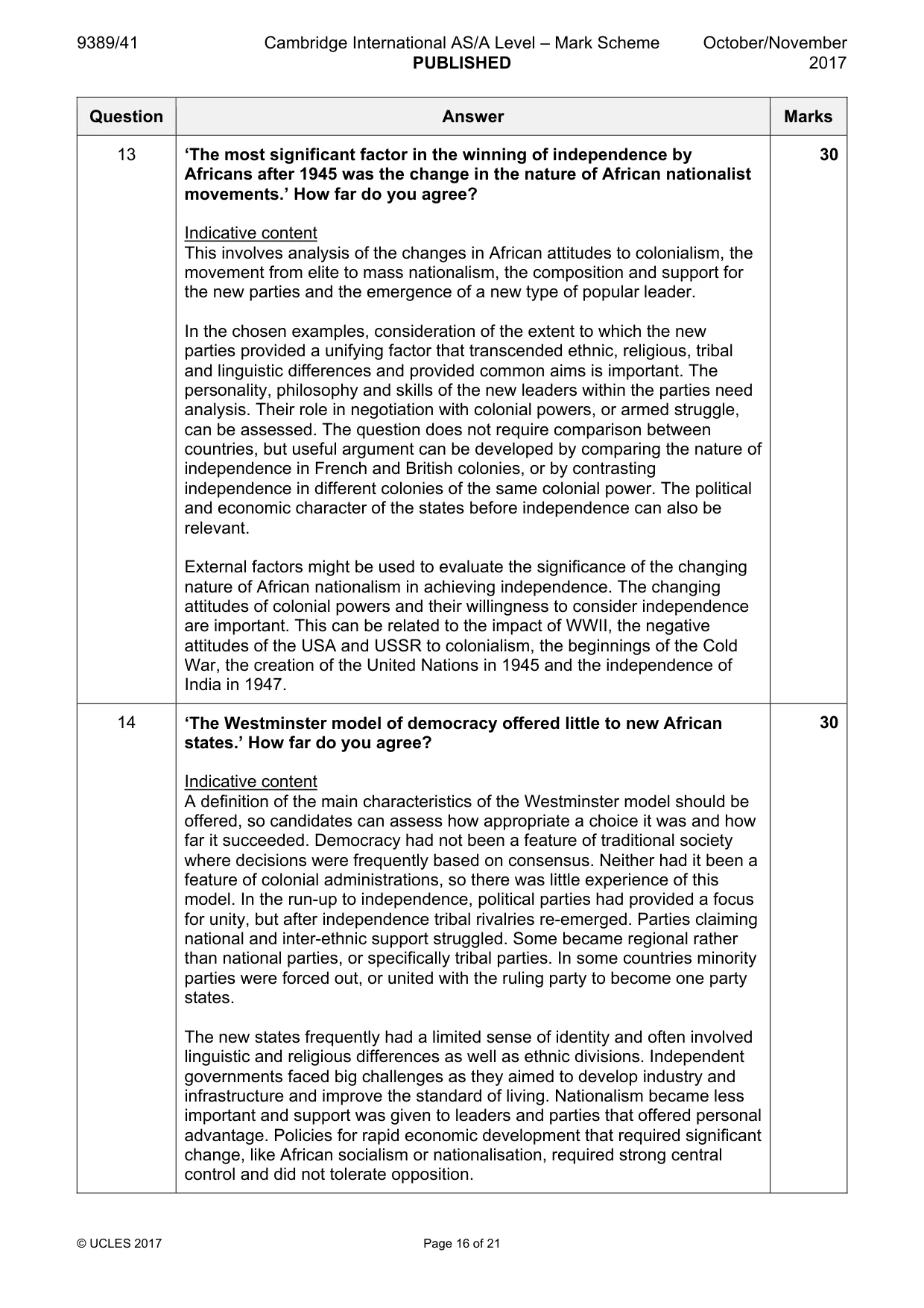
13 ‘The most significant factor in the winning of independence by Africans after 1945 was the change in the nature of African nationalist movements.’ How far do you agree? [30]
Mark scheme: 13 ‘The most significant factor in the winning of independence by 30 Africans after 1945 was the change in the nature of African nationalist movements.’ How far do you agree? Indicative content This involves analysis of the changes in African attitudes to colonialism, the movement from elite to mass nationalism, the composition and support for the new parties and the emergence of a new type of popular leader. In the chosen examples, consideration of the extent to which the new parties provided a unifying factor that transcended ethnic, religious, tribal and linguistic differences and provided common aims is important. The personality, philosophy and skills of the new leaders within the parties need analysis. Their role in negotiation with colonial powers, or armed struggle, can be assessed. The question does not require comparison between countries, but useful argument can be developed by comparing the nature of independence in French and British colonies, or by contrasting independence in different colonies of the same colonial power. The political and economic character of the states before independence can also be relevant. External factors might be used to evaluate the significance of the changing nature of African nationalism in achieving independence. The changing attitudes of colonial powers and their willingness to consider independence are important. This can be related to the impact of WWII, the negative attitudes of the USA and USSR to colonialism, the beginnings of the Cold War, the creation of the United Nations in 1945 and the independence of India in 1947.
Q14 · ‘The Westminster model of democracy offered little to new African states.’ How far do you…
14 ‘The Westminster model of democracy offered little to new African states.’ How far do you agree? [30]
Mark scheme: 14 ‘The Westminster model of democracy offered little to new African 30 states.’ How far do you agree? Indicative content A definition of the main characteristics of the Westminster model should be offered, so candidates can assess how appropriate a choice it was and how far it succeeded. Democracy had not been a feature of traditional society where decisions were frequently based on consensus. Neither had it been a feature of colonial administrations, so there was little experience of this model. In the run-up to independence, political parties had provided a focus for unity, but after independence tribal rivalries re-emerged. Parties claiming national and inter-ethnic support struggled. Some became regional rather than national parties, or specifically tribal parties. In some countries minority parties were forced out, or united with the ruling party to become one party states. The new states frequently had a limited sense of identity and often involved linguistic and religious differences as well as ethnic divisions. Independent governments faced big challenges as they aimed to develop industry and infrastructure and improve the standard of living. Nationalism became less important and support was given to leaders and parties that offered personal advantage. Policies for rapid economic development that required significant change, like African socialism or nationalisation, required strong central control and did not tolerate opposition.
Q15 · How far did independence improve the standard of living of ordinary Africans?
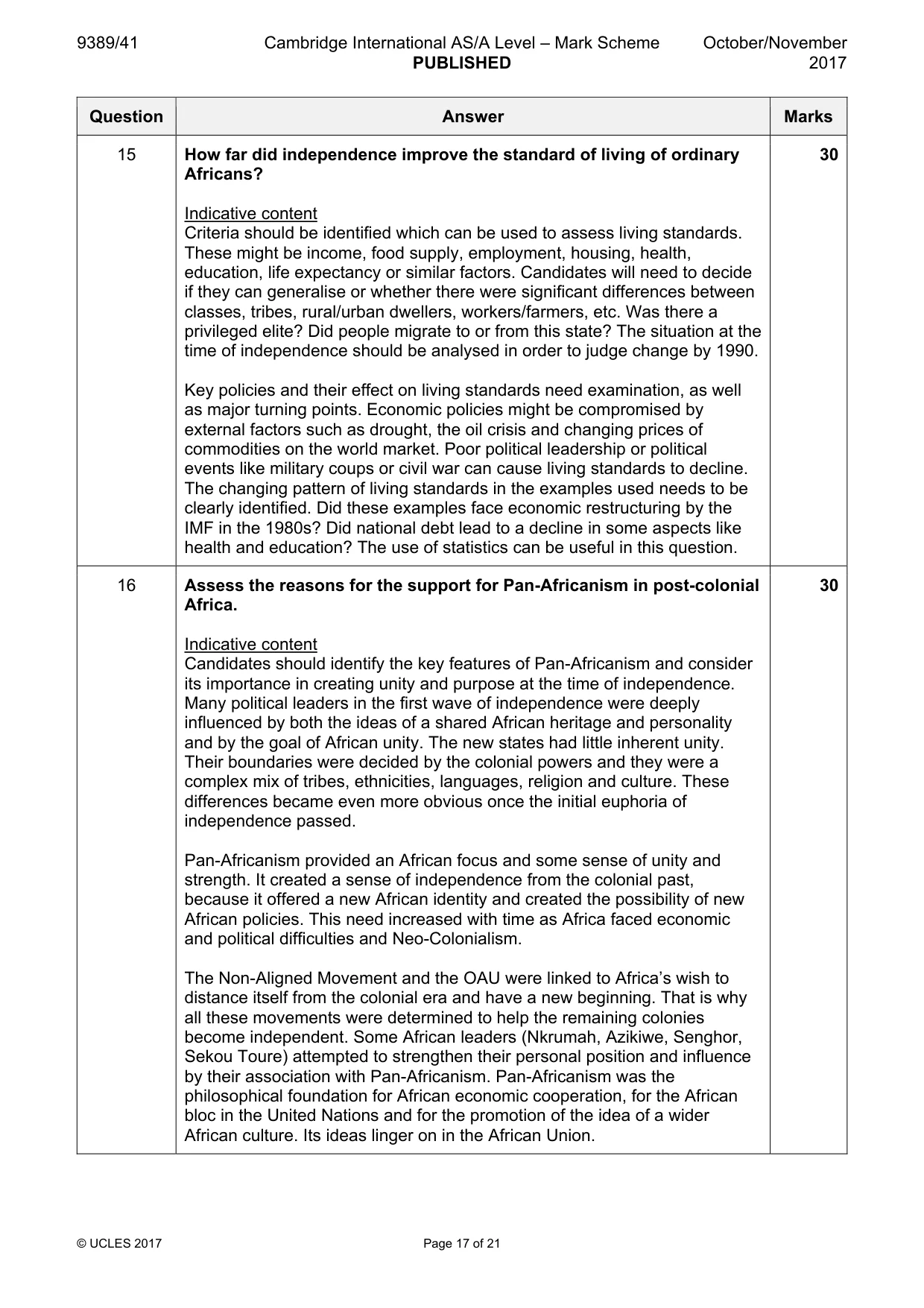
15 How far did independence improve the standard of living of ordinary Africans? [30]
Mark scheme: 15 How far did independence improve the standard of living of ordinary 30 Africans? Indicative content Criteria should be identified which can be used to assess living standards. These might be income, food supply, employment, housing, health, education, life expectancy or similar factors. Candidates will need to decide if they can generalise or whether there were significant differences between classes, tribes, rural/urban dwellers, workers/farmers, etc. Was there a privileged elite? Did people migrate to or from this state? The situation at the time of independence should be analysed in order to judge change by 1990. Key policies and their effect on living standards need examination, as well as major turning points. Economic policies might be compromised by external factors such as drought, the oil crisis and changing prices of commodities on the world market. Poor political leadership or political events like military coups or civil war can cause living standards to decline. The changing pattern of living standards in the examples used needs to be clearly identified. Did these examples face economic restructuring by the IMF in the 1980s? Did national debt lead to a decline in some aspects like health and education? The use of statistics can be useful in this question.
Q16 · Depth Study 5: Southeast Asian History, 1945–1990s Answer any two questions
Depth Study 5: Southeast Asian History, 1945–1990s Answer any two questions.
Mark scheme: 16 Assess the reasons for the support for Pan-Africanism in post-colonial 30 Africa. Indicative content Candidates should identify the key features of Pan-Africanism and consider its importance in creating unity and purpose at the time of independence. Many political leaders in the first wave of independence were deeply influenced by both the ideas of a shared African heritage and personality and by the goal of African unity. The new states had little inherent unity. Their boundaries were decided by the colonial powers and they were a complex mix of tribes, ethnicities, languages, religion and culture. These differences became even more obvious once the initial euphoria of independence passed. Pan-Africanism provided an African focus and some sense of unity and strength. It created a sense of independence from the colonial past, because it offered a new African identity and created the possibility of new African policies. This need increased with time as Africa faced economic and political difficulties and Neo-Colonialism. The Non-Aligned Movement and the OAU were linked to Africa’s wish to distance itself from the colonial era and have a new beginning. That is why all these movements were determined to help the remaining colonies become independent. Some African leaders (Nkrumah, Azikiwe, Senghor, Sekou Toure) attempted to strengthen their personal position and influence by their association with Pan-Africanism. Pan-Africanism was the philosophical foundation for African economic cooperation, for the African bloc in the United Nations and for the promotion of the idea of a wider African culture. Its ideas linger on in the African Union.
Q17 · ‘Political dominance and oppression, not economic cooperation, characterised the Japanese…
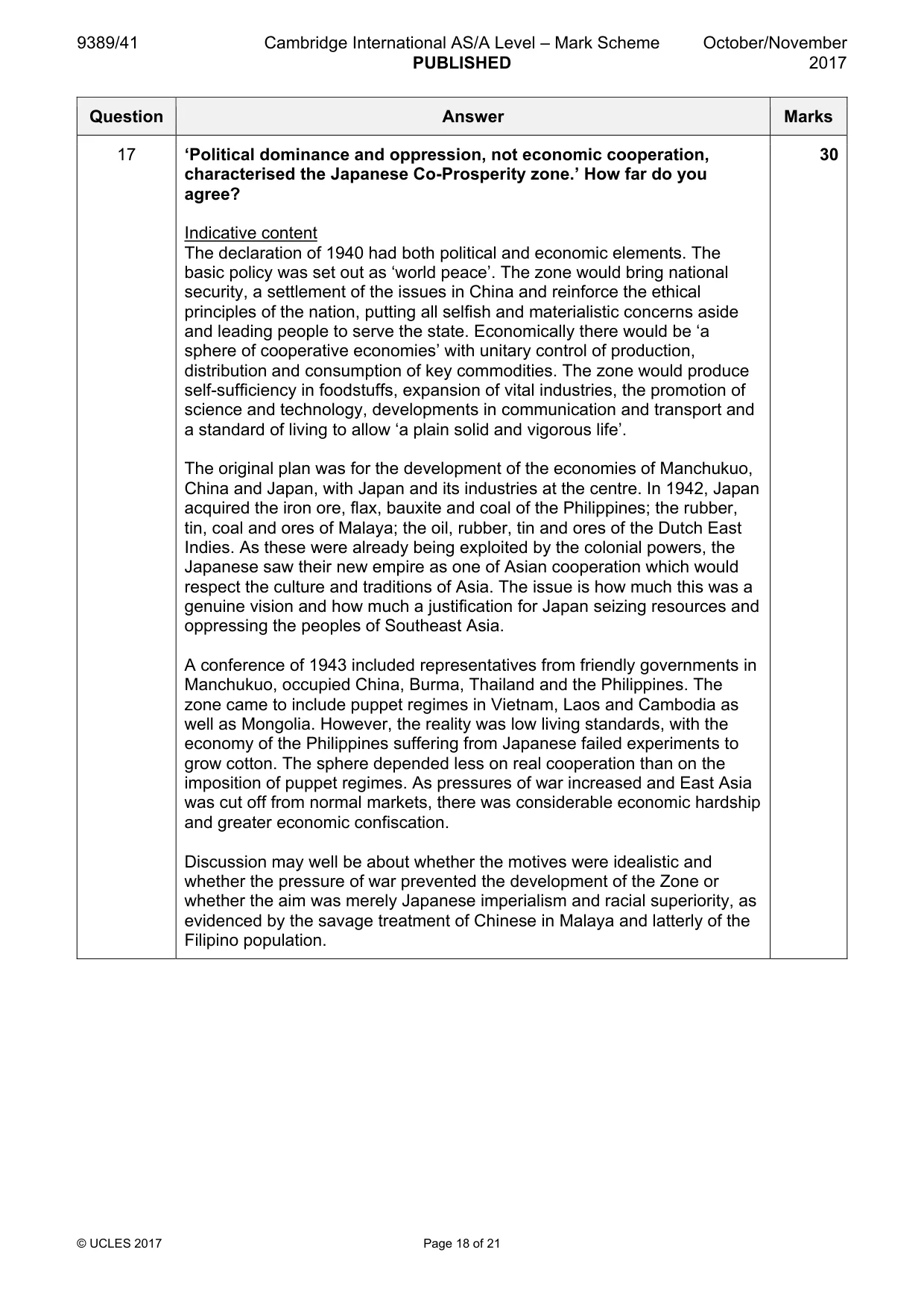
17 ‘Political dominance and oppression, not economic cooperation, characterised the Japanese Co-Prosperity zone.’ How far do you agree? [30]
Mark scheme: 17 ‘Political dominance and oppression, not economic cooperation, 30 characterised the Japanese Co-Prosperity zone.’ How far do you agree? Indicative content The declaration of 1940 had both political and economic elements. The basic policy was set out as ‘world peace’. The zone would bring national security, a settlement of the issues in China and reinforce the ethical principles of the nation, putting all selfish and materialistic concerns aside and leading people to serve the state. Economically there would be ‘a sphere of cooperative economies’ with unitary control of production, distribution and consumption of key commodities. The zone would produce self-sufficiency in foodstuffs, expansion of vital industries, the promotion of science and technology, developments in communication and transport and a standard of living to allow ‘a plain solid and vigorous life’. The original plan was for the development of the economies of Manchukuo, China and Japan, with Japan and its industries at the centre. In 1942, Japan acquired the iron ore, flax, bauxite and coal of the Philippines; the rubber, tin, coal and ores of Malaya; the oil, rubber, tin and ores of the Dutch East Indies. As these were already being exploited by the colonial powers, the Japanese saw their new empire as one of Asian cooperation which would respect the culture and traditions of Asia. The issue is how much this was a genuine vision and how much a justification for Japan seizing resources and oppressing the peoples of Southeast Asia. A conference of 1943 included representatives from friendly governments in Manchukuo, occupied China, Burma, Thailand and the Philippines. The zone came to include puppet regimes in Vietnam, Laos and Cambodia as well as Mongolia. However, the reality was low living standards, with the economy of the Philippines suffering from Japanese failed experiments to grow cotton. The sphere depended less on real cooperation than on the imposition of puppet regimes. As pressures of war increased and East Asia was cut off from normal markets, there was considerable economic hardship and greater economic confiscation. Discussion may well be about whether the motives were idealistic and whether the pressure of war prevented the development of the Zone or whether the aim was merely Japanese imperialism and racial superiority, as evidenced by the savage treatment of Chinese in Malaya and latterly of the Filipino population.
Q18 · How far can France’s defeat in Vietnam in 1954 be explained by the strengths of its…
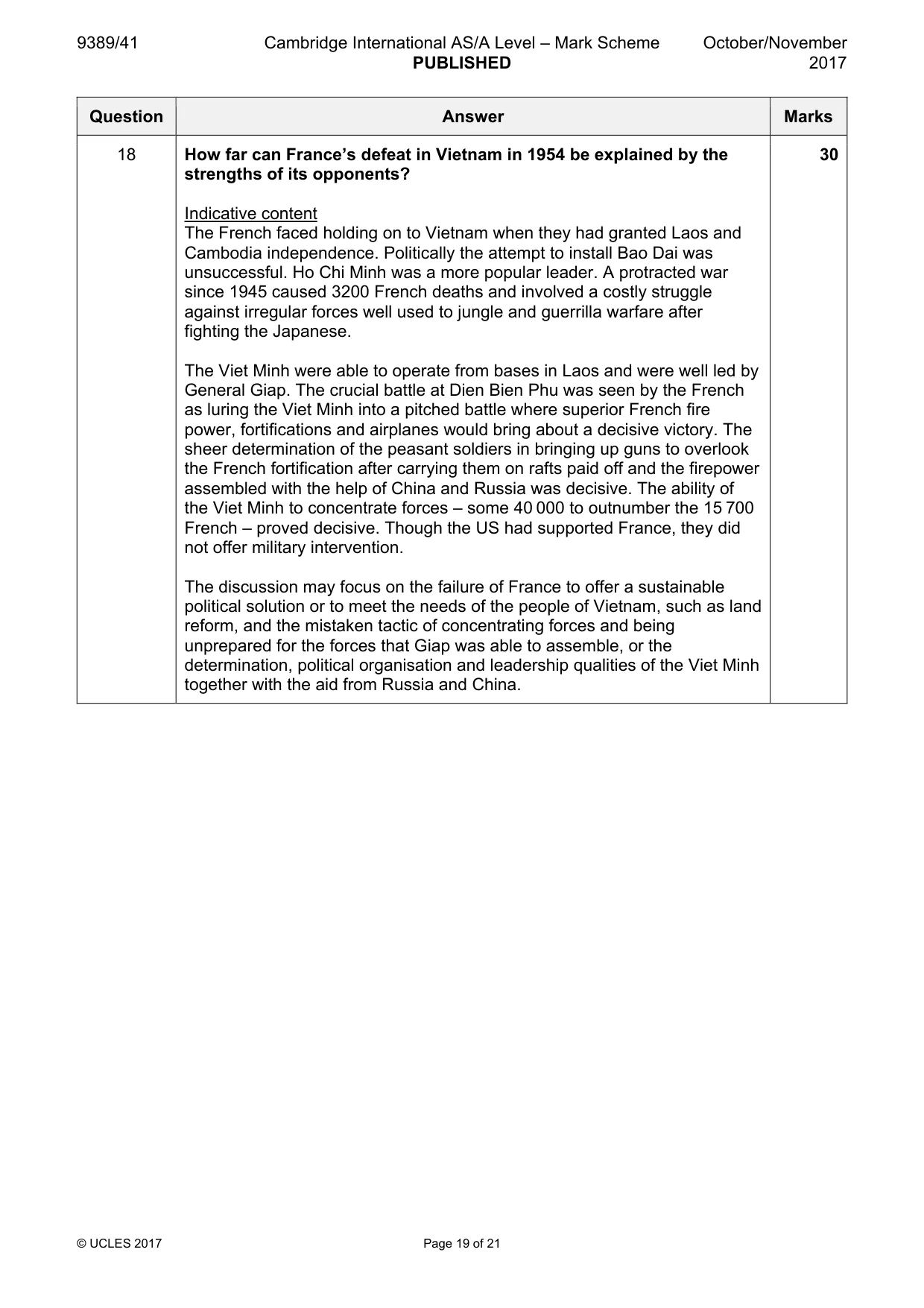
18 How far can France’s defeat in Vietnam in 1954 be explained by the strengths of its opponents? [30]
Mark scheme: 18 How far can France’s defeat in Vietnam in 1954 be explained by the 30 strengths of its opponents? Indicative content The French faced holding on to Vietnam when they had granted Laos and Cambodia independence. Politically the attempt to install Bao Dai was unsuccessful. Ho Chi Minh was a more popular leader. A protracted war since 1945 caused 3200 French deaths and involved a costly struggle against irregular forces well used to jungle and guerrilla warfare after fighting the Japanese. The Viet Minh were able to operate from bases in Laos and were well led by General Giap. The crucial battle at Dien Bien Phu was seen by the French as luring the Viet Minh into a pitched battle where superior French fire power, fortifications and airplanes would bring about a decisive victory. The sheer determination of the peasant soldiers in bringing up guns to overlook the French fortification after carrying them on rafts paid off and the firepower assembled with the help of China and Russia was decisive. The ability of the Viet Minh to concentrate forces – some 40 000 to outnumber the 15 700 French – proved decisive. Though the US had supported France, they did not offer military intervention. The discussion may focus on the failure of France to offer a sustainable political solution or to meet the needs of the people of Vietnam, such as land reform, and the mistaken tactic of concentrating forces and being unprepared for the forces that Giap was able to assemble, or the determination, political organisation and leadership qualities of the Viet Minh together with the aid from Russia and China.
Q19 · ‘The most successful leader of the Philippines in the post-Marcos era’
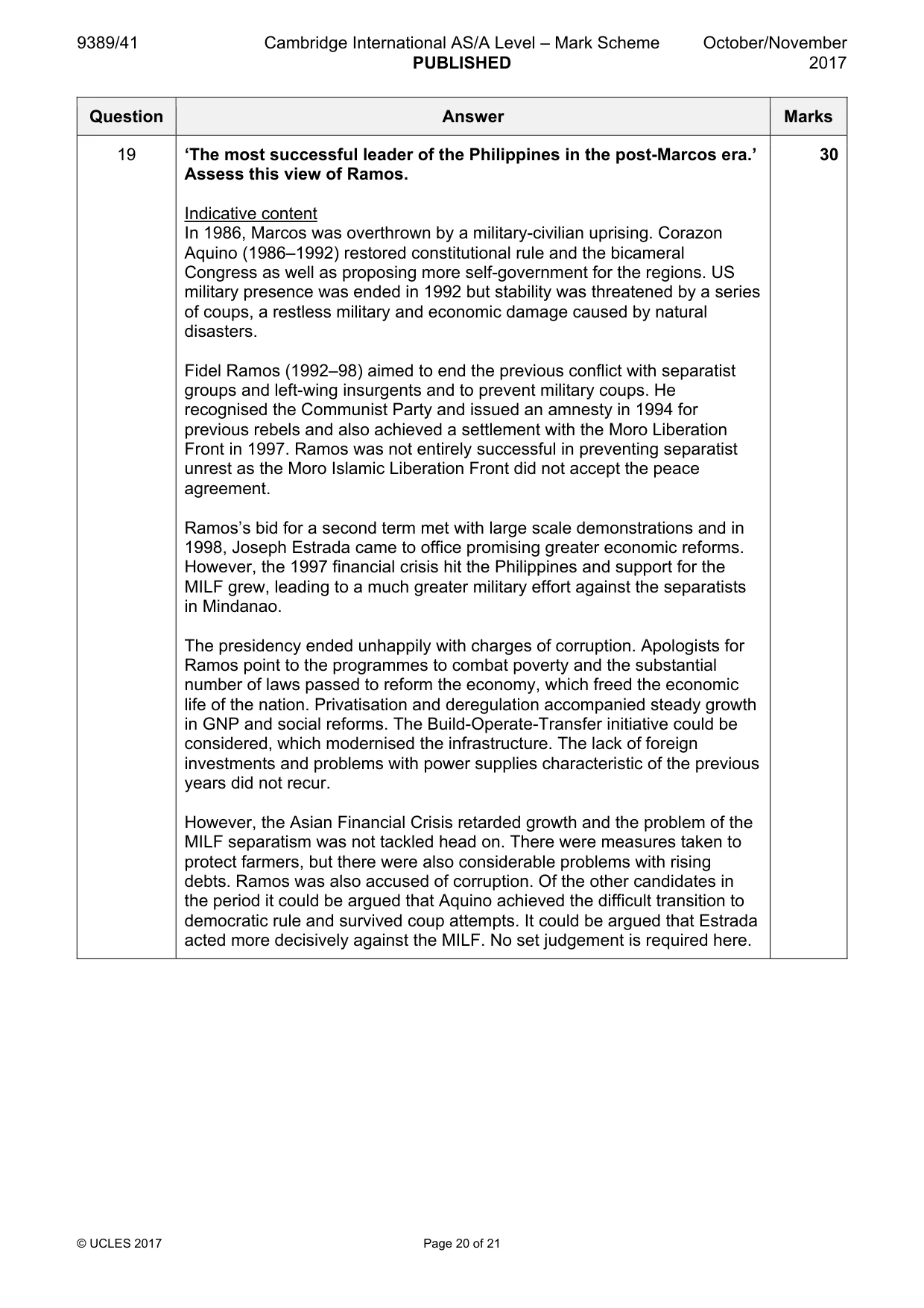
19 ‘The most successful leader of the Philippines in the post-Marcos era’. Assess this view of Ramos. [30]
Mark scheme: 19 ‘The most successful leader of the Philippines in the post-Marcos era.’ 30 Assess this view of Ramos. Indicative content In 1986, Marcos was overthrown by a military-civilian uprising. Corazon Aquino (1986–1992) restored constitutional rule and the bicameral Congress as well as proposing more self-government for the regions. US military presence was ended in 1992 but stability was threatened by a series of coups, a restless military and economic damage caused by natural disasters. Fidel Ramos (1992–98) aimed to end the previous conflict with separatist groups and left-wing insurgents and to prevent military coups. He recognised the Communist Party and issued an amnesty in 1994 for previous rebels and also achieved a settlement with the Moro Liberation Front in 1997. Ramos was not entirely successful in preventing separatist unrest as the Moro Islamic Liberation Front did not accept the peace agreement. Ramos’s bid for a second term met with large scale demonstrations and in 1998, Joseph Estrada came to office promising greater economic reforms. However, the 1997 financial crisis hit the Philippines and support for the MILF grew, leading to a much greater military effort against the separatists in Mindanao. The presidency ended unhappily with charges of corruption. Apologists for Ramos point to the programmes to combat poverty and the substantial number of laws passed to reform the economy, which freed the economic life of the nation. Privatisation and deregulation accompanied steady growth in GNP and social reforms. The Build-Operate-Transfer initiative could be considered, which modernised the infrastructure. The lack of foreign investments and problems with power supplies characteristic of the previous years did not recur. However, the Asian Financial Crisis retarded growth and the problem of the MILF separatism was not tackled head on. There were measures taken to protect farmers, but there were also considerable problems with rising debts. Ramos was also accused of corruption. Of the other candidates in the period it could be argued that Aquino achieved the difficult transition to democratic rule and survived coup attempts. It could be argued that Estrada acted more decisively against the MILF. No set judgement is required here.
What you needed in this session
Cambridge’s own grade thresholds for 2017 Oct/Nov, Paper 4 · Variant 1. A higher threshold means an easier paper — the bar moves with how the cohort did.