Cambridge A Level History 9389 — 2017 Oct/Nov Paper 3 · Variant 3
9389/33/O/N/17 · 3 questions · 40 marks · ≈45 min
The question paper and its mark scheme, free to read here and free to download. This is Cambridge’s own paper, exactly as it was sat.
Question paper4 pages
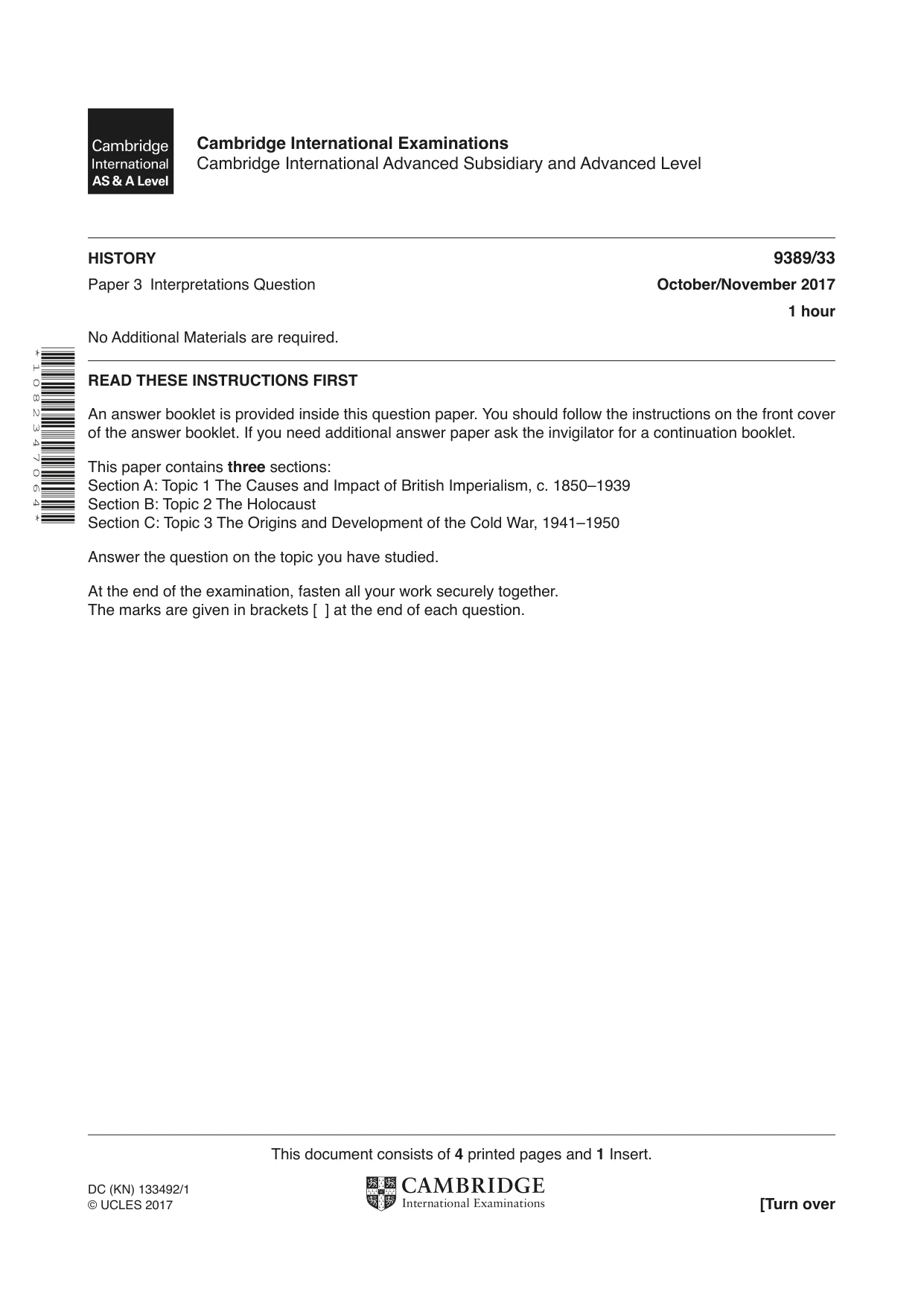
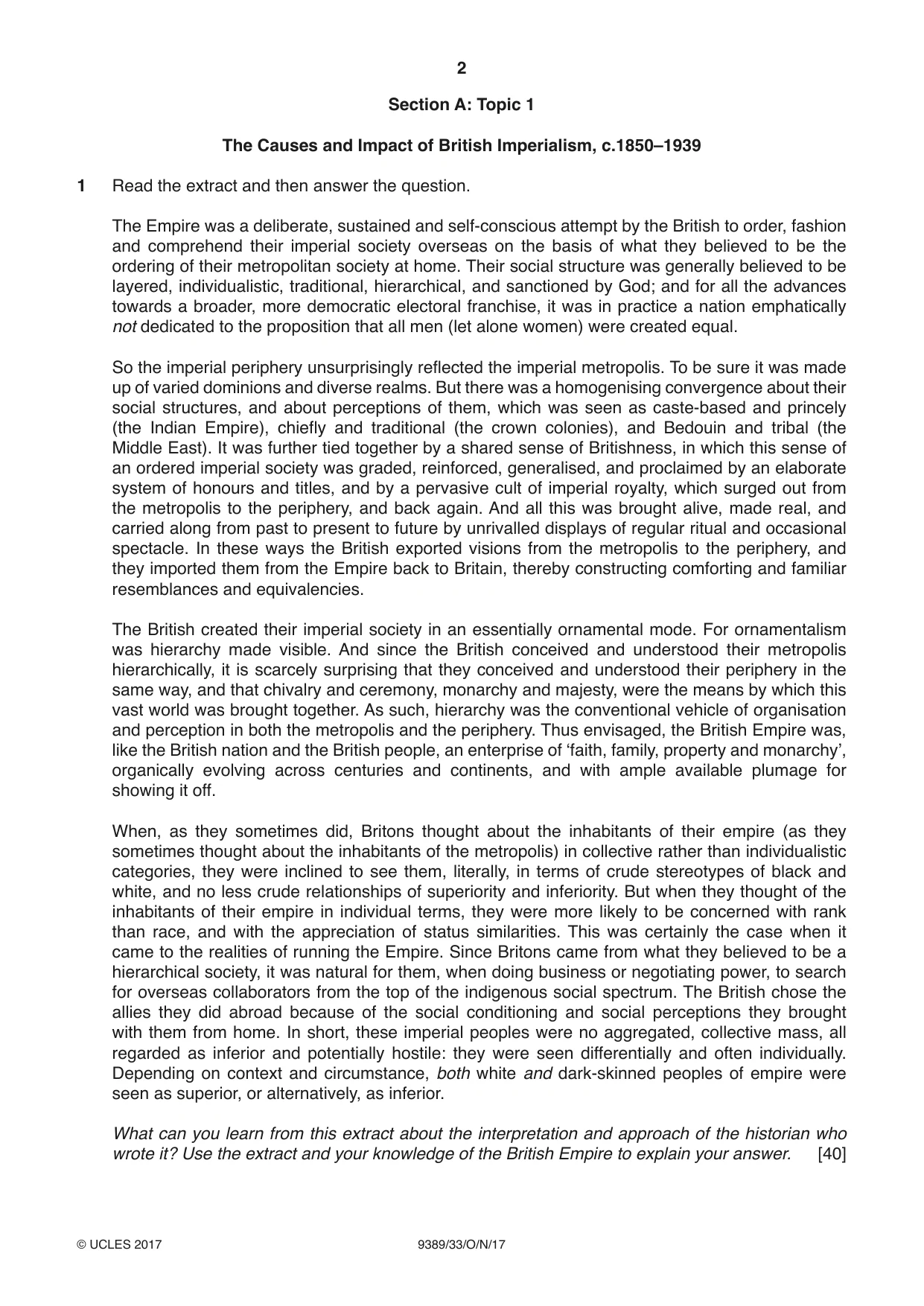
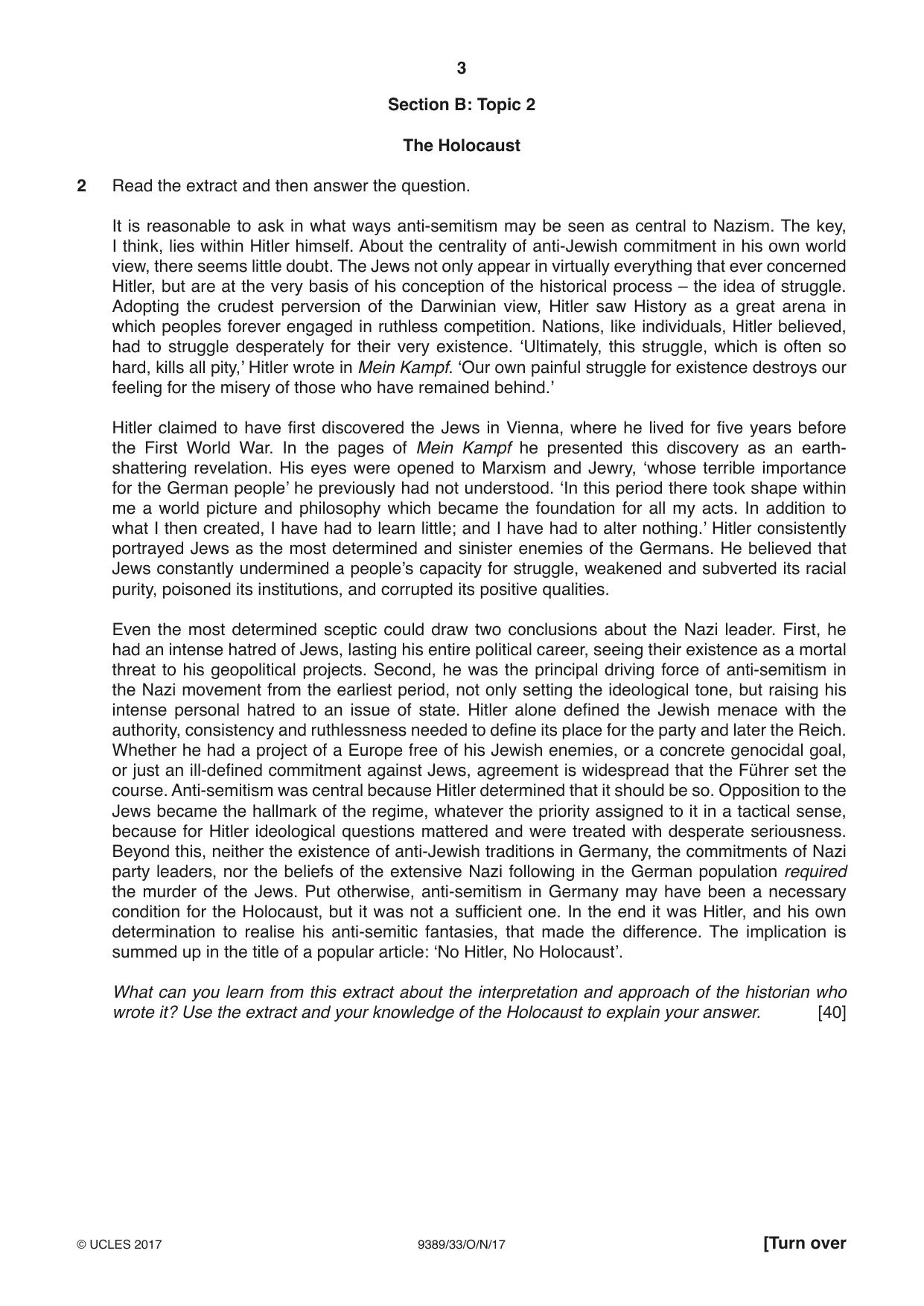
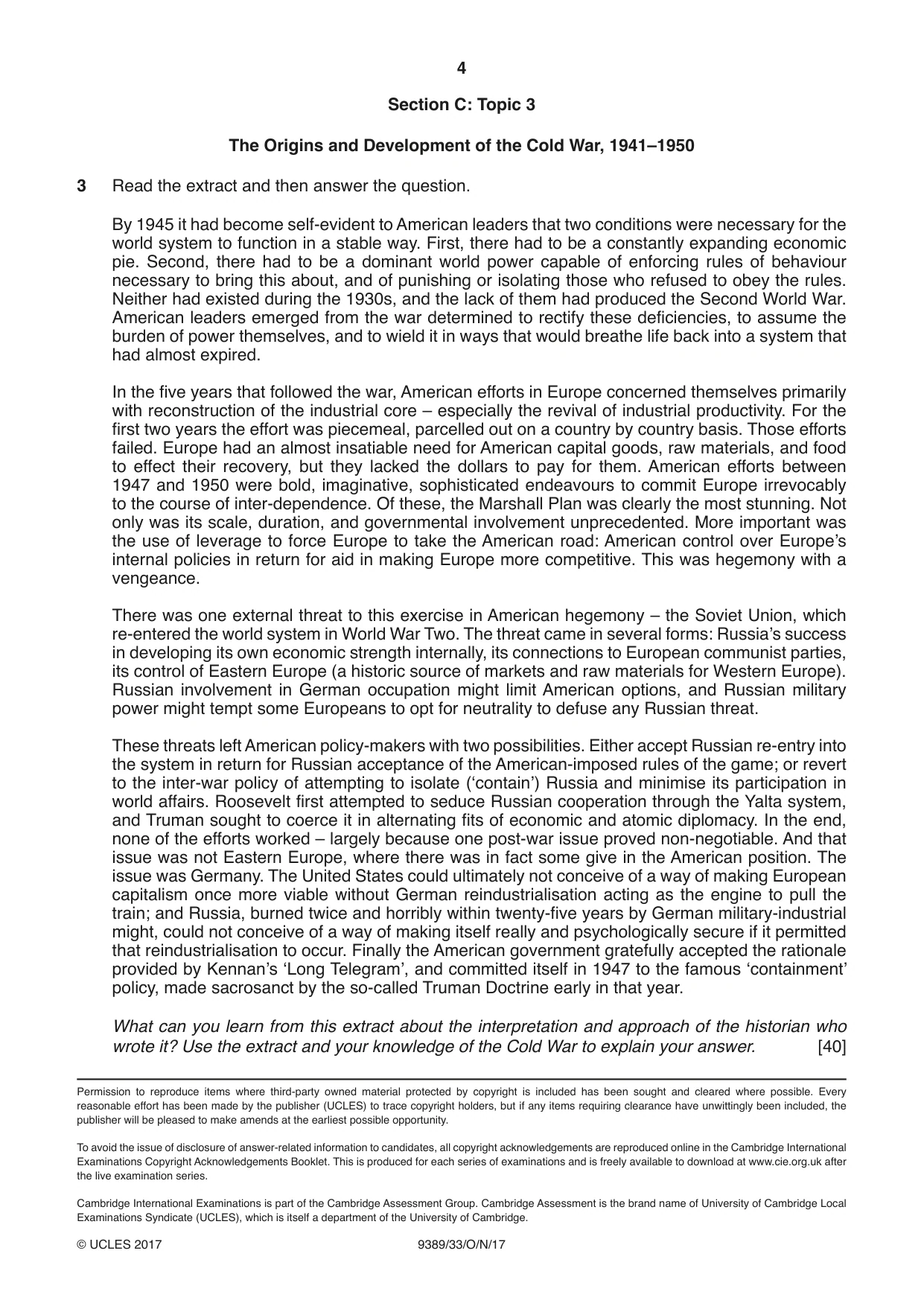
Mark scheme6 pages
Answers below. Sit the paper first if you are practising.
Questions as text
Q1 · Read the extract and then answer the question
1 Read the extract and then answer the question. The Empire was a deliberate, sustained and self-conscious attempt by the British to order, fashion and comprehend their imperial society overseas on the basis of what they believed to be the ordering of their metropolitan society at home. Their social structure was generally believed to be layered, individualistic, traditional, hierarchical, and sanctioned by God; and for all the advances towards a broader, more democratic electoral franchise, it was in practice a nation emphatically not dedicated to the proposition that all men (let alone women) were created equal. So the imperial periphery unsurprisingly reflected the imperial metropolis. To be sure it was made up of varied dominions and diverse realms. But there was a homogenising convergence about their social structures, and about perceptions of them, which was seen as caste-based and princely (the Indian Empire), chiefly and traditional (the crown colonies), and Bedouin and tribal (the Middle East). It was further tied together by a shared sense of Britishness, in which this sense of an ordered imperial society was graded, reinforced, generalised, and proclaimed by an elaborate system of honours and titles, and by a pervasive cult of imperial royalty, which surged out from the metropolis to the periphery, and back again. And all this was brought alive, made real, and carried along from past to present to future by unrivalled displays of regular ritual and occasional spectacle. In these ways the British exported visions from the metropolis to the periphery, and they imported them from the Empire back to Britain, thereby constructing comforting and familiar resemblances and equivalencies. The British created their imperial society in an essentially ornamental mode. For ornamentalism was hierarchy made visible. And since the British conceived and understood their metropolis hierarchically, it is scarcely surprising that they conceived and understood their periphery in the same way, and that chivalry and ceremony, monarchy and majesty, were the means by which this vast world was brought together. As such, hierarchy was the conventional vehicle of organisation and perception in both the metropolis and the periphery. Thus envisaged, the British Empire was, like the British nation and the British people, an enterprise of ‘faith, family, property and monarchy’, organically evolving across centuries and continents, and with ample available plumage for showing it off. When, as they sometimes did, Britons thought about the inhabitants of their empire (as they sometimes thought about the inhabitants of the metropolis) in collective rather than individualistic categories, they were inclined to see them, literally, in terms of crude stereotypes of black and white, and no less crude relationships of superiority and inferiority. But when they thought of the inhabitants of their empire in individual terms, they were more likely to be concerned with rank than race, and with the appreciation of status similarities. This was certainly the case when it came to the realities of running the Empire. Since Britons came from what they believed to be a hierarchical society, it was natural for them, when doing business or negotiating power, to search for overseas collaborators from the top of the indigenous social spectrum. The British chose the allies they did abroad because of the social conditioning and social perceptions they brought with them from home. In short, these imperial peoples were no aggregated, collective mass, all regarded as inferior and potentially hostile: they were seen differentially and often individually. Depending on context and circumstance, both white and dark-skinned peoples of empire were seen as superior, or alternatively, as inferior. What can you learn from this extract about the interpretation and approach of the historian who wrote it? Use the extract and your knowledge of the British Empire to explain your answer. [40]
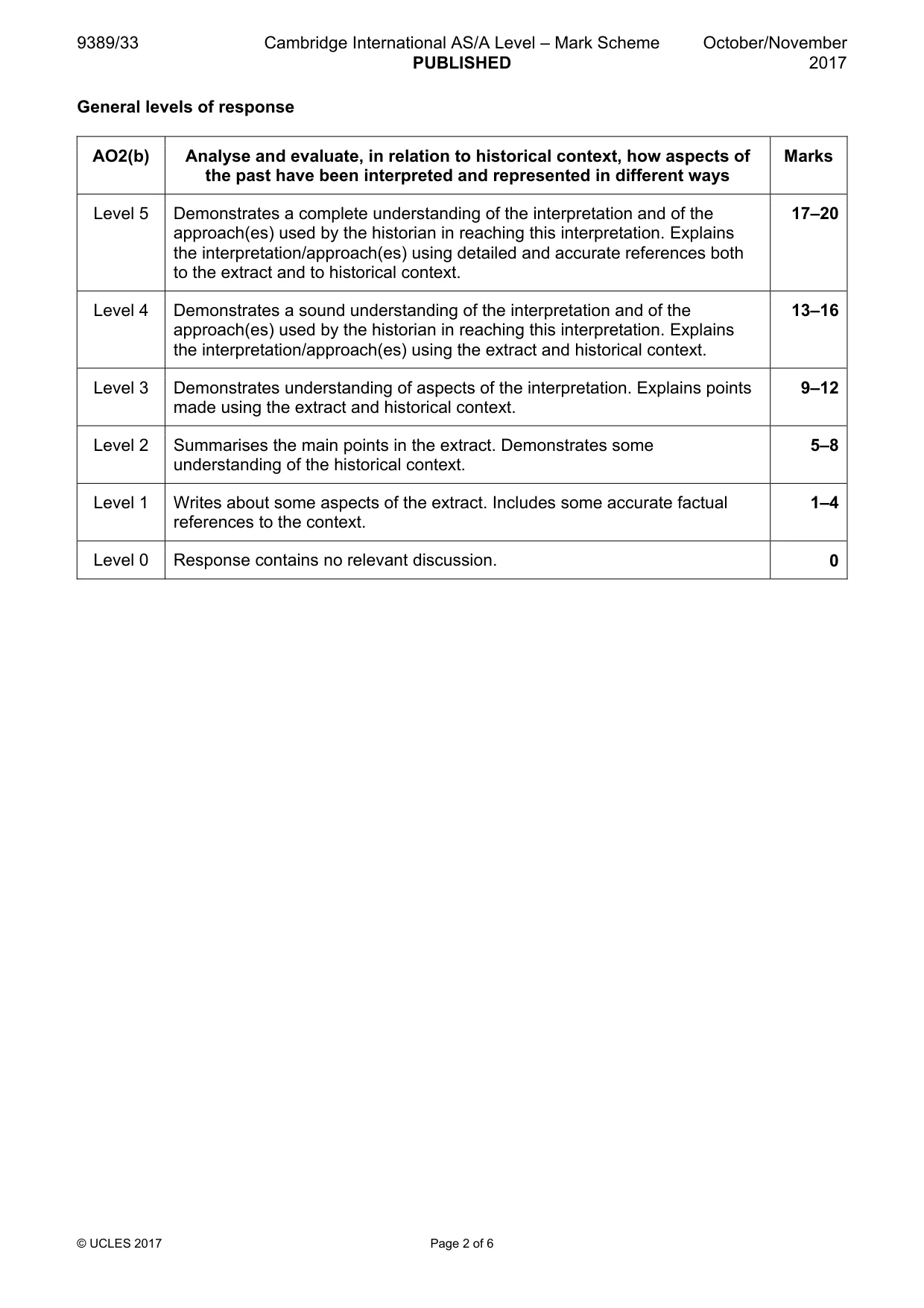
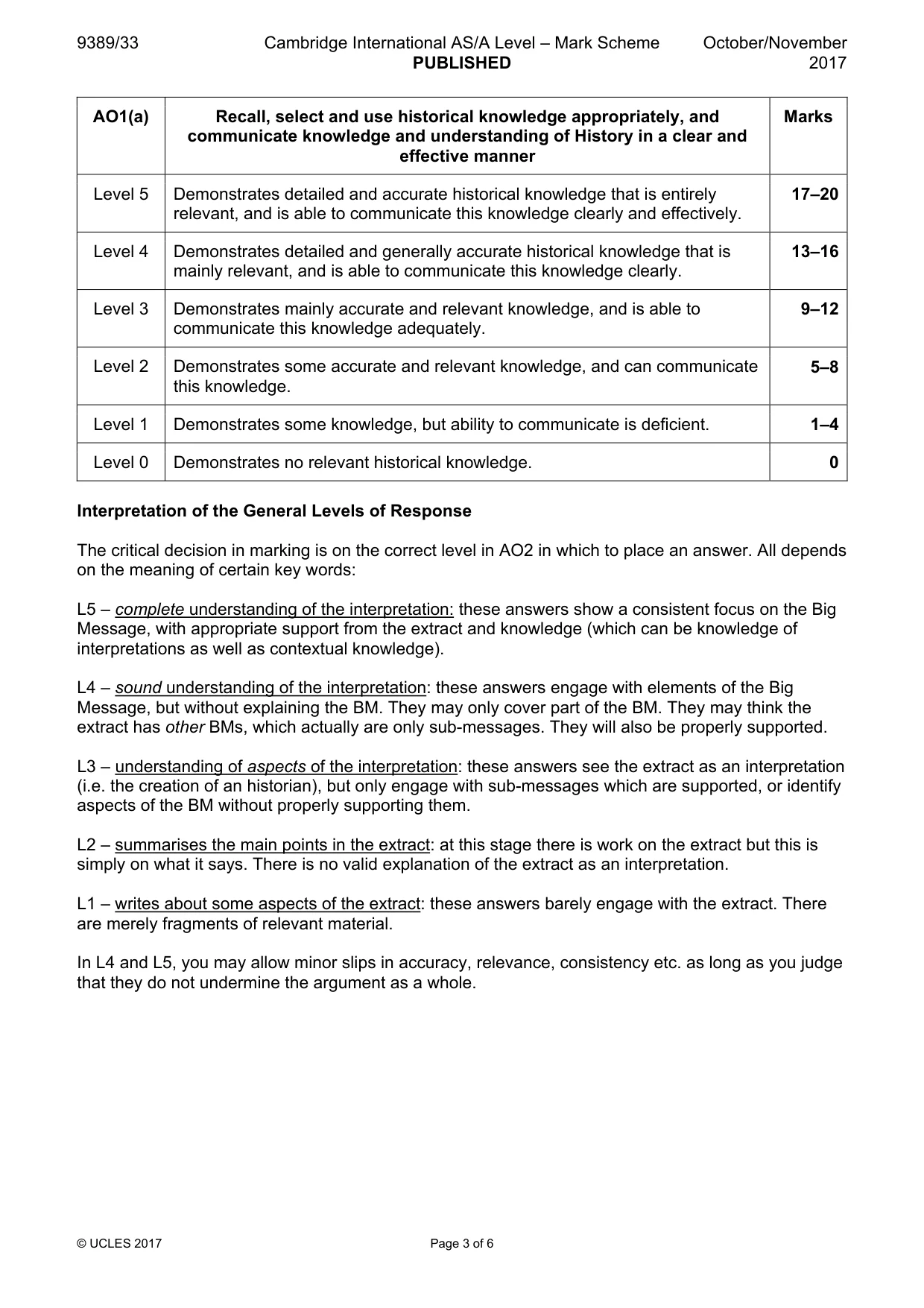
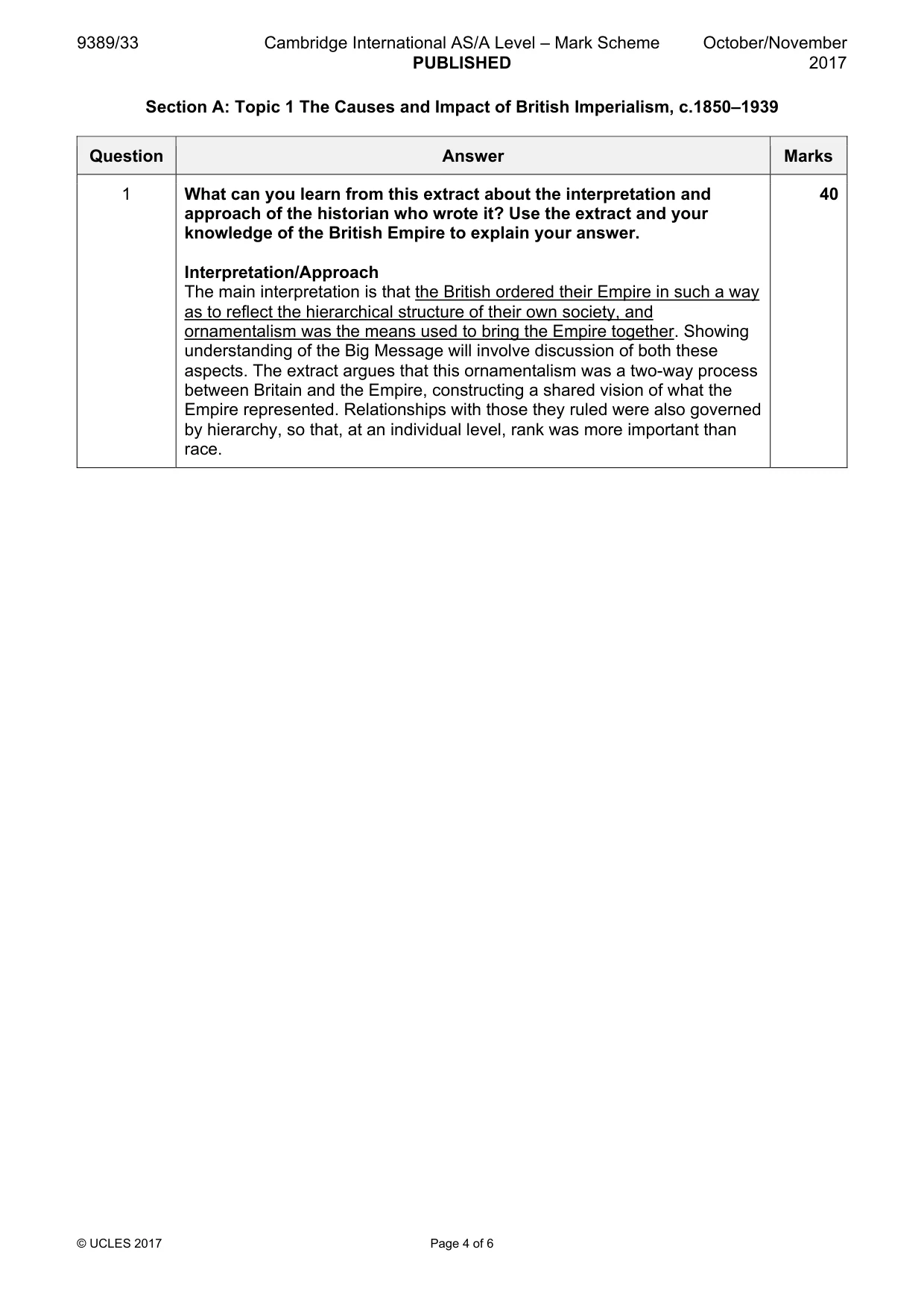
Mark scheme: Question Answer Marks 1 What can you learn from this extract about the interpretation and 40 approach of the historian who wrote it? Use the extract and your knowledge of the British Empire to explain your answer. Interpretation/Approach The main interpretation is that the British ordered their Empire in such a way as to reflect the hierarchical structure of their own society, and ornamentalism was the means used to bring the Empire together. Showing understanding of the Big Message will involve discussion of both these aspects. The extract argues that this ornamentalism was a two-way process between Britain and the Empire, constructing a shared vision of what the Empire represented. Relationships with those they ruled were also governed by hierarchy, so that, at an individual level, rank was more important than race. Section B: Topic 2 The Holocaust
Q2 · Read the extract and then answer the question
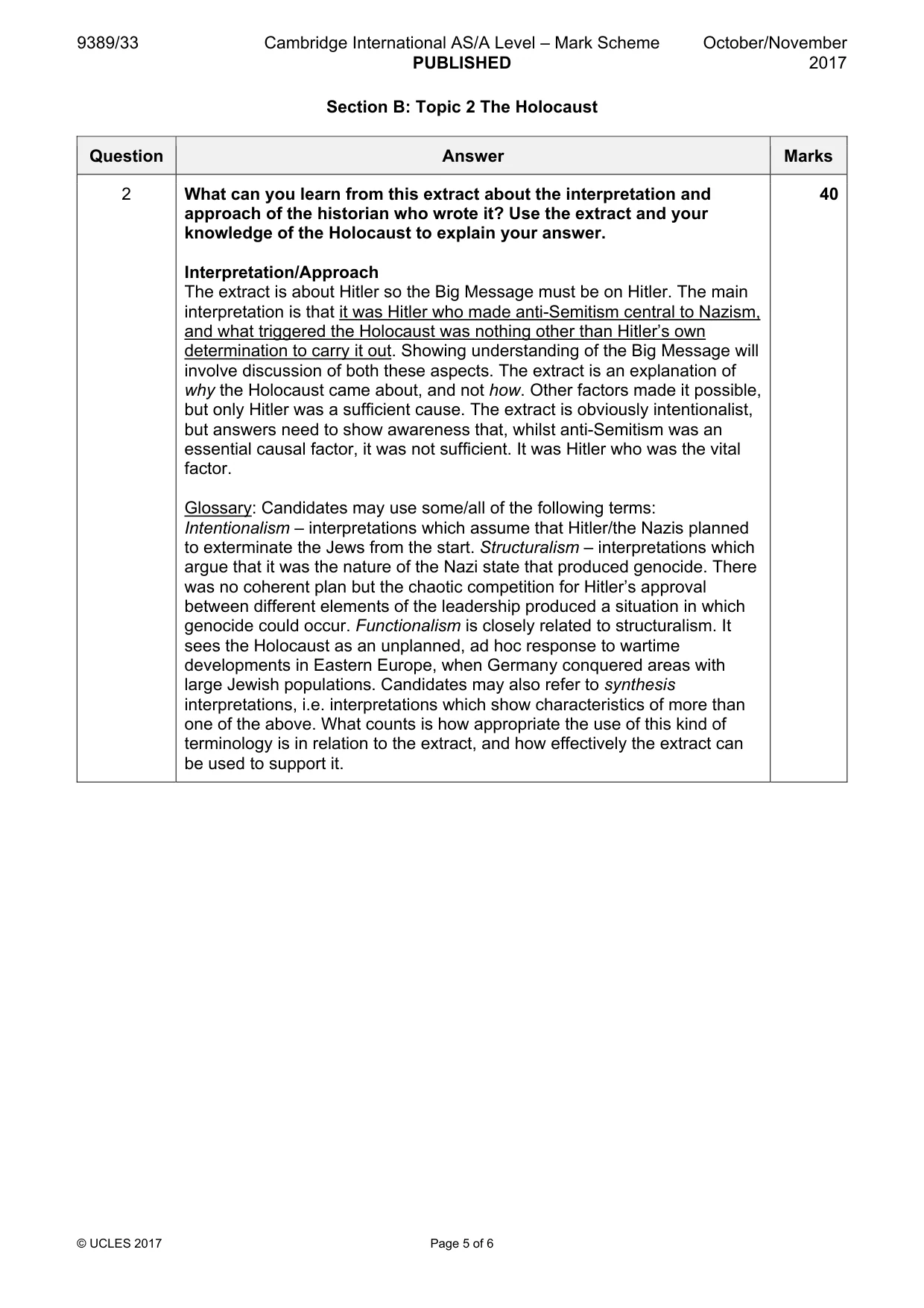
2 Read the extract and then answer the question. It is reasonable to ask in what ways anti-semitism may be seen as central to Nazism. The key, I think, lies within Hitler himself. About the centrality of anti-Jewish commitment in his own world view, there seems little doubt. The Jews not only appear in virtually everything that ever concerned Hitler, but are at the very basis of his conception of the historical process – the idea of struggle. Adopting the crudest perversion of the Darwinian view, Hitler saw History as a great arena in which peoples forever engaged in ruthless competition. Nations, like individuals, Hitler believed, had to struggle desperately for their very existence. ‘Ultimately, this struggle, which is often so hard, kills all pity,’ Hitler wrote in Mein Kampf. ‘Our own painful struggle for existence destroys our feeling for the misery of those who have remained behind.’ Hitler claimed to have first discovered the Jews in Vienna, where he lived for five years before the First World War. In the pages of Mein Kampf he presented this discovery as an earth- shattering revelation. His eyes were opened to Marxism and Jewry, ‘whose terrible importance for the German people’ he previously had not understood. ‘In this period there took shape within me a world picture and philosophy which became the foundation for all my acts. In addition to what I then created, I have had to learn little; and I have had to alter nothing.’ Hitler consistently portrayed Jews as the most determined and sinister enemies of the Germans. He believed that Jews constantly undermined a people’s capacity for struggle, weakened and subverted its racial purity, poisoned its institutions, and corrupted its positive qualities. Even the most determined sceptic could draw two conclusions about the Nazi leader. First, he had an intense hatred of Jews, lasting his entire political career, seeing their existence as a mortal threat to his geopolitical projects. Second, he was the principal driving force of anti-semitism in the Nazi movement from the earliest period, not only setting the ideological tone, but raising his intense personal hatred to an issue of state. Hitler alone defined the Jewish menace with the authority, consistency and ruthlessness needed to define its place for the party and later the Reich. Whether he had a project of a Europe free of his Jewish enemies, or a concrete genocidal goal, or just an ill-defined commitment against Jews, agreement is widespread that the Führer set the course. Anti-semitism was central because Hitler determined that it should be so. Opposition to the Jews became the hallmark of the regime, whatever the priority assigned to it in a tactical sense, because for Hitler ideological questions mattered and were treated with desperate seriousness. Beyond this, neither the existence of anti-Jewish traditions in Germany, the commitments of Nazi party leaders, nor the beliefs of the extensive Nazi following in the German population required the murder of the Jews. Put otherwise, anti-semitism in Germany may have been a necessary condition for the Holocaust, but it was not a sufficient one. In the end it was Hitler, and his own determination to realise his anti-semitic fantasies, that made the difference. The implication is summed up in the title of a popular article: ‘No Hitler, No Holocaust’. What can you learn from this extract about the interpretation and approach of the historian who wrote it? Use the extract and your knowledge of the Holocaust to explain your answer. [40] Section C: Topic 3 The Origins and Development of the Cold War, 1941–1950
Mark scheme: 2 What can you learn from this extract about the interpretation and 40 approach of the historian who wrote it? Use the extract and your knowledge of the Holocaust to explain your answer. Interpretation/Approach The extract is about Hitler so the Big Message must be on Hitler. The main interpretation is that it was Hitler who made anti-Semitism central to Nazism, and what triggered the Holocaust was nothing other than Hitler’s own determination to carry it out. Showing understanding of the Big Message will involve discussion of both these aspects. The extract is an explanation of why the Holocaust came about, and not how. Other factors made it possible, but only Hitler was a sufficient cause. The extract is obviously intentionalist, but answers need to show awareness that, whilst anti-Semitism was an essential causal factor, it was not sufficient. It was Hitler who was the vital factor. Glossary: Candidates may use some/all of the following terms: Intentionalism – interpretations which assume that Hitler/the Nazis planned to exterminate the Jews from the start. Structuralism – interpretations which argue that it was the nature of the Nazi state that produced genocide. There was no coherent plan but the chaotic competition for Hitler’s approval between different elements of the leadership produced a situation in which genocide could occur. Functionalism is closely related to structuralism. It sees the Holocaust as an unplanned, ad hoc response to wartime developments in Eastern Europe, when Germany conquered areas with large Jewish populations. Candidates may also refer to synthesis interpretations, i.e. interpretations which show characteristics of more than one of the above. What counts is how appropriate the use of this kind of terminology is in relation to the extract, and how effectively the extract can be used to support it. Section C: Topic 3 The Origins and Development of the Cold War, 1941–1950
Q3 · Read the extract and then answer the question
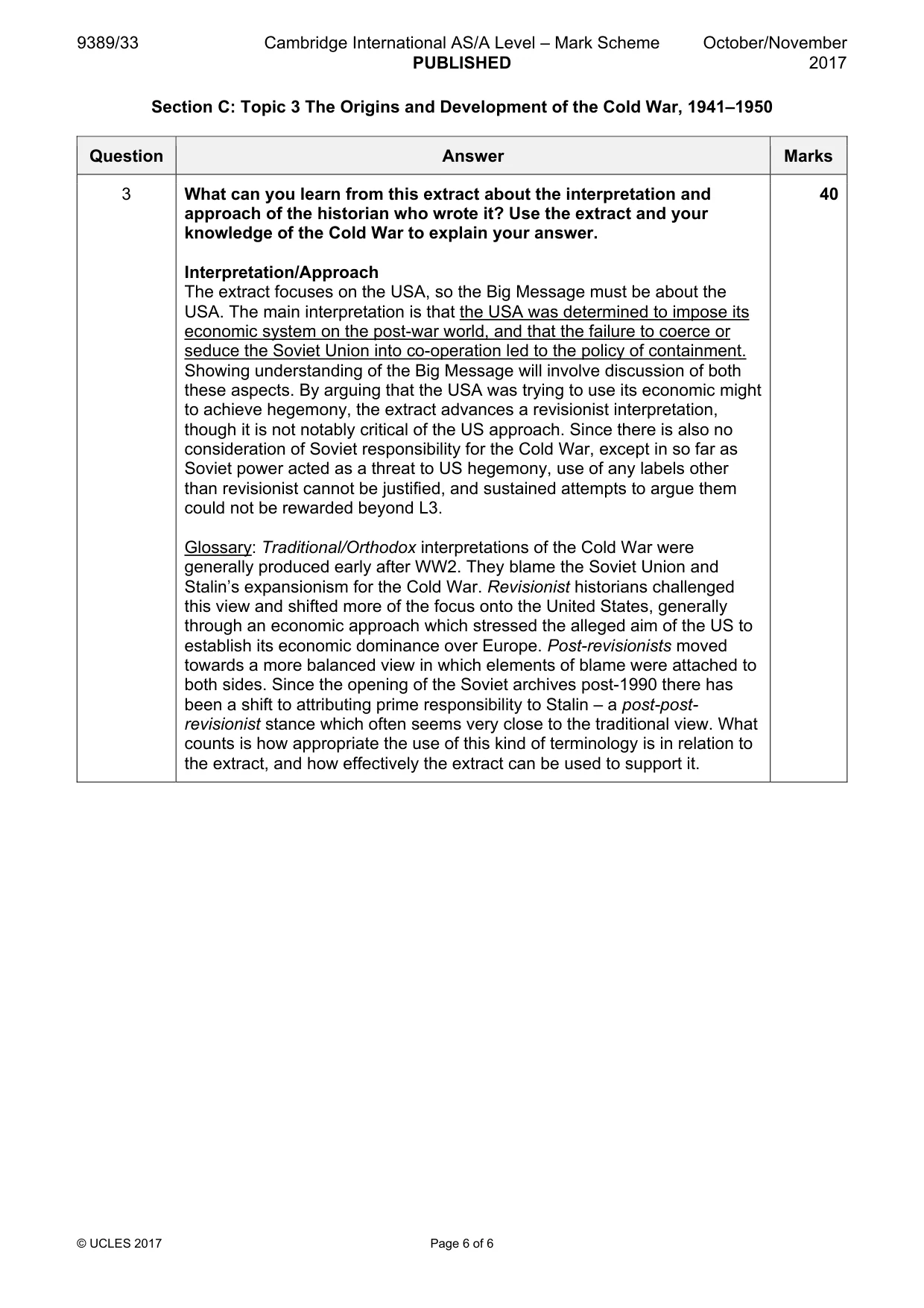
3 Read the extract and then answer the question. By 1945 it had become self-evident to American leaders that two conditions were necessary for the world system to function in a stable way. First, there had to be a constantly expanding economic pie. Second, there had to be a dominant world power capable of enforcing rules of behaviour necessary to bring this about, and of punishing or isolating those who refused to obey the rules. Neither had existed during the 1930s, and the lack of them had produced the Second World War. American leaders emerged from the war determined to rectify these deficiencies, to assume the burden of power themselves, and to wield it in ways that would breathe life back into a system that had almost expired. In the five years that followed the war, American efforts in Europe concerned themselves primarily with reconstruction of the industrial core – especially the revival of industrial productivity. For the first two years the effort was piecemeal, parcelled out on a country by country basis. Those efforts failed. Europe had an almost insatiable need for American capital goods, raw materials, and food to effect their recovery, but they lacked the dollars to pay for them. American efforts between 1947 and 1950 were bold, imaginative, sophisticated endeavours to commit Europe irrevocably to the course of inter-dependence. Of these, the Marshall Plan was clearly the most stunning. Not only was its scale, duration, and governmental involvement unprecedented. More important was the use of leverage to force Europe to take the American road: American control over Europe’s internal policies in return for aid in making Europe more competitive. This was hegemony with a vengeance. There was one external threat to this exercise in American hegemony – the Soviet Union, which re-entered the world system in World War Two. The threat came in several forms: Russia’s success in developing its own economic strength internally, its connections to European communist parties, its control of Eastern Europe (a historic source of markets and raw materials for Western Europe). Russian involvement in German occupation might limit American options, and Russian military power might tempt some Europeans to opt for neutrality to defuse any Russian threat. These threats left American policy-makers with two possibilities. Either accept Russian re-entry into the system in return for Russian acceptance of the American-imposed rules of the game; or revert to the inter-war policy of attempting to isolate (‘contain’) Russia and minimise its participation in world affairs. Roosevelt first attempted to seduce Russian cooperation through the Yalta system, and Truman sought to coerce it in alternating fits of economic and atomic diplomacy. In the end, none of the efforts worked – largely because one post-war issue proved non-negotiable. And that issue was not Eastern Europe, where there was in fact some give in the American position. The issue was Germany. The United States could ultimately not conceive of a way of making European capitalism once more viable without German reindustrialisation acting as the engine to pull the train; and Russia, burned twice and horribly within twenty-five years by German military-industrial might, could not conceive of a way of making itself really and psychologically secure if it permitted that reindustrialisation to occur. Finally the American government gratefully accepted the rationale provided by Kennan’s ‘Long Telegram’, and committed itself in 1947 to the famous ‘containment’ policy, made sacrosanct by the so-called Truman Doctrine early in that year. What can you learn from this extract about the interpretation and approach of the historian who wrote it? Use the extract and your knowledge of the Cold War to explain your answer. [40]
Mark scheme: 3 What can you learn from this extract about the interpretation and 40 approach of the historian who wrote it? Use the extract and your knowledge of the Cold War to explain your answer. Interpretation/Approach The extract focuses on the USA, so the Big Message must be about the USA. The main interpretation is that the USA was determined to impose its economic system on the post-war world, and that the failure to coerce or seduce the Soviet Union into co-operation led to the policy of containment. Showing understanding of the Big Message will involve discussion of both these aspects. By arguing that the USA was trying to use its economic might to achieve hegemony, the extract advances a revisionist interpretation, though it is not notably critical of the US approach. Since there is also no consideration of Soviet responsibility for the Cold War, except in so far as Soviet power acted as a threat to US hegemony, use of any labels other than revisionist cannot be justified, and sustained attempts to argue them could not be rewarded beyond L3. Glossary: Traditional/Orthodox interpretations of the Cold War were generally produced early after WW2. They blame the Soviet Union and Stalin’s expansionism for the Cold War. Revisionist historians challenged this view and shifted more of the focus onto the United States, generally through an economic approach which stressed the alleged aim of the US to establish its economic dominance over Europe. Post-revisionists moved towards a more balanced view in which elements of blame were attached to both sides. Since the opening of the Soviet archives post-1990 there has been a shift to attributing prime responsibility to Stalin – a post-post- revisionist stance which often seems very close to the traditional view. What counts is how appropriate the use of this kind of terminology is in relation to the extract, and how effectively the extract can be used to support it.
What you needed in this session
Cambridge’s own grade thresholds for 2017 Oct/Nov, Paper 3 · Variant 3. A higher threshold means an easier paper — the bar moves with how the cohort did.