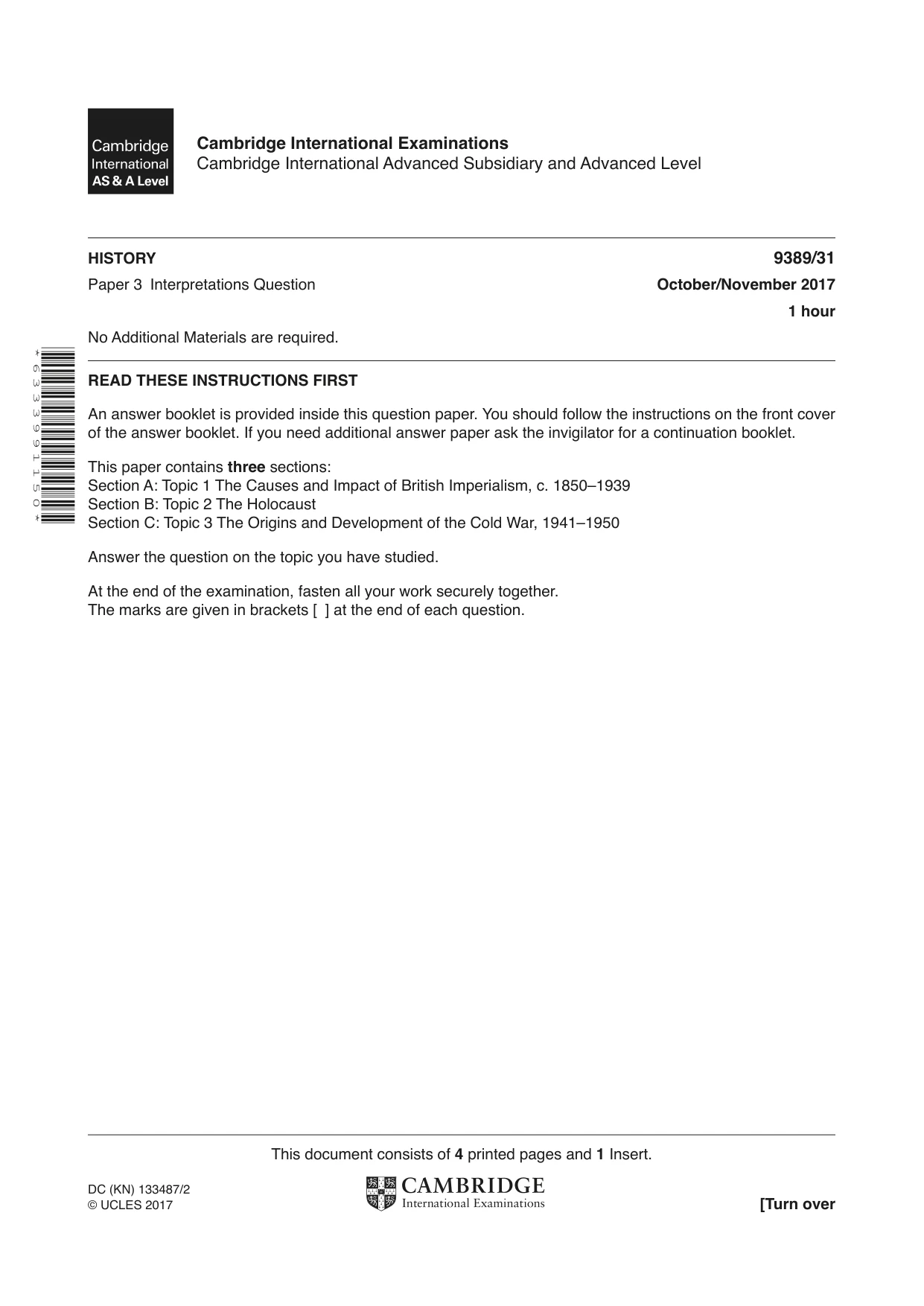
Cambridge A Level History 9389 — 2017 Oct/Nov Paper 3 · Variant 1
9389/31/O/N/17 · 3 questions · 40 marks · ≈45 min
The question paper and its mark scheme, free to read here and free to download. This is Cambridge’s own paper, exactly as it was sat.
Question paper4 pages
Mark scheme6 pages
Answers below. Sit the paper first if you are practising.
Questions as text
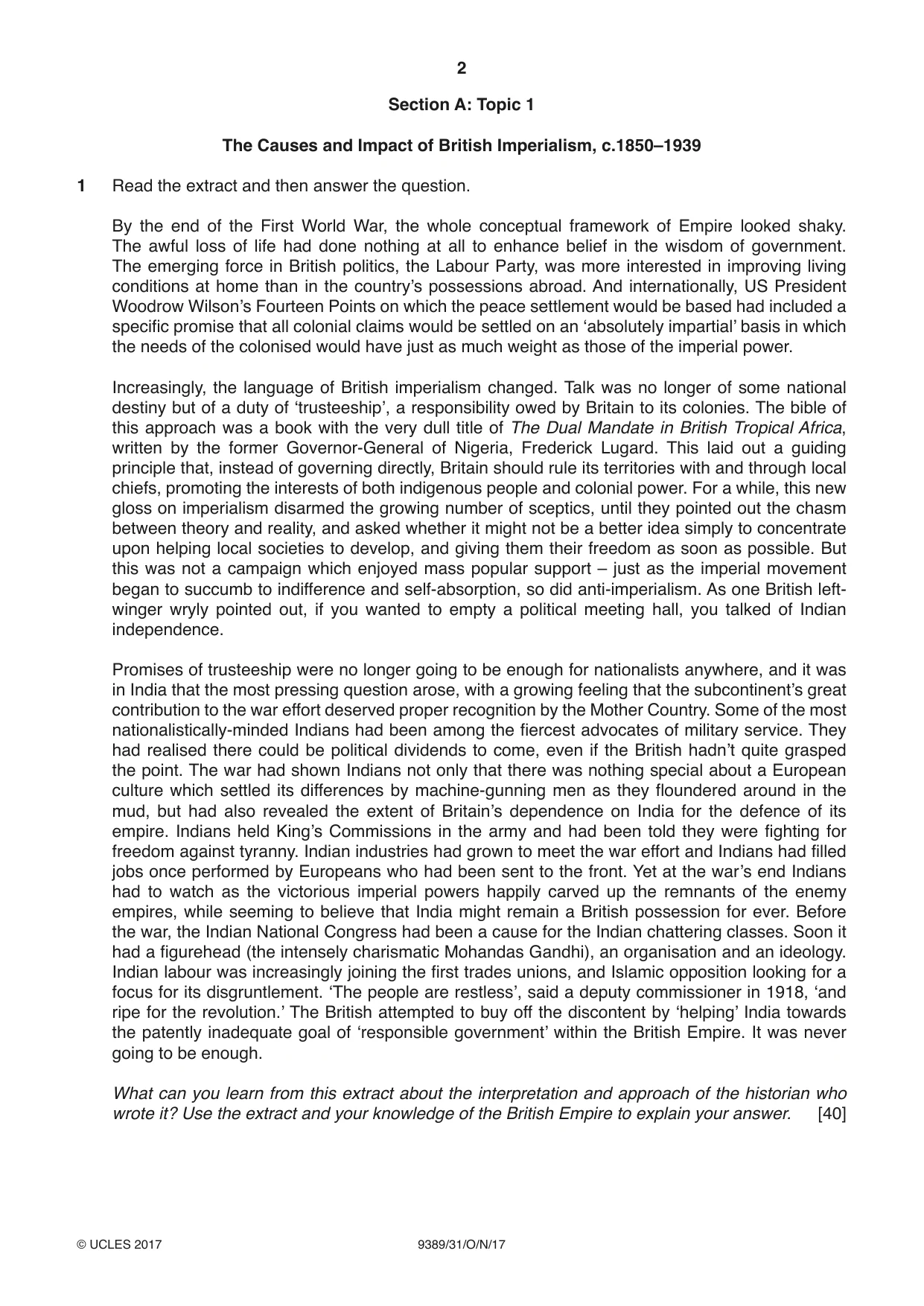
Q1 · Read the extract and then answer the question
1 Read the extract and then answer the question. By the end of the First World War, the whole conceptual framework of Empire looked shaky. The awful loss of life had done nothing at all to enhance belief in the wisdom of government. The emerging force in British politics, the Labour Party, was more interested in improving living conditions at home than in the country’s possessions abroad. And internationally, US President Woodrow Wilson’s Fourteen Points on which the peace settlement would be based had included a specific promise that all colonial claims would be settled on an ‘absolutely impartial’ basis in which the needs of the colonised would have just as much weight as those of the imperial power. Increasingly, the language of British imperialism changed. Talk was no longer of some national destiny but of a duty of ‘trusteeship’, a responsibility owed by Britain to its colonies. The bible of this approach was a book with the very dull title of The Dual Mandate in British Tropical Africa, written by the former Governor-General of Nigeria, Frederick Lugard. This laid out a guiding principle that, instead of governing directly, Britain should rule its territories with and through local chiefs, promoting the interests of both indigenous people and colonial power. For a while, this new gloss on imperialism disarmed the growing number of sceptics, until they pointed out the chasm between theory and reality, and asked whether it might not be a better idea simply to concentrate upon helping local societies to develop, and giving them their freedom as soon as possible. But this was not a campaign which enjoyed mass popular support – just as the imperial movement began to succumb to indifference and self-absorption, so did anti-imperialism. As one British left- winger wryly pointed out, if you wanted to empty a political meeting hall, you talked of Indian independence. Promises of trusteeship were no longer going to be enough for nationalists anywhere, and it was in India that the most pressing question arose, with a growing feeling that the subcontinent’s great contribution to the war effort deserved proper recognition by the Mother Country. Some of the most nationalistically-minded Indians had been among the fiercest advocates of military service. They had realised there could be political dividends to come, even if the British hadn’t quite grasped the point. The war had shown Indians not only that there was nothing special about a European culture which settled its differences by machine-gunning men as they floundered around in the mud, but had also revealed the extent of Britain’s dependence on India for the defence of its empire. Indians held King’s Commissions in the army and had been told they were fighting for freedom against tyranny. Indian industries had grown to meet the war effort and Indians had filled jobs once performed by Europeans who had been sent to the front. Yet at the war’s end Indians had to watch as the victorious imperial powers happily carved up the remnants of the enemy empires, while seeming to believe that India might remain a British possession for ever. Before the war, the Indian National Congress had been a cause for the Indian chattering classes. Soon it had a figurehead (the intensely charismatic Mohandas Gandhi), an organisation and an ideology. Indian labour was increasingly joining the first trades unions, and Islamic opposition looking for a focus for its disgruntlement. ‘The people are restless’, said a deputy commissioner in 1918, ‘and ripe for the revolution.’ The British attempted to buy off the discontent by ‘helping’ India towards the patently inadequate goal of ‘responsible government’ within the British Empire. It was never going to be enough. What can you learn from this extract about the interpretation and approach of the historian who wrote it? Use the extract and your knowledge of the British Empire to explain your answer. [40]
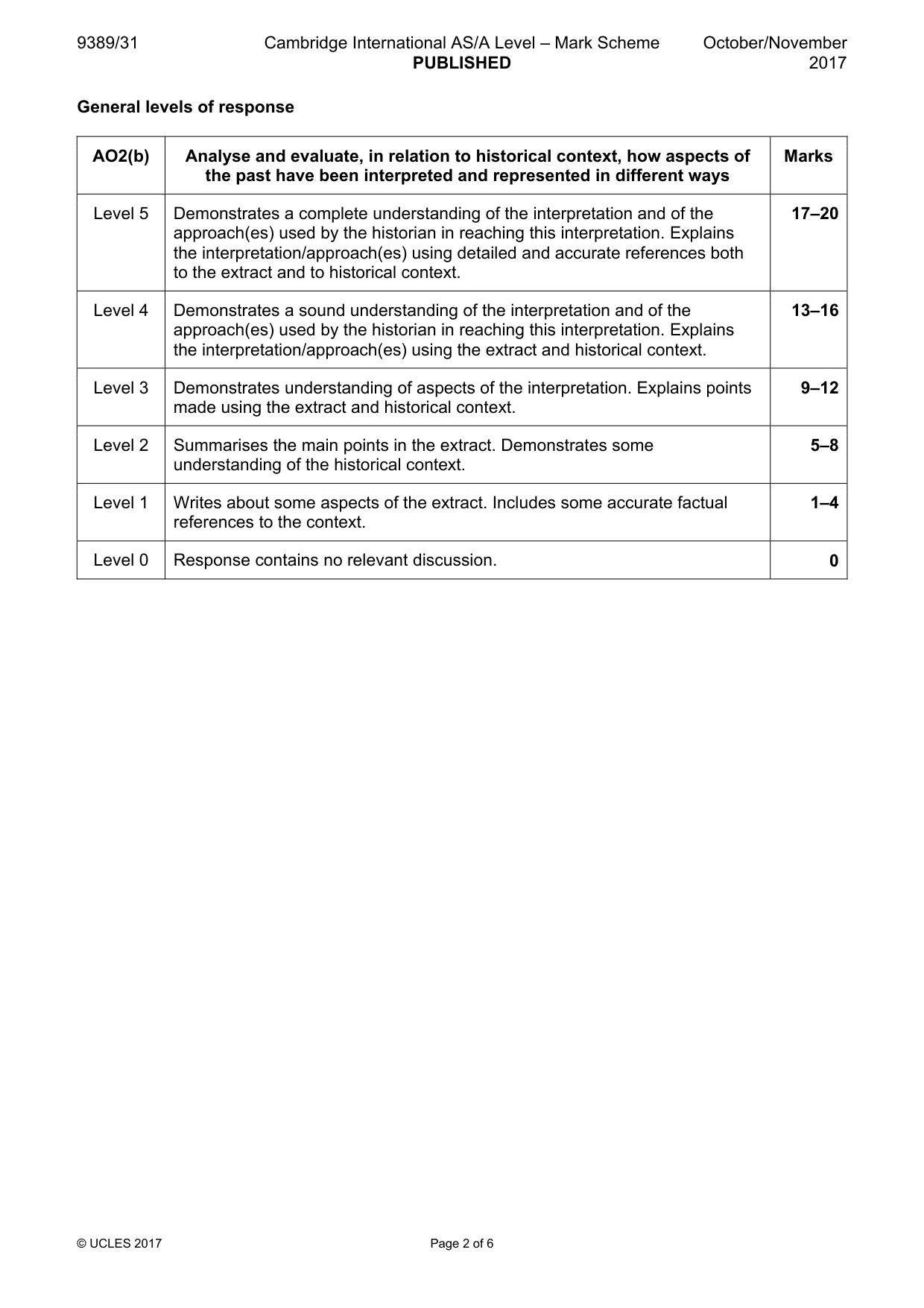
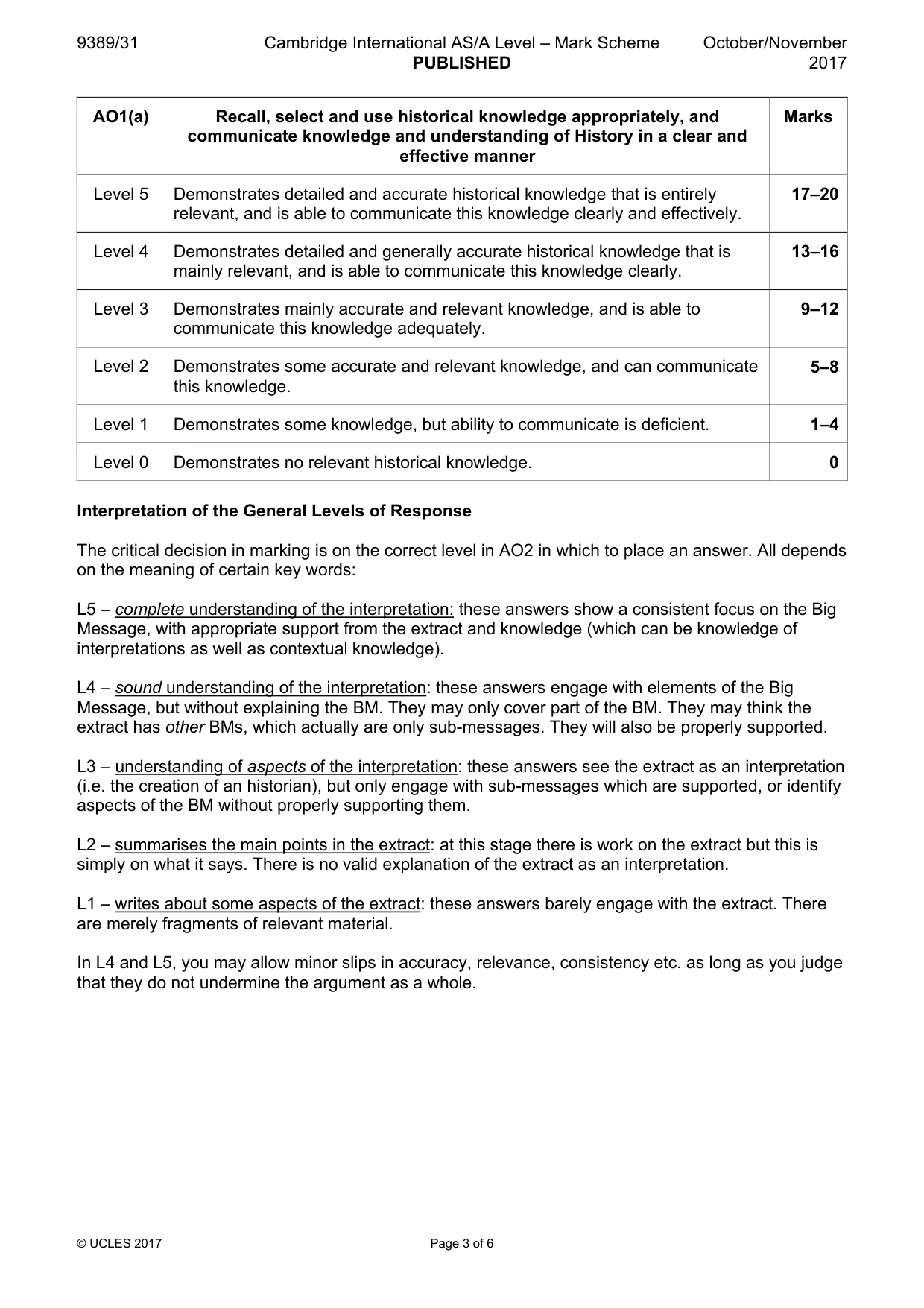
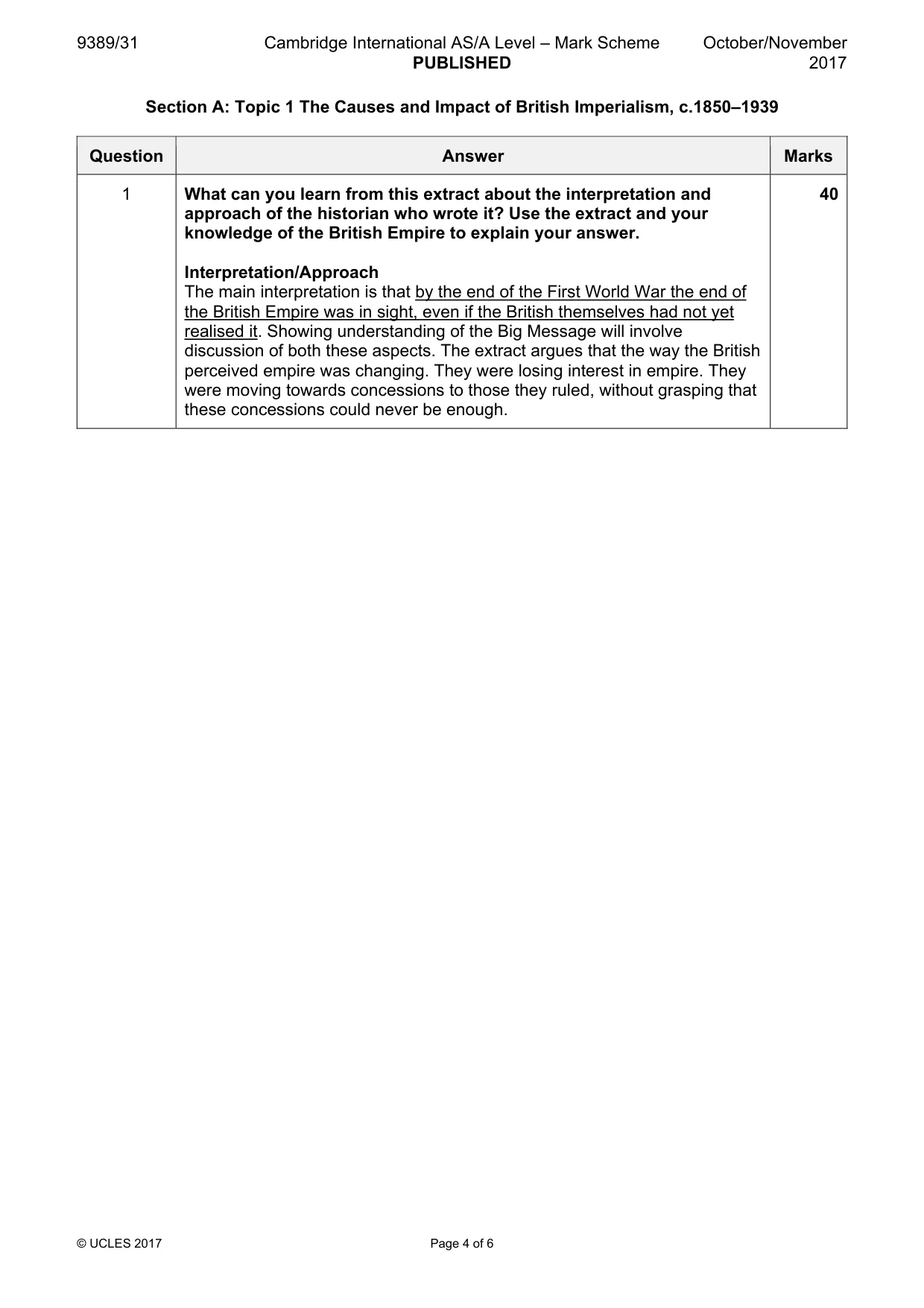
Mark scheme: Question Answer Marks 1 What can you learn from this extract about the interpretation and 40 approach of the historian who wrote it? Use the extract and your knowledge of the British Empire to explain your answer. Interpretation/Approach The main interpretation is that by the end of the First World War the end of the British Empire was in sight, even if the British themselves had not yet realised it. Showing understanding of the Big Message will involve discussion of both these aspects. The extract argues that the way the British perceived empire was changing. They were losing interest in empire. They were moving towards concessions to those they ruled, without grasping that these concessions could never be enough. Section B: Topic 2 The Holocaust
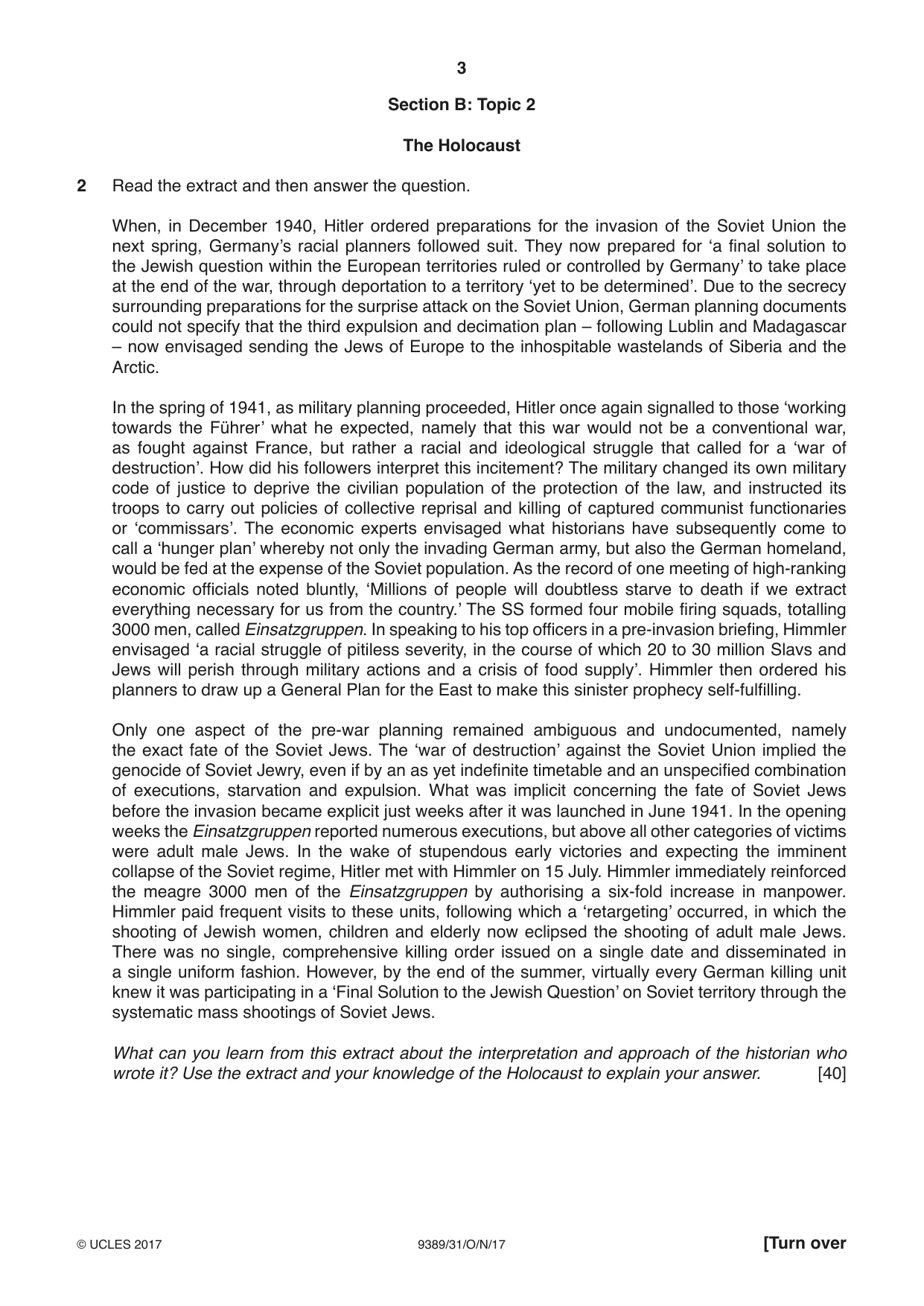
Q2 · Read the extract and then answer the question
2 Read the extract and then answer the question. When, in December 1940, Hitler ordered preparations for the invasion of the Soviet Union the next spring, Germany’s racial planners followed suit. They now prepared for ‘a final solution to the Jewish question within the European territories ruled or controlled by Germany’ to take place at the end of the war, through deportation to a territory ‘yet to be determined’. Due to the secrecy surrounding preparations for the surprise attack on the Soviet Union, German planning documents could not specify that the third expulsion and decimation plan – following Lublin and Madagascar – now envisaged sending the Jews of Europe to the inhospitable wastelands of Siberia and the Arctic. In the spring of 1941, as military planning proceeded, Hitler once again signalled to those ‘working towards the Führer’ what he expected, namely that this war would not be a conventional war, as fought against France, but rather a racial and ideological struggle that called for a ‘war of destruction’. How did his followers interpret this incitement? The military changed its own military code of justice to deprive the civilian population of the protection of the law, and instructed its troops to carry out policies of collective reprisal and killing of captured communist functionaries or ‘commissars’. The economic experts envisaged what historians have subsequently come to call a ‘hunger plan’ whereby not only the invading German army, but also the German homeland, would be fed at the expense of the Soviet population. As the record of one meeting of high-ranking economic officials noted bluntly, ‘Millions of people will doubtless starve to death if we extract everything necessary for us from the country.’ The SS formed four mobile firing squads, totalling 3000 men, called Einsatzgruppen. In speaking to his top officers in a pre-invasion briefing, Himmler envisaged ‘a racial struggle of pitiless severity, in the course of which 20 to 30 million Slavs and Jews will perish through military actions and a crisis of food supply’. Himmler then ordered his planners to draw up a General Plan for the East to make this sinister prophecy self-fulfilling. Only one aspect of the pre-war planning remained ambiguous and undocumented, namely the exact fate of the Soviet Jews. The ‘war of destruction’ against the Soviet Union implied the genocide of Soviet Jewry, even if by an as yet indefinite timetable and an unspecified combination of executions, starvation and expulsion. What was implicit concerning the fate of Soviet Jews before the invasion became explicit just weeks after it was launched in June 1941. In the opening weeks the Einsatzgruppen reported numerous executions, but above all other categories of victims were adult male Jews. In the wake of stupendous early victories and expecting the imminent collapse of the Soviet regime, Hitler met with Himmler on 15 July. Himmler immediately reinforced the meagre 3000 men of the Einsatzgruppen by authorising a six-fold increase in manpower. Himmler paid frequent visits to these units, following which a ‘retargeting’ occurred, in which the shooting of Jewish women, children and elderly now eclipsed the shooting of adult male Jews. There was no single, comprehensive killing order issued on a single date and disseminated in a single uniform fashion. However, by the end of the summer, virtually every German killing unit knew it was participating in a ‘Final Solution to the Jewish Question’ on Soviet territory through the systematic mass shootings of Soviet Jews. What can you learn from this extract about the interpretation and approach of the historian who wrote it? Use the extract and your knowledge of the Holocaust to explain your answer. [40] Section C: Topic 3 The Origins and Development of the Cold War, 1941–1950
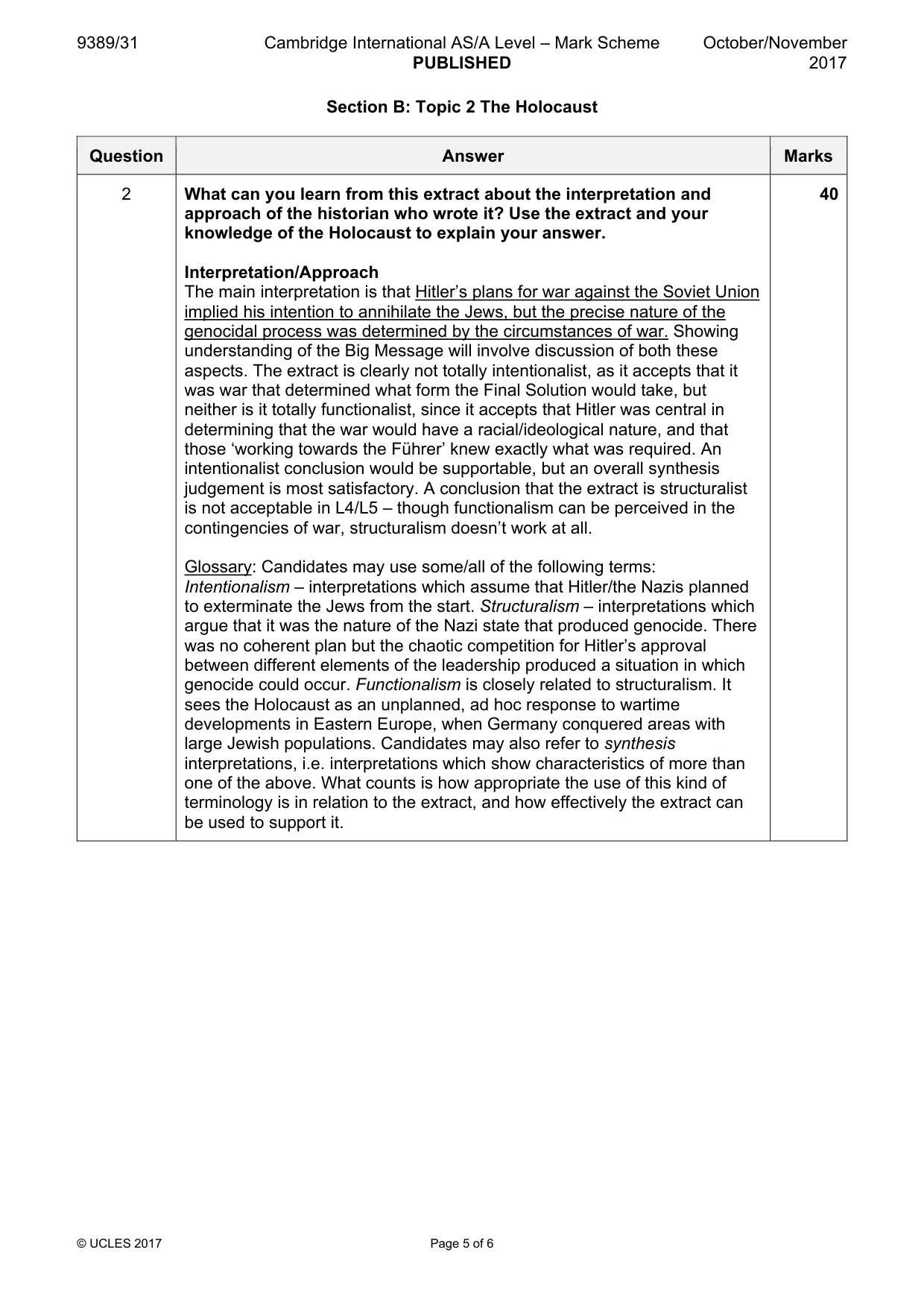
Mark scheme: 2 What can you learn from this extract about the interpretation and 40 approach of the historian who wrote it? Use the extract and your knowledge of the Holocaust to explain your answer. Interpretation/Approach The main interpretation is that Hitler’s plans for war against the Soviet Union implied his intention to annihilate the Jews, but the precise nature of the genocidal process was determined by the circumstances of war. Showing understanding of the Big Message will involve discussion of both these aspects. The extract is clearly not totally intentionalist, as it accepts that it was war that determined what form the Final Solution would take, but neither is it totally functionalist, since it accepts that Hitler was central in determining that the war would have a racial/ideological nature, and that those ‘working towards the Führer’ knew exactly what was required. An intentionalist conclusion would be supportable, but an overall synthesis judgement is most satisfactory. A conclusion that the extract is structuralist is not acceptable in L4/L5 – though functionalism can be perceived in the contingencies of war, structuralism doesn’t work at all. Glossary: Candidates may use some/all of the following terms: Intentionalism – interpretations which assume that Hitler/the Nazis planned to exterminate the Jews from the start. Structuralism – interpretations which argue that it was the nature of the Nazi state that produced genocide. There was no coherent plan but the chaotic competition for Hitler’s approval between different elements of the leadership produced a situation in which genocide could occur. Functionalism is closely related to structuralism. It sees the Holocaust as an unplanned, ad hoc response to wartime developments in Eastern Europe, when Germany conquered areas with large Jewish populations. Candidates may also refer to synthesis interpretations, i.e. interpretations which show characteristics of more than one of the above. What counts is how appropriate the use of this kind of terminology is in relation to the extract, and how effectively the extract can be used to support it. Section C: Topic 3 The Origins and Development of the Cold War, 1941–1950
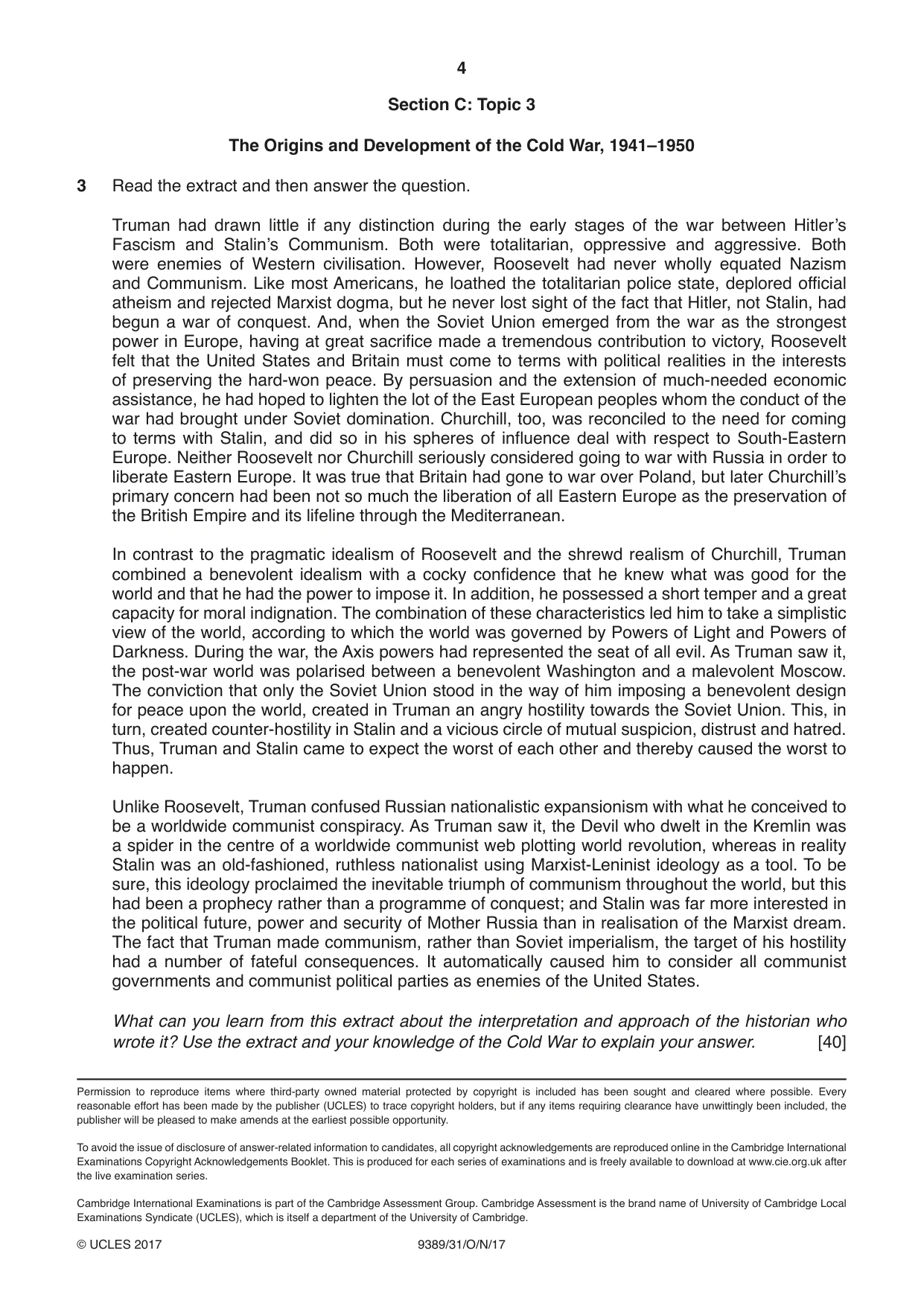
Q3 · Read the extract and then answer the question
3 Read the extract and then answer the question. Truman had drawn little if any distinction during the early stages of the war between Hitler’s Fascism and Stalin’s Communism. Both were totalitarian, oppressive and aggressive. Both were enemies of Western civilisation. However, Roosevelt had never wholly equated Nazism and Communism. Like most Americans, he loathed the totalitarian police state, deplored official atheism and rejected Marxist dogma, but he never lost sight of the fact that Hitler, not Stalin, had begun a war of conquest. And, when the Soviet Union emerged from the war as the strongest power in Europe, having at great sacrifice made a tremendous contribution to victory, Roosevelt felt that the United States and Britain must come to terms with political realities in the interests of preserving the hard-won peace. By persuasion and the extension of much-needed economic assistance, he had hoped to lighten the lot of the East European peoples whom the conduct of the war had brought under Soviet domination. Churchill, too, was reconciled to the need for coming to terms with Stalin, and did so in his spheres of influence deal with respect to South-Eastern Europe. Neither Roosevelt nor Churchill seriously considered going to war with Russia in order to liberate Eastern Europe. It was true that Britain had gone to war over Poland, but later Churchill’s primary concern had been not so much the liberation of all Eastern Europe as the preservation of the British Empire and its lifeline through the Mediterranean. In contrast to the pragmatic idealism of Roosevelt and the shrewd realism of Churchill, Truman combined a benevolent idealism with a cocky confidence that he knew what was good for the world and that he had the power to impose it. In addition, he possessed a short temper and a great capacity for moral indignation. The combination of these characteristics led him to take a simplistic view of the world, according to which the world was governed by Powers of Light and Powers of Darkness. During the war, the Axis powers had represented the seat of all evil. As Truman saw it, the post-war world was polarised between a benevolent Washington and a malevolent Moscow. The conviction that only the Soviet Union stood in the way of him imposing a benevolent design for peace upon the world, created in Truman an angry hostility towards the Soviet Union. This, in turn, created counter-hostility in Stalin and a vicious circle of mutual suspicion, distrust and hatred. Thus, Truman and Stalin came to expect the worst of each other and thereby caused the worst to happen. Unlike Roosevelt, Truman confused Russian nationalistic expansionism with what he conceived to be a worldwide communist conspiracy. As Truman saw it, the Devil who dwelt in the Kremlin was a spider in the centre of a worldwide communist web plotting world revolution, whereas in reality Stalin was an old-fashioned, ruthless nationalist using Marxist-Leninist ideology as a tool. To be sure, this ideology proclaimed the inevitable triumph of communism throughout the world, but this had been a prophecy rather than a programme of conquest; and Stalin was far more interested in the political future, power and security of Mother Russia than in realisation of the Marxist dream. The fact that Truman made communism, rather than Soviet imperialism, the target of his hostility had a number of fateful consequences. It automatically caused him to consider all communist governments and communist political parties as enemies of the United States. What can you learn from this extract about the interpretation and approach of the historian who wrote it? Use the extract and your knowledge of the Cold War to explain your answer. [40]
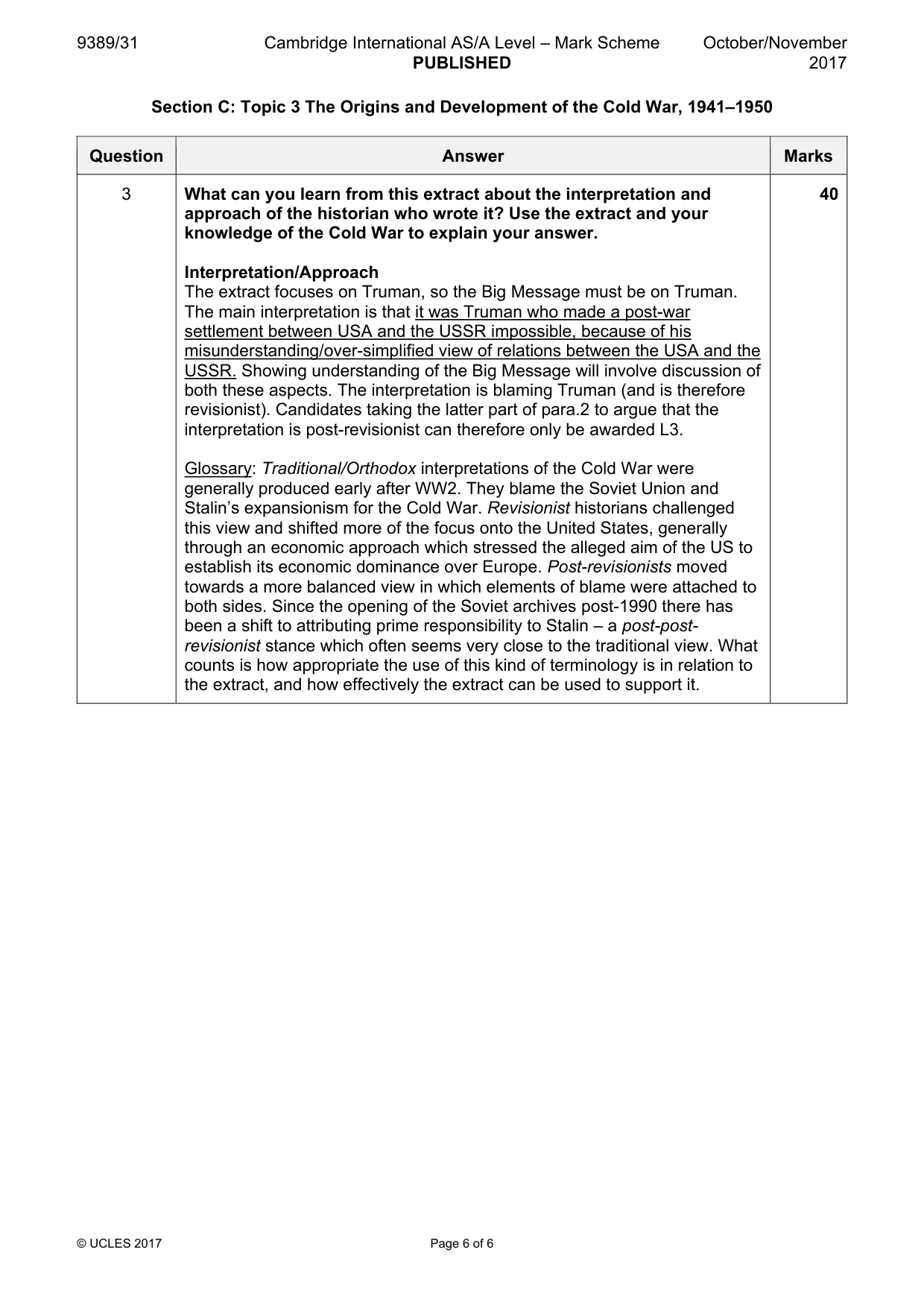
Mark scheme: 3 What can you learn from this extract about the interpretation and 40 approach of the historian who wrote it? Use the extract and your knowledge of the Cold War to explain your answer. Interpretation/Approach The extract focuses on Truman, so the Big Message must be on Truman. The main interpretation is that it was Truman who made a post-war settlement between USA and the USSR impossible, because of his misunderstanding/over-simplified view of relations between the USA and the USSR. Showing understanding of the Big Message will involve discussion of both these aspects. The interpretation is blaming Truman (and is therefore revisionist). Candidates taking the latter part of para.2 to argue that the interpretation is post-revisionist can therefore only be awarded L3. Glossary: Traditional/Orthodox interpretations of the Cold War were generally produced early after WW2. They blame the Soviet Union and Stalin’s expansionism for the Cold War. Revisionist historians challenged this view and shifted more of the focus onto the United States, generally through an economic approach which stressed the alleged aim of the US to establish its economic dominance over Europe. Post-revisionists moved towards a more balanced view in which elements of blame were attached to both sides. Since the opening of the Soviet archives post-1990 there has been a shift to attributing prime responsibility to Stalin – a post-post- revisionist stance which often seems very close to the traditional view. What counts is how appropriate the use of this kind of terminology is in relation to the extract, and how effectively the extract can be used to support it.
What you needed in this session
Cambridge’s own grade thresholds for 2017 Oct/Nov, Paper 3 · Variant 1. A higher threshold means an easier paper — the bar moves with how the cohort did.