Cambridge A Level History 9389 — 2017 Oct/Nov Paper 3 · Variant 2
9389/32/O/N/17 · 3 questions · 40 marks · ≈45 min
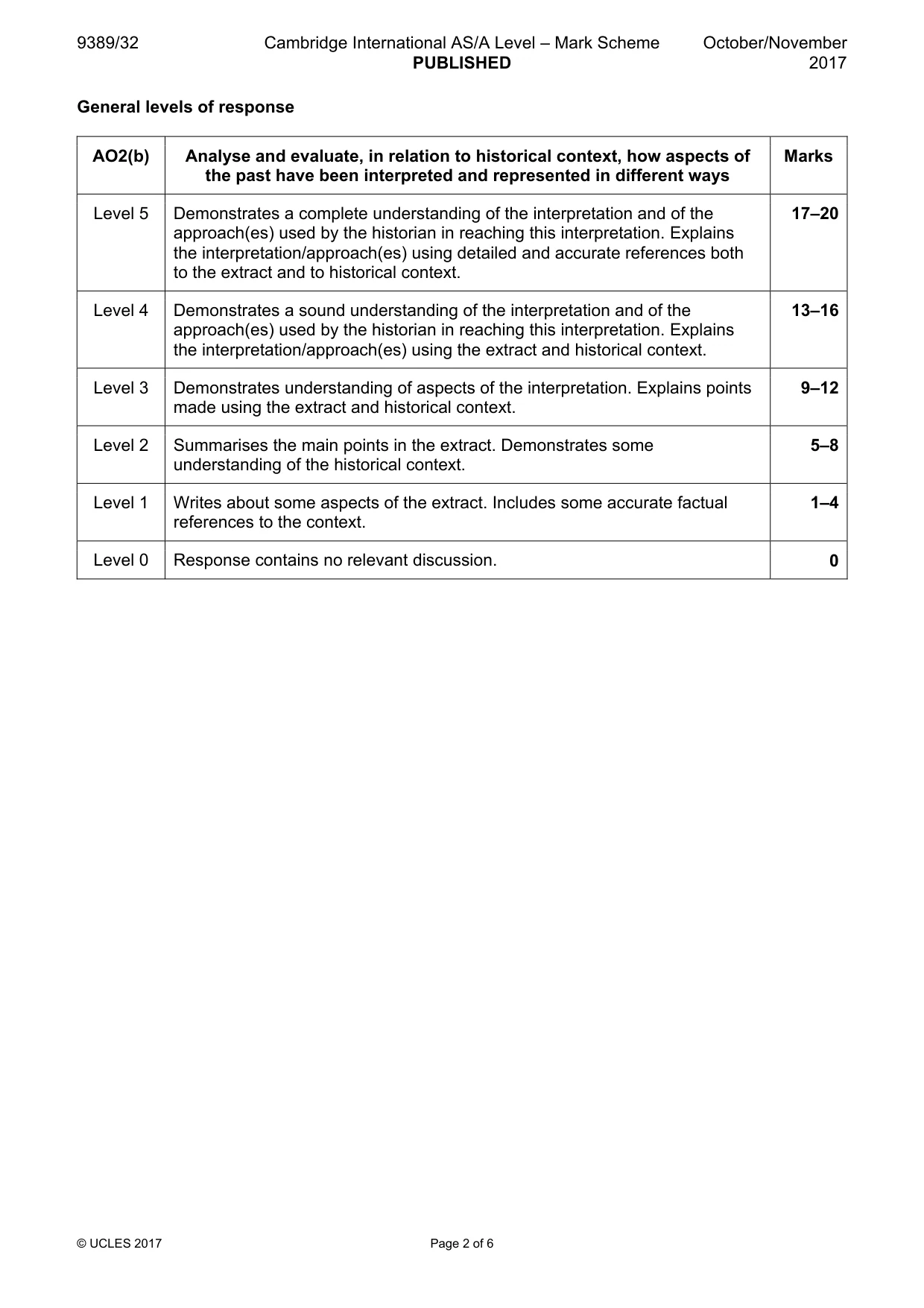
The question paper and its mark scheme, free to read here and free to download. This is Cambridge’s own paper, exactly as it was sat.
Question paper4 pages
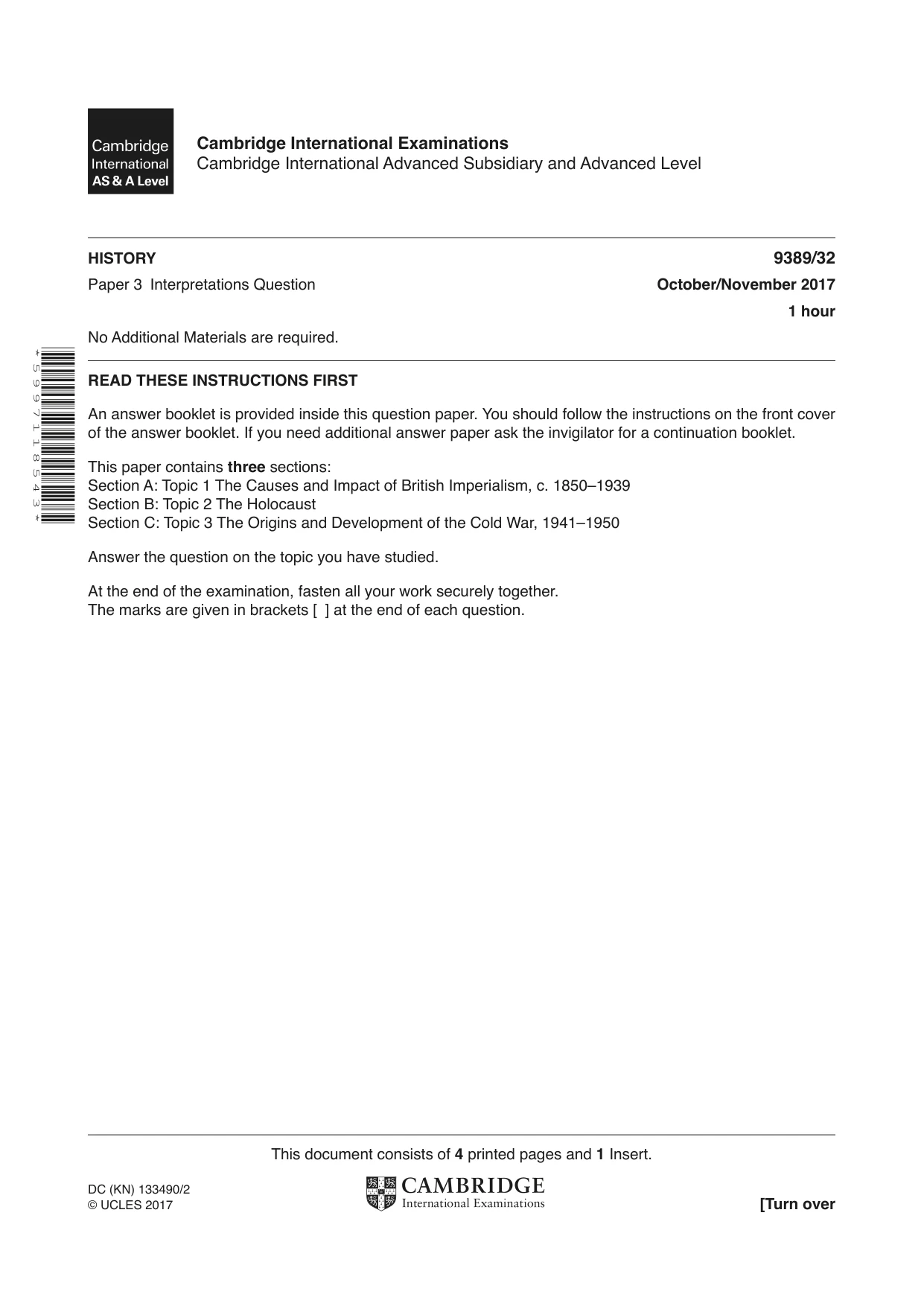
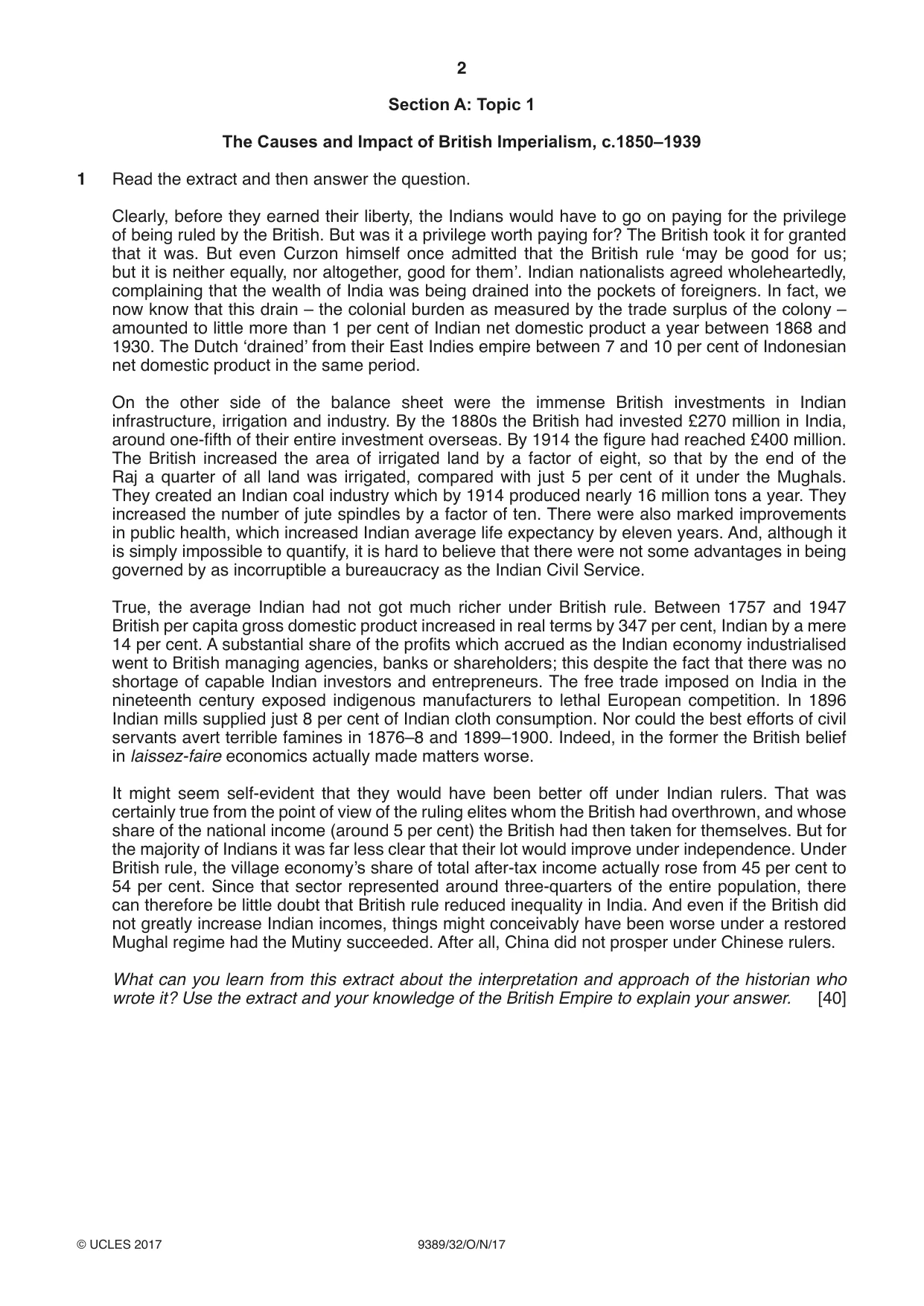
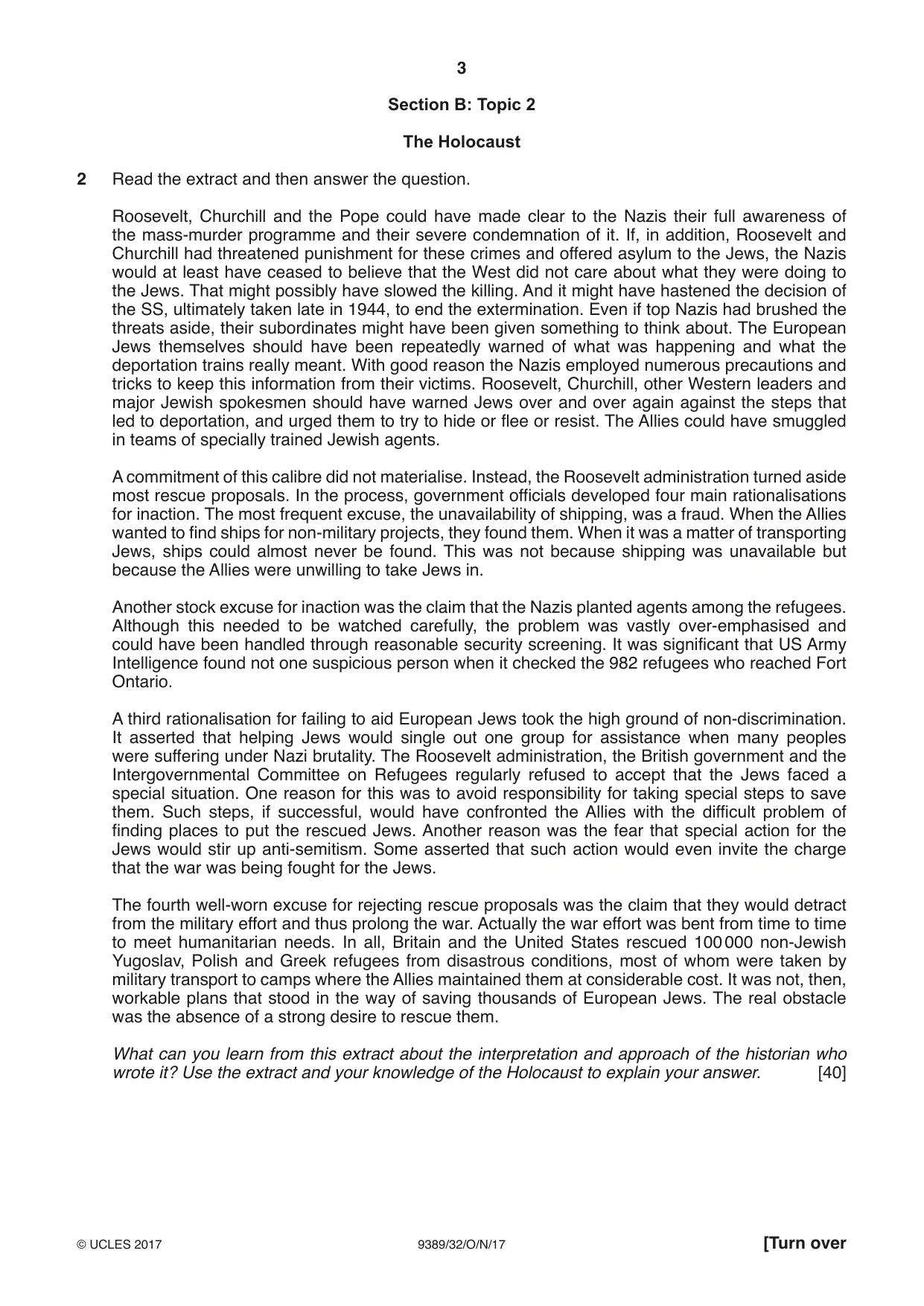
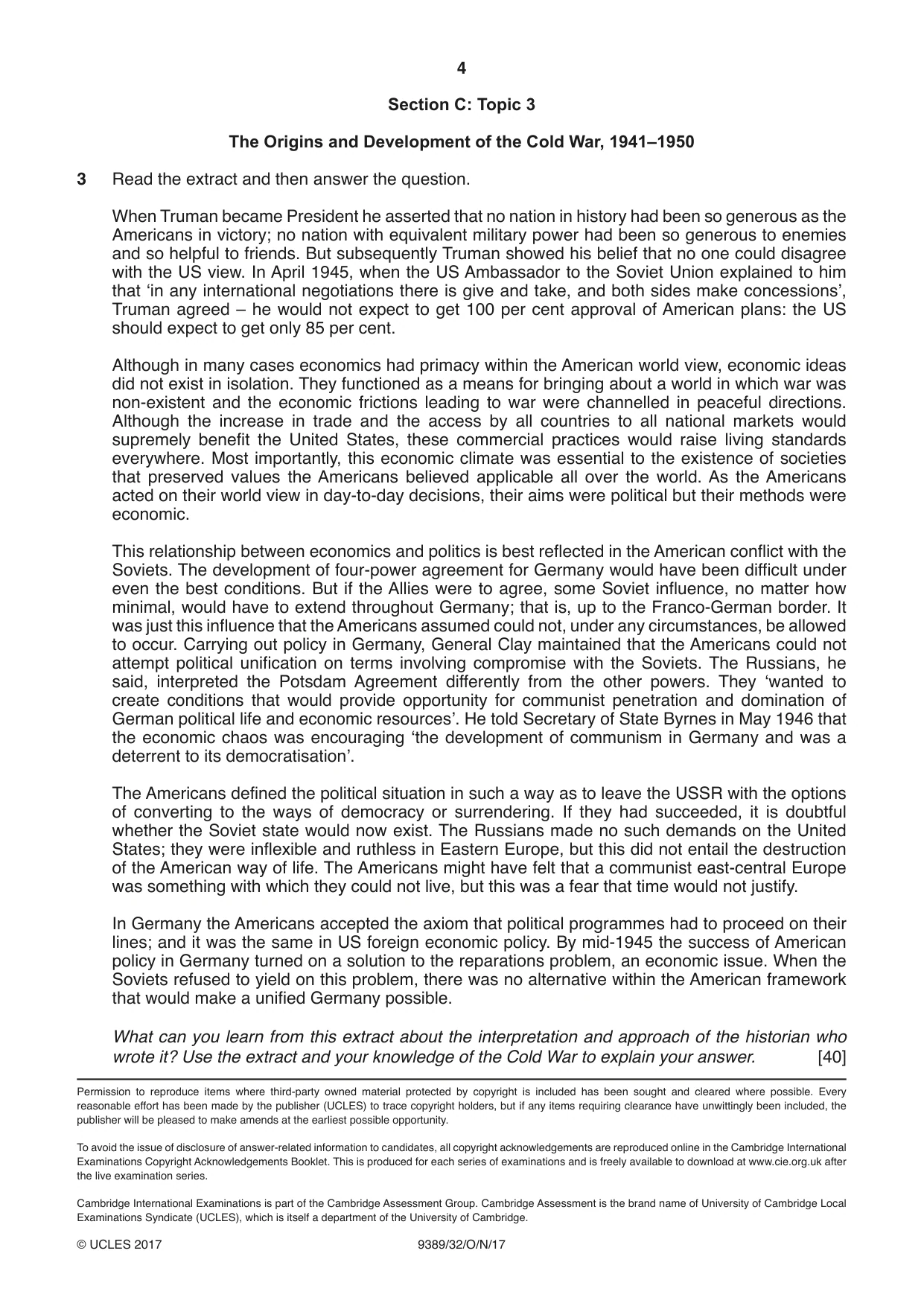
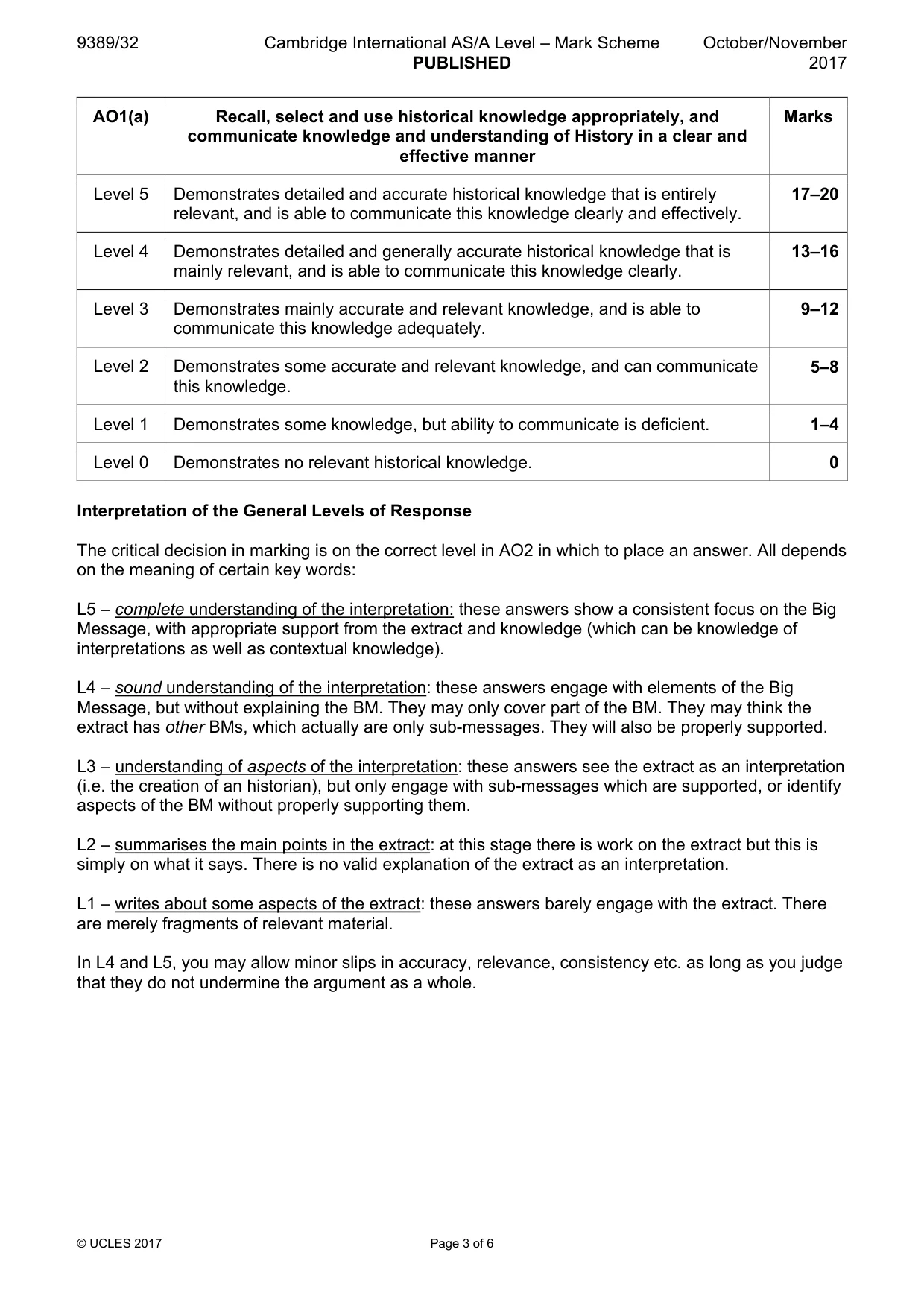
Mark scheme6 pages
Answers below. Sit the paper first if you are practising.
Questions as text
Q1 · Read the extract and then answer the question
1 Read the extract and then answer the question. Clearly, before they earned their liberty, the Indians would have to go on paying for the privilege of being ruled by the British. But was it a privilege worth paying for? The British took it for granted that it was. But even Curzon himself once admitted that the British rule ‘may be good for us; but it is neither equally, nor altogether, good for them’. Indian nationalists agreed wholeheartedly, complaining that the wealth of India was being drained into the pockets of foreigners. In fact, we now know that this drain – the colonial burden as measured by the trade surplus of the colony – amounted to little more than 1 per cent of Indian net domestic product a year between 1868 and 1930. The Dutch ‘drained’ from their East Indies empire between 7 and 10 per cent of Indonesian net domestic product in the same period. On the other side of the balance sheet were the immense British investments in Indian infrastructure, irrigation and industry. By the 1880s the British had invested £270 million in India, around one-fifth of their entire investment overseas. By 1914 the figure had reached £400 million. The British increased the area of irrigated land by a factor of eight, so that by the end of the Raj a quarter of all land was irrigated, compared with just 5 per cent of it under the Mughals. They created an Indian coal industry which by 1914 produced nearly 16 million tons a year. They increased the number of jute spindles by a factor of ten. There were also marked improvements in public health, which increased Indian average life expectancy by eleven years. And, although it is simply impossible to quantify, it is hard to believe that there were not some advantages in being governed by as incorruptible a bureaucracy as the Indian Civil Service. True, the average Indian had not got much richer under British rule. Between 1757 and 1947 British per capita gross domestic product increased in real terms by 347 per cent, Indian by a mere 14 per cent. A substantial share of the profits which accrued as the Indian economy industrialised went to British managing agencies, banks or shareholders; this despite the fact that there was no shortage of capable Indian investors and entrepreneurs. The free trade imposed on India in the nineteenth century exposed indigenous manufacturers to lethal European competition. In 1896 Indian mills supplied just 8 per cent of Indian cloth consumption. Nor could the best efforts of civil servants avert terrible famines in 1876–8 and 1899–1900. Indeed, in the former the British belief in laissez-faire economics actually made matters worse. It might seem self-evident that they would have been better off under Indian rulers. That was certainly true from the point of view of the ruling elites whom the British had overthrown, and whose share of the national income (around 5 per cent) the British had then taken for themselves. But for the majority of Indians it was far less clear that their lot would improve under independence. Under British rule, the village economy’s share of total after-tax income actually rose from 45 per cent to 54 per cent. Since that sector represented around three-quarters of the entire population, there can therefore be little doubt that British rule reduced inequality in India. And even if the British did not greatly increase Indian incomes, things might conceivably have been worse under a restored Mughal regime had the Mutiny succeeded. After all, China did not prosper under Chinese rulers. What can you learn from this extract about the interpretation and approach of the historian who wrote it? Use the extract and your knowledge of the British Empire to explain your answer. [40]
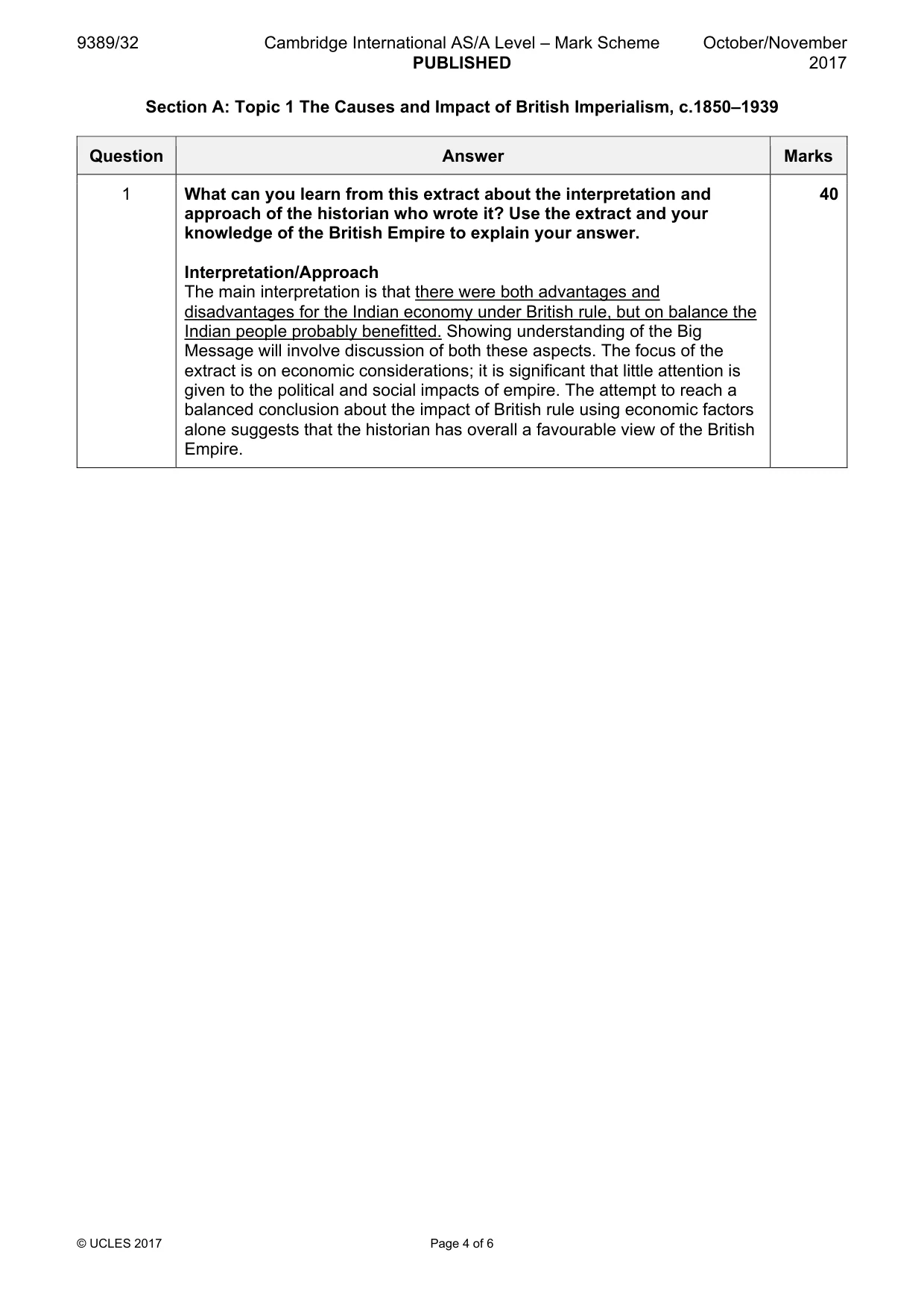
Mark scheme: Question Answer Marks 1 What can you learn from this extract about the interpretation and 40 approach of the historian who wrote it? Use the extract and your knowledge of the British Empire to explain your answer. Interpretation/Approach The main interpretation is that there were both advantages and disadvantages for the Indian economy under British rule, but on balance the Indian people probably benefitted. Showing understanding of the Big Message will involve discussion of both these aspects. The focus of the extract is on economic considerations; it is significant that little attention is given to the political and social impacts of empire. The attempt to reach a balanced conclusion about the impact of British rule using economic factors alone suggests that the historian has overall a favourable view of the British Empire. Section B: Topic 2 The Holocaust
Q2 · Read the extract and then answer the question
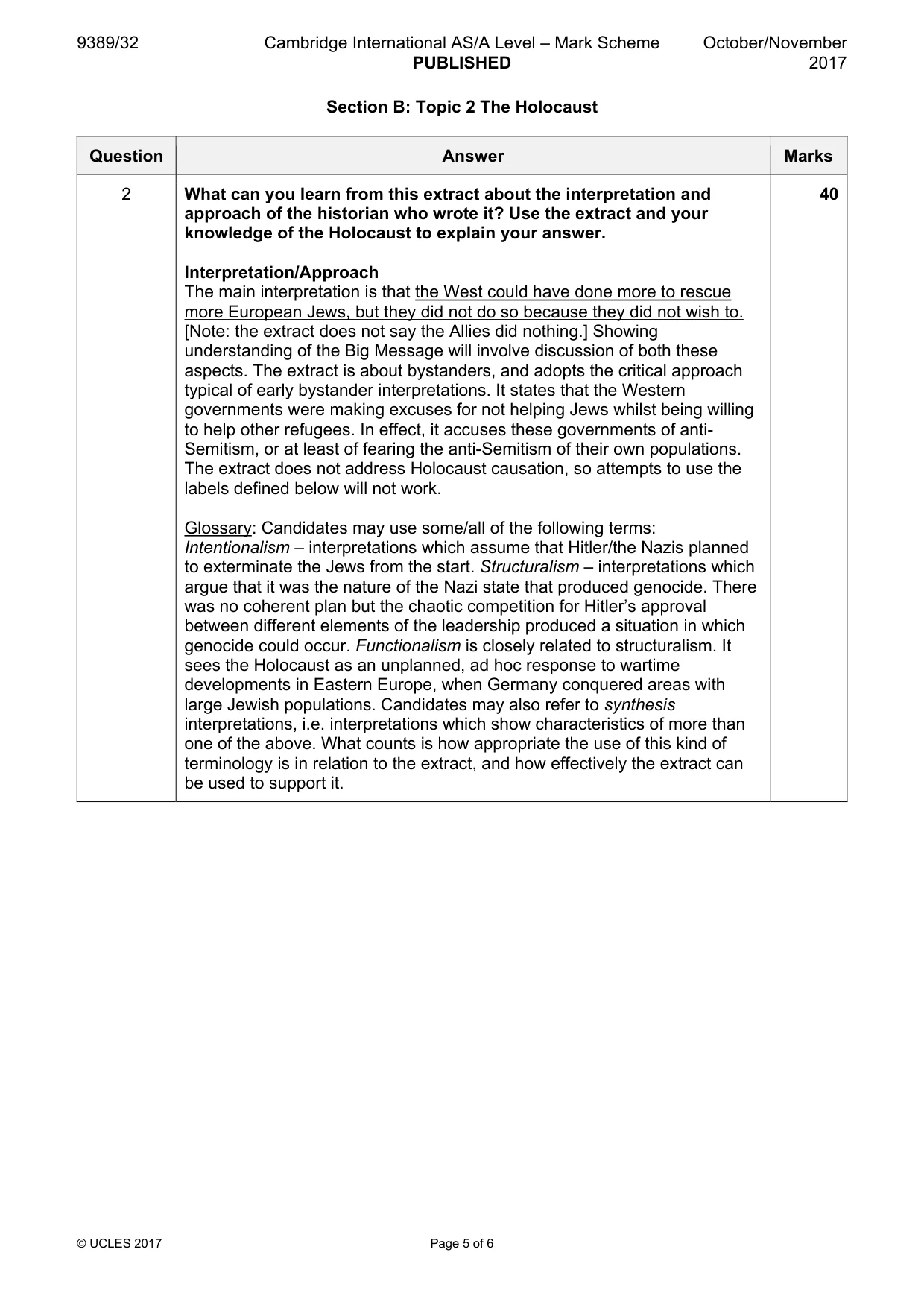
2 Read the extract and then answer the question. Roosevelt, Churchill and the Pope could have made clear to the Nazis their full awareness of the mass-murder programme and their severe condemnation of it. If, in addition, Roosevelt and Churchill had threatened punishment for these crimes and offered asylum to the Jews, the Nazis would at least have ceased to believe that the West did not care about what they were doing to the Jews. That might possibly have slowed the killing. And it might have hastened the decision of the SS, ultimately taken late in 1944, to end the extermination. Even if top Nazis had brushed the threats aside, their subordinates might have been given something to think about. The European Jews themselves should have been repeatedly warned of what was happening and what the deportation trains really meant. With good reason the Nazis employed numerous precautions and tricks to keep this information from their victims. Roosevelt, Churchill, other Western leaders and major Jewish spokesmen should have warned Jews over and over again against the steps that led to deportation, and urged them to try to hide or flee or resist. The Allies could have smuggled in teams of specially trained Jewish agents. A commitment of this calibre did not materialise. Instead, the Roosevelt administration turned aside most rescue proposals. In the process, government officials developed four main rationalisations for inaction. The most frequent excuse, the unavailability of shipping, was a fraud. When the Allies wanted to find ships for non-military projects, they found them. When it was a matter of transporting Jews, ships could almost never be found. This was not because shipping was unavailable but because the Allies were unwilling to take Jews in. Another stock excuse for inaction was the claim that the Nazis planted agents among the refugees. Although this needed to be watched carefully, the problem was vastly over-emphasised and could have been handled through reasonable security screening. It was significant that US Army Intelligence found not one suspicious person when it checked the 982 refugees who reached Fort Ontario. A third rationalisation for failing to aid European Jews took the high ground of non-discrimination. It asserted that helping Jews would single out one group for assistance when many peoples were suffering under Nazi brutality. The Roosevelt administration, the British government and the Intergovernmental Committee on Refugees regularly refused to accept that the Jews faced a special situation. One reason for this was to avoid responsibility for taking special steps to save them. Such steps, if successful, would have confronted the Allies with the difficult problem of finding places to put the rescued Jews. Another reason was the fear that special action for the Jews would stir up anti-semitism. Some asserted that such action would even invite the charge that the war was being fought for the Jews. The fourth well-worn excuse for rejecting rescue proposals was the claim that they would detract from the military effort and thus prolong the war. Actually the war effort was bent from time to time to meet humanitarian needs. In all, Britain and the United States rescued 100 000 non-Jewish Yugoslav, Polish and Greek refugees from disastrous conditions, most of whom were taken by military transport to camps where the Allies maintained them at considerable cost. It was not, then, workable plans that stood in the way of saving thousands of European Jews. The real obstacle was the absence of a strong desire to rescue them. What can you learn from this extract about the interpretation and approach of the historian who wrote it? Use the extract and your knowledge of the Holocaust to explain your answer. [40] Section C: Topic 3 The Origins and Development of the Cold War, 1941–1950
Mark scheme: 2 What can you learn from this extract about the interpretation and 40 approach of the historian who wrote it? Use the extract and your knowledge of the Holocaust to explain your answer. Interpretation/Approach The main interpretation is that the West could have done more to rescue more European Jews, but they did not do so because they did not wish to. [Note: the extract does not say the Allies did nothing.] Showing understanding of the Big Message will involve discussion of both these aspects. The extract is about bystanders, and adopts the critical approach typical of early bystander interpretations. It states that the Western governments were making excuses for not helping Jews whilst being willing to help other refugees. In effect, it accuses these governments of anti- Semitism, or at least of fearing the anti-Semitism of their own populations. The extract does not address Holocaust causation, so attempts to use the labels defined below will not work. Glossary: Candidates may use some/all of the following terms: Intentionalism – interpretations which assume that Hitler/the Nazis planned to exterminate the Jews from the start. Structuralism – interpretations which argue that it was the nature of the Nazi state that produced genocide. There was no coherent plan but the chaotic competition for Hitler’s approval between different elements of the leadership produced a situation in which genocide could occur. Functionalism is closely related to structuralism. It sees the Holocaust as an unplanned, ad hoc response to wartime developments in Eastern Europe, when Germany conquered areas with large Jewish populations. Candidates may also refer to synthesis interpretations, i.e. interpretations which show characteristics of more than one of the above. What counts is how appropriate the use of this kind of terminology is in relation to the extract, and how effectively the extract can be used to support it. Section C: Topic 3 The Origins and Development of the Cold War, 1941–1950
Q3 · Read the extract and then answer the question
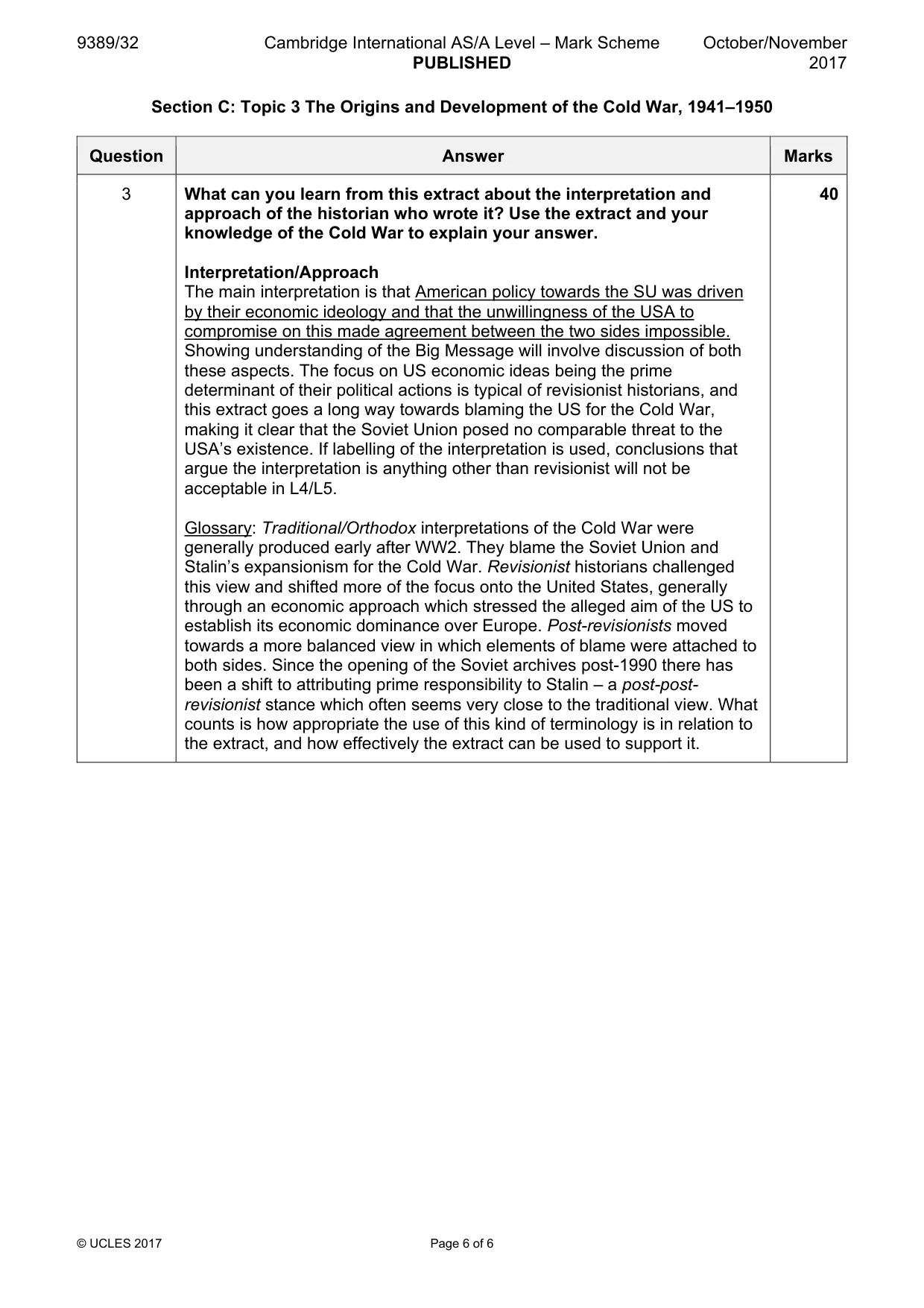
3 Read the extract and then answer the question. When Truman became President he asserted that no nation in history had been so generous as the Americans in victory; no nation with equivalent military power had been so generous to enemies and so helpful to friends. But subsequently Truman showed his belief that no one could disagree with the US view. In April 1945, when the US Ambassador to the Soviet Union explained to him that ‘in any international negotiations there is give and take, and both sides make concessions’, Truman agreed – he would not expect to get 100 per cent approval of American plans: the US should expect to get only 85 per cent. Although in many cases economics had primacy within the American world view, economic ideas did not exist in isolation. They functioned as a means for bringing about a world in which war was non-existent and the economic frictions leading to war were channelled in peaceful directions. Although the increase in trade and the access by all countries to all national markets would supremely benefit the United States, these commercial practices would raise living standards everywhere. Most importantly, this economic climate was essential to the existence of societies that preserved values the Americans believed applicable all over the world. As the Americans acted on their world view in day-to-day decisions, their aims were political but their methods were economic. This relationship between economics and politics is best reflected in the American conflict with the Soviets. The development of four-power agreement for Germany would have been difficult under even the best conditions. But if the Allies were to agree, some Soviet influence, no matter how minimal, would have to extend throughout Germany; that is, up to the Franco-German border. It was just this influence that the Americans assumed could not, under any circumstances, be allowed to occur. Carrying out policy in Germany, General Clay maintained that the Americans could not attempt political unification on terms involving compromise with the Soviets. The Russians, he said, interpreted the Potsdam Agreement differently from the other powers. They ‘wanted to create conditions that would provide opportunity for communist penetration and domination of German political life and economic resources’. He told Secretary of State Byrnes in May 1946 that the economic chaos was encouraging ‘the development of communism in Germany and was a deterrent to its democratisation’. The Americans defined the political situation in such a way as to leave the USSR with the options of converting to the ways of democracy or surrendering. If they had succeeded, it is doubtful whether the Soviet state would now exist. The Russians made no such demands on the United States; they were inflexible and ruthless in Eastern Europe, but this did not entail the destruction of the American way of life. The Americans might have felt that a communist east-central Europe was something with which they could not live, but this was a fear that time would not justify. In Germany the Americans accepted the axiom that political programmes had to proceed on their lines; and it was the same in US foreign economic policy. By mid-1945 the success of American policy in Germany turned on a solution to the reparations problem, an economic issue. When the Soviets refused to yield on this problem, there was no alternative within the American framework that would make a unified Germany possible. What can you learn from this extract about the interpretation and approach of the historian who wrote it? Use the extract and your knowledge of the Cold War to explain your answer. [40]
Mark scheme: 3 What can you learn from this extract about the interpretation and 40 approach of the historian who wrote it? Use the extract and your knowledge of the Cold War to explain your answer. Interpretation/Approach The main interpretation is that American policy towards the SU was driven by their economic ideology and that the unwillingness of the USA to compromise on this made agreement between the two sides impossible. Showing understanding of the Big Message will involve discussion of both these aspects. The focus on US economic ideas being the prime determinant of their political actions is typical of revisionist historians, and this extract goes a long way towards blaming the US for the Cold War, making it clear that the Soviet Union posed no comparable threat to the USA’s existence. If labelling of the interpretation is used, conclusions that argue the interpretation is anything other than revisionist will not be acceptable in L4/L5. Glossary: Traditional/Orthodox interpretations of the Cold War were generally produced early after WW2. They blame the Soviet Union and Stalin’s expansionism for the Cold War. Revisionist historians challenged this view and shifted more of the focus onto the United States, generally through an economic approach which stressed the alleged aim of the US to establish its economic dominance over Europe. Post-revisionists moved towards a more balanced view in which elements of blame were attached to both sides. Since the opening of the Soviet archives post-1990 there has been a shift to attributing prime responsibility to Stalin – a post-post- revisionist stance which often seems very close to the traditional view. What counts is how appropriate the use of this kind of terminology is in relation to the extract, and how effectively the extract can be used to support it.
What you needed in this session
Cambridge’s own grade thresholds for 2017 Oct/Nov, Paper 3 · Variant 2. A higher threshold means an easier paper — the bar moves with how the cohort did.