Cambridge A Level History 9389 — 2017 Oct/Nov Paper 1 · Variant 2
9389/12/O/N/17 · 40 marks · ≈45 min
The question paper and its mark scheme, free to read here and free to download. This is Cambridge’s own paper, exactly as it was sat.
Question paper8 pages

Mark scheme9 pages
Answers below. Sit the paper first if you are practising.
Paper as text
Question paper, page 1
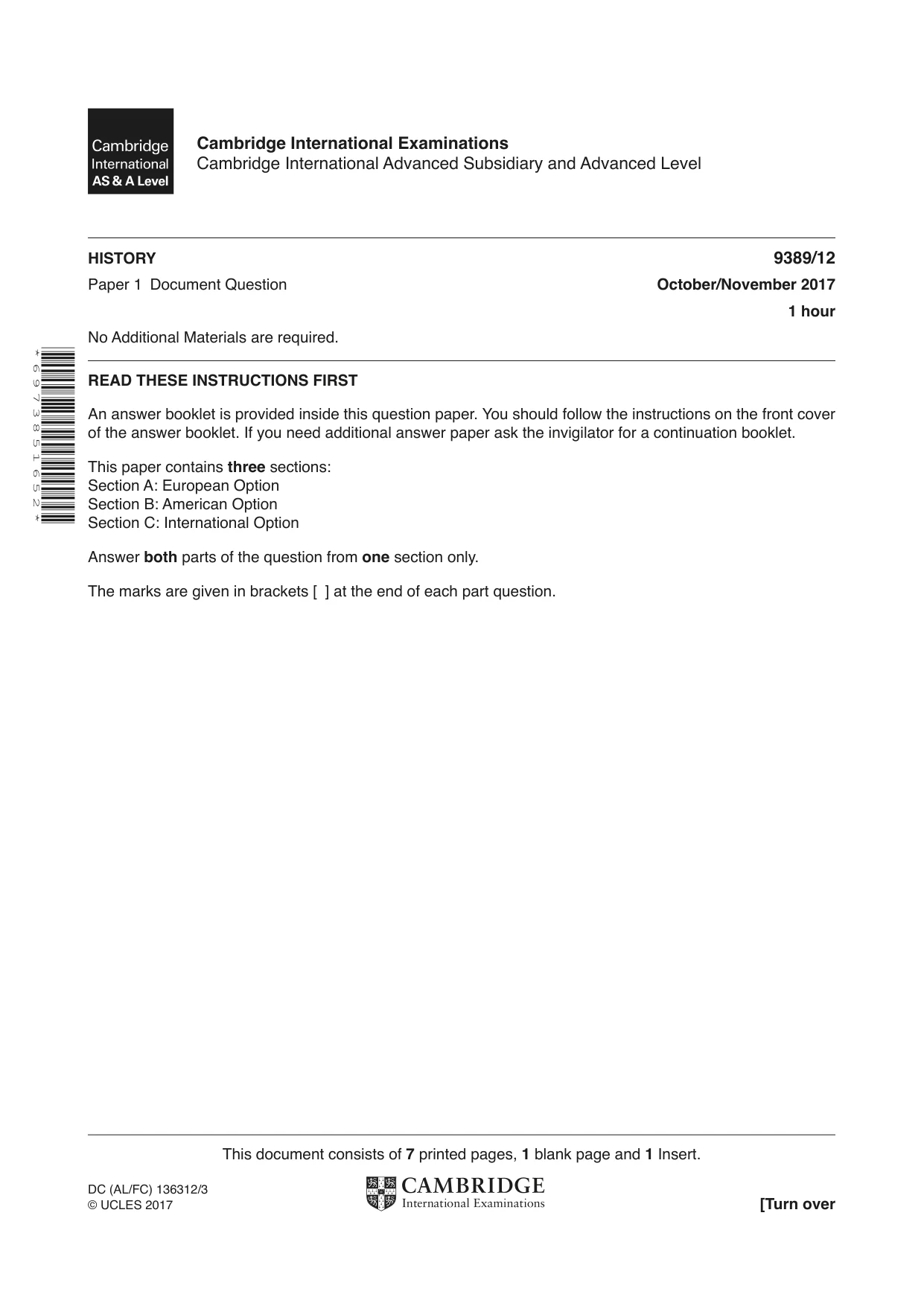
* 6 9 7 3 8 5 1 6 5 2 * This document consists of 7 printed pages, 1 blank page and 1 Insert. DC (AL/FC) 136312/3 © UCLES 2017 [Turn over Cambridge International Examinations Cambridge International Advanced Subsidiary and Advanced Level HISTORY 9389/12 Paper 1 Document Question October/November 2017 1 hour No Additional Materials are required. READ THESE INSTRUCTIONS FIRST An answer booklet is provided inside this question paper. You should follow the instructions on the front cover of the answer booklet. If you need additional answer paper ask the invigilator for a continuation booklet. This paper contains three sections: Section A: European Option Section B: American Option Section C: International Option Answer both parts of the question from one section only. The marks are given in brackets [ ] at the end of each part question.
Question paper, page 2
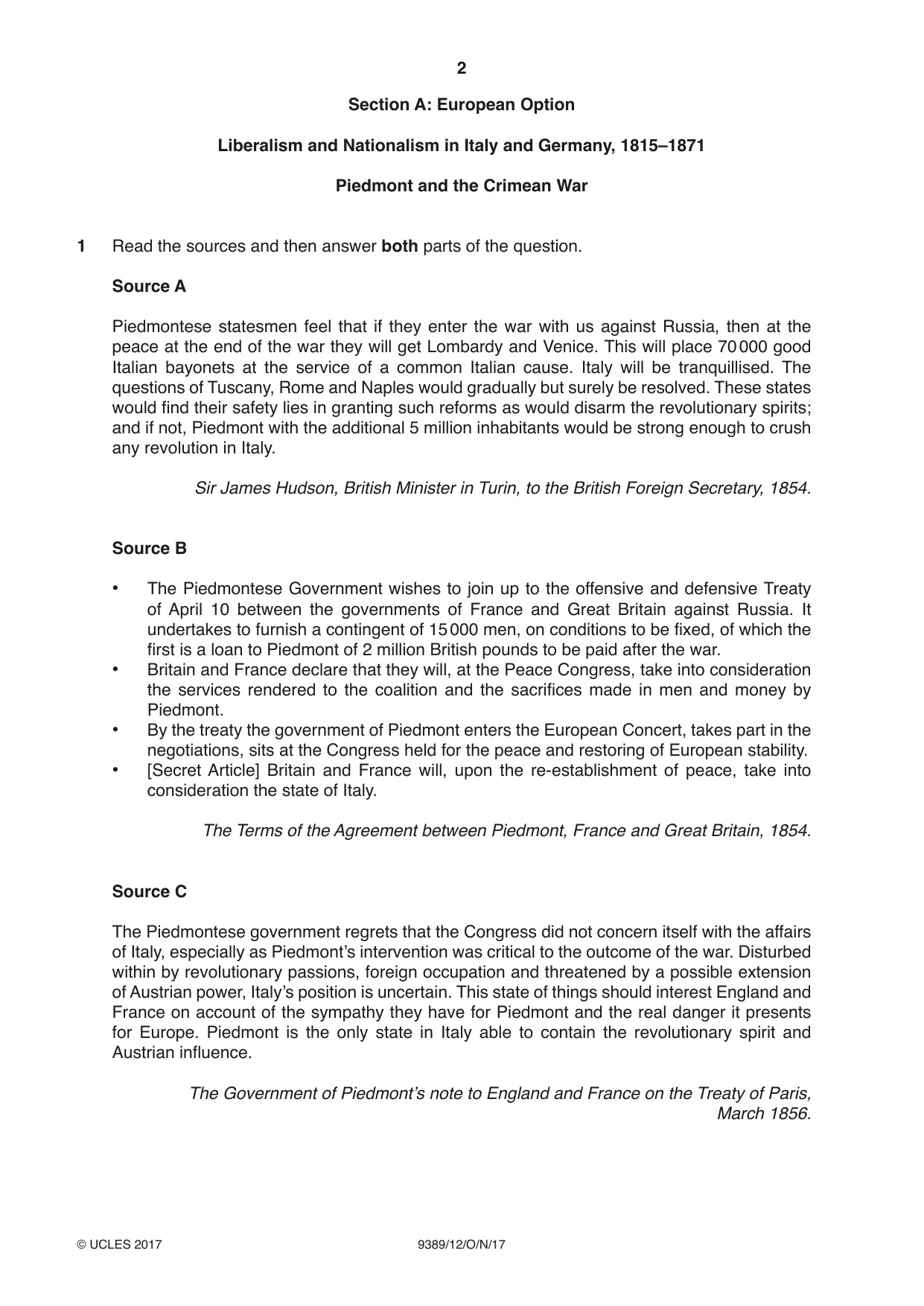
2 9389/12/O/N/17 © UCLES 2017 Section A: European Option Liberalism and Nationalism in Italy and Germany, 1815–1871 Piedmont and the Crimean War 1 Read the sources and then answer both parts of the question. Source A Piedmontese statesmen feel that if they enter the war with us against Russia, then at the peace at the end of the war they will get Lombardy and Venice. This will place 70 000 good Italian bayonets at the service of a common Italian cause. Italy will be tranquillised. The questions of Tuscany, Rome and Naples would gradually but surely be resolved. These states would find their safety lies in granting such reforms as would disarm the revolutionary spirits; and if not, Piedmont with the additional 5 million inhabitants would be strong enough to crush any revolution in Italy. Sir James Hudson, British Minister in Turin, to the British Foreign Secretary, 1854. Source B • The Piedmontese Government wishes to join up to the offensive and defensive Treaty of April 10 between the governments of France and Great Britain against Russia. It undertakes to furnish a contingent of 15 000 men, on conditions to be fixed, of which the first is a loan to Piedmont of 2 million British pounds to be paid after the war. • Britain and France declare that they will, at the Peace Congress, take into consideration the services rendered to the coalition and the sacrifices made in men and money by Piedmont. • By the treaty the government of Piedmont enters the European Concert, takes part in the negotiations, sits at the Congress held for the peace and restoring of European stability. • [Secret Article] Britain and France will, upon the re-establishment of peace, take into consideration the state of Italy. The Terms of the Agreement between Piedmont, France and Great Britain, 1854. Source C The Piedmontese government regrets that the Congress did not concern itself with the affairs of Italy, especially as Piedmont’s intervention was critical to the outcome of the war. Disturbed within by revolutionary passions, foreign occupation and threatened by a possible extension of Austrian power, Italy’s position is uncertain. This state of things should interest England and France on account of the sympathy they have for Piedmont and the real danger it presents for Europe. Piedmont is the only state in Italy able to contain the revolutionary spirit and Austrian influence. The Government of Piedmont’s note to England and France on the Treaty of Paris, March 1856.
Question paper, page 3
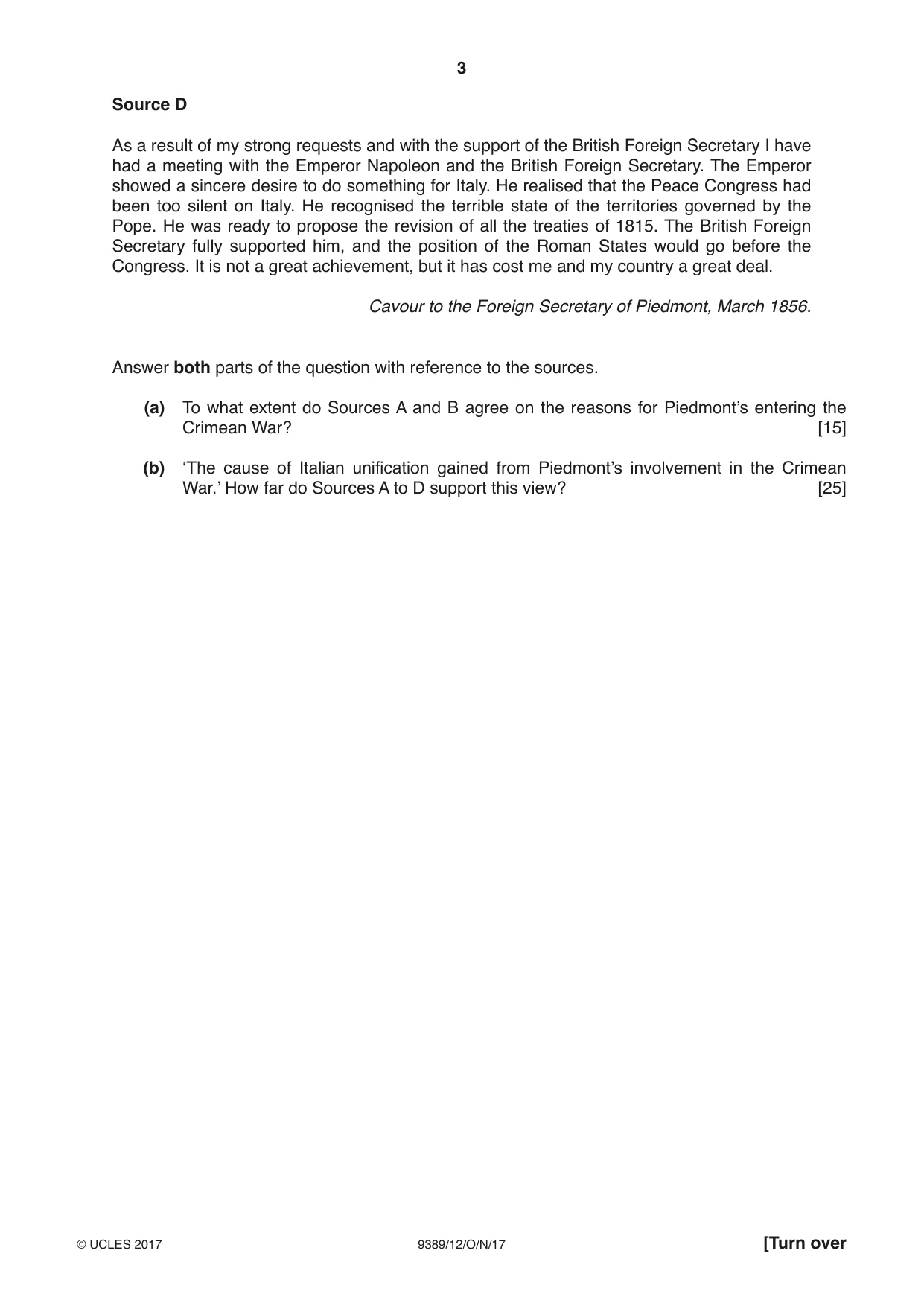
3 9389/12/O/N/17 © UCLES 2017 [Turn over Source D As a result of my strong requests and with the support of the British Foreign Secretary I have had a meeting with the Emperor Napoleon and the British Foreign Secretary. The Emperor showed a sincere desire to do something for Italy. He realised that the Peace Congress had been too silent on Italy. He recognised the terrible state of the territories governed by the Pope. He was ready to propose the revision of all the treaties of 1815. The British Foreign Secretary fully supported him, and the position of the Roman States would go before the Congress. It is not a great achievement, but it has cost me and my country a great deal. Cavour to the Foreign Secretary of Piedmont, March 1856. Answer both parts of the question with reference to the sources. (a) To what extent do Sources A and B agree on the reasons for Piedmont’s entering the Crimean War? [15] (b) ‘The cause of Italian unification gained from Piedmont’s involvement in the Crimean War.’ How far do Sources A to D support this view? [25]
Question paper, page 4
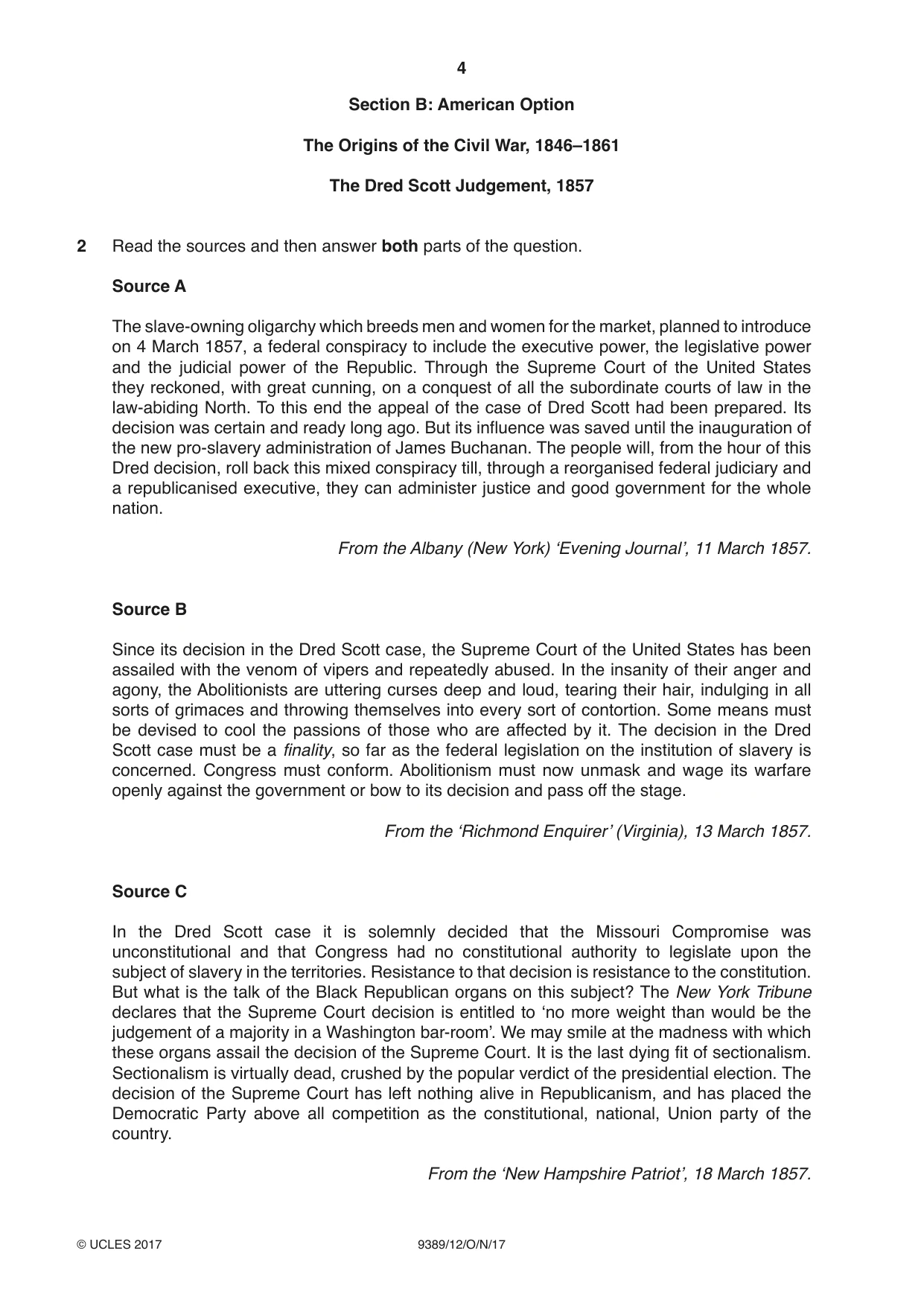
4 9389/12/O/N/17 © UCLES 2017 Section B: American Option The Origins of the Civil War, 1846–1861 The Dred Scott Judgement, 1857 2 Read the sources and then answer both parts of the question. Source A The slave-owning oligarchy which breeds men and women for the market, planned to introduce on 4 March 1857, a federal conspiracy to include the executive power, the legislative power and the judicial power of the Republic. Through the Supreme Court of the United States they reckoned, with great cunning, on a conquest of all the subordinate courts of law in the law-abiding North. To this end the appeal of the case of Dred Scott had been prepared. Its decision was certain and ready long ago. But its influence was saved until the inauguration of the new pro-slavery administration of James Buchanan. The people will, from the hour of this Dred decision, roll back this mixed conspiracy till, through a reorganised federal judiciary and a republicanised executive, they can administer justice and good government for the whole nation. From the Albany (New York) ‘Evening Journal’, 11 March 1857. Source B Since its decision in the Dred Scott case, the Supreme Court of the United States has been assailed with the venom of vipers and repeatedly abused. In the insanity of their anger and agony, the Abolitionists are uttering curses deep and loud, tearing their hair, indulging in all sorts of grimaces and throwing themselves into every sort of contortion. Some means must be devised to cool the passions of those who are affected by it. The decision in the Dred Scott case must be a finality, so far as the federal legislation on the institution of slavery is concerned. Congress must conform. Abolitionism must now unmask and wage its warfare openly against the government or bow to its decision and pass off the stage. From the ‘Richmond Enquirer’ (Virginia), 13 March 1857. Source C In the Dred Scott case it is solemnly decided that the Missouri Compromise was unconstitutional and that Congress had no constitutional authority to legislate upon the subject of slavery in the territories. Resistance to that decision is resistance to the constitution. But what is the talk of the Black Republican organs on this subject? The New York Tribune declares that the Supreme Court decision is entitled to ‘no more weight than would be the judgement of a majority in a Washington bar-room’. We may smile at the madness with which these organs assail the decision of the Supreme Court. It is the last dying fit of sectionalism. Sectionalism is virtually dead, crushed by the popular verdict of the presidential election. The decision of the Supreme Court has left nothing alive in Republicanism, and has placed the Democratic Party above all competition as the constitutional, national, Union party of the country. From the ‘New Hampshire Patriot’, 18 March 1857.
Question paper, page 5
5 9389/12/O/N/17 © UCLES 2017 [Turn over Source D Study the Dred Scott decision. That decision may be reduced to three points. The first is that a negro cannot be a citizen. The second is that the United States Constitution protects slavery in all the United States territories. The third point is that the voluntary bringing of Dred Scott into Illinois by his master, and holding him there a long time as a slave, did not make him free. Whether this shall be an entire slave nation is the issue before us. Every incident only consolidates the opposing sides and brings them more and more distinctly face to face. The conflict will be a severe one. To give victory to justice, not bloody bullets but peaceful ballots only are necessary. Thanks to our good old Constitution and organisation under it, these alone are necessary. It only needs that every right-thinking man shall go to the polls and, without fear or prejudice, vote as he thinks. From a speech by Abraham Lincoln to an unspecified audience, December 1857. Answer both parts of the question with reference to the sources. (a) To what extent do Sources A and B agree on the impact of the Dred Scott judgement on the issue of slavery? [15] (b) ‘The Dred Scott judgement was a huge setback for the abolitionist cause.’ How far do Sources A to D support this assertion? [25]
Question paper, page 6
6 9389/12/O/N/17 © UCLES 2017 Section C: International Option The Search for International Peace and Security, 1919–1945 President Woodrow Wilson and proposals for a League of Nations 3 Read the sources and then answer both parts of the question. Source A I am in favour of the League of Nations Covenant, of which our gallant and noble President is the proposer. I believe Mr Wilson will be able to accomplish the fulfilment of the Covenant despite all opposition. The League of Nations idea is a very delicate matter to handle, and no one but our President, who possesses the necessary qualities, could really be at the head of it. The abuse and discredit given to our President by Lodge, Borah and the like would make one imagine that these men lack intelligence. They know the Covenant is good for humanity; they should boost the League instead of criticising it. Their criticism of every move President Wilson makes implies that they are foolish or influenced by political motives. The League of Nations will alleviate all unrest, discontent and anxiety, and will make the world safe for democracy. The League would promote commerce, civilisation and brotherly love. I sincerely hope our President sees his way clear, and happy will I be the day the Covenant is accomplished and put into operation. Letter to an American newspaper, March 1919. Source B We trusted our policies in the hands of President Wilson; now look where they are today. As far as I can see, Senators of both parties are against the present plans for a League of Nations. Mr Wilson is simply playing politics. My idea would be for President Wilson to hasten peace negotiations, then come home where he belongs and let those foreign countries sort out their own treaties. Then, after everything is settled, if he still has the desire, let him go across and draw up plans for a League of Nations. How could a League of Nations be a success until all those treaties are settled up? To my mind, inefficiency has been the by-word of Mr Wilson’s administration and, to break up this inefficiency, the Senators have been forced to be a little stronger headed than the President. Letter to an American newspaper, March 1919. Source C Opinions sent into our offices show a greater support for the League of Nations than appears in opinions gathered in the streets: • 1191 are in favour of the League as proposed in Paris, while 303 oppose the plan. • At the University of Pennsylvania, balloting on the proposed plan for a League shows 106 to be in favour and 79 against. • A poll being taken in fourteen cities shows 63 662 supporting the League of Nations plan and 21 624 opposing. • One of the most interesting ballots taken so far was recorded at a New York theatrical performance attended by soldiers of the 27th Division. 102 of these veterans voted in favour of the plan for a League of Nations while 130 opposed.
Question paper, page 7
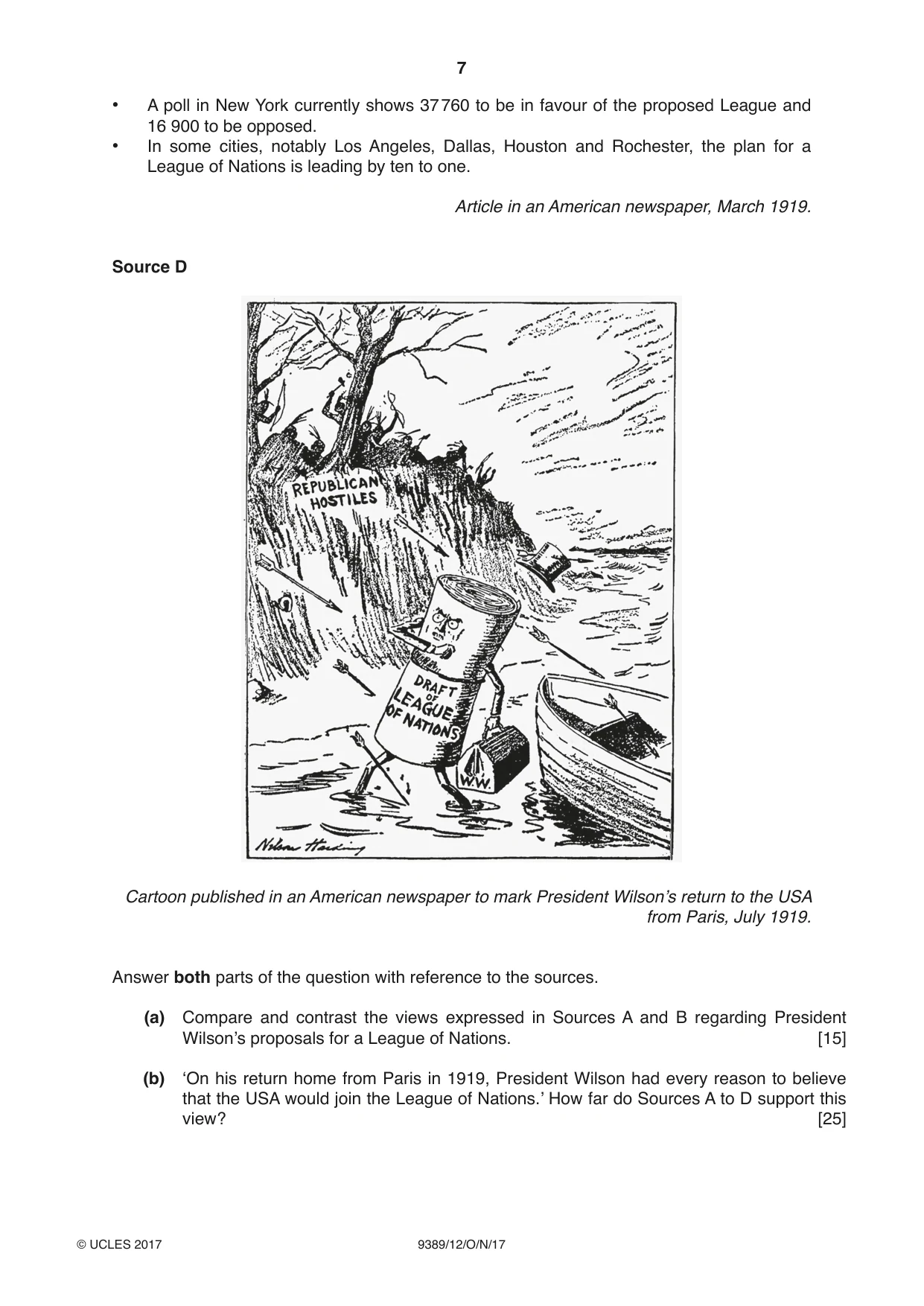
7 9389/12/O/N/17 © UCLES 2017 • A poll in New York currently shows 37 760 to be in favour of the proposed League and 16 900 to be opposed. • In some cities, notably Los Angeles, Dallas, Houston and Rochester, the plan for a League of Nations is leading by ten to one. Article in an American newspaper, March 1919. Source D Cartoon published in an American newspaper to mark President Wilson’s return to the USA from Paris, July 1919. Answer both parts of the question with reference to the sources. (a) Compare and contrast the views expressed in Sources A and B regarding President Wilson’s proposals for a League of Nations. [15] (b) ‘On his return home from Paris in 1919, President Wilson had every reason to believe that the USA would join the League of Nations.’ How far do Sources A to D support this view? [25]
Question paper, page 8
8 9389/12/O/N/17 © UCLES 2017 BLANK PAGE Permission to reproduce items where third-party owned material protected by copyright is included has been sought and cleared where possible. Every reasonable effort has been made by the publisher (UCLES) to trace copyright holders, but if any items requiring clearance have unwittingly been included, the publisher will be pleased to make amends at the earliest possible opportunity. To avoid the issue of disclosure of answer-related information to candidates, all copyright acknowledgements are reproduced online in the Cambridge International Examinations Copyright Acknowledgements Booklet. This is produced for each series of examinations and is freely available to download at www.cie.org.uk after the live examination series. Cambridge International Examinations is part of the Cambridge Assessment Group. Cambridge Assessment is the brand name of University of Cambridge Local Examinations Syndicate (UCLES), which is itself a department of the University of Cambridge.
Mark scheme, page 1
® IGCSE is a registered trademark. This document consists of 9 printed pages. © UCLES 2017 [Turn over Cambridge Assessment International Education Cambridge International Advanced Subsidiary and Advanced Level HISTORY 9389/12 Paper 1 October/November 2017 MARK SCHEME Maximum Mark: 40 Published This mark scheme is published as an aid to teachers and candidates, to indicate the requirements of the examination. It shows the basis on which Examiners were instructed to award marks. It does not indicate the details of the discussions that took place at an Examiners’ meeting before marking began, which would have considered the acceptability of alternative answers. Mark schemes should be read in conjunction with the question paper and the Principal Examiner Report for Teachers. Cambridge International will not enter into discussions about these mark schemes. Cambridge International is publishing the mark schemes for the October/November 2017 series for most Cambridge IGCSE®, Cambridge International A and AS Level components and some Cambridge O Level components.
Mark scheme, page 2
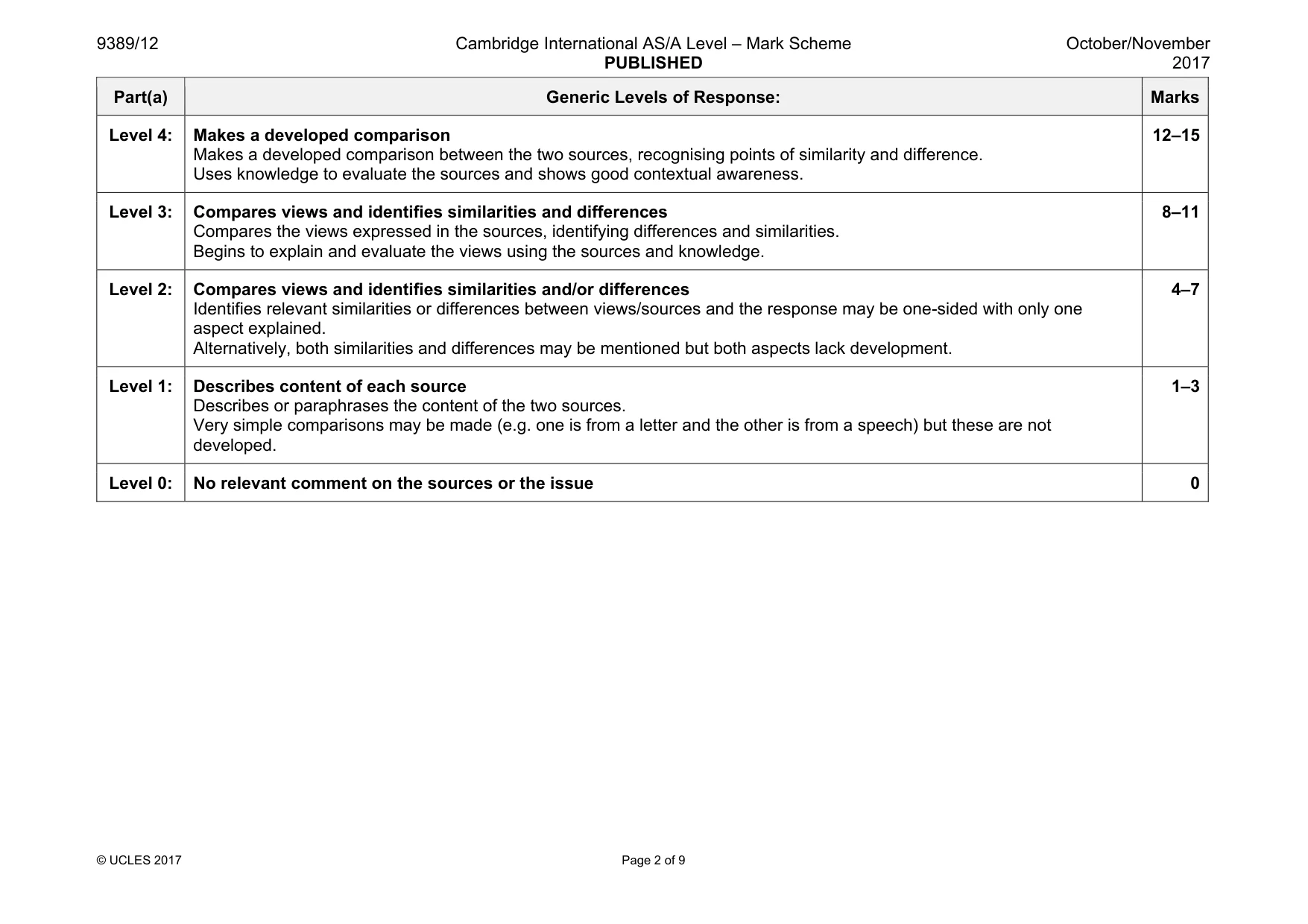
9389/12 Cambridge International AS/A Level – Mark Scheme PUBLISHED October/November 2017 © UCLES 2017 Page 2 of 9 Part(a) Generic Levels of Response: Marks Level 4: Makes a developed comparison Makes a developed comparison between the two sources, recognising points of similarity and difference. Uses knowledge to evaluate the sources and shows good contextual awareness. 12–15 Level 3: Compares views and identifies similarities and differences Compares the views expressed in the sources, identifying differences and similarities. Begins to explain and evaluate the views using the sources and knowledge. 8–11 Level 2: Compares views and identifies similarities and/or differences Identifies relevant similarities or differences between views/sources and the response may be one-sided with only one aspect explained. Alternatively, both similarities and differences may be mentioned but both aspects lack development. 4–7 Level 1: Describes content of each source Describes or paraphrases the content of the two sources. Very simple comparisons may be made (e.g. one is from a letter and the other is from a speech) but these are not developed. 1–3 Level 0: No relevant comment on the sources or the issue 0
Mark scheme, page 3
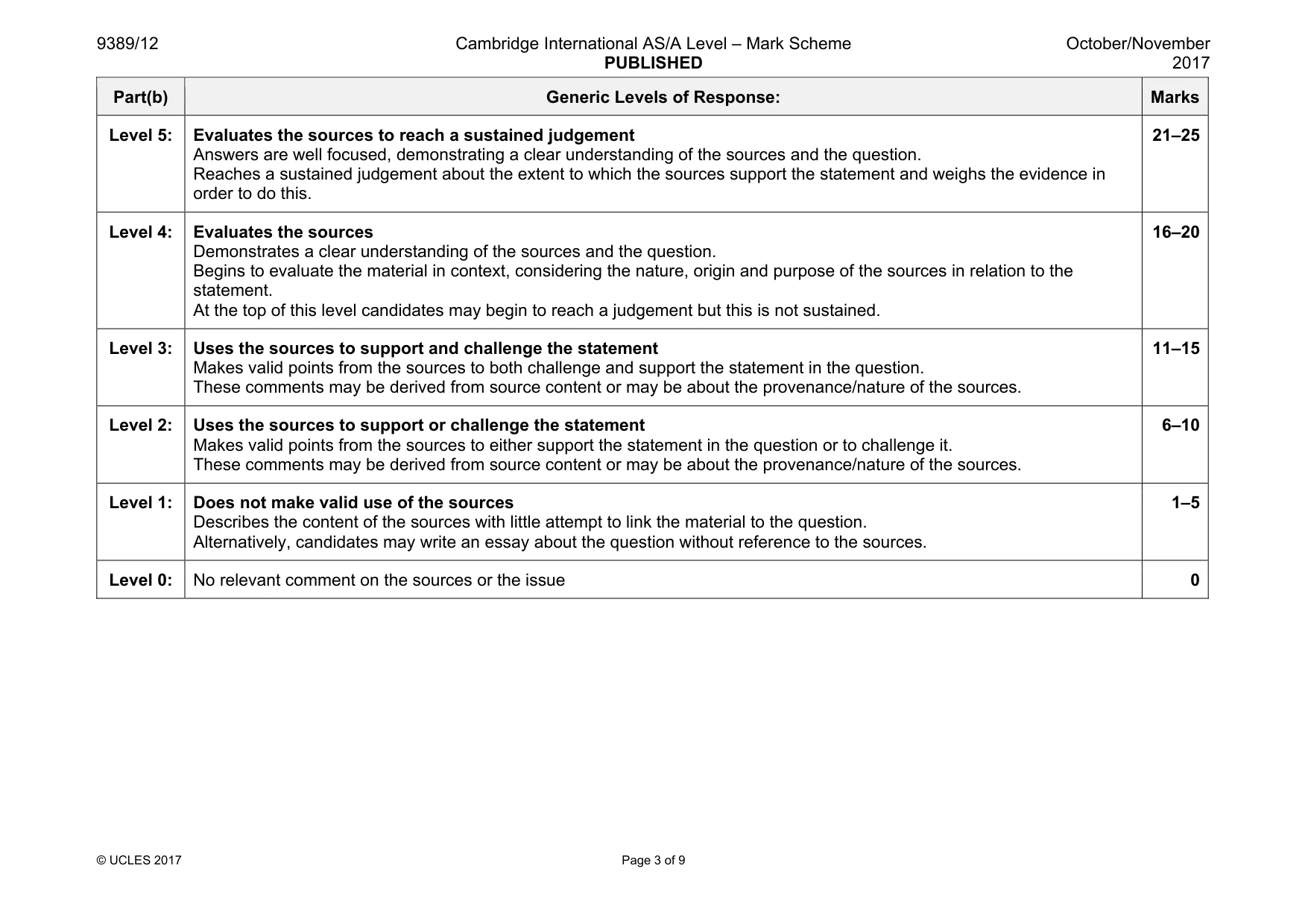
9389/12 Cambridge International AS/A Level – Mark Scheme PUBLISHED October/November 2017 © UCLES 2017 Page 3 of 9 Part(b) Generic Levels of Response: Marks Level 5: Evaluates the sources to reach a sustained judgement Answers are well focused, demonstrating a clear understanding of the sources and the question. Reaches a sustained judgement about the extent to which the sources support the statement and weighs the evidence in order to do this. 21–25 Level 4: Evaluates the sources Demonstrates a clear understanding of the sources and the question. Begins to evaluate the material in context, considering the nature, origin and purpose of the sources in relation to the statement. At the top of this level candidates may begin to reach a judgement but this is not sustained. 16–20 Level 3: Uses the sources to support and challenge the statement Makes valid points from the sources to both challenge and support the statement in the question. These comments may be derived from source content or may be about the provenance/nature of the sources. 11–15 Level 2: Uses the sources to support or challenge the statement Makes valid points from the sources to either support the statement in the question or to challenge it. These comments may be derived from source content or may be about the provenance/nature of the sources. 6–10 Level 1: Does not make valid use of the sources Describes the content of the sources with little attempt to link the material to the question. Alternatively, candidates may write an essay about the question without reference to the sources. 1–5 Level 0: No relevant comment on the sources or the issue 0
Mark scheme, page 4
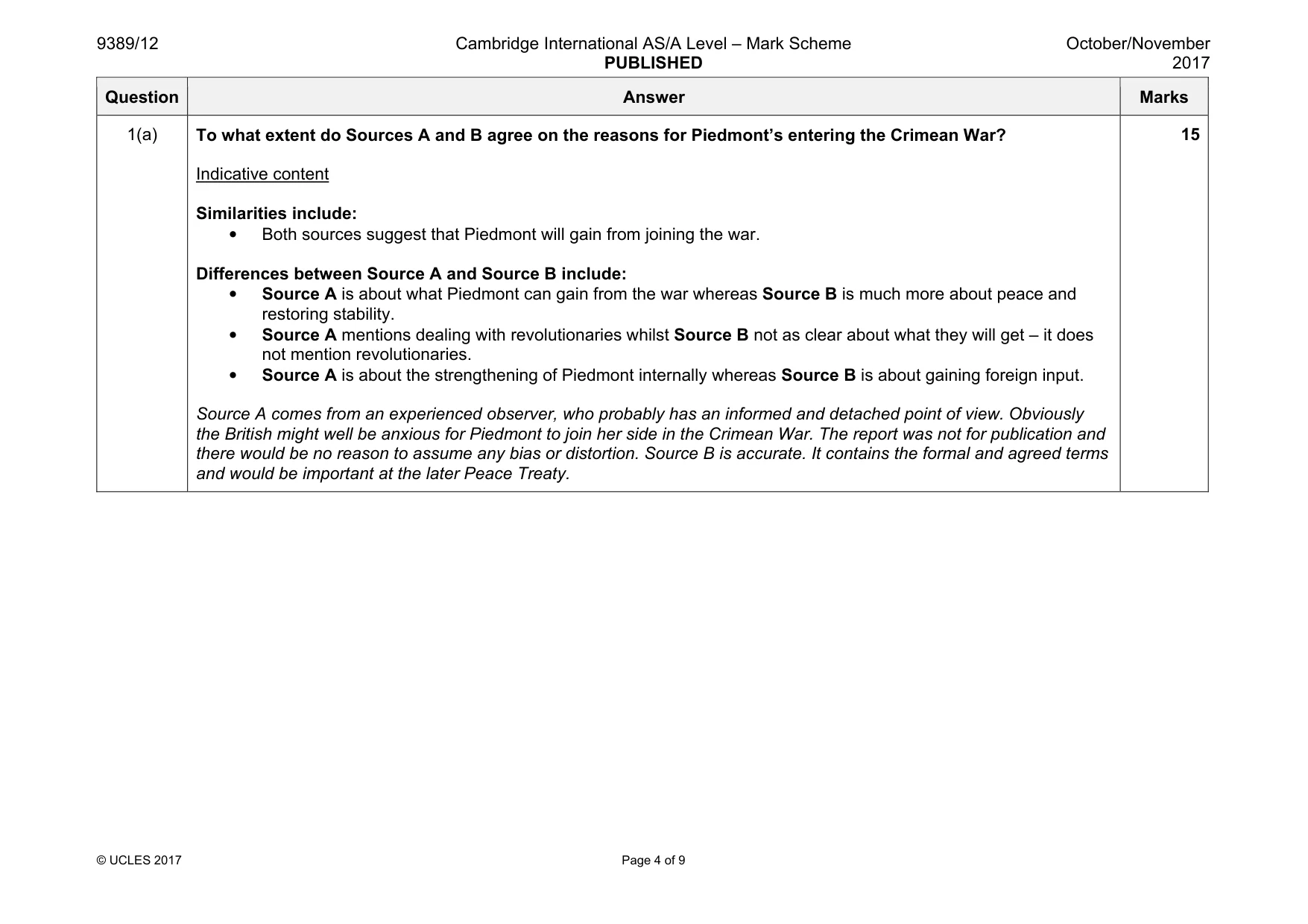
9389/12 Cambridge International AS/A Level – Mark Scheme PUBLISHED October/November 2017 © UCLES 2017 Page 4 of 9 Question Answer Marks 1(a) To what extent do Sources A and B agree on the reasons for Piedmont’s entering the Crimean War? Indicative content Similarities include: • Both sources suggest that Piedmont will gain from joining the war. Differences between Source A and Source B include: • Source A is about what Piedmont can gain from the war whereas Source B is much more about peace and restoring stability. • Source A mentions dealing with revolutionaries whilst Source B not as clear about what they will get – it does not mention revolutionaries. • Source A is about the strengthening of Piedmont internally whereas Source B is about gaining foreign input. Source A comes from an experienced observer, who probably has an informed and detached point of view. Obviously the British might well be anxious for Piedmont to join her side in the Crimean War. The report was not for publication and there would be no reason to assume any bias or distortion. Source B is accurate. It contains the formal and agreed terms and would be important at the later Peace Treaty. 15
Mark scheme, page 5
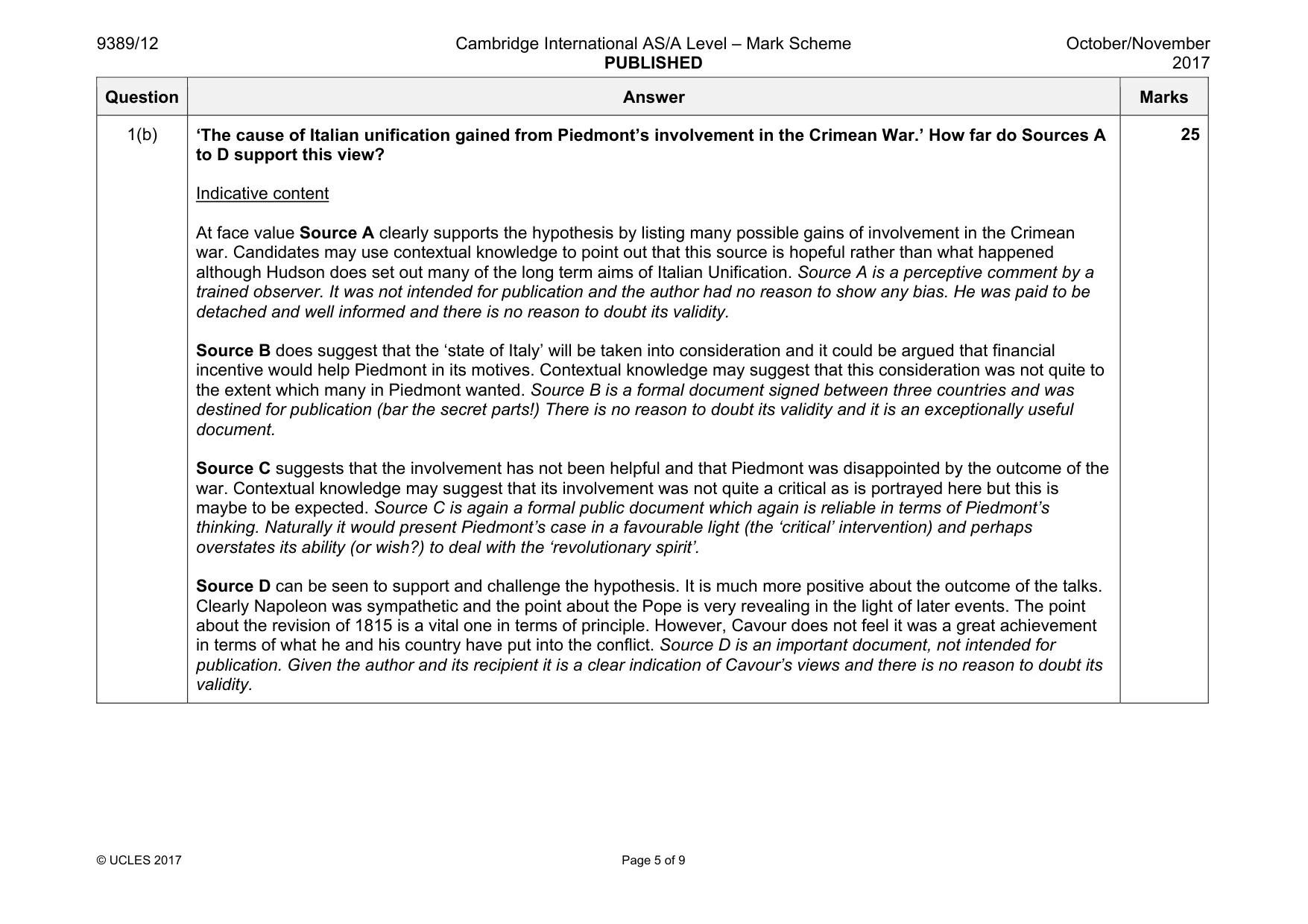
9389/12 Cambridge International AS/A Level – Mark Scheme PUBLISHED October/November 2017 © UCLES 2017 Page 5 of 9 Question Answer Marks 1(b) ‘The cause of Italian unification gained from Piedmont’s involvement in the Crimean War.’ How far do Sources A to D support this view? Indicative content At face value Source A clearly supports the hypothesis by listing many possible gains of involvement in the Crimean war. Candidates may use contextual knowledge to point out that this source is hopeful rather than what happened although Hudson does set out many of the long term aims of Italian Unification. Source A is a perceptive comment by a trained observer. It was not intended for publication and the author had no reason to show any bias. He was paid to be detached and well informed and there is no reason to doubt its validity. Source B does suggest that the ‘state of Italy’ will be taken into consideration and it could be argued that financial incentive would help Piedmont in its motives. Contextual knowledge may suggest that this consideration was not quite to the extent which many in Piedmont wanted. Source B is a formal document signed between three countries and was destined for publication (bar the secret parts!) There is no reason to doubt its validity and it is an exceptionally useful document. Source C suggests that the involvement has not been helpful and that Piedmont was disappointed by the outcome of the war. Contextual knowledge may suggest that its involvement was not quite a critical as is portrayed here but this is maybe to be expected. Source C is again a formal public document which again is reliable in terms of Piedmont’s thinking. Naturally it would present Piedmont’s case in a favourable light (the ‘critical’ intervention) and perhaps overstates its ability (or wish?) to deal with the ‘revolutionary spirit’. Source D can be seen to support and challenge the hypothesis. It is much more positive about the outcome of the talks. Clearly Napoleon was sympathetic and the point about the Pope is very revealing in the light of later events. The point about the revision of 1815 is a vital one in terms of principle. However, Cavour does not feel it was a great achievement in terms of what he and his country have put into the conflict. Source D is an important document, not intended for publication. Given the author and its recipient it is a clear indication of Cavour’s views and there is no reason to doubt its validity. 25
Mark scheme, page 6
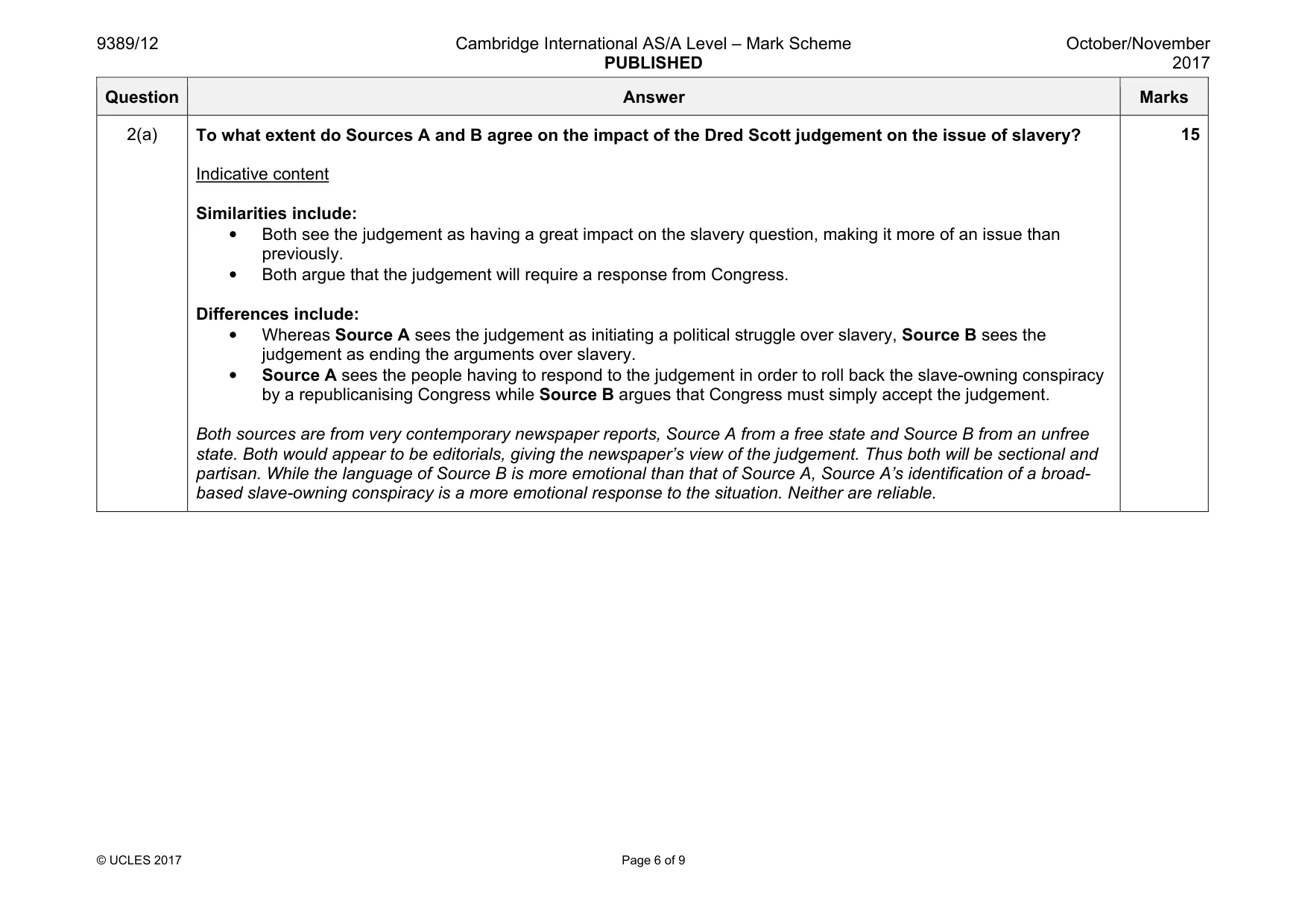
9389/12 Cambridge International AS/A Level – Mark Scheme PUBLISHED October/November 2017 © UCLES 2017 Page 6 of 9 Question Answer Marks 2(a) To what extent do Sources A and B agree on the impact of the Dred Scott judgement on the issue of slavery? Indicative content Similarities include: • Both see the judgement as having a great impact on the slavery question, making it more of an issue than previously. • Both argue that the judgement will require a response from Congress. Differences include: • Whereas Source A sees the judgement as initiating a political struggle over slavery, Source B sees the judgement as ending the arguments over slavery. • Source A sees the people having to respond to the judgement in order to roll back the slave-owning conspiracy by a republicanising Congress while Source B argues that Congress must simply accept the judgement. Both sources are from very contemporary newspaper reports, Source A from a free state and Source B from an unfree state. Both would appear to be editorials, giving the newspaper’s view of the judgement. Thus both will be sectional and partisan. While the language of Source B is more emotional than that of Source A, Source A’s identification of a broad- based slave-owning conspiracy is a more emotional response to the situation. Neither are reliable. 15
Mark scheme, page 7
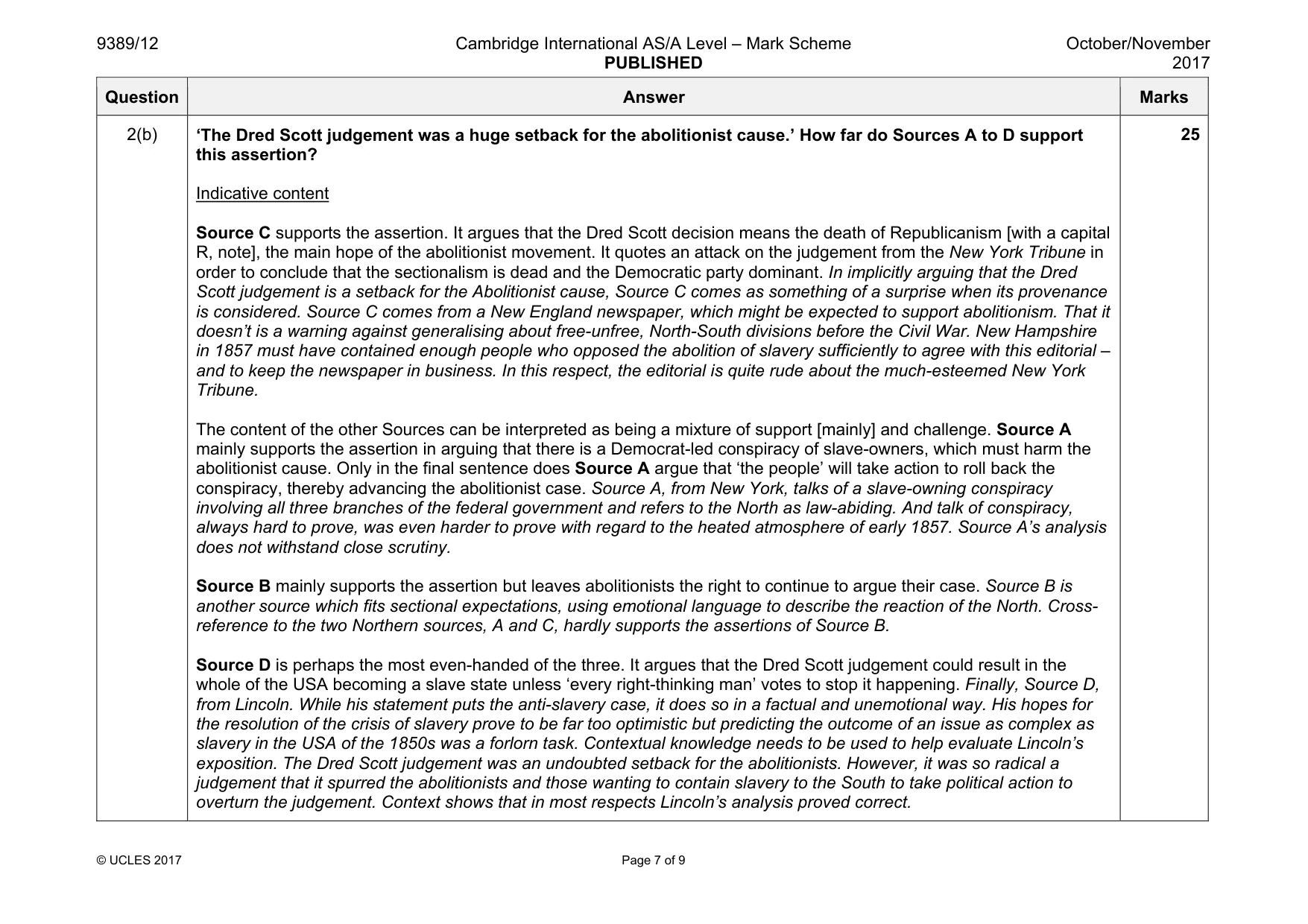
9389/12 Cambridge International AS/A Level – Mark Scheme PUBLISHED October/November 2017 © UCLES 2017 Page 7 of 9 Question Answer Marks 2(b) ‘The Dred Scott judgement was a huge setback for the abolitionist cause.’ How far do Sources A to D support this assertion? Indicative content Source C supports the assertion. It argues that the Dred Scott decision means the death of Republicanism [with a capital R, note], the main hope of the abolitionist movement. It quotes an attack on the judgement from the New York Tribune in order to conclude that the sectionalism is dead and the Democratic party dominant. In implicitly arguing that the Dred Scott judgement is a setback for the Abolitionist cause, Source C comes as something of a surprise when its provenance is considered. Source C comes from a New England newspaper, which might be expected to support abolitionism. That it doesn’t is a warning against generalising about free-unfree, North-South divisions before the Civil War. New Hampshire in 1857 must have contained enough people who opposed the abolition of slavery sufficiently to agree with this editorial – and to keep the newspaper in business. In this respect, the editorial is quite rude about the much-esteemed New York Tribune. The content of the other Sources can be interpreted as being a mixture of support [mainly] and challenge. Source A mainly supports the assertion in arguing that there is a Democrat-led conspiracy of slave-owners, which must harm the abolitionist cause. Only in the final sentence does Source A argue that ‘the people’ will take action to roll back the conspiracy, thereby advancing the abolitionist case. Source A, from New York, talks of a slave-owning conspiracy involving all three branches of the federal government and refers to the North as law-abiding. And talk of conspiracy, always hard to prove, was even harder to prove with regard to the heated atmosphere of early 1857. Source A’s analysis does not withstand close scrutiny. Source B mainly supports the assertion but leaves abolitionists the right to continue to argue their case. Source B is another source which fits sectional expectations, using emotional language to describe the reaction of the North. Cross- reference to the two Northern sources, A and C, hardly supports the assertions of Source B. Source D is perhaps the most even-handed of the three. It argues that the Dred Scott judgement could result in the whole of the USA becoming a slave state unless ‘every right-thinking man’ votes to stop it happening. Finally, Source D, from Lincoln. While his statement puts the anti-slavery case, it does so in a factual and unemotional way. His hopes for the resolution of the crisis of slavery prove to be far too optimistic but predicting the outcome of an issue as complex as slavery in the USA of the 1850s was a forlorn task. Contextual knowledge needs to be used to help evaluate Lincoln’s exposition. The Dred Scott judgement was an undoubted setback for the abolitionists. However, it was so radical a judgement that it spurred the abolitionists and those wanting to contain slavery to the South to take political action to overturn the judgement. Context shows that in most respects Lincoln’s analysis proved correct. 25
Mark scheme, page 8
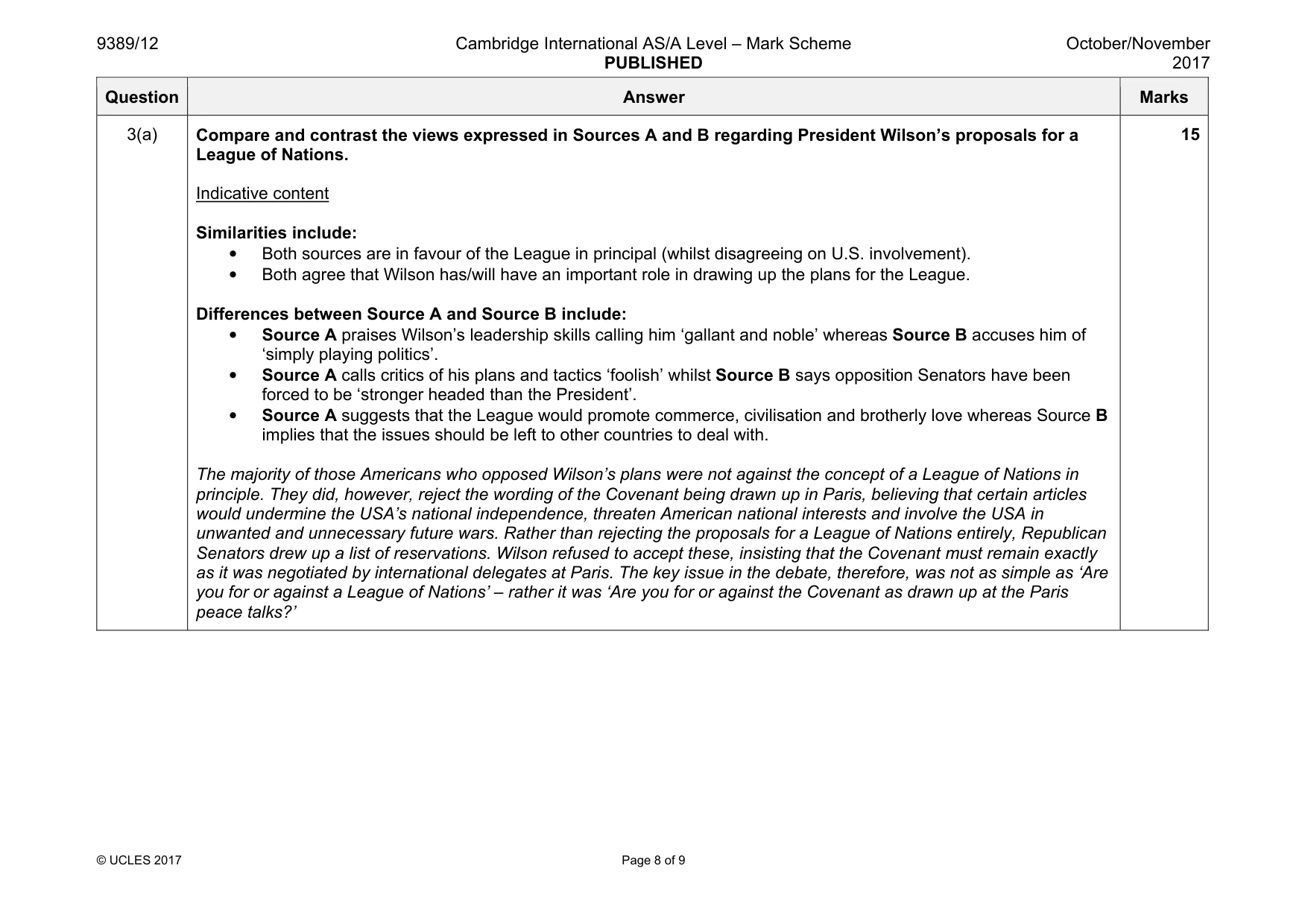
9389/12 Cambridge International AS/A Level – Mark Scheme PUBLISHED October/November 2017 © UCLES 2017 Page 8 of 9 Question Answer Marks 3(a) Compare and contrast the views expressed in Sources A and B regarding President Wilson’s proposals for a League of Nations. Indicative content Similarities include: • Both sources are in favour of the League in principal (whilst disagreeing on U.S. involvement). • Both agree that Wilson has/will have an important role in drawing up the plans for the League. Differences between Source A and Source B include: • Source A praises Wilson’s leadership skills calling him ‘gallant and noble’ whereas Source B accuses him of ‘simply playing politics’. • Source A calls critics of his plans and tactics ‘foolish’ whilst Source B says opposition Senators have been forced to be ‘stronger headed than the President’. • Source A suggests that the League would promote commerce, civilisation and brotherly love whereas Source B implies that the issues should be left to other countries to deal with. The majority of those Americans who opposed Wilson’s plans were not against the concept of a League of Nations in principle. They did, however, reject the wording of the Covenant being drawn up in Paris, believing that certain articles would undermine the USA’s national independence, threaten American national interests and involve the USA in unwanted and unnecessary future wars. Rather than rejecting the proposals for a League of Nations entirely, Republican Senators drew up a list of reservations. Wilson refused to accept these, insisting that the Covenant must remain exactly as it was negotiated by international delegates at Paris. The key issue in the debate, therefore, was not as simple as ‘Are you for or against a League of Nations’ – rather it was ‘Are you for or against the Covenant as drawn up at the Paris peace talks?’ 15
Mark scheme, page 9
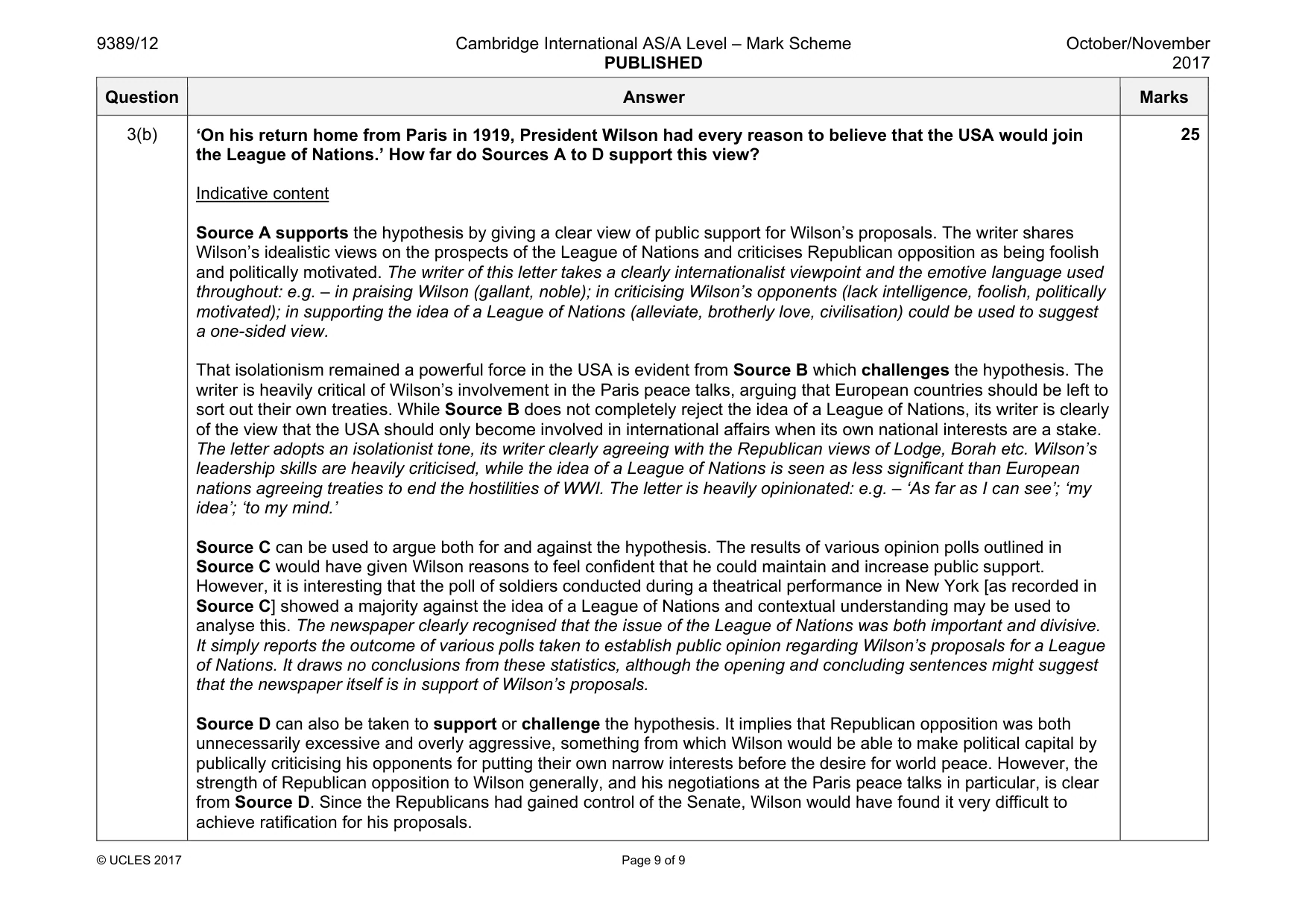
9389/12 Cambridge International AS/A Level – Mark Scheme PUBLISHED October/November 2017 © UCLES 2017 Page 9 of 9 Question Answer Marks 3(b) ‘On his return home from Paris in 1919, President Wilson had every reason to believe that the USA would join the League of Nations.’ How far do Sources A to D support this view? Indicative content Source A supports the hypothesis by giving a clear view of public support for Wilson’s proposals. The writer shares Wilson’s idealistic views on the prospects of the League of Nations and criticises Republican opposition as being foolish and politically motivated. The writer of this letter takes a clearly internationalist viewpoint and the emotive language used throughout: e.g. – in praising Wilson (gallant, noble); in criticising Wilson’s opponents (lack intelligence, foolish, politically motivated); in supporting the idea of a League of Nations (alleviate, brotherly love, civilisation) could be used to suggest a one-sided view. That isolationism remained a powerful force in the USA is evident from Source B which challenges the hypothesis. The writer is heavily critical of Wilson’s involvement in the Paris peace talks, arguing that European countries should be left to sort out their own treaties. While Source B does not completely reject the idea of a League of Nations, its writer is clearly of the view that the USA should only become involved in international affairs when its own national interests are a stake. The letter adopts an isolationist tone, its writer clearly agreeing with the Republican views of Lodge, Borah etc. Wilson’s leadership skills are heavily criticised, while the idea of a League of Nations is seen as less significant than European nations agreeing treaties to end the hostilities of WWI. The letter is heavily opinionated: e.g. – ‘As far as I can see’; ‘my idea’; ‘to my mind.’ Source C can be used to argue both for and against the hypothesis. The results of various opinion polls outlined in Source C would have given Wilson reasons to feel confident that he could maintain and increase public support. However, it is interesting that the poll of soldiers conducted during a theatrical performance in New York [as recorded in Source C] showed a majority against the idea of a League of Nations and contextual understanding may be used to analyse this. The newspaper clearly recognised that the issue of the League of Nations was both important and divisive. It simply reports the outcome of various polls taken to establish public opinion regarding Wilson’s proposals for a League of Nations. It draws no conclusions from these statistics, although the opening and concluding sentences might suggest that the newspaper itself is in support of Wilson’s proposals. Source D can also be taken to support or challenge the hypothesis. It implies that Republican opposition was both unnecessarily excessive and overly aggressive, something from which Wilson would be able to make political capital by publically criticising his opponents for putting their own narrow interests before the desire for world peace. However, the strength of Republican opposition to Wilson generally, and his negotiations at the Paris peace talks in particular, is clear from Source D. Since the Republicans had gained control of the Senate, Wilson would have found it very difficult to achieve ratification for his proposals. 25
What you needed in this session
Cambridge’s own grade thresholds for 2017 Oct/Nov, Paper 1 · Variant 2. A higher threshold means an easier paper — the bar moves with how the cohort did.