Cambridge A Level History 9389 — 2017 Oct/Nov Paper 1 · Variant 3
9389/13/O/N/17 · 40 marks · ≈45 min
The question paper and its mark scheme, free to read here and free to download. This is Cambridge’s own paper, exactly as it was sat.
Question paper8 pages

Mark scheme10 pages
Answers below. Sit the paper first if you are practising.
Paper as text
Question paper, page 1
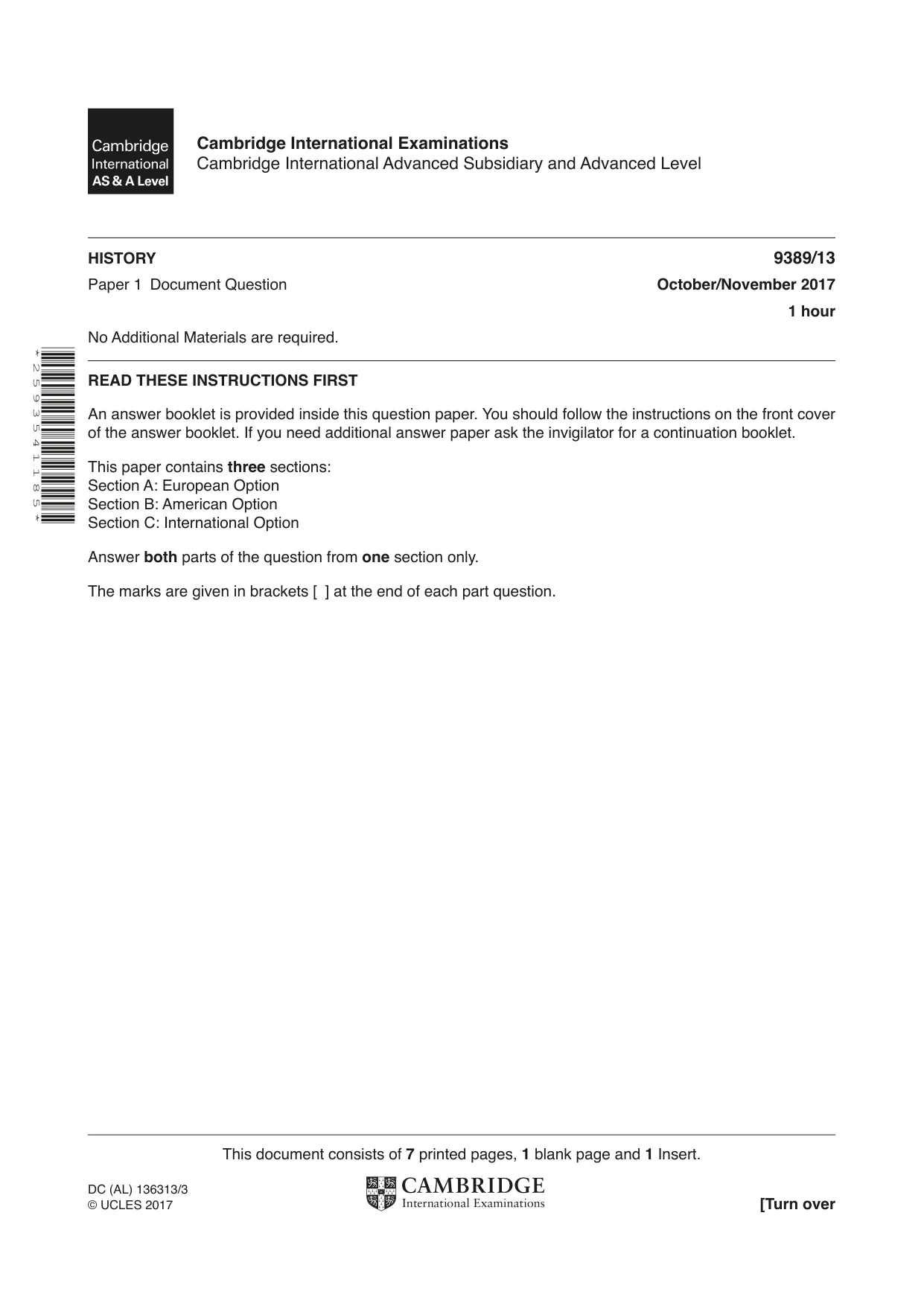
* 2 5 9 3 5 4 1 1 8 5 * This document consists of 7 printed pages, 1 blank page and 1 Insert. DC (AL) 136313/3 © UCLES 2017 [Turn over Cambridge International Examinations Cambridge International Advanced Subsidiary and Advanced Level HISTORY 9389/13 Paper 1 Document Question October/November 2017 1 hour No Additional Materials are required. READ THESE INSTRUCTIONS FIRST An answer booklet is provided inside this question paper. You should follow the instructions on the front cover of the answer booklet. If you need additional answer paper ask the invigilator for a continuation booklet. This paper contains three sections: Section A: European Option Section B: American Option Section C: International Option Answer both parts of the question from one section only. The marks are given in brackets [ ] at the end of each part question.
Question paper, page 2
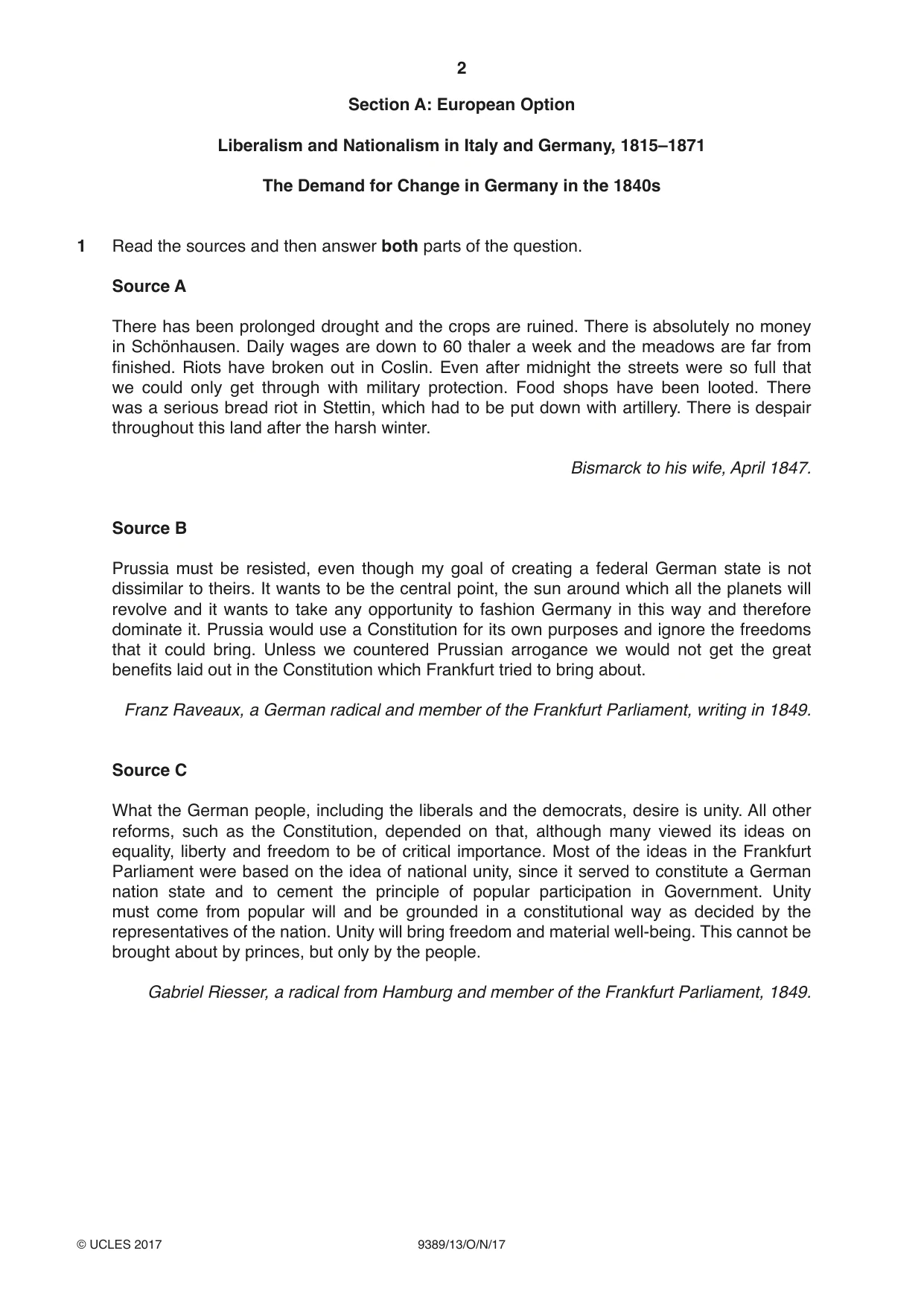
2 9389/13/O/N/17 © UCLES 2017 Section A: European Option Liberalism and Nationalism in Italy and Germany, 1815–1871 The Demand for Change in Germany in the 1840s 1 Read the sources and then answer both parts of the question. Source A There has been prolonged drought and the crops are ruined. There is absolutely no money in Schönhausen. Daily wages are down to 60 thaler a week and the meadows are far from finished. Riots have broken out in Coslin. Even after midnight the streets were so full that we could only get through with military protection. Food shops have been looted. There was a serious bread riot in Stettin, which had to be put down with artillery. There is despair throughout this land after the harsh winter. Bismarck to his wife, April 1847. Source B Prussia must be resisted, even though my goal of creating a federal German state is not dissimilar to theirs. It wants to be the central point, the sun around which all the planets will revolve and it wants to take any opportunity to fashion Germany in this way and therefore dominate it. Prussia would use a Constitution for its own purposes and ignore the freedoms that it could bring. Unless we countered Prussian arrogance we would not get the great benefits laid out in the Constitution which Frankfurt tried to bring about. Franz Raveaux, a German radical and member of the Frankfurt Parliament, writing in 1849. Source C What the German people, including the liberals and the democrats, desire is unity. All other reforms, such as the Constitution, depended on that, although many viewed its ideas on equality, liberty and freedom to be of critical importance. Most of the ideas in the Frankfurt Parliament were based on the idea of national unity, since it served to constitute a German nation state and to cement the principle of popular participation in Government. Unity must come from popular will and be grounded in a constitutional way as decided by the representatives of the nation. Unity will bring freedom and material well-being. This cannot be brought about by princes, but only by the people. Gabriel Riesser, a radical from Hamburg and member of the Frankfurt Parliament, 1849.
Question paper, page 3
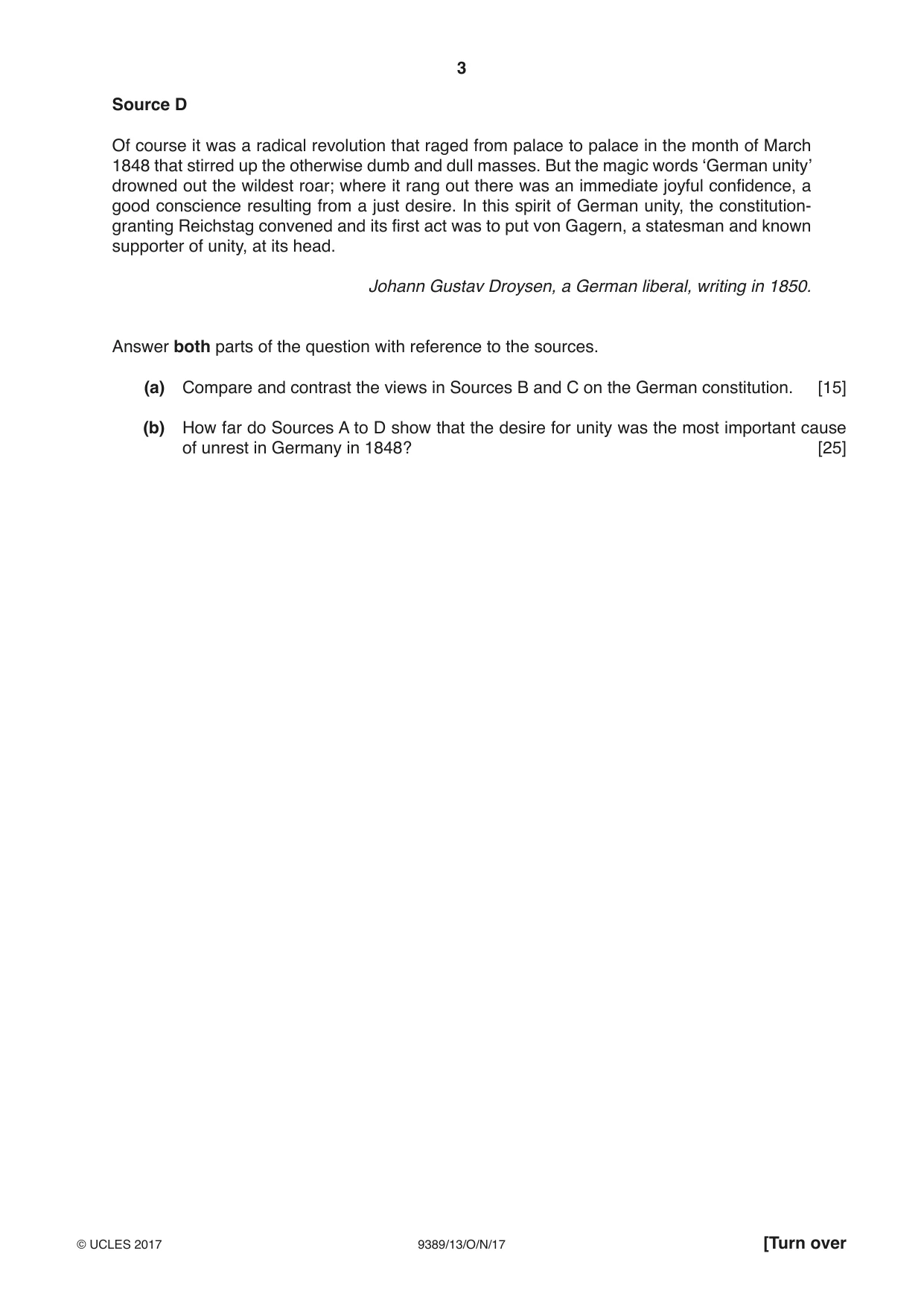
3 9389/13/O/N/17 © UCLES 2017 [Turn over Source D Of course it was a radical revolution that raged from palace to palace in the month of March 1848 that stirred up the otherwise dumb and dull masses. But the magic words ‘German unity’ drowned out the wildest roar; where it rang out there was an immediate joyful confidence, a good conscience resulting from a just desire. In this spirit of German unity, the constitution- granting Reichstag convened and its first act was to put von Gagern, a statesman and known supporter of unity, at its head. Johann Gustav Droysen, a German liberal, writing in 1850. Answer both parts of the question with reference to the sources. (a) Compare and contrast the views in Sources B and C on the German constitution. [15] (b) How far do Sources A to D show that the desire for unity was the most important cause of unrest in Germany in 1848? [25]
Question paper, page 4
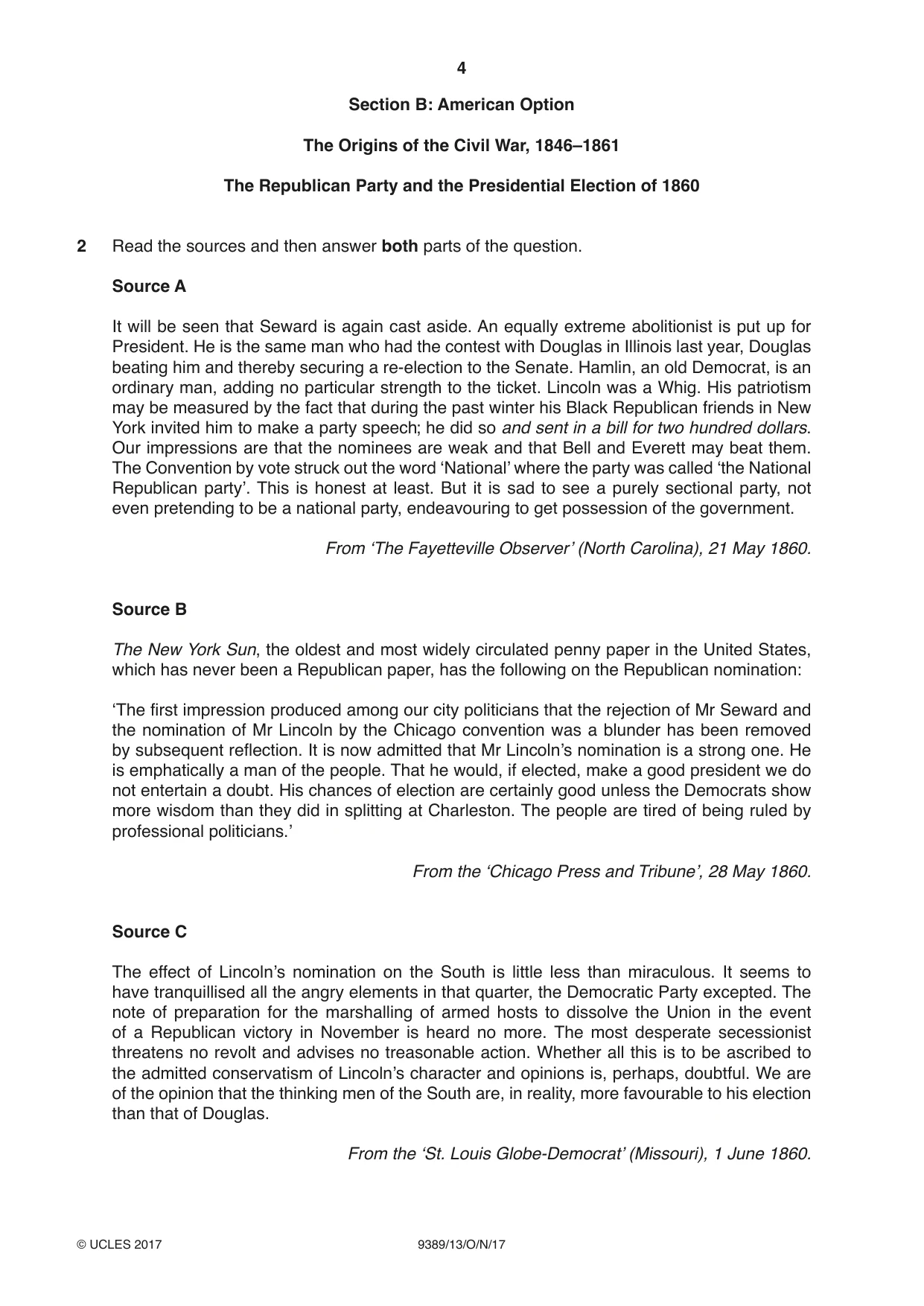
4 9389/13/O/N/17 © UCLES 2017 Section B: American Option The Origins of the Civil War, 1846–1861 The Republican Party and the Presidential Election of 1860 2 Read the sources and then answer both parts of the question. Source A It will be seen that Seward is again cast aside. An equally extreme abolitionist is put up for President. He is the same man who had the contest with Douglas in Illinois last year, Douglas beating him and thereby securing a re-election to the Senate. Hamlin, an old Democrat, is an ordinary man, adding no particular strength to the ticket. Lincoln was a Whig. His patriotism may be measured by the fact that during the past winter his Black Republican friends in New York invited him to make a party speech; he did so and sent in a bill for two hundred dollars. Our impressions are that the nominees are weak and that Bell and Everett may beat them. The Convention by vote struck out the word ‘National’ where the party was called ‘the National Republican party’. This is honest at least. But it is sad to see a purely sectional party, not even pretending to be a national party, endeavouring to get possession of the government. From ‘The Fayetteville Observer’ (North Carolina), 21 May 1860. Source B The New York Sun, the oldest and most widely circulated penny paper in the United States, which has never been a Republican paper, has the following on the Republican nomination: ‘The first impression produced among our city politicians that the rejection of Mr Seward and the nomination of Mr Lincoln by the Chicago convention was a blunder has been removed by subsequent reflection. It is now admitted that Mr Lincoln’s nomination is a strong one. He is emphatically a man of the people. That he would, if elected, make a good president we do not entertain a doubt. His chances of election are certainly good unless the Democrats show more wisdom than they did in splitting at Charleston. The people are tired of being ruled by professional politicians.’ From the ‘Chicago Press and Tribune’, 28 May 1860. Source C The effect of Lincoln’s nomination on the South is little less than miraculous. It seems to have tranquillised all the angry elements in that quarter, the Democratic Party excepted. The note of preparation for the marshalling of armed hosts to dissolve the Union in the event of a Republican victory in November is heard no more. The most desperate secessionist threatens no revolt and advises no treasonable action. Whether all this is to be ascribed to the admitted conservatism of Lincoln’s character and opinions is, perhaps, doubtful. We are of the opinion that the thinking men of the South are, in reality, more favourable to his election than that of Douglas. From the ‘St. Louis Globe-Democrat’ (Missouri), 1 June 1860.
Question paper, page 5
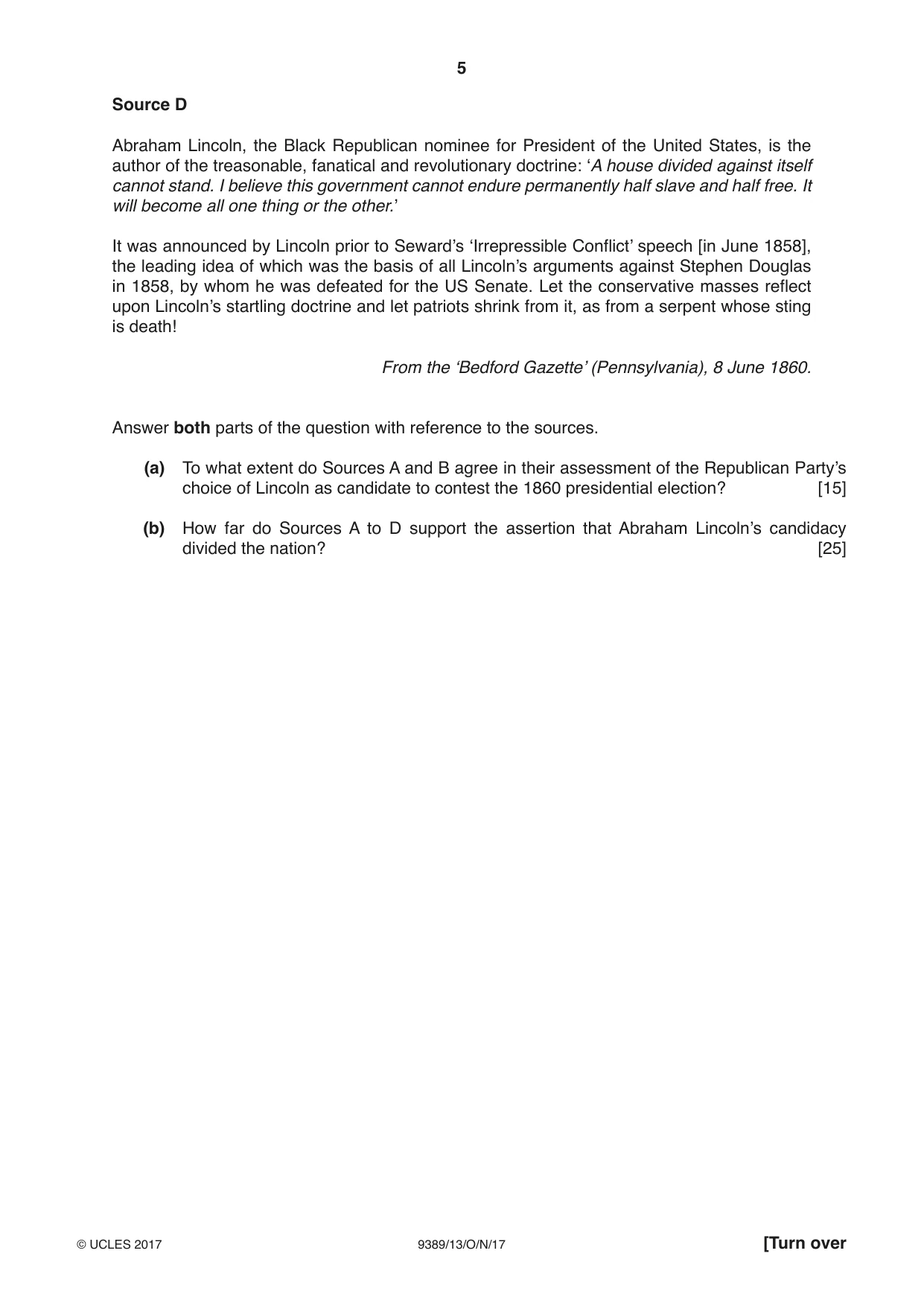
5 9389/13/O/N/17 © UCLES 2017 [Turn over Source D Abraham Lincoln, the Black Republican nominee for President of the United States, is the author of the treasonable, fanatical and revolutionary doctrine: ‘A house divided against itself cannot stand. I believe this government cannot endure permanently half slave and half free. It will become all one thing or the other.’ It was announced by Lincoln prior to Seward’s ‘Irrepressible Conflict’ speech [in June 1858], the leading idea of which was the basis of all Lincoln’s arguments against Stephen Douglas in 1858, by whom he was defeated for the US Senate. Let the conservative masses reflect upon Lincoln’s startling doctrine and let patriots shrink from it, as from a serpent whose sting is death! From the ‘Bedford Gazette’ (Pennsylvania), 8 June 1860. Answer both parts of the question with reference to the sources. (a) To what extent do Sources A and B agree in their assessment of the Republican Party’s choice of Lincoln as candidate to contest the 1860 presidential election? [15] (b) How far do Sources A to D support the assertion that Abraham Lincoln’s candidacy divided the nation? [25]
Question paper, page 6
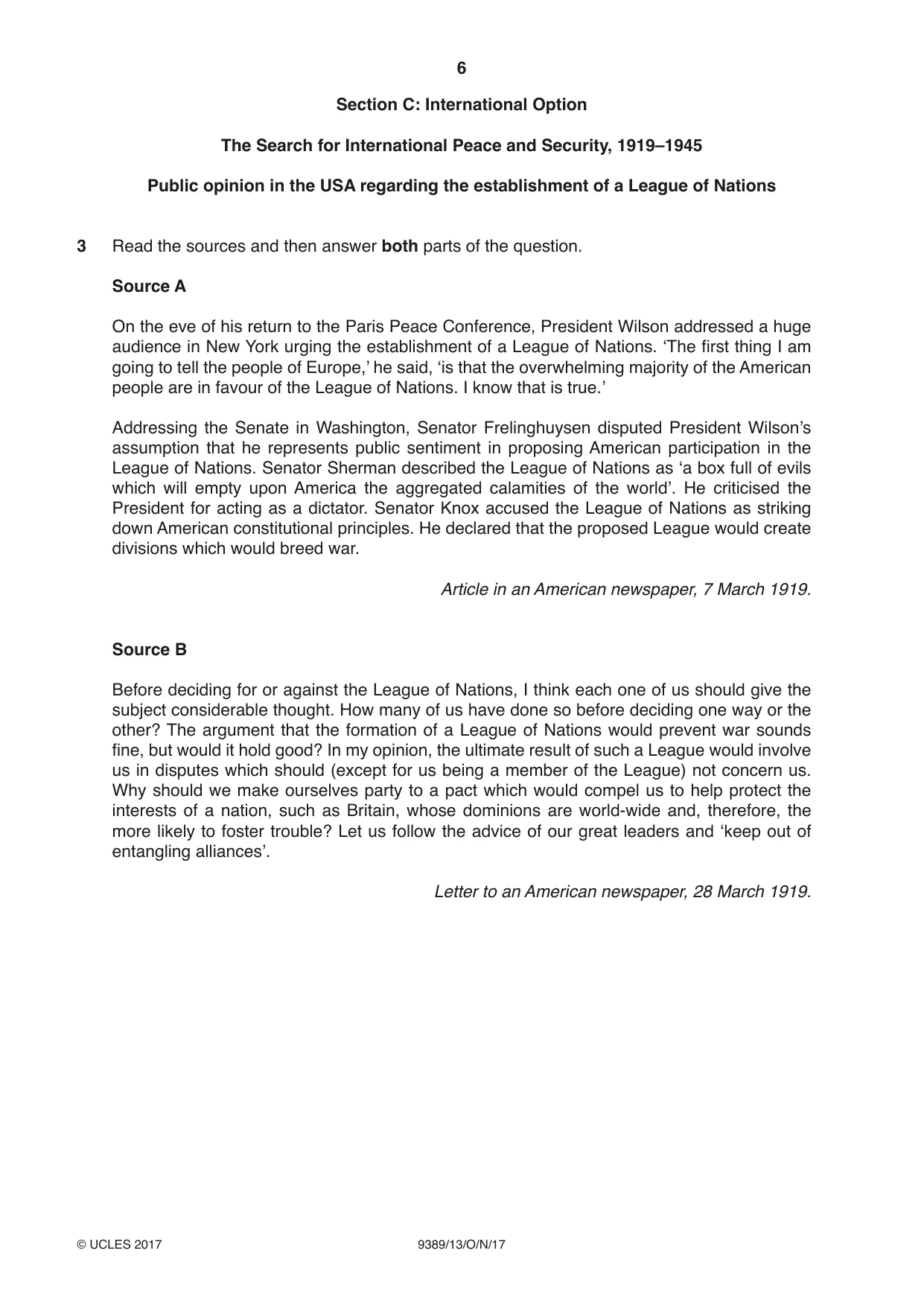
6 9389/13/O/N/17 © UCLES 2017 Section C: International Option The Search for International Peace and Security, 1919–1945 Public opinion in the USA regarding the establishment of a League of Nations 3 Read the sources and then answer both parts of the question. Source A On the eve of his return to the Paris Peace Conference, President Wilson addressed a huge audience in New York urging the establishment of a League of Nations. ‘The first thing I am going to tell the people of Europe,’ he said, ‘is that the overwhelming majority of the American people are in favour of the League of Nations. I know that is true.’ Addressing the Senate in Washington, Senator Frelinghuysen disputed President Wilson’s assumption that he represents public sentiment in proposing American participation in the League of Nations. Senator Sherman described the League of Nations as ‘a box full of evils which will empty upon America the aggregated calamities of the world’. He criticised the President for acting as a dictator. Senator Knox accused the League of Nations as striking down American constitutional principles. He declared that the proposed League would create divisions which would breed war. Article in an American newspaper, 7 March 1919. Source B Before deciding for or against the League of Nations, I think each one of us should give the subject considerable thought. How many of us have done so before deciding one way or the other? The argument that the formation of a League of Nations would prevent war sounds fine, but would it hold good? In my opinion, the ultimate result of such a League would involve us in disputes which should (except for us being a member of the League) not concern us. Why should we make ourselves party to a pact which would compel us to help protect the interests of a nation, such as Britain, whose dominions are world-wide and, therefore, the more likely to foster trouble? Let us follow the advice of our great leaders and ‘keep out of entangling alliances’. Letter to an American newspaper, 28 March 1919.
Question paper, page 7
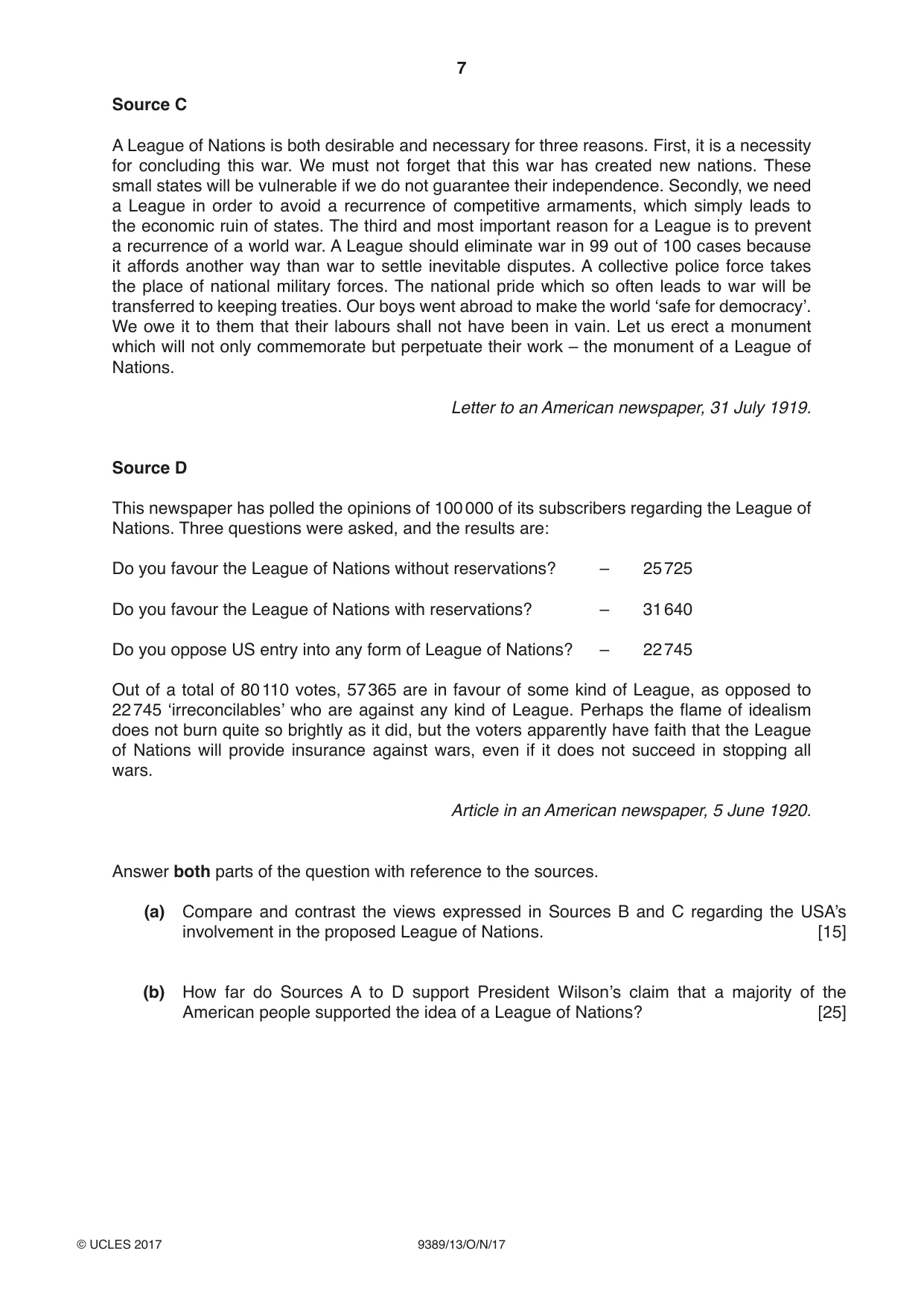
7 9389/13/O/N/17 © UCLES 2017 Source C A League of Nations is both desirable and necessary for three reasons. First, it is a necessity for concluding this war. We must not forget that this war has created new nations. These small states will be vulnerable if we do not guarantee their independence. Secondly, we need a League in order to avoid a recurrence of competitive armaments, which simply leads to the economic ruin of states. The third and most important reason for a League is to prevent a recurrence of a world war. A League should eliminate war in 99 out of 100 cases because it affords another way than war to settle inevitable disputes. A collective police force takes the place of national military forces. The national pride which so often leads to war will be transferred to keeping treaties. Our boys went abroad to make the world ‘safe for democracy’. We owe it to them that their labours shall not have been in vain. Let us erect a monument which will not only commemorate but perpetuate their work – the monument of a League of Nations. Letter to an American newspaper, 31 July 1919. Source D This newspaper has polled the opinions of 100 000 of its subscribers regarding the League of Nations. Three questions were asked, and the results are: Do you favour the League of Nations without reservations? – 25 725 Do you favour the League of Nations with reservations? – 31 640 Do you oppose US entry into any form of League of Nations? – 22 745 Out of a total of 80 110 votes, 57 365 are in favour of some kind of League, as opposed to 22 745 ‘irreconcilables’ who are against any kind of League. Perhaps the flame of idealism does not burn quite so brightly as it did, but the voters apparently have faith that the League of Nations will provide insurance against wars, even if it does not succeed in stopping all wars. Article in an American newspaper, 5 June 1920. Answer both parts of the question with reference to the sources. (a) Compare and contrast the views expressed in Sources B and C regarding the USA’s involvement in the proposed League of Nations. [15] (b) How far do Sources A to D support President Wilson’s claim that a majority of the American people supported the idea of a League of Nations? [25]
Question paper, page 8
8 9389/13/O/N/17 © UCLES 2017 BLANK PAGE Permission to reproduce items where third-party owned material protected by copyright is included has been sought and cleared where possible. Every reasonable effort has been made by the publisher (UCLES) to trace copyright holders, but if any items requiring clearance have unwittingly been included, the publisher will be pleased to make amends at the earliest possible opportunity. To avoid the issue of disclosure of answer-related information to candidates, all copyright acknowledgements are reproduced online in the Cambridge International Examinations Copyright Acknowledgements Booklet. This is produced for each series of examinations and is freely available to download at www.cie.org.uk after the live examination series. Cambridge International Examinations is part of the Cambridge Assessment Group. Cambridge Assessment is the brand name of University of Cambridge Local Examinations Syndicate (UCLES), which is itself a department of the University of Cambridge.
Mark scheme, page 1
® IGCSE is a registered trademark. This document consists of 10 printed pages. © UCLES 2017 [Turn over Cambridge Assessment International Education Cambridge International Advanced Subsidiary and Advanced Level HISTORY 9389/13 Paper 1 Document Question October/November 2017 MARK SCHEME Maximum Mark: 40 Published This mark scheme is published as an aid to teachers and candidates, to indicate the requirements of the examination. It shows the basis on which Examiners were instructed to award marks. It does not indicate the details of the discussions that took place at an Examiners’ meeting before marking began, which would have considered the acceptability of alternative answers. Mark schemes should be read in conjunction with the question paper and the Principal Examiner Report for Teachers. Cambridge International will not enter into discussions about these mark schemes. Cambridge International is publishing the mark schemes for the October/November 2017 series for most Cambridge IGCSE®, Cambridge International A and AS Level components and some Cambridge O Level components.
Mark scheme, page 2
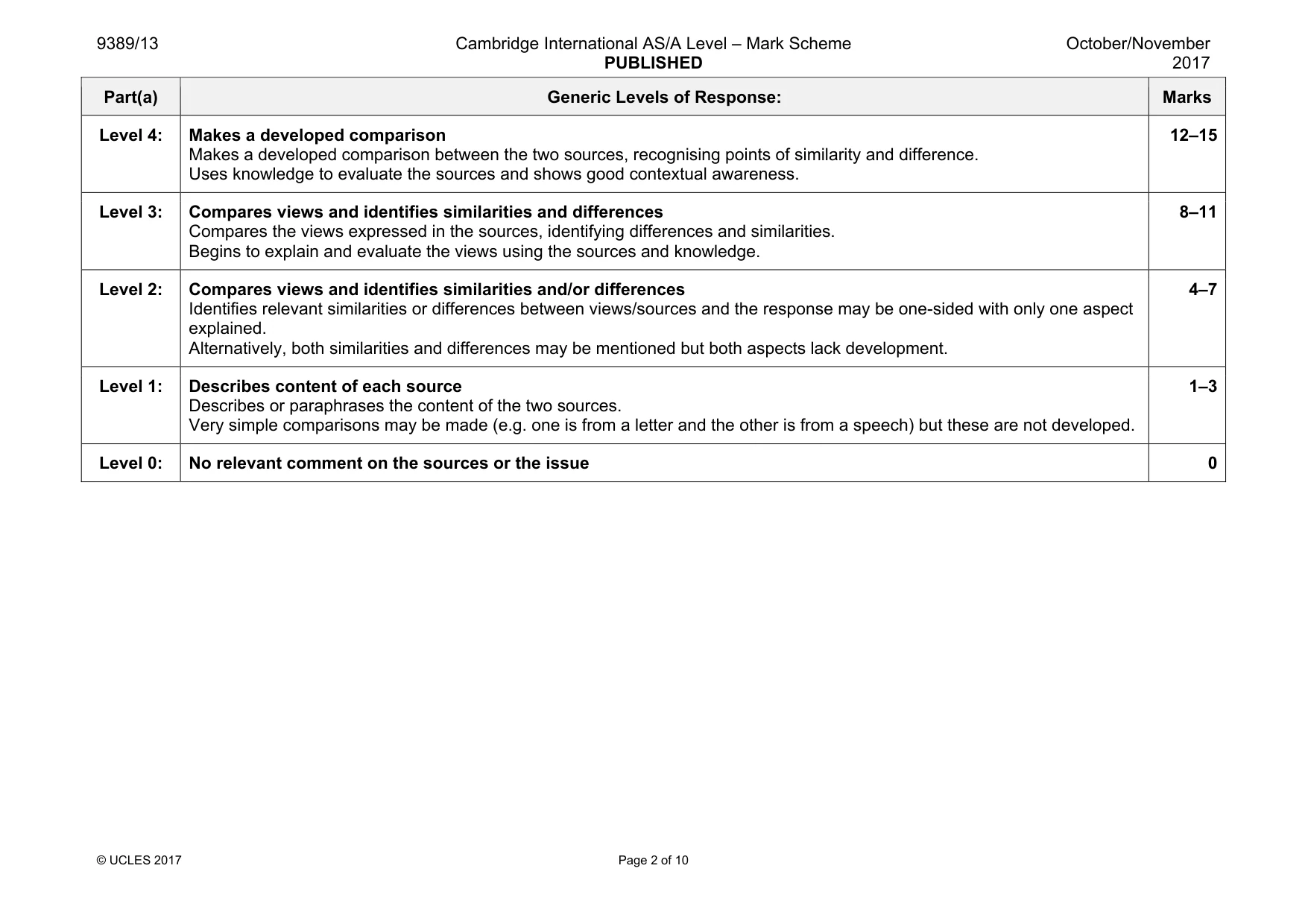
9389/13 Cambridge International AS/A Level – Mark Scheme PUBLISHED October/November 2017 © UCLES 2017 Page 2 of 10 Part(a) Generic Levels of Response: Marks Level 4: Makes a developed comparison Makes a developed comparison between the two sources, recognising points of similarity and difference. Uses knowledge to evaluate the sources and shows good contextual awareness. 12–15 Level 3: Compares views and identifies similarities and differences Compares the views expressed in the sources, identifying differences and similarities. Begins to explain and evaluate the views using the sources and knowledge. 8–11 Level 2: Compares views and identifies similarities and/or differences Identifies relevant similarities or differences between views/sources and the response may be one-sided with only one aspect explained. Alternatively, both similarities and differences may be mentioned but both aspects lack development. 4–7 Level 1: Describes content of each source Describes or paraphrases the content of the two sources. Very simple comparisons may be made (e.g. one is from a letter and the other is from a speech) but these are not developed. 1–3 Level 0: No relevant comment on the sources or the issue 0
Mark scheme, page 3
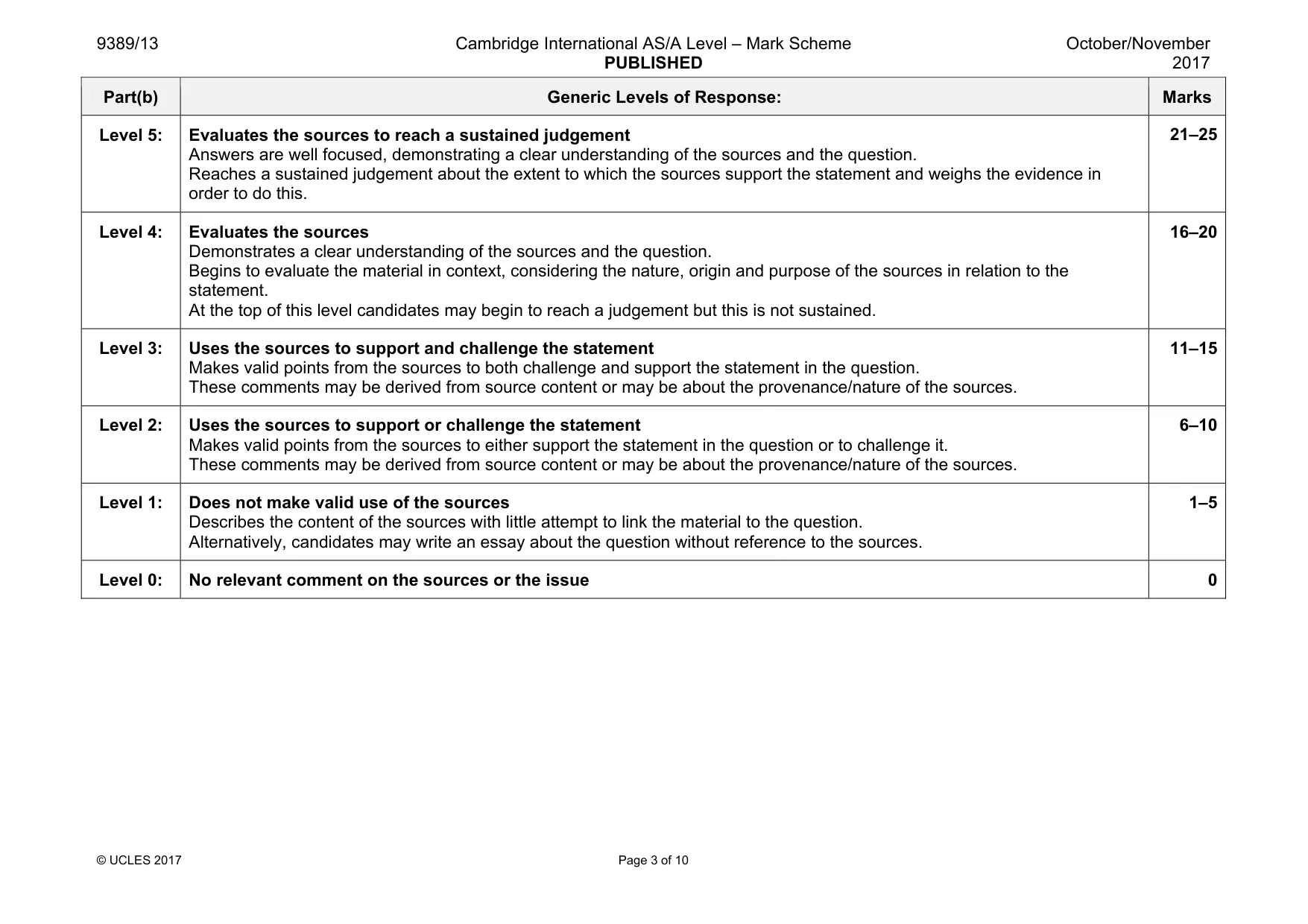
9389/13 Cambridge International AS/A Level – Mark Scheme PUBLISHED October/November 2017 © UCLES 2017 Page 3 of 10 Part(b) Generic Levels of Response: Marks Level 5: Evaluates the sources to reach a sustained judgement Answers are well focused, demonstrating a clear understanding of the sources and the question. Reaches a sustained judgement about the extent to which the sources support the statement and weighs the evidence in order to do this. 21–25 Level 4: Evaluates the sources Demonstrates a clear understanding of the sources and the question. Begins to evaluate the material in context, considering the nature, origin and purpose of the sources in relation to the statement. At the top of this level candidates may begin to reach a judgement but this is not sustained. 16–20 Level 3: Uses the sources to support and challenge the statement Makes valid points from the sources to both challenge and support the statement in the question. These comments may be derived from source content or may be about the provenance/nature of the sources. 11–15 Level 2: Uses the sources to support or challenge the statement Makes valid points from the sources to either support the statement in the question or to challenge it. These comments may be derived from source content or may be about the provenance/nature of the sources. 6–10 Level 1: Does not make valid use of the sources Describes the content of the sources with little attempt to link the material to the question. Alternatively, candidates may write an essay about the question without reference to the sources. 1–5 Level 0: No relevant comment on the sources or the issue 0
Mark scheme, page 4
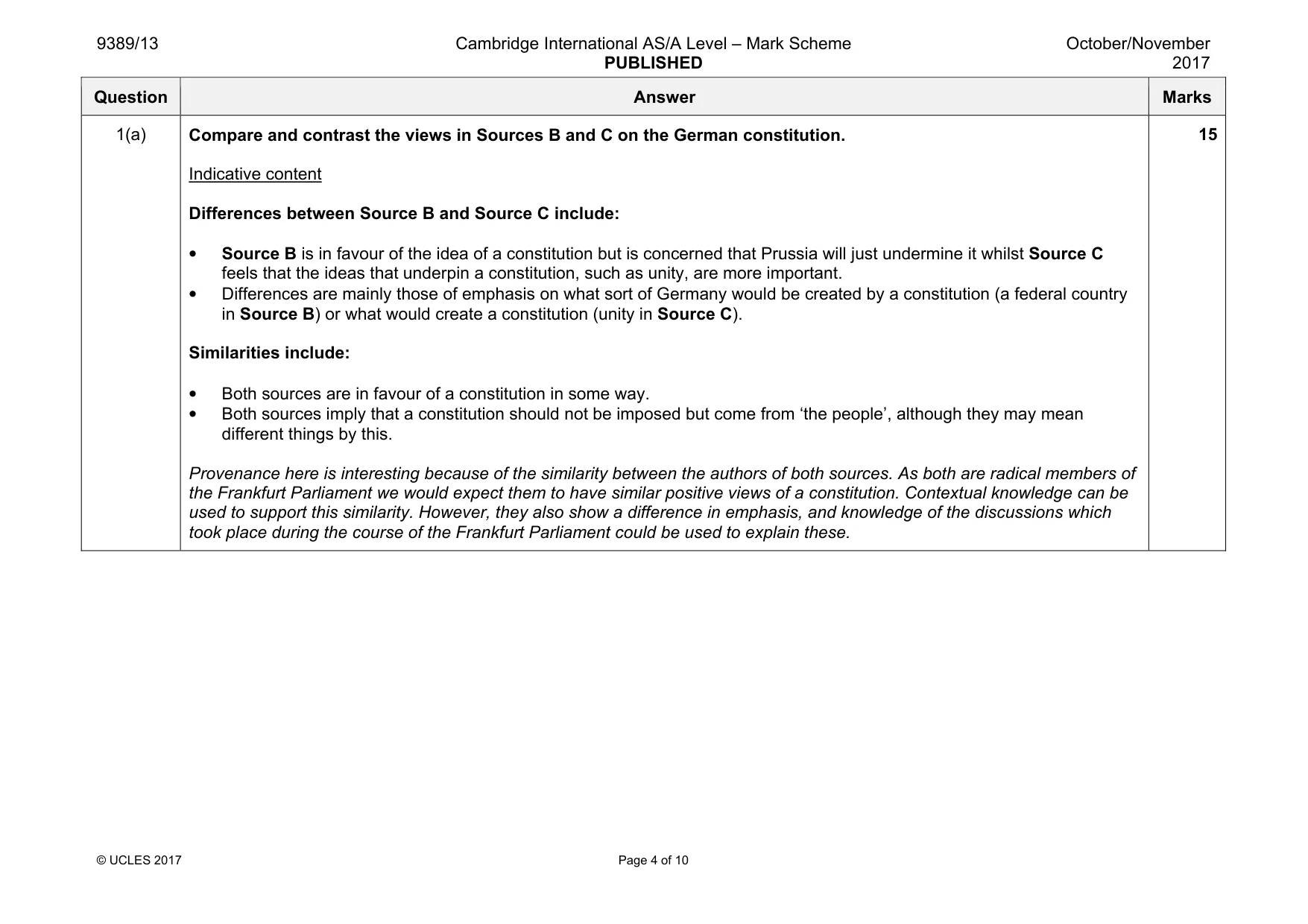
9389/13 Cambridge International AS/A Level – Mark Scheme PUBLISHED October/November 2017 © UCLES 2017 Page 4 of 10 Question Answer Marks 1(a) Compare and contrast the views in Sources B and C on the German constitution. Indicative content Differences between Source B and Source C include: • Source B is in favour of the idea of a constitution but is concerned that Prussia will just undermine it whilst Source C feels that the ideas that underpin a constitution, such as unity, are more important. • Differences are mainly those of emphasis on what sort of Germany would be created by a constitution (a federal country in Source B) or what would create a constitution (unity in Source C). Similarities include: • Both sources are in favour of a constitution in some way. • Both sources imply that a constitution should not be imposed but come from ‘the people’, although they may mean different things by this. Provenance here is interesting because of the similarity between the authors of both sources. As both are radical members of the Frankfurt Parliament we would expect them to have similar positive views of a constitution. Contextual knowledge can be used to support this similarity. However, they also show a difference in emphasis, and knowledge of the discussions which took place during the course of the Frankfurt Parliament could be used to explain these. 15
Mark scheme, page 5
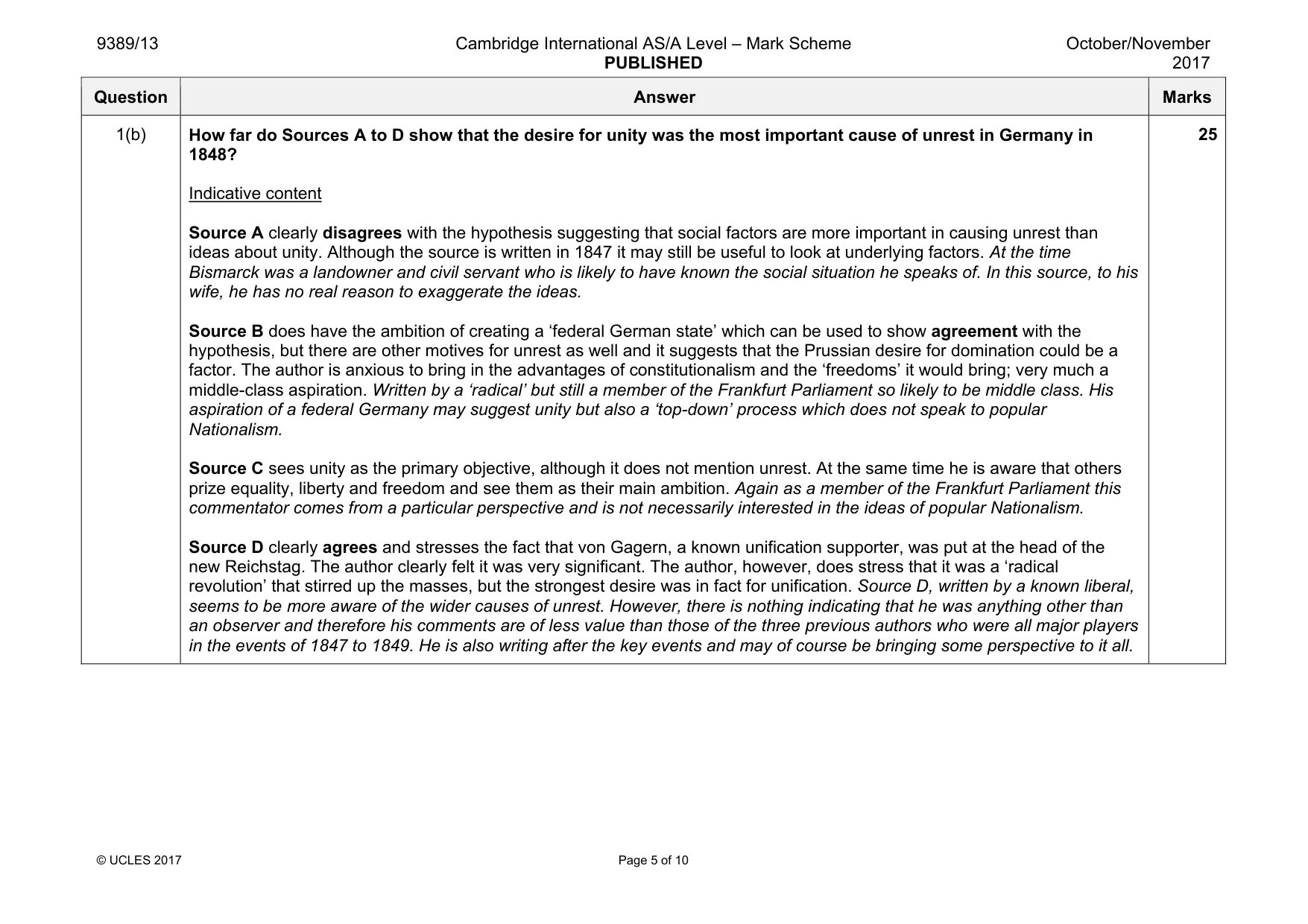
9389/13 Cambridge International AS/A Level – Mark Scheme PUBLISHED October/November 2017 © UCLES 2017 Page 5 of 10 Question Answer Marks 1(b) How far do Sources A to D show that the desire for unity was the most important cause of unrest in Germany in 1848? Indicative content Source A clearly disagrees with the hypothesis suggesting that social factors are more important in causing unrest than ideas about unity. Although the source is written in 1847 it may still be useful to look at underlying factors. At the time Bismarck was a landowner and civil servant who is likely to have known the social situation he speaks of. In this source, to his wife, he has no real reason to exaggerate the ideas. Source B does have the ambition of creating a ‘federal German state’ which can be used to show agreement with the hypothesis, but there are other motives for unrest as well and it suggests that the Prussian desire for domination could be a factor. The author is anxious to bring in the advantages of constitutionalism and the ‘freedoms’ it would bring; very much a middle-class aspiration. Written by a ‘radical’ but still a member of the Frankfurt Parliament so likely to be middle class. His aspiration of a federal Germany may suggest unity but also a ‘top-down’ process which does not speak to popular Nationalism. Source C sees unity as the primary objective, although it does not mention unrest. At the same time he is aware that others prize equality, liberty and freedom and see them as their main ambition. Again as a member of the Frankfurt Parliament this commentator comes from a particular perspective and is not necessarily interested in the ideas of popular Nationalism. Source D clearly agrees and stresses the fact that von Gagern, a known unification supporter, was put at the head of the new Reichstag. The author clearly felt it was very significant. The author, however, does stress that it was a ‘radical revolution’ that stirred up the masses, but the strongest desire was in fact for unification. Source D, written by a known liberal, seems to be more aware of the wider causes of unrest. However, there is nothing indicating that he was anything other than an observer and therefore his comments are of less value than those of the three previous authors who were all major players in the events of 1847 to 1849. He is also writing after the key events and may of course be bringing some perspective to it all. 25
Mark scheme, page 6
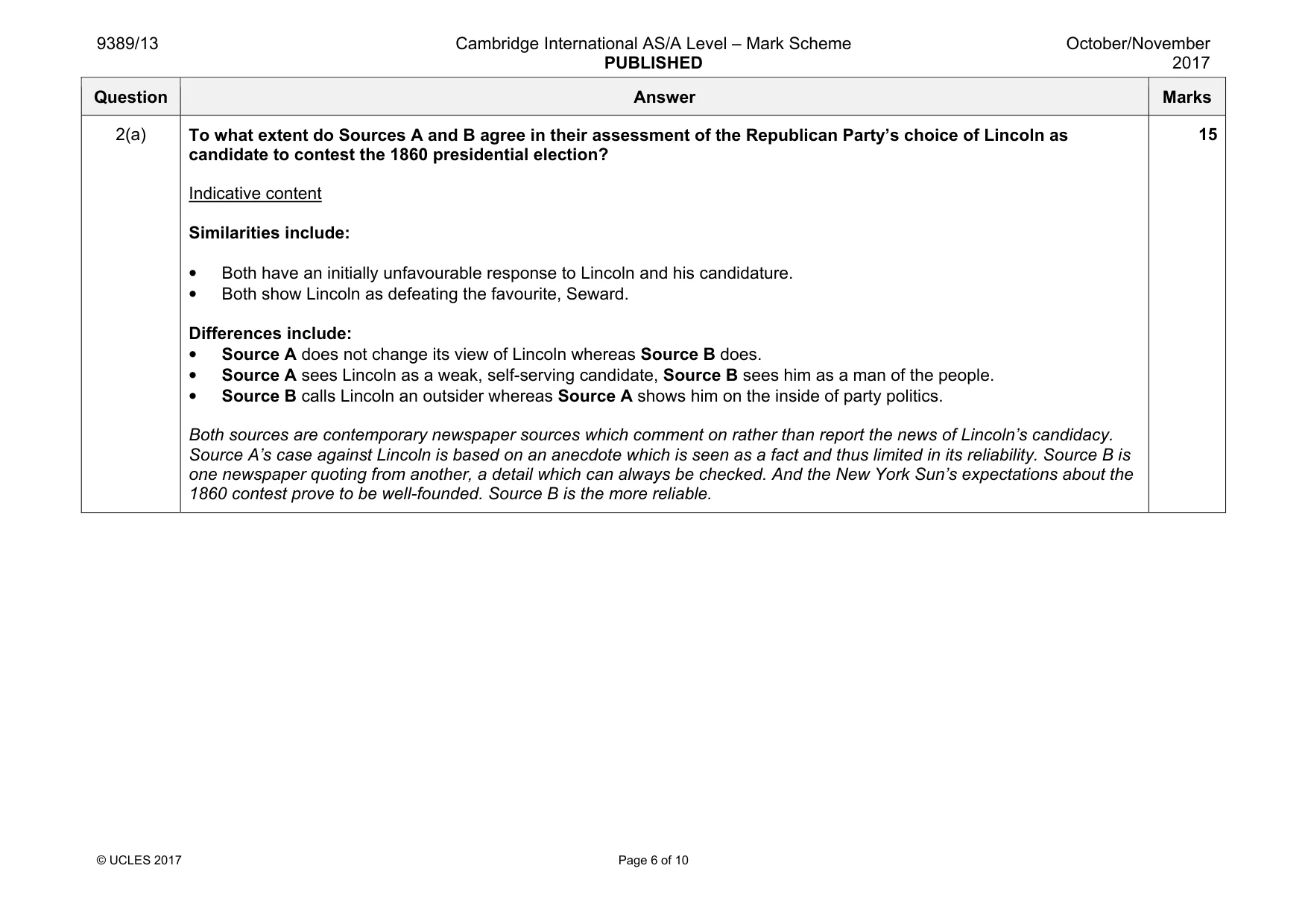
9389/13 Cambridge International AS/A Level – Mark Scheme PUBLISHED October/November 2017 © UCLES 2017 Page 6 of 10 Question Answer Marks 2(a) To what extent do Sources A and B agree in their assessment of the Republican Party’s choice of Lincoln as candidate to contest the 1860 presidential election? Indicative content Similarities include: • Both have an initially unfavourable response to Lincoln and his candidature. • Both show Lincoln as defeating the favourite, Seward. Differences include: • Source A does not change its view of Lincoln whereas Source B does. • Source A sees Lincoln as a weak, self-serving candidate, Source B sees him as a man of the people. • Source B calls Lincoln an outsider whereas Source A shows him on the inside of party politics. Both sources are contemporary newspaper sources which comment on rather than report the news of Lincoln’s candidacy. Source A’s case against Lincoln is based on an anecdote which is seen as a fact and thus limited in its reliability. Source B is one newspaper quoting from another, a detail which can always be checked. And the New York Sun’s expectations about the 1860 contest prove to be well-founded. Source B is the more reliable. 15
Mark scheme, page 7
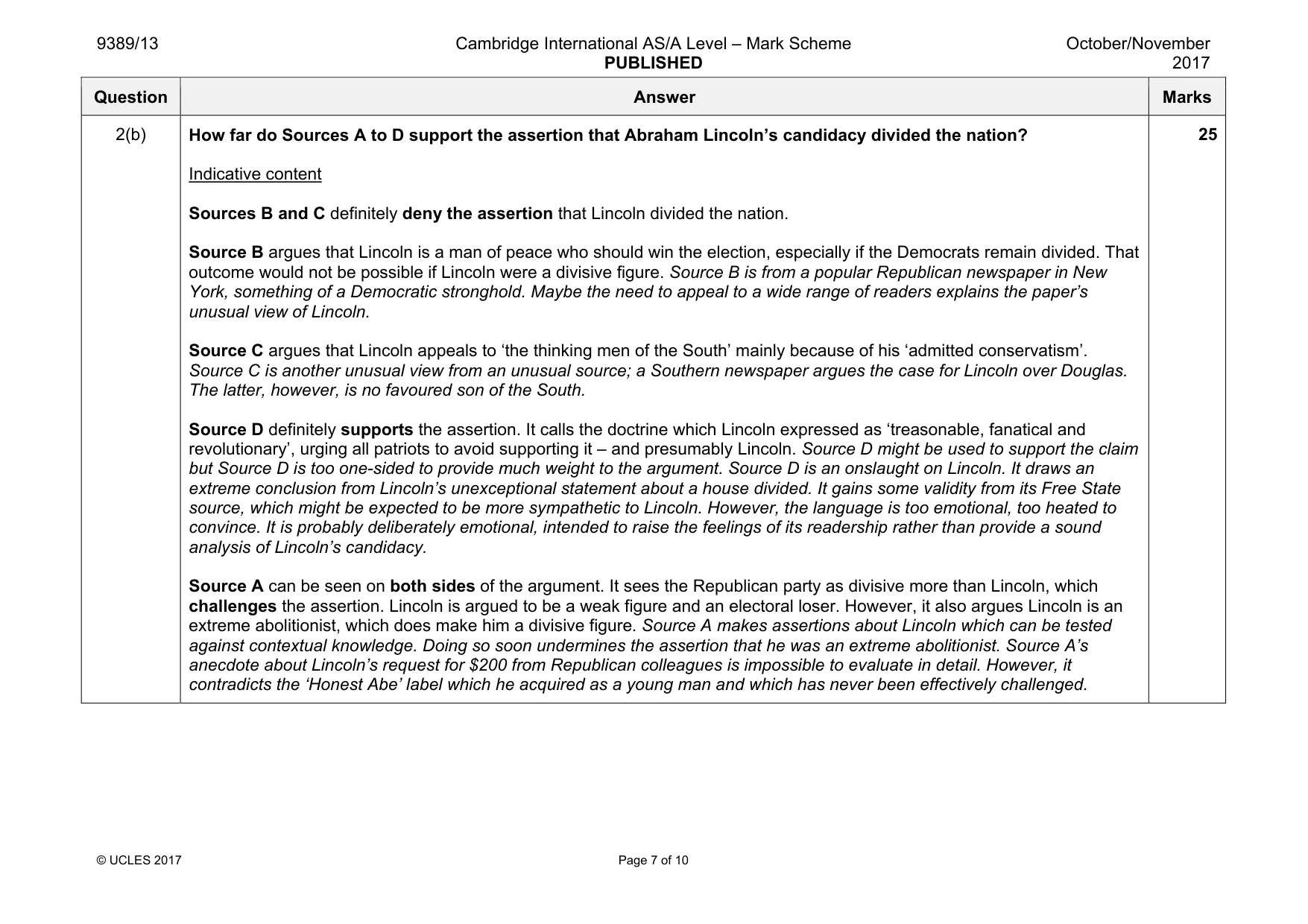
9389/13 Cambridge International AS/A Level – Mark Scheme PUBLISHED October/November 2017 © UCLES 2017 Page 7 of 10 Question Answer Marks 2(b) How far do Sources A to D support the assertion that Abraham Lincoln’s candidacy divided the nation? Indicative content Sources B and C definitely deny the assertion that Lincoln divided the nation. Source B argues that Lincoln is a man of peace who should win the election, especially if the Democrats remain divided. That outcome would not be possible if Lincoln were a divisive figure. Source B is from a popular Republican newspaper in New York, something of a Democratic stronghold. Maybe the need to appeal to a wide range of readers explains the paper’s unusual view of Lincoln. Source C argues that Lincoln appeals to ‘the thinking men of the South’ mainly because of his ‘admitted conservatism’. Source C is another unusual view from an unusual source; a Southern newspaper argues the case for Lincoln over Douglas. The latter, however, is no favoured son of the South. Source D definitely supports the assertion. It calls the doctrine which Lincoln expressed as ‘treasonable, fanatical and revolutionary’, urging all patriots to avoid supporting it – and presumably Lincoln. Source D might be used to support the claim but Source D is too one-sided to provide much weight to the argument. Source D is an onslaught on Lincoln. It draws an extreme conclusion from Lincoln’s unexceptional statement about a house divided. It gains some validity from its Free State source, which might be expected to be more sympathetic to Lincoln. However, the language is too emotional, too heated to convince. It is probably deliberately emotional, intended to raise the feelings of its readership rather than provide a sound analysis of Lincoln’s candidacy. Source A can be seen on both sides of the argument. It sees the Republican party as divisive more than Lincoln, which challenges the assertion. Lincoln is argued to be a weak figure and an electoral loser. However, it also argues Lincoln is an extreme abolitionist, which does make him a divisive figure. Source A makes assertions about Lincoln which can be tested against contextual knowledge. Doing so soon undermines the assertion that he was an extreme abolitionist. Source A’s anecdote about Lincoln’s request for $200 from Republican colleagues is impossible to evaluate in detail. However, it contradicts the ‘Honest Abe’ label which he acquired as a young man and which has never been effectively challenged. 25
Mark scheme, page 8
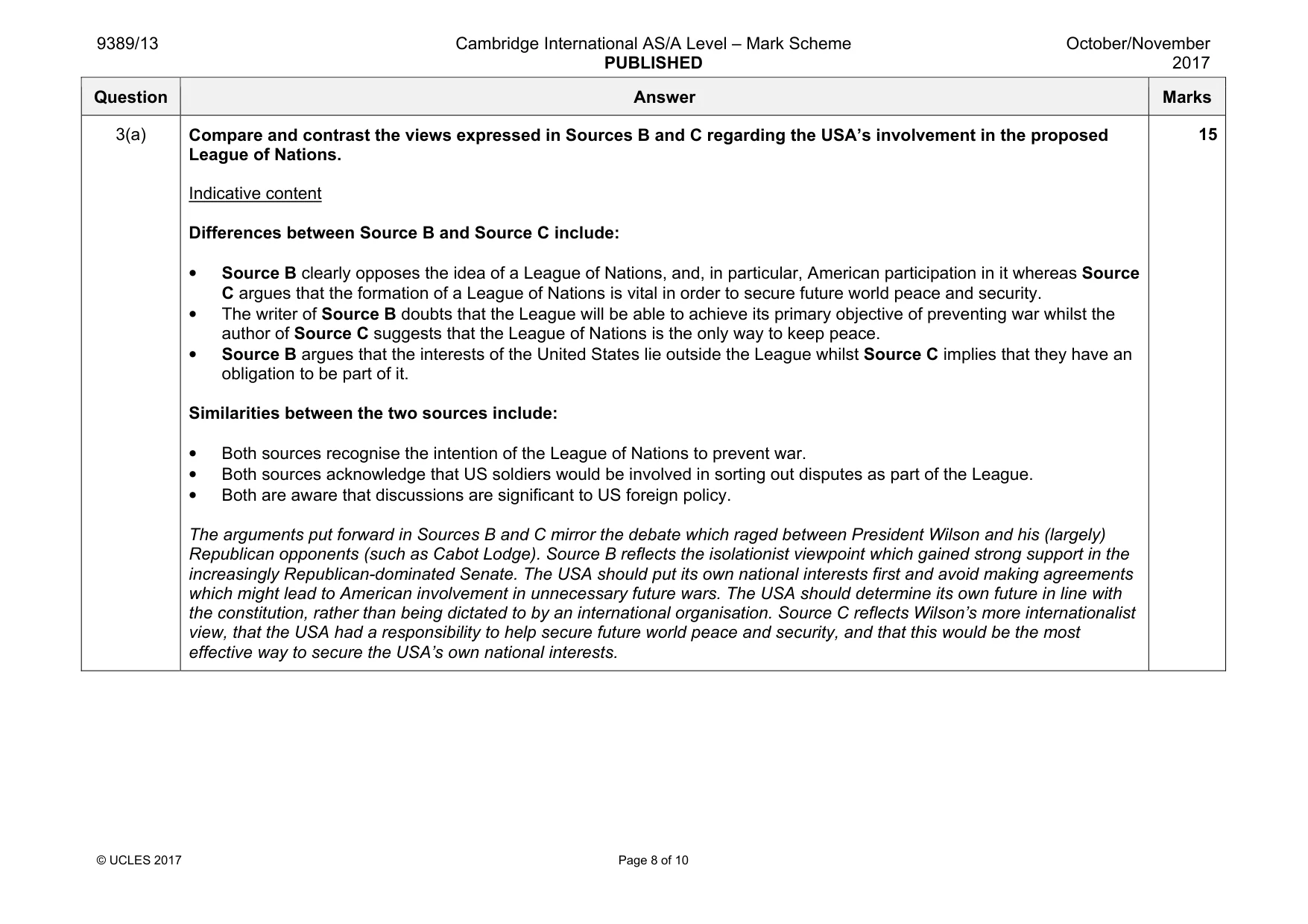
9389/13 Cambridge International AS/A Level – Mark Scheme PUBLISHED October/November 2017 © UCLES 2017 Page 8 of 10 Question Answer Marks 3(a) Compare and contrast the views expressed in Sources B and C regarding the USA’s involvement in the proposed League of Nations. Indicative content Differences between Source B and Source C include: • Source B clearly opposes the idea of a League of Nations, and, in particular, American participation in it whereas Source C argues that the formation of a League of Nations is vital in order to secure future world peace and security. • The writer of Source B doubts that the League will be able to achieve its primary objective of preventing war whilst the author of Source C suggests that the League of Nations is the only way to keep peace. • Source B argues that the interests of the United States lie outside the League whilst Source C implies that they have an obligation to be part of it. Similarities between the two sources include: • Both sources recognise the intention of the League of Nations to prevent war. • Both sources acknowledge that US soldiers would be involved in sorting out disputes as part of the League. • Both are aware that discussions are significant to US foreign policy. The arguments put forward in Sources B and C mirror the debate which raged between President Wilson and his (largely) Republican opponents (such as Cabot Lodge). Source B reflects the isolationist viewpoint which gained strong support in the increasingly Republican-dominated Senate. The USA should put its own national interests first and avoid making agreements which might lead to American involvement in unnecessary future wars. The USA should determine its own future in line with the constitution, rather than being dictated to by an international organisation. Source C reflects Wilson’s more internationalist view, that the USA had a responsibility to help secure future world peace and security, and that this would be the most effective way to secure the USA’s own national interests. 15
Mark scheme, page 9
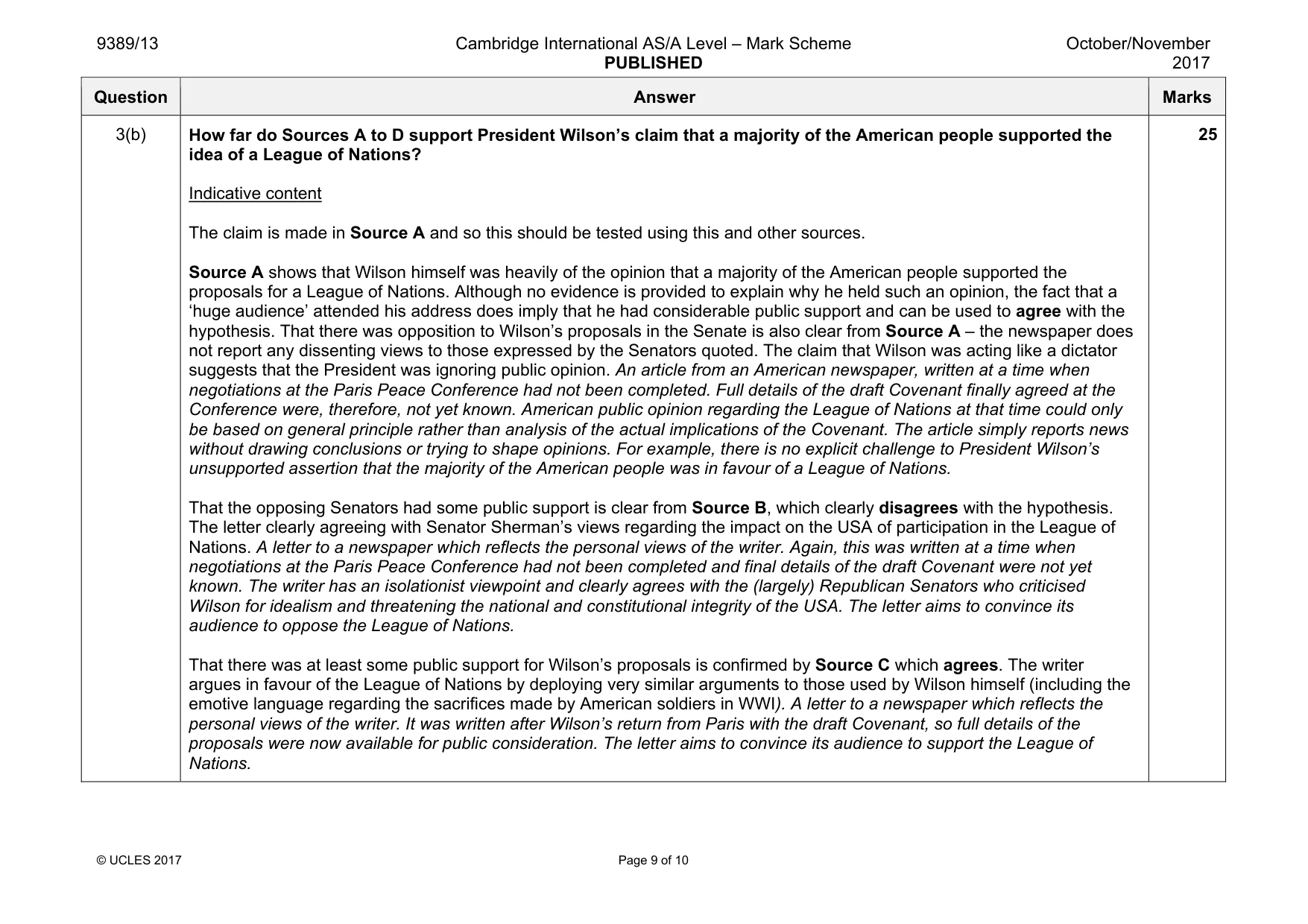
9389/13 Cambridge International AS/A Level – Mark Scheme PUBLISHED October/November 2017 © UCLES 2017 Page 9 of 10 Question Answer Marks 3(b) How far do Sources A to D support President Wilson’s claim that a majority of the American people supported the idea of a League of Nations? Indicative content The claim is made in Source A and so this should be tested using this and other sources. Source A shows that Wilson himself was heavily of the opinion that a majority of the American people supported the proposals for a League of Nations. Although no evidence is provided to explain why he held such an opinion, the fact that a ‘huge audience’ attended his address does imply that he had considerable public support and can be used to agree with the hypothesis. That there was opposition to Wilson’s proposals in the Senate is also clear from Source A – the newspaper does not report any dissenting views to those expressed by the Senators quoted. The claim that Wilson was acting like a dictator suggests that the President was ignoring public opinion. An article from an American newspaper, written at a time when negotiations at the Paris Peace Conference had not been completed. Full details of the draft Covenant finally agreed at the Conference were, therefore, not yet known. American public opinion regarding the League of Nations at that time could only be based on general principle rather than analysis of the actual implications of the Covenant. The article simply reports news without drawing conclusions or trying to shape opinions. For example, there is no explicit challenge to President Wilson’s unsupported assertion that the majority of the American people was in favour of a League of Nations. That the opposing Senators had some public support is clear from Source B, which clearly disagrees with the hypothesis. The letter clearly agreeing with Senator Sherman’s views regarding the impact on the USA of participation in the League of Nations. A letter to a newspaper which reflects the personal views of the writer. Again, this was written at a time when negotiations at the Paris Peace Conference had not been completed and final details of the draft Covenant were not yet known. The writer has an isolationist viewpoint and clearly agrees with the (largely) Republican Senators who criticised Wilson for idealism and threatening the national and constitutional integrity of the USA. The letter aims to convince its audience to oppose the League of Nations. That there was at least some public support for Wilson’s proposals is confirmed by Source C which agrees. The writer argues in favour of the League of Nations by deploying very similar arguments to those used by Wilson himself (including the emotive language regarding the sacrifices made by American soldiers in WWI). A letter to a newspaper which reflects the personal views of the writer. It was written after Wilson’s return from Paris with the draft Covenant, so full details of the proposals were now available for public consideration. The letter aims to convince its audience to support the League of Nations. 25
Mark scheme, page 10
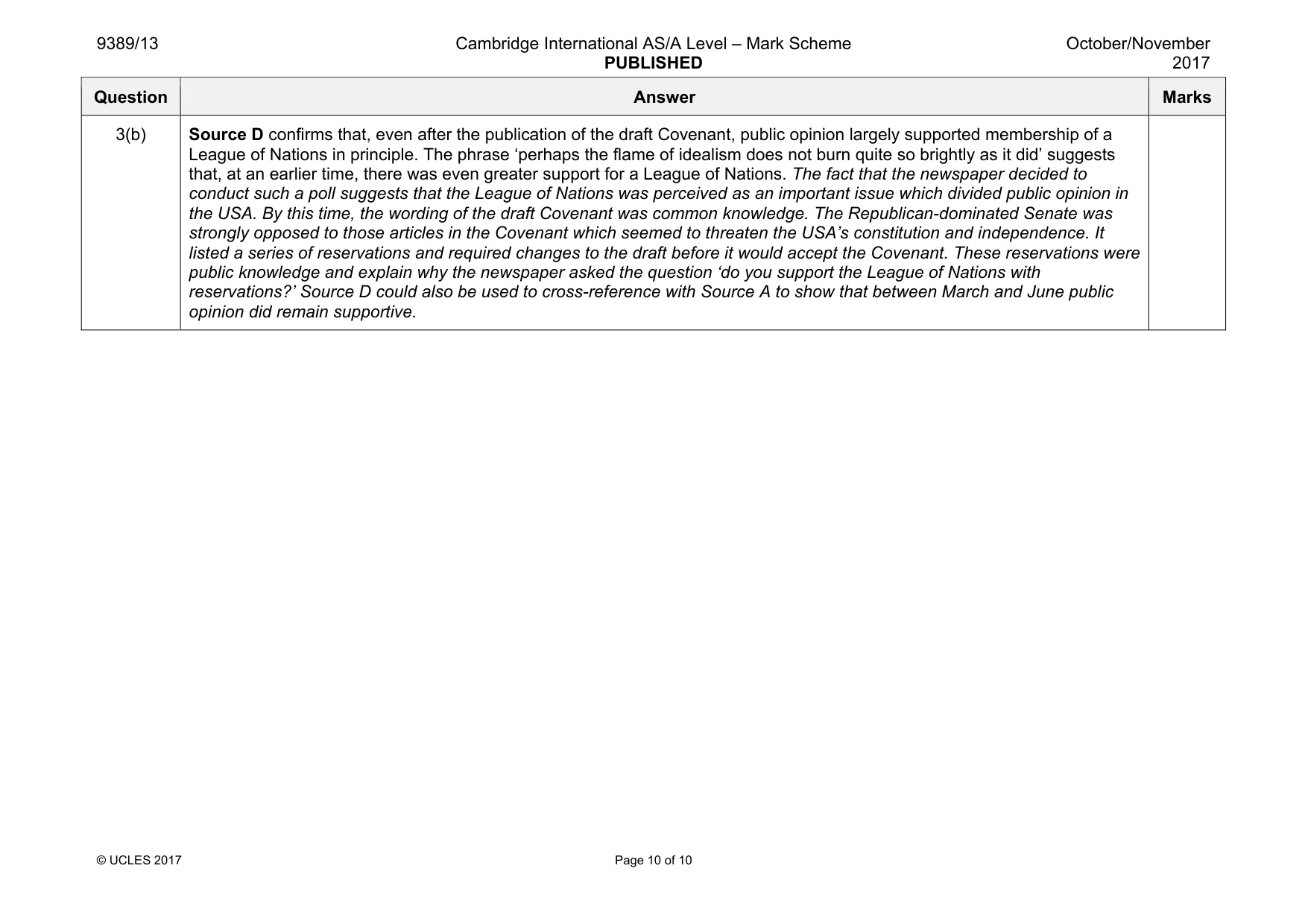
9389/13 Cambridge International AS/A Level – Mark Scheme PUBLISHED October/November 2017 © UCLES 2017 Page 10 of 10 Question Answer Marks 3(b) Source D confirms that, even after the publication of the draft Covenant, public opinion largely supported membership of a League of Nations in principle. The phrase ‘perhaps the flame of idealism does not burn quite so brightly as it did’ suggests that, at an earlier time, there was even greater support for a League of Nations. The fact that the newspaper decided to conduct such a poll suggests that the League of Nations was perceived as an important issue which divided public opinion in the USA. By this time, the wording of the draft Covenant was common knowledge. The Republican-dominated Senate was strongly opposed to those articles in the Covenant which seemed to threaten the USA’s constitution and independence. It listed a series of reservations and required changes to the draft before it would accept the Covenant. These reservations were public knowledge and explain why the newspaper asked the question ‘do you support the League of Nations with reservations?’ Source D could also be used to cross-reference with Source A to show that between March and June public opinion did remain supportive.
What you needed in this session
Cambridge’s own grade thresholds for 2017 Oct/Nov, Paper 1 · Variant 3. A higher threshold means an easier paper — the bar moves with how the cohort did.