Cambridge A Level History 9389 — 2016 May/June Paper 3 · Variant 3
9389/33/M/J/16 · 40 marks · ≈45 min
The question paper and its mark scheme, free to read here and free to download. This is Cambridge’s own paper, exactly as it was sat.
Question paper4 pages
Mark scheme5 pages
Answers below. Sit the paper first if you are practising.
Paper as text
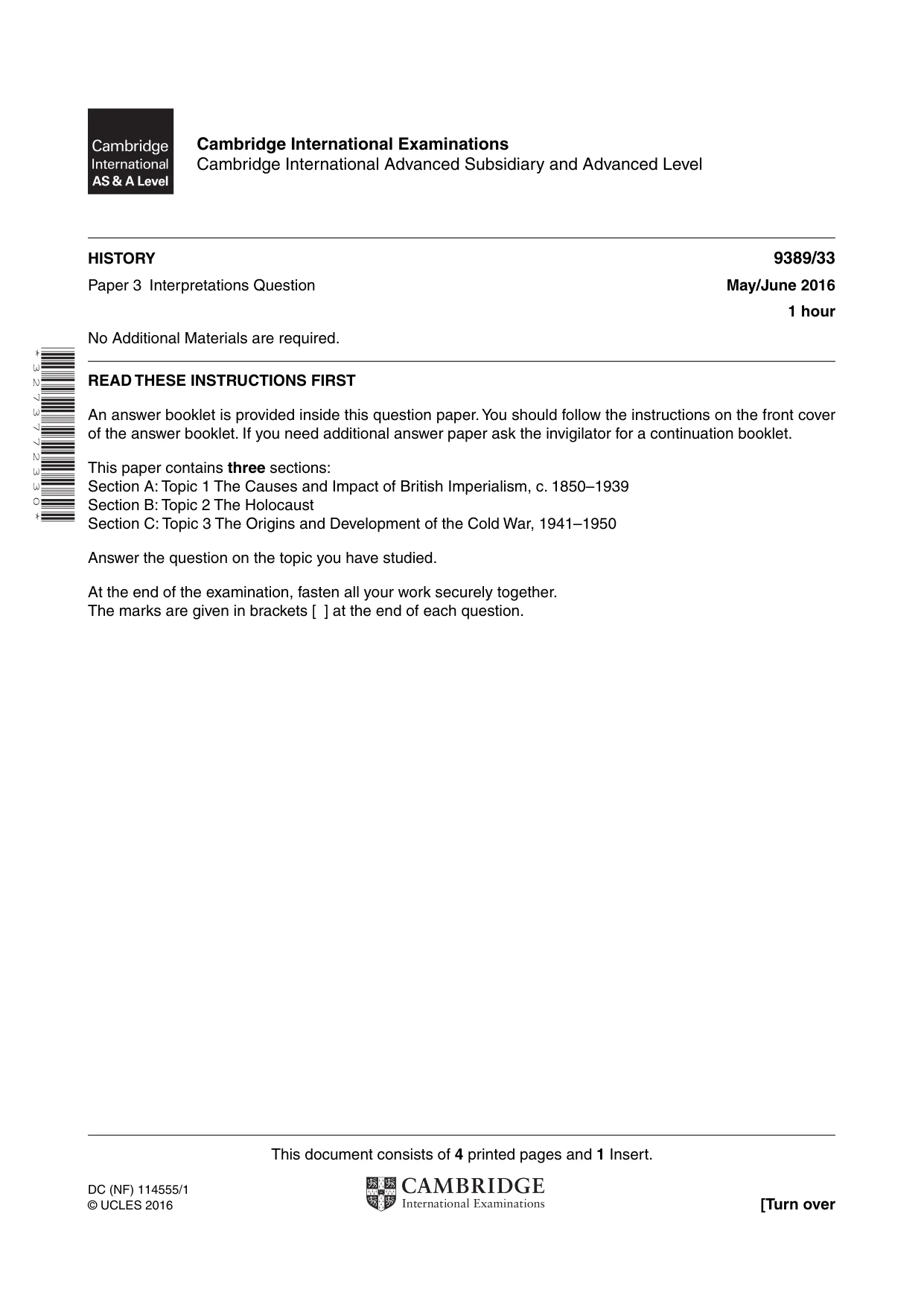
Question paper, page 1
This document consists of 4 printed pages and 1 Insert. DC (NF) 114555/1 © UCLES 2016 [Turn over Cambridge International Examinations Cambridge International Advanced Subsidiary and Advanced Level * 3 2 7 3 7 7 2 3 3 0 * HISTORY 9389/33 Paper 3 Interpretations Question May/June 2016 1 hour No Additional Materials are required. READ THESE INSTRUCTIONS FIRST An answer booklet is provided inside this question paper. You should follow the instructions on the front cover of the answer booklet. If you need additional answer paper ask the invigilator for a continuation booklet. This paper contains three sections: Section A: Topic 1 The Causes and Impact of British Imperialism, c. 1850–1939 Section B: Topic 2 The Holocaust Section C: Topic 3 The Origins and Development of the Cold War, 1941–1950 Answer the question on the topic you have studied. At the end of the examination, fasten all your work securely together. The marks are given in brackets [ ] at the end of each question.
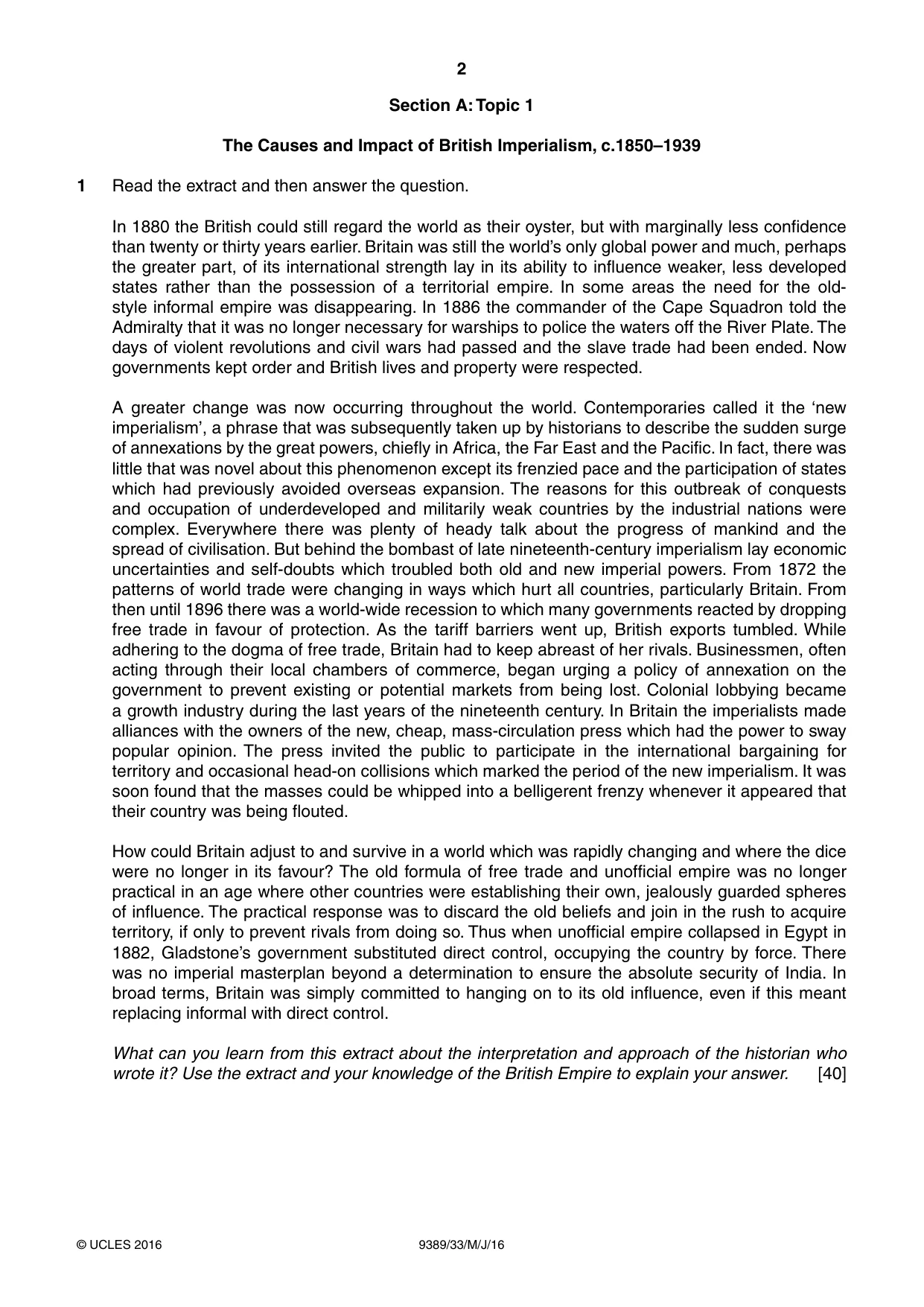
Question paper, page 2
2 9389/33/M/J/16 © UCLES 2016 Section A: Topic 1 The Causes and Impact of British Imperialism, c.1850–1939 1 Read the extract and then answer the question. In 1880 the British could still regard the world as their oyster, but with marginally less confidence than twenty or thirty years earlier. Britain was still the world’s only global power and much, perhaps the greater part, of its international strength lay in its ability to influence weaker, less developed states rather than the possession of a territorial empire. In some areas the need for the old- style informal empire was disappearing. In 1886 the commander of the Cape Squadron told the Admiralty that it was no longer necessary for warships to police the waters off the River Plate. The days of violent revolutions and civil wars had passed and the slave trade had been ended. Now governments kept order and British lives and property were respected. A greater change was now occurring throughout the world. Contemporaries called it the ‘new imperialism’, a phrase that was subsequently taken up by historians to describe the sudden surge of annexations by the great powers, chiefly in Africa, the Far East and the Pacific. In fact, there was little that was novel about this phenomenon except its frenzied pace and the participation of states which had previously avoided overseas expansion. The reasons for this outbreak of conquests and occupation of underdeveloped and militarily weak countries by the industrial nations were complex. Everywhere there was plenty of heady talk about the progress of mankind and the spread of civilisation. But behind the bombast of late nineteenth-century imperialism lay economic uncertainties and self-doubts which troubled both old and new imperial powers. From 1872 the patterns of world trade were changing in ways which hurt all countries, particularly Britain. From then until 1896 there was a world-wide recession to which many governments reacted by dropping free trade in favour of protection. As the tariff barriers went up, British exports tumbled. While adhering to the dogma of free trade, Britain had to keep abreast of her rivals. Businessmen, often acting through their local chambers of commerce, began urging a policy of annexation on the government to prevent existing or potential markets from being lost. Colonial lobbying became a growth industry during the last years of the nineteenth century. In Britain the imperialists made alliances with the owners of the new, cheap, mass-circulation press which had the power to sway popular opinion. The press invited the public to participate in the international bargaining for territory and occasional head-on collisions which marked the period of the new imperialism. It was soon found that the masses could be whipped into a belligerent frenzy whenever it appeared that their country was being flouted. How could Britain adjust to and survive in a world which was rapidly changing and where the dice were no longer in its favour? The old formula of free trade and unofficial empire was no longer practical in an age where other countries were establishing their own, jealously guarded spheres of influence. The practical response was to discard the old beliefs and join in the rush to acquire territory, if only to prevent rivals from doing so. Thus when unofficial empire collapsed in Egypt in 1882, Gladstone’s government substituted direct control, occupying the country by force. There was no imperial masterplan beyond a determination to ensure the absolute security of India. In broad terms, Britain was simply committed to hanging on to its old influence, even if this meant replacing informal with direct control. What can you learn from this extract about the interpretation and approach of the historian who wrote it? Use the extract and your knowledge of the British Empire to explain your answer. [40]
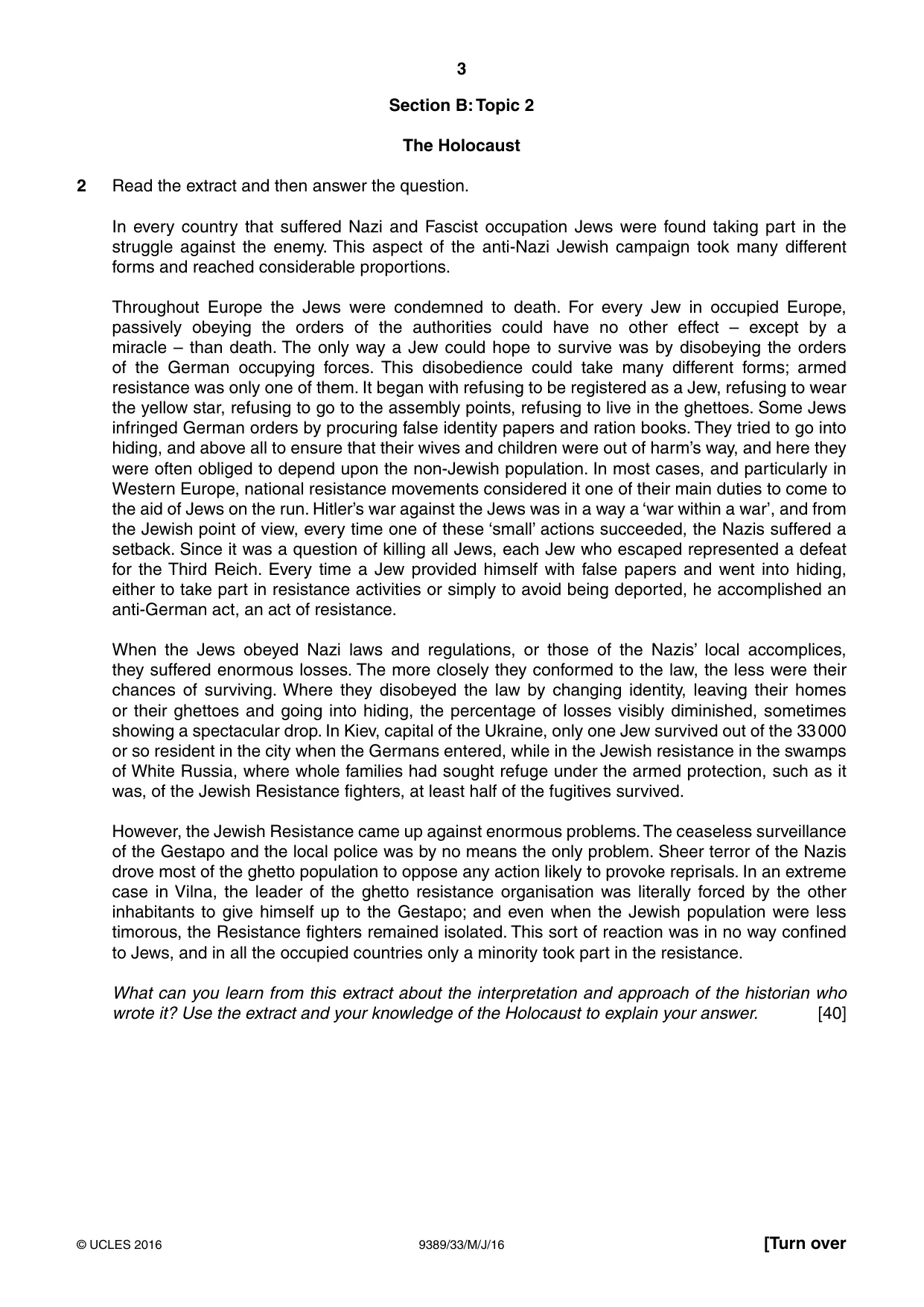
Question paper, page 3
3 9389/33/M/J/16 © UCLES 2016 [Turn over Section B: Topic 2 The Holocaust 2 Read the extract and then answer the question. In every country that suffered Nazi and Fascist occupation Jews were found taking part in the struggle against the enemy. This aspect of the anti-Nazi Jewish campaign took many different forms and reached considerable proportions. Throughout Europe the Jews were condemned to death. For every Jew in occupied Europe, passively obeying the orders of the authorities could have no other effect – except by a miracle – than death. The only way a Jew could hope to survive was by disobeying the orders of the German occupying forces. This disobedience could take many different forms; armed resistance was only one of them. It began with refusing to be registered as a Jew, refusing to wear the yellow star, refusing to go to the assembly points, refusing to live in the ghettoes. Some Jews infringed German orders by procuring false identity papers and ration books. They tried to go into hiding, and above all to ensure that their wives and children were out of harm’s way, and here they were often obliged to depend upon the non-Jewish population. In most cases, and particularly in Western Europe, national resistance movements considered it one of their main duties to come to the aid of Jews on the run. Hitler’s war against the Jews was in a way a ‘war within a war’, and from the Jewish point of view, every time one of these ‘small’ actions succeeded, the Nazis suffered a setback. Since it was a question of killing all Jews, each Jew who escaped represented a defeat for the Third Reich. Every time a Jew provided himself with false papers and went into hiding, either to take part in resistance activities or simply to avoid being deported, he accomplished an anti-German act, an act of resistance. When the Jews obeyed Nazi laws and regulations, or those of the Nazis’ local accomplices, they suffered enormous losses. The more closely they conformed to the law, the less were their chances of surviving. Where they disobeyed the law by changing identity, leaving their homes or their ghettoes and going into hiding, the percentage of losses visibly diminished, sometimes showing a spectacular drop. In Kiev, capital of the Ukraine, only one Jew survived out of the 33 000 or so resident in the city when the Germans entered, while in the Jewish resistance in the swamps of White Russia, where whole families had sought refuge under the armed protection, such as it was, of the Jewish Resistance fighters, at least half of the fugitives survived. However, the Jewish Resistance came up against enormous problems. The ceaseless surveillance of the Gestapo and the local police was by no means the only problem. Sheer terror of the Nazis drove most of the ghetto population to oppose any action likely to provoke reprisals. In an extreme case in Vilna, the leader of the ghetto resistance organisation was literally forced by the other inhabitants to give himself up to the Gestapo; and even when the Jewish population were less timorous, the Resistance fighters remained isolated. This sort of reaction was in no way confined to Jews, and in all the occupied countries only a minority took part in the resistance. What can you learn from this extract about the interpretation and approach of the historian who wrote it? Use the extract and your knowledge of the Holocaust to explain your answer. [40]
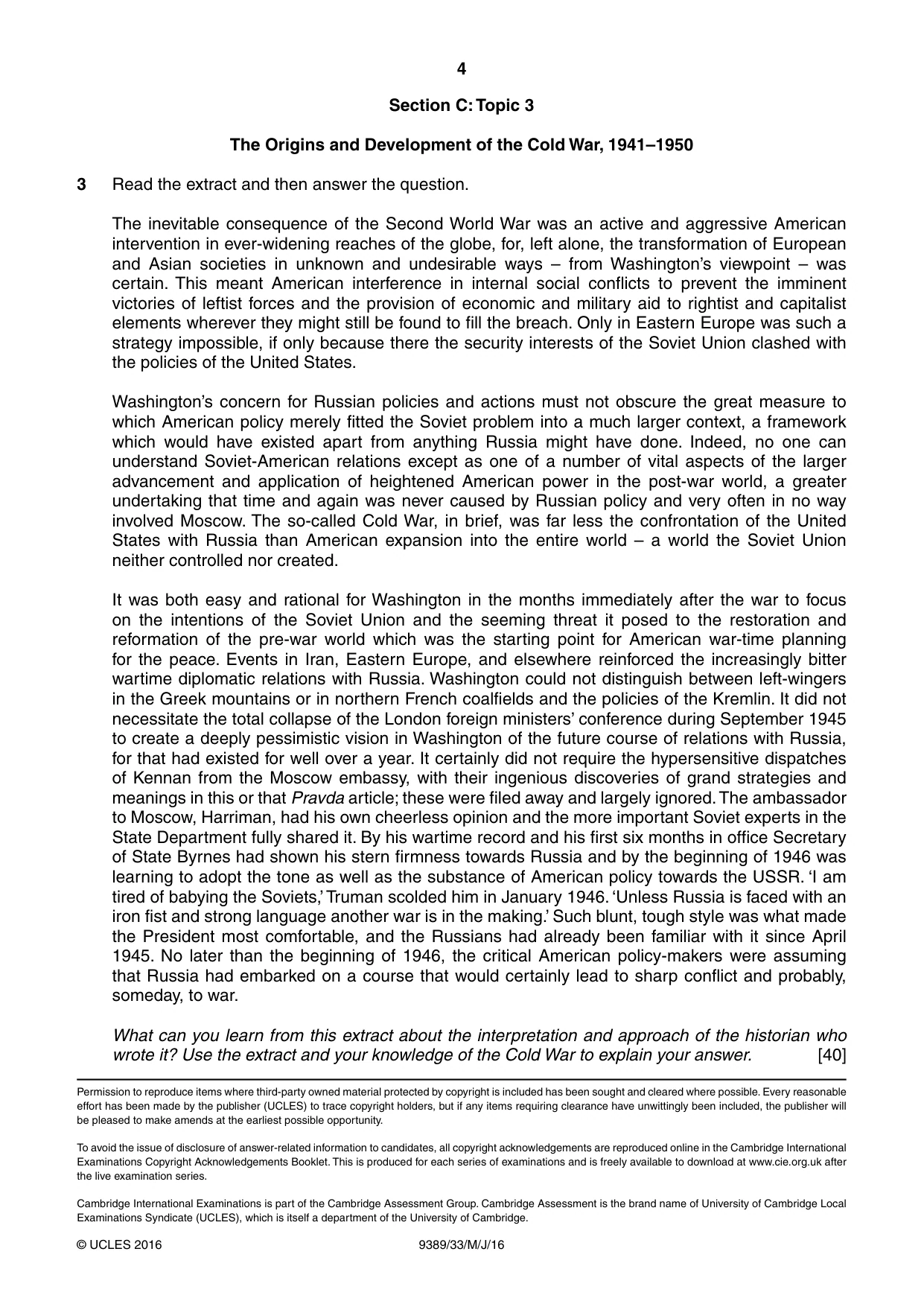
Question paper, page 4
4 9389/33/M/J/16 © UCLES 2016 Section C: Topic 3 The Origins and Development of the Cold War, 1941–1950 3 Read the extract and then answer the question. The inevitable consequence of the Second World War was an active and aggressive American intervention in ever-widening reaches of the globe, for, left alone, the transformation of European and Asian societies in unknown and undesirable ways – from Washington’s viewpoint – was certain. This meant American interference in internal social conflicts to prevent the imminent victories of leftist forces and the provision of economic and military aid to rightist and capitalist elements wherever they might still be found to fill the breach. Only in Eastern Europe was such a strategy impossible, if only because there the security interests of the Soviet Union clashed with the policies of the United States. Washington’s concern for Russian policies and actions must not obscure the great measure to which American policy merely fitted the Soviet problem into a much larger context, a framework which would have existed apart from anything Russia might have done. Indeed, no one can understand Soviet-American relations except as one of a number of vital aspects of the larger advancement and application of heightened American power in the post-war world, a greater undertaking that time and again was never caused by Russian policy and very often in no way involved Moscow. The so-called Cold War, in brief, was far less the confrontation of the United States with Russia than American expansion into the entire world – a world the Soviet Union neither controlled nor created. It was both easy and rational for Washington in the months immediately after the war to focus on the intentions of the Soviet Union and the seeming threat it posed to the restoration and reformation of the pre-war world which was the starting point for American war-time planning for the peace. Events in Iran, Eastern Europe, and elsewhere reinforced the increasingly bitter wartime diplomatic relations with Russia. Washington could not distinguish between left-wingers in the Greek mountains or in northern French coalfields and the policies of the Kremlin. It did not necessitate the total collapse of the London foreign ministers’ conference during September 1945 to create a deeply pessimistic vision in Washington of the future course of relations with Russia, for that had existed for well over a year. It certainly did not require the hypersensitive dispatches of Kennan from the Moscow embassy, with their ingenious discoveries of grand strategies and meanings in this or that Pravda article; these were filed away and largely ignored. The ambassador to Moscow, Harriman, had his own cheerless opinion and the more important Soviet experts in the State Department fully shared it. By his wartime record and his first six months in office Secretary of State Byrnes had shown his stern firmness towards Russia and by the beginning of 1946 was learning to adopt the tone as well as the substance of American policy towards the USSR. ‘I am tired of babying the Soviets,’ Truman scolded him in January 1946. ‘Unless Russia is faced with an iron fist and strong language another war is in the making.’ Such blunt, tough style was what made the President most comfortable, and the Russians had already been familiar with it since April 1945. No later than the beginning of 1946, the critical American policy-makers were assuming that Russia had embarked on a course that would certainly lead to sharp conflict and probably, someday, to war. What can you learn from this extract about the interpretation and approach of the historian who wrote it? Use the extract and your knowledge of the Cold War to explain your answer. [40] Permission to reproduce items where third-party owned material protected by copyright is included has been sought and cleared where possible. Every reasonable effort has been made by the publisher (UCLES) to trace copyright holders, but if any items requiring clearance have unwittingly been included, the publisher will be pleased to make amends at the earliest possible opportunity. To avoid the issue of disclosure of answer-related information to candidates, all copyright acknowledgements are reproduced online in the Cambridge International Examinations Copyright Acknowledgements Booklet. This is produced for each series of examinations and is freely available to download at www.cie.org.uk after the live examination series. Cambridge International Examinations is part of the Cambridge Assessment Group. Cambridge Assessment is the brand name of University of Cambridge Local Examinations Syndicate (UCLES), which is itself a department of the University of Cambridge.
Mark scheme, page 1
® IGCSE is the registered trademark of Cambridge International Examinations. This document consists of 5 printed pages. © UCLES 2016 [Turn over Cambridge International Examinations Cambridge International Advanced Subsidiary and Advanced Level HISTORY 9389/33 Paper 3 Interpretations Question May/June 2016 MARK SCHEME Maximum Mark: 40 Published This mark scheme is published as an aid to teachers and candidates, to indicate the requirements of the examination. It shows the basis on which Examiners were instructed to award marks. It does not indicate the details of the discussions that took place at an Examiners’ meeting before marking began, which would have considered the acceptability of alternative answers. Mark schemes should be read in conjunction with the question paper and the Principal Examiner Report for Teachers. Cambridge will not enter into discussions about these mark schemes. Cambridge is publishing the mark schemes for the May/June 2016 series for most Cambridge IGCSE®, Cambridge International A and AS Level components and some Cambridge O Level components.
Mark scheme, page 2
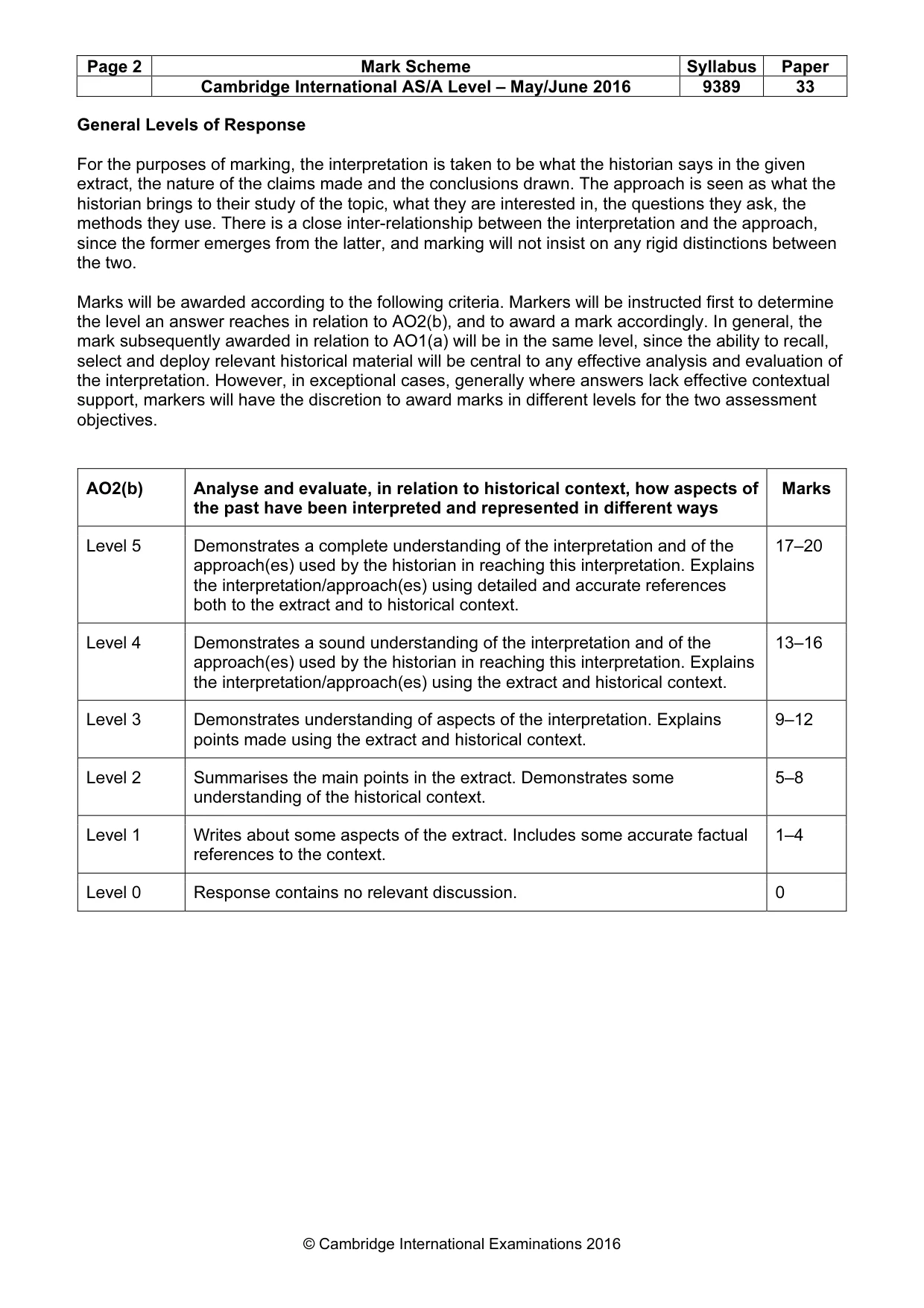
Page 2 Mark Scheme Syllabus Paper Cambridge International AS/A Level – May/June 2016 9389 33 © Cambridge International Examinations 2016 General Levels of Response For the purposes of marking, the interpretation is taken to be what the historian says in the given extract, the nature of the claims made and the conclusions drawn. The approach is seen as what the historian brings to their study of the topic, what they are interested in, the questions they ask, the methods they use. There is a close inter-relationship between the interpretation and the approach, since the former emerges from the latter, and marking will not insist on any rigid distinctions between the two. Marks will be awarded according to the following criteria. Markers will be instructed first to determine the level an answer reaches in relation to AO2(b), and to award a mark accordingly. In general, the mark subsequently awarded in relation to AO1(a) will be in the same level, since the ability to recall, select and deploy relevant historical material will be central to any effective analysis and evaluation of the interpretation. However, in exceptional cases, generally where answers lack effective contextual support, markers will have the discretion to award marks in different levels for the two assessment objectives. AO2(b) Analyse and evaluate, in relation to historical context, how aspects of the past have been interpreted and represented in different ways Marks Level 5 Demonstrates a complete understanding of the interpretation and of the approach(es) used by the historian in reaching this interpretation. Explains the interpretation/approach(es) using detailed and accurate references both to the extract and to historical context. 17–20 Level 4 Demonstrates a sound understanding of the interpretation and of the approach(es) used by the historian in reaching this interpretation. Explains the interpretation/approach(es) using the extract and historical context. 13–16 Level 3 Demonstrates understanding of aspects of the interpretation. Explains points made using the extract and historical context. 9–12 Level 2 Summarises the main points in the extract. Demonstrates some understanding of the historical context. 5–8 Level 1 Writes about some aspects of the extract. Includes some accurate factual references to the context. 1–4 Level 0 Response contains no relevant discussion. 0
Mark scheme, page 3
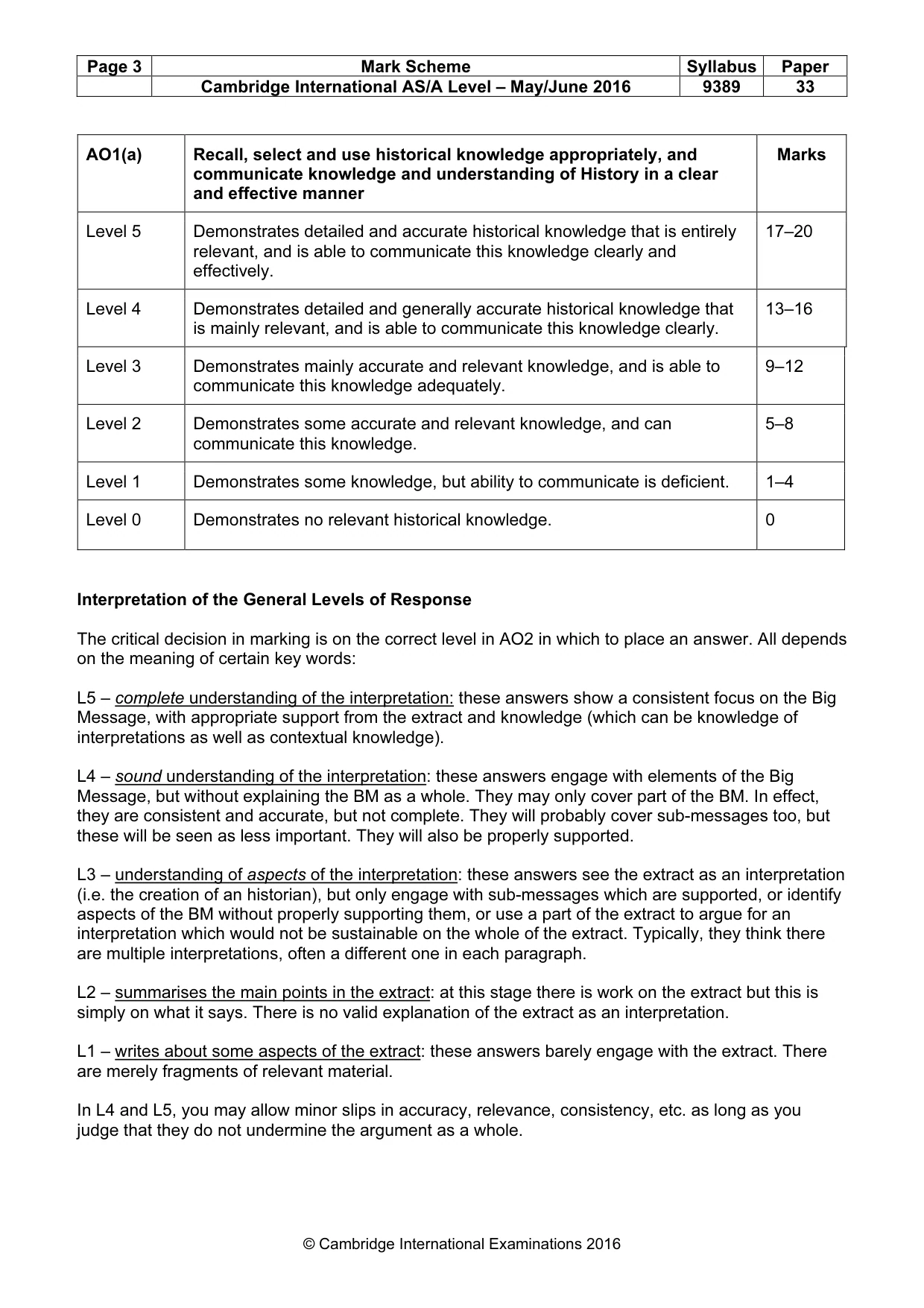
Page 3 Mark Scheme Syllabus Paper Cambridge International AS/A Level – May/June 2016 9389 33 © Cambridge International Examinations 2016 AO1(a) Recall, select and use historical knowledge appropriately, and communicate knowledge and understanding of History in a clear and effective manner Marks Level 5 Demonstrates detailed and accurate historical knowledge that is entirely relevant, and is able to communicate this knowledge clearly and effectively. 17–20 Level 4 Demonstrates detailed and generally accurate historical knowledge that is mainly relevant, and is able to communicate this knowledge clearly. 13–16 Level 3 Demonstrates mainly accurate and relevant knowledge, and is able to communicate this knowledge adequately. 9–12 Level 2 Demonstrates some accurate and relevant knowledge, and can communicate this knowledge. 5–8 Level 1 Demonstrates some knowledge, but ability to communicate is deficient. 1–4 Level 0 Demonstrates no relevant historical knowledge. 0 Interpretation of the General Levels of Response The critical decision in marking is on the correct level in AO2 in which to place an answer. All depends on the meaning of certain key words: L5 – complete understanding of the interpretation: these answers show a consistent focus on the Big Message, with appropriate support from the extract and knowledge (which can be knowledge of interpretations as well as contextual knowledge). L4 – sound understanding of the interpretation: these answers engage with elements of the Big Message, but without explaining the BM as a whole. They may only cover part of the BM. In effect, they are consistent and accurate, but not complete. They will probably cover sub-messages too, but these will be seen as less important. They will also be properly supported. L3 – understanding of aspects of the interpretation: these answers see the extract as an interpretation (i.e. the creation of an historian), but only engage with sub-messages which are supported, or identify aspects of the BM without properly supporting them, or use a part of the extract to argue for an interpretation which would not be sustainable on the whole of the extract. Typically, they think there are multiple interpretations, often a different one in each paragraph. L2 – summarises the main points in the extract: at this stage there is work on the extract but this is simply on what it says. There is no valid explanation of the extract as an interpretation. L1 – writes about some aspects of the extract: these answers barely engage with the extract. There are merely fragments of relevant material. In L4 and L5, you may allow minor slips in accuracy, relevance, consistency, etc. as long as you judge that they do not undermine the argument as a whole.
Mark scheme, page 4
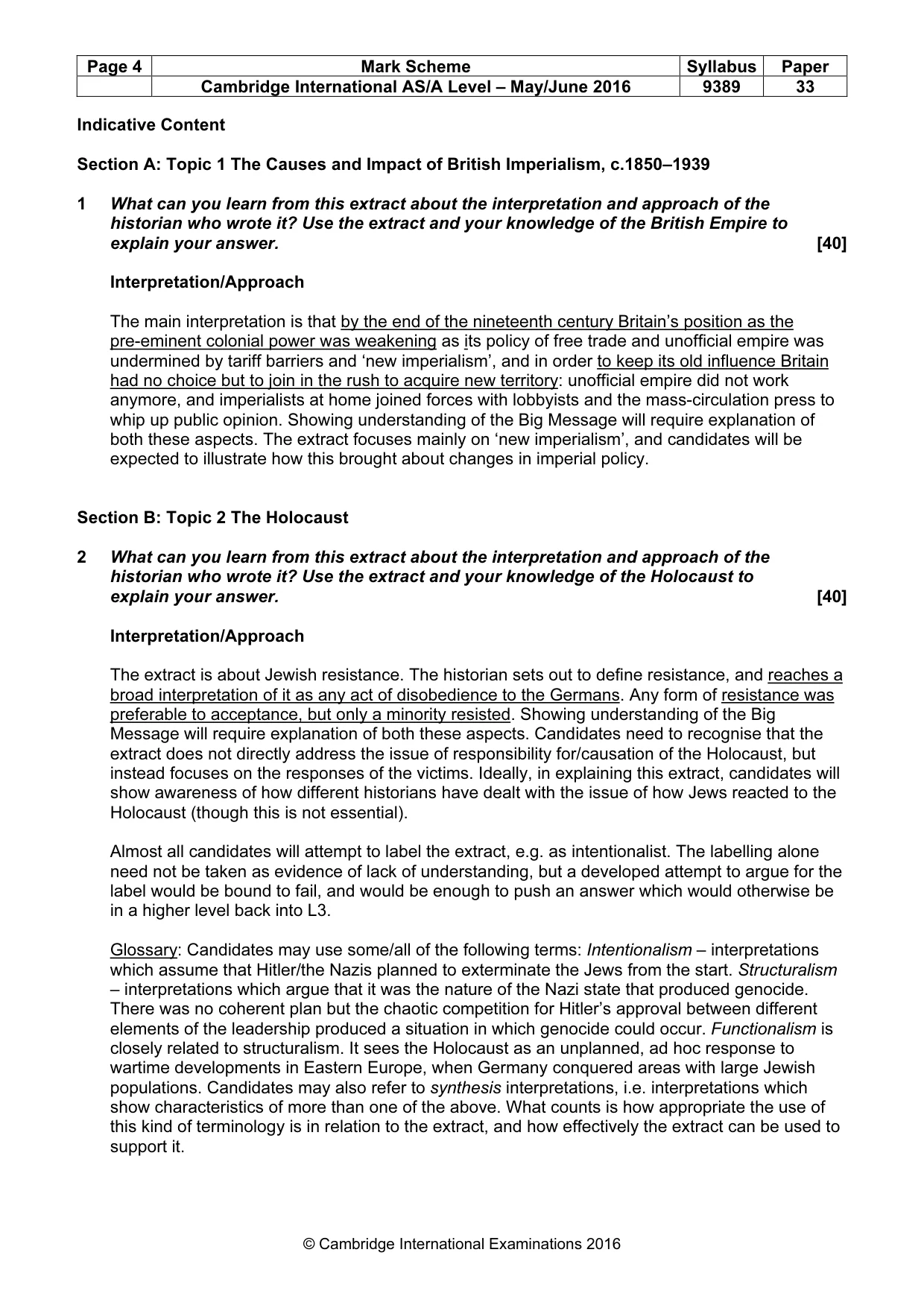
Page 4 Mark Scheme Syllabus Paper Cambridge International AS/A Level – May/June 2016 9389 33 © Cambridge International Examinations 2016 Indicative Content Section A: Topic 1 The Causes and Impact of British Imperialism, c.1850–1939 1 What can you learn from this extract about the interpretation and approach of the historian who wrote it? Use the extract and your knowledge of the British Empire to explain your answer. [40] Interpretation/Approach The main interpretation is that by the end of the nineteenth century Britain’s position as the pre-eminent colonial power was weakening as its policy of free trade and unofficial empire was undermined by tariff barriers and ‘new imperialism’, and in order to keep its old influence Britain had no choice but to join in the rush to acquire new territory: unofficial empire did not work anymore, and imperialists at home joined forces with lobbyists and the mass-circulation press to whip up public opinion. Showing understanding of the Big Message will require explanation of both these aspects. The extract focuses mainly on ‘new imperialism’, and candidates will be expected to illustrate how this brought about changes in imperial policy. Section B: Topic 2 The Holocaust 2 What can you learn from this extract about the interpretation and approach of the historian who wrote it? Use the extract and your knowledge of the Holocaust to explain your answer. [40] Interpretation/Approach The extract is about Jewish resistance. The historian sets out to define resistance, and reaches a broad interpretation of it as any act of disobedience to the Germans. Any form of resistance was preferable to acceptance, but only a minority resisted. Showing understanding of the Big Message will require explanation of both these aspects. Candidates need to recognise that the extract does not directly address the issue of responsibility for/causation of the Holocaust, but instead focuses on the responses of the victims. Ideally, in explaining this extract, candidates will show awareness of how different historians have dealt with the issue of how Jews reacted to the Holocaust (though this is not essential). Almost all candidates will attempt to label the extract, e.g. as intentionalist. The labelling alone need not be taken as evidence of lack of understanding, but a developed attempt to argue for the label would be bound to fail, and would be enough to push an answer which would otherwise be in a higher level back into L3. Glossary: Candidates may use some/all of the following terms: Intentionalism – interpretations which assume that Hitler/the Nazis planned to exterminate the Jews from the start. Structuralism – interpretations which argue that it was the nature of the Nazi state that produced genocide. There was no coherent plan but the chaotic competition for Hitler’s approval between different elements of the leadership produced a situation in which genocide could occur. Functionalism is closely related to structuralism. It sees the Holocaust as an unplanned, ad hoc response to wartime developments in Eastern Europe, when Germany conquered areas with large Jewish populations. Candidates may also refer to synthesis interpretations, i.e. interpretations which show characteristics of more than one of the above. What counts is how appropriate the use of this kind of terminology is in relation to the extract, and how effectively the extract can be used to support it.
Mark scheme, page 5
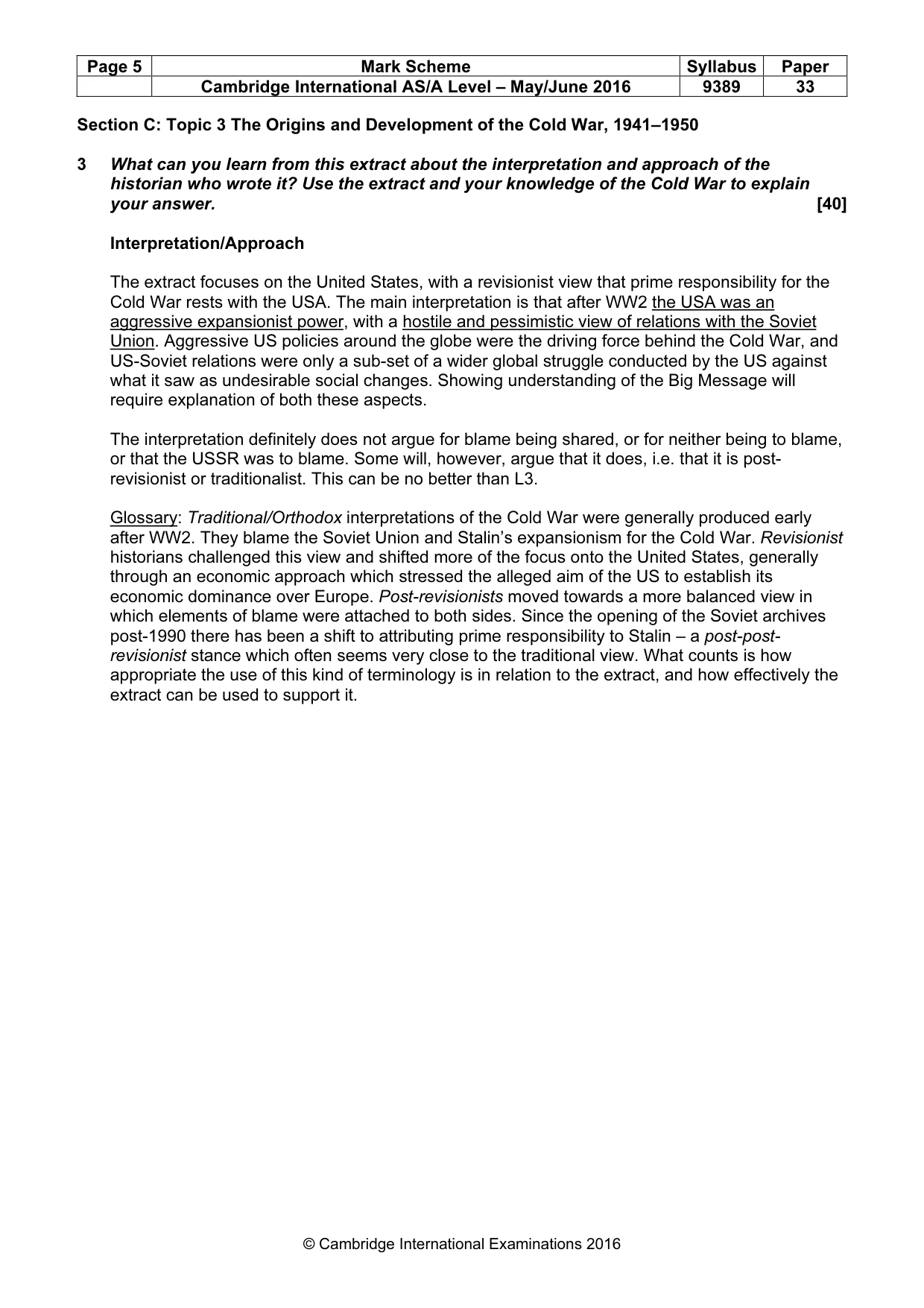
Page 5 Mark Scheme Syllabus Paper Cambridge International AS/A Level – May/June 2016 9389 33 © Cambridge International Examinations 2016 Section C: Topic 3 The Origins and Development of the Cold War, 1941–1950 3 What can you learn from this extract about the interpretation and approach of the historian who wrote it? Use the extract and your knowledge of the Cold War to explain your answer. [40] Interpretation/Approach The extract focuses on the United States, with a revisionist view that prime responsibility for the Cold War rests with the USA. The main interpretation is that after WW2 the USA was an aggressive expansionist power, with a hostile and pessimistic view of relations with the Soviet Union. Aggressive US policies around the globe were the driving force behind the Cold War, and US-Soviet relations were only a sub-set of a wider global struggle conducted by the US against what it saw as undesirable social changes. Showing understanding of the Big Message will require explanation of both these aspects. The interpretation definitely does not argue for blame being shared, or for neither being to blame, or that the USSR was to blame. Some will, however, argue that it does, i.e. that it is post- revisionist or traditionalist. This can be no better than L3. Glossary: Traditional/Orthodox interpretations of the Cold War were generally produced early after WW2. They blame the Soviet Union and Stalin’s expansionism for the Cold War. Revisionist historians challenged this view and shifted more of the focus onto the United States, generally through an economic approach which stressed the alleged aim of the US to establish its economic dominance over Europe. Post-revisionists moved towards a more balanced view in which elements of blame were attached to both sides. Since the opening of the Soviet archives post-1990 there has been a shift to attributing prime responsibility to Stalin – a post-post- revisionist stance which often seems very close to the traditional view. What counts is how appropriate the use of this kind of terminology is in relation to the extract, and how effectively the extract can be used to support it.
What you needed in this session
Cambridge’s own grade thresholds for 2016 May/June, Paper 3 · Variant 3. A higher threshold means an easier paper — the bar moves with how the cohort did.