Cambridge A Level History 9389 — 2016 May/June Paper 3 · Variant 2
9389/32/M/J/16 · 40 marks · ≈45 min
The question paper and its mark scheme, free to read here and free to download. This is Cambridge’s own paper, exactly as it was sat.
Question paper4 pages
Mark scheme5 pages
Answers below. Sit the paper first if you are practising.
Paper as text
Question paper, page 1
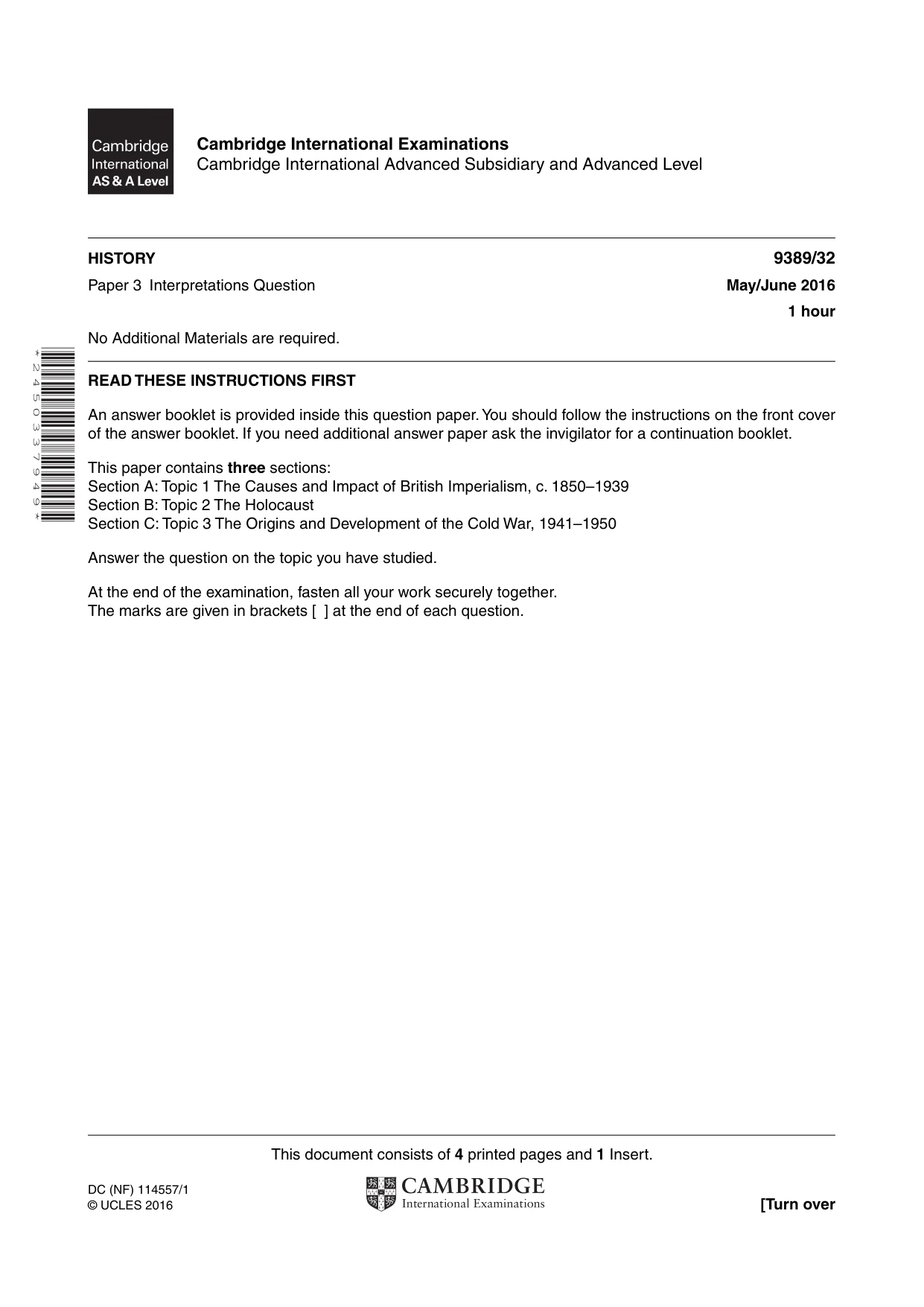
This document consists of 4 printed pages and 1 Insert. DC (NF) 114557/1 © UCLES 2016 [Turn over Cambridge International Examinations Cambridge International Advanced Subsidiary and Advanced Level * 2 4 5 0 3 3 7 9 4 9 * HISTORY 9389/32 Paper 3 Interpretations Question May/June 2016 1 hour No Additional Materials are required. READ THESE INSTRUCTIONS FIRST An answer booklet is provided inside this question paper. You should follow the instructions on the front cover of the answer booklet. If you need additional answer paper ask the invigilator for a continuation booklet. This paper contains three sections: Section A: Topic 1 The Causes and Impact of British Imperialism, c. 1850–1939 Section B: Topic 2 The Holocaust Section C: Topic 3 The Origins and Development of the Cold War, 1941–1950 Answer the question on the topic you have studied. At the end of the examination, fasten all your work securely together. The marks are given in brackets [ ] at the end of each question.
Question paper, page 2
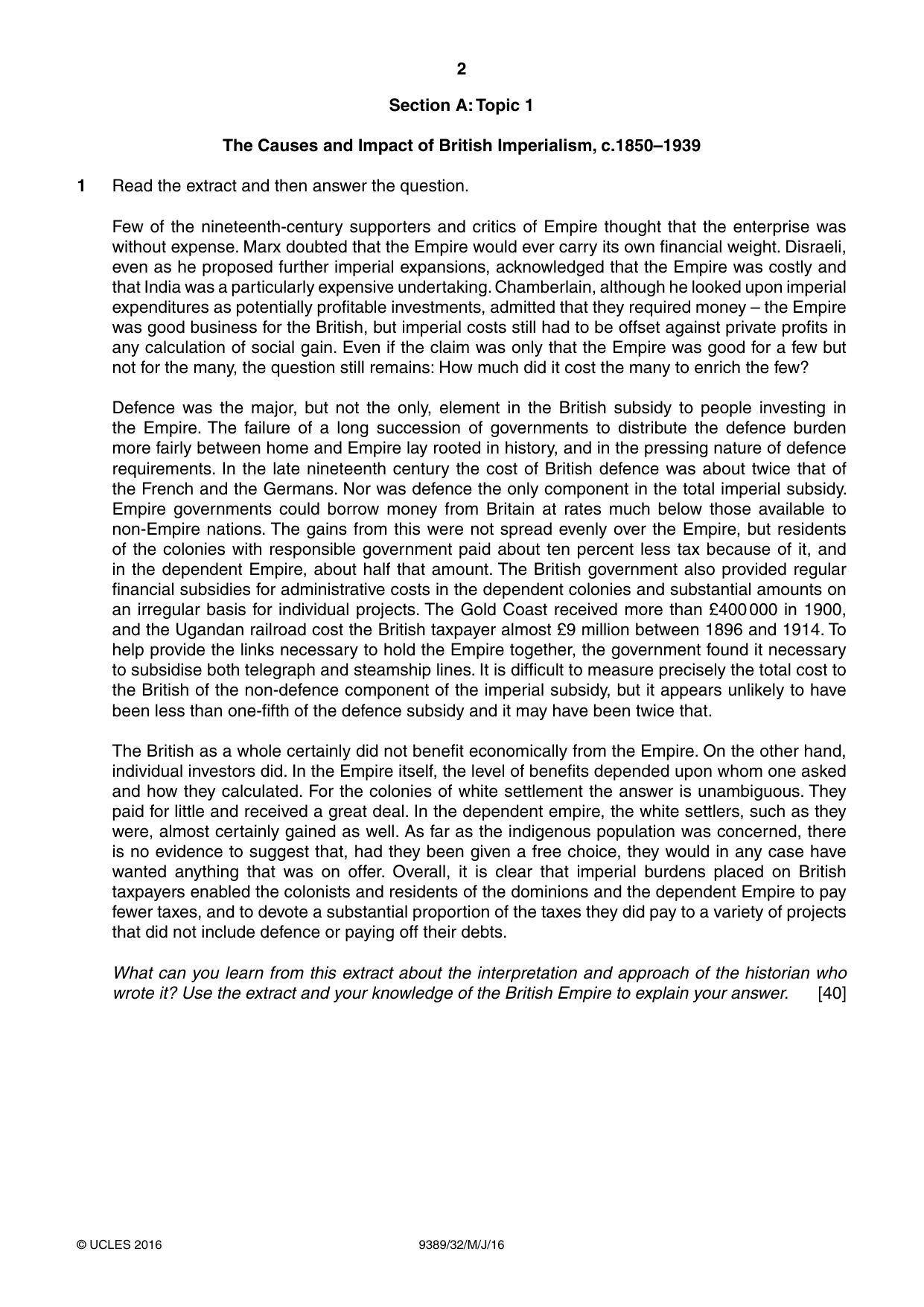
2 9389/32/M/J/16 © UCLES 2016 Section A: Topic 1 The Causes and Impact of British Imperialism, c.1850–1939 1 Read the extract and then answer the question. Few of the nineteenth-century supporters and critics of Empire thought that the enterprise was without expense. Marx doubted that the Empire would ever carry its own financial weight. Disraeli, even as he proposed further imperial expansions, acknowledged that the Empire was costly and that India was a particularly expensive undertaking. Chamberlain, although he looked upon imperial expenditures as potentially profitable investments, admitted that they required money – the Empire was good business for the British, but imperial costs still had to be offset against private profits in any calculation of social gain. Even if the claim was only that the Empire was good for a few but not for the many, the question still remains: How much did it cost the many to enrich the few? Defence was the major, but not the only, element in the British subsidy to people investing in the Empire. The failure of a long succession of governments to distribute the defence burden more fairly between home and Empire lay rooted in history, and in the pressing nature of defence requirements. In the late nineteenth century the cost of British defence was about twice that of the French and the Germans. Nor was defence the only component in the total imperial subsidy. Empire governments could borrow money from Britain at rates much below those available to non-Empire nations. The gains from this were not spread evenly over the Empire, but residents of the colonies with responsible government paid about ten percent less tax because of it, and in the dependent Empire, about half that amount. The British government also provided regular financial subsidies for administrative costs in the dependent colonies and substantial amounts on an irregular basis for individual projects. The Gold Coast received more than £400 000 in 1900, and the Ugandan railroad cost the British taxpayer almost £9 million between 1896 and 1914. To help provide the links necessary to hold the Empire together, the government found it necessary to subsidise both telegraph and steamship lines. It is difficult to measure precisely the total cost to the British of the non-defence component of the imperial subsidy, but it appears unlikely to have been less than one-fifth of the defence subsidy and it may have been twice that. The British as a whole certainly did not benefit economically from the Empire. On the other hand, individual investors did. In the Empire itself, the level of benefits depended upon whom one asked and how they calculated. For the colonies of white settlement the answer is unambiguous. They paid for little and received a great deal. In the dependent empire, the white settlers, such as they were, almost certainly gained as well. As far as the indigenous population was concerned, there is no evidence to suggest that, had they been given a free choice, they would in any case have wanted anything that was on offer. Overall, it is clear that imperial burdens placed on British taxpayers enabled the colonists and residents of the dominions and the dependent Empire to pay fewer taxes, and to devote a substantial proportion of the taxes they did pay to a variety of projects that did not include defence or paying off their debts. What can you learn from this extract about the interpretation and approach of the historian who wrote it? Use the extract and your knowledge of the British Empire to explain your answer. [40]
Question paper, page 3
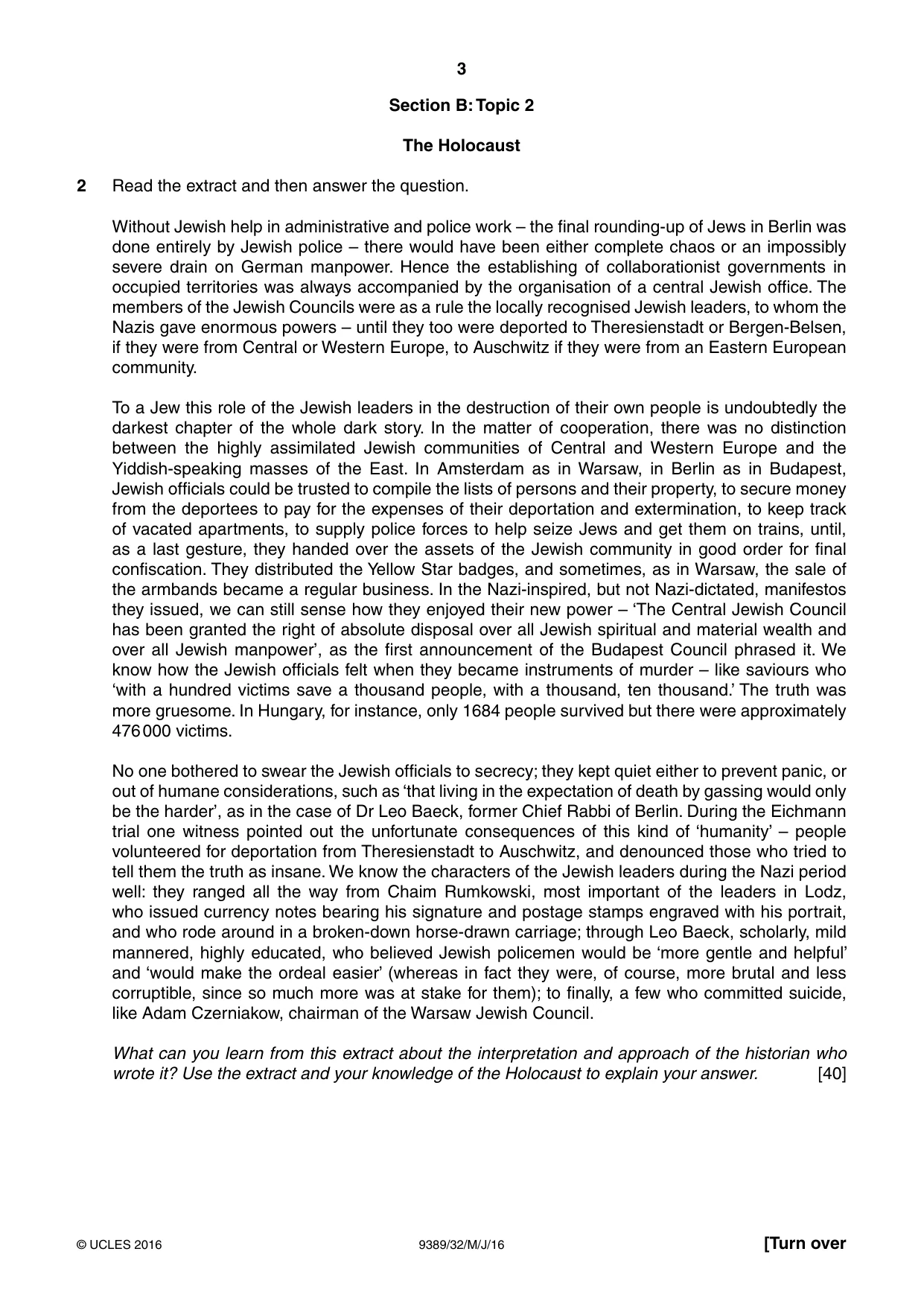
3 9389/32/M/J/16 © UCLES 2016 [Turn over Section B: Topic 2 The Holocaust 2 Read the extract and then answer the question. Without Jewish help in administrative and police work – the final rounding-up of Jews in Berlin was done entirely by Jewish police – there would have been either complete chaos or an impossibly severe drain on German manpower. Hence the establishing of collaborationist governments in occupied territories was always accompanied by the organisation of a central Jewish office. The members of the Jewish Councils were as a rule the locally recognised Jewish leaders, to whom the Nazis gave enormous powers – until they too were deported to Theresienstadt or Bergen-Belsen, if they were from Central or Western Europe, to Auschwitz if they were from an Eastern European community. To a Jew this role of the Jewish leaders in the destruction of their own people is undoubtedly the darkest chapter of the whole dark story. In the matter of cooperation, there was no distinction between the highly assimilated Jewish communities of Central and Western Europe and the Yiddish-speaking masses of the East. In Amsterdam as in Warsaw, in Berlin as in Budapest, Jewish officials could be trusted to compile the lists of persons and their property, to secure money from the deportees to pay for the expenses of their deportation and extermination, to keep track of vacated apartments, to supply police forces to help seize Jews and get them on trains, until, as a last gesture, they handed over the assets of the Jewish community in good order for final confiscation. They distributed the Yellow Star badges, and sometimes, as in Warsaw, the sale of the armbands became a regular business. In the Nazi-inspired, but not Nazi-dictated, manifestos they issued, we can still sense how they enjoyed their new power – ‘The Central Jewish Council has been granted the right of absolute disposal over all Jewish spiritual and material wealth and over all Jewish manpower’, as the first announcement of the Budapest Council phrased it. We know how the Jewish officials felt when they became instruments of murder – like saviours who ‘with a hundred victims save a thousand people, with a thousand, ten thousand.’ The truth was more gruesome. In Hungary, for instance, only 1684 people survived but there were approximately 476 000 victims. No one bothered to swear the Jewish officials to secrecy; they kept quiet either to prevent panic, or out of humane considerations, such as ‘that living in the expectation of death by gassing would only be the harder’, as in the case of Dr Leo Baeck, former Chief Rabbi of Berlin. During the Eichmann trial one witness pointed out the unfortunate consequences of this kind of ‘humanity’ – people volunteered for deportation from Theresienstadt to Auschwitz, and denounced those who tried to tell them the truth as insane. We know the characters of the Jewish leaders during the Nazi period well: they ranged all the way from Chaim Rumkowski, most important of the leaders in Lodz, who issued currency notes bearing his signature and postage stamps engraved with his portrait, and who rode around in a broken-down horse-drawn carriage; through Leo Baeck, scholarly, mild mannered, highly educated, who believed Jewish policemen would be ‘more gentle and helpful’ and ‘would make the ordeal easier’ (whereas in fact they were, of course, more brutal and less corruptible, since so much more was at stake for them); to finally, a few who committed suicide, like Adam Czerniakow, chairman of the Warsaw Jewish Council. What can you learn from this extract about the interpretation and approach of the historian who wrote it? Use the extract and your knowledge of the Holocaust to explain your answer. [40]
Question paper, page 4
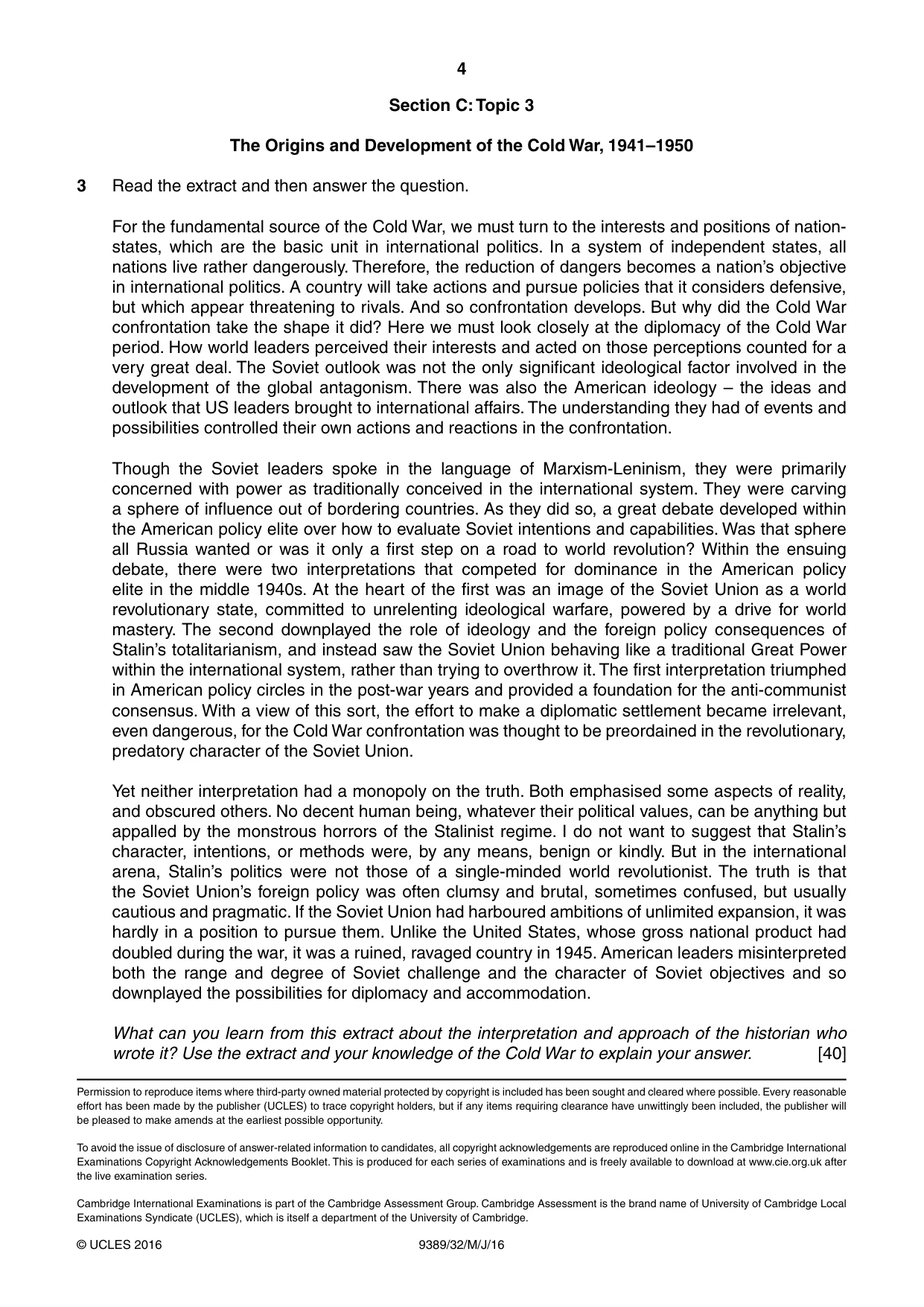
4 9389/32/M/J/16 © UCLES 2016 Section C: Topic 3 The Origins and Development of the Cold War, 1941–1950 3 Read the extract and then answer the question. For the fundamental source of the Cold War, we must turn to the interests and positions of nation- states, which are the basic unit in international politics. In a system of independent states, all nations live rather dangerously. Therefore, the reduction of dangers becomes a nation’s objective in international politics. A country will take actions and pursue policies that it considers defensive, but which appear threatening to rivals. And so confrontation develops. But why did the Cold War confrontation take the shape it did? Here we must look closely at the diplomacy of the Cold War period. How world leaders perceived their interests and acted on those perceptions counted for a very great deal. The Soviet outlook was not the only significant ideological factor involved in the development of the global antagonism. There was also the American ideology – the ideas and outlook that US leaders brought to international affairs. The understanding they had of events and possibilities controlled their own actions and reactions in the confrontation. Though the Soviet leaders spoke in the language of Marxism-Leninism, they were primarily concerned with power as traditionally conceived in the international system. They were carving a sphere of influence out of bordering countries. As they did so, a great debate developed within the American policy elite over how to evaluate Soviet intentions and capabilities. Was that sphere all Russia wanted or was it only a first step on a road to world revolution? Within the ensuing debate, there were two interpretations that competed for dominance in the American policy elite in the middle 1940s. At the heart of the first was an image of the Soviet Union as a world revolutionary state, committed to unrelenting ideological warfare, powered by a drive for world mastery. The second downplayed the role of ideology and the foreign policy consequences of Stalin’s totalitarianism, and instead saw the Soviet Union behaving like a traditional Great Power within the international system, rather than trying to overthrow it. The first interpretation triumphed in American policy circles in the post-war years and provided a foundation for the anti-communist consensus. With a view of this sort, the effort to make a diplomatic settlement became irrelevant, even dangerous, for the Cold War confrontation was thought to be preordained in the revolutionary, predatory character of the Soviet Union. Yet neither interpretation had a monopoly on the truth. Both emphasised some aspects of reality, and obscured others. No decent human being, whatever their political values, can be anything but appalled by the monstrous horrors of the Stalinist regime. I do not want to suggest that Stalin’s character, intentions, or methods were, by any means, benign or kindly. But in the international arena, Stalin’s politics were not those of a single-minded world revolutionist. The truth is that the Soviet Union’s foreign policy was often clumsy and brutal, sometimes confused, but usually cautious and pragmatic. If the Soviet Union had harboured ambitions of unlimited expansion, it was hardly in a position to pursue them. Unlike the United States, whose gross national product had doubled during the war, it was a ruined, ravaged country in 1945. American leaders misinterpreted both the range and degree of Soviet challenge and the character of Soviet objectives and so downplayed the possibilities for diplomacy and accommodation. What can you learn from this extract about the interpretation and approach of the historian who wrote it? Use the extract and your knowledge of the Cold War to explain your answer. [40] Permission to reproduce items where third-party owned material protected by copyright is included has been sought and cleared where possible. Every reasonable effort has been made by the publisher (UCLES) to trace copyright holders, but if any items requiring clearance have unwittingly been included, the publisher will be pleased to make amends at the earliest possible opportunity. To avoid the issue of disclosure of answer-related information to candidates, all copyright acknowledgements are reproduced online in the Cambridge International Examinations Copyright Acknowledgements Booklet. This is produced for each series of examinations and is freely available to download at www.cie.org.uk after the live examination series. Cambridge International Examinations is part of the Cambridge Assessment Group. Cambridge Assessment is the brand name of University of Cambridge Local Examinations Syndicate (UCLES), which is itself a department of the University of Cambridge.
Mark scheme, page 1
® IGCSE is the registered trademark of Cambridge International Examinations. This document consists of 5 printed pages. © UCLES 2016 [Turn over Cambridge International Examinations Cambridge International Advanced Subsidiary and Advanced Level HISTORY 9389/32 Paper 3 Interpretations Question May/June 2016 MARK SCHEME Maximum Mark: 40 Published This mark scheme is published as an aid to teachers and candidates, to indicate the requirements of the examination. It shows the basis on which Examiners were instructed to award marks. It does not indicate the details of the discussions that took place at an Examiners’ meeting before marking began, which would have considered the acceptability of alternative answers. Mark schemes should be read in conjunction with the question paper and the Principal Examiner Report for Teachers. Cambridge will not enter into discussions about these mark schemes. Cambridge is publishing the mark schemes for the May/June 2016 series for most Cambridge IGCSE®, Cambridge International A and AS Level components and some Cambridge O Level components.
Mark scheme, page 2
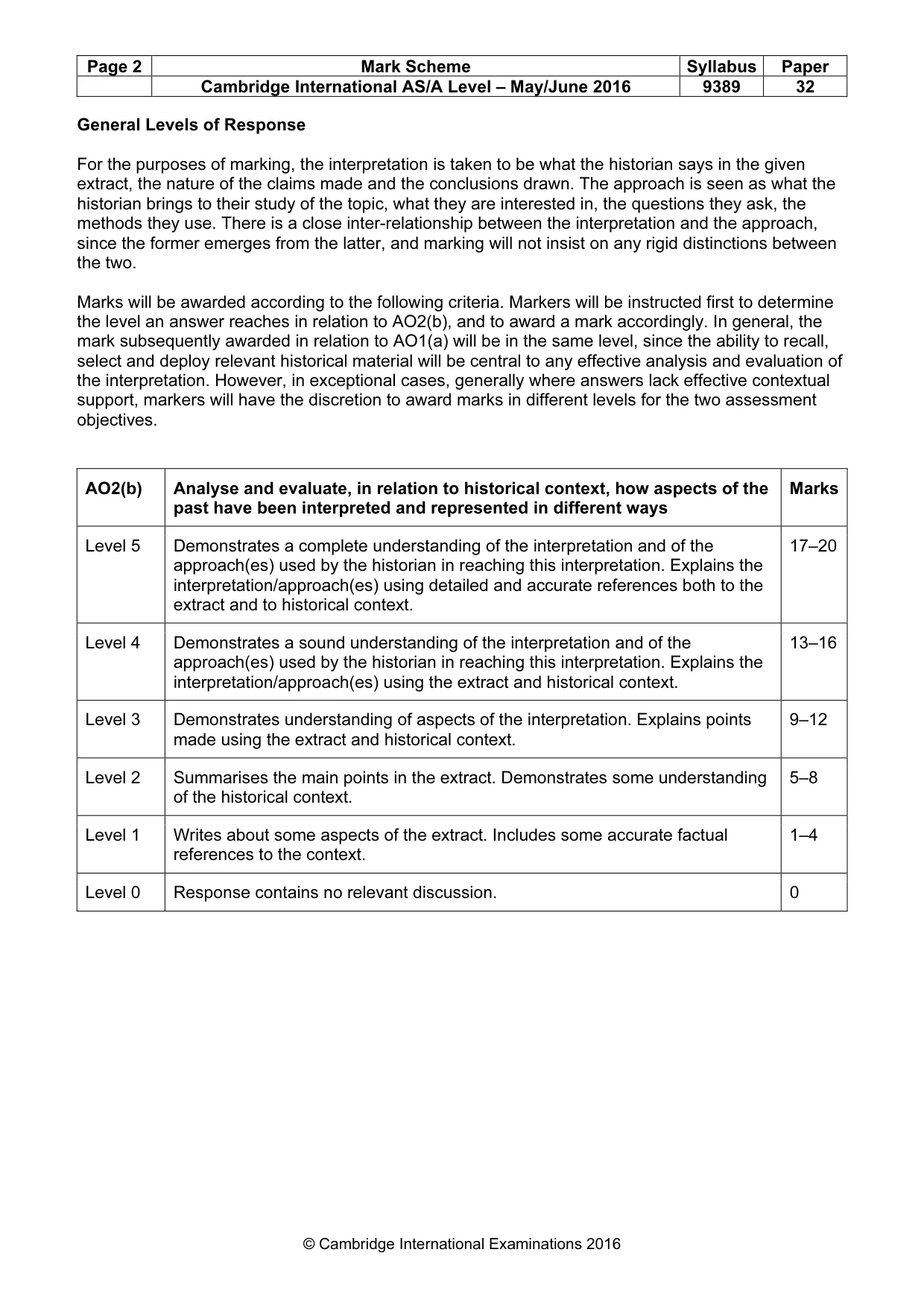
Page 2 Mark Scheme Syllabus Paper Cambridge International AS/A Level – May/June 2016 9389 32 © Cambridge International Examinations 2016 General Levels of Response For the purposes of marking, the interpretation is taken to be what the historian says in the given extract, the nature of the claims made and the conclusions drawn. The approach is seen as what the historian brings to their study of the topic, what they are interested in, the questions they ask, the methods they use. There is a close inter-relationship between the interpretation and the approach, since the former emerges from the latter, and marking will not insist on any rigid distinctions between the two. Marks will be awarded according to the following criteria. Markers will be instructed first to determine the level an answer reaches in relation to AO2(b), and to award a mark accordingly. In general, the mark subsequently awarded in relation to AO1(a) will be in the same level, since the ability to recall, select and deploy relevant historical material will be central to any effective analysis and evaluation of the interpretation. However, in exceptional cases, generally where answers lack effective contextual support, markers will have the discretion to award marks in different levels for the two assessment objectives. AO2(b) Analyse and evaluate, in relation to historical context, how aspects of the past have been interpreted and represented in different ways Marks Level 5 Demonstrates a complete understanding of the interpretation and of the approach(es) used by the historian in reaching this interpretation. Explains the interpretation/approach(es) using detailed and accurate references both to the extract and to historical context. 17–20 Level 4 Demonstrates a sound understanding of the interpretation and of the approach(es) used by the historian in reaching this interpretation. Explains the interpretation/approach(es) using the extract and historical context. 13–16 Level 3 Demonstrates understanding of aspects of the interpretation. Explains points made using the extract and historical context. 9–12 Level 2 Summarises the main points in the extract. Demonstrates some understanding of the historical context. 5–8 Level 1 Writes about some aspects of the extract. Includes some accurate factual references to the context. 1–4 Level 0 Response contains no relevant discussion. 0
Mark scheme, page 3
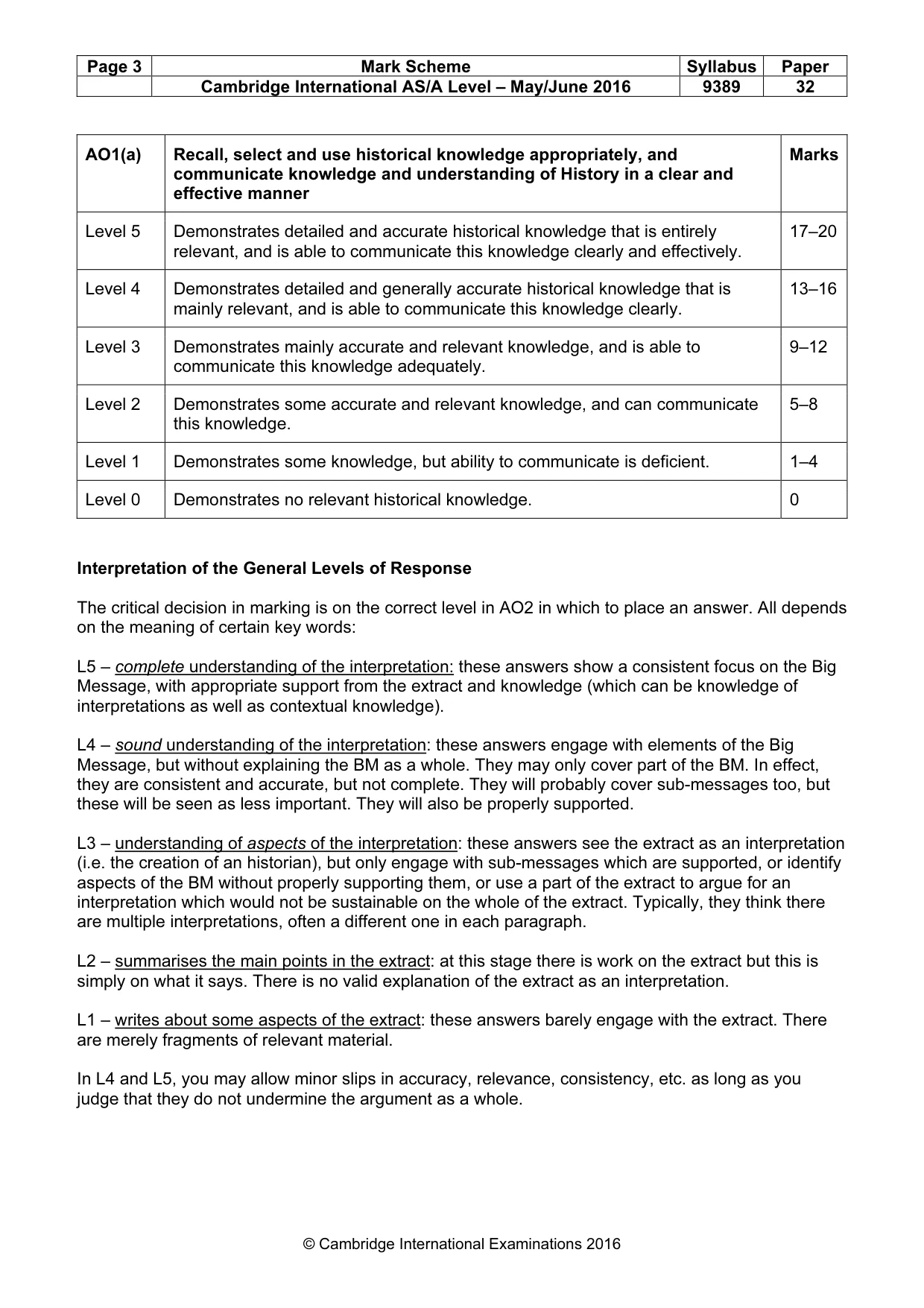
Page 3 Mark Scheme Syllabus Paper Cambridge International AS/A Level – May/June 2016 9389 32 © Cambridge International Examinations 2016 AO1(a) Recall, select and use historical knowledge appropriately, and communicate knowledge and understanding of History in a clear and effective manner Marks Level 5 Demonstrates detailed and accurate historical knowledge that is entirely relevant, and is able to communicate this knowledge clearly and effectively. 17–20 Level 4 Demonstrates detailed and generally accurate historical knowledge that is mainly relevant, and is able to communicate this knowledge clearly. 13–16 Level 3 Demonstrates mainly accurate and relevant knowledge, and is able to communicate this knowledge adequately. 9–12 Level 2 Demonstrates some accurate and relevant knowledge, and can communicate this knowledge. 5–8 Level 1 Demonstrates some knowledge, but ability to communicate is deficient. 1–4 Level 0 Demonstrates no relevant historical knowledge. 0 Interpretation of the General Levels of Response The critical decision in marking is on the correct level in AO2 in which to place an answer. All depends on the meaning of certain key words: L5 – complete understanding of the interpretation: these answers show a consistent focus on the Big Message, with appropriate support from the extract and knowledge (which can be knowledge of interpretations as well as contextual knowledge). L4 – sound understanding of the interpretation: these answers engage with elements of the Big Message, but without explaining the BM as a whole. They may only cover part of the BM. In effect, they are consistent and accurate, but not complete. They will probably cover sub-messages too, but these will be seen as less important. They will also be properly supported. L3 – understanding of aspects of the interpretation: these answers see the extract as an interpretation (i.e. the creation of an historian), but only engage with sub-messages which are supported, or identify aspects of the BM without properly supporting them, or use a part of the extract to argue for an interpretation which would not be sustainable on the whole of the extract. Typically, they think there are multiple interpretations, often a different one in each paragraph. L2 – summarises the main points in the extract: at this stage there is work on the extract but this is simply on what it says. There is no valid explanation of the extract as an interpretation. L1 – writes about some aspects of the extract: these answers barely engage with the extract. There are merely fragments of relevant material. In L4 and L5, you may allow minor slips in accuracy, relevance, consistency, etc. as long as you judge that they do not undermine the argument as a whole.
Mark scheme, page 4
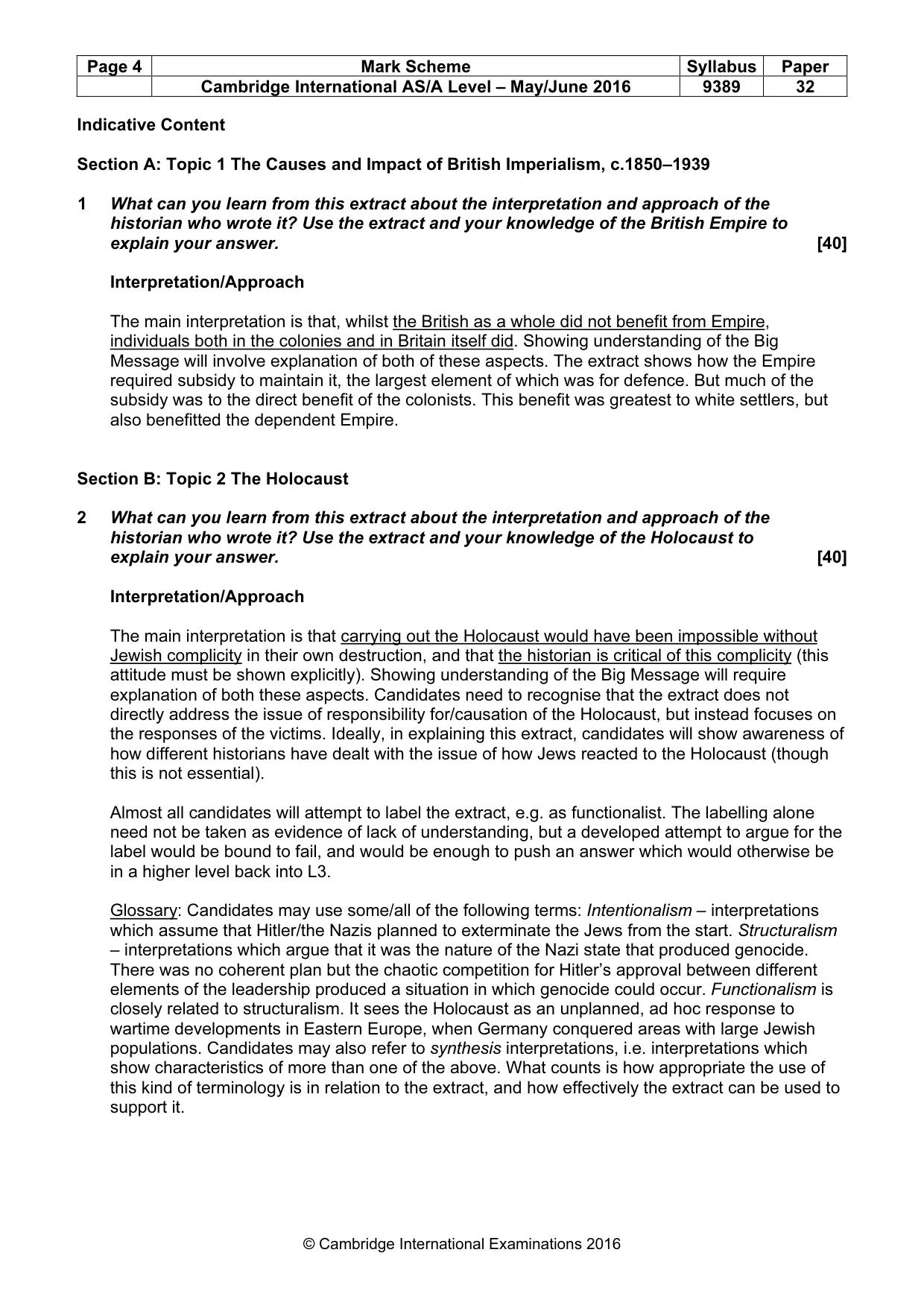
Page 4 Mark Scheme Syllabus Paper Cambridge International AS/A Level – May/June 2016 9389 32 © Cambridge International Examinations 2016 Indicative Content Section A: Topic 1 The Causes and Impact of British Imperialism, c.1850–1939 1 What can you learn from this extract about the interpretation and approach of the historian who wrote it? Use the extract and your knowledge of the British Empire to explain your answer. [40] Interpretation/Approach The main interpretation is that, whilst the British as a whole did not benefit from Empire, individuals both in the colonies and in Britain itself did. Showing understanding of the Big Message will involve explanation of both of these aspects. The extract shows how the Empire required subsidy to maintain it, the largest element of which was for defence. But much of the subsidy was to the direct benefit of the colonists. This benefit was greatest to white settlers, but also benefitted the dependent Empire. Section B: Topic 2 The Holocaust 2 What can you learn from this extract about the interpretation and approach of the historian who wrote it? Use the extract and your knowledge of the Holocaust to explain your answer. [40] Interpretation/Approach The main interpretation is that carrying out the Holocaust would have been impossible without Jewish complicity in their own destruction, and that the historian is critical of this complicity (this attitude must be shown explicitly). Showing understanding of the Big Message will require explanation of both these aspects. Candidates need to recognise that the extract does not directly address the issue of responsibility for/causation of the Holocaust, but instead focuses on the responses of the victims. Ideally, in explaining this extract, candidates will show awareness of how different historians have dealt with the issue of how Jews reacted to the Holocaust (though this is not essential). Almost all candidates will attempt to label the extract, e.g. as functionalist. The labelling alone need not be taken as evidence of lack of understanding, but a developed attempt to argue for the label would be bound to fail, and would be enough to push an answer which would otherwise be in a higher level back into L3. Glossary: Candidates may use some/all of the following terms: Intentionalism – interpretations which assume that Hitler/the Nazis planned to exterminate the Jews from the start. Structuralism – interpretations which argue that it was the nature of the Nazi state that produced genocide. There was no coherent plan but the chaotic competition for Hitler’s approval between different elements of the leadership produced a situation in which genocide could occur. Functionalism is closely related to structuralism. It sees the Holocaust as an unplanned, ad hoc response to wartime developments in Eastern Europe, when Germany conquered areas with large Jewish populations. Candidates may also refer to synthesis interpretations, i.e. interpretations which show characteristics of more than one of the above. What counts is how appropriate the use of this kind of terminology is in relation to the extract, and how effectively the extract can be used to support it.
Mark scheme, page 5
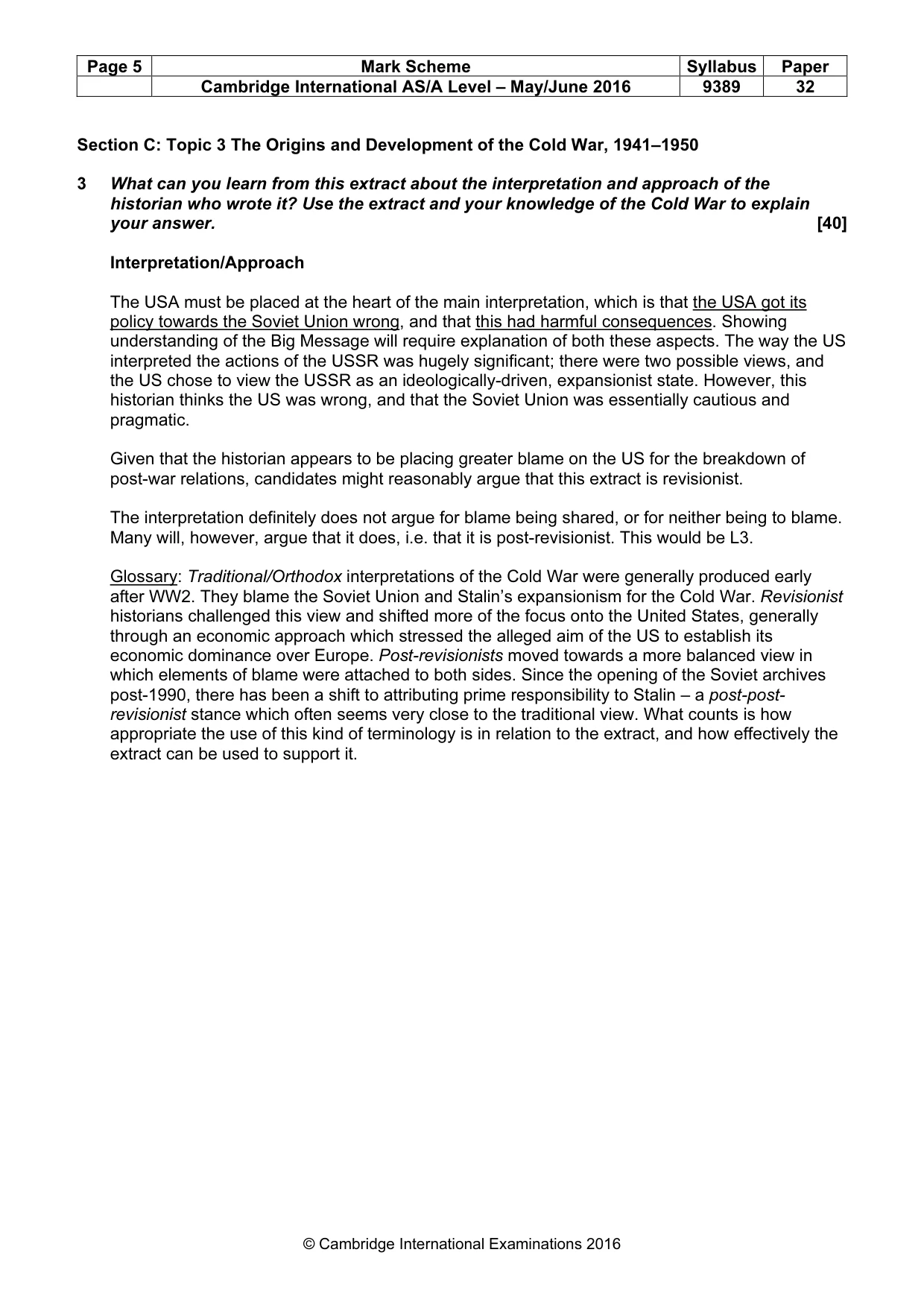
Page 5 Mark Scheme Syllabus Paper Cambridge International AS/A Level – May/June 2016 9389 32 © Cambridge International Examinations 2016 Section C: Topic 3 The Origins and Development of the Cold War, 1941–1950 3 What can you learn from this extract about the interpretation and approach of the historian who wrote it? Use the extract and your knowledge of the Cold War to explain your answer. [40] Interpretation/Approach The USA must be placed at the heart of the main interpretation, which is that the USA got its policy towards the Soviet Union wrong, and that this had harmful consequences. Showing understanding of the Big Message will require explanation of both these aspects. The way the US interpreted the actions of the USSR was hugely significant; there were two possible views, and the US chose to view the USSR as an ideologically-driven, expansionist state. However, this historian thinks the US was wrong, and that the Soviet Union was essentially cautious and pragmatic. Given that the historian appears to be placing greater blame on the US for the breakdown of post-war relations, candidates might reasonably argue that this extract is revisionist. The interpretation definitely does not argue for blame being shared, or for neither being to blame. Many will, however, argue that it does, i.e. that it is post-revisionist. This would be L3. Glossary: Traditional/Orthodox interpretations of the Cold War were generally produced early after WW2. They blame the Soviet Union and Stalin’s expansionism for the Cold War. Revisionist historians challenged this view and shifted more of the focus onto the United States, generally through an economic approach which stressed the alleged aim of the US to establish its economic dominance over Europe. Post-revisionists moved towards a more balanced view in which elements of blame were attached to both sides. Since the opening of the Soviet archives post-1990, there has been a shift to attributing prime responsibility to Stalin – a post-post- revisionist stance which often seems very close to the traditional view. What counts is how appropriate the use of this kind of terminology is in relation to the extract, and how effectively the extract can be used to support it.
What you needed in this session
Cambridge’s own grade thresholds for 2016 May/June, Paper 3 · Variant 2. A higher threshold means an easier paper — the bar moves with how the cohort did.