Cambridge A Level History 9389 — 2016 May/June Paper 3 · Variant 1
9389/31/M/J/16 · 40 marks · ≈45 min
The question paper and its mark scheme, free to read here and free to download. This is Cambridge’s own paper, exactly as it was sat.
Question paper4 pages
Mark scheme5 pages
Answers below. Sit the paper first if you are practising.
Paper as text
Question paper, page 1
This document consists of 4 printed pages and 1 Insert. DC (NF) 114558/1 © UCLES 2016 [Turn over Cambridge International Examinations Cambridge International Advanced Subsidiary and Advanced Level * 7 3 2 0 1 2 4 4 7 2 * HISTORY 9389/31 Paper 3 Interpretations Question May/June 2016 1 hour No Additional Materials are required. READ THESE INSTRUCTIONS FIRST An answer booklet is provided inside this question paper. You should follow the instructions on the front cover of the answer booklet. If you need additional answer paper ask the invigilator for a continuation booklet. This paper contains three sections: Section A: Topic 1 The Causes and Impact of British Imperialism, c. 1850–1939 Section B: Topic 2 The Holocaust Section C: Topic 3 The Origins and Development of the Cold War, 1941–1950 Answer the question on the topic you have studied. At the end of the examination, fasten all your work securely together. The marks are given in brackets [ ] at the end of each question.
Question paper, page 2
2 9389/31/M/J/16 © UCLES 2016 Section A: Topic 1 The Causes and Impact of British Imperialism, c.1850–1939 1 Read the extract and then answer the question. Wherever the British sought to plant their flag, they met with opposition. In almost every colony they had to fight their way ashore. While they could sometimes count on a handful of friends and allies, they never arrived as welcome guests, for the expansion of empire was nearly always conducted as a military operation. The initial opposition continued off and on, and in varying forms, in almost every colonial territory until independence. To retain control the British were obliged to establish systems of oppression on a global scale, both brutal and sophisticated. These in turn created new outbreaks of revolt. A self-satisfied belief survives in Britain that the Empire was an imaginative, civilising enterprise, reluctantly undertaken, that brought the benefits of modern society to backward peoples. Indeed it is often suggested that the British Empire was something of a model experience, unlike that of the French, the Dutch, the Germans, the Spaniards, the Portuguese – or, of course, the Americans. There is a widespread opinion that the British Empire was obtained and maintained with a minimum degree of force and with maximum cooperation from a grateful indigenous population. This benign, romanticised view of the past is not an understanding of their history that young people in the territories that once made up the Empire would now recognise. New generations have been recovering tales of rebellion, repression and resistance that make nonsense of the accepted imperial version of what went on. Focusing on resistance has been a way of challenging not just the traditional, self-indulgent view of the Empire, but also the customary depiction of the colonised as victims, lacking in agency or political will. Throughout the period of the British Empire, the British were for the most part loathed and despised by those they colonised. While a thin crust of colonial society in the Empire – princes, bureaucrats, settlers, mercenary soldiers – often gave open support to the British, the majority of the people always held the colonial occupiers in contempt and made their views plain whenever the opportunity arose. Resistance, revolt and rebellion were permanent facts of empire and the imperial power, endlessly challenged, was tireless in its repression. The sullen passivity, for most of the time, of the mass of the population gave a true indication of popular feeling. Individual murder, killings and assassination were sometimes the simplest responses that poor people could summon up to express their resentment of their alien conquerors, yet the long story of empire is littered with large-scale outbreaks of rage and fury, suppressed with great brutality. For much of its history, the British Empire was run as a military dictatorship. Colonial governors were often military men who imposed martial law whenever trouble threatened. ‘Special’ courts and courts martial were set up to deal with dissidents, and handed out speedy injustice. Normal judicial procedures were replaced by rule through terror; resistance was crushed, rebellion suffocated. The drive towards the annihilation of dissidents and peoples in twentieth-century Europe certainly had precedents in the nineteenth-century imperial operations in the colonial world, where the elimination of ‘inferior’ peoples was seen by some to be historically inevitable, and where the experience helped in the construction of the racist ideologies that arose subsequently in Europe. What can you learn from this extract about the interpretation and approach of the historian who wrote it? Use the extract and your knowledge of the British Empire to explain your answer. [40]
Question paper, page 3
3 9389/31/M/J/16 © UCLES 2016 [Turn over Section B: Topic 2 The Holocaust 2 Read the extract and then answer the question. The confidential Führer decree which authorised Himmler to ‘eliminate’ alien population groups without actually spelling out the details was in essence already no longer a decree on organisation but a command to fight and to destroy, delivered to a special group suited to this end. This sort of command, in so far as the content was kept secret from the regular organs of administration or could be disguised, was likely to be most easily carried out when a special group directly subordinate to the Führer was available, and which was tightly organised enough for the execution of the secret measures to take place without any particular attempt to inform and to involve the normal state organs. In Germany there was much less guarantee of maintaining secrecy or suppressing news about local measures of coercion than there was among the police-controlled population of Poland. The fact that the euthanasia action had to be abandoned in 1941 because complaints from the public, the judiciary and the administration multiplied, can be viewed as evidence of the fact that constitutional developments in the Führer state had not yet gone far enough within Germany itself for such actions to take place without friction. This experience undoubtedly contributed to the fact that the mass murder of the Jews was shifted to remote Polish and Soviet Russian areas and to the especially enlarged jurisdiction which Himmler possessed there. A small circle of SS leaders was fully informed, sworn to secrecy and authorised to act with specific reference to the ‘effect of law’ of the Führer’s will. Apart from this, other offices were only partially informed and involved. The emergency apparatus directly responsible to the Führer represented by the Security Police and the SS had become big enough and sufficiently independent to take charge of carrying out the mass crimes. The offices of the state administration which were still bound by the law were sufficiently split up and largely stripped of their security and self-confidence, and accordingly had become susceptible to manipulation. This was because of the lasting effects of competition with authorities directly subordinate to the Führer, through the infiltration of party personnel, ideological training etc. Thus they could be assigned what were often partly technical, legislative and executive functions (without being fully informed of the ultimate aims of the leadership) necessary to the development of the overall process of the final solution of the Jewish question. This criminal mass destruction of the Jews must not be seen simply as the continuation of the legal discrimination against Jews after 1933. Procedurally this was in fact a break with former practice and in that respect had a different quality. All the same, the previous laws and decrees which step by step had further discriminated against the Jews in Germany, had subjected them to emergency laws and had condemned them to a social ghetto, paved the way for the final solution. The progressive undermining of the principle of law through measures cast in legal form finally resulted in an utterly crude, lawless, criminal action. What can you learn from this extract about the interpretation and approach of the historian who wrote it? Use the extract and your knowledge of the Holocaust to explain your answer. [40]
Question paper, page 4
4 9389/31/M/J/16 © UCLES 2016 Section C: Topic 3 The Origins and Development of the Cold War, 1941–1950 3 Read the extract and then answer the question. There were four major assumptions on which the United States built its initial post-World War II policy. Washington officials first assumed that foreign policy grew directly from domestic policy; American actions abroad did not respond primarily to the pressures of other nations, but to political, social and economic forces at home. Policy-makers would consider the economic the most important of these forces, not unreasonably given the ghosts of the Great Depression. These ghosts led to a second assumption. The economic dislocations of the 1930s had inexorably led to political conflicts which had ignited World War II. Free flow of exports and imports was therefore essential. Third, the USA, quadrupling its production whilst other nations suffered severe wartime damage, wielded the required economic power to establish this desired world economic community. Finally, Washington determined to use this power; the USA would not sit on the side- lines. American officials hoped that this process would occur through the United Nations, the World Bank and the International Monetary Fund. American economic power necessarily made the USA the dominant force in these organisations. With considerably more brutality and less regard for the formalities of the United Nations Charter, Stalin constructed his post-war policy upon the necessity of maintaining freedom of action in spheres he considered vital for Soviet economic and strategic requirements. America’s open-world diplomacy crashed against Stalin’s iron curtain. Regardless of threats, whether economic or atomic, Stalin had reasons for not lifting the curtain. The Soviet peoples and leaders alike viewed almost everything in their lives through the memories of the horrors that struck from 1941 to 1945. Stalin’s objectives were accomplished by the Red Army’s occupation and consequent communisation of Eastern Europe. Ideology and personal ambition partly explained Stalin’s policies in this area. But the overriding requirement was the Soviets’ need for security and economic reconstruction. Here Stalin’s dilemma became strikingly evident. If he wished quick economic reconstruction, he would need American funds, since the United States possessed the only sufficient capital supply in the world. To obtain those funds, however, Stalin would have to loosen his control of Eastern Europe, allow American political and economic power to flow into the area, and consequently surrender what he considered to be the first essential of Soviet security. However, through absolute control of Eastern Europe, Stalin might obtain both security and, through forced seizures from those economies, the economic resources needed for Soviet reconstruction. Russia had lost one quarter of her capital equipment, 1700 towns, 70 000 villages, nearly 100 000 collective farms and more than 20 million dead during World War II. In 1945 Soviet steel production sunk to only one-eighth the amount of American production. Stalin imposed a communist system over Eastern Europe not because of ideology, but because, in the Russians’ view, both their security and economic requirements could be found in such a system. For American policy makers dedicated to creating a Western democratic world built on the Atlantic Charter Freedoms, Stalin’s moves posed the terrible problem of how to open the Soviet empire without alienating the Soviets. Given their assumptions of how the post-war world must work, Washington officials had little choice but to attempt to stop the descent of the curtain around Stalin’s domains. Otherwise the world would be divided, as in the late 1930s, into separate and hostile blocs. In these dilemmas lay the roots of the Cold War. What can you learn from this extract about the interpretation and approach of the historian who wrote it? Use the extract and your knowledge of the Cold War to explain your answer. [40] Permission to reproduce items where third-party owned material protected by copyright is included has been sought and cleared where possible. Every reasonable effort has been made by the publisher (UCLES) to trace copyright holders, but if any items requiring clearance have unwittingly been included, the publisher will be pleased to make amends at the earliest possible opportunity. To avoid the issue of disclosure of answer-related information to candidates, all copyright acknowledgements are reproduced online in the Cambridge International Examinations Copyright Acknowledgements Booklet. This is produced for each series of examinations and is freely available to download at www.cie.org.uk after the live examination series. Cambridge International Examinations is part of the Cambridge Assessment Group. Cambridge Assessment is the brand name of University of Cambridge Local Examinations Syndicate (UCLES), which is itself a department of the University of Cambridge.
Mark scheme, page 1
® IGCSE is the registered trademark of Cambridge International Examinations. This document consists of 5 printed pages. © UCLES 2016 [Turn over Cambridge International Examinations Cambridge International Advanced Subsidiary and Advanced Level HISTORY 9389/31 Paper 3 Interpretations Question May/June 2016 MARK SCHEME Maximum Mark: 40 Published This mark scheme is published as an aid to teachers and candidates, to indicate the requirements of the examination. It shows the basis on which Examiners were instructed to award marks. It does not indicate the details of the discussions that took place at an Examiners’ meeting before marking began, which would have considered the acceptability of alternative answers. Mark schemes should be read in conjunction with the question paper and the Principal Examiner Report for Teachers. Cambridge will not enter into discussions about these mark schemes. Cambridge is publishing the mark schemes for the May/June 2016 series for most Cambridge IGCSE®, Cambridge International A and AS Level components and some Cambridge O Level components.
Mark scheme, page 2
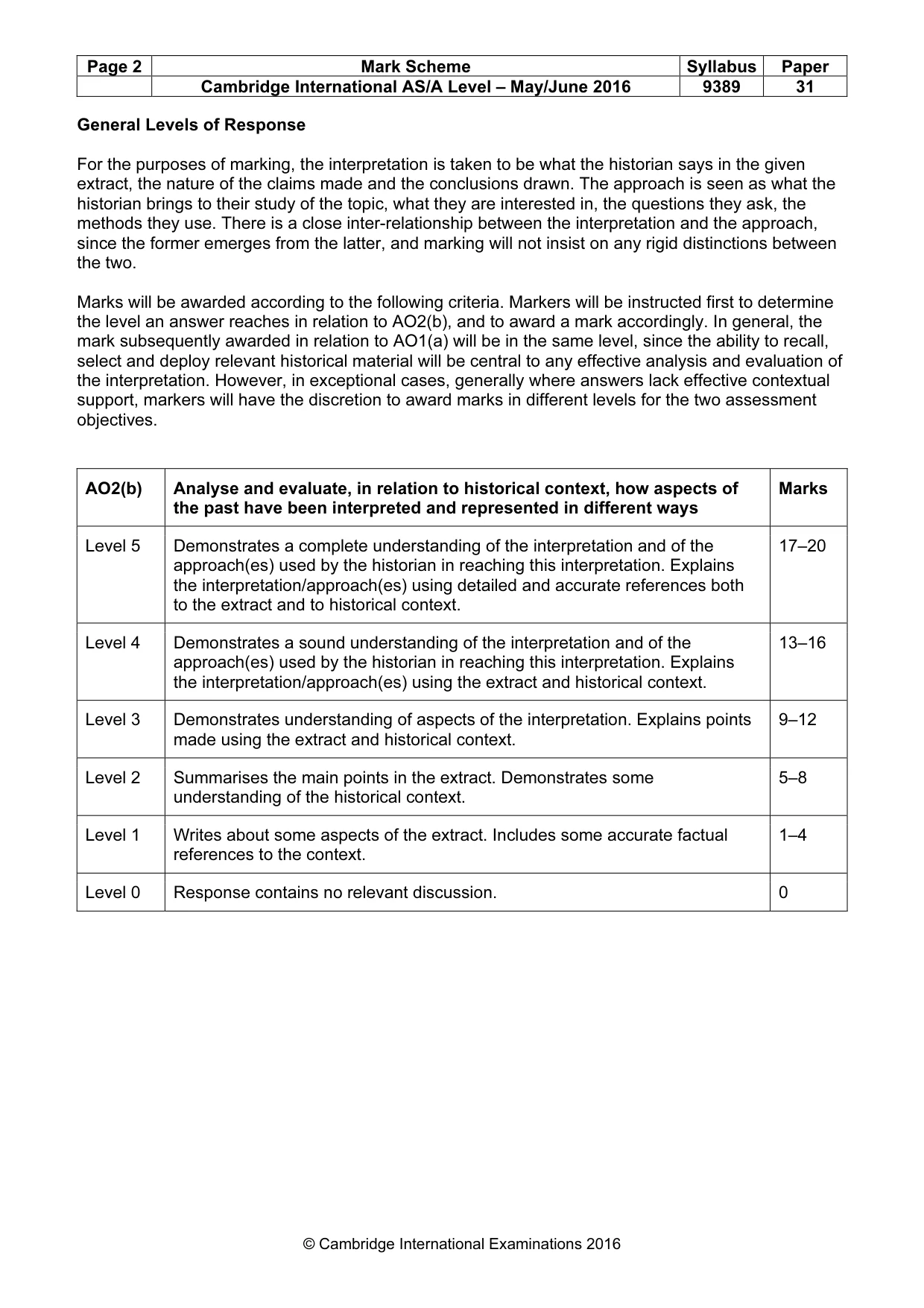
Page 2 Mark Scheme Syllabus Paper Cambridge International AS/A Level – May/June 2016 9389 31 © Cambridge International Examinations 2016 General Levels of Response For the purposes of marking, the interpretation is taken to be what the historian says in the given extract, the nature of the claims made and the conclusions drawn. The approach is seen as what the historian brings to their study of the topic, what they are interested in, the questions they ask, the methods they use. There is a close inter-relationship between the interpretation and the approach, since the former emerges from the latter, and marking will not insist on any rigid distinctions between the two. Marks will be awarded according to the following criteria. Markers will be instructed first to determine the level an answer reaches in relation to AO2(b), and to award a mark accordingly. In general, the mark subsequently awarded in relation to AO1(a) will be in the same level, since the ability to recall, select and deploy relevant historical material will be central to any effective analysis and evaluation of the interpretation. However, in exceptional cases, generally where answers lack effective contextual support, markers will have the discretion to award marks in different levels for the two assessment objectives. AO2(b) Analyse and evaluate, in relation to historical context, how aspects of the past have been interpreted and represented in different ways Marks Level 5 Demonstrates a complete understanding of the interpretation and of the approach(es) used by the historian in reaching this interpretation. Explains the interpretation/approach(es) using detailed and accurate references both to the extract and to historical context. 17–20 Level 4 Demonstrates a sound understanding of the interpretation and of the approach(es) used by the historian in reaching this interpretation. Explains the interpretation/approach(es) using the extract and historical context. 13–16 Level 3 Demonstrates understanding of aspects of the interpretation. Explains points made using the extract and historical context. 9–12 Level 2 Summarises the main points in the extract. Demonstrates some understanding of the historical context. 5–8 Level 1 Writes about some aspects of the extract. Includes some accurate factual references to the context. 1–4 Level 0 Response contains no relevant discussion. 0
Mark scheme, page 3
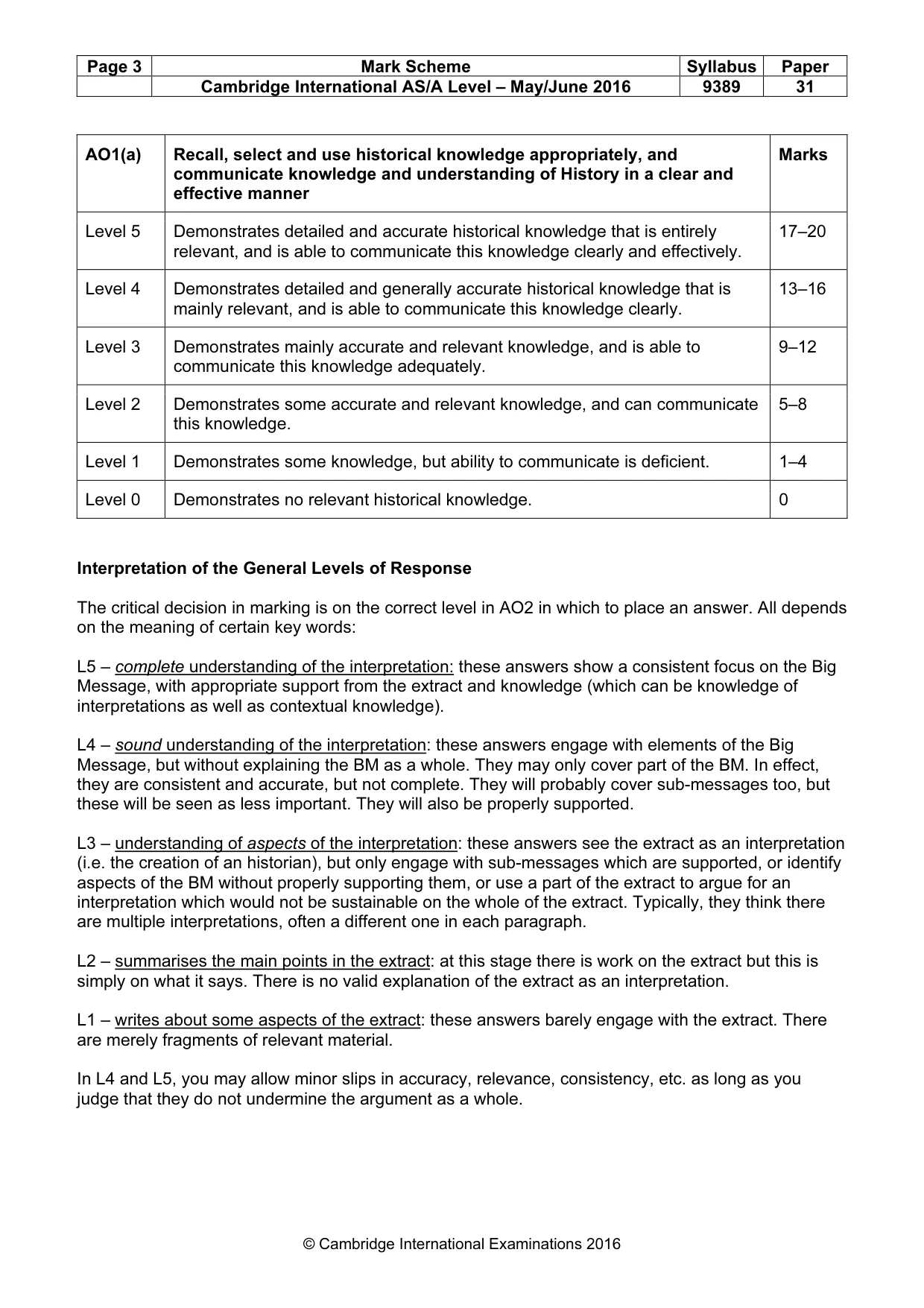
Page 3 Mark Scheme Syllabus Paper Cambridge International AS/A Level – May/June 2016 9389 31 © Cambridge International Examinations 2016 AO1(a) Recall, select and use historical knowledge appropriately, and communicate knowledge and understanding of History in a clear and effective manner Marks Level 5 Demonstrates detailed and accurate historical knowledge that is entirely relevant, and is able to communicate this knowledge clearly and effectively. 17–20 Level 4 Demonstrates detailed and generally accurate historical knowledge that is mainly relevant, and is able to communicate this knowledge clearly. 13–16 Level 3 Demonstrates mainly accurate and relevant knowledge, and is able to communicate this knowledge adequately. 9–12 Level 2 Demonstrates some accurate and relevant knowledge, and can communicate this knowledge. 5–8 Level 1 Demonstrates some knowledge, but ability to communicate is deficient. 1–4 Level 0 Demonstrates no relevant historical knowledge. 0 Interpretation of the General Levels of Response The critical decision in marking is on the correct level in AO2 in which to place an answer. All depends on the meaning of certain key words: L5 – complete understanding of the interpretation: these answers show a consistent focus on the Big Message, with appropriate support from the extract and knowledge (which can be knowledge of interpretations as well as contextual knowledge). L4 – sound understanding of the interpretation: these answers engage with elements of the Big Message, but without explaining the BM as a whole. They may only cover part of the BM. In effect, they are consistent and accurate, but not complete. They will probably cover sub-messages too, but these will be seen as less important. They will also be properly supported. L3 – understanding of aspects of the interpretation: these answers see the extract as an interpretation (i.e. the creation of an historian), but only engage with sub-messages which are supported, or identify aspects of the BM without properly supporting them, or use a part of the extract to argue for an interpretation which would not be sustainable on the whole of the extract. Typically, they think there are multiple interpretations, often a different one in each paragraph. L2 – summarises the main points in the extract: at this stage there is work on the extract but this is simply on what it says. There is no valid explanation of the extract as an interpretation. L1 – writes about some aspects of the extract: these answers barely engage with the extract. There are merely fragments of relevant material. In L4 and L5, you may allow minor slips in accuracy, relevance, consistency, etc. as long as you judge that they do not undermine the argument as a whole.
Mark scheme, page 4
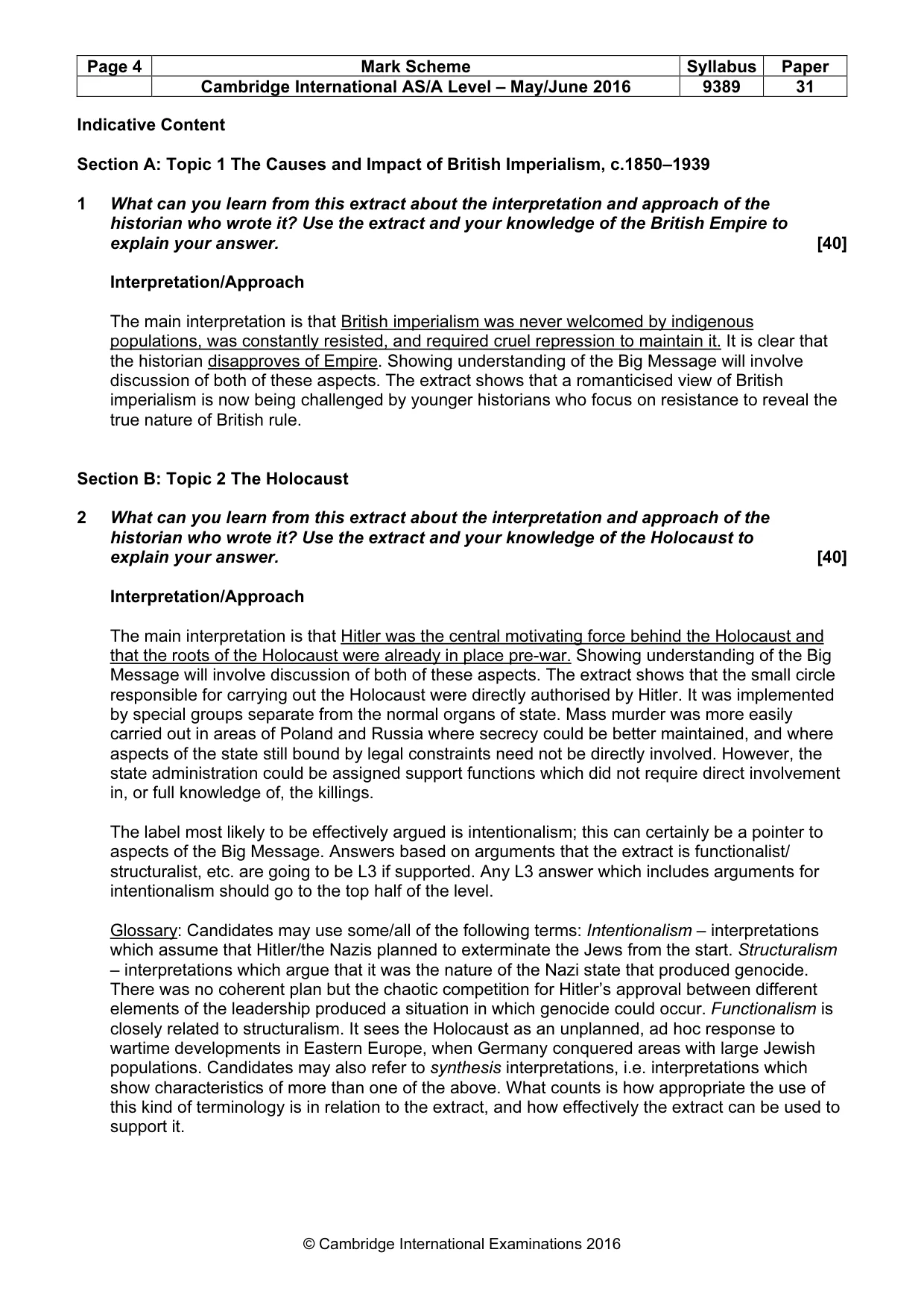
Page 4 Mark Scheme Syllabus Paper Cambridge International AS/A Level – May/June 2016 9389 31 © Cambridge International Examinations 2016 Indicative Content Section A: Topic 1 The Causes and Impact of British Imperialism, c.1850–1939 1 What can you learn from this extract about the interpretation and approach of the historian who wrote it? Use the extract and your knowledge of the British Empire to explain your answer. [40] Interpretation/Approach The main interpretation is that British imperialism was never welcomed by indigenous populations, was constantly resisted, and required cruel repression to maintain it. It is clear that the historian disapproves of Empire. Showing understanding of the Big Message will involve discussion of both of these aspects. The extract shows that a romanticised view of British imperialism is now being challenged by younger historians who focus on resistance to reveal the true nature of British rule. Section B: Topic 2 The Holocaust 2 What can you learn from this extract about the interpretation and approach of the historian who wrote it? Use the extract and your knowledge of the Holocaust to explain your answer. [40] Interpretation/Approach The main interpretation is that Hitler was the central motivating force behind the Holocaust and that the roots of the Holocaust were already in place pre-war. Showing understanding of the Big Message will involve discussion of both of these aspects. The extract shows that the small circle responsible for carrying out the Holocaust were directly authorised by Hitler. It was implemented by special groups separate from the normal organs of state. Mass murder was more easily carried out in areas of Poland and Russia where secrecy could be better maintained, and where aspects of the state still bound by legal constraints need not be directly involved. However, the state administration could be assigned support functions which did not require direct involvement in, or full knowledge of, the killings. The label most likely to be effectively argued is intentionalism; this can certainly be a pointer to aspects of the Big Message. Answers based on arguments that the extract is functionalist/ structuralist, etc. are going to be L3 if supported. Any L3 answer which includes arguments for intentionalism should go to the top half of the level. Glossary: Candidates may use some/all of the following terms: Intentionalism – interpretations which assume that Hitler/the Nazis planned to exterminate the Jews from the start. Structuralism – interpretations which argue that it was the nature of the Nazi state that produced genocide. There was no coherent plan but the chaotic competition for Hitler’s approval between different elements of the leadership produced a situation in which genocide could occur. Functionalism is closely related to structuralism. It sees the Holocaust as an unplanned, ad hoc response to wartime developments in Eastern Europe, when Germany conquered areas with large Jewish populations. Candidates may also refer to synthesis interpretations, i.e. interpretations which show characteristics of more than one of the above. What counts is how appropriate the use of this kind of terminology is in relation to the extract, and how effectively the extract can be used to support it.
Mark scheme, page 5
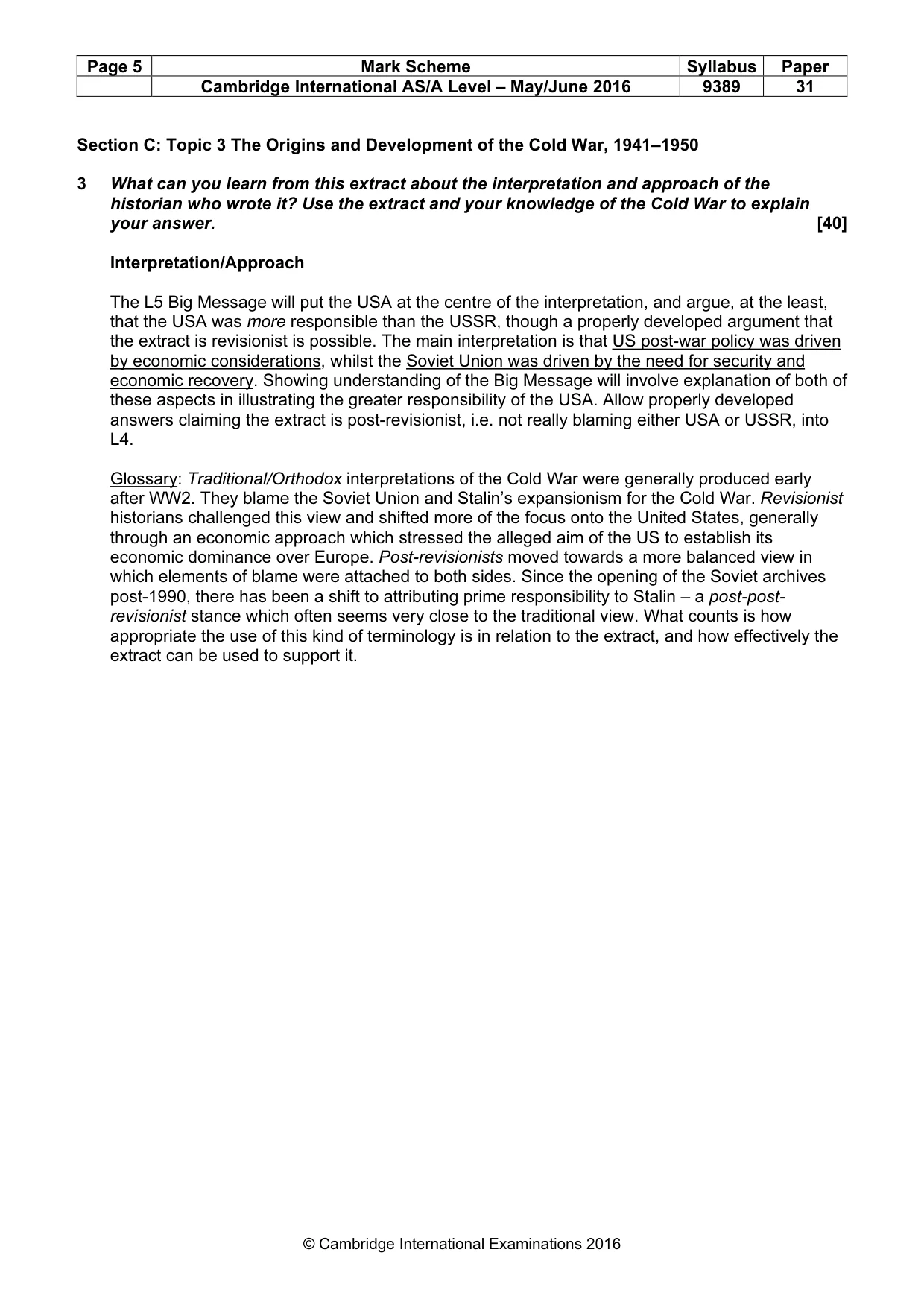
Page 5 Mark Scheme Syllabus Paper Cambridge International AS/A Level – May/June 2016 9389 31 © Cambridge International Examinations 2016 Section C: Topic 3 The Origins and Development of the Cold War, 1941–1950 3 What can you learn from this extract about the interpretation and approach of the historian who wrote it? Use the extract and your knowledge of the Cold War to explain your answer. [40] Interpretation/Approach The L5 Big Message will put the USA at the centre of the interpretation, and argue, at the least, that the USA was more responsible than the USSR, though a properly developed argument that the extract is revisionist is possible. The main interpretation is that US post-war policy was driven by economic considerations, whilst the Soviet Union was driven by the need for security and economic recovery. Showing understanding of the Big Message will involve explanation of both of these aspects in illustrating the greater responsibility of the USA. Allow properly developed answers claiming the extract is post-revisionist, i.e. not really blaming either USA or USSR, into L4. Glossary: Traditional/Orthodox interpretations of the Cold War were generally produced early after WW2. They blame the Soviet Union and Stalin’s expansionism for the Cold War. Revisionist historians challenged this view and shifted more of the focus onto the United States, generally through an economic approach which stressed the alleged aim of the US to establish its economic dominance over Europe. Post-revisionists moved towards a more balanced view in which elements of blame were attached to both sides. Since the opening of the Soviet archives post-1990, there has been a shift to attributing prime responsibility to Stalin – a post-post- revisionist stance which often seems very close to the traditional view. What counts is how appropriate the use of this kind of terminology is in relation to the extract, and how effectively the extract can be used to support it.
What you needed in this session
Cambridge’s own grade thresholds for 2016 May/June, Paper 3 · Variant 1. A higher threshold means an easier paper — the bar moves with how the cohort did.