Cambridge A Level History 9389 — 2016 May/June Paper 2 · Variant 2
9389/22/M/J/16 · 60 marks · ≈68 min
The question paper and its mark scheme, free to read here and free to download. This is Cambridge’s own paper, exactly as it was sat.
Question paper4 pages
Mark scheme13 pages
Answers below. Sit the paper first if you are practising.
Paper as text
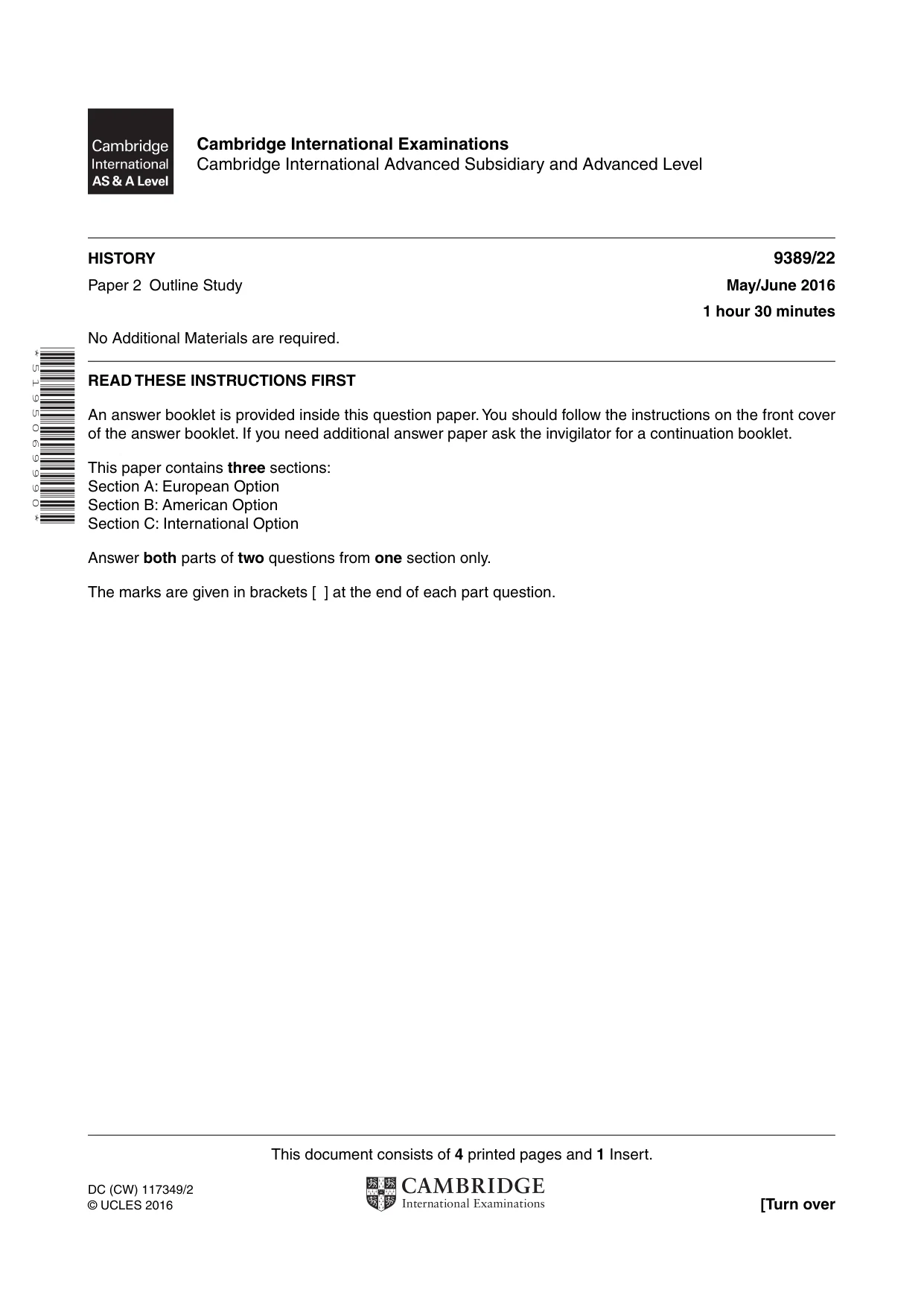
Question paper, page 1
This document consists of 4 printed pages and 1 Insert. DC (CW) 117349/2 © UCLES 2016 [Turn over * 5 1 9 5 0 6 9 9 9 0 * HISTORY 9389/22 Paper 2 Outline Study May/June 2016 1 hour 30 minutes No Additional Materials are required. READ THESE INSTRUCTIONS FIRST An answer booklet is provided inside this question paper. You should follow the instructions on the front cover of the answer booklet. If you need additional answer paper ask the invigilator for a continuation booklet. This paper contains three sections: Section A: European Option Section B: American Option Section C: International Option Answer both parts of two questions from one section only. The marks are given in brackets [ ] at the end of each part question. Cambridge International Examinations Cambridge International Advanced Subsidiary and Advanced Level
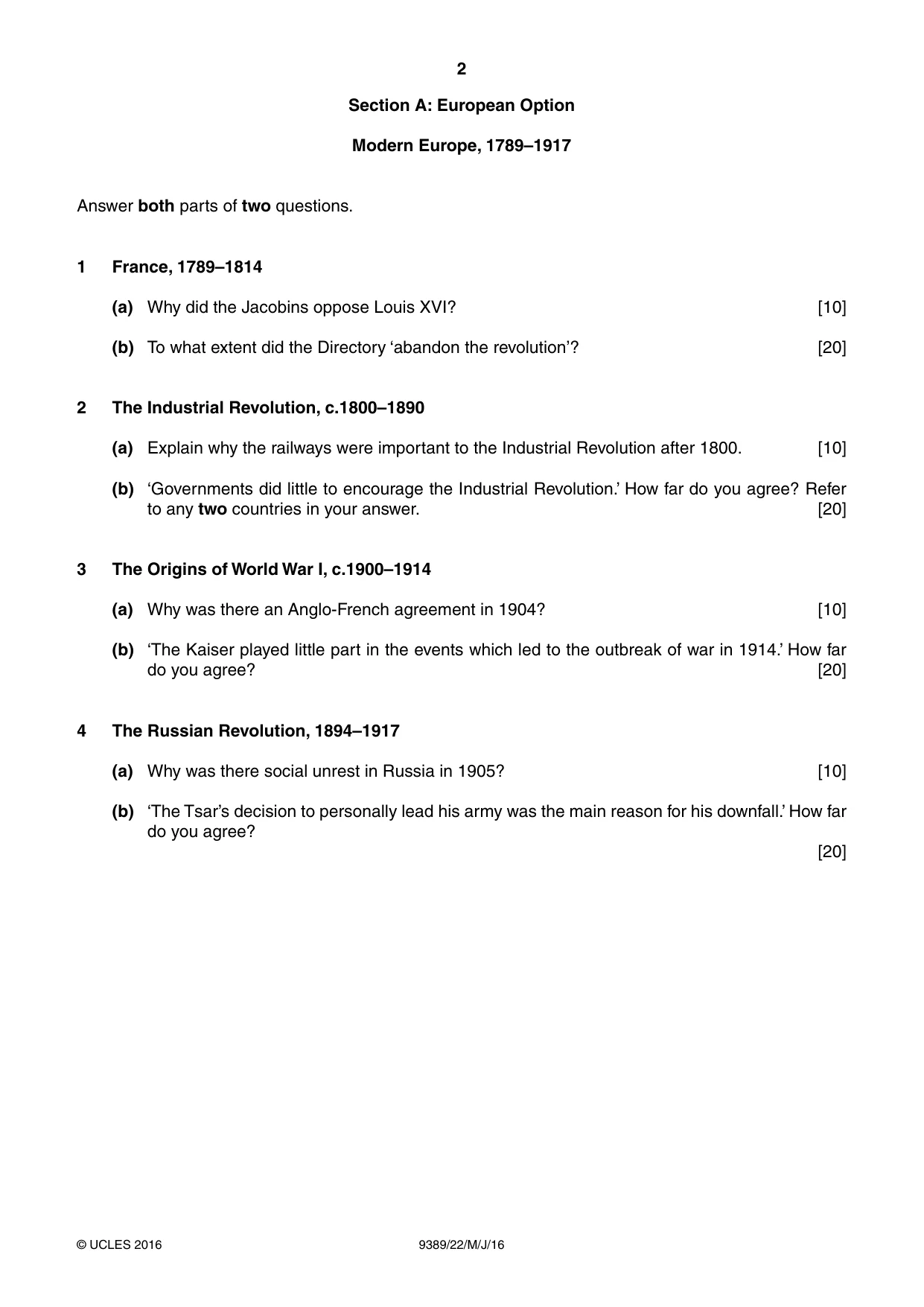
Question paper, page 2
2 9389/22/M/J/16 © UCLES 2016 Section A: European Option Modern Europe, 1789–1917 Answer both parts of two questions. 1 France, 1789–1814 (a) Why did the Jacobins oppose Louis XVI? [10] (b) To what extent did the Directory ‘abandon the revolution’? [20] 2 The Industrial Revolution, c.1800–1890 (a) Explain why the railways were important to the Industrial Revolution after 1800. [10] (b) ‘Governments did little to encourage the Industrial Revolution.’ How far do you agree? Refer to any two countries in your answer. [20] 3 The Origins of World War I, c.1900–1914 (a) Why was there an Anglo-French agreement in 1904? [10] (b) ‘The Kaiser played little part in the events which led to the outbreak of war in 1914.’ How far do you agree? [20] 4 The Russian Revolution, 1894–1917 (a) Why was there social unrest in Russia in 1905? [10] (b) ‘The Tsar’s decision to personally lead his army was the main reason for his downfall.’ How far do you agree? [20]
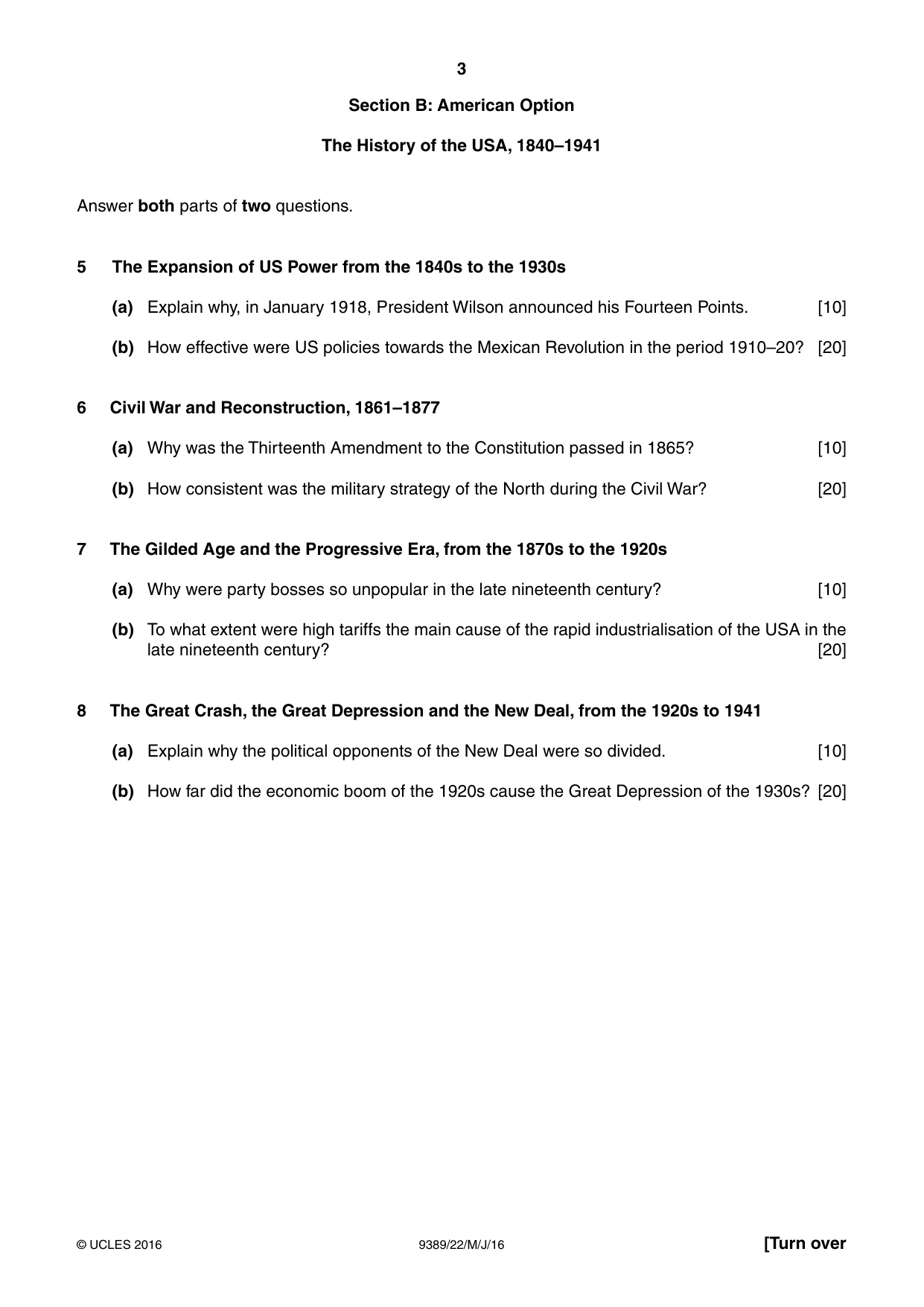
Question paper, page 3
3 9389/22/M/J/16 © UCLES 2016 [Turn over Section B: American Option The History of the USA, 1840–1941 Answer both parts of two questions. 5 The Expansion of US Power from the 1840s to the 1930s (a) Explain why, in January 1918, President Wilson announced his Fourteen Points. [10] (b) How effective were US policies towards the Mexican Revolution in the period 1910–20? [20] 6 Civil War and Reconstruction, 1861–1877 (a) Why was the Thirteenth Amendment to the Constitution passed in 1865? [10] (b) How consistent was the military strategy of the North during the Civil War? [20] 7 The Gilded Age and the Progressive Era, from the 1870s to the 1920s (a) Why were party bosses so unpopular in the late nineteenth century? [10] (b) To what extent were high tariffs the main cause of the rapid industrialisation of the USA in the late nineteenth century? [20] 8 The Great Crash, the Great Depression and the New Deal, from the 1920s to 1941 (a) Explain why the political opponents of the New Deal were so divided. [10] (b) How far did the economic boom of the 1920s cause the Great Depression of the 1930s? [20]
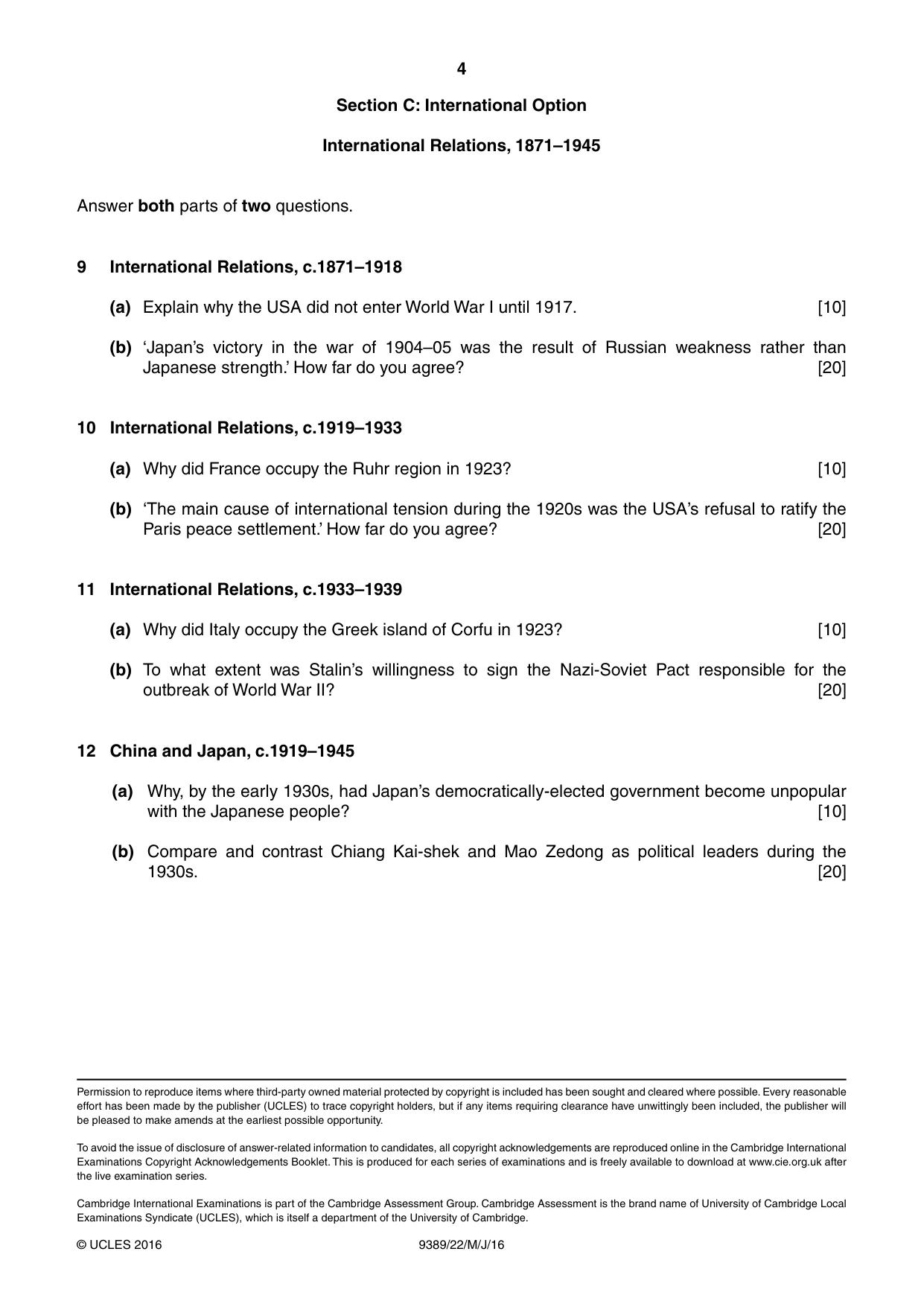
Question paper, page 4
4 9389/22/M/J/16 © UCLES 2016 Permission to reproduce items where third-party owned material protected by copyright is included has been sought and cleared where possible. Every reasonable effort has been made by the publisher (UCLES) to trace copyright holders, but if any items requiring clearance have unwittingly been included, the publisher will be pleased to make amends at the earliest possible opportunity. To avoid the issue of disclosure of answer-related information to candidates, all copyright acknowledgements are reproduced online in the Cambridge International Examinations Copyright Acknowledgements Booklet. This is produced for each series of examinations and is freely available to download at www.cie.org.uk after the live examination series. Cambridge International Examinations is part of the Cambridge Assessment Group. Cambridge Assessment is the brand name of University of Cambridge Local Examinations Syndicate (UCLES), which is itself a department of the University of Cambridge. Section C: International Option International Relations, 1871–1945 Answer both parts of two questions. 9 International Relations, c.1871–1918 (a) Explain why the USA did not enter World War I until 1917. [10] (b) ‘Japan’s victory in the war of 1904–05 was the result of Russian weakness rather than Japanese strength.’ How far do you agree? [20] 10 International Relations, c.1919–1933 (a) Why did France occupy the Ruhr region in 1923? [10] (b) ‘The main cause of international tension during the 1920s was the USA’s refusal to ratify the Paris peace settlement.’ How far do you agree? [20] 11 International Relations, c.1933–1939 (a) Why did Italy occupy the Greek island of Corfu in 1923? [10] (b) To what extent was Stalin’s willingness to sign the Nazi-Soviet Pact responsible for the outbreak of World War II? [20] 12 China and Japan, c.1919–1945 (a) Why, by the early 1930s, had Japan’s democratically-elected government become unpopular with the Japanese people? [10] (b) Compare and contrast Chiang Kai-shek and Mao Zedong as political leaders during the 1930s. [20]
Mark scheme, page 1
® IGCSE is the registered trademark of Cambridge International Examinations. This document consists of 13 printed pages. © UCLES 2016 [Turn over Cambridge International Examinations Cambridge International Advanced Subsidiary and Advanced Level HISTORY 9389/22 Paper 2 Outline Study 22 May/June 2016 MARK SCHEME Maximum Mark: 60 Published This mark scheme is published as an aid to teachers and candidates, to indicate the requirements of the examination. It shows the basis on which Examiners were instructed to award marks. It does not indicate the details of the discussions that took place at an Examiners’ meeting before marking began, which would have considered the acceptability of alternative answers. Mark schemes should be read in conjunction with the question paper and the Principal Examiner Report for Teachers. Cambridge will not enter into discussions about these mark schemes. Cambridge is publishing the mark schemes for the May/June 2016 series for most Cambridge IGCSE®, Cambridge International A and AS Level components and some Cambridge O Level components.
Mark scheme, page 2
Page 2 Mark Scheme Syllabus Paper Cambridge International AS/A Level – May/June 2016 9389 22 © Cambridge International Examinations 2016 Generic levels of response Part (a) Level 4: Evaluates factors [9–10] Answers are well focused and identify and explain a range of factors. Answers are supported by precise evidence and demonstrate clear understanding of the connections between causes. Answers consider the relative significance of factors and reach a supported conclusion. Level 3: Explains factors [6–8] Answers demonstrate good understanding of the demands of the question, providing relevant explanations supported by relevant and detailed information. Answers are clearly expressed. Candidates may attempt to reach a judgement about the significance of factors but this may not be effectively supported. Level 2: Describes factors [3–5] Answers show some knowledge and understanding of the demands of the question. Answers are either entirely descriptive in approach with few explicit links to the question, or they provide some explanation which is supported by information which is limited in range and depth. Level 1: Describes the topic/issue [1–2] Answers contain some relevant material but are descriptive in nature, making little reference to causation. Answers may be assertive or generalised. The response is limited in development. Level 0: Answers contain no relevant content [0] Part (b) Level 5: Responses which develop a sustained judgement [18–20] Answers are well focused and closely argued. Arguments are supported by precisely selected evidence. They lead to a relevant conclusion/judgement which is developed and supported. They are fluent and well organised. Level 4: Responses which develop a balanced argument [15–17] Answers show explicit understanding of the demands of the question. They develop a balanced argument supported by a good range of appropriately selected evidence. They begin to form a judgement in response to the question. At this level the judgement may be partial or not fully supported. Level 3: Responses which begin to develop assessment [10–14] Answers show a developed understanding of the demands of the question. They provide some assessment, supported by relevant and appropriately selected evidence. However, these answers are likely to lack depth and/or balance. Answers are generally coherent and well organised. Level 2: Responses which show some understanding of the question [6–9] Answers show some understanding of the focus of the question. They are either entirely descriptive with few explicit links to the question or they may contain some explicit comment with relevant but limited support. Level 1: Descriptive or partial responses [1–5] Answers contain descriptive material which is only loosely linked to the focus of the question. They may only address part of the question. Alternatively, there may be some explicit comment on the question which lacks detailed factual support. Answers are likely to be generalised and assertive. Answers may be fragmentary and disjointed. Level 0: Answers contain no relevant content [0]
Mark scheme, page 3
Page 3 Mark Scheme Syllabus Paper Cambridge International AS/A Level – May/June 2016 9389 22 © Cambridge International Examinations 2016 Section A: European Option Modern Europe, 1789–1917 1 France, 1789–1814 (a) Why did the Jacobins oppose Louis XVI? [10] A wide range of possible reasons can be considered. They certainly wished to gain leadership of the revolutionary process and spearheaded the move away from the Estates General/National Assembly status. They were primarily democrats and parliamentarians and wished to move at least towards a constitutional settlement. They were patriotic and also essentially egalitarian. They wished to protect the gains of the revolution by force and radical means if necessary. Many were anti-Christian, some just anti-clerical, and underneath it all, radicals. Some were enthusiastic about the execution of the monarchy and it was a definite aim for them; for others it was something rather imposed on them. An end to the Ancien Régime and a move towards a much more egalitarian society was certainly a factor that united them all. (b) To what extent did the Directory ‘abandon the revolution’? [20] It was a charge levelled at them, and how justified it was needs to be reflected on. They certainly managed in some cases to build on the huge achievements of 1791–2 and they were a great deal more than a chaotic transitional regime which they have been accused of. They actually made democratic institutions work for a time which, given the background, was a remarkable achievement and it was certainly not their intention to make a profound change in direction backwards. There was a fairly broad franchise there, far broader than that of their British or Dutch neighbours, and there were also frequent elections and a remarkably free press. They had some good ideas of financial administration which were a great deal more egalitarian in concept than any of those of the Ancien Régime. There was a much better system of local movement and sensible tax-raising ideas. They really did try very hard to make constitutionalism work. Inevitably the ‘coups’ were to damage the reputation of the Directory and authoritarian methods had to be used at times. Perhaps the charge is better levelled at the regime which replaced it? 2 The Industrial Revolution, c.1800–1890 (a) Explain why the railways were important to the Industrial Revolution after 1800. [10] It could be stated that they ‘were’ the Industrial Revolution in some areas. Their impact was massive. Not only did they have an insatiable demand for coal, iron, steel, labour, banking services and investment which was an enormous stimulus, but they also enabled the transportation of huge quantities of raw materials, finished goods, foodstuffs and people quickly and efficiently. Their stimulus to capitalism, technical innovation, engineering and organisational growth/development was also massive. There is a great deal to choose from.
Mark scheme, page 4
Page 4 Mark Scheme Syllabus Paper Cambridge International AS/A Level – May/June 2016 9389 22 © Cambridge International Examinations 2016 (b) ‘Governments did little to encourage the Industrial Revolution.’ How far do you agree? Refer to any two countries in your answer. [20] Governments had a mixed record in this respect. Certainly the laissez faire policy of the UK proved to be of enormous benefit and Parliament’s willingness to pass legislation, such as enclosure acts and new patent laws, was of great help. Governments tended universally to be hostile to labour organising itself which, of course, benefitted the manufacturer and employer. Some encouraged far too much regulation and control; France was often an example of this, which was to stifle growth. Guilds with their restrictive practices were encouraged and supported by some, and actively discouraged by others. Attitudes to the growth of capitalism and banking could vary. Some were hostile to the degree of social mobility which resulted from change, others actively encouraged it. The willingness to assist in creating new markets, defending those already gained was important, as was the attitude to free trade and open markets. The best responses will have specific examples from named countries and avoid generalisations. 3 The Origins of World War I, c.1900–1914 (a) Why was there an Anglo-French agreement in 1904? [10] A variety of factors provided the stimulus to end a long-standing rivalry and potential for hostilities. There was a need to sort out major colonial differences which had nearly caused conflict at Fashoda in the Nile area but also in West Africa and in Siam. Both countries felt the need for agreement in order to consolidate and develop their gains in Africa. France was enmeshed in the Dreyfus Affair and the government there needed some good news. France, always worried about Germany, was beginning to have doubts about Russia’s commitment to them as an ally. The British were increasingly worried about a German threat. The Kruger telegram had irritated and angered, and German spending on their navy was worrying. The British also were hoping to use French backing to repress possible Russian ambitions in Asia. (b) ‘The Kaiser played little part in the events which led to the outbreak of war in 1914.’ How far do you agree? [20] He certainly felt that it was the case and there are those who defend him, perhaps with difficulty. His planners, with their Schlieffen Plan, can be accredited with some blame, but it was the Kaiser who failed to spot the horrendous possible implications of carrying it out. His role in the ‘blank cheque’ and above all during July and early August 1914 was critical. Whether he would have been capable of preventing a strong Austrian response to the assassination is also arguable. He was the key decision-maker in Germany and his role was significant. However, there are many other factors. The Tsar was irresponsible and overanxious to remedy the humiliation of 1905. The British and the French cannot escape blame either. The fact that at critical moments he was away on holiday with limited communication could also be seen as a factor.
Mark scheme, page 5
Page 5 Mark Scheme Syllabus Paper Cambridge International AS/A Level – May/June 2016 9389 22 © Cambridge International Examinations 2016 4 The Russian Revolution, 1894–1917 (a) Why was there social unrest in Russia in 1905? [10] A variety of reasons could be considered. There was the growth of an educated middle class who were denied any role in the government of the country – men such as Lenin and Trotsky. Domination by a ‘divine’ ruler and an autocratic aristocracy was out of place in the 20th century. Serfdom had ended, but the costs to the peasantry were still substantial and a semi-feudal system still existed in the countryside with a huge gap between the rich and the poor. Real wages were falling and hunger was still a real issue. Industrialisation brought urbanisation which encouraged working class organisation which was unhappy about appalling living and working conditions. The humiliation of Tsushima and Port Arthur did not help either. Conscription was still a real burden on the peasantry. (b) ‘The Tsar’s decision to personally lead his army was the main reason for his downfall.’ How far do you agree? [20] The Tsar took the decision to make himself the supreme commander without any of the necessary experience or competence, and yet took both strategic and tactical control of huge forces without any awareness of the implications of his decisions. Many of the disasters of 1916 and early 1917 can be attributed directly to his decision-making. Some of the gains made under the Provisional Government in the middle of 1917 show that there was scope for much better leadership. However, Russia was not ready for war in 1914. The infrastructure was not there and the early problems of troops without food or weapons were to last throughout the war. The regime as a whole was totally unsuited to conducting a modern war. The Tsar handed over the day-to-day running of the country to the Tsarina. The people did not trust her due to her German background and the influence that Rasputin had over her. She dismissed able ministers and constant ministerial changes led to disorganisation of supplies of food and fuel to the cities. Desperate conditions led to demonstrations in 1917. The soldiers turned on the officers and joined the protesters. The Tsar's ill-advised gamble in publicly associating himself so closely with the success of his army had backfired in both showing his personal weakness as a military leader and through neglecting to ensure that Russia was well governed domestically during the war. In order to ensure balance, the relative significance of other factors needs to be considered.
Mark scheme, page 6
Page 6 Mark Scheme Syllabus Paper Cambridge International AS/A Level – May/June 2016 9389 22 © Cambridge International Examinations 2016 Section B: American Option The History of the USA, 1840–1941 5 The Expansion of US Power from the 1840s to the 1930s (a) Explain why, in January 1918, President Wilson announced his Fourteen Points. [10] Wilson won a second presidential election in 1916, when he was described as ‘the man who kept us out of the war’. Following the return of unrestricted submarine warfare by Germany, the USA entered the First World War in April 1917, marking a major departure from the USA’s traditional stance of non-intervention in European conflicts. In October 1917, the Bolsheviks seized power in Russia and gained an important propaganda victory by publishing secret treaties agreed by the allies which showed the territorial ambitions of the allied powers. The British Prime Minister, Lloyd George, made a speech outlining Britain’s plan for the world after war. Faced with the contrasting approaches of revolutionary Russia and traditionalist Britain, Wilson set out the American vision for the post-war world. It would be a very different world from that before 1914. He wanted a new form of diplomacy, based on an international organisation rather than the balance of power and on the rule of international law. His speech was an assertion of American leadership of the allied war effort. Even before the USA joined the war, Wilson was expressing his desire for US involvement in shaping the post-war world. He was something of a liberal idealist and as the war came to an end, he believed in his mission to lead the world away from the old ways. (b) How effective were US policies towards the Mexican Revolution in the period 1910– 1920? [20] The Mexican Revolution of 1910–20 was a complex series of events as the overthrow of the 34-year-old dictatorship of Porfirio Diaz in 1910–11 led to a complex series of struggles for power over the next decade before some kind of stability was restored. President Taft [1909– 1913] was cautious, especially when in late 1912 he became a lame duck president. President Wilson was much more interventionist. Initially he hoped US intervention would bring about some kind of democratic government. He took strong objection to General Huerta, who had come to power in 1913 by a military coup and refused to introduce democratic elections. In 1914, Wilson did send troops into the port of Vera Cruz after a minor incident at Tampico involving US sailors. The troops stayed for seven months, causing anti- American protests across Latin America. Eventually, Huerta was overthrown to be replaced by Carranza, a skilful nationalist politician who led Mexico until his assassination in 1920. Carranza initially faced opposition from Zapata in the south and Pancho Villa in the north. When Villa attacked a town in New Mexico in March 1916, Wilson had to send in another and larger force to capture Pancho Villa. General Pershing led a punitive force of c.10 000 troops into Mexico but never achieved its prime goal. The forces stayed until January 1917. By then, Carranza had managed to establish some kind of order with the 1917 constitution which remained after his death under Obregon. He gradually established better relations with the USA. Overall, US policies did not affect Mexico in the ways that Wilson had intended. More often they were counter- productive. American economic interests in Mexican oilfields, for example, were restricted by Article 27 of the 1917 constitution.
Mark scheme, page 7
Page 7 Mark Scheme Syllabus Paper Cambridge International AS/A Level – May/June 2016 9389 22 © Cambridge International Examinations 2016 6 Civil War and Reconstruction, 1861–1877 (a) Why was the Thirteenth Amendment to the Constitution passed in 1865? [10] The Thirteenth Amendment abolished slavery. It gained the necessary two-thirds majority in the US Senate in April 1864 and in the US House of Representatives in January 1865. It was then approved by three quarters of US states by December 1865, including several Southern states. These votes followed the introduction of the Emancipation Proclamation in January 1863. The key vote was that of the House of Representatives. There was some kind of national mandate for abolition in that it had been part of the Republican party’s platform in the 1864 federal elections. However, the US President has no formal say in the passing of constitutional amendments, though Lincoln did make the passage of the Amendment his legislative priority after winning the election. The current House of Representatives did not have a two-thirds Republican party majority. Democrats had to be won over. Lincoln ordered any kind of arm-twisting by executive ministers or House representatives to ensure the two- thirds majority. It is this process which is the focus of Steven Spielberg’s film Lincoln. That three quarters of states approved the amendment within the year showed that the political case for abolishing slavery had been won. Thus the victory of the North in the Civil War, the moral and political leadership of Lincoln and the unscrupulous methods used for gaining the two-thirds majority in the House are the main reasons why the Thirteenth Amendment was passed. (b) How consistent was the military strategy of the North during the Civil War? [20] The initial strategy of the North was the Anaconda Plan devised by Winfield Scott. It aimed to strangle the South by means of a naval blockade and the North’s gaining control of the Mississippi. It was a gradualist, relatively bloodless strategy and not immediately enforceable because the North lacked the necessary ships needed to take the Mississippi river. It was also too gradualist for many Northerners who demanded action to take Richmond, Virginia, the Confederate capital. Hence the various campaigns in the eastern theatre in 1861–63. At the same time, the North was making some advances in the West, where the taking of Vicksburg in 1863 did give it control of the Mississippi. Hence Vicksburg could be seen as the successful implementation of the Anaconda Plan. The South, however, was far from defeated. To ensure a clear victory for the North, a different strategy was needed. This was developed by Ulysses Grant, who was made the commander of all Northern forces in March 1864. He led armies on the eastern front to take Richmond while Sherman advanced on the western front to take Atlanta. The North was now occupying the South and, with Sherman’s March to the Sea in December 1864, destroying much of its infrastructure and directly inflicting great hardship on civilians. Within months, the South surrendered. Thus it can be argued that a war of armies in 1861–63 was replaced by a war against armies and peoples in 1864–65. Some historians argue that this latter stage was the first example of what came to be called total war.
Mark scheme, page 8
Page 8 Mark Scheme Syllabus Paper Cambridge International AS/A Level – May/June 2016 9389 22 © Cambridge International Examinations 2016 7 The Gilded Age and the Progressive Era, from the 1870s to the 1920s (a) Why were party bosses so unpopular in the late nineteenth century? [10] The best-known party boss was Boss Tweed who controlled the politics and government of New York in the late 1860s and early 1870s in the name of the Democratic party. Tweed’s organisation was known as Tammany Hall, after the headquarters of a charity, St. Tammany. Tammany Hall politics meant the control of city government by a small group of individuals who conspired to their own material benefit by gaining control of key departments and the money they spent. It also meant control of local elections as Tammany Hall politicians controlled the registration of electors and the conduct of elections. Thus they could be sure that grateful voters would elect their friends, knowing that they would issue contracts which benefited both Tammany members, also known as the Tweed Ring, as well as their voters. Boss Tweed’s abuse of power led to his downfall in the 1870s but he was soon replaced by another corrupt politician, John Kelly, who was eventually replaced by Boss Croker. In the late 19th century, New York was the home of party bosses though they did emerge in other cities, the best known usually being twentieth century figures and thus not strictly relevant. The TV series Boardwalk Empire is based on one such party boss, Enoch Johnson. Party bosses were unpopular with progressive reformers in particular because they abused both the electoral process and the conduct of city government and mainly in their own self- interest. [There is a defence of party bosses, that they provided some kind of job security net for the new, usually immigrant voters in fast-growing industrial cities, especially in an era when the concept of an impartial civil service was only just emerging.] Thus the main reasons for their unpopularity were political, financial and moral. (b) To what extent were high tariffs the main cause of the rapid industrialisation of the USA in the late nineteenth century? [20] Between 1870 and 1900, US manufacturing output grew fivefold, making the USA, not the UK, the workshop of the world. Tariffs had traditionally been the main source of federal government revenue but from the 1860s they also protected US industries from European competition. Northern industries linked with the Republican party wanted higher tariffs – and the Republican party was in power for most of this period. In addition, higher tariffs were credited with the higher wages which US workers earned compared with their European counterparts. Those wages further increased domestic demand. The McKinley Tariff of 1890 imposed an average 48% tariff on specified products, the highest ever. Tariffs tended to benefit manufacturing industry and hit agriculture, which wanted the opportunity to import agricultural machinery at lower prices. US industry had access to three crucial inputs: its natural resources, a plentiful supply of labour, skilled and unskilled, and capital funds from the UK. US companies could invest and innovate, exploiting the new technologies such as electrical power in order to supply a large and expanding domestic market, safe in the knowledge that tariffs made foreign competition much more difficult. National investment in projects such as transcontinental railroads helped make that national market a reality. Thus tariffs were one of a series of factors which helped American industrialisation in the late nineteenth century. Deciding on its relative importance depends on the criteria used and the evidence provided. Note that detailed knowledge of individual tariff changes is not required.
Mark scheme, page 9
Page 9 Mark Scheme Syllabus Paper Cambridge International AS/A Level – May/June 2016 9389 22 © Cambridge International Examinations 2016 8 The Great Crash, the Great Depression and the New Deal, from the 1920s to 1941 (a) Explain why the political opponents of the New Deal were so divided. [10] Opponents could include both political and institutional, the latter including the Supreme Court and the states of the USA. Note that opposition groups do not have to be named, though doing so makes for a more convincing answer. The main reason for the division was the breadth of opposition which the New Deal provoked. From left to right, from West to East, individuals and groups opposed some aspects of the New Deal. The left-right split is the best known. The right opposed much: the growing role of the federal state; the development of state-delivered social security; the recognition of labour unions as contained in the 1935 Wagner Act. The left criticised the cautious nature of some of the reforms, the reluctance to challenge special business interests and the acceptance of traditional orthodoxy, such as balanced budgets. Socialists and communists thought federal state intervention had not gone far enough. Also the opposition rarely came together because of the protean nature of the New Deal itself. The New Deal was a disjointed series of reforms and innovations, lacking any coherent plan and concerned only with doing something to address the serious economic and social problems facing the USA in the 1930s. The improvised nature of the New Deal was bound to provoke criticism from some group or other at some time during the 1930s. Candidates who try to link political and institutional opposition should be rewarded according to the quality of their arguments and evidence. (b) How far did the economic boom of the 1920s cause the Great Depression of the 1930s? [20] The causes of the Great Depression are a big and familiar historical topic. The causes are basically threefold: the [massive] boom of the 1920s leading to the [massive] bust of the 1930s as an increasingly debt-based society overstretched itself; the policies of the Hoover presidency, which were crucial in converting the end of the boom into a major bust; and post- war efforts of all Western powers to restore the gold standard at its pre-war price, which raised interest rates and deflated international trade. [The latter receives less attention than the first two, either because it is genuinely less significant [the US trading account was less important than its domestic economy] or perhaps because it is harder to understand.] The vast economic boom of the ‘Roaring Twenties’ had to come to an end sooner or later, especially given the amounts which private consumers were willing to borrow and were unable to pay once the stock exchange crash occurred in October 1929. That crash, however, was not bound to lead to a deep, long-lasting depression. The policies followed by federal institutions only made things worse. Hoover initially did little beyond appealing to bosses not to lay off their workers, if only because he believed that the crash was a necessary corrective to the boom, as had happened in 1920–21. In 1932, however, he did start to do more, establishing the Reconstruction Finance Corporation to help rescue failing banks, for example. It was a case of ‘too little, too late’. Also the Federal Reserve Bank made things worse in 1931–32 by raising interest rates to maintain the USA’s supply of gold. [Here the international dimension is important.] Instead, it should have reduced rates to encourage investment. Remember that candidates usually find economic history harder than political history and mark accordingly.
Mark scheme, page 10
Page 10 Mark Scheme Syllabus Paper Cambridge International AS/A Level – May/June 2016 9389 22 © Cambridge International Examinations 2016 Section C: International Option International Relations, 1871–1945 9 International Relations, c.1871–1918 (a) Explain why the USA did not enter World War I until 1917. [10] Despite becoming an imperial power in its own right, the USA retained many aspects of its isolationist tradition, becoming involved in international affairs only when it believed its own interests were directly threatened. Americans perceived World War I as a European affair, caused by the selfish and expansionist behaviour of the major European powers. If anything, the USA saw World War I as an opportunity to expand its own international trading interests while its European rivals were distracted. By 1917, however, it was clear that World War I had indeed become a threat to American interests. Convinced that the USA was supplying Britain and its allies with weapons, Germany began a U-boat campaign against US ships trading across the Atlantic. The sinking of the Lusitania and the Sussex, with no warning to allow passengers to escape, caused outrage in the USA. In addition, American intelligence believed that Germany was encouraging Mexico and Japan to declare war against the USA. At this point, American interests were directly threatened; hence the declaration of war against Germany in 1917. (b) ‘Japan’s victory in the war of 1904–05 was the result of Russian weakness rather than Japanese strength.’ How far do you agree? [20] In support of the hypothesis, it could be argued that the Russian army, though large, was inefficient, poorly equipped and badly led. Soldiers and their equipment had to be transported over long distances to face an enemy which had already established itself in situ. Communications and supply lines were an additional problem. The Russian navy comprised large, slow and obsolete vessels, which were no match for the more modern ships of the Japanese navy. Moreover, the Russian fleet was widely dispersed, its Baltic Fleet having to undertake a long and eventful journey (including a potentially serious confrontation with British ships and being denied access to the Suez Canal) in order to finally face its Japanese enemy. Russian arrogance had blindly assumed that Japan would be no match for a major European Power such as Russia. In challenging the hypothesis, it could be argued that during the late 19th century, Japan had undergone rapid industrial development, with a heavy commitment to enhancing its military capacity. Its navy comprised modern and fast vessels, which were able to transport men and equipment quickly and which could both outrun and outgun their older Russian counterparts. Japanese forces, both army and navy, were more localised than their Russian equivalents; as a result, the Japanese were able to secure their positions before the Russians arrived. Japan’s alliance with Britain (1902) was also significant, not least because it helped to delay the arrival of the Russian Baltic Fleet, a factor which proved significant.
Mark scheme, page 11
Page 11 Mark Scheme Syllabus Paper Cambridge International AS/A Level – May/June 2016 9389 22 © Cambridge International Examinations 2016 10 International Relations, c.1919–1933 (a) Why did France occupy the Ruhr region in 1923? [10] At the Paris peace conference in 1919, France (Clemenceau) had argued for a harsh settlement on Germany. The Treaty of Versailles included the War Guilt Clause as a justification for the imposition of high reparations on Germany. France adopted a tough and uncompromising policy, demanding that Germany pay reparations in full and on time. There were three reasons for this. Firstly, France wanted to keep Germany economically and militarily weak to prevent the possibility of any further German attacks on France. Secondly, France wanted revenge for the Franco-Prussian War (1870–71) and the German invasion in WWI. Thirdly, France needed the reparations payments from Germany in order to repay its own war debts to the USA. When Germany fell behind in its reparations payments, its government claiming an inability to pay, France adopted extreme measures. The occupation of the Ruhr industrial region in 1923, effectively an act of war, proved to be counter- productive, though it did lead to the Dawes Plan (1924), which helped to reduce tension. (b) ‘The main cause of international tension during the 1920s was the USA’s refusal to ratify the Paris peace settlement.’ How far do you agree? [20] In support of the hypothesis, it could be argued that the USA’s refusal to ratify the settlement undermined the League of Nations from its inception. The USA made no commitment to disarmament or taking sanctions (economic or military) against aggressive nations – this posed a threat to the military and economic interests of other countries. By refusing to ratify the settlement and forming its own treaty with Germany, the USA was no longer committed to protecting France against possible future German aggression. This caused alarm in France, making her even more determined to prevent the military and economic resurgence of Germany. It was for this reason that France insisted that Germany pay its reparations in full and on time; German failure to do this led to the French occupation of the Ruhr, effectively an act of war. In challenging the hypothesis, it could be argued that there were more significant causes of tension in the period – for example, economic problems and the threat of social unrest, heightened by the aftermath of the Russian revolution and inflamed by the Treaty of Rapallo between the USSR and Germany in 1922. Although Germany was forced to disarm under the terms of the Treaty of Versailles, other countries, concerned about their own national security, failed to keep to their commitments. Italy, dissatisfied with the terms of the settlement, made no secret of its determination to gain new territory and, indeed, ignored the League of Nations over the Corfu incident. The USA’s decision to enforce repayment of Allied war debts caused economic problems in Europe, and was one of the main reasons why France was determined to claim full reparations from Germany. French fear of German resurgence was a key factor in causing tension; the French occupation of the Ruhr backfired, British opposition adding to France’s sense of isolation and vulnerability. Many of the borders established by the peace settlement were under threat throughout the 1920s, while the successor states faced social and economic problems throughout, damaging international stability. Rivalry in the Far East between Japan, the USA and the main European powers was another area of international tension.
Mark scheme, page 12
Page 12 Mark Scheme Syllabus Paper Cambridge International AS/A Level – May/June 2016 9389 22 © Cambridge International Examinations 2016 11 International Relations, c.1933–1939 (a) Why did Italy occupy the Greek island of Corfu in 1923? [10] In 1923, a border dispute between Greece and Albania was referred to the League of Nations, which established a commission to determine where the border should be. Greece showed little willingness to cooperate, and when four Italian members of the commission were killed, Mussolini believed that Greece was responsible. Italy demanded financial compensation and the execution of the guilty parties. When these conditions were not met, Italy bombarded and occupied Corfu, resulting in the death of civilians. Despite an appeal to the League of Nations, Greece was forced to pay the full amount of compensation demanded by Italy in exchange for the withdrawal of Italian troops from Corfu. Mussolini almost certainly had two other motives. Firstly, the event raised the international prestige of Italy and provided Mussolini with a propaganda opportunity to increase his popularity with the Italian people. Secondly, Corfu occupies a strategic position at the entrance to the Adriatic Sea. Gaining the island would have enabled Italy to challenge British naval supremacy in the Mediterranean, in line with Mussolini’s ambition to re-create Italian greatness by making the Mediterranean ‘Mare Nostrum’ (Our Sea). (b) To what extent was Stalin’s willingness to sign the Nazi-Soviet Pact responsible for the outbreak of World War II? [20] In support of the view, it could be argued that Stalin’s willingness to sign the Nazi-Soviet Pact made the German invasion of Poland inevitable. Believing that Britain and France would do nothing to protect Poland, Hitler felt that he had effectively removed all potential opposition to his plans to gain lebensraum to the east, firstly by taking Poland and, subsequently, invading the USSR. The Pact came as a shock to the rest of the world; the fundamental political differences between Germany and the USSR, together with the open hostility which existed between Hitler and Stalin, made such an agreement seem impossible. Hitler believed that Britain and France would do nothing to protect the USSR from German aggression; communism posed a real threat to Western European countries facing major economic problems. He could see no reason why Britain and France would defend Poland when they had done nothing to protect Czechoslovakia. In this belief, Hitler was wrong – it was the invasion of Poland, made possible by the Nazi-Soviet Pact, which led Britain and France to declare war on Germany. In challenging the view, it could be argued that prior to the invasion of Czechoslovakia, Hitler’s foreign policy had been largely successful. He had effectively challenged the Treaty of Versailles, rebuilding Germany’s military strength and restoring German control over lost territory. He had been able to justify his actions as simply redressing the wrongs imposed by the Treaty of Versailles. Britain and France, facing economic problems and desperate to avoid involvement in another war, had believed Hitler’s claims that he wanted peace. Even at Munich, appeasement was the order of the day. However, Hitler’s subsequent actions in taking Czechoslovakia had been in defiance of the Munich agreement and had no possible justification. It was this which finally convinced Britain and France of Hitler’s aggressive intentions, bringing appeasement to an end. It was Hitler’s miscalculation regarding the British and French reaction to a German invasion of Poland rather than Stalin’s agreement to the Nazi-Soviet Pact which led to WWII.
Mark scheme, page 13
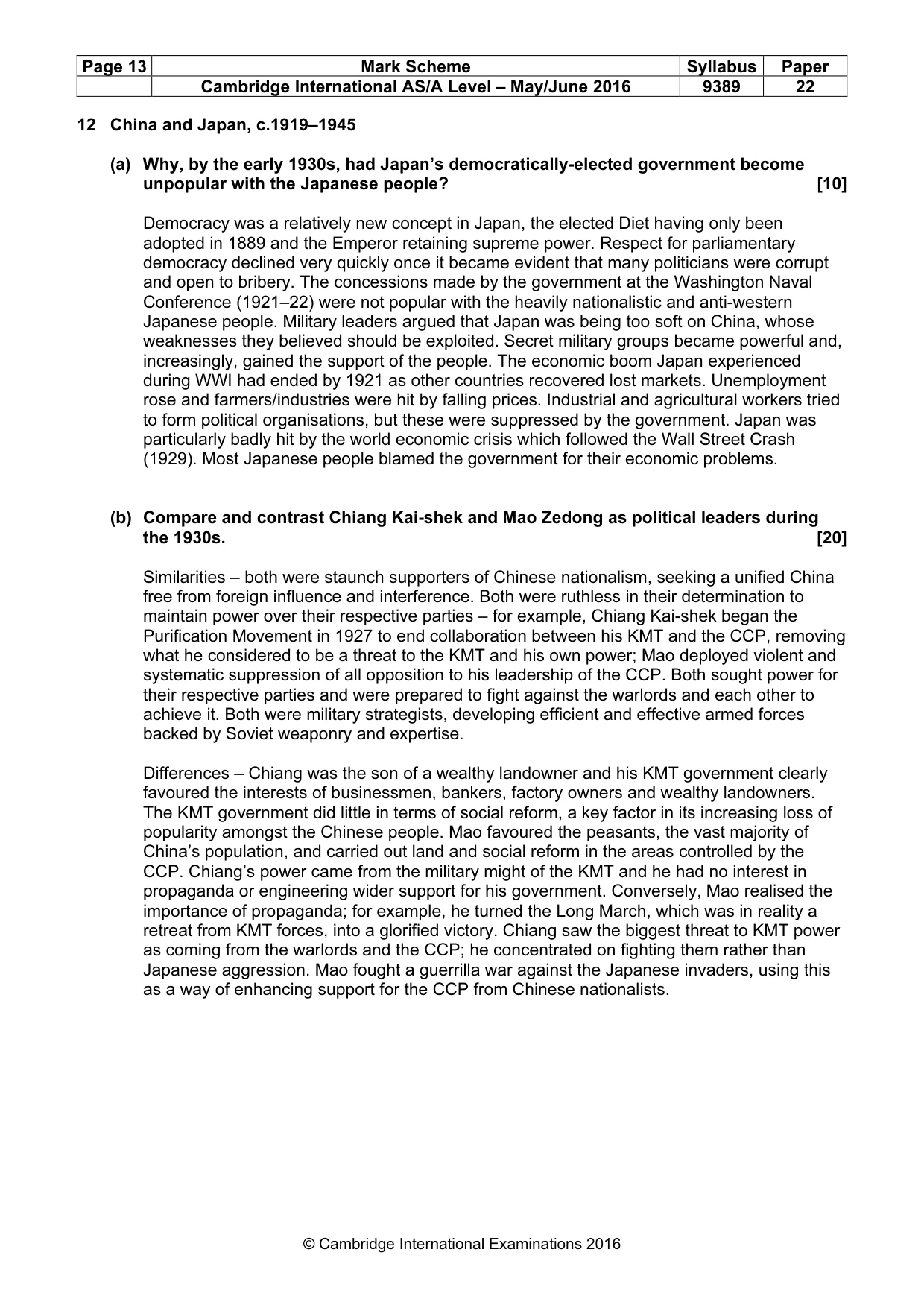
Page 13 Mark Scheme Syllabus Paper Cambridge International AS/A Level – May/June 2016 9389 22 © Cambridge International Examinations 2016 12 China and Japan, c.1919–1945 (a) Why, by the early 1930s, had Japan’s democratically-elected government become unpopular with the Japanese people? [10] Democracy was a relatively new concept in Japan, the elected Diet having only been adopted in 1889 and the Emperor retaining supreme power. Respect for parliamentary democracy declined very quickly once it became evident that many politicians were corrupt and open to bribery. The concessions made by the government at the Washington Naval Conference (1921–22) were not popular with the heavily nationalistic and anti-western Japanese people. Military leaders argued that Japan was being too soft on China, whose weaknesses they believed should be exploited. Secret military groups became powerful and, increasingly, gained the support of the people. The economic boom Japan experienced during WWI had ended by 1921 as other countries recovered lost markets. Unemployment rose and farmers/industries were hit by falling prices. Industrial and agricultural workers tried to form political organisations, but these were suppressed by the government. Japan was particularly badly hit by the world economic crisis which followed the Wall Street Crash (1929). Most Japanese people blamed the government for their economic problems. (b) Compare and contrast Chiang Kai-shek and Mao Zedong as political leaders during the 1930s. [20] Similarities – both were staunch supporters of Chinese nationalism, seeking a unified China free from foreign influence and interference. Both were ruthless in their determination to maintain power over their respective parties – for example, Chiang Kai-shek began the Purification Movement in 1927 to end collaboration between his KMT and the CCP, removing what he considered to be a threat to the KMT and his own power; Mao deployed violent and systematic suppression of all opposition to his leadership of the CCP. Both sought power for their respective parties and were prepared to fight against the warlords and each other to achieve it. Both were military strategists, developing efficient and effective armed forces backed by Soviet weaponry and expertise. Differences – Chiang was the son of a wealthy landowner and his KMT government clearly favoured the interests of businessmen, bankers, factory owners and wealthy landowners. The KMT government did little in terms of social reform, a key factor in its increasing loss of popularity amongst the Chinese people. Mao favoured the peasants, the vast majority of China’s population, and carried out land and social reform in the areas controlled by the CCP. Chiang’s power came from the military might of the KMT and he had no interest in propaganda or engineering wider support for his government. Conversely, Mao realised the importance of propaganda; for example, he turned the Long March, which was in reality a retreat from KMT forces, into a glorified victory. Chiang saw the biggest threat to KMT power as coming from the warlords and the CCP; he concentrated on fighting them rather than Japanese aggression. Mao fought a guerrilla war against the Japanese invaders, using this as a way of enhancing support for the CCP from Chinese nationalists.
What you needed in this session
Cambridge’s own grade thresholds for 2016 May/June, Paper 2 · Variant 2. A higher threshold means an easier paper — the bar moves with how the cohort did.