Cambridge A Level History 9389 — 2016 May/June Paper 2 · Variant 3
9389/23/M/J/16 · 60 marks · ≈68 min
The question paper and its mark scheme, free to read here and free to download. This is Cambridge’s own paper, exactly as it was sat.
Question paper4 pages
Mark scheme14 pages
Answers below. Sit the paper first if you are practising.
Paper as text
Question paper, page 1
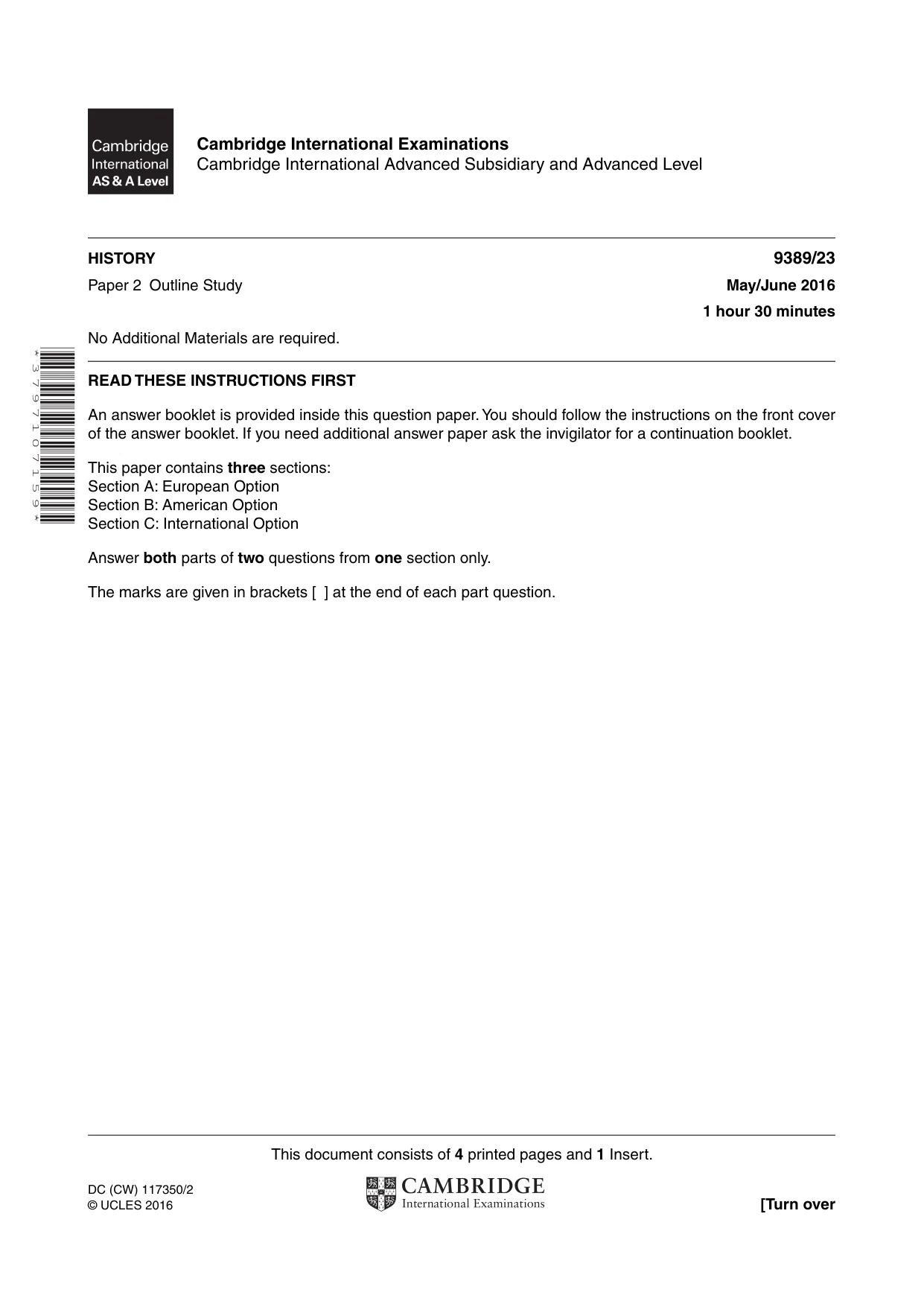
This document consists of 4 printed pages and 1 Insert. DC (CW) 117350/2 © UCLES 2016 [Turn over * 3 7 9 7 1 0 7 1 5 9 * HISTORY 9389/23 Paper 2 Outline Study May/June 2016 1 hour 30 minutes No Additional Materials are required. READ THESE INSTRUCTIONS FIRST An answer booklet is provided inside this question paper. You should follow the instructions on the front cover of the answer booklet. If you need additional answer paper ask the invigilator for a continuation booklet. This paper contains three sections: Section A: European Option Section B: American Option Section C: International Option Answer both parts of two questions from one section only. The marks are given in brackets [ ] at the end of each part question. Cambridge International Examinations Cambridge International Advanced Subsidiary and Advanced Level
Question paper, page 2
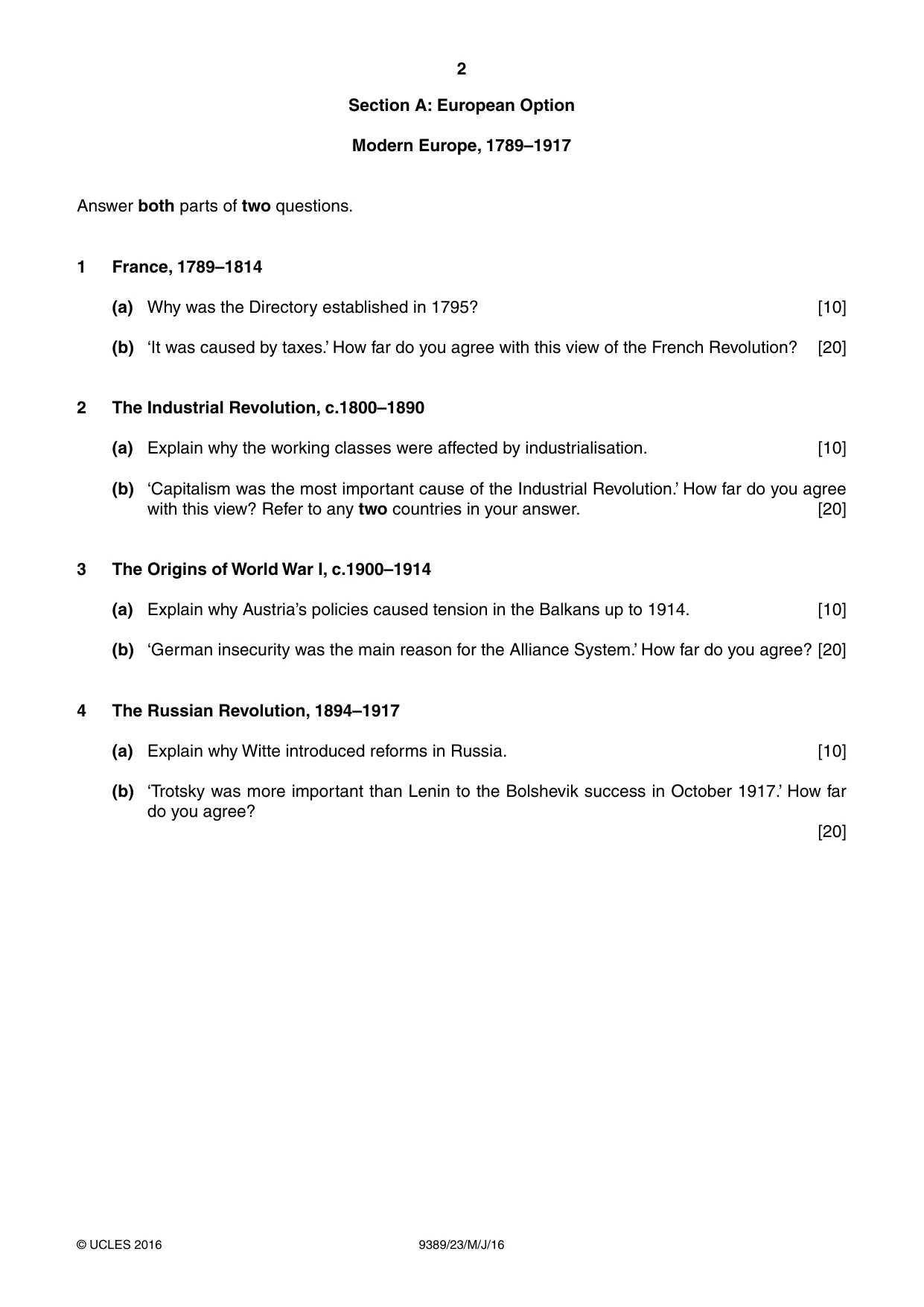
2 9389/23/M/J/16 © UCLES 2016 Section A: European Option Modern Europe, 1789–1917 Answer both parts of two questions. 1 France, 1789–1814 (a) Why was the Directory established in 1795? [10] (b) ‘It was caused by taxes.’ How far do you agree with this view of the French Revolution? [20] 2 The Industrial Revolution, c.1800–1890 (a) Explain why the working classes were affected by industrialisation. [10] (b) ‘Capitalism was the most important cause of the Industrial Revolution.’ How far do you agree with this view? Refer to any two countries in your answer. [20] 3 The Origins of World War I, c.1900–1914 (a) Explain why Austria’s policies caused tension in the Balkans up to 1914. [10] (b) ‘German insecurity was the main reason for the Alliance System.’ How far do you agree? [20] 4 The Russian Revolution, 1894–1917 (a) Explain why Witte introduced reforms in Russia. [10] (b) ‘Trotsky was more important than Lenin to the Bolshevik success in October 1917.’ How far do you agree? [20]
Question paper, page 3
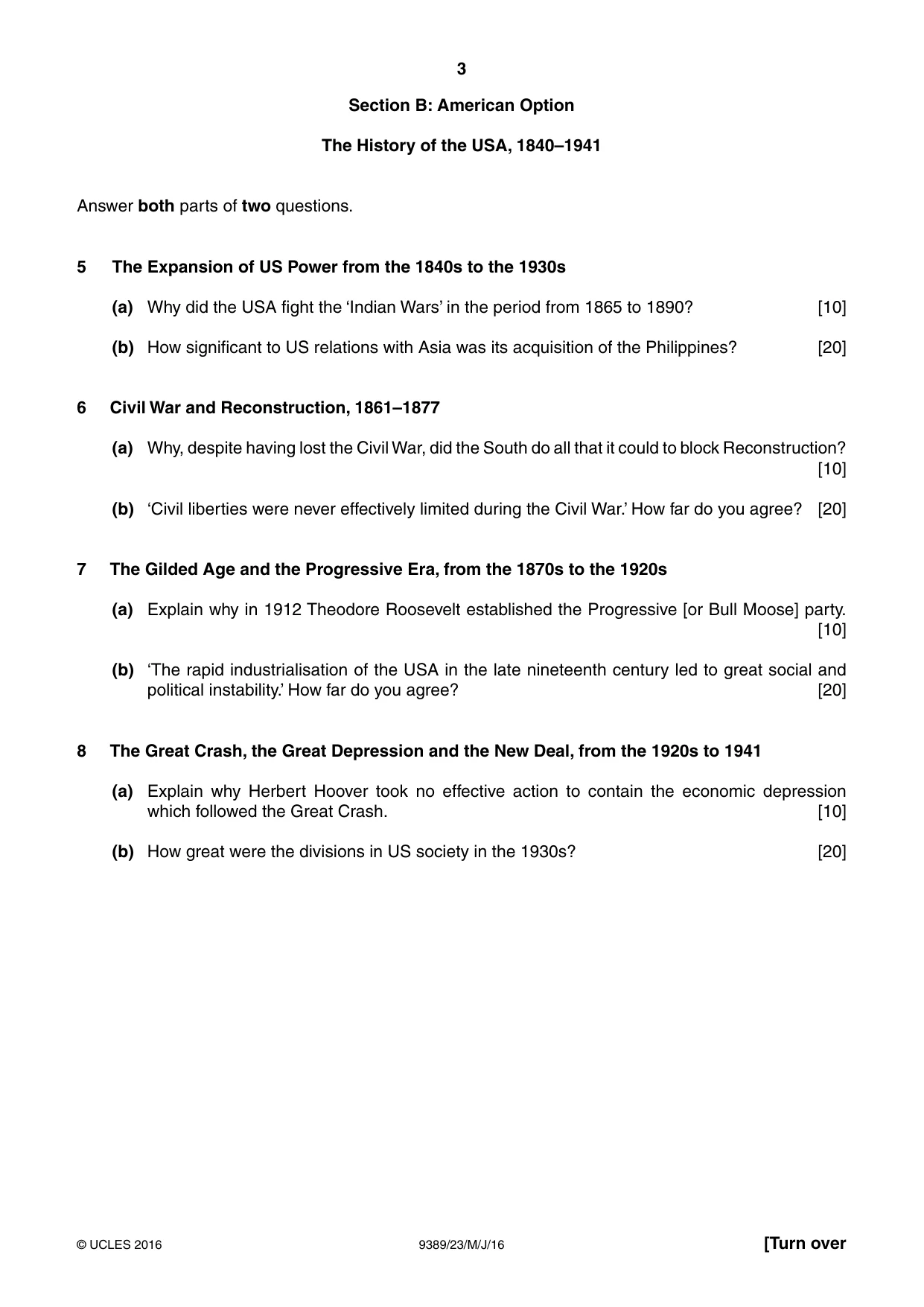
3 9389/23/M/J/16 © UCLES 2016 [Turn over Section B: American Option The History of the USA, 1840–1941 Answer both parts of two questions. 5 The Expansion of US Power from the 1840s to the 1930s (a) Why did the USA fight the ‘Indian Wars’ in the period from 1865 to 1890? [10] (b) How significant to US relations with Asia was its acquisition of the Philippines? [20] 6 Civil War and Reconstruction, 1861–1877 (a) Why, despite having lost the Civil War, did the South do all that it could to block Reconstruction? [10] (b) ‘Civil liberties were never effectively limited during the Civil War.’ How far do you agree? [20] 7 The Gilded Age and the Progressive Era, from the 1870s to the 1920s (a) Explain why in 1912 Theodore Roosevelt established the Progressive [or Bull Moose] party. [10] (b) ‘The rapid industrialisation of the USA in the late nineteenth century led to great social and political instability.’ How far do you agree? [20] 8 The Great Crash, the Great Depression and the New Deal, from the 1920s to 1941 (a) Explain why Herbert Hoover took no effective action to contain the economic depression which followed the Great Crash. [10] (b) How great were the divisions in US society in the 1930s? [20]
Question paper, page 4
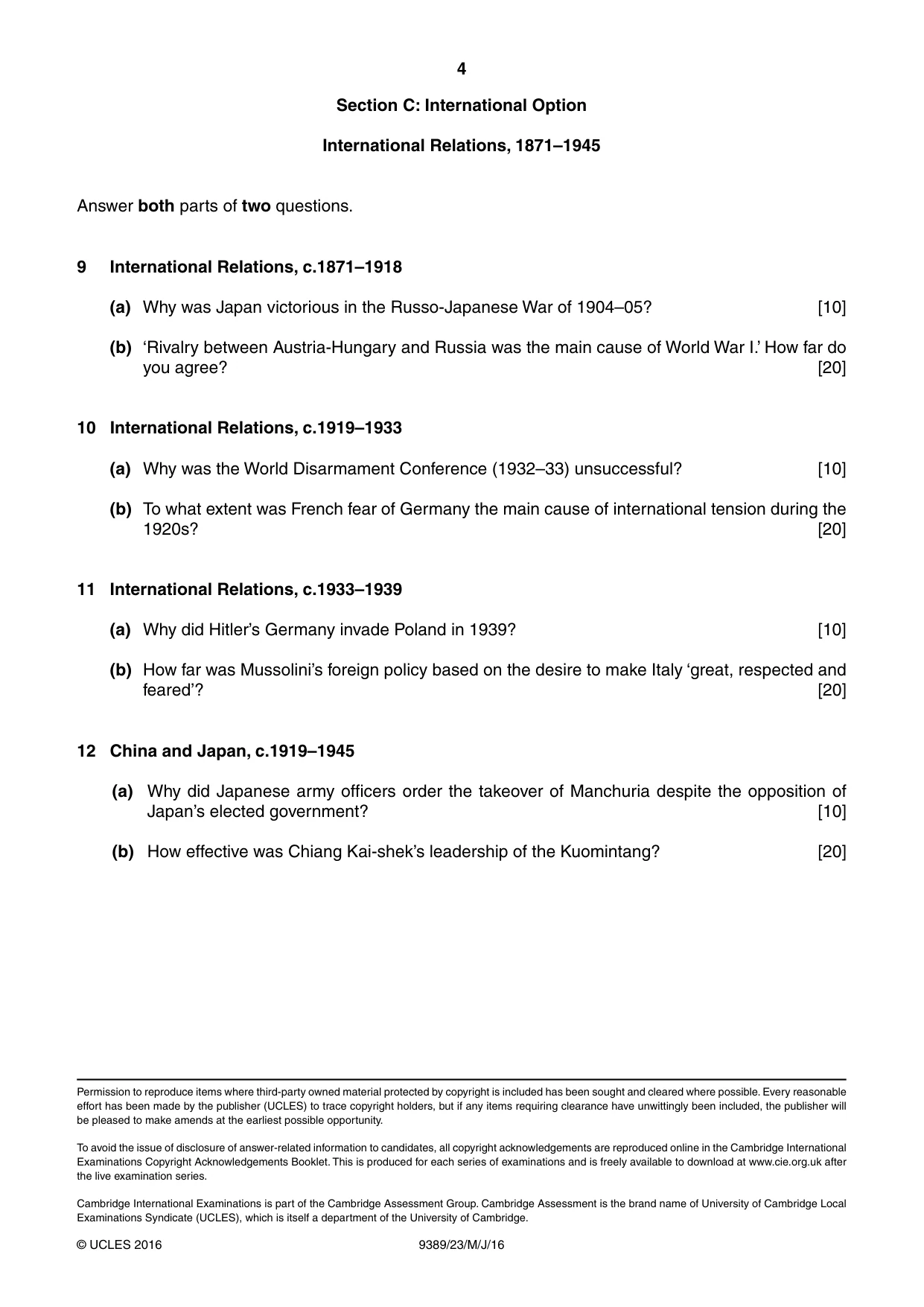
4 9389/23/M/J/16 © UCLES 2016 Permission to reproduce items where third-party owned material protected by copyright is included has been sought and cleared where possible. Every reasonable effort has been made by the publisher (UCLES) to trace copyright holders, but if any items requiring clearance have unwittingly been included, the publisher will be pleased to make amends at the earliest possible opportunity. To avoid the issue of disclosure of answer-related information to candidates, all copyright acknowledgements are reproduced online in the Cambridge International Examinations Copyright Acknowledgements Booklet. This is produced for each series of examinations and is freely available to download at www.cie.org.uk after the live examination series. Cambridge International Examinations is part of the Cambridge Assessment Group. Cambridge Assessment is the brand name of University of Cambridge Local Examinations Syndicate (UCLES), which is itself a department of the University of Cambridge. Section C: International Option International Relations, 1871–1945 Answer both parts of two questions. 9 International Relations, c.1871–1918 (a) Why was Japan victorious in the Russo-Japanese War of 1904–05? [10] (b) ‘Rivalry between Austria-Hungary and Russia was the main cause of World War I.’ How far do you agree? [20] 10 International Relations, c.1919–1933 (a) Why was the World Disarmament Conference (1932–33) unsuccessful? [10] (b) To what extent was French fear of Germany the main cause of international tension during the 1920s? [20] 11 International Relations, c.1933–1939 (a) Why did Hitler’s Germany invade Poland in 1939? [10] (b) How far was Mussolini’s foreign policy based on the desire to make Italy ‘great, respected and feared’? [20] 12 China and Japan, c.1919–1945 (a) Why did Japanese army officers order the takeover of Manchuria despite the opposition of Japan’s elected government? [10] (b) How effective was Chiang Kai-shek’s leadership of the Kuomintang? [20]
Mark scheme, page 1
® IGCSE is the registered trademark of Cambridge International Examinations. This document consists of 14 printed pages. © UCLES 2016 [Turn over Cambridge International Examinations Cambridge International Advanced Subsidiary and Advanced Level HISTORY 9389/23 Paper 2 Outline Study 23 May/June 2016 MARK SCHEME Maximum Mark: 60 Published This mark scheme is published as an aid to teachers and candidates, to indicate the requirements of the examination. It shows the basis on which Examiners were instructed to award marks. It does not indicate the details of the discussions that took place at an Examiners’ meeting before marking began, which would have considered the acceptability of alternative answers. Mark schemes should be read in conjunction with the question paper and the Principal Examiner Report for Teachers. Cambridge will not enter into discussions about these mark schemes. Cambridge is publishing the mark schemes for the May/June 2016 series for most Cambridge IGCSE®, Cambridge International A and AS Level components and some Cambridge O Level components.
Mark scheme, page 2
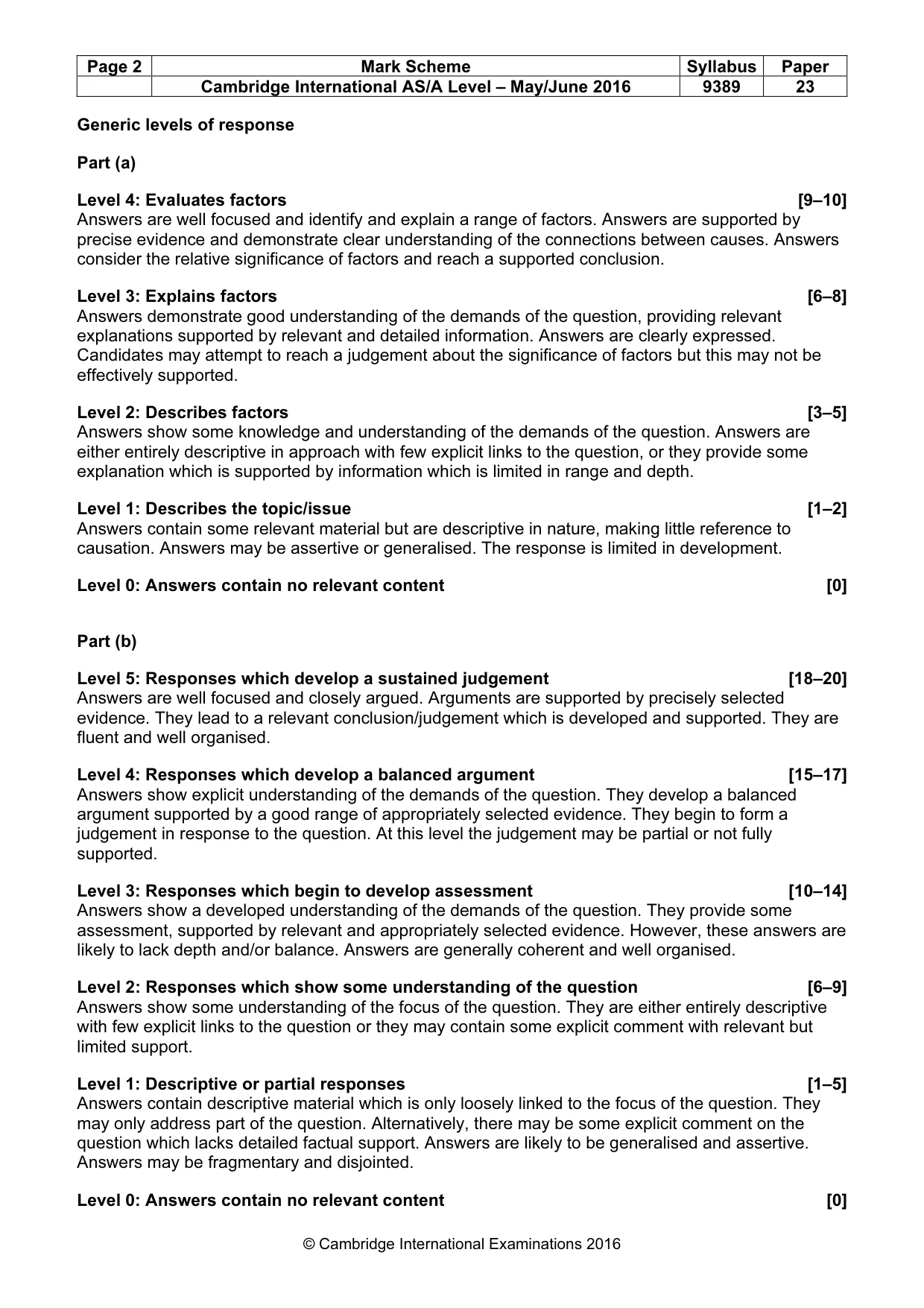
Page 2 Mark Scheme Syllabus Paper Cambridge International AS/A Level – May/June 2016 9389 23 © Cambridge International Examinations 2016 Generic levels of response Part (a) Level 4: Evaluates factors [9–10] Answers are well focused and identify and explain a range of factors. Answers are supported by precise evidence and demonstrate clear understanding of the connections between causes. Answers consider the relative significance of factors and reach a supported conclusion. Level 3: Explains factors [6–8] Answers demonstrate good understanding of the demands of the question, providing relevant explanations supported by relevant and detailed information. Answers are clearly expressed. Candidates may attempt to reach a judgement about the significance of factors but this may not be effectively supported. Level 2: Describes factors [3–5] Answers show some knowledge and understanding of the demands of the question. Answers are either entirely descriptive in approach with few explicit links to the question, or they provide some explanation which is supported by information which is limited in range and depth. Level 1: Describes the topic/issue [1–2] Answers contain some relevant material but are descriptive in nature, making little reference to causation. Answers may be assertive or generalised. The response is limited in development. Level 0: Answers contain no relevant content [0] Part (b) Level 5: Responses which develop a sustained judgement [18–20] Answers are well focused and closely argued. Arguments are supported by precisely selected evidence. They lead to a relevant conclusion/judgement which is developed and supported. They are fluent and well organised. Level 4: Responses which develop a balanced argument [15–17] Answers show explicit understanding of the demands of the question. They develop a balanced argument supported by a good range of appropriately selected evidence. They begin to form a judgement in response to the question. At this level the judgement may be partial or not fully supported. Level 3: Responses which begin to develop assessment [10–14] Answers show a developed understanding of the demands of the question. They provide some assessment, supported by relevant and appropriately selected evidence. However, these answers are likely to lack depth and/or balance. Answers are generally coherent and well organised. Level 2: Responses which show some understanding of the question [6–9] Answers show some understanding of the focus of the question. They are either entirely descriptive with few explicit links to the question or they may contain some explicit comment with relevant but limited support. Level 1: Descriptive or partial responses [1–5] Answers contain descriptive material which is only loosely linked to the focus of the question. They may only address part of the question. Alternatively, there may be some explicit comment on the question which lacks detailed factual support. Answers are likely to be generalised and assertive. Answers may be fragmentary and disjointed. Level 0: Answers contain no relevant content [0]
Mark scheme, page 3
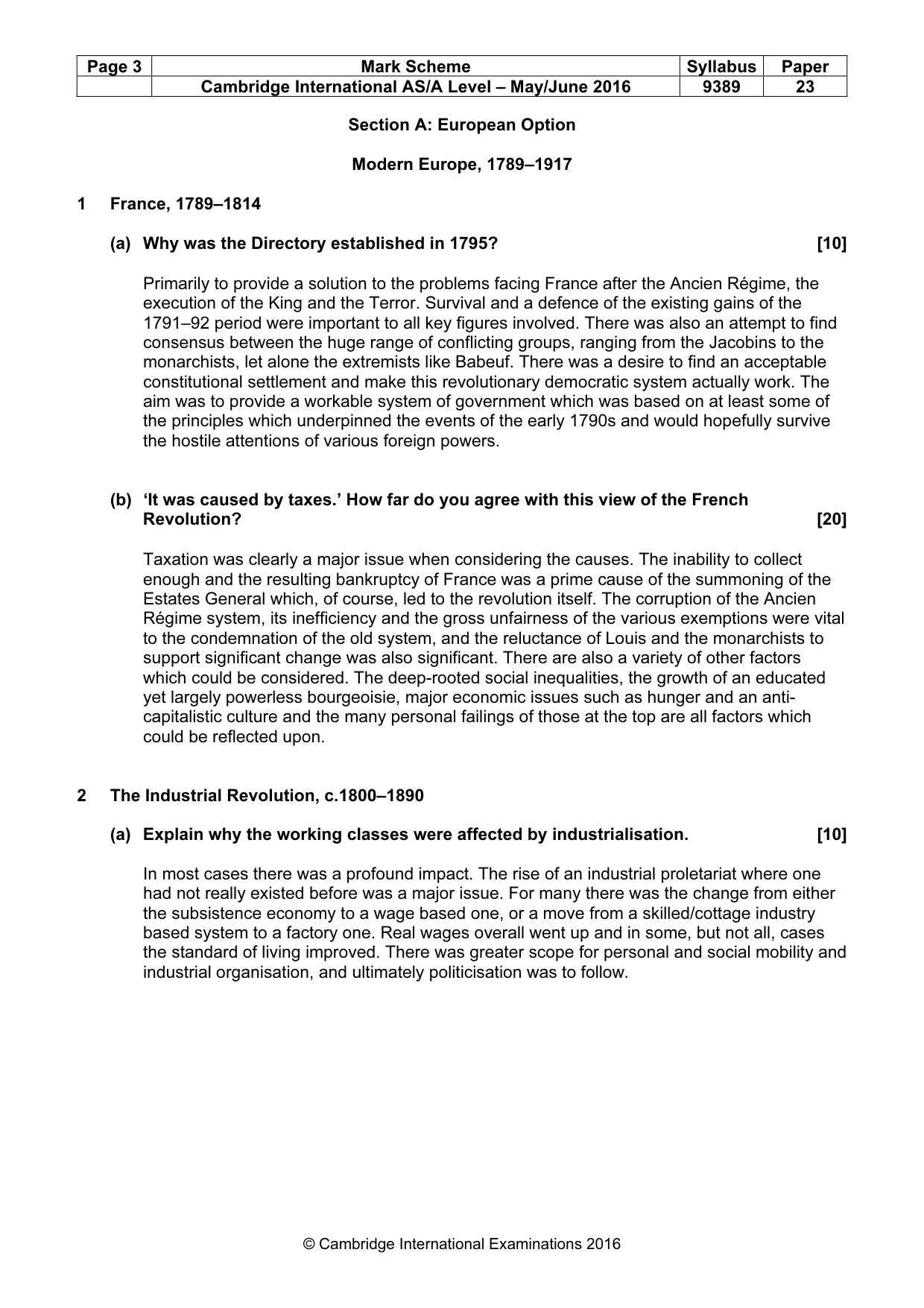
Page 3 Mark Scheme Syllabus Paper Cambridge International AS/A Level – May/June 2016 9389 23 © Cambridge International Examinations 2016 Section A: European Option Modern Europe, 1789–1917 1 France, 1789–1814 (a) Why was the Directory established in 1795? [10] Primarily to provide a solution to the problems facing France after the Ancien Régime, the execution of the King and the Terror. Survival and a defence of the existing gains of the 1791–92 period were important to all key figures involved. There was also an attempt to find consensus between the huge range of conflicting groups, ranging from the Jacobins to the monarchists, let alone the extremists like Babeuf. There was a desire to find an acceptable constitutional settlement and make this revolutionary democratic system actually work. The aim was to provide a workable system of government which was based on at least some of the principles which underpinned the events of the early 1790s and would hopefully survive the hostile attentions of various foreign powers. (b) ‘It was caused by taxes.’ How far do you agree with this view of the French Revolution? [20] Taxation was clearly a major issue when considering the causes. The inability to collect enough and the resulting bankruptcy of France was a prime cause of the summoning of the Estates General which, of course, led to the revolution itself. The corruption of the Ancien Régime system, its inefficiency and the gross unfairness of the various exemptions were vital to the condemnation of the old system, and the reluctance of Louis and the monarchists to support significant change was also significant. There are also a variety of other factors which could be considered. The deep-rooted social inequalities, the growth of an educated yet largely powerless bourgeoisie, major economic issues such as hunger and an anti- capitalistic culture and the many personal failings of those at the top are all factors which could be reflected upon. 2 The Industrial Revolution, c.1800–1890 (a) Explain why the working classes were affected by industrialisation. [10] In most cases there was a profound impact. The rise of an industrial proletariat where one had not really existed before was a major issue. For many there was the change from either the subsistence economy to a wage based one, or a move from a skilled/cottage industry based system to a factory one. Real wages overall went up and in some, but not all, cases the standard of living improved. There was greater scope for personal and social mobility and industrial organisation, and ultimately politicisation was to follow.
Mark scheme, page 4
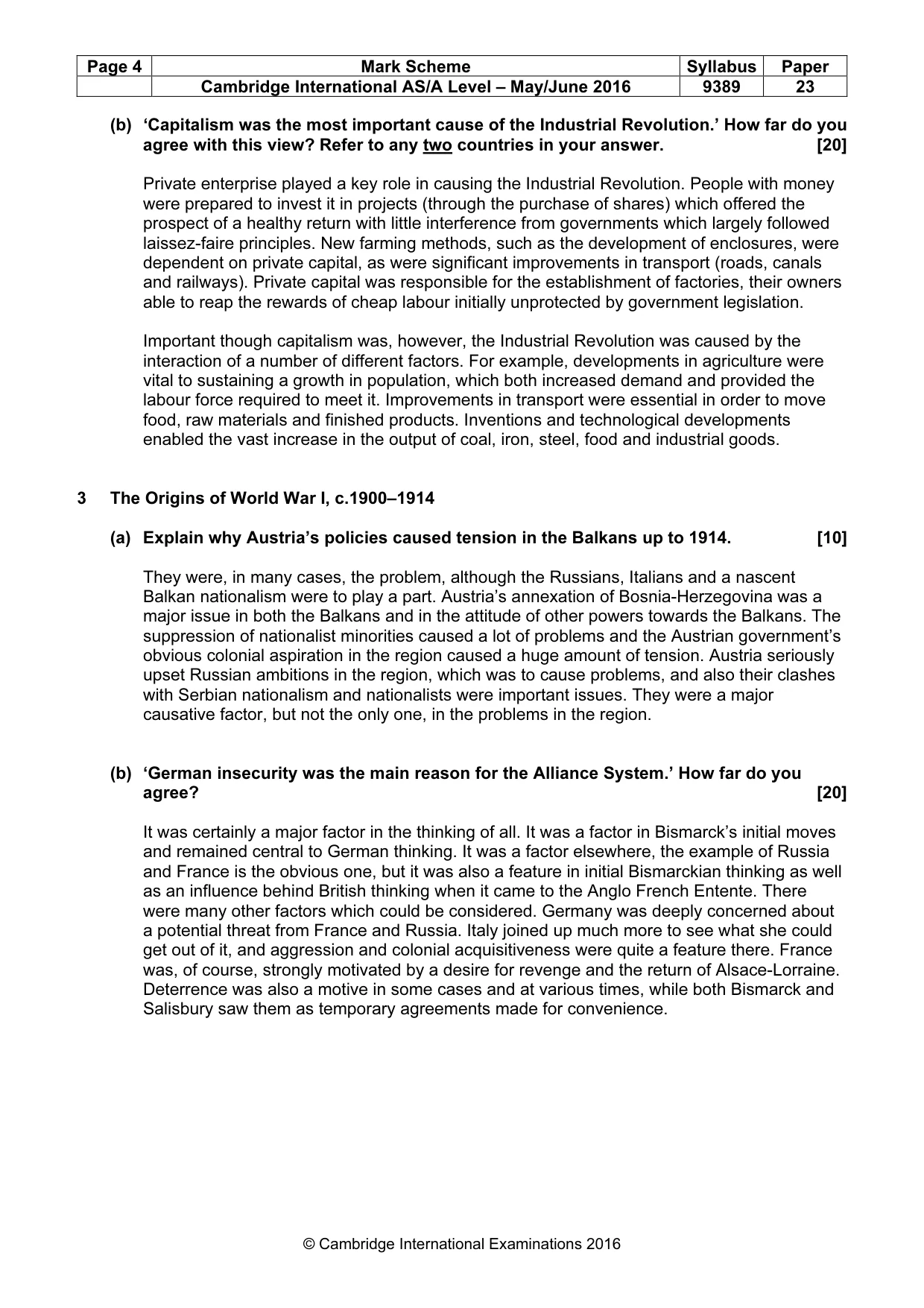
Page 4 Mark Scheme Syllabus Paper Cambridge International AS/A Level – May/June 2016 9389 23 © Cambridge International Examinations 2016 (b) ‘Capitalism was the most important cause of the Industrial Revolution.’ How far do you agree with this view? Refer to any two countries in your answer. [20] Private enterprise played a key role in causing the Industrial Revolution. People with money were prepared to invest it in projects (through the purchase of shares) which offered the prospect of a healthy return with little interference from governments which largely followed laissez-faire principles. New farming methods, such as the development of enclosures, were dependent on private capital, as were significant improvements in transport (roads, canals and railways). Private capital was responsible for the establishment of factories, their owners able to reap the rewards of cheap labour initially unprotected by government legislation. Important though capitalism was, however, the Industrial Revolution was caused by the interaction of a number of different factors. For example, developments in agriculture were vital to sustaining a growth in population, which both increased demand and provided the labour force required to meet it. Improvements in transport were essential in order to move food, raw materials and finished products. Inventions and technological developments enabled the vast increase in the output of coal, iron, steel, food and industrial goods. 3 The Origins of World War I, c.1900–1914 (a) Explain why Austria’s policies caused tension in the Balkans up to 1914. [10] They were, in many cases, the problem, although the Russians, Italians and a nascent Balkan nationalism were to play a part. Austria’s annexation of Bosnia-Herzegovina was a major issue in both the Balkans and in the attitude of other powers towards the Balkans. The suppression of nationalist minorities caused a lot of problems and the Austrian government’s obvious colonial aspiration in the region caused a huge amount of tension. Austria seriously upset Russian ambitions in the region, which was to cause problems, and also their clashes with Serbian nationalism and nationalists were important issues. They were a major causative factor, but not the only one, in the problems in the region. (b) ‘German insecurity was the main reason for the Alliance System.’ How far do you agree? [20] It was certainly a major factor in the thinking of all. It was a factor in Bismarck’s initial moves and remained central to German thinking. It was a factor elsewhere, the example of Russia and France is the obvious one, but it was also a feature in initial Bismarckian thinking as well as an influence behind British thinking when it came to the Anglo French Entente. There were many other factors which could be considered. Germany was deeply concerned about a potential threat from France and Russia. Italy joined up much more to see what she could get out of it, and aggression and colonial acquisitiveness were quite a feature there. France was, of course, strongly motivated by a desire for revenge and the return of Alsace-Lorraine. Deterrence was also a motive in some cases and at various times, while both Bismarck and Salisbury saw them as temporary agreements made for convenience.
Mark scheme, page 5
Page 5 Mark Scheme Syllabus Paper Cambridge International AS/A Level – May/June 2016 9389 23 © Cambridge International Examinations 2016 4 The Russian Revolution, 1894–1917 (a) Explain why Witte introduced reforms in Russia. [10] He was to start the industrialisation of Russia and make a genuine attempt to raise Russia to ‘a great power’ status. There was substantial industrial investment during his time as Finance Minister. He played a major role in drafting the October Manifesto and started the process of finding a middle way between the autocracy with its aristocracy and the radicalism of the extreme left. The survival as well as the strengthening of the regime were of importance to him, but he had concerns for Russia as a whole. (b) ‘Trotsky was more important than Lenin to the Bolshevik success in October 1917.’ How far do you agree? [20] Lenin was an inspiring leader who attracted great loyalty. His rhetoric and his charisma were vital in attracting support and keeping a very diverse group of supporters together. He was capable of taking decisions when he had to and his slogan of ‘peace, bread and land’ was a vital formula for success. Trotsky, of course, was also vital. It was his leadership in the months/years before inside Russia and his management of the Soviets, etc., which were also vital. There could be mention of other factors such as the failings of both the Tsar and the Provisional Government, and above all the disastrous war, without which neither man could have achieved anything bar a footnote in history books. The attitude of the vast majority of the soldiers was vital, as were the passivity of the peasantry and the divisions between so many of his potential opponents.
Mark scheme, page 6
Page 6 Mark Scheme Syllabus Paper Cambridge International AS/A Level – May/June 2016 9389 23 © Cambridge International Examinations 2016 Section B: American Option The History of the USA, 1840–1941 5 The Expansion of US Power from the 1840s to the 1930s (a) Why did the USA fight the ‘Indian Wars’ in the period from 1865 to 1890? [10] The wars were mainly against the Plains Indians, i.e. Sioux (Lakota), Cheyenne and Arapaho to the north, Cheyenne, Comanche and Arapaho to the south. ‘Wars’ often followed treaties between Native Americans and the USA. In the north, the Fort Laramie Treaty of 1868 was broken by White Americans keen to get to the gold discovered in Montana in the 1860s and in the Black Hills of the Dakota Territory in the 1870s. This led to the Great Sioux war of the 1870s, which included the defeat of Custer’s forces at Little Big Horn. To the south, the Medicine Lodge Treaty of 1867, the first to try and ‘civilise’ the Native Americans, was never fully accepted by either side. Fighting recommenced shortly after and lasted until the mid-1870s, when the Native Americans accepted defeat. Away from the Plains, in the far south west, US forces faced resistance from the Apache tribe led by Geronimo from the 1850s until his surrender in 1886. Only in the 1880s were Native Americans fully subdued, the massacre at Wounded Knee in 1890 being the last such defeat. Candidates need to know these and other campaigns only to illustrate the reasons for the US military offensive. Many candidates will mention the slaughter of the buffalo, but those massacres were how the USA subdued the Native Americans rather than why. The USA fought these wars for a variety of reasons, mainly economic, to gain resources, and political, to gain control. Protecting settlers and railroads was the main focus of the latter. Some might mention the view that the USA followed a policy of genocide against the Native Americans, usually misquoting in support General Sheridan as saying ‘the only good Indian is a dead one’. Such assertions require a careful definition of terms and specific supporting evidence to become convincing. (b) How significant to US relations with Asia was its acquisition of the Philippines? [20] The Philippines had been ruled by the Spanish since 1571. In 1898, Spain withdrew in favour of the USA which had won the ‘splendid little war’ of that year. After some domestic debate, the USA annexed the Philippines from Spain – rather than making it a US Protectorate or Territory. This gave the USA a large state of about seven million people at the far side of the Pacific Ocean. [At around the same time, the USA also took control of Guam and Hawaii.] Those who justified this radical departure from the USA’s anti-imperialist values did so on the grounds that control of the Philippines would serve America’s commercial and strategic interests in the Far East. The latter would seem to be proved by the dispatch of 6300 US soldiers from the Philippines in 1900 as the US contingent of an international force sent to crush the anti-foreigner Boxer Rising. In fact, the troops were in the Philippines to defeat a rebellion against American rule by Filipinos fighting for their independence since 1896. The war ended in 1903, when some kind of joint rule, albeit with American dominance, was agreed. Full independence would come much later. In the 1890s and early 1900s, especially following the Sino-Japanese war of 1894–95, China had become the focus of great power interest. ‘The sick man of Asia’ looked likely to be partitioned as Africa had been in recent decades. In 1899 and 1900, the US Secretary of State, John Hay, published two Open Door Notes, asking all great powers to agree to open
Mark scheme, page 7
Page 7 Mark Scheme Syllabus Paper Cambridge International AS/A Level – May/June 2016 9389 23 © Cambridge International Examinations 2016 access for all states to China. Most states grudgingly agreed to what was no more than a form of words. In 1905, Russia and Japan went to war in part because of claims to Chinese territory. The US intervened only to facilitate peace talks. The US presence in the affairs of the Western Pacific clearly grew in the decade following its acquisition of the Philippines. Whether this acquisition caused the increased intervention is hard to say. The reverse could be equally valid: because the future of China was looking increasingly problematic, because Japan was emerging as a force to be reckoned with, both evident before 1898, the USA decided it needed more of a presence in the Far East and thus decided to acquire the Philippines. After all, the great powers’ attention was focused on events much further north, on the mainland of Asia, in regions such as Korea and Manchuria, rather than on a country consisting of 7000 islands, even if taken over by the USA. 6 Civil War and Reconstruction, 1861–1877 (a) Why, despite having lost the Civil War, did the South do all that it could to block Reconstruction? [10] The main forms of opposition to Reconstruction included the passage of the Black Codes in 1865–66 and the formation of groups such as the Ku Klux Klan, violent grassroots bodies which attacked ex-slaves and Southern Republicans in order to prevent Reconstruction. The South resisted as much as it could because it objected to giving freedmen political equality via the 14th and 15th Amendments, as a result of which freedmen voted and were voted into office. The abolition of slavery via the 13th Amendment did not mean that freedmen need be granted political equality. Thus Black Codes were passed in nine Southern states. The South also resisted Reconstruction because it was imposed and enforced by Northern politicians. President Johnson, a Southerner himself, opposed Radical Reconstruction and thus the South did not experience its full enforcement. His successor, Ulysses Grant, was determined to ensure equality for the freedmen. Thus the Ku Klux Klan became even more active in 1869–71. The South was prepared to use violence to uphold the supremacy of the whites. Southern opposition to Reconstruction was based on a fear of racial equality. In 1877, the Republicans, essentially a Northern party, conceded rule of the South to the Democrats. They ensured that political equality became an ever-more distant reality as they introduced Jim Crow laws. (b) ‘Civil liberties were never effectively limited during the Civil War.’ How far do you agree? [20] There has been much debate about civil liberties in the Civil War, around both whether the respective Presidents, Lincoln and Davis, could limit them and also the effects of the limits they imposed. The first is not relevant here. Both presidents certainly limited civil liberties, such as freedom of movement, freedom of speech. The major issues concerning civil liberties were (a) the suspension of the writ of habeas corpus, thus allowing indefinite detention without charge, and (b) the establishment of military tribunals to uphold the laws of war. Lincoln allowed military leaders to suspend habeas corpus in parts of Maryland as soon as the war had started because it was a strategically important border state which had yet to decide between North and South. Many state representatives sympathetic to the South were detained without charge in order to prevent a state vote on secession. In this case, military rule worked; Maryland did not secede. The most famous case of suppression of civil liberties in the North concerned Clement Vallandigham, a leading opponent who was tried and sentenced by a military tribunal. This
Mark scheme, page 8
Page 8 Mark Scheme Syllabus Paper Cambridge International AS/A Level – May/June 2016 9389 23 © Cambridge International Examinations 2016 punishment aroused a lot of criticism of Lincoln’s administration. The South followed a similar pattern, limiting habeas corpus and setting up military tribunals, despite historical interpretations to the contrary. In both North and South, elections were held, which suggests that limits on civil liberties were restricted to those who undermined the war effort and encouraged people to support the other side. It was still possible to argue about the politics of the war, about its goals and how long it should be fought. The offence which did provoke state action was explicit support of the enemy’s war effort. 7 The Gilded Age and the Progressive Era, from the 1870s to the 1920s (a) Explain why in 1912 Theodore Roosevelt established the Progressive [or Bull Moose] party. [10] Theodore Roosevelt [TR] had been president from 1901, when as VP he replaced the assassinated McKinley, to 1908. He could have run again but in 1904 had said that he would not do so. He had identified his successor as William Taft, his Secretary of War, believing that Taft would follow his path; he did not. He was less progressive than TR and much less charismatic. In addition, in 1910 the Republican party divided over the question of tariffs. By early 1912, TR announced that he wished to run for the Republican nomination for president against Taft. Taft won the nomination. In September 1912, TR announced the formation of the Progressive party. It was also known as the Bull Moose party because TR, when asked, said ‘I’m as fit as a Bull Moose’. TR’s candidacy split the Republican vote – inevitably, given the US electoral college and the two-party system – and allowed the election of Woodrow Wilson, only the second Democrat president since the Civil War. The reasons which might be deduced from this narrative must focus on TR himself, his ambition and his tactical mistakes. He later admitted that he might not have formed a third party had the Democratic party nomination already taken place. By choosing Wilson, they chose another Progressive. (b) ‘The rapid industrialisation of the USA in the late nineteenth century led to great social and political instability.’ How far do you agree? [20] Rapid industrialisation meant rapid urbanisation as more workers were needed to work the machines. Many of these workers were immigrants, from Europe mainly and from Asia. Many of the industrial cities lacked the facilities and infrastructure necessary to provide for the ‘huddled masses’ crowded around the factories. Economic depressions, for example, 1873+ and 1893+, did not help matters. These factors led to social instability if not effectively managed. ‘Social instability’ is best illustrated by strikes and demonstrations against living and working conditions, for example, long working hours. There was certainly plenty of unrest as workers started to organise themselves, for example, American Federation of Labour, 1881+. Various examples can be found of labour unrest resulting in conflict with the authorities, casualties and death, for example, Molly Maguires in Pennsylvania, 1874, Haymarket Affair, Chicago, 1886. Such extremes, though infrequent, did keep recurring. Whether they also helped cause political instability is harder to measure. ‘Political instability’ involves challenges to existing party political systems, in this case Democrat and Republican. Working class movements did turn to party political activism, as shown by the Socialist Labour Party from 1876 and the People’s Party from 1891. Before the turn of the century, however, these parties made little national impact. At the city level, progressive reformers usually worked through the traditional party system. In many cities, party remained in control of affairs. Thus, assuming labour unrest is seen as social, a contrast can be drawn between relative social instability and comparative political stability,
Mark scheme, page 9
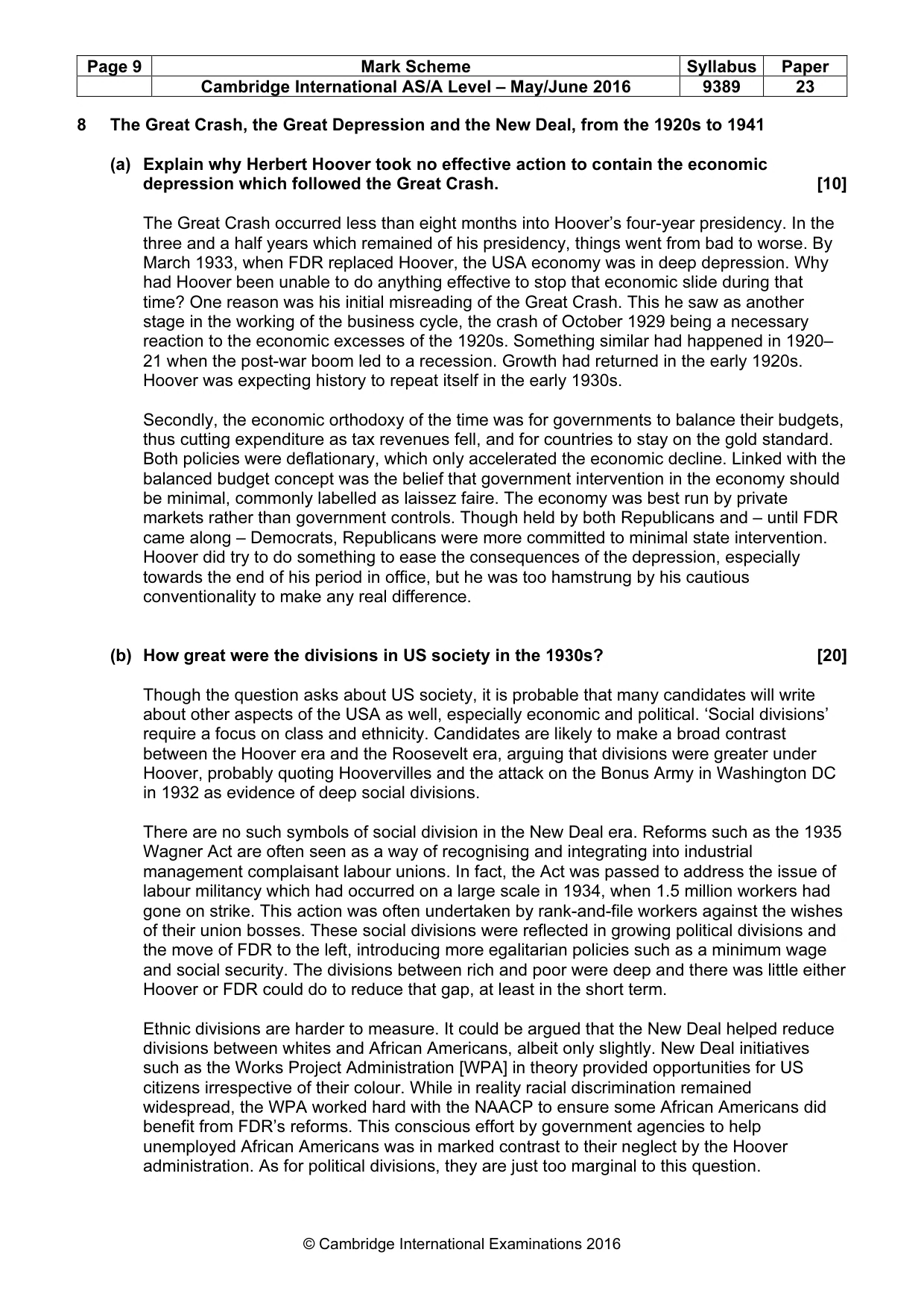
Page 9 Mark Scheme Syllabus Paper Cambridge International AS/A Level – May/June 2016 9389 23 © Cambridge International Examinations 2016 8 The Great Crash, the Great Depression and the New Deal, from the 1920s to 1941 (a) Explain why Herbert Hoover took no effective action to contain the economic depression which followed the Great Crash. [10] The Great Crash occurred less than eight months into Hoover’s four-year presidency. In the three and a half years which remained of his presidency, things went from bad to worse. By March 1933, when FDR replaced Hoover, the USA economy was in deep depression. Why had Hoover been unable to do anything effective to stop that economic slide during that time? One reason was his initial misreading of the Great Crash. This he saw as another stage in the working of the business cycle, the crash of October 1929 being a necessary reaction to the economic excesses of the 1920s. Something similar had happened in 1920– 21 when the post-war boom led to a recession. Growth had returned in the early 1920s. Hoover was expecting history to repeat itself in the early 1930s. Secondly, the economic orthodoxy of the time was for governments to balance their budgets, thus cutting expenditure as tax revenues fell, and for countries to stay on the gold standard. Both policies were deflationary, which only accelerated the economic decline. Linked with the balanced budget concept was the belief that government intervention in the economy should be minimal, commonly labelled as laissez faire. The economy was best run by private markets rather than government controls. Though held by both Republicans and – until FDR came along – Democrats, Republicans were more committed to minimal state intervention. Hoover did try to do something to ease the consequences of the depression, especially towards the end of his period in office, but he was too hamstrung by his cautious conventionality to make any real difference. (b) How great were the divisions in US society in the 1930s? [20] Though the question asks about US society, it is probable that many candidates will write about other aspects of the USA as well, especially economic and political. ‘Social divisions’ require a focus on class and ethnicity. Candidates are likely to make a broad contrast between the Hoover era and the Roosevelt era, arguing that divisions were greater under Hoover, probably quoting Hoovervilles and the attack on the Bonus Army in Washington DC in 1932 as evidence of deep social divisions. There are no such symbols of social division in the New Deal era. Reforms such as the 1935 Wagner Act are often seen as a way of recognising and integrating into industrial management complaisant labour unions. In fact, the Act was passed to address the issue of labour militancy which had occurred on a large scale in 1934, when 1.5 million workers had gone on strike. This action was often undertaken by rank-and-file workers against the wishes of their union bosses. These social divisions were reflected in growing political divisions and the move of FDR to the left, introducing more egalitarian policies such as a minimum wage and social security. The divisions between rich and poor were deep and there was little either Hoover or FDR could do to reduce that gap, at least in the short term. Ethnic divisions are harder to measure. It could be argued that the New Deal helped reduce divisions between whites and African Americans, albeit only slightly. New Deal initiatives such as the Works Project Administration [WPA] in theory provided opportunities for US citizens irrespective of their colour. While in reality racial discrimination remained widespread, the WPA worked hard with the NAACP to ensure some African Americans did benefit from FDR’s reforms. This conscious effort by government agencies to help unemployed African Americans was in marked contrast to their neglect by the Hoover administration. As for political divisions, they are just too marginal to this question.
Mark scheme, page 10
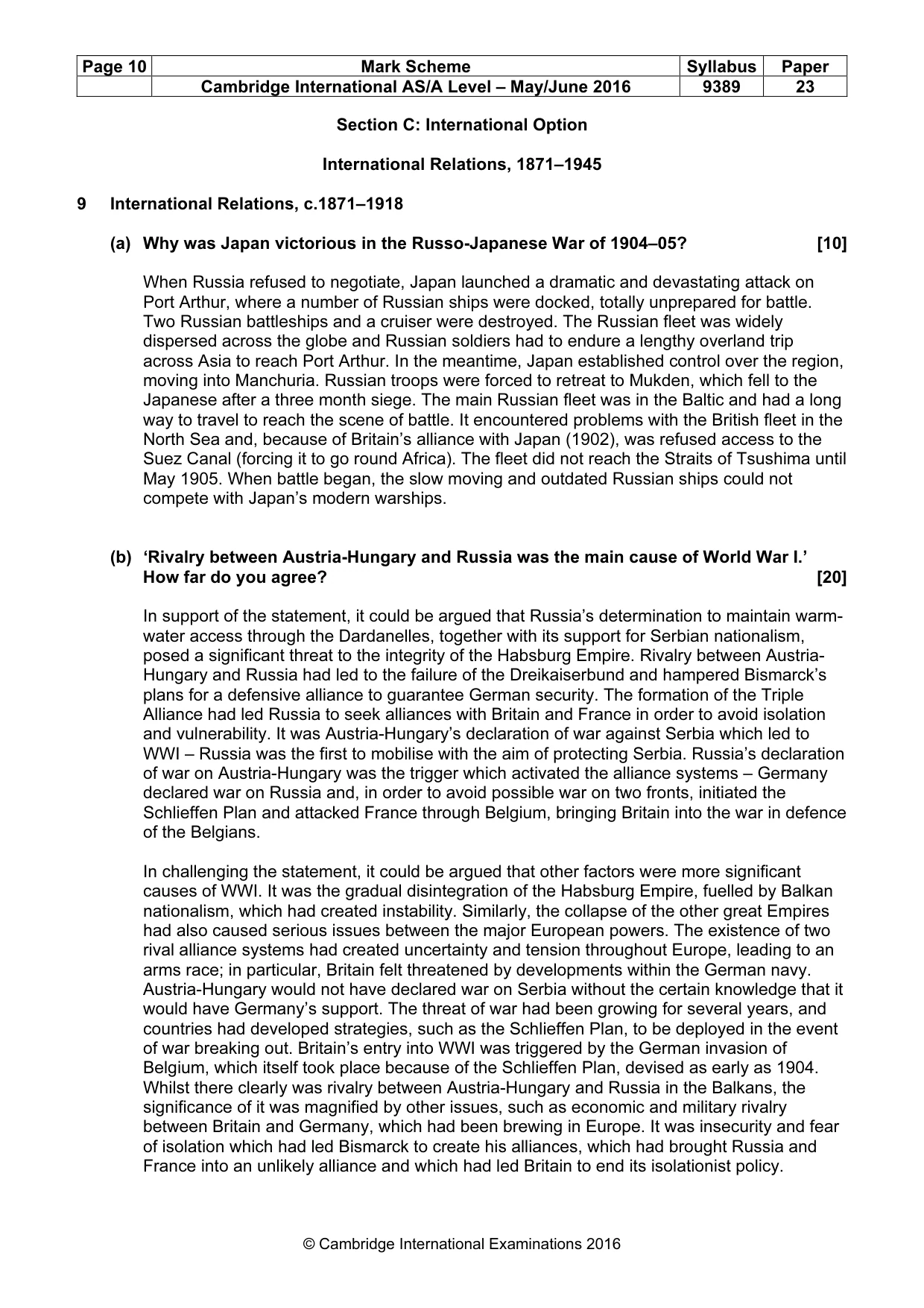
Page 10 Mark Scheme Syllabus Paper Cambridge International AS/A Level – May/June 2016 9389 23 © Cambridge International Examinations 2016 Section C: International Option International Relations, 1871–1945 9 International Relations, c.1871–1918 (a) Why was Japan victorious in the Russo-Japanese War of 1904–05? [10] When Russia refused to negotiate, Japan launched a dramatic and devastating attack on Port Arthur, where a number of Russian ships were docked, totally unprepared for battle. Two Russian battleships and a cruiser were destroyed. The Russian fleet was widely dispersed across the globe and Russian soldiers had to endure a lengthy overland trip across Asia to reach Port Arthur. In the meantime, Japan established control over the region, moving into Manchuria. Russian troops were forced to retreat to Mukden, which fell to the Japanese after a three month siege. The main Russian fleet was in the Baltic and had a long way to travel to reach the scene of battle. It encountered problems with the British fleet in the North Sea and, because of Britain’s alliance with Japan (1902), was refused access to the Suez Canal (forcing it to go round Africa). The fleet did not reach the Straits of Tsushima until May 1905. When battle began, the slow moving and outdated Russian ships could not compete with Japan’s modern warships. (b) ‘Rivalry between Austria-Hungary and Russia was the main cause of World War I.’ How far do you agree? [20] In support of the statement, it could be argued that Russia’s determination to maintain warm- water access through the Dardanelles, together with its support for Serbian nationalism, posed a significant threat to the integrity of the Habsburg Empire. Rivalry between Austria- Hungary and Russia had led to the failure of the Dreikaiserbund and hampered Bismarck’s plans for a defensive alliance to guarantee German security. The formation of the Triple Alliance had led Russia to seek alliances with Britain and France in order to avoid isolation and vulnerability. It was Austria-Hungary’s declaration of war against Serbia which led to WWI – Russia was the first to mobilise with the aim of protecting Serbia. Russia’s declaration of war on Austria-Hungary was the trigger which activated the alliance systems – Germany declared war on Russia and, in order to avoid possible war on two fronts, initiated the Schlieffen Plan and attacked France through Belgium, bringing Britain into the war in defence of the Belgians. In challenging the statement, it could be argued that other factors were more significant causes of WWI. It was the gradual disintegration of the Habsburg Empire, fuelled by Balkan nationalism, which had created instability. Similarly, the collapse of the other great Empires had also caused serious issues between the major European powers. The existence of two rival alliance systems had created uncertainty and tension throughout Europe, leading to an arms race; in particular, Britain felt threatened by developments within the German navy. Austria-Hungary would not have declared war on Serbia without the certain knowledge that it would have Germany’s support. The threat of war had been growing for several years, and countries had developed strategies, such as the Schlieffen Plan, to be deployed in the event of war breaking out. Britain’s entry into WWI was triggered by the German invasion of Belgium, which itself took place because of the Schlieffen Plan, devised as early as 1904. Whilst there clearly was rivalry between Austria-Hungary and Russia in the Balkans, the significance of it was magnified by other issues, such as economic and military rivalry between Britain and Germany, which had been brewing in Europe. It was insecurity and fear of isolation which had led Bismarck to create his alliances, which had brought Russia and France into an unlikely alliance and which had led Britain to end its isolationist policy.
Mark scheme, page 11
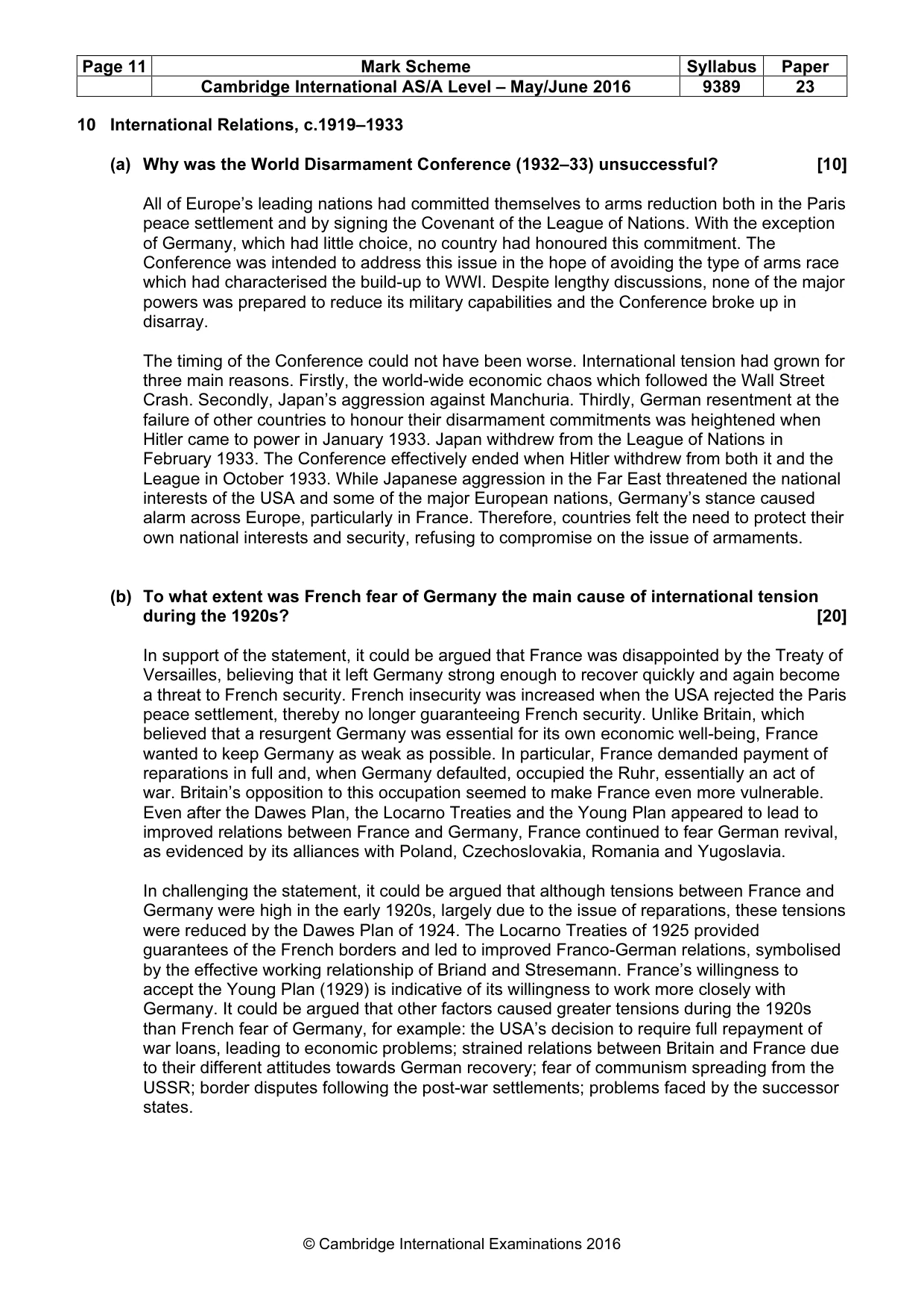
Page 11 Mark Scheme Syllabus Paper Cambridge International AS/A Level – May/June 2016 9389 23 © Cambridge International Examinations 2016 10 International Relations, c.1919–1933 (a) Why was the World Disarmament Conference (1932–33) unsuccessful? [10] All of Europe’s leading nations had committed themselves to arms reduction both in the Paris peace settlement and by signing the Covenant of the League of Nations. With the exception of Germany, which had little choice, no country had honoured this commitment. The Conference was intended to address this issue in the hope of avoiding the type of arms race which had characterised the build-up to WWI. Despite lengthy discussions, none of the major powers was prepared to reduce its military capabilities and the Conference broke up in disarray. The timing of the Conference could not have been worse. International tension had grown for three main reasons. Firstly, the world-wide economic chaos which followed the Wall Street Crash. Secondly, Japan’s aggression against Manchuria. Thirdly, German resentment at the failure of other countries to honour their disarmament commitments was heightened when Hitler came to power in January 1933. Japan withdrew from the League of Nations in February 1933. The Conference effectively ended when Hitler withdrew from both it and the League in October 1933. While Japanese aggression in the Far East threatened the national interests of the USA and some of the major European nations, Germany’s stance caused alarm across Europe, particularly in France. Therefore, countries felt the need to protect their own national interests and security, refusing to compromise on the issue of armaments. (b) To what extent was French fear of Germany the main cause of international tension during the 1920s? [20] In support of the statement, it could be argued that France was disappointed by the Treaty of Versailles, believing that it left Germany strong enough to recover quickly and again become a threat to French security. French insecurity was increased when the USA rejected the Paris peace settlement, thereby no longer guaranteeing French security. Unlike Britain, which believed that a resurgent Germany was essential for its own economic well-being, France wanted to keep Germany as weak as possible. In particular, France demanded payment of reparations in full and, when Germany defaulted, occupied the Ruhr, essentially an act of war. Britain’s opposition to this occupation seemed to make France even more vulnerable. Even after the Dawes Plan, the Locarno Treaties and the Young Plan appeared to lead to improved relations between France and Germany, France continued to fear German revival, as evidenced by its alliances with Poland, Czechoslovakia, Romania and Yugoslavia. In challenging the statement, it could be argued that although tensions between France and Germany were high in the early 1920s, largely due to the issue of reparations, these tensions were reduced by the Dawes Plan of 1924. The Locarno Treaties of 1925 provided guarantees of the French borders and led to improved Franco-German relations, symbolised by the effective working relationship of Briand and Stresemann. France’s willingness to accept the Young Plan (1929) is indicative of its willingness to work more closely with Germany. It could be argued that other factors caused greater tensions during the 1920s than French fear of Germany, for example: the USA’s decision to require full repayment of war loans, leading to economic problems; strained relations between Britain and France due to their different attitudes towards German recovery; fear of communism spreading from the USSR; border disputes following the post-war settlements; problems faced by the successor states.
Mark scheme, page 12
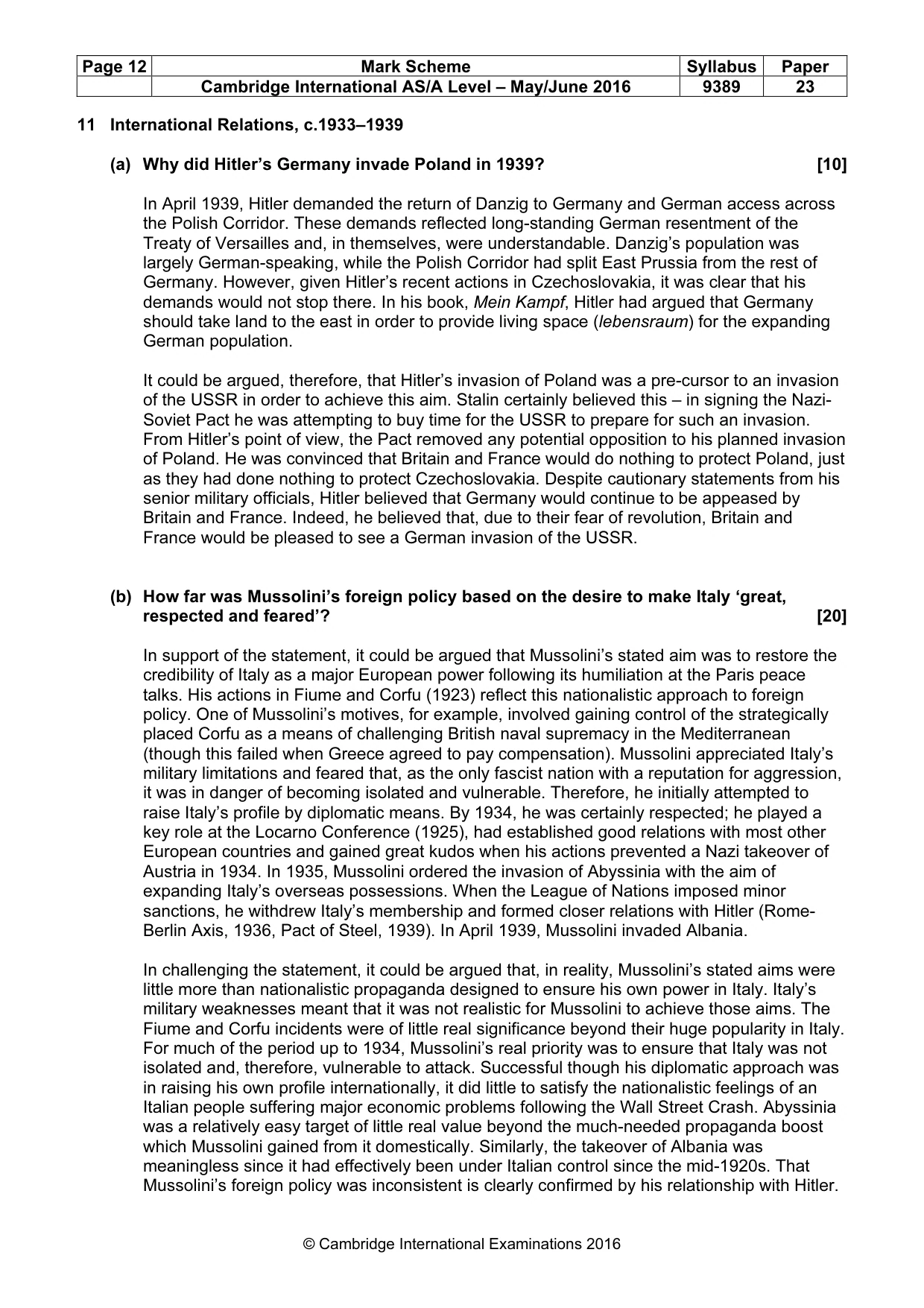
Page 12 Mark Scheme Syllabus Paper Cambridge International AS/A Level – May/June 2016 9389 23 © Cambridge International Examinations 2016 11 International Relations, c.1933–1939 (a) Why did Hitler’s Germany invade Poland in 1939? [10] In April 1939, Hitler demanded the return of Danzig to Germany and German access across the Polish Corridor. These demands reflected long-standing German resentment of the Treaty of Versailles and, in themselves, were understandable. Danzig’s population was largely German-speaking, while the Polish Corridor had split East Prussia from the rest of Germany. However, given Hitler’s recent actions in Czechoslovakia, it was clear that his demands would not stop there. In his book, Mein Kampf, Hitler had argued that Germany should take land to the east in order to provide living space (lebensraum) for the expanding German population. It could be argued, therefore, that Hitler’s invasion of Poland was a pre-cursor to an invasion of the USSR in order to achieve this aim. Stalin certainly believed this – in signing the Nazi- Soviet Pact he was attempting to buy time for the USSR to prepare for such an invasion. From Hitler’s point of view, the Pact removed any potential opposition to his planned invasion of Poland. He was convinced that Britain and France would do nothing to protect Poland, just as they had done nothing to protect Czechoslovakia. Despite cautionary statements from his senior military officials, Hitler believed that Germany would continue to be appeased by Britain and France. Indeed, he believed that, due to their fear of revolution, Britain and France would be pleased to see a German invasion of the USSR. (b) How far was Mussolini’s foreign policy based on the desire to make Italy ‘great, respected and feared’? [20] In support of the statement, it could be argued that Mussolini’s stated aim was to restore the credibility of Italy as a major European power following its humiliation at the Paris peace talks. His actions in Fiume and Corfu (1923) reflect this nationalistic approach to foreign policy. One of Mussolini’s motives, for example, involved gaining control of the strategically placed Corfu as a means of challenging British naval supremacy in the Mediterranean (though this failed when Greece agreed to pay compensation). Mussolini appreciated Italy’s military limitations and feared that, as the only fascist nation with a reputation for aggression, it was in danger of becoming isolated and vulnerable. Therefore, he initially attempted to raise Italy’s profile by diplomatic means. By 1934, he was certainly respected; he played a key role at the Locarno Conference (1925), had established good relations with most other European countries and gained great kudos when his actions prevented a Nazi takeover of Austria in 1934. In 1935, Mussolini ordered the invasion of Abyssinia with the aim of expanding Italy’s overseas possessions. When the League of Nations imposed minor sanctions, he withdrew Italy’s membership and formed closer relations with Hitler (Rome- Berlin Axis, 1936, Pact of Steel, 1939). In April 1939, Mussolini invaded Albania. In challenging the statement, it could be argued that, in reality, Mussolini’s stated aims were little more than nationalistic propaganda designed to ensure his own power in Italy. Italy’s military weaknesses meant that it was not realistic for Mussolini to achieve those aims. The Fiume and Corfu incidents were of little real significance beyond their huge popularity in Italy. For much of the period up to 1934, Mussolini’s real priority was to ensure that Italy was not isolated and, therefore, vulnerable to attack. Successful though his diplomatic approach was in raising his own profile internationally, it did little to satisfy the nationalistic feelings of an Italian people suffering major economic problems following the Wall Street Crash. Abyssinia was a relatively easy target of little real value beyond the much-needed propaganda boost which Mussolini gained from it domestically. Similarly, the takeover of Albania was meaningless since it had effectively been under Italian control since the mid-1920s. That Mussolini’s foreign policy was inconsistent is clearly confirmed by his relationship with Hitler.
Mark scheme, page 13
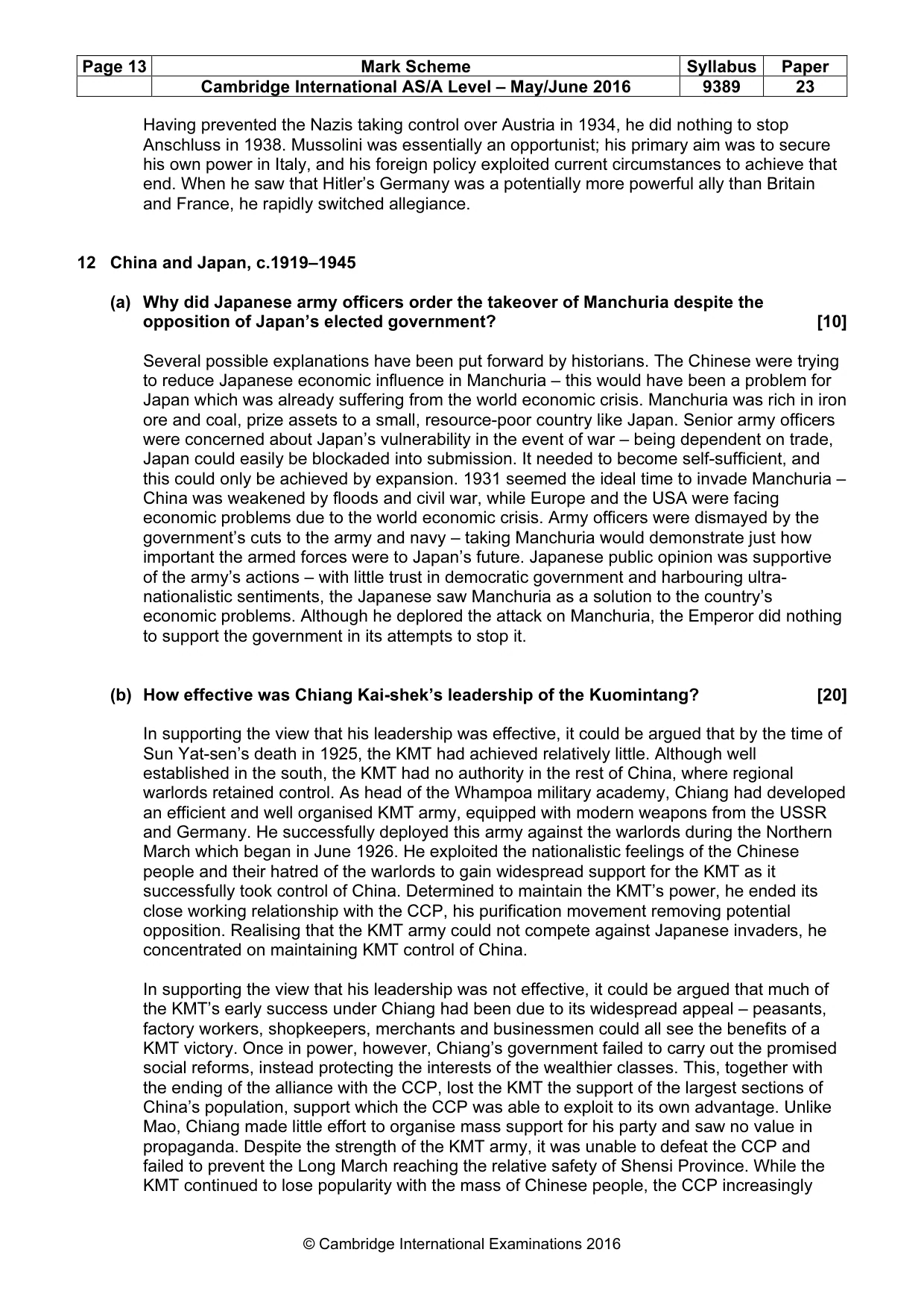
Page 13 Mark Scheme Syllabus Paper Cambridge International AS/A Level – May/June 2016 9389 23 © Cambridge International Examinations 2016 Having prevented the Nazis taking control over Austria in 1934, he did nothing to stop Anschluss in 1938. Mussolini was essentially an opportunist; his primary aim was to secure his own power in Italy, and his foreign policy exploited current circumstances to achieve that end. When he saw that Hitler’s Germany was a potentially more powerful ally than Britain and France, he rapidly switched allegiance. 12 China and Japan, c.1919–1945 (a) Why did Japanese army officers order the takeover of Manchuria despite the opposition of Japan’s elected government? [10] Several possible explanations have been put forward by historians. The Chinese were trying to reduce Japanese economic influence in Manchuria – this would have been a problem for Japan which was already suffering from the world economic crisis. Manchuria was rich in iron ore and coal, prize assets to a small, resource-poor country like Japan. Senior army officers were concerned about Japan’s vulnerability in the event of war – being dependent on trade, Japan could easily be blockaded into submission. It needed to become self-sufficient, and this could only be achieved by expansion. 1931 seemed the ideal time to invade Manchuria – China was weakened by floods and civil war, while Europe and the USA were facing economic problems due to the world economic crisis. Army officers were dismayed by the government’s cuts to the army and navy – taking Manchuria would demonstrate just how important the armed forces were to Japan’s future. Japanese public opinion was supportive of the army’s actions – with little trust in democratic government and harbouring ultra- nationalistic sentiments, the Japanese saw Manchuria as a solution to the country’s economic problems. Although he deplored the attack on Manchuria, the Emperor did nothing to support the government in its attempts to stop it. (b) How effective was Chiang Kai-shek’s leadership of the Kuomintang? [20] In supporting the view that his leadership was effective, it could be argued that by the time of Sun Yat-sen’s death in 1925, the KMT had achieved relatively little. Although well established in the south, the KMT had no authority in the rest of China, where regional warlords retained control. As head of the Whampoa military academy, Chiang had developed an efficient and well organised KMT army, equipped with modern weapons from the USSR and Germany. He successfully deployed this army against the warlords during the Northern March which began in June 1926. He exploited the nationalistic feelings of the Chinese people and their hatred of the warlords to gain widespread support for the KMT as it successfully took control of China. Determined to maintain the KMT’s power, he ended its close working relationship with the CCP, his purification movement removing potential opposition. Realising that the KMT army could not compete against Japanese invaders, he concentrated on maintaining KMT control of China. In supporting the view that his leadership was not effective, it could be argued that much of the KMT’s early success under Chiang had been due to its widespread appeal – peasants, factory workers, shopkeepers, merchants and businessmen could all see the benefits of a KMT victory. Once in power, however, Chiang’s government failed to carry out the promised social reforms, instead protecting the interests of the wealthier classes. This, together with the ending of the alliance with the CCP, lost the KMT the support of the largest sections of China’s population, support which the CCP was able to exploit to its own advantage. Unlike Mao, Chiang made little effort to organise mass support for his party and saw no value in propaganda. Despite the strength of the KMT army, it was unable to defeat the CCP and failed to prevent the Long March reaching the relative safety of Shensi Province. While the KMT continued to lose popularity with the mass of Chinese people, the CCP increasingly
Mark scheme, page 14
Page 14 Mark Scheme Syllabus Paper Cambridge International AS/A Level – May/June 2016 9389 23 © Cambridge International Examinations 2016 gained respect and support. Chiang’s decision to fight against the CCP rather than Japanese aggression lost the KMT further support – Mao could claim that the CCP was the real defender of Chinese nationalism while the KMT was simply seeking to maintain its own power. Having been taken prisoner by some of his own KMT forces in 1936, Chiang was forced to restore the alliance between the KMT and the CCP.
What you needed in this session
Cambridge’s own grade thresholds for 2016 May/June, Paper 2 · Variant 3. A higher threshold means an easier paper — the bar moves with how the cohort did.