Cambridge A Level History 9389 — 2015 Oct/Nov Paper 2 · Variant 2
9389/22/O/N/15 · 60 marks · ≈68 min
The question paper and its mark scheme, free to read here and free to download. This is Cambridge’s own paper, exactly as it was sat.
Question paper4 pages
Mark scheme15 pages
Answers below. Sit the paper first if you are practising.
Paper as text
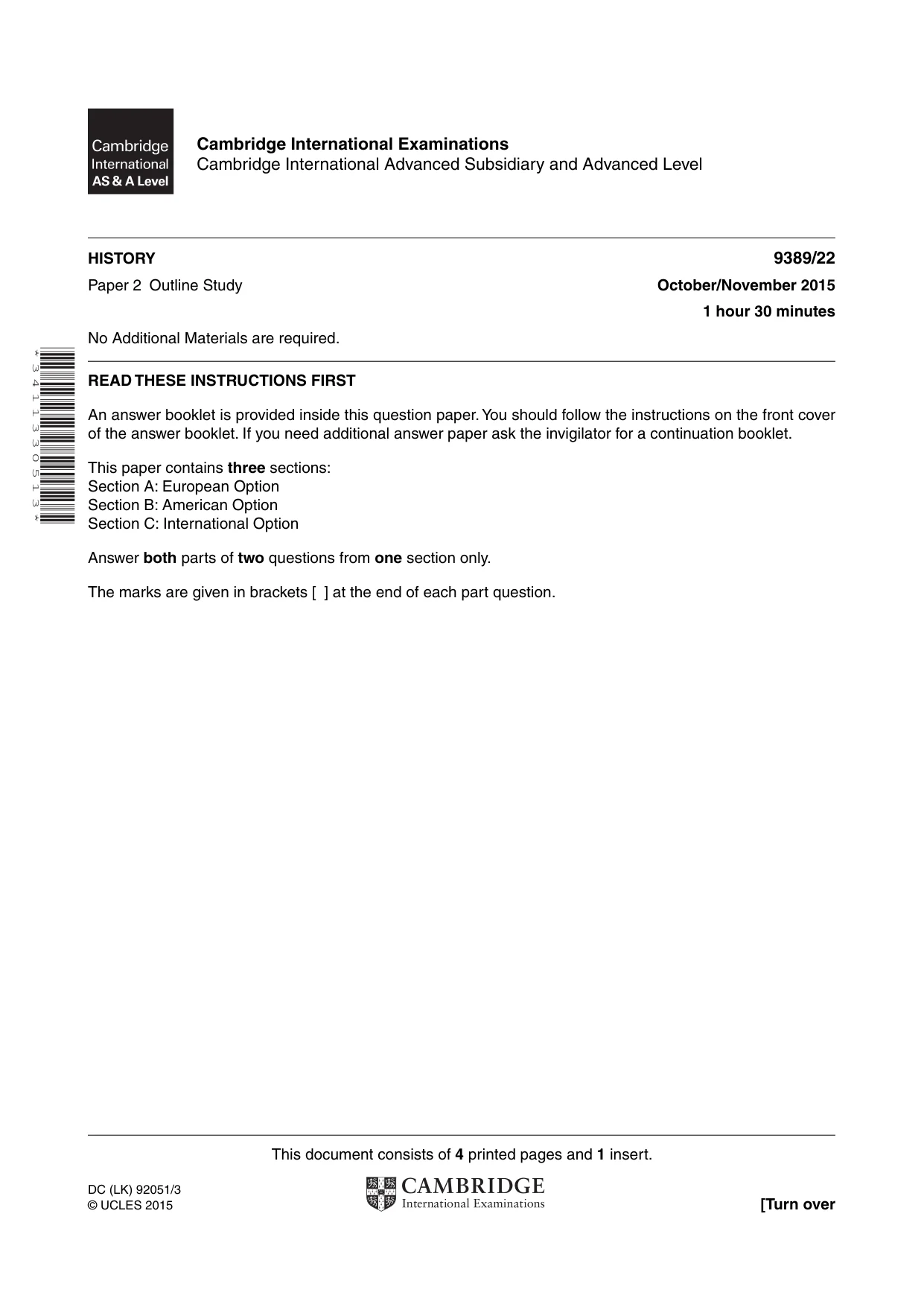
Question paper, page 1
This document consists of 4 printed pages and 1 insert. DC (LK) 92051/3 © UCLES 2015 [Turn over * 3 4 1 1 3 3 0 5 1 3 * HISTORY 9389/22 Paper 2 Outline Study October/November 2015 1 hour 30 minutes No Additional Materials are required. READ THESE INSTRUCTIONS FIRST An answer booklet is provided inside this question paper. You should follow the instructions on the front cover of the answer booklet. If you need additional answer paper ask the invigilator for a continuation booklet. This paper contains three sections: Section A: European Option Section B: American Option Section C: International Option Answer both parts of two questions from one section only. The marks are given in brackets [ ] at the end of each part question. Cambridge International Examinations Cambridge International Advanced Subsidiary and Advanced Level
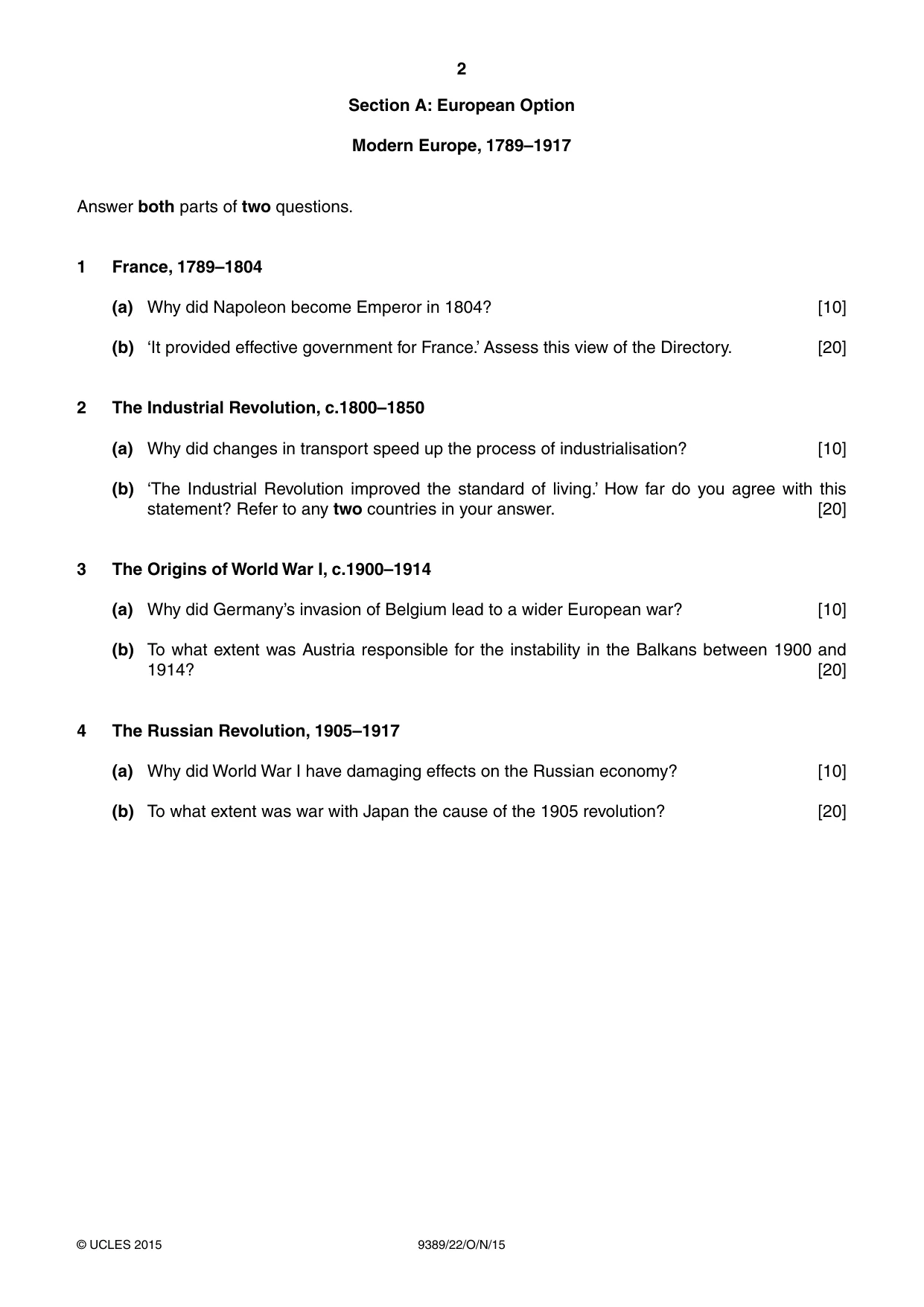
Question paper, page 2
2 9389/22/O/N/15 © UCLES 2015 Section A: European Option Modern Europe, 1789–1917 Answer both parts of two questions. 1 France, 1789–1804 (a) Why did Napoleon become Emperor in 1804? [10] (b) ‘It provided effective government for France.’ Assess this view of the Directory. [20] 2 The Industrial Revolution, c.1800–1850 (a) Why did changes in transport speed up the process of industrialisation? [10] (b) ‘The Industrial Revolution improved the standard of living.’ How far do you agree with this statement? Refer to any two countries in your answer. [20] 3 The Origins of World War I, c.1900–1914 (a) Why did Germany’s invasion of Belgium lead to a wider European war? [10] (b) To what extent was Austria responsible for the instability in the Balkans between 1900 and 1914? [20] 4 The Russian Revolution, 1905–1917 (a) Why did World War I have damaging effects on the Russian economy? [10] (b) To what extent was war with Japan the cause of the 1905 revolution? [20]
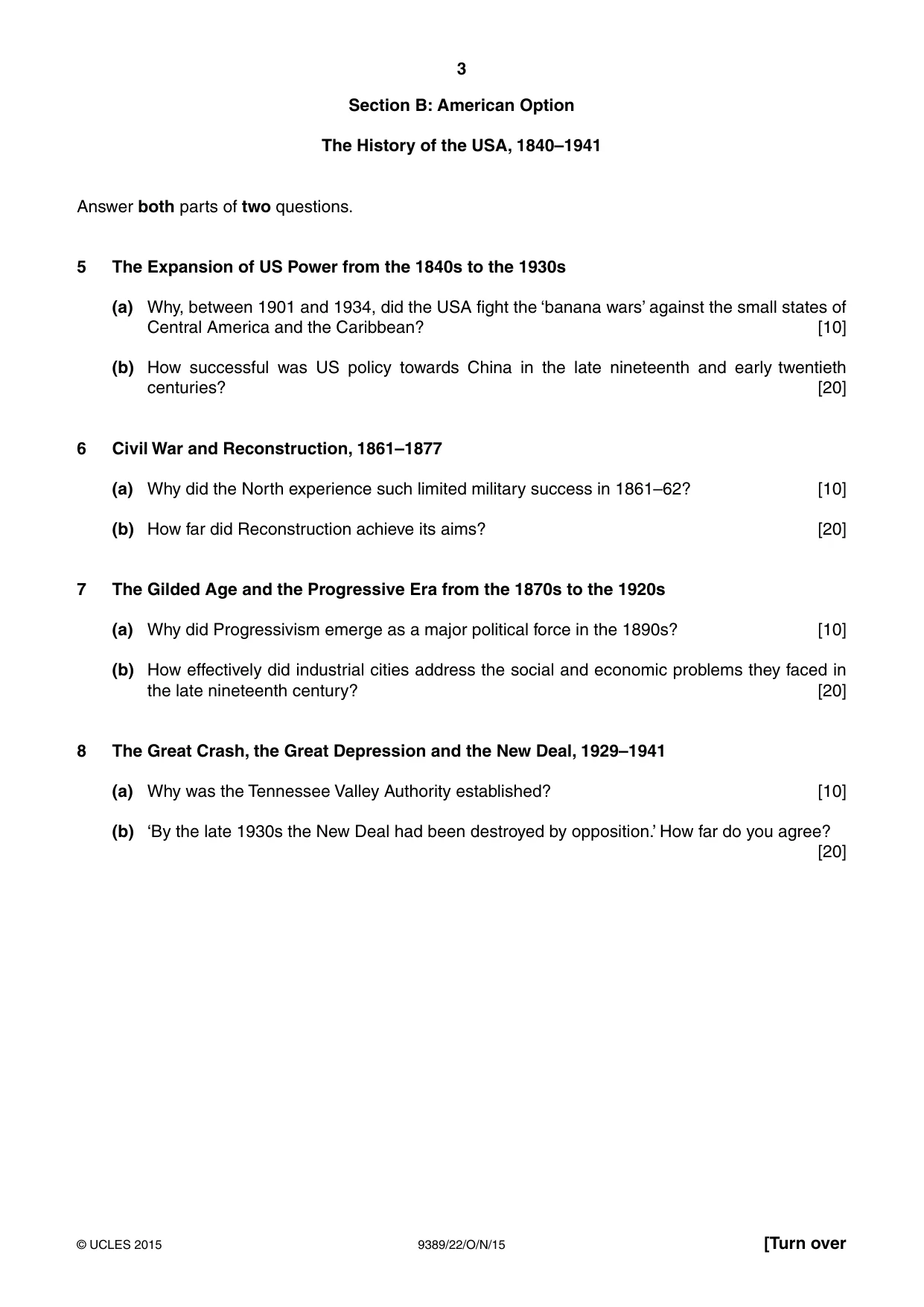
Question paper, page 3
3 9389/22/O/N/15 © UCLES 2015 [Turn over Section B: American Option The History of the USA, 1840–1941 Answer both parts of two questions. 5 The Expansion of US Power from the 1840s to the 1930s (a) Why, between 1901 and 1934, did the USA fight the ‘banana wars’ against the small states of Central America and the Caribbean? [10] (b) How successful was US policy towards China in the late nineteenth and early twentieth centuries? [20] 6 Civil War and Reconstruction, 1861–1877 (a) Why did the North experience such limited military success in 1861–62? [10] (b) How far did Reconstruction achieve its aims? [20] 7 The Gilded Age and the Progressive Era from the 1870s to the 1920s (a) Why did Progressivism emerge as a major political force in the 1890s? [10] (b) How effectively did industrial cities address the social and economic problems they faced in the late nineteenth century? [20] 8 The Great Crash, the Great Depression and the New Deal, 1929–1941 (a) Why was the Tennessee Valley Authority established? [10] (b) ‘By the late 1930s the New Deal had been destroyed by opposition.’ How far do you agree? [20]
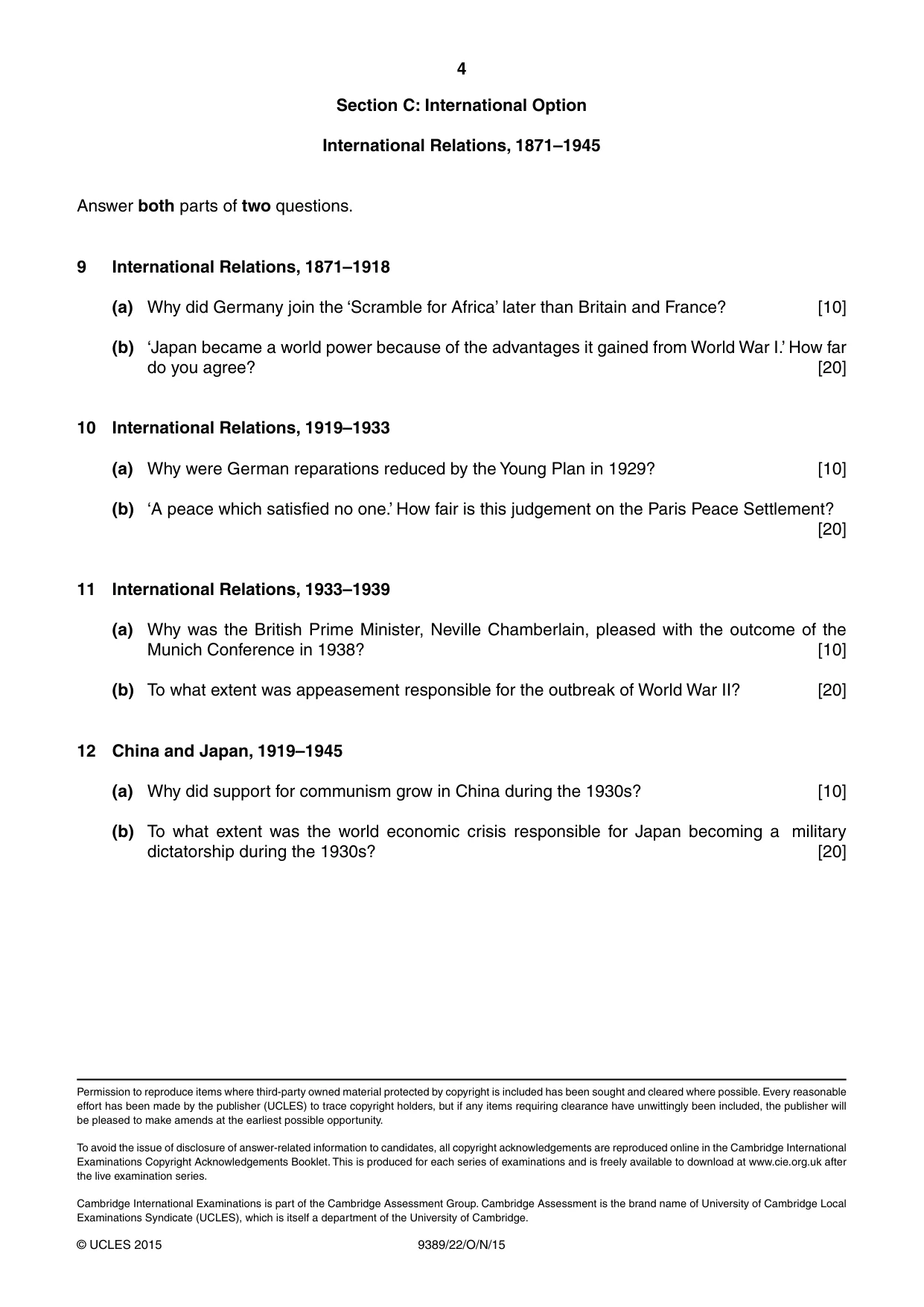
Question paper, page 4
4 9389/22/O/N/15 © UCLES 2015 Section C: International Option International Relations, 1871–1945 Answer both parts of two questions. 9 International Relations, 1871–1918 (a) Why did Germany join the ‘Scramble for Africa’ later than Britain and France? [10] (b) ‘Japan became a world power because of the advantages it gained from World War I.’ How far do you agree? [20] 10 International Relations, 1919–1933 (a) Why were German reparations reduced by the Young Plan in 1929? [10] (b) ‘A peace which satisfied no one.’ How fair is this judgement on the Paris Peace Settlement? [20] 11 International Relations, 1933–1939 (a) Why was the British Prime Minister, Neville Chamberlain, pleased with the outcome of the Munich Conference in 1938? [10] (b) To what extent was appeasement responsible for the outbreak of World War II? [20] 12 China and Japan, 1919–1945 (a) Why did support for communism grow in China during the 1930s? [10] (b) To what extent was the world economic crisis responsible for Japan becoming a military dictatorship duri ng the 1930s? [20] Permission to reproduce items where third-party owned material protected by copyright is included has been sought and cleared where possible. Every reasonable effort has been made by the publisher (UCLES) to trace copyright holders, but if any items requiring clearance have unwittingly been included, the publisher will be pleased to make amends at the earliest possible opportunity. To avoid the issue of disclosure of answer-related information to candidates, all copyright acknowledgements are reproduced online in the Cambridge International Examinations Copyright Acknowledgements Booklet. This is produced for each series of examinations and is freely available to download at www.cie.org.uk after the live examination series. Cambridge International Examinations is part of the Cambridge Assessment Group. Cambridge Assessment is the brand name of University of Cambridge Local Examinations Syndicate (UCLES), which is itself a department of the University of Cambridge.
Mark scheme, page 1
® IGCSE is the registered trademark of Cambridge International Examinations. CAMBRIDGE INTERNATIONAL EXAMINATIONS Cambridge International Advanced Subsidiary and Advanced Level MARK SCHEME for the October/November 2015 series 9389 HISTORY 9389/22 Paper 2 (Outline Study), maximum raw mark 60 This mark scheme is published as an aid to teachers and candidates, to indicate the requirements of the examination. It shows the basis on which Examiners were instructed to award marks. It does not indicate the details of the discussions that took place at an Examiners’ meeting before marking began, which would have considered the acceptability of alternative answers. Mark schemes should be read in conjunction with the question paper and the Principal Examiner Report for Teachers. Cambridge will not enter into discussions about these mark schemes. Cambridge is publishing the mark schemes for the October/November 2015 series for most Cambridge IGCSE®, Cambridge International A and AS Level components and some Cambridge O Level components.
Mark scheme, page 2
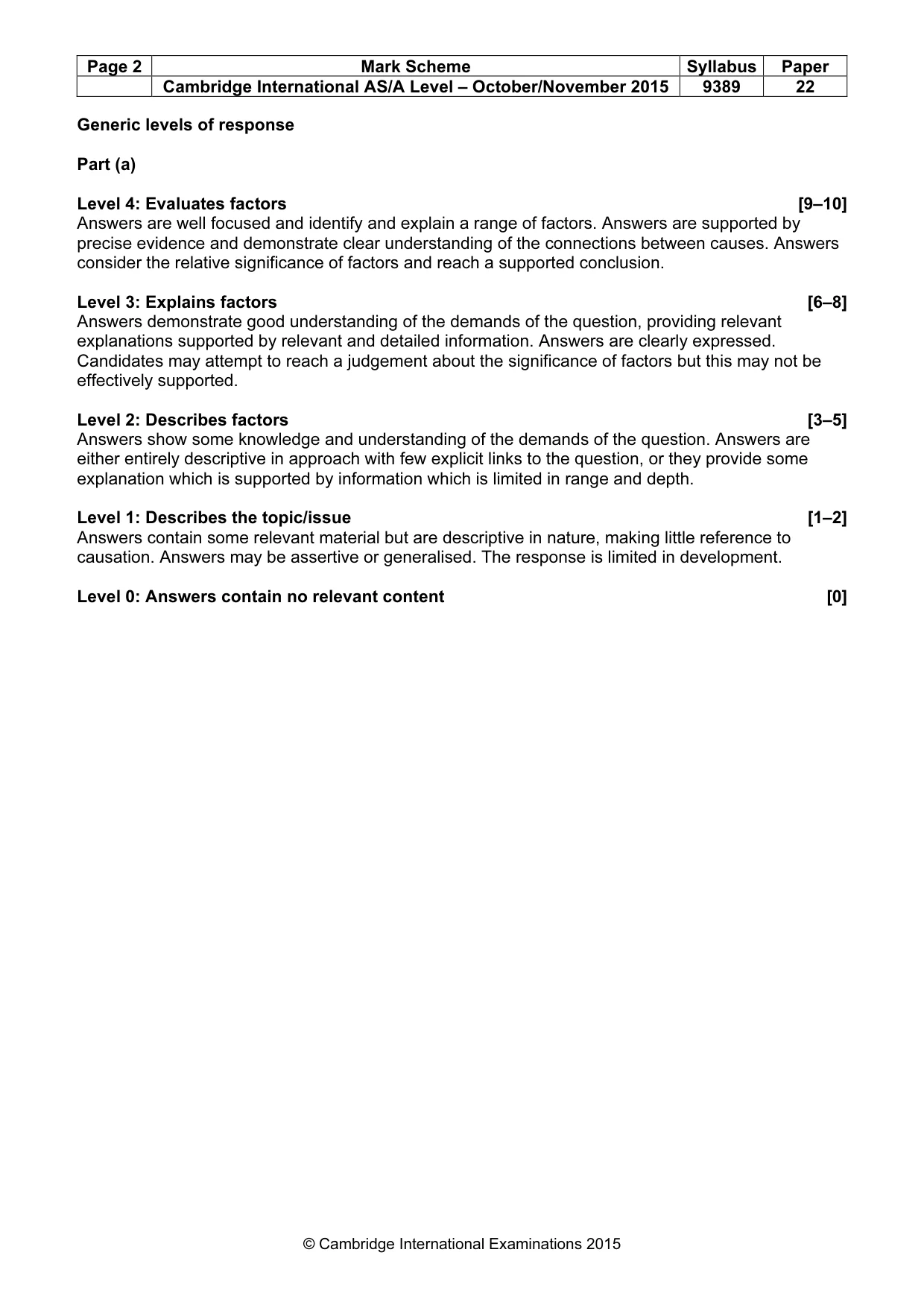
Page 2 Mark Scheme Syllabus Paper Cambridge International AS/A Level – October/November 2015 9389 22 © Cambridge International Examinations 2015 Generic levels of response Part (a) Level 4: Evaluates factors [9–10] Answers are well focused and identify and explain a range of factors. Answers are supported by precise evidence and demonstrate clear understanding of the connections between causes. Answers consider the relative significance of factors and reach a supported conclusion. Level 3: Explains factors [6–8] Answers demonstrate good understanding of the demands of the question, providing relevant explanations supported by relevant and detailed information. Answers are clearly expressed. Candidates may attempt to reach a judgement about the significance of factors but this may not be effectively supported. Level 2: Describes factors [3–5] Answers show some knowledge and understanding of the demands of the question. Answers are either entirely descriptive in approach with few explicit links to the question, or they provide some explanation which is supported by information which is limited in range and depth. Level 1: Describes the topic/issue [1–2] Answers contain some relevant material but are descriptive in nature, making little reference to causation. Answers may be assertive or generalised. The response is limited in development. Level 0: Answers contain no relevant content [0]
Mark scheme, page 3
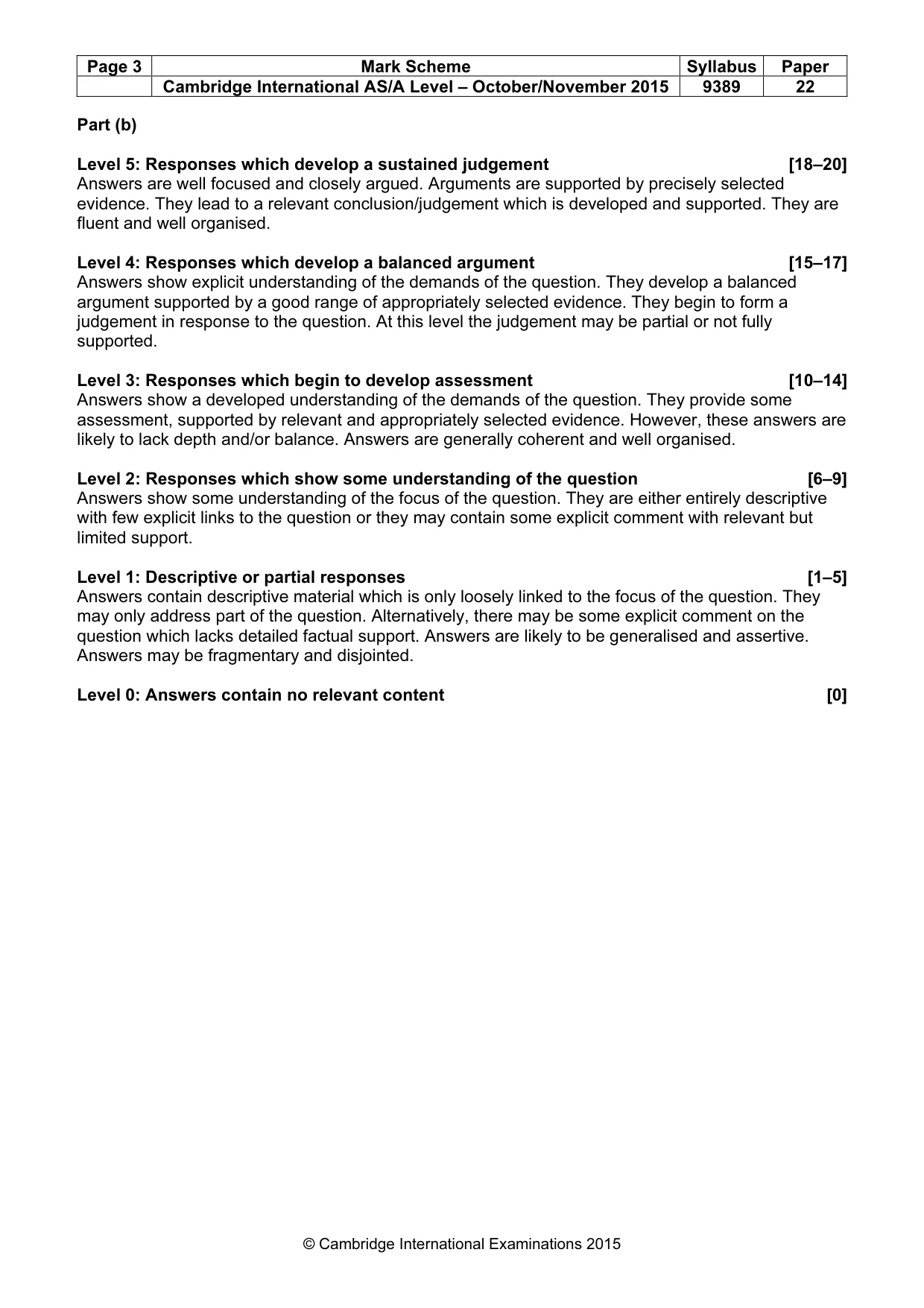
Page 3 Mark Scheme Syllabus Paper Cambridge International AS/A Level – October/November 2015 9389 22 © Cambridge International Examinations 2015 Part (b) Level 5: Responses which develop a sustained judgement [18–20] Answers are well focused and closely argued. Arguments are supported by precisely selected evidence. They lead to a relevant conclusion/judgement which is developed and supported. They are fluent and well organised. Level 4: Responses which develop a balanced argument [15–17] Answers show explicit understanding of the demands of the question. They develop a balanced argument supported by a good range of appropriately selected evidence. They begin to form a judgement in response to the question. At this level the judgement may be partial or not fully supported. Level 3: Responses which begin to develop assessment [10–14] Answers show a developed understanding of the demands of the question. They provide some assessment, supported by relevant and appropriately selected evidence. However, these answers are likely to lack depth and/or balance. Answers are generally coherent and well organised. Level 2: Responses which show some understanding of the question [6–9] Answers show some understanding of the focus of the question. They are either entirely descriptive with few explicit links to the question or they may contain some explicit comment with relevant but limited support. Level 1: Descriptive or partial responses [1–5] Answers contain descriptive material which is only loosely linked to the focus of the question. They may only address part of the question. Alternatively, there may be some explicit comment on the question which lacks detailed factual support. Answers are likely to be generalised and assertive. Answers may be fragmentary and disjointed. Level 0: Answers contain no relevant content [0]
Mark scheme, page 4
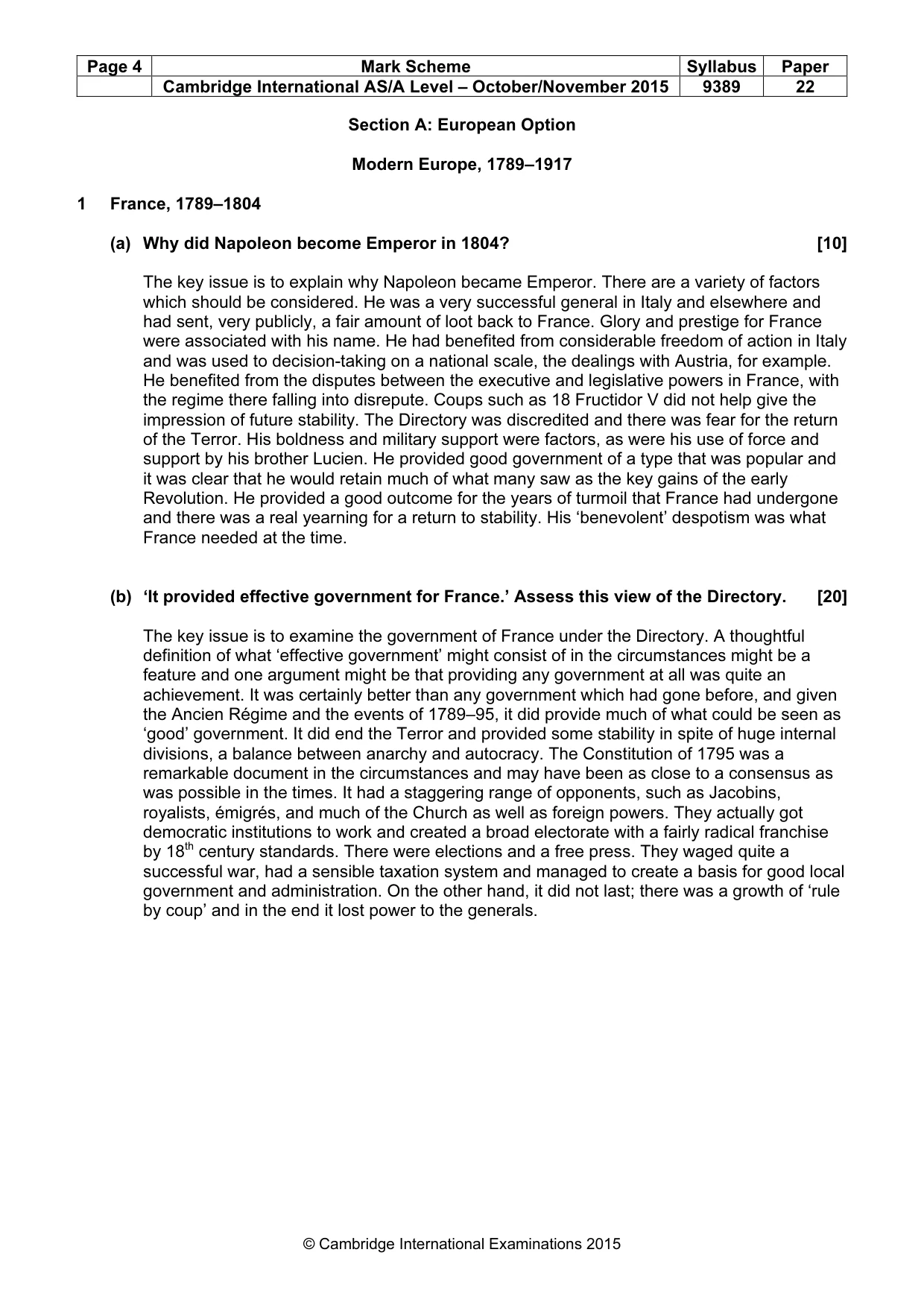
Page 4 Mark Scheme Syllabus Paper Cambridge International AS/A Level – October/November 2015 9389 22 © Cambridge International Examinations 2015 Section A: European Option Modern Europe, 1789–1917 1 France, 1789–1804 (a) Why did Napoleon become Emperor in 1804? [10] The key issue is to explain why Napoleon became Emperor. There are a variety of factors which should be considered. He was a very successful general in Italy and elsewhere and had sent, very publicly, a fair amount of loot back to France. Glory and prestige for France were associated with his name. He had benefited from considerable freedom of action in Italy and was used to decision-taking on a national scale, the dealings with Austria, for example. He benefited from the disputes between the executive and legislative powers in France, with the regime there falling into disrepute. Coups such as 18 Fructidor V did not help give the impression of future stability. The Directory was discredited and there was fear for the return of the Terror. His boldness and military support were factors, as were his use of force and support by his brother Lucien. He provided good government of a type that was popular and it was clear that he would retain much of what many saw as the key gains of the early Revolution. He provided a good outcome for the years of turmoil that France had undergone and there was a real yearning for a return to stability. His ‘benevolent’ despotism was what France needed at the time. (b) ‘It provided effective government for France.’ Assess this view of the Directory. [20] The key issue is to examine the government of France under the Directory. A thoughtful definition of what ‘effective government’ might consist of in the circumstances might be a feature and one argument might be that providing any government at all was quite an achievement. It was certainly better than any government which had gone before, and given the Ancien Régime and the events of 1789–95, it did provide much of what could be seen as ‘good’ government. It did end the Terror and provided some stability in spite of huge internal divisions, a balance between anarchy and autocracy. The Constitution of 1795 was a remarkable document in the circumstances and may have been as close to a consensus as was possible in the times. It had a staggering range of opponents, such as Jacobins, royalists, émigrés, and much of the Church as well as foreign powers. They actually got democratic institutions to work and created a broad electorate with a fairly radical franchise by 18th century standards. There were elections and a free press. They waged quite a successful war, had a sensible taxation system and managed to create a basis for good local government and administration. On the other hand, it did not last; there was a growth of ‘rule by coup’ and in the end it lost power to the generals.
Mark scheme, page 5
Page 5 Mark Scheme Syllabus Paper Cambridge International AS/A Level – October/November 2015 9389 22 © Cambridge International Examinations 2015 2 The Industrial Revolution, c.1800–1850 (a) Why did changes in transport speed up the process of industrialisation? [10] The key issue here is the ways in which changes in transport and communication impacted on the industrial revolution. Transport changes, those affecting roads, rivers, canals, seagoing ships and, of course, railways, were vital. They enabled the revolution to actually happen. Prior to these changes industry was inevitably small scale and localised, dependent on horse transport, the weather and poor roads which in some cases had not developed since Roman times. Raw materials could be moved into a country, energy supplies such as coal could be moved in bulk, and finished products could be moved out to the regions and abroad. Improved communications meant that markets could be developed, capital moved, ideas spread and labour moved to where it was needed. The two factors were interdependent and integral to the whole process. Canals, for example, required huge capital as well as great management and engineering skills, and the experience was invaluable for the development of the rail, shipping and metal industries. (b) ‘The Industrial Revolution improved the standard of living.’ How far do you agree with this statement? Refer to any two countries in your answer. [20] The key issue here is the impact of industrialisation on the standard of living, its nature and extent. There is a substantial on-going debate amongst historians about the impact on the working classes, and even then there is a variable impact within the various social groups. In the UK, there may not have been the consistent rise in the standard of living amongst the working class that there was to be in Germany later on in the 19th century. Amongst the middle classes there was a radical increase, with a rise in real income as well as disposable income, and much of the house building on the fringes of the new urban centres reflects this. What happened in the UK, with real wages rising slowly from 1780 to 1820 and then much faster afterwards, was reflected in both Germany and France from c.1820 onwards. Average annual income in the UK increased significantly during this period, at a rate which was the fastest rise in recorded history prior to that date. The extent to which environmental decay should play a part in the equation is much debated – with the rise in real wages for most being undermined by poor living and working conditions, although the extent to which urban living conditions were necessarily worse than rural ones in the early 19th century is also much debated. For the skilled artisan who managed looms in a factory to the former handloom weaver who was reduced to the status of a day labourer in a slum dependent on his wife and children’s labour for survival, there was a substantially different impact.
Mark scheme, page 6
Page 6 Mark Scheme Syllabus Paper Cambridge International AS/A Level – October/November 2015 9389 22 © Cambridge International Examinations 2015 3 The Origins of World War I, c.1900–1914 (a) Why did Germany’s invasion of Belgium lead to a wider European war? [10] It was decisive in bringing Britain into the war and there was no chance now that it could just be confined to the Balkans or a Russian/French war versus the Germans and Austrians. The focus now turned to the West, and with Britain coming in then, there was going to be a wider ‘imperial’ connection as its Empire and its concern for Germany’s imperial aspirations would come into play. There was a real division in Britain about whether the Liberal Government should or should not get involved, in spite of the Entente, but with the breach of the long- standing recognition of Belgian neutrality, the waverers in the British Cabinet came out in support of the war and gave a superb propaganda opportunity to the Allies. (b) To what extent was Austria responsible for the instability in the Balkans between 1900 and 1914? [20] The key issue here is the degree of responsibility that should be allocated to Austria as the main causative factor in the instability in the Balkans in this period. There is a good case to be made as Austria was determined to retain great power status, and retaining and increasing its hold in the Balkans was a major feature of this. Like several other countries, Austria was determined to gain maximum advantage from the collapse of the Ottoman Empire. There was the hatred of Serbia and Serbian nationalism and quite an aggressive policy towards Serbia, which was a destabilising factor. The annexation of Bosnia- Herzegovina was bound to cause trouble and Austrian involvement and interest in Albania was seen by many as provocative. There is, of course, a large range of other factors to be considered as alternatives. The decline of the now incompetent and corrupt Ottoman Empire was a key factor, as was the growth of aggressive nationalism in the region. The Russians and the Italians must take substantial responsibility, and Greece was hardly an innocent bystander either. Religion and race were issues as were other conflicts between the Rumanians and the Bulgars, while the Serbs themselves were not innocent parties either.
Mark scheme, page 7
Page 7 Mark Scheme Syllabus Paper Cambridge International AS/A Level – October/November 2015 9389 22 © Cambridge International Examinations 2015 4 The Russian Revolution, 1905–1917 (a) Why did World War I have damaging effects on the Russian economy? [10] The Russian economy was hardly strong to start with and it was not well managed. Industrialisation was in its very early stages and agriculture was only slowly moving away from a subsistence economy run by peasants in a semi-feudal setting. While even much more sophisticated economies such as in France and the UK had major problems in moving from a peace-time economy to the demands of total war, it was inevitable that the Russian economy would struggle. The transport system was still in its infancy. Roads were impassable in the winter. The factory system was undeveloped with poor management, dreadful working conditions and erratic sources of both energy and raw materials. Acute shortages of labour led to shortages of food and munitions, the latter fuelling large price rises. The conscription system led to many men vital for food production being taken off the land at harvest time and dreadful generalship led to horrendous casualties. (b) To what extent was war with Japan the cause of the 1905 revolution? [20] The key issue here is the relative importance of the factors which led to the revolution of 1905. Some might try and argue that it was not a revolution, or even an attempted one, but the focus should be on the causes. Certainly the humiliations of the war, both at sea and on land, did the regime no good, but the extent to which there was full awareness within Russia of the extent of the disasters is debateable. With a restricted press and mass illiteracy, not much information spread beyond the centres. With the growth of industry and factories and low wages and poor working conditions, there was scope for the growth of radicalism. The work of Plevhe and the Interior Ministry alienated many, and many came to see the state as immovable and oppressive. With no political parties in the conventional sense, no Trade Unions allowed, there was simply no outlet for any dissent, especially for the huge working class. The legacy of serfdom still dominated the countryside with its attended debts and problems. Middle class anger was fuelled by a rigid caste system which created a massive ‘glass ceiling’ for the able. The military mutinies tended to have different causes, mainly incompetent officers, while many of the strikes, such as those on the railways, had different causes as well.
Mark scheme, page 8
Page 8 Mark Scheme Syllabus Paper Cambridge International AS/A Level – October/November 2015 9389 22 © Cambridge International Examinations 2015 Section B: American Option The History of the USA, 1840–1941 5 The Expansion of US Power from the 1840s to the 1930s (a) Why, between 1901 and 1934, did the USA fight the ‘banana wars’ against the small states of Central America and the Caribbean? [10] The main banana-producing countries were Central American: Honduras, Guatemala and Nicaragua. US military intervention in these states was certainly frequent; US marines moved into Honduras in 1903, 1907, 1911, 1912, 1919 and 1924–25, for example. Candidates can include other countries in the region which experienced US military intervention, e.g. Cuba, Panama and Haiti. Mexico is not properly included, though the USA did send troops in during the revolution of 1910–20. The justification for intervention came in the form of the Roosevelt Corollary of 1904, which asserted the US clam to intervene in states of the region, initially in order to prevent European great power intervention. The main reasons for intervention were three: political, i.e. to prevent disorder, revolt and revolution; economic and financial, i.e. to protect US investments; strategic, i.e. to protect the trade routes through the region, especially once the Panama Canal was opened. Theodore Roosevelt was the Republican president who introduced this change of strategy but even the Democrat Woodrow Wilson continued to intervene, e.g. in Haiti. Franklin Roosevelt switched to a diplomacy-based Good Neighbour policy from 1933, withdrawing US forces from several Central American states. (b) How successful was US policy towards China in the late nineteenth and early twentieth centuries? [20] The period to be covered is from c.1880 to c.1920. In the first thirty years, China was an empire facing partition by European great powers and Japan. Then the 1911 revolution brought initial confusion and attempts to build a more democratic China, attempts which were overtaken by the impact of the First World War. Throughout the period, China was seen as a weak state, often threatened with partition. Thus US policy towards China was aimed more at Britain, France, Germany, Russia and Japan than it was at China. Each had a sphere of influence within China. The USA wanted those various spheres to be open to everyone. This was known as an Open Door policy. It was detailed by the US Secretary of State, John Hay, in 1899 and 1900 in two Notes sent to the great powers for their agreement. They did eventually agree, though the Notes had no force in international law. Japan made great demands on China in 1915, which further strained US-Japanese relations. The Open Door approach was restored by the Nine-Power Treaty signed as part of the 1922 Washington Treaty. The fact that China was not partitioned in this era suggests US policy was successful. It is hard to argue, however, that this was a consequence of US diplomatic efforts. As for the relationship between the USA and China, it fluctuated considerably. At the start of the period, governmental relations between the two states were minimal. In the 1880s and 1890s, Chinese persecution of American missionaries and American exploitation of Chinese immigrants caused tension between the two powers. The Boxer Rebellion of 1900 in China, an anti-foreigner revolt, and its suppression by eight great powers including the USA did little to improve matters. The USA welcomed the overthrow of the empire in 1911–12 but provided little effective help for the new, more democratic government. China was not a great market for US investments during this era; it was too remote, too different to merit investments by US finance corporations.
Mark scheme, page 9
Page 9 Mark Scheme Syllabus Paper Cambridge International AS/A Level – October/November 2015 9389 22 © Cambridge International Examinations 2015 6 Civil War and Reconstruction, 1861–1877 (a) Why did the North experience such limited military success in 1861–62? [10] The main theatre of war was to the east, between the two capitals, Washington DC and Richmond, Virginia. Here the North had over-cautious military leaders following inconsistent military strategies in the first two years of the war. The leaders included Winfield Scott and, for the 1861–62 winter, George McClellan, before Lincoln himself took over for a few months. The First Bull Run battle in July 1861 and Second Bull Run in August 1862 were significant defeats for the North. On the other side, the South had skilful military leaders who followed a more aggressive strategy, taking the fight to the North. General Lee led Southern armies into Northern territory in 1862, to fight the bloody battle of Antietam, and in 1863 to fight at Gettysburg. On the western front between the Mississippi and the Appalachians, Northern forces were also slow to gain the upper hand. The main reasons for this poor record, despite a great superiority of men and resources, were the inexperience of Lincoln as US president and the reluctance of the Northern leadership to fight a more dynamic and aggressive war, allowing the South to gain the upper hand. Eventually, Lincoln learnt the necessary lessons and appointed Ulysses Grant as the general in command of Northern forces. The balance of military success soon shifted to the North. (b) How far did Reconstruction achieve its aims? [20] Reconstruction of the South by the North was certainly ambitious, not least because the victors of the civil war were imposing their plans on a white South which accepted defeat with great reluctance and much resentment. The main aims of Reconstruction were political and social: to reintegrate the eleven Confederate states into a reformed USA and to reorder Southern society to take account of the four million freed slaves. The infrastructure of the South, greatly damaged in the civil war, also needed rebuilding. The victors, however, did not always agree on the policies to be followed or even who should lead Reconstruction. Thus Reconstruction policies changed as Presidents and Congresses changed. The reintegration of the Southern states into the US system of government was accomplished once those states had revised their constitutions and accepted the 13th and 14th amendments. That was the easy part. Reforming the society of the South was much harder. Southern governments were Republican for much of the twelve years after the war, though they did need the support of the US army to stay in power. The Freedmen’s Bureau did some good work for ex-slaves in the mid-1860s but it lacked enough federal support to continue its work in the 1870s. Some ex-slaves participated in state politics and government in the late 1860s and early 1870s. These reforms need to be set against the continued opposition of the white South, as shown by the Black Codes of the mid-1860s and by the emergence of the Ku Klux Klan around the same time. Though both were checked by the federal government in the short term, anti-freemen policies returned to the South once Northern Republicans and the federal army withdrew in the later 1870s. Even when the North was at its most interventionist, it never tried to change the system of land ownership. The plantations were never broken up; the whites still owned the land and the blacks did not. Reconstruction is usually accepted as finishing in 1877. Twelve years was too short a time to reconstruct the South. While slaves had gained some freedoms, they were to lose many in the Jim Crow era of the late nineteenth century.
Mark scheme, page 10
Page 10 Mark Scheme Syllabus Paper Cambridge International AS/A Level – October/November 2015 9389 22 © Cambridge International Examinations 2015 7 The Gilded Age and the Progressive Era from the 1870s to the 1920s (a) Why did Progressivism emerge as a major political force in the 1890s? [10] By the last decade of the nineteenth century, popular dissatisfaction with the consequences of Gilded Age capitalism was becoming widespread. Farmers in the countryside – still the largest occupational group in the USA – had for many years experienced rising costs and falling prices. They wanted to return to a bimetallic currency, gold and silver, and to limit the power of the railroad barons. In 1890 they formed the Farmers’ Alliance. In 1892 they formed the People’s Party, looking to gain the support of the industrial working class as well, by demanding a limit to daily working hours. They did win some elections in the West. In 1896, rather than split the anti-business vote, they chose the Democratic Party’s candidate, William Bryan Jennings, as their candidate. They still lost. However, their ideas had become a key element of political debate. Many policies were implemented by the administration of Theodore Roosevelt in the 1900s. The 1890s was a decade of transition from the Gilded Age to the Progressive era. The policies associated with Progressivism gained the support of many working men in both town and countryside. In a democracy such as the USA they could not be ignored completely, especially as there was growing evidence from muckraking journalists to support them. (b) How effectively did industrial cities address the social and economic problems they faced in the late nineteenth century? [20] The most obvious cities are probably New York, Chicago and Detroit, with Boston and Pittsburgh also worth consideration [not that candidates are likely to mention specific cities]. The most obvious social problem was the development of slums or ghettos, even though the latter term was probably not used at the time. A slum is an urban area of poverty and deprivation while a ghetto is an ethnically distinct area, e.g. Chinatown, Little Italy, which is not wholly poor. Slums and ghettos were caused mainly by the rapid growth of population, especially immigrants from Europe. New York City grew from 1.2m in 1860 to 3.4m in 1900. Most of those immigrants were Irish and German to start with, followed by Poles and Russians later on. Tenement buildings were devised to house them; they soon became overcrowded. Sanitation was inadequate, the water closet being developed for mass production only in the 1870s. Disease was rife, mortality rates high. Sweat shops provided the main form of employment. Crime was rife. City government usually did little to address the problems of the slums. Their governance was often in the hands of city bosses such as Boss Tweed in New York. They tended to exploit the ‘huddled masses’ who moved to their cities rather than introduce relevant social reforms. By the 1890s, however, the Progressive movement was starting to develop, intent on urban social reform. A leading example was Hazen Pingree, four-time mayor of Detroit, who set about improving the city’s infrastructure. In 1890, Jacob Riis, a Danish immigrant, published a book on slum conditions in New York entitled How The Other Half Lives, an early form of muckraking journalism which further helped the development of Progressivism in the early twentieth century. The social problems of the new industrial cities were greater than their economic problems, except at times of economic depression – which were usually short- lived. The USA was a mobile country in terms of both society and geography. If you worked hard, the rapidly-growing US economy provided enough opportunities for you to escape the slums, if only into the suburbs made possible by railroads and tramways. Though more in the early twentieth century, city authorities eventually did enough to alleviate the worst social problems of the industrial slums.
Mark scheme, page 11
Page 11 Mark Scheme Syllabus Paper Cambridge International AS/A Level – October/November 2015 9389 22 © Cambridge International Examinations 2015 8 The Great Crash, the Great Depression and the New Deal, 1929–1941 (a) Why was the Tennessee Valley Authority established? [10] The TVA was established in May 1933 for perhaps four main reasons. Firstly, it was included in the 100 Days of action at the start of FDR’s presidency. The TVA was an eye-catching ambitious project which conveyed the positive efforts of the new administration to get America moving again. Proposals to dam the Tennessee River had been around for many years. Some dam-building had taken place in the First World War. Several more ambitious schemes to develop the river had been vetoed by Republican presidents in the 1920s. FDR turned proposals into action, making something of a party political point as he did so. Secondly, the project focused on the Tennessee River, which covered several relatively impoverished states which were hit hard by the Great Crash and Great Depression. The new authority would control flooding, prevent soil erosion, create electricity for a region with little electrical power and improve navigation. The ambitious scheme showed that the Democrats had regard for the poorer parts of the USA and not just the richest. Thirdly, the TVA was a government agency, not a private, profit-making company. It was intended to show that public bodies were able to work for the public good, communicating an important message to the American people. Fourthly, it was a regional agency, neither state nor federal, but covering several states. This was new; it was intended as a model which could be applied elsewhere, though it never happened. (b) ‘By the late 1930s the New Deal had been destroyed by opposition.’ How far do you agree? [20] The opposition took two forms: political, in the form of individuals and groups which gained popular support, and governmental, in the form of institutional opposition to new laws, proposed and actual. The political opposition came from both left and right. Left-wing opposition is perhaps the better known: Dr Francis Townsend, Father Coughlin, Huey Long all criticised FDR for failing to do more to achieve economic growth and social equality. They all emerged in 1934–35 as the mix of reforms labelled the First New Deal failed to have the positive effect that had been expected. At the same time, some conservative Democrats from the South left the party and set up the American Liberty League, if with less impact than the left wingers. FDR introduced more radical policies, often labelled the Second New Deal, partly in response to the left-wing criticism. For the 1936 presidential elections, those left-wing critics formed a Union Party, but its candidate went the way of all third party candidates, attracting few votes. Left-wing criticism of the New Deal was more muted thereafter. After 1936 the critics of the New Deal were more governmental. The judgements of the US Supreme Court undermined much of the New Deal, causing FDR to announce his ‘court-packing’ plan. Though that came to naught, the Supreme Court was less critical of New Deal reforms thereafter. The opposition of Southern Democrats in the US Senate in 1937–38 caused FDR to tour the South to put the case for the New Deal, but with little success. After the 1938 mid-term elections, FDR introduced no new New Deal reforms. By the end of the decade there was little opposition, but by then the energy of the early New Deal reforms – and reformers – had dissipated. In addition, the economy had not revived in the way that had been hoped when the New Deal was first launched. In this respect, it could be argued that by the late 1930s the New Deal had failed. However, the institutions and reforms of the New Deal remained largely intact – and indeed some have survived into the 21st century.
Mark scheme, page 12
Page 12 Mark Scheme Syllabus Paper Cambridge International AS/A Level – October/November 2015 9389 22 © Cambridge International Examinations 2015 Section C: International Option International Relations, 1871–1945 9 International Relations, 1871–1918 (a) Why did Germany join the ‘scramble for Africa’ later than Britain and France? [10] Bismarck’s primary concern was to ensure German security – he focused on creating a series of alliances and wanted to avoid unnecessary rivalry with other countries. He argued strongly against Germany adopting a policy of imperial expansion, fearing that this would lead to the country’s downfall. When Bismarck left office in 1890, Kaiser Wilhelm adopted a more aggressive foreign policy, which led to German involvement in imperialistic ambitions in Africa and the East. Boastful and impetuous, Wilhelm’s primary aim was to increase Germany’s power – he saw imperial acquisitions as one way of achieving this. (b) ‘Japan became a world power because of the advantages it gained from World War I.’ How far do you agree? [20] WWI enabled Japan to greatly increase exports and industry, while at the same time extending its influence over China (e.g. by providing loans and imposing the Twenty-One Demands). Although Japan was eventually forced to reduce the twenty-one demands, it retained similar rights in China to those enjoyed by the other world powers. By 1918, Japan was in a very strong position and unquestionably the most powerful Asian country, posing a significant threat to the interests of other world powers, especially the USA. However, it could be argued that Japan already had great power status even before WWI. It had already established impressive industrial and military infrastructure, gained significant concessions from China, gained credibility from its alliance with Britain (1902) and defeated a major European power in war (Russia, 1904–5). Both Britain and the USA viewed Japan as a vital ally in the war against Germany.
Mark scheme, page 13
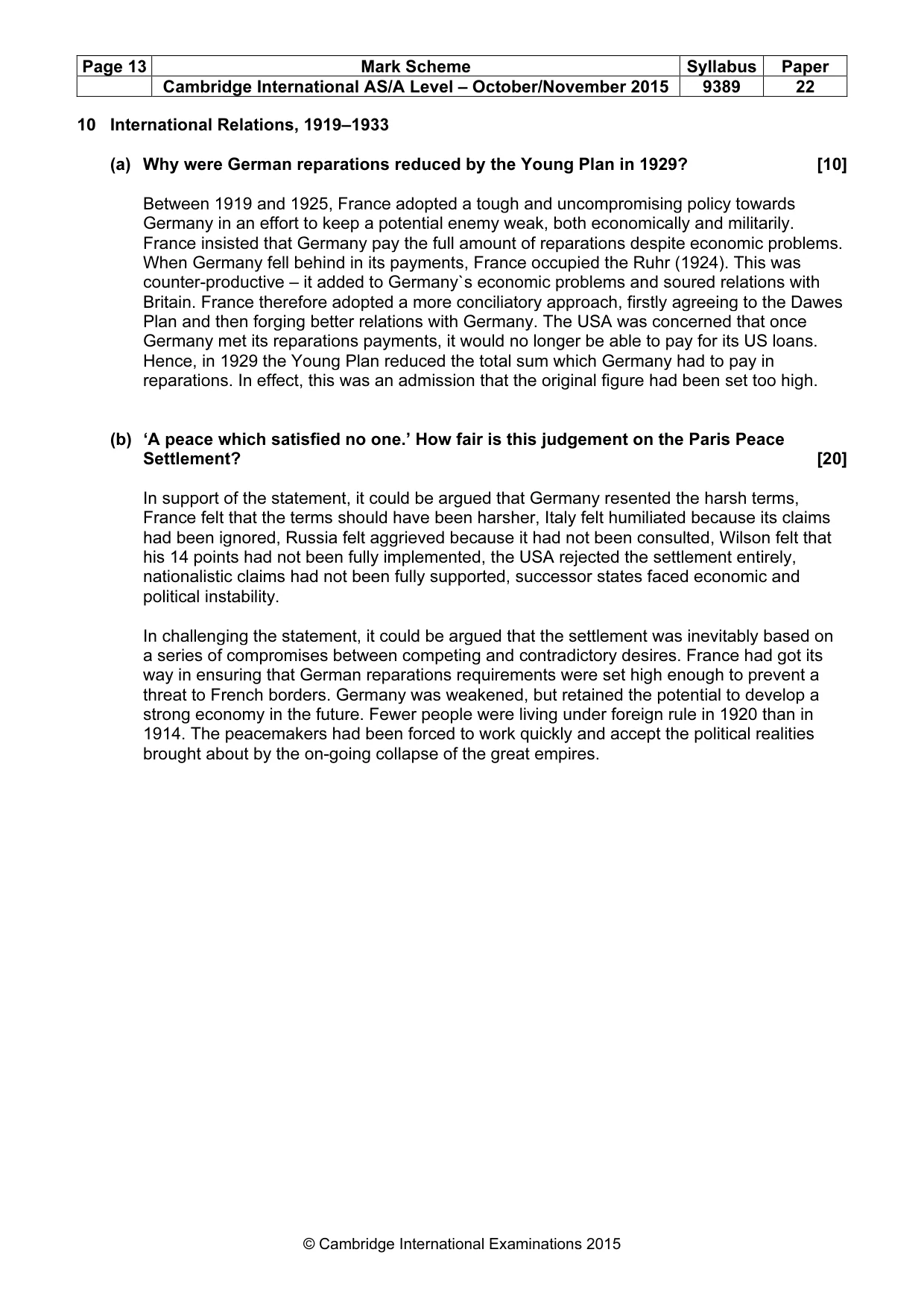
Page 13 Mark Scheme Syllabus Paper Cambridge International AS/A Level – October/November 2015 9389 22 © Cambridge International Examinations 2015 10 International Relations, 1919–1933 (a) Why were German reparations reduced by the Young Plan in 1929? [10] Between 1919 and 1925, France adopted a tough and uncompromising policy towards Germany in an effort to keep a potential enemy weak, both economically and militarily. France insisted that Germany pay the full amount of reparations despite economic problems. When Germany fell behind in its payments, France occupied the Ruhr (1924). This was counter-productive – it added to Germany`s economic problems and soured relations with Britain. France therefore adopted a more conciliatory approach, firstly agreeing to the Dawes Plan and then forging better relations with Germany. The USA was concerned that once Germany met its reparations payments, it would no longer be able to pay for its US loans. Hence, in 1929 the Young Plan reduced the total sum which Germany had to pay in reparations. In effect, this was an admission that the original figure had been set too high. (b) ‘A peace which satisfied no one.’ How fair is this judgement on the Paris Peace Settlement? [20] In support of the statement, it could be argued that Germany resented the harsh terms, France felt that the terms should have been harsher, Italy felt humiliated because its claims had been ignored, Russia felt aggrieved because it had not been consulted, Wilson felt that his 14 points had not been fully implemented, the USA rejected the settlement entirely, nationalistic claims had not been fully supported, successor states faced economic and political instability. In challenging the statement, it could be argued that the settlement was inevitably based on a series of compromises between competing and contradictory desires. France had got its way in ensuring that German reparations requirements were set high enough to prevent a threat to French borders. Germany was weakened, but retained the potential to develop a strong economy in the future. Fewer people were living under foreign rule in 1920 than in 1914. The peacemakers had been forced to work quickly and accept the political realities brought about by the on-going collapse of the great empires.
Mark scheme, page 14
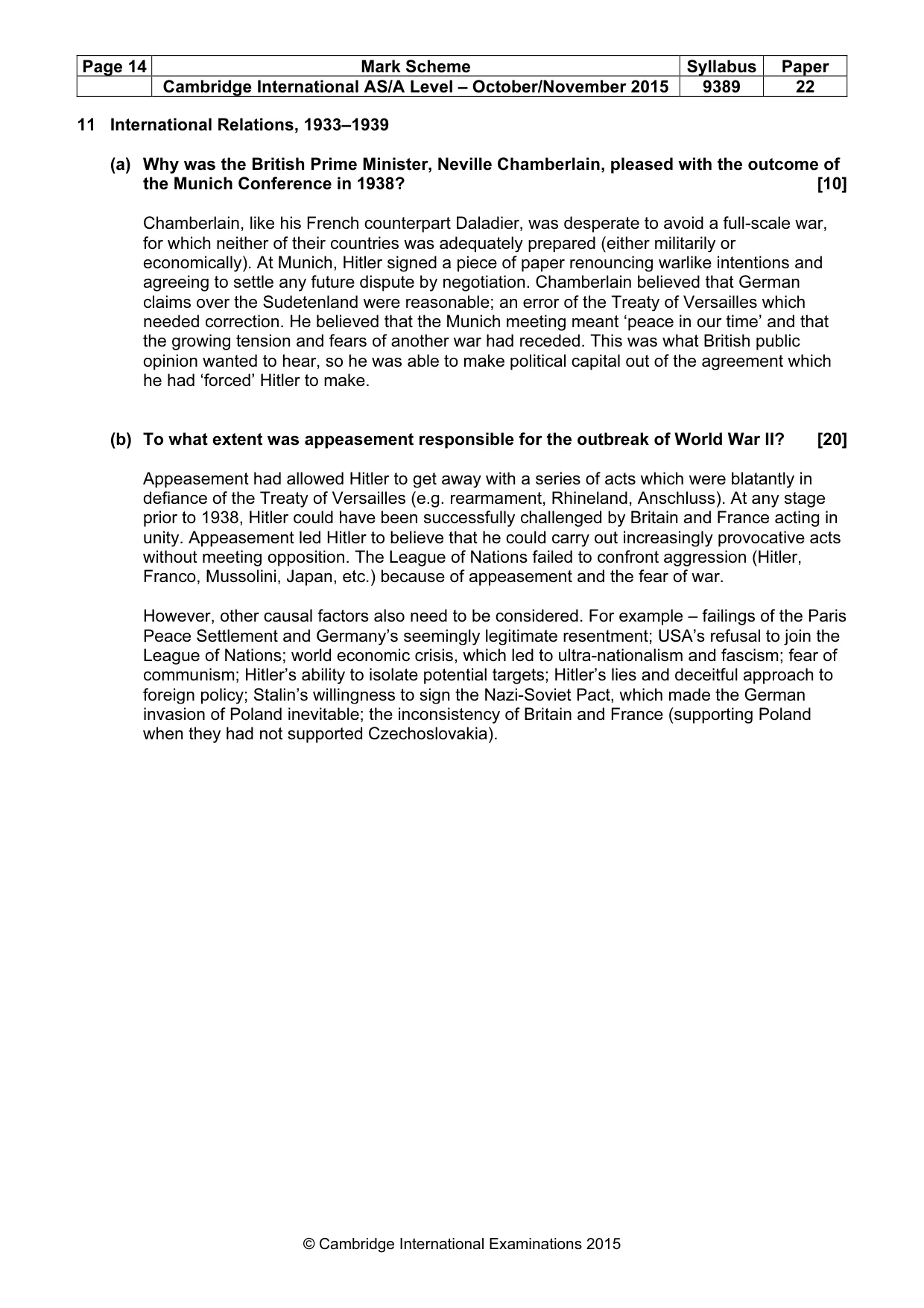
Page 14 Mark Scheme Syllabus Paper Cambridge International AS/A Level – October/November 2015 9389 22 © Cambridge International Examinations 2015 11 International Relations, 1933–1939 (a) Why was the British Prime Minister, Neville Chamberlain, pleased with the outcome of the Munich Conference in 1938? [10] Chamberlain, like his French counterpart Daladier, was desperate to avoid a full-scale war, for which neither of their countries was adequately prepared (either militarily or economically). At Munich, Hitler signed a piece of paper renouncing warlike intentions and agreeing to settle any future dispute by negotiation. Chamberlain believed that German claims over the Sudetenland were reasonable; an error of the Treaty of Versailles which needed correction. He believed that the Munich meeting meant ‘peace in our time’ and that the growing tension and fears of another war had receded. This was what British public opinion wanted to hear, so he was able to make political capital out of the agreement which he had ‘forced’ Hitler to make. (b) To what extent was appeasement responsible for the outbreak of World War II? [20] Appeasement had allowed Hitler to get away with a series of acts which were blatantly in defiance of the Treaty of Versailles (e.g. rearmament, Rhineland, Anschluss). At any stage prior to 1938, Hitler could have been successfully challenged by Britain and France acting in unity. Appeasement led Hitler to believe that he could carry out increasingly provocative acts without meeting opposition. The League of Nations failed to confront aggression (Hitler, Franco, Mussolini, Japan, etc.) because of appeasement and the fear of war. However, other causal factors also need to be considered. For example – failings of the Paris Peace Settlement and Germany’s seemingly legitimate resentment; USA’s refusal to join the League of Nations; world economic crisis, which led to ultra-nationalism and fascism; fear of communism; Hitler’s ability to isolate potential targets; Hitler’s lies and deceitful approach to foreign policy; Stalin’s willingness to sign the Nazi-Soviet Pact, which made the German invasion of Poland inevitable; the inconsistency of Britain and France (supporting Poland when they had not supported Czechoslovakia).
Mark scheme, page 15
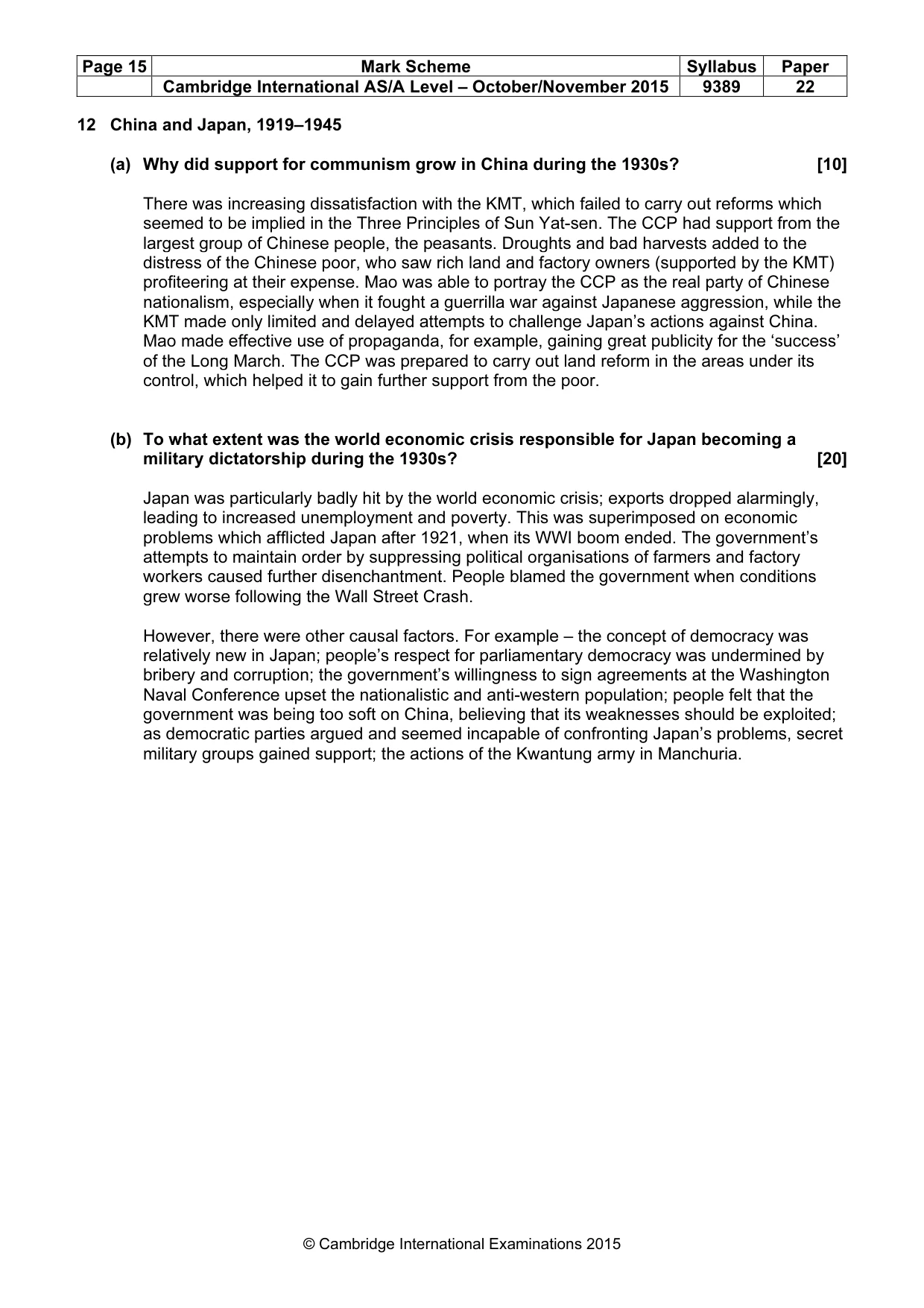
Page 15 Mark Scheme Syllabus Paper Cambridge International AS/A Level – October/November 2015 9389 22 © Cambridge International Examinations 2015 12 China and Japan, 1919–1945 (a) Why did support for communism grow in China during the 1930s? [10] There was increasing dissatisfaction with the KMT, which failed to carry out reforms which seemed to be implied in the Three Principles of Sun Yat-sen. The CCP had support from the largest group of Chinese people, the peasants. Droughts and bad harvests added to the distress of the Chinese poor, who saw rich land and factory owners (supported by the KMT) profiteering at their expense. Mao was able to portray the CCP as the real party of Chinese nationalism, especially when it fought a guerrilla war against Japanese aggression, while the KMT made only limited and delayed attempts to challenge Japan’s actions against China. Mao made effective use of propaganda, for example, gaining great publicity for the ‘success’ of the Long March. The CCP was prepared to carry out land reform in the areas under its control, which helped it to gain further support from the poor. (b) To what extent was the world economic crisis responsible for Japan becoming a military dictatorship during the 1930s? [20] Japan was particularly badly hit by the world economic crisis; exports dropped alarmingly, leading to increased unemployment and poverty. This was superimposed on economic problems which afflicted Japan after 1921, when its WWI boom ended. The government’s attempts to maintain order by suppressing political organisations of farmers and factory workers caused further disenchantment. People blamed the government when conditions grew worse following the Wall Street Crash. However, there were other causal factors. For example – the concept of democracy was relatively new in Japan; people’s respect for parliamentary democracy was undermined by bribery and corruption; the government’s willingness to sign agreements at the Washington Naval Conference upset the nationalistic and anti-western population; people felt that the government was being too soft on China, believing that its weaknesses should be exploited; as democratic parties argued and seemed incapable of confronting Japan’s problems, secret military groups gained support; the actions of the Kwantung army in Manchuria.
What you needed in this session
Cambridge’s own grade thresholds for 2015 Oct/Nov, Paper 2 · Variant 2. A higher threshold means an easier paper — the bar moves with how the cohort did.