Cambridge A Level History 9389 — 2015 Oct/Nov Paper 2 · Variant 1
9389/21/O/N/15 · 60 marks · ≈68 min
The question paper and its mark scheme, free to read here and free to download. This is Cambridge’s own paper, exactly as it was sat.
Question paper4 pages
Mark scheme15 pages
Answers below. Sit the paper first if you are practising.
Paper as text
Question paper, page 1
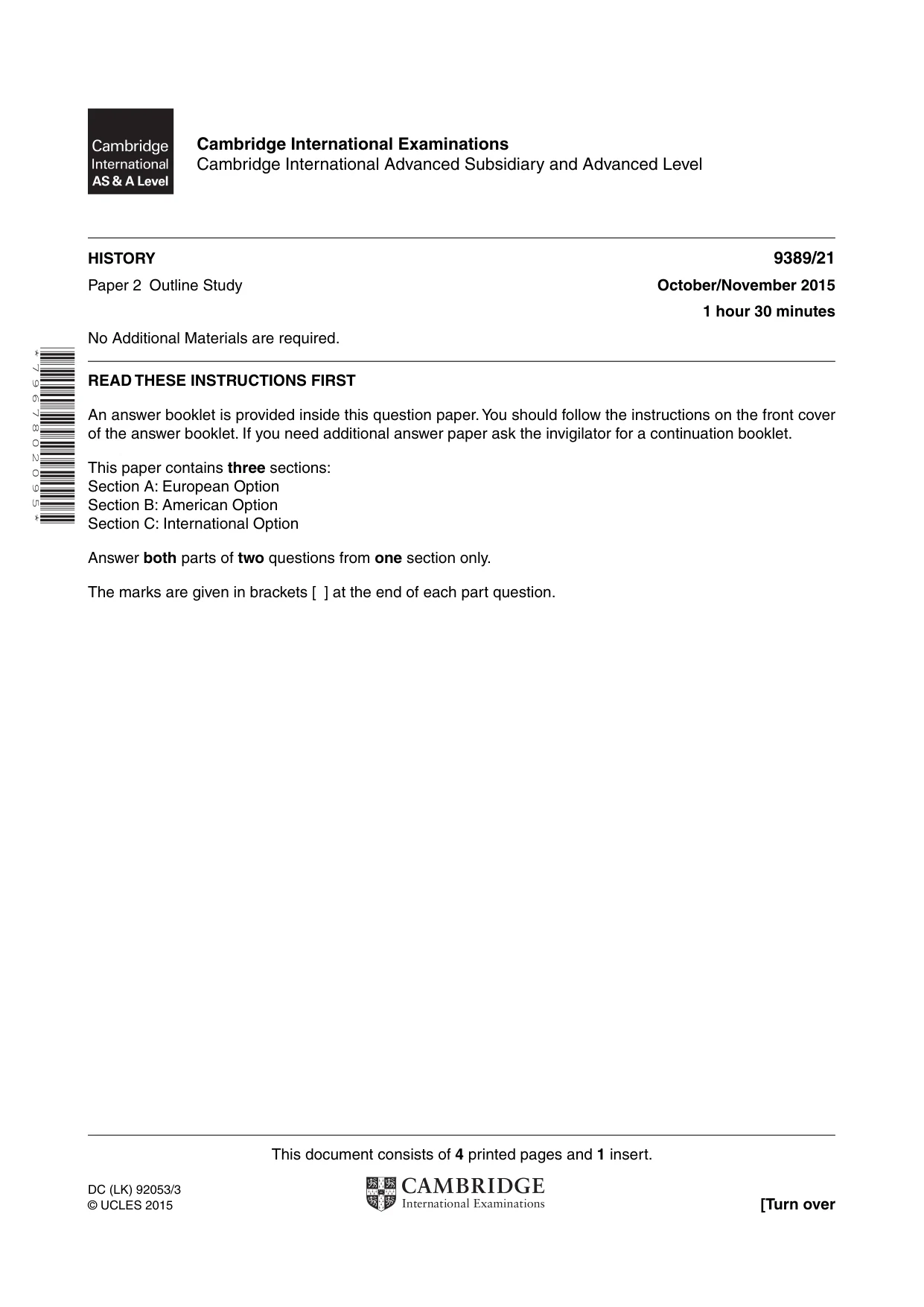
This document consists of 4 printed pages and 1 insert. DC (LK) 92053/3 © UCLES 2015 [Turn over * 7 9 6 7 8 0 2 0 9 5 * HISTORY 9389/21 Paper 2 Outline Study October/November 2015 1 hour 30 minutes No Additional Materials are required. READ THESE INSTRUCTIONS FIRST An answer booklet is provided inside this question paper. You should follow the instructions on the front cover of the answer booklet. If you need additional answer paper ask the invigilator for a continuation booklet. This paper contains three sections: Section A: European Option Section B: American Option Section C: International Option Answer both parts of two questions from one section only. The marks are given in brackets [ ] at the end of each part question. Cambridge International Examinations Cambridge International Advanced Subsidiary and Advanced Level
Question paper, page 2
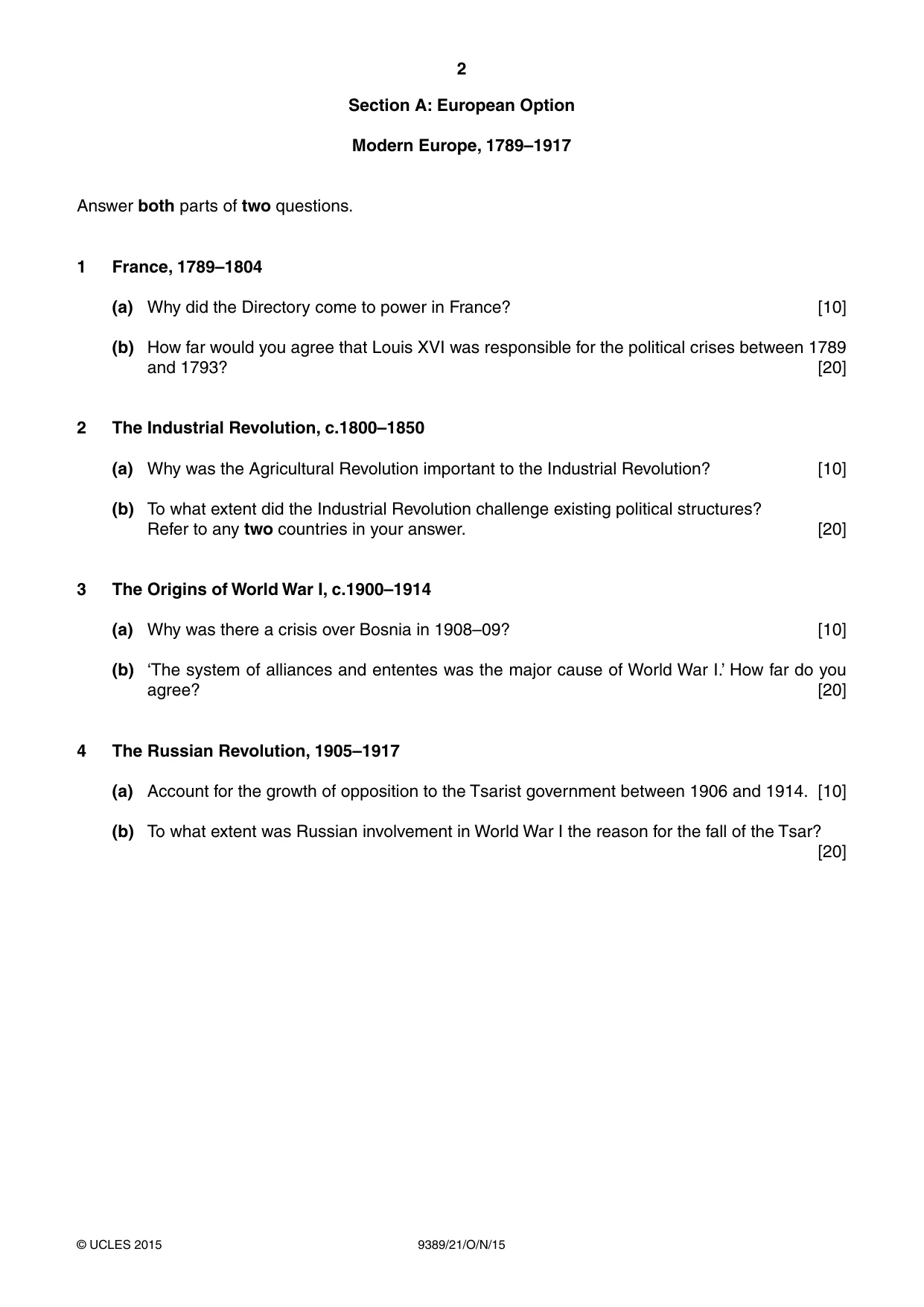
2 9389/21/O/N/15 © UCLES 2015 Section A: European Option Modern Europe, 1789–1917 Answer both parts of two questions. 1 France, 1789–1804 (a) Why did the Directory come to power in France? [10] (b) How far would you agree that Louis XVI was responsible for the political crises between 1789 and 1793? [20] 2 The Industrial Revolution, c.1800–1850 (a) Why was the Agricultural Revolution important to the Industrial Revolution? [10] (b) To what extent did the Industrial Revolution challenge existing political structures? Refer to any two countries in your answer. [20] 3 The Origins of World War I, c.1900–1914 (a) Why was there a crisis over Bosnia in 1908–09? [10] (b) ‘The system of alliances and ententes was the major cause of World War I.’ How far do you agree? [20] 4 The Russian Revolution, 1905–1917 (a) Account for the growth of opposition to the Tsarist government between 1906 and 1914. [10] (b) To what extent was Russian involvement in World War I the reason for the fall of the Tsar? [20]
Question paper, page 3
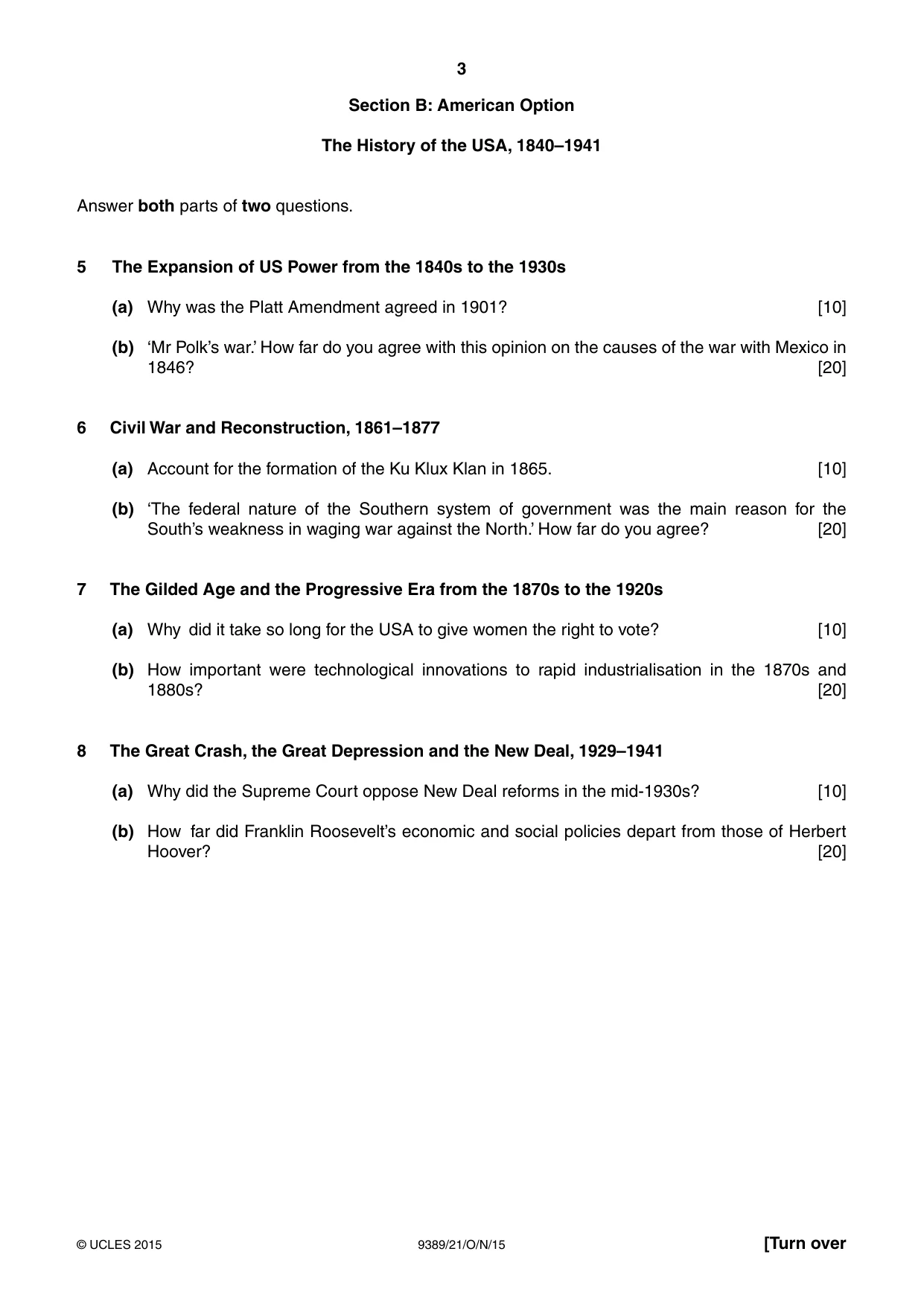
3 9389/21/O/N/15 © UCLES 2015 [Turn over Section B: American Option The History of the USA, 1840–1941 Answer both parts of two questions. 5 The Expansion of US Power from the 1840s to the 1930s (a) Why was the Platt Amendment agreed in 1901? [10] (b) ‘Mr Polk’s war.’ How far do you agree with this opinion on the causes of the war with Mexico in 1846? [20] 6 Civil War and Reconstruction, 1861–1877 (a) Account for the formation of the Ku Klux Klan in 1865. [10] (b) ‘The federal nature of the Southern system of government was the main reason for the South’s weakness in waging war against the North.’ How far do you agree? [20] 7 The Gilded Age and the Progressive Era from the 1870s to the 1920s (a) Why did it take so long for the USA to give women the right to vote? [10] (b) How important were technological innovations to rapid industrialisation in the 1870s and 1880s? [20] 8 The Great Crash, the Great Depression and the New Deal, 1929–1941 (a) Why did the Supreme Court oppose New Deal reforms in the mid-1930s? [10] (b) How far did Franklin Roosevelt’s economic and social policies depart from those of Herbert Hoover? [20]
Question paper, page 4
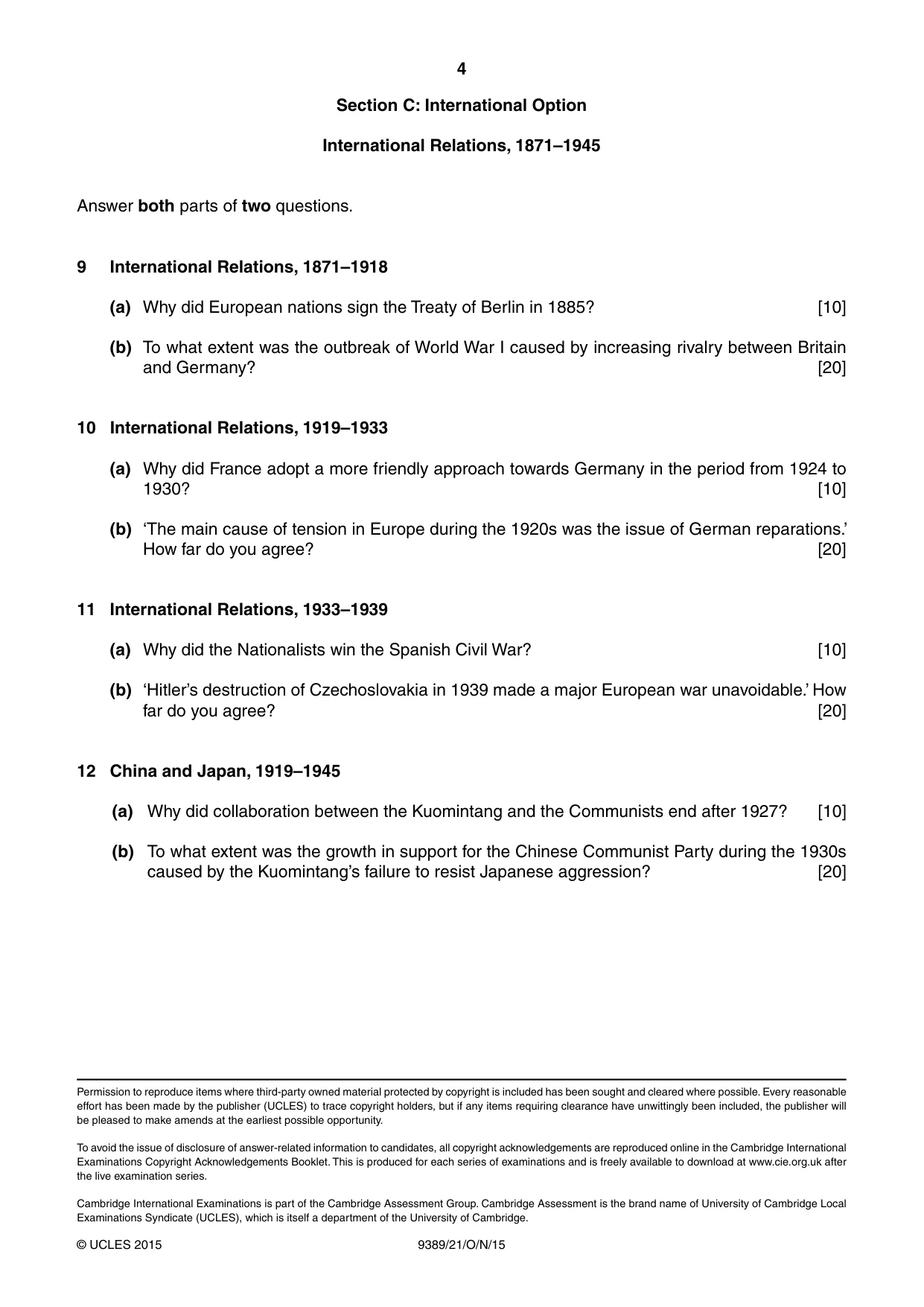
4 9389/21/O/N/15 © UCLES 2015 Permission to reproduce items where third-party owned material protected by copyright is included has been sought and cleared where possible. Every reasonable effort has been made by the publisher (UCLES) to trace copyright holders, but if any items requiring clearance have unwittingly been included, the publisher will be pleased to make amends at the earliest possible opportunity. To avoid the issue of disclosure of answer-related information to candidates, all copyright acknowledgements are reproduced online in the Cambridge International Examinations Copyright Acknowledgements Booklet. This is produced for each series of examinations and is freely available to download at www.cie.org.uk after the live examination series. Cambridge International Examinations is part of the Cambridge Assessment Group. Cambridge Assessment is the brand name of University of Cambridge Local Examinations Syndicate (UCLES), which is itself a department of the University of Cambridge. Section C: International Option International Relations, 1871–1945 Answer both parts of two questions. 9 International Relations, 1871–1918 (a) Why did European nations sign the Treaty of Berlin in 1885? [10] (b) To what extent was the outbreak of World War I caused by increasing rivalry between Britain and Germany? [20] 10 International Relations, 1919–1933 (a) Why did France adopt a more friendly approach towards Germany in the period from 1924 to 1930? [10] (b) ‘The main cause of tension in Europe during the 1920s was the issue of German reparations.’ How far do you agree? [20] 11 International Relations, 1933–1939 (a) Why did the Nationalists win the Spanish Civil War? [10] (b) ‘Hitler’s destruction of Czechoslovakia in 1939 made a major European war unavoidable.’ How far do you agree? [20] 12 China and Japan, 1919–1945 (a) Why did collaboration between the Kuomintang and the Communists end after 1927? [10] (b) To what extent was the growth in support for the Chinese Communist Party during the 1930s caused by the Kuomintang’s failure to resist Japanese aggression? [20]
Mark scheme, page 1
® IGCSE is the registered trademark of Cambridge International Examinations. CAMBRIDGE INTERNATIONAL EXAMINATIONS Cambridge International Advanced Subsidiary and Advanced Level MARK SCHEME for the October/November 2015 series 9389 HISTORY 9389/21 Paper 2 (Outline Study), maximum raw mark 60 This mark scheme is published as an aid to teachers and candidates, to indicate the requirements of the examination. It shows the basis on which Examiners were instructed to award marks. It does not indicate the details of the discussions that took place at an Examiners’ meeting before marking began, which would have considered the acceptability of alternative answers. Mark schemes should be read in conjunction with the question paper and the Principal Examiner Report for Teachers. Cambridge will not enter into discussions about these mark schemes. Cambridge is publishing the mark schemes for the October/November 2015 series for most Cambridge IGCSE®, Cambridge International A and AS Level components and some Cambridge O Level components.
Mark scheme, page 2
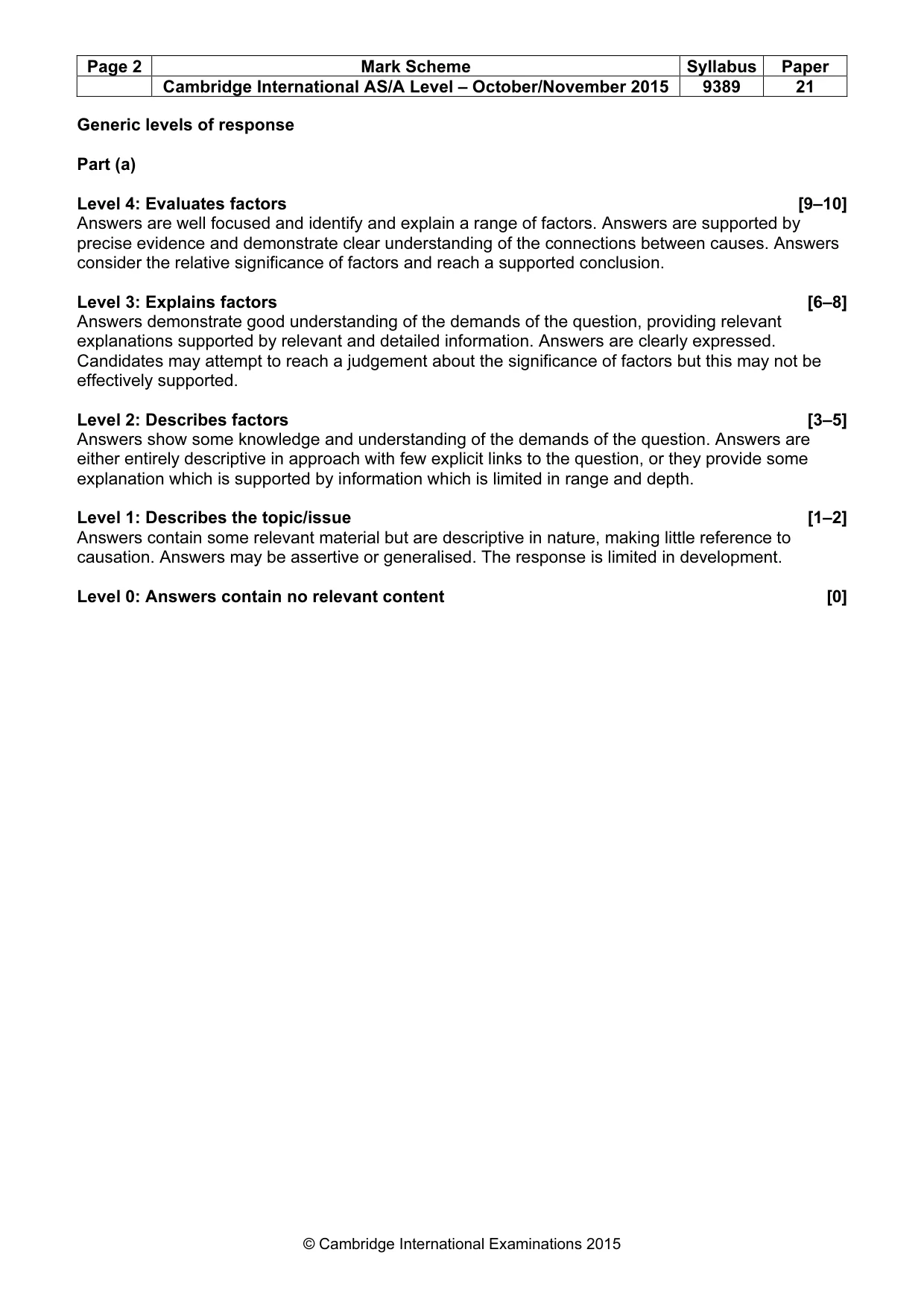
Page 2 Mark Scheme Syllabus Paper Cambridge International AS/A Level – October/November 2015 9389 21 © Cambridge International Examinations 2015 Generic levels of response Part (a) Level 4: Evaluates factors [9–10] Answers are well focused and identify and explain a range of factors. Answers are supported by precise evidence and demonstrate clear understanding of the connections between causes. Answers consider the relative significance of factors and reach a supported conclusion. Level 3: Explains factors [6–8] Answers demonstrate good understanding of the demands of the question, providing relevant explanations supported by relevant and detailed information. Answers are clearly expressed. Candidates may attempt to reach a judgement about the significance of factors but this may not be effectively supported. Level 2: Describes factors [3–5] Answers show some knowledge and understanding of the demands of the question. Answers are either entirely descriptive in approach with few explicit links to the question, or they provide some explanation which is supported by information which is limited in range and depth. Level 1: Describes the topic/issue [1–2] Answers contain some relevant material but are descriptive in nature, making little reference to causation. Answers may be assertive or generalised. The response is limited in development. Level 0: Answers contain no relevant content [0]
Mark scheme, page 3
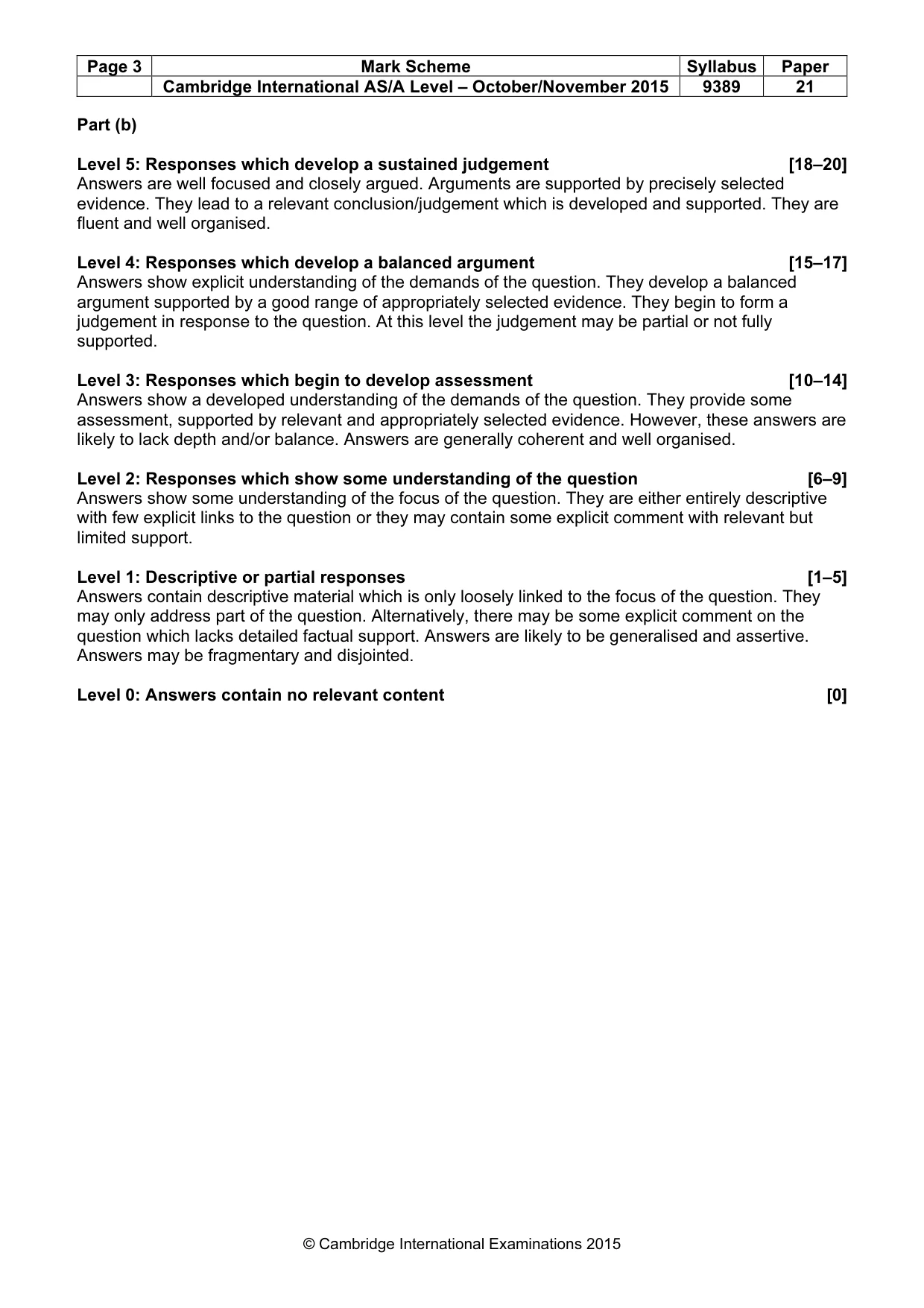
Page 3 Mark Scheme Syllabus Paper Cambridge International AS/A Level – October/November 2015 9389 21 © Cambridge International Examinations 2015 Part (b) Level 5: Responses which develop a sustained judgement [18–20] Answers are well focused and closely argued. Arguments are supported by precisely selected evidence. They lead to a relevant conclusion/judgement which is developed and supported. They are fluent and well organised. Level 4: Responses which develop a balanced argument [15–17] Answers show explicit understanding of the demands of the question. They develop a balanced argument supported by a good range of appropriately selected evidence. They begin to form a judgement in response to the question. At this level the judgement may be partial or not fully supported. Level 3: Responses which begin to develop assessment [10–14] Answers show a developed understanding of the demands of the question. They provide some assessment, supported by relevant and appropriately selected evidence. However, these answers are likely to lack depth and/or balance. Answers are generally coherent and well organised. Level 2: Responses which show some understanding of the question [6–9] Answers show some understanding of the focus of the question. They are either entirely descriptive with few explicit links to the question or they may contain some explicit comment with relevant but limited support. Level 1: Descriptive or partial responses [1–5] Answers contain descriptive material which is only loosely linked to the focus of the question. They may only address part of the question. Alternatively, there may be some explicit comment on the question which lacks detailed factual support. Answers are likely to be generalised and assertive. Answers may be fragmentary and disjointed. Level 0: Answers contain no relevant content [0]
Mark scheme, page 4
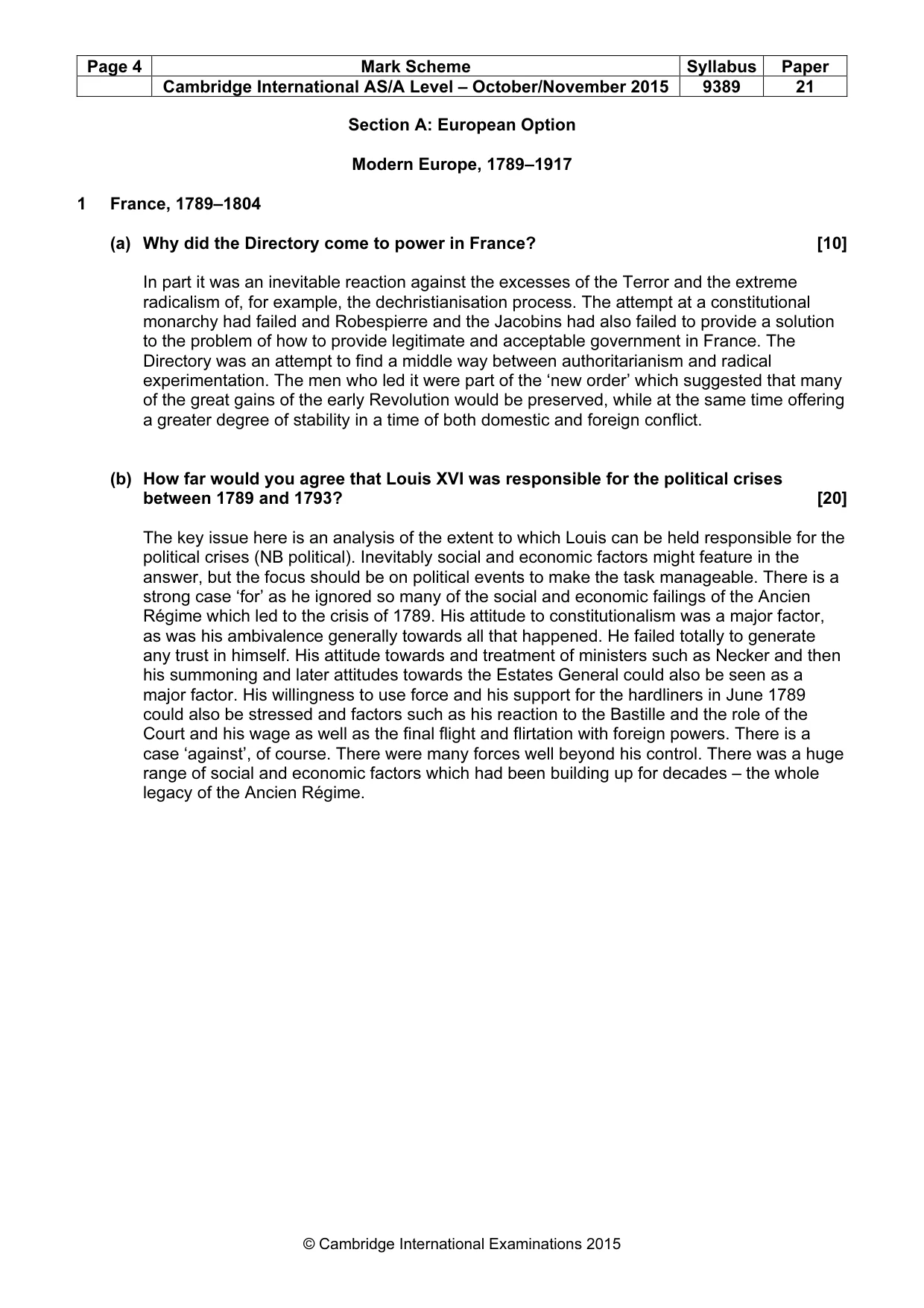
Page 4 Mark Scheme Syllabus Paper Cambridge International AS/A Level – October/November 2015 9389 21 © Cambridge International Examinations 2015 Section A: European Option Modern Europe, 1789–1917 1 France, 1789–1804 (a) Why did the Directory come to power in France? [10] In part it was an inevitable reaction against the excesses of the Terror and the extreme radicalism of, for example, the dechristianisation process. The attempt at a constitutional monarchy had failed and Robespierre and the Jacobins had also failed to provide a solution to the problem of how to provide legitimate and acceptable government in France. The Directory was an attempt to find a middle way between authoritarianism and radical experimentation. The men who led it were part of the ‘new order’ which suggested that many of the great gains of the early Revolution would be preserved, while at the same time offering a greater degree of stability in a time of both domestic and foreign conflict. (b) How far would you agree that Louis XVI was responsible for the political crises between 1789 and 1793? [20] The key issue here is an analysis of the extent to which Louis can be held responsible for the political crises (NB political). Inevitably social and economic factors might feature in the answer, but the focus should be on political events to make the task manageable. There is a strong case ‘for’ as he ignored so many of the social and economic failings of the Ancien Régime which led to the crisis of 1789. His attitude to constitutionalism was a major factor, as was his ambivalence generally towards all that happened. He failed totally to generate any trust in himself. His attitude towards and treatment of ministers such as Necker and then his summoning and later attitudes towards the Estates General could also be seen as a major factor. His willingness to use force and his support for the hardliners in June 1789 could also be stressed and factors such as his reaction to the Bastille and the role of the Court and his wage as well as the final flight and flirtation with foreign powers. There is a case ‘against’, of course. There were many forces well beyond his control. There was a huge range of social and economic factors which had been building up for decades – the whole legacy of the Ancien Régime.
Mark scheme, page 5
Page 5 Mark Scheme Syllabus Paper Cambridge International AS/A Level – October/November 2015 9389 21 © Cambridge International Examinations 2015 2 The Industrial Revolution, c.1800–1850 (a) Why was the Agricultural Revolution important to the Industrial Revolution? [10] The key issue here is the link between the two ‘revolutions’. Agricultural change, with its shift from a subsistence economy to production for profit, provided the food to feed an industrial workforce. It enabled a substantial proportion of the population to move to cities to provide the labour needed there. It raised capital which could be invested in industry and it stimulated communications and professions like banking, law and architects/surveyors who were vital for industrialisation as well. Mechanisation and the application of scientific methods were seen to work in agriculture and the lessons were not lost on industry. It also helped social mobility which could be seen as a causative factor as well as a result of the processes. (b) To what extent did the Industrial Revolution challenge existing political structures? Refer to any two countries in your answer. [20] The key issue here is the identification and analysis of the link between industrialisation and political change. There are considerable variants between countries, with both France and Germany retaining authoritarian regimes for much longer than the UK and seeing far less impact until well into the 19th century. Industrialisation led, in many cases, to a decline in aristocratic power and the ‘caste’ system, but it could also be argued that other factors, especially in France, led to this. An emerging middle class, particularly in the UK, demanded and got the vote in 1832, and with politics dominated by the son of a factory owner, Robert Peel, the impact of industrialisation could be seen there. Socialism began to influence working class movement and encouraged the growth of Unions, but neither was to have any significant impact until well into the 19th century in any country. There is a link between industrialisation and the revolutions of 1848, but it is hard to substantiate accurately. While in many cases the face of the ruling class does not seem to be very different after industrialisation, their policies, in the form of support for laisser faire and hostility to organised labour, did not appear to have changed much.
Mark scheme, page 6
Page 6 Mark Scheme Syllabus Paper Cambridge International AS/A Level – October/November 2015 9389 21 © Cambridge International Examinations 2015 3 The Origins of World War I, c.1900–1914 (a) Why was there a crisis over Bosnia in 1908–09? [10] The principal reason was simply the desire of Austria-Hungary to expand territorially into the Balkans and to demonstrate that it was not just a pale imitator of Germany dependent on German support for any expansionism. Bosnia had been part of the crumbling Ottoman Empire and was seen as ripe for exploitation and annexation by the Austrians. The annexation naturally infuriated the aggressive and intensely nationalistic Serbs. The Russians, still smarting from their humiliation of the Japanese Wars, felt aggrieved at their inability to profit in any way from the Ottoman collapse in the Balkans, while at the same time the British were concerned at the wider implications of the decline of the Turks. (b) ‘The system of alliances and ententes was the major cause of World War l.’ How far do you agree? [20] The key issue here is the relative importance of the alliance/entente systems as causative factors in the outbreak of the First World War. Certainly it was a major creator of tension. Nations started to think in terms of ‘sides’ as a result and the secrecy which surrounded them all gave rise to suspicion. They raised expectations of support, and events in 1914 with both the Austrians and the Russians are good evidence of this, but there are similar examples with both France and Britain. The Schlieffen Plan and the thinking behind it were based on it, but the absence of a ‘stop’ button could not necessarily be blamed on it. The intention was, of course, to build a balance of power. Arguably the system seemed to dominate so much of the thinking behind the decisions taken in the summer of 1914 as well as so much of the strategic planning which was a major causative factor. Obviously many other factors could be considered, ranging from the incompetence of the Kaiser and the Tsar, the arms race, and longer term issues over empire and commerce. It was an expression of the tension and not a cause is a possible theme.
Mark scheme, page 7
Page 7 Mark Scheme Syllabus Paper Cambridge International AS/A Level – October/November 2015 9389 21 © Cambridge International Examinations 2015 4 The Russian Revolution, 1905–1917 (a) Account for the growth of opposition to the Tsarist government between 1906 and 1914. [10] The key issue here is the relative importance of factors which led to the growth of opposition to the Tsarist regime. There was the failure of the promises to reform and disillusionment that the lessons of 1905 did not seem to have been learned. There was the inevitable legacy of the Russian-Japanese war with the humiliation involved. Much of the work of Witte and Stolypin was unpopular, for different reasons with different groups. There was a growth of radicalism at all levels and an increasing alienation of a growing middle class together with a diminution of any possible support from the peasantry, let alone the urban working class. Economic conditions worsened for many and there was a real failure to identify the causes of 1905 and act on them. Pogroms alienated many and the caste system prevailed. The regime provided ample grounds for strong growth of an opposition. (b) To what extent was Russian involvement in World War l the reason for the fall of the Tsar? [20] The key issue here is the relative importance of factors which led to the collapse of the tsarist regime. There is a major debate here amongst historians and no accepted ‘right’ answer. The many personal failings of the Tsar himself need to be examined as well as the likely survival of any such hereditary autocracy into the 20th century. There were the many military failures which were added to the charge sheet against the Tsar once he took personal command. The appalling treatment of soldiers, and especially the wounded, led to increasing disenchantment with both the regime and the war, and lost him vital military support. The war led to massive economic problems, inflation and real hunger. The rumours concerning Rasputin and his wife did not help. The Tsar’s choice of Ministers was invariably poor and the quality of generalship was little better. The war fuelled growing opposition to the regime from all classes and gave the radical/socialist groups ample grounds for widening support. In the end, of course, it was the generals who pushed him out. The accepted view seems to be that the war just accelerated a process which was going to happen in any case.
Mark scheme, page 8
Page 8 Mark Scheme Syllabus Paper Cambridge International AS/A Level – October/November 2015 9389 21 © Cambridge International Examinations 2015 Section B: American Option The History of the USA, 1840–1941 5 The Expansion of US Power from the 1840s to the 1930s (a) Why was the Platt Amendment agreed in 1901? [10] The ‘splendid, little war’ against Spain in 1898 had resulted in Cuba becoming an independent state. Cuban revolutionaries had been helped by American forces. Before these forces were sent, the US Congress passed the Teller Amendment stating that the USA would not annex Cuba after the war. The four-month war resulted in defeat for Spain; peace was agreed in December 1898. Thereafter, the US army governed Cuba until 1902. Many Americans did not believe that Cuba was ready for self-government. Thus in 1901 the US Congress passed the Platt Amendment. This greatly limited Cuban independence and gave the USA the right to intervene in Cuban affairs. In order to uphold the 1823 Monroe Doctrine, Cuba agreed not to ally with any other state. The Amendment also led to the establishment of US naval bases in Cuba, e.g. Guantanamo Bay. Cubans had to accept the inclusion of the Platt Amendment in its constitution as a price for the withdrawal of US troops. It had allowed American dominance over Cuba, as shown by the sending of US troops to Cuba on several occasions from 1906. Formally, Cuba was an independent state from 1902. However, that independence was greatly limited by the Platt Amendment and subsequent treaties to implement the Amendment. And the economic ties between the USA and Cuba were strengthened by a 1903 reciprocity treaty which lowered US duties on Cuban tobacco and sugar by 20% while Cuba reduced its tariffs on US goods by 20–40%. The primary-producing Cuba economy became very dependent on access to the large US market. It could be argued that the Platt Amendment was only a documentary illustration of the reality of US economic and military power, and it was the latter which ensured that Cuba was as dependent on the USA as if it were a US colony. The Amendment was formally repealed in 1934. (b) ‘Mr Polk’s war.’ How far do you agree with this opinion on the causes of the war with Mexico in 1846? [20] The US Congress declared war on Mexico in May 1846 following clashes between US and Mexican forces on the Rio Grande, the disputed border between Texas and Mexico. The USA had agreed to annex Texas in February 1845, Texas agreeing later in the year. Nine years previously, Texas had declared itself independent of Mexico. The Mexican government still saw Texas as its territory. The war was known at the time as ‘Mr Polk’s war’. President Polk, a Democrat, took office in March 1845. He was anxious to acquire territory in the south west, both to uphold the slave states in the USA and to expand the USA. In particular he wanted to gain the Mexican provinces of New Mexico and California. Thus his motives were both sectional and national. He moved troops to the Rio Grande, which the Mexicans did not accept as the border. The two sides clashed in May 1846. The subsequent loss of American lives justified rather than caused the war which followed. Many Americans were in an expansionist mood, best illustrated by John O’Sullivan’s coining of the phrase ‘manifest destiny’. It had a president keen to lead that expansion. His party, predominately Southern, was anxious to gain territories which would increase the number of slave states and help maintain the position of the South in the delicate North-South balance that was the USA. Even so, some Americans opposed the war. The abolitionists of New England were the most vocal. Some Whigs joined them, e.g. Abraham Lincoln, at that time a member of the US House of Representatives. Even some Democrats in the North also
Mark scheme, page 9
Page 9 Mark Scheme Syllabus Paper Cambridge International AS/A Level – October/November 2015 9389 21 © Cambridge International Examinations 2015 expressed dissent. The 1846–48 war provided early signs of a sectional divide across the USA which was to grow wider in the 1850s, leading to civil war in 1861. 6 Civil War and Reconstruction, 1861–1877 (a) Account for the formation of the Ku Klux Klan in 1865. [10] The first Ku Klux Klan society was formed in a small town in Tennessee in the winter of 1865–66. [Kyklos is the Greek for circle.] It was a secret society with a mission to uphold White supremacy by attacking those who supported Reconstruction, i.e. freedmen, Northerners who came to govern the South – carpetbaggers – and White Southerners who worked with the North – scalawags. Similar societies were soon formed in most Southern states. Sporadic, disorganised violence had been a feature of Southern life. The KKK gave that violence a more organised and collective structure as well as a sense of purpose following the military defeat of the Confederacy in early 1865. The dislocation of life in the South after a long, bitter and bloody civil war meant that there were many ex-soldiers who found the changes in Southern life following the abolition very hard to take. The passage of the Civil Rights Act in 1866, with Congress overriding a Presidential veto to give legal equality to ex-slaves, would have accentuated those changes. The lack of strong state government – many Southern political leaders sympathised with the KKK – enabled the KKK to grow with great speed in 1866–67, eventually forcing federal intervention in their place. (b) ‘The federal nature of the Southern system of government was the main reason for the South’s weakness in waging war against the North.’ How far do you agree? [20] The eleven secessionist states formed the Confederate States of America [CSA], based on the concept of ‘states’ rights’, which gave the states great autonomy in their relations with the federal government based in Richmond. The CSA constitution also gave considerable powers to the states. The CSA was a confederacy rather than a federacy. That government, however, led by Jefferson Davis, needed to impose some policies on the states in order to fight the war as effectively as possible. For example, in April 1862 he introduced conscription, almost a year before the North did. Some states were reluctant to provide their share of troops, in part because of exemptions given to slave owners. In the South, the war became known as ‘a rich man’s war but a poor man’s fight’. Georgia is one example of a state which opposed conscription. Its Governor, Joe Brown, resisted Confederate conscription orders as much as he could. He called Jefferson Davis an incipient tyrant. Governor Zebulon Vance of North Carolina was another who opposed the implementation of conscription. North Carolina was the only Confederate state to maintain the civil right of habeas corpus. Also elections to the CSA Congress were held in 1861 and 1863. Though there was no two-party system, the 1863 election saw the defeat of some pro-Davis candidates, which made it harder for the Davis administration to gain Congressional approval for key legislation. Thus the South faced additional obstacles to waging war because it had established a federal system of government. However, other factors also weakened the South’s war effort. Paying for the war was one. The government printed money rather than raise taxes, which led to very high rates of inflation, erosion of living standards and loss of morale. The North’s naval embargo was another factor, restricting exports of cotton and imports of materiel. Imports of military equipment were needed because of another major weakness of the South: its lack of an industrial base which would have been used to produce the equipment. The South was an essentially agricultural society waging war against the more industrial society of the North.
Mark scheme, page 10
Page 10 Mark Scheme Syllabus Paper Cambridge International AS/A Level – October/November 2015 9389 21 © Cambridge International Examinations 2015 The longer the war lasted, the greater the disadvantage experienced by the South. Note that the question asks about the waging of war and not winning; the focus is importantly different. 7 The Gilded Age and the Progressive Era from the 1870s to the 1920s (a) Why did it take so long for the USA to give women the right to vote? [10] The key reasons why women had to wait for fifty years were (a) the opposition of male politicians across the USA, helped in part by divisions among women’s groups, and (b) the difficulty of amending the US constitution. In the 1860s, some women had lobbied for female suffrage. In 1878, Susan B Anthony appeared before the US Congress to propose an amendment which was identical in wording to the 19th amendment forty two years later. And from the 1860s some states had given women the right to vote. The pioneers were Rocky Mountain states, led by Wyoming, which introduced female suffrage in order to attract women to their region in the belief that doing so would reduce the male-female imbalance as well as increasing the number of people living there. Their example slowly spread eastwards in the early twentieth century. By 1918, fifteen states had granted women full suffrage rights. This accelerating bandwagon was given momentum by the efforts of women’s groups, such as the National American Woman Suffrage Association [1870+] and the more militant National Woman’s Party from 1916 – though in 1911 some women did form the National Association Opposed to Women’s Suffrage. Women’s contribution to the First World War helped further, as did Woodrow Wilson, who addressed the US Senate on the subject in September 1918. Congress finally approved the amendment in 1919 and enough states did so by 1920. A few Southern states continued to oppose women’s suffrage until the end. (b) How important were technological innovations to rapid industrialisation in the 1870s and 1880s? [20] Electrical power, the internal combustion engine, the typewriter [1867], celluloid, an early form of plastic [1870] and the telephone [1876] are all technological innovations relevant to this period. Collectively they give rise to the period being described by some as ‘the second industrial revolution’. While many inventions were labour-saving devices, causing unemployment, others resulted in new products and services which were bought by the ‘early adopters’ of the time, thus creating new employment opportunities. Though the balance between the two is hard to assess, labour-saving innovations were often needed to overcome problems caused by labour shortages, especially in the north east. Thus, overall, innovative technologies did help the continued growth of the industrial sector. However, other factors were also important. On the supply side, these included the availability of resources, especially financial. Capital came either from American banks or the City of London in sufficient quantities. Also relevant was the individualistic, entrepreneurial culture of the USA which ensured competition between the inventors of the new technologies, e.g. incandescent light bulbs and electricity supply. The US system of patents also encouraged innovation because, unusually, it granted patents to improvements to inventions as well as the initial invention. This encouraged many to adapt new products to gain patent rights. Finally, the high tariff walls of the era protected developing industries. On the demand side, the growing population of the USA provided a large mass market which was not available to America’s industrial competitors. Thus rapid industrialisation resulted from a series of factors, one of which was the new technologies of the time.
Mark scheme, page 11
Page 11 Mark Scheme Syllabus Paper Cambridge International AS/A Level – October/November 2015 9389 21 © Cambridge International Examinations 2015 8 The Great Crash, the Great Depression and the New Deal, 1929–1941 (a) Why did the Supreme Court oppose New Deal reforms in the mid-1930s? [10] The key cases include Schechter Poultry Corporation vs. United States [1935], in which a unanimous Supreme Court made a judgement which undermined the National Industrial Recovery Act of 1933, a crucial New Deal reform, and US vs. Butler [1936], which negated the Agricultural Adjustment Act. These judgements were made by a Supreme Court which contained a group of ‘Four Horsemen’ [of the Apocalypse], all conservative, which a swing judge would often support to ensure a majority in a court of nine judges. The three liberal judges were known as the Three Musketeers. Since the early 1900s, the Supreme Court had been judicially active but politically conservative in what has become known as ‘the Lochner era’, following a judgement of that name in 1907. Since then, the Supreme Court had opposed legislation and executive actions which limited the workings of the free market. Thus it was almost inevitable that the Supreme Court would reject much New Deal legislation, which intervened in and regulated relations between business and labour. This opposition of laws approved by the democratically-elected Congress eventually caused FDR to propose his court-packing plan, which, though too radical, was followed by a Supreme Court judgement which did accept a state’s right to establish a minimum wage, something it had rejected a year before. Defenders of the Supreme Court said that the two events were not related. (b) How far did Franklin Roosevelt’s economic and social policies depart from those of Herbert Hoover? [20] A clear contrast is usually made between the laissez faire approach of Herbert Hoover and the active interventionism of Franklin Roosevelt. Hoover is associated with Hoovervilles – the Hoover Dam is usually overlooked, correctly, as Hoover had little to do with its development – Roosevelt with alphabet agencies and the 100 Days of governmental activism, all attempting to shock start the economy back to life. Other clear contrasts include FDR’s decisions in 1933–34 not to take part in the London conference on the international economy and to leave the gold standard, aspects of economic orthodoxy which Hoover had upheld. In reality, the difference was less clear-cut. Hoover became more radical during his presidency while FDR was quite conservative in his first term. By 1931, Hoover was approving legislation which regulated the free market, especially when it came to union recognition and labour disputes. At the end of 1931, Hoover made more radical proposals for government intervention, proposals which at least one historian has labelled ‘Hoover’s New Deal’. His plans included a Reconstruction Finance Corporation which would lend tax dollars to banks and companies in financial need. Not only was this proposal approved by Congress in 1932, it was further developed by FDR from 1933 onwards. Conversely, FDR was not always a radical reformer. The 1933 Economy Act aimed to achieve a balanced federal budget. FDR also opposed a Bonus Bill which would make an additional payment to army veterans. The Bill was passed in 1936 only by Congress overriding a presidential veto. Some of the reforms of the Second New Deal, such as the Social Security Act, did go further than anything Hoover had proposed. In general, however, the gap between Hoover’s and Roosevelt’s policies was less than often perceived.
Mark scheme, page 12
Page 12 Mark Scheme Syllabus Paper Cambridge International AS/A Level – October/November 2015 9389 21 © Cambridge International Examinations 2015 Section C: International Option International Relations, 1871–1945 9 International Relations, 1871–1918 (a) Why did European nations sign the Treaty of Berlin in 1885? [10] European nations were competing for African possessions and there was an obvious risk that this could lead to conflict between them. The Treaty aimed to minimise this risk by regulating the actions of European nations, ensuring that they respected each other’s possessions. The Treaty therefore defined the process necessary for a European country to ‘officially’ claim control of African territory. At the same time, the Treaty ensured that vital transport routes (e.g. Rivers Congo and Niger) remained accessible to all. The Treaty also provided a moral justification for European acquisition of African possessions by stating that slavery was to be abolished throughout Africa – this was to satisfy the opposition which the ‘scramble for Africa’ faced within Europe itself. Some historians argue that Africa provided a ‘safety valve’ – a place where European nations could enhance their wealth, power and prestige without risking war. The Treaty was designed to ensure that war was avoided. (b) To what extent was the outbreak of World War I caused by increasing rivalry between Britain and Germany? [20] Rivalry between Britain and Germany unquestionably added to the tensions which existed in Europe. Kaiser Wilhelm’s more assertive foreign policy caused alarm in Britain, e.g. imperial rivalry and the Kaiser’s support of the Boers against Britain; the naval arms race. Concern over the implications of the Triple Alliance led Britain to end its isolationist policy, culminating in agreements with Japan, France and Russia. However, Britain and Germany retained many common interests (e.g. related royal families, commercial interests), and it could be argued that other factors were more significant causes of WWI, e.g. French concern over Germany’s aggressive policies and determination to regain Alsace and Lorraine; rivalry between Austria- Hungary and Russia over the Balkans; rising nationalism and the disintegration of the great empires; general alarm caused by the secret terms of the various alliances.
Mark scheme, page 13
Page 13 Mark Scheme Syllabus Paper Cambridge International AS/A Level – October/November 2015 9389 21 © Cambridge International Examinations 2015 10 International Relations, 1919–1933 (a) Why did France adopt a more friendly approach towards Germany in the period from 1924 to 1930? [10] France had been invaded by Germany twice in less than 50 years and its aim during the initial post-WWI period was to keep Germany militarily, politically and economically weak. France had insisted that the Treaty of Versailles restricted the size of the German army, demilitarised the Rhineland and imposed high reparations on Germany. In 1923, when Germany fell behind in its reparations payments, France had even occupied the Ruhr industrial region. This had backfired – it reduced still further Germany’s ability to pay reparations and soured France’s relations with Britain. There was a danger that France could become politically isolated and therefore vulnerable. As a result, France adopted a more conciliatory policy towards Germany, as indicated by France’s acceptance of the Dawes Plan, agreements at Locarno, the Kellogg-Briand Pact and the Young Plan. Improved relations were aided by the good relationship which emerged between Briand and Stresemann. (b) ‘The main cause of tension in Europe during the 1920s was the issue of German reparations.’ How far do you agree? [20] The issue of reparations did cause major tension, as evidenced by the French occupation of the Ruhr in 1924. France, feeling insecure as a result of the USA’s refusal to ratify the post- war settlement and Britain’s refusal to guarantee French borders, was determined to keep Germany weak. As a result, France was determined to ensure that Germany met its reparation requirements in full. However, the Dawes and Young Plans reduced the tensions caused by the issue of reparations, and France and Germany enjoyed improved relations following the Locarno Treaties in 1925. It could be argued that other factors caused greater tensions, e.g. USA’s decision to require full repayment of war loans, leading to economic problems; strained relations between Britain and France due to their different attitudes towards German recovery; fear of communism spreading from the USSR; border disputes following the post-war settlements; problems faced by the successor states.
Mark scheme, page 14
Page 14 Mark Scheme Syllabus Paper Cambridge International AS/A Level – October/November 2015 9389 21 © Cambridge International Examinations 2015 11 International Relations, 1933–1939 (a) Why did the Nationalists win the Spanish Civil War? [10] Franco managed to maintain unity between the various right-wing groups that made up the Nationalists (the Church, the army, monarchists, Falangists). The Nationalists also benefitted from the military support provided by Italy and Germany – planes, tanks and additional troops proved significant in enabling the Nationalists to take key cities/areas. Conversely, the Republicans were far less unified, the various left-wing groups all having their own, often contradictory, aims. Unlike the professional, well trained soldiers under Franco’s command, the Republicans were simply armed workers who lacked military organisation and discipline. Moreover, whereas Franco benefitted from the military assistance provided by Italy and Germany, the Republicans were denied organised foreign assistance as a result of the Non- Interference policy adopted by the League of Nations. The Republicans were supported by the International Brigades, but these consisted of well-meaning volunteers who lacked both military training and equipment. (b) ‘Hitler’s destruction of Czechoslovakia in 1939 made a major European war unavoidable.’ How far do you agree? [20] In support of the view, it could be argued that Hitler’s destruction of Czechoslovakia was the event which finally ended appeasement. Chamberlain and Daladier had done little to protect Czechoslovakia at the Munich meeting. Hitler quickly made it clear that he had no intention of honouring his Munich agreements. Within 48 hours, Chamberlain was adopting a more confrontational approach towards Hitler in his speeches and Britain introduced conscription. It was clear that any further aggression by Hitler would lead to war with Britain and France. Whereas Hitler’s earlier actions could be justified by the claim that he was redressing the unfair terms of the Treaty of Versailles, his acquisition of Czechoslovakia was different – he had seized territory over which Germany had no justifiable right and broken the promises he had made at Munich. Therefore, when Hitler invaded Poland, Britain and France declared war on Germany. In challenging the view, it could be argued that neither Britain nor France went to war against Germany to protect Czechoslovakia. Chamberlain’s initial reaction was to argue that Hitler had not broken his Munich agreements because the Germans had been ‘invited’ into Czechoslovakia to restore order. It was this weak response which convinced Hitler that Britain and France would never go to war against him unless their own interests were directly threatened. It was Hitler’s invasion of Poland, rather than his destruction of Czechoslovakia, which led to WWII. Hitler believed that Britain and France would do nothing to protect Poland and, indeed, might even support his longer-term plan to invade Russia, whose communism had long been feared in Western Europe. Before invading Poland, Hitler had removed potential opposition from Russia (Nazi-Soviet Pact) and felt that anti-war public opinion in Britain and France would prevent their involvement.
Mark scheme, page 15
Page 15 Mark Scheme Syllabus Paper Cambridge International AS/A Level – October/November 2015 9389 21 © Cambridge International Examinations 2015 12 China and Japan, 1919–1945 (a) Why did collaboration between the Kuomintang and the Communists end after 1927? [10] Much of the KMT’s early success under Chiang Kai-shek was due to the support it received from peasants and factory workers, attracted by the Communists’ promise of land redistribution and industrial co-operatives. Moreover, the KMT had benefitted from the military training it received from the USSR. Both of these factors were dependent on the KMT’s collaboration with the Communists. However, Chiang’s main concern was to protect the interests of businessmen, bankers, factory owners and wealthy landowners. Chiang began to see the Communists as both an embarrassing ally and, indeed, a threat to his own ambition to become the political and military leader of a re-united China. As a result, Communists were expelled from the KMT and many Communists, trade unionists and peasant leaders were murdered. (b) To what extent was the growth in support for the Chinese Communist Party during the 1930s caused by the Kuomintang’s failure to resist Japanese aggression? [20] The KMT’s control of China was far from complete, and Chiang’s priority was to defeat the warlords and the CCP. He realised that his armies could not defeat Japan. This policy was not popular with the majority of Chinese and, indeed, was opposed by many members of the KMT. Conversely, Mao fought a guerrilla campaign against the Japanese invaders, portraying the CCP as the true party of Chinese nationalism. This unquestionably added to the support which the CCP received. However, there were other factors which explain the growth in support for the CCP, e.g. Mao’s use of propaganda; the CCP was supported by the largest group of Chinese (peasants); the KMT’s failure to carry out reforms; the land redistribution which Mao carried out in the areas controlled by the CCP; the KMT became seen as a supporter of the wealthy classes, whereas the CCP was seen as the party of the disadvantaged (i.e. the vast majority); the CCP was seen to be carrying out the three principles laid down by Sun Yat- sen.
What you needed in this session
Cambridge’s own grade thresholds for 2015 Oct/Nov, Paper 2 · Variant 1. A higher threshold means an easier paper — the bar moves with how the cohort did.