Cambridge A Level History 9389 — 2015 May/June Paper 3 · Variant 3
9389/33/M/J/15 · 40 marks · ≈45 min
The question paper and its mark scheme, free to read here and free to download. This is Cambridge’s own paper, exactly as it was sat.
Question paper8 pages




Mark scheme5 pages
Answers below. Sit the paper first if you are practising.
Paper as text
Question paper, page 1
This document consists of 4 printed pages and 4 blank pages. DC (LEG) 96494/2 © UCLES 2015 [Turn over Cambridge International Examinations Cambridge International Advanced Subsidiary and Advanced Level * 1 0 4 5 8 4 8 9 1 6 * HISTORY 9389/33 Paper 3 Interpretations Question May/June 2015 1 hour Additional Materials: Answer Booklet/Paper READ THESE INSTRUCTIONS FIRST If you have been given an Answer Booklet, follow the instructions on the front cover of the Booklet. Write your Centre number, candidate number and name on the work you hand in. Write in dark blue or black pen. Do not use staples, paper clips, glue or correction fl uid. DO NOT WRITE IN ANY BARCODES. This paper contains three sections: Section A: Topic 1 The Causes and Impact of British Imperialism, c. 1850–1939 Section B: Topic 2 The Holocaust Section C: Topic 3 The Origins and Development of the Cold War, 1941–50 Answer the question on the topic you have studied. At the end of the examination, fasten all your work securely together. The marks are given in brackets [ ] at the end of each question.
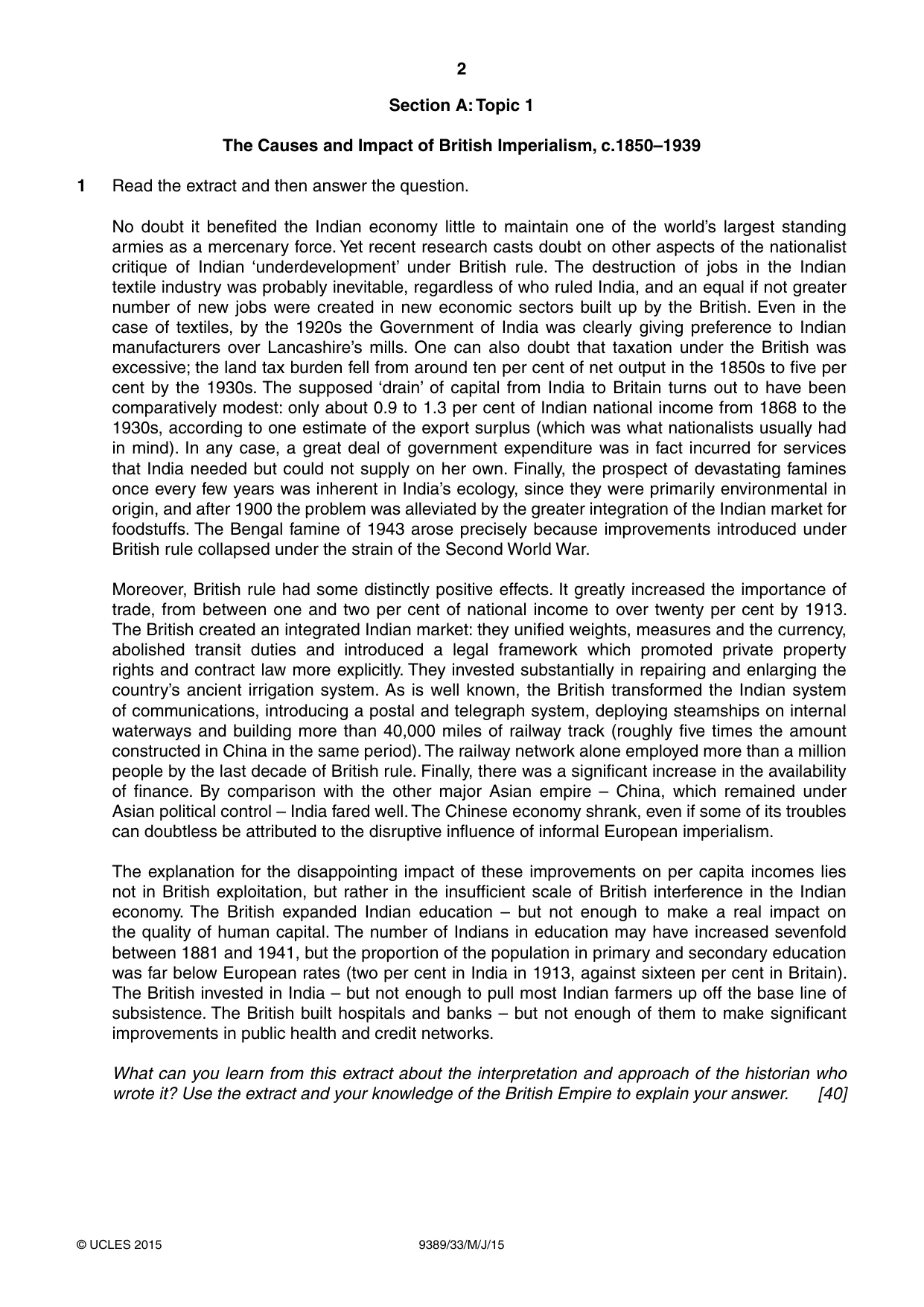
Question paper, page 2
2 9389/33/M/J/15 © UCLES 2015 Section A: Topic 1 The Causes and Impact of British Imperialism, c.1850–1939 1 Read the extract and then answer the question. No doubt it benefited the Indian economy little to maintain one of the world’s largest standing armies as a mercenary force. Yet recent research casts doubt on other aspects of the nationalist critique of Indian ‘underdevelopment’ under British rule. The destruction of jobs in the Indian textile industry was probably inevitable, regardless of who ruled India, and an equal if not greater number of new jobs were created in new economic sectors built up by the British. Even in the case of textiles, by the 1920s the Government of India was clearly giving preference to Indian manufacturers over Lancashire’s mills. One can also doubt that taxation under the British was excessive; the land tax burden fell from around ten per cent of net output in the 1850s to five per cent by the 1930s. The supposed ‘drain’ of capital from India to Britain turns out to have been comparatively modest: only about 0.9 to 1.3 per cent of Indian national income from 1868 to the 1930s, according to one estimate of the export surplus (which was what nationalists usually had in mind). In any case, a great deal of government expenditure was in fact incurred for services that India needed but could not supply on her own. Finally, the prospect of devastating famines once every few years was inherent in India’s ecology, since they were primarily environmental in origin, and after 1900 the problem was alleviated by the greater integration of the Indian market for foodstuffs. The Bengal famine of 1943 arose precisely because improvements introduced under British rule collapsed under the strain of the Second World War. Moreover, British rule had some distinctly positive effects. It greatly increased the importance of trade, from between one and two per cent of national income to over twenty per cent by 1913. The British created an integrated Indian market: they unified weights, measures and the currency, abolished transit duties and introduced a legal framework which promoted private property rights and contract law more explicitly. They invested substantially in repairing and enlarging the country’s ancient irrigation system. As is well known, the British transformed the Indian system of communications, introducing a postal and telegraph system, deploying steamships on internal waterways and building more than 40,000 miles of railway track (roughly five times the amount constructed in China in the same period). The railway network alone employed more than a million people by the last decade of British rule. Finally, there was a significant increase in the availability of finance. By comparison with the other major Asian empire – China, which remained under Asian political control – India fared well. The Chinese economy shrank, even if some of its troubles can doubtless be attributed to the disruptive influence of informal European imperialism. The explanation for the disappointing impact of these improvements on per capita incomes lies not in British exploitation, but rather in the insufficient scale of British interference in the Indian economy. The British expanded Indian education – but not enough to make a real impact on the quality of human capital. The number of Indians in education may have increased sevenfold between 1881 and 1941, but the proportion of the population in primary and secondary education was far below European rates (two per cent in India in 1913, against sixteen per cent in Britain). The British invested in India – but not enough to pull most Indian farmers up off the base line of subsistence. The British built hospitals and banks – but not enough of them to make significant improvements in public health and credit networks. What can you learn from this extract about the interpretation and approach of the historian who wrote it? Use the extract and your knowledge of the British Empire to explain your answer. [40]
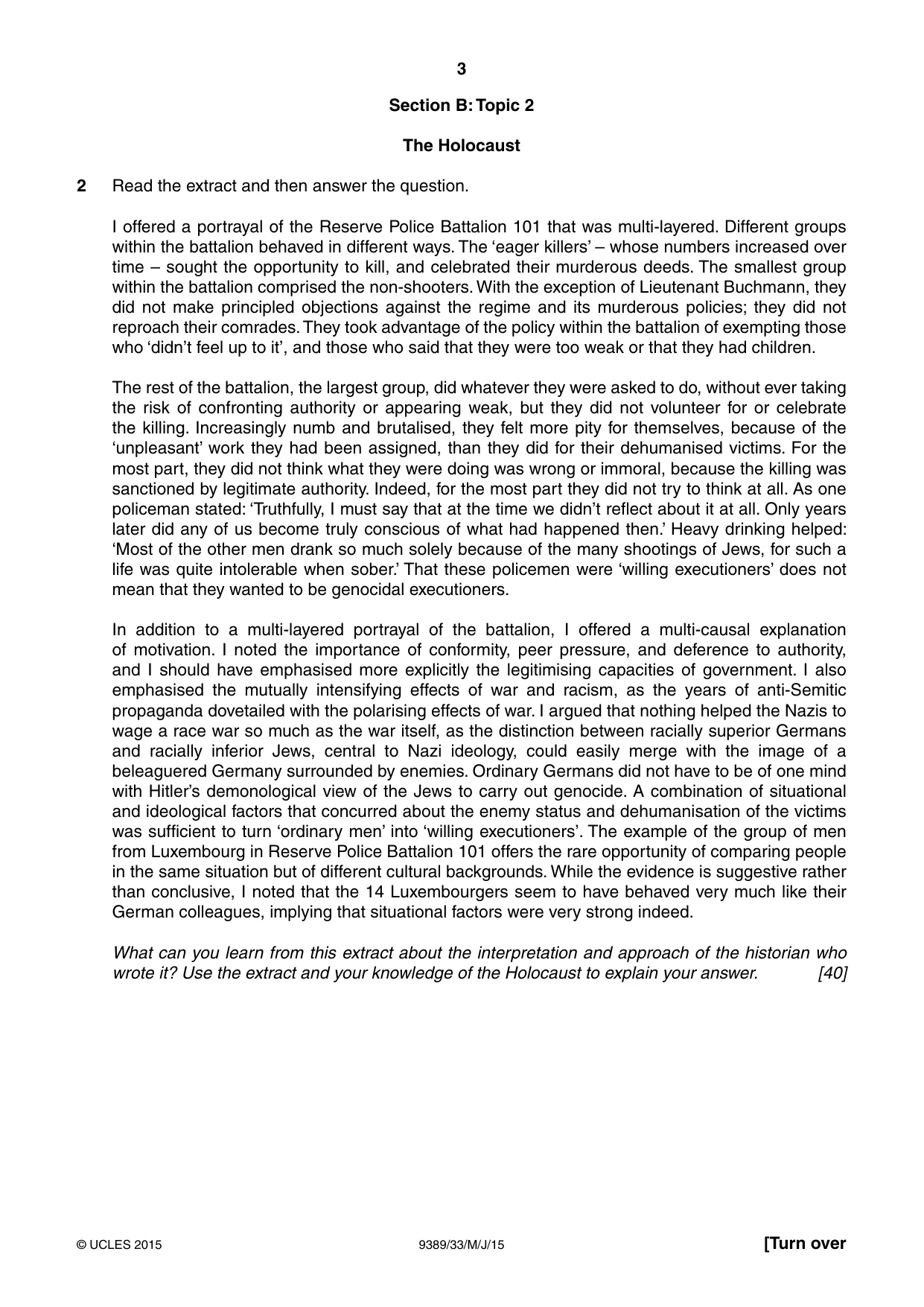
Question paper, page 3
3 9389/33/M/J/15 © UCLES 2015 [Turn over Section B: Topic 2 The Holocaust 2 Read the extract and then answer the question. I offered a portrayal of the Reserve Police Battalion 101 that was multi-layered. Different groups within the battalion behaved in different ways. The ‘eager killers’ – whose numbers increased over time – sought the opportunity to kill, and celebrated their murderous deeds. The smallest group within the battalion comprised the non-shooters. With the exception of Lieutenant Buchmann, they did not make principled objections against the regime and its murderous policies; they did not reproach their comrades. They took advantage of the policy within the battalion of exempting those who ‘didn’t feel up to it’, and those who said that they were too weak or that they had children. The rest of the battalion, the largest group, did whatever they were asked to do, without ever taking the risk of confronting authority or appearing weak, but they did not volunteer for or celebrate the killing. Increasingly numb and brutalised, they felt more pity for themselves, because of the ‘unpleasant’ work they had been assigned, than they did for their dehumanised victims. For the most part, they did not think what they were doing was wrong or immoral, because the killing was sanctioned by legitimate authority. Indeed, for the most part they did not try to think at all. As one policeman stated: ‘Truthfully, I must say that at the time we didn’t reflect about it at all. Only years later did any of us become truly conscious of what had happened then.’ Heavy drinking helped: ‘Most of the other men drank so much solely because of the many shootings of Jews, for such a life was quite intolerable when sober.’ That these policemen were ‘willing executioners’ does not mean that they wanted to be genocidal executioners. In addition to a multi-layered portrayal of the battalion, I offered a multi-causal explanation of motivation. I noted the importance of conformity, peer pressure, and deference to authority, and I should have emphasised more explicitly the legitimising capacities of government. I also emphasised the mutually intensifying effects of war and racism, as the years of anti-Semitic propaganda dovetailed with the polarising effects of war. I argued that nothing helped the Nazis to wage a race war so much as the war itself, as the distinction between racially superior Germans and racially inferior Jews, central to Nazi ideology, could easily merge with the image of a beleaguered Germany surrounded by enemies. Ordinary Germans did not have to be of one mind with Hitler’s demonological view of the Jews to carry out genocide. A combination of situational and ideological factors that concurred about the enemy status and dehumanisation of the victims was sufficient to turn ‘ordinary men’ into ‘willing executioners’. The example of the group of men from Luxembourg in Reserve Police Battalion 101 offers the rare opportunity of comparing people in the same situation but of different cultural backgrounds. While the evidence is suggestive rather than conclusive, I noted that the 14 Luxembourgers seem to have behaved very much like their German colleagues, implying that situational factors were very strong indeed. What can you learn from this extract about the interpretation and approach of the historian who wrote it? Use the extract and your knowledge of the Holocaust to explain your answer. [40]
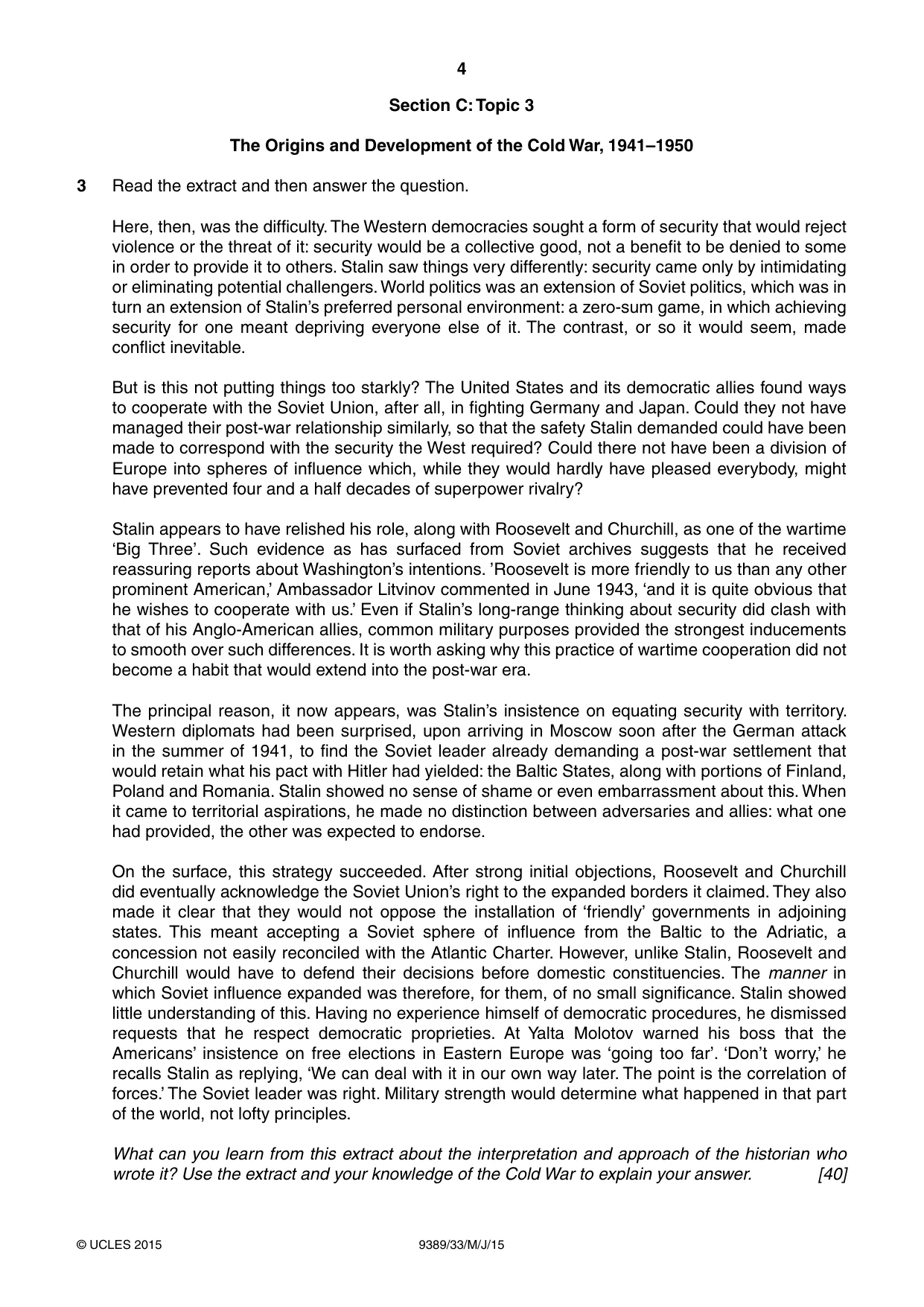
Question paper, page 4
4 9389/33/M/J/15 © UCLES 2015 Section C: Topic 3 The Origins and Development of the Cold War, 1941–1950 3 Read the extract and then answer the question. Here, then, was the difficulty. The Western democracies sought a form of security that would reject violence or the threat of it: security would be a collective good, not a benefit to be denied to some in order to provide it to others. Stalin saw things very differently: security came only by intimidating or eliminating potential challengers. World politics was an extension of Soviet politics, which was in turn an extension of Stalin’s preferred personal environment: a zero-sum game, in which achieving security for one meant depriving everyone else of it. The contrast, or so it would seem, made conflict inevitable. But is this not putting things too starkly? The United States and its democratic allies found ways to cooperate with the Soviet Union, after all, in fighting Germany and Japan. Could they not have managed their post-war relationship similarly, so that the safety Stalin demanded could have been made to correspond with the security the West required? Could there not have been a division of Europe into spheres of influence which, while they would hardly have pleased everybody, might have prevented four and a half decades of superpower rivalry? Stalin appears to have relished his role, along with Roosevelt and Churchill, as one of the wartime ‘Big Three’. Such evidence as has surfaced from Soviet archives suggests that he received reassuring reports about Washington’s intentions. ’Roosevelt is more friendly to us than any other prominent American,’ Ambassador Litvinov commented in June 1943, ‘and it is quite obvious that he wishes to cooperate with us.’ Even if Stalin’s long-range thinking about security did clash with that of his Anglo-American allies, common military purposes provided the strongest inducements to smooth over such differences. It is worth asking why this practice of wartime cooperation did not become a habit that would extend into the post-war era. The principal reason, it now appears, was Stalin’s insistence on equating security with territory. Western diplomats had been surprised, upon arriving in Moscow soon after the German attack in the summer of 1941, to find the Soviet leader already demanding a post-war settlement that would retain what his pact with Hitler had yielded: the Baltic States, along with portions of Finland, Poland and Romania. Stalin showed no sense of shame or even embarrassment about this. When it came to territorial aspirations, he made no distinction between adversaries and allies: what one had provided, the other was expected to endorse. On the surface, this strategy succeeded. After strong initial objections, Roosevelt and Churchill did eventually acknowledge the Soviet Union’s right to the expanded borders it claimed. They also made it clear that they would not oppose the installation of ‘friendly’ governments in adjoining states. This meant accepting a Soviet sphere of influence from the Baltic to the Adriatic, a concession not easily reconciled with the Atlantic Charter. However, unlike Stalin, Roosevelt and Churchill would have to defend their decisions before domestic constituencies. The manner in which Soviet influence expanded was therefore, for them, of no small significance. Stalin showed little understanding of this. Having no experience himself of democratic procedures, he dismissed requests that he respect democratic proprieties. At Yalta Molotov warned his boss that the Americans’ insistence on free elections in Eastern Europe was ‘going too far’. ‘Don’t worry,’ he recalls Stalin as replying, ‘We can deal with it in our own way later. The point is the correlation of forces.’ The Soviet leader was right. Military strength would determine what happened in that part of the world, not lofty principles. What can you learn from this extract about the interpretation and approach of the historian who wrote it? Use the extract and your knowledge of the Cold War to explain your answer. [40]
Question paper, page 5
5 9389/33/M/J/15 © UCLES 2015 BLANK PAGE
Question paper, page 6
6 9389/33/M/J/15 © UCLES 2015 BLANK PAGE
Question paper, page 7
7 9389/33/M/J/15 © UCLES 2015 BLANK PAGE
Question paper, page 8
8 9389/33/M/J/15 © UCLES 2015 Permission to reproduce items where third-party owned material protected by copyright is included has been sought and cleared where possible. Every reasonable effort has been made by the publisher (UCLES) to trace copyright holders, but if any items requiring clearance have unwittingly been included, the publisher will be pleased to make amends at the earliest possible opportunity. To avoid the issue of disclosure of answer-related information to candidates, all copyright acknowledgements are reproduced online in the Cambridge International Examinations Copyright Acknowledgements Booklet. This is produced for each series of examinations and is freely available to download at www.cie.org.uk after the live examination series. Cambridge International Examinations is part of the Cambridge Assessment Group. Cambridge Assessment is the brand name of University of Cambridge Local Examinations Syndicate (UCLES), which is itself a department of the University of Cambridge. BLANK PAGE
Mark scheme, page 1
® IGCSE is the registered trademark of Cambridge International Examinations. CAMBRIDGE INTERNATIONAL EXAMINATIONS Cambridge International Advanced Subsidiary and Advanced Level MARK SCHEME for the May/June 2015 series 9389 HISTORY 9389/33 Paper 3 (Interpretations Question), maximum raw mark 40 This mark scheme is published as an aid to teachers and candidates, to indicate the requirements of the examination. It shows the basis on which Examiners were instructed to award marks. It does not indicate the details of the discussions that took place at an Examiners’ meeting before marking began, which would have considered the acceptability of alternative answers. Mark schemes should be read in conjunction with the question paper and the Principal Examiner Report for Teachers. Cambridge will not enter into discussions about these mark schemes. Cambridge is publishing the mark schemes for the May/June 2015 series for most Cambridge IGCSE®, Cambridge International A and AS Level components and some Cambridge O Level components.
Mark scheme, page 2
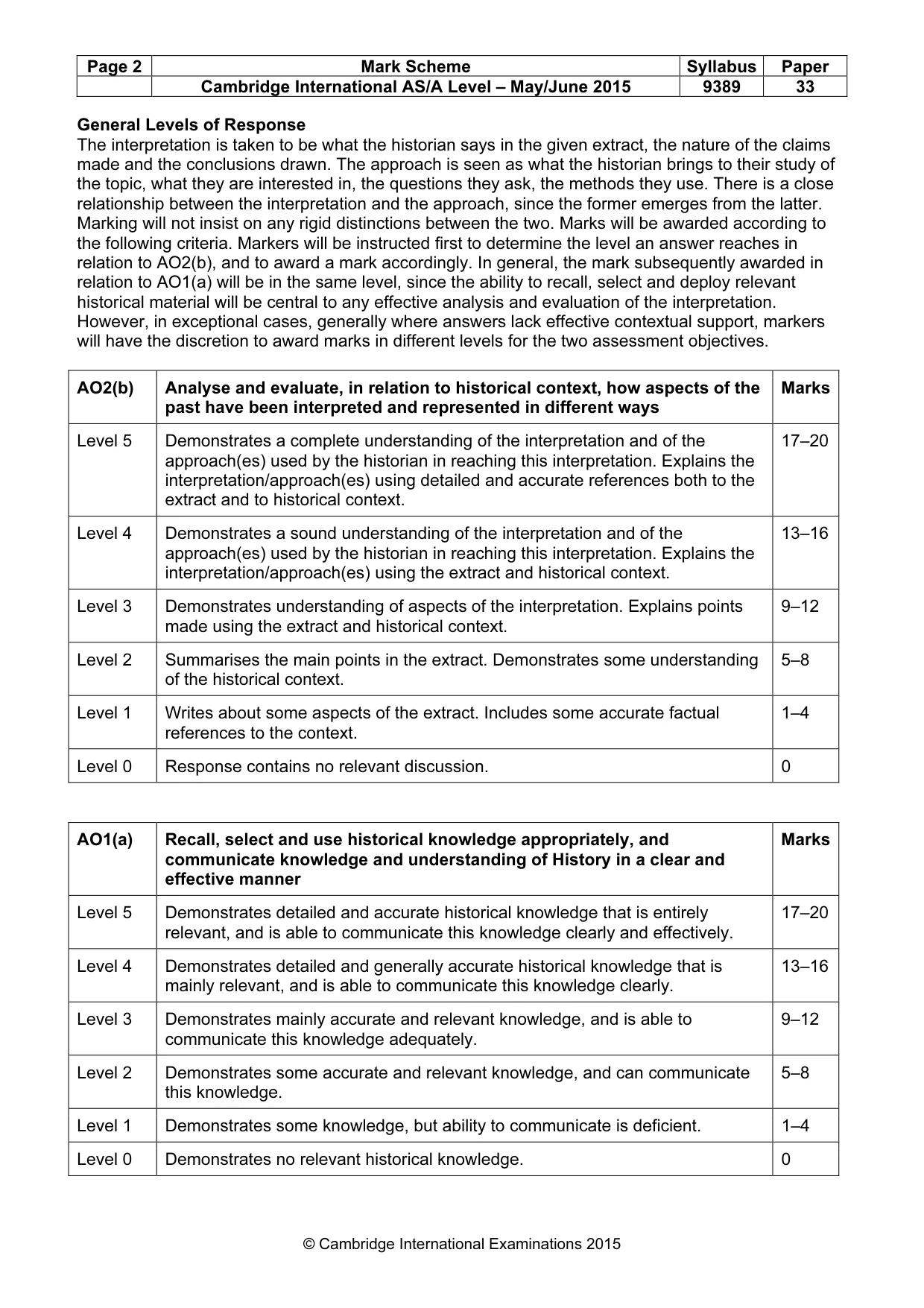
Page 2 Mark Scheme Syllabus Paper Cambridge International AS/A Level – May/June 2015 9389 33 © Cambridge International Examinations 2015 General Levels of Response The interpretation is taken to be what the historian says in the given extract, the nature of the claims made and the conclusions drawn. The approach is seen as what the historian brings to their study of the topic, what they are interested in, the questions they ask, the methods they use. There is a close relationship between the interpretation and the approach, since the former emerges from the latter. Marking will not insist on any rigid distinctions between the two. Marks will be awarded according to the following criteria. Markers will be instructed first to determine the level an answer reaches in relation to AO2(b), and to award a mark accordingly. In general, the mark subsequently awarded in relation to AO1(a) will be in the same level, since the ability to recall, select and deploy relevant historical material will be central to any effective analysis and evaluation of the interpretation. However, in exceptional cases, generally where answers lack effective contextual support, markers will have the discretion to award marks in different levels for the two assessment objectives. AO2(b) Analyse and evaluate, in relation to historical context, how aspects of the past have been interpreted and represented in different ways Marks Level 5 Demonstrates a complete understanding of the interpretation and of the approach(es) used by the historian in reaching this interpretation. Explains the interpretation/approach(es) using detailed and accurate references both to the extract and to historical context. 17–20 Level 4 Demonstrates a sound understanding of the interpretation and of the approach(es) used by the historian in reaching this interpretation. Explains the interpretation/approach(es) using the extract and historical context. 13–16 Level 3 Demonstrates understanding of aspects of the interpretation. Explains points made using the extract and historical context. 9–12 Level 2 Summarises the main points in the extract. Demonstrates some understanding of the historical context. 5–8 Level 1 Writes about some aspects of the extract. Includes some accurate factual references to the context. 1–4 Level 0 Response contains no relevant discussion. 0 AO1(a) Recall, select and use historical knowledge appropriately, and communicate knowledge and understanding of History in a clear and effective manner Marks Level 5 Demonstrates detailed and accurate historical knowledge that is entirely relevant, and is able to communicate this knowledge clearly and effectively. 17–20 Level 4 Demonstrates detailed and generally accurate historical knowledge that is mainly relevant, and is able to communicate this knowledge clearly. 13–16 Level 3 Demonstrates mainly accurate and relevant knowledge, and is able to communicate this knowledge adequately. 9–12 Level 2 Demonstrates some accurate and relevant knowledge, and can communicate this knowledge. 5–8 Level 1 Demonstrates some knowledge, but ability to communicate is deficient. 1–4 Level 0 Demonstrates no relevant historical knowledge. 0
Mark scheme, page 3
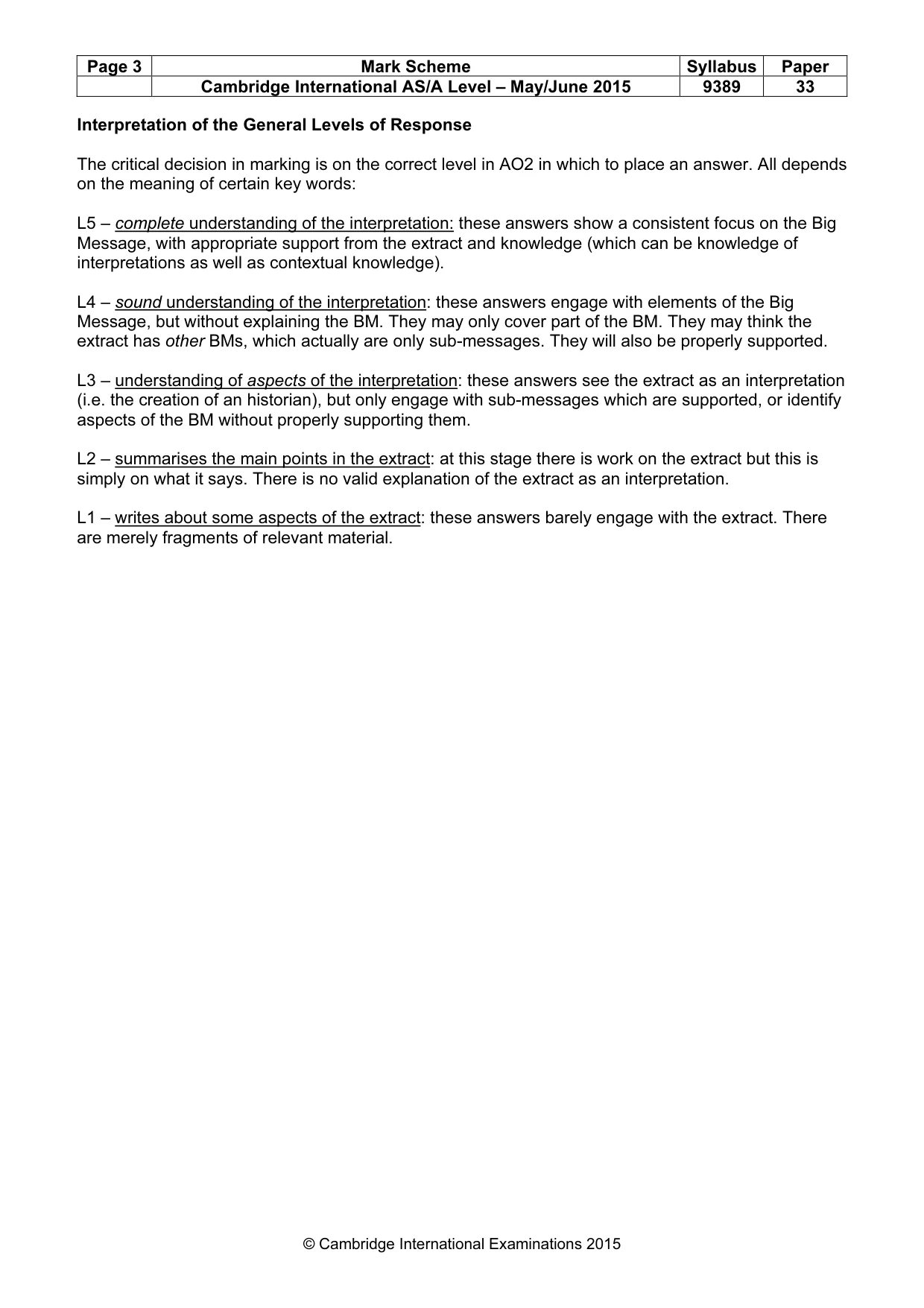
Page 3 Mark Scheme Syllabus Paper Cambridge International AS/A Level – May/June 2015 9389 33 © Cambridge International Examinations 2015 Interpretation of the General Levels of Response The critical decision in marking is on the correct level in AO2 in which to place an answer. All depends on the meaning of certain key words: L5 – complete understanding of the interpretation: these answers show a consistent focus on the Big Message, with appropriate support from the extract and knowledge (which can be knowledge of interpretations as well as contextual knowledge). L4 – sound understanding of the interpretation: these answers engage with elements of the Big Message, but without explaining the BM. They may only cover part of the BM. They may think the extract has other BMs, which actually are only sub-messages. They will also be properly supported. L3 – understanding of aspects of the interpretation: these answers see the extract as an interpretation (i.e. the creation of an historian), but only engage with sub-messages which are supported, or identify aspects of the BM without properly supporting them. L2 – summarises the main points in the extract: at this stage there is work on the extract but this is simply on what it says. There is no valid explanation of the extract as an interpretation. L1 – writes about some aspects of the extract: these answers barely engage with the extract. There are merely fragments of relevant material.
Mark scheme, page 4
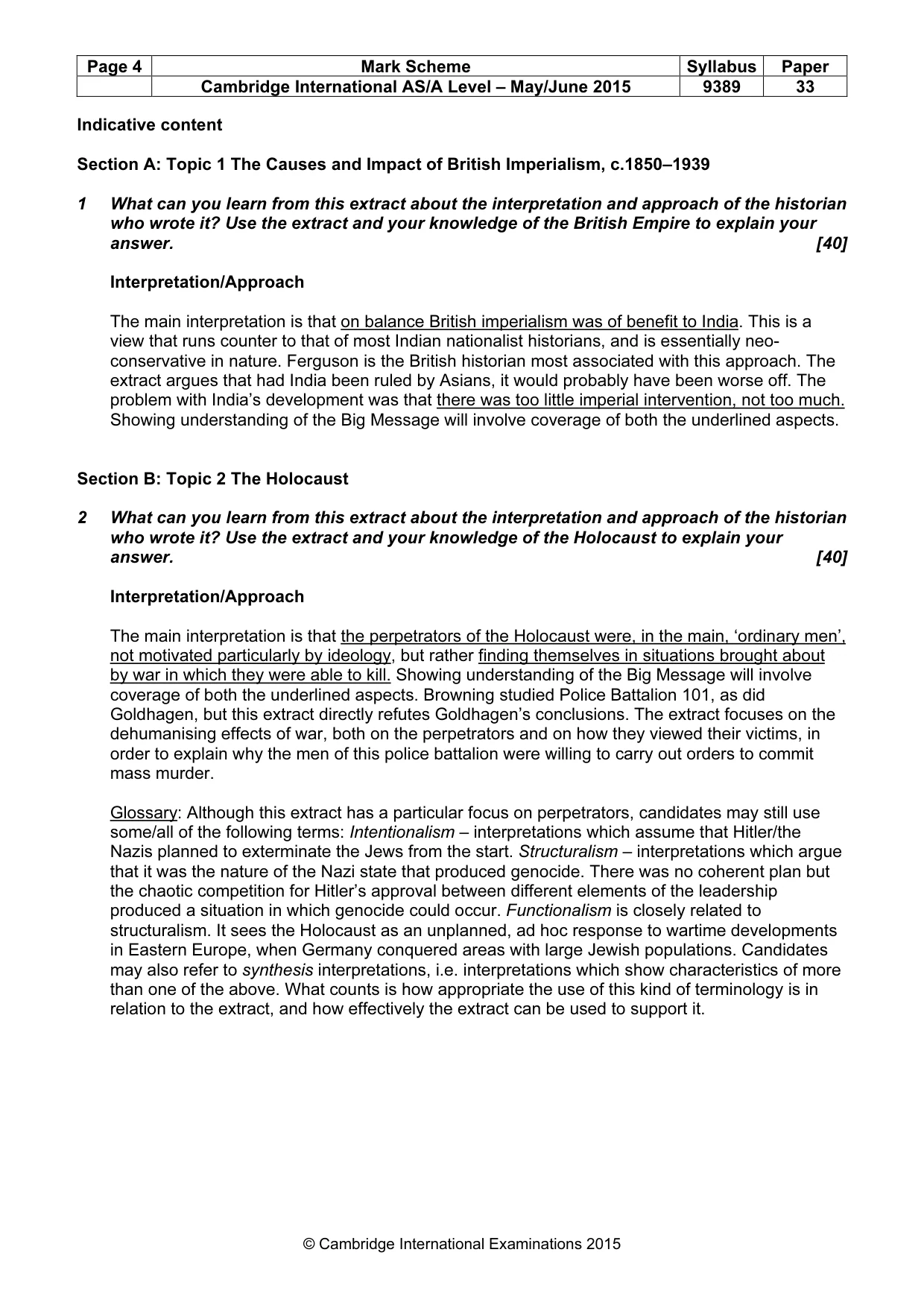
Page 4 Mark Scheme Syllabus Paper Cambridge International AS/A Level – May/June 2015 9389 33 © Cambridge International Examinations 2015 Indicative content Section A: Topic 1 The Causes and Impact of British Imperialism, c.1850–1939 1 What can you learn from this extract about the interpretation and approach of the historian who wrote it? Use the extract and your knowledge of the British Empire to explain your answer. [40] Interpretation/Approach The main interpretation is that on balance British imperialism was of benefit to India. This is a view that runs counter to that of most Indian nationalist historians, and is essentially neo- conservative in nature. Ferguson is the British historian most associated with this approach. The extract argues that had India been ruled by Asians, it would probably have been worse off. The problem with India’s development was that there was too little imperial intervention, not too much. Showing understanding of the Big Message will involve coverage of both the underlined aspects. Section B: Topic 2 The Holocaust 2 What can you learn from this extract about the interpretation and approach of the historian who wrote it? Use the extract and your knowledge of the Holocaust to explain your answer. [40] Interpretation/Approach The main interpretation is that the perpetrators of the Holocaust were, in the main, ‘ordinary men’, not motivated particularly by ideology, but rather finding themselves in situations brought about by war in which they were able to kill. Showing understanding of the Big Message will involve coverage of both the underlined aspects. Browning studied Police Battalion 101, as did Goldhagen, but this extract directly refutes Goldhagen’s conclusions. The extract focuses on the dehumanising effects of war, both on the perpetrators and on how they viewed their victims, in order to explain why the men of this police battalion were willing to carry out orders to commit mass murder. Glossary: Although this extract has a particular focus on perpetrators, candidates may still use some/all of the following terms: Intentionalism – interpretations which assume that Hitler/the Nazis planned to exterminate the Jews from the start. Structuralism – interpretations which argue that it was the nature of the Nazi state that produced genocide. There was no coherent plan but the chaotic competition for Hitler’s approval between different elements of the leadership produced a situation in which genocide could occur. Functionalism is closely related to structuralism. It sees the Holocaust as an unplanned, ad hoc response to wartime developments in Eastern Europe, when Germany conquered areas with large Jewish populations. Candidates may also refer to synthesis interpretations, i.e. interpretations which show characteristics of more than one of the above. What counts is how appropriate the use of this kind of terminology is in relation to the extract, and how effectively the extract can be used to support it.
Mark scheme, page 5
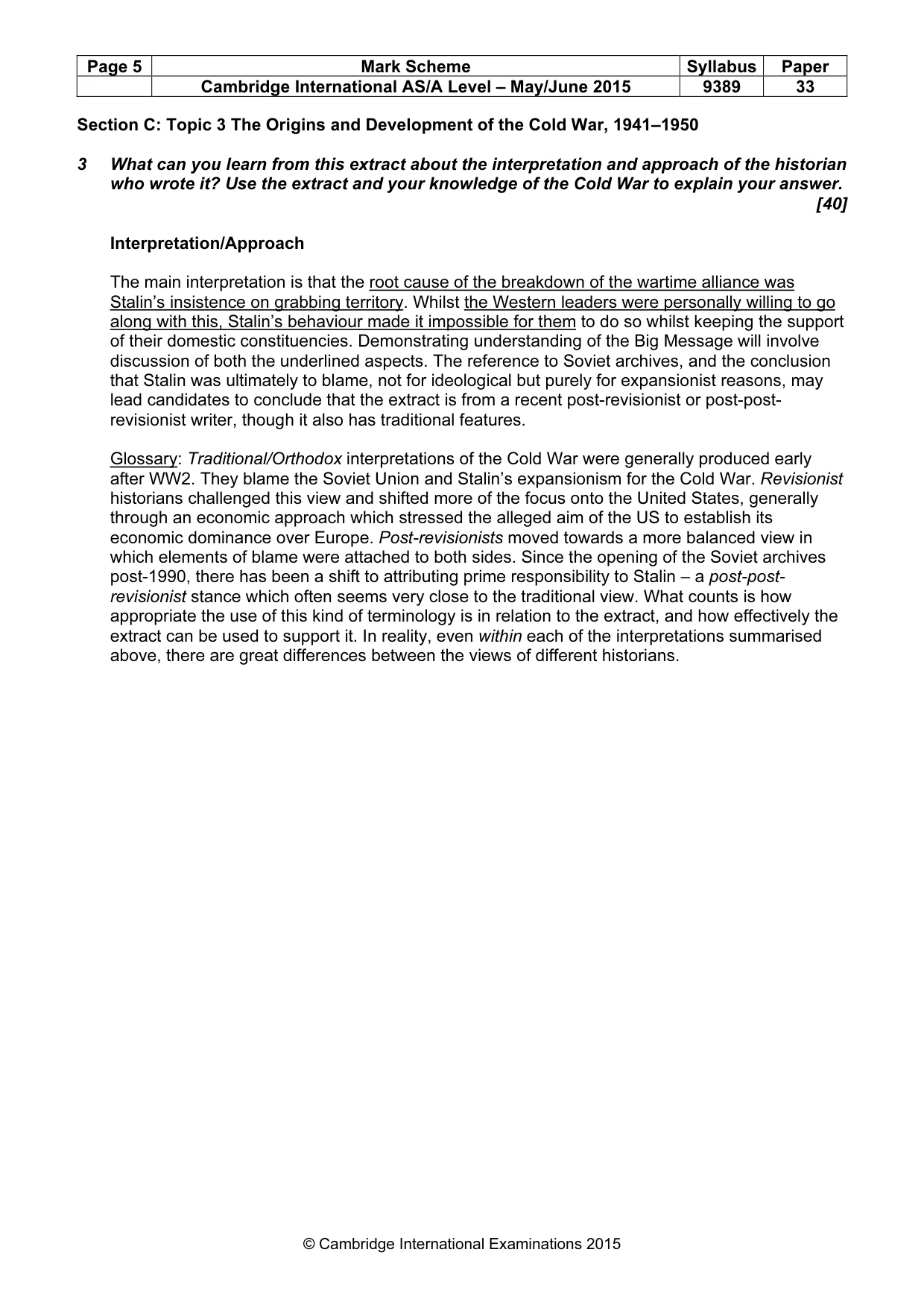
Page 5 Mark Scheme Syllabus Paper Cambridge International AS/A Level – May/June 2015 9389 33 © Cambridge International Examinations 2015 Section C: Topic 3 The Origins and Development of the Cold War, 1941–1950 3 What can you learn from this extract about the interpretation and approach of the historian who wrote it? Use the extract and your knowledge of the Cold War to explain your answer. [40] Interpretation/Approach The main interpretation is that the root cause of the breakdown of the wartime alliance was Stalin’s insistence on grabbing territory. Whilst the Western leaders were personally willing to go along with this, Stalin’s behaviour made it impossible for them to do so whilst keeping the support of their domestic constituencies. Demonstrating understanding of the Big Message will involve discussion of both the underlined aspects. The reference to Soviet archives, and the conclusion that Stalin was ultimately to blame, not for ideological but purely for expansionist reasons, may lead candidates to conclude that the extract is from a recent post-revisionist or post-post- revisionist writer, though it also has traditional features. Glossary: Traditional/Orthodox interpretations of the Cold War were generally produced early after WW2. They blame the Soviet Union and Stalin’s expansionism for the Cold War. Revisionist historians challenged this view and shifted more of the focus onto the United States, generally through an economic approach which stressed the alleged aim of the US to establish its economic dominance over Europe. Post-revisionists moved towards a more balanced view in which elements of blame were attached to both sides. Since the opening of the Soviet archives post-1990, there has been a shift to attributing prime responsibility to Stalin – a post-post- revisionist stance which often seems very close to the traditional view. What counts is how appropriate the use of this kind of terminology is in relation to the extract, and how effectively the extract can be used to support it. In reality, even within each of the interpretations summarised above, there are great differences between the views of different historians.
What you needed in this session
Cambridge’s own grade thresholds for 2015 May/June, Paper 3 · Variant 3. A higher threshold means an easier paper — the bar moves with how the cohort did.