Cambridge A Level History 9389 — 2015 May/June Paper 3 · Variant 2
9389/32/M/J/15 · 40 marks · ≈45 min
The question paper and its mark scheme, free to read here and free to download. This is Cambridge’s own paper, exactly as it was sat.
Question paper4 pages
Mark scheme5 pages
Answers below. Sit the paper first if you are practising.
Paper as text
Question paper, page 1
This document consists of 4 printed pages. DC (LEG) 96495/2 © UCLES 2015 [Turn over Cambridge International Examinations Cambridge International Advanced Subsidiary and Advanced Level * 8 5 5 8 6 2 1 4 5 4 * HISTORY 9389/32 Paper 3 Interpretations Question May/June 2015 1 hour Additional Materials: Answer Booklet/Paper READ THESE INSTRUCTIONS FIRST If you have been given an Answer Booklet, follow the instructions on the front cover of the Booklet. Write your Centre number, candidate number and name on the work you hand in. Write in dark blue or black pen. Do not use staples, paper clips, glue or correction fl uid. DO NOT WRITE IN ANY BARCODES. This paper contains three sections: Section A: Topic 1 The Causes and Impact of British Imperialism, c. 1850–1939 Section B: Topic 2 The Holocaust Section C: Topic 3 The Origins and Development of the Cold War, 1941–50 Answer the question on the topic you have studied. At the end of the examination, fasten all your work securely together. The marks are given in brackets [ ] at the end of each question.
Question paper, page 2
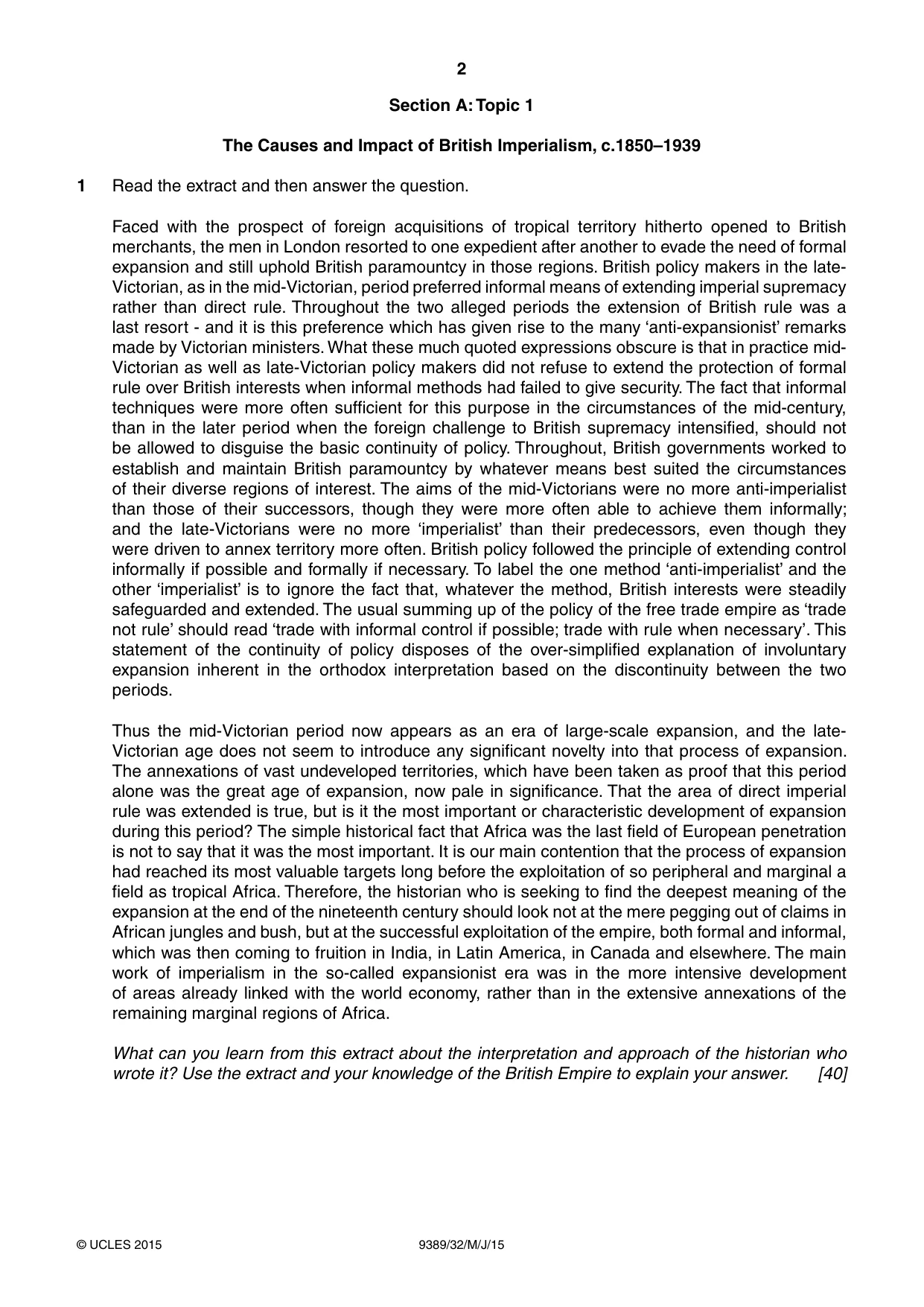
2 9389/32/M/J/15 © UCLES 2015 Section A: Topic 1 The Causes and Impact of British Imperialism, c.1850–1939 1 Read the extract and then answer the question. Faced with the prospect of foreign acquisitions of tropical territory hitherto opened to British merchants, the men in London resorted to one expedient after another to evade the need of formal expansion and still uphold British paramountcy in those regions. British policy makers in the late- Victorian, as in the mid-Victorian, period preferred informal means of extending imperial supremacy rather than direct rule. Throughout the two alleged periods the extension of British rule was a last resort - and it is this preference which has given rise to the many ‘anti-expansionist’ remarks made by Victorian ministers. What these much quoted expressions obscure is that in practice mid- Victorian as well as late-Victorian policy makers did not refuse to extend the protection of formal rule over British interests when informal methods had failed to give security. The fact that informal techniques were more often sufficient for this purpose in the circumstances of the mid-century, than in the later period when the foreign challenge to British supremacy intensified, should not be allowed to disguise the basic continuity of policy. Throughout, British governments worked to establish and maintain British paramountcy by whatever means best suited the circumstances of their diverse regions of interest. The aims of the mid-Victorians were no more anti-imperialist than those of their successors, though they were more often able to achieve them informally; and the late-Victorians were no more ‘imperialist’ than their predecessors, even though they were driven to annex territory more often. British policy followed the principle of extending control informally if possible and formally if necessary. To label the one method ‘anti-imperialist’ and the other ‘imperialist’ is to ignore the fact that, whatever the method, British interests were steadily safeguarded and extended. The usual summing up of the policy of the free trade empire as ‘trade not rule’ should read ‘trade with informal control if possible; trade with rule when necessary’. This statement of the continuity of policy disposes of the over-simplified explanation of involuntary expansion inherent in the orthodox interpretation based on the discontinuity between the two periods. Thus the mid-Victorian period now appears as an era of large-scale expansion, and the late- Victorian age does not seem to introduce any significant novelty into that process of expansion. The annexations of vast undeveloped territories, which have been taken as proof that this period alone was the great age of expansion, now pale in significance. That the area of direct imperial rule was extended is true, but is it the most important or characteristic development of expansion during this period? The simple historical fact that Africa was the last field of European penetration is not to say that it was the most important. It is our main contention that the process of expansion had reached its most valuable targets long before the exploitation of so peripheral and marginal a field as tropical Africa. Therefore, the historian who is seeking to find the deepest meaning of the expansion at the end of the nineteenth century should look not at the mere pegging out of claims in African jungles and bush, but at the successful exploitation of the empire, both formal and informal, which was then coming to fruition in India, in Latin America, in Canada and elsewhere. The main work of imperialism in the so-called expansionist era was in the more intensive development of areas already linked with the world economy, rather than in the extensive annexations of the remaining marginal regions of Africa. What can you learn from this extract about the interpretation and approach of the historian who wrote it? Use the extract and your knowledge of the British Empire to explain your answer. [40]
Question paper, page 3
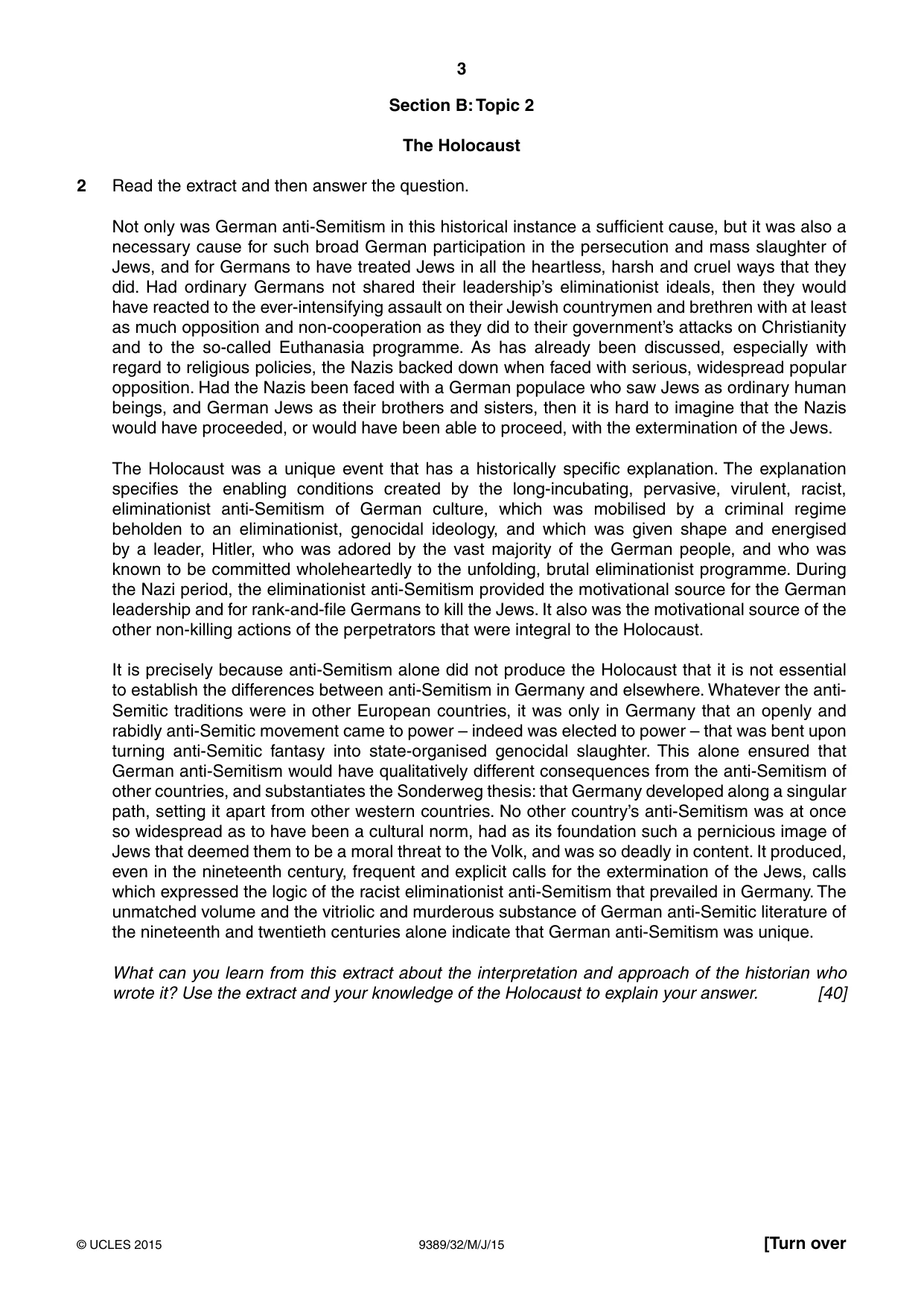
3 9389/32/M/J/15 © UCLES 2015 [Turn over Section B: Topic 2 The Holocaust 2 Read the extract and then answer the question. Not only was German anti-Semitism in this historical instance a sufficient cause, but it was also a necessary cause for such broad German participation in the persecution and mass slaughter of Jews, and for Germans to have treated Jews in all the heartless, harsh and cruel ways that they did. Had ordinary Germans not shared their leadership’s eliminationist ideals, then they would have reacted to the ever-intensifying assault on their Jewish countrymen and brethren with at least as much opposition and non-cooperation as they did to their government’s attacks on Christianity and to the so-called Euthanasia programme. As has already been discussed, especially with regard to religious policies, the Nazis backed down when faced with serious, widespread popular opposition. Had the Nazis been faced with a German populace who saw Jews as ordinary human beings, and German Jews as their brothers and sisters, then it is hard to imagine that the Nazis would have proceeded, or would have been able to proceed, with the extermination of the Jews. The Holocaust was a unique event that has a historically specific explanation. The explanation specifies the enabling conditions created by the long-incubating, pervasive, virulent, racist, eliminationist anti-Semitism of German culture, which was mobilised by a criminal regime beholden to an eliminationist, genocidal ideology, and which was given shape and energised by a leader, Hitler, who was adored by the vast majority of the German people, and who was known to be committed wholeheartedly to the unfolding, brutal eliminationist programme. During the Nazi period, the eliminationist anti-Semitism provided the motivational source for the German leadership and for rank-and-file Germans to kill the Jews. It also was the motivational source of the other non-killing actions of the perpetrators that were integral to the Holocaust. It is precisely because anti-Semitism alone did not produce the Holocaust that it is not essential to establish the differences between anti-Semitism in Germany and elsewhere. Whatever the anti- Semitic traditions were in other European countries, it was only in Germany that an openly and rabidly anti-Semitic movement came to power – indeed was elected to power – that was bent upon turning anti-Semitic fantasy into state-organised genocidal slaughter. This alone ensured that German anti-Semitism would have qualitatively different consequences from the anti-Semitism of other countries, and substantiates the Sonderweg thesis: that Germany developed along a singular path, setting it apart from other western countries. No other country’s anti-Semitism was at once so widespread as to have been a cultural norm, had as its foundation such a pernicious image of Jews that deemed them to be a moral threat to the Volk, and was so deadly in content. It produced, even in the nineteenth century, frequent and explicit calls for the extermination of the Jews, calls which expressed the logic of the racist eliminationist anti-Semitism that prevailed in Germany. The unmatched volume and the vitriolic and murderous substance of German anti-Semitic literature of the nineteenth and twentieth centuries alone indicate that German anti-Semitism was unique. What can you learn from this extract about the interpretation and approach of the historian who wrote it? Use the extract and your knowledge of the Holocaust to explain your answer. [40]
Question paper, page 4
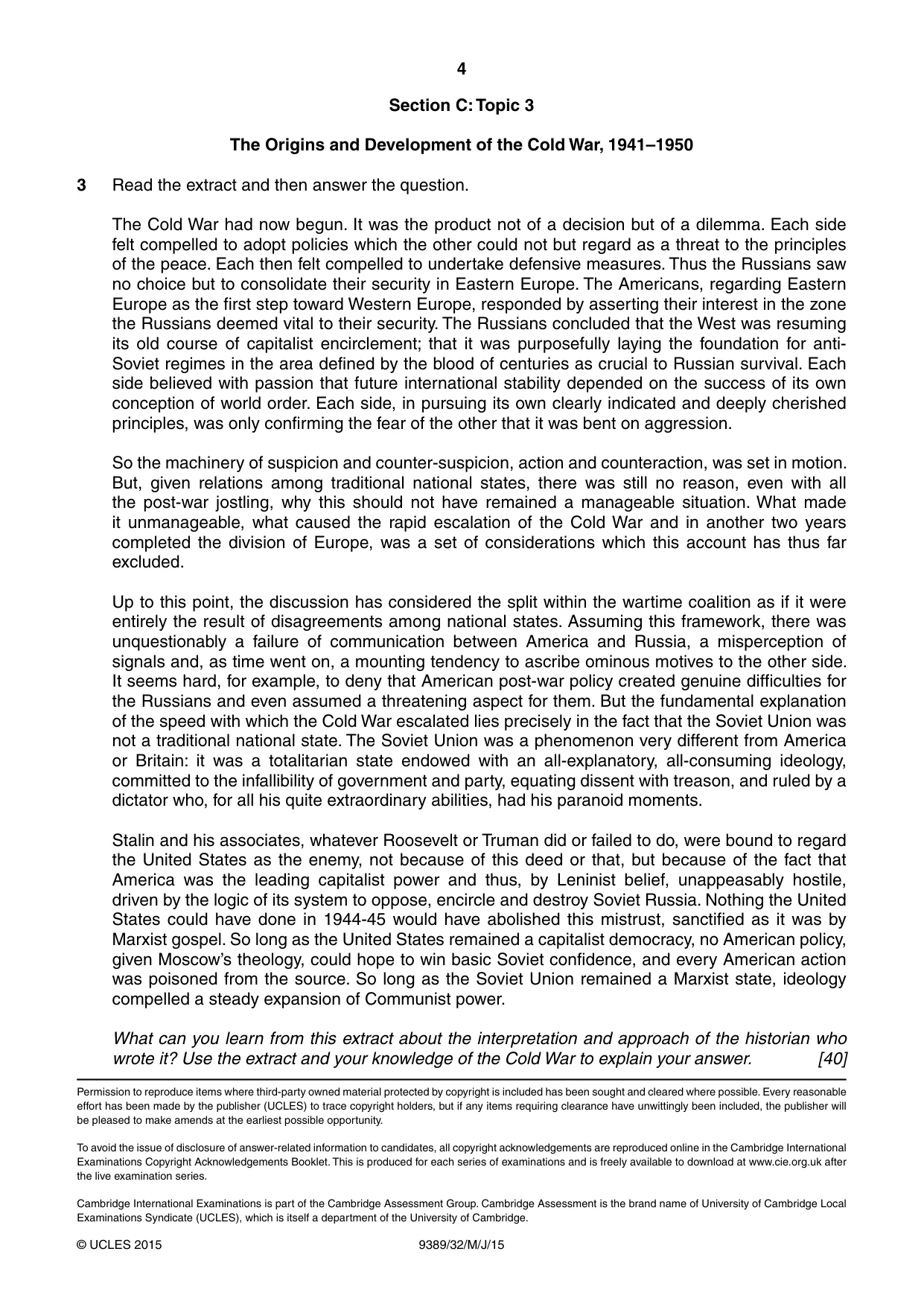
4 9389/32/M/J/15 © UCLES 2015 Permission to reproduce items where third-party owned material protected by copyright is included has been sought and cleared where possible. Every reasonable effort has been made by the publisher (UCLES) to trace copyright holders, but if any items requiring clearance have unwittingly been included, the publisher will be pleased to make amends at the earliest possible opportunity. To avoid the issue of disclosure of answer-related information to candidates, all copyright acknowledgements are reproduced online in the Cambridge International Examinations Copyright Acknowledgements Booklet. This is produced for each series of examinations and is freely available to download at www.cie.org.uk after the live examination series. Cambridge International Examinations is part of the Cambridge Assessment Group. Cambridge Assessment is the brand name of University of Cambridge Local Examinations Syndicate (UCLES), which is itself a department of the University of Cambridge. Section C: Topic 3 The Origins and Development of the Cold War, 1941–1950 3 Read the extract and then answer the question. The Cold War had now begun. It was the product not of a decision but of a dilemma. Each side felt compelled to adopt policies which the other could not but regard as a threat to the principles of the peace. Each then felt compelled to undertake defensive measures. Thus the Russians saw no choice but to consolidate their security in Eastern Europe. The Americans, regarding Eastern Europe as the first step toward Western Europe, responded by asserting their interest in the zone the Russians deemed vital to their security. The Russians concluded that the West was resuming its old course of capitalist encirclement; that it was purposefully laying the foundation for anti- Soviet regimes in the area defined by the blood of centuries as crucial to Russian survival. Each side believed with passion that future international stability depended on the success of its own conception of world order. Each side, in pursuing its own clearly indicated and deeply cherished principles, was only confirming the fear of the other that it was bent on aggression. So the machinery of suspicion and counter-suspicion, action and counteraction, was set in motion. But, given relations among traditional national states, there was still no reason, even with all the post-war jostling, why this should not have remained a manageable situation. What made it unmanageable, what caused the rapid escalation of the Cold War and in another two years completed the division of Europe, was a set of considerations which this account has thus far excluded. Up to this point, the discussion has considered the split within the wartime coalition as if it were entirely the result of disagreements among national states. Assuming this framework, there was unquestionably a failure of communication between America and Russia, a misperception of signals and, as time went on, a mounting tendency to ascribe ominous motives to the other side. It seems hard, for example, to deny that American post-war policy created genuine difficulties for the Russians and even assumed a threatening aspect for them. But the fundamental explanation of the speed with which the Cold War escalated lies precisely in the fact that the Soviet Union was not a traditional national state. The Soviet Union was a phenomenon very different from America or Britain: it was a totalitarian state endowed with an all-explanatory, all-consuming ideology, committed to the infallibility of government and party, equating dissent with treason, and ruled by a dictator who, for all his quite extraordinary abilities, had his paranoid moments. Stalin and his associates, whatever Roosevelt or Truman did or failed to do, were bound to regard the United States as the enemy, not because of this deed or that, but because of the fact that America was the leading capitalist power and thus, by Leninist belief, unappeasably hostile, driven by the logic of its system to oppose, encircle and destroy Soviet Russia. Nothing the United States could have done in 1944-45 would have abolished this mistrust, sanctified as it was by Marxist gospel. So long as the United States remained a capitalist democracy, no American policy, given Moscow’s theology, could hope to win basic Soviet confidence, and every American action was poisoned from the source. So long as the Soviet Union remained a Marxist state, ideology compelled a steady expansion of Communist power. What can you learn from this extract about the interpretation and approach of the historian who wrote it? Use the extract and your knowledge of the Cold War to explain your answer. [40]
Mark scheme, page 1
® IGCSE is the registered trademark of Cambridge International Examinations. CAMBRIDGE INTERNATIONAL EXAMINATIONS Cambridge International Advanced Subsidiary and Advanced Level MARK SCHEME for the May/June 2015 series 9389 HISTORY 9389/32 Paper 3 (Interpretations Question), maximum raw mark 40 This mark scheme is published as an aid to teachers and candidates, to indicate the requirements of the examination. It shows the basis on which Examiners were instructed to award marks. It does not indicate the details of the discussions that took place at an Examiners’ meeting before marking began, which would have considered the acceptability of alternative answers. Mark schemes should be read in conjunction with the question paper and the Principal Examiner Report for Teachers. Cambridge will not enter into discussions about these mark schemes. Cambridge is publishing the mark schemes for the May/June 2015 series for most Cambridge IGCSE®, Cambridge International A and AS Level components and some Cambridge O Level components.
Mark scheme, page 2
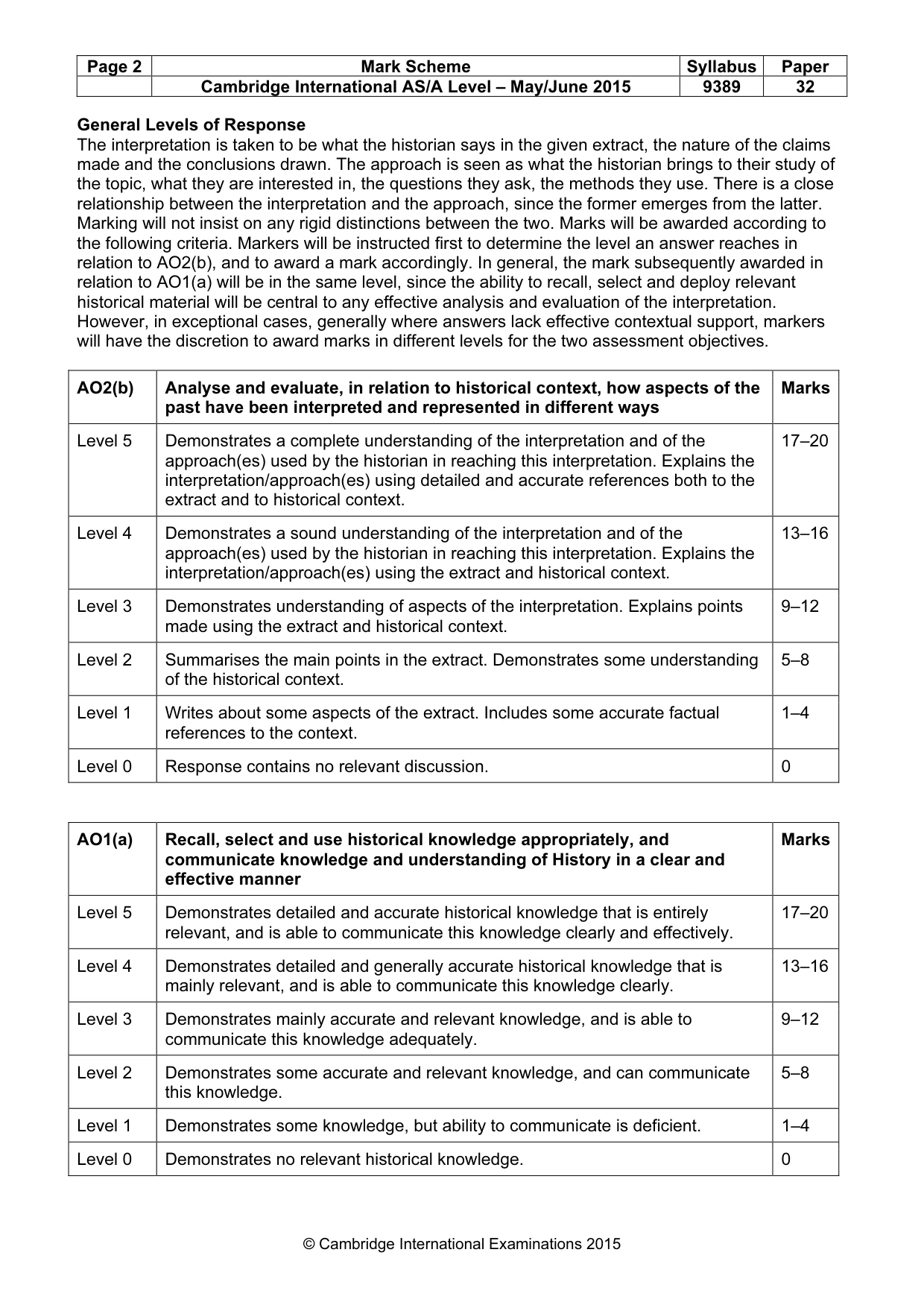
Page 2 Mark Scheme Syllabus Paper Cambridge International AS/A Level – May/June 2015 9389 32 © Cambridge International Examinations 2015 General Levels of Response The interpretation is taken to be what the historian says in the given extract, the nature of the claims made and the conclusions drawn. The approach is seen as what the historian brings to their study of the topic, what they are interested in, the questions they ask, the methods they use. There is a close relationship between the interpretation and the approach, since the former emerges from the latter. Marking will not insist on any rigid distinctions between the two. Marks will be awarded according to the following criteria. Markers will be instructed first to determine the level an answer reaches in relation to AO2(b), and to award a mark accordingly. In general, the mark subsequently awarded in relation to AO1(a) will be in the same level, since the ability to recall, select and deploy relevant historical material will be central to any effective analysis and evaluation of the interpretation. However, in exceptional cases, generally where answers lack effective contextual support, markers will have the discretion to award marks in different levels for the two assessment objectives. AO2(b) Analyse and evaluate, in relation to historical context, how aspects of the past have been interpreted and represented in different ways Marks Level 5 Demonstrates a complete understanding of the interpretation and of the approach(es) used by the historian in reaching this interpretation. Explains the interpretation/approach(es) using detailed and accurate references both to the extract and to historical context. 17–20 Level 4 Demonstrates a sound understanding of the interpretation and of the approach(es) used by the historian in reaching this interpretation. Explains the interpretation/approach(es) using the extract and historical context. 13–16 Level 3 Demonstrates understanding of aspects of the interpretation. Explains points made using the extract and historical context. 9–12 Level 2 Summarises the main points in the extract. Demonstrates some understanding of the historical context. 5–8 Level 1 Writes about some aspects of the extract. Includes some accurate factual references to the context. 1–4 Level 0 Response contains no relevant discussion. 0 AO1(a) Recall, select and use historical knowledge appropriately, and communicate knowledge and understanding of History in a clear and effective manner Marks Level 5 Demonstrates detailed and accurate historical knowledge that is entirely relevant, and is able to communicate this knowledge clearly and effectively. 17–20 Level 4 Demonstrates detailed and generally accurate historical knowledge that is mainly relevant, and is able to communicate this knowledge clearly. 13–16 Level 3 Demonstrates mainly accurate and relevant knowledge, and is able to communicate this knowledge adequately. 9–12 Level 2 Demonstrates some accurate and relevant knowledge, and can communicate this knowledge. 5–8 Level 1 Demonstrates some knowledge, but ability to communicate is deficient. 1–4 Level 0 Demonstrates no relevant historical knowledge. 0
Mark scheme, page 3
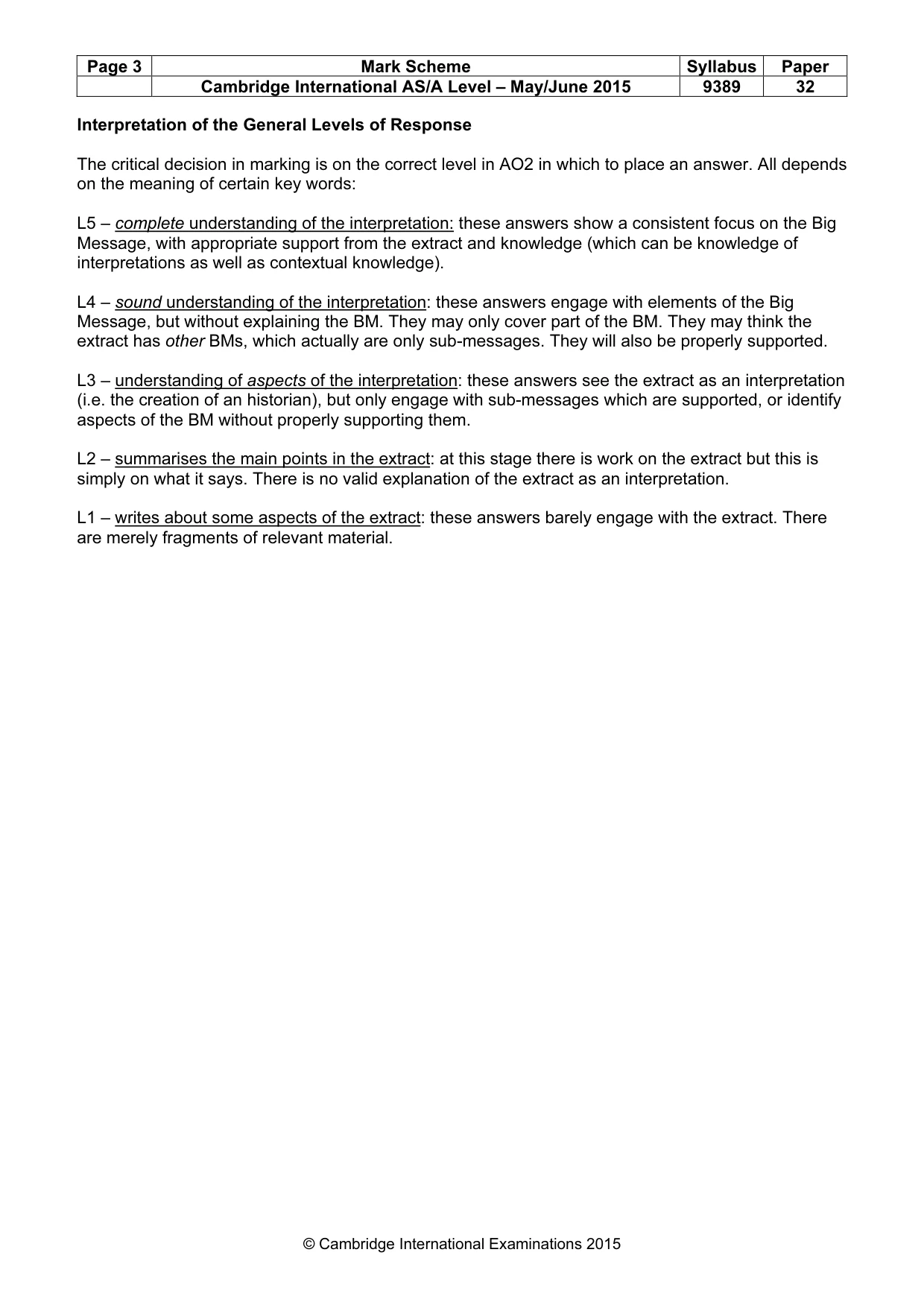
Page 3 Mark Scheme Syllabus Paper Cambridge International AS/A Level – May/June 2015 9389 32 © Cambridge International Examinations 2015 Interpretation of the General Levels of Response The critical decision in marking is on the correct level in AO2 in which to place an answer. All depends on the meaning of certain key words: L5 – complete understanding of the interpretation: these answers show a consistent focus on the Big Message, with appropriate support from the extract and knowledge (which can be knowledge of interpretations as well as contextual knowledge). L4 – sound understanding of the interpretation: these answers engage with elements of the Big Message, but without explaining the BM. They may only cover part of the BM. They may think the extract has other BMs, which actually are only sub-messages. They will also be properly supported. L3 – understanding of aspects of the interpretation: these answers see the extract as an interpretation (i.e. the creation of an historian), but only engage with sub-messages which are supported, or identify aspects of the BM without properly supporting them. L2 – summarises the main points in the extract: at this stage there is work on the extract but this is simply on what it says. There is no valid explanation of the extract as an interpretation. L1 – writes about some aspects of the extract: these answers barely engage with the extract. There are merely fragments of relevant material.
Mark scheme, page 4
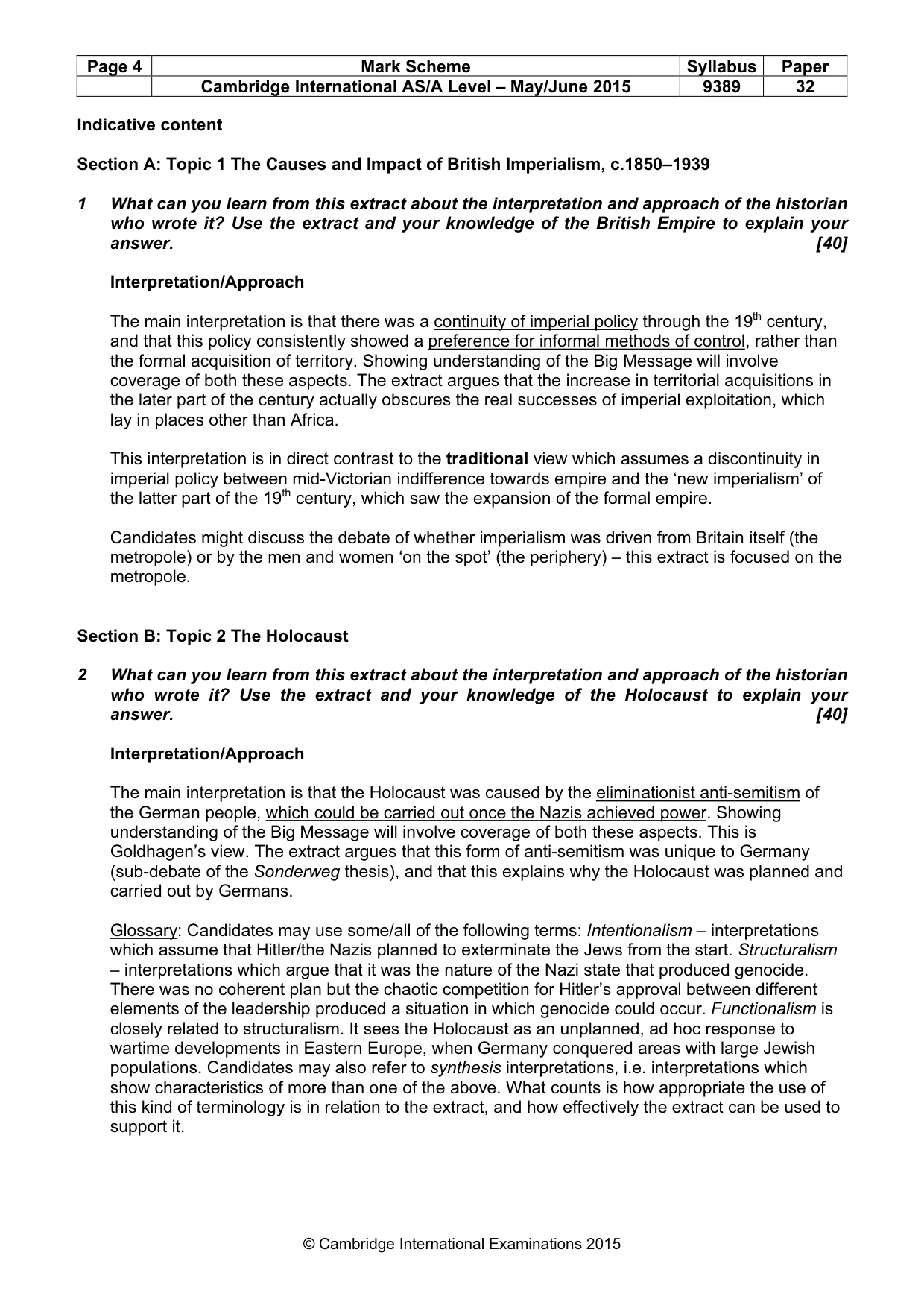
Page 4 Mark Scheme Syllabus Paper Cambridge International AS/A Level – May/June 2015 9389 32 © Cambridge International Examinations 2015 Indicative content Section A: Topic 1 The Causes and Impact of British Imperialism, c.1850–1939 1 What can you learn from this extract about the interpretation and approach of the historian who wrote it? Use the extract and your knowledge of the British Empire to explain your answer. [40] Interpretation/Approach The main interpretation is that there was a continuity of imperial policy through the 19th century, and that this policy consistently showed a preference for informal methods of control, rather than the formal acquisition of territory. Showing understanding of the Big Message will involve coverage of both these aspects. The extract argues that the increase in territorial acquisitions in the later part of the century actually obscures the real successes of imperial exploitation, which lay in places other than Africa. This interpretation is in direct contrast to the traditional view which assumes a discontinuity in imperial policy between mid-Victorian indifference towards empire and the ‘new imperialism’ of the latter part of the 19th century, which saw the expansion of the formal empire. Candidates might discuss the debate of whether imperialism was driven from Britain itself (the metropole) or by the men and women ‘on the spot’ (the periphery) – this extract is focused on the metropole. Section B: Topic 2 The Holocaust 2 What can you learn from this extract about the interpretation and approach of the historian who wrote it? Use the extract and your knowledge of the Holocaust to explain your answer. [40] Interpretation/Approach The main interpretation is that the Holocaust was caused by the eliminationist anti-semitism of the German people, which could be carried out once the Nazis achieved power. Showing understanding of the Big Message will involve coverage of both these aspects. This is Goldhagen’s view. The extract argues that this form of anti-semitism was unique to Germany (sub-debate of the Sonderweg thesis), and that this explains why the Holocaust was planned and carried out by Germans. Glossary: Candidates may use some/all of the following terms: Intentionalism – interpretations which assume that Hitler/the Nazis planned to exterminate the Jews from the start. Structuralism – interpretations which argue that it was the nature of the Nazi state that produced genocide. There was no coherent plan but the chaotic competition for Hitler’s approval between different elements of the leadership produced a situation in which genocide could occur. Functionalism is closely related to structuralism. It sees the Holocaust as an unplanned, ad hoc response to wartime developments in Eastern Europe, when Germany conquered areas with large Jewish populations. Candidates may also refer to synthesis interpretations, i.e. interpretations which show characteristics of more than one of the above. What counts is how appropriate the use of this kind of terminology is in relation to the extract, and how effectively the extract can be used to support it.
Mark scheme, page 5
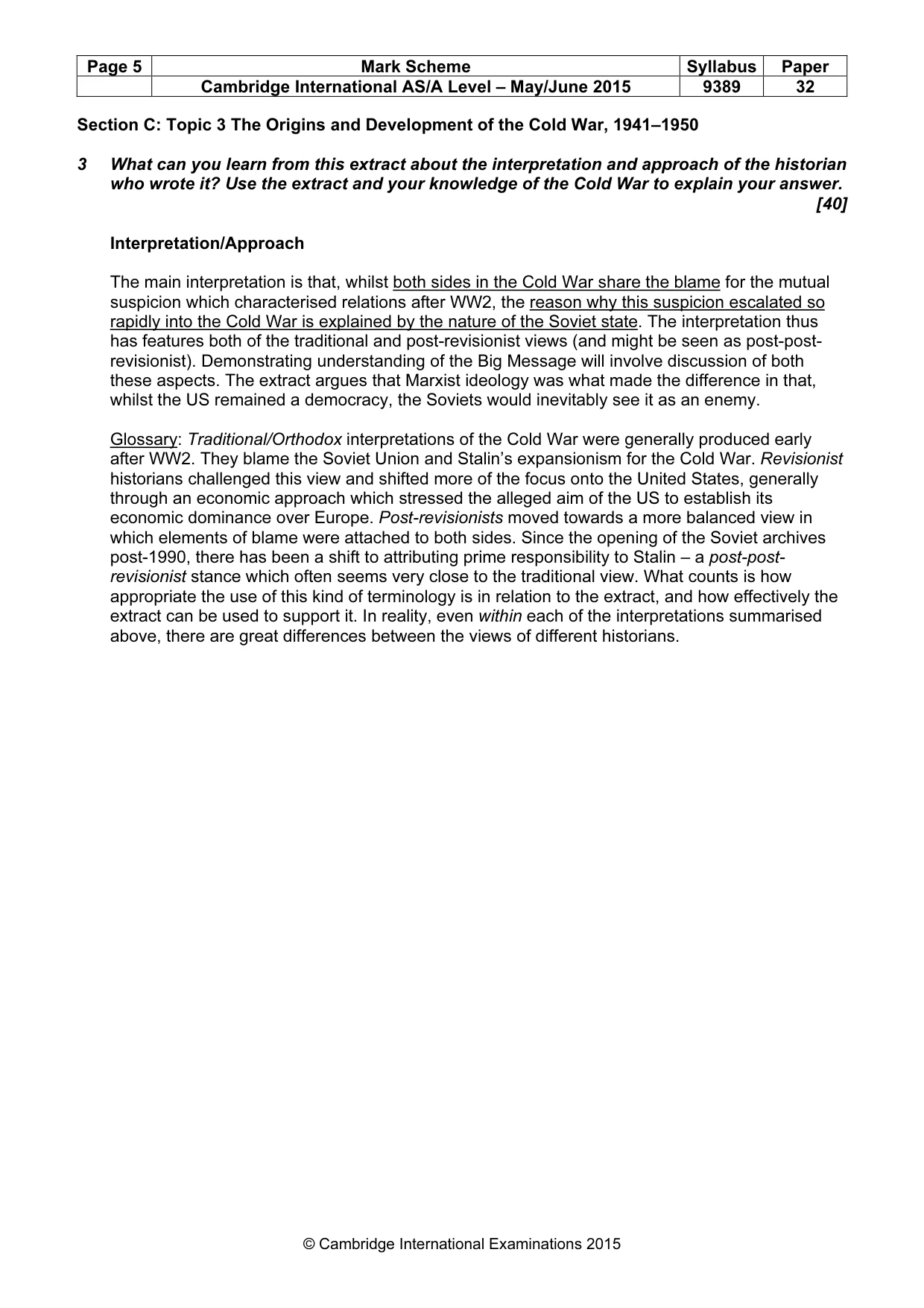
Page 5 Mark Scheme Syllabus Paper Cambridge International AS/A Level – May/June 2015 9389 32 © Cambridge International Examinations 2015 Section C: Topic 3 The Origins and Development of the Cold War, 1941–1950 3 What can you learn from this extract about the interpretation and approach of the historian who wrote it? Use the extract and your knowledge of the Cold War to explain your answer. [40] Interpretation/Approach The main interpretation is that, whilst both sides in the Cold War share the blame for the mutual suspicion which characterised relations after WW2, the reason why this suspicion escalated so rapidly into the Cold War is explained by the nature of the Soviet state. The interpretation thus has features both of the traditional and post-revisionist views (and might be seen as post-post- revisionist). Demonstrating understanding of the Big Message will involve discussion of both these aspects. The extract argues that Marxist ideology was what made the difference in that, whilst the US remained a democracy, the Soviets would inevitably see it as an enemy. Glossary: Traditional/Orthodox interpretations of the Cold War were generally produced early after WW2. They blame the Soviet Union and Stalin’s expansionism for the Cold War. Revisionist historians challenged this view and shifted more of the focus onto the United States, generally through an economic approach which stressed the alleged aim of the US to establish its economic dominance over Europe. Post-revisionists moved towards a more balanced view in which elements of blame were attached to both sides. Since the opening of the Soviet archives post-1990, there has been a shift to attributing prime responsibility to Stalin – a post-post- revisionist stance which often seems very close to the traditional view. What counts is how appropriate the use of this kind of terminology is in relation to the extract, and how effectively the extract can be used to support it. In reality, even within each of the interpretations summarised above, there are great differences between the views of different historians.
What you needed in this session
Cambridge’s own grade thresholds for 2015 May/June, Paper 3 · Variant 2. A higher threshold means an easier paper — the bar moves with how the cohort did.