Cambridge A Level History 9389 — 2015 May/June Paper 3 · Variant 1
9389/31/M/J/15 · 40 marks · ≈45 min
The question paper and its mark scheme, free to read here and free to download. This is Cambridge’s own paper, exactly as it was sat.
Question paper4 pages
Mark scheme5 pages
Answers below. Sit the paper first if you are practising.
Paper as text
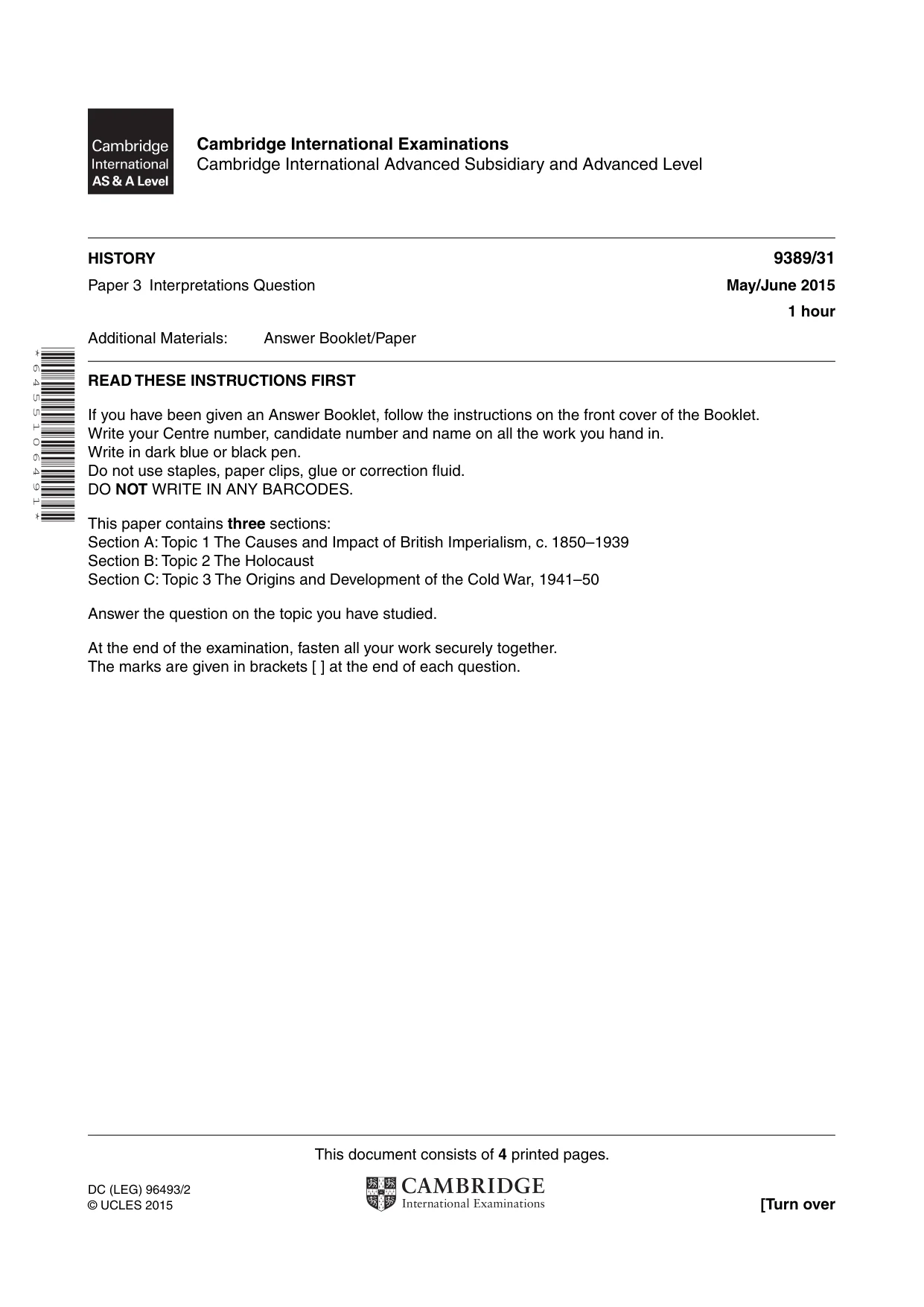
Question paper, page 1
This document consists of 4 printed pages. DC (LEG) 96493/2 © UCLES 2015 [Turn over Cambridge International Examinations Cambridge International Advanced Subsidiary and Advanced Level * 6 4 5 5 1 0 6 4 9 1 * HISTORY 9389/31 Paper 3 Interpretations Question May/June 2015 1 hour Additional Materials: Answer Booklet/Paper READ THESE INSTRUCTIONS FIRST If you have been given an Answer Booklet, follow the instructions on the front cover of the Booklet. Write your Centre number, candidate number and name on all the work you hand in. Write in dark blue or black pen. Do not use staples, paper clips, glue or correction fl uid. DO NOT WRITE IN ANY BARCODES. This paper contains three sections: Section A: Topic 1 The Causes and Impact of British Imperialism, c. 1850–1939 Section B: Topic 2 The Holocaust Section C: Topic 3 The Origins and Development of the Cold War, 1941–50 Answer the question on the topic you have studied. At the end of the examination, fasten all your work securely together. The marks are given in brackets [ ] at the end of each question.
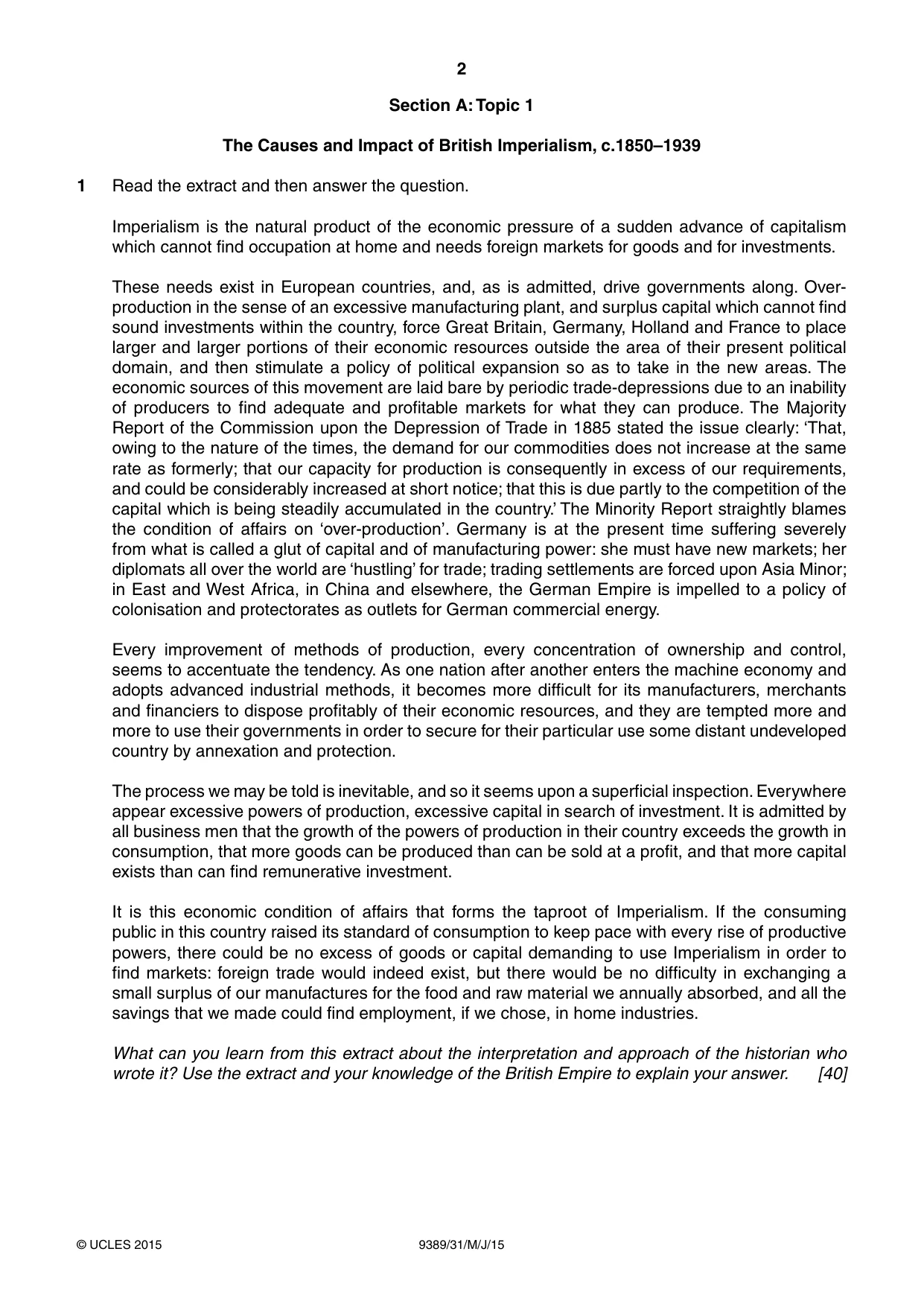
Question paper, page 2
2 9389/31/M/J/15 © UCLES 2015 Section A: Topic 1 The Causes and Impact of British Imperialism, c.1850–1939 1 Read the extract and then answer the question. Imperialism is the natural product of the economic pressure of a sudden advance of capitalism which cannot find occupation at home and needs foreign markets for goods and for investments. These needs exist in European countries, and, as is admitted, drive governments along. Over- production in the sense of an excessive manufacturing plant, and surplus capital which cannot find sound investments within the country, force Great Britain, Germany, Holland and France to place larger and larger portions of their economic resources outside the area of their present political domain, and then stimulate a policy of political expansion so as to take in the new areas. The economic sources of this movement are laid bare by periodic trade-depressions due to an inability of producers to find adequate and profitable markets for what they can produce. The Majority Report of the Commission upon the Depression of Trade in 1885 stated the issue clearly: ‘That, owing to the nature of the times, the demand for our commodities does not increase at the same rate as formerly; that our capacity for production is consequently in excess of our requirements, and could be considerably increased at short notice; that this is due partly to the competition of the capital which is being steadily accumulated in the country.’ The Minority Report straightly blames the condition of affairs on ‘over-production’. Germany is at the present time suffering severely from what is called a glut of capital and of manufacturing power: she must have new markets; her diplomats all over the world are ‘hustling’ for trade; trading settlements are forced upon Asia Minor; in East and West Africa, in China and elsewhere, the German Empire is impelled to a policy of colonisation and protectorates as outlets for German commercial energy. Every improvement of methods of production, every concentration of ownership and control, seems to accentuate the tendency. As one nation after another enters the machine economy and adopts advanced industrial methods, it becomes more difficult for its manufacturers, merchants and financiers to dispose profitably of their economic resources, and they are tempted more and more to use their governments in order to secure for their particular use some distant undeveloped country by annexation and protection. The process we may be told is inevitable, and so it seems upon a superficial inspection. Everywhere appear excessive powers of production, excessive capital in search of investment. It is admitted by all business men that the growth of the powers of production in their country exceeds the growth in consumption, that more goods can be produced than can be sold at a profit, and that more capital exists than can find remunerative investment. It is this economic condition of affairs that forms the taproot of Imperialism. If the consuming public in this country raised its standard of consumption to keep pace with every rise of productive powers, there could be no excess of goods or capital demanding to use Imperialism in order to find markets: foreign trade would indeed exist, but there would be no difficulty in exchanging a small surplus of our manufactures for the food and raw material we annually absorbed, and all the savings that we made could find employment, if we chose, in home industries. What can you learn from this extract about the interpretation and approach of the historian who wrote it? Use the extract and your knowledge of the British Empire to explain your answer. [40]
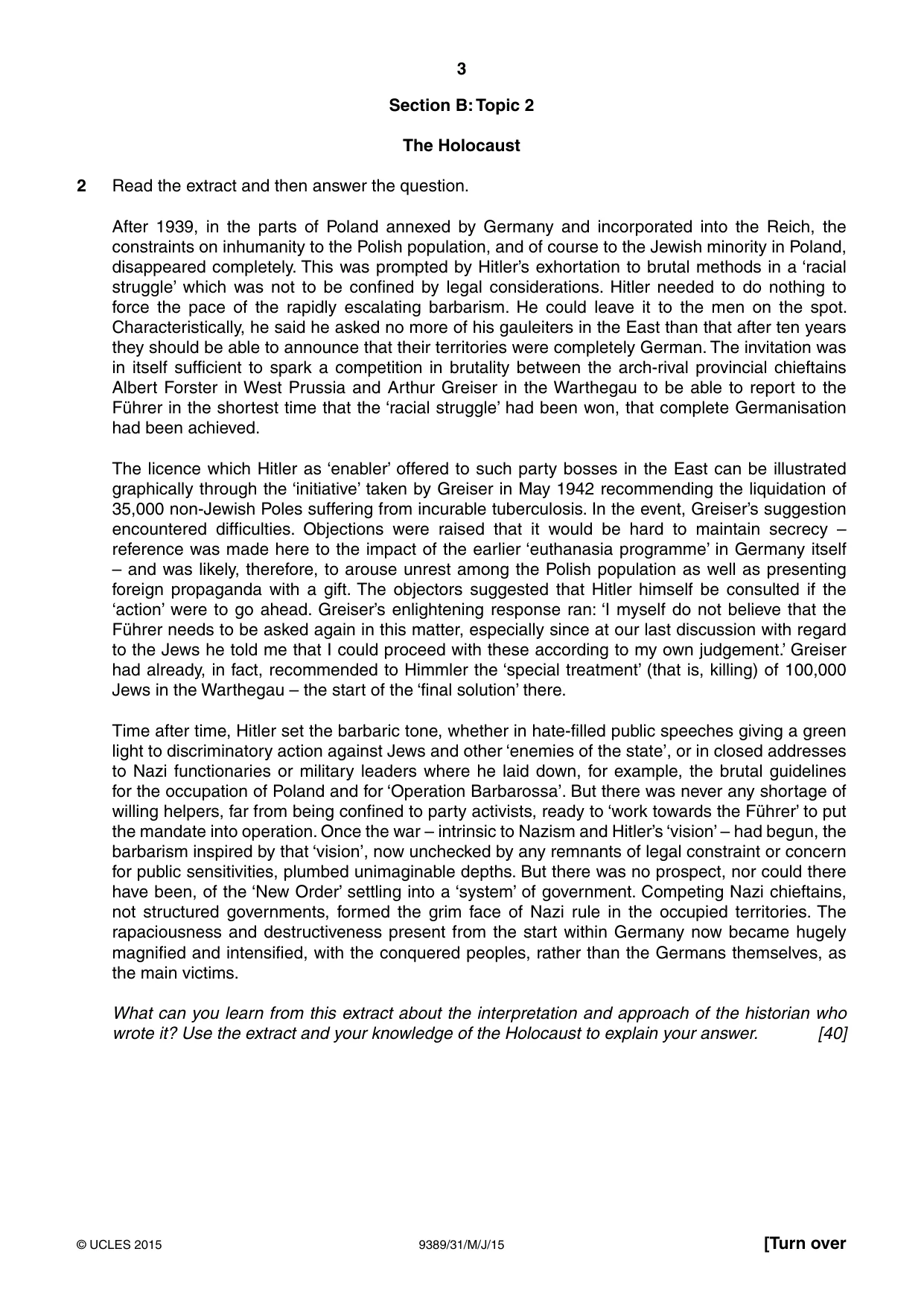
Question paper, page 3
3 9389/31/M/J/15 © UCLES 2015 [Turn over Section B: Topic 2 The Holocaust 2 Read the extract and then answer the question. After 1939, in the parts of Poland annexed by Germany and incorporated into the Reich, the constraints on inhumanity to the Polish population, and of course to the Jewish minority in Poland, disappeared completely. This was prompted by Hitler’s exhortation to brutal methods in a ‘racial struggle’ which was not to be confined by legal considerations. Hitler needed to do nothing to force the pace of the rapidly escalating barbarism. He could leave it to the men on the spot. Characteristically, he said he asked no more of his gauleiters in the East than that after ten years they should be able to announce that their territories were completely German. The invitation was in itself sufficient to spark a competition in brutality between the arch-rival provincial chieftains Albert Forster in West Prussia and Arthur Greiser in the Warthegau to be able to report to the Führer in the shortest time that the ‘racial struggle’ had been won, that complete Germanisation had been achieved. The licence which Hitler as ‘enabler’ offered to such party bosses in the East can be illustrated graphically through the ‘initiative’ taken by Greiser in May 1942 recommending the liquidation of 35,000 non-Jewish Poles suffering from incurable tuberculosis. In the event, Greiser’s suggestion encountered difficulties. Objections were raised that it would be hard to maintain secrecy – reference was made here to the impact of the earlier ‘euthanasia programme’ in Germany itself – and was likely, therefore, to arouse unrest among the Polish population as well as presenting foreign propaganda with a gift. The objectors suggested that Hitler himself be consulted if the ‘action’ were to go ahead. Greiser’s enlightening response ran: ‘I myself do not believe that the Führer needs to be asked again in this matter, especially since at our last discussion with regard to the Jews he told me that I could proceed with these according to my own judgement.’ Greiser had already, in fact, recommended to Himmler the ‘special treatment’ (that is, killing) of 100,000 Jews in the Warthegau – the start of the ‘final solution’ there. Time after time, Hitler set the barbaric tone, whether in hate-filled public speeches giving a green light to discriminatory action against Jews and other ‘enemies of the state’, or in closed addresses to Nazi functionaries or military leaders where he laid down, for example, the brutal guidelines for the occupation of Poland and for ‘Operation Barbarossa’. But there was never any shortage of willing helpers, far from being confined to party activists, ready to ‘work towards the Führer’ to put the mandate into operation. Once the war – intrinsic to Nazism and Hitler’s ‘vision’ – had begun, the barbarism inspired by that ‘vision’, now unchecked by any remnants of legal constraint or concern for public sensitivities, plumbed unimaginable depths. But there was no prospect, nor could there have been, of the ‘New Order’ settling into a ‘system’ of government. Competing Nazi chieftains, not structured governments, formed the grim face of Nazi rule in the occupied territories. The rapaciousness and destructiveness present from the start within Germany now became hugely magnified and intensified, with the conquered peoples, rather than the Germans themselves, as the main victims. What can you learn from this extract about the interpretation and approach of the historian who wrote it? Use the extract and your knowledge of the Holocaust to explain your answer. [40]
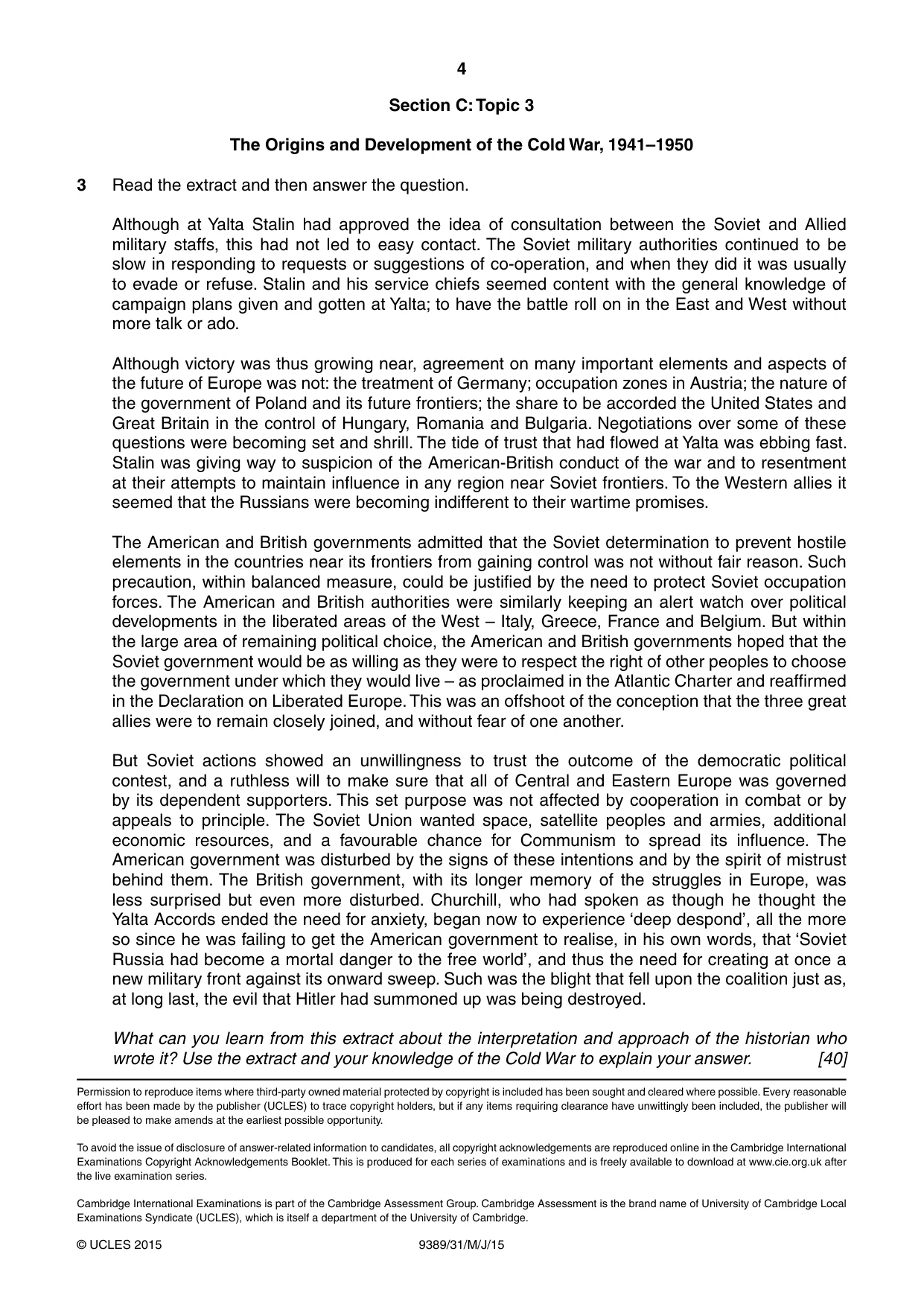
Question paper, page 4
4 9389/31/M/J/15 © UCLES 2015 Permission to reproduce items where third-party owned material protected by copyright is included has been sought and cleared where possible. Every reasonable effort has been made by the publisher (UCLES) to trace copyright holders, but if any items requiring clearance have unwittingly been included, the publisher will be pleased to make amends at the earliest possible opportunity. To avoid the issue of disclosure of answer-related information to candidates, all copyright acknowledgements are reproduced online in the Cambridge International Examinations Copyright Acknowledgements Booklet. This is produced for each series of examinations and is freely available to download at www.cie.org.uk after the live examination series. Cambridge International Examinations is part of the Cambridge Assessment Group. Cambridge Assessment is the brand name of University of Cambridge Local Examinations Syndicate (UCLES), which is itself a department of the University of Cambridge. Section C: Topic 3 The Origins and Development of the Cold War, 1941–1950 3 Read the extract and then answer the question. Although at Yalta Stalin had approved the idea of consultation between the Soviet and Allied military staffs, this had not led to easy contact. The Soviet military authorities continued to be slow in responding to requests or suggestions of co-operation, and when they did it was usually to evade or refuse. Stalin and his service chiefs seemed content with the general knowledge of campaign plans given and gotten at Yalta; to have the battle roll on in the East and West without more talk or ado. Although victory was thus growing near, agreement on many important elements and aspects of the future of Europe was not: the treatment of Germany; occupation zones in Austria; the nature of the government of Poland and its future frontiers; the share to be accorded the United States and Great Britain in the control of Hungary, Romania and Bulgaria. Negotiations over some of these questions were becoming set and shrill. The tide of trust that had flowed at Yalta was ebbing fast. Stalin was giving way to suspicion of the American-British conduct of the war and to resentment at their attempts to maintain influence in any region near Soviet frontiers. To the Western allies it seemed that the Russians were becoming indifferent to their wartime promises. The American and British governments admitted that the Soviet determination to prevent hostile elements in the countries near its frontiers from gaining control was not without fair reason. Such precaution, within balanced measure, could be justified by the need to protect Soviet occupation forces. The American and British authorities were similarly keeping an alert watch over political developments in the liberated areas of the West – Italy, Greece, France and Belgium. But within the large area of remaining political choice, the American and British governments hoped that the Soviet government would be as willing as they were to respect the right of other peoples to choose the government under which they would live – as proclaimed in the Atlantic Charter and reaffirmed in the Declaration on Liberated Europe. This was an offshoot of the conception that the three great allies were to remain closely joined, and without fear of one another. But Soviet actions showed an unwillingness to trust the outcome of the democratic political contest, and a ruthless will to make sure that all of Central and Eastern Europe was governed by its dependent supporters. This set purpose was not affected by cooperation in combat or by appeals to principle. The Soviet Union wanted space, satellite peoples and armies, additional economic resources, and a favourable chance for Communism to spread its influence. The American government was disturbed by the signs of these intentions and by the spirit of mistrust behind them. The British government, with its longer memory of the struggles in Europe, was less surprised but even more disturbed. Churchill, who had spoken as though he thought the Yalta Accords ended the need for anxiety, began now to experience ‘deep despond’, all the more so since he was failing to get the American government to realise, in his own words, that ‘Soviet Russia had become a mortal danger to the free world’, and thus the need for creating at once a new military front against its onward sweep. Such was the blight that fell upon the coalition just as, at long last, the evil that Hitler had summoned up was being destroyed. What can you learn from this extract about the interpretation and approach of the historian who wrote it? Use the extract and your knowledge of the Cold War to explain your answer. [40]
Mark scheme, page 1
® IGCSE is the registered trademark of Cambridge International Examinations. CAMBRIDGE INTERNATIONAL EXAMINATIONS Cambridge International Advanced Subsidiary and Advanced Level MARK SCHEME for the May/June 2015 series 9389 HISTORY 9389/31 Paper 3 (Interpretations Question), maximum raw mark 40 This mark scheme is published as an aid to teachers and candidates, to indicate the requirements of the examination. It shows the basis on which Examiners were instructed to award marks. It does not indicate the details of the discussions that took place at an Examiners’ meeting before marking began, which would have considered the acceptability of alternative answers. Mark schemes should be read in conjunction with the question paper and the Principal Examiner Report for Teachers. Cambridge will not enter into discussions about these mark schemes. Cambridge is publishing the mark schemes for the May/June 2015 series for most Cambridge IGCSE®, Cambridge International A and AS Level components and some Cambridge O Level components.
Mark scheme, page 2
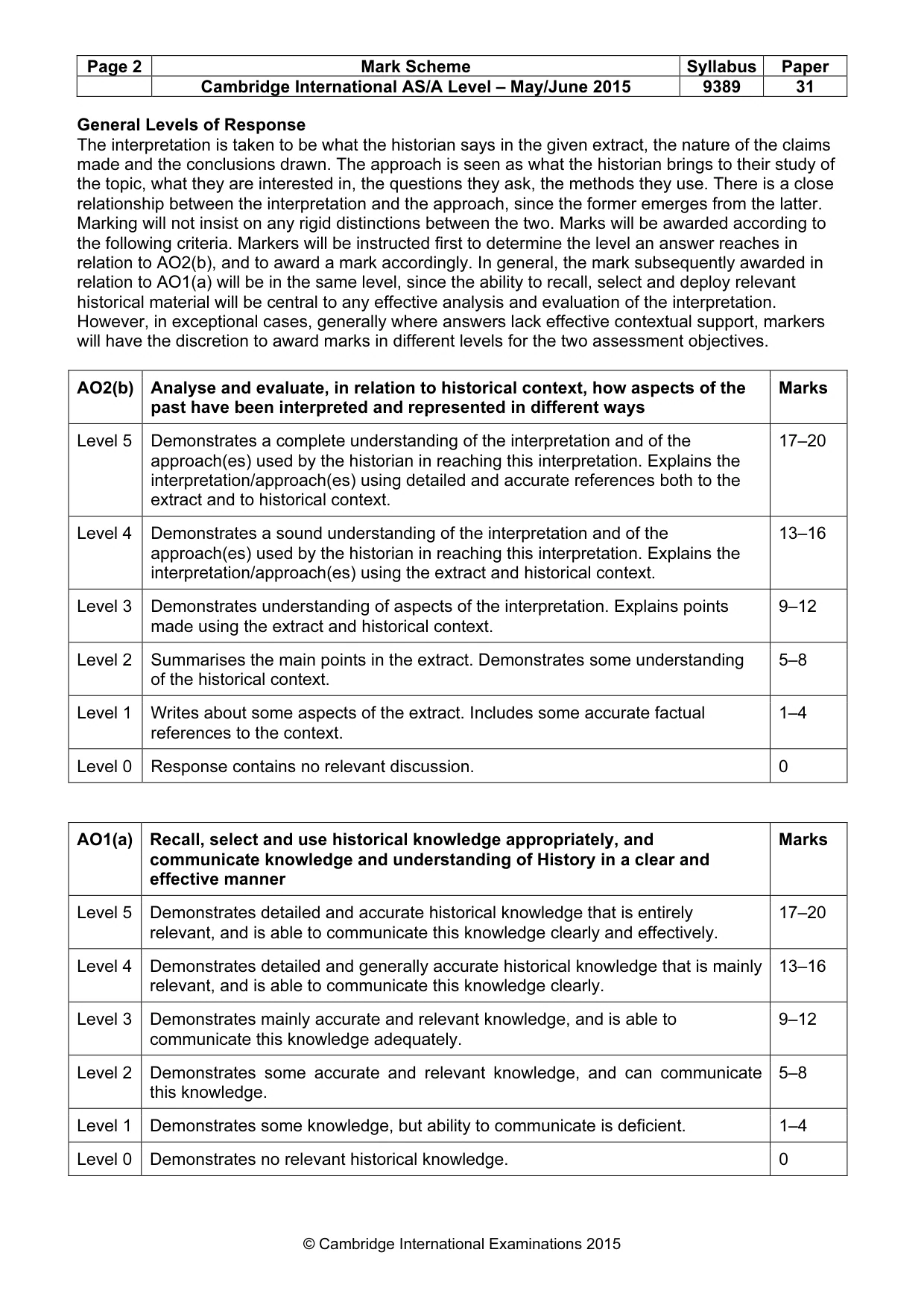
Page 2 Mark Scheme Syllabus Paper Cambridge International AS/A Level – May/June 2015 9389 31 © Cambridge International Examinations 2015 General Levels of Response The interpretation is taken to be what the historian says in the given extract, the nature of the claims made and the conclusions drawn. The approach is seen as what the historian brings to their study of the topic, what they are interested in, the questions they ask, the methods they use. There is a close relationship between the interpretation and the approach, since the former emerges from the latter. Marking will not insist on any rigid distinctions between the two. Marks will be awarded according to the following criteria. Markers will be instructed first to determine the level an answer reaches in relation to AO2(b), and to award a mark accordingly. In general, the mark subsequently awarded in relation to AO1(a) will be in the same level, since the ability to recall, select and deploy relevant historical material will be central to any effective analysis and evaluation of the interpretation. However, in exceptional cases, generally where answers lack effective contextual support, markers will have the discretion to award marks in different levels for the two assessment objectives. AO2(b) Analyse and evaluate, in relation to historical context, how aspects of the past have been interpreted and represented in different ways Marks Level 5 Demonstrates a complete understanding of the interpretation and of the approach(es) used by the historian in reaching this interpretation. Explains the interpretation/approach(es) using detailed and accurate references both to the extract and to historical context. 17–20 Level 4 Demonstrates a sound understanding of the interpretation and of the approach(es) used by the historian in reaching this interpretation. Explains the interpretation/approach(es) using the extract and historical context. 13–16 Level 3 Demonstrates understanding of aspects of the interpretation. Explains points made using the extract and historical context. 9–12 Level 2 Summarises the main points in the extract. Demonstrates some understanding of the historical context. 5–8 Level 1 Writes about some aspects of the extract. Includes some accurate factual references to the context. 1–4 Level 0 Response contains no relevant discussion. 0 AO1(a) Recall, select and use historical knowledge appropriately, and communicate knowledge and understanding of History in a clear and effective manner Marks Level 5 Demonstrates detailed and accurate historical knowledge that is entirely relevant, and is able to communicate this knowledge clearly and effectively. 17–20 Level 4 Demonstrates detailed and generally accurate historical knowledge that is mainly relevant, and is able to communicate this knowledge clearly. 13–16 Level 3 Demonstrates mainly accurate and relevant knowledge, and is able to communicate this knowledge adequately. 9–12 Level 2 Demonstrates some accurate and relevant knowledge, and can communicate this knowledge. 5–8 Level 1 Demonstrates some knowledge, but ability to communicate is deficient. 1–4 Level 0 Demonstrates no relevant historical knowledge. 0
Mark scheme, page 3
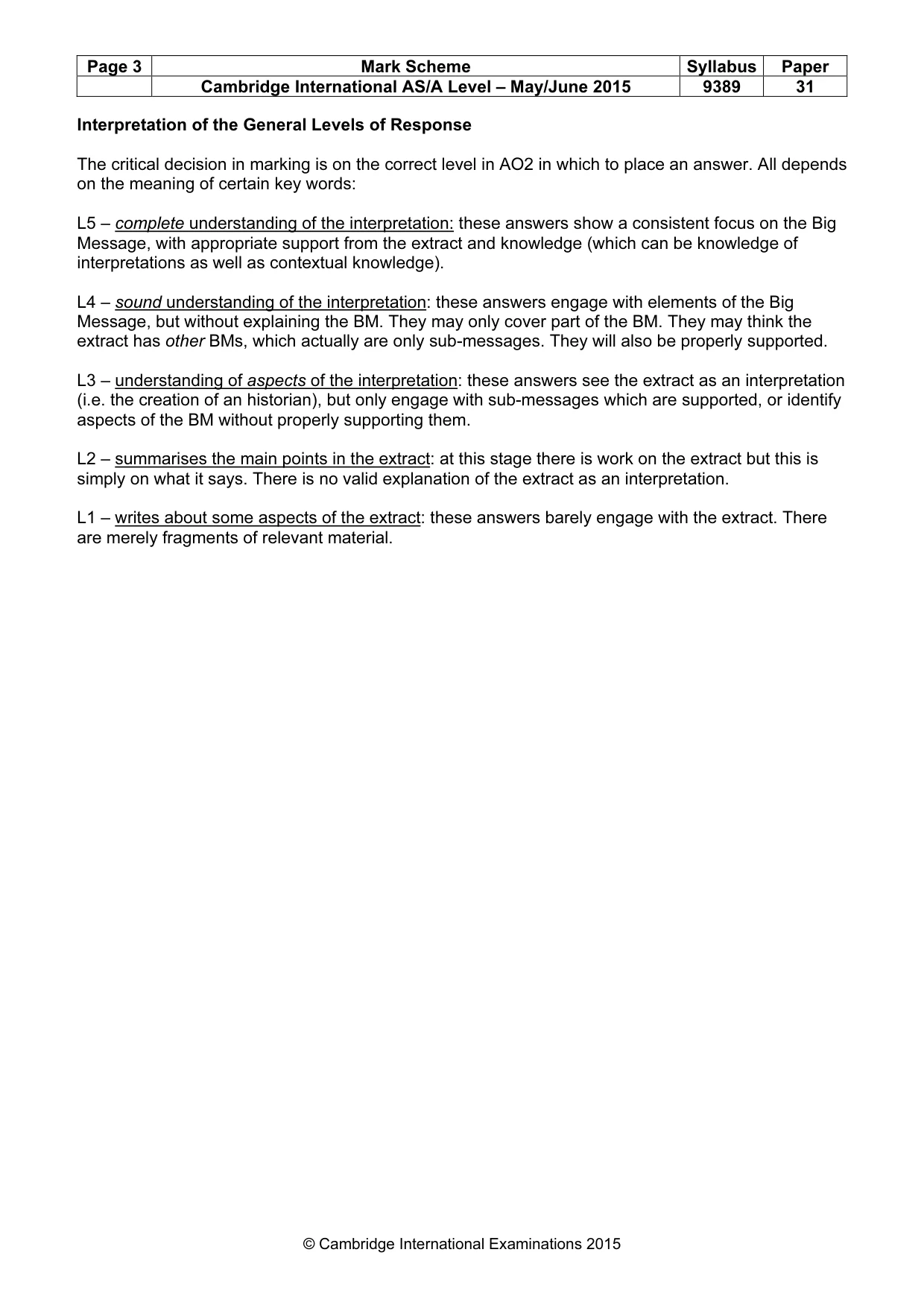
Page 3 Mark Scheme Syllabus Paper Cambridge International AS/A Level – May/June 2015 9389 31 © Cambridge International Examinations 2015 Interpretation of the General Levels of Response The critical decision in marking is on the correct level in AO2 in which to place an answer. All depends on the meaning of certain key words: L5 – complete understanding of the interpretation: these answers show a consistent focus on the Big Message, with appropriate support from the extract and knowledge (which can be knowledge of interpretations as well as contextual knowledge). L4 – sound understanding of the interpretation: these answers engage with elements of the Big Message, but without explaining the BM. They may only cover part of the BM. They may think the extract has other BMs, which actually are only sub-messages. They will also be properly supported. L3 – understanding of aspects of the interpretation: these answers see the extract as an interpretation (i.e. the creation of an historian), but only engage with sub-messages which are supported, or identify aspects of the BM without properly supporting them. L2 – summarises the main points in the extract: at this stage there is work on the extract but this is simply on what it says. There is no valid explanation of the extract as an interpretation. L1 – writes about some aspects of the extract: these answers barely engage with the extract. There are merely fragments of relevant material.
Mark scheme, page 4
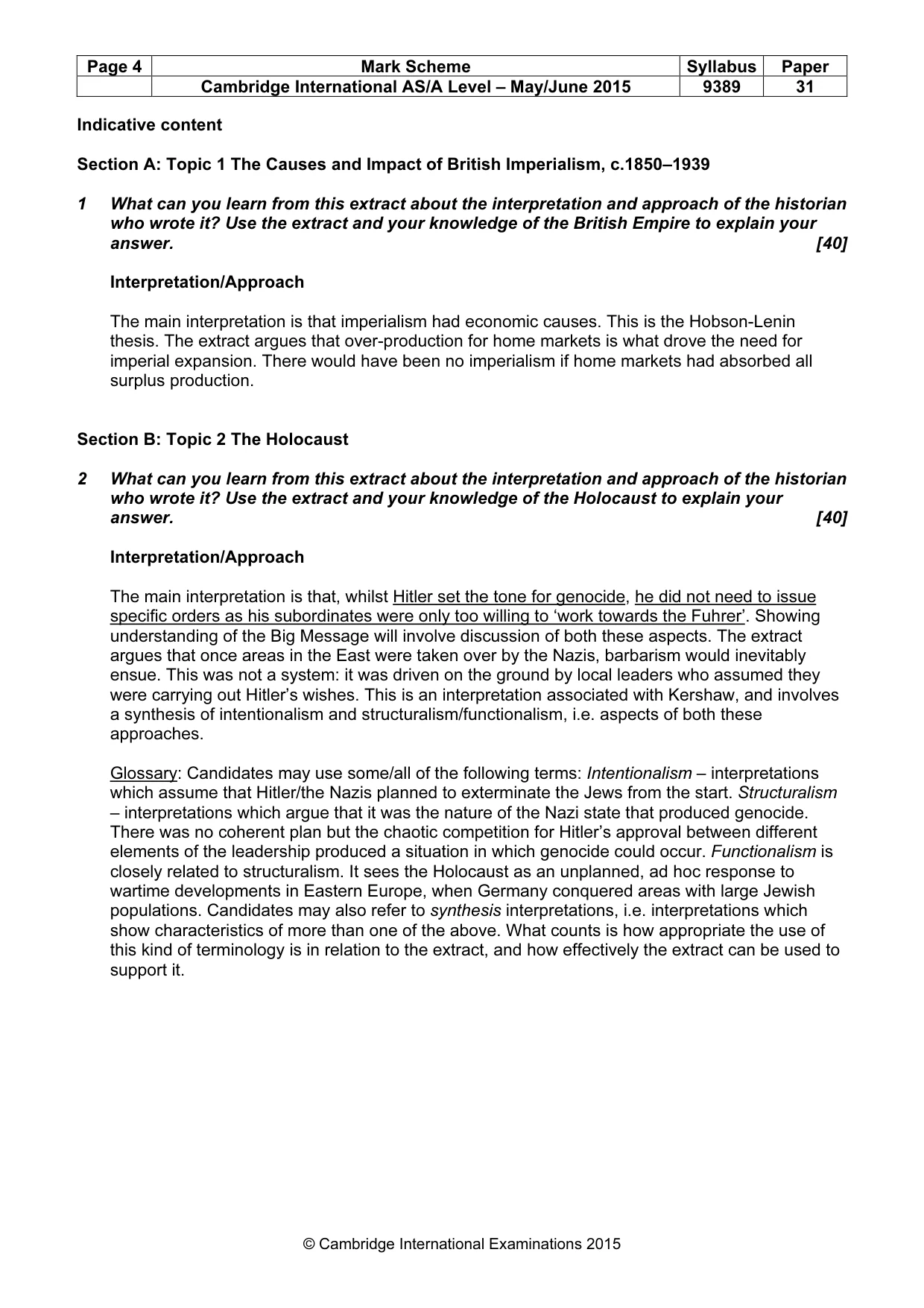
Page 4 Mark Scheme Syllabus Paper Cambridge International AS/A Level – May/June 2015 9389 31 © Cambridge International Examinations 2015 Indicative content Section A: Topic 1 The Causes and Impact of British Imperialism, c.1850–1939 1 What can you learn from this extract about the interpretation and approach of the historian who wrote it? Use the extract and your knowledge of the British Empire to explain your answer. [40] Interpretation/Approach The main interpretation is that imperialism had economic causes. This is the Hobson-Lenin thesis. The extract argues that over-production for home markets is what drove the need for imperial expansion. There would have been no imperialism if home markets had absorbed all surplus production. Section B: Topic 2 The Holocaust 2 What can you learn from this extract about the interpretation and approach of the historian who wrote it? Use the extract and your knowledge of the Holocaust to explain your answer. [40] Interpretation/Approach The main interpretation is that, whilst Hitler set the tone for genocide, he did not need to issue specific orders as his subordinates were only too willing to ‘work towards the Fuhrer’. Showing understanding of the Big Message will involve discussion of both these aspects. The extract argues that once areas in the East were taken over by the Nazis, barbarism would inevitably ensue. This was not a system: it was driven on the ground by local leaders who assumed they were carrying out Hitler’s wishes. This is an interpretation associated with Kershaw, and involves a synthesis of intentionalism and structuralism/functionalism, i.e. aspects of both these approaches. Glossary: Candidates may use some/all of the following terms: Intentionalism – interpretations which assume that Hitler/the Nazis planned to exterminate the Jews from the start. Structuralism – interpretations which argue that it was the nature of the Nazi state that produced genocide. There was no coherent plan but the chaotic competition for Hitler’s approval between different elements of the leadership produced a situation in which genocide could occur. Functionalism is closely related to structuralism. It sees the Holocaust as an unplanned, ad hoc response to wartime developments in Eastern Europe, when Germany conquered areas with large Jewish populations. Candidates may also refer to synthesis interpretations, i.e. interpretations which show characteristics of more than one of the above. What counts is how appropriate the use of this kind of terminology is in relation to the extract, and how effectively the extract can be used to support it.
Mark scheme, page 5
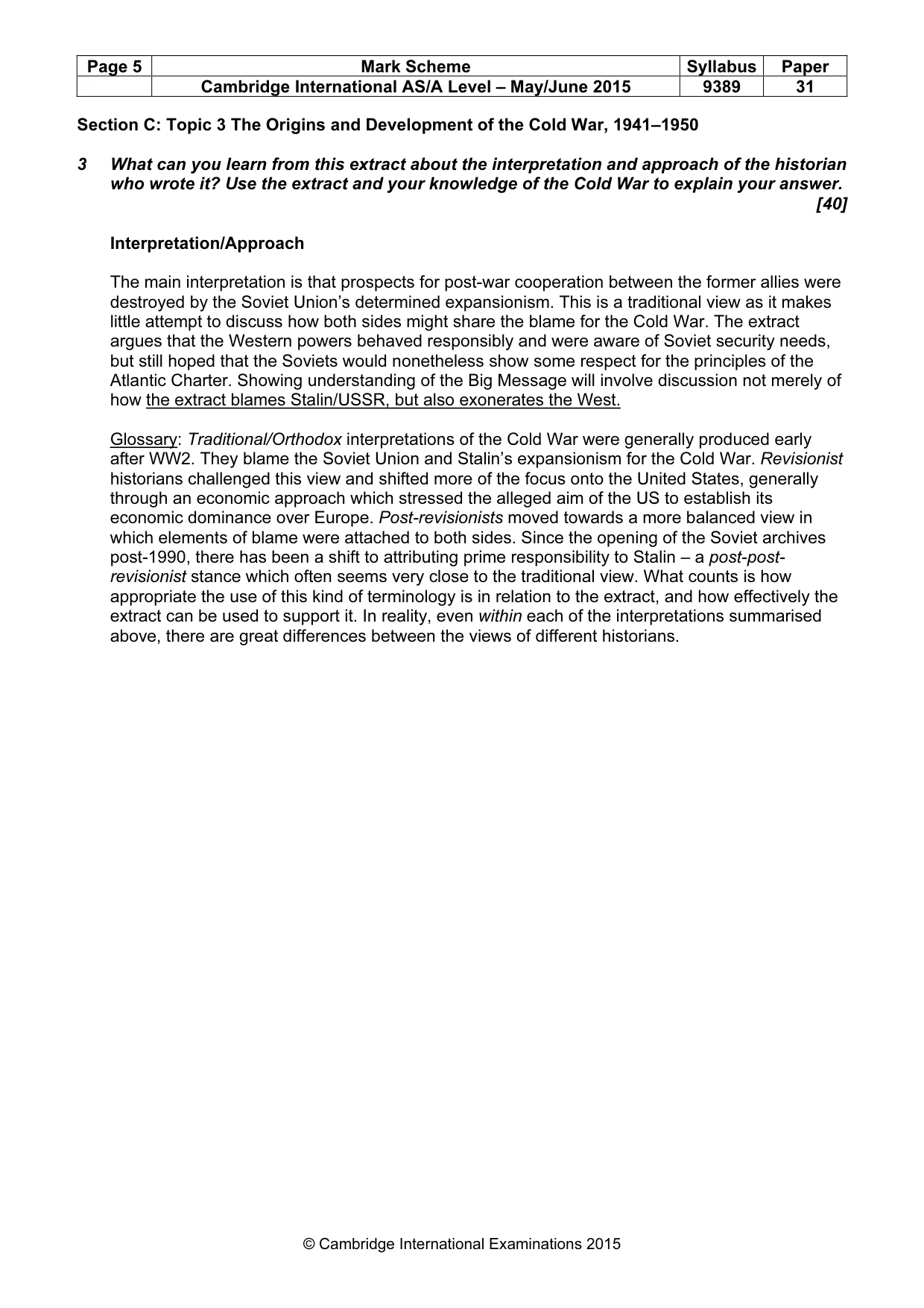
Page 5 Mark Scheme Syllabus Paper Cambridge International AS/A Level – May/June 2015 9389 31 © Cambridge International Examinations 2015 Section C: Topic 3 The Origins and Development of the Cold War, 1941–1950 3 What can you learn from this extract about the interpretation and approach of the historian who wrote it? Use the extract and your knowledge of the Cold War to explain your answer. [40] Interpretation/Approach The main interpretation is that prospects for post-war cooperation between the former allies were destroyed by the Soviet Union’s determined expansionism. This is a traditional view as it makes little attempt to discuss how both sides might share the blame for the Cold War. The extract argues that the Western powers behaved responsibly and were aware of Soviet security needs, but still hoped that the Soviets would nonetheless show some respect for the principles of the Atlantic Charter. Showing understanding of the Big Message will involve discussion not merely of how the extract blames Stalin/USSR, but also exonerates the West. Glossary: Traditional/Orthodox interpretations of the Cold War were generally produced early after WW2. They blame the Soviet Union and Stalin’s expansionism for the Cold War. Revisionist historians challenged this view and shifted more of the focus onto the United States, generally through an economic approach which stressed the alleged aim of the US to establish its economic dominance over Europe. Post-revisionists moved towards a more balanced view in which elements of blame were attached to both sides. Since the opening of the Soviet archives post-1990, there has been a shift to attributing prime responsibility to Stalin – a post-post- revisionist stance which often seems very close to the traditional view. What counts is how appropriate the use of this kind of terminology is in relation to the extract, and how effectively the extract can be used to support it. In reality, even within each of the interpretations summarised above, there are great differences between the views of different historians.
What you needed in this session
Cambridge’s own grade thresholds for 2015 May/June, Paper 3 · Variant 1. A higher threshold means an easier paper — the bar moves with how the cohort did.