Cambridge A Level History 9389 — 2014 May/June Paper 1 · Variant 2
9389/12/M/J/14 · 40 marks · ≈45 min
The question paper and its mark scheme, free to read here and free to download. This is Cambridge’s own paper, exactly as it was sat.
Question paper8 pages

Mark scheme7 pages
Answers below. Sit the paper first if you are practising.
Paper as text
Question paper, page 1
This document consists of 7 printed pages and 1 blank page. DC (NH/SLM) 84011/3 © UCLES 2014 [Turn over * 9 0 1 0 7 0 8 2 6 4 * HISTORY 9389/12 Paper 1 Document Question May/June 2014 1 hour Additional Materials: Answer Booklet/Paper READ THESE INSTRUCTIONS FIRST If you have been given an Answer Booklet, follow the instructions on the front cover of the Booklet. Write your Centre number, candidate number and name on all the work you hand in. Write in dark blue or black pen. Do not use staples, paper clips, glue or correction fluid. DO NOT WRITE IN ANY BARCODES. This paper contains three sections: Section A: European Option Section B: American Option Section C: International Option Answer both parts of the question from one section only. At the end of the examination, fasten all your work securely together. The marks are given in brackets [ ] at the end of each part question. Cambridge International Examinations Cambridge International Advanced Subsidiary Level
Question paper, page 2
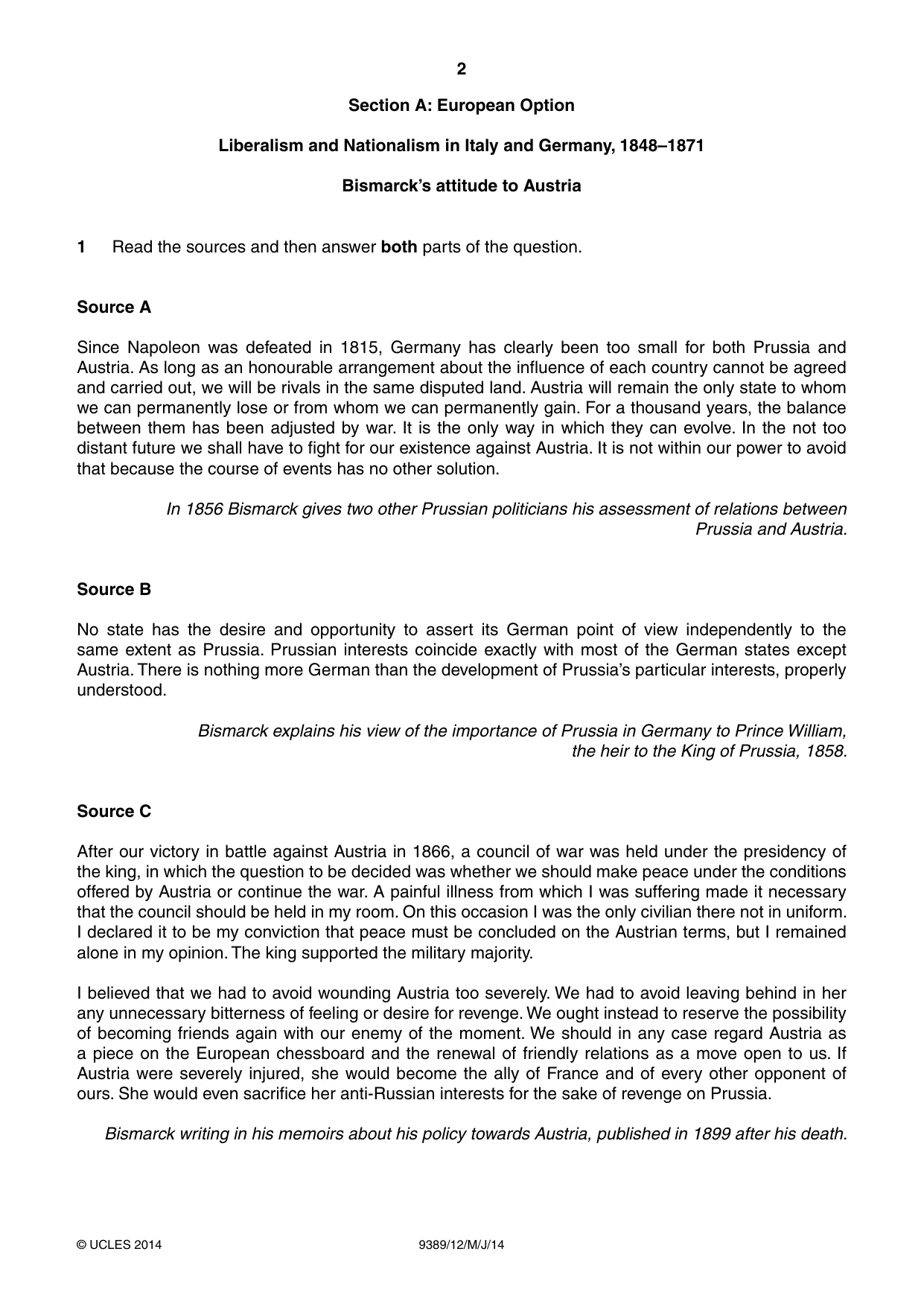
2 9389/12/M/J/14 © UCLES 2014 Section A: European Option Liberalism and Nationalism in Italy and Germany, 1848–1871 Bismarck’s attitude to Austria 1 Read the sources and then answer both parts of the question. Source A Since Napoleon was defeated in 1815, Germany has clearly been too small for both Prussia and Austria. As long as an honourable arrangement about the influence of each country cannot be agreed and carried out, we will be rivals in the same disputed land. Austria will remain the only state to whom we can permanently lose or from whom we can permanently gain. For a thousand years, the balance between them has been adjusted by war. It is the only way in which they can evolve. In the not too distant future we shall have to fight for our existence against Austria. It is not within our power to avoid that because the course of events has no other solution. In 1856 Bismarck gives two other Prussian politicians his assessment of relations between Prussia and Austria. Source B No state has the desire and opportunity to assert its German point of view independently to the same extent as Prussia. Prussian interests coincide exactly with most of the German states except Austria. There is nothing more German than the development of Prussia’s particular interests, properly understood. Bismarck explains his view of the importance of Prussia in Germany to Prince William, the heir to the King of Prussia, 1858. Source C After our victory in battle against Austria in 1866, a council of war was held under the presidency of the king, in which the question to be decided was whether we should make peace under the conditions offered by Austria or continue the war. A painful illness from which I was suffering made it necessary that the council should be held in my room. On this occasion I was the only civilian there not in uniform. I declared it to be my conviction that peace must be concluded on the Austrian terms, but I remained alone in my opinion. The king supported the military majority. I believed that we had to avoid wounding Austria too severely. We had to avoid leaving behind in her any unnecessary bitterness of feeling or desire for revenge. We ought instead to reserve the possibility of becoming friends again with our enemy of the moment. We should in any case regard Austria as a piece on the European chessboard and the renewal of friendly relations as a move open to us. If Austria were severely injured, she would become the ally of France and of every other opponent of ours. She would even sacrifice her anti-Russian interests for the sake of revenge on Prussia. Bismarck writing in his memoirs about his policy towards Austria, published in 1899 after his death.
Question paper, page 3
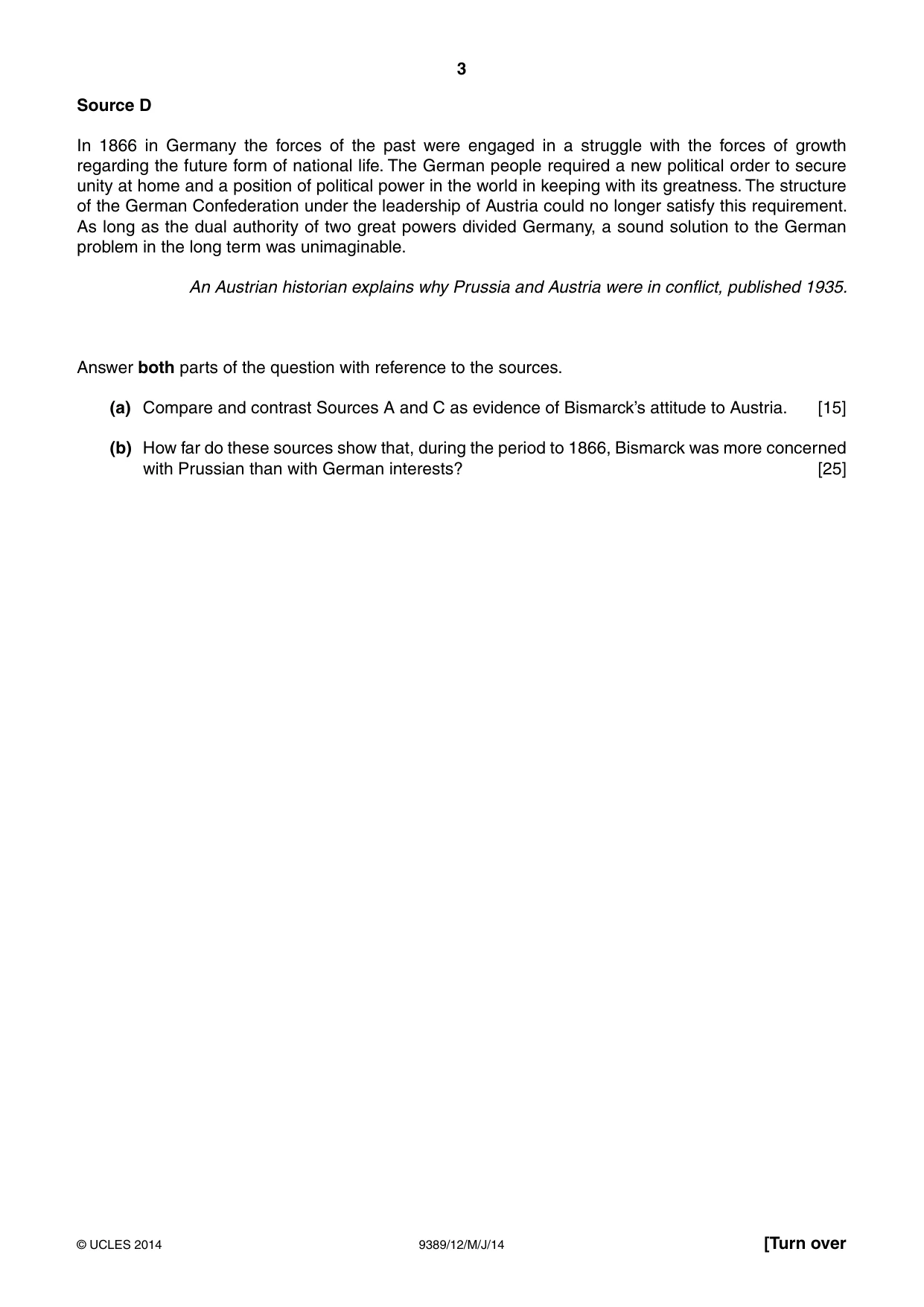
3 9389/12/M/J/14 © UCLES 2014 [Turn over Source D In 1866 in Germany the forces of the past were engaged in a struggle with the forces of growth regarding the future form of national life. The German people required a new political order to secure unity at home and a position of political power in the world in keeping with its greatness. The structure of the German Confederation under the leadership of Austria could no longer satisfy this requirement. As long as the dual authority of two great powers divided Germany, a sound solution to the German problem in the long term was unimaginable. An Austrian historian explains why Prussia and Austria were in conflict, published 1935. Answer both parts of the question with reference to the sources. (a) Compare and contrast Sources A and C as evidence of Bismarck’s attitude to Austria. [15] (b) How far do these sources show that, during the period to 1866, Bismarck was more concerned with Prussian than with German interests? [25]
Question paper, page 4
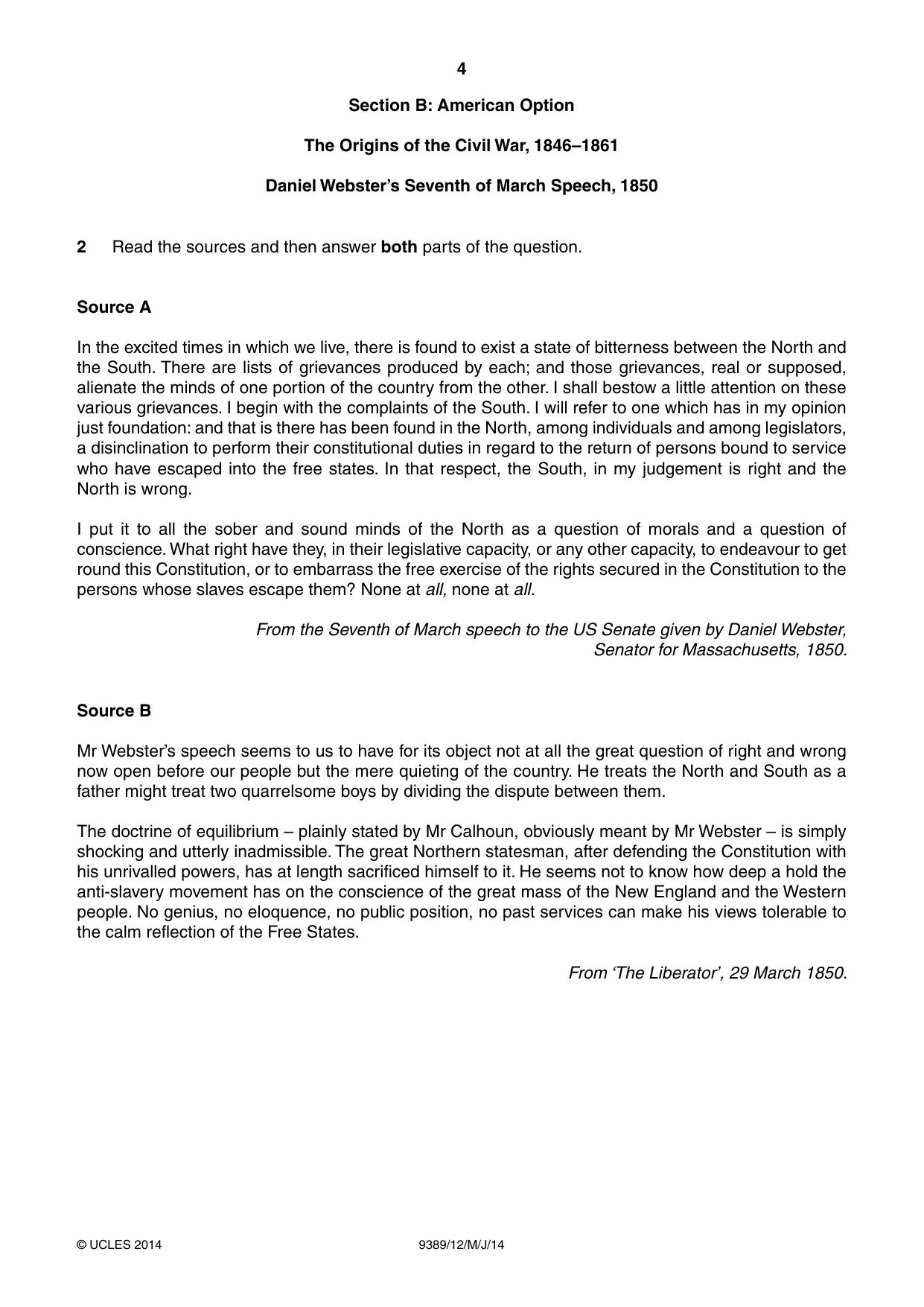
4 9389/12/M/J/14 © UCLES 2014 Section B: American Option The Origins of the Civil War, 1846–1861 Daniel Webster’s Seventh of March Speech, 1850 2 Read the sources and then answer both parts of the question. Source A In the excited times in which we live, there is found to exist a state of bitterness between the North and the South. There are lists of grievances produced by each; and those grievances, real or supposed, alienate the minds of one portion of the country from the other. I shall bestow a little attention on these various grievances. I begin with the complaints of the South. I will refer to one which has in my opinion just foundation: and that is there has been found in the North, among individuals and among legislators, a disinclination to perform their constitutional duties in regard to the return of persons bound to service who have escaped into the free states. In that respect, the South, in my judgement is right and the North is wrong. I put it to all the sober and sound minds of the North as a question of morals and a question of conscience. What right have they, in their legislative capacity, or any other capacity, to endeavour to get round this Constitution, or to embarrass the free exercise of the rights secured in the Constitution to the persons whose slaves escape them? None at all, none at all. From the Seventh of March speech to the US Senate given by Daniel Webster, Senator for Massachusetts, 1850. Source B Mr Webster’s speech seems to us to have for its object not at all the great question of right and wrong now open before our people but the mere quieting of the country. He treats the North and South as a father might treat two quarrelsome boys by dividing the dispute between them. The doctrine of equilibrium – plainly stated by Mr Calhoun, obviously meant by Mr Webster – is simply shocking and utterly inadmissible. The great Northern statesman, after defending the Constitution with his unrivalled powers, has at length sacrificed himself to it. He seems not to know how deep a hold the anti-slavery movement has on the conscience of the great mass of the New England and the Western people. No genius, no eloquence, no public position, no past services can make his views tolerable to the calm reflection of the Free States. From ‘The Liberator’, 29 March 1850.
Question paper, page 5
5 9389/12/M/J/14 © UCLES 2014 [Turn over Source C About eight hundred men, most of them citizens of Boston, have addressed to Daniel Webster a letter expressing their approval of his late, notorious speech in the Senate. The leading signers belong to the class expressively termed the ‘Cottonocracy’, of whom it is said that if they were ever to reach heaven, they would no doubt seek to dam up the waters of the river of life to drive their spinning machines. Webster has been for years not the Representative of Massachusetts but the tool of these ‘cotton lords’, the Trinity of whose worship is the golden eagle, the silver dollar and the copper cent, these three being, according to their faith, ‘one Money, and entitled to the supreme adoration of their stunted souls’. From ‘The Anti-Slavery Bugle’, New Lisbon, Ohio, 20 April 1850. Source D Four years ago tonight, on one of those high critical moments in history when great issues are determined, when the powers of right and wrong are mustered for conflict, Mr Webster most unexpectedly threw his whole weight on the side of slavery and caused by his personal and official authority the passage of the Fugitive Slave Bill. People were expecting a totally different course from Mr Webster. The old fugitive law was fast becoming a dead letter. The new Bill made it operative, required me to hunt slaves. The way in which the country was dragged to consent to this, and the disastrous defection of the men of letters, of some preachers of religion, was the darkest passage in our history. From a lecture on the Fugitive Slave Law read by a prominent abolitionist at the Tabernacle, New York City, 7 March 1854. Answer both parts of the question with reference to the sources. (a) To what extent do Sources B and C agree on the reaction of the North to Daniel Webster’s Seventh of March speech? [15] (b) ‘A disaster for the abolitionists.’ How far do these sources support this assertion about the passage of the Fugitive Slave Act in 1850? [25]
Question paper, page 6
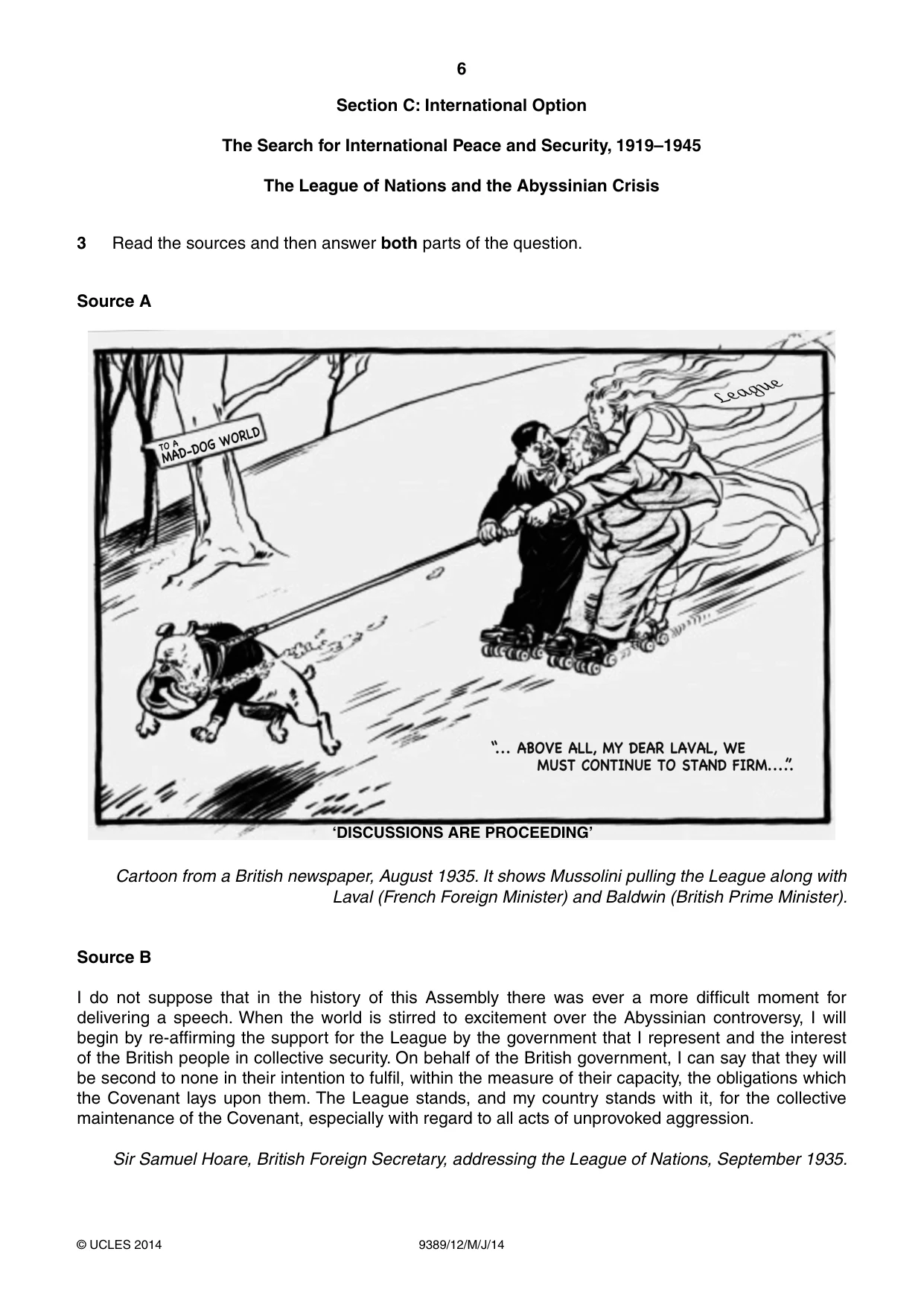
6 9389/12/M/J/14 © UCLES 2014 Section C: International Option The Search for International Peace and Security, 1919–1945 The League of Nations and the Abyssinian Crisis 3 Read the sources and then answer both parts of the question. Source A Cartoon from a British newspaper, August 1935. It shows Mussolini pulling the League along with Laval (French Foreign Minister) and Baldwin (British Prime Minister). Source B I do not suppose that in the history of this Assembly there was ever a more difficult moment for delivering a speech. When the world is stirred to excitement over the Abyssinian controversy, I will begin by re-affirming the support for the League by the government that I represent and the interest of the British people in collective security. On behalf of the British government, I can say that they will be second to none in their intention to fulfil, within the measure of their capacity, the obligations which the Covenant lays upon them. The League stands, and my country stands with it, for the collective maintenance of the Covenant, especially with regard to all acts of unprovoked aggression. Sir Samuel Hoare, British Foreign Secretary, addressing the League of Nations, September 1935. ‘DISCUSSIONS ARE PROCEEDING’
Question paper, page 7
7 9389/12/M/J/14 © UCLES 2014 Source C In October 1935, the League unanimously concluded that Italy had violated the Covenant and was in a state of aggression. I was assured that the resources of the Covenant would be employed so that the aggressor would not triumph. My confidence in the League was absolute. The Great Powers have promised the guarantee of collective security to small states. I thought it to be impossible that fifty-two nations, including the most powerful in the world, should be successfully opposed by a single aggressor. What has become of these promises? The Great Powers considered their undertakings under the Covenant as absolutely of no value. Their connections with Italy forced them to refuse to take any measures whatsoever to stop Italian aggression. Their governments, whilst ever protesting scrupulous attachment to the Covenant, have tirelessly used all their efforts to prevent its observance. As soon as any measure which was likely to be effective was proposed, various pretexts were devised in order to postpone even consideration of the measure. Haile Selassie, Emperor of Abyssinia, addressing the League of Nations, June 1936. Source D I would like to make a few observations upon events of the last twelve months and their effect upon the League of Nations and the policy of collective security to which we have given such whole-hearted support with such disappointing results. The policy of collective security seemed to be an attractive alternative to the old system of alliances and balance of power which was unsuccessful in preventing the greatest war in history. The circumstances in which the dispute between Italy and Abyssinia began appeared to offer a favourable opportunity for the exercise of collective security. Italy’s aggression was blatant and there was hardly any country to which it appeared that a policy of sanctions could be exercised with a greater chance of success than upon Italy. It is no use for us to shut our eyes to realities – collective security has been tried out and it has failed to prevent war, failed to stop war, failed to save the victim of aggression. Surely we must admit that we have tried to impose upon the League a task which it was beyond its powers to fulfil. From a speech by Neville Chamberlain, a senior member of the British government, June 1936. Answer both parts of the question with reference to the sources. (a) Compare and contrast the views expressed in Sources A and B about Britain’s commitment to the Covenant of the League of Nations. [15] (b) How far do Sources A–D support the view that the League of Nations was never fully committed to taking effective measures in response to Italy’s invasion of Abyssinia? [25]
Question paper, page 8
8 9389/12/M/J/14 © UCLES 2014 BLANK PAGE Copyright Acknowledgements: Section C Source A © David Low; Discussions are proceeding; Evening Standard; 29 August 1935; Ref: DL0999; www.cartoons.ac.uk. Permission to reproduce items where third-party owned material protected by copyright is included has been sought and cleared where possible. Every reasonable effort has been made by the publisher (UCLES) to trace copyright holders, but if any items requiring clearance have unwittingly been included, the publisher will be pleased to make amends at the earliest possible opportunity. Cambridge International Examinations is part of the Cambridge Assessment Group. Cambridge Assessment is the brand name of University of Cambridge Local Examinations Syndicate (UCLES), which is itself a department of the University of Cambridge.
Mark scheme, page 1
CAMBRIDGE INTERNATIONAL EXAMINATIONS GCE Advanced Subsidiary Level and GCE Advanced Level MARK SCHEME for the May/June 2014 series 9389 HISTORY 9389/12 Paper 1 (Document Question 12), maximum raw mark 40 This mark scheme is published as an aid to teachers and candidates, to indicate the requirements of the examination. It shows the basis on which Examiners were instructed to award marks. It does not indicate the details of the discussions that took place at an Examiners’ meeting before marking began, which would have considered the acceptability of alternative answers. Mark schemes should be read in conjunction with the question paper and the Principal Examiner Report for Teachers. Cambridge will not enter into discussions about these mark schemes. Cambridge is publishing the mark schemes for the May/June 2014 series for most IGCSE, GCE Advanced Level and Advanced Subsidiary Level components and some Ordinary Level components.
Mark scheme, page 2
Page 2 Mark Scheme Syllabus Paper GCE AS/A LEVEL – May/June 2014 9389 12 © Cambridge International Examinations 2014 Generic levels of response Part (a) Level 4: Makes a developed comparison [12–15] Makes a developed comparison between the two sources, recognising points of similarity and difference. Uses knowledge to evaluate the sources and shows good contextual awareness. Level 3: Compares views and identifies similarities and differences [8–11] Compares the views expressed in the sources, identifying differences and similarities. Begins to explain and evaluate the views using the sources and knowledge. Level 2: Compares views and identifies similarities and/or differences [4–7] Identifies relevant similarities or differences between views/sources and the response may be one- sided with only one aspect explained. Alternatively, both similarities and differences may be mentioned but both aspects lack development. Level 1: Describes content of each source [1–3] Describes or paraphrases the content of the two sources. Very simple comparisons may be made (e.g. one is from a letter and the other is from a speech) but these are not developed. Level 0: No relevant comment on the sources or the issue. [0] Part (b) Level 5 Evaluates the sources to reach a sustained judgement [21–25] Answers are well-focused, demonstrating a clear understanding of the sources and the question. Reaches a sustained judgement about the extent to which the sources support the statement and weighs the evidence in order to do this. Level 4: Evaluates the sources [16–20] Demonstrates a clear understanding of the sources and the question. Begins to evaluate the material in context, considering the nature, origin and purpose of the sources in relation to the statement. At the top of this level candidates may begin to reach a judgement but this is not sustained. Level 3: Uses the sources to support and challenge the statement [11–15] Makes valid points from the sources to both challenge and support the statement in the question. These comments may be derived from source content or may be about the provenance/nature of the sources. Level 2: Uses the sources to support or challenge the statement [6–10] Makes valid points from the sources to either support the statement in the question or to challenge it. These comments may be derived from source content or may be about the provenance/nature of the sources. Level 1: Does not make valid use of the sources [1–5] Describes the content of the sources with little attempt to link the material to the question. Alternatively, candidates may write an essay about the question without reference to the sources. Level 0: No relevant comment on the sources or the issue. [0]
Mark scheme, page 3
Page 3 Mark Scheme Syllabus Paper GCE AS/A LEVEL – May/June 2014 9389 12 © Cambridge International Examinations 2014 Section A: European Option Liberalism and Nationalism in Italy and Germany, 1848–1871 Bismarck’s attitude to Austria (a) Compare and contrast Sources A and C as evidence of Bismarck’s attitude to Austria. [15] The sources have a common provenance but can be compared because they come from different periods of Bismarck’s career. Source A was written before he came to power and offers a long-term view of relations between Prussia and Austria. War is certain, Bismarck believes, and probably sooner rather than later. It is a matter of Prussian survival. Source C shows Bismarck on the defensive in Prussia although having just inflicted a major defeat on Austria. His priority is to avoid making an enemy of an embittered Austria. Like Source A, it shows Bismarck taking a wide view of politics. In both, Bismarck still regards Austria as an enemy. Candidates should question the reliability of the two sources. Bismarck’s memoirs are likely to be very unreliable as Bismarck used them to justify his actions and decisions when in power. The story of the meeting of the war cabinet in 1866 seems to prove that point. Source A should be more reliable as it is taken from a record of what was presumably a private discussion which took place before he held government office, (b) How far do these sources show that, during the period to 1866, Bismarck was more concerned with Prussian than with German interests? [25] Context: The politics of German unification in the mid-nineteenth century were extremely complex. In 1815, the great powers had established the German Confederation, consisting of 39 states dominated by the Habsburg Empire [Austria] to ensure revolutionary forces of liberalism and nationalism were contained and controlled. Prussia was a junior partner of Austria and almost as conservative. In 1833–4 Prussia established the Zollverein, a customs union, from which Austria was excluded. Economic factors caused Prussia to become a greater force within Germany; some Prussians found Austrian predominance increasingly irksome. Bismarck was a conservative Prussian diplomat and politician. In 1862 he was appointed Minister-President [PM] of Prussia to break a constitutional deadlock with the liberals in the Prussian parliament. A controversial appointment, he soon proved to have the political skills to lead Prussia into a war with Austria in 1866 which replaced the 1815 Confederation with the North German Confederation, dominated by Prussia. Four years later, Prussia fought France to create the union of north and south Germany into the German Empire. Austria remained excluded from this empire. Analysis / Evaluation: Sources A, B and C are from Bismarck himself. Source C makes no explicit reference to Germany; Bismarck concentrates on Austro-Prussian relations. Source A makes one reference to Germany but only to place Austro-Prussian relations in context. D agrees with Source A inasmuch as they both accept that relations between the two states were a matter of importance for Germany. This is supported by Source B. However, Source C refers to the situation in 1866. Bismarck was concerned that Prussia should not be isolated and seems concerned about the weakness of Prussia in spite of his victory over Austria. He was anxious to accept the implications of a more extreme peace being forced on Austria because it would have European implications for Prussia. Sources A, B and C are from Bismarck but need candidates to consider how far he was consistent. Source D returns to the theme of Germany. The author is a modern historian who sees events in a wider context than Prussia and Austria. The most successful answers can be expected to be consistently analytical in approach with coherent, focused, sustained and balanced arguments, fully supported by appropriate factual material. But candidates should note that the relevant period is to 1866.
Mark scheme, page 4
Page 4 Mark Scheme Syllabus Paper GCE AS/A LEVEL – May/June 2014 9389 12 © Cambridge International Examinations 2014 Section B: American Option The Origins of the Civil War, 1846–1861 Daniel Webster’s Seventh of March Speech 1850 Indicative Content (a) To what extent do Sources B and C agree on the reaction of the North to Daniel Webster’s Seventh of March speech? [15] Source B is very critical of Webster’s speech. It argues that Webster was aiming to keep the USA quiet and in a state of equilibrium rather than addressing a great political problem, namely the issue of slavery. The Liberator sees Webster as a father resolving a quarrel between two sons by making concessions to each rather than deciding who was right, who was wrong. Source B also suggests that Webster is badly out of touch with Northern public opinion. Source C focuses on part of that public. It identifies a group which approves Webster’s speech. It is a Northern group but an elitist group which it dubs the ‘Cottonocracy’, Boston traders who have grown rich by organising the cotton trade between the South and the UK. They support the speech because Webster recognises the arguments of the South over the Fugitive Slaves issue. Thus while B reacts to the speech itself, Source C considers the reaction of one small Northern group which supports the speech. (b) ‘A disaster for the abolitionists.’ How far do these sources support this assertion about the passage of the Fugitive Slave Act in 1850? [25] Context: Daniel Webster was a leading Whig politician from the Northern state of Massachusetts who had played a major part in US politics since the 1820s. By 1850, towards the end of his life, he was anxious to ensure that the related issues of territorial expansion and slavery did not threaten the unity of the USA. By 1850, however, the issue of expansion had become more complex following the war with Mexico in 1846–48. Huge areas of frontier territory had to be absorbed, initially as territories, eventually as states. Were these states to be slave or free? The answers had huge consequences for the future of the USA. Webster’s Seventh of March speech was a major attempt to help resolve the issue. He tried to put US interests before those of his section by offering concessions to the South. His speech helped pass a new Fugitive Slave Act, which was seen as benefitting the South. This speech shocked people in the North who had supported his leadership over many years. Analysis: Source A is an extract from Webster’s speech in which he criticises those in the North who had failed to uphold the Fugitive Slave law of 1793. Webster is blunt in his criticisms. He also says the matter is one of morals and conscience. This antagonised those Northerners who saw the very existence of slavery in the South, let alone its expansion to new states and territories, as a matter of conscience. This point is made by Source B, a Northern newspaper, which argues that, when it comes to the issue of slavery, there can be no balance, no compromise between North and South. Source C, a second Northern newspaper, if from what was then known as the West, shows that some in the North, in Webster’s state, did approve of Webster’s speech and thus, by implication, his position on the Fugitive Slave law. Source C, however, heaps criticism on these supporters, arguing that they do so only from narrow self-interest. Source D is an abolitionist’s reflection on the passage of the Fugitive Slave Act of 1850 made four years later. The author certainly sees the act as disastrous, if for the USA rather than just for abolitionists. Evaluation: Three of the four sources are abolitionist. Each has a slightly different focus. Source B analyses the speech and how out of touch with Northern opinion it shows Webster
Mark scheme, page 5
Page 5 Mark Scheme Syllabus Paper GCE AS/A LEVEL – May/June 2014 9389 12 © Cambridge International Examinations 2014 to be. Source C concentrates on a small group of wealthy Northerners who support Webster’s arguments. Source D reflects on how Webster’s speech ensured the passage of a bill on the topic of fugitive slaves which until then was becoming less significant with time. They can be used to support each other by means of cross-referencing. Conversely, they can all be criticised because they are abolitionist. Both approaches are valid. Contextual knowledge needs to be used to evaluate the arguments which Webster puts forward in Source A. Northerners were reluctant to return fugitive slaves to the South, Webster was right. Uncle Tom’s Cabin, published two years later, though fiction, was based on many such examples. By not returning these fugitives, Northerners were breaking US law and thus failing in their duties as US citizens to obey the law. The Fugitive Slave act of 1850, part of a complex compromise between North and South and passed by Congress, was a legitimate attempt to address the problem. The problem was Northern abolitionists did not see the new law as legitimate and were prepared to resist it. At the same time, Southerners expected the new law to be more rigorously upheld than the old. And the new act was tougher than the old, which further antagonised Northern abolitionists. The number of fugitive slaves dealt with under the Act appears to have been relatively small. More importantly, radicals on both sides of the argument argued more passionately, spoke in more dramatic terms for and against the act. In terms of the law, the Fugitive Slave Act of 1850 was a disaster for the abolitionists. In political terms, however, it was almost the complete opposite as it revived their campaign against slavery.
Mark scheme, page 6
Page 6 Mark Scheme Syllabus Paper GCE AS/A LEVEL – May/June 2014 9389 12 © Cambridge International Examinations 2014 Section C: International Option The Search for International Peace and Security, 1919–1945 The League of Nations and the Abyssinian Crisis (a) Compare and contrast the views expressed in Sources A and B about Britain’s commitment to the Covenant of the League of Nations. [15] Source A is sarcastic regarding Britain’s commitment to the Covenant of the League of Nations. While claiming that Britain will stand firm against Italian aggression, and encouraging France to do likewise, the British Prime Minister is depicted as doing anything but. Mussolini, depicted as a mad dog, is seen to be taking Britain for a ride along with France and the League of Nations. In a speech delivered during the League’s discussions on what action to take in response to Italy’s invasion of Abyssinia, Hoare (Source B) argues that Britain stands firmly behind its commitments under the Covenant of the League of Nations. He further claims that Britain will support the League in any collective security measures which it decides to take against Italy. He does, however, say that the British government will support the League ‘within the measure of their capacity’, suggesting that there could be a limit to the amount of support Britain might give. The cartoon is based on the opinions of the artist and the newspaper in which it was published, but is also likely to reflect public opinion in Britain. Source B, dated a month after the publication of the cartoon, seems to disagree with the views expressed in Source A. However, given the time and place of his speech, it is inevitable that Hoare would stress Britain’s support for the League. He would not mention other factors (such as Britain’s desire to maintain good relationships with Italy) which might have conditioned British foreign policy. The speech is generalised and does not commit Britain to anything. It could be argued that this is another example of Britain ‘talking tough’ but doing nothing. (b) How far do Sources A – D support the view that the League of Nations was never fully committed to taking effective measures in response to Italy’s invasion of Abyssinia? [25] Context: The first clash between Italian and Abyssinian troops came in December 1934 at a place called Walwal on the Somali-Abyssinian border. Thus Italy was being aggressive towards Abyssinia some ten months before it invaded the country. Abyssinia asked the League to arbitrate on the clash but the longer the league dithered, the more Mussolini was persuaded that it was time to take military action. As the situation in Africa deteriorated in the spring of 1935, Britain, France and Italy signed the Stresa Front. This was aimed at Germany, especially following the attempt at Anschluss the previous year. At the same time the situation in Abyssinia continued to deteriorate. In October 1935, Italy invaded Abyssinia. In November the League imposed limited sanctions, on arms sales finance and some goods. They hit Abyssinia harder than they did Italy. Oil was not on the list though the UK made some attempts to extend sanctions. However, the UK refused to close the Suez Canal to Italian ships. A month later, in December 1935, the British and French government drew up plans to divide Abyssinia between Abyssinia and Italy. These plans became known as the Hoare-Laval Pact. Before they were accepted by Italy, the plans were published in the French press. The public response to the Pact was so hostile, especially in Britain, that the Pact had to be abandoned and Hoare had to resign. Some in Britain blamed the French government for leaking the terms of the Pact. By May 1936 Italian troops had entered Addis Ababa. In July 1936 the League withdrew sanctions on Italy. In December 1937 Italy left the League.
Mark scheme, page 7
Page 7 Mark Scheme Syllabus Paper GCE AS/A LEVEL – May/June 2014 9389 12 © Cambridge International Examinations 2014 Analysis: The main support for the hypothesis comes from Sources A and C. Source A implies that British reaction to the Italian invasion of Abyssinia was hypocritical – claiming to ‘stand firm’ against Italy yet effectively doing nothing and being controlled by Mussolini. The League of Nations, powerless to act without the support of Britain and France, is shown as being dragged along on the backs of senior British and French politicians. Source C accuses Britain (and France) of much the same thing: making promises to support the League while, at the same time, protecting their own national interests by undermining the League’s ability to initiate effective measures. Source B challenges the hypothesis, since it argues that Britain is fully committed to supporting the League and upholding its responsibilities under the Covenant. Similarly, Chamberlain (Source D) claims that Britain had given ‘whole-hearted’ support to the policy of collective security. He continues that ‘collective security has been tried out and it has failed’ – this implies that blame for the failure of the League to take effective action against Italy rests not with Britain’s or the League’s lack of commitment, but with a Covenant which ‘was beyond its powers to fulfil’. Evaluation: Source A, the cartoon, was published in August 1935, before the League discussed what actions to take in response to the crisis surrounding Abyssinia. In many ways it makes an accurate prediction about how the British government would react: claiming to stand firm against Mussolini (as suggested in Source B) while doing nothing to support Abyssinia (as suggested in Source C). Source B is a speech made during the League’s deliberations about what actions to take against Italy’s moves against Abyssinia. There was much anger regarding Mussolini’s actions and it was essential that the British Foreign Secretary was seen to be supporting the League. Anything else would have undermined the League’s credibility. It is possible that Britain wanted to support the League in taking effective measures against Italy and that it was only after French refusal to take action that Britain also backed down. Source B, however, implies that this is not the case and that Britain’s own national self-interest would have made it impossible to take measures against Italy. Hoare’s statement that the British government would support the League ‘within the measure of their capacity’ implies that there was a limit to the action which Britain would be willing or able to support. Source C is an angry and emotional speech by an Emperor who feels that the League has let down his country, leaving it unprotected against Italian aggression. He blames the Great Powers (Britain and France) for failing to support the League in taking effective measures against Italy. Contextual knowledge confirms his views. Source D is a speech by a senior British politician which seeks to explain why the League failed to take more effective measures against Italy. In particular, it aims to justify Britain’s role. Collective security failed despite the fact that Britain had given ‘such whole-hearted support to it’. In fact, Britain had not supported effective action and refused to impose meaningful sanctions. Chamberlain is wrong to claim that ‘collective security has been tried out and it has failed’.
What you needed in this session
Cambridge’s own grade thresholds for 2014 May/June, Paper 1 · Variant 2. A higher threshold means an easier paper — the bar moves with how the cohort did.